EP0867504B2 - Oxidation-stable alpha-amylase - Google Patents
Oxidation-stable alpha-amylase Download PDFInfo
- Publication number
- EP0867504B2 EP0867504B2 EP98109967A EP98109967A EP0867504B2 EP 0867504 B2 EP0867504 B2 EP 0867504B2 EP 98109967 A EP98109967 A EP 98109967A EP 98109967 A EP98109967 A EP 98109967A EP 0867504 B2 EP0867504 B2 EP 0867504B2
- Authority
- EP
- European Patent Office
- Prior art keywords
- amylase
- alpha
- dna sequence
- precursor
- seq
- Prior art date
- Legal status (The legal status is an assumption and is not a legal conclusion. Google has not performed a legal analysis and makes no representation as to the accuracy of the status listed.)
- Expired - Lifetime
Links
Images


Classifications
-
- C—CHEMISTRY; METALLURGY
- C12—BIOCHEMISTRY; BEER; SPIRITS; WINE; VINEGAR; MICROBIOLOGY; ENZYMOLOGY; MUTATION OR GENETIC ENGINEERING
- C12N—MICROORGANISMS OR ENZYMES; COMPOSITIONS THEREOF; PROPAGATING, PRESERVING, OR MAINTAINING MICROORGANISMS; MUTATION OR GENETIC ENGINEERING; CULTURE MEDIA
- C12N9/00—Enzymes; Proenzymes; Compositions thereof; Processes for preparing, activating, inhibiting, separating or purifying enzymes
- C12N9/14—Hydrolases (3)
- C12N9/24—Hydrolases (3) acting on glycosyl compounds (3.2)
- C12N9/2402—Hydrolases (3) acting on glycosyl compounds (3.2) hydrolysing O- and S- glycosyl compounds (3.2.1)
- C12N9/2405—Glucanases
- C12N9/2408—Glucanases acting on alpha -1,4-glucosidic bonds
- C12N9/2411—Amylases
- C12N9/2414—Alpha-amylase (3.2.1.1.)
- C12N9/2417—Alpha-amylase (3.2.1.1.) from microbiological source
-
- C—CHEMISTRY; METALLURGY
- C11—ANIMAL OR VEGETABLE OILS, FATS, FATTY SUBSTANCES OR WAXES; FATTY ACIDS THEREFROM; DETERGENTS; CANDLES
- C11D—DETERGENT COMPOSITIONS; USE OF SINGLE SUBSTANCES AS DETERGENTS; SOAP OR SOAP-MAKING; RESIN SOAPS; RECOVERY OF GLYCEROL
- C11D3/00—Other compounding ingredients of detergent compositions covered in group C11D1/00
- C11D3/16—Organic compounds
- C11D3/38—Products with no well-defined composition, e.g. natural products
- C11D3/386—Preparations containing enzymes, e.g. protease or amylase
-
- C—CHEMISTRY; METALLURGY
- C12—BIOCHEMISTRY; BEER; SPIRITS; WINE; VINEGAR; MICROBIOLOGY; ENZYMOLOGY; MUTATION OR GENETIC ENGINEERING
- C12N—MICROORGANISMS OR ENZYMES; COMPOSITIONS THEREOF; PROPAGATING, PRESERVING, OR MAINTAINING MICROORGANISMS; MUTATION OR GENETIC ENGINEERING; CULTURE MEDIA
- C12N15/00—Mutation or genetic engineering; DNA or RNA concerning genetic engineering, vectors, e.g. plasmids, or their isolation, preparation or purification; Use of hosts therefor
- C12N15/09—Recombinant DNA-technology
- C12N15/11—DNA or RNA fragments; Modified forms thereof; Non-coding nucleic acids having a biological activity
- C12N15/52—Genes encoding for enzymes or proenzymes
-
- C—CHEMISTRY; METALLURGY
- C12—BIOCHEMISTRY; BEER; SPIRITS; WINE; VINEGAR; MICROBIOLOGY; ENZYMOLOGY; MUTATION OR GENETIC ENGINEERING
- C12N—MICROORGANISMS OR ENZYMES; COMPOSITIONS THEREOF; PROPAGATING, PRESERVING, OR MAINTAINING MICROORGANISMS; MUTATION OR GENETIC ENGINEERING; CULTURE MEDIA
- C12N15/00—Mutation or genetic engineering; DNA or RNA concerning genetic engineering, vectors, e.g. plasmids, or their isolation, preparation or purification; Use of hosts therefor
- C12N15/09—Recombinant DNA-technology
- C12N15/63—Introduction of foreign genetic material using vectors; Vectors; Use of hosts therefor; Regulation of expression
- C12N15/74—Vectors or expression systems specially adapted for prokaryotic hosts other than E. coli, e.g. Lactobacillus, Micromonospora
- C12N15/75—Vectors or expression systems specially adapted for prokaryotic hosts other than E. coli, e.g. Lactobacillus, Micromonospora for Bacillus
-
- C—CHEMISTRY; METALLURGY
- C12—BIOCHEMISTRY; BEER; SPIRITS; WINE; VINEGAR; MICROBIOLOGY; ENZYMOLOGY; MUTATION OR GENETIC ENGINEERING
- C12P—FERMENTATION OR ENZYME-USING PROCESSES TO SYNTHESISE A DESIRED CHEMICAL COMPOUND OR COMPOSITION OR TO SEPARATE OPTICAL ISOMERS FROM A RACEMIC MIXTURE
- C12P19/00—Preparation of compounds containing saccharide radicals
- C12P19/14—Preparation of compounds containing saccharide radicals produced by the action of a carbohydrase (EC 3.2.x), e.g. by alpha-amylase, e.g. by cellulase, hemicellulase
Definitions
- the present invention relates to novel alpha-amylase mutants having an amino acid sequence not found in nature, such mutants having an amino acid sequence wherein one or more amino acid residue(s) of a precursor alpha-amylase, specifically an oxidizable amino acid, have been substituted with a different amino acid.
- the mutant enzymes of the present invention exhibit altered stability/activity profiles including but not limited to altered oxidative stability, altered pH performance profile, altered specific activity and/or altered thermostability.
- the invention provides Bacillus alpha-amylases having a substitution of an amino acid at a position equivalent to M + 15 in Bacillus licheniformis alpha-amylase and provides uses of these alpha-amylases
- Alpha-amylases (alpha-1,4-glucan-4-glucanohydrolase, EC3.2.1.1) hydrolyze internal alpha-1,4-glucosidic linkages in starch largely at random, to produce smaller molecular weight malto-dextrins.
- Alpha-amylases are of considerable commercial value, being used in the initial stages (liquefaction) of starch processing; in alcohol production; as cleaning agents in detergent matrices; and in the textile industry for starch desizing.
- Alpha-amylases are produced by a wide variety of microorganisms including Bacillus and Aspergillus , with most commercial amylases being produced from bacterial sources such as B. licheniformis, B. amyloliquefaciens, B. subtilis , or B. strearothermophilus .
- the preferred enzymes in commercial use have been those from B. licheniformis because of their neat stability and performance, at least at neutral and mildly alkaline pH's.
- alpha-amylase is inactivated by hydrogen peroxide and other oxidants at pH's between 4 and 10.5 as described in the examples herein.
- alpha-amylase enzymes can be used under dramatically different conditions such as both high and low pH conditions, depending on the commercial application.
- alpha-amylases may be used in the liquefaction of starch, a process preferably performed at a low pH (pH ⁇ 5.5).
- amylases may be used in commercial dish care or laundry detergents, which often contain oxidants such as bleach or peracids, and which are used in much more alkaline conditions.
- amylase enzymes In order to alter the stability or activity profile of amylase enzymes under varying conditions, it has been found that selective replacement, substitution or deletion of oxidizable amino acids, such as methionine, tryptophan, tyrosine, histidine or cysteine, results in an altered profile of the variant enzyme as compared to its precursor. Because currently commercially available amylases are not acceptable (stable) under various conditions, there is a need for an amylase having an altered stability and/or activity profile. This altered stability (oxidative, thermal or pH performance profile) can be achieved while maintaining adequate enzymatic activity, as compared to the wild-type or precursor enzyme. The characteristic affected by introducing such mutations may be a change in oxidative stability while maintaining thermal stability or vice versa .
- the substitution of different amino acids for an oxidizable amino acid(s) in the alpha-amylase precursor sequence or the deletion of one or more oxidizable amino acid(s) may result in altered enzymatic activity at a pH other than that which is considered optimal for the precursor alpha-amylase.
- the mutant enzymes of the present invention may also have altered pH performance profiles, which may be due to the enhanced oxidative stability of the enzyme.
- the present invention relates to novel alpha-armylase mutants that are the expression product of a mutated DNA sequence encoding an alpha-amylase, the mutated DNA sequence being derived from a precursor alpha-amylase by the substitution (replacement) of one or more oxidizable amino acid.
- Such mutant alpha-amylases are obtained by in vitro modification of a precursor DNA sequence encoding a naturally occurring or recombinant alpha-amylase to encode the substitution of one or more amino acid residues in a precursor amino acid sequence.
- substitution or deletion of one or more amino acids in the amino acid sequence is due to the replacement or deletion of one or more methionine and/or tryptophan, residues in such sequence.
- These oxidizable amino acid residues may be replaced by any of the other 20 naturally occurring amino acids.
- the amino acid residue may be substituted with a non-oxidizable amino acid (such as alanine, arginine, asparagine, aspartic acid, glutamic acid, glutamine, glycine, isoleucine, leucine, lysine, phenylalanine, proline, serine, threonine, or valine) or another oxidizable amino acid (such as cysteine, methionine, tryptophan, tyrosine or histidine, listed in order of most easily oxidizable to less readily oxidizable).
- a non-oxidizable amino acid such as alanine, arginine, asparagine, aspartic acid, glutamic acid, glutamine, glycine, isoleucine, leucine, lysine, phenylalanine, proline, serine, threonine, or valine
- another oxidizable amino acid such as cysteine, methionine,
- mutant alpha amylase selected from the group consisting of:
- the invention provides a method of altering the pH and/or temperature performance profile of a Bacillus alpha-amylase comprising the steps of:
- the method may comprise the step of further modifying said precursor DNA sequence such that the mutant alpha-amylase comprises one or more other site specific mutations.
- the method may further comprise the step of formulating the mutant alpha-amylase into a detergent composition, e.g. a liquid, gel or granular composition, or a starch liquefying composition.
- a detergent composition e.g. a liquid, gel or granular composition, or a starch liquefying composition.
- the detergent composition may further comprise one or more additional enzymes.
- a mutation (substitution) at a tryptophan residue may be made in combination with mutations at other oxidizable amino acid residues. Specifically, it may be advantageous to modify by substitution of at least one tryptophan in combination with at least one methionine.
- the alpha-amylase mutants described exhibit altered oxidative stability in the presence of hydrogen peroxide and other oxidants such as bleach or peracids, or, more specific, milder oxidants such as chloramine-T.
- Mutant enzymes having enhanced oxidative stability will be useful in extending the shelf life and bleach, perborate, percarbonate or peracid compatibility of amylases used in cleaning products.
- reduced oxidative stability may be useful in industrial processes that require the rapid and efficient quenching of enzymatic activity.
- the mutant enzymes may also demonstrate a broadened pH performance profile whereby mutants such as M15L show stability for low pH starch liquefaction.
- the mutants may also have altered thermal stability whereby the mutant may have enhanced stability at either high or low temperatures. It is understood that any change (increase or decrease) in the mutant's enzymatic characteristic(s), as compared to its precursor, may be beneficial depending on the desired end use of the mutant alpha-amylase.
- variant amylases of the present invention may be used in any application in which known amylases are used, for example, variant amylases can be used in textile processing, food processing, etc.
- variant amylases can be used in textile processing, food processing, etc.
- a variant enzyme; inactivated by oxidation would be useful in a process where it is desirable to completely remove amylase activity at the end of the process, for example, in frozen food processing applications.
- the alpha-amylase mutants are derived from a Bacillus strain such as B. licheniformis .
- A4 form There is a novel form of the alpha-amylase normally produced by B. licheniformis .
- This novel form designated as the A4 form, has an additional four alanine residues at the N-terminus of the secreted amylase.
- Fig. 4b Derivatives or mutants of the A4 form of alpha-amylase are encompassed within the present invention.
- derivatives or mutants of the A4 form it is meant that the present invention comprises the A4 form alpha-amylase modified as described and containing one or more additional mutations such as for example, mutation (substitution, replacement or deletion) of one or more oxidizable amino acid(s).
- the invention provides a detergent composition which comprises a mutant alpha-amylase and one or more additional enzymes wherein said mutant alpha-amylase is selected from the group consisting of
- the detergent compositions may be liquid, gel or granular. Additionally, it is contemplated that the compositions of the present invention may include an alpha-amylase mutant having more than one site-specific mutation.
- the invention provides a starch liquefying composition which comprises a mutant alpha-amylase wherein said mutant alpha-amylase is selected from the group consisting of
- compositions may comprise additional components as known to those skilled in the art, including, for example, antioxidants, calcium, ions, etc.
- a process aspect of the present invention there are provided methods for liquefying starch, and particularly granular starch slurries, from either a wet or dry milled process using compositions as described above.
- the starch slurry is gelatinized by heating at a relatively high temperature (up to about 110°C). After the starch slurry is gelatinized it is liquefied and dextrinized using an alpha-amylase.
- the conditions for such liquefaction are described in US patent applications 07/785,624 and 07/785,623 and US Patent 5,180,699 .
- the present method for liquefying starch comprises adding to a starch slurry an effective amount of an alpha-amylase of the present invention, alone or in combination with additional excipients such as an antioxidant, and reacting the slurry for an appropriate time and temperature to liquefy the starch.
- amylases used in starch liquefaction may be subject to some form of inactivation due to some activity present in the starch slurry (see US applications 07/785,624 and 07/785,623 and US Patent 5,180,669, issued January 19, 1993 .
- use of an amylase in the presence of oxidants, such as in bleach or peracid containing detergents may result in partial or complete inactivation of the amylase. Therefore, the present invention focuses on altering the oxidative sensitivity of amylases.
- the mutant enzymes of the present invention may also have an altered pH profile and/or altered thermal stability which may be due to the enhanced oxidative stability of the enzyme at low or high pH's.
- Alpha-amylase as used herein includes naturally occurring amylases as well as recombinant amylases.
- Preferred amylases in the present invention are alpha-amylases derived from B. licheniformis including the A4 form of alpha-amylase derived from B. licheniformis as described herein.
- Recombinant alpha-amylases refers to an alpha-amylase in which the DNA sequence encoding the naturally occurring atpha-amylase is modified to produce a mutant DNA sequence which encodes the substitution, insertion or deletion of one or more amino acids in the alpha-amylase sequence. Suitable modification methods are disclosed herein, and also in US Patents 4,760,025 and 5,185,258 .
- the relative sequence homology between B. stearothermophilus and B. licheniformis amylase is about 66%, as determined by Holm, L. et al. (1990) Protein Engineering 3 (3) pp. 181-191 .
- the sequence homology between B. licheniformis and B. amyloliquefaciens amylases is about 81%, as per Holm, L. et al., supra . While sequence homology is important, it is generally recognized that structural homology is also important in comparing amylases or other enzymes. For example, structural homology between fungal amylases and bacterial ( Bacillus ) amylase have been suggested.
- An alpha-amylase mutant has an amino acid sequence which is derived from the amino acid sequence of a precursor alpha-amylase.
- the precursor alpha-amylases include naturally occurring alpha-amylases and recombinant alpha-amylases (as defined).
- the amino acid sequence of the alpha-amylase mutant is derived from the precursor alpha-amylase amino acid sequence by the substitution of one or more amino acids of the precursor amino acid sequence.
- Such modification is of the precursor DNA sequence which encodes the amino acid sequence of the precursor alpha-amylase rather than manipulation of the precursor alpha-amylase enzyme per se. Suitable methods for such manipulation of the precursor DNA sequence include methods disclosed herein and in US patent 4,760,025 and 5,185,258
- amino acid position number refers to the number assigned to the mature Bacillus licheniformis alpha-amylase sequence presented in Fig. 2 .
- the invention is not limited to the mutation of this particular mature alpha-amylase ( B. licheniformis ) but extends to precursor alpha-amylases containing amino acid residues at positions which are equivalent to the particular identified residue in B. licheniformis alpha-amylase.
- a residue (amino acid) of a precursor alpha-amylase is equivalent to a residue of B. licheniformis alpha-amylase if it is either homologous (i.e.. corresponding in position in either primary or tertiary structure) or analogous to a specific residue or portion of that residue in B. licheniformis alpha-amylase (i.e., having the same or similar functional capacity to combine, react, or interact chemically or structurally).
- Fig. 3 The four highly conserved regions shown in Fig. 3 contain many residues thought to be part of the active-site ( Matsuura, Y. et al. (1984) J. Biochem. (Tokyo) 95:697-702 ; Buisson, G. et al. (1987) EMBO J. 6:3909-3916 ; Vihinen, M. et at. (1990) J. Biochem. 107:267-272 ) including, in the licheniformis numbering. His105; Arg229; Asp231; His235; Glu261 and Asp328.
- Expression vector refers to a DNA construct containing a DNA sequence which is operably linked to a suitable control sequence capable of effecting the expression of said DNA in a suitable host.
- control sequences may include a promoter to effect transcription, an optional operator sequence to control such transcription, a sequence encoding suitable mRNA ribosome-binding sites, and sequences which control termination of transcription and translation.
- a preferred promoter is the B. subtilis aprE promoter.
- the vector may be a plasmid, a phage particle, or simply a potential genomic insert. Once transformed into a suitable host, the vector may replicate and function independently of the host genome, or may, in some instances, integrate into the genome itself.
- plasmid and vector are sometimes used interchangeably as the plasmid is the most commonly used form of vector at present.
- the invention is intended to include such other forms of expression vectors which serve equivalent functions and which are, or become, known in the art.
- Host strains (or cells) useful in the present invention generally are procaryotic or eucaryotic hosts and include any transformable microorganism in which the expression of alpha-amylase can be achieved.
- host strains of the same species or genus from which the alpha-amylase is derived are suitable, such as a Bacillus strain.
- an alpha-amylase negative Bacillus strain (genes deleted) and/or an alpha-amylase and protease deleted Bacillus strain such as Bacillus subtilis strain BG2473 ( ⁇ amyE, ⁇ apr, ⁇ npr ) is used.
- Host cells are transformed or transfected with vectors constructed using recombinant DNA techniques. Such transformed host cells are capable of either replicating vectors encoding the alpha-amylase and its variants (mutants) or expressing the desired alpha-amylase.
- mutants of the present invention are secreted into the culture medium during fermentation.
- Any suitable signal sequence such as the aprE signal peptide, can be used to achieve secretion.
- Alpha-amylase mutants described are useful in formulating various detergent compositions, particularly certain dish care cleaning compositions, especially those cleaning compositions containing known oxidants.
- Alpha-amylase mutants of the invention can be formulated into known powdered, liquid or gel detergents having pH between 6.5 to 12.0. Suitable granular composition may be made as described in commonly owned US patent applications 07/429,881 , 07/533,721 and 07/957,973 .
- These detergent cleaning compositions can also contain other enzymes, such as known proteases, lipases, cellulases, endoglycosidases or other amylases, as well as builders, stabilizers or other excipients known to those skilled in the art.
- enzymes can be present as co-granules or as blended mixes or in any other manner known to those skilled in the art. Furthermore, it is contemplated by the present invention that multiple mutants may be useful in cleaning or other applications. For example, a mutant enzyme having changes at both +15 and +197 may exhibit enhanced performance useful in a cleaning product.
- alpha-amylase mutants described may also be useful in the liquefaction of starch.
- Starch liquefaction particularly granular starch slurry liquefaction, is typically carried out at near neutral pH's and high temperatures.
- an oxidizing agent or inactivating agent of some sort is also present in typical liquefaction processes, which may affect the enzyme activity; thus, in these related patent applications an antioxidant is added to the process to protect the enzyme.
- preferred mutants of the present invention for use in liquefaction processes comprise mutants exhibiting altered pH performance profiles (i.e., low pH profile, pH ⁇ 6 and preferably pH ⁇ 5.5), and/or altered thermal stability (i.e., high temperature, about 90°-110°C), and/or altered oxidative stability (i.e., enhanced oxidative stability).
- an improved method for liquefying starch comprising liquefying a granular starch slurry from either a wet or dry milling process at a pH from about 4 to 6 by adding an effective amount of an alpha-amylase mutant to the starch slurry; optionally adding an effective amount of an antioxidant or other excipient to the slurry; and reacting the slurry for an appropriate time and temperature to liquefy the starch.
- the alpha-amylase gene ( Fig. 1 ) was cloned from B. licheniformis NCIB8061 obtained from the National Collection of Industrial Bacteria, Aberdeen, Scotland ( Gray, G. et al. (1986) J. Bacteriology 166:635-643 ).
- the 1.72kb Pstl-Sstl fragment, encoding the last three residues of the signal sequence; the entire mature protein and the terminator region was subcloned into M13MPJ8.
- a synthetic terminator was added between the Bcll and Sstl sites using a synthetic oligonucleotide cassette of the form: designed to contain the B. amyloliquefaciens subtilisin transcriptional terminator ( Wells et al. (1983) Nucleic Acid Research 11:7911-7925 ).
- the heteroduplex was used to transfect E. coli mutL cells ( Kramer et al. (1984) Cell 38:879 ) and, after plaque-purification, clones were analyzed by restriction analysis of the RF1's. Positives were confirmed by dideoxy sequencing ( Sanger et al. (1977) Proc. Natl. Acad. Sci. U.S.A. 74:5463-5467 ) and the Pstl-Sstl fragments for each subcloned into an E. coli vector, plasmid pA4BL.
- pA4BL is a plasmid able to replicate in E. coli and integrate into the B. subtilis chromosome. Plasmids containing different variants were transformed into B. subtilis ( Anagnostopoulos, C. and Spizizen, J. (1961) J. Bacter. 81:741-746 ) and integrated into the chromosome at the aprE locus by a Campbell-type mechanism ( Young, M. (1984) J. Gen. Microbiol. 130:1613-1621 ). The Bacillus subtilis strain BG2473 was a derivative of I168 which had been deleted for amylase ( ⁇ amyE ) and two proteases ( ⁇ apr, ⁇ npr ) ( Stahl, M.L.
- A4 form N-terminal analysis of the amylase expressed from pA4BL in B. subtilis showed it to be processed having four extra alanines at the N-terminus of the secreted amylase protein ("A4 form"). These extra residues had no significant, deleterious effect on the activity or thermal stability of the A4 form and in some applications may enhance performance.
- the correctly processed forms of the licheniformis amylase and the variant M197T were made from a very similar construction (see Fig. 6 ). Specifically, the 5' end of the A4 construction was subcloned on an EcoRI-SstII fragment, from pA4BL ( Fig. 5 ) into M13BM20 (Boehringer Mannheim) in order to obtain a coding-strand template for the mutagenic oligonucleotide below:
- This primer eliminated the codons for the extra four N-terminal alanines, correct forms being screened for by the absence of the Pstl site.
- the M197T substitution could then be moved, on a Sstll-Sstl fragment, out of pA4BL (M197T) into the complementary pBLapr vector to give plasmid pBLapr (M197T).
- N-terminal analysis of the amylase expressed from pBLapr in B. subtilis showed it to be processed with the same N-terminus found in B. licheniformis alpha-amylase.
- B. licheniformis alpha-amylase such as Spezyme® AA20 (commercially available from Genencor International, Inc.), is inactivated rapidly in the presence of hydrogen peroxide ( Fig. 7 ).
- Various methionine variants were expressed in shake-flask cultures of B. subtilis and the crude supernatants purified by ammonium sulphate cuts. The amylase was precipitated from a 20% saturated ammonium sulphate supernatant by raising the ammonium sulphate to 70% saturated, and then resuspended. The variants were then exposed to 0.88M hydrogen peroxide at pH 5.0, at 25°C. Variants at six of the methionine positions in B.
- licheniformis alpha-amylase were still subject to oxidation by peroxide while the substitution at position +197 (M197L) showed resistance to peroxide oxidation. (See Fig. 7 .) However, subsequent analysis described in further detail below showed that while a variant may be susceptible to oxidation at pH 5.0, 25°C, it may exhibit altered enhanced properties under different conditions (i.e., liquefaction).
- M197 variants were produced in the A4 form by cassette mutagenesis, as outlined in Fig. 8 :
- the cassettes were designed to destroy the EcoRV site upon ligation, thus plasmids from E. coli transformants were screened for loss of this unique site.
- the common bottom strand of the cassette contained a frame-shift and encoded a Nsil site, thus transformants derived from this strand could be eliminated by screening for the presence of the unique Nsil site and would not be expected, in any case, to lead to expression of active amylase.
- Soluble Substrate Assay A rate assay was developed based on an end-point assay kit supplied by Megazyme (Aust.) Pty. Ltd.: Each vial of substrate ( p -nitrophenyl maltoheptaoside, BPNPG7) was dissolved in 10ml of sterile water, followed by a 1 to 4 dilution in assay buffer (50mM maleate buffer, pH 6.7, 5mM calcium chloride, 0.002% Tween20). Assays were performed by adding 10 ⁇ l of amylase to 790 ⁇ l of the substrate in a cuvette at 25°C. Rates of hydrolysis were measured as the rate of change of absorbance at 410nm, after a delay of 75 seconds. The assay was linear up to rates of 0.4 absorption units/min.
- amylase protein concentration was measured using the standard Bio-Rad assay (Bio-Rad Laboratories) based on the method of Bradford. M. (1976) Anal. Biochem. 72:248 ) using bovine serum albumin standards.
- Starch Hydrolysis Assay The standard method for assaying the alpha-amylase activity of Spezyme® AA20 was used. This method is described in detail in Example 1 of USSN 07/785,624 , incorporated herein by reference.
- Native starch forms a blue color with iodine but fails to do so when it is hydrolyzed into shorter dextrin molecules.
- Variant M15L made as per the prior examples did not show increased amylase activity (Table III) and was still inactivated by hydrogen peroxide ( Fig. 7 ). It did, however, show significantly increased performance in jet-liquefaction of starch, especially at low pH as shown in Table IV below.
- Starch liquefaction was typically performed using a Hydroheater M 103-M steam jet equipped with a 2.5 liter delay coil behind the mixing chamber and a terminal back pressure valve. Starch was fed to the jet by a Moyno pump and steam was supplied by a 150 psi steam line, reduced to 90-100 psi. Temperature probes were installed just after the Hydroheater jet and just before the back pressure valve.
- Starch slurry was obtained from a corn wet miller and used within two days. The starch was diluted to the desired solids level with deionized water and the pH of the starch was adjusted with 2% NaOH or saturated Na 2 CO 3 . Typical liquefaction conditions were: Starch 32%-35% solids Calcium 40-50 ppm (30 ppm added) pH 5.0-6.0 Alpha-amylase 12-14 LU/g starch dry basis
- Starch was introduced into the jet at about 350 ml/min. The jet temperature was held at 105°-107°C. Samples of starch were transferred from the jet cooker to a 95°C second stage liquefaction and held for 90 minutes.
- the degree of starch liquefaction was measured immediately after the second stage liquefaction by determining the dextrose equivalence (DE) of the sample and by testing for the presence of raw starch, both according to the methods described in the Standard Analytical Methods of the Member Companies of the Corn Refiners Association, Inc. , sixth edition.
- Starch when treated generally under the conditions given above and at pH 6.0, will yield a liquefied starch with a DE of about 10 and with no raw starch. Results of starch liquefaction tests using mutants of the present invention are provided in Table IV. TABLE IV Performance of Variants M15L (A4 form) and M15L in Starch Liquefaction pH DE after 90 Mins.
- Eleven alpha-amylase variants with substitutions for M15 made as per Example 5 were assayed for activity, as compared to Spezyme® AA20 (commercially available from Genencor International, Inc.) in liquefaction at pH 5.5 using a bench liquefaction system.
- the bench scale liquefaction system consisted of a stainless steel coil (0.25 inch diameter, approximately 350 ml volume) equipped with a 7 inch long static mixing element approximately 12 inches from the anterior end and a 30 psi back pressure valve at the posterior end. The coil, except for each end, was immersed in a glycerol-water bath equipped with thermostatically controlled heating elements that maintained the bath at 105-106°C.
- Chloramine-T sodium N-chloro- p -toluenesulfonimide
- chloramine-T sodium N-chloro- p -toluenesulfonimide
- W138 F, Y and A
- M197T made as per the disclosure of Example 3
- the double mutants were made following the methods described in Examples 1 and 3.
- Generally single negative strands of DNA were prepared from an M13MP18 clone of the 1.72kb coding sequence (Pst I-Sst I) of the B. licheniformis alpha-amylase M197T mutant.
- Site-directed mutagenesis was done using the primers listed below, essentially by the method of Zoller, M. et al. (1983) except T4 gene 32 protein and T4 polymerase were substituted for klenow.
- the primers all contained unique sites, as well as the desired mutation, in order to identify those clones with the appropriate mutation.
- mutants W138L, W138H and W138C were made by ligating synthetic cassettes into the pBLapr (BspE I, Xma I) vector using the following primers:
Landscapes
- Life Sciences & Earth Sciences (AREA)
- Health & Medical Sciences (AREA)
- Engineering & Computer Science (AREA)
- Chemical & Material Sciences (AREA)
- Genetics & Genomics (AREA)
- Organic Chemistry (AREA)
- Wood Science & Technology (AREA)
- Zoology (AREA)
- Bioinformatics & Cheminformatics (AREA)
- Biotechnology (AREA)
- Biomedical Technology (AREA)
- General Engineering & Computer Science (AREA)
- Molecular Biology (AREA)
- Microbiology (AREA)
- Biochemistry (AREA)
- General Health & Medical Sciences (AREA)
- Chemical Kinetics & Catalysis (AREA)
- Medicinal Chemistry (AREA)
- Physics & Mathematics (AREA)
- Biophysics (AREA)
- Plant Pathology (AREA)
- General Chemical & Material Sciences (AREA)
- Oil, Petroleum & Natural Gas (AREA)
- Micro-Organisms Or Cultivation Processes Thereof (AREA)
- Enzymes And Modification Thereof (AREA)
- Detergent Compositions (AREA)
- Immobilizing And Processing Of Enzymes And Microorganisms (AREA)
- Materials For Medical Uses (AREA)
- Investigating Or Analyzing Non-Biological Materials By The Use Of Chemical Means (AREA)
- Preparation Of Compounds By Using Micro-Organisms (AREA)
- Polysaccharides And Polysaccharide Derivatives (AREA)
- Treatments For Attaching Organic Compounds To Fibrous Goods (AREA)
- Medicines Containing Material From Animals Or Micro-Organisms (AREA)
- Bakery Products And Manufacturing Methods Therefor (AREA)
Abstract
Description
- This application is a divisional application from
European Patent Application No 94909609.3 filed 10th February 1994 - The present invention relates to novel alpha-amylase mutants having an amino acid sequence not found in nature, such mutants having an amino acid sequence wherein one or more amino acid residue(s) of a precursor alpha-amylase, specifically an oxidizable amino acid, have been substituted with a different amino acid. The mutant enzymes of the present invention exhibit altered stability/activity profiles including but not limited to altered oxidative stability, altered pH performance profile, altered specific activity and/or altered thermostability. In a particular embodiment the invention provides Bacillus alpha-amylases having a substitution of an amino acid at a position equivalent to M + 15 in Bacillus licheniformis alpha-amylase and provides uses of these alpha-amylases
- Alpha-amylases (alpha-1,4-glucan-4-glucanohydrolase, EC3.2.1.1) hydrolyze internal alpha-1,4-glucosidic linkages in starch largely at random, to produce smaller molecular weight malto-dextrins. Alpha-amylases are of considerable commercial value, being used in the initial stages (liquefaction) of starch processing; in alcohol production; as cleaning agents in detergent matrices; and in the textile industry for starch desizing. Alpha-amylases are produced by a wide variety of microorganisms including Bacillus and Aspergillus, with most commercial amylases being produced from bacterial sources such as B. licheniformis, B. amyloliquefaciens, B. subtilis, or B. strearothermophilus. In recent years the preferred enzymes in commercial use have been those from B. licheniformis because of their neat stability and performance, at least at neutral and mildly alkaline pH's.
- Previously there have been studies using recombinant DNA techniques to explore which residues are important for the catalytic activity of amylases and/or to explore the effect of modifying certain amino acids within the active site of various amylases (Vihinen, M. et al. (1990) J. Bichem. 107:267-272; Holm, L. et al. (1990) Protein Engineering 3:181-191; Takase, K. et al. (1992) Biochemica et Biophysica Acta, 1120:281-288; Matsui, I. et al. (1992) Feds Letters Vol. 310, No. 3, pp. 216-218); which residues are important for thermal stability (Suzuki, Y. et al. (1989) J. Biol. Chem. 264:18933-18938); and one group has used such methods to introduce mutations at various histidine residues in a B. licheniformis amylase, the rationale for making substitutions at histidine residues was that B. licheniformis amylase (known to be thermostable) when compared to other similar Bacillus amylases, has an excess of histidines and. therefore, it was suggested that replacing a histidine could affect the thermostability of the enzyme (Declerck, N. et al. (1990) J. Biol. Chem. 265:15481-15488;
FR 2 665 178-A1 - It has been found that alpha-amylase is inactivated by hydrogen peroxide and other oxidants at pH's between 4 and 10.5 as described in the examples herein. Commercially, alpha-amylase enzymes can be used under dramatically different conditions such as both high and low pH conditions, depending on the commercial application. For example, alpha-amylases may be used in the liquefaction of starch, a process preferably performed at a low pH (pH < 5.5). On the other hand, amylases may be used in commercial dish care or laundry detergents, which often contain oxidants such as bleach or peracids, and which are used in much more alkaline conditions.
- In order to alter the stability or activity profile of amylase enzymes under varying conditions, it has been found that selective replacement, substitution or deletion of oxidizable amino acids, such as methionine, tryptophan, tyrosine, histidine or cysteine, results in an altered profile of the variant enzyme as compared to its precursor. Because currently commercially available amylases are not acceptable (stable) under various conditions, there is a need for an amylase having an altered stability and/or activity profile. This altered stability (oxidative, thermal or pH performance profile) can be achieved while maintaining adequate enzymatic activity, as compared to the wild-type or precursor enzyme. The characteristic affected by introducing such mutations may be a change in oxidative stability while maintaining thermal stability or vice versa. Accordingly, the substitution of different amino acids for an oxidizable amino acid(s) in the alpha-amylase precursor sequence or the deletion of one or more oxidizable amino acid(s) may result in altered enzymatic activity at a pH other than that which is considered optimal for the precursor alpha-amylase. In other words, the mutant enzymes of the present invention may also have altered pH performance profiles, which may be due to the enhanced oxidative stability of the enzyme.
- The present invention relates to novel alpha-armylase mutants that are the expression product of a mutated DNA sequence encoding an alpha-amylase, the mutated DNA sequence being derived from a precursor alpha-amylase by the substitution (replacement) of one or more oxidizable amino acid.
- Such mutant alpha-amylases, in general, are obtained by in vitro modification of a precursor DNA sequence encoding a naturally occurring or recombinant alpha-amylase to encode the substitution of one or more amino acid residues in a precursor amino acid sequence.
- In general the substitution or deletion of one or more amino acids in the amino acid sequence is due to the replacement or deletion of one or more methionine and/or tryptophan, residues in such sequence. These oxidizable amino acid residues may be replaced by any of the other 20 naturally occurring amino acids. If the desired effect is to alter the stability of the precursor, the amino acid residue may be substituted with a non-oxidizable amino acid (such as alanine, arginine, asparagine, aspartic acid, glutamic acid, glutamine, glycine, isoleucine, leucine, lysine, phenylalanine, proline, serine, threonine, or valine) or another oxidizable amino acid (such as cysteine, methionine, tryptophan, tyrosine or histidine, listed in order of most easily oxidizable to less readily oxidizable). Likewise, if the desired effect is to alter thermostability, any of the other 20 naturally occurring amino acids may be substituted (i.e., cysteine may be substituted for methionine).
- In accordance with one aspect of the invention there is provided a mutant alpha amylase selected from the group consisting of:
- (a) an alpha-amylase that is the expression product of a mutated DNA sequence encoding an alpha-amylase, the mutated DNA sequence being derived from a precursor alpha-amylase of Bacillus licheniformis by site-specific substitution of an amino acid at position M+15, and
- (b) an alpha-amylase that is the expression product of a mutated DNA sequence encoding an alpha-amylase, the mutated DNA sequence being derived from a precursor alpha-amylase which is a Bacillus alpha-amylase by site-specific substitution of a methionine residue that corresponds in position in either the primary or tertiary structure to M+15 in Bacillus licheniformis alpha-amylase,
- In a further aspect, the invention provides a method of altering the pH and/or temperature performance profile of a Bacillus alpha-amylase comprising the steps of:
- (a) providing a precursor DNA sequence encoding a precursor alpha-amylase of Bacillus licheniformis, and modifying said precursor DNA sequence to obtain a mutated DNA sequence encoding a mutant alpha-amylase which differs from said precursor alpha-amylase by site-specific substitution of an amino acid at position M+15, or
- (b) providing a precursor DNA sequence encoding a precursor alpha-amylase from a Bacillus, and modifying said precursor DNA sequence to obtain a mutated DNA sequence encoding a mutant alpha-amylase which differs from said precursor alpha-amylase by site-specific substitution of a methionine residue that corresponds in position in either the primary or tertiary structure to M+15 in Bacillus licheniformis alpha-amylase;
- The method may comprise the step of further modifying said precursor DNA sequence such that the mutant alpha-amylase comprises one or more other site specific mutations.
- The method may further comprise the step of formulating the mutant alpha-amylase into a detergent composition, e.g. a liquid,
gel or granular composition, or a starch liquefying composition. - The detergent composition may further comprise one or more additional enzymes.
- A mutation (substitution) at a tryptophan residue may be made in combination with mutations at other oxidizable amino acid residues. Specifically, it may be advantageous to modify by substitution of at least one tryptophan in combination with at least one methionine.
- The alpha-amylase mutants described, in general, exhibit altered oxidative stability in the presence of hydrogen peroxide and other oxidants such as bleach or peracids, or, more specific, milder oxidants such as chloramine-T. Mutant enzymes having enhanced oxidative stability will be useful in extending the shelf life and bleach, perborate, percarbonate or peracid compatibility of amylases used in cleaning products. Similarly, reduced oxidative stability may be useful in industrial processes that require the rapid and efficient quenching of enzymatic activity. The mutant enzymes may also demonstrate a broadened pH performance profile whereby mutants such as M15L show stability for low pH starch liquefaction. The mutants may also have altered thermal stability whereby the mutant may have enhanced stability at either high or low temperatures. It is understood that any change (increase or decrease) in the mutant's enzymatic characteristic(s), as compared to its precursor, may be beneficial depending on the desired end use of the mutant alpha-amylase.
- In addition to starch processing and cleaning applications, variant amylases of the present invention may be used in any application in which known amylases are used, for example, variant amylases can be used in textile processing, food processing, etc. Specifically, it is contemplated that a variant enzyme; inactivated by oxidation, would be useful in a process where it is desirable to completely remove amylase activity at the end of the process, for example, in frozen food processing applications.
- The alpha-amylase mutants are derived from a Bacillus strain such as B. licheniformis.
- There is a novel form of the alpha-amylase normally produced by B. licheniformis. This novel form, designated as the A4 form, has an additional four alanine residues at the N-terminus of the secreted amylase. (
Fig. 4b .) Derivatives or mutants of the A4 form of alpha-amylase are encompassed within the present invention. By derivatives or mutants of the A4 form, it is meant that the present invention comprises the A4 form alpha-amylase modified as described and containing one or more additional mutations such as for example, mutation (substitution, replacement or deletion) of one or more oxidizable amino acid(s). - In a further aspect, the invention provides a detergent composition which comprises a mutant alpha-amylase and one or more additional enzymes wherein said mutant alpha-amylase is selected from the group consisting of
- (a) an alpha-amylase that is the expression product of a mutated DNA sequence encoding an alpha-amylase, the mutated DNA sequence being derived from a precursor alpha-amylase of Bacillus licheniformis by site-specific substitution of an amino-acid at position M+15, and
- (b) an alpha-amylase that is the expression product of a mutated DNA sequence encoding an alpha-amylase, the mutated DNA sequence being derived from a precursor alpha-amylase which is a Bacillus alpha-amylase by site-specific substitution of a methionine residue that corresponds in position in either the primary or tertiary structure to M+15 in Bacillus licheniformis alpha-amylase,
- The detergent compositions may be liquid, gel or granular. Additionally, it is contemplated that the compositions of the present invention may include an alpha-amylase mutant having more than one site-specific mutation.
- In a further aspect, the invention provides a starch liquefying composition which comprises a mutant alpha-amylase wherein said mutant alpha-amylase is selected from the group consisting of
- (a) an alpha-amylase that is the expression product of a mutated DNA sequence encoding an alpha-amylase, the mutated DNA sequence being derived from a precursor alpha-amylase of Bacillus licheniformis by site-specific substitution of an amino acid at position M+15, and
- (b) an alpha-amylase that is the expression product of a mutated DNA sequence encoding an alpha-amylase, the mutated DNA sequence being derived from a precursor alpha-amylase which is a Bacillus alpha-amylase by site-specific substitution of a methionine residue that corresponds in position in either the primary or tertiary structure to M+15 in Bacillus licheniformis alpha-amylase,
- Additionally, it is contemplated that such compositions may comprise additional components as known to those skilled in the art, including, for example, antioxidants, calcium, ions, etc.
- In a process aspect of the present invention there are provided methods for liquefying starch, and particularly granular starch slurries, from either a wet or dry milled process using compositions as described above. Generally, in the first step of the starch degradation process, the starch slurry is gelatinized by heating at a relatively high temperature (up to about 110°C). After the starch slurry is gelatinized it is liquefied and dextrinized using an alpha-amylase. The conditions for such liquefaction are described in
US patent applications 07/785,624 and07/785,623 andUS Patent 5,180,699 . The present method for liquefying starch comprises adding to a starch slurry an effective amount of an alpha-amylase of the present invention, alone or in combination with additional excipients such as an antioxidant, and reacting the slurry for an appropriate time and temperature to liquefy the starch. - The invention will now be described by way of example with reference to the accompanying drawings:-
-
Fig. 1 shows the DNA sequence of the gene for alpha-amylase from B. licheniformis (INCIB8061), Seq ID No 31, and deduced translation product as described in Gray, G et al. (1986) J. Bacter. 166:635-643. -
Fig.2 shows the amino acid sequence of the mature alpha amylase enzyme from B. licheniformis (NCIB8061), Seq ID No 32. -
Fig.3 shows an alignment of primary structures of Bacillus alpha-amylases. The B. licheniformis amylase (Am-Lich), Seq ID No 33, is described by Gray, G. et al. (1986) J.Bact. 166:635-643; the B. amyloliquefaciens amylase (Am-Amylo),Seq ID No 34, is described by Takkinen, K. et al. (1983) J. Biol. Chem. 285: 1007-1013; and the B stearothermophilus (Am-Stearo), Seq ID No 35, is described by Ihara, H. et al. (1985) J. Biochem, 98:95-103. -
Fig. 4 shows the amino acid sequence of the mature alpha-amylase variant M197T,Seq ID No 36. -
Fig. 4b shows the amino acid sequence of the A4 form of alpha-amylase from B. licheniformis NCIB8061, Seq ID No 37. Numbering is from the N-terminus, starting with the four additional alanines. -
Fig. 5 shows plasmid pA4BL wherein BLAA refers to B. licheniformis alpha-amylase gene, Pstl to Sstl; AmpR refers to the ampicillin-resistant gene from pBR322; and CAT refers to the Chloramphenicol-resistant gene from pC194. -
Fig. 6 shows the signal sequence-mature protein junctions for B. licheniformis (Seq ID No 38), B. subtilis (Seq ID No 39). B. licheniformis in pA4BL (Seq ID No 40) and B. licheniformis in pBLapr (Seq ID No 41). -
Fig 7 shows inactivation of certain alpha-amylases (Spezyme ® AA20, M1 5L) with 0.88M H2O2 at pH 5.0 25°C. -
Fig. 8 shows a schematic for the production of M15X cassette mutants. -
Fig. 9 shows expression of M15X variants. -
Fig. 10 shows specific activity of M15X variants on soluble starch. -
Fig. 11 shows heat stability of M15X variants at 90°C, pH 5.0, 5mM CaCl2, 5 mins. -
Fig. 12 shows a specific activity on starch and soluble substrate, and performance in jet liquefaction at pH 5.5, of M15 variants as a function of percent activity of B.licheniformis wild-type. -
Fig. 13 shows the inactivation of B.licheniformis alpha-amylase (AA20 at 0.65mg/ml) with chloramine-T at pH 8.0 as compared to variants M197A (1.7mg/ml) and M197L (1.7 mg/ml). -
Fig. 14 shows the inactivation of B.licheniformis alpha-amylase (AA20 at 0.22mg/ml) with chloramine-T at pH 4.0 as compared to variants M197A (4.3 mg/ml) and M197L -
Fig. 15 shows the reaction of B. licheniformis alpha-amylase (AA20 at 0.75 mg/ml) with chloramine-T at pH 5.0 as compared to double variants M197T/W138F (0.64 mg/ml) and M197T/W138Y (0.60 mg/ml). - It is believed that amylases used in starch liquefaction may be subject to some form of inactivation due to some activity present in the starch slurry (see
US applications 07/785,624 and07/785,623 andUS Patent 5,180,669, issued January 19, 1993 . Furthermore, use of an amylase in the presence of oxidants, such as in bleach or peracid containing detergents, may result in partial or complete inactivation of the amylase. Therefore, the present invention focuses on altering the oxidative sensitivity of amylases. The mutant enzymes of the present invention may also have an altered pH profile and/or altered thermal stability which may be due to the enhanced oxidative stability of the enzyme at low or high pH's. - Alpha-amylase as used herein includes naturally occurring amylases as well as recombinant amylases. Preferred amylases in the present invention are alpha-amylases derived from B. licheniformis including the A4 form of alpha-amylase derived from B. licheniformis as described herein.
- Recombinant alpha-amylases refers to an alpha-amylase in which the DNA sequence encoding the naturally occurring atpha-amylase is modified to produce a mutant DNA sequence which encodes the substitution, insertion or deletion of one or more amino acids in the alpha-amylase sequence. Suitable modification methods are disclosed herein, and also in
US Patents 4,760,025 and5,185,258 . - Homologies have been found between almost all endo-amylases sequenced to date, ranging from plants, mammals, and bacteria (Nakajima, R.T. et al. (1986) Appl. Microbiol. Biotechnol. 23:355-360; Rogers, J.C. (1985) Biochem. Biophys. Res. Commun. 128:470-476). There are four areas of particularly high homology in certain Bacillus amylases, as shown in
Fig. 3 , wherein the underlined sections designate the areas of high homology. Further, sequence alignments have been used to map the relationship between Bacillus endo-amylases (Feng, D.F. and Doolittle, R.F. (1987) J. Molec. Evol. 35:351-360). The relative sequence homology between B. stearothermophilus and B. licheniformis amylase is about 66%, as determined by Holm, L. et al. (1990) Protein Engineering 3 (3) pp. 181-191. The sequence homology between B. licheniformis and B. amyloliquefaciens amylases is about 81%, as per Holm, L. et al., supra. While sequence homology is important, it is generally recognized that structural homology is also important in comparing amylases or other enzymes. For example, structural homology between fungal amylases and bacterial (Bacillus) amylase have been suggested. - An alpha-amylase mutant has an amino acid sequence which is derived from the amino acid sequence of a precursor alpha-amylase. The precursor alpha-amylases include naturally occurring alpha-amylases and recombinant alpha-amylases (as defined). The amino acid sequence of the alpha-amylase mutant is derived from the precursor alpha-amylase amino acid sequence by the substitution of one or more amino acids of the precursor amino acid sequence. Such modification is of the precursor DNA sequence which encodes the amino acid sequence of the precursor alpha-amylase rather than manipulation of the precursor alpha-amylase enzyme per se. Suitable methods for such manipulation of the precursor DNA sequence include methods disclosed herein and in
US patent 4,760,025 and5,185,258 - Specific residues corresponding to position W138 of Bacillus licheniformis alpha-amylase are also identified herein for substitution or deletion, as are all methionine, histidine, tryptophan, cysteine and tyrosine positions. The amino acid position number (i.e., +197) refers to the number assigned to the mature Bacillus licheniformis alpha-amylase sequence presented in
Fig. 2 . The invention, however, is not limited to the mutation of this particular mature alpha-amylase (B. licheniformis) but extends to precursor alpha-amylases containing amino acid residues at positions which are equivalent to the particular identified residue in B. licheniformis alpha-amylase. A residue (amino acid) of a precursor alpha-amylase is equivalent to a residue of B. licheniformis alpha-amylase if it is either homologous (i.e.. corresponding in position in either primary or tertiary structure) or analogous to a specific residue or portion of that residue in B. licheniformis alpha-amylase (i.e., having the same or similar functional capacity to combine, react, or interact chemically or structurally). - In order to establish homology to primary structure, the amino acid sequence of a precursor alpha-amylase is directly compared to the B. licheniformis alpha-amylase primary sequence and particularly to a set of residues known to be invariant to all alpha-amylases for which sequence is known, as seen in
Fig. 3 . It is possible also to determine equivalent residues by tertiary structure: crystal structures have been reported for porcine pancreatic alpha-amylase (Buisson, G. et al. (1987) EMBO J.6:3909-3916); Taka-amylase A from Aspergillus oryzae (Matsuura, Y. et al. (1984) J. Biochem. (Tokyo) 95:697-702); and an acid alpha-amylase from A. niger (Boel, E. et al. (1990) Biochemistry 29:6244-6249), with the former two structures being similar. There are no published structures for Bacillus alpha-amylases, although there are predicted to be common super-secondary structures between glucanases (MacGregor, E.A. & Svensson, B. (1989) Biochem. J. 259:145-152) and a structure for the B. stearothermophilus enzyme has been modeled on that of Taka-amylase A (Holm, L. et al. (1990) Protein Engineering 3:181-191). The four highly conserved regions shown inFig. 3 contain many residues thought to be part of the active-site (Matsuura, Y. et al. (1984) J. Biochem. (Tokyo) 95:697-702; Buisson, G. et al. (1987) EMBO J. 6:3909-3916; Vihinen, M. et at. (1990) J. Biochem. 107:267-272) including, in the licheniformis numbering. His105; Arg229; Asp231; His235; Glu261 and Asp328. - Expression vector as used herein refers to a DNA construct containing a DNA sequence which is operably linked to a suitable control sequence capable of effecting the expression of said DNA in a suitable host. Such control sequences may include a promoter to effect transcription, an optional operator sequence to control such transcription, a sequence encoding suitable mRNA ribosome-binding sites, and sequences which control termination of transcription and translation. A preferred promoter is the B. subtilis aprE promoter. The vector may be a plasmid, a phage particle, or simply a potential genomic insert. Once transformed into a suitable host, the vector may replicate and function independently of the host genome, or may, in some instances, integrate into the genome itself. In the present specification, plasmid and vector are sometimes used interchangeably as the plasmid is the most commonly used form of vector at present. However, the invention is intended to include such other forms of expression vectors which serve equivalent functions and which are, or become, known in the art.
- Host strains (or cells) useful in the present invention generally are procaryotic or eucaryotic hosts and include any transformable microorganism in which the expression of alpha-amylase can be achieved. Specifically, host strains of the same species or genus from which the alpha-amylase is derived are suitable, such as a Bacillus strain. Preferably an alpha-amylase negative Bacillus strain (genes deleted) and/or an alpha-amylase and protease deleted Bacillus strain such as Bacillus subtilis strain BG2473 (ΔamyE,Δapr,Δnpr) is used. Host cells are transformed or transfected with vectors constructed using recombinant DNA techniques. Such transformed host cells are capable of either replicating vectors encoding the alpha-amylase and its variants (mutants) or expressing the desired alpha-amylase.
- Preferably the mutants of the present invention are secreted into the culture medium during fermentation. Any suitable signal sequence, such as the aprE signal peptide, can be used to achieve secretion.
- Many of the alpha-amylase mutants described are useful in formulating various detergent compositions, particularly certain dish care cleaning compositions, especially those cleaning compositions containing known oxidants. Alpha-amylase mutants of the invention can be formulated into known powdered, liquid or gel detergents having pH between 6.5 to 12.0. Suitable granular composition may be made as described in commonly owned
US patent applications 07/429,881 ,07/533,721 and07/957,973 . These detergent cleaning compositions can also contain other enzymes, such as known proteases, lipases, cellulases, endoglycosidases or other amylases, as well as builders, stabilizers or other excipients known to those skilled in the art. These enzymes can be present as co-granules or as blended mixes or in any other manner known to those skilled in the art. Furthermore, it is contemplated by the present invention that multiple mutants may be useful in cleaning or other applications. For example, a mutant enzyme having changes at both +15 and +197 may exhibit enhanced performance useful in a cleaning product. - As described previously, alpha-amylase mutants described may also be useful in the liquefaction of starch. Starch liquefaction, particularly granular starch slurry liquefaction, is typically carried out at near neutral pH's and high temperatures. As described in
US applications 07/788,624 and07/785,623 andUS Patent 5,180,669 , it appears that an oxidizing agent or inactivating agent of some sort is also present in typical liquefaction processes, which may affect the enzyme activity; thus, in these related patent applications an antioxidant is added to the process to protect the enzyme. - Based on the conditions of a preferred liquefaction process, as described in
US applications 07/788,624 and07/785,623 andUS Patent 5,180,669 , namely low pH, high temperature and potential oxidation conditions, preferred mutants of the present invention for use in liquefaction processes comprise mutants exhibiting altered pH performance profiles (i.e., low pH profile, pH <6 and preferably pH <5.5), and/or altered thermal stability (i.e., high temperature, about 90°-110°C), and/or altered oxidative stability (i.e., enhanced oxidative stability). - Thus, an improved method for liquefying starch is taught by the present invention, the method comprising liquefying a granular starch slurry from either a wet or dry milling process at a pH from about 4 to 6 by adding an effective amount of an alpha-amylase mutant to the starch slurry; optionally adding an effective amount of an antioxidant or other excipient to the slurry; and reacting the slurry for an appropriate time and temperature to liquefy the starch.
- The following is presented by way of example and is not to be construed as a limitation to the scope of the claims. Abbreviations used herein, particularly three letter or one letter notations for amino acids are described in Dale, J.W., Molecular Genetics of Bacteria, John Wiley & Sons, (1989) Appendix B.
- The alpha-amylase gene (
Fig. 1 ) was cloned from B. licheniformis NCIB8061 obtained from the National Collection of Industrial Bacteria, Aberdeen, Scotland (Gray, G. et al. (1986) J. Bacteriology 166:635-643). The 1.72kb Pstl-Sstl fragment, encoding the last three residues of the signal sequence; the entire mature protein and the terminator region was subcloned into M13MPJ8. A synthetic terminator was added between the Bcll and Sstl sites using a synthetic oligonucleotide cassette of the form:designed to contain the B. amyloliquefaciens subtilisin transcriptional terminator (Wells et al. (1983) Nucleic Acid Research 11:7911-7925).
- Site-directed mutagenesis by oligonucleotides used essentially the protocol of Zoller, M. et al. (1983) Meth. Enzymol. 100:468-500: briefly, 5'-phosphorylated oligonucleotide primers were used to introduce the desired mutations on the M13 single-stranded DNA template using the oligonucleotides listed in Table I to substitute for each of the seven methionines found in B. licheniformis alpha-amylase. Each mutagenic oligonucleotide also introduced a restriction endonuclease site to use as a screen for the linked mutation.

- The heteroduplex was used to transfect E. coli mutL cells (Kramer et al. (1984) Cell 38:879) and, after plaque-purification, clones were analyzed by restriction analysis of the RF1's. Positives were confirmed by dideoxy sequencing (Sanger et al. (1977) Proc. Natl. Acad. Sci. U.S.A. 74:5463-5467) and the Pstl-Sstl fragments for each subcloned into an E. coli vector, plasmid pA4BL.
- Following the methods described in
US application 860,468 (Power et al. ), a silent Pstl site was introduced at condon + 1 (the first amino-acid following the signal cleavage site) of the aprE gene from pS168-1 (Stahl, M.L. and Ferrari, E. (1984) J. Bacter. 158:411-418). The aprE promoter and signal peptide region was then cloned out of a pJH101 plasmid (Ferrari, F.A. et al. (1983) J. Bacter. 154:1513-1515) as a HindIII-PstI fragment and subcloned into the pUC18-derived plasmid JM102 (Ferrari, E. and Hoch, J.A. (1989) Bacillus, ed. C.R. Harwood, Plenum Pub., pp. 57-72). Addition of the Pstl-Sstl fragment from B. licheniformis alpha-amylase gave pA4BL (Fig. 5 ) having the resulting aprE signal peptide-amylase junction as shown inFig. 6 . - pA4BL is a plasmid able to replicate in E. coli and integrate into the B. subtilis chromosome. Plasmids containing different variants were transformed into B. subtilis (Anagnostopoulos, C. and Spizizen, J. (1961) J. Bacter. 81:741-746) and integrated into the chromosome at the aprE locus by a Campbell-type mechanism (Young, M. (1984) J. Gen. Microbiol. 130:1613-1621). The Bacillus subtilis strain BG2473 was a derivative of I168 which had been deleted for amylase (ΔamyE) and two proteases (Δapr, Δnpr) (Stahl, M.L. and Ferrari, E.. J. Bacter, 158:411-418 and
US Patent 5,264,366 , incorporated herein by reference). After transformation the sacU32(Hy) (Henner, D.J. et al. (1988) J. Bacter. 170:296-300) mutation was introduced by PBS-1 mediated transduction (Hoch, J.A. (1983) 154:1513-1515). - N-terminal analysis of the amylase expressed from pA4BL in B. subtilis showed it to be processed having four extra alanines at the N-terminus of the secreted amylase protein ("A4 form"). These extra residues had no significant, deleterious effect on the activity or thermal stability of the A4 form and in some applications may enhance performance. In subsequent experiments the correctly processed forms of the licheniformis amylase and the variant M197T were made from a very similar construction (see
Fig. 6 ). Specifically, the 5' end of the A4 construction was subcloned on an EcoRI-SstII fragment, from pA4BL (Fig. 5 ) into M13BM20 (Boehringer Mannheim) in order to obtain a coding-strand template for the mutagenic oligonucleotide below:
- This primer eliminated the codons for the extra four N-terminal alanines, correct forms being screened for by the absence of the Pstl site. Subcloning the EcoRI-SstII fragment back into the pA4BL vector (
Fig. 5 ) gave plasmid pBLapr. The M197T substitution could then be moved, on a Sstll-Sstl fragment, out of pA4BL (M197T) into the complementary pBLapr vector to give plasmid pBLapr (M197T). N-terminal analysis of the amylase expressed from pBLapr in B. subtilis showed it to be processed with the same N-terminus found in B. licheniformis alpha-amylase. - B. licheniformis alpha-amylase, such as Spezyme® AA20 (commercially available from Genencor International, Inc.), is inactivated rapidly in the presence of hydrogen peroxide (
Fig. 7 ). Various methionine variants were expressed in shake-flask cultures of B. subtilis and the crude supernatants purified by ammonium sulphate cuts. The amylase was precipitated from a 20% saturated ammonium sulphate supernatant by raising the ammonium sulphate to 70% saturated, and then resuspended. The variants were then exposed to 0.88M hydrogen peroxide at pH 5.0, at 25°C. Variants at six of the methionine positions in B. licheniformis alpha-amylase were still subject to oxidation by peroxide while the substitution at position +197 (M197L) showed resistance to peroxide oxidation. (SeeFig. 7 .) However, subsequent analysis described in further detail below showed that while a variant may be susceptible to oxidation at pH 5.0, 25°C, it may exhibit altered enhanced properties under different conditions (i.e., liquefaction). - All of the M197 variants (M197X) were produced in the A4 form by cassette mutagenesis, as outlined in
Fig. 8 : - 1) Site directed mutagenesis (via primer extension in M13) was used to make M197A using the mutagenic oligonucleotide below:
which also inserted an EcoRV site (codons 200-201) to replace the Clal site (codons 201-202). (codons 201-202).

- 2) Then primer LAAM12 (Table II) was used to introduce another silent restriction site (BstBI) over codons 186-188.
- 3) The resultant M197A (BstBI+, EcoRV+) variant was then subcloned (Pstl-Sstl fragment) into plasmid pA4BL and the resultant plasmid digested with BstBI and EcoRV and the large vector-containing fragment isolated by electroelution from agarose gel.
- 4) Synthetic primers LAAM14-30 (Table II) were each annealed with the largely complementary common primer LAAM13 (Table II). The resulting cassettes encoded for all the remaining naturally occurring amino acids at position +197 and were ligated, individually, into the vector fragment prepared above.


- The cassettes were designed to destroy the EcoRV site upon ligation, thus plasmids from E. coli transformants were screened for loss of this unique site. In addition, the common bottom strand of the cassette contained a frame-shift and encoded a Nsil site, thus transformants derived from this strand could be eliminated by screening for the presence of the unique Nsil site and would not be expected, in any case, to lead to expression of active amylase.
- Positives by restriction analysis were confirmed by sequencing and transformed in B. subtilis for expression in shake-flask cultures. The specific activity of certain of the M197X mutants was then determined using a soluble substrate assay. The data generated using the following assay methods are presented below in Table III.
- Soluble Substrate Assay: A rate assay was developed based on an end-point assay kit supplied by Megazyme (Aust.) Pty. Ltd.: Each vial of substrate (p-nitrophenyl maltoheptaoside, BPNPG7) was dissolved in 10ml of sterile water, followed by a 1 to 4 dilution in assay buffer (50mM maleate buffer, pH 6.7, 5mM calcium chloride, 0.002% Tween20). Assays were performed by adding 10µℓ of amylase to 790µℓ of the substrate in a cuvette at 25°C. Rates of hydrolysis were measured as the rate of change of absorbance at 410nm, after a delay of 75 seconds. The assay was linear up to rates of 0.4 absorption units/min.
- The amylase protein concentration was measured using the standard Bio-Rad assay (Bio-Rad Laboratories) based on the method of Bradford. M. (1976) Anal. Biochem. 72:248) using bovine serum albumin standards.
- Starch Hydrolysis Assay: The standard method for assaying the alpha-amylase activity of Spezyme® AA20 was used. This method is described in detail in Example 1 of
USSN 07/785,624 , incorporated herein by reference. Native starch forms a blue color with iodine but fails to do so when it is hydrolyzed into shorter dextrin molecules. The substrate is soluble Lintner starch 5gm/liter in phosphate buffer, pH 6.2 (42.5gm/liter potassium dihydrogen phosphate, 3.16gm/liter sodium hydroxide). The sample is added in 25mM calcium chloride and activity is measured as the time taken to give a negative iodine test upon incubation at 30°C. Activity is recorded in liquefons per gram or ml (LU) calculated according to the formula:
- LU = liquefon unit
- V = volume of sample (5ml)
- t = dextrinization time (minutes)
- D = dilution factor = dilution volume/ml or g of added enzyme.
- Variant M15L made as per the prior examples did not show increased amylase activity (Table III) and was still inactivated by hydrogen peroxide (
Fig. 7 ). It did, however, show significantly increased performance in jet-liquefaction of starch, especially at low pH as shown in Table IV below. - Starch liquefaction was typically performed using a Hydroheater M 103-M steam jet equipped with a 2.5 liter delay coil behind the mixing chamber and a terminal back pressure valve. Starch was fed to the jet by a Moyno pump and steam was supplied by a 150 psi steam line, reduced to 90-100 psi. Temperature probes were installed just after the Hydroheater jet and just before the back pressure valve.
- Starch slurry was obtained from a corn wet miller and used within two days. The starch was diluted to the desired solids level with deionized water and the pH of the starch was adjusted with 2% NaOH or saturated Na2CO3. Typical liquefaction conditions were:
Starch 32%-35% solids Calcium 40-50 ppm (30 ppm added) pH 5.0-6.0 Alpha-amylase 12-14 LU/g starch dry basis - Starch was introduced into the jet at about 350 ml/min. The jet temperature was held at 105°-107°C. Samples of starch were transferred from the jet cooker to a 95°C second stage liquefaction and held for 90 minutes.
- The degree of starch liquefaction was measured immediately after the second stage liquefaction by determining the dextrose equivalence (DE) of the sample and by testing for the presence of raw starch, both according to the methods described in the Standard Analytical Methods of the Member Companies of the Corn Refiners Association, Inc., sixth edition. Starch, when treated generally under the conditions given above and at pH 6.0, will yield a liquefied starch with a DE of about 10 and with no raw starch. Results of starch liquefaction tests using mutants of the present invention are provided in Table IV.
TABLE IV Performance of
Variants M15L (A4 form) and M15L in Starch LiquefactionpH DE after 90 Mins. Spezyme® AA20 5.9 9.9 M15L (A4 form) 5.9 10.4 Spezyme® AA20 5.2 1.2 M15L (A4 form) 5.2 2.2 Spezyme® AA20 5.9 9.3* M15L 5.9 11.3* Spezyme® AA20 5.5 3.25** M15L 5.5 6.7** Spezyme® AA20 5.2 0.7** M15L 5.2 3.65** ∗average of three experiments ∗∗ average of two experiments - Following generally the processes described in Example 3 above, all variants at M15 (M15X) were produced in native B. licheniformis by cassette mutagenesis, as outlined in
Fig. 8 - 1) Site directed mutagenesis (via primer extension in M13) was used to introduce unique restriction sites flanking the M15 codon to facilitate insertion of a mutagenesis cassette. Specifically, a BstB1 site at codons 11-13 and a Msc1 site at codons 18-20 were introduced using the two oligonucleotides shown below.


- 2) The vector for M15X cassette mutagenesis was then constructed by subcloning the Sfi1-SstII fragment from the mutagenized amylase (BstB1 +, Msc1 +) into plasmid pBLapr. The resulting plasmid was then digested with BstB1 and Msc1 and the large vector fragment isolated by electroelution from a polyacrylamide gel.
- 3) Mutagenesis cassettes were created as with the M197X variants. Synthetic oligomers, each encoding a substitution at
codon 15, were annealed to a common bottom primer. Upon proper ligation of the cassette to the vector, the Msc1 is destroyed allowing for screening of positive transformants by loss of this site. The bottom primer contains an unique SnaB1 site allowing for the transformants derived from the bottom strand to be eliminated by screening for the SnaB1 site. This primer also contains a frameshift which would also eliminate amylase expression for the mutants derived from the common bottom strand. - The synthetic cassettes are listed in Table V and the general cassette mutagenesis strategy is illustrated in
Figure 8 .TABLE V Synthetic Oligonucleotides Used for Cassette Mutagenesis to Produce M15X variants M15A (BstB1) C GAA TGG TAT GCT CCC AAT GAC GG (Msc1) Seq ID No 50 M15R (BstB1) C GAA TGG TAT CGC CCC AAT GAC GG (Msc1) Seq ID No 51 M15N (BstB1) C GAA TGG TAT AAT CCC AAT GAC GG (Msc1) Seq ID No 52 M15D (BstB1) C GAA TGG TAT GAT CCC AAT GAC GG (Msc1) Seq ID No 53 M15H (BstB1) C GAA TGG TAT CAC CCC AAT GAC GG (Msc1) Seq ID No 54 M15K (BstB1) C GAA TGG TAT AAA CCC AAT GAC GG (Msc1) Seq ID No 55 M15P (BstB1) C GAA TGG TAT CCG CCC AAT GAC GG (Msc1) Seq ID No 56 M15S (BstB1) C GAA TGG TAT TCT CCC AAT GAC GG (Msc1) Seq ID No 57 M15T (BstB1) C GAA TGG TAC ACT CCC AAT GAC GG (Msc1) Seq ID No 58 M15V (BstB1) C GAA TGG TAT GTT CCC AAT GAC GG (Msc1) Seq ID No 59 M15C (BstB1) C GAA TGG TAT TGT CCC AAT GAC GG (Msc1) Seq ID No 60 M15Q (BstB1) C GAA TGG TAT CAA CCC AAT GAC GG (Msc1) Seq ID No 61 M15E (BstB1) C GAA TGG TAT GAA CCC AAT GAC GG (Msc1) Seq ID No 62 M15G (BstB1) C GAA TGG TAT GGT CCC AAT GAC GG (Msc1) Seq ID No 63 M15I (BstB1) C GAA TGG TAT ATT CCC AAT GAC GG (Msc1) Seq ID No 64 M15F (BstB1) C GAA TGG TAT TTT CCC AAT GAC GG (Msc1) Seq ID No 65 M15W (BstB1) C GAA TGG TAC TGG CCC AAT GAC GG (Msc1) Seq ID No 66 M15Y (BstB1) C GAA TGG TAT TAT CCC AAT GAC GG (Msc1) Seq ID No 67 M15X (Msc1) CC GTC ATT GGG ACT ACG TAC CAT T (BstB1) Seq ID No 68 (bottom strand) Underline indicates codon changes at amino acid position 15.
Conservative substitutions were made in some cases to prevent introduction of new restriction sites. - Eleven alpha-amylase variants with substitutions for M15 made as per Example 5 were assayed for activity, as compared to Spezyme® AA20 (commercially available from Genencor International, Inc.) in liquefaction at pH 5.5 using a bench liquefaction system. The bench scale liquefaction system consisted of a stainless steel coil (0.25 inch diameter, approximately 350 ml volume) equipped with a 7 inch long static mixing element approximately 12 inches from the anterior end and a 30 psi back pressure valve at the posterior end. The coil, except for each end, was immersed in a glycerol-water bath equipped with thermostatically controlled heating elements that maintained the bath at 105-106°C.
- Starch slurry containing enzyme, maintained in suspension by stirring, was introduced into the reaction coil by a piston driven metering pump at about 70 ml/min. The starch was recovered from the end of the coil and was transferred to the secondary hold (95°C for 90 minutes). Immediately after the secondary hold, the DE of the liquefied starch was determined, as described in Example 4. The results are shown in
Fig. 12 . - All M15X variants were propagated in Bacillus subtilis and the expression level monitored as shown in
Fig. 9 The amylase was isolated and partially purified by a 20-70% ammonium sulfate cut. The specific activity of these variants on the soluble substrate was determined as per Example 3 (Fig. 10 ). Many of the M15X amylases have specific activities greater than that of Spezyme® AA20. A benchtop heat stability assay was performed on the variants by heating the amylase at 90°C for 5 min. in 50 mMacetate buffer pH 5 in the presence of 5 mM CaCl2 (Fig. 11 ). Most of the variants performed as well as Spezyme® AA20 in this assay. Those variants that exhibited reasonable stability in this assay (reasonable stability defined as those that retained at least about 60% of Spezyme® AA20's heat stability) were tested for specific activity on starch and for liquefaction performance at pH 5.5. The most interesting of those mutants are shown in Fig. 16. M15D, N and T, along with L. outperformed Spezyme ® AA20 in liquefaction at pH 5.5 and have increased specific activities in both the soluble substrate and starch hydrolysis assays. - Generally, we have found that by substituting for the methionine at
position 15, we can provide variants with increased low pH-liquefaction performance and/or increased specific activity. - Chloramine-T (sodium N-chloro-p-toluenesulfonimide) is a selective oxidant, which oxidizes methionine to methionine sulfoxide at neutral or alkaline pH. At acidic pH, chloramine-T will modify both methionine and tryptophan (Schechter, Y., Burstein, Y. and Patchornik, A. (1975) Biochemistry 14 (20) 4497-4503).
Fig. 13 shows the inactivation of B. licheniformis alpha-amylase with chloramine-T at pH 8.0 (AA20 = 0.65 mg/ml, M197A = 1.7 mg/ml, M197L = 1.7 mg/ml). The data shows that by changing the methionine a:position 197 to leucine or alanine, the inactivation of alpha-amylase can be prevented. Conversely, as shown inFig. 14 , at pH 4.0 inactivation of the M197A and M197L proceeds, but require more equivalents of chloramine-T (Fig. 18; AA20 = 0.22 mg/ml, M197A = 4.3 mg/ml, M197L = 0.53 mg/ml; 200 mM NaAcetate at pH 4.0). This suggests that a tryptophan residue is also implicated in the chloramine-T mediated inactivation event. Furthermore, tryptic mapping and subsequent amino acid sequencing indicated that the tryptophan at position 138 was oxidized by chloramine-T (data not shown). To prove this, site-directed mutants were made at tryptophan 138 as provided below: - Certain variants of W138 (F, Y and A) were made as double mutants, with M197T (made as per the disclosure of Example 3). The double mutants were made following the methods described in Examples 1 and 3. Generally single negative strands of DNA were prepared from an M13MP18 clone of the 1.72kb coding sequence (Pst I-Sst I) of the B. licheniformis alpha-amylase M197T mutant. Site-directed mutagenesis was done using the primers listed below, essentially by the method of Zoller, M. et al. (1983) except T4 gene 32 protein and T4 polymerase were substituted for klenow. The primers all contained unique sites, as well as the desired mutation, in order to identify those clones with the appropriate mutation.
-

-

-

- Mutants were identified by restriction analysis and W138F and W138Y confirmed by DNA sequencing. The W133A sequence revealed a nucleotide deletion between the unique BspE I and Xma I sites, however, the rest of the gene sequenced correctly. The 1.37kb SstII/SstI fragment containing both W138X and M197T mutations was moved from M13MP18 into the expression vector pBLapr resulting in pBLapr (W138F, M197T) and pBLapr (W138Y, M197T). The fragment containing unique BspE I and Xma I sites was cloned into pBLapr (BspE I. Xma I, M197T) since it is useful for cloning cassettes containing other amino acid substitutions at position 138.
- Following the general methods described in the prior examples, certain single variants of W138 (F, Y, L, H and C) were made.
- The 1.24kb Asp718-SstI fragment containing the M197T mutation in plasmid pBLapr (W138X, M197T) of Example 7 was replaced by the wild-type fragment with methionine at 197, resulting in pBLapr (W138F), pBLapr (W138Y) and pBLapr (BspE I. Xma I).
- The mutants W138L, W138H and W138C were made by ligating synthetic cassettes into the pBLapr (BspE I, Xma I) vector using the following primers:
- CC GGA GAA CAC CTA ATT AAA GCC CTA ACA CAT TTT CAT TTT C Seq ID No 45
- CC GGA GAA CAC CTA ATT AAA GCC CAC ACA CAT TTT CAT TTT C Seq ID No 46
- CC GGA GAA CAC CTA ATT AAA GCC TGC ACA CAT TTT CAT TTT C Seq ID No 47
- Reaction of the double mutants M197T/W138F and M197T/W138Y with chloramine-T was compared with wild-type (AA20 = 0.75 mg/ml, M197T/W138F = 0.64 mg/ml, M197T/W138Y = 0.60 mg/ml; 50 mM NaAcetate at pH 5.0). The results shown in Fig. 19 show that mutagenesis of tryptophan 138 has caused the variant to be more resistant to chloramine-T.
-
- (1) GENERAL INFORMATION:
- (i) APPLICANT: GENENCOR INTERNTIONAL, INC.
- (ii) TITLE OF INVENTION: Mutant Alpha-Amylase
- (iii) NUMBER OF SEQUENCES: 68
- (iv) CORRESPONDENCE ADDRESS:
- (A) ADDRESSEE: Genencor International, Inc.
- (B) STREET: 4 Cambridge Place, 1870 Winton Road South
- (C) CITY: Rochester
- (D) STATE: NY
- (E) COUNTRY: USA
- (F) ZIP: 14618
- (v) COMPUTER READABLE FORM:
- (A) MEDIUM TYPE: Floppy disk
- (B) COMPUTER: IBM PC compatible
- (C) OPERATING SYSTEM: PC-DOS/MS-DOS
- (D) SOFTWARE: Patent In Release #1.0, version #1.25
- (vi) CURRENT APPLICATION DATA:
- (A) APPLICATION NUMBER:
- (B) FILING DATE:
- (C) CLASSIFICATION:
- (viii) ATTORNEY/AGENT INFORMATION:
- (A) NAME: Sharon C Baldock
- (B) REGISTRATION NUMBER: 3340
- (C) REFERENCE/DOCKET NUMBER: 44411/400
- (ix) TELECOMMUNICATION INFORMATION:
- (A) TELEPHONE: 44 171 404 5921
- (B) TELEFAX: 44 171 831 1768
- (2) INFORMATION FOR SEQ ID NO:1:
- (i) SEQUENCE CHARACTERISTICS:
- (A) LENGTH: 56 base pairs
- (B) TYPE: nucleic acid
- (C) STRANDEDNESS: single
- (D) TOPOLOGY: Linear
- (ii) MOLECULE TYPE: DNA (genomic)
- (xi) SEQUENCE DESCRIPTION: SEQ ID NO:1:
GATCAAAACA TAAAAAACG GCCTTGGCCC CGCCCGTTTT TTATTATTTT TGAGCT 56
- (i) SEQUENCE CHARACTERISTICS:
- (2) INFORMATION FOR SEQ ID NO:2:
- (i) SEQUENCE CHARACTERISTICS:
- (A) LENGTH: 25 base pairs
- (B) TYPE: nucleic acid
- (C) STRANDEDNESS: single
- (D) TOPOLOGY: linear
- (ii) MOLECULE TYPE: DNA (genomic)
- (xi) SEQUENCE DESCRIPTION: SEQ ID NO:2:
TGCGACGCTG GCGCAGTACT TTGAATGGT 29
- (i) SEQUENCE CHARACTERISTICS:
- (2) INFORMATION FOR SEQ ID NO:3:
- (i) SEQUENCE CHARACTERISTICS:
- (A) LENGTH: 34 base pairs
- (B) TYPE: nucleic acid
- (C) STRANDEDNESS: single
- (D) TOPOLOGY: linear
- (ii) MOLECULE TYPE: DNA (genomic)
- (xi) SEQUENCE DESCRIPTION: SEQ ID NO:3:
TGATGCAGTACTTTGAATGG TACCTGCCCA ATGA 34
- (i) SEQUENCE CHARACTERISTICS:
- (2) INFORMATION FOR SEQ ID NO:4:
- (i) SEQUENCE CHARACTERISTICS:
- (A) LENGTH: 36 base pairs
- (B) TYPE: nucleic acid
- (C) STRANDEDNESS: single
- (D) TOPOLOGY: linear
- (ii) MOLECULE TYPE: DNA (genomic)
- (xi) SEQUENCE DESCRIPTION: SEQ ID NO:4:
GATTATTTGTTGTATGCCCA TATCGACTAT GACCAT 36
- (i) SEQUENCE CHARACTERISTICS:
- (2) INFORMATION FOR SEQ ID NO:5:
- (i) SEQUENCE CHARACTERISTICS:
- (A) LENGTH: 26 base pairs
- (B) TYPE: nucleic acid
- (C) STRANDEDNESS: single
- (D) TOPOLOGY: linear
- (ii) MOLECULE TYPE: DNA (genomic)
- (xi) SEQUENCE DESCRIPTION: SEQ ID NO:5:
CGGGGAAGGA GGCCTTTACG GTAGCT 26
- (i) SEQUENCE CHARACTERISTICS:
- (2) INFORMATION FOR SEQ ID NO:6:
- (i) SEQUENCE CHARACTERISTICS:
- (A) LENGTH: 24 base pairs
- (B) TYPE: nucleic acid
- (C) STRANDEDNESS: single
- (D) TOPOLOGY: linear
- (ii) MOLECULE TYPE: DNA (genomic)
- (xi) SEQUENCE DESCRIPTION: SEQ ID NO:6:
GCGGCTATGA CTTAAGGAAA TTGC 24
- (i) SEQUENCE CHARACTERISTICS:
- (2) INFORMATION FOR SEQ ID NO:7:
- (i) SEQUENCE CHARACTERISTICS:
- (A) LENGTH: 23 pase pairs
- (B) TYPE: nucleic acid
- (C) STRANDEDNESS: single
- (D) TOPOLOGY: linear
- (ii) MOLECULE TYPE: DNA (genomic)
- (xi) SEQUENCE DESCRIPTION: SEQ ID NO:7:
CTACGGGGAT GCATACGGGA CGA 23
- (i) SEQUENCE CHARACTERISTICS:
- (2) INFORMATION FOR SEQ ID NO:8:
- (i) SEQUENCE CHARACTERISTICS:
- (A) LENGTH: 35 pase pairs
- (B) TYPE: nucleic acid
- (C) STRANDEDNESS: single
- (D) TOPOLOGY: linear
- (ii) MOLECULE TYPE: DNA (genomic)
- (xi) SEQUENCE DESCRIPTION: SEQ ID NO:8:
CTACGGGGAT TACTACGGGA CCAAGGGAGA CTCCC 35
- (i) SEQUENCE CHARACTERISTICS:
- (2) INFORMATION FOR SEQ ID NO:9:
- (i) SEQUENCE CHARACTERISTICS:
- (A) LENGTH: 36 base pairs
- (B) TYPE: nucleic acid
- (C) STRANDEDNESS: single
- (D) TOPOLOGY: linear
- (ii) MOLECULE TYPE: DNA (genomic)
- (xi) SEQUENCE DESCRIPTION: SEQ ID NO:9:
CCGGTGGGGC CAAGCCGCC TATCTTGGCC GGCAAA 35
- (i) SEQUENCE CHARACTERISTICS:
- (2) INFORMATION FOR SEQ ID NO:10:
- (i) SEQUENCE CHARACTERISTICS:
- (A) LENGTH: 45 base pairs
- (B) TYPE: nucleic acid
- (C) STRANDEDNESS: single
- (D) TOPOLOGY: linear
- (ii) MOLECULE TYPE: DNA (genomic)
- (xi) SEQUENCE DESCRIPTION: SEQ ID NO:10:
CATCAGGGTC CCATTAAGAT TTGCAGCCTG CGCAGACATG TTGCT 45
- (i) SEQUENCE CHARACTERISTICS:
- (2) INFORMATION FOR SEQ ID NO:11:
- (i) SEQUENCE CHARACTERISTICS:
- (A) LENGTH: 36 base pairs
- (B) TYPE: nucleic acid
- (C) STRANDEDNESS: single
- (D) TOPOLOGY: linear
- (ii) MOLECULE TYPE: DNA (genomic)
- (xi) SEQUENCE DESCRIPTION: SEQ ID NO:11:
GATTATTTGGCGTATGCCGA TATCGACTAT GACCAT 36
- (i) SEQUENCE CHARACTERISTICS:
- (2) INFORMATION FOR SEQ ID NO:12:
- (i) SEQUENCE CHARACTERISTICS:
- (A) LENGTH: 21 base pairs
- (B) TYPE: nucleic acid
- (C) STRANDEDNESS: single
- (D) TOPOLOGY: linear
- (ii) MOLECULE TYPE: DNA (genomic)
- (xi) SEQUENCE DESCRIPTION: SEQ ID NO:12:
GGGAAGTTTC GAATGAAAAC G 21
- (i) SEQUENCE CHARACTERISTICS:
- (2) INFORMATION FOR SEQ ID NO:13:
- (i) SEQUENCE CHARACTERISTICS:
- (A) LENGTH: 33 base pairs
- (B) TYPE: nucleic acid
- (C) STRANDEDNESS: single
- (D) TOPOLOGY: linear
- (ii) MOLECULE TYPE: DNA (genomic)
- (xi) SEQUENCE DESCRIPTION: SEQ ID NO:13:
GTCGGCATAT GCATATAATC ATAGTTGCCG TTTTCATT 38
- (i) SEQUENCE CHARACTERISTICS:
- (2) INFORMATION FOR SEQ ID NO : 14 :
- (i) SEQUENCE CHARACTERISTICS :
- (A) LENGTH: 41 base pairs
- (B) TYPE: nucleic acid
- (C) STRANDEDNESS: single
- (D) TOPOLOGY: linear
- (ii) MOLECULE TYPE: DNA (genomic)
- (xi) SEQUENCE DESCRIPTION: SEQ ID NO:14:
CGAATGAAAA CGGCAACTAT GATTATTTGA TCTATGCCGA C 41
- (i) SEQUENCE CHARACTERISTICS :
- (2) INFORMATION FOR SEQ ID NO:15:
- (i) SEQUENCE CHARACTERISTICS:
- (A) LENGTH: 41 base pairs
- (B) TYPE: nucleic acid
- (C) STRANDEDNESS: single
- (D) TOPOLOGY: linear
- (ii) MOLECULE TYPE: DNA (genomic)
- (xi) SEQUENCE DESCRIPTION: SEQ ID NO:15:
CGAATGAAAA CGGCAACTAT GATTATTTGT TCTATGCCGA C 41
- (i) SEQUENCE CHARACTERISTICS:
- (2) INFORMATION FOR SEQ ID NO:16:
- (i) SEQUENCE CHARACTERISTICS:
- (A) LENGTH: 41 base pairs
- (B) TYPE: nucleic acid
- (C) STRANDEDNESS: single
- (D) TOPOLOGY: linear
- (ii) MOLECULE TYPE: DNA (genomic)
- (xi) SEQUENCE DESCRIPTION: SEQ ID NO:16:
CGAATGAAAA CGGCAACTAT GATTATTTGG TTTATGCCGA C 41
- (i) SEQUENCE CHARACTERISTICS:
- (2) INFORMATION FOR SEQ ID NO:17:
- (i) SEQUENCE CHARACTERISTICS:
- (A) LENGTH: 41 base pairs
- (B) TYPE: nucleic acid
- (C) STRANDEDNESS: single
- (D) TOPOLOGY: linear
- (ii) MOLECULE TYPE: DNA (genomic)
- (xi) SEQUENCE DESCRIPTION: SEQ ID NO:17:
CGAATGAAAA CGGCAACTAT GATTATTTGA GCTATGCCGA C 41
- (i) SEQUENCE CHARACTERISTICS:
- (2) INFORMATION FOR SEQ ID NO:18:
- (i) SEQUENCE CHARACTERISTICS:
- (A) LENGTH: 41 base pairs
- (B) TYPE: nucleic acid
- (C) STRANDEDNESS: single
- (D) TOPOLOGY: linear
- (ii) MOLECULE TYPE: DNA (genomic)
- (xi) SEQUENCE DESCRIPTION: SEQ ID NO:18:
CGAATGAAAA CGGCAACTAT GATTATTTGC CTTATGCCGA C 41
- (i) SEQUENCE CHARACTERISTICS:
- (2) INFORMATION FOR SEQ ID NO:19:
- (i) SEQUENCE CHARACTERISTICS:
- (A) LENGTH: 41 base pairs
- (B) TYPE: nucleic acid
- (C) STRANDEDNESS: single
- (D) TOPOLOGY: linear
- (ii) MOLECULE TYPE: DNA (genomic)
- (xi) SEQUENCE DESCRIPTION: SEQ ID NO:19:
CGAATGAAAA CGCCAACTAT CATTATTTGA CATATGCCGA C 41
- (i) SEQUENCE CHARACTERISTICS:
- (2) INFORMATION FOR SEQ ID NO:20:
- (i) SEQUENCE CHARACTERISTICS:
- (A) LENGTH: 41 base pairs
- (B) TYPE: nucleic acid
- (C) STRANDEDNESS: single
- (D) TOPOLOGY: linear
- (ii) MOLECULE TYPE: DNA (genomic)
- (xi) SEQUENCE DESCRIPTION: SEQ ID NO:20:
CGAATGAAAA CGGCAACTAT GATTATTTGT ACTATGCCGA C 41
- (i) SEQUENCE CHARACTERISTICS:
- (2) INFORMATION FOR SEQ ID NO:21:
- (i) SEQUENCE CHARACTERISTICS:
- (A) LENGTH: 41 base pairs
- (B) TYPE: nucleic acid
- (C) STRANDEDNESS: single
- (D) TOPOLOGY: linear
- (ii) MOLECULE TYPE: DNA (genomic)
- (xi) SEQUENCE DESCRIPTION: SEQ ID NO:21:
CGAATGAAAA CGGCAACTAT GATTATTTGC ACTATGCCGA C 41
- (i) SEQUENCE CHARACTERISTICS:
- (2) INFORMATION FOR SEQ ID NO:22:
- (i) SEQUENCE CHARACTERISTICS:
- (A) LENGTH: 41 base pairs
- (B) TYPE: nucleic acid
- (C) STRANDEDNESS: single
- (D) TOPOLOGY: linear
- (ii) MOLECULE TYPE: DNA (genomic)
- (xi) SEQUENCE DESCRIPTION: SEQ ID NO:22:
CGAATGAAAA CGGCAACTAT GATTATTTGG GCTATGCCGA C 41
- (i) SEQUENCE CHARACTERISTICS:
- (2) INFORMATION FOR SEQ ID NO:23:
- (i) SEQUENCE CHARACTERISTICS:
- (A) LENGTH: 41 base pairs
- (B) TYPE: nucleic acid
- (C) STRANDEDNESS: single
- (D) TOPOLOGY: linear
- (ii) MOLECULE TYPE: DNA (genomic)
- (xi) SEQUENCE DESCRIPTION: SEQ ID NO:23:
CGAATGAAAA CGGAACTAT GATTATTTGC AATATGCCGA C 41
- (i) SEQUENCE CHARACTERISTICS:
- (2) INFORMATION FOR SEQ ID NO:24:
- (i) SEQUENCE CHARACTERISTICS:
- (A) LENGTH: 41 base pairs
- (B) TYPE: nucleic acid
- (C) STRANDEDNESS: single
- (D) TOPOLOGY: linear
- (ii) MOLECULE TYPE: DNA (genomic)
- (xi) SEQUENCE DESCRIPTION: SEQ ID NO:24:
CGAATGAAAA CGGCAACTAT GATTATTTGA ACTATGCCGA C 41
- (i) SEQUENCE CHARACTERISTICS:
- (2) INFORMATION FOR SEQ ID NO:25:
- (i) SEQUENCE CHARACTERISTICS:
- (A) LENGTH: 41 base pairs
- (B) TYPE: nucleic acid
- (C) STRANDEDNESS: single
- (D) TOPOLOGY: linear
- (ii) MOLECULE TYPE: DNA (genomic)
- (xi) SEQUENCE DESCRIPTION: SEQ ID NO:25:
GCAATGAAAA CGGCAACTAT GATTATTTGA AATATGCCGA C 41
- (i) SEQUENCE CHARACTERISTICS:
- (2) INFORMATION FOR SEQ ID NO:26:
- (i) SEQUENCE CHARACTERISTICS:
- (A) LENGTH: 41 base pairs
- (B) TYPE: nucleic acid
- (C) STRANDEDNESS: single
- (D) TOPOLOGY: linear
- (ii) MOLECULE TYPE: DNA (genomic)
- (xi) SEQUENCE DESCRIPTION: SEQ ID NO:26
CGAATGAAAA CGGCAACTAT GATTATTTGG ATTATGCCGA C 41
- (i) SEQUENCE CHARACTERISTICS:
- (2) INFORMATION FOR SEQ ID NO:27:
- (i) SEQUENCE CHARACTERISTICS:
- (A) LENGTH: 41 base pairs
- (B) TYPE: nucleic acid
- (C) STRANDEDNESS: single
- (D) TOPOLOGY: linear
- (ii) MOLECULE TYPE: DNA (genomic)
- (xi) SEQUENCE DESCRIPTION: SEQ ID NO:27:
CGAATGAAAA CGGCAACTAT GATTATTTGG AATATGCCGA C 41
- (i) SEQUENCE CHARACTERISTICS:
- (2) INFORMATION FOR SEQ ID NO:28:
- (i) SEQUENCE CHARACTERISTICS:
- (A) LENGTH: 41 base pairs
- (B) TYPE: nucleic acid
- (C) STRANDEDNESS: single
- (D) TOPOLOGY: linear
- (ii) MOLECULE TYPE: DNA (genomic)
- (xi) SEQUENCE DESCRIPTION: SEQ ID NO:28:
CGAATGAAAA CGGCAACTAT GATTATTTGT GTATTGCCGA C 41
- (i) SEQUENCE CHARACTERISTICS:
- (2) INFORMATION FOR SEQ ID NO:29:
- (i) SEQUENCE CHARACTERISTICS:
- (A) LENGTH: 41 base pairs
- (B) TYPE: nucleic acid
- (C) STRANDEDNESS: single
- (D) TOPOLOGY: linear
- (ii) MOLECULE TYPE: DNA (genomic)
- (xi) SEQUENCE DESCRIPTION: SEQ ID NO:29:
CGAATGAAAA CGGCAACTAT GATTATTTGT GGTATGCCGA C 41
- (i) SEQUENCE CHARACTERISTICS:
- (2) INFORMATION FOR SEQ ID NO:30:
- (i) SEQUENCE CHARACTERISTICS:
- (A) LENGTH: 41 base pairs
- (B) TYPE: nucleic acid
- (C) STRANDEDNESS: single
- (D) TOPOLOGY: linear
- (ii) MOLECULE TYPE: DNA (genomic)
- (xi) SEQUENCE DESCRIPTION: SEQ ID NO:30:
CGAATGAAAA CGGCAACTAT GATTATTTGA GATATGCCGA C 41
- (i) SEQUENCE CHARACTERISTICS:
- (2) INFORMATION FOR SEQ ID NO:31:
- (i) SEQUENCE CHARACTERISTICS:
- (A) LENGTH: 1968 base pairs
- (B) TYPE: nucleic acid
- (C) STRANDEDNESS: single
- (D) TOPOLOGY: linear
- (ii) MOLECULE TYPE: DNA (genomic)
- (xi) SEQUENCE DESCRIPTION: SEQ ID NO:31:


- (i) SEQUENCE CHARACTERISTICS:
- (2) INFORMATION FOR SEQ ID NO:32:
- (i) SEQUENCE CHARACTERISTICS:
- (A) LENGTH: 483 amino acids
- (B) TYPE: amino acid
- (C) STRANDEDNESS: single
- (D) TOPOLOGY: linear
- (ii) MOLECULE TYPE: protein
- (xi) SEQUENCE DESCRIPTION: SEQ ID NO:32:

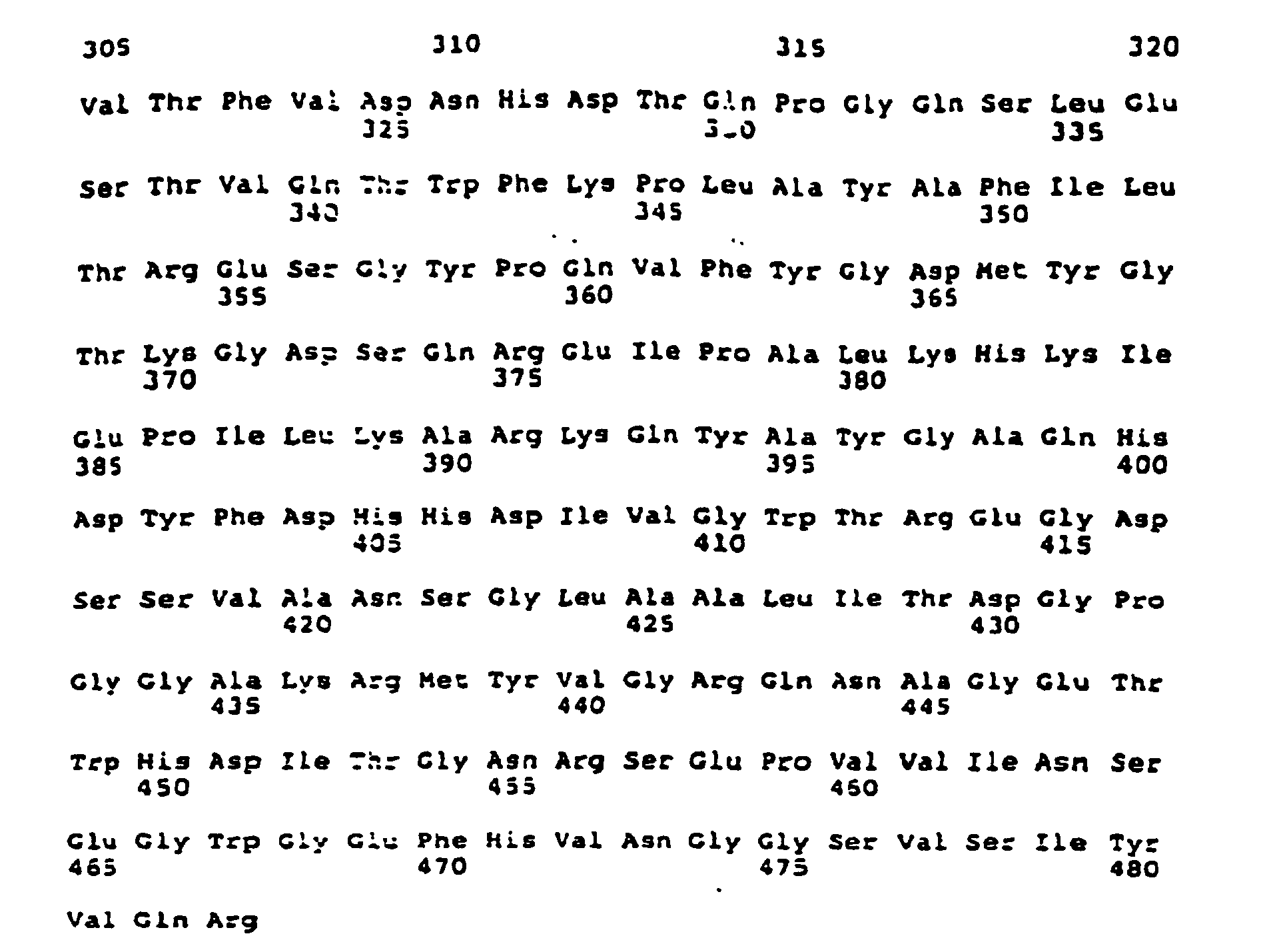
- (i) SEQUENCE CHARACTERISTICS:
- (2) INFORMATION FOR SEQ ID NO:33:
- (i) SEQUENCE CHARACTERISTICS:
- (A) LENGTH: 511 amino acids
- (B) TYPE: amino acid
- (C) STRANDEDNESS: single
- (D) TOPOLOGY: linear
- (ii) MOLECULE TYPE: protein
- (xi) SEQUENCE DESCRIPTION: SEQ ID NO:33:

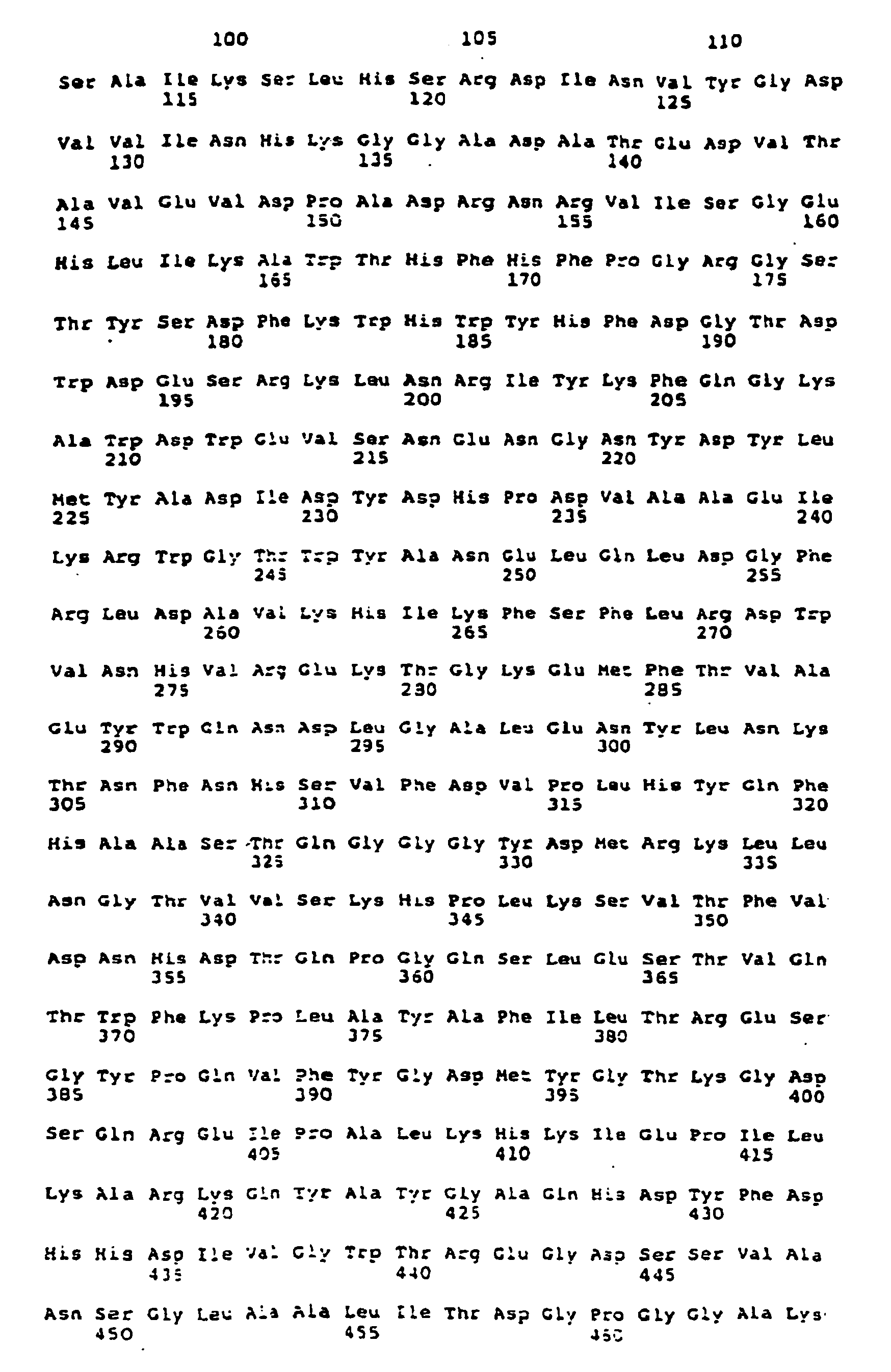
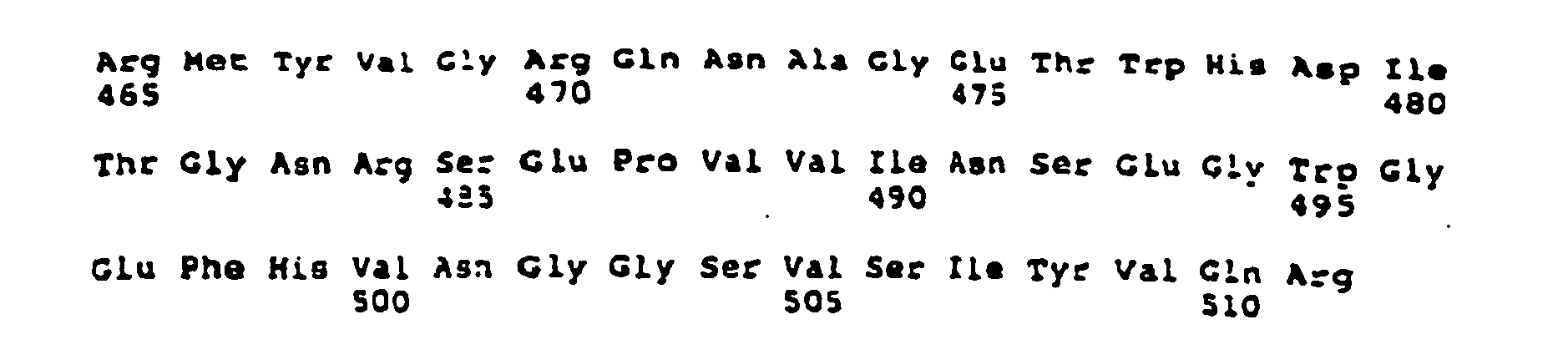
- (i) SEQUENCE CHARACTERISTICS:
- (2) INFORMATION FOR SEQ ID NO:34:
- (i) SEQUENCE CHARACTERISTICS:
- (A) LENGTH: 520 amino acids
- (B) TYPE: amino acid
- (C) STRANDEDNESS: single
- (D) TOPOLOGY: linear
- (ii) MOLECULE TYPE: protein
- (xi) SEQUENCE DESCRIPTION: SEQ ID NO:34:
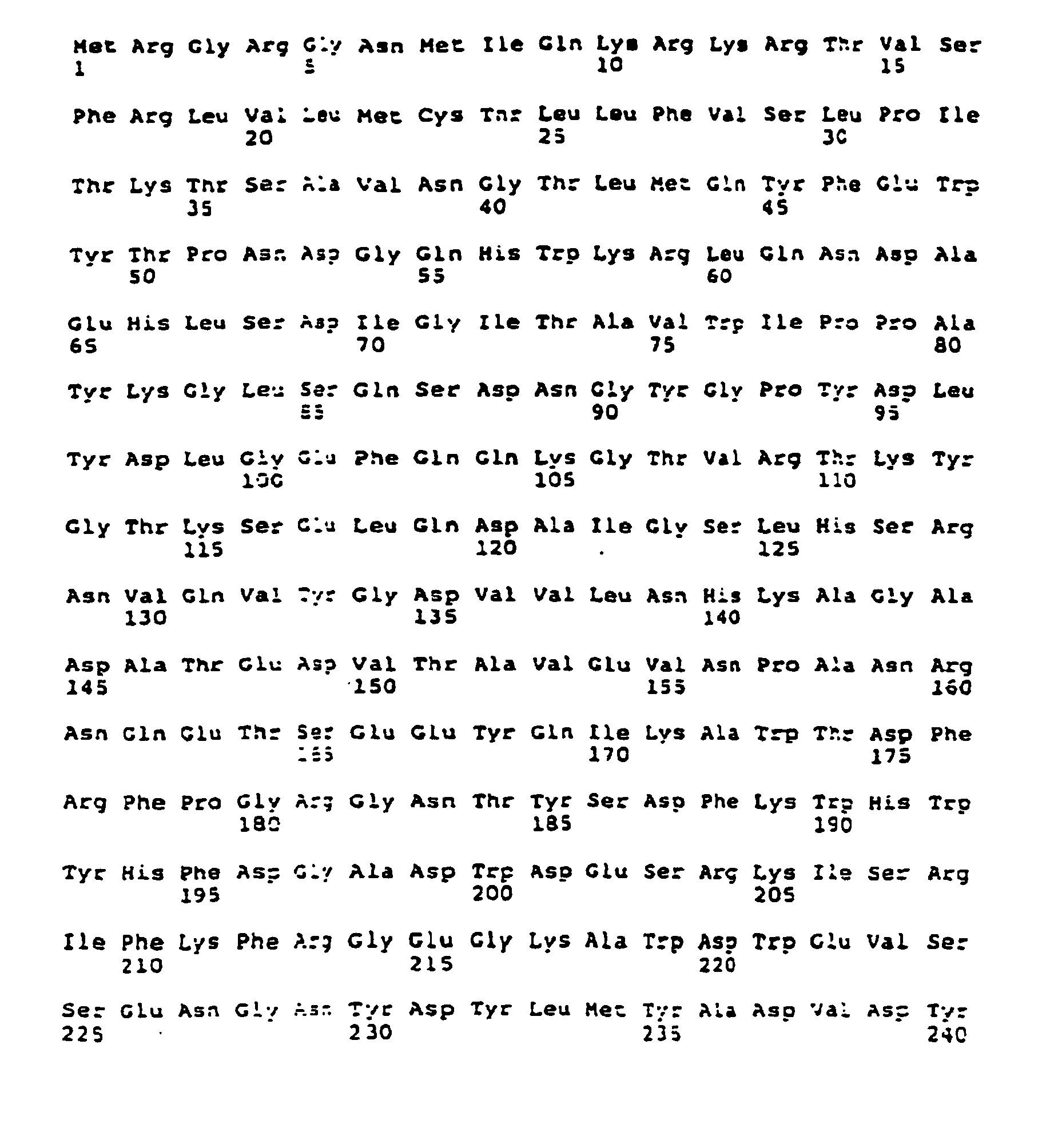
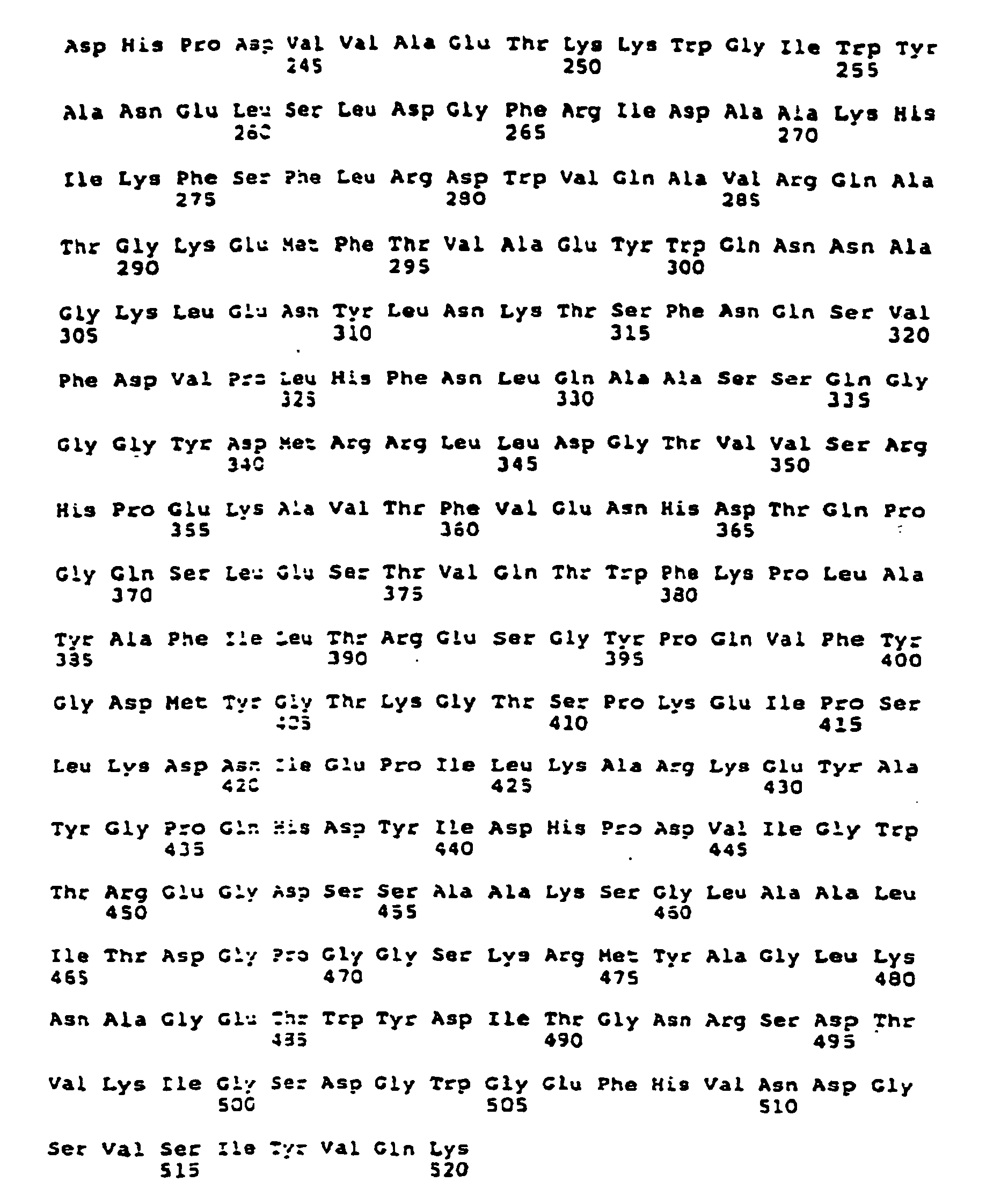
- (i) SEQUENCE CHARACTERISTICS:
- (2) INFORMATION FOR SEQ ID NO:35:
- (i) SEQUENCE CHARACTERISTICS:
- (A) LENGTH: 543 amino acids
- (B) TYPE: amino acid
- (C) STRANDEDNESS: single
- (D) TOPOLOGY: linear
- (ii) MOLECULE TYPE: protein
- (xi) SEQUENCE DESCRIPTION: SEQ ID NO:35:


- (i) SEQUENCE CHARACTERISTICS:
- (2) INFORMATION FOR SEQ ID NO:36:
- (i) SEQUENCE CHARACTERISTICS:
- (A) LENGTH: 433 amino acids
- (3) TYPE: amino acid
- (C) STRANDEDNESS: single
- (D) TOPOLOGY: linear
- (ii) MOLECULE TYPE: protein
- (xi) SEQUENCE DESCRIPTION: SEQ ID NO:36:

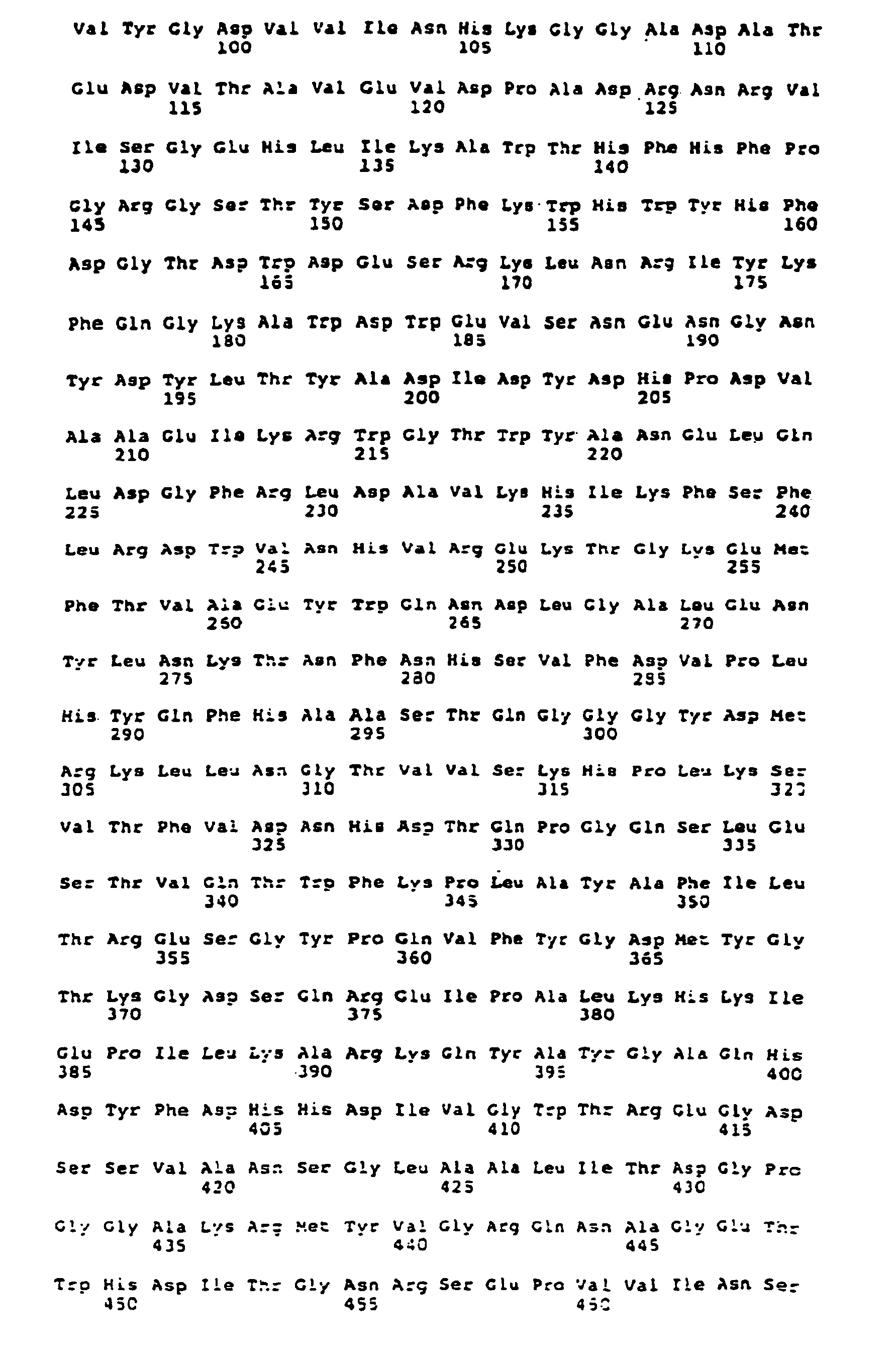

- (i) SEQUENCE CHARACTERISTICS:
- (2) INFORMATION FOR SEQ ID NO:37:
- (i) SEQUENCE CHARACTERISTICS:
- (A) LENGTH: 487 amino acids
- (B) TYPE: amino acid
- (C) STRANDEDNESS: single
- (D) TOPOLOGY: linear
- (ii) MOLECULE TYPE: protein
- (xi) SEQUENCE DESCRIPTION: SEQ ID NO:37:


- (i) SEQUENCE CHARACTERISTICS:
- (2) INFORMATION FOR SEQ ID NO:38:
- (i) SEQUENCE CHARACTERISTICS:
- (A) LENGTH: 32 amino acids
- (B) TYPE: amino acid
- (C) STRANDEDNESS: single
- (D) TOPOLOGY: linear
- (ii) MOLECULE TYPE: protein
- (xi) SEQUENCE DESCRIPTION: SEQ ID NO:38:

- (i) SEQUENCE CHARACTERISTICS:
- (2) INFORMATION FOR SEQ ID NO:39:
- (i) SEQUENCE CHARACTERISTICS:
- (A) LENGTH: 33 amino acids
- (B) TYPE: amino acid
- (C) STRANDEDNESS: single
- (D) TOPOLOGY: linear
- (ii) MOLECULE TYPE: protein
- (xi) SEQUENCE DESCRIPTION: SEQ ID NO:39:

- (i) SEQUENCE CHARACTERISTICS:
- (2) INFORMATION FOR SEQ ID NO:40:
- (i) SEQUENCE CHARACTERISTICS:
- (A) LENGTH: 35 amino acids
- (B) TYPE: amino acid
- (C) STRANDEDNESS: single
- (D) TOPOLOGY: linear
- (ii) MOLECULE TYPE: protein
- (xi) SEQUENCE DESCRIPTION: SEQ ID NO:40:

- (i) SEQUENCE CHARACTERISTICS:
- (2) INFORMATION FOR SEQ ID NO:41:
- (i) SEQUENCE CHARACTERISTICS:
- (A) LENGTH: 32 amino acids
- (B) TYPE: amino acid
- (C) STRANDEDNESS: single
- (D) TOPOLOGY: linear
- (ii) MOLECULE TYPE: protein
- (xi) SEQUENCE DESCRIPTION: SEQ ID NO:41:

- (i) SEQUENCE CHARACTERISTICS:
- (2) INFORMATION FOR SEQ ID NO:42:
- (i) SEQUENCE CHARACTERISTICS:
- (A) LENGTH: 33 base pairs
- (B) TYPE: nucleic acid
- (C) STRANDEDNESS: single
- (D) TOPOLOGY: linear
- (ii) MOLECULE TYPE: DNA (genomic)
- (xi) SEQUENCE DESCRIPTION: SEQ ID NO:42:
GACCTAATTA AAGCTTTCAC ACATTTTCAT TTT 33
- (i) SEQUENCE CHARACTERISTICS:
- (2) INFORMATION FOR SEQ ID NO:43:
- (i) SEQUENCE CHARACTERISTICS:
- (A) LENGTH: 33 base pairs
- (B) TYPE: nucleic acid
- (C) STRANDEDNESS: single
- (D) TOPOLOGY: linear
- (ii) MOLECULE TYPE: DNA (genomic)
- (xi) SEQUENCE DESCRIPTION: SEQ ID NO:43:
CACCTAATTA AAGCTTACAC ACATTTTCAT TTT 33
- (i) SEQUENCE CHARACTERISTICS:
- (2) INFORMATION FOR SEQ ID NO:44:
- (i) SEQUENCE CHARACTERISTICS:
- (A) LENGTH: 66 base pairs
- (B) TYPE: nucleic acid
- (C) STRANDEDNESS: single
- (D) TOPOLOGY: linear
- (ii) MOLECULE TYPE: DNA (genomic)
- (xi) SEQUENCE DESCRIPTION: SEQ ID NO:44:

- (i) SEQUENCE CHARACTERISTICS:
- (2) INFORMATION FOR SEQ ID NO:45:
- (i) SEQUENCE CHARACTERISTICS:
- (A) LENGTH: 42 base pairs
- (B) TYPE: nucleic acid
- (C) STRANDEDNESS: single
- (D) TOPOLOGY: linear
- (ii) MOLECULE TYPE: DNA (genomic)
- (xi) SEQUENCE DESCRIPTION: SEQ ID NO:45:
CCGGAGAACA CCTAATTAAA GCCCTAACAC ATTTTCATTT TC 42
- (i) SEQUENCE CHARACTERISTICS:
- (2) INFORMATION FOR SEQ ID NO:46:
- (i) SEQUENCE CHARACTERISTICS:
- (A) LENGTH: 42 base pairs
- (B) TYPE: nucleic acid
- (C) STRANDEDNESS: single
- (D) TOPOLOGY: linear
- (ii) MOLECULE TYPE: DNA (genomic)
- (xi) SEQUENCE DESCRIPTION: SEQ ID NO:46:
CCGGAGAACA CCTAATTAAA GCCCACACAC ATTTTCATTT TC 42
- (i) SEQUENCE CHARACTERISTICS:
- (2) INFORMATION FOR SEQ ID NO:47:
- (i) SEQUENCE CHARACTERISTICS:
- (A) LENGTH: 42 base pairs
- (B) TYPE: nucleic acid
- (C) STRANDEDNESS: single
- (D) TOPOLOGY: linear
- (ii) MOLECULE TYPE: DNA (genomic)
- (xi) SEQUENCE DESCRIPTION: SEQ ID NO:47:
CCGGAGAACA CCTAATTAAA GCCTGCACAC ATTTTCATTT TC 42
- (i) SEQUENCE CHARACTERISTICS:
- (2) INFORMATION FOR SEQ ID NO:48:
- (i) SEQUENCE CHARACTERISTICS:
- (A) LENGTH: 24 base pairs
- (3) TYPE: nucleic acid
- (C) STRANDEDNESS: single
- (D) TOPOLOGY: linear
- (ii) MOLECULE TYPE: DNA (genomic)
- (xi) SEQUENCE DESCRIPTION: SEQ ID NO:48:
GATGCAGTAT TTCGAACTGG TATA 24
- (i) SEQUENCE CHARACTERISTICS:
- (2) INFORMATION FOR SEQ ID NO:49:
- (i) SEQUENCE CHARACTERISTICS:
- (A) LENGTH: 26 base pairs
- (B) TYPE: nucleic acid
- (C) STRANDEDNESS: single
- (D) TOPOLOGY: linear
- (ii) MOLECULE TYPE: DNA (genomic)
- (xi) SEQUENCE DESCRIPTION: SEQ ID NO:49:
TGCCCAATGA TGGCCAACAT TGGAAG 26
- (i) SEQUENCE CHARACTERISTICS:
- (2) INFORMATION FOR SEQ ID NO:50:
- (i) SEQUENCE CHARACTERISTICS:
- (A) LENGTH: 24 base pairs
- (B) TYPE: nucleic acid
- (C) STRANDEDNESS: single
- (D) TOPOLOGY: linear
- (ii) MOLECULE TYPE: DNA (genomic)
- (xi) SEQUENCE DESCRIPTION: SEQ ID NO:50:
CGAATGGTAT GCTCCCAATG ACGG 24
- (i) SEQUENCE CHARACTERISTICS:
- (2) INFORMATION FOR SEQ ID NO:51:
- (i) SEQUENCE CHARACTERISTICS:
- (A) LENGTH: 24 base pairs
- (B) TYPE: nucleic acid
- (C) STRANDEDNESS: single
- (D) TOPOLOGY: linear
- (ii) MOLECULE TYPE: DNA (genomic)
- (xi) SEQUENCE DESCRIPTION: SEQ ID NO:51:
CGAATGGTAT CGCCCCAATG ACGG 24
- (i) SEQUENCE CHARACTERISTICS:
- (2) INFORMATION FOR SEQ ID NO:52:
- (i) SEQUENCE CHARACTERISTICS:
- (A) LENGTH: 24 base pairs
- (B) TYPE: nucleic acid
- (C) STRANDEDNESS: single
- (D) TOPOLOGY: linear
- (ii) MOLECULE TYPE: DNA (genomic)
- (xi) SEQUENCE DESCRIPTION: SEQ ID NO:52:
CGAATGGTAT AATCCCAATG ACCG 24
- (i) SEQUENCE CHARACTERISTICS:
- (2) INFORMATION FOR SEQ ID NO:53:
- (i) SEQUENCE CHARACTERISTICS:
- (A) LENGTH: 24 base pairs
- (B) TYPE: nucleic acid
- (C) STRANDEDNESS: single
- (D) TOPOLOGY: linear
- (ii) MOLECULE TYPE: DNA (genomic)
- (xi) SEQUENCE DESCRIPTION: SEQ ID NO:53:
CGAATGGTAT GATCCCAATG ACGG 24
- (i) SEQUENCE CHARACTERISTICS:
- (2) INFORMATION FOR SEQ ID NO:54:
- (i) SEQUENCE CHARACTERISTICS:
- (A) LENGTH: 24 base pairs
- (B) TYPE: nucleic acid
- (C) STRANDEDNESS: single
- (D) TOPOLOGY: linear
- (ii) MOLECULE TYPE: DNA (genomic)
- (xi) SEQUENCE DESCRIPTION: SEQ ID NO:54:
CGAATGGTAT CACCCCAATG ACGG 24
- (i) SEQUENCE CHARACTERISTICS:
- (2) INFORMATION FOR SEQ ID NO:55:
- (i) SEQUENCE CHARACTERISTICS:
- (A) LENGTH: 24 base pairs
- (B) TYPE: nucleic acid
- (C) STRANDEDNESS: single
- (D) TOPOLOGY: linear
- (ii) MOLECULE TYPE: DNA (genomic)
- (xi) SEQUENCE DESCRIPTION: SEQ ID NO:55:
CGAATGGTAT AAACCCAATG ACGG 24
- (i) SEQUENCE CHARACTERISTICS:
- (2) INFORMATION FOR SEQ ID NO:56:
- (i) SEQUENCE CHARACTERISTICS:
- (A) LENGTH: 24 base pairs
- (B) TYPE: nucleic acid
- (C) STRANDEDNESS: single
- (D) TOPOLOGY: linear
- (ii) MOLECULE TYPE: DNA (genomic)
- (xi) SEQUENCE DESCRIPTION: SEQ ID NO:56:
CGAATGGTAT CCGCCCAATG ACGG 24
- (i) SEQUENCE CHARACTERISTICS:
- (2) INFORMATION FOR SEQ ID NO:57:
- (i) SEQUENCE CHARACTERISTICS:
- (A) LENGTH: 24 base pairs
- (B) TYPE: nucleic acid
- (C) STRANDEDNESS: single
- (D) TOPOLOGY: linear
- (ii) MOLECULE TYPE: DNA (genomic)
- (xi) SEQUENCE DESCRIPTION: SEQ ID NO:57:
CGAATGGTAT TGTCCCAATG ACGG 24
- (i) SEQUENCE CHARACTERISTICS:
- (2) INFORMATION FOR SEQ ID NO:58:
- (i) SEQUENCE CHARACTERISTICS:
- (A) LENGTH: 24 base pairs
- (B) TYPE: nucleic acid
- (C) STRANDEDNESS: single
- (D) TOPOLOGY: linear
- (ii) MOLECULE TYPE: DNA (genomic)
- (xi) SEQUENCE DESCRIPTION: SEQ ID NO:58:
CGAATGGTAC ACTCCCAATG ACGG 24
- (i) SEQUENCE CHARACTERISTICS:
- (2) INFORMATION FOR SEQ ID NO:59:
- (i) SEQUENCE CHARACTERISTICS:
- (A) LENGTH: 24 base pairs
- (B) TYPE: nucleic acid
- (C) STRANDEDNESS: single
- (D) TOPOLOGY: linear
- (ii) MOLECULE TYPE: DNA (genomic)
- (xi) SEQUENCE DESCRIPTION: SEQ ID NO: 59:
CGAATGGTAT GTTCCCAATG ACGG 24
- (i) SEQUENCE CHARACTERISTICS:
- (2) INFORMATION FOR SEQ ID NO:60:
- (i) SEQUENCE CHARACTERISTICS:
- (A) LENGTH: 24 base pairs
- (B) TYPE: nucleic acid
- (C) STRANDEDNESS: single
- (D) TOPOLOGY: linear
- (ii) MOLECULE TYPE: DNA (genomic)
- (xi) SEQUENCE DESCRIPTION: SEQ ID NO:60:
CGAATGCTAT TGTCCCAATG ACGG 24
- (i) SEQUENCE CHARACTERISTICS:
- (2) INFORMATION FOR SEQ ID NO:61:
- (i) SEQUENCE CHARACTERISTICS:
- (A) LENGTH: 24 base pairs
- (B) TYPE: nucleic acid
- (C) STRANDEDNESS: single
- (D) TOPOLOGY: linear
- (ii) MOLECULE TYPE: DNA (genomic)
- (xi) SEQUENCE DESCRIPTION: SEQ ID NO:61:
CGAATGGTAT CAACCCAATG ACGG 24
- (i) SEQUENCE CHARACTERISTICS:
- (2) INFORMATION FOR SEQ ID NO:62:
- (i) SEQUENCE CHARACTERISTICS:
- (A) LENGTH: 24 base pairs
- (B) TYPE: nucleic acid
- (C) STRANDEDNESS: single
- (D) TOPOLOGY: linear
- (ii) MOLECULE TYPE: DNA (genomic)
- (xi) SEQUENCE DESCRIPTION: SEQ ID NO:62:
CGAATGGTAT GAACCCAATG ACGG 24
- (i) SEQUENCE CHARACTERISTICS:
- (2) INFORMATION FOR SEQ ID NO:63:
- (i) SEQUENCE CHARACTERISTICS:
- (A) LENGTH: 24 base pairs
- (B) TYPE: nucleic acid
- (C) STRANDEDNESS: single
- (D) TOPOLOGY: linear
- (ii) MOLECULE TYPE: DNA (genomic)
- (xi) SEQUENCE DESCRIPTION: SEQ ID NO:63:
CGAATGGTAT GCTCCCAATG ACGG 24
- (i) SEQUENCE CHARACTERISTICS:
- (2) INFORMATION FOR SEQ ID NO:64:
- (i) SEQUENCE CHARACTERISTICS:
- (A) LENGTH: 24 base pairs
- (B) TYPE: nucleic acid
- (C) STRANDEDNESS: single
- (D) TOPOLOGY: linear
- (ii) MOLECULE TYPE: DNA (genomic)
- (xi) SEQUENCE DESCRIPTION: SEQ ID NO:64:
CGAATGGTAT ATTCCCAATG ACGG 24
- (i) SEQUENCE CHARACTERISTICS:
- (2) INFORMATION FOR SEQ ID NO:65:
- (i) SEQUENCE CHARACTERISTICS:
- (A) LENGTH: 24 base pairs
- (B) TYPE: nucleic acid
- (C) STRANDEDNESS: single
- (D) TOPOLOGY: linear
- (ii) MOLECULE TYPE: DNA (genomic)
- (xi) SEQUENCE DESCRIPTION: SEQ ID NO:65:
CGAATGGTAT TTTCCCAATG ACGG 24
- (i) SEQUENCE CHARACTERISTICS:
- (2) INFORMATION FOR SEQ ID NO:66:
- (i) SEQUENCE CHARACTERISTICS:
- (A) LENGTH: 24 base pairs
- (B) TYPE: nucleic acid
- (C) STRANDEDNESS: single
- (D) TOPOLOGY: linear
- (ii) MOLECULE TYPE: DNA (genomic)
- (xi) SEQUENCE DESCRIPTION: SEQ ID NO:66:
CGAATGGTAC TGGCCCAATG ACGG 24
- (i) SEQUENCE CHARACTERISTICS:
- (2) INFORMATION FOR SEQ ID NO:67:
- (i) SEQUENCE CHARACTERISTICS:
- (A) LENGTH: 24 base pairs
- (B) TYPE: nucleic acid
- (C) STRANDEDNESS: single
- (D) TOPOLOGY: linear
- (ii) MOLECULE TYPE: DNA (genomic)
- (xi) SEQUENCE DESCRIPTION: SEQ ID NO:67:
CGAATGGTAT TATCCCTG ACGG 24
- (i) SEQUENCE CHARACTERISTICS:
- (2) INFORMATION FOR SEQ ID NO:68:
- (i) SEQUENCE CHARACTERISTICS:
- (A) LENGTH: 24 base pairs
- (B) TYPE: nucleic acid
- (C) STRANDEDNESS: single
- (D) TOPOLOGY: linear
- (ii) MOLECULE TYPE: DNA (genomic)
- (xi) SEQUENCE DESCRIPTION: SEQ ID NO: 68:
CCGTCATTGG GACTACGTAC CATT 24
- (i) SEQUENCE CHARACTERISTICS:
wherein the substituent amino acid is Val.
wherein the substituent amino acid is Leu, Thr, Asn, Asp, Ser, Val or Ile.
wherein the substituent amino acid is Leu, Asn, Asp, Ser, Val or Ile.
| ALPHA-AMYLASE | SPECIFIC ACTIVITY (as % of AA20 value) on: | |
| Soluble Substrate | Starch | |
| | 100 | 100 |
| A4 form | 105 | 115 |
| M15L (A4 form) | 93 | 94 |
| M15L | 85 | 103 |
| M197T (A4 form) | 75 | 83 |
| M197T | 62 | 81 |
| M197A (A4 form) | 88 | 89 |
| M197C | 85 | 85 |
| M197L (A4 form) | 51 | 17 |
Claims (24)
- A mutant alpha-amylase selected from the group consisting of:(a) an alpha-amylase that is the expression product of a mutated DNA sequence encoding an alpha-amylase, the mutated DNA sequence being derived from a precursor alpha-amylase of Bacillus licheniformis by site-specific substitution of an amino acid at position M+15, and(b) an alpha-amylase that is the expression product of a mutated DNA sequence encoding an alpha-amylase, the mutated DNA sequence being derived from a precursor alpha-amylase which is a Bacillus alpha-amylase by site-specific substitution of a methionine residue that corresponds in position in either the primary or tertiary structure to M+15 in Bacillus licheniformis alpha-amylase,said alpha-amylase exhibiting an altered pH and/or temperature performance profile when compared to wild-type Bacillus alpha-amylase;
wherein the substituent amino acid is Val. - A mutant alpha-amylase of claim 1 further comprising one or more other site specific mutations.
- A mutant alpha-amylase of claim 1 or claim 2 wherein the precursor is Bacillus licheniformis alpha-amylase.
- DNA encoding a mutant alpha-amylase of any one of claims 1 to 3.
- Expression vectors encoding the DNA of claim 4.
- Host cells transformed with the expression vector of claim 5.
- A detergent composition comprising a mutant alpha-amylase of any one of claims 1 to 3.
- A detergent composition of claim 7 which is a liquid, gel or granular composition.
- A detergent composition of claim 7 or claim 8 further comprising one or more additional enzymes.
- A starch liquefying composition comprising a mutant alpha-amylase of any one of claims 1 to 3.
- A method of altering the pH and/or temperature performance profile of a Bacillus alpha-amylase comprising the steps of:(a) providing a precursor DNA sequence encoding a precursor alpha-amylase of Bacillus licheniformis, and modifying said precursor DNA sequence to obtain a mutated DNA sequence encoding a mutant alpha-amylase which differs from said precursor alpha-amylase by site-specific substitution of an amino acid at position M+15, or(b) providing a precursor DNA sequence encoding a precursor alpha-amylase from a Bacillus, and modifying said precursor DNA sequence to obtain a mutated DNA sequence encoding a mutant alpha-amylase which differs from said precursor alpha-amylase by site-specific substitution of a methionine residue that corresponds in position in either the primary or tertiary structure to M+15 in Bacillus licheniformis alpha-amylase;and expressing said mutant alpha-amylase from said mutated DNA sequence, wherein said mutant alpha-amylase exhibits an altered pH and/or temperature performance profile when compared to the precursor Bacillus alpha amylase, wherein the substituent amino acid is Thr.
- A method according to claim 11, comprising further modifying said precursor DNA sequence such that the mutant alpha-amylase comprises one or more other site specific mutations.
- A method according to claim 11 or claim 12 wherein the precursor is Bacillus licheniformis alpha-amylase.
- A method according to any of claims 11 to 13, further comprising formulating the mutant alpha-amylase into a detergent composition.
- A method according to claim 14 wherein the detergent composition is a liquid, gel or granular composition.
- A method according to claim 14 or claim 15 wherein the detergent composition further comprises one or more additional enzymes.
- A method according to any one of claims 11 to 13, further comprising formulating the mutant alpha-amylase into a starch liquefying composition.
- A detergent composition which comprises a mutant alpha-amylase and one or more additional enzymes wherein said mutant alpha-amylase is selected from the group consisting of(a) an alpha-amylase that is the expression product of a mutated DNA sequence encoding an alpha-amylase, the mutated DNA sequence being derived from a precursor alpha-amylase of Bacillus licheniformis by site-specific substitution of an amino-acid at position M+15, and(b) an alpha-amylase that is the expression product of a mutated DNA sequence encoding an alpha-amylase, the mutated DNA sequence being derived from a precursor alpha-amylase which is a Bacillus alpha-amylase by site-specific substitution of a methionine residue that corresponds in position in either the primary or tertiary structure to M+15 in Bacillus licheniformis alpha-amylase,said alpha-amylase exhibiting an altered pH and/or temperature performance profile when compared to wild-type Bacillus alpha-amylase;
wherein the substituent amino acid is Leu, Thr, Asn, Asp, Ser, Val or Ile. - The detergent composition of claim 18 wherein said mutant alpha-amylase is M 15L.
- The detergent composition of claim 18 or claim 19 wherein said mutant alpha-amylase comprises one or more other site specific mutations.
- A detergent composition as claimed in any one of claims 18 to 20 wherein said additional enzyme or enzymes is selected from the group consisting of amylase, proteases, lipases and celluloses.
- A method of liquefying a granular starch slurry from either a wet or dry milling process at a pH of from about 4 to about 6 comprising:(a) adding an effective amount of mutant alpha-amylase to the slurry;(b) optionally adding an effective amount of an antioxidant to the slurry; and(c) reacting the slurry for an appropriate time and at an appropriate temperature to liquefy the starch;wherein said alpha-amylase mutant is selected from the group consisting of(a) an alpha-amylase that is the expression product of a mutated DNA sequence encoding an alpha-amylase, the mutated DNA sequence being derived from a precursor alpha-amylase of Bacillus licheniformis by site-specific substitution of an amino acid at position M+15, and(b) an alpha-amylase that is the expression product of a mutated DNA sequence encoding an alpha-amylase, the mutated DNA sequence being derived from a precursor alpha-amylase which is a Bacillus alpha-amylase by site-specific substitution of a methionine residue that corresponds in position in either the primary or tertiary structure to M+15 in Bacillus licheniformis alpha-amylase,said alpha-amylase exhibiting an altered pH and/or temperature performance profile when compared to wild-type Bacillus alpha-amylase;
wherein the substituent amino acid is Leu, Asn, Asp, Ser, Val or Ile. - A starch liquefying composition which comprises a mutant alpha-amylase wherein said mutant alpha-amylase is selected from the group consisting of(a) an alpha-amylase that is the expression product of a mutated DNA sequence encoding an alpha-amylase, the mutated DNA sequence being derived from a precursor alpha-amylase of Bacillus licheniformis by site-specific substitution of an amino acid at position M+15, and(b) an alpha-amylase that is the expression product of a mutated DNA sequence encoding an alpha-amylase, the mutated DNA sequence being derived from a precursor alpha-amylase which is a Bacillus alpha-amylase by site-specific substitution of a methionine residue that corresponds in position in either the primary or tertiary structure to M+15 in Bacillus licheniformis alpha-amylase,said alpha-amylase exhibiting an altered pH and/or temperature performance profile when compared to wild-type Bacillus alpha-amylase;
wherein the substituent amino acid is Leu, Asn, Asp, Ser, Val or Ile. - The starch liquefying composition of claim 23 wherein said mutant alpha-amylase is M 15L.
Priority Applications (1)
| Application Number | Priority Date | Filing Date | Title |
|---|---|---|---|
| DE69432610T DE69432610T3 (en) | 1993-02-11 | 1994-02-10 | Oxidation-stable alpha-amylase |
Applications Claiming Priority (3)
| Application Number | Priority Date | Filing Date | Title |
|---|---|---|---|
| US1639593A | 1993-02-11 | 1993-02-11 | |
| US16395 | 1993-02-11 | ||
| EP94909609A EP0689589B2 (en) | 1993-02-11 | 1994-02-10 | Oxidatively stable alpha-amylase |
Related Parent Applications (2)
| Application Number | Title | Priority Date | Filing Date |
|---|---|---|---|
| EP94909609A Division EP0689589B2 (en) | 1993-02-11 | 1994-02-10 | Oxidatively stable alpha-amylase |
| EP94909609.3 Division | 1994-08-18 |
Publications (3)
| Publication Number | Publication Date |
|---|---|
| EP0867504A1 EP0867504A1 (en) | 1998-09-30 |
| EP0867504B1 EP0867504B1 (en) | 2003-05-02 |
| EP0867504B2 true EP0867504B2 (en) | 2011-05-18 |
Family
ID=21776903
Family Applications (2)
| Application Number | Title | Priority Date | Filing Date |
|---|---|---|---|
| EP94909609A Expired - Lifetime EP0689589B2 (en) | 1993-02-11 | 1994-02-10 | Oxidatively stable alpha-amylase |
| EP98109967A Expired - Lifetime EP0867504B2 (en) | 1993-02-11 | 1994-02-10 | Oxidation-stable alpha-amylase |
Family Applications Before (1)
| Application Number | Title | Priority Date | Filing Date |
|---|---|---|---|
| EP94909609A Expired - Lifetime EP0689589B2 (en) | 1993-02-11 | 1994-02-10 | Oxidatively stable alpha-amylase |
Country Status (20)
| Country | Link |
|---|---|
| US (3) | US6297037B1 (en) |
| EP (2) | EP0689589B2 (en) |
| JP (1) | JPH08506491A (en) |
| KR (1) | KR100322793B1 (en) |
| CN (1) | CN1104499C (en) |
| AT (2) | ATE175235T1 (en) |
| AU (1) | AU682863C (en) |
| BR (1) | BR9405720A (en) |
| CA (1) | CA2155831C (en) |
| CZ (1) | CZ293163B6 (en) |
| DE (2) | DE69415659T3 (en) |
| DK (2) | DK0689589T4 (en) |
| ES (2) | ES2126743T5 (en) |
| FI (2) | FI119694B (en) |
| HU (1) | HU219675B (en) |
| NO (1) | NO307187B1 (en) |
| NZ (1) | NZ262623A (en) |
| PL (1) | PL310326A1 (en) |
| PT (1) | PT867504E (en) |
| WO (1) | WO1994018314A1 (en) |
Families Citing this family (786)
| Publication number | Priority date | Publication date | Assignee | Title |
|---|---|---|---|---|
| CN1189558C (en) * | 1993-10-08 | 2005-02-16 | 诺沃奇梅兹有限公司 | Amylase variants |
| DE69434635D1 (en) | 1993-10-08 | 2006-04-27 | Novo Nordisk As | Amylasevarianten |
| US5830837A (en) * | 1994-11-22 | 1998-11-03 | Novo Nordisk A/S | Amylase variants |
| MY111537A (en) * | 1994-02-02 | 2000-07-31 | Novo Nordisk As | A combined desizing and bleaching process. |
| TW255887B (en) * | 1994-05-25 | 1995-09-01 | Lilly Co Eli | Synthesis of benzoquinolinones |
| AU685638B2 (en) * | 1994-06-17 | 1998-01-22 | Genencor International, Inc. | Novel amylolytic enzymes derived from the b. licheniformis alpha-amylase, having improved characteristics |
| MX9700776A (en) * | 1994-08-11 | 1997-05-31 | Genecor Int Inc | An improved cleaning composition. |
| US6440716B1 (en) | 1995-02-03 | 2002-08-27 | Novozymes A/S | α-amylase mutants |
| AR000862A1 (en) * | 1995-02-03 | 1997-08-06 | Novozymes As | VARIANTS OF A MOTHER-AMYLASE, A METHOD TO PRODUCE THE SAME, A DNA STRUCTURE AND A VECTOR OF EXPRESSION, A CELL TRANSFORMED BY SUCH A DNA STRUCTURE AND VECTOR, A DETERGENT ADDITIVE, DETERGENT COMPOSITION, A COMPOSITION FOR AND A COMPOSITION FOR THE ELIMINATION OF |
| US6093562A (en) * | 1996-02-05 | 2000-07-25 | Novo Nordisk A/S | Amylase variants |
| DK2199378T3 (en) * | 1995-02-03 | 2012-10-29 | Novozymes As | alpha-amylase mutants |
| US7115409B1 (en) | 1995-02-03 | 2006-10-03 | Novozymes A/S | α-amylase mutants |
| CN101381712A (en) * | 1995-02-03 | 2009-03-11 | 诺维信公司 | Amylase variant |
| WO1996030481A1 (en) * | 1995-03-24 | 1996-10-03 | Genencor International, Inc. | An improved laundry detergent composition comprising amylase |
| US5922083A (en) * | 1995-04-03 | 1999-07-13 | Procter & Gamble Company | Detergent composition comprising a mutant amylase enzyme and oxygen bleaching agent |
| EP0736597A1 (en) * | 1995-04-03 | 1996-10-09 | The Procter & Gamble Company | Soaker compositions |
| US5736499A (en) * | 1995-06-06 | 1998-04-07 | Genencor International, Inc. | Mutant A-amylase |
| WO1997004054A1 (en) * | 1995-07-24 | 1997-02-06 | The Procter & Gamble Company | Detergent compositions comprising a specific amylase and a protease |
| AR003020A1 (en) * | 1995-07-24 | 1998-05-27 | Procter & Gamble | DETERGENT COMPOSITION INCLUDING AN INCREASED OXIDATIVE STABILITY AMYLASE AND A SPECIFIC SURFACTING SYSTEM. |
| EP0756000A1 (en) * | 1995-07-24 | 1997-01-29 | The Procter & Gamble Company | Detergent compositions comprising specific amylase and linear alkyl benzene sulfonate surfactant |
| BR9609940A (en) * | 1995-07-24 | 1999-06-15 | Procter & Gamble | Detergent compositions comprising specific amylase and linear alkyl benzene sulfonate surfactant |
| CN1105173C (en) * | 1995-07-24 | 2003-04-09 | 普罗格特-甘布尔公司 | Dingy fabric clean-up with amylase enzyme in detergent compsns. |
| DE19605688A1 (en) * | 1996-02-16 | 1997-08-21 | Henkel Kgaa | Transition metal complexes as activators for peroxygen compounds |
| JP2000505502A (en) * | 1996-03-07 | 2000-05-09 | ザ、プロクター、エンド、ギャンブル、カンパニー | Detergent compositions comprising improved amylase |
| EP0798371A1 (en) * | 1996-03-29 | 1997-10-01 | The Procter & Gamble Company | Detergent compositions comprising specific amylase and alkyl poly glucoside surfactants |
| US6046149A (en) * | 1996-04-17 | 2000-04-04 | Procter & Gamble Company | Detergent compositions |
| EP0904360B1 (en) | 1996-04-30 | 2013-07-31 | Novozymes A/S | alpha-AMYLASE MUTANTS |
| US6066612A (en) | 1996-05-03 | 2000-05-23 | The Procter & Gamble Company | Detergent compositions comprising polyamine polymers with improved soil dispersancy |
| US5763385A (en) * | 1996-05-14 | 1998-06-09 | Genencor International, Inc. | Modified α-amylases having altered calcium binding properties |
| US6211134B1 (en) * | 1996-05-14 | 2001-04-03 | Genecor International, Inc. | Mutant α-amylase |
| US6197070B1 (en) | 1996-05-15 | 2001-03-06 | The Procter & Gamble Company | Detergent compositions comprising alpha combination of α-amylases for malodor stripping |
| US5958739A (en) * | 1996-06-06 | 1999-09-28 | Genencor International Inc. | Mutant α-amylase |
| BR9609755A (en) * | 1996-06-19 | 1999-01-26 | Procter & Gamble | Detergent compositions comprising a specific amylase and a protease |
| CZ34499A3 (en) * | 1996-08-01 | 2000-01-12 | The Procter & Gamble Company | Use of a specific enzyme amylase in laundry detergent |
| DE19649375A1 (en) | 1996-11-29 | 1998-06-04 | Henkel Kgaa | Acetonitrile derivatives as bleach activators in detergents |
| US6194370B1 (en) | 1996-12-31 | 2001-02-27 | The Procter & Gamble Company | Cost effective stain and soil removal aqueous heavy duty liquid laundry detergent compositions |
| EP0958342B1 (en) | 1996-12-31 | 2003-07-09 | The Procter & Gamble Company | Thickened, highly aqueous liquid detergent compositions |
| DE19700327A1 (en) * | 1997-01-08 | 1998-07-09 | Henkel Kgaa | Protease and amylase detergent |
| US6486113B1 (en) | 1997-03-31 | 2002-11-26 | Kao Corporation | Mutant α-amylases |
| DE19732750A1 (en) | 1997-07-30 | 1999-02-04 | Henkel Kgaa | Cleaning agent containing glucanase for hard surfaces |
| DE19732749A1 (en) | 1997-07-30 | 1999-02-04 | Henkel Kgaa | Detergent containing glucanase |
| DE19732751A1 (en) | 1997-07-30 | 1999-02-04 | Henkel Kgaa | New Bacillus beta glucanase |
| US6080568A (en) * | 1997-08-19 | 2000-06-27 | Genencor International, Inc. | Mutant α-amylase comprising modification at residues corresponding to A210, H405 and/or T412 in Bacillus licheniformis |
| DK2206768T3 (en) | 1997-10-13 | 2015-06-29 | Novozymes As | Alfa-amylasemutanter |
| EP2386568B1 (en) | 1997-10-30 | 2014-08-06 | Novozymes A/S | Alpha-amylase mutants |
| DE19819187A1 (en) * | 1998-04-30 | 1999-11-11 | Henkel Kgaa | Solid dishwasher detergent with phosphate and crystalline layered silicates |
| DE19824687A1 (en) * | 1998-06-03 | 1999-12-09 | Henkel Kgaa | Detergents and cleaning agents containing amylase and acetonitrile derivatives |
| DE19824705A1 (en) | 1998-06-03 | 1999-12-09 | Henkel Kgaa | Detergents and cleaning agents containing amylase and protease |
| MXPA00012241A (en) | 1998-06-10 | 2002-06-04 | Novozymes As | Novel mannanases. |
| DE19850100A1 (en) | 1998-10-29 | 2000-05-04 | Henkel Kgaa | Polymer granules through fluidized bed granulation |
| ATE504651T1 (en) | 1998-12-18 | 2011-04-15 | Novozymes As | SUBTILASE ENZYMES OF THE I-S1 AND I-S2 SUBGROUPS WITH AN ADDITIONAL AMINO ACID RESIDUE IN AN ACTIVE LOOP REGION |
| DE19908051A1 (en) | 1999-02-25 | 2000-08-31 | Henkel Kgaa | Process for the preparation of compounded acetonitrile derivatives |
| CN1252256C (en) | 1999-03-30 | 2006-04-19 | 诺维信公司 | Alpha-amylase variants |
| US6410295B1 (en) | 1999-03-30 | 2002-06-25 | Novozymes A/S | Alpha-amylase variants |
| ES2322426T3 (en) | 1999-03-31 | 2009-06-22 | Novozymes A/S | POLYPEPTIDES WITH ALFA-AMYLASE ACTIVITY AND NUCLEIC ACIDS THAT CODIFY THEMSELVES. |
| EP2889375B1 (en) | 1999-03-31 | 2019-03-20 | Novozymes A/S | Polypeptides having alkaline alpha-amylase activity and nucleic acids encoding same |
| DE60040282D1 (en) | 1999-05-20 | 2008-10-30 | Novozymes As | SUBTILASE ENZYMES OF I-S1 AND I-S2 SUB-GROUPS WITH AT LEAST ONE ADDITIONAL AMINO ACID BETWEEN POSITIONS 132 AND 133 |
| WO2000071687A1 (en) | 1999-05-20 | 2000-11-30 | Novozymes A/S | Subtilase enzymes of the i-s1 and i-s2 sub-groups having at least one additional amino acid residue between positions 129 and 130 |
| WO2000071691A1 (en) | 1999-05-20 | 2000-11-30 | Novozymes A/S | Subtilase enzymes of the i-s1 and i-s2 sub-groups having at least one additional amino acid residue between positions 125 and 126 |
| AU4392800A (en) | 1999-05-20 | 2000-12-12 | Novozymes A/S | Subtilase enzymes of the i-s1 and i-s2 sub-groups having at least one additionalamino acid residue between positions 126 and 127 |
| ATE408680T1 (en) | 1999-05-20 | 2008-10-15 | Novozymes As | SUBTILASE ENZYMES OF THE I-S1 AND I-S2 SUBGROUPS WITH AT LEAST ONE ADDITIONAL AMINO ACID BETWEEN POSITIONS 128 AND 129 |
| WO2000071689A1 (en) | 1999-05-20 | 2000-11-30 | Novozymes A/S | Subtilase enzymes of the i-s1 and i-s2 sub-groups having at least one additional amino acid residue between positions 127 and 128 |
| EP1067181A1 (en) * | 1999-06-10 | 2001-01-10 | Rijksuniversiteit te Groningen | Enzyme selection |
| NZ517409A (en) | 1999-08-31 | 2004-05-28 | Novozymes As | RP-II properties with amino acid substitutions used in detergent compositions and additives |
| AU7744000A (en) | 1999-09-30 | 2001-04-30 | Procter & Gamble Company, The | Detergent package with means to mask amine malodours |
| MXPA02003744A (en) * | 1999-10-15 | 2002-08-30 | Procter & Gamble | Enzymatic liquid cleaning composition. |
| DK1240524T3 (en) * | 1999-12-23 | 2011-02-14 | Genencor Int | Cellulase from T. Reesei with improved thermostability |
| CN101532001A (en) | 2000-03-08 | 2009-09-16 | 诺维信公司 | Variants with altered properties |
| WO2001096537A2 (en) * | 2000-06-14 | 2001-12-20 | Novozymes A/S | Pre-oxidized alpha-amylase |
| US7153818B2 (en) | 2000-07-28 | 2006-12-26 | Henkel Kgaa | Amylolytic enzyme extracted from bacillus sp. A 7-7 (DSM 12368) and washing and cleaning agents containing this novel amylolytic enzyme |
| EP2180035A1 (en) | 2000-08-01 | 2010-04-28 | Novozymes A/S | Alpha-amylase mutants with altered properties |
| US20020155574A1 (en) * | 2000-08-01 | 2002-10-24 | Novozymes A/S | Alpha-amylase mutants with altered properties |
| CA2419896C (en) | 2000-08-21 | 2014-12-09 | Novozymes A/S | Subtilase enzymes |
| CN100497617C (en) | 2000-10-13 | 2009-06-10 | 诺维信公司 | Subtilase variants |
| US20040091994A1 (en) | 2000-10-13 | 2004-05-13 | Carsten Andersen | Alpha-amylase variant with altered properties |
| DE10058645A1 (en) | 2000-11-25 | 2002-05-29 | Clariant Gmbh | Use of cyclic sugar ketones as catalysts for peroxygen compounds |
| US7888104B2 (en) | 2000-11-28 | 2011-02-15 | Henkel Ag & Co. Kgaa | Cyclodextrin glucanotransferase (CGTase), obtained from<I>Bacillus agaradherens<λ>(DSM 9948) and detergents and cleaning agents containing said novel cyclodextrin glucanotransferase |
| DE10102248A1 (en) | 2001-01-19 | 2002-07-25 | Clariant Gmbh | Use of transition metal complexes with oxime ligands as bleach catalysts |
| ATE510023T1 (en) | 2001-02-21 | 2011-06-15 | Verenium Corp | ENZYMES HAVING ALPHA-AMYLASE ACTIVITY AND METHOD FOR USE THEREOF |
| US7659102B2 (en) | 2001-02-21 | 2010-02-09 | Verenium Corporation | Amylases, nucleic acids encoding them and methods for making and using them |
| US7498158B2 (en) | 2001-05-15 | 2009-03-03 | Novozymes A/S | Alpha-amylase variant with altered properties |
| WO2003000941A2 (en) | 2001-06-26 | 2003-01-03 | Novozymes A/S | Polypeptides having cellobiohydrolase i activity and polynucleotides encoding same |
| DK200101090A (en) | 2001-07-12 | 2001-08-16 | Novozymes As | Subtilase variants |
| US7153820B2 (en) | 2001-08-13 | 2006-12-26 | Ecolab Inc. | Solid detergent composition and method for solidifying a detergent composition |
| US20030134396A1 (en) * | 2001-12-19 | 2003-07-17 | Shetty Jayarama K. | Process for hydrolyzing starch without pH adjustment |
| DE10163748A1 (en) | 2001-12-21 | 2003-07-17 | Henkel Kgaa | New glycosyl hydrolases |
| EP1490485B1 (en) | 2002-03-27 | 2015-03-04 | Novozymes A/S | Granules with filamentous coatings |
| AU2003243925A1 (en) | 2002-07-01 | 2004-01-19 | Novozymes A/S | Mpg added to fermentation |
| ATE494368T1 (en) | 2002-10-01 | 2011-01-15 | Novozymes As | POLYPEPTIDES OF THE GH-61 FAMILY |
| US7741092B2 (en) | 2002-10-31 | 2010-06-22 | Verenium Corporation | Amylases, nucleic acids encoding them and methods for making and using them |
| TWI319007B (en) | 2002-11-06 | 2010-01-01 | Novozymes As | Subtilase variants |
| DE60328715D1 (en) | 2002-12-20 | 2009-09-17 | Novozymes As | POLYPEPTIDES USING CELLOBIOHYDROLASE II ACTIVITY AND POLYNUCLEOTIDES THAT CODE |
| WO2004067739A2 (en) | 2003-01-27 | 2004-08-12 | Novozymes A/S | Stabilization of granules |
| JP2006517989A (en) | 2003-02-18 | 2006-08-03 | ノボザイムス アクティーゼルスカブ | Detergent composition |
| WO2004078960A1 (en) * | 2003-02-26 | 2004-09-16 | Genencor International, Inc. | Amylases producing an altered immunogenic response and methods of making and using the same |
| EP2500423B1 (en) * | 2003-02-26 | 2015-06-17 | Danisco US Inc. | Amylases producing an altered immunogenic response and methods of making and using the same |
| EP1862521A3 (en) | 2003-02-28 | 2010-05-26 | The Procter and Gamble Company | Foam-generating kit containing a foam-generating dispensor and a composition containing a high level of surfactant |
| AU2004219649A1 (en) * | 2003-03-10 | 2004-09-23 | Broin And Associates, Inc. | Method for producing ethanol using raw starch |
| US20050233030A1 (en) | 2004-03-10 | 2005-10-20 | Broin And Associates, Inc. | Methods and systems for producing ethanol using raw starch and fractionation |
| AU2004220052B2 (en) | 2003-03-10 | 2010-08-19 | Genencor International Inc. | Grain compositions containing pre-biotic isomalto-oligosaccharides and methods of making and using same |
| WO2004099228A2 (en) | 2003-05-02 | 2004-11-18 | Novozymes Inc. | Variants of beta-glucosidases |
| WO2005001064A2 (en) | 2003-06-25 | 2005-01-06 | Novozymes A/S | Polypeptides having alpha-amylase activity and polypeptides encoding same |
| WO2005030926A2 (en) | 2003-08-25 | 2005-04-07 | Novozymes Inc. | Variants of glycoside hydrolases |
| ES2358092T3 (en) | 2003-10-10 | 2011-05-05 | Novozymes A/S | PROTEASE VARIANTS. |
| EP1678296B1 (en) | 2003-10-23 | 2011-07-13 | Novozymes A/S | Protease with improved stability in detergents |
| DK1682656T3 (en) | 2003-10-28 | 2013-11-18 | Novozymes Inc | Polypeptides with beta-glucosidase activity and polynucleotides encoding them |
| PL1716224T3 (en) | 2003-12-13 | 2009-11-30 | Henkel Ag & Co Kgaa | Multicomponent thin-to-thick system |
| WO2005066339A2 (en) | 2004-01-06 | 2005-07-21 | Novozymes A/S | Polypeptides of alicyclobacillus sp. |
| EP2305703B1 (en) | 2004-01-30 | 2014-03-12 | Novozymes Inc. | Polypeptides having cellulolytic enhancing activity and polynucleotides encoding same |
| EP2305821A3 (en) | 2004-02-13 | 2011-04-13 | Novozymes A/S | Protease variants |
| US20050239181A1 (en) * | 2004-03-10 | 2005-10-27 | Broin And Associates, Inc. | Continuous process for producing ethanol using raw starch |
| US7148404B2 (en) | 2004-05-04 | 2006-12-12 | Novozymes A/S | Antimicrobial polypeptides |
| ES2380105T3 (en) | 2004-06-21 | 2012-05-08 | Novozymes A/S | Nocardiopsis proteases |
| CN103275951A (en) | 2004-07-05 | 2013-09-04 | 诺维信公司 | Alpha-amylase variants with altered properties |
| EP1774013A1 (en) * | 2004-07-13 | 2007-04-18 | Novozymes North America, Inc. | Liquefaction process |
| RU2291692C2 (en) * | 2004-08-06 | 2007-01-20 | Самарский областной кожно-венерологический диспансер | Anti-fungal preparation |
| US7741095B2 (en) | 2004-09-21 | 2010-06-22 | Novozymes A/S | Subtilases |
| EP2261329A3 (en) | 2004-09-21 | 2011-01-19 | Novozymes A/S | Subtilases |
| EP1794297B1 (en) | 2004-09-21 | 2011-02-23 | Novozymes A/S | Subtilases |
| EP1799819B1 (en) | 2004-09-30 | 2011-03-23 | Novozymes Inc. | Polypeptides having lipase activity and polynucleotides encoding same |
| DE102004047776B4 (en) | 2004-10-01 | 2018-05-09 | Basf Se | Stabilized against di- and / or multimerization alpha-amylase variants, processes for their preparation and their use |
| DE102004047777B4 (en) | 2004-10-01 | 2018-05-09 | Basf Se | Alpha-amylase variants with increased solvent stability, process for their preparation and their use |
| EP1700904A1 (en) | 2005-03-11 | 2006-09-13 | Unilever N.V. | Liquid detergent composition |
| EP1700907A1 (en) | 2005-03-11 | 2006-09-13 | Unilever N.V. | Liquid bleaching composition |
| DK1877551T4 (en) | 2005-04-27 | 2014-03-31 | Novozymes Inc | Polypeptides having endoglucanase activity and polynucleotides encoding the same |
| US20070037267A1 (en) * | 2005-05-02 | 2007-02-15 | Broin And Associates, Inc. | Methods and systems for producing ethanol using raw starch and fractionation |
| EP2385112B1 (en) | 2005-07-08 | 2016-11-30 | Novozymes A/S | Subtilase variants |
| ATE530642T1 (en) | 2005-08-16 | 2011-11-15 | Novozymes As | SUBTILATE |
| US8119387B2 (en) | 2005-08-16 | 2012-02-21 | Novozymes A/S | Polypeptides of strain Bacillus sp. P203 |
| NZ589570A (en) | 2005-09-30 | 2012-06-29 | Novozymes Inc | Methods for enhancing the degradation or conversion of cellulosic material |
| WO2007036235A1 (en) | 2005-09-30 | 2007-04-05 | Novozymes A/S | Immobilization of enzymes |
| US7919289B2 (en) | 2005-10-10 | 2011-04-05 | Poet Research, Inc. | Methods and systems for producing ethanol using raw starch and selecting plant material |
| EP1994130A1 (en) | 2006-03-02 | 2008-11-26 | Novozymes A/S | High capacity encapsulation process |
| EP1998793A1 (en) | 2006-03-22 | 2008-12-10 | Novozymes A/S | Use of polypeptides having antimicrobial activity |
| WO2007113241A1 (en) | 2006-03-31 | 2007-10-11 | Novozymes A/S | A stabilized liquid enzyme composition |
| US7968318B2 (en) * | 2006-06-06 | 2011-06-28 | Genencor International, Inc. | Process for conversion of granular starch to ethanol |
| BRPI0714870A2 (en) | 2006-07-21 | 2013-05-28 | Novozymes Inc | Method for producing a secreted polypeptide having biological activity, isolated fusion protein, isolated polynucleotide, fusion protein construct, expression vector, authentic host cell, methods for degrading or converting a cellulosic material and for producing a substance |
| US20080019956A1 (en) * | 2006-07-24 | 2008-01-24 | Manoj Kumar | Enzymatic prevention and control of biofilm |
| CN109022302A (en) | 2006-08-11 | 2018-12-18 | 诺维信生物股份有限公司 | Bacterial cultures and composition comprising bacterial cultures |
| CN101522878B (en) | 2006-10-06 | 2012-11-14 | 诺维信公司 | Detergent compositions and the use of enzyme combinations therein |
| US8541236B2 (en) * | 2006-12-08 | 2013-09-24 | University Of Washington | Mutant apolipoprotein A-1 polypeptide with increased resistance to oxidation and reactive carbonyls |
| US20080299622A1 (en) * | 2007-02-07 | 2008-12-04 | Paulson Bradley A | Starch Hydrolysis Using Phytase with an Alpha Amylase |
| US8093200B2 (en) | 2007-02-15 | 2012-01-10 | Ecolab Usa Inc. | Fast dissolving solid detergent |
| EP2126089A2 (en) * | 2007-03-09 | 2009-12-02 | Danisco US, INC., Genencor Division | Alkaliphilic bacillus species a-amylase variants, compositions comprising a-amylase variants, and methods of use |
| WO2008112282A1 (en) | 2007-03-14 | 2008-09-18 | Danisco Us, Inc., Genencor Division | Production of ethanol from barley and ddgs containing reduced beta-glucan and phytic acid |
| EP2132316B1 (en) * | 2007-03-23 | 2015-03-18 | Danisco US Inc. | Enhanced amylase production by n-terminal addition to mature amylase protein |
| DK2134657T3 (en) | 2007-03-23 | 2014-01-20 | Novozymes Biologicals Inc | Prevention and reduction of biofilm formation and plankton propagation |
| DE102007016139A1 (en) | 2007-03-30 | 2008-10-02 | Jenabios Gmbh | Method for regioselective oxygenation of N-heterocycles |
| JP5511653B2 (en) * | 2007-04-20 | 2014-06-04 | シグマ−タウ レア ディジージズ エスィアー | Stable recombinant adenosine deaminase |
| MX2010003721A (en) | 2007-10-18 | 2010-05-17 | Ecolab Inc | Pressed, waxy, solid cleaning compositions and methods of making them. |
| US7618801B2 (en) | 2007-10-30 | 2009-11-17 | Danison US Inc. | Streptomyces protease |
| BRPI0820500A2 (en) | 2007-11-05 | 2015-06-16 | Danisco Us Inc | Bacillus sp. Alpha-amylase variants Ts-23 with changed properties |
| KR20100085964A (en) | 2007-11-05 | 2010-07-29 | 다니스코 유에스 인크. | Alpha-amylase variants with altered properties |
| DE102007053615A1 (en) | 2007-11-08 | 2009-05-14 | Henkel Ag & Co. Kgaa | Improvement of the fragrance effect of fragrance esters |
| MX2010006743A (en) * | 2007-12-20 | 2010-08-16 | Danisco Us Inc | Enzymatic prevention and control of biofilm. |
| US8236545B2 (en) | 2008-02-04 | 2012-08-07 | Danisco Us Inc., Genencor Division | TS23 alpha-amylase variants with altered properties |
| JP2011510682A (en) * | 2008-02-06 | 2011-04-07 | ダニスコ・ユーエス・インク | A pH-free system for the production of fermentable sugars and alcohols |
| US8066818B2 (en) | 2008-02-08 | 2011-11-29 | The Procter & Gamble Company | Water-soluble pouch |
| US20090209447A1 (en) | 2008-02-15 | 2009-08-20 | Michelle Meek | Cleaning compositions |
| US20090217464A1 (en) * | 2008-02-29 | 2009-09-03 | Philip Frank Souter | Detergent composition comprising lipase |
| AR070497A1 (en) * | 2008-02-29 | 2010-04-07 | Procter & Gamble | DETERGENT COMPOSITION THAT LIPASA INCLUDES |
| CA2718017C (en) | 2008-03-11 | 2017-10-10 | Danisco Us Inc. | Glucoamylase and buttiauxiella phytase during saccharification |
| US20090233830A1 (en) | 2008-03-14 | 2009-09-17 | Penny Sue Dirr | Automatic detergent dishwashing composition |
| EP2100947A1 (en) | 2008-03-14 | 2009-09-16 | The Procter and Gamble Company | Automatic dishwashing detergent composition |
| US8323945B2 (en) * | 2008-06-06 | 2012-12-04 | Danisco Us Inc. | Variant alpha-amylases from Bacillus subtilis and methods of uses, thereof |
| CN102057040A (en) | 2008-06-06 | 2011-05-11 | 丹尼斯科美国公司 | Geobacillus stearothermophilus alpha-amylase (AMYS) variants with improved properties |
| EP2149786A1 (en) | 2008-08-01 | 2010-02-03 | Unilever PLC | Improvements relating to detergent analysis |
| CN202181298U (en) | 2008-09-12 | 2012-04-04 | 荷兰联合利华有限公司 | Dispenser and preconditioner for viscous liquids |
| EP2166073A1 (en) | 2008-09-23 | 2010-03-24 | The Procter & Gamble Company | Cleaning composition |
| EP2166076A1 (en) | 2008-09-23 | 2010-03-24 | The Procter & Gamble Company | Cleaning composition |
| EP2166075A1 (en) | 2008-09-23 | 2010-03-24 | The Procter and Gamble Company | Cleaning composition |
| DK2337837T4 (en) | 2008-09-25 | 2017-02-06 | Danisco Us Inc | ALPHA-AMYLASE MIXTURES AND PROCEDURES FOR USING IT |
| WO2010059413A2 (en) | 2008-11-20 | 2010-05-27 | Novozymes, Inc. | Polypeptides having amylolytic enhancing activity and polynucleotides encoding same |
| US20100125046A1 (en) | 2008-11-20 | 2010-05-20 | Denome Frank William | Cleaning products |
| CN102300986A (en) | 2008-12-04 | 2011-12-28 | 诺维信股份有限公司 | Polypeptides Having Cellulolytic Enhancing Activity And Polynucleotides Encoding Same |
| US20110296557A1 (en) | 2008-12-12 | 2011-12-01 | Novozymes, Inc. | Polypeptides Having Lipase Activity And Polynucleotides Encoding Same |
| EP2202290A1 (en) | 2008-12-23 | 2010-06-30 | Unilever PLC | A flowable laundry composition and packaging therefor |
| EP2213723A1 (en) | 2009-01-30 | 2010-08-04 | Novozymes A/S | Isomaltose for fungus fermentation |
| EP2216393B1 (en) | 2009-02-09 | 2024-04-24 | The Procter & Gamble Company | Detergent composition |
| WO2010097436A1 (en) | 2009-02-27 | 2010-09-02 | Novozymes A/S | Mutant cells having reduced expression of metallopeptidase, suitable for recombinant polypeptide production |
| US8450094B1 (en) | 2009-03-03 | 2013-05-28 | Poet Research, Inc. | System for management of yeast to facilitate the production of ethanol |
| MX2011009269A (en) | 2009-03-03 | 2011-09-26 | Poet Res Inc | Fermentation of biomass for the production of ethanol. |
| WO2010102060A2 (en) * | 2009-03-03 | 2010-09-10 | Poet Research, Inc. | System for pre-treatment of biomass for the production of ethanol |
| US9068206B1 (en) | 2009-03-03 | 2015-06-30 | Poet Research, Inc. | System for treatment of biomass to facilitate the production of ethanol |
| BRPI1013388A2 (en) | 2009-04-01 | 2019-04-09 | Danisco Us Inc | cleaning composition comprising an alpha-amylase and a protease and method of cleaning a tissue or hard surface |
| BR112012000520A2 (en) | 2009-07-09 | 2016-02-16 | Procter & Gamble | laundry detergent catalyst composition comprising relatively low levels of water-soluble electrolyte |
| EP2451914A1 (en) | 2009-07-09 | 2012-05-16 | The Procter & Gamble Company | A catalytic laundry detergent composition comprising relatively low levels of water-soluble electrolyte |
| HUE029942T2 (en) | 2009-08-13 | 2017-04-28 | Procter & Gamble | Method of laundering fabrics at low temperature |
| CN106085988A (en) | 2009-09-17 | 2016-11-09 | 诺维信股份有限公司 | There is the polypeptide of cellulolytic enhancing activity and encode its polynucleotides |
| RU2639534C2 (en) | 2009-09-25 | 2017-12-21 | Новозимс А/С | Application of protease versions |
| EP2480650B1 (en) | 2009-09-25 | 2017-03-22 | Novozymes A/S | Subtilase variants |
| EP2483295B1 (en) | 2009-09-29 | 2015-11-25 | Novozymes Inc. | Polypeptides having cellulolytic enhancing activity and polynucleotides encoding same |
| BR112012007375A2 (en) | 2009-09-30 | 2016-11-22 | Novozymes As | isolated polypeptide, isolated polynucleotide, methods for making a polypeptide, for producing a precursor cell mutant, for inhibiting expression of a polypeptide, for producing a protein, for degrading or converting a cellulosic material, for producing a fermentation product, and for ferment a cellulosic material, transgenic plant, transformed plant part or plant cell, double stranded inhibitory rna molecule, and detergent composition |
| EP2483402A1 (en) | 2009-09-30 | 2012-08-08 | Novozymes A/S | Polypeptides having cellulolytic enhancing activity and polynucleotides encoding same |
| EP4159833A3 (en) | 2009-12-09 | 2023-07-26 | The Procter & Gamble Company | Fabric and home care products |
| EP2333039B2 (en) | 2009-12-10 | 2020-11-11 | The Procter & Gamble Company | Method and use of a dishwasher composition |
| PL2333042T3 (en) | 2009-12-10 | 2015-12-31 | Procter & Gamble | Automatic dishwashing product and use thereof |
| EP2333041B1 (en) | 2009-12-10 | 2013-05-15 | The Procter & Gamble Company | Method and use of a dishwasher composition |
| ES2399311T5 (en) | 2009-12-10 | 2020-06-19 | Procter & Gamble | Detergent composition |
| US20130071913A1 (en) | 2009-12-22 | 2013-03-21 | Novozymes A/S | Use of amylase variants at low temperature |
| US20110150955A1 (en) | 2009-12-23 | 2011-06-23 | Shannon Elizabeth Klingman | Products and Methods for Reducing Malodor from the Pudendum |
| EP2501792A2 (en) | 2009-12-29 | 2012-09-26 | Novozymes A/S | Gh61 polypeptides having detergency enhancing effect |
| MX2012007709A (en) | 2010-01-04 | 2012-08-15 | Novozymes As | Alpha-amylase variants and polynucleotides encoding same. |
| CN102869759B (en) | 2010-02-10 | 2015-07-15 | 诺维信公司 | Variants having high stability in the presence of chelating agents and compositions comprising the variants |
| EP2357220A1 (en) | 2010-02-10 | 2011-08-17 | The Procter & Gamble Company | Cleaning composition comprising amylase variants with high stability in the presence of a chelating agent |
| US8859259B2 (en) | 2010-02-14 | 2014-10-14 | Ls9, Inc. | Surfactant and cleaning compositions comprising microbially produced branched fatty alcohols |
| PL2361964T3 (en) | 2010-02-25 | 2013-05-31 | Procter & Gamble | Detergent composition |
| WO2011104339A1 (en) | 2010-02-25 | 2011-09-01 | Novozymes A/S | Variants of a lysozyme and polynucleotides encoding same |
| EP2552934B1 (en) | 2010-03-30 | 2015-07-15 | Novozymes A/S | Crystal metabolite recovery |
| EP2380961B1 (en) | 2010-04-23 | 2018-05-23 | The Procter and Gamble Company | Detergent composition |
| PL2380962T3 (en) | 2010-04-23 | 2017-01-31 | The Procter And Gamble Company | Particle |
| EP2380478A1 (en) | 2010-04-23 | 2011-10-26 | The Procter & Gamble Company | Automatic dishwashing product |
| EP2383329A1 (en) | 2010-04-23 | 2011-11-02 | The Procter & Gamble Company | Particle |
| ES2533368T3 (en) | 2010-04-23 | 2015-04-09 | The Procter & Gamble Company | Dishwasher product |
| EP2380963B1 (en) | 2010-04-23 | 2015-12-23 | The Procter and Gamble Company | Method of perfuming |
| EP3279319B1 (en) | 2010-04-26 | 2020-06-10 | Novozymes A/S | Enzyme granules |
| CN108410585A (en) | 2010-05-06 | 2018-08-17 | 宝洁公司 | The consumer goods with ease variants |
| EP2420558B1 (en) | 2010-08-17 | 2017-08-02 | The Procter & Gamble Company | Stable sustainable hand dish-washing detergents |
| EP2606111B1 (en) | 2010-08-17 | 2017-12-06 | The Procter and Gamble Company | Method for hand washing dishes having long lasting suds |
| JP2013535983A (en) | 2010-08-24 | 2013-09-19 | ダニスコ・ユーエス・インク | Foods containing low-temperature rice protein concentrate |
| MX2011008654A (en) | 2010-08-24 | 2012-02-23 | Corn Products Int Inc | Production of isomaltooligosaccharides and uses therefor. |
| JP2013541356A (en) | 2010-08-30 | 2013-11-14 | ノボザイムス アクティーゼルスカブ | Concentrated immersion cleaning |
| EP2611897A1 (en) | 2010-08-30 | 2013-07-10 | Novozymes A/S | A two-soak wash |
| US20130266554A1 (en) | 2010-09-16 | 2013-10-10 | Novozymes A/S | Lysozymes |
| GB201015672D0 (en) | 2010-09-20 | 2010-10-27 | Unilever Plc | Improvements relating to fabric treatment compositions comprising targeted benefit agents |
| EP2622068B1 (en) | 2010-09-30 | 2016-07-20 | Novozymes, Inc. | Variants of polypeptides having cellulolytic enhancing activity and polynucleotides encoding same |
| MX2013003237A (en) | 2010-09-30 | 2013-05-30 | Novozymes Inc | Variants of polypeptides having cellulolytic enhancing activity and polynucleotides encoding same. |
| DK177132B1 (en) | 2010-11-05 | 2012-01-30 | Respekt Danmark As | Automatic Dishwasher |
| WO2012068509A1 (en) | 2010-11-18 | 2012-05-24 | Novozymes, Inc. | Chimeric polypeptides having cellulolytic enhancing activity and polynucleotides encoding same |
| EP2670839B1 (en) | 2011-01-31 | 2017-11-08 | Novozymes A/S | Use of browned glucose for the fermentative production of thaxtomin. |
| CN107815817A (en) | 2011-02-15 | 2018-03-20 | 诺维信生物股份有限公司 | The mitigation of smell in cleaning machine and clean method |
| WO2012110563A1 (en) | 2011-02-16 | 2012-08-23 | Novozymes A/S | Detergent compositions comprising metalloproteases |
| WO2012110562A2 (en) | 2011-02-16 | 2012-08-23 | Novozymes A/S | Detergent compositions comprising metalloproteases |
| MX2013009177A (en) | 2011-02-16 | 2013-08-29 | Novozymes As | Detergent compositions comprising m7 or m35 metalloproteases. |
| EP2678352B1 (en) | 2011-02-23 | 2017-12-06 | Novozymes, Inc. | Polypeptides having cellulolytic enhancing activity and polynucleotides encoding same |
| US9410136B2 (en) | 2011-03-31 | 2016-08-09 | Novozymes, Inc. | Methods for enhancing the degradation or conversion of cellulosic material |
| WO2012149344A1 (en) | 2011-04-29 | 2012-11-01 | Novozymes, Inc. | Methods for enhancing the degradation or conversion of cellulosic material |
| CN103764823B (en) | 2011-05-05 | 2018-05-11 | 丹尼斯科美国公司 | Compositions and methods comprising serine protease variants |
| JP5933688B2 (en) | 2011-05-05 | 2016-06-15 | ザ プロクター アンド ギャンブル カンパニー | Compositions and methods comprising serine protease variants |
| EP2902471A1 (en) | 2011-05-20 | 2015-08-05 | Ecolab USA Inc. | Non-phosphate detergents and non-phosphoric acids in an alternating alkali/acid system for warewashing |
| US8758520B2 (en) | 2011-05-20 | 2014-06-24 | Ecolab Usa Inc. | Acid formulations for use in a system for warewashing |
| US20140371435A9 (en) | 2011-06-03 | 2014-12-18 | Eduardo Torres | Laundry Care Compositions Containing Thiophene Azo Dyes |
| EP2537918A1 (en) | 2011-06-20 | 2012-12-26 | The Procter & Gamble Company | Consumer products with lipase comprising coated particles |
| WO2012175401A2 (en) | 2011-06-20 | 2012-12-27 | Novozymes A/S | Particulate composition |
| CN103620029B (en) | 2011-06-24 | 2017-06-09 | 诺维信公司 | Polypeptide and their polynucleotides of coding with proteinase activity |
| IN2014CN00650A (en) * | 2011-06-30 | 2015-04-03 | Novozymes As | |
| WO2013001087A2 (en) | 2011-06-30 | 2013-01-03 | Novozymes A/S | Method for screening alpha-amylases |
| MX350874B (en) | 2011-07-01 | 2017-09-19 | Novozymes As | Liquid detergent composition. |
| US9085750B2 (en) | 2011-07-01 | 2015-07-21 | Novozymes A/S | Stabilized subtilisin composition |
| CN107523441A (en) | 2011-07-12 | 2017-12-29 | 诺维信公司 | The enzyme granulate of stable storing |
| EP2551335A1 (en) | 2011-07-25 | 2013-01-30 | The Procter & Gamble Company | Enzyme stabilized liquid detergent composition |
| EP2744898A1 (en) | 2011-08-15 | 2014-06-25 | Novozymes A/S | Polypeptides having cellulase activity and polynucleotides encoding same |
| CN103764822B (en) | 2011-08-19 | 2016-11-23 | 诺维信公司 | Polypeptides with protease activity |
| JP2014530598A (en) | 2011-09-22 | 2014-11-20 | ノボザイムスアクティーゼルスカブ | Polypeptide having protease activity and polynucleotide encoding the same |
| EP2761013A1 (en) | 2011-09-29 | 2014-08-06 | Danisco US Inc. | Liquefaction and saccharification of granular starch at high concentration |
| PL2584028T3 (en) | 2011-10-19 | 2017-10-31 | Procter & Gamble | Particle |
| BR112014012165A2 (en) | 2011-11-21 | 2020-06-23 | Novozymes, Inc. | VARIANT TO A GH61 POLYPEPTIDE, ISOLATED POLYNUCLEOTIDE, RECOMBINANT HOSTING CELL, METHOD FOR PRODUCTION OF A VARIANT TO A GH61 POLYPEPTIDE, PROCESSES FOR THE DEGRADATION OR CONVERSION OF A CELENTULATIC MATERIAL, FOR THE PRODUCTION OF A CELENTULATIC MATERIAL, FOR CELLULATION PRODUCT, ENZYMATIC COMPOSITION, COMPLETE BREATH FORMULATION, OR CELL CULTURE COMPOSITION, DETERGENT COMPOSITION, AND METHOD OF CLEANING OR WASHING A HARD SURFACE OR CLOTHING. |
| ES2624531T3 (en) | 2011-11-25 | 2017-07-14 | Novozymes A/S | Polypeptides that have lysozyme activity and polynucleotides encoding them |
| JP2015500006A (en) | 2011-11-25 | 2015-01-05 | ノボザイムス アクティーゼルスカブ | Subtilase variant and polynucleotide encoding the same |
| WO2013088266A1 (en) | 2011-12-13 | 2013-06-20 | Ecolab Usa Inc. | Concentrated warewashing compositions and methods |
| EP3272862A1 (en) | 2011-12-16 | 2018-01-24 | Novozymes, Inc. | Polypeptides having laccase activity and polynucleotides encoding same |
| JP2015504660A (en) | 2011-12-20 | 2015-02-16 | ノボザイムス アクティーゼルスカブ | Subtilase variant and polynucleotide encoding the same |
| EP2607468A1 (en) | 2011-12-20 | 2013-06-26 | Henkel AG & Co. KGaA | Detergent compositions comprising subtilase variants |
| MX358963B (en) | 2011-12-28 | 2018-09-11 | Novozymes As | Polypeptides having protease activity. |
| MX2014007612A (en) | 2011-12-29 | 2014-09-15 | Novozymes As | Detergent compositions with lipase variants. |
| BR112014017919A2 (en) | 2012-01-26 | 2017-06-27 | Novozymes As | use of a variant polypeptide, composition, isolated polynucleotide, nucleic acid construct or expression vector, recombinant expression host cell, pilipeptide production methods, for enhancing the nutritional value of an animal feed, and for protein treatment, plant , transgenic plant part or plant cell, animal feed additive, animal feed, and, animal feed or detergent composition |
| DK2623586T3 (en) | 2012-02-03 | 2017-11-13 | Procter & Gamble | COMPOSITIONS AND PROCEDURES FOR LIPASER SURFACE TREATMENT |
| EP2628785B1 (en) | 2012-02-17 | 2016-05-18 | Henkel AG & Co. KGaA | Detergent compositions comprising subtilase variants |
| US10093911B2 (en) | 2012-02-17 | 2018-10-09 | Novozymes A/S | Subtilisin variants and polynucleotides encoding same |
| CN104704102A (en) | 2012-03-07 | 2015-06-10 | 诺维信公司 | Detergent composition and substitution of optical brighteners in detergent compositions |
| US10087401B2 (en) | 2012-03-16 | 2018-10-02 | Monosol, Llc | Water soluble compositions incorporating enzymes, and method of making same |
| JP6203812B2 (en) | 2012-03-19 | 2017-09-27 | ミリケン・アンド・カンパニーMilliken & Company | Carboxylate dye |
| WO2013148152A1 (en) | 2012-03-28 | 2013-10-03 | Danisco Us Inc. | Method for making high maltose syrup |
| US20150152458A1 (en) | 2012-03-28 | 2015-06-04 | Danisco Us Inc. | Low temperature method for making high glucose syrup |
| CN104204183A (en) | 2012-03-29 | 2014-12-10 | 诺维信公司 | Use of enzymes for preparing water soluble films |
| US9315831B2 (en) | 2012-03-30 | 2016-04-19 | Danisco Us Inc. | Direct starch to fermentable sugar as feedstock for the production of isoprene, isoprenoid precursor molecules, and/or isoprenoids |
| WO2013148207A2 (en) | 2012-03-30 | 2013-10-03 | Danisco Us Inc. | Direct starch to fermentable sugar |
| US9909109B2 (en) | 2012-04-02 | 2018-03-06 | Novozymes A/S | Lipase variants and polynucleotides encoding same |
| US9394092B2 (en) | 2012-04-16 | 2016-07-19 | Monosol, Llc | Powdered pouch and method of making same |
| WO2013163590A2 (en) | 2012-04-27 | 2013-10-31 | Novozymes, Inc. | Gh61 polypeptide variants and polynucleotides encoding same |
| WO2013167581A1 (en) | 2012-05-07 | 2013-11-14 | Novozymes A/S | Polypeptides having xanthan degrading activity and polynucleotides encoding same |
| MX2014013727A (en) | 2012-05-16 | 2015-02-10 | Novozymes As | Compositions comprising lipase and methods of use thereof. |
| EP2674475A1 (en) | 2012-06-11 | 2013-12-18 | The Procter & Gamble Company | Detergent composition |
| US20150184208A1 (en) | 2012-06-19 | 2015-07-02 | Novozymes A/S | Enzymatic reduction of hydroperoxides |
| AU2013279440B2 (en) | 2012-06-20 | 2016-10-06 | Novozymes A/S | Use of polypeptides having protease activity in animal feed and detergents |
| JP2015523078A (en) | 2012-07-12 | 2015-08-13 | ノボザイムス アクティーゼルスカブ | Polypeptide having lipase activity and polynucleotide encoding the same |
| PL3553172T3 (en) | 2012-08-16 | 2023-03-27 | Novozymes A/S | Method for treating textile with endoglucanase |
| MX2015002212A (en) | 2012-08-22 | 2015-05-08 | Novozymes As | Detergent compositions comprising metalloproteases. |
| WO2014029819A1 (en) | 2012-08-22 | 2014-02-27 | Novozymes A/S | Metalloprotease from exiguobacterium |
| WO2014029821A1 (en) | 2012-08-22 | 2014-02-27 | Novozymes A/S | Metalloproteases from alicyclobacillus sp. |
| US9745543B2 (en) | 2012-09-10 | 2017-08-29 | Ecolab Usa Inc. | Stable liquid manual dishwashing compositions containing enzymes |
| CN104837979B (en) | 2012-12-07 | 2019-09-03 | 诺维信公司 | Prevent bacterial adhesion |
| WO2014092960A1 (en) | 2012-12-11 | 2014-06-19 | Danisco Us Inc. | Trichoderma reesei host cells expressing a glucoamylase from aspergillus fumigatus and methods of use thereof |
| CN102965359B (en) * | 2012-12-12 | 2014-07-09 | 江南大学 | Acid-resistant amylase mutant, and preparation method and application thereof |
| WO2014090940A1 (en) | 2012-12-14 | 2014-06-19 | Novozymes A/S | Removal of skin-derived body soils |
| EP2935095A1 (en) | 2012-12-20 | 2015-10-28 | The Procter & Gamble Company | Detergent composition with silicate coated bleach |
| WO2014096259A1 (en) | 2012-12-21 | 2014-06-26 | Novozymes A/S | Polypeptides having protease activiy and polynucleotides encoding same |
| US9902946B2 (en) | 2013-01-03 | 2018-02-27 | Novozymes A/S | Alpha-amylase variants and polynucleotides encoding same |
| CA2902279C (en) | 2013-03-05 | 2019-05-28 | The Procter & Gamble Company | Mixed sugar amine or sugar amide surfactant compositions |
| CN105189724A (en) | 2013-03-14 | 2015-12-23 | 诺维信公司 | Enzyme and inhibitor containing water-soluble films |
| MX360759B (en) | 2013-03-21 | 2018-11-15 | Novozymes As | Polypeptides with lipase activity and polynucleotides encoding same. |
| US10577564B2 (en) | 2013-03-28 | 2020-03-03 | The Procter & Gamble Company | Cleaning compositions containing a polyetheramine |
| EP3569611A1 (en) | 2013-04-23 | 2019-11-20 | Novozymes A/S | Liquid automatic dish washing detergent compositions with stabilised subtilisin |
| US20160075976A1 (en) | 2013-05-03 | 2016-03-17 | Novozymes A/S | Microencapsulation of Detergent Enzymes |
| RU2020101263A (en) | 2013-05-14 | 2020-02-17 | Новозимс А/С | WASHING COMPOSITIONS |
| EP2997143A1 (en) | 2013-05-17 | 2016-03-23 | Novozymes A/S | Polypeptides having alpha amylase activity |
| EP2808372A1 (en) | 2013-05-28 | 2014-12-03 | The Procter and Gamble Company | Surface treatment compositions comprising photochromic dyes |
| WO2014194054A1 (en) | 2013-05-29 | 2014-12-04 | Danisco Us Inc. | Novel metalloproteases |
| EP4159854A1 (en) | 2013-05-29 | 2023-04-05 | Danisco US Inc | Novel metalloproteases |
| US20160160202A1 (en) | 2013-05-29 | 2016-06-09 | Danisco Us Inc. | Novel metalloproteases |
| WO2014194117A2 (en) | 2013-05-29 | 2014-12-04 | Danisco Us Inc. | Novel metalloproteases |
| CN105283534B (en) | 2013-05-30 | 2019-10-01 | 诺维信公司 | Graininess enzymatic compositions |
| CN118813589A (en) | 2013-06-06 | 2024-10-22 | 诺维信公司 | Alpha-amylase variants and polynucleotides encoding the same |
| CA2914855C (en) | 2013-06-12 | 2022-01-04 | Earth Alive Clean Technologies Inc. | Dust suppressant |
| US20160145596A1 (en) | 2013-06-27 | 2016-05-26 | Novozymes A/S | Subtilase Variants and Polynucleotides Encoding Same |
| RU2016102045A (en) | 2013-06-27 | 2017-08-01 | Новозимс А/С | SUBTILASE OPTIONS AND THE POLYNUCLEOTIDES ENCODING THEM |
| US20160152925A1 (en) | 2013-07-04 | 2016-06-02 | Novozymes A/S | Polypeptides Having Anti-Redeposition Effect and Polynucleotides Encoding Same |
| CN105358686A (en) | 2013-07-29 | 2016-02-24 | 诺维信公司 | Protease variants and polynucleotides encoding same |
| CN105358684A (en) | 2013-07-29 | 2016-02-24 | 诺维信公司 | Protease variants and polynucleotides encoding same |
| EP2832853A1 (en) | 2013-07-29 | 2015-02-04 | Henkel AG&Co. KGAA | Detergent composition comprising protease variants |
| EP3047010B1 (en) | 2013-09-18 | 2018-05-09 | The Procter and Gamble Company | Laundry care compositions containing thiophene azo carboxylate dyes |
| CA2921433A1 (en) | 2013-09-18 | 2015-03-26 | The Procter & Gamble Company | Laundry care composition comprising carboxylate dye |
| US9834682B2 (en) | 2013-09-18 | 2017-12-05 | Milliken & Company | Laundry care composition comprising carboxylate dye |
| WO2015042086A1 (en) | 2013-09-18 | 2015-03-26 | The Procter & Gamble Company | Laundry care composition comprising carboxylate dye |
| WO2015049370A1 (en) | 2013-10-03 | 2015-04-09 | Novozymes A/S | Detergent composition and use of detergent composition |
| EP2857486A1 (en) | 2013-10-07 | 2015-04-08 | WeylChem Switzerland AG | Multi-compartment pouch comprising cleaning compositions, washing process and use for washing and cleaning of textiles and dishes |
| EP2857485A1 (en) | 2013-10-07 | 2015-04-08 | WeylChem Switzerland AG | Multi-compartment pouch comprising alkanolamine-free cleaning compositions, washing process and use for washing and cleaning of textiles and dishes |
| EP2857487A1 (en) | 2013-10-07 | 2015-04-08 | WeylChem Switzerland AG | Multi-compartment pouch comprising cleaning compositions, washing process and use for washing and cleaning of textiles and dishes |
| WO2015089447A1 (en) | 2013-12-13 | 2015-06-18 | Danisco Us Inc. | Serine proteases of the bacillus gibsonii-clade |
| EP3514230B1 (en) | 2013-12-13 | 2021-09-22 | Danisco US Inc. | Serine proteases of bacillus species |
| AU2014366222B2 (en) | 2013-12-16 | 2018-07-19 | Nutrition & Biosciences USA 4, Inc. | Use of poly alpha-1,3-glucan ethers as viscosity modifiers |
| JP6559139B2 (en) | 2013-12-18 | 2019-08-14 | イー・アイ・デュポン・ドウ・ヌムール・アンド・カンパニーE.I.Du Pont De Nemours And Company | Cationic poly α-1,3-glucan ether |
| US10030239B2 (en) | 2013-12-20 | 2018-07-24 | Novozymes A/S | Polypeptides having protease activity and polynucleotides encoding same |
| CN103834606A (en) * | 2014-01-16 | 2014-06-04 | 北京中科星冠生物技术有限责任公司 | Engineering strain expressing acid-resistant high-temperature alpha-amylase gene mutants |
| WO2015112340A1 (en) | 2014-01-22 | 2015-07-30 | The Procter & Gamble Company | Method of treating textile fabrics |
| WO2015112339A1 (en) | 2014-01-22 | 2015-07-30 | The Procter & Gamble Company | Fabric treatment composition |
| EP3097175B1 (en) | 2014-01-22 | 2018-10-17 | The Procter and Gamble Company | Fabric treatment composition |
| EP3097172A1 (en) | 2014-01-22 | 2016-11-30 | The Procter & Gamble Company | Method of treating textile fabrics |
| CA2841024C (en) | 2014-01-30 | 2017-03-07 | The Procter & Gamble Company | Unit dose article |
| US20150232785A1 (en) | 2014-02-14 | 2015-08-20 | E I Du Pont De Nemours And Company | Polysaccharides for viscosity modification |
| US10752562B2 (en) | 2014-02-25 | 2020-08-25 | The Procter & Gamble Company | Process for making renewable surfactant intermediates and surfactants from fats and oils and products thereof |
| US9994497B2 (en) | 2014-02-25 | 2018-06-12 | The Procter & Gamble Company | Process for making renewable surfactant intermediates and surfactants from fats and oils and products thereof |
| US20160348035A1 (en) | 2014-03-05 | 2016-12-01 | Novozymes A/S | Compositions and Methods for Improving Properties of Non-Cellulosic Textile Materials with Xyloglucan Endotransglycosylase |
| US20160333292A1 (en) | 2014-03-05 | 2016-11-17 | Novozymes A/S | Compositions and Methods for Improving Properties of Cellulosic Textile Materials with Xyloglucan Endotransglycosylase |
| ES2734726T3 (en) | 2014-03-11 | 2019-12-11 | Du Pont | Oxidized alpha-1,2-glucan poly as a detergent booster |
| JP6585698B2 (en) | 2014-03-21 | 2019-10-02 | ダニスコ・ユーエス・インク | Serine protease of Bacillus species |
| CA2941253A1 (en) | 2014-03-27 | 2015-10-01 | Frank Hulskotter | Cleaning compositions containing a polyetheramine |
| CN106164235B (en) | 2014-03-27 | 2020-01-31 | 宝洁公司 | Cleaning compositions comprising polyetheramines |
| EP3122850A1 (en) | 2014-03-27 | 2017-02-01 | The Procter & Gamble Company | Cleaning compositions containing a polyetheramine |
| EP2924105A1 (en) | 2014-03-28 | 2015-09-30 | The Procter and Gamble Company | Water soluble unit dose article |
| EP2924107A1 (en) | 2014-03-28 | 2015-09-30 | The Procter and Gamble Company | Water soluble unit dose article |
| WO2015150457A1 (en) | 2014-04-01 | 2015-10-08 | Novozymes A/S | Polypeptides having alpha amylase activity |
| RU2737535C2 (en) | 2014-04-11 | 2020-12-01 | Новозимс А/С | Detergent composition |
| US11530374B2 (en) | 2014-05-06 | 2022-12-20 | Milliken & Company | Laundry care compositions |
| AR100605A1 (en) | 2014-05-27 | 2016-10-19 | Novozymes As | METHODS FOR LIPASE PRODUCTION |
| CN106459939A (en) | 2014-05-27 | 2017-02-22 | 诺维信公司 | Lipase variants and polynucleotides encoding same |
| WO2015187757A1 (en) | 2014-06-06 | 2015-12-10 | The Procter & Gamble Company | Detergent composition comprising polyalkyleneimine polymers |
| US20170121695A1 (en) | 2014-06-12 | 2017-05-04 | Novozymes A/S | Alpha-amylase variants and polynucleotides encoding same |
| CN106661563A (en) * | 2014-06-12 | 2017-05-10 | 诺维信公司 | Oxidation stable alpha-amylase variants |
| EP3155083B1 (en) | 2014-06-12 | 2021-08-11 | Novozymes A/S | Alpha-amylase variants |
| EP3158043B1 (en) | 2014-06-19 | 2021-03-10 | Nutrition & Biosciences USA 4, Inc. | Compositions containing one or more poly alpha-1,3-glucan ether compounds |
| US9714403B2 (en) | 2014-06-19 | 2017-07-25 | E I Du Pont De Nemours And Company | Compositions containing one or more poly alpha-1,3-glucan ether compounds |
| US20170121646A1 (en) | 2014-07-03 | 2017-05-04 | Novozymes A/S | Improved Stabilization of Non-Protease Enzyme |
| US10626388B2 (en) | 2014-07-04 | 2020-04-21 | Novozymes A/S | Subtilase variants and polynucleotides encoding same |
| EP3878960A1 (en) | 2014-07-04 | 2021-09-15 | Novozymes A/S | Subtilase variants and polynucleotides encoding same |
| US9617502B2 (en) | 2014-09-15 | 2017-04-11 | The Procter & Gamble Company | Detergent compositions containing salts of polyetheramines and polymeric acid |
| EP3197988B1 (en) | 2014-09-25 | 2018-08-01 | The Procter & Gamble Company | Cleaning compositions containing a polyetheramine |
| US20160090552A1 (en) | 2014-09-25 | 2016-03-31 | The Procter & Gamble Company | Detergent compositions containing a polyetheramine and an anionic soil release polymer |
| US9388368B2 (en) | 2014-09-26 | 2016-07-12 | The Procter & Gamble Company | Cleaning compositions containing a polyetheramine |
| EP3201100A2 (en) | 2014-10-03 | 2017-08-09 | Monosol, LLC | Degradable materials and packaging made from same |
| EP3207129B1 (en) | 2014-10-17 | 2019-11-20 | Danisco US Inc. | Serine proteases of bacillus species |
| US20180010074A1 (en) | 2014-10-27 | 2018-01-11 | Danisco Us Inc. | Serine proteases of bacillus species |
| EP3212781B1 (en) | 2014-10-27 | 2019-09-18 | Danisco US Inc. | Serine proteases |
| WO2016069552A1 (en) | 2014-10-27 | 2016-05-06 | Danisco Us Inc. | Serine proteases |
| EP3957729A1 (en) | 2014-10-27 | 2022-02-23 | Danisco US Inc. | Serine proteases |
| WO2016069544A1 (en) | 2014-10-27 | 2016-05-06 | Danisco Us Inc. | Serine proteases |
| MX2017006377A (en) | 2014-11-17 | 2017-08-21 | Procter & Gamble | Benefit agent delivery compositions. |
| WO2016079110A2 (en) | 2014-11-19 | 2016-05-26 | Novozymes A/S | Use of enzyme for cleaning |
| WO2016079305A1 (en) | 2014-11-20 | 2016-05-26 | Novozymes A/S | Alicyclobacillus variants and polynucleotides encoding same |
| EP3690037A1 (en) | 2014-12-04 | 2020-08-05 | Novozymes A/S | Subtilase variants and polynucleotides encoding same |
| EP3227442B1 (en) | 2014-12-05 | 2022-02-16 | Novozymes A/S | Lipase variants and polynucleotides encoding same |
| DK3399031T3 (en) | 2014-12-15 | 2020-01-20 | Henkel Ag & Co Kgaa | DETERGENT COMPOSITION WITH SUBTILASE VARIETIES |
| CN107002049A (en) | 2014-12-16 | 2017-08-01 | 诺维信公司 | Polypeptide with N acerylglucosamine oxidase actives |
| EP3034590A1 (en) | 2014-12-17 | 2016-06-22 | The Procter and Gamble Company | Method of automatic dishwashing |
| EP3034589A1 (en) | 2014-12-17 | 2016-06-22 | The Procter and Gamble Company | Detergent composition |
| EP3034597A1 (en) | 2014-12-17 | 2016-06-22 | The Procter and Gamble Company | Detergent composition |
| EP3034591A1 (en) | 2014-12-17 | 2016-06-22 | The Procter and Gamble Company | Method of automatic dishwashing |
| EP3034588B1 (en) | 2014-12-17 | 2019-04-24 | The Procter and Gamble Company | Detergent composition |
| EP3034596B2 (en) | 2014-12-17 | 2021-11-10 | The Procter & Gamble Company | Detergent composition |
| EP3034592A1 (en) | 2014-12-17 | 2016-06-22 | The Procter and Gamble Company | Method of automatic dishwashing |
| DK3234123T3 (en) | 2014-12-19 | 2020-08-24 | Novozymes As | PROTEASE VARIANTS AND POLYNUCLEOTIDES ENCODING THEM |
| DK3234093T3 (en) | 2014-12-19 | 2020-08-17 | Novozymes As | PROTEASE VARIANTS AND POLYNUCLEOTIDES ENCODING THEM |
| JP2018512109A (en) | 2014-12-23 | 2018-05-17 | イー・アイ・デュポン・ドウ・ヌムール・アンド・カンパニーE.I.Du Pont De Nemours And Company | Cellulose produced by enzymes |
| EP3075832B1 (en) | 2015-03-30 | 2021-04-14 | Dalli-Werke GmbH & Co. KG | Manganese-amino acid compounds in cleaning compositions |
| EP3280800A1 (en) | 2015-04-10 | 2018-02-14 | Novozymes A/S | Detergent composition |
| CN107567489A (en) | 2015-04-10 | 2018-01-09 | 诺维信公司 | The purposes of laundry process, DNA enzymatic and detergent composition |
| JP2018521149A (en) | 2015-04-29 | 2018-08-02 | ザ プロクター アンド ギャンブル カンパニー | Detergent composition |
| CN107532116B (en) | 2015-04-29 | 2021-05-07 | 宝洁公司 | method of treating fabrics |
| DK3088505T3 (en) | 2015-04-29 | 2020-08-03 | Procter & Gamble | PROCEDURE FOR TREATMENT OF A TEXTILE FABRIC |
| US20160319227A1 (en) | 2015-04-29 | 2016-11-03 | The Procter & Gamble Company | Method of treating a fabric |
| WO2016176280A1 (en) | 2015-04-29 | 2016-11-03 | The Procter & Gamble Company | Method of treating a fabric |
| EP3292173B1 (en) | 2015-05-04 | 2025-03-26 | Milliken & Company | Leuco triphenylmethane colorants as bluing agents in laundry care compositions |
| CN114621942B (en) | 2015-05-08 | 2024-05-14 | 诺维信公司 | Alpha-amylase variants and polynucleotides encoding same |
| CN107750275A (en) | 2015-05-08 | 2018-03-02 | 诺维信公司 | Alpha-amylase variants and the polynucleotides for encoding them |
| EP3294884B1 (en) | 2015-05-13 | 2021-01-27 | Danisco US Inc. | Aprl-clade protease variants and uses thereof |
| EP3298121B1 (en) | 2015-05-19 | 2019-03-20 | Novozymes A/S | Odor reduction |
| ES2712459T3 (en) | 2015-06-04 | 2019-05-13 | Procter & Gamble | Liquid detergent composition for dishwashing by hand |
| EP3287513A1 (en) | 2015-06-04 | 2018-02-28 | The Procter & Gamble Company | Hand dishwashing liquid detergent composition |
| EP3101102B2 (en) | 2015-06-05 | 2023-12-13 | The Procter & Gamble Company | Compacted liquid laundry detergent composition |
| EP3101103B1 (en) | 2015-06-05 | 2019-04-24 | The Procter and Gamble Company | Compacted liquid laundry detergent composition |
| PL3101100T3 (en) | 2015-06-05 | 2018-07-31 | The Procter And Gamble Company | Compacted liquid laundry detergent composition |
| EP3101107B1 (en) | 2015-06-05 | 2019-04-24 | The Procter and Gamble Company | Compacted liquid laundry detergent composition |
| WO2016201040A1 (en) | 2015-06-09 | 2016-12-15 | Danisco Us Inc. | Water-triggered enzyme suspension |
| WO2016201069A1 (en) | 2015-06-09 | 2016-12-15 | Danisco Us Inc | Low-density enzyme-containing particles |
| FI3307427T3 (en) | 2015-06-09 | 2023-11-09 | Danisco Us Inc | Osmotic burst encapsulates |
| CN108012543B (en) | 2015-06-16 | 2022-01-04 | 诺维信公司 | Polypeptides having lipase activity and polynucleotides encoding same |
| EP4234693A3 (en) | 2015-06-17 | 2023-11-01 | Danisco US Inc | Bacillus gibsonii-clade serine proteases |
| WO2016202785A1 (en) | 2015-06-17 | 2016-12-22 | Novozymes A/S | Container |
| EP3872175A1 (en) | 2015-06-18 | 2021-09-01 | Novozymes A/S | Subtilase variants and polynucleotides encoding same |
| EP3106508B1 (en) | 2015-06-18 | 2019-11-20 | Henkel AG & Co. KGaA | Detergent composition comprising subtilase variants |
| EP3317388B1 (en) | 2015-06-30 | 2019-11-13 | Novozymes A/S | Laundry detergent composition, method for washing and use of composition |
| EP3317407B1 (en) | 2015-07-01 | 2021-05-19 | Novozymes A/S | Methods of reducing odor |
| WO2017005816A1 (en) | 2015-07-06 | 2017-01-12 | Novozymes A/S | Lipase variants and polynucleotides encoding same |
| KR20180053365A (en) | 2015-09-17 | 2018-05-21 | 헨켈 아게 운트 코. 카게아아 | A detergent composition comprising a polypeptide having xanthan-decomposing activity |
| EP3350323B1 (en) | 2015-09-17 | 2021-04-14 | Novozymes A/S | Polypeptides having xanthan degrading activity and polynucleotides encoding same |
| EP3708660A3 (en) | 2015-10-07 | 2020-12-30 | Novozymes A/S | Polypeptides |
| CN108367251A (en) | 2015-10-14 | 2018-08-03 | 诺维信公司 | The cleaning of water filtration membrane |
| US10479981B2 (en) | 2015-10-14 | 2019-11-19 | Novozymes A/S | DNase variants |
| WO2017064253A1 (en) | 2015-10-14 | 2017-04-20 | Novozymes A/S | Polypeptides having protease activity and polynucleotides encoding same |
| WO2017079751A1 (en) | 2015-11-05 | 2017-05-11 | Danisco Us Inc | Paenibacillus sp. mannanases |
| WO2017079756A1 (en) | 2015-11-05 | 2017-05-11 | Danisco Us Inc | Paenibacillus and bacillus spp. mannanases |
| WO2017083229A1 (en) | 2015-11-13 | 2017-05-18 | E. I. Du Pont De Nemours And Company | Glucan fiber compositions for use in laundry care and fabric care |
| JP7045313B2 (en) | 2015-11-13 | 2022-03-31 | ニュートリション・アンド・バイオサイエンシーズ・ユーエスエー・フォー,インコーポレイテッド | Glucan fiber composition for use in laundry care and textile care |
| JP6997706B2 (en) | 2015-11-13 | 2022-01-18 | ニュートリション・アンド・バイオサイエンシーズ・ユーエスエー・フォー,インコーポレイテッド | Glucan fiber composition for use in laundry care and textile care |
| EP3380608A1 (en) | 2015-11-24 | 2018-10-03 | Novozymes A/S | Polypeptides having protease activity and polynucleotides encoding same |
| MX2018006475A (en) | 2015-11-26 | 2018-09-28 | Procter & Gamble | Liquid detergent compositions comprising protease and encapsulated lipase. |
| US10870838B2 (en) | 2015-12-01 | 2020-12-22 | Novozymes A/S | Methods for producing lipases |
| CN108431220B (en) | 2015-12-07 | 2022-06-07 | 诺维信公司 | Polypeptides having beta-glucanase activity, polynucleotides encoding the same, and uses thereof in cleaning and detergent compositions |
| KR20180085737A (en) | 2015-12-09 | 2018-07-27 | 바스프 에스이 | Method for Purifying Proteins from Fermented Solids under Desorption Conditions |
| US20180362946A1 (en) | 2015-12-18 | 2018-12-20 | Danisco Us Inc. | Polypeptides with endoglucanase activity and uses thereof |
| WO2017117089A1 (en) | 2015-12-28 | 2017-07-06 | Novozymes Bioag A/S | Heat priming of bacterial spores |
| US11407986B2 (en) | 2015-12-30 | 2022-08-09 | Novozymes A/S | Enzyme variants and polynucleotides encoding same |
| EP3408386A1 (en) | 2016-01-29 | 2018-12-05 | Novozymes A/S | Beta-glucanase variants and polynucleotides encoding same |
| EP3715442A1 (en) | 2016-03-23 | 2020-09-30 | Novozymes A/S | Use of polypeptide having dnase activity for treating fabrics |
| WO2017174769A2 (en) | 2016-04-08 | 2017-10-12 | Novozymes A/S | Detergent compositions and uses of the same |
| CN109312271A (en) | 2016-04-29 | 2019-02-05 | 诺维信公司 | Detergent composition and use thereof |
| EP3452497B1 (en) | 2016-05-03 | 2021-02-17 | Novozymes A/S | Alpha-amylase variants and polynucleotides encoding the same |
| CA3022875A1 (en) | 2016-05-03 | 2017-11-09 | Danisco Us Inc | Protease variants and uses thereof |
| BR112018072586A2 (en) | 2016-05-05 | 2019-02-19 | Danisco Us Inc | protease variants and uses thereof |
| JP6985295B2 (en) | 2016-05-09 | 2021-12-22 | ノボザイムス アクティーゼルスカブ | Mutant polypeptides with improved performance and their use |
| WO2017205337A1 (en) | 2016-05-23 | 2017-11-30 | Dupont Nutrition Biosciences Aps | Baking process and a method thereof |
| US11661567B2 (en) | 2016-05-31 | 2023-05-30 | Danisco Us Inc. | Protease variants and uses thereof |
| US20190218479A1 (en) | 2016-05-31 | 2019-07-18 | Novozymes A/S | Stabilized Liquid Peroxide Compositions |
| EP3464582A1 (en) | 2016-06-03 | 2019-04-10 | Novozymes A/S | Subtilase variants and polynucleotides encoding same |
| MX2018015559A (en) | 2016-06-17 | 2019-06-06 | Danisco Us Inc | Protease variants and uses thereof. |
| EP3257931A1 (en) | 2016-06-17 | 2017-12-20 | The Procter and Gamble Company | Detergent composition |
| US11001787B2 (en) | 2016-06-23 | 2021-05-11 | Novozymes A/S | Use of enzymes, composition and method for removing soil |
| WO2018002261A1 (en) | 2016-07-01 | 2018-01-04 | Novozymes A/S | Detergent compositions |
| EP3481949B1 (en) | 2016-07-05 | 2021-06-09 | Novozymes A/S | Pectate lyase variants and polynucleotides encoding same |
| WO2018007573A1 (en) | 2016-07-08 | 2018-01-11 | Novozymes A/S | Detergent compositions with galactanase |
| CA3027272C (en) | 2016-07-13 | 2022-06-21 | The Procter & Gamble Company | Bacillus cibi dnase variants and uses thereof |
| BR112018077483A2 (en) | 2016-07-14 | 2019-04-02 | Basf Se | fermentation medium, methods for cultivating a microorganism and for producing a compound of interest, trace element solution for a fermentation process, and use of a chelating agent. |
| WO2018015295A1 (en) | 2016-07-18 | 2018-01-25 | Novozymes A/S | Lipase variants, polynucleotides encoding same and the use thereof |
| EP3284805B1 (en) | 2016-08-17 | 2020-02-19 | The Procter & Gamble Company | Cleaning composition comprising enzymes |
| US11512300B2 (en) | 2016-08-24 | 2022-11-29 | Novozymes A/S | Xanthan lyase variants and polynucleotides encoding same |
| WO2018037064A1 (en) | 2016-08-24 | 2018-03-01 | Henkel Ag & Co. Kgaa | Detergent compositions comprising xanthan lyase variants i |
| CA3031609A1 (en) | 2016-08-24 | 2018-03-01 | Novozymes A/S | Gh9 endoglucanase variants and polynucleotides encoding same |
| CN109563451A (en) | 2016-08-24 | 2019-04-02 | 汉高股份有限及两合公司 | Detergent composition comprising GH9 endo-glucanase enzyme variants I |
| US20190284647A1 (en) | 2016-09-29 | 2019-09-19 | Novozymes A/S | Spore Containing Granule |
| CN110023474A (en) | 2016-09-29 | 2019-07-16 | 诺维信公司 | Purposes, washing methods and utensil washing composition of the enzyme for washing |
| US20210284933A1 (en) | 2016-10-25 | 2021-09-16 | Novozymes A/S | Detergent compositions |
| MX2019005120A (en) | 2016-11-01 | 2019-06-20 | Procter & Gamble | Leuco colorants as bluing agents in laundry care compositions. |
| US11753605B2 (en) | 2016-11-01 | 2023-09-12 | Novozymes A/S | Multi-core granules |
| US20180119070A1 (en) | 2016-11-01 | 2018-05-03 | The Procter & Gamble Company | Leuco colorants as bluing agents in laundry care compositions, packaging, kits and methods thereof |
| BR112019006576A2 (en) | 2016-11-01 | 2019-07-02 | Milliken & Co | leuco dyes as bleaching agents in laundry care compositions |
| US20180119056A1 (en) | 2016-11-03 | 2018-05-03 | Milliken & Company | Leuco Triphenylmethane Colorants As Bluing Agents in Laundry Care Compositions |
| EP3535365A2 (en) | 2016-11-07 | 2019-09-11 | Danisco US Inc. | Laundry detergent composition |
| US20190292494A1 (en) | 2016-12-01 | 2019-09-26 | Basf Se | Stabilization of enzymes in compositions |
| US10550443B2 (en) | 2016-12-02 | 2020-02-04 | The Procter & Gamble Company | Cleaning compositions including enzymes |
| WO2018102478A1 (en) | 2016-12-02 | 2018-06-07 | The Procter & Gamble Company | Cleaning compositions including enzymes |
| MX2019006422A (en) | 2016-12-02 | 2019-08-01 | Procter & Gamble | Cleaning compositions including enzymes. |
| WO2018108865A1 (en) | 2016-12-12 | 2018-06-21 | Novozymes A/S | Use of polypeptides |
| EP4424805A3 (en) | 2016-12-21 | 2024-11-20 | Danisco Us Inc | Bacillus gibsonii-clade serine proteases |
| US20200392477A1 (en) | 2016-12-21 | 2020-12-17 | Danisco Us Inc. | Protease variants and uses thereof |
| ES2965826T3 (en) | 2017-02-01 | 2024-04-17 | Procter & Gamble | Cleansing compositions comprising amylase variants |
| FI3585910T3 (en) | 2017-02-24 | 2024-06-19 | Danisco Us Inc | Compositions and methods for increased protein production in bacillus licheniformis |
| WO2018169750A1 (en) | 2017-03-15 | 2018-09-20 | Danisco Us Inc | Trypsin-like serine proteases and uses thereof |
| US11180720B2 (en) | 2017-03-31 | 2021-11-23 | Novozymes A/S | Polypeptides having DNase activity |
| US20200040283A1 (en) | 2017-03-31 | 2020-02-06 | Danisco Us Inc | Delayed release enzyme formulations for bleach-containing detergents |
| CN110651041A (en) | 2017-03-31 | 2020-01-03 | 诺维信公司 | Polypeptides having DNase activity |
| MX2019011375A (en) | 2017-03-31 | 2020-02-05 | Danisco Us Inc | Alpha-amylase combinatorial variants. |
| WO2018178061A1 (en) | 2017-03-31 | 2018-10-04 | Novozymes A/S | Polypeptides having rnase activity |
| WO2018177936A1 (en) | 2017-03-31 | 2018-10-04 | Novozymes A/S | Polypeptides having dnase activity |
| WO2018185048A1 (en) | 2017-04-03 | 2018-10-11 | Novozymes A/S | Recovery process |
| EP3607041A1 (en) | 2017-04-04 | 2020-02-12 | Novozymes A/S | Glycosyl hydrolases |
| WO2018185150A1 (en) | 2017-04-04 | 2018-10-11 | Novozymes A/S | Polypeptides |
| EP3607040A1 (en) | 2017-04-04 | 2020-02-12 | Novozymes A/S | Polypeptide compositions and uses thereof |
| EP3385362A1 (en) | 2017-04-05 | 2018-10-10 | Henkel AG & Co. KGaA | Detergent compositions comprising fungal mannanases |
| DK3385361T3 (en) | 2017-04-05 | 2019-06-03 | Ab Enzymes Gmbh | Detergent compositions comprising bacterial mannanases |
| EP3607042A1 (en) | 2017-04-06 | 2020-02-12 | Novozymes A/S | Cleaning compositions and uses thereof |
| CN110709499A (en) | 2017-04-06 | 2020-01-17 | 诺维信公司 | Cleaning composition and use thereof |
| WO2018184818A1 (en) | 2017-04-06 | 2018-10-11 | Novozymes A/S | Cleaning compositions and uses thereof |
| EP3607037A1 (en) | 2017-04-06 | 2020-02-12 | Novozymes A/S | Cleaning compositions and uses thereof |
| CA3058520A1 (en) | 2017-04-06 | 2018-10-11 | Novozymes A/S | Detergent compositions and uses thereof |
| US20200190437A1 (en) | 2017-04-06 | 2020-06-18 | Novozymes A/S | Cleaning compositions and uses thereof |
| JP7032430B2 (en) | 2017-04-06 | 2022-03-08 | ノボザイムス アクティーゼルスカブ | Cleaning composition and its use |
| EP3607043A1 (en) | 2017-04-06 | 2020-02-12 | Novozymes A/S | Cleaning compositions and uses thereof |
| CN120005686A (en) | 2017-05-05 | 2025-05-16 | 诺维信公司 | Composition comprising lipase and sulfite |
| WO2018206535A1 (en) | 2017-05-08 | 2018-11-15 | Novozymes A/S | Carbohydrate-binding domain and polynucleotides encoding the same |
| EP3401385A1 (en) | 2017-05-08 | 2018-11-14 | Henkel AG & Co. KGaA | Detergent composition comprising polypeptide comprising carbohydrate-binding domain |
| EP4570894A3 (en) | 2017-05-08 | 2025-09-03 | Novozymes A/S | Mannanase variants and polynucleotides encoding same |
| US11492605B2 (en) | 2017-05-08 | 2022-11-08 | Novozymes A/S | Mannanase variants and polynucleotides encoding same |
| WO2018224544A1 (en) | 2017-06-08 | 2018-12-13 | Novozymes A/S | Compositions comprising polypeptides having cellulase activity and amylase activity, and uses thereof in cleaning and detergent compositions |
| EP3415592A1 (en) | 2017-06-15 | 2018-12-19 | The Procter & Gamble Company | Water-soluble unit dose article comprising a solid laundry detergent composition |
| CN111108183A (en) | 2017-06-30 | 2020-05-05 | 诺维信公司 | Enzyme slurry composition |
| JP7680825B2 (en) | 2017-06-30 | 2025-05-21 | ダニスコ・ユーエス・インク | Low-aggregation enzyme-containing particles |
| EP3665267A1 (en) | 2017-08-07 | 2020-06-17 | Novozymes A/S | Use of fca control based on ph |
| CN111212906B (en) | 2017-08-18 | 2024-02-02 | 丹尼斯科美国公司 | Alpha-amylase variants |
| EP3655537A1 (en) | 2017-08-23 | 2020-05-27 | Danisco US Inc. | Methods and compositions for efficient genetic modifications of bacillus licheniformis strains |
| CA3071078A1 (en) | 2017-08-24 | 2019-02-28 | Novozymes A/S | Xanthan lyase variants and polynucleotides encoding same |
| US11624059B2 (en) | 2017-08-24 | 2023-04-11 | Henkel Ag & Co. Kgaa | Detergent compositions comprising GH9 endoglucanase variants II |
| CN111278971A (en) | 2017-08-24 | 2020-06-12 | 诺维信公司 | GH9 endoglucanase variants and polynucleotides encoding same |
| US20210130744A1 (en) | 2017-08-24 | 2021-05-06 | Henkel Ag & Co. Kgaa | Detergent composition comprising xanthan lyase variants ii |
| WO2019055261A1 (en) | 2017-09-13 | 2019-03-21 | Danisco Us Inc | Modified 5'-untranslated region (utr) sequences for increased protein production in bacillus |
| MX2020002953A (en) | 2017-09-20 | 2020-07-22 | Novozymes As | Use of enzymes for improving water absorption and/or whiteness. |
| US11414814B2 (en) | 2017-09-22 | 2022-08-16 | Novozymes A/S | Polypeptides |
| CN111108195A (en) | 2017-09-27 | 2020-05-05 | 宝洁公司 | Detergent compositions comprising lipase |
| EP4567094A3 (en) | 2017-09-27 | 2026-01-07 | Novozymes A/S | Lipase variants and microcapsule compositions comprising such lipase variants |
| US11732221B2 (en) | 2017-10-02 | 2023-08-22 | Novozymes A/S | Polypeptides having mannanase activity and polynucleotides encoding same |
| CN111417725A (en) | 2017-10-02 | 2020-07-14 | 诺维信公司 | Polypeptides having mannanase activity and polynucleotides encoding same |
| WO2019075148A1 (en) | 2017-10-12 | 2019-04-18 | The Procter & Gamble Company | Leuco colorants as bluing agents in laundry care compositions |
| TWI715878B (en) | 2017-10-12 | 2021-01-11 | 美商美力肯及公司 | Leuco colorants and compositions |
| US10731112B2 (en) | 2017-10-12 | 2020-08-04 | The Procter & Gamble Company | Leuco colorants in combination with a second whitening agent as bluing agents in laundry care compositions |
| MX2020003103A (en) | 2017-10-12 | 2020-07-28 | Procter & Gamble | Leuco colorants as bluing agents in laundry care composition. |
| WO2019076800A1 (en) | 2017-10-16 | 2019-04-25 | Novozymes A/S | Cleaning compositions and uses thereof |
| EP3697880B1 (en) | 2017-10-16 | 2024-07-24 | Novozymes A/S | Low dusting granules |
| US20230193162A1 (en) | 2017-10-16 | 2023-06-22 | Novozymes A/S | Low dusting granules |
| WO2019081515A1 (en) | 2017-10-24 | 2019-05-02 | Novozymes A/S | Compositions comprising polypeptides having mannanase activity |
| CN111542604A (en) | 2017-10-27 | 2020-08-14 | 诺维信公司 | DNase variants |
| CN117683748A (en) | 2017-10-27 | 2024-03-12 | 宝洁公司 | Detergent compositions containing polypeptide variants |
| US11053392B2 (en) | 2017-11-01 | 2021-07-06 | Milliken & Company | Leuco compounds, colorant compounds, and compositions containing the same |
| CN111479919A (en) | 2017-11-01 | 2020-07-31 | 诺维信公司 | Polypeptides and compositions comprising such polypeptides |
| EP4379029A1 (en) | 2017-11-01 | 2024-06-05 | Novozymes A/S | Polypeptides and compositions comprising such polypeptides |
| DE102017125560A1 (en) | 2017-11-01 | 2019-05-02 | Henkel Ag & Co. Kgaa | CLEANSING COMPOSITIONS CONTAINING DISPERSINE III |
| WO2019086532A1 (en) | 2017-11-01 | 2019-05-09 | Novozymes A/S | Methods for cleaning medical devices |
| DE102017125559A1 (en) | 2017-11-01 | 2019-05-02 | Henkel Ag & Co. Kgaa | CLEANSING COMPOSITIONS CONTAINING DISPERSINE II |
| DE102017125558A1 (en) | 2017-11-01 | 2019-05-02 | Henkel Ag & Co. Kgaa | CLEANING COMPOSITIONS CONTAINING DISPERSINE I |
| WO2019089898A1 (en) | 2017-11-02 | 2019-05-09 | Danisco Us Inc | Freezing point depressed solid matrix compositions for melt granulation of enzymes |
| BR112020009093A2 (en) | 2017-11-09 | 2020-10-13 | Basf Se | enzyme particle, washing or cleaning and food or feed compositions, and use of an organic white pigment |
| WO2019108599A1 (en) | 2017-11-29 | 2019-06-06 | Danisco Us Inc | Subtilisin variants having improved stability |
| EP3720954A1 (en) | 2017-12-04 | 2020-10-14 | Novozymes A/S | Lipase variants and polynucleotides encoding same |
| CN111742041B (en) | 2017-12-21 | 2023-06-06 | 丹尼斯科美国公司 | Enzyme-containing hot-melt granules containing a heat-resistant desiccant |
| WO2019135868A1 (en) | 2018-01-03 | 2019-07-11 | Danisco Us Inc | Mutant and genetically modified bacillus cells and methods thereof for increased protein production |
| US20210123033A1 (en) | 2018-02-08 | 2021-04-29 | Novozymes A/S | Lipases, Lipase Variants and Compositions Thereof |
| MX2020008302A (en) | 2018-02-08 | 2020-10-14 | Danisco Us Inc | Thermally-resistant wax matrix particles for enzyme encapsulation. |
| WO2019154955A1 (en) | 2018-02-08 | 2019-08-15 | Novozymes A/S | Lipase variants and compositions thereof |
| EP3755793A1 (en) | 2018-02-23 | 2020-12-30 | Henkel AG & Co. KGaA | Detergent composition comprising xanthan lyase and endoglucanase variants |
| EP3533859A1 (en) | 2018-02-28 | 2019-09-04 | The Procter & Gamble Company | Cleaning compositions |
| JP2021512986A (en) | 2018-02-28 | 2021-05-20 | ザ プロクター アンド ギャンブル カンパニーThe Procter & Gamble Company | Cleaning method |
| CN111770788B (en) | 2018-03-13 | 2023-07-25 | 诺维信公司 | Microencapsulation using amino sugar oligomers |
| EP3768835A1 (en) | 2018-03-23 | 2021-01-27 | Novozymes A/S | Subtilase variants and compositions comprising same |
| US11535837B2 (en) | 2018-03-29 | 2022-12-27 | Novozymes A/S | Mannanase variants and polynucleotides encoding same |
| WO2019201793A1 (en) | 2018-04-17 | 2019-10-24 | Novozymes A/S | Polypeptides comprising carbohydrate binding activity in detergent compositions and their use in reducing wrinkles in textile or fabric. |
| CN118460512A (en) | 2018-04-19 | 2024-08-09 | 诺维信公司 | Stabilized cellulase variants |
| CN112204137B (en) | 2018-04-19 | 2024-05-14 | 诺维信公司 | Stabilized cellulase variants |
| CN112368375A (en) | 2018-04-26 | 2021-02-12 | 巴斯夫欧洲公司 | Lipase enzyme |
| EP3788145A1 (en) | 2018-05-03 | 2021-03-10 | Basf Se | Amylase enzymes |
| WO2019238761A1 (en) | 2018-06-15 | 2019-12-19 | Basf Se | Water soluble multilayer films containing wash active chemicals and enzymes |
| EP3799601A1 (en) | 2018-06-19 | 2021-04-07 | Danisco US Inc. | Subtilisin variants |
| WO2019245704A1 (en) | 2018-06-19 | 2019-12-26 | Danisco Us Inc | Subtilisin variants |
| CN112368363A (en) | 2018-06-28 | 2021-02-12 | 诺维信公司 | Detergent composition and use thereof |
| EP3814489A1 (en) | 2018-06-29 | 2021-05-05 | Novozymes A/S | Subtilase variants and compositions comprising same |
| EP3814473A1 (en) | 2018-06-29 | 2021-05-05 | Novozymes A/S | Detergent compositions and uses thereof |
| CN112352039B (en) | 2018-07-02 | 2022-11-15 | 诺维信公司 | Cleaning composition and use thereof |
| WO2020007875A1 (en) | 2018-07-03 | 2020-01-09 | Novozymes A/S | Cleaning compositions and uses thereof |
| WO2020008024A1 (en) | 2018-07-06 | 2020-01-09 | Novozymes A/S | Cleaning compositions and uses thereof |
| EP3818140A1 (en) | 2018-07-06 | 2021-05-12 | Novozymes A/S | Cleaning compositions and uses thereof |
| CN112805361A (en) | 2018-07-31 | 2021-05-14 | 丹尼斯科美国公司 | Variant alpha-amylases with amino acid substitutions that reduce PKA of generalized acids |
| US20210189295A1 (en) | 2018-08-30 | 2021-06-24 | Danisco Us Inc | Enzyme-containing granules |
| WO2020068486A1 (en) | 2018-09-27 | 2020-04-02 | Danisco Us Inc | Compositions for medical instrument cleaning |
| US20210340466A1 (en) | 2018-10-01 | 2021-11-04 | Novozymes A/S | Detergent compositions and uses thereof |
| WO2020070209A1 (en) | 2018-10-02 | 2020-04-09 | Novozymes A/S | Cleaning composition |
| CN112969788A (en) | 2018-10-02 | 2021-06-15 | 诺维信公司 | Endonuclease 1 ribonuclease for cleaning |
| US20230287306A1 (en) | 2018-10-02 | 2023-09-14 | Novozymes A/S | Cleaning Composition |
| WO2020070014A1 (en) | 2018-10-02 | 2020-04-09 | Novozymes A/S | Cleaning composition comprising anionic surfactant and a polypeptide having rnase activity |
| EP3861008A1 (en) | 2018-10-03 | 2021-08-11 | Novozymes A/S | Polypeptides having alpha-mannan degrading activity and polynucleotides encoding same |
| WO2020070249A1 (en) | 2018-10-03 | 2020-04-09 | Novozymes A/S | Cleaning compositions |
| EP3861114A1 (en) | 2018-10-05 | 2021-08-11 | Basf Se | Compounds stabilizing amylases in liquids |
| EP3677676A1 (en) | 2019-01-03 | 2020-07-08 | Basf Se | Compounds stabilizing amylases in liquids |
| WO2020074545A1 (en) | 2018-10-11 | 2020-04-16 | Novozymes A/S | Cleaning compositions and uses thereof |
| CA3116128A1 (en) | 2018-10-12 | 2020-04-16 | Danisco Us Inc | Alpha-amylases with mutations that improve stability in the presence of chelants |
| EP3647397A1 (en) | 2018-10-31 | 2020-05-06 | Henkel AG & Co. KGaA | Cleaning compositions containing dispersins iv |
| EP3647398B1 (en) | 2018-10-31 | 2024-05-15 | Henkel AG & Co. KGaA | Cleaning compositions containing dispersins v |
| US12509672B2 (en) | 2018-11-28 | 2025-12-30 | Danisco Us Inc. | Subtilisin variants having improved stability |
| WO2020114965A1 (en) | 2018-12-03 | 2020-06-11 | Novozymes A/S | LOW pH POWDER DETERGENT COMPOSITION |
| EP3891277A1 (en) | 2018-12-03 | 2021-10-13 | Novozymes A/S | Powder detergent compositions |
| US11959111B2 (en) | 2018-12-21 | 2024-04-16 | Novozymes A/S | Polypeptides having peptidoglycan degrading activity and polynucleotides encoding same |
| WO2020127775A1 (en) | 2018-12-21 | 2020-06-25 | Novozymes A/S | Detergent pouch comprising metalloproteases |
| MX2021010110A (en) | 2019-02-20 | 2021-09-21 | Basf Se | Industrial fermentation process for bacillus using defined medium and magnesium feed. |
| WO2020169564A1 (en) | 2019-02-20 | 2020-08-27 | Basf Se | Industrial fermentation process for bacillus using defined medium and trace element feed |
| EP3702452A1 (en) | 2019-03-01 | 2020-09-02 | Novozymes A/S | Detergent compositions comprising two proteases |
| EP3942032A1 (en) | 2019-03-21 | 2022-01-26 | Novozymes A/S | Alpha-amylase variants and polynucleotides encoding same |
| WO2020193534A2 (en) | 2019-03-25 | 2020-10-01 | Basf Se | Amylase enzymes |
| EP3947665A2 (en) | 2019-03-25 | 2022-02-09 | Basf Se | Amylase enzymes |
| US20220169953A1 (en) | 2019-04-03 | 2022-06-02 | Novozymes A/S | Polypeptides having beta-glucanase activity, polynucleotides encoding same and uses thereof in cleaning and detergent compositions |
| US12247237B2 (en) | 2019-04-10 | 2025-03-11 | Novozymes A/S | Polypeptide variants |
| CN113795576A (en) | 2019-04-12 | 2021-12-14 | 诺维信公司 | Stabilized glycoside hydrolase variants |
| WO2020229480A1 (en) | 2019-05-14 | 2020-11-19 | Basf Se | Compounds stabilizing hydrolases in liquids |
| CN114174504A (en) | 2019-05-24 | 2022-03-11 | 丹尼斯科美国公司 | Subtilisin variants and methods of use |
| CN114174486A (en) | 2019-06-06 | 2022-03-11 | 丹尼斯科美国公司 | Methods and compositions for cleaning |
| US12146171B2 (en) | 2019-06-13 | 2024-11-19 | Basf Se | Method of recovering a protein from fermentation broth using a divalent cation |
| EP3986996A1 (en) | 2019-06-24 | 2022-04-27 | The Procter & Gamble Company | Cleaning compositions comprising amylase variants |
| MX2021015894A (en) | 2019-07-01 | 2022-02-03 | Basf Se | Peptide acetals for stabilising enzymes. |
| EP3994255A1 (en) | 2019-07-02 | 2022-05-11 | Novozymes A/S | Lipase variants and compositions thereof |
| PL3959326T3 (en) | 2019-07-05 | 2023-10-09 | Basf Se | Industrial fermentation process for microbial cells using a fed-batch pre-culture |
| US12157869B2 (en) | 2019-07-10 | 2024-12-03 | Jeffrey Dean Lindsay | Methods and compositions for reducing persistent odor in clothing and mitigating biofilms on various materials |
| US20220403298A1 (en) | 2019-07-12 | 2022-12-22 | Novozymes A/S | Enzymatic emulsions for detergents |
| US11891588B2 (en) | 2019-07-31 | 2024-02-06 | Ecolab Usa Inc. | Personal protective equipment free delimer compositions o |
| JP7676362B2 (en) | 2019-08-14 | 2025-05-14 | ダニスコ・ユーエス・インク | Compositions and methods for increased protein production in Bacillus licheniformis |
| WO2021032881A1 (en) | 2019-08-22 | 2021-02-25 | Basf Se | Amylase variants |
| WO2021037878A1 (en) | 2019-08-27 | 2021-03-04 | Novozymes A/S | Composition comprising a lipase |
| CN114787329A (en) | 2019-08-27 | 2022-07-22 | 诺维信公司 | Detergent composition |
| US20220315866A1 (en) | 2019-09-19 | 2022-10-06 | Novozymes A/S | Detergent Composition |
| EP4038170A1 (en) | 2019-10-03 | 2022-08-10 | Novozymes A/S | Polypeptides comprising at least two carbohydrate binding domains |
| CN112680433B (en) * | 2019-10-18 | 2022-08-02 | 清华大学 | Method for producing and secreting protein by using halophilic bacteria |
| BR112022006082A2 (en) | 2019-10-18 | 2022-06-21 | Basf Se | Enzyme preparation, detergent formulation, and use of at least one diol |
| BR112022007697A2 (en) | 2019-10-24 | 2022-07-12 | Danisco Us Inc | VARIANT ALPHA-AMYLASE THAT FORMS MALTOPENTAOSE/MALTOHEXAOSE |
| EP4058553A1 (en) | 2019-11-11 | 2022-09-21 | Danisco US Inc. | Compositions and methods for enhanced protein production in bacillus cells |
| BR112021021050A2 (en) | 2019-11-29 | 2022-09-13 | Basf Se | COMPOSITION, USE OF A COMPOSITION, POLYMER, PROCESS FOR PREPARING POLYMERS, AND, METHOD FOR IMPROVING CLEANING PERFORMANCE OF A LIQUID DETERGENT COMPOSITION |
| EP3835396B1 (en) | 2019-12-09 | 2025-12-03 | The Procter & Gamble Company | A detergent composition comprising a polymer |
| WO2021115912A1 (en) | 2019-12-09 | 2021-06-17 | Basf Se | Formulations comprising a hydrophobically modified polyethyleneimine and one or more enzymes |
| EP4077656A2 (en) | 2019-12-20 | 2022-10-26 | Novozymes A/S | Polypeptides having proteolytic activity and use thereof |
| EP4077621A2 (en) | 2019-12-20 | 2022-10-26 | Henkel AG & Co. KGaA | Cleaning compositions comprising dispersins viii |
| EP4077617B1 (en) | 2019-12-20 | 2026-03-18 | Novozymes A/S | Stabilized liquid boron-free enzyme compositions |
| CN114829562A (en) | 2019-12-20 | 2022-07-29 | 汉高股份有限及两合公司 | Cleaning compositions comprising dispersible protein VI |
| CN114829564A (en) | 2019-12-20 | 2022-07-29 | 汉高股份有限及两合公司 | Cleaning compositions comprising dispersible protein and carbohydrase |
| WO2021146411A1 (en) | 2020-01-15 | 2021-07-22 | Danisco Us Inc | Compositions and methods for enhanced protein production in bacillus licheniformis |
| EP4097206B1 (en) | 2020-01-29 | 2023-08-09 | Unilever IP Holdings B.V. | Laundry detergent product |
| CN115052981A (en) | 2020-01-31 | 2022-09-13 | 诺维信公司 | Mannanase variants and polynucleotides encoding same |
| US12497606B2 (en) | 2020-01-31 | 2025-12-16 | Novozymes A/S | Mannanase variants and polynucleotides encoding same |
| EP3892708A1 (en) | 2020-04-06 | 2021-10-13 | Henkel AG & Co. KGaA | Cleaning compositions comprising dispersin variants |
| MX2022011948A (en) | 2020-04-08 | 2022-10-21 | Novozymes As | Carbohydrate binding module variants. |
| WO2021214059A1 (en) | 2020-04-21 | 2021-10-28 | Novozymes A/S | Cleaning compositions comprising polypeptides having fructan degrading activity |
| EP3907271A1 (en) | 2020-05-07 | 2021-11-10 | Novozymes A/S | Cleaning composition, use and method of cleaning |
| WO2021239818A1 (en) | 2020-05-26 | 2021-12-02 | Novozymes A/S | Subtilase variants and compositions comprising same |
| CN115836125A (en) | 2020-06-24 | 2023-03-21 | 诺维信公司 | Use of cellulase for removing dust mites from textiles |
| EP3936593A1 (en) | 2020-07-08 | 2022-01-12 | Henkel AG & Co. KGaA | Cleaning compositions and uses thereof |
| WO2022008732A1 (en) | 2020-07-10 | 2022-01-13 | Basf Se | Enhancing the activity of antimicrobial preservatives |
| EP4189051B1 (en) | 2020-07-27 | 2024-02-28 | Unilever IP Holdings B.V. | Use of an enzyme and surfactant for inhibiting microorganisms |
| JP2023538740A (en) | 2020-08-25 | 2023-09-11 | ノボザイムス アクティーゼルスカブ | Variants of family 44 xyloglucanase |
| US20240034960A1 (en) | 2020-08-27 | 2024-02-01 | Danisco Us Inc | Enzymes and enzyme compositions for cleaning |
| EP4204547A1 (en) | 2020-08-28 | 2023-07-05 | Novozymes A/S | Protease variants with improved solubility |
| EP4213641A1 (en) | 2020-09-15 | 2023-07-26 | Novozymes A/S | Animal feed comprising insects or insect meal |
| EP4217367A1 (en) | 2020-09-22 | 2023-08-02 | Basf Se | Liquid composition comprising peptide aldehyde |
| CN116096731A (en) | 2020-09-22 | 2023-05-09 | 巴斯夫欧洲公司 | Improved combinations of protease and protease inhibitor with a second enzyme |
| US20250346879A1 (en) | 2020-10-07 | 2025-11-13 | Novozymes A/S | Alpha-amylase variants |
| WO2022084303A2 (en) | 2020-10-20 | 2022-04-28 | Novozymes A/S | Use of polypeptides having dnase activity |
| EP4237498A1 (en) | 2020-10-27 | 2023-09-06 | Milliken & Company | Compositions comprising leuco compounds and colorants |
| US20230399588A1 (en) | 2020-10-28 | 2023-12-14 | Novozymes A/S | Use of lipoxygenase |
| US20240035005A1 (en) | 2020-10-29 | 2024-02-01 | Novozymes A/S | Lipase variants and compositions comprising such lipase variants |
| CN116670261A (en) | 2020-11-13 | 2023-08-29 | 诺维信公司 | Detergent composition comprising lipase |
| WO2022106400A1 (en) | 2020-11-18 | 2022-05-27 | Novozymes A/S | Combination of immunochemically different proteases |
| WO2022106404A1 (en) | 2020-11-18 | 2022-05-27 | Novozymes A/S | Combination of proteases |
| EP4006131A1 (en) | 2020-11-30 | 2022-06-01 | The Procter & Gamble Company | Method of laundering fabric |
| EP4015629A1 (en) | 2020-12-18 | 2022-06-22 | Basf Se | Polymer mixtures for increasing stability and performance of hydrolase-containing detergents |
| EP4032966A1 (en) | 2021-01-22 | 2022-07-27 | Novozymes A/S | Liquid enzyme composition with sulfite scavenger |
| EP4284905A1 (en) | 2021-01-28 | 2023-12-06 | Novozymes A/S | Lipase with low malodor generation |
| EP4284906A1 (en) | 2021-01-29 | 2023-12-06 | Danisco US Inc. | Compositions for cleaning and methods related thereto |
| EP4039806A1 (en) | 2021-02-04 | 2022-08-10 | Henkel AG & Co. KGaA | Detergent composition comprising xanthan lyase and endoglucanase variants with im-proved stability |
| US20250075152A1 (en) | 2021-02-12 | 2025-03-06 | Novozymes A/S | Stabilized biological detergents |
| CN116829709A (en) | 2021-02-12 | 2023-09-29 | 诺维信公司 | Alpha-amylase variants |
| EP4047088A1 (en) | 2021-02-22 | 2022-08-24 | Basf Se | Amylase variants |
| CN116897160A (en) | 2021-02-22 | 2023-10-17 | 丹尼斯科美国公司 | Methods and compositions for producing target proteins in pigment-deficient Bacillus cells |
| JP2024508766A (en) | 2021-02-22 | 2024-02-28 | ベーアーエスエフ・エスエー | amylase variant |
| US20240301328A1 (en) | 2021-03-12 | 2024-09-12 | Novozymes A/S | Polypeptide variants |
| WO2022194673A1 (en) | 2021-03-15 | 2022-09-22 | Novozymes A/S | Dnase variants |
| JP2024510996A (en) | 2021-03-15 | 2024-03-12 | ジェン-プローブ・インコーポレーテッド | Compositions and methods for biological sample processing |
| EP4060036A1 (en) | 2021-03-15 | 2022-09-21 | Novozymes A/S | Polypeptide variants |
| WO2022199418A1 (en) | 2021-03-26 | 2022-09-29 | Novozymes A/S | Detergent composition with reduced polymer content |
| EP4086330A1 (en) | 2021-05-06 | 2022-11-09 | The Procter & Gamble Company | Surface treatment |
| WO2022268885A1 (en) | 2021-06-23 | 2022-12-29 | Novozymes A/S | Alpha-amylase polypeptides |
| US20240294888A1 (en) | 2021-06-30 | 2024-09-05 | Danisco Us Inc. | Variant enzymes and uses thereof |
| EP4123006B1 (en) | 2021-07-19 | 2026-03-25 | The Procter & Gamble Company | Composition comprising spores and pro-perfume materials |
| EP4123007A1 (en) | 2021-07-19 | 2023-01-25 | The Procter & Gamble Company | Fabric treatment using bacterial spores |
| JP7739435B2 (en) | 2021-08-10 | 2025-09-16 | 株式会社日本触媒 | Polyalkylene oxide-containing compounds |
| EP4388077A1 (en) | 2021-08-20 | 2024-06-26 | Danisco US Inc. | Polynucleotides encoding novel nucleases, compositions thereof and methods thereof for eliminating dna from protein preparations |
| EP4396320A2 (en) | 2021-09-03 | 2024-07-10 | Danisco US Inc. | Laundry compositions for cleaning |
| CN117957318A (en) | 2021-09-13 | 2024-04-30 | 丹尼斯科美国公司 | Particles containing biologically active substances |
| US20250051748A1 (en) | 2021-12-16 | 2025-02-13 | Danisco Us Inc. | Subtilisin variants and methods of use |
| CA3241094A1 (en) | 2021-12-16 | 2023-06-22 | Jonathan LASSILA | Variant maltopentaose/maltohexaose-forming alpha-amylases |
| CN118679252A (en) | 2021-12-16 | 2024-09-20 | 丹尼斯科美国公司 | Subtilisin variants and methods of use |
| US20250132404A1 (en) | 2021-12-21 | 2025-04-24 | Basf Se | Battery passport |
| CN118871559A (en) | 2021-12-21 | 2024-10-29 | 诺维信公司 | Composition comprising lipase and a enhancer |
| EP4206309A1 (en) | 2021-12-30 | 2023-07-05 | Novozymes A/S | Protein particles with improved whiteness |
| EP4234664A1 (en) | 2022-02-24 | 2023-08-30 | Evonik Operations GmbH | Composition comprising glucolipids and enzymes |
| JP2025507844A (en) | 2022-03-02 | 2025-03-21 | ノボザイムス アクティーゼルスカブ | Use of xyloglucanases to improve the sustainability of detergents |
| AU2023228020A1 (en) | 2022-03-04 | 2024-07-11 | Novozymes A/S | Dnase variants and compositions |
| JP2025510974A (en) | 2022-03-30 | 2025-04-15 | ビーエーエスエフ ソシエタス・ヨーロピア | Surfactant production process |
| US20250188027A1 (en) | 2022-03-30 | 2025-06-12 | Basf Se | Process for the production of a tertiary amine surfactant |
| CA3246516A1 (en) | 2022-04-08 | 2023-10-12 | Novozymes A/S | Hexosaminidase variants and compositions |
| CA3257053A1 (en) | 2022-05-14 | 2023-11-23 | Novozymes A/S | Compositions and methods for preventing, treating, supressing and/or eliminating phytopathogenic infestations and infections |
| EP4279571A1 (en) | 2022-05-19 | 2023-11-22 | The Procter & Gamble Company | Laundry composition comprising spores |
| EP4532671B1 (en) | 2022-06-03 | 2026-02-11 | Unilever IP Holdings B.V. | Laundry detergent product |
| CN119487167A (en) | 2022-06-21 | 2025-02-18 | 丹尼斯科美国公司 | Compositions and methods for cleaning comprising polypeptides having thermolysin activity |
| WO2023247348A1 (en) | 2022-06-21 | 2023-12-28 | Novozymes A/S | Mannanase variants and polynucleotides encoding same |
| CN119522274A (en) | 2022-06-24 | 2025-02-25 | 诺维信公司 | Lipase variants and compositions comprising such lipase variants |
| WO2024012894A1 (en) | 2022-07-15 | 2024-01-18 | Basf Se | Alkanolamine formates for enzyme stabilization in liquid formulations |
| EP4321604A1 (en) | 2022-08-08 | 2024-02-14 | The Procter & Gamble Company | A fabric and home care composition comprising surfactant and a polyester |
| CN119677846A (en) | 2022-08-11 | 2025-03-21 | 巴斯夫欧洲公司 | Amylase variants |
| US20260055347A1 (en) | 2022-08-11 | 2026-02-26 | Basf Se | Amylase variants |
| CN120693402A (en) | 2022-11-04 | 2025-09-23 | 巴斯夫欧洲公司 | Polypeptides having protease activity for use in detergent compositions |
| JP2025541600A (en) | 2022-11-04 | 2025-12-22 | ザ プロクター アンド ギャンブル カンパニー | Fabric and home care compositions |
| WO2024094735A1 (en) | 2022-11-04 | 2024-05-10 | Basf Se | Polypeptides having protease activity for use in detergent compositions |
| EP4612209A1 (en) | 2022-11-04 | 2025-09-10 | The Procter & Gamble Company | Fabric and home care composition |
| WO2024094803A1 (en) | 2022-11-04 | 2024-05-10 | The Procter & Gamble Company | Fabric and home care composition |
| WO2024094733A1 (en) | 2022-11-04 | 2024-05-10 | Basf Se | Polypeptides having protease activity for use in detergent compositions |
| CN120989059A (en) | 2022-12-05 | 2025-11-21 | 诺维信公司 | Protease variants and the polynucleotides encoding them |
| WO2024119298A1 (en) | 2022-12-05 | 2024-06-13 | The Procter & Gamble Company | Fabric and home care composition comprising a polyalkylenecarbonate compound |
| CN120225643A (en) | 2022-12-05 | 2025-06-27 | 诺维信公司 | Compositions comprising lipase and peptide |
| WO2024129520A1 (en) | 2022-12-12 | 2024-06-20 | The Procter & Gamble Company | Fabric and home care composition |
| CN120265743A (en) | 2022-12-14 | 2025-07-04 | 诺维信公司 | Improved lipase (GCL1) variants |
| EP4386074B1 (en) | 2022-12-16 | 2025-12-03 | The Procter & Gamble Company | Fabric and home care composition |
| WO2024137250A1 (en) | 2022-12-19 | 2024-06-27 | Novozymes A/S | Carbohydrate esterase family 3 (ce3) polypeptides having acetyl xylan esterase activity and polynucleotides encoding same |
| WO2024137252A1 (en) | 2022-12-19 | 2024-06-27 | Novozymes A/S | Process for reducing syrup viscosity in the backend of a process for producing a fermentation product |
| CN120380140A (en) | 2022-12-19 | 2025-07-25 | 诺维信公司 | Carbohydrate esterase family 1 (CE 1) polypeptides having feruloyl esterase and/or acetylxylan esterase activity and polynucleotides encoding same |
| CN120693401A (en) | 2022-12-19 | 2025-09-23 | 诺维信公司 | Compositions comprising arabinofuranosidase and xylanase and their use for increasing the solubility of hemicellulose fibers |
| EP4389864A1 (en) | 2022-12-20 | 2024-06-26 | Basf Se | Cutinases |
| WO2024133344A1 (en) | 2022-12-20 | 2024-06-27 | Novozymes A/S | A method for providing a candidate biological sequence and related electronic device |
| CN120344647A (en) | 2022-12-23 | 2025-07-18 | 诺维信公司 | Detergent composition comprising catalase and amylase |
| EP4646473A1 (en) | 2023-01-05 | 2025-11-12 | Basf Se | Use of foldases to improve heterologous expression of secreted molecules |
| EP4655371A1 (en) | 2023-01-23 | 2025-12-03 | Novozymes A/S | Cleaning compositions and uses thereof |
| EP4410938A1 (en) | 2023-02-02 | 2024-08-07 | AMSilk GmbH | Automatic dishwashing composition comprising a structural polypeptide |
| WO2024194245A1 (en) | 2023-03-21 | 2024-09-26 | Novozymes A/S | Detergent compositions based on biosurfactants |
| WO2024213513A1 (en) | 2023-04-12 | 2024-10-17 | Novozymes A/S | Compositions comprising polypeptides having alkaline phosphatase activity |
| WO2024213755A1 (en) | 2023-04-14 | 2024-10-17 | Basf Se | Porous starch |
| CN121039261A (en) | 2023-04-26 | 2025-11-28 | 诺维信公司 | Cleaning compositions and cleaning methods |
| EP4458932A1 (en) | 2023-05-04 | 2024-11-06 | The Procter & Gamble Company | A fabric and home care composition |
| EP4458933A1 (en) | 2023-05-05 | 2024-11-06 | The Procter & Gamble Company | A fabric and home care composition comprising a propoxylated polyol |
| EP4461796A1 (en) | 2023-05-10 | 2024-11-13 | Novozymes A/S | Detergent composition comprising laccase |
| EP4461795A1 (en) | 2023-05-10 | 2024-11-13 | Novozymes A/S | Detergent composition comprising laccase |
| CN121057807A (en) | 2023-05-11 | 2025-12-02 | 诺维信公司 | Automatic dishwashing detergent composition containing lipase |
| MX2025014975A (en) | 2023-06-13 | 2026-02-03 | Basf Se | STABILIZED CLEANING COMPOSITIONS COMPRISING EDDS AND ENZYMES AND THEIR USE |
| EP4484536A1 (en) | 2023-06-26 | 2025-01-01 | The Procter & Gamble Company | Fabric and home care composition |
| WO2025002934A1 (en) | 2023-06-28 | 2025-01-02 | Novozymes A/S | Detergent composition comprising lipases |
| WO2025011933A1 (en) | 2023-07-07 | 2025-01-16 | Novozymes A/S | Washing method for removing proteinaceous stains |
| CN121666450A (en) | 2023-08-08 | 2026-03-13 | 巴斯夫欧洲公司 | Modified Bacillus cells with inactivated metalloproteinases |
| CN121712869A (en) | 2023-08-15 | 2026-03-20 | 赢创运营有限公司 | Improved cleaning methods |
| WO2025068422A1 (en) | 2023-09-28 | 2025-04-03 | Basf Se | Process for the production of a tertiary amine surfactant |
| WO2025068428A1 (en) | 2023-09-28 | 2025-04-03 | Basf Se | N-heterocyclic compounds and their use as surfactants |
| WO2025088003A1 (en) | 2023-10-24 | 2025-05-01 | Novozymes A/S | Use of xyloglucanase for replacement of optical brightener |
| WO2025093368A1 (en) | 2023-11-02 | 2025-05-08 | Basf Se | Enzyme stabilization in compositions containing a protease inhibitor |
| EP4549540A1 (en) | 2023-11-02 | 2025-05-07 | The Procter & Gamble Company | Fabric and home care composition |
| EP4549541A1 (en) | 2023-11-02 | 2025-05-07 | The Procter & Gamble Company | Fabric and home care composition |
| EP4553137A1 (en) | 2023-11-08 | 2025-05-14 | The Procter & Gamble Company | A fabric and home care composition comprising a polyester |
| WO2025103765A1 (en) | 2023-11-17 | 2025-05-22 | Novozymes A/S | Lytic polysaccharide monooxygenases and their use in detergent |
| EP4559998A1 (en) | 2023-11-22 | 2025-05-28 | The Procter & Gamble Company | Composition comprising microcapsules comprising spores |
| WO2025114053A1 (en) | 2023-11-30 | 2025-06-05 | Novozymes A/S | Biopolymers for use in detergent |
| WO2025128568A1 (en) | 2023-12-11 | 2025-06-19 | Novozymes A/S | Composition and use thereof for increasing hemicellulosic fiber solubilization |
| EP4570892A1 (en) | 2023-12-15 | 2025-06-18 | The Procter & Gamble Company | A laundry detergent composition |
| EP4570893A1 (en) | 2023-12-15 | 2025-06-18 | The Procter & Gamble Company | Fabric and home care composition |
| WO2025132258A1 (en) | 2023-12-20 | 2025-06-26 | Basf Se | Stabilized enzyme composition comprising a protease |
| WO2025153046A1 (en) | 2024-01-19 | 2025-07-24 | Novozymes A/S | Detergent compositions and uses thereof |
| EP4610340A1 (en) | 2024-03-01 | 2025-09-03 | The Procter & Gamble Company | A laundry detergent composition comprising a polyester |
| EP4624554A1 (en) | 2024-03-26 | 2025-10-01 | The Procter & Gamble Company | Fabric care compositions |
| EP4624555A1 (en) | 2024-03-26 | 2025-10-01 | The Procter & Gamble Company | Fabric and home care compositions |
| WO2025202372A1 (en) | 2024-03-27 | 2025-10-02 | Basf Se | Polypeptides having protease activity for use in detergent compositions |
| WO2025202369A1 (en) | 2024-03-27 | 2025-10-02 | Basf Se | Polypeptides having protease activity for use in detergent compositions |
| EP4624572A1 (en) | 2024-03-27 | 2025-10-01 | Basf Se | Polypeptides having protease activity for use in detergent compositions |
| WO2025202370A1 (en) | 2024-03-27 | 2025-10-02 | Basf Se | Polypeptides having protease activity for use in detergent compositions |
| WO2025202374A1 (en) | 2024-03-27 | 2025-10-02 | Basf Se | Polypeptides having protease activity for use in detergent compositions |
| WO2025202379A1 (en) | 2024-03-27 | 2025-10-02 | Basf Se | Polypeptides having protease activity for use in detergent compositions |
| WO2025213357A1 (en) | 2024-04-09 | 2025-10-16 | The Procter & Gamble Company | Particulate fabric care composition |
| EP4636063A1 (en) | 2024-04-19 | 2025-10-22 | The Procter & Gamble Company | A unit dose laundry detergent product |
| WO2025217909A1 (en) | 2024-04-19 | 2025-10-23 | The Procter & Gamble Company | Particulate fabric care product |
| EP4644515A1 (en) | 2024-05-02 | 2025-11-05 | The Procter & Gamble Company | Composition comprising spores and cationic glucan |
| WO2025247848A1 (en) | 2024-05-28 | 2025-12-04 | Basf Se | Gallic acid esters or amides or hydrogenated gallic esters or amides or sulfated or sulfonated derivatives thereof for use as surfactants |
| WO2025247849A1 (en) | 2024-05-28 | 2025-12-04 | Basf Se | Shikimic acid- or 3-dehydroshikimic acid-derived esters or amides or sulfated or sulfonated derivatives thereof for use as surfactants |
| EP4660287A1 (en) | 2024-06-06 | 2025-12-10 | The Procter & Gamble Company | Use of a polysaccharide ester in a laundry detergent composition |
| EP4663732A1 (en) | 2024-06-10 | 2025-12-17 | The Procter & Gamble Company | Use of graft polymer in a laundry detergent composition |
| EP4663733A1 (en) | 2024-06-10 | 2025-12-17 | The Procter & Gamble Company | Use of a graft polymer in a laundering process |
| WO2025257254A1 (en) | 2024-06-12 | 2025-12-18 | Novozymes A/S | Lipases and lipase variants and the use thereof |
| WO2026008449A2 (en) | 2024-07-04 | 2026-01-08 | Novozymes A/S | A process for producing a fermentation product and a concentrated protein co-product |
| WO2026017636A1 (en) | 2024-07-17 | 2026-01-22 | Novozymes A/S | Compositions comprising combination of enzymes |
| EP4692292A1 (en) | 2024-08-06 | 2026-02-11 | Evonik Operations GmbH | Improved method for germinating bacterial spores |
| WO2026032783A1 (en) | 2024-08-06 | 2026-02-12 | Evonik Operations Gmbh | Bacillus velezensis strains in cleaning and animal feeding |
| WO2026046881A1 (en) | 2024-08-26 | 2026-03-05 | Novozymes A/S | Compositions comprising a hexosaminidase and a protease |
Family Cites Families (23)
| Publication number | Priority date | Publication date | Assignee | Title |
|---|---|---|---|---|
| FR676456A (en) * | 1929-06-10 | 1930-02-24 | Raw materials for obtaining plastics, coatings, binders, etc., and processes for the manufacture of these materials | |
| US4284722A (en) | 1978-08-16 | 1981-08-18 | Cpc International Inc. | Heat and acid-stable alpha-amylase enzymes and processes for producing the same |
| US4261868A (en) | 1979-08-08 | 1981-04-14 | Lever Brothers Company | Stabilized enzymatic liquid detergent composition containing a polyalkanolamine and a boron compound |
| US4493893A (en) | 1981-01-15 | 1985-01-15 | Cpc International Inc. | Process for cloning the gene coding for a thermostable alpha-amylase into Escherichia coli and Bacillus subtilis |
| US4760025A (en) | 1984-05-29 | 1988-07-26 | Genencor, Inc. | Modified enzymes and methods for making same |
| NZ208612A (en) | 1983-06-24 | 1991-09-25 | Genentech Inc | Method of producing "procaryotic carbonyl hydrolases" containing predetermined, site specific mutations |
| GB8321923D0 (en) | 1983-08-15 | 1983-09-14 | Unilever Plc | Machine-dishwashing compositions |
| US5346823A (en) * | 1984-05-29 | 1994-09-13 | Genencor, Inc. | Subtilisin modifications to enhance oxidative stability |
| US4732973A (en) * | 1984-06-14 | 1988-03-22 | Chiron Corporation | Active site modified protease α-1-antitrypsin inhibitors |
| US4634551A (en) | 1985-06-03 | 1987-01-06 | Procter & Gamble Company | Bleaching compounds and compositions comprising fatty peroxyacids salts thereof and precursors therefor having amide moieties in the fatty chain |
| US4752585A (en) * | 1985-12-17 | 1988-06-21 | Cetus Corporation | Oxidation-resistant muteins |
| US4863626A (en) * | 1985-08-21 | 1989-09-05 | The Clorox Company | Encapsulated enzyme in dry bleach composition |
| EP0285123A3 (en) * | 1987-04-03 | 1989-02-01 | Stabra AG | A method for complete mutagenesis of nucleic acids |
| US5118623A (en) * | 1988-05-27 | 1992-06-02 | Solvay Enzymes, Inc. | Bleach stable enzymes |
| GB8900496D0 (en) | 1989-01-10 | 1989-03-08 | Procter & Gamble | Liquid detergent composition containing enzyme and enzyme stabilization system |
| KR0165550B1 (en) | 1989-06-29 | 1999-01-15 | 마가렛트 에이. 호른 | Mutant microbial amylases with increased thermal acid and/or alkaline stability |
| CA2032518A1 (en) | 1989-06-29 | 1990-12-30 | Jan H. Van Eijk | Mutant enzyme having reduced stability under industrial application conditions |
| DK97190D0 (en) * | 1990-04-19 | 1990-04-19 | Novo Nordisk As | OXIDATION STABLE DETERGENT ENZYMER |
| DK271490D0 (en) | 1990-11-14 | 1990-11-14 | Novo Nordisk As | detergent composition |
| AU9103791A (en) * | 1990-12-21 | 1992-07-22 | Allelix Biopharmaceuticals Inc. | Oxidation resistant variants of parathyroid hormone |
| FR2676456A1 (en) * | 1991-05-13 | 1992-11-20 | Agronomique Inst Nat Rech | Thermostable variants of Bacillus licheniformis alpha -amylase, process for preparing them and their use |
| US5322778A (en) * | 1991-10-31 | 1994-06-21 | Genencor International, Inc. | Liquefaction of granular starch slurries using an antioxidant with alpha amylase |
| JP3678309B2 (en) * | 1992-07-23 | 2005-08-03 | ノボザイムス アクティーゼルスカブ | Mutant α-amylase, detergent, dishwashing agent and liquefying agent |
-
1994
- 1994-02-10 CN CN94191138A patent/CN1104499C/en not_active Expired - Lifetime
- 1994-02-10 DE DE69415659T patent/DE69415659T3/en not_active Expired - Lifetime
- 1994-02-10 DK DK94909609T patent/DK0689589T4/en active
- 1994-02-10 PT PT98109967T patent/PT867504E/en unknown
- 1994-02-10 CA CA002155831A patent/CA2155831C/en not_active Expired - Lifetime
- 1994-02-10 ES ES94909609T patent/ES2126743T5/en not_active Expired - Lifetime
- 1994-02-10 DE DE69432610T patent/DE69432610T3/en not_active Expired - Lifetime
- 1994-02-10 EP EP94909609A patent/EP0689589B2/en not_active Expired - Lifetime
- 1994-02-10 NZ NZ262623A patent/NZ262623A/en not_active IP Right Cessation
- 1994-02-10 BR BR9405720A patent/BR9405720A/en not_active IP Right Cessation
- 1994-02-10 WO PCT/US1994/001553 patent/WO1994018314A1/en not_active Ceased
- 1994-02-10 EP EP98109967A patent/EP0867504B2/en not_active Expired - Lifetime
- 1994-02-10 JP JP6518371A patent/JPH08506491A/en active Pending
- 1994-02-10 CZ CZ19952057A patent/CZ293163B6/en not_active IP Right Cessation
- 1994-02-10 AT AT94909609T patent/ATE175235T1/en active
- 1994-02-10 KR KR1019950703350A patent/KR100322793B1/en not_active Expired - Lifetime
- 1994-02-10 AT AT98109967T patent/ATE239075T1/en not_active IP Right Cessation
- 1994-02-10 AU AU62392/94A patent/AU682863C/en not_active Expired
- 1994-02-10 US US08/194,664 patent/US6297037B1/en not_active Expired - Lifetime
- 1994-02-10 ES ES98109967T patent/ES2198617T5/en not_active Expired - Lifetime
- 1994-02-10 DK DK98109967.4T patent/DK0867504T4/en active
- 1994-02-10 PL PL94310326A patent/PL310326A1/en unknown
- 1994-02-10 HU HU9502364A patent/HU219675B/en not_active IP Right Cessation
-
1995
- 1995-06-06 US US08/468,698 patent/US5849549A/en not_active Expired - Lifetime
- 1995-06-06 US US08/468,220 patent/US5824532A/en not_active Expired - Lifetime
- 1995-08-10 FI FI953797A patent/FI119694B/en not_active IP Right Cessation
- 1995-08-10 NO NO953147A patent/NO307187B1/en not_active IP Right Cessation
-
2008
- 2008-01-07 FI FI20080005A patent/FI122574B/en not_active IP Right Cessation
Also Published As
Similar Documents
| Publication | Publication Date | Title |
|---|---|---|
| EP0867504B2 (en) | Oxidation-stable alpha-amylase | |
| AU686007B2 (en) | An improved cleaning composition | |
| AU718509B2 (en) | An improved laundry detergent composition comprising amylase | |
| CA2295693C (en) | Mutant .alpha.-amylase having introduced therein a disulfide bond | |
| EP0938570B1 (en) | Mutant alpha-amylase comprising modification at residues corresponding to a210, h405 and/or t412 in bacillus licheniformis | |
| EP0942994B1 (en) | H mutant alpha-amylase enzymes | |
| JP4191244B2 (en) | Mutant α-amylase | |
| MXPA97009472A (en) | Alfa amilasa muta |
Legal Events
| Date | Code | Title | Description |
|---|---|---|---|
| PUAI | Public reference made under article 153(3) epc to a published international application that has entered the european phase |
Free format text: ORIGINAL CODE: 0009012 |
|
| 17P | Request for examination filed |
Effective date: 19980602 |
|
| AC | Divisional application: reference to earlier application |
Ref document number: 689589 Country of ref document: EP |
|
| AK | Designated contracting states |
Kind code of ref document: A1 Designated state(s): AT BE CH DE DK ES FR GB GR IE IT LI LU MC NL PT SE |
|
| RIN1 | Information on inventor provided before grant (corrected) |
Inventor name: MITCHINSON, COLIN Inventor name: REQUADT, CAROL A. Inventor name: POWER, SCOTT D. Inventor name: SOLHEIM, LEIF |
|
| 17Q | First examination report despatched |
Effective date: 19990317 |
|
| GRAH | Despatch of communication of intention to grant a patent |
Free format text: ORIGINAL CODE: EPIDOS IGRA |
|
| GRAH | Despatch of communication of intention to grant a patent |
Free format text: ORIGINAL CODE: EPIDOS IGRA |
|
| RAP1 | Party data changed (applicant data changed or rights of an application transferred) |
Owner name: GENENCOR INTERNATIONAL, INC. |
|
| GRAA | (expected) grant |
Free format text: ORIGINAL CODE: 0009210 |
|
| AC | Divisional application: reference to earlier application |
Ref document number: 0689589 Country of ref document: EP Kind code of ref document: P |
|
| AK | Designated contracting states |
Designated state(s): AT BE CH DE DK ES FR GB GR IE IT LI LU MC NL PT SE |
|
| PG25 | Lapsed in a contracting state [announced via postgrant information from national office to epo] |
Ref country code: AT Free format text: LAPSE BECAUSE OF FAILURE TO SUBMIT A TRANSLATION OF THE DESCRIPTION OR TO PAY THE FEE WITHIN THE PRESCRIBED TIME-LIMIT Effective date: 20030502 |
|
| REG | Reference to a national code |
Ref country code: GB Ref legal event code: FG4D |
|
| REG | Reference to a national code |
Ref country code: CH Ref legal event code: EP |
|
| REF | Corresponds to: |
Ref document number: 69432610 Country of ref document: DE Date of ref document: 20030605 Kind code of ref document: P |
|
| REG | Reference to a national code |
Ref country code: IE Ref legal event code: FG4D |
|
| REG | Reference to a national code |
Ref country code: CH Ref legal event code: NV Representative=s name: DR. R.C. SALGO EUROPEAN PATENT ATTORNEY |
|
| PG25 | Lapsed in a contracting state [announced via postgrant information from national office to epo] |
Ref country code: GR Free format text: LAPSE BECAUSE OF FAILURE TO SUBMIT A TRANSLATION OF THE DESCRIPTION OR TO PAY THE FEE WITHIN THE PRESCRIBED TIME-LIMIT Effective date: 20030802 |
|
| REG | Reference to a national code |
Ref country code: SE Ref legal event code: TRGR |
|
| REG | Reference to a national code |
Ref country code: DK Ref legal event code: T3 |
|
| ET | Fr: translation filed | ||
| REG | Reference to a national code |
Ref country code: ES Ref legal event code: FG2A Ref document number: 2198617 Country of ref document: ES Kind code of ref document: T3 |
|
| PG25 | Lapsed in a contracting state [announced via postgrant information from national office to epo] |
Ref country code: LU Free format text: LAPSE BECAUSE OF NON-PAYMENT OF DUE FEES Effective date: 20040210 Ref country code: IE Free format text: LAPSE BECAUSE OF NON-PAYMENT OF DUE FEES Effective date: 20040210 |
|
| PLBQ | Unpublished change to opponent data |
Free format text: ORIGINAL CODE: EPIDOS OPPO |
|
| PLBI | Opposition filed |
Free format text: ORIGINAL CODE: 0009260 |
|
| PG25 | Lapsed in a contracting state [announced via postgrant information from national office to epo] |
Ref country code: MC Free format text: LAPSE BECAUSE OF NON-PAYMENT OF DUE FEES Effective date: 20040228 |
|
| 26 | Opposition filed |
Opponent name: NOVOZYMES A/S Effective date: 20040202 |
|
| PLAX | Notice of opposition and request to file observation + time limit sent |
Free format text: ORIGINAL CODE: EPIDOSNOBS2 |
|
| NLR1 | Nl: opposition has been filed with the epo |
Opponent name: NOVOZYMES A/S |
|
| PLAX | Notice of opposition and request to file observation + time limit sent |
Free format text: ORIGINAL CODE: EPIDOSNOBS2 |
|
| PLAX | Notice of opposition and request to file observation + time limit sent |
Free format text: ORIGINAL CODE: EPIDOSNOBS2 |
|
| REG | Reference to a national code |
Ref country code: IE Ref legal event code: MM4A |
|
| PLBB | Reply of patent proprietor to notice(s) of opposition received |
Free format text: ORIGINAL CODE: EPIDOSNOBS3 |
|
| APBP | Date of receipt of notice of appeal recorded |
Free format text: ORIGINAL CODE: EPIDOSNNOA2O |
|
| APAH | Appeal reference modified |
Free format text: ORIGINAL CODE: EPIDOSCREFNO |
|
| PLAB | Opposition data, opponent's data or that of the opponent's representative modified |
Free format text: ORIGINAL CODE: 0009299OPPO |
|
| APBP | Date of receipt of notice of appeal recorded |
Free format text: ORIGINAL CODE: EPIDOSNNOA2O |
|
| R26 | Opposition filed (corrected) |
Opponent name: NOVOZYMES A/S Effective date: 20040202 |
|
| APBQ | Date of receipt of statement of grounds of appeal recorded |
Free format text: ORIGINAL CODE: EPIDOSNNOA3O |
|
| APBQ | Date of receipt of statement of grounds of appeal recorded |
Free format text: ORIGINAL CODE: EPIDOSNNOA3O |
|
| NLR1 | Nl: opposition has been filed with the epo |
Opponent name: NOVOZYMES A/S |
|
| REG | Reference to a national code |
Ref country code: CH Ref legal event code: PFA Owner name: GENENCOR INTERNATIONAL, INC. Free format text: GENENCOR INTERNATIONAL, INC.#925 PAGE MILL ROAD#PALO ALTO, CALIFORNIA 94304 (US) -TRANSFER TO- GENENCOR INTERNATIONAL, INC.#925 PAGE MILL ROAD#PALO ALTO, CALIFORNIA 94304 (US) |
|
| APBU | Appeal procedure closed |
Free format text: ORIGINAL CODE: EPIDOSNNOA9O |
|
| APBM | Appeal reference recorded |
Free format text: ORIGINAL CODE: EPIDOSNREFNO |
|
| APBP | Date of receipt of notice of appeal recorded |
Free format text: ORIGINAL CODE: EPIDOSNNOA2O |
|
| APAH | Appeal reference modified |
Free format text: ORIGINAL CODE: EPIDOSCREFNO |
|
| APAW | Appeal reference deleted |
Free format text: ORIGINAL CODE: EPIDOSDREFNO |
|
| APBM | Appeal reference recorded |
Free format text: ORIGINAL CODE: EPIDOSNREFNO |
|
| APBP | Date of receipt of notice of appeal recorded |
Free format text: ORIGINAL CODE: EPIDOSNNOA2O |
|
| APBQ | Date of receipt of statement of grounds of appeal recorded |
Free format text: ORIGINAL CODE: EPIDOSNNOA3O |
|
| APBQ | Date of receipt of statement of grounds of appeal recorded |
Free format text: ORIGINAL CODE: EPIDOSNNOA3O |
|
| APBU | Appeal procedure closed |
Free format text: ORIGINAL CODE: EPIDOSNNOA9O |
|
| PUAH | Patent maintained in amended form |
Free format text: ORIGINAL CODE: 0009272 |
|
| STAA | Information on the status of an ep patent application or granted ep patent |
Free format text: STATUS: PATENT MAINTAINED AS AMENDED |
|
| REG | Reference to a national code |
Ref country code: CH Ref legal event code: AEN Free format text: AUFRECHTERHALTUNG DES PATENTES IN GEAENDERTER FORM |
|
| REG | Reference to a national code |
Ref country code: DE Ref legal event code: R102 Ref document number: 69432610 Country of ref document: DE Effective date: 20110518 |
|
| REG | Reference to a national code |
Ref country code: NL Ref legal event code: T3 |
|
| REG | Reference to a national code |
Ref country code: DK Ref legal event code: T4 |
|
| REG | Reference to a national code |
Ref country code: SE Ref legal event code: RPEO |
|
| REG | Reference to a national code |
Ref country code: ES Ref legal event code: DC2A Ref document number: 2198617 Country of ref document: ES Kind code of ref document: T5 Effective date: 20111103 |
|
| PGFP | Annual fee paid to national office [announced via postgrant information from national office to epo] |
Ref country code: IT Payment date: 20120224 Year of fee payment: 19 |
|
| PGFP | Annual fee paid to national office [announced via postgrant information from national office to epo] |
Ref country code: DK Payment date: 20130225 Year of fee payment: 20 Ref country code: ES Payment date: 20130226 Year of fee payment: 20 Ref country code: SE Payment date: 20130227 Year of fee payment: 20 Ref country code: GB Payment date: 20130227 Year of fee payment: 20 Ref country code: CH Payment date: 20130225 Year of fee payment: 20 Ref country code: FR Payment date: 20130311 Year of fee payment: 20 Ref country code: DE Payment date: 20130227 Year of fee payment: 20 |
|
| PGFP | Annual fee paid to national office [announced via postgrant information from national office to epo] |
Ref country code: NL Payment date: 20130224 Year of fee payment: 20 Ref country code: BE Payment date: 20130227 Year of fee payment: 20 |
|
| PGFP | Annual fee paid to national office [announced via postgrant information from national office to epo] |
Ref country code: PT Payment date: 20130121 Year of fee payment: 20 |
|
| REG | Reference to a national code |
Ref country code: DE Ref legal event code: R071 Ref document number: 69432610 Country of ref document: DE |
|
| REG | Reference to a national code |
Ref country code: DE Ref legal event code: R071 Ref document number: 69432610 Country of ref document: DE |
|
| REG | Reference to a national code |
Ref country code: DK Ref legal event code: EUP Effective date: 20140210 |
|
| REG | Reference to a national code |
Ref country code: PT Ref legal event code: MM4A Free format text: MAXIMUM VALIDITY LIMIT REACHED Effective date: 20140210 |
|
| REG | Reference to a national code |
Ref country code: NL Ref legal event code: V4 Effective date: 20140210 |
|
| BE20 | Be: patent expired |
Owner name: *GENENCOR INTERNATIONAL INC. Effective date: 20140210 |
|
| REG | Reference to a national code |
Ref country code: CH Ref legal event code: PL |
|
| REG | Reference to a national code |
Ref country code: GB Ref legal event code: PE20 Expiry date: 20140209 |
|
| REG | Reference to a national code |
Ref country code: SE Ref legal event code: EUG |
|
| PG25 | Lapsed in a contracting state [announced via postgrant information from national office to epo] |
Ref country code: GB Free format text: LAPSE BECAUSE OF EXPIRATION OF PROTECTION Effective date: 20140209 Ref country code: DE Free format text: LAPSE BECAUSE OF EXPIRATION OF PROTECTION Effective date: 20140211 |
|
| PG25 | Lapsed in a contracting state [announced via postgrant information from national office to epo] |
Ref country code: PT Free format text: LAPSE BECAUSE OF EXPIRATION OF PROTECTION Effective date: 20140218 |
|
| REG | Reference to a national code |
Ref country code: ES Ref legal event code: FD2A Effective date: 20140925 |
|
| PG25 | Lapsed in a contracting state [announced via postgrant information from national office to epo] |
Ref country code: ES Free format text: LAPSE BECAUSE OF EXPIRATION OF PROTECTION Effective date: 20140211 |