EP0857973A2 - Verfahren zur Bestimmung eines Proteins mit einer Mutation - Google Patents
Verfahren zur Bestimmung eines Proteins mit einer Mutation Download PDFInfo
- Publication number
- EP0857973A2 EP0857973A2 EP98890007A EP98890007A EP0857973A2 EP 0857973 A2 EP0857973 A2 EP 0857973A2 EP 98890007 A EP98890007 A EP 98890007A EP 98890007 A EP98890007 A EP 98890007A EP 0857973 A2 EP0857973 A2 EP 0857973A2
- Authority
- EP
- European Patent Office
- Prior art keywords
- protein
- mutation
- ligand
- wild type
- factor
- Prior art date
- Legal status (The legal status is an assumption and is not a legal conclusion. Google has not performed a legal analysis and makes no representation as to the accuracy of the status listed.)
- Granted
Links
Classifications
-
- G—PHYSICS
- G01—MEASURING; TESTING
- G01N—INVESTIGATING OR ANALYSING MATERIALS BY DETERMINING THEIR CHEMICAL OR PHYSICAL PROPERTIES
- G01N33/00—Investigating or analysing materials by specific methods not covered by groups G01N1/00 - G01N31/00
- G01N33/48—Biological material, e.g. blood, urine; Haemocytometers
- G01N33/50—Chemical analysis of biological material, e.g. blood, urine; Testing involving biospecific ligand binding methods; Immunological testing
- G01N33/68—Chemical analysis of biological material, e.g. blood, urine; Testing involving biospecific ligand binding methods; Immunological testing involving proteins, peptides or amino acids
-
- G—PHYSICS
- G01—MEASURING; TESTING
- G01N—INVESTIGATING OR ANALYSING MATERIALS BY DETERMINING THEIR CHEMICAL OR PHYSICAL PROPERTIES
- G01N33/00—Investigating or analysing materials by specific methods not covered by groups G01N1/00 - G01N31/00
- G01N33/48—Biological material, e.g. blood, urine; Haemocytometers
- G01N33/50—Chemical analysis of biological material, e.g. blood, urine; Testing involving biospecific ligand binding methods; Immunological testing
- G01N33/86—Chemical analysis of biological material, e.g. blood, urine; Testing involving biospecific ligand binding methods; Immunological testing involving blood coagulating time or factors, or their receptors
-
- G—PHYSICS
- G01—MEASURING; TESTING
- G01N—INVESTIGATING OR ANALYSING MATERIALS BY DETERMINING THEIR CHEMICAL OR PHYSICAL PROPERTIES
- G01N33/00—Investigating or analysing materials by specific methods not covered by groups G01N1/00 - G01N31/00
- G01N33/48—Biological material, e.g. blood, urine; Haemocytometers
- G01N33/50—Chemical analysis of biological material, e.g. blood, urine; Testing involving biospecific ligand binding methods; Immunological testing
- G01N33/92—Chemical analysis of biological material, e.g. blood, urine; Testing involving biospecific ligand binding methods; Immunological testing involving lipids, e.g. cholesterol, lipoproteins, or their receptors
-
- G—PHYSICS
- G01—MEASURING; TESTING
- G01N—INVESTIGATING OR ANALYSING MATERIALS BY DETERMINING THEIR CHEMICAL OR PHYSICAL PROPERTIES
- G01N2333/00—Assays involving biological materials from specific organisms or of a specific nature
- G01N2333/435—Assays involving biological materials from specific organisms or of a specific nature from animals; from humans
- G01N2333/745—Assays involving non-enzymic blood coagulation factors
- G01N2333/7456—Factor V
-
- G—PHYSICS
- G01—MEASURING; TESTING
- G01N—INVESTIGATING OR ANALYSING MATERIALS BY DETERMINING THEIR CHEMICAL OR PHYSICAL PROPERTIES
- G01N2333/00—Assays involving biological materials from specific organisms or of a specific nature
- G01N2333/90—Enzymes; Proenzymes
- G01N2333/914—Hydrolases (3)
- G01N2333/948—Hydrolases (3) acting on peptide bonds (3.4)
- G01N2333/95—Proteinases, i.e. endopeptidases (3.4.21-3.4.99)
- G01N2333/964—Proteinases, i.e. endopeptidases (3.4.21-3.4.99) derived from animal tissue
- G01N2333/96425—Proteinases, i.e. endopeptidases (3.4.21-3.4.99) derived from animal tissue from mammals
- G01N2333/96427—Proteinases, i.e. endopeptidases (3.4.21-3.4.99) derived from animal tissue from mammals in general
- G01N2333/9643—Proteinases, i.e. endopeptidases (3.4.21-3.4.99) derived from animal tissue from mammals in general with EC number
- G01N2333/96433—Serine endopeptidases (3.4.21)
- G01N2333/96441—Serine endopeptidases (3.4.21) with definite EC number
- G01N2333/96463—Blood coagulation factors not provided for in a preceding group or according to more than one of the proceeding groups
Definitions
- the present invention relates to a method for determination of a protein with a mutation in a biological sample.
- Enzyme tests for a wide variety of common mutations developed with which an earlier detection of different Inherited diseases such as Huntington's chorea, phenylketonuria, Alkaptonuria, etc. were made possible.
- Enzyme testing was either the non-metabolized intermediate chemically detected or the respective metabolic process, in which the mutation manifests, reproduced in vitro.
- these tests are extremely complex and complex and moreover they were for every illness Part extremely different. A simple screening, at which different diseases in same or similar Systems can only be diagnosed in a few Diseases possible.
- the PCR methodology requires an elaborate and sophisticated one Laboratory infrastructure and logistics. That's how it is Diagnostics using PCR methodology in terms of equipment very expensive; you need special thermal cyclers and Electrophoresis or sequencing equipment for the detection of PCR products. Therefore, the PCR detection methodology is not in Can be installed in all diagnostic laboratories. Especially in small ones Laboratories or in countries where this technology other diagnostic systems are simply too expensive or is still adhering to the old biochemical diagnostic method.
- PCR therefore requires an overall so much effort to ensure adequate reliability ensure that they are only in state of the art, accurate and secured Laboratories carried out by specially trained personnel can be. However, this is usually for simple Diagnostic laboratories not possible.
- the PCR technique alone is for the detection of mutations not very suitable. In this case, it serves rather for sample preparation, the gene of interest being amplified.
- the mutation is then detected by sequencing, for example by sequencing according to the method by singer.
- the object of the present invention is therefore a method for the diagnosis of mutations in a biological sample To provide, which the disadvantages of overcomes known methods, and a simple, standardized and to enable procedures that are less prone to errors, which is particularly suitable for screening examinations.
- This method is also intended to quantify the Proportion of mutated protein can be performed.
- Wild type is generally understood to mean that form of the protein which is normally present in a corresponding population and which has the function which is currently assigned to this protein.
- a protein with a mutation is understood to mean a protein which has at least one change in the amino acid sequence compared to the wild type.
- Such a change in the amino acid sequence can consist, for example, of an amino acid being replaced by another amino acid (point mutation) or by other known mutation mechanisms, such as, for example, a frame shift, a change in the stop codon, an insertion or deletion.
- protein with a mutation also includes a To understand protein with polymorphism or isoforms.
- Polymorphism or polymorphism is the occurrence of a genetic conditional variant of a protein in at least 1% to understand an organism population.
- human proteins are, for example, haptoglobin or apolipoprotein E.
- point mutations in a protein also determine those that represent functional mutations, i.e. the respective protein influence in a specific function.
- the altered function of the protein is according to the present Invention on the changed binding properties for ligands returned.
- the use of a very specific ligands detected the presence of a mutation.
- This ligand binds in the process according to the invention specifically either to the site affected by the mutation in the protein or it specifically binds only the wild type.
- a suitable ligand takes place in practice, for example, such that from the of the wild-type protein physiologically bound ligand or reaction partner the binding region is selected which from which protein with mutation is no longer recognized.
- This suitable binding site can be, for example, by means of a peptide scan, as explained in more detail in the examples will.
- ligands can also be used come, which are organic chemical substances, which the physiological spatial structure of a corresponding ligand can reproduce. Such substances can, for example Sugar compounds, nucleotides or organic ring compounds be.
- a preferred way to "construct" one Ligands consist of certain peptides or modified ones Peptides from a physiological binding protein to a wild-type protein to derive.
- the protein can be an enzyme and the ligand according to the present invention can then be derived from a corresponding substrate.
- a protein-ligand pair is said to be factor - Cofactor.
- it is Ligands around one of a binding partner of the wild-type protein derived structure (Mimogand). The prerequisite is, of course, that the binding site of the physiological binding partner is affected by the respective mutation.
- the test according to the invention enables a reliable, fast and - because in principle it is a simple binding test is - little distinction or determination of Samples with wild-type protein and samples with mutated proteins.
- the method according to the invention can in a conventional manner homogeneous solution. It is preferred but the process is carried out such that the protein is preferred before binding to the ligand on a solid support is immobilized.
- the protein is preferably used immobilized on the solid support by means of a specific antibody.
- the extent of bound ligand although specific detection reagents for the ligand and complex Protein can be used.
- the extent on bound ligand by determining the bound ligand itself or the bound protein determined. It can this determination is a direct or indirect one Act evidence.
- the optimal ones necessary for the respective determination and detection Conditions can of course be determined by any professional be easily set in this area.
- a preferred determination method can be carried out in such a way that the protein is bound to a solid support, this carrier having only a limited number of binding sites for the protein and the binding sites opposite the The amount of protein in the sample is limited and then the Binding of the ligand can be performed.
- This embodiment has the advantage that the number is limited in principle Binding sites for the protein allows good standardization becomes.
- plasmas or Preparations used that are either only wild-type protein, only that Protein with the mutation or a defined mixture thereof contain.
- protein in a standard can also be a numerical one Value or a graphical representation of the relationship.
- apolipoprotein B For people with a genetic defect in the apolipoprotein (a) Expression, if there is little or no apolipoprotein (a), the presence of a mutation on apolipoprotein B is nevertheless possible. Because this mutation is the LDL binding site the LDL recording is still disturbed (see see for example DE 44 32 905). Suitable in this system not by mutation or by the person to be examined Polymorphism affected apolipoprotein as a ligand or a peptide, which consists of the respective apolipoprotein is derived. When determining apolipoprotein B is for example a peptide derived from apolipoprotein (a) used as ligand.
- the method is to identify factor VII mutants and quantify, especially the mutation Arg353 ⁇ Gln353 (Silveira et al., Thromb. Haemostas. 72 (5) (1994), 734 to 739), who are at increased risk for cardiovascular Diseases is associated.
- a possible ligand For example, a structure can be used that between the replacement of a basic amino acid with a neutral one Amino acid differs.
- the method according to the invention is also suitable, the most varied Identify mutations in blood coagulation factor VIII fect and quantify, the ligand for example from the binding region of the activated protein C to the factor VIII is derived.
- the inventive method is also for differentiation of the protein content of pathogens. For example can determine different virus proteins or prions will.
- a marked ligand is preferably already included in the set Provided, preferably a biotinylated ligand.
- the set also includes one Protein standard, preferably a wild type protein.
- the solid support comprises an antibody that does both Wild-type protein as well as the protein with a mutation in in the same way, for example with the same binding constant, binds.
- Example 1 Factor V / Factor V Leiden determination
- the test can also be used as a simple assay without simultaneous antigen determination be performed.
- the antibody in an amount of about 0.1 ⁇ q / ml, i.e. in a limiting amount, provided or the sample diluted less.
- the incubation is carried out as already described likewise the first conjugate reaction, but in the absence of a corresponding one Antibodies and also the 2nd conjugate reaction.
- the amount of bound peptide is then carried out after the 2. Substrate reaction determined indirectly.
Landscapes
- Health & Medical Sciences (AREA)
- Life Sciences & Earth Sciences (AREA)
- Engineering & Computer Science (AREA)
- Molecular Biology (AREA)
- Hematology (AREA)
- Chemical & Material Sciences (AREA)
- Biomedical Technology (AREA)
- Urology & Nephrology (AREA)
- Immunology (AREA)
- Cell Biology (AREA)
- Analytical Chemistry (AREA)
- Biotechnology (AREA)
- Pathology (AREA)
- Food Science & Technology (AREA)
- Medicinal Chemistry (AREA)
- Physics & Mathematics (AREA)
- Microbiology (AREA)
- Biochemistry (AREA)
- General Health & Medical Sciences (AREA)
- General Physics & Mathematics (AREA)
- Proteomics, Peptides & Aminoacids (AREA)
- Biophysics (AREA)
- Endocrinology (AREA)
- Peptides Or Proteins (AREA)
- Investigating Or Analysing Biological Materials (AREA)
Abstract
Description
Unter einem Protein mit einer Mutation wird gemäß der vorliegenden Erfindung ein solches Protein verstanden, welches mindestens eine Änderung der Aminosäuresequenz gegenüber dem Wildtyp aufweist. Eine solche Änderung der Aminosäuresequenz kann beispielsweise in einem Austausch einer Aminosäure gegen eine andere Aminosäure (Punktmutation) bestehen oder durch andere bekannte Mutationsmechanismen, wie z.B. ein Frameshift, eine Änderung im Stoppcodon, eine Insertion oder Deletion, entstanden sein.
- einen Liganden, der entweder an den Wildtyp-Protein oder an das Protein mit einer Mutation bindet,
- einen festen Träger, welcher Bindungsstellen für das Protein aufweist, und
- ein Mittel zur Detektion der Bindung des Liganden an das Protein.
- einen von Protein C abgeleiteten, vorzugsweise bioLinylierten Liganden,
- einen festen Träger umfassend Antikörper gegen Faktor V,
- Chemikalien zur Durchführung der Detektionsreaktion, vorzugsweise der Biotin-Detektionsreaktion, und
- gegebenenfalls einen Faktor V-Wildtyp-Standard und/oder einen Faktor V-Leiden-Standard.
- AA 265-277 (LEGYDLRRWEKWE)
- AA 409-422 (HNYGVYTKVSRYL
- AA 217-229 (MTRRGDSPWQVVL)
- AA 339-358 (TGWGYHSSREKEAKRNRTF)
- AA 4-16 (LTSLLLFVATWGI, Signalsequenz)
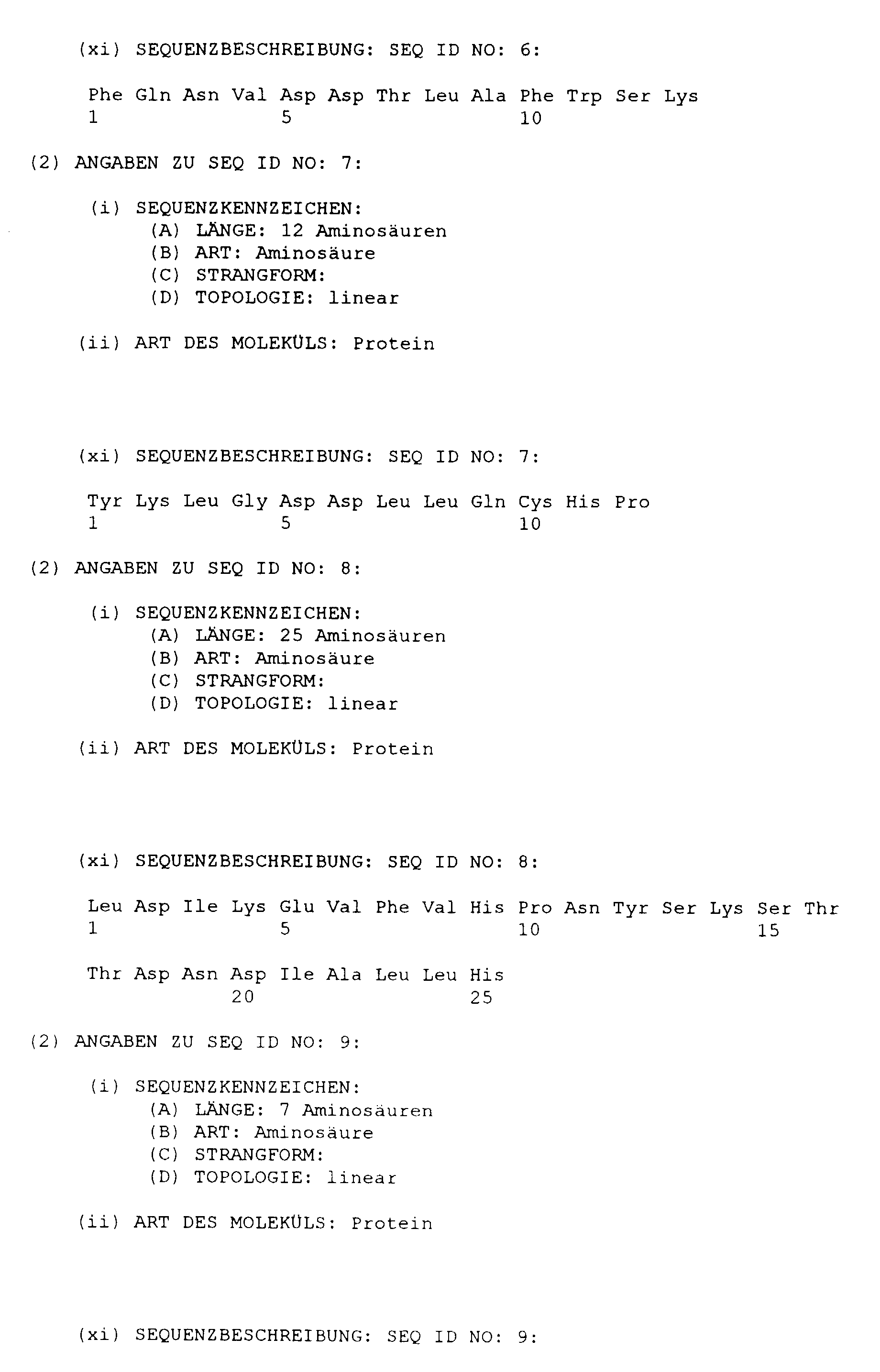
- AA 73-85 (FQNVDDTLAFWSK)
- AA 166-178 (YKLGDDLLQCHP)
- AA 279-304 (LDIKEVFVHPNYSKSTTDNDIALLH) mit der Konsensussequenz:
- AA 288-293 HPNYSKS
- AA 333-346 (GQETLVTGWGYHS)
- AA 336-352 (TLVTGWGYHSSREKEA)
- AA 427-439 (GLLHNYGVYTKVS)
- AA 449-461 (IRDKEAPQKSWAP, C-Terminus)
AA 265-277 (LEGYDLRRWEKWE)Folgende Sequenzen wurden als schwach bindend für Faktor V identifiziert (AA von Signalsequenz 1-32 gezählt):
AA 336-352 (TLVTGWGYHSSREKEA)Das geschilderte Verfahren kann in analoger Weise auch für alle anderen Mutationen angewendet werden, um an geeignete Liganden zu gelangen.
Mikrotestplatten (MTP; Greiner) werden mit 2 µg/ml eines anti-Faktor V-Antikörpers in 0,1 mol/l Carbonatpuffer, pH 9,6, für 16 h bei Raumtemperatur beschichtet. Nachfolgend wird die MTP entleert und mit einem Nachbeschichtungspuffer (0,15 mol/l NaCl, 0,1 % BSA, 0,1 % Saccharose) inkubiert. So hergestellte Mikrotestplatten sind nach dem Trocknen eingeschweißt mit einem Trockenbeutel bis zu 24 Monaten haltbar.
Bei nicht vorhandenen Mutationen ist die Reaktion positiv. Vorhandene Mutationen zeichnen sich durch abgeschwächte bzw. keine Reaktion aus.
Im zweiten Vorversuch wurde ein Peptid in der Apolipoprotein(a)-Sequenz gesucht, welches an o.g. Sequenz bindet. Mit Peptid-Scan wurde die Aminosäuresequenz Apo(a) K9 YTTDPCVRWEY identifiziert. Wobei besonders XTTXPXXRXXX (X = alle anderen bekannten Aminosäuren) wichtig sind. Der Diagnose liegt die Annahme zugrunde, daß das bindende Apo(a)-Peptid Strukturhomologie zum ApoB/E-Rezeptor besitzt und ein Verlust der Bindungsfähigkeit dieses Peptids auch den Verlust oder eine Verminderung der Affinität zu Rezeptor zur Folge hat (Vega, G.L., Grundy, S.M.: In vivo evidence for reduced binding of low density lipoproteins to receptors as a cause of primary moderate hypercholesterolemia. J. Clin. Invest. 78: 1410-1414, 1986).





Claims (23)
- Verfahren zur Bestimmung eines Proteins mit einer Mutation in einer Probe, die gegebenenfalls den Wildtyp des Proteins enthält, durch Zusetzen eines Liganden zur Probe, welcher Ligand entweder an das Protein mit der Mutation bindet oder an den Wildtyp, Ermitteln des Ausmaßes an gebundenem Liganden und Qualifizieren bzw. Quantifizieren der Mutation.
- Verfahren nach Anspruch 1, dadurch gekennzeichnet, daß als Ligand ein Peptid zugesetzt wird.
- Verfahren nach Anspruch 1 oder 2, dadurch gekennzeichnet, daß ein Ligand zugesetzt wird, der von einem physiologischen Bindungspartner zum Wildtyp abgeleitet ist.
- Verfahren nach einem der Ansprüche 1 bis 3, dadurch gekennzeichnet, daß ein Ligand zugegeben wird, der ein Peptid mit wenigstens drei Aminosäuren ist.
- Verfahren nach einem der Ansprüche 1 bis 4, dadurch gekennzeichnet, daß ein Ligand zugegeben wird, der wenigstens eine unphysiologische Aminosäure umfaßt.
- Verfahren nach einem der Ansprüche 1 bis 5, dadurch gekennzeichnet, daß als Ligand ein Antikörper zugegeben wird, der an die Stelle der Mutation bindet.
- Verfahren nach einem der Ansprüche 1 bis 6, dadurch gekennzeichnet, daß ein Ligand, der mit einem zur Detektion geeigneten Label versehen ist, zugegegeben wird.
- Verfahren nach einem der Ansprüche 1 bis 7, dadurch gekennzeichnet, daß der Label ausgewählt ist aus der Gruppe Chromogen, Fluorogen, Radionuklid, Enzym, Lanthanid und Luminogen.
- Verfahren nach einem der Ansprüche 1 bis 8, dadurch gekennzeichnet, daß das Protein an einem festen Träger immobilisiert ist.
- Verfahren nach einem der Ansprüche 1 bis 9, dadurch gekennzeichnet, daß das Protein mittels eines spezifischen Antikörpers an den festen Träger immobilisiert wird, welcher Antiköper nicht an die Stelle der Mutation bindet.
- Verfahren nach einem der Ansprüche 1 bis 10, dadurch gekennzeichnet, daß das Protein eine funktionelle Mutation aufweist.
- Verfahren nach einem der Ansprüche 1 bis 11, dadurch gekennzeichnet, daß das Ausmaß an gebundenem Liganden durch Detektion des gebundenen Liganden und/oder gebundenen Proteins ermittelt wird.
- Verfahren nach einem der Ansprüche 1 bis 12, dadurch gekennzeichnet, daß der Wildtyp Blutgerinnungsfaktor V ist und das Protein mit einer Mutation der Blutgerinnungsfaktor V-Leiden.
- Verfahren nach einem der Ansprüche 1 bis 13, dadurch gekennzeichnet, daß der Wildtyp Apoprotein a oder Apolipoprotein B ist und das Protein mit einer Mutation ein funktionell mutiertes Apoprotein a oder Apolipoprotein B ist.
- Verfahren nach Anspruch 13, dadurch gekennzeichnet, daß ein Ligand zugegeben wird, der von Protein C abgeleitet ist.
- Verfahren nach einem der Ansprüche 1 bis 12, dadurch gekennzeichnet, daß der Wildtyp eine erste Form von Apolipoprotein E ist und das Protein mit einer Mutation eine vom Wildtyp verschiedene Isoform des Apolipoproteins E ist.
- Verfahren nach einem der Ansprüche 1 bis 12, dadurch gekennzeichnet, daß der Wildtyp Blutgerinnungsfaktor VII ist und das Protein eine Mutante des Blutgerinnungsfaktor VII.
- Verfahren nach einem der Ansprüche 1 bis 12, dadurch gekennzeichnet, daß der Wildtyp Blutgerinnungsfaktor VIII ist und das Protein eine Mutante des Faktor VIII mit einer Punktmutation an der Bindungsstelle zu aktiviertem Protein C (APC) ist.
- Set zur Durchführung des Verfahrens nach Anspruch 1, umfassend die Komponenteneinen Liganden, der entweder an den Wildtyp des Proteins oder an das Protein mit einer Mutation bindet,einen festen Träger, welcher Bindungsstellen für das Protein aufweist,ein Mittel zur Detektion der Bindung des Liganden an das Protein, undein Mittel zum Vergleich der Bindung des Liganden an das Protein in einer Probe mit der Bindung des Liganden an das Protein in einem Standard.
- Set nach Anspruch 19, dadurch gekennzeichnet, daß der Ligand mit einem Label versehen ist.
- Set nach Anspruch 19 oder 20, dadurch gekennzeichnet, daß es zusätzlich einen Standard umfaßt.
- Set nach einem der Ansprüche 19 bis 21, dadurch gekennzeichnet, daß der feste Träger einen Antikörper umfaßt, der sowohl den Wildtyp als auch das Protein mit einer Mutation bindet.
- Set nach einem der Ansprüche 19 bis 22, dadurch gekennzeichnet, daß es die folgenden Komponenten umfaßt:einen von Protein C abgeleiteten, vorzugsweise biotinylierten Liganden,einen festen Träger umfassend Antikörper gegen Faktor V,Chemikalien zur Durchführung der Detektionsreaktion, vorzugsweise der Biotin-Detektionsreaktion, undggfs. einen Faktor V-Wildtyp-Standard und/oder einen Faktor-V-Leiden Standard.
Priority Applications (1)
| Application Number | Priority Date | Filing Date | Title |
|---|---|---|---|
| AT98890007T ATE280391T1 (de) | 1997-01-13 | 1998-01-12 | Verfahren zur bestimmung eines proteins mit einer mutation |
Applications Claiming Priority (3)
| Application Number | Priority Date | Filing Date | Title |
|---|---|---|---|
| AT0004497A AT404993B (de) | 1997-01-13 | 1997-01-13 | Verfahren zur bestimmung eines proteins mit einer mutation |
| AT4497 | 1997-01-13 | ||
| AT44/97 | 1997-01-13 |
Publications (3)
| Publication Number | Publication Date |
|---|---|
| EP0857973A2 true EP0857973A2 (de) | 1998-08-12 |
| EP0857973A3 EP0857973A3 (de) | 2000-06-21 |
| EP0857973B1 EP0857973B1 (de) | 2004-10-20 |
Family
ID=3480052
Family Applications (1)
| Application Number | Title | Priority Date | Filing Date |
|---|---|---|---|
| EP98890007A Expired - Lifetime EP0857973B1 (de) | 1997-01-13 | 1998-01-12 | Verfahren zur Bestimmung eines Proteins mit einer Mutation |
Country Status (3)
| Country | Link |
|---|---|
| EP (1) | EP0857973B1 (de) |
| AT (2) | AT404993B (de) |
| DE (1) | DE59812139D1 (de) |
Family Cites Families (6)
| Publication number | Priority date | Publication date | Assignee | Title |
|---|---|---|---|---|
| DK0489149T3 (da) * | 1990-06-27 | 2001-12-27 | Univ Princeton | Prober til påvisning af mutant P53 |
| JP3265577B2 (ja) * | 1992-10-13 | 2002-03-11 | デューク・ユニバーシティ | アポリポ蛋白eの4型イソ型の測定法 |
| ES2090001T3 (es) * | 1994-02-14 | 1998-08-01 | Univ Leiden | Un metodo para seleccionar por la presencia de un defecto genetico asociado con trombosis y/o una pobre respuesta anticoagulante a la proteina c activada. |
| GB9415073D0 (en) * | 1994-06-27 | 1994-09-14 | Smithkline Beecham Plc | Novel method |
| GB9414624D0 (en) * | 1994-07-20 | 1994-09-07 | Smithkline Beecham Plc | Novel method |
| US5712157A (en) * | 1994-12-20 | 1998-01-27 | University Of Washington | Methods and materials for the immunoassay of apolipoprotein(a) and lipoprotein(a) |
-
1997
- 1997-01-13 AT AT0004497A patent/AT404993B/de not_active IP Right Cessation
-
1998
- 1998-01-12 DE DE59812139T patent/DE59812139D1/de not_active Expired - Fee Related
- 1998-01-12 EP EP98890007A patent/EP0857973B1/de not_active Expired - Lifetime
- 1998-01-12 AT AT98890007T patent/ATE280391T1/de not_active IP Right Cessation
Also Published As
| Publication number | Publication date |
|---|---|
| EP0857973A3 (de) | 2000-06-21 |
| AT404993B (de) | 1999-04-26 |
| ATA4497A (de) | 1998-08-15 |
| EP0857973B1 (de) | 2004-10-20 |
| DE59812139D1 (de) | 2004-11-25 |
| ATE280391T1 (de) | 2004-11-15 |
Similar Documents
| Publication | Publication Date | Title |
|---|---|---|
| DE69633780T3 (de) | Verfahren zum assay von troponin i und t und komplexen von troponin i und t und auswahl von antikörpern zur verwendung in immunoassays | |
| DE69632734T2 (de) | QUANTIFIZIERUNG VON p97 ZUR DIAGNOSE UND ÜBERWACHUNG DER ALZHEIMHER-KRANKHEIT | |
| DE60033380T2 (de) | Verfahren zur quantifizierung der zahl von leukozyten in einer blutprobe | |
| DE3922960A1 (de) | Verfahren zur bestimmung eines analyten | |
| DE60202008T2 (de) | Verfahren zum Auffinden von Reagenzien und Festphasenkomponenten in spezifischen Bindungsassays, frei von fortgeschrittenen Glykosylierungsendprodukten | |
| EP1059359B1 (de) | Verfahren zur Bestimmung der Aktivität der Faktor VII-aktivierenden Protease aus Proteinlösungen | |
| EP0780687A2 (de) | Verfahren zur Herstellung eines synthetischen Kalibrators für Sandwich-Immunoassays | |
| Kroll et al. | Bias between enzymatic methods and the reference method for cholesterol. | |
| EP1650305A1 (de) | Mutanten der den Faktor VII aktivierenden Protease und Nachweisverfahren mit spezifischen Antikörpern | |
| EP3413053B1 (de) | Kalibration von lupus antikoagulans | |
| AT404993B (de) | Verfahren zur bestimmung eines proteins mit einer mutation | |
| DE4038899C2 (de) | Verfahren und Reagenzien zur Bestimmung der enzymatischen Aktivität von Transglutaminasen (EC 2.3.2.13) | |
| Higgins et al. | Tentative identification of hemoglobin variants in the Bio-Rad VARIANT II Hb A1C method | |
| EP0826965B1 (de) | Verfahren zur Herstellung von Faktor V-Mangelplasma und ein so erhaltenes Mangelplasma | |
| DE68911619T2 (de) | Reagenz und verfahren zum nachweis von rheumatoiden faktoren. | |
| EP0874994B1 (de) | Bestimmung der endständigen sialinsäurereste des human-transferrin-moleküls | |
| DE69025008T2 (de) | Verfahren für direkte chemische Bindung des D-Dimers aus einer biologischen Probe zwecks Diagnostik und Überwachung von thrombolytischen und hyperkoagulablen Zuständen | |
| DE10101792B4 (de) | Verfahren zum Nachweis von Pankreaskarzinom oder chronischer Pankreatitis und Verwendung von Antikörpern | |
| DE102009034119A1 (de) | Verfahren, insbesondere Enzyme-linked Immunosorbent Assay (ELISA), zum in vitro Nachweis von Amyloid beta Autoantikörpern, Mikrotiterplatte und Testkit | |
| DE10238429A1 (de) | Marburg I Mutante der Faktor VII aktivierenden Protease (FSAP) als Risikofaktor für Atherosklerose | |
| EP1583970B1 (de) | Elisa-verfahren zum nachweis von guanylat-bindungsprotein-1 (gbp-1) | |
| März et al. | Apolipoprotein E to B ratio: a marker for type III hyperlipoproteinaemia | |
| DE19701177C2 (de) | Verfahren zur Abtrennung und/oder Bestimmung von Cholesterin aus Lipoproteinfraktionen | |
| EP0565903B1 (de) | Verfahren zur immunologischen Bestimmung eines oder mehrerer Analyten | |
| EP1941055A1 (de) | In vitro verfahren zur diagnose von neurodegenerativen erkrankungen |
Legal Events
| Date | Code | Title | Description |
|---|---|---|---|
| PUAI | Public reference made under article 153(3) epc to a published international application that has entered the european phase |
Free format text: ORIGINAL CODE: 0009012 |
|
| AK | Designated contracting states |
Kind code of ref document: A2 Designated state(s): AT BE CH DE DK ES FI FR GB IT LI NL SE |
|
| AX | Request for extension of the european patent |
Free format text: AL;LT;LV;MK;RO;SI |
|
| RAP1 | Party data changed (applicant data changed or rights of an application transferred) |
Owner name: BAXTER AKTIENGESELLSCHAFT |
|
| RAP1 | Party data changed (applicant data changed or rights of an application transferred) |
Owner name: BAXTER AKTIENGESELLSCHAFT |
|
| PUAL | Search report despatched |
Free format text: ORIGINAL CODE: 0009013 |
|
| PUAF | Information related to the publication of a search report (a3 document) modified or deleted |
Free format text: ORIGINAL CODE: 0009199SEPU |
|
| PUAL | Search report despatched |
Free format text: ORIGINAL CODE: 0009013 |
|
| AK | Designated contracting states |
Kind code of ref document: A3 Designated state(s): AT BE CH DE DK ES FI FR GB GR IE IT LI LU MC NL PT SE |
|
| AX | Request for extension of the european patent |
Free format text: AL;LT;LV;MK;RO;SI |
|
| PUAF | Information related to the publication of a search report (a3 document) modified or deleted |
Free format text: ORIGINAL CODE: 0009199SEPU |
|
| D17D | Deferred search report published (deleted) | ||
| AX | Request for extension of the european patent |
Free format text: AL;LT;LV;MK;RO;SI |
|
| D17D | Deferred search report published (deleted) | ||
| PUAL | Search report despatched |
Free format text: ORIGINAL CODE: 0009013 |
|
| AK | Designated contracting states |
Kind code of ref document: A3 Designated state(s): AT BE CH DE DK ES FI FR GB GR IE IT LI LU MC NL PT SE |
|
| AX | Request for extension of the european patent |
Free format text: AL;LT;LV;MK;RO;SI |
|
| 17P | Request for examination filed |
Effective date: 20001202 |
|
| AKX | Designation fees paid |
Free format text: AT BE CH DE DK ES FI FR GB IT LI NL SE |
|
| 17Q | First examination report despatched |
Effective date: 20030409 |
|
| GRAP | Despatch of communication of intention to grant a patent |
Free format text: ORIGINAL CODE: EPIDOSNIGR1 |
|
| GRAS | Grant fee paid |
Free format text: ORIGINAL CODE: EPIDOSNIGR3 |
|
| GRAA | (expected) grant |
Free format text: ORIGINAL CODE: 0009210 |
|
| RIN1 | Information on inventor provided before grant (corrected) |
Inventor name: SCHENK, VERENA Inventor name: LANG, HARTMUT, DR. Inventor name: KIESSIG, STEPHAN Inventor name: MORITZ, BERTA, DR. |
|
| RIN1 | Information on inventor provided before grant (corrected) |
Inventor name: SCHENK, VERENA Inventor name: LANG, HARTMUT, DR. Inventor name: KIESSIG, STEPHAN Inventor name: MORITZ, BERTA, DR. |
|
| AK | Designated contracting states |
Kind code of ref document: B1 Designated state(s): AT BE CH DE DK ES FI FR GB IT LI NL SE |
|
| PG25 | Lapsed in a contracting state [announced via postgrant information from national office to epo] |
Ref country code: NL Free format text: LAPSE BECAUSE OF FAILURE TO SUBMIT A TRANSLATION OF THE DESCRIPTION OR TO PAY THE FEE WITHIN THE PRESCRIBED TIME-LIMIT Effective date: 20041020 Ref country code: IT Free format text: LAPSE BECAUSE OF FAILURE TO SUBMIT A TRANSLATION OF THE DESCRIPTION OR TO PAY THE FEE WITHIN THE PRESCRIBED TIME-LIMIT;WARNING: LAPSES OF ITALIAN PATENTS WITH EFFECTIVE DATE BEFORE 2007 MAY HAVE OCCURRED AT ANY TIME BEFORE 2007. THE CORRECT EFFECTIVE DATE MAY BE DIFFERENT FROM THE ONE RECORDED. Effective date: 20041020 Ref country code: GB Free format text: LAPSE BECAUSE OF FAILURE TO SUBMIT A TRANSLATION OF THE DESCRIPTION OR TO PAY THE FEE WITHIN THE PRESCRIBED TIME-LIMIT Effective date: 20041020 Ref country code: FR Free format text: LAPSE BECAUSE OF FAILURE TO SUBMIT A TRANSLATION OF THE DESCRIPTION OR TO PAY THE FEE WITHIN THE PRESCRIBED TIME-LIMIT Effective date: 20041020 Ref country code: FI Free format text: LAPSE BECAUSE OF FAILURE TO SUBMIT A TRANSLATION OF THE DESCRIPTION OR TO PAY THE FEE WITHIN THE PRESCRIBED TIME-LIMIT Effective date: 20041020 |
|
| REG | Reference to a national code |
Ref country code: GB Ref legal event code: FG4D Free format text: NOT ENGLISH |
|
| REG | Reference to a national code |
Ref country code: CH Ref legal event code: EP |
|
| REF | Corresponds to: |
Ref document number: 59812139 Country of ref document: DE Date of ref document: 20041125 Kind code of ref document: P |
|
| PG25 | Lapsed in a contracting state [announced via postgrant information from national office to epo] |
Ref country code: AT Free format text: LAPSE BECAUSE OF NON-PAYMENT OF DUE FEES Effective date: 20050112 |
|
| PG25 | Lapsed in a contracting state [announced via postgrant information from national office to epo] |
Ref country code: SE Free format text: LAPSE BECAUSE OF FAILURE TO SUBMIT A TRANSLATION OF THE DESCRIPTION OR TO PAY THE FEE WITHIN THE PRESCRIBED TIME-LIMIT Effective date: 20050120 Ref country code: DK Free format text: LAPSE BECAUSE OF FAILURE TO SUBMIT A TRANSLATION OF THE DESCRIPTION OR TO PAY THE FEE WITHIN THE PRESCRIBED TIME-LIMIT Effective date: 20050120 |
|
| PG25 | Lapsed in a contracting state [announced via postgrant information from national office to epo] |
Ref country code: LI Free format text: LAPSE BECAUSE OF NON-PAYMENT OF DUE FEES Effective date: 20050131 Ref country code: ES Free format text: LAPSE BECAUSE OF FAILURE TO SUBMIT A TRANSLATION OF THE DESCRIPTION OR TO PAY THE FEE WITHIN THE PRESCRIBED TIME-LIMIT Effective date: 20050131 Ref country code: CH Free format text: LAPSE BECAUSE OF NON-PAYMENT OF DUE FEES Effective date: 20050131 Ref country code: BE Free format text: LAPSE BECAUSE OF NON-PAYMENT OF DUE FEES Effective date: 20050131 |
|
| NLV1 | Nl: lapsed or annulled due to failure to fulfill the requirements of art. 29p and 29m of the patents act | ||
| GBV | Gb: ep patent (uk) treated as always having been void in accordance with gb section 77(7)/1977 [no translation filed] |
Effective date: 20041020 |
|
| BERE | Be: lapsed |
Owner name: BAXTER A.G. Effective date: 20050131 |
|
| PG25 | Lapsed in a contracting state [announced via postgrant information from national office to epo] |
Ref country code: DE Free format text: LAPSE BECAUSE OF NON-PAYMENT OF DUE FEES Effective date: 20050802 |
|
| PLBE | No opposition filed within time limit |
Free format text: ORIGINAL CODE: 0009261 |
|
| STAA | Information on the status of an ep patent application or granted ep patent |
Free format text: STATUS: NO OPPOSITION FILED WITHIN TIME LIMIT |
|
| REG | Reference to a national code |
Ref country code: CH Ref legal event code: PL |
|
| 26N | No opposition filed |
Effective date: 20050721 |
|
| EN | Fr: translation not filed | ||
| BERE | Be: lapsed |
Owner name: *BAXTER A.G. Effective date: 20050131 |