EP0854380A2 - Gütergeschaltetes Lasersystem mit ausserhalb des Resonators harmonisch erzeugtem UV-Licht - Google Patents
Gütergeschaltetes Lasersystem mit ausserhalb des Resonators harmonisch erzeugtem UV-Licht Download PDFInfo
- Publication number
- EP0854380A2 EP0854380A2 EP98300112A EP98300112A EP0854380A2 EP 0854380 A2 EP0854380 A2 EP 0854380A2 EP 98300112 A EP98300112 A EP 98300112A EP 98300112 A EP98300112 A EP 98300112A EP 0854380 A2 EP0854380 A2 EP 0854380A2
- Authority
- EP
- European Patent Office
- Prior art keywords
- laser
- harmonic
- crystal
- linear crystal
- conversion
- Prior art date
- Legal status (The legal status is an assumption and is not a legal conclusion. Google has not performed a legal analysis and makes no representation as to the accuracy of the status listed.)
- Withdrawn
Links
- 239000013078 crystal Substances 0.000 claims abstract description 135
- 238000006243 chemical reaction Methods 0.000 claims description 49
- 229910017502 Nd:YVO4 Inorganic materials 0.000 claims description 27
- 230000003287 optical effect Effects 0.000 claims description 11
- 238000000034 method Methods 0.000 description 15
- 239000007787 solid Substances 0.000 description 9
- 239000000835 fiber Substances 0.000 description 7
- 230000000694 effects Effects 0.000 description 6
- 230000007423 decrease Effects 0.000 description 5
- 239000000463 material Substances 0.000 description 5
- 238000010586 diagram Methods 0.000 description 4
- 150000002500 ions Chemical class 0.000 description 4
- 241000502522 Luscinia megarhynchos Species 0.000 description 2
- 229910009372 YVO4 Inorganic materials 0.000 description 2
- 238000005086 pumping Methods 0.000 description 2
- 230000001105 regulatory effect Effects 0.000 description 2
- 101100029576 Schizosaccharomyces pombe (strain 972 / ATCC 24843) cwg2 gene Proteins 0.000 description 1
- 229910003069 TeO2 Inorganic materials 0.000 description 1
- 238000013459 approach Methods 0.000 description 1
- 238000000576 coating method Methods 0.000 description 1
- 230000003247 decreasing effect Effects 0.000 description 1
- 230000000593 degrading effect Effects 0.000 description 1
- 230000001419 dependent effect Effects 0.000 description 1
- 238000001514 detection method Methods 0.000 description 1
- 230000001627 detrimental effect Effects 0.000 description 1
- 238000011161 development Methods 0.000 description 1
- 238000006073 displacement reaction Methods 0.000 description 1
- 238000004146 energy storage Methods 0.000 description 1
- 238000005516 engineering process Methods 0.000 description 1
- 230000003993 interaction Effects 0.000 description 1
- VCZFPTGOQQOZGI-UHFFFAOYSA-N lithium bis(oxoboranyloxy)borinate Chemical compound [Li+].[O-]B(OB=O)OB=O VCZFPTGOQQOZGI-UHFFFAOYSA-N 0.000 description 1
- 238000004519 manufacturing process Methods 0.000 description 1
- 238000012986 modification Methods 0.000 description 1
- 230000004048 modification Effects 0.000 description 1
- 238000012544 monitoring process Methods 0.000 description 1
- 230000010355 oscillation Effects 0.000 description 1
- 238000010248 power generation Methods 0.000 description 1
- 239000011347 resin Substances 0.000 description 1
- 229920005989 resin Polymers 0.000 description 1
- 238000000926 separation method Methods 0.000 description 1
- 238000006467 substitution reaction Methods 0.000 description 1
- LAJZODKXOMJMPK-UHFFFAOYSA-N tellurium dioxide Chemical compound O=[Te]=O LAJZODKXOMJMPK-UHFFFAOYSA-N 0.000 description 1
- 230000002123 temporal effect Effects 0.000 description 1
- 238000013519 translation Methods 0.000 description 1
Images

Classifications
-
- H—ELECTRICITY
- H01—ELECTRIC ELEMENTS
- H01S—DEVICES USING THE PROCESS OF LIGHT AMPLIFICATION BY STIMULATED EMISSION OF RADIATION [LASER] TO AMPLIFY OR GENERATE LIGHT; DEVICES USING STIMULATED EMISSION OF ELECTROMAGNETIC RADIATION IN WAVE RANGES OTHER THAN OPTICAL
- H01S3/00—Lasers, i.e. devices using stimulated emission of electromagnetic radiation in the infrared, visible or ultraviolet wave range
- H01S3/10—Controlling the intensity, frequency, phase, polarisation or direction of the emitted radiation, e.g. switching, gating, modulating or demodulating
-
- G—PHYSICS
- G02—OPTICS
- G02F—OPTICAL DEVICES OR ARRANGEMENTS FOR THE CONTROL OF LIGHT BY MODIFICATION OF THE OPTICAL PROPERTIES OF THE MEDIA OF THE ELEMENTS INVOLVED THEREIN; NON-LINEAR OPTICS; FREQUENCY-CHANGING OF LIGHT; OPTICAL LOGIC ELEMENTS; OPTICAL ANALOGUE/DIGITAL CONVERTERS
- G02F1/00—Devices or arrangements for the control of the intensity, colour, phase, polarisation or direction of light arriving from an independent light source, e.g. switching, gating or modulating; Non-linear optics
- G02F1/35—Non-linear optics
- G02F1/353—Frequency conversion, i.e. wherein a light beam is generated with frequency components different from those of the incident light beams
-
- G—PHYSICS
- G02—OPTICS
- G02F—OPTICAL DEVICES OR ARRANGEMENTS FOR THE CONTROL OF LIGHT BY MODIFICATION OF THE OPTICAL PROPERTIES OF THE MEDIA OF THE ELEMENTS INVOLVED THEREIN; NON-LINEAR OPTICS; FREQUENCY-CHANGING OF LIGHT; OPTICAL LOGIC ELEMENTS; OPTICAL ANALOGUE/DIGITAL CONVERTERS
- G02F1/00—Devices or arrangements for the control of the intensity, colour, phase, polarisation or direction of light arriving from an independent light source, e.g. switching, gating or modulating; Non-linear optics
- G02F1/35—Non-linear optics
- G02F1/353—Frequency conversion, i.e. wherein a light beam is generated with frequency components different from those of the incident light beams
- G02F1/3534—Three-wave interaction, e.g. sum-difference frequency generation
-
- G—PHYSICS
- G02—OPTICS
- G02F—OPTICAL DEVICES OR ARRANGEMENTS FOR THE CONTROL OF LIGHT BY MODIFICATION OF THE OPTICAL PROPERTIES OF THE MEDIA OF THE ELEMENTS INVOLVED THEREIN; NON-LINEAR OPTICS; FREQUENCY-CHANGING OF LIGHT; OPTICAL LOGIC ELEMENTS; OPTICAL ANALOGUE/DIGITAL CONVERTERS
- G02F1/00—Devices or arrangements for the control of the intensity, colour, phase, polarisation or direction of light arriving from an independent light source, e.g. switching, gating or modulating; Non-linear optics
- G02F1/35—Non-linear optics
- G02F1/37—Non-linear optics for second-harmonic generation
-
- G—PHYSICS
- G02—OPTICS
- G02F—OPTICAL DEVICES OR ARRANGEMENTS FOR THE CONTROL OF LIGHT BY MODIFICATION OF THE OPTICAL PROPERTIES OF THE MEDIA OF THE ELEMENTS INVOLVED THEREIN; NON-LINEAR OPTICS; FREQUENCY-CHANGING OF LIGHT; OPTICAL LOGIC ELEMENTS; OPTICAL ANALOGUE/DIGITAL CONVERTERS
- G02F1/00—Devices or arrangements for the control of the intensity, colour, phase, polarisation or direction of light arriving from an independent light source, e.g. switching, gating or modulating; Non-linear optics
- G02F1/35—Non-linear optics
- G02F1/353—Frequency conversion, i.e. wherein a light beam is generated with frequency components different from those of the incident light beams
- G02F1/354—Third or higher harmonic generation
-
- G—PHYSICS
- G02—OPTICS
- G02F—OPTICAL DEVICES OR ARRANGEMENTS FOR THE CONTROL OF LIGHT BY MODIFICATION OF THE OPTICAL PROPERTIES OF THE MEDIA OF THE ELEMENTS INVOLVED THEREIN; NON-LINEAR OPTICS; FREQUENCY-CHANGING OF LIGHT; OPTICAL LOGIC ELEMENTS; OPTICAL ANALOGUE/DIGITAL CONVERTERS
- G02F2201/00—Constructional arrangements not provided for in groups G02F1/00 - G02F7/00
- G02F2201/16—Constructional arrangements not provided for in groups G02F1/00 - G02F7/00 series; tandem
Definitions
- This invention relates to diode-pumped solid-state lasers, and in particularly to diode-pumped solid state laser systems that provide harmonically converted output.
- Diode-pumped Nd:YVO 4 lasers have been used in applications that require short pulses ( ⁇ 20 nsec) at high repetition rates (> 10 kHz). See for example M.S. Keirstead, T.M. Baer, S.B. Hutshison, J. Hobbs, "High repetition rate, diode-bar-pumped, Q-switched Nd:YVO 4 laser", in Conference on Lasers and Electro-Optics, 1993, Vol. 11, OSA Technical Digest Series (Optical Society of America, Washington, D.C., 1993), p. 642, and S.B. Hutchison, T.M. Baer, K. Cox, P. Gooding, D. Head, J. Hobbs, M. Keirstead, and G.
- Nd:YVO 4 lasers in a manner that provides short pulses at high repetition rate, as does W.L. Nighan, Jr., Mark S. Keirstead, Alan B. Petersen, and Jan-Wvettem Pieterse "Harmonic generation at high repetition rate with Q-switched Nd:YVO 4 lasers", in SPIE 2380-24, 1995, which discloses generation of Q-switched pulses with an end-pumped, acousto-optically Q-switched laser.
- the characteristics of Nd:YVO 4 facilitate the generation of short, high peak power Q-switched pulses at high repetition rates, which subsequently facilitates harmonic generation with nonlinear crystals.
- pulse durations of 7 - 20 nsec were generated for repetition rates of 10 - 80 kHz, at average output power of 3 to 4 W in a TEM oo mode.
- the pump source was a fiber-coupled diode bar, as disclosed in US Patents 5,127,068 and 5,436,990. End-pumping of Nd:YVO 4 with a pump source like this fiber-coupled bar allows generation of very high small signal gain, since this material has a stimulated emission cross-section that is much higher than that of Nd:YLF or Nd:YAG. This is useful for building a diode-pumped laser with a low laser oscillation thresholds and is also useful for building a laser that provides short pulses at high repetition rates.
- Nd:YLF 500 ⁇ sec
- Nd:YAG 200 ⁇ sec
- an Nd:YVO 4 laser pumped at 10 W can provide 200 ⁇ J at low repetition rates
- the YLF laser designated "TFR" by Spectra-Physics lasers, described by T.M. Baer, D.F. Head, P. Gooding, G.J. Kintz, S.B.
- Hutchison in "Performance of Diode-Pumped Nd:YAG and Nd:YLF in a Tightly Folded Resonator Configuration", IEEE J. Quantum Electron, vol. QE-28, pp. 1131-1133, 1992) provide ⁇ 800 ⁇ J.
- the application of Nd:YVO 4 is thus well suited to generation of short pulses at high repetition rate.
- This form of doubling is relatively angle insensitive and preserves the beam quality of the infrared laser. Conversion efficiencies of over 50% were be achieved with a pulsed Nd: YVO 4 laser at 10-20 kHz, with nearly diffraction limited beam quality at 532 nm.
- Petersen describes the general advantages of LBO, including a high damage threshold and the absence of gray-tracking seen with KTP. Taking advantage of the NCPM frequency doubling, Petersen subsequently demonstrated sum-frequency generation of the third harmonic in a second crystal, also in LBO, but Type II, critically-phase-matched or angle-tuned.
- LBO has become popularized in recent years, owing to the capacity for NCPM, the high damage thresholds, reasonable nonlinear coefficients, and low-loss.
- the capacity for non-critical phase-matching in the doubling process is considered to be highly advantageous by those skilled in the art.
- the LBO doubling and tripling allows production of laser light at the highly useful wavelength of 355 nm.
- Petersen's work over 600 mW of 355 nm light were generated using an NCPM doubler and an angle tuned tripler.
- a single fiber-coupled 20 W diode bar was used as the source to end-pump the Nd:YVO 4 crystal; only 12 W was used (from the fiber) to achieve the result.
- the power conversion efficiency from 1.064 microns to 355 nm was therefore 20%, and the conversion efficiency from diode pump power (12 W) to 355 mn was 5%.
- the repetition rate of 20 kHz is high enough allows substitution of the Nd:YVO 4 system for traditional high power CW ion lasers operating at 351 nm.
- One important application is stereolithography, where the UV laser beam is scanned across the surface of a UV sensitive resin in order to "rapidly prototype" solid models of given parts. This application of solid-state and ion lasers in this area is reviewed by Partanen (SPIE 1996).
- Alfrey et al (CLEO 1996 PD) presented a diode pumped Nd:YVO 4 laser system that provided 355 nm light via intracavity, Q-switched third harmonic generation. He utilized two LBO crystals placed near one another in laser cavity, with a side-pumped Nd:YVO 4 gain medium placed elsewhere in the cavity. The two LBO crystals were cut at angles that allowed near room-temperature doubling and near room-temperature tripling. The crystals were apparently angle-tuned.
- Alfrey's work was intracavity THG, with the two LBO crystals placed very close to one another, with no intervening optics; (2) Alfrey used angle-turned LBO crystals, and did not utilize NCPM doubling; (3) Alfrey's work utilized the relatively higher average 1.064 micron powers that can be generated intracavity, which are typically on the order of 10 times higher than that available extracavity, as in Petersen's work. Alfrey generated over 2 W of 355 nm light at a Q-switch repetition rate of ⁇ 30 kHz. A single, direct coupled 20 W diode bar was used to side-pump the Nd:YVO 4 material. The power conversion efficiency from diode light to 355 nm was 10% in this intracavity THG arrangement.
- Alfrey's scheme was a Q-switched, intracavity tripled scheme, which generated more UV for a given amount of diode pump light than did the extracavity scheme of Petersen et al.
- an intracavity tripled scheme does expose the nonlinear crystals to much higher average power densities and peak power densities than does an extracavity scheme, such as in Petersen et al.
- This exposure to high power densities is recognized to be a potential problem by those skilled in the art. Crystal surfaces or coatings may be damaged or degraded by this power density.
- an extracavity tripled system that matched or exceeded the conversion efficiencies demonstrated by Alfrey would be useful.
- Alfrey does not describe the effects of walk-off in the LBO doubler and/or tripler, although one skilled in the art will realize that there are some effects of walk-off in those processes. Alfrey does not consider the use of optics between the two crystals to condition the walk-off of the two beams leaving the doubler prior to their entrance into the tripler. He does not consider an optimal conversion efficiency for a doubling process in order to optimize the efficiency of a tripling proccss.
- Alfrey's scheme is an intracavity scheme, which differs greatly from the extracavity arrangements of Petersen; the ratios of 1064, 532 and 355 no powers are quite different since the 1.064 power is intracavity and therefore relatively higher in power than an extracavity 1064 nm beam from a similarly pumped laser.
- the work was directed towards the generation of high repetition rate UV light near 355 nm.
- the pulsed 355 nm beam can be used as a substitute for a CW UV laser beam. See for example Partanen et al, SPIE 1996.
- the average power generated at the 355 nm harmonic will relate to the peak power and repetition rate of the infrared laser, as well as the high repetition rate average power of the infrared Q-switched laser at the fundamental wavelength.
- the average power of a CW-pumped, repetitively Q-swiched laser approaches its CW non-Q-switched power when the repetition rate exceeds 1/ ⁇ f , where ⁇ f is the upperstate lifetime of the gain medium.
- this repetition rate is ⁇ 10 kHz, or 1/(100 ⁇ sec).
- the pulse energy is approximately constant.
- Nd:YVO 4 lasers from 10 to 40 kHz.
- the maximum average powers upon harmonic generation typically occur at lower repetition rates, such as 2 - 9 kHz. This is due to the longer upper state lifetimes in this materials, with respect to Nd:YVO 4 .
- the Q-switched laser pulse will not build up as rapidly in the laser cavity as it would at lower repetition rate. Therefore, at increasing repetition rates, the pulse will be longer, energy lower, and peak power will decrease. This will have a direct impact upon harmonic generation efficiency.
- NCPM non-critical phase-matching
- SHG second-harmonic generation
- Bosenberg in US Patent #5,047,668, "Optical walk-off compensation in critically phase-matched three-wave frequency conversion schemes", where Bosenberg describes tbe use of two identical crystals positioned at tilt angles theta and (- theta), for a total relative angle of 2(theta).
- Bosenberg teaches that two identical crystals can be used, positioned symmetrically at angle theta and ( - theta) from the propagation direction.
- the walk-off of the second crystal undoes the walk-off of the first, and the fundamental beam and harmonic beam can therefore exit the crystal pair as overlapped beams.
- Bosenberg points out that 2 identical crystals of the same cut can be used in opposing orientation where the second crystal completely compensates the walk-off introduced by the first crystal. Bosenberg does not consider the use of optics between the two crystals to condition the walk-off of the two beams leaving the doubler. He does not consider an optimal conversion efficiency for a doubling process in order to optimize the efficiency of a tripling process.
- Nightingale describes a related problem in US Patent #5,136,597, "Poynting vector walk-off compensation in Type II phase matching.” This relates specifically to the doubling process, especially in an intracavity or resonant cavity method. It does not consider tripling, let alone non-intracavity or non-resonant doubling. Nightingale solved a specific problem with KTP in Type II phase-matching in an intracavity-doubled solid state laser. He did not consider the use of two or more crystals. He does not teach tripling with at least two crystals.
- One aspect of the invention provides a Q-switched or pulsed diode-pumped solid-state laser system that provides harmonically generated UV light at high repetition rate with high efficiency.
- Another aspect of the invention provides a Q-switched or pulsed solid-state laser that provides harmonically generated UV light at high repetition rate with high efficiency with Nd:YVO 4 as the gain medium.
- Yet another aspect of the invention provides a Q-switched or pulsed solid state laser that provides harmonically generated UV light at high repetition rate with high efficiency with non-linear crystals utilised in an extracavity harmonic generation configuration.
- Still a further aspect of the invention provides a Q-switched or pulsed solid state laser that provides harmonically generated UV light at high repetition rate with high efficiency, incorporating LBO as the non-linear harmonic generation medium, with multiple LBO crystals utilised in an extracavity harmonic generation configuration.
- a further aspect of the invention provides a Q-switched or pulsed solid state laser that provides harmonically generated UV light at high repetition rate with multiple LBO crystals cut at angles that introduce walk-off between ordinary and extra-ordinary waves in the LBO non-linear crystals in a manner that optimises generation of UV.
- Still another aspect of the invention provides a Q-switched or pulsed solid state laser that provides harmonically generated UV light at high repetition rate with multiple LBO crystals cut at angles that introduce walk-off between ordinary and extra-ordinary waves in the LBO non-linear crystals, and including an optical device placed in the beam path between the LBO crystals in order to condition the walk-off between the multiple LBO non-linear crystals in a manner that optimises the generation of UV.
- a further aspect of the invention provides a Q-switched or pulsed solid state laser that provides harmonically generated UV light at high repetition rate with multiple LBO crystals cut at angles that introduce walk-off between ordinary and extra-ordinary waves in the LBO non-linear crystals in a manner that optimises generation of UV, with the conversion efficiency from infrared to green reduced from a maximum IR to green conversion efficiency in order to maximise a conversion efficiency from IR to UV.
- Yet another aspect of the invention provides a Q-switched diode-pumped solid-state laser that provides 355nm pulsed output at repetition rates greater than 10kHz, at powers greater than 100mW.
- the invention provides a diode pumped laser that includes a high reflector and an output coupler defining a resonator.
- the resonator includes a gain medium and a Q-switch and produces a fundamental beam.
- a first non-linear crystal is positioned extra-cavity of the resonator along a path of the fundamental beam.
- the first non-linear crystal generates a second harmonic beam from the fundamental beam.
- the first non-linear crystal is critically phased matched.
- a second non-linear crystal is portioned extra-cavity of the resonator along a path of the fundamental beam and the path of the second harmonic beam.
- the second non-linear crystal produces a third harmonic beam.
- the second non-linear crystal is critically phased matched.
- a Q-switched diode-pumped solid-state laser with an Nd:YVO 4 laser crystal placed in the resonator of the laser, said resonator incorporating at least two mirrors, with a Q-switch device placed in the laser resonator, with the pump power density and cavity lifetime balanced to provide short Q-switched pulses at high repetition rate with high stability.
- the infrared beam from said laser is passed through a doubling crystal that is critically phase-matched.
- this doubling crystal is LBO, cut for angle-tuned doubling, operated at a temperature of about 50 °C, and cut with an angle phi of about 5 to 15 degrees.
- the conversion efficiency to green from IR is reduced to a level below the maximum obtainable level, for example, it is about 30%.
- the green and IR beams are subsequently passed through a second LBO crystal, this LBO crystal cut for angle-tuned tripling.
- the conversion efficiency to UV from IR, or to 355 nm from 1.064 ⁇ m is optimized (such as to > 30%) when the conversion efficiency to green from IR, or to 532 nm from 1.064 ⁇ m, is reduced (such as to ⁇ 30%).
- the conversion efficiency from 1.064 ⁇ m to 355 nm is also optimized when the two LBO crystals each introduce some amount of walk-off between the IR and green beams. In a preferred embodiment, this conversion efficiency is optimized further when optical devices are placed in the beam path between the LBO crystals in order to condition the walk-off between the multiple LBO nonlinear crystals.
- the beam quality is nearly diffraction-limited.
- the power is greater than 200 mW at 355 nm, and it is possible to generate over 1 W at 355 nm, still with only 1 diode bar.
- the LBO crystals are operated at a temperature near 50 ° C.
- Nd:YVO 4 and an angle-tuned LBO doubler and an angle-tuned LBO tripler have been incorporated for the first time in an extracavity-tripled, high power (>100 mW), high repetition rate (> 10 kHz), high beam quality (M 2 ⁇ 2), Q-switched diode-pumped solid-state laser. In a preferred embodiment, it provides over 300 mW in average output power at repetition rates greater than 20 kHz.
- the laser of the present invention provides over 1 W at 355 nm. Additionally, the output of the UV laser system is optimized for stereolithgraphy applications.
- Figure 1 is a diagram of a critically phase-matched doubling process followed by a critically-phase-matched tripling process.
- Figure 2 is a diagram of a Q-switched, diode-pumped, Nd:YVO 4 solid-state laser and an extracavity harmonic generation scheme utilized in a preferred embodiment of the invention.
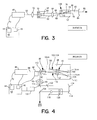
- Figure 3 is a schematic diagram of one embodiment of the invention.
- Figure 4 is a schematic diagram of a system of the invention utilized with stereolithography.
- the present invention is a diode pumped laser includes a high reflector and an output coupler defining a resonator.
- the resonator includes a gain medium and a Q-switch and produces a fundamental beam.
- a first non-linear crystal is positioned extra-cavity of the resonator along a path of the fundamental beam.
- the first non-linear crystal generates a second harmonic beam from the fundamental beam.
- the first non-linear crystal is critically phased matched.
- a second non-linear crystal is portioned extra-cavity of the resonator along a path of the fundamental beam and the path of the second harmonic beam.
- the second non-linear crystal produces a third harmonic beam.
- the second non-linear crystal is critically phased matched.
- the first non-linear crystal is made of LBO.
- the second non-linear crystal is made of LBO.
- the first non-linear crystal can have a cut of phi in the range of 5 to 10 degrees and theta in the range of 85 to 90 degrees.
- the second non-linear crystal can have a cut of phi in the range of 85 to 90 degrees and theta in the range of 42 to 47 degrees.
- the gain medium may be Nd:YVO 4 .
- the resonator may be Q-switched at repetition rates of 10 KHz and greater.
- An optical element can be positioned between the first non-linear crystal and the second non-linear crystal.
- the optical element modifies a walk-off between the fundamental and the second harmonic beams.
- An efficiency of conversion from the fundamental beam to the second harmonic beam is less than a maximum efficiency of conversion to increase an efficiency of conversion from the fundamental beam to the third harmonic beam.
- An efficiency of conversion from the fundamental beam to the second harmonic beam is in the range of 25 to 35%.
- the efficiency of conversion from the fundamental beam to the second harmonic beam is less than a maximum efficiency of conversion to increase an efficiency of conversion from the fundamental beam to the third harmonic beam.
- the efficiency of conversion from the fundamental beam to the second harmonic beam is in the range of 25 to 35%. In one embodiment, the efficiency of conversion from the fundamental beam to the second harmonic beam is 30%.
- LBO doubling and tripling crystals 10 and 12 do not use zero-walk-off NCPM doubling.
- a preferred embodiment utilizes a critically phase-matched, angle-tuned doubling LBO crystal 10, followed by a critically phase-matched tripler crystal 12.
- LBO doubling crystal 10 is operated at a temperature of 50 °C, as opposed to the typical 150 - 160 °C utilized for NCPM.
- a fundamental 1064 nm beam 16 is incident upon LBO angle-tuned doubling crystal 10, with an intracrystal fundamental beam 18 and intracavity doubled beam 20 generated in crystal 10.
- a relative walk-off 22 between the two is generated by this type of frequency-doubling, as is well-known.
- the doubled 532 nm beam and 1064 nm beam leave doubling crystal 10 as beams 24 and 26, respectively, and enter critically phase-matched tripling crystal 12.
- Beams 28 and 30 are separated from one another after leaving crystal 10.
- Doubled and infrared beams 28 and 30 have finite spatial extent, as is well-known. Beams 28 and 30 may overlap partially, but they do not overlap perfectly as in the case of NCPM.
- the beams 24 and 26 enter LBO tripling crystal 12, where the intracrystal 1064 nm beam 30 and intracrystal 532 nm beam 28 propagate through LBO tripling crystal 12.
- tripling crystal 12 is oriented in a way that the walk-off 32 intoduced by LBO tripling crystal 12 is such that beams 28 and 30 walk still further apart. If the beams 28 and 30 have spatial extent that allows some overlap in crystal 12, a tripled UV beam 34 is generated at 355 nm, as beams 28 and 30 mix via sum-frequency mixing, as is well-known.
- Beams 36, 38 and 40 leave crystal 12 as 1064 nm, 532 nmn, and 355 nm output beams, respectively, save for Fresnel losses, which are well-known.
- LBO tripling crystal 12' is positioned in an opposite sense to that in Figure 1. Crystal 12 is rotated 180 degrees with respect to the position shown in Figure 1. In this case, the 1064 nm beam 30 and the green 532 nm beam 28 walk towards one another in tripling crystal 12' with walk-off angle 32', generating 355 nm beam 34 in crystal 12', and 355 nm beam 40 exits crystal 12'.
- the 1064 nm and 532 nm beams 36 and 38 also leave crystal 12', with beams 36, 38 and 40 experiencing some Fresnel loss, as is well-known.
- FIG. 1 and 2 are optional optics in the path of beams 24 and 26, in between doubling and tripling crystals 10 and 12'.
- Such optics can adjust relative position and angles of beams 24 and 26.
- One example is a simple lens or a focussing concave mirror or minors (not shown).
- Such an optic takes beams 24 and 26 and modifies the relative angle between them and may modify the relative position.
- These modifying optics can include but are not limited to lenses, mirrors, dispersive optics or elements, refractive optics or elements, and diffractive optics or elements.
- the intermediate conversion efficiency of 1064 nm to 532 nm has an optimum with respect to the amount of 355 nm light produced. It is possible to convert over 60% of the 1064 power to power at 532 nm. However, optimal 355 nm power is not obtained at such high conversions to 532 nm. Such a high conversion can distort the spatial and temporal character of the 1064 nm beam, thus degrading the sum frequency process of 1064 plus 532 nm in generating 355 nm power. Optimal conversion of 1064 nm to 355 nm is obtained when the intermediate conversion to 532 nm is reduced to ⁇ 30%. There are numerous methods to reduce this efficiency including but not limited to translation of doubling crystal 10 to a plane of reduced 1064 nm power density, angle detuning, temperature detuning and the like.
- a power supply 42 houses a fiber-coupled diode module 44 and RF driver 46, and drives Q-switched Nd:YVO 4 laser head 48.
- This is available from Spectra-Physics Lasers as a B10-106Q, and is described in Nighan and Petersen. It produces 1064 nm beam 50, which can be a 3 W average power beam of Q-switched 10 nsec pulses at 20 - 30 kHz.
- the beam quality is typically measured as M 2 ⁇ 1.2.
- Beam 50 is focussed by one or more optics 52, as described above.
- the focussed 1064 nm beam 54 in doubler crystal 10 may be on the order of 50 ⁇ m in radius.
- a doubled beam 56 is generated, with a relative walk-off angle 58 wiht respect to beam 54. Typical walk-off angles can be on the order of 0.5 degrees.
- the depleted 1064 nm beam 60 leaves doubling crystal 10, as does doubled exit beam 62. Beams 60 and 62 are separated by the walk-off from the angle-tuned, critically phase matched doubling crystal 10.
- a second optic or group of optics 64 focusses the 1064 nm and 532 nm beams 60 and 62, resulting in focussed beams 66 and 68.
- Optics 64 can be a lens or lenses, or mirrors, or other optics. In a preferred embodiment, optics 64 are a pair of concave mirrors.
- An angle of ⁇ 42 degees is used with the tripling crystal at a temperature of 50° C, while an angle of ⁇ 44 degrees can be used for 70° C.
- Typical lengths are 10 mm, but can be made longer or shorter depending upon beam sizes and overlaps.
- Uncoated crystals are used in a preferred embodiment, although coated crystals 12' can also be used.
- the optical surfaces of crystal 12' is polished to good optical quality, as is required and well-known for laser use.
- LBO crystals can be procured from Fujian Casix or Fijain Castesh, in the Fujian province of China. Crystal 12' ends may be wedged with respect to one another, with a wedge angle of about 1 degree.
- Infrared beam 70 and green beam 72 interact in tripling crystal 12' generating third harmonic beam 74.
- the relative walk-off of beams 70 and 72 is angle 76. In one embodiment, angle 76 and angle 58 at least partially compensate one another.
- Beams 78, 80 and 82 exit from tripling crystal 12' as depleted fundamental, depleted second harmonic and third harmonic beams respectively.
- Filter element 84 is used to block beams 78 and 80. However, filter element 84 transmits third harmonic beam 82, providing output beam 86.
- Filter element 84 can be a coated optic or optics, a prism or other dispersive, refractive or diffraction devices.
- a beam 88 leaves Q-switched Nd:YVO 4 laser 48, passing through an acousto-optic modulator 90 as beam 92.
- a suitable modulator 90 is available from Crystal Technologies, Mountain View, California. Modulator 90 modulates beam 88 which results a modulated output beam 94 at 355 nm. Preferably, modulator 90 is made of TeO 2 . Modulated 1064 nm beam 92 passes through window 96 into tripler housing 98. Window 96 can be a Brewster window. Housing 98 is sealed to protect crystals 10 and 12'. Modulated beam 92 strikes a concave optic 100 which focuses modulated 1064 nm beam 92 into LBO doubling crystal 10.
- Optic 100 has a 10 cm radius of curvature and is a high reflector at 1064 nm.
- Depleted infrared 102 and doubled beam 104 are incident on concave mirrors 106 and 108, which modify the relative walk-off between beams 102 and 104.
- Mirrors 106 and 108 have radii of curvatures of 10 cm and 15 cm, respectively, and are high reflectors at 1064 nm and 532 nm.
- Beams 102 and 104 are focused into tripling crystal 12', generating a third harmonic beam 110.
- Mirrors 112 and 114 are highly reflecting at 355 nm and transmitting at 1064 nm and 532 nm, and thus act as a filter.
- lenses 116, 118 and 120 are also included in the beam train, which are used to manipulate the beam size and propagation charateristics of 355 nm beam 110, as is well known.
- a beam splitter 122 which directs a fraction of 355 nm beam 110 into a detector 124 which is coupled to power supply 42. This detection can be used for power monitoring or closed loop feedback using diode current or acoustic-optic modulator 90.
- output beam 94 has power of greater than 240 mW at 355 nm at a repetition rate of 40 KHz. In another embodiment, output beam 94 has a power of than 500 mW at 355 nm at a repetition rate of 40 KHz. In another embodiment, output beam 94 has a power of greater than 1W at 355 nm at a repetition rate of 20KHz.
Landscapes
- Physics & Mathematics (AREA)
- Nonlinear Science (AREA)
- Optics & Photonics (AREA)
- General Physics & Mathematics (AREA)
- Electromagnetism (AREA)
- Engineering & Computer Science (AREA)
- Plasma & Fusion (AREA)
- Lasers (AREA)
- Optical Modulation, Optical Deflection, Nonlinear Optics, Optical Demodulation, Optical Logic Elements (AREA)
Priority Applications (1)
| Application Number | Priority Date | Filing Date | Title |
|---|---|---|---|
| EP05012516A EP1584974A1 (de) | 1997-01-08 | 1998-01-08 | Gütergeschaltetes Lasersystem mit außerhalb des Resonators harmonisch erzeugtem UV-Licht |
Applications Claiming Priority (2)
| Application Number | Priority Date | Filing Date | Title |
|---|---|---|---|
| US08/780,495 US5835513A (en) | 1997-01-08 | 1997-01-08 | Q-switched laser system providing UV light |
| US780495 | 1997-01-08 |
Publications (2)
| Publication Number | Publication Date |
|---|---|
| EP0854380A2 true EP0854380A2 (de) | 1998-07-22 |
| EP0854380A3 EP0854380A3 (de) | 1999-09-01 |
Family
ID=25119747
Family Applications (2)
| Application Number | Title | Priority Date | Filing Date |
|---|---|---|---|
| EP05012516A Withdrawn EP1584974A1 (de) | 1997-01-08 | 1998-01-08 | Gütergeschaltetes Lasersystem mit außerhalb des Resonators harmonisch erzeugtem UV-Licht |
| EP98300112A Withdrawn EP0854380A3 (de) | 1997-01-08 | 1998-01-08 | Gütergeschaltetes Lasersystem mit ausserhalb des Resonators harmonisch erzeugtem UV-Licht |
Family Applications Before (1)
| Application Number | Title | Priority Date | Filing Date |
|---|---|---|---|
| EP05012516A Withdrawn EP1584974A1 (de) | 1997-01-08 | 1998-01-08 | Gütergeschaltetes Lasersystem mit außerhalb des Resonators harmonisch erzeugtem UV-Licht |
Country Status (3)
| Country | Link |
|---|---|
| US (1) | US5835513A (de) |
| EP (2) | EP1584974A1 (de) |
| JP (1) | JPH10311992A (de) |
Cited By (3)
| Publication number | Priority date | Publication date | Assignee | Title |
|---|---|---|---|---|
| WO2001079928A1 (de) * | 2000-04-14 | 2001-10-25 | Lpkf Laser & Electronics Ag | Vorrichtung zur frequenzkonvertierung eines lasers |
| CN101986484A (zh) * | 2010-08-26 | 2011-03-16 | 大恒新纪元科技股份有限公司 | 一种激光三倍频系统 |
| WO2011120777A1 (de) * | 2010-04-01 | 2011-10-06 | Trumpf Laser Marking Systems Ag | Anordnung und verfahren zur frequenzkonversion von laserstrahlung |
Families Citing this family (26)
| Publication number | Priority date | Publication date | Assignee | Title |
|---|---|---|---|---|
| JPH10228719A (ja) * | 1997-02-10 | 1998-08-25 | Mitsumi Electric Co Ltd | 磁気ディスクドライブのddモータ |
| JP2007516600A (ja) | 1997-03-21 | 2007-06-21 | イムラ アメリカ インコーポレイテッド | 先進材料処理応用のためのピコ秒−ナノ秒パルス用高エネルギ光ファイバ増幅器 |
| JP3212931B2 (ja) * | 1997-11-26 | 2001-09-25 | 日本電気株式会社 | 波長変換方法及び波長変換素子 |
| US6157663A (en) * | 1998-04-16 | 2000-12-05 | 3D Systems, Inc. | Laser with optimized coupling of pump light to a gain medium in a side-pumped geometry |
| JP3977529B2 (ja) * | 1998-11-18 | 2007-09-19 | 三菱電機株式会社 | 波長変換レーザ装置およびレーザ加工装置 |
| US6753628B1 (en) | 1999-07-29 | 2004-06-22 | Encap Motor Corporation | High speed spindle motor for disc drive |
| US6587487B2 (en) | 2000-12-19 | 2003-07-01 | Photonics Industries International, Inc. | Harmonic laser |
| TWI269924B (en) * | 2001-05-25 | 2007-01-01 | Mitsubishi Materials Corp | Optical wavelength conversion method, optical wavelength conversion system, program and medium, and laser oscillation system |
| DE10143709A1 (de) * | 2001-08-31 | 2003-04-03 | Jenoptik Laser Optik Sys Gmbh | Einrichtung zur Frequenzkonversion einer Lasergrundfrequenz in andere Frequenzen |
| DE10147362B4 (de) * | 2001-09-26 | 2009-07-30 | Lumera Laser Gmbh | Vorrichtung und Verfahren zur optischen Frequenzkonversion von zumindest zwei Laserstrahlen aus ultrakurzen Strahlungsimpulsen |
| US6785041B1 (en) * | 2001-10-31 | 2004-08-31 | Konstantin Vodopyanov | Cascaded noncritical optical parametric oscillator |
| US7357486B2 (en) * | 2001-12-20 | 2008-04-15 | Hewlett-Packard Development Company, L.P. | Method of laser machining a fluid slot |
| EP1769872A3 (de) * | 2001-12-20 | 2007-04-11 | Hewlett-Packard Company | Verfahren zur laserbearbeitung eines flüssigkeitsschlitzes |
| US6690692B2 (en) | 2002-01-29 | 2004-02-10 | Hans Laser Technology Co., Ltd. | Third harmonic laser system |
| US6697390B2 (en) | 2002-02-01 | 2004-02-24 | Spectra Physics Lasers, Inc. | Extended lifetime harmonic generator |
| US6930274B2 (en) * | 2003-03-26 | 2005-08-16 | Siemens Vdo Automotive Corporation | Apparatus and method of maintaining a generally constant focusing spot size at different average laser power densities |
| US20060098698A1 (en) * | 2004-11-10 | 2006-05-11 | Lightwave Electronics Corporation | Frequency-converting lasers with non-linear materials optimized for high power operation |
| US7672342B2 (en) * | 2005-05-24 | 2010-03-02 | MAX-PLANCK-Gesellschaft zur Förderung der Wissenschaften e.V. | Method and radiation source for generating pulsed coherent radiation |
| US7535938B2 (en) * | 2005-08-15 | 2009-05-19 | Pavilion Integration Corporation | Low-noise monolithic microchip lasers capable of producing wavelengths ranging from IR to UV based on efficient and cost-effective frequency conversion |
| EP2936245B1 (de) * | 2012-12-18 | 2018-04-18 | Rofin Sinar Laser GmbH | Einrichtung zur frequenzumwandlung eines mit einer ersten frequenz von einer laserstrahlquelle erzeugten laserstrahls |
| CN103050880A (zh) * | 2012-12-28 | 2013-04-17 | 清华大学 | 一种激光走离效应补偿方法 |
| CN103151694A (zh) * | 2013-02-04 | 2013-06-12 | 中国科学院上海光学精密机械研究所 | 193nm波长紫外固体激光器 |
| WO2014151887A1 (en) | 2013-03-14 | 2014-09-25 | Ipg Photonics Corporation | Highly efficient, single-pass, harmonic generator with round output beam |
| KR101582614B1 (ko) | 2014-05-16 | 2016-01-05 | 전자부품연구원 | 레이저 모듈 제작방법 및 레이저 모듈 패키지 |
| CN107623247B (zh) * | 2017-10-11 | 2023-12-26 | 福建科彤光电技术有限公司 | 一种光纤激光倍频器 |
| WO2021049021A1 (ja) * | 2019-09-13 | 2021-03-18 | ギガフォトン株式会社 | レーザシステム、及び電子デバイスの製造方法 |
Citations (1)
| Publication number | Priority date | Publication date | Assignee | Title |
|---|---|---|---|---|
| US5384803A (en) * | 1993-02-22 | 1995-01-24 | Lai; Shui T. | Laser wave mixing and harmonic generation of laser beams |
Family Cites Families (2)
| Publication number | Priority date | Publication date | Assignee | Title |
|---|---|---|---|---|
| US4346314A (en) * | 1980-05-01 | 1982-08-24 | The University Of Rochester | High power efficient frequency conversion of coherent radiation with nonlinear optical elements |
| JPH04233290A (ja) * | 1990-12-28 | 1992-08-21 | Hoya Corp | 固体レーザ装置 |
-
1997
- 1997-01-08 US US08/780,495 patent/US5835513A/en not_active Expired - Lifetime
-
1998
- 1998-01-08 EP EP05012516A patent/EP1584974A1/de not_active Withdrawn
- 1998-01-08 EP EP98300112A patent/EP0854380A3/de not_active Withdrawn
- 1998-01-08 JP JP10033505A patent/JPH10311992A/ja active Pending
Patent Citations (1)
| Publication number | Priority date | Publication date | Assignee | Title |
|---|---|---|---|---|
| US5384803A (en) * | 1993-02-22 | 1995-01-24 | Lai; Shui T. | Laser wave mixing and harmonic generation of laser beams |
Non-Patent Citations (2)
| Title |
|---|
| FALI XIE ET AL: "Characterization of LIB3O5 crystal for second-harmonic generation", OPTICS LETTERS, vol. 16, WASHINGTON, USA, pages 1237 - 1239, XP000220063 * |
| KRAUSE HANS-JORGEN: "Nichtlineare optische Spektroskopie an Grenzflächen", 6 September 1993, RWTH, AACHEN * |
Cited By (9)
| Publication number | Priority date | Publication date | Assignee | Title |
|---|---|---|---|---|
| WO2001079928A1 (de) * | 2000-04-14 | 2001-10-25 | Lpkf Laser & Electronics Ag | Vorrichtung zur frequenzkonvertierung eines lasers |
| DE10018874A1 (de) * | 2000-04-14 | 2001-10-25 | Lpkf Laser & Electronics Ag | Vorrichtung zur Frequenzkonvertierung eines Lasers |
| US6529532B2 (en) | 2000-04-14 | 2003-03-04 | Lpkf Laser & Electronics Ag | Apparatus for frequency conversion of a laser |
| DE10018874C2 (de) * | 2000-04-14 | 2003-10-02 | Lpkf Laser & Electronics Ag | Vorrichtung zur Frequenzkonversion des Lichts eines Lasers |
| WO2011120777A1 (de) * | 2010-04-01 | 2011-10-06 | Trumpf Laser Marking Systems Ag | Anordnung und verfahren zur frequenzkonversion von laserstrahlung |
| CN102934019A (zh) * | 2010-04-01 | 2013-02-13 | 通快激光标记系统公司 | 用于激光辐射的频率转换的装置和方法 |
| US8553734B2 (en) | 2010-04-01 | 2013-10-08 | Trumpf Laser Marking Systems Ag | Frequency conversion of laser radiation |
| CN102934019B (zh) * | 2010-04-01 | 2016-03-30 | 通快激光标记系统公司 | 用于激光辐射的频率转换的装置和方法 |
| CN101986484A (zh) * | 2010-08-26 | 2011-03-16 | 大恒新纪元科技股份有限公司 | 一种激光三倍频系统 |
Also Published As
| Publication number | Publication date |
|---|---|
| US5835513A (en) | 1998-11-10 |
| EP1584974A1 (de) | 2005-10-12 |
| JPH10311992A (ja) | 1998-11-24 |
| EP0854380A3 (de) | 1999-09-01 |
Similar Documents
| Publication | Publication Date | Title |
|---|---|---|
| US5835513A (en) | Q-switched laser system providing UV light | |
| US6587487B2 (en) | Harmonic laser | |
| US5850407A (en) | Third-harmonic generator with uncoated brewster-cut dispersive output facet | |
| EP0742966B1 (de) | Diodengepumpter multi-axialmoden-laser mit frequenzverdoppler innerhalb des resonators | |
| US6366596B1 (en) | High power laser | |
| US10283926B2 (en) | Laser system with highly efficient, single-pass, harmonic generator with round output beam | |
| US6697391B2 (en) | Intracavity resonantly enhanced fourth-harmonic generation using uncoated brewster surfaces | |
| US6229829B1 (en) | Fourth harmonic generation apparatus | |
| US6241720B1 (en) | Diode pumped, multi axial mode intracavity doubled laser | |
| US7903701B2 (en) | Intracavity harmonic generation using a recycled intermediate harmonic | |
| US5936983A (en) | Third harmonic generation apparatus | |
| US20070263693A1 (en) | Compact efficient and robust ultraviolet | |
| US6327281B1 (en) | Laser with harmonic cavity | |
| US5898717A (en) | Third harmonic generation apparatus | |
| US7079557B1 (en) | Intracavity OPO laser | |
| Chen et al. | High-power diode-pumped nonlinear mirror mode-locked Nd: YVO4 laser with periodically-poled KTP | |
| CN111404011A (zh) | 一种高次谐波激光器 | |
| CN110932079A (zh) | 一种四次谐波光束的产生装置 | |
| US6807200B2 (en) | Apparatus for generating laser radiation | |
| Chen et al. | Compact efficient diode-pumped Nd: YVO4 Q-switched blue laser with intracavity frequency tripling | |
| McCarthy et al. | Novel, efficient, high brightness KTP optical parametric oscillator-amplifier in single beamline | |
| EP2973897B1 (de) | Hocheffizienter eingängiger oberwellengenerator mit rundem ausgangsstrahl | |
| Knoke et al. | Frequency doubled Nd: YVO/sub 4/thin disk laser with 30% diode-to-green efficiency | |
| Wang et al. | Laser-diode pumped Nd: GdVO4 ultraviolet laser with LBO frequency tripling | |
| Hodgson et al. | Resonators with Internal Nonlinear Elements |
Legal Events
| Date | Code | Title | Description |
|---|---|---|---|
| PUAI | Public reference made under article 153(3) epc to a published international application that has entered the european phase |
Free format text: ORIGINAL CODE: 0009012 |
|
| AK | Designated contracting states |
Kind code of ref document: A2 Designated state(s): DE FR GB |
|
| AX | Request for extension of the european patent |
Free format text: AL;LT;LV;MK;RO;SI |
|
| PUAL | Search report despatched |
Free format text: ORIGINAL CODE: 0009013 |
|
| RIC1 | Information provided on ipc code assigned before grant |
Free format text: 6G 02F 1/37 A, 6G 02F 1/35 B, 6H 01S 3/11 B |
|
| AK | Designated contracting states |
Kind code of ref document: A3 Designated state(s): AT BE CH DE DK ES FI FR GB GR IE IT LI LU MC NL PT SE |
|
| AX | Request for extension of the european patent |
Free format text: AL;LT;LV;MK;RO;SI |
|
| 17P | Request for examination filed |
Effective date: 20000124 |
|
| AKX | Designation fees paid |
Free format text: DE FR GB |
|
| 17Q | First examination report despatched |
Effective date: 20030210 |
|
| GRAP | Despatch of communication of intention to grant a patent |
Free format text: ORIGINAL CODE: EPIDOSNIGR1 |
|
| STAA | Information on the status of an ep patent application or granted ep patent |
Free format text: STATUS: THE APPLICATION IS DEEMED TO BE WITHDRAWN |
|
| 18D | Application deemed to be withdrawn |
Effective date: 20050701 |