EP0844583B1 - Verfahren und Gerät zur Zeichenerkennung - Google Patents
Verfahren und Gerät zur Zeichenerkennung Download PDFInfo
- Publication number
- EP0844583B1 EP0844583B1 EP97119471A EP97119471A EP0844583B1 EP 0844583 B1 EP0844583 B1 EP 0844583B1 EP 97119471 A EP97119471 A EP 97119471A EP 97119471 A EP97119471 A EP 97119471A EP 0844583 B1 EP0844583 B1 EP 0844583B1
- Authority
- EP
- European Patent Office
- Prior art keywords
- character
- search
- searching
- characters
- data
- Prior art date
- Legal status (The legal status is an assumption and is not a legal conclusion. Google has not performed a legal analysis and makes no representation as to the accuracy of the status listed.)
- Expired - Lifetime
Links
Images

















Classifications
-
- G—PHYSICS
- G06—COMPUTING OR CALCULATING; COUNTING
- G06V—IMAGE OR VIDEO RECOGNITION OR UNDERSTANDING
- G06V30/00—Character recognition; Recognising digital ink; Document-oriented image-based pattern recognition
- G06V30/10—Character recognition
- G06V30/26—Techniques for post-processing, e.g. correcting the recognition result
- G06V30/262—Techniques for post-processing, e.g. correcting the recognition result using context analysis, e.g. lexical, syntactic or semantic context
-
- G—PHYSICS
- G06—COMPUTING OR CALCULATING; COUNTING
- G06V—IMAGE OR VIDEO RECOGNITION OR UNDERSTANDING
- G06V30/00—Character recognition; Recognising digital ink; Document-oriented image-based pattern recognition
- G06V30/10—Character recognition
Definitions
- the present invention relates to a method and an apparatus for character recognition used when a document such as a printed document, a hand-written document or the like, which is not converted into text data, is converted into text data.
- Malyan R et al "Handprinted text reader that learns by experience", MICROPROCESSORS AND MICROSYSTEMS, Sept. 1986, UK, vol. 10, no. 7, pages 377-385 discloses a microcomputer-based handwritten text reader.
- the reader has two modes: training and reading.
- training mode the reader is taught to recognize a finite set of topological shapes constituted by a writer's handwritten characters. This is achieved by providing a predetermined string of training characters comprising samples of all character images that the system is expected to read.
- the training characters are entered in a predetermined order and are used to generate and store a character knowledge base.
- the character knowledge base generated in the training mode is used to recognize unknown characters in a handwritten text by classifying them.
- the recognized characters After recognizing the characters one by one, the recognized characters are grouped into words. Then, these words are compared with words in a dynamic dictionary which initially contains a small core of words and is gradually extended by new words generated from the recognized characters.
- the dynamic dictionary is employed to correct single misrecognized characters.
- the words After the words have been compared with the dynamic dictionary and have possibly been corrected, they are used to synthesize speech into sentences.
- the synthesized sentences are utilized to implement an additional feedback loop.
- a listener inputs feedback by an alphabetic keyboard. An occurrence of corrections by the listener causes a reentry into the training mode to learn character images that were previously undefined and also to reclassify the characters which were incorrectly classified.
- a character recognizing apparatus for converting a printed document or a hand-written document into text data, into which a post-processing is introduced to propose a plurality of candidate characters if the apparatus cannot accurately recognize a character in the document so as to determine a correct character among the plural candidate characters, whereby a rate of recognition is improved.
- FIG. 45 is a block diagram showing a general character recognizing apparatus. Now, an operation of the general character recognizing apparatus will be described with reference to FIG. 45.
- An image inputting unit 10 captures a paper document, and converts it into image data in a form of bit map.
- a region dividing unit 31 divides the image data into a character region and a region of picture, graphics or the like other than the character region.
- a character extracting unit 32 extracts one character from the divided character region, and supplies it to a character recognizing unit 33.
- the character recognizing unit 33 recognizes the character to convert it into character data, and makes a plurality of conversion candidate characters.
- a post-processing unit 34 morphologically analyzes a sentence configured with a combination of the conversion candidate characters.
- the post-processing unit 34 requests a dictionary searching unit 20 to search for a word as a search condition.
- the dictionary searching unit 20 searches for the given word in a word dictionary 40, and replies as to whether or not there is the word in the word dictionary 40.
- the post-processing unit 34 outputs the word as a correct word if the word exists in the word dictionary 40.
- the character recognizing apparatus corrects a character improperly recognized by the character recognizing unit 33, using the dictionary, as above.
- the above character recognizing apparatus with the above structure requires enormous labor and time to make a dictionary such as the word dictionary, and maintenance thereof since the morphological analysis is carried out using the dictionary as a post-processing.
- the morphological analysis requires complex processes, a lot of time to configure and operate a system therefor, and tends to make a lot of mistakes if there exists an unrecognizable word in the document.
- an object of the present invention is to provide a method and an apparatus for character recognition, which can accurately correct misrecognition, and whose system can be configured readily and within a short period of time.
- the present invention therefore provides a character recognizing method and apparatus as outlined in the attached claims.
- the apparatus it is possible to correct misrecognition without a dictionary such as a word dictionary or the like and a complex process such as morphological analysis.
- a character that is difficult to be recognized is replaced with candidate characters to make search character strings, and the search character strings are searched in a plurality of documents having been converted into text data to determine a correct character.
- the invention it is possible to realize a maintenance-free character recognizing apparatus with a simple structure which can accurately correct misrecognition. Furthermore, correction of misrecognition reflecting characteristics of the document which is an object of the character recognition is possible. Moreover, it is possible to correct misrecognition caused by improper extraction of image data of a character from the image data without a dictionary or the like.
- the invention it is possible to convert sentences separated into plural regions into text data for each document without labor. Further, it is possible to shorten a search time since a volume of data which is an object of the search can be decreased, and to correct misrecognition, reflecting characteristics of the document which is an object of the character recognition. In addition, it is possible to use misrecognition data obtained in the past to correct misrecognition, reflecting characteristics of an image inputting unit.
- the invention it is possible to display output text data in a layout looking like the image data inputted to the character recognizing apparatus so that the user can edit the document since the data is text data and readily make a different document in a layout similar to one of a paper document, differently from a mere display of image data.
- a document which is an object of character recognition is written in a language such as English or Hunkul (Hungul) where a character string is separated by spaces or the like, it is possible to minimize the search for a meaningless character string such as only a part of a character string (a word, for example) separated by spaces or the like so that correction of misrecognition according to characteristics of a language or a document is possible.
- FIG. 1 is a block diagram showing a character recognizing apparatus according to the first embodiment of this invention.
- reference numeral 110 denotes an image inputting unit such as a scanner, facsimile or the like for inputting a printed document, or a hand-written document as image data
- 120 an image data storing unit for storing the image data read by the image inputting unit 110 in a form of bit map, 170 a terminal from which a user of the character recognizing apparatus inputs necessary information, or the apparatus outputs information
- 130 a text data converting unit for converting the image data stored in the image data storing unit 120 into text data
- 140 a full text searching unit having a searching unit for searching for a given character string as a search condition in full text of registered data in response to a request from the text data converting unit 130 and sending back the number of times of occurrence of the search condition in the entire data
- a registering unit for making an index file from document data having been converted into the text data and storing the document data in a form of file
- 150 an index file storing unit for storing the index file made by the full text searching unit 140
- the text data converting unit 130 includes a region dividing unit 131 for dividing the image data into regions having different attributes (character region, graphic region, photograph region, etc.), a character extracting unit 132 for extracting a character of the image data one by one from the image data in the character region among the regions divided by the region dividing unit 131, a character recognizing unit 133 for converting the image data extracted as the above character together with a numeral value indicating a degree of certainty of that image data, a post-processing unit 134 for correcting the misrecognition of the text data including misrecognition, which has been converted into the character data by the character recognizing unit 133, and a recognition result storing unit 135 for storing a result of the recognition obtained by the character recognizing unit 133.
- a region dividing unit 131 for dividing the image data into regions having different attributes (character region, graphic region, photograph region, etc.)
- a character extracting unit 132 for extracting a character of the image data one by one from the
- FIG. 2 is a flowchart for illustrating a flow of a whole process conducted by the character recognizing apparatus according to this embodiment, in the case where a printed document is used.
- the printed document is of a size readable by the image inputting unit 110 in one operation, besides a character region in the printed document is not separated as shown in FIG. 3.
- the printed document is inputted as image data.
- the inputted image data is given a unique name and stored in a form of file in the image data storing unit 120.
- the file is given a name, for example, bunsho1.bmp (Step A1).
- the user selects the image data file bunsyo1.bmp through the terminal 170, and gives an instruction to convert the image data into text data. Responsive to that, the text data converting unit 130 converts the designated image data into text data.
- the text data converting unit 130 obtains the image data file (busho1.bmp) designated by the user from the image data storing unit 120.
- the region dividing unit 131 then divides the image data into different regions such as a photograph region, a graphic region, a character region and the like (Step A2), and sends position information of the character region to the character extracting unit 132.
- the character extracting unit 132 determines a region of one character from, for example, spaces in the front and the rear of that character and extracts the character one by one from the beginning of the character region, and supplies information about a position of each of the characters to the character recognizing unit 133. For instance, the character extracting unit 132 extracts a region of a character of " " as shown in FIG. 4, and supplies its position to the character recognizing unit 133 (Step A3).
- the character recognizing unit 133 recognizes a character obtained from the position information supplied from the character extracting unit 132, and converts the character into character data.
- the character recognizing unit 133 generates a plurality of candidates for the character as a result of the recognition to make a conversion candidate characters.
- the character recognizing unit 133 expresses a degree of certainty of each of the conversion candidate characters by a numerical value (called an evaluation value), obtains evaluation values of all the conversion candidate characters, and outputs the conversion candidates in the order of the evaluation value.
- Conversion candidate characters and their respective evaluation values are stored in a form shown in FIG. 5 in the recognition result storing unit 135 (Step A4).
- M represents the number of characters in the character region, and N a maximum number of conversion candidate characters.
- the evaluation value can be calculated using a degree of analogy to a reference pattern, for example. Up to this process, determination of a character string shown in FIG. 4 results in as shown in FIG, 6, for example.
- the character extracting unit 132 conducts a similar process on the next character.
- the processes conducted by the character extracting unit 132 and the character recognizing unit 133 are repeated up to the last character in the character region (Step A5).
- the post-processing unit 134 determines whether or not a conversion candidate 1 of the first character is misrecognized, and repeats this process on all characters of the text data stored in the recognition result storing unit 135.
- FIG. 9 is a flowchart showing a flow of a process of determining misrecognition.
- i denotes a count of conversion candidate characters
- j denotes a count of characters in the character region.
- the determination of misrecognition is carried out as follows. First, an evaluation value of the conversion candidate 1 is compared with an evaluation value of the conversion candidate 2, then the evaluation value of the conversion candidate 2 is compared with an evaluation value of the conversion candidate 3 and so on.
- a difference d between the evaluation value of the conversion candidate 1 and the evaluation value of the conversion candidate 2 is below a threshold value, it is determined that the conversion candidate 2 is quite analogous to the conversion candidate 1, and the conversion candidate 2 is assigned as an upper conversion candidate character since the candidate character 2 is of a high probability that the candidate character 2 is correct.
- the conversion candidate 1 having the upper conversion candidate character is judged as a misrecognized character.
- a character in a circle is determined as an upper conversion candidate character and a character in a triangle is determined as a misrecognized character in FIG. 7, if the threshold value is set to 0.4 in the example shown in FIG. 6.
- the present invention does not specify a method of judging candidate characters using a misrecognized character and upper conversion candidate characters. Therefore, it is alternatively possible that if there are a plurality of conversion candidate characters whose evaluation value are above a certain threshold value, all the conversion candidate characters are assigned as the upper conversion candidate character (Step A6).
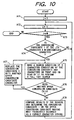
- FIG. 10 is a flowchart showing a flow of a process of correcting a misrecognized character.
- the post-processing unit 134 requests the full text searching unit 140 to search for a character string of three characters consisting of a character judged as a misrecognized character and characters in the front and the in the rear of that character as a search condition. Further, the post-processing unit 140 replaces the misrecognized character with an upper conversion candidate character thereof in the character string, and requests the full text searching unit 140 to perform a search. If the upper conversion candidate character is plural, the post-processing unit 140 requests the full text searching unit 140 to search for each of all search conditions including respective upper conversion candidate characters.
- the full text searching unit 140 performs a full text search in registered data stored in the text data storing unit 180 using the index files stored in the index file storing unit 150, and sends back the number of times of occurrence of the search condition character string in all the registered data as a result of the search to the post-processing unit 134. Assuming here that a lot of document data converted into text data by the full text searching unit 140 have been registered in the text data storing unit 180.
- the post-processing unit 134 compares the numbers of times of occurrence of the three-character strings obtained as results of the full text search with each other to determine that a character string having most frequently occurred has the highest probability that the character string is correct, thereby correcting the misrecognized character with that the conversion candidate character assigned in the search condition character string is assumed to be correct.
- FIG. 8 An example of a manner of making the search condition for the full text search is shown in FIG. 8.
- “ " [search character string in the first search (conversion candidate 1)] is compared with " " [search character string in the second search (conversion candidate 2)]
- " " has a larger value (400) of a result of the search so that " " is determined to be correct (Step A7).
- the search condition for the full text search it is possible to variously set the search condition according to a characteristic of a document which is an object of character recognition. For instance, the number of characters included in the search condition may be changed, a character string interposed between two punctuation marks may be set as the search condition, a character string divided at which a different kind of character, for example, Japanese Hiragana Character, Japanese Katakana character, Kanji character or the like, appears may be assigned as the search condition.
- the post-processing unit 134 makes a search character string for each misrecognized character to correct the misrecognized character, as stated above.
- chain information of characters which can be a word is stored so as to configure a knowledge database if the above full text searching unit is applied.
- Text data in which correction of misrecognized characters is completed is given a unique name such as bunsho1.txt, and registered in the full text searching unit 140. At this time, if an extension .bmp given by the image inputting unit 110 is changed into .txt, it is possible to correspond the image data to the text data.
- the text data bunsho1.txt is sent to the text data outputting unit 160.
- the full text searching unit 140 stores the text data bunsho1.txt in the text data storing unit 180, besides making an index file from bunsho1.txt.
- FIG. 11 shows a flow of the registering process.
- the index file is stored in the index file storing unit 150, and used as the knowledge database by the post-processing unit 134 from the next data processing (Step A8).
- the text data outputting unit 160 outputs the text data bunsho1.text to a display, a facsimile or the like (Step A9).
- the character recognizing apparatus replaces a character which is difficult to be recognized with each of conversion candidate characters to make a search character string, performs the full text search in plural documents which have been converted into text data to find out a correct character among the conversion candidate characters. It is therefore unnecessary to make a dictionary such as a word dictionary requiring a lot of labor and time to make the same, and maintenance thereof, and morphological analysis requiring a lot of time to configure or operate a system therefor in order to conduct complex processes, although tending to make a lot of mistakes. As a result, it is possible to readily configure the system, and correct misrecognized characters within a short period.
- the index file of a document converted into text data is made using the full text searching unit 140 one after another, and stored in the index file storing unit 150 so that the knowledge database is automatically enriched even without maintenance.
- the character recognizing apparatus of this embodiment performs, not a keyword search, but a full text search, segmentation of a search character string is not restricted by concept of word, sentence, clause or the like, the search character string can be thus freely set. It is therefore possible to desirably set a speed or an accuracy of the post-processing at need.
- an index file is made from converted text data to be used as an object of the full text search so that it is possible to manage the documents at the same time.
- the manner of the full text search is not limited to what uses the index file.
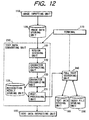
- FIG. 12 is a block diagram showing a structure of a character recognizing apparatus according to the second embodiment.
- the character recognizing apparatus has an image inputting unit 110, an image data storing unit 120, a text data converting unit 230 including a region dividing unit 131, a character extracting unit 132, a character recognizing unit 133, a post-processing unit 231 and a recognition result storing unit 135, a terminal 170, a full text searching unit 240, a text data storing unit 180, an index file storing unit 250, and a text data outputting unit 160, which are similar to those of the character recognizing apparatus according to the first embodiment shown in FIG. 1.
- the second embodiment differs from the first embodiment in that when a misrecognized character is corrected by the post-processing unit 231, an index is made from text data before the post-processing, and not only the registered data but also a document which is an object of the character recognition is also used as the knowledge data.
- a document which is an object of the character recognition itself is also assigned as an object of the search if the same character string repeatedly appears, and most of the characters are accurately recognized although some characters are misrecognized in the document such as a hand-written document, whereby errors are corrected at a higher speed and with a higher accuracy.
- FIG. 13 shows a flow of a whole process conducted by the apparatus, in which Steps B1 through B5 are similar to Steps A1 through A5 according to the first embodiment shown in FIG. 2.
- the post-processing apparatus 231 obtains results of recognition from the recognition result storing unit 135.
- the post-processing unit 231 sends text data obtained from the recognition result storing unit 135 to the full text searching unit 240.
- the text data is hereinafter called "own document” since it is a document which is an object of the character recognition.
- the full text searching unit 240 makes an index file configured with only conversion candidates 1 from the received text data, and stores the index file in the index file storing unit 250, distinguishing from indexes having been registered.
- the post-processing unit 231 determines misrecognized characters in the text data.
- the process of determining the misrecognized characters is similar to that according to the first embodiment. After that, the post-processing unit 231 corrects the misrecognized characters.
- FIG. 14 shows a flow of the process of correcting the misrecognized character.
- the post-processing unit 231 makes a three-character string consisting of a character determined as a misrecognized character and characters in the front and in the rear of that character as the search condition, then requests the full text searching unit 240 to perform the full text search in its own document under the above seach condition.
- the full test searching unit 240 performs the whole text search in its own document using the index file stored in the index file storing unit 250, and sends back the number of times of occurrence of the search condition character string in its own document as a result of the search to the post-processing unit 231.
- the post-processing unit 231 holds the result as a result 1.
- the post-processing unit 231 requests the full text searching unit to search for the same search condition in the registered data.
- the full text searching unit 240 performs the full text search in the registered data stored in the text data storing unit 180 using the index files stored in the index file storing unit 250, and sends back the number of times of occurrence of the search condition character string in the all registered data as a result of the search to the post-processing unit 231.
- the post-processing unit 231 holds the result as a result 2.
- the post-processing unit 231 replaces the misrecognized character in the search condition character string with an upper conversion candidate character, and requests the full text searching unit 240 to search for the search condition character string in the above two kinds of texts in the similar manner.
- the upper conversion candidate character is plural, each of all the search condition character strings including every upper conversion candidate character is searched.
- the post-processing unit 231 compares results 2 obtained by the search with each other. A character string having occurred most frequently has the highest probability to be correct, so that a conversion candidate character assigned in the search condition character string having occurred most frequently is assumed to be a correct character, whereby the misrecognized character is corrected.
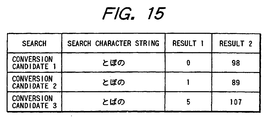
- search character strings including conversion candidate characters shown in FIG. 7 when searched in the above manner, the search results in as shown in FIG. 15, for example.
- the threshold value of the difference in the number of time of occurrence is 10, it is impossible to determine a correct search character string by referring to only the results 2.
- a document which is grammatically uniformed that is, a document in which the same word frequently appears, or the same vein or the same expression are repeatedly used, is also used as the knowledge database so as to be an object of the search in the document itself. Accordingly, tendency of the document such as words, grammar and the like used in the document can be reflected upon correcting misrecognized characters. Moreover, an unregistered word can be searched since such unregistered word very likely appears in its own document, whereby a rate of recognition is improved.
- the search condition character string is of three characters.
- the third embodiment differs from the first embodiment in that when the numbers of times of occurrence of the conversion candidate character strings for correcting a miscognized character, which are results of the full text search performed by the full text searching unit, are uniformly small upon correcting the misrecognized character, the post-processing unit decides that an extracting position of the character of image data is improper, and instructs the character extracting unit to extract the character once again.
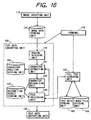
- FIG. 16 is a block diagram showing a structure of a character recognizing apparatus according to the third embodiment of this invention.
- the character recognizing apparatus according to the third embodiment has an image inputting unit 110, an image data storing unit 120, a text data converting unit 330 including a region dividing unit 131, a character extracting unit 331, a character recognizing unit 332, a post-processing unit 333 and a recognition result storing unit 135, a terminal 170, a full text searching unit 140, a text data storing unit 180, an index file storing unit 150, and a text data outputting unit 150, which are similar to those of the character recognizing apparatus according to the first embodiment shown in FIG.
- the text data converting unit 330 additionally has a character position storing unit 334 for storing position information of an extracted character in a form of file when the character is extracted, and the post-processing unit 333 instructs the character extracting unit 331 to extract the character once again.
- FIG. 17 shows a flow of a whole process conducted by the character recognizing apparatus according to the third embodiment, wherein Steps C1 and C2 shown in FIG. 17 are similar to Steps A1 and A2 according to the first embodiment shown in FIG. 2.
- the character extracting unit 331 stores position information of an extracted character in a form of file when extracting the character.
- the file is given a name bunsho1.loc, for example.
- Processes at Steps C4 through C6 in FIG. 17 are similar to Steps A4 through A6 in FIG. 2.
- a misrecognized character is corrected.
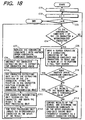
- a flow of the process of correcting the misrecognized character is shown in FIG. 18.
- a manner of making a search condition and a manner of requesting the full text search are similar to those according to the first embodiment. However, when all obtained results of the search for search conditions for a character are smaller than a predetermined threshold value, the post-processing unit 333 determines that the character is extracted at an improper position by the character extracting unit 331, and sends a character number of the character counted from the leading character to the character extracting unit 331 to instruct the same to extract the character once again before determining a correct character by comparing the results of the search.
- the character extracting unit 331 obtains position information of the character having the received character number from the character position storing unit 334, appropriately shifts the position in the horizontal and vertical directions, and again stores newly obtained position information in the character position storing unit 334, besides sending the position information to the character recognizing unit 332.
- the character recognizing unit 332 recognizes a character in the received character position, and sends a result of the recognition to the post-processing unit 333.
- the post-processing unit 333 judges the misrecognized character on the basis of the result of the character recognition supplied from the character recognizing unit 332. If the result is still a misrecognized character, the post-processing unit 33 determines a correct character using again the full text searching unit 140. If the result is correct, the post-processing unit 333 processes the next character.
- the post-processing unit 333 of the character recognizing apparatus detects misrecognition caused from that a position at which a character of image data has been extracted is improper when correcting the misrecognized character, and instructs re-extraction of the character, whereby a rate of recognition is improved.
- the search condition character string is of three characters.
- the fourth embodiment is characterized in that when a plurality of character regions are generated when image data is divided, a region coupling unit couples the divided plural character regions using the full text search.
- FIG. 20 is a block diagram showing a structure of a character recognizing apparatus according to the fourth embodiment of this invention.
- the character recognizing apparatus shown in FIG. 20 has an image inputting means 110, an image data storing unit 120, a text data converting unit 430 including a region dividing unit 131, a character extracting unit 132, a character recognizing unit 133, a post-processing unit 134 and a recognition result storing unit 135, a terminal 170, a full text searching unit 140, a text data storing unit 180, an index file storing unit 150 and a text data outputting unit 160, which are similar to those of the character recognizing apparatus according to the first embodiment shown in FIG. 1, excepting that the text data converting unit 430 additionally includes a region coupling unit 431 for coupling a plurality of regions divided by the region dividing unit 131 using the full text searching unit 140.
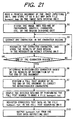
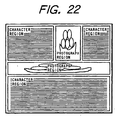
- FIG. 21 is a flowchart illustrating a whole process conducted by the character recognizing apparatus of this embodiment. Assuming here that a printed document, which is of a size readable in one operation by the image inputting unit 110 and in which the character region is separated by, for example, the photograph regions, as shown in FIG. 22, is applied in this embodiment.
- Steps D1 through D3 are similar to Steps A1 through A3 according to the first embodiment shown in FIG. 2.
- steps D4 characters are recognized in a similar manner to the first embodiment.
- results of the recognition are stored in the recognition result storing unit 135, different names, for example, bunsho1_1.moj, bunsho1_2.moj, ..., are given to respective character regions and the results are stored along with the respective names in the recognition result storing unit 135.
- the post-processing unit 134 obtains files of the character regions one by one from the recognition result storing unit 135 to judge misrecognition and correct the same in all the regions in a manner similar to the first embodiment.
- the post-processing unit 134 sends results of the above processes to the region coupling unit 431.
- the region coupling unit 431 determines which region is followed by which region, and couples these regions to form a file. If there are three divided regions 1, 2 and 3, the region coupling unit 431 requests the full text searching unit 140 to search for a character string made by coupling the last character in the region 1 and the leading character in the region 2 as the search condition.
- the region coupling unit 431 connects the last character in the region 1 to the leading character in the region 3, the last character in the region 2 to the leading character in the region 3, and the last character in the region 2 to the leading character in the region 1 to make each of the search conditions, and requests the full text searching unit 140 to search for each of the search condition character strings.
- the full text searching unit 140 searches for each of the requested search conditions in the registered data, and sends back the number of times of occurrence of each of the search condition character strings in the registered data as a result.
- the region coupling unit 431 compares the results of the search received from the full text searching unit 140, determines that a character string having occurred most frequently is a grammatically correct character string to couple the regions.
- region 3 ends at a punctuation mark " .” So that the regions are coupled in the order of 1, 2 and 3, as shown in FIG. 23C.
- document is generally such made that the reader starts reading from the top toward the bottom. Accordingly, it is alternatively possible to use position information of a region obtained when the region is divided as a judgement value since a region in a higher position is followed by a region in a lower position in the document.
- the regions are coupled to form one file, and given a unique name bunsho1.txt, as above. After that, the file is registered in the full text searching unit 140, and sent to the text data outputting unit 160. This process is similar to that according to the first embodiment.
- the character recognizing apparatus automatically couples regions when one document is divided into a plurality of regions, and deteremines the order of the regions. It is therefore possible to efficiently recognize characters without labor.
- a document of a size readable in one operation by the image inputting unit 110 there is used a document of a size readable in one operation by the image inputting unit 110.
- the search condition character string is of two characters.
- the search condition character string is of any number of characters, not limiting to two characters.
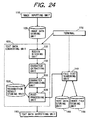
- FIG. 24 is a block diagram showing a structure of a character recognizing apparatus according to the fifth embodiment of this invention.
- the character recognizing apparatus has an image inputting unit 110, an image data storing unit 120, a text data converting unit 530 including a region dividing unit 131, a character extracting unit 132, a character recognizing unit 533, a post-processing unit 534 and a recognition result storing unit 535, a terminal 170, a whole text retrieving unit 140, a text data storing unit 180, an index file storing unit 150 and a text data outputting unit 160, which are similar to those of the character recognizing apparatus shown in FIG. 1 according to the first embodiment.
- the character recognizing apparatus according to the fifth embodiment differs from the character recognizing apparatus according to the first embodiment in that image data extracted as a character is converted into at least one character data without an evaluation value by the character recognizing unit 533.
- FIG. 25 is a flowchart showing a flow of a whole process conducted by the apparatus. Steps E1 through E3 in FIG. 25 are similar to Steps A1 through A3 according to the first embodiment shown in FIG. 2.
- the character recognizing unit 533 recognizes one character obtained from position information supplied from the character extracting unit 132, converts the character into one character data, and stores a result of the conversion in the recognition result storing unit 535 in a form shown in FIG. 26.
- the character data converted by the character recognizing unit 530 will be hereinafter referred "a conversion candidate character".
- a character string shown in FIG. 4 for example, results in as shown in FIG. 27.
- Step E5 in FIG. 25 is similar to Step A5 in FIG. 2.
- the post-processing unit 534 determines a correct recognition result from at least one conversion candidate character stored in the recognition result storing unit 535.
- the post-processing unit 534 combines a conversion candidate character 1 of the first character with a conversion candidate character 1 of the second character stored in the recognition result storing unit 535 to make a search condition, and requests the full text searching unit 140 to search for the search condition.
- the post-processing unit 534 combines a conversion candidate 2 of the first character with a conversion candidate character 1 of the second character to make a search condition, and requests the full text searching unit 140 to search for it.
- the post-processing unit 534 makes every combination of the conversion candidate characters 3, 4, 5,... of the first and the second character to make search conditions, and request the full text searching unit 140 to search for each of the search conditions.
- the post-processing unit 534 eliminates search conditions never occurred or scarcely occurred by comparing results of the search.
- the post-processing unit 534 then attaches a conversion candidate character 1 of the third character to the tail of the remaining two-character string to make a search condition, and requests the full text search unit 140 to search for it. Similarly, the post-processing unit 534 adds each of the conversion candidate characters of the third character to the two-character string to make a search condition, and requests the full text searching unit 140 to search for it. The post-processing unit 534 compares results of the search, and determines the conversion candidate character included in the search condition having most frequently occurred as a correct character.
- the post-processing unit 534 adds each of the conversion candidate characters of the fourth character to the character string consisting of the second character and the third character determined as correct to make each of search conditions, and requests the full text searching unit 140 to search for the retrieval conditions.
- the post-processing unit 534 compares results of the retrieval to determine a conversion candidate character included in the search condition having most frequently occurred as a correct character. In a similar manner, the post-processing unit 534 determines the following correct characters.
- FIGS. 28A through 28C show an example of making a search condition for the full text search As shown in FIG.
- the search condition character string is of three characters, but a manner of making the search condition character string is not limited to the above.
- this embodiment it is unnecessary to make a dictionary such as a word dictionary which requires a lot of labor and time to make the same and maintenance thereof similarly to the first embodiment even if the character recognizing apparatus does not (cannot) yield an evaluation value. It is also unnecessary to conduct morphological analysis which requires a lot of time to configure and operate the system therefor since it requires complex processes, although tending to make a lot of mistakes. Therefore, it is possible to configure the system readily and within a short period, and correct misrecognition within a short period.
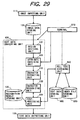
- FIG. 29 is a block diagram showing a structure of a character recognizing apparatus according to the sixth embodiment.
- the character recognizing apparatus according to the sixth embodiment has an image inputting unit 110, an image data storing unit 120, a text data converting unit 630 including a region dividing unit 131, a character extracting unit 132, a character recognizing unit 133, a post processing unit 634, a recognition result storing unit 135, a terminal 670, a whole text retrieving unit 640, a text data storing unit 680, an index file storing unit 650 and a text data outputting unit 160, which are similar to those of the character recognizing apparatus according to the first embodiment shown in FIG.
- the text data converting unit 630 additionally includes an attribute obtaining unit 636 for obtaining attributes as to a region divided by the region dividing unit 131, and the post-processing unit 634 designates attributes of registered data to which the attributes have been given when making a search request to correct misrecognition.
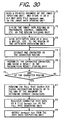
- FIG. 30 is a flowchart showing a flow of a whole process conducted by the apparatus.
- Steps F1 and F2 are similar to Steps A1 and A2 according to the first embodiment shown in FIG. 2.
- the attribute obtaining unit 636 obtains attributes of a document in a character region divided at Step K2.
- the user inputs four attributes of the document, for example, a name of a writer, a date, a mode (hand-written or printed), and a kind (report or paper), through the terminal 670.
- Steps E4 through E6 in FIG. 30 are similar to Steps A3 through A5 in FIG. 2.
- the post-processing unit 634 designates the attributes of the document when requesting the full text searching unit 640 to search, and responsive to the request, the full text searching unit 640 searches in text data having the attributes designated by the post-processing unit 634, dissimilarly to the process at Step A6 in FIG. 2.
- Other processes are similar to those according to the first embodiment.
- FIG. 31 shows an example of a data structure of text data stored in the text data storing unit 680.
- the text data storing unit 680 stores text data of documents each having four attributes as to a date, a name of writer, a mode and a kind of the document.
- the index file storing unit 650 stores index files each made from the text data-stored in the text data storing unit 680.
- the post-processing unit 634 designates attributes of the documents, that is, 1992, Taro Matsushita, printed and paper when requesting the full text searching unit 640 to search.
- the full text searching unit 640 performs the full text search in only documents having the designated attributes, that is, bodies having the record number 4 and 6 in FIG. 31.
- the post-processing unit 634 determines correct characters in a similar manner to the first embodiment.
- As a manner of designating the attributes it is possible to designate several years before and after a date when the document was written, or only a writer, for example, depending on a characteristic of a document which is an object of character recognition.
- the user inputs attributes of a document which is an object of character recognition to the attribute obtaining unit 636.
- the attributes can be obtained from, for example, position information of a character region.
- the manner of obtaining attribute is not limited to the above example.
- the seventh embodiment differs from the first embodiment in that a character string including misrecognition requested to be searched and a character string including a correct character obtained by the full text search are corresponded to each other to make misrecognition data, and the misrecognition data is registered in the full text searching unit after the misrecognition is corrected, so as to be also used in correcting another misrecognition after that.
- FIG. 32 is a block diagram showing a character recognizing apparatus according to the seventh embodiment of this invention.
- the character recognizing apparatus shown in FIG. 32 has an image inputting unit 110, an image data storing unit 120, a text data converting unit 730 including a region dividing unit 131, a character extracting unit 132, a character recognizing unit 133, a post-processing unit 734 and a recognition result storing unit 135, a terminal 170, a whole text retrieving unit 740, a text data storing unit 180, an index file storing unit 150 and a text data outputting unit 160, which are similar to those of the character recognizing apparatus according to the first embodiment shown in FIG. 2.
- misrecognition storing unit 736 in the text data converting unit 730 for registering misrecognition data made by corresponding a character string including a misrecognized character (hereinafter referred a misrecognized character string) used as a search character string when the misrecognized character is corrected by the post-processing unit 734 and a character string including a correct character (hereinafter referred a correct character string) in the full text searching unit 740, a misrecognized data storing unit 780 for storing the misrecognized data registered in the full text searching unit 740 in a form of file, and a misrecognition index file storing unit 750 for storing an index file made from the misrecognized data by the full text searching unit 740.
- a misrecognition storing unit 736 in the text data converting unit 730 for registering misrecognition data made by corresponding a character string including a misrecognized character (her
- FIG. 33 shows a flow of a whole process conducted by the apparatus. Processes at Steps G1 through G5 in FIG. 33 are similar to those at Steps A1 through A5 according to the first embodiment shown in FIG. 2.
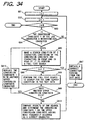
- a process at Step G6 in FIG. 33 is shown in detail in FIG. 34.
- a misrecognized character is determined and a search condition is made, similarly to the first embodiment.
- the post-processing unit 734 requests the full text searching unit 740 to search for the search condition in the misrecognized data.
- the full text searching unit 740 searches for the search condition in misrecognition character strings of the registered misrecognition data stored in the misrecognition data storing unit 780 by using an index file stored in the misrecognition index file storing unit 750, and if relevant data exists, the full text searching unit 740 sends back a correct character string of a record thereof as a result of the search to the post-processing unit 734. If no relevant data exists, the full text searching unit 740 replies to the post-processing unit 734 that there is no relevant data.
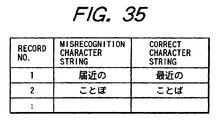
- FIG. 35 shows a data structure of the misrecognition data stored in the misrecognition data storing unit 780.
- the full text searching unit 740 makes an index file from the misrecognition character strings of the misrecognition data in a manner similar to when the document data is registered according to the first embodiment.
- the post-processing unit 734 determines the character string as being correct.
- the post-processing unit 734 requests the full text searching unit 740 to search in the text data.
- the post-processing unit 734 requests the full text searching unit 740 to search for all retrieval conditions in the above two kinds of data, and compares results of the search similarly to the first embodiment to determine a correct character.
- the post-processing unit 734 stores both the misrecognition character string used as the search condition to determine the correct character and a correct character string in the data structure shown in FIG. 35 in the misrecognition storing unit 736.
- the misrecognition storing unit 736 registers the misrecognition data received from the post-processing unit 734 in the full text searching unit 740.
- the following processes are similar to the first embodiment.
- data of a misrecognized character and a corresponding correct character is stored each time the misrecognized character is corrected, and misrecognition data in the past is also used as the knowledge database, whereby correction of misrecognition reflecting characteristics of the image inputting unit 110 is possible.
- the eighth embodiment differs from the first embodiment in that document data converted into text data is displayed in a layout looking like input image data when the document data is outputted.
- FIG. 36 is a block diagram showing a structure of a character recognizing apparatus according to the eighth embodiment of this invention.
- the character recognizing apparatus shown in FIG. 36 has an image inputting unit 110, an image data storing unit 120, a text data converting unit 830 including a region dividing unit 831, a character extracting unit 832, a character recognizing unit 133, a post-processing unit 134 and a recognition result storing unit 135, a terminal 170, a full text searching unit 140, a text data storing unit 180, an index file storing unit 150 and a text data outputting unit 860, which are similar to those of the character recognizing apparatus according to the first embodiment shown in FIG. 1.
- a region position storing unit 836 for storing position information of each region when a region is divided by the region dividing unit 831
- a graphic data storing unit 838 for storing data of, for example, drawings, photographs and the like other than character data
- a character font storing unit 837 for storing a font and position information of characters obtained by the character extracting unit 832.
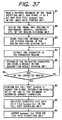
- FIG. 37 shows a flow of a whole process conducted by the apparatus.
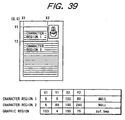
- a printed document a size of which is readable in one operation by the image inputting unit 110, and in which a character region is separated from a graphic region as shown in FIG. 38.
- Steps H1 and H2 in FIG. 37 are similar to Steps A1 and A2 according to the first embodiment shown in FIG. 2.
- position information of each region divided at Step H2 is stored in the region position storing unit 836. More concretely, there are obtained a horizontal distance X1 and a vertical distance Y1 from an origin at the top left-hand corner of the paper to top left-hand corner of the region, and a horizontal distance X2 and a vertical distance from the origin to the bottom right-hand corner of the region expressed in cm. If the region is of character data, the obtained position information is labeled as NULL, whereas if the region is of graphic data, the obtained position information is given a file name of graphic data, and stored in the region position storing unit 836. Data of, for example, a picture, a photograph or the like other than character data is given a name zul.bmp, for example, in a form of file in the picture data storing unit 838.
- the character extracting unit 832 extracts a character in the character region similarly to Step A3 in FIG. 2, and stores position information of a horizontal distance X1 and a vertical distance Y1 from the origin at the top left-hand corner of the paper to the top left-hand corner of the character, and a horizontal distance X2 and a vertical distance Y2 from the origin to the bottom right-hand corner of the character expressed in cm along with a font of the character in the character font storing unit 837, as shown in FIG. 40, for example.
- Processes conducted at Steps H5 through H7 are similar to those at Steps A4 through A7 in FIG. 2.
- the text data outputting unit 860 obtains the region position information from the region position storing unit 836, the graphic data form the graphic data storing unit 838 and the character font information from the character font storing unit 837 when outputting document data converted into text data, so arranges the graphic data and the document data on the basis of the obtained information that output data is diplayed looking like the input data, and outputs the picture data and the document using characters of a size and a font similar to those of characters of the input data.
- output data can be displayed in a layout looking like inputted image data so that the user can see easily the data.
- the outputted data is, not mere displayed imaged data, but text data, the user can edit the document so as to readily make a different document in a layout looking like a paper document.
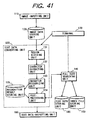
- FIG. 41 is a block diagram showing a structure of a character recognizing apparatus according to the ninth embodiment.
- the character recognizing apparatus shown in FIG. 41 has an image inputting unit 110, an image data storing unit 120, a text data converting unit 930 including a region dividing unit 131, a character extracting unit 132, a character recognizing unit 133, a post-processing unit 934 and a recognition result storing unit 135, a terminal 170, a full text searching unit 140, a text data storing unit 180, an index file storing unit 150 and a text data outputting unit 160, which are similar to those of the character recognizing apparatus according to the first embodiment shown in FIG. 1, excepting an operation of the post-processing unit 934 in the text data converting unit 930.
- the ninth embodiment is characterized in that when the post-processing unit 934 corrects misrecognition of a document written in a language such as English, Hankul (Hangul) or the like other than Japanese in which a character string is written separated by a space or the like, a character string separated by a space, that is, a character string sandwiched between spaces, is used as a search character string.
- a language such as English, Hankul (Hangul) or the like other than Japanese in which a character string is written separated by a space or the like
- a character string separated by a space that is, a character string sandwiched between spaces
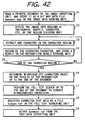
- FIG. 42 is a flowchart showing a flow of a whole operation conducted by the apparatus.
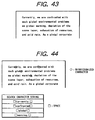
- a printed document in which a word is separated by spaces as done in English or Hunkul (Hngul) language This embodiment will be described by way of an example where a document written in English language is used as shown in FIG. 43.
- Processes at Steps I1 through I6 in FIG. 41 are similar to those at Steps A1 through A6 according to the first embodiment shown in FIG. 2.
- the post-processing unit 934 combines a misrecognized character determined at Step I6 and characters in the front and in the rear of the misrecognized character to make a search condition, as shown in FIG. 44.
- the post-processing unit 934 uses a character string including the misrecognized character sandwiched by spaces as a search condition, and requests the full text searching unit 140 to search for it.
- the post-processing unit 934 replaces the misrecognized character with an upper conversion candidate character to make a search condition, and requests the full text searching unit 140 to search for it.
- the post-processing unit 934 requests the full text searching unit 140 to search for each of all search conditions including the respective upper conversion candidate letters. The following processes are similar to the first embodiment.
- spaces are used to discriminate a character string.
- spaces are used to discriminate a character string.
- periods, specific characters, control codes or symbols instead of spaces. This invention is not limited to the above example.
- a character string sandwiched by spaces is used as a search condition.
- the character recognizing apparatus of this embodiment searches for a character string sandwiched by spaces as a search condition. Accordingly, it is possible to correct misrecognition according to characteristics of a language or a document by avoiding a meaningless character string which is a part of a word such as "harac" in a word "character”, for example, whereby correction of misrecognition according to characteristics of a language or a document is possible.
- a character recognizing apparatus has a post-processing unit which makes character strings including a plurality of conversion candidates, respectively, made by a character recognizing unit, and a full text searching unit performs a full text search for the character strings in a plurality of documents having been converted into text data, whereby the post-processing unit determines a correct character on the basis of results of the search to correct misrecognition.
Landscapes
- Engineering & Computer Science (AREA)
- Computational Linguistics (AREA)
- Computer Vision & Pattern Recognition (AREA)
- Physics & Mathematics (AREA)
- General Physics & Mathematics (AREA)
- Multimedia (AREA)
- Theoretical Computer Science (AREA)
- Character Discrimination (AREA)
- Document Processing Apparatus (AREA)
- Information Retrieval, Db Structures And Fs Structures Therefor (AREA)
Claims (40)
- Zeichenerkennungsverfahren mit den Schritten:Erkennen (A4; B4; C4; D4; E4; F5; G4; H5; I4) aus einem derart, daß es ein einzelnes zu erkennendes Zeichen umfaßt, bereitgestellten Zeichenbild, eines Wandlungskandidatenzeichens oder mehrerer Wandlungskandidatenzeichen für das Zeichen, wobei das eine Wandlungskandidatenzeichen oder die mehreren Wandlungskandidatenzeichen jeweils aus Textdaten bestehen und das Zeichenbild neu und wiederholt bereitgestellt wird, so daß das eine Wandlungskandidatenzeichen oder die mehreren Wandlungskandidatenzeichen für jedes Zeichenbild erhalten werden;Erzeugen (A75; B85; C75; G65) einer Vielzahl von Suchzeichenfolgen durch ein Kombinieren einiger der einen oder mehreren Wandlungskandidatenzeichen mit Wandlungskandidatenzeichen von an das einzelne Zeichen angrenzenden Zeichen;Durchsuchen (A7; B8; C7; D7; E6; F7; G6; H7; I7) von Bezugstextdaten nach jeder Suchzeichenfolge der Vielzahl von Suchzeichenfolgen in einer Volltextsuchtechnik, um eine Auftretenshäufigkeit jeder der in den Bezugstextdaten enthaltenen Suchzeichenfolgen bereitzustellen; undBestimmen (A7; B8; C7; D7; E6; F7; G6; H7; I7) eines für das Zeichenbild am besten passenden richtigen Zeichens unter Verwendung der Auftretenshäufigkeit jeder der Suchzeichenfolgen.
- Zeichenerkennungsverfahren nach Anspruch 1, wobei eine Indexdatei der Bezugstextdaten bereitgestellt wird (A82), und
der Suchschritt die Bezugstextdaten in der Volltextsuchtechnik basierend auf der Indexdatei der Bezugstextdaten nach jeder der Vielzahl von Suchzeichenfolgen durchsucht, um die Auftretenshäufigkeit jeder der in den Bezugstextdaten enthaltenen Suchzeichenfolgen bereitzustellen. - Zeichenerkennungsverfahren nach Anspruch 2, wobei der Erzeugungsschritt einen ersten Erzeugungsschritt und einen zweiten Erzeugungsschritt umfaßt, bei denen
der erste Erzeugungsschritt ein Schritt des Erzeugens der Vielzahl von Suchzeichenfolgen durch ein Kombinieren eines Wandlungskandidatenzeichens des einen Wandlungskandidatenzeichens oder der mehreren Wandlungskandidatenzeichen für ein erstes Zeichen der Zeichen mit einem Wandlungskandidatenzeichen des einen Wandlungskandidatenzeichens oder der mehreren Wandlungskandidatenzeichen für ein zweites Zeichen der Zeichen ist; und
der zweite Erzeugungsschritt die Schritte des Empfangens der in dem Suchschritt im Ansprechen auf die in dem ersten Erzeugungsschritt erzeugten Suchzeichenfolgen erhaltenen Auftretenshäufigkeit, Entfernens jeder der Suchzeichenfolgen, deren Auftretenshäufigkeit niedriger als ein bestimmter Betrag ist, und erneuten Erzeugens der Vielzahl von Suchzeichenfolgen durch ein Hinzufügen eines Wandlungskandidatenzeichens des einen Wandlungskandidatenzeichens oder der mehreren Wandlungskandidatenzeichen für ein drittes Zeichen der Zeichen zu verbleibenden Folgen der Suchzeichenfolgen umfaßt. - Zeichenerkennungsverfahren nach Anspruch 3, wobei der Suchschritt (E6) einen ersten Suchschritt und einen zweiten Suchschritt umfaßt, bei denen
der erste Suchschritt ein Schritt des Durchsuchens der Bezugstextdaten nach den in dem ersten Erzeugungsschritt erzeugten Suchzeichenfolgen ist, wobei Informationen über die Auftretenshäufigkeit für den zweiten Erzeugungsschritt bereitgestellt werden; und
der zweite Suchschritt ein Schritt des Durchsuchens der Bezugstextdaten nach den in dem zweiten Erzeugungsschritt erzeugten Suchzeichenfolgen ist. - Zeichenerkennungsverfahren nach Anspruch 1, wobei der Erkennungsschritt ein Berechnen eines einen Grad der Sicherheit jedes Wandlungskandidatenzeichens des einen Wandlungskandidatenzeichens oder der mehreren Wandlungskandidatenzeichen angebenden Bewertungswerts umfaßt.
- Zeichenerkennungsverfahren nach Anspruch 5, wobei der Erzeugungsschritt ein Schritt des Erzeugens der Vielzahl von Suchzeichenfolgen aus dem einen Wandlungskandidatenzeichen oder den mehreren Wandlungskandidatenzeichen unter Verwendung des Bewertungswerts und eines Schwellenwerts davon, der eingestellt ist, um ein falsch erkanntes Zeichen von dem einen Wandlungskandidatenzeichen oder den mehreren Wandlungskandidatenzeichen zu unterscheiden, ist.
- Zeichenerkennungsverfahren nach Anspruch 5, wobei der Erzeugungsschritt die Schritte umfaßt:Bestimmen unter Verwendung des Bewertungswerts und eines Schwellenwerts davon, ob ein Wandlungskandidatenzeichen des einen Wandlungskandidatenzeichens oder der mehreren Wandlungskandidatenzeichen, das die höchste Auftretenshäufigkeit aufweist, anderen Wandlungskandidatenzeichen des einen Wandlungskandidatenzeichens oder der mehreren Wandlungskandidatenzeichen ähnelt oder nicht; undBezeichnen des Zeichens mit dem einen Wandlungskandidatenzeichen des einen Wandlungskandidatenzeichens oder der mehreren Wandlungskandidatenzeichen, das den anderen Wandlungskandidatenzeichen des einen Wandlungskandidatenzeichens oder der mehreren Wandlungskandidatenzeichen ähnelt, als ein falsch erkanntes Zeichen.
- Zeichenerkennungsverfahren nach Anspruch 6, wobei der Bestimmungsschritt des richtigen Zeichens die Schritte umfaßt:Vergleichen der Auftretenshäufigkeit jeder Suchzeichenfolge der Vielzahl von Suchzeichenfolgen miteinander;Auswählen einer Suchzeichenfolge der Vielzahl von Suchzeichenfolgen, die einen höchsten Wert der Auftretenshäufigkeit aufweist, aus der Vielzahl von Suchzeichenfolgen; undErhalten des richtigen Zeichens aus der einen Suchzeichenfolge der Vielzahl von Suchzeichenfolgen.
- Zeichenerkennungsverfahren nach Anspruch 8, ferner mit einem Schritt des Korrigierens des falsch erkannten Zeichens mit dem richtigen Zeichen.
- Zeichenerkennungsverfahren nach Anspruch 5, wobei die Vielzahl von Suchzeichenfolgen aus einer festen Anzahl von Zeichen besteht.
- Zeichenerkennungsverfahren nach Anspruch 5, wobei die Vielzahl von Suchzeichenfolgen bezüglich der Anzahl von Zeichen und/oder eines Typs von Zeichen änderbar ist.
- Zeichenerkennungsverfahren nach Anspruch 1, wobei die Bezugstextdaten aus Ketteninformationen von Zeichen, die ein Wort bilden, bestehen und als eine Wissensdatenbank arbeiten.
- Zeichenerkennungsverfahren nach Anspruch 1, wobei der Suchschritt (B8) den Schritt des Durchsuchens der Textdaten selbst des einen Wandlungskandidatenzeichens oder der mehreren Wandlungskandidatenzeichen nach jeder Suchzeichenfolge der Vielzahl von Suchzeichenfolgen in einer Volltextsuchtechnik umfaßt.
- Zeichenerkennungsverfahren nach Anspruch 1, ferner mit den Schritten:Bereitstellen (A1; B1; C1; D1; E1; F1; G1; H1; I1) eines Dokuments mit einem das zu erkennende Zeichenbild umfassenden Zeichenbereich;Absondern (A2; B2; C2; D2; E2; F2; G2; H2; I2) des Zeichenbereichs von dem Dokument; undExtrahieren (A3; B3; C3; D3; E3; F4; G3; H4; I3) des Zeichenbilds für jedes Zeichen aus dem Zeichenbereich, wobei das extrahierte eine Zeichen für den Erkennungsschritt bereitgestellt wird.
- Zeichenerkennungsverfahren nach Anspruch 14, wobei der Suchschritt (C7) den Schritt des Anweisens des Extraktionsschritts zum neuen Extrahieren des Zeichens eines nach dem anderen aus dem Zeichenbereich umfaßt.
- Zeichenerkennungsverfahren nach Anspruch 14, ferner mit dem Schritt des Neukombinierens (D8) der richtigen Zeichen einer Vielzahl von Zeichenbereichen unter Verwendung einer Suche nach einer das richtige Zeichen an einem Ende eines Bereichs mit dem richtigen Zeichen an einem Ende eines weiteren Bereichs verbindenden Zeichenfolge.
- Zeichenerkennungsverfahren nach einem der Ansprüche 1 und 2, wobei der Erzeugungsschritt Eigenschaften bezeichnet (F3), der Suchschritt (F7) in der Volltextsuchtechnik auf der Grundlage der bezeichneten Eigenschaften nur in Textdaten mit den in dem Erzeugungsschritt bezeichneten Eigenschaften sucht, und der Bestimmungsschritt (F7) auf der Grundlage von Ergebnissen der Suche ein für das Zeichenbild am besten passendes richtiges Zeichen bestimmt.
- Zeichenerkennungsverfahren nach einem der Ansprüche 1 und 2, wobei der Suchschritt (G6) die Volltextsuche in Fehlerkennungsdaten ausführt, die mit einer Zeichenfolge mit einer Fehlerkennung, deren Suche in dem Suchschritt (G6) angefordert worden ist, wenn der Bestimmungsschritt (G6) die Fehlerkennung korrigiert, und einer Zeichenfolge mit einem durch ein Korrigieren der Fehlerkennung erhaltenen richtigen Zeichen, die einander entsprechen, konfiguriert sind, und der Bestimmungsschritt (G6) auf der Grundlage von Ergebnissen der Suche in den Fehlerkennungsdaten ein für das Zeichenbild am besten passendes richtiges Zeichen bestimmt.
- Zeichenerkennungsverfahren nach einem der Ansprüche 1 und 2, ferner mit:wobei das Zeichnerkennungsverfahren Daten eines in Textdaten gewandelten Dokuments in einem wie Bilddaten des darin eingegebenen Dokuments aussehenden Layout anzeigt.Aufteilen (H2) von Bilddaten eines Dokuments mit dem Zeichenbild in verschiedene Bereiche;Speichern (H3) von Positionsinformationen jedes der Bereiche der in dem Aufteilungsschritt (H2) aufgeteilten Bilddaten der Bereiche;Speichern (H3) von anderen Daten als Zeichendaten; undSpeichern (H4) von Informationen über eine Position und eine Schriftart von Zeichendaten;
- Zeichenerkennungsverfahren nach einem der Ansprüche 1 und 2, wobei dann, wenn das Zeichenerkennungsverfahren ein in einer Sprache, bei der eine Zeichenfolge durch Zwischenräume getrennt ist, geschriebenes Dokument erkennt, der Erzeugungsschritt eine durch Zwischenräume eingeschlossene Zeichenfolge als eine Suchzeichenfolge verwendet und der Suchschritt (I7) die durch Zwischenräume eingeschlossene Zeichenfolge als die Suchzeichenfolge sucht, um eine Fehlerkennung zu korrigieren.
- Zeichenerkennungsvorrichtung mit:einer Erkennungseinrichtung (133; 332; 533) zum Erkennen aus einem derart, daß es ein einzelnes zu erkennendes Zeichen umfaßt, bereitgestellten Zeichenbild, eines Wandlungskandidatenzeichens oder mehrerer Wandlungskandidatenzeichen für das Zeichen, wobei das eine Wandlungskandidatenzeichen oder die mehreren Wandlungskandidatenzeichen jeweils aus Textdaten bestehen und das Zeichenbild neu und wiederholt bereitgestellt wird, so daß das eine Wandlungskandidatenzeichen oder die mehreren Wandlungskandidatenzeichen für jedes Zeichenbild erhalten werden;einer Erzeugungseinrichtung (134; 231; 333; 534; 634; 734; 934) zum Erzeugen einer Vielzahl von Suchzeichenfolgen durch ein Kombinieren einiger der einen oder mehreren Wandlungskandidatenzeichen mit Wandlungskandidatenzeichen von an das einzelne Zeichen angrenzenden Zeichen;einer Sucheinrichtung (140; 240; 640; 740) zum Durchsuchen von Bezugstextdaten nach jeder Suchzeichenfolge der Vielzahl von Suchzeichenfolgen in einer Volltextsuchtechnik, um eine Auftretenshäufigkeit jeder der in den Bezugstextdaten enthaltenen Suchzeichenfolgen bereitzustellen; undeiner Bestimmungseinrichtung (134; 231; 333; 534; 634; 734; 934) zum Bestimmen eines für das Zeichenbild am besten passenden richtigen Zeichens unter Verwendung der Auftretenshäufigkeit jeder der Suchzeichenfolgen.
- Zeichenerkennungsvorrichtung nach Anspruch 21, wobei eine Indexdatei der Bezugstextdaten bereitgestellt wird, und
die Sucheinrichtung aus einer Einrichtung zum Durchsuchen der Bezugstextdaten in der Volltextsuchtechnik basierend auf der Indexdatei der Bezugstextdaten nach jeder der Vielzahl von Suchzeichenfolgen, um die Auftretenshäufigkeit jeder der in den Bezugstextdaten enthaltenen Suchzeichenfolgen bereitzustellen, besteht. - Zeichenerkennungsvorrichtung nach Anspruch 22, wobei die Erzeugungseinrichtung eine erste Erzeugungseinrichtung und eine zweite Erzeugungseinrichtung umfaßt, bei denen
die erste Erzeugungseinrichtung aus einer Einrichtung zum Erzeugen der Vielzahl von Suchzeichenfolgen durch ein Kombinieren eines Wandlungskandidatenzeichens des einen Wandlungskandidatenzeichens oder der mehreren Wandlungskandidatenzeichen für ein erstes Zeichen der Zeichen mit einem Wandlungskandidatenzeichen des einen Wandlungskandidatenzeichens oder der mehreren Wandlungskandidatenzeichen für ein zweites Zeichen der Zeichen besteht; und
die zweite Erzeugungseinrichtung eine Einrichtung zum Empfangen der durch die Sucheinrichtung im Ansprechen auf die durch die erste Erzeugungseinrichtung erzeugten Suchzeichenfolgen erhaltenen Auftretenshäufigkeit, eine Einrichtung zum Entfernen jeder der Suchzeichenfolgen, deren Auftretenshäufigkeit niedriger als ein bestimmter Betrag ist, und eine Einrichtung zum erneuten Erzeugen der Vielzahl von Suchzeichenfolgen durch ein Hinzufügen eines Wandlungskandidatenzeichens des einen Wandlungskandidatenzeichens oder der mehreren Wandlungskandidatenzeichen für ein drittes Zeichen der Zeichen zu verbleibenden Folgen der Suchzeichenfolgen umfaßt. - Zeichenerkennungsvorrichtung nach Anspruch 23, wobei die Sucheinrichtung (140) eine erste Sucheinrichtung und eine zweite Sucheinrichtung umfaßt, bei denen
die erste Sucheinrichtung aus einer Einrichtung zum Durchsuchen der Bezugstextdaten nach den durch die erste Erzeugungseinrichtung erzeugten Suchzeichenfolgen besteht, wobei Informationen über die Auftretenshäufigkeit für die zweite Erzeugungseinrichtung bereitgestellt werden; und
die zweite Sucheinrichtung aus einer Einrichtung zum Durchsuchen der Bezugstextdaten nach den durch die zweite Erzeugungseinrichtung erzeugten Suchzeichenfolgen besteht. - Zeichenerkennungsvorrichtung nach Anspruch 21, wobei die Erkennungseinrichtung eine Berechnungseinrichtung zum Berechnen eines einen Grad der Sicherheit jedes Wandlungskandidatenzeichens des einen Wandlungskandidatenzeichens oder der mehreren Wandlungskandidatenzeichen angebenden Bewertungswerts umfaßt.
- Zeichenerkennungsvorrichtung nach Anspruch 25, wobei die Erzeugungseinrichtung aus einer Einrichtung zum Erzeugen der Vielzahl von Suchzeichenfolgen aus dem einen Wandlungskandidatenzeichen oder den mehreren Wandlungskandidatenzeichen unter Verwendung des Bewertungswerts und eines Schwellenwerts davon, der eingestellt ist, um ein falsch erkanntes Zeichen von dem einen Wandlungskandidatenzeichen oder den mehreren Wandlungskandidatenzeichen zu unterscheiden, besteht.
- Zeichenerkennungsvorrichtung nach Anspruch 25, wobei die Erzeugungseinrichtung umfaßt:eine Bestimmungseinrichtung zum Bestimmen unter Verwendung des Bewertungswerts und eines Schwellenwerts davon, ob ein Wandlungskandidatenzeichen des einen Wandlungskandidatenzeichens oder der mehreren Wandlungskandidatenzeichen, das die höchste Auftretenshäufigkeit aufweist, anderen Wandlungskandidatenzeichen des einen Wandlungskandidatenzeichens oder der mehreren Wandlungskandidatenzeichen ähnelt oder nicht; undeine Bezeichnungseinrichtung zum Bezeichnen des Zeichens mit dem einen Wandlungskandidatenzeichen des einen Wandlungskandidatenzeichens oder der mehreren Wandlungskandidatenzeichen, das den anderen Wandlungskandidatenzeichen des einen Wandlungskandidatenzeichens oder der mehreren Wandlungskandidatenzeichen ähnelt, als ein falsch erkanntes Zeichen.
- Zeichenerkennungsvorrichtung nach Anspruch 26, wobei die Bestimmungseinrichtung für das richtige Zeichen umfaßt:eine Vergleichseinrichtung zum Vergleichen der Auftretenshäufigkeit jeder Suchzeichenfolge der Vielzahl von Suchzeichenfolgen miteinander;eine Auswahleinrichtung zum Auswählen einer Suchzeichenfolge der Vielzahl von Suchzeichenfolgen, die einen höchsten Wert der Auftretenshäufigkeit aufweist, aus der Vielzahl von Suchzeichenfolgen; undeine Erhalteinrichtung zum Erhalten des richtigen Zeichens aus der einen Suchzeichenfolge der Vielzahl von Suchzeichenfolgen.
- Zeichenerkennungsvorrichtung nach Anspruch 28, ferner mit einer Einrichtung zum Korrigieren des falsch erkannten Zeichens mit dem richtigen Zeichen.
- Zeichenerkennungsvorrichtung nach Anspruch 25, wobei die Vielzahl von Suchzeichenfolgen aus einer festen Anzahl von Zeichen besteht.
- Zeichenerkennungsvorrichtung nach Anspruch 25, wobei die Vielzahl von Suchzeichenfolgen bezüglich der Anzahl von Zeichen und/oder eines Typs von Zeichen änderbar ist.
- Zeichenerkennungsvorrichtung nach Anspruch 21, wobei die Bezugstextdaten aus Ketteninformationen von Zeichen, die ein Wort bilden, bestehen und als eine Wissensdatenbank arbeiten.
- Zeichenerkennungsvorrichtung nach Anspruch 21, wobei die Sucheinrichtung (240) eine Einrichtung zum Durchsuchen der Textdaten selbst des einen Wandlungskandidatenzeichens oder der mehreren Wandlungskandidatenzeichen nach jeder Suchzeichenfolge der Vielzahl von Suchzeichenfolgen in der Volltextsuchtechnik umfaßt.
- Zeichenerkennungsvorrichtung nach Anspruch 21, ferner mit:wobei das extrahierte eine Zeichen für die Erkennungseinrichtung bereitgestellt wird.einer Bereitstellungseinrichtung zum Bereitstellen eines Dokuments mit einem das zu erkennende Zeichenbild umfassenden Zeichenbereich;einer Absonderungseinrichtung zum Absondern des Zeichenbereichs von dem Dokument; undeiner Extraktionseinrichtung zum Extrahieren des Zeichenbilds für jedes Zeichen aus dem Zeichenbereich,
- Zeichenerkennungsvorrichtung nach Anspruch 34, wobei die Sucheinrichtung (140) eine Einrichtung zum Anweisen der Extraktionseinrichtung zum neuen Extrahieren des Zeichens eines nach dem anderen aus dem Zeichenbereich umfaßt.
- Zeichenerkennungsvorrichtung nach Anspruch 34, ferner mit einer Neukombinationseinrichtung zum Neukombinieren der richtigen Zeichen einer Vielzahl von Zeichenbereichen unter Verwendung einer Suche nach einer das richtige Zeichen an einem Ende eines Bereichs mit dem richtigen Zeichen an einem Ende eines weiteren Bereichs verbindenden Zeichenfolge.
- Zeichenerkennungsvorrichtung nach einem der Ansprüche 21 und 22, wobei die Erzeugungseinrichtung (634) Eigenschaften bezeichnet und die Sucheinrichtung (640) zum Suchen auf der Grundlage der bezeichneten Eigenschaften auffordert, die Sucheinrichtung (640) die Volltextsuche nur in Textdaten mit den durch die Erzeugungseinrichtung (634) bezeichneten Eigenschaften ausführt, und die Bestimmungseinrichtung (634) auf der Grundlage von Ergebnissen der Suche ein für das Zeichenbild am besten passendes richtiges Zeichen bestimmt.
- Zeichenerkennungsvorrichtung nach einem der Ansprüche 21 und 22, wobei die Sucheinrichtung (740) die Volltextsuche in Fehlerkennungsdaten ausführt, die mit einer Zeichenfolge mit einer Fehlerkennung, deren Suche durch die Sucheinrichtung (740) angefordert worden ist, wenn die Bestimmungseinrichtung (734) die Fehlerkennung korrigiert, und einer Zeichenfolge mit einem durch ein Korrigieren der Fehlerkennung erhaltenen richtigen Zeichen, die einander entsprechen, konfiguriert sind, und die Bestimmungseinrichtung (734) auf der Grundlage von Ergebnissen der Suche in den Fehlerkennungsdaten ein für das Zeichenbild am besten passendes richtiges Zeichen bestimmt.
- Zeichenerkennungsvorrichtung nach einem der Ansprüche 21 und 22, ferner mit:wobei die Zeichnerkennungsvorrichtung Daten eines in Textdaten gewandelten Dokuments in einem wie Bilddaten des darin eingegebenen Dokuments aussehenden Layout anzeigt.einer Bereichsaufteilungseinrichtung (831) zum Aufteilen von Bilddaten eines Dokuments mit dem Zeichenbild in verschiedene Bereiche;einer Bereichspositionsspeichereinrichtung (836) zum Speichern von Positionsinformationen jedes der Bereiche der durch die Bereichsaufteilungseinrichtung (831) aufgeteilten Bilddaten;einer Grafikdatenspeichereinrichtung (838) zum Speichern von anderen Daten als Zeichendaten; undeiner Zeichenschriftartspeichereinrichtung (837) zum Speichern von Informationen über eine Position und eine Schriftart von Zeichendaten;
- Zeichenerkennungsvorrichtung nach einem der Ansprüche 21 und 22, wobei dann, wenn die Zeichenerkennungsvorrichtung ein in einer Sprache, bei der eine Zeichenfolge durch Zwischenräume getrennt ist, geschriebenes Dokument erkennt, die Erzeugungseinrichtung (934) eine durch Zwischenräume eingeschlossene Zeichenfolge als eine Suchzeichenfolge verwendet und die Sucheinrichtung (140) zum Suchen der durch Zwischenräume eingeschlossenen Zeichenfolge als die Suchzeichenfolge, um eine Fehlerkennung zu korrigieren, auffordert.
Applications Claiming Priority (6)
| Application Number | Priority Date | Filing Date | Title |
|---|---|---|---|
| JP30896196 | 1996-11-20 | ||
| JP308961/96 | 1996-11-20 | ||
| JP30896196 | 1996-11-20 | ||
| JP24503997A JP3427692B2 (ja) | 1996-11-20 | 1997-09-10 | 文字認識方法および文字認識装置 |
| JP245039/97 | 1997-09-10 | ||
| JP24503997 | 1997-09-10 |
Publications (3)
| Publication Number | Publication Date |
|---|---|
| EP0844583A2 EP0844583A2 (de) | 1998-05-27 |
| EP0844583A3 EP0844583A3 (de) | 1998-07-01 |
| EP0844583B1 true EP0844583B1 (de) | 2004-09-29 |
Family
ID=26537019
Family Applications (1)
| Application Number | Title | Priority Date | Filing Date |
|---|---|---|---|
| EP97119471A Expired - Lifetime EP0844583B1 (de) | 1996-11-20 | 1997-11-06 | Verfahren und Gerät zur Zeichenerkennung |
Country Status (6)
| Country | Link |
|---|---|
| US (1) | US6341176B1 (de) |
| EP (1) | EP0844583B1 (de) |
| JP (1) | JP3427692B2 (de) |
| KR (1) | KR100292098B1 (de) |
| CN (1) | CN1158627C (de) |
| DE (1) | DE69730930T2 (de) |
Families Citing this family (63)
| Publication number | Priority date | Publication date | Assignee | Title |
|---|---|---|---|---|
| JP2000181927A (ja) * | 1998-12-15 | 2000-06-30 | Toshiba Corp | 電子ファイリングシステム及び同システムに適用するファイル検索方法 |
| JP3467437B2 (ja) * | 1999-09-16 | 2003-11-17 | 富士通株式会社 | 文字認識装置及びその方法とプログラム記録媒体 |
| JP2001125894A (ja) * | 1999-10-29 | 2001-05-11 | Sony Corp | 文書編集処理装置及び文書編集処理方法およびプログラム提供媒体 |
| AU1390501A (en) * | 1999-11-04 | 2001-05-14 | Telefonaktiebolaget Lm Ericsson (Publ) | System and method of increasing the recognition rate of speech-input instructions in remote communication terminals |
| US6845369B1 (en) * | 2000-01-14 | 2005-01-18 | Relevant Software Inc. | System, apparatus and method for using and managing digital information |
| JP4613397B2 (ja) * | 2000-06-28 | 2011-01-19 | コニカミノルタビジネステクノロジーズ株式会社 | 画像認識装置、画像認識方法および画像認識プログラムを記録したコンピュータ読取可能な記録媒体 |
| JP5033277B2 (ja) * | 2000-09-12 | 2012-09-26 | コニカミノルタビジネステクノロジーズ株式会社 | 画像処理装置および画像処理方法並びにコンピュータ読み取り可能な記録媒体 |
| JP4421134B2 (ja) | 2001-04-18 | 2010-02-24 | 富士通株式会社 | 文書画像検索装置 |
| US20020176628A1 (en) | 2001-05-22 | 2002-11-28 | Starkweather Gary K. | Document imaging and indexing system |
| US7340092B2 (en) * | 2001-12-21 | 2008-03-04 | Minolta Co., Ltd. | Image processing device, image processing method, program for executing image processing, and computer readable recording medium on which the program is stored |
| US6768816B2 (en) | 2002-02-13 | 2004-07-27 | Convey Corporation | Method and system for interactive ground-truthing of document images |
| US20030202683A1 (en) * | 2002-04-30 | 2003-10-30 | Yue Ma | Vehicle navigation system that automatically translates roadside signs and objects |
| US20040019735A1 (en) * | 2002-07-29 | 2004-01-29 | Peng-Cheng Huang | Method for capturing characters of a file without need to recognize the file format |
| US7715640B2 (en) * | 2002-11-05 | 2010-05-11 | Konica Minolta Business Technologies, Inc. | Image processing device, image processing method, image processing program and computer-readable recording medium on which the program is recorded |
| JP2004178490A (ja) * | 2002-11-29 | 2004-06-24 | Oki Electric Ind Co Ltd | 数値情報検索装置 |
| JP2005301664A (ja) * | 2004-04-12 | 2005-10-27 | Fuji Xerox Co Ltd | 画像辞書作成装置、符号化装置、データファイル、画像辞書作成方法及びそのプログラム |
| KR100747879B1 (ko) * | 2004-06-10 | 2007-08-08 | 캐논 가부시끼가이샤 | 화상 처리 장치, 제어 방법 및 기록 매체 |
| US7523102B2 (en) * | 2004-06-12 | 2009-04-21 | Getty Images, Inc. | Content search in complex language, such as Japanese |
| JP4587165B2 (ja) * | 2004-08-27 | 2010-11-24 | キヤノン株式会社 | 情報処理装置及びその制御方法 |
| JP2006072744A (ja) | 2004-09-02 | 2006-03-16 | Canon Inc | 文書処理装置、その制御方法、プログラム、及び記憶媒体 |
| US7787158B2 (en) * | 2005-02-01 | 2010-08-31 | Canon Kabushiki Kaisha | Data processing apparatus, image processing apparatus, data processing method, image processing method, and programs for implementing the methods |
| CN100356392C (zh) * | 2005-08-18 | 2007-12-19 | 北大方正集团有限公司 | 一种字符识别的后处理方法 |
| JP4977368B2 (ja) * | 2005-12-28 | 2012-07-18 | 富士通株式会社 | 媒体処理装置,媒体処理方法,媒体処理システム,及び媒体処理プログラムを記録したコンピュータ読取可能な記録媒体 |
| US8391614B2 (en) * | 2006-01-25 | 2013-03-05 | Equivio Ltd. | Determining near duplicate “noisy” data objects |
| JP5109274B2 (ja) * | 2006-03-27 | 2012-12-26 | 富士通株式会社 | 文字表示装置、文字表示方法およびそのためのプログラム |
| EP3493074A1 (de) | 2006-10-05 | 2019-06-05 | Splunk Inc. | Zeitreihensuchmaschine |
| JP4461167B2 (ja) * | 2007-10-25 | 2010-05-12 | シャープ株式会社 | 画像形成装置 |
| US20090323134A1 (en) * | 2008-06-30 | 2009-12-31 | Kabushiki Kaisha Toshiba | Apparatus and method for generating segmentation data of a scanned image |
| KR101035744B1 (ko) * | 2008-12-08 | 2011-05-20 | 삼성전자주식회사 | 카메라를 이용한 문자 인식 장치 및 방법 |
| JP2010157107A (ja) * | 2008-12-26 | 2010-07-15 | Hitachi Software Eng Co Ltd | 業務文書処理装置 |
| JP5487208B2 (ja) * | 2009-08-27 | 2014-05-07 | 株式会社東芝 | 情報検索装置 |
| KR20110091296A (ko) * | 2010-02-05 | 2011-08-11 | 삼성전자주식회사 | 문서 작성 장치 및 방법 |
| JP5488077B2 (ja) * | 2010-03-15 | 2014-05-14 | オムロン株式会社 | 文字列検知装置、文字評価装置、画像処理装置、文字列検知方法、文字評価方法、制御プログラムおよび記録媒体 |
| JP5591578B2 (ja) * | 2010-04-19 | 2014-09-17 | 日本電産サンキョー株式会社 | 文字列認識装置および文字列認識方法 |
| CN102043766B (zh) * | 2010-12-30 | 2012-05-30 | 方正国际软件有限公司 | 一种扫描文档编改的方法与系统 |
| US8983211B2 (en) * | 2012-05-14 | 2015-03-17 | Xerox Corporation | Method for processing optical character recognizer output |
| US9323726B1 (en) * | 2012-06-27 | 2016-04-26 | Amazon Technologies, Inc. | Optimizing a glyph-based file |
| JP2014078168A (ja) * | 2012-10-11 | 2014-05-01 | Fuji Xerox Co Ltd | 文字認識装置及びプログラム |
| US9008425B2 (en) * | 2013-01-29 | 2015-04-14 | Xerox Corporation | Detection of numbered captions |
| FR3005175B1 (fr) | 2013-04-24 | 2018-07-27 | Myscript | Systeme de synchronisation permanente pour la saisie manuscrite |
| US10225136B2 (en) | 2013-04-30 | 2019-03-05 | Splunk Inc. | Processing of log data and performance data obtained via an application programming interface (API) |
| US10318541B2 (en) | 2013-04-30 | 2019-06-11 | Splunk Inc. | Correlating log data with performance measurements having a specified relationship to a threshold value |
| US10346357B2 (en) | 2013-04-30 | 2019-07-09 | Splunk Inc. | Processing of performance data and structure data from an information technology environment |
| US10019496B2 (en) | 2013-04-30 | 2018-07-10 | Splunk Inc. | Processing of performance data and log data from an information technology environment by using diverse data stores |
| US10353957B2 (en) | 2013-04-30 | 2019-07-16 | Splunk Inc. | Processing of performance data and raw log data from an information technology environment |
| US10997191B2 (en) | 2013-04-30 | 2021-05-04 | Splunk Inc. | Query-triggered processing of performance data and log data from an information technology environment |
| US9495187B2 (en) | 2013-04-30 | 2016-11-15 | Splunk, Inc. | Interactive, top-down presentation of the architecture and performance of a hypervisor environment |
| US12373497B1 (en) | 2013-04-30 | 2025-07-29 | Splunk Inc. | Dynamic generation of performance state tree |
| US10614132B2 (en) | 2013-04-30 | 2020-04-07 | Splunk Inc. | GUI-triggered processing of performance data and log data from an information technology environment |
| JP6046088B2 (ja) * | 2014-07-30 | 2016-12-14 | 京セラドキュメントソリューションズ株式会社 | 画像処理装置及び画像処理方法 |
| US9747273B2 (en) * | 2014-08-19 | 2017-08-29 | International Business Machines Corporation | String comparison results for character strings using frequency data |
| KR101626500B1 (ko) * | 2015-02-09 | 2016-06-01 | 동의대학교 산학협력단 | 광학 문자 인식을 기반으로 한 단어 정리 시스템 및 방법 |
| US10416868B2 (en) | 2016-02-29 | 2019-09-17 | Myscript | Method and system for character insertion in a character string |
| US10248635B2 (en) * | 2016-02-29 | 2019-04-02 | Myscript | Method for inserting characters in a character string and the corresponding digital service |
| JP6593303B2 (ja) * | 2016-10-31 | 2019-10-23 | 京セラドキュメントソリューションズ株式会社 | 問題作成装置、問題作成方法、及び画像形成装置 |
| RU2661760C1 (ru) * | 2017-08-25 | 2018-07-19 | Общество с ограниченной ответственностью "Аби Продакшн" | Использование нескольких камер для выполнения оптического распознавания символов |
| JP7139669B2 (ja) * | 2018-04-17 | 2022-09-21 | 富士フイルムビジネスイノベーション株式会社 | 情報処理装置及びプログラム |
| JP7263721B2 (ja) * | 2018-09-25 | 2023-04-25 | 富士フイルムビジネスイノベーション株式会社 | 情報処理装置及びプログラム |
| KR102605451B1 (ko) * | 2018-11-14 | 2023-11-24 | 삼성전자주식회사 | 이미지 내에 포함된 복수의 외부 객체들 각각에 대응하는 복수의 서비스들을 제공하는 전자 장치 및 방법 |
| KR102196110B1 (ko) * | 2018-12-31 | 2020-12-29 | 주식회사 포스코아이씨티 | 광학 문자 판독 장치를 포함하는 로봇 프로세스 자동화 시스템 |
| CN113474767B (zh) * | 2019-02-14 | 2023-09-01 | 株式会社力森诺科 | 文件检索装置、文件检索系统、文件检索程序及文件检索方法 |
| JP7243409B2 (ja) * | 2019-04-17 | 2023-03-22 | 富士フイルムビジネスイノベーション株式会社 | 情報処理装置及びプログラム |
| CN111582282B (zh) * | 2020-05-13 | 2024-04-12 | 科大讯飞股份有限公司 | 一种文本识别方法、装置、设备及存储介质 |
Family Cites Families (25)
| Publication number | Priority date | Publication date | Assignee | Title |
|---|---|---|---|---|
| US4589142A (en) * | 1983-12-28 | 1986-05-13 | International Business Machines Corp. (Ibm) | Method and apparatus for character recognition based upon the frequency of occurrence of said characters |
| JPH0797373B2 (ja) * | 1985-08-23 | 1995-10-18 | 株式会社日立製作所 | 文書フアイリングシステム |
| US5133023A (en) * | 1985-10-15 | 1992-07-21 | The Palantir Corporation | Means for resolving ambiguities in text based upon character context |
| ATE75552T1 (de) * | 1987-10-16 | 1992-05-15 | Computer Ges Konstanz | Verfahren zur automatischen zeichenerkennung. |
| US5131053A (en) * | 1988-08-10 | 1992-07-14 | Caere Corporation | Optical character recognition method and apparatus |
| US5757983A (en) * | 1990-08-09 | 1998-05-26 | Hitachi, Ltd. | Document retrieval method and system |
| US5448692A (en) * | 1991-03-27 | 1995-09-05 | Ricoh Company, Ltd. | Digital image processing device involving processing of areas of image, based on respective contour line traces |
| US5875263A (en) * | 1991-10-28 | 1999-02-23 | Froessl; Horst | Non-edit multiple image font processing of records |
| CA2077604C (en) * | 1991-11-19 | 1999-07-06 | Todd A. Cass | Method and apparatus for determining the frequency of words in a document without document image decoding |
| US5369714A (en) * | 1991-11-19 | 1994-11-29 | Xerox Corporation | Method and apparatus for determining the frequency of phrases in a document without document image decoding |
| US5321770A (en) * | 1991-11-19 | 1994-06-14 | Xerox Corporation | Method for determining boundaries of words in text |
| US5359673A (en) * | 1991-12-27 | 1994-10-25 | Xerox Corporation | Method and apparatus for converting bitmap image documents to editable coded data using a standard notation to record document recognition ambiguities |
| JPH06274680A (ja) * | 1993-03-17 | 1994-09-30 | Hitachi Ltd | 文書認識方法およびシステム |
| US5377280A (en) * | 1993-04-19 | 1994-12-27 | Xerox Corporation | Method and apparatus for automatic language determination of European script documents |
| US5438628A (en) * | 1993-04-19 | 1995-08-01 | Xerox Corporation | Method for matching text images and documents using character shape codes |
| DE69425607T2 (de) * | 1993-05-07 | 2001-04-19 | Canon K.K., Tokio/Tokyo | Selektive Einrichtung und Verfahren zur Dokumentenwiederauffindung. |
| US5860075A (en) * | 1993-06-30 | 1999-01-12 | Matsushita Electric Industrial Co., Ltd. | Document data filing apparatus for generating visual attribute values of document data to be filed |
| US5524066A (en) * | 1994-03-31 | 1996-06-04 | Xerox Corporation | Text recognition by predictive composed shapes |
| JP3986098B2 (ja) * | 1994-08-16 | 2007-10-03 | 富士通株式会社 | 文字列検索方法及び文字列検索装置 |
| JP3647518B2 (ja) * | 1994-10-06 | 2005-05-11 | ゼロックス コーポレイション | コード化したワードトークンを使用して文書画像をハイライトで強調する装置 |
| US5642435A (en) * | 1995-01-25 | 1997-06-24 | Xerox Corporation | Structured document processing with lexical classes as context |
| US5745602A (en) * | 1995-05-01 | 1998-04-28 | Xerox Corporation | Automatic method of selecting multi-word key phrases from a document |
| US5764799A (en) * | 1995-06-26 | 1998-06-09 | Research Foundation Of State Of State Of New York | OCR method and apparatus using image equivalents |
| US5892842A (en) * | 1995-12-14 | 1999-04-06 | Xerox Corporation | Automatic method of identifying sentence boundaries in a document image |
| US5850480A (en) * | 1996-05-30 | 1998-12-15 | Scan-Optics, Inc. | OCR error correction methods and apparatus utilizing contextual comparison |
-
1997
- 1997-09-10 JP JP24503997A patent/JP3427692B2/ja not_active Expired - Fee Related
- 1997-11-06 EP EP97119471A patent/EP0844583B1/de not_active Expired - Lifetime
- 1997-11-06 DE DE69730930T patent/DE69730930T2/de not_active Expired - Fee Related
- 1997-11-13 US US08/970,155 patent/US6341176B1/en not_active Expired - Fee Related
- 1997-11-20 KR KR1019970063137A patent/KR100292098B1/ko not_active Expired - Fee Related
- 1997-11-20 CN CNB971231672A patent/CN1158627C/zh not_active Expired - Fee Related
Also Published As
| Publication number | Publication date |
|---|---|
| US6341176B1 (en) | 2002-01-22 |
| JP3427692B2 (ja) | 2003-07-22 |
| KR19980042782A (ko) | 1998-08-17 |
| KR100292098B1 (ko) | 2001-06-01 |
| EP0844583A3 (de) | 1998-07-01 |
| CN1186287A (zh) | 1998-07-01 |
| DE69730930D1 (de) | 2004-11-04 |
| DE69730930T2 (de) | 2005-12-22 |
| CN1158627C (zh) | 2004-07-21 |
| JPH10207988A (ja) | 1998-08-07 |
| EP0844583A2 (de) | 1998-05-27 |
Similar Documents
| Publication | Publication Date | Title |
|---|---|---|
| US6341176B1 (en) | Method and apparatus for character recognition | |
| JP2973944B2 (ja) | 文書処理装置および文書処理方法 | |
| US20210034849A1 (en) | System and method of character recognition using fully convolutional neural networks with attention | |
| Leydier et al. | Towards an omnilingual word retrieval system for ancient manuscripts | |
| CA2174258C (en) | Method and system for automatic transcription correction | |
| KR100412317B1 (ko) | 문자인식/수정방법및장치 | |
| JP3480404B2 (ja) | 単語大分類装置及びその単語大分類方法並びにその制御プログラムを記録した記録媒体 | |
| Clausner et al. | Icdar2019 competition on recognition of early indian printed documents–reid2019 | |
| US20190318190A1 (en) | Information processing apparatus, and non-transitory computer readable medium | |
| JP2003524258A (ja) | 電子ドキュメントを処理する方法および装置 | |
| JP2000315247A (ja) | 文字認識装置 | |
| US20060045340A1 (en) | Character recognition apparatus and character recognition method | |
| JP2008225695A (ja) | 文字認識誤り修正装置およびプログラム | |
| JP2007122403A (ja) | 文書タイトルおよび関連情報の自動抽出装置、抽出方法および抽出プログラム | |
| Nagata | Japanese OCR error correction using character shape similarity and statistical language model | |
| US20250225807A1 (en) | Method and apparatus employing context-aware optical character recognition to extract form information | |
| JP3975825B2 (ja) | 文字認識誤り訂正方法、装置及びプログラム | |
| KR100571080B1 (ko) | 문서 인식 장치 및 우편 구분기 | |
| JP2024003769A (ja) | 文字認識システム、コンピュータによる文字の認識方法、および文字検索システム | |
| JP3274014B2 (ja) | 文字認識装置および文字認識方法 | |
| JPH11328318A (ja) | 確率テーブル作成装置、確率方式言語処理装置、認識装置、及び、記録媒体 | |
| JPH07319880A (ja) | キーワード抽出・検索装置 | |
| JP2000090193A (ja) | 文字認識装置および項目分類方法 | |
| JP3548372B2 (ja) | 文字認識装置 | |
| Balasooriya | Improving and Measuring OCR Accuracy for Sinhala with Tesseract OCR Engine |
Legal Events
| Date | Code | Title | Description |
|---|---|---|---|
| PUAI | Public reference made under article 153(3) epc to a published international application that has entered the european phase |
Free format text: ORIGINAL CODE: 0009012 |
|
| PUAL | Search report despatched |
Free format text: ORIGINAL CODE: 0009013 |
|
| 17P | Request for examination filed |
Effective date: 19971106 |
|
| AK | Designated contracting states |
Kind code of ref document: A2 Designated state(s): DE FR GB |
|
| AX | Request for extension of the european patent |
Free format text: AL;LT;LV;RO;SI |
|
| AK | Designated contracting states |
Kind code of ref document: A3 Designated state(s): AT BE CH DE DK ES FI FR GB GR IE IT LI LU MC NL PT SE |
|
| AX | Request for extension of the european patent |
Free format text: AL;LT;LV;RO;SI |
|
| AKX | Designation fees paid |
Free format text: DE FR GB |
|
| RBV | Designated contracting states (corrected) |
Designated state(s): DE FR GB |
|
| 17Q | First examination report despatched |
Effective date: 20010803 |
|
| GRAP | Despatch of communication of intention to grant a patent |
Free format text: ORIGINAL CODE: EPIDOSNIGR1 |
|
| RIC1 | Information provided on ipc code assigned before grant |
Ipc: 7G 06K 9/03 B Ipc: 7G 06K 9/72 A |
|
| GRAS | Grant fee paid |
Free format text: ORIGINAL CODE: EPIDOSNIGR3 |
|
| GRAA | (expected) grant |
Free format text: ORIGINAL CODE: 0009210 |
|
| AK | Designated contracting states |
Kind code of ref document: B1 Designated state(s): DE FR GB |
|
| REG | Reference to a national code |
Ref country code: GB Ref legal event code: FG4D |
|
| REF | Corresponds to: |
Ref document number: 69730930 Country of ref document: DE Date of ref document: 20041104 Kind code of ref document: P |
|
| ET | Fr: translation filed | ||
| PLBE | No opposition filed within time limit |
Free format text: ORIGINAL CODE: 0009261 |
|
| STAA | Information on the status of an ep patent application or granted ep patent |
Free format text: STATUS: NO OPPOSITION FILED WITHIN TIME LIMIT |
|
| 26N | No opposition filed |
Effective date: 20050630 |
|
| PGFP | Annual fee paid to national office [announced via postgrant information from national office to epo] |
Ref country code: GB Payment date: 20051102 Year of fee payment: 9 |
|
| PGFP | Annual fee paid to national office [announced via postgrant information from national office to epo] |
Ref country code: DE Payment date: 20051103 Year of fee payment: 9 |
|
| PGFP | Annual fee paid to national office [announced via postgrant information from national office to epo] |
Ref country code: FR Payment date: 20051108 Year of fee payment: 9 |
|
| PG25 | Lapsed in a contracting state [announced via postgrant information from national office to epo] |
Ref country code: DE Free format text: LAPSE BECAUSE OF NON-PAYMENT OF DUE FEES Effective date: 20070601 |
|
| GBPC | Gb: european patent ceased through non-payment of renewal fee |
Effective date: 20061106 |
|
| REG | Reference to a national code |
Ref country code: FR Ref legal event code: ST Effective date: 20070731 |
|
| PG25 | Lapsed in a contracting state [announced via postgrant information from national office to epo] |
Ref country code: GB Free format text: LAPSE BECAUSE OF NON-PAYMENT OF DUE FEES Effective date: 20061106 |
|
| PG25 | Lapsed in a contracting state [announced via postgrant information from national office to epo] |
Ref country code: FR Free format text: LAPSE BECAUSE OF NON-PAYMENT OF DUE FEES Effective date: 20061130 |