EP0844582A2 - Anlage und Verfahren zur Detektion eines menschlichen Gesichts - Google Patents
Anlage und Verfahren zur Detektion eines menschlichen Gesichts Download PDFInfo
- Publication number
- EP0844582A2 EP0844582A2 EP97309444A EP97309444A EP0844582A2 EP 0844582 A2 EP0844582 A2 EP 0844582A2 EP 97309444 A EP97309444 A EP 97309444A EP 97309444 A EP97309444 A EP 97309444A EP 0844582 A2 EP0844582 A2 EP 0844582A2
- Authority
- EP
- European Patent Office
- Prior art keywords
- model
- ellipse
- probability
- image
- regions
- Prior art date
- Legal status (The legal status is an assumption and is not a legal conclusion. Google has not performed a legal analysis and makes no representation as to the accuracy of the status listed.)
- Withdrawn
Links
Images




Classifications
-
- G—PHYSICS
- G06—COMPUTING OR CALCULATING; COUNTING
- G06V—IMAGE OR VIDEO RECOGNITION OR UNDERSTANDING
- G06V40/00—Recognition of biometric, human-related or animal-related patterns in image or video data
- G06V40/10—Human or animal bodies, e.g. vehicle occupants or pedestrians; Body parts, e.g. hands
- G06V40/16—Human faces, e.g. facial parts, sketches or expressions
- G06V40/161—Detection; Localisation; Normalisation
- G06V40/162—Detection; Localisation; Normalisation using pixel segmentation or colour matching
-
- G—PHYSICS
- G06—COMPUTING OR CALCULATING; COUNTING
- G06V—IMAGE OR VIDEO RECOGNITION OR UNDERSTANDING
- G06V40/00—Recognition of biometric, human-related or animal-related patterns in image or video data
- G06V40/10—Human or animal bodies, e.g. vehicle occupants or pedestrians; Body parts, e.g. hands
- G06V40/18—Eye characteristics, e.g. of the iris
- G06V40/19—Sensors therefor
Definitions
- the present invention generally relates to real-time video image analysis, and more specifically to the detection of human faces and eyes within real-time video images.
- an example-based learning approach for locating unoccluded human frontal faces is used.
- the approach measures a distance between the local image and a few view-based "face” and “non face” pattern prototypes at each image location to locate the face.
- the distance to a "face space”, defined by "eigenfaces” is used to locate and track frontal human faces.
- human faces are detected by searching for significant facial features at each location in the image.
- a deformable template based approach is used to detect faces and to extract facial features.
- a system for processing a video image comprising pixels representing a foreground including one or more human faces, the system comprising;
- FIG. 1 is a block diagram of the present invention.
- FIG. 2 is a flow diagram depicting the overall operation of the present invention.
- FIG. 3 is a flow diagram depicting a process for choosing the most likely model of people within the video image.
- FIG. 4 is a flow diagram further depicting the modeling process of FIG. 3.
- FIG. 5 is a flow diagram depicting a process for fitting an ellipse around the head of a person detected within a video image.
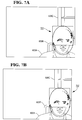
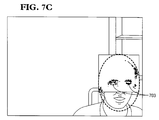
- FIGS. 6A-6D, 7A-7C, 8A-8D and 9A-9D depict examples of video images that may be processed by the present invention.
- FIG. 10 depicts criteria that may be used to model a face within a video image.
- FIGS. 11-12 are flow diagrams depicting processes that are performed by the present invention.
- FIG. 1 depicts the overall structure of the present invention in one embodiment.
- the hardware components of the present invention may consist of standard off-the-shelf components.
- the primary components in the system are one or more video cameras 110, one or more frame grabbers 120, and a processing system 130, such as a personal computer (PC).
- the combination of the PC 130 and frame grabber 120 may collectively be referred to as a "video processor" 140.
- the video processor 140 receives a standard video signal format 115, such as RS-170, NTSC, CCIR, PAL, from one or more of the cameras 110, which can be monochrome or color.
- the camera(s) 110 may be mounted or positioned to view a selected area of interest, such as within a retail establishment or other suitable location.
- the video signal 115 is input to the frame grabber 120.
- the frame grabber 120 may comprise a Meteor Color Frame Grabber, available from Matrox.
- the frame grabber 120 operates to convert the analog video signal 115 into a digital image stored within the memory 135, which can be processed by the video processor 140.
- the frame grabber 120 may convert the video signal 115 into a 640 x 480 (NTSC) or 768 x 576 (PAL) color image.
- the color image may consist of three color planes, commonly referred to as YUV or YIQ. Each pixel in a color plane may have 8 bits of resolution, which is sufficient for most purposes.
- a variety of other digital image formats and resolutions may be used as well, as will be recognized by one of ordinary skill.
- analysis of the video image may begin. All analysis according to the teachings of the present invention may be performed by the processing system 130, but may also be performed by any other suitable means. Such analysis is described in further detail below.
- FIG. 2 An overall flow diagram depicting the process performed by the processing system 130 of the present invention is shown in FIG. 2.
- the first overall stage 201 performed by the processing system 130 is the detection of one or more human heads (or equivalent) within the video image from camera 110, which is stored in memory 135, and the second overall stage 202 is the detection of any eyes associated with the detected human head(s).
- the output 230 of stages 201-202 may be passed to recognition and classification systems (or the like) for further processing.
- stage 201 The steps performed in stage 201 are described below.
- the first steps 212-213 and 216 is the segmentation of people in the foreground regions of the sequence of video images stored in memory 135 over time, which is represented in FIG. 2 as video sequence 211. Such segmentation is accomplished by background modeling (step 216), background subtraction and thresholding (step 212) and connected component analysis (step 213). Assuming the original image 600 of FIG. 6A (which may be stored in memory 135, etc.), as shown in FIG. 6B, the result of steps 212 and 213 is a set of connected regions (blobs) (e.g., blobs 601) which have large deviations from the background image. The connected components 601 are then filtered also in step 213 to remove insignificant blobs due to shadow, noise and lighting variations, resulting in, for example, the blobs 602 in FIG. 6C.
- blobs connected regions
- step 214-215, 217 To detect the head of people whose bodies are occluded, a model-based approach is used (steps 214-215, 217).
- different foreground models (step 217) may be used for the case where there is one person in a foreground region and the case where there are two people in a foreground region.
- the output of step 214 are the probabilities of the input given each of the foreground region models.
- Step 215 selects the model that best describes the foreground region by selecting the maximum probability computed in step 214.
- An example output of step 215 is shown in Figure 6D, wherein the ellipse 603 is generated.
- FIGS. 9A-9D represent a video image that may be created by frame grabber 120 and stored in memory 135 (FIG. 1).
- FIG. 9A depicts an example foreground region representing one person 901.
- the one person model (x1, x2) matches the input data.
- FIG. 9B depicts the same foreground region modeled as two persons (x1, x2, x3). In this case two dashed ellipses 911, 912 are fitted but they do not represent the correct location of the head 913.
- the probability of the foreground region is computed for each model as is described later and the system automatically selects the model for one person to best describe the foreground region in this case.
- FIGS. 9C and 9D depict an example foreground region with two people 902, 903 with occluded bodies.
- the system 130 of the present invention selects the two people model (x1, x2, x3) to best represent the data.
- the large dashed ellipse 921 is fitted which does not correspond to any of the people's 902, 903 heads.
- the system does not select the single person model because the probability of one person model for the given input data is lower than the probability of the two person model given the input data.
- the next overall stage 202 in the present invention is the detection of eyes from varying poses and the extraction of those faces that correspond to frontal views.
- prior art articles such as those described by Turk et al., "Face Recognition Using Eigenfaces", Proceedings on International Conference on Pattern Recognition , 1991 and Brunelli et al., “Face Recognition: Features versus Templates", IEEE Transactions on Pattern Analysis and Machine Intelligence , vol. 15, no. 10, October 1993, techniques have been proposed whereby eyes are detected from frontal views.
- the assumption of frontal view faces is not valid for real world applications.
- step 221-222 the most significant face features are detected by analyzing the connected regions of large deviations from facial statistics.
- Region size and anthropological measure-based filtering detect the eyes and the frontal faces.
- Eye detection based upon anthropological measures for frontal views has been studied in the prior art (see, e.g., Brunelli et al., cited previously). However, such methods can run into problems in the analysis of profile or back views of faces.
- filtering based on detected region size is able to remove big connected components corresponding to hair as well as small regions generated by noise or shadow effects.
- step 224 the remaining components are filtered considering the anthropological features of human eyes for frontal views, and again the output 230 may be passed to another system for further processing.
- the eye detection stage 202 of the present invention is described in further detail below.
- the background may be modeled as a texture with the intensity of each point modeled by a Gaussian distribution with mean ⁇ and variance ⁇ , N b ( ⁇ , ⁇ ) (step 216).
- the pixels in the image are classified as foreground if p ( O ( x,y )
- the observation O ( x,y ) represents the intensity of the pixels at location ( x,y ), and T is a constant (step 212).
- the connectivity analysis (step 213) of the "foreground" pixels generates connected sets of pixels, i.e. sets of pixels that are adjacent or touching. Each of the above sets of pixels describe a foreground region. Small foreground regions are assumed to be due to shadow, camera noise and lighting variations and are removed.
- the foreground regions are analyzed in further detail in steps 214-215 and 217 to detect the head. It is known that if there is only one head in the image, then it may be detected by finding the upper region in each set of connected foreground regions. However, this technique fails when people in an image are occluded by other people. In this case, a foreground region may correspond to two or more people, and finding the regions corresponding to heads requires a more complicated approach. In the case of partial people occlusion, in which bodies are occluded by other bodies, but heads are not occluded, special processing must be performed.
- N separate models ⁇ i (301), (where i may equal 1 to N) may be built, each model ⁇ i 301 corresponding to i people in a set of connected foreground region.
- the approach used to determine the number of people in each foreground region is to select in step 215 the model ⁇ i 301 for which the maximum likelihood is achieved: where the observations O ( x,y )are the pixel intensities at coordinates ( x,y ) in the foreground regions and P ( O ( x,y )
- the probability computation steps 302 in FIG. 3 determines the likelihood functions for each model 301.
- the observations O ( x,y ) in the foreground regions are used to find for each model ⁇ i 301 the optimal set of parameters ( x 0 , x 1 ,... x i )that maximize P ( O ( x,y )
- the head model 301 is parameterized by the set ( x 0 ,y 0 ,a,b ), where x 0 and y 0 are the coordinates of the ellipse centroid and a and b are the axis of the ellipse.
- the set ( x 0 , y 0 , a,b ) is determined through an efficient ellipse fitting process described elsewhere with respect to FIG. 5.
- HMM Hidden Markov Model
- the head detection problem is reduced to finding the set of parameters ( x 0 , y 0 , a,b ) that describe an ellipse type deformable template (step 402 in FIG. 4).
- Parameters x 0 and y 0 describe the ellipse centroid coordinates and a and b are the ellipse axis.
- the ellipse fitting algorithm is described in more detail with respect to FIG. 5.
- a rectangular template (W in FIG. 10) is defined by the set of parameters ( x 0 , y 0 , ⁇ a , ⁇ b ), where x 0 and y 0 are the coordinates of the center of the rectangle and ⁇ a , ⁇ b are the width and length of the rectangle, and ⁇ is some constant (see FIG. 10).
- x j -1 x j , R out,j is the set of pixels outside the ellipse template and inside the rectangle template and R in,j is the set of pixels inside the ellipse template (FIG. 10).
- the regions R in,j and R out,j locally classify the image in "face” and "non face” regions.
- the goal in steps 301-302 is not only to compute the likelihood functions P ( O ( x,y )
- x i are iteratively adjusted to maximize P ( O ( x,y )
- the iterations are terminated if the difference of the likelihood functions in two consecutive iterations is smaller than a threshold (step 405).
- x 1 is the only parameter that is iteratively adjusted for the estimation of the model.
- the computation of the likelihood function for a two person model is described in the following steps.
- the reference numerals within [brackets] correspond to like-numbered steps illustrated in FIG. 11:
- FIG 4 A general prior art technique for fitting the ellipse around the detected blobs in step 402 (Fig 4) is the use of the Hough Transform, described by Chellapa et al. in "Human and Machine Recognition of Faces: A Survey", Proceedings of the IEEE , vol. 83, no. 5, pp. 705-740, May 1993.
- the computational complexity of the Hough Transform approach, as well as the need for a robust edge detection algorithm make it ineffective for real-time applications.
- a better alternative for fitting the ellipse in step 402 is an inexpensive recursive technique that reduces the search for the ellipse parameters from a four dimensional space x 0 , y 0 , a , b to a one dimensional space.
- the parameter space of the ellipse is reduced based on the following observations:
- step 503 the edges and the vertical skeleton of the foreground regions in the area bordered by x j -1 , x j are extracted. After the extraction of the skeletons of the foreground regions, the y 0 parameter of the ellipse is iteratively computed.
- the initial y coordinate of the ellipse centroid, y (0) / 0 is chosen close enough to the top of the object on the vertical skeleton in order for the algorithm to perform well for all types of sequences from head-and-shoulder to full-body sequence (step 504).
- the ellipses detected from stage 201 are potentially the region of support for human faces. After the detection of these regions, a more refined model for the face is required in order to determine which of the detected regions correspond to valid faces.
- the present invention may use an eye-detection algorithm based on both region size and geometrical measure filtering.
- the exclusive use of geometrical measures to detect the eyes inside a rectangular window around the ellipse centroid may lead to problems in the analysis of non-frontal faces.
- the hair regions inside the eye band generate small hair regions that are not connected to each other and that are in general close in size and intensity to the eye regions.
- the simple inspection of geometrical distances between regions and positions inside the eye band cannot indicate which regions correspond to the eyes.
- a more difficult approach based on region shape can be taken into account.
- a simple method may be implemented to discriminate eye and hair regions that perform with good results for a large number of video image sequences.
- the small hair regions inside the eye band are removed by analyzing the region sizes in a larger window around the upper portion of the face (W face-up 1002 in Fig 10). Inside this window, the hair corresponds to the region of large size.
- Stage 202 of FIG. 2 illustrates the steps of the eye detection approach that may be used according to the present invention.
- step 221 the pixel intensities inside the face regions are compared to a threshold ⁇ , and pixels with intensities lower than ⁇ are extracted from the face region.
- step 222 and as shown in FIG. 7A, the connectivity analysis of the extracted pixels generates connected sets of pixels (e.g., pixels 701), i.e. sets of pixels that are adjacent or touching. Each of these connected sets of pixels 701 describe a low intensity region of the face.
- step 223 the pixel regions 701 resulting from steps 221-222 are filtered with respect to the region size. Regions having a small number of pixels due to camera noise or shadows are removed. Large regions generally cannot represent eyes, but instead correspond in general to hair.
- the size of the regions selected at this stage is in the interval [ ⁇ m , ⁇ M ] where ⁇ m , is the minimum and ⁇ M is the maximum number of pixels allowed by our system to describe a valid eye region. Threshold values ⁇ m , ⁇ M are determined based on the size of the ellipse that characterizes the head region (the ellipse being generated iteratively in step 215).
- the end result of step 223 is an image 702, such as that shown in FIG. 7B.
- step 224 the remaining components within the image of FIG. 7B are filtered based on anthropological measures, such as the geometrical distances between eyes and the expected position of the eyes inside a rectangular window (eye band) centered in the ellipse centroid.
- the eye regions are determined by analyzing the minimum and maximum distance between the regions inside this band.
- the output 230 of step 224 is an image, such as shown in FIG. 7C, whereby the eyes 703 have been detected.
- FIGS. 8A, 8B, 8C and 8D depict the results obtained by operating the present invention in a sample laboratory environment, based upon the teachings above.
- FIGS. 8A-8D comprise four different scenarios generated to demonstrate the performances under different conditions such as non-frontal poses, multiple occluding people back views, and faces with glasses.
- the face 812 of a single person 811 is detected, via ellipse 813.
- the ellipse 813 is properly fitted around the face 812 and the eyes 814 are detected even though the person 811 is wearing optical glasses on his face 812.
- FIG. 8B shows the back view of a single person 821 in the video scene.
- the ellipse 823 is fitted around the head of the person 821, but no eye is detected, indicating the robustness of the eye detection stage 202 of the present invention.
- FIGS. 8C and 8D show two scenarios in which two people 831A and 831B are present in the scene.
- the body of one person 831B is covering part of the body of the other person 831A.
- ellipses 833A and 833B are positioned around the faces 832A and 832B, and eyes 834A and 834B are detected.
- the face 832A of the person 831A in the back has a non-frontal position.
- the size of the two faces 832A and 832B are different.
- the faces 832A and 832B of both persons 831A and 831B are detected indicating the robustness of the system to variations in parameters such as size and position of the faces 832A and 832B.
Landscapes
- Engineering & Computer Science (AREA)
- General Physics & Mathematics (AREA)
- General Health & Medical Sciences (AREA)
- Human Computer Interaction (AREA)
- Physics & Mathematics (AREA)
- Health & Medical Sciences (AREA)
- Multimedia (AREA)
- Theoretical Computer Science (AREA)
- Ophthalmology & Optometry (AREA)
- Oral & Maxillofacial Surgery (AREA)
- Image Analysis (AREA)
- Image Processing (AREA)
- Collating Specific Patterns (AREA)
Applications Claiming Priority (4)
| Application Number | Priority Date | Filing Date | Title |
|---|---|---|---|
| US3181696P | 1996-11-26 | 1996-11-26 | |
| US31816P | 1996-11-26 | ||
| US08/859,902 US6184926B1 (en) | 1996-11-26 | 1997-05-21 | System and method for detecting a human face in uncontrolled environments |
| US859902 | 1997-05-21 |
Publications (2)
| Publication Number | Publication Date |
|---|---|
| EP0844582A2 true EP0844582A2 (de) | 1998-05-27 |
| EP0844582A3 EP0844582A3 (de) | 1999-05-26 |
Family
ID=26707653
Family Applications (1)
| Application Number | Title | Priority Date | Filing Date |
|---|---|---|---|
| EP97309444A Withdrawn EP0844582A3 (de) | 1996-11-26 | 1997-11-24 | Anlage und Verfahren zur Detektion eines menschlichen Gesichts |
Country Status (3)
| Country | Link |
|---|---|
| US (1) | US6184926B1 (de) |
| EP (1) | EP0844582A3 (de) |
| JP (1) | JPH10320562A (de) |
Cited By (12)
| Publication number | Priority date | Publication date | Assignee | Title |
|---|---|---|---|---|
| EP0984386A3 (de) * | 1998-09-05 | 2000-03-15 | Sharp Kabushiki Kaisha | Verfahren und Vorrichtung zum Wahrnehmen eines menschlichen Gesichtes und ein Beobachternachführdisplay |
| JP2001222719A (ja) * | 1999-12-01 | 2001-08-17 | Matsushita Electric Ind Co Ltd | 顔抽出装置及び顔抽出方法並びに顔抽出プログラムの記録媒体 |
| WO2003044737A1 (en) * | 2001-11-19 | 2003-05-30 | Koninklijke Philips Electronics N.V. | Computer vision method and system for blob-based analysis using a probabilistic framework |
| EP1510973A2 (de) * | 2003-08-29 | 2005-03-02 | Samsung Electronics Co., Ltd. | Verfahren und Gerät zur bildbasierten fotorealistischen 3D Gesichtsmodellierung |
| US6903782B2 (en) | 2001-03-28 | 2005-06-07 | Koninklijke Philips Electronics N.V. | System and method for performing segmentation-based enhancements of a video image |
| GB2409027A (en) * | 2003-12-11 | 2005-06-15 | Sony Uk Ltd | Face detection |
| EP1330128A3 (de) * | 2001-12-03 | 2006-02-08 | Microsoft Corporation | Automatische Detektion und Verfolgung mehrfache Menschengesichte unter Verwendung mehrfacher Signale |
| EP1017019A3 (de) * | 1998-12-31 | 2007-01-10 | Eastman Kodak Company | Verfahren zur automatischen Bestimmung von Hauptgegenständen in photographischen Bildern |
| EP1833002A1 (de) * | 2006-03-08 | 2007-09-12 | ID-Development AG | Verfahren und Vorrichtung zum Erhalt biometrischer Bildproben oder biometrischer Daten |
| EP1107166A3 (de) * | 1999-12-01 | 2008-08-06 | Matsushita Electric Industrial Co., Ltd. | Gerät und Verfahren zur Extraktion von Gesichtbildern und Speicherträger mit gespeichertem Program für das Verfahren |
| EP1777643A4 (de) * | 2004-08-04 | 2009-02-25 | Daulet Kulenov | Verfahren zum automatischen erkennen eines gesichts in einem elektronisch digitalisierten bild |
| US8254639B2 (en) * | 2006-10-31 | 2012-08-28 | Sony Corporation | Image storage device, imaging device, image storage method, and program |
Families Citing this family (136)
| Publication number | Priority date | Publication date | Assignee | Title |
|---|---|---|---|---|
| USRE46310E1 (en) | 1991-12-23 | 2017-02-14 | Blanding Hovenweep, Llc | Ergonomic man-machine interface incorporating adaptive pattern recognition based control system |
| US6850252B1 (en) | 1999-10-05 | 2005-02-01 | Steven M. Hoffberg | Intelligent electronic appliance system and method |
| USRE47908E1 (en) | 1991-12-23 | 2020-03-17 | Blanding Hovenweep, Llc | Ergonomic man-machine interface incorporating adaptive pattern recognition based control system |
| US5903454A (en) | 1991-12-23 | 1999-05-11 | Hoffberg; Linda Irene | Human-factored interface corporating adaptive pattern recognition based controller apparatus |
| US10361802B1 (en) | 1999-02-01 | 2019-07-23 | Blanding Hovenweep, Llc | Adaptive pattern recognition based control system and method |
| USRE48056E1 (en) | 1991-12-23 | 2020-06-16 | Blanding Hovenweep, Llc | Ergonomic man-machine interface incorporating adaptive pattern recognition based control system |
| KR100595926B1 (ko) * | 1998-01-26 | 2006-07-05 | 웨인 웨스터만 | 수동 입력 통합 방법 및 장치 |
| US6400830B1 (en) * | 1998-02-06 | 2002-06-04 | Compaq Computer Corporation | Technique for tracking objects through a series of images |
| US6332139B1 (en) * | 1998-11-09 | 2001-12-18 | Mega Chips Corporation | Information communication system |
| KR100361497B1 (ko) * | 1999-01-08 | 2002-11-18 | 엘지전자 주식회사 | 얼굴영역 추출방법 |
| US7038715B1 (en) * | 1999-01-19 | 2006-05-02 | Texas Instruments Incorporated | Digital still camera with high-quality portrait mode |
| JP3617373B2 (ja) * | 1999-06-03 | 2005-02-02 | オムロン株式会社 | ゲート装置 |
| JP2000350123A (ja) | 1999-06-04 | 2000-12-15 | Fuji Photo Film Co Ltd | 画像選択装置、カメラ、画像選択方法及び記録媒体 |
| JP2001357404A (ja) * | 2000-06-14 | 2001-12-26 | Minolta Co Ltd | 画像抽出装置 |
| US7099510B2 (en) * | 2000-11-29 | 2006-08-29 | Hewlett-Packard Development Company, L.P. | Method and system for object detection in digital images |
| KR100416991B1 (ko) * | 2001-01-11 | 2004-02-05 | 삼성전자주식회사 | 가상 배경 표시 기능을 갖는 영상 단말 장치 및 그 구현방법 |
| US7082393B2 (en) * | 2001-03-27 | 2006-07-25 | Rast Associates, Llc | Head-worn, trimodal device to increase transcription accuracy in a voice recognition system and to process unvocalized speech |
| US20020172419A1 (en) * | 2001-05-15 | 2002-11-21 | Qian Lin | Image enhancement using face detection |
| JP2003061105A (ja) * | 2001-06-07 | 2003-02-28 | Seiko Epson Corp | 画像処理方法、画像処理プログラム、画像処理装置およびそれを用いたディジタルスチルカメラ |
| US7274800B2 (en) * | 2001-07-18 | 2007-09-25 | Intel Corporation | Dynamic gesture recognition from stereo sequences |
| US8898106B2 (en) | 2001-08-01 | 2014-11-25 | T-System, Inc. | Method for entering, recording, distributing and reporting data |
| CA2359269A1 (en) * | 2001-10-17 | 2003-04-17 | Biodentity Systems Corporation | Face imaging system for recordal and automated identity confirmation |
| US20030113002A1 (en) * | 2001-12-18 | 2003-06-19 | Koninklijke Philips Electronics N.V. | Identification of people using video and audio eigen features |
| US7921036B1 (en) | 2002-04-30 | 2011-04-05 | Videomining Corporation | Method and system for dynamically targeting content based on automatic demographics and behavior analysis |
| US20030212552A1 (en) * | 2002-05-09 | 2003-11-13 | Liang Lu Hong | Face recognition procedure useful for audiovisual speech recognition |
| US7209883B2 (en) * | 2002-05-09 | 2007-04-24 | Intel Corporation | Factorial hidden markov model for audiovisual speech recognition |
| US7165029B2 (en) | 2002-05-09 | 2007-01-16 | Intel Corporation | Coupled hidden Markov model for audiovisual speech recognition |
| US7843495B2 (en) * | 2002-07-10 | 2010-11-30 | Hewlett-Packard Development Company, L.P. | Face recognition in a digital imaging system accessing a database of people |
| US8064650B2 (en) | 2002-07-10 | 2011-11-22 | Hewlett-Packard Development Company, L.P. | File management of digital images using the names of people identified in the images |
| US20040012576A1 (en) * | 2002-07-16 | 2004-01-22 | Robert Cazier | Digital image display method and system |
| US6996460B1 (en) | 2002-10-03 | 2006-02-07 | Advanced Interfaces, Inc. | Method and apparatus for providing virtual touch interaction in the drive-thru |
| US7171043B2 (en) | 2002-10-11 | 2007-01-30 | Intel Corporation | Image recognition using hidden markov models and coupled hidden markov models |
| US20040136870A1 (en) * | 2002-10-25 | 2004-07-15 | Kochy Thomas E. | Automatic analysis apparatus |
| US7307654B2 (en) * | 2002-10-31 | 2007-12-11 | Hewlett-Packard Development Company, L.P. | Image capture and viewing system and method for generating a synthesized image |
| US7283650B1 (en) | 2002-11-27 | 2007-10-16 | Video Mining Corporation | Method and system for printing of automatically captured facial images augmented with promotional content |
| US7472063B2 (en) * | 2002-12-19 | 2008-12-30 | Intel Corporation | Audio-visual feature fusion and support vector machine useful for continuous speech recognition |
| US7734070B1 (en) | 2002-12-31 | 2010-06-08 | Rajeev Sharma | Method and system for immersing face images into a video sequence |
| US7203368B2 (en) * | 2003-01-06 | 2007-04-10 | Intel Corporation | Embedded bayesian network for pattern recognition |
| US7711155B1 (en) | 2003-04-14 | 2010-05-04 | Videomining Corporation | Method and system for enhancing three dimensional face modeling using demographic classification |
| US8494286B2 (en) * | 2008-02-05 | 2013-07-23 | DigitalOptics Corporation Europe Limited | Face detection in mid-shot digital images |
| US7680342B2 (en) | 2004-08-16 | 2010-03-16 | Fotonation Vision Limited | Indoor/outdoor classification in digital images |
| US8593542B2 (en) * | 2005-12-27 | 2013-11-26 | DigitalOptics Corporation Europe Limited | Foreground/background separation using reference images |
| US8330831B2 (en) * | 2003-08-05 | 2012-12-11 | DigitalOptics Corporation Europe Limited | Method of gathering visual meta data using a reference image |
| US7620218B2 (en) * | 2006-08-11 | 2009-11-17 | Fotonation Ireland Limited | Real-time face tracking with reference images |
| US8682097B2 (en) | 2006-02-14 | 2014-03-25 | DigitalOptics Corporation Europe Limited | Digital image enhancement with reference images |
| US7606417B2 (en) * | 2004-08-16 | 2009-10-20 | Fotonation Vision Limited | Foreground/background segmentation in digital images with differential exposure calculations |
| US8896725B2 (en) * | 2007-06-21 | 2014-11-25 | Fotonation Limited | Image capture device with contemporaneous reference image capture mechanism |
| JP2005050016A (ja) * | 2003-07-31 | 2005-02-24 | National Aerospace Laboratory Of Japan | 形状認識装置及び形状認識方法及び形状認識プログラム |
| EP1669890A4 (de) * | 2003-09-26 | 2007-04-04 | Nikon Corp | Verfahren, einrichtung und system zur akkumulation elektronischer bilder |
| US6984039B2 (en) * | 2003-12-01 | 2006-01-10 | Eastman Kodak Company | Laser projector having silhouette blanking for objects in the output light path |
| JP2005242640A (ja) * | 2004-02-26 | 2005-09-08 | Fuji Photo Film Co Ltd | 対象物検出方法および装置並びにプログラム |
| US7697026B2 (en) * | 2004-03-16 | 2010-04-13 | 3Vr Security, Inc. | Pipeline architecture for analyzing multiple video streams |
| US8345918B2 (en) * | 2004-04-14 | 2013-01-01 | L-3 Communications Corporation | Active subject privacy imaging |
| US7889381B2 (en) * | 2004-05-28 | 2011-02-15 | Fujifilm Corporation | Photo service system |
| US7430321B2 (en) * | 2004-09-09 | 2008-09-30 | Siemens Medical Solutions Usa, Inc. | System and method for volumetric tumor segmentation using joint space-intensity likelihood ratio test |
| NO321642B1 (no) * | 2004-09-27 | 2006-06-12 | Tandberg Telecom As | Fremgangsmate for koding av bildeutsnitt |
| US8320641B2 (en) * | 2004-10-28 | 2012-11-27 | DigitalOptics Corporation Europe Limited | Method and apparatus for red-eye detection using preview or other reference images |
| US7386150B2 (en) * | 2004-11-12 | 2008-06-10 | Safeview, Inc. | Active subject imaging with body identification |
| JP4824411B2 (ja) * | 2005-01-20 | 2011-11-30 | パナソニック株式会社 | 顔抽出装置、半導体集積回路 |
| JP2006259924A (ja) * | 2005-03-15 | 2006-09-28 | Omron Corp | 被写体認証装置、携帯電話、被写体認証ユニット、被写体認証方法、及び被写体認証プログラム |
| JP4830650B2 (ja) * | 2005-07-05 | 2011-12-07 | オムロン株式会社 | 追跡装置 |
| JP4538008B2 (ja) * | 2005-08-12 | 2010-09-08 | 株式会社ソニー・コンピュータエンタテインメント | 顔画像表示装置、顔画像表示方法及び顔画像表示プログラム |
| GB2432064B (en) * | 2005-10-31 | 2011-01-19 | Hewlett Packard Development Co | Method of triggering a detector to detect a moving feature within a video stream |
| JP4516516B2 (ja) * | 2005-12-07 | 2010-08-04 | 本田技研工業株式会社 | 人物検出装置、人物検出方法及び人物検出プログラム |
| JP3962803B2 (ja) * | 2005-12-16 | 2007-08-22 | インターナショナル・ビジネス・マシーンズ・コーポレーション | 頭部検出装置、頭部検出方法および頭部検出プログラム |
| US7692696B2 (en) | 2005-12-27 | 2010-04-06 | Fotonation Vision Limited | Digital image acquisition system with portrait mode |
| US7916897B2 (en) | 2006-08-11 | 2011-03-29 | Tessera Technologies Ireland Limited | Face tracking for controlling imaging parameters |
| US20080059522A1 (en) * | 2006-08-29 | 2008-03-06 | International Business Machines Corporation | System and method for automatically creating personal profiles for video characters |
| US7689011B2 (en) * | 2006-09-26 | 2010-03-30 | Hewlett-Packard Development Company, L.P. | Extracting features from face regions and auxiliary identification regions of images for person recognition and other applications |
| US7987111B1 (en) * | 2006-10-30 | 2011-07-26 | Videomining Corporation | Method and system for characterizing physical retail spaces by determining the demographic composition of people in the physical retail spaces utilizing video image analysis |
| US8315463B2 (en) * | 2006-11-14 | 2012-11-20 | Eastman Kodak Company | User interface for face recognition |
| US7891818B2 (en) | 2006-12-12 | 2011-02-22 | Evans & Sutherland Computer Corporation | System and method for aligning RGB light in a single modulator projector |
| US8130203B2 (en) | 2007-01-03 | 2012-03-06 | Apple Inc. | Multi-touch input discrimination |
| US7855718B2 (en) * | 2007-01-03 | 2010-12-21 | Apple Inc. | Multi-touch input discrimination |
| US8269727B2 (en) * | 2007-01-03 | 2012-09-18 | Apple Inc. | Irregular input identification |
| JP4639208B2 (ja) * | 2007-03-16 | 2011-02-23 | 富士フイルム株式会社 | 画像選択装置、画像選択方法、撮像装置及びプログラム |
| US8331674B2 (en) * | 2007-04-06 | 2012-12-11 | International Business Machines Corporation | Rule-based combination of a hierarchy of classifiers for occlusion detection |
| TWI351001B (en) * | 2007-11-21 | 2011-10-21 | Ind Tech Res Inst | Method and apparatus for adaptive object detection |
| US8682029B2 (en) * | 2007-12-14 | 2014-03-25 | Flashfoto, Inc. | Rule-based segmentation for objects with frontal view in color images |
| US8629883B2 (en) * | 2008-02-28 | 2014-01-14 | Befun Bilgi Teknologileri A.S. | Method and system for generating online cartoon outputs |
| US9483237B2 (en) | 2008-02-28 | 2016-11-01 | Befun Bilgi Teknolojileri A.S. | Method and system for providing an image effects interface |
| US7953255B2 (en) * | 2008-05-01 | 2011-05-31 | At&T Intellectual Property I, L.P. | Avatars in social interactive television |
| US8358317B2 (en) | 2008-05-23 | 2013-01-22 | Evans & Sutherland Computer Corporation | System and method for displaying a planar image on a curved surface |
| US8702248B1 (en) | 2008-06-11 | 2014-04-22 | Evans & Sutherland Computer Corporation | Projection method for reducing interpixel gaps on a viewing surface |
| US8238604B2 (en) * | 2008-08-18 | 2012-08-07 | Kabushiki Kaisha Toshiba | System and method for validation of face detection in electronic images |
| US8077378B1 (en) | 2008-11-12 | 2011-12-13 | Evans & Sutherland Computer Corporation | Calibration system and method for light modulation device |
| KR101593573B1 (ko) * | 2009-06-19 | 2016-02-12 | 삼성전자주식회사 | 단말기의 카메라를 이용한 컨텐츠 제작 방법 및 장치 |
| US8864581B2 (en) * | 2010-01-29 | 2014-10-21 | Microsoft Corporation | Visual based identitiy tracking |
| KR20120069331A (ko) | 2010-12-20 | 2012-06-28 | 삼성전자주식회사 | 영상의 전경과 배경을 분리하는 방법 |
| US9641826B1 (en) | 2011-10-06 | 2017-05-02 | Evans & Sutherland Computer Corporation | System and method for displaying distant 3-D stereo on a dome surface |
| KR101901591B1 (ko) * | 2011-11-01 | 2018-09-28 | 삼성전자주식회사 | 얼굴 인식 장치 및 그 제어방법 |
| AU2011253977B2 (en) | 2011-12-12 | 2015-04-09 | Canon Kabushiki Kaisha | Method, system and apparatus for selecting an image captured on an image capture device |
| US9679215B2 (en) | 2012-01-17 | 2017-06-13 | Leap Motion, Inc. | Systems and methods for machine control |
| US12260023B2 (en) | 2012-01-17 | 2025-03-25 | Ultrahaptics IP Two Limited | Systems and methods for machine control |
| US8693731B2 (en) | 2012-01-17 | 2014-04-08 | Leap Motion, Inc. | Enhanced contrast for object detection and characterization by optical imaging |
| US10691219B2 (en) | 2012-01-17 | 2020-06-23 | Ultrahaptics IP Two Limited | Systems and methods for machine control |
| US8638989B2 (en) | 2012-01-17 | 2014-01-28 | Leap Motion, Inc. | Systems and methods for capturing motion in three-dimensional space |
| US20130182079A1 (en) * | 2012-01-17 | 2013-07-18 | Ocuspec | Motion capture using cross-sections of an object |
| US11493998B2 (en) | 2012-01-17 | 2022-11-08 | Ultrahaptics IP Two Limited | Systems and methods for machine control |
| US9070019B2 (en) | 2012-01-17 | 2015-06-30 | Leap Motion, Inc. | Systems and methods for capturing motion in three-dimensional space |
| US9501152B2 (en) | 2013-01-15 | 2016-11-22 | Leap Motion, Inc. | Free-space user interface and control using virtual constructs |
| US9324292B2 (en) * | 2012-09-27 | 2016-04-26 | Hewlett-Packard Development Company, L.P. | Selecting an interaction scenario based on an object |
| US9285893B2 (en) | 2012-11-08 | 2016-03-15 | Leap Motion, Inc. | Object detection and tracking with variable-field illumination devices |
| US9191707B2 (en) | 2012-11-08 | 2015-11-17 | Bank Of America Corporation | Automatic display of user-specific financial information based on audio content recognition |
| US9027048B2 (en) | 2012-11-14 | 2015-05-05 | Bank Of America Corporation | Automatic deal or promotion offering based on audio cues |
| US10609285B2 (en) | 2013-01-07 | 2020-03-31 | Ultrahaptics IP Two Limited | Power consumption in motion-capture systems |
| US9465461B2 (en) | 2013-01-08 | 2016-10-11 | Leap Motion, Inc. | Object detection and tracking with audio and optical signals |
| US9459697B2 (en) | 2013-01-15 | 2016-10-04 | Leap Motion, Inc. | Dynamic, free-space user interactions for machine control |
| US9632658B2 (en) | 2013-01-15 | 2017-04-25 | Leap Motion, Inc. | Dynamic user interactions for display control and scaling responsiveness of display objects |
| US9754154B2 (en) | 2013-02-15 | 2017-09-05 | Microsoft Technology Licensing, Llc | Identification using depth-based head-detection data |
| US9702977B2 (en) | 2013-03-15 | 2017-07-11 | Leap Motion, Inc. | Determining positional information of an object in space |
| US10620709B2 (en) | 2013-04-05 | 2020-04-14 | Ultrahaptics IP Two Limited | Customized gesture interpretation |
| US9916009B2 (en) | 2013-04-26 | 2018-03-13 | Leap Motion, Inc. | Non-tactile interface systems and methods |
| US9747696B2 (en) | 2013-05-17 | 2017-08-29 | Leap Motion, Inc. | Systems and methods for providing normalized parameters of motions of objects in three-dimensional space |
| US10281987B1 (en) | 2013-08-09 | 2019-05-07 | Leap Motion, Inc. | Systems and methods of free-space gestural interaction |
| US10846942B1 (en) | 2013-08-29 | 2020-11-24 | Ultrahaptics IP Two Limited | Predictive information for free space gesture control and communication |
| US9632572B2 (en) | 2013-10-03 | 2017-04-25 | Leap Motion, Inc. | Enhanced field of view to augment three-dimensional (3D) sensory space for free-space gesture interpretation |
| US10168873B1 (en) | 2013-10-29 | 2019-01-01 | Leap Motion, Inc. | Virtual interactions for machine control |
| US9996638B1 (en) | 2013-10-31 | 2018-06-12 | Leap Motion, Inc. | Predictive information for free space gesture control and communication |
| US9996797B1 (en) | 2013-10-31 | 2018-06-12 | Leap Motion, Inc. | Interactions with virtual objects for machine control |
| US10416834B1 (en) | 2013-11-15 | 2019-09-17 | Leap Motion, Inc. | Interaction strength using virtual objects for machine control |
| US9613262B2 (en) | 2014-01-15 | 2017-04-04 | Leap Motion, Inc. | Object detection and tracking for providing a virtual device experience |
| US9679197B1 (en) | 2014-03-13 | 2017-06-13 | Leap Motion, Inc. | Biometric aware object detection and tracking |
| US9785247B1 (en) | 2014-05-14 | 2017-10-10 | Leap Motion, Inc. | Systems and methods of tracking moving hands and recognizing gestural interactions |
| US9741169B1 (en) | 2014-05-20 | 2017-08-22 | Leap Motion, Inc. | Wearable augmented reality devices with object detection and tracking |
| JP2016038889A (ja) | 2014-08-08 | 2016-03-22 | リープ モーション, インコーポレーテッドLeap Motion, Inc. | モーション感知を伴う拡張現実 |
| US10656720B1 (en) | 2015-01-16 | 2020-05-19 | Ultrahaptics IP Two Limited | Mode switching for integrated gestural interaction and multi-user collaboration in immersive virtual reality environments |
| US10429923B1 (en) | 2015-02-13 | 2019-10-01 | Ultrahaptics IP Two Limited | Interaction engine for creating a realistic experience in virtual reality/augmented reality environments |
| US9696795B2 (en) | 2015-02-13 | 2017-07-04 | Leap Motion, Inc. | Systems and methods of creating a realistic grab experience in virtual reality/augmented reality environments |
| EP3485314A4 (de) * | 2016-07-16 | 2020-02-19 | Ideal Perceptions Llc | Interaktives projektionssystem |
| US10297059B2 (en) | 2016-12-21 | 2019-05-21 | Motorola Solutions, Inc. | Method and image processor for sending a combined image to human versus machine consumers |
| US11295139B2 (en) | 2018-02-19 | 2022-04-05 | Intellivision Technologies Corp. | Human presence detection in edge devices |
| US11615623B2 (en) | 2018-02-19 | 2023-03-28 | Nortek Security & Control Llc | Object detection in edge devices for barrier operation and parcel delivery |
| US11875012B2 (en) | 2018-05-25 | 2024-01-16 | Ultrahaptics IP Two Limited | Throwable interface for augmented reality and virtual reality environments |
| US11275819B2 (en) | 2018-12-05 | 2022-03-15 | Bank Of America Corporation | Generative adversarial network training and feature extraction for biometric authentication |
| US12637896B2 (en) | 2021-08-27 | 2026-05-26 | The Chamberlain Group Llc. | Systems and methods for operating a movable barrier operator |
Family Cites Families (10)
| Publication number | Priority date | Publication date | Assignee | Title |
|---|---|---|---|---|
| US5150432A (en) * | 1990-03-26 | 1992-09-22 | Kabushiki Kaisha Toshiba | Apparatus for encoding/decoding video signals to improve quality of a specific region |
| US5164992A (en) * | 1990-11-01 | 1992-11-17 | Massachusetts Institute Of Technology | Face recognition system |
| JP2973676B2 (ja) * | 1992-01-23 | 1999-11-08 | 松下電器産業株式会社 | 顔画像特徴点抽出装置 |
| US5689575A (en) * | 1993-11-22 | 1997-11-18 | Hitachi, Ltd. | Method and apparatus for processing images of facial expressions |
| US5781650A (en) * | 1994-02-18 | 1998-07-14 | University Of Central Florida | Automatic feature detection and age classification of human faces in digital images |
| US5497430A (en) * | 1994-11-07 | 1996-03-05 | Physical Optics Corporation | Method and apparatus for image recognition using invariant feature signals |
| JP3452685B2 (ja) * | 1995-05-10 | 2003-09-29 | 三菱電機株式会社 | 顔画像の処理装置 |
| JP3735893B2 (ja) * | 1995-06-22 | 2006-01-18 | セイコーエプソン株式会社 | 顔画像処理方法および顔画像処理装置 |
| JP3350296B2 (ja) * | 1995-07-28 | 2002-11-25 | 三菱電機株式会社 | 顔画像処理装置 |
| US5901244A (en) * | 1996-06-18 | 1999-05-04 | Matsushita Electric Industrial Co., Ltd. | Feature extraction system and face image recognition system |
-
1997
- 1997-05-21 US US08/859,902 patent/US6184926B1/en not_active Expired - Lifetime
- 1997-11-24 EP EP97309444A patent/EP0844582A3/de not_active Withdrawn
- 1997-11-26 JP JP9363370A patent/JPH10320562A/ja active Pending
Non-Patent Citations (3)
| Title |
|---|
| "METHOD FOR EXTRACTING FACIAL FEATURES BY USING COLOR INFORMATION" IBM TECHNICAL DISCLOSURE BULLETIN, vol. 38, no. 10, 1 October 1995, pages 163-165, XP000540455 * |
| SABER E ET AL: "Face detection and facial feature extraction using color, shape and symmetry-based cost functions" PROCEEDINGS OF THE 13TH INTERNATIONAL CONFERENCE ON PATTERN RECOGNITION, PROCEEDINGS OF 13TH INTERNATIONAL CONFERENCE ON PATTERN RECOGNITION, VIENNA, AUSTRIA, 25-29 AUG. 1996, pages 654-658 vol.3, XP002097369 ISBN 0-8186-7282-X, 1996, Los Alamitos, CA, USA, IEEE Comput. Soc. Press, USA * |
| SOBOTTKA K ET AL: "FACE LOCALIZATION AND FACIAL FEATURE EXTRACTION BASED ON SHAPE AND COLOR INFORMATION" PROCEEDINGS OF THE INTERNATIONAL CONFERENCE ON IMAGE PROCESSING (IC, LAUSANNE, SEPT. 16 - 19, 1996, vol. 3, 16 September 1996, pages 483-486, XP000704075 INSTITUTE OF ELECTRICAL AND ELECTRONICS ENGINEERS * |
Cited By (19)
| Publication number | Priority date | Publication date | Assignee | Title |
|---|---|---|---|---|
| EP0984386A3 (de) * | 1998-09-05 | 2000-03-15 | Sharp Kabushiki Kaisha | Verfahren und Vorrichtung zum Wahrnehmen eines menschlichen Gesichtes und ein Beobachternachführdisplay |
| US6633655B1 (en) | 1998-09-05 | 2003-10-14 | Sharp Kabushiki Kaisha | Method of and apparatus for detecting a human face and observer tracking display |
| EP1017019A3 (de) * | 1998-12-31 | 2007-01-10 | Eastman Kodak Company | Verfahren zur automatischen Bestimmung von Hauptgegenständen in photographischen Bildern |
| JP2001222719A (ja) * | 1999-12-01 | 2001-08-17 | Matsushita Electric Ind Co Ltd | 顔抽出装置及び顔抽出方法並びに顔抽出プログラムの記録媒体 |
| EP1107166A3 (de) * | 1999-12-01 | 2008-08-06 | Matsushita Electric Industrial Co., Ltd. | Gerät und Verfahren zur Extraktion von Gesichtbildern und Speicherträger mit gespeichertem Program für das Verfahren |
| US6903782B2 (en) | 2001-03-28 | 2005-06-07 | Koninklijke Philips Electronics N.V. | System and method for performing segmentation-based enhancements of a video image |
| WO2003044737A1 (en) * | 2001-11-19 | 2003-05-30 | Koninklijke Philips Electronics N.V. | Computer vision method and system for blob-based analysis using a probabilistic framework |
| US7151843B2 (en) | 2001-12-03 | 2006-12-19 | Microsoft Corporation | Automatic detection and tracking of multiple individuals using multiple cues |
| EP1330128A3 (de) * | 2001-12-03 | 2006-02-08 | Microsoft Corporation | Automatische Detektion und Verfolgung mehrfache Menschengesichte unter Verwendung mehrfacher Signale |
| US7171025B2 (en) | 2001-12-03 | 2007-01-30 | Microsoft Corporation | Automatic detection and tracking of multiple individuals using multiple cues |
| US7428315B2 (en) | 2001-12-03 | 2008-09-23 | Microsoft Corporation | Automatic detection and tracking of multiple individuals using multiple cues |
| US7433495B2 (en) | 2001-12-03 | 2008-10-07 | Microsoft Corporation | Automatic detection and tracking of multiple individuals using multiple cues |
| EP1838104A3 (de) * | 2001-12-03 | 2009-09-30 | Microsoft Corporation | Automatische Entdeckung und Verfolgung mehrerer Personen über mehrere Signale |
| EP1510973A2 (de) * | 2003-08-29 | 2005-03-02 | Samsung Electronics Co., Ltd. | Verfahren und Gerät zur bildbasierten fotorealistischen 3D Gesichtsmodellierung |
| GB2409027A (en) * | 2003-12-11 | 2005-06-15 | Sony Uk Ltd | Face detection |
| US7421149B2 (en) | 2003-12-11 | 2008-09-02 | Sony United Kingdom Limited | Object detection |
| EP1777643A4 (de) * | 2004-08-04 | 2009-02-25 | Daulet Kulenov | Verfahren zum automatischen erkennen eines gesichts in einem elektronisch digitalisierten bild |
| EP1833002A1 (de) * | 2006-03-08 | 2007-09-12 | ID-Development AG | Verfahren und Vorrichtung zum Erhalt biometrischer Bildproben oder biometrischer Daten |
| US8254639B2 (en) * | 2006-10-31 | 2012-08-28 | Sony Corporation | Image storage device, imaging device, image storage method, and program |
Also Published As
| Publication number | Publication date |
|---|---|
| JPH10320562A (ja) | 1998-12-04 |
| US6184926B1 (en) | 2001-02-06 |
| EP0844582A3 (de) | 1999-05-26 |
Similar Documents
| Publication | Publication Date | Title |
|---|---|---|
| US6184926B1 (en) | System and method for detecting a human face in uncontrolled environments | |
| JP4755202B2 (ja) | 顔特徴の検出方法 | |
| US7460693B2 (en) | Method and apparatus for the automatic detection of facial features | |
| EP2192549B1 (de) | Zielverfolgungsvorrichtung und zielverfolgungsverfahren | |
| US8520956B2 (en) | Optimized correlation filters for signal processing | |
| US7035456B2 (en) | Face detection in color images with complex background | |
| US7212665B2 (en) | Human pose estimation with data driven belief propagation | |
| US7953253B2 (en) | Face detection on mobile devices | |
| US6741756B1 (en) | System and method for estimating the orientation of an object | |
| CA2218793C (en) | Multi-modal system for locating objects in images | |
| US20070154096A1 (en) | Facial feature detection on mobile devices | |
| EP1059608A2 (de) | Vorrichtung mit Eigenvektorraummethode zur Erkennung von Gestalt und Position einer Hand | |
| Boehnen et al. | A fast multi-modal approach to facial feature detection | |
| CN107330371A (zh) | 3d脸部模型的脸部表情的获取方法、装置和存储装置 | |
| Fukui et al. | Facial feature point extraction method based on combination of shape extraction and pattern matching | |
| De Smet et al. | A generalized EM approach for 3D model based face recognition under occlusions | |
| Kervrann et al. | Generalized likelihood ratio-based face detection and extraction of mouth features | |
| Nefian et al. | Real-time detection of human faces in uncontrolled environments | |
| Cadavid et al. | Multi-modal biometric modeling and recognition of the human face and ear | |
| Gürel | Development of a face recognition system | |
| Jacques et al. | Improved head-shoulder human contour estimation through clusters of learned shape models | |
| Bobis et al. | Face recognition using binary thresholding for features extraction | |
| Chen et al. | Multi-cue facial feature detection and tracking | |
| Chen et al. | Robust facial feature detection and tracking for head pose estimation in a novel multimodal interface for social skills learning | |
| Sibiryakov et al. | Real-time facial feature detection by statistical template matching |
Legal Events
| Date | Code | Title | Description |
|---|---|---|---|
| PUAI | Public reference made under article 153(3) epc to a published international application that has entered the european phase |
Free format text: ORIGINAL CODE: 0009012 |
|
| AK | Designated contracting states |
Kind code of ref document: A2 Designated state(s): DE FR GB |
|
| AX | Request for extension of the european patent |
Free format text: AL;LT;LV;MK;RO;SI |
|
| PUAL | Search report despatched |
Free format text: ORIGINAL CODE: 0009013 |
|
| AK | Designated contracting states |
Kind code of ref document: A3 Designated state(s): AT BE CH DE DK ES FI FR GB GR IE IT LI LU MC NL PT SE |
|
| AX | Request for extension of the european patent |
Free format text: AL;LT;LV;MK;RO;SI |
|
| 17P | Request for examination filed |
Effective date: 19991126 |
|
| AKX | Designation fees paid |
Free format text: DE FR GB |
|
| 17Q | First examination report despatched |
Effective date: 20001023 |
|
| STAA | Information on the status of an ep patent application or granted ep patent |
Free format text: STATUS: THE APPLICATION IS DEEMED TO BE WITHDRAWN |
|
| 18D | Application deemed to be withdrawn |
Effective date: 20010424 |