EP0837641B1 - Container for hyperpolarized noble gases having a surface coated with a modified polymer - Google Patents
Container for hyperpolarized noble gases having a surface coated with a modified polymer Download PDFInfo
- Publication number
- EP0837641B1 EP0837641B1 EP96918293A EP96918293A EP0837641B1 EP 0837641 B1 EP0837641 B1 EP 0837641B1 EP 96918293 A EP96918293 A EP 96918293A EP 96918293 A EP96918293 A EP 96918293A EP 0837641 B1 EP0837641 B1 EP 0837641B1
- Authority
- EP
- European Patent Office
- Prior art keywords
- noble gas
- container
- polymer
- relaxation
- modified
- Prior art date
- Legal status (The legal status is an assumption and is not a legal conclusion. Google has not performed a legal analysis and makes no representation as to the accuracy of the status listed.)
- Expired - Lifetime
Links
- 229910052756 noble gas Inorganic materials 0.000 title claims abstract description 94
- 229920000642 polymer Polymers 0.000 title claims abstract description 90
- 150000002835 noble gases Chemical class 0.000 title description 17
- 238000000034 method Methods 0.000 claims abstract description 61
- 238000000576 coating method Methods 0.000 claims abstract description 42
- 230000003993 interaction Effects 0.000 claims abstract description 38
- 239000011248 coating agent Substances 0.000 claims abstract description 35
- 230000035699 permeability Effects 0.000 claims abstract description 15
- 230000002829 reductive effect Effects 0.000 claims abstract description 14
- 230000002102 hyperpolarization Effects 0.000 claims description 22
- -1 polysiloxane Polymers 0.000 claims description 20
- 230000002999 depolarising effect Effects 0.000 claims description 14
- 239000004215 Carbon black (E152) Substances 0.000 claims description 13
- 229930195733 hydrocarbon Natural products 0.000 claims description 13
- 150000002430 hydrocarbons Chemical class 0.000 claims description 13
- 229920001296 polysiloxane Polymers 0.000 claims description 11
- 150000004756 silanes Chemical class 0.000 claims description 6
- XUIMIQQOPSSXEZ-UHFFFAOYSA-N Silicon Chemical compound [Si] XUIMIQQOPSSXEZ-UHFFFAOYSA-N 0.000 claims description 5
- 230000028161 membrane depolarization Effects 0.000 claims description 5
- 150000003376 silicon Chemical class 0.000 claims description 5
- 229910052710 silicon Inorganic materials 0.000 claims description 5
- 239000010703 silicon Substances 0.000 claims description 5
- 229920005573 silicon-containing polymer Polymers 0.000 claims description 5
- 230000026030 halogenation Effects 0.000 claims description 4
- 238000005658 halogenation reaction Methods 0.000 claims description 4
- 230000021523 carboxylation Effects 0.000 claims description 3
- 238000006473 carboxylation reaction Methods 0.000 claims description 3
- 238000006277 sulfonation reaction Methods 0.000 claims description 3
- 150000008282 halocarbons Chemical class 0.000 claims 2
- 125000003963 dichloro group Chemical group Cl* 0.000 claims 1
- 230000002401 inhibitory effect Effects 0.000 abstract description 8
- 230000000670 limiting effect Effects 0.000 abstract description 6
- YZCKVEUIGOORGS-OUBTZVSYSA-N Deuterium Chemical compound [2H] YZCKVEUIGOORGS-OUBTZVSYSA-N 0.000 abstract description 4
- 230000003247 decreasing effect Effects 0.000 abstract description 4
- 229910052805 deuterium Inorganic materials 0.000 abstract description 4
- 230000004048 modification Effects 0.000 abstract description 3
- 238000012986 modification Methods 0.000 abstract description 3
- PXGOKWXKJXAPGV-UHFFFAOYSA-N Fluorine Chemical compound FF PXGOKWXKJXAPGV-UHFFFAOYSA-N 0.000 abstract 1
- 230000002708 enhancing effect Effects 0.000 abstract 1
- 229910052731 fluorine Inorganic materials 0.000 abstract 1
- 239000011737 fluorine Substances 0.000 abstract 1
- 229910052736 halogen Inorganic materials 0.000 abstract 1
- 150000002367 halogens Chemical class 0.000 abstract 1
- 238000004519 manufacturing process Methods 0.000 abstract 1
- 230000010287 polarization Effects 0.000 description 28
- 230000005291 magnetic effect Effects 0.000 description 23
- 238000005481 NMR spectroscopy Methods 0.000 description 18
- 150000001340 alkali metals Chemical class 0.000 description 15
- 229910052783 alkali metal Inorganic materials 0.000 description 14
- 238000005086 pumping Methods 0.000 description 13
- 229910052724 xenon Inorganic materials 0.000 description 13
- FHNFHKCVQCLJFQ-UHFFFAOYSA-N xenon atom Chemical compound [Xe] FHNFHKCVQCLJFQ-UHFFFAOYSA-N 0.000 description 13
- 239000007789 gas Substances 0.000 description 12
- 125000004429 atom Chemical group 0.000 description 10
- 238000001179 sorption measurement Methods 0.000 description 9
- 230000003068 static effect Effects 0.000 description 9
- 239000011521 glass Substances 0.000 description 8
- 238000002474 experimental method Methods 0.000 description 7
- 230000003287 optical effect Effects 0.000 description 7
- 230000001419 dependent effect Effects 0.000 description 6
- 229910052739 hydrogen Inorganic materials 0.000 description 6
- 239000001257 hydrogen Substances 0.000 description 6
- 230000005298 paramagnetic effect Effects 0.000 description 6
- 229910052701 rubidium Inorganic materials 0.000 description 6
- IGLNJRXAVVLDKE-UHFFFAOYSA-N rubidium atom Chemical compound [Rb] IGLNJRXAVVLDKE-UHFFFAOYSA-N 0.000 description 6
- UFHFLCQGNIYNRP-UHFFFAOYSA-N Hydrogen Chemical compound [H][H] UFHFLCQGNIYNRP-UHFFFAOYSA-N 0.000 description 5
- 230000008878 coupling Effects 0.000 description 5
- 238000010168 coupling process Methods 0.000 description 5
- 238000005859 coupling reaction Methods 0.000 description 5
- 230000000694 effects Effects 0.000 description 5
- 230000006870 function Effects 0.000 description 5
- 230000005283 ground state Effects 0.000 description 5
- 230000005415 magnetization Effects 0.000 description 5
- 230000008569 process Effects 0.000 description 5
- 125000000217 alkyl group Chemical group 0.000 description 4
- 230000006872 improvement Effects 0.000 description 4
- 238000002595 magnetic resonance imaging Methods 0.000 description 4
- IJGRMHOSHXDMSA-UHFFFAOYSA-N Atomic nitrogen Chemical compound N#N IJGRMHOSHXDMSA-UHFFFAOYSA-N 0.000 description 3
- QVGXLLKOCUKJST-UHFFFAOYSA-N atomic oxygen Chemical compound [O] QVGXLLKOCUKJST-UHFFFAOYSA-N 0.000 description 3
- 239000012535 impurity Substances 0.000 description 3
- 239000000463 material Substances 0.000 description 3
- 229910052760 oxygen Inorganic materials 0.000 description 3
- 239000001301 oxygen Substances 0.000 description 3
- 229920000098 polyolefin Polymers 0.000 description 3
- 230000009467 reduction Effects 0.000 description 3
- 238000011160 research Methods 0.000 description 3
- IGLNJRXAVVLDKE-IGMARMGPSA-N rubidium-85 atom Chemical compound [85Rb] IGLNJRXAVVLDKE-IGMARMGPSA-N 0.000 description 3
- 239000004447 silicone coating Substances 0.000 description 3
- 125000001424 substituent group Chemical group 0.000 description 3
- OKTJSMMVPCPJKN-UHFFFAOYSA-N Carbon Chemical compound [C] OKTJSMMVPCPJKN-UHFFFAOYSA-N 0.000 description 2
- XEEYBQQBJWHFJM-UHFFFAOYSA-N Iron Chemical compound [Fe] XEEYBQQBJWHFJM-UHFFFAOYSA-N 0.000 description 2
- IGLNJRXAVVLDKE-NJFSPNSNSA-N Rubidium-87 Chemical compound [87Rb] IGLNJRXAVVLDKE-NJFSPNSNSA-N 0.000 description 2
- 238000004458 analytical method Methods 0.000 description 2
- 230000008901 benefit Effects 0.000 description 2
- 229910052799 carbon Inorganic materials 0.000 description 2
- 229920001577 copolymer Polymers 0.000 description 2
- 238000004132 cross linking Methods 0.000 description 2
- 238000011161 development Methods 0.000 description 2
- 238000009792 diffusion process Methods 0.000 description 2
- KPUWHANPEXNPJT-UHFFFAOYSA-N disiloxane Chemical class [SiH3]O[SiH3] KPUWHANPEXNPJT-UHFFFAOYSA-N 0.000 description 2
- 230000005684 electric field Effects 0.000 description 2
- 238000005516 engineering process Methods 0.000 description 2
- 238000003682 fluorination reaction Methods 0.000 description 2
- 125000001183 hydrocarbyl group Chemical group 0.000 description 2
- 238000000338 in vitro Methods 0.000 description 2
- 238000001727 in vivo Methods 0.000 description 2
- 230000000155 isotopic effect Effects 0.000 description 2
- 230000033001 locomotion Effects 0.000 description 2
- 238000005259 measurement Methods 0.000 description 2
- 230000007246 mechanism Effects 0.000 description 2
- 238000013421 nuclear magnetic resonance imaging Methods 0.000 description 2
- 238000006116 polymerization reaction Methods 0.000 description 2
- 239000005297 pyrex Substances 0.000 description 2
- 230000002040 relaxant effect Effects 0.000 description 2
- 239000000523 sample Substances 0.000 description 2
- 150000003377 silicon compounds Chemical class 0.000 description 2
- 239000010936 titanium Substances 0.000 description 2
- RZVAJINKPMORJF-UHFFFAOYSA-N Acetaminophen Chemical compound CC(=O)NC1=CC=C(O)C=C1 RZVAJINKPMORJF-UHFFFAOYSA-N 0.000 description 1
- 241000282326 Felis catus Species 0.000 description 1
- ZLMJMSJWJFRBEC-UHFFFAOYSA-N Potassium Chemical compound [K] ZLMJMSJWJFRBEC-UHFFFAOYSA-N 0.000 description 1
- BLRPTPMANUNPDV-UHFFFAOYSA-N Silane Chemical compound [SiH4] BLRPTPMANUNPDV-UHFFFAOYSA-N 0.000 description 1
- RTAQQCXQSZGOHL-UHFFFAOYSA-N Titanium Chemical compound [Ti] RTAQQCXQSZGOHL-UHFFFAOYSA-N 0.000 description 1
- YZCKVEUIGOORGS-NJFSPNSNSA-N Tritium Chemical compound [3H] YZCKVEUIGOORGS-NJFSPNSNSA-N 0.000 description 1
- QCWXUUIWCKQGHC-UHFFFAOYSA-N Zirconium Chemical compound [Zr] QCWXUUIWCKQGHC-UHFFFAOYSA-N 0.000 description 1
- 230000004913 activation Effects 0.000 description 1
- 238000013459 approach Methods 0.000 description 1
- 230000004888 barrier function Effects 0.000 description 1
- 239000002585 base Substances 0.000 description 1
- QXJJQWWVWRCVQT-UHFFFAOYSA-K calcium;sodium;phosphate Chemical compound [Na+].[Ca+2].[O-]P([O-])([O-])=O QXJJQWWVWRCVQT-UHFFFAOYSA-K 0.000 description 1
- 230000003197 catalytic effect Effects 0.000 description 1
- 239000003795 chemical substances by application Substances 0.000 description 1
- 125000001309 chloro group Chemical group Cl* 0.000 description 1
- 239000008199 coating composition Substances 0.000 description 1
- 229920001688 coating polymer Polymers 0.000 description 1
- 150000001875 compounds Chemical class 0.000 description 1
- 239000000356 contaminant Substances 0.000 description 1
- 238000007796 conventional method Methods 0.000 description 1
- 238000005314 correlation function Methods 0.000 description 1
- 238000005388 cross polarization Methods 0.000 description 1
- 230000001351 cycling effect Effects 0.000 description 1
- 229910001873 dinitrogen Inorganic materials 0.000 description 1
- 230000005284 excitation Effects 0.000 description 1
- 230000005281 excited state Effects 0.000 description 1
- 238000013213 extrapolation Methods 0.000 description 1
- 229920002313 fluoropolymer Polymers 0.000 description 1
- 230000014509 gene expression Effects 0.000 description 1
- 229920001519 homopolymer Polymers 0.000 description 1
- 150000002431 hydrogen Chemical class 0.000 description 1
- 238000003384 imaging method Methods 0.000 description 1
- 238000007689 inspection Methods 0.000 description 1
- 229910052742 iron Inorganic materials 0.000 description 1
- 239000007788 liquid Substances 0.000 description 1
- 239000012528 membrane Substances 0.000 description 1
- 229910052751 metal Inorganic materials 0.000 description 1
- 239000002184 metal Substances 0.000 description 1
- 229910052757 nitrogen Inorganic materials 0.000 description 1
- 239000012188 paraffin wax Substances 0.000 description 1
- 230000010399 physical interaction Effects 0.000 description 1
- 229920000306 polymethylpentene Polymers 0.000 description 1
- 239000011116 polymethylpentene Substances 0.000 description 1
- 238000002360 preparation method Methods 0.000 description 1
- 238000012552 review Methods 0.000 description 1
- 238000000926 separation method Methods 0.000 description 1
- 229910000077 silane Inorganic materials 0.000 description 1
- KEAYESYHFKHZAL-IGMARMGPSA-N sodium-23 atom Chemical compound [23Na] KEAYESYHFKHZAL-IGMARMGPSA-N 0.000 description 1
- 239000007787 solid Substances 0.000 description 1
- 238000007614 solvation Methods 0.000 description 1
- 238000006467 substitution reaction Methods 0.000 description 1
- 229910052719 titanium Inorganic materials 0.000 description 1
- 230000007704 transition Effects 0.000 description 1
- 229910052722 tritium Inorganic materials 0.000 description 1
- 238000012795 verification Methods 0.000 description 1
- 229910052726 zirconium Inorganic materials 0.000 description 1
Images

Classifications
-
- G—PHYSICS
- G01—MEASURING; TESTING
- G01R—MEASURING ELECTRIC VARIABLES; MEASURING MAGNETIC VARIABLES
- G01R33/00—Arrangements or instruments for measuring magnetic variables
- G01R33/20—Arrangements or instruments for measuring magnetic variables involving magnetic resonance
- G01R33/28—Details of apparatus provided for in groups G01R33/44 - G01R33/64
- G01R33/282—Means specially adapted for hyperpolarisation or for hyperpolarised contrast agents, e.g. for the generation of hyperpolarised gases using optical pumping cells, for storing hyperpolarised contrast agents or for the determination of the polarisation of a hyperpolarised contrast agent
-
- A—HUMAN NECESSITIES
- A61—MEDICAL OR VETERINARY SCIENCE; HYGIENE
- A61K—PREPARATIONS FOR MEDICAL, DENTAL OR TOILETRY PURPOSES
- A61K49/00—Preparations for testing in vivo
- A61K49/06—Nuclear magnetic resonance [NMR] contrast preparations; Magnetic resonance imaging [MRI] contrast preparations
- A61K49/18—Nuclear magnetic resonance [NMR] contrast preparations; Magnetic resonance imaging [MRI] contrast preparations characterised by a special physical form, e.g. emulsions, microcapsules, liposomes
- A61K49/1806—Suspensions, emulsions, colloids, dispersions
- A61K49/1815—Suspensions, emulsions, colloids, dispersions compo-inhalant, e.g. breath tests
-
- B—PERFORMING OPERATIONS; TRANSPORTING
- B65—CONVEYING; PACKING; STORING; HANDLING THIN OR FILAMENTARY MATERIAL
- B65D—CONTAINERS FOR STORAGE OR TRANSPORT OF ARTICLES OR MATERIALS, e.g. BAGS, BARRELS, BOTTLES, BOXES, CANS, CARTONS, CRATES, DRUMS, JARS, TANKS, HOPPERS, FORWARDING CONTAINERS; ACCESSORIES, CLOSURES, OR FITTINGS THEREFOR; PACKAGING ELEMENTS; PACKAGES
- B65D25/00—Details of other kinds or types of rigid or semi-rigid containers
- B65D25/14—Linings or internal coatings
-
- C—CHEMISTRY; METALLURGY
- C01—INORGANIC CHEMISTRY
- C01B—NON-METALLIC ELEMENTS; COMPOUNDS THEREOF; METALLOIDS OR COMPOUNDS THEREOF NOT COVERED BY SUBCLASS C01C
- C01B23/00—Noble gases; Compounds thereof
-
- F—MECHANICAL ENGINEERING; LIGHTING; HEATING; WEAPONS; BLASTING
- F17—STORING OR DISTRIBUTING GASES OR LIQUIDS
- F17C—VESSELS FOR CONTAINING OR STORING COMPRESSED, LIQUEFIED OR SOLIDIFIED GASES; FIXED-CAPACITY GAS-HOLDERS; FILLING VESSELS WITH, OR DISCHARGING FROM VESSELS, COMPRESSED, LIQUEFIED, OR SOLIDIFIED GASES
- F17C1/00—Pressure vessels, e.g. gas cylinder, gas tank, replaceable cartridge
- F17C1/16—Pressure vessels, e.g. gas cylinder, gas tank, replaceable cartridge constructed of plastics materials
-
- F—MECHANICAL ENGINEERING; LIGHTING; HEATING; WEAPONS; BLASTING
- F17—STORING OR DISTRIBUTING GASES OR LIQUIDS
- F17C—VESSELS FOR CONTAINING OR STORING COMPRESSED, LIQUEFIED OR SOLIDIFIED GASES; FIXED-CAPACITY GAS-HOLDERS; FILLING VESSELS WITH, OR DISCHARGING FROM VESSELS, COMPRESSED, LIQUEFIED, OR SOLIDIFIED GASES
- F17C2203/00—Vessel construction, in particular walls or details thereof
- F17C2203/06—Materials for walls or layers thereof; Properties or structures of walls or their materials
- F17C2203/0602—Wall structures; Special features thereof
- F17C2203/0607—Coatings
-
- F—MECHANICAL ENGINEERING; LIGHTING; HEATING; WEAPONS; BLASTING
- F17—STORING OR DISTRIBUTING GASES OR LIQUIDS
- F17C—VESSELS FOR CONTAINING OR STORING COMPRESSED, LIQUEFIED OR SOLIDIFIED GASES; FIXED-CAPACITY GAS-HOLDERS; FILLING VESSELS WITH, OR DISCHARGING FROM VESSELS, COMPRESSED, LIQUEFIED, OR SOLIDIFIED GASES
- F17C2221/00—Handled fluid, in particular type of fluid
- F17C2221/07—Hyperpolarised gases
-
- F—MECHANICAL ENGINEERING; LIGHTING; HEATING; WEAPONS; BLASTING
- F17—STORING OR DISTRIBUTING GASES OR LIQUIDS
- F17C—VESSELS FOR CONTAINING OR STORING COMPRESSED, LIQUEFIED OR SOLIDIFIED GASES; FIXED-CAPACITY GAS-HOLDERS; FILLING VESSELS WITH, OR DISCHARGING FROM VESSELS, COMPRESSED, LIQUEFIED, OR SOLIDIFIED GASES
- F17C2270/00—Applications
- F17C2270/05—Applications for industrial use
- F17C2270/0527—Superconductors
- F17C2270/0536—Magnetic resonance imaging
-
- Y—GENERAL TAGGING OF NEW TECHNOLOGICAL DEVELOPMENTS; GENERAL TAGGING OF CROSS-SECTIONAL TECHNOLOGIES SPANNING OVER SEVERAL SECTIONS OF THE IPC; TECHNICAL SUBJECTS COVERED BY FORMER USPC CROSS-REFERENCE ART COLLECTIONS [XRACs] AND DIGESTS
- Y10—TECHNICAL SUBJECTS COVERED BY FORMER USPC
- Y10T—TECHNICAL SUBJECTS COVERED BY FORMER US CLASSIFICATION
- Y10T428/00—Stock material or miscellaneous articles
- Y10T428/13—Hollow or container type article [e.g., tube, vase, etc.]
- Y10T428/131—Glass, ceramic, or sintered, fused, fired, or calcined metal oxide or metal carbide containing [e.g., porcelain, brick, cement, etc.]
- Y10T428/1317—Multilayer [continuous layer]
- Y10T428/1321—Polymer or resin containing [i.e., natural or synthetic]
-
- Y—GENERAL TAGGING OF NEW TECHNOLOGICAL DEVELOPMENTS; GENERAL TAGGING OF CROSS-SECTIONAL TECHNOLOGIES SPANNING OVER SEVERAL SECTIONS OF THE IPC; TECHNICAL SUBJECTS COVERED BY FORMER USPC CROSS-REFERENCE ART COLLECTIONS [XRACs] AND DIGESTS
- Y10—TECHNICAL SUBJECTS COVERED BY FORMER USPC
- Y10T—TECHNICAL SUBJECTS COVERED BY FORMER US CLASSIFICATION
- Y10T428/00—Stock material or miscellaneous articles
- Y10T428/31504—Composite [nonstructural laminate]
- Y10T428/31551—Of polyamidoester [polyurethane, polyisocyanate, polycarbamate, etc.]
- Y10T428/31609—Particulate metal or metal compound-containing
- Y10T428/31612—As silicone, silane or siloxane
Definitions
- This invention relates to methods of inhibiting nuclear spin relaxation of hyperpolarized noble gas. More particularly, the invention relates to a method of inhibiting depolarizing interactions of hyperpolarized 129 Xe with a polymeric coating on a surface.
- the present invention addresses the inadequacies of prior technologies by providing a method of reducing depolarizing interactions between hyperpolarized noble gas nuclei and surfaces which can adsorb and trap such nuclei.
- the present invention provides a container adapted to receive a hyperpolarized noble gas, the container having a surface coated with a polymer, the polymer having been modified by deuteration to replace at least some protons with deuterons and thereby having a reduced capacity for depolarization of the noble gas and/or the polymer having been modified by one or more of halogenation, sulfonation and carboxylation to reduce its permeability to the hyperpolarized noble gas and thereby having a reduced capacity for spin relaxation of the noble gas.
- Preferred containers include any container which can come in contact with, or are adapted to receive, a noble gas, either during or after hyperpolarization.
- Such containers include hyperpolarization cells, storage reservoirs, conduits, and the like.
- such containers are made of a substantially impermeable material, preferably glass.
- the invention also provides a method of reducing the depolarizing effect of the adsorption and trapping of noble gas nuclei, preferably 129 Xe, by surfaces with which the gas comes in contact.
- the invention includes coating a surface with a modified polymer which inhibits nuclear spin relaxation.
- the modified polymer is a polymer which has been modified by deuteration to replace at least some protons with deuterons.
- the polymer may be modified to reduce its permeability. Methods are known to reduce polymer permeability, including cross-linking of a polymer as well as halogenation, preferably fluorination, of a polymer.
- the invention provides a method of inhibiting nuclear spin relaxation of a hyperpolarized noble gas, including:
- the polymer coating useful according to the invention preferably includes a modified silicon-containing polymer, or a modified hydrocarbon polymer.
- the modified polymers are preferably deuterated, modified to reduce permeability to a noble gas, or modified by a combination of both means.
- Preferred modified silicon-containing polymers include deuterated polysiloxanes, deuterated silane polymers, and combinations thereof.
- a highly preferred modified silicon-containing polymer is deuterated dichloro(dimethylsiloxane).
- Other preferred siloxanes include cross-linked siloxanes, having reduced permeability. Such polymers may also be deuterated to provide additional reduction in depolarizing capacity.
- Preferred modified hydrocarbon polymers useful according to the invention include deuterated hydrocarbon polymers, and hydrocarbon polymers having modified permeability to a noble gas.
- the modified hydrocarbon polymer is selected from among modified paraffins, modified homopolymers or copolymers of polyolefins, and combinations thereof, provided that said polymer may be used as a coating on a surface.
- Hydrocarbon polymers useful according to the invention may also be cross-linked.
- the invention provides a method of hyperpolarizing a noble gas, wherein the method includes hyperpolarizing a noble gas in a container adapted for hyperpolarization of a noble gas, wherein the container has a surface which has been modified to exhibit reduced depolarizing interaction with the noble gas.
- the surface is coated with a modified polymer such as described above and elsewhere herein.
- the invention provides a method of reducing the noble-gas depolarizing capacity of a surface of a container, wherein the method includes coating a surface of a container, adapted to receive a noble gas, with a polymer having substantially reduced capacity to depolarize the noble gas.
- the surface of the container is coated with a polymer such as is described above and elsewhere herein.
- the invention also provides a method of hyperpolarizing a noble gas, wherein the method includes hyperpolarizing a noble gas in a cell modified according to the method of the invention. Moreover, the invention provides a method of storing a hyperpolarized noble gas, wherein the method includes storing a hyperpolarized noble gas in a reservoir which has been modified according to the method of the invention.
- One method of limiting contact would involve limiting the extent of the type of contact which would lead to depolarization. This would require removal of the moieties in the coating which cause depolarization, i.e., the protons.
- the principal attribute of protons responsible for depolarization of noble gas nuclei is their significant magnetic moment. Accordingly, the removal of the coating protons and their replacement with moieties having smaller magnetic moment would reduce the depolarizing influence of the coating.
- a preferred substituent for the protons are deuterons which have a magnetic moment which is 6.5 times smaller than the magnetic moment of protons.
- Silicone and silane polymers have achieved prominent use in the field of noble gas polarization primarily due to their ease of use. Typical of such compounds is a dichloro(dimethylsiloxane) sold under the SurfaSil TM brand name by Pierce Scientific, Inc.
- Deuterated silicones and silanes may be employed according to the invention to reduce nuclear spin relaxation of noble gases.
- the deuterated siloxanes preferably have a structure [(-SiR 1 R 2 O-) n ] (Cl) 2 , where n is greater than 2, preferably about 2-1000.
- the siloxanes include a polymer of siloxane units having substituents R 1 and R 2 , which are independently deuterium or a partially or completely deuterated hydrocarbyl group, typically a partially or completely deuterated alkyl group of 1-4 carbons. It is also known to cross-link silicon polymers, such as polysiloxanes. Such modification can be accomplished separated from or in conjunction with deuterationof the polymer.
- Preferred siloxanes and silanes include terminal chloro groups for ease of coating onto a surface such as glass.
- Such deuterated silicon compounds as deuterated siloxanes and deuterated silanes may be prepared according to known methods to provide coating polymers having improved compatibility with hyperpolarized noble gases.
- the preparation of deuterated silicon polymers requires deuteration prior to polymerization.
- hydrocarbon moieties such as lower alkyl groups (R) on SiOR 1 R 2 subunits are deuterated prior to the polymerization into a polysiloxane.
- Methods for preparing substituted silicon compounds are described, for example, in U.S. Patent Nos. 3,642,851 and 3,646,090 , the disclosures of which are incorporated herein by reference. Methods for cross-linking such polymers are also known.
- Hydrocarbon polymers such as paraffins ((CH 2 ) n ) and polyolefins have also been employed to reduce nuclear spin relaxation of hyperpolarized noble gases on surfaces.
- Deuterated hydrocarbon polymers may, accordingly, be employed according to the invention to achieve even longer lifetimes for noble gas nuclei.
- Methods of deuterating polymers are known in the art. The deuteration of hydrocarbon polymers is described, for example, in U.S. Patent Nos. 3,657,363 , 3,966,781 , 3,989,705 , and 4,914,160 , the disclosures of which are incorporated herein by reference. Such methods typically require catalytic substitution of deuterons for protons.
- Preferred deuterated hydrocarbon polymers and copolymers include deuterated paraffins, polyolefins, and the like. Such polymers may also be cross-linked according to known methods.
- Another approach to reducing spin relaxation according to the invention involves improving coating performance by decreasing its permeability to xenon.
- a reduction in permeability would lead to decreased xenon trapping times and, consequently, increased nuclear spin lifetimes.
- Methods of preparing polymers having reduced gas permeability are known in the art.
- the halogenation, preferably the fluorination, of a polymer can decrease its permeability to xenon and other noble gases.
- a method for fluorinating a silicon polymer has described, for example, in a paper by LeRoux et al. which describes gas transport properties of fluorinated poly(vinyltrimethylsilane) polymers (Ref. 18). Mohr et al.
- Noble gas hyperpolarization according to the method of the invention is most preferably performed using the 129 Xe nucleus.
- the method of the invention may also be performed with other noble gases, i.e., other noble gas isotopes having nuclear spin. 3 He, 129 Xe and the other noble gases may be preferred in different applications because of their different physical and magnetic resonance properties.
- a list of noble gas nuclei useful according to the invention is provided below in Table I. This list is intended to be illustrative and non-limiting. TABLE I Hyperpolarizable Noble Gases Isotope Natural Abundance (%) Nuclear Spin 3 He ⁇ 10 -6 1 ⁇ 2 21 Ne 0.27 3/2 83 Kr 11.5 9/2 129 Xe 26. 4 1 ⁇ 2 131 Xe 21.2 3/2
- the noble gas is preferably hyperpolarized relative to its normal Boltzmann polarization.
- Such hyperpolarization is preferably induced prior to data acquisition by an NMR spectrometer and may be induced by any of the techniques known in the art.
- Further enhancement of the noble gas magnetic resonance signal may be obtained, independently of or together with hyperpolarization, by increasing the proportion of the detectable isotope in each noble gas to a level above the natural abundance of such imageable isotopes in the noble gas.
- 129 Xe which has a natural isotopic abundance of about 26%
- Other considerations, such as the hyperpolarizability of the noble gas usually play a much larger role in signal enhancement, but isotopic enrichment can provide a significant contribution to the ultimate efficacy of the present invention. This is especially true in the case of 3 He which has a natural abundance of on the order of 10 -6 .
- the invention now provides additional enhancement of NMR techniques which rely on hyperpolarization of noble gas nuclei.
- the extension of relaxation times enabled by the invention simply has not been possible heretofore.
- Noble gases may be hyperpolarized in accordance with the invention through any of various means known in the art. Any noble gas hyperpolarization process may be employed since the effects of the invention are believed to be independent of the method by which hyperpolarization is achieved. Such methods include, for example, spin-exchange interactions with optically pumped alkali metal vapor. (Refs. 1, 20-22). The optical pumping and spin-exchange can be performed using modest applied magnetic fields of about 1 G or larger. Pumping in the NMR magnet bore at fields of several Tesla is also possible. The maximum steady state 129 Xe nuclear polarization achievable depends on the time constant characterizing the spin exchange with the alkali metal and the time constant characterizing the relaxation ( T 1 ) due, for example, to contact with the surfaces of the pumping cell.
- T 1 20 min
- polarizations of 20-40% are quite practicable, (Ref, 23), and polarizations of 90% or more should be attainable.
- the long T 1 of the gas also allows samples to be manipulated, even stored as Xe ice, (Ref. 23), and transported on time scales of hours or even days, without serious loss of magnetization. Even so, the invention now enables further improvement of these polarizations.
- the art of hyperpolarizing noble gases through spin exchange with an optically pumped alkali-metal vapor starts with the irradiation of the alkali-metal vapor with circularly polarized light at the wavelength of the first principal (D 1 ) resonance of the alkali metal (e.g. 795 nm for Rb).
- the 2 S 1/2 ground state atoms are thus excited to the 2 P 1/2 state and subsequently decay back to the ground state. If performed in a modest (10 Gauss) magnetic field aligned along the axis of incident D 1 light, this cycling of atoms between the ground and first excited states leads to nearly 100% polarization of the atoms in a few microseconds.
- This polarization is carried mostly by the lone valence electron characteristic of all alkali metals; this essentially means that all of these electrons have their spin either aligned or anti-aligned to the magnetic field depending upon the helicity (right- or left-handed circular polarization state) of the pumping light. If a noble gas with non-zero nuclear spin is also present, the alkali-metal atoms can undergo collisions with the noble gas atoms in which the polarization of the valence electrons is transferred to the noble-gas nuclei through a mutual spin flip. This spin exchange results from the Fermi-contact hyperfine interaction between the electron and the noble-gas nucleus.
- the alkali metals capable of acting as spin exchange partners in optically pumped systems include any of the alkali metals.
- Preferred alkali metals for this hyperpolarization technique include Sodium-23, Potassium-39, Rubidium-85, Rubidium-87, and Cesium-133.
- Alkali metal isotopes, useful according to the invention, and their relative abundance and nuclear spins are listed in Table II, below. This list is intended to be illustrative and non-limiting. TABLE II Alkali Metals Capable of Spin Exchange Isotope Natural Abundance (%) Nuclear Spin 23 Na 100 3/2 39 K 93.3 3/2 85 Rb 72.2 5/2 87 Rb 27.8 3/2 133 CS 100 7/2
- the noble gas may be hyperpolarized using metastability exchange.
- the technique of metastability exchange involves direct optical pumping of, for example, 3 He, without need for an alkali metal intermediary.
- the method of metastability exchange usually involves the excitation of ground state 3 He atoms (1 1 S 0 ) to a metastable state (2 3 S 1 ) by weak radio frequency discharge.
- the 2 3 S 1 atoms are then optically pumped using circularly polarized light having a wavelength of 1.08 ⁇ m in the case of 3 He.
- the light drives transitions up to the 2 3 P states, producing high polarizations in the metastable state to which the 2 3 P atoms then decay.
- the polarization of the 2 3 S 1 states is rapidly transferred to the ground state through metastability exchange collisions between metastable and ground state atoms.
- Metastability exchange optical pumping will work in the same low magnetic fields in which spin exchange pumping works. Similar polarizations are achievable, but generally at lower pressures, e.g., about 0-10 Torr.
- the nuclei were first polarized to ⁇ 25% through optical pumping and spin exchange.
- Cells were placed in a 30 G magnetic field and heated to 85°C, increasing the Rb density to [Rb] ⁇ 2 x 10 12 cm -3 .
- the Rb atoms were optically pumped with 2-4 W of circularly polarized 795 nm Rb D 1 light from a Ti:Sapphire laser, while polarization of the 129 Xe nuclei proceeded through Rb-Xe spin-exchange collisions (Refs. 2, 20). After -20 min. the cells were removed from the pumping oven and cooled to room temperature.
- AFP Adiabatic Fast Passage NMR
- T 1 The 129 Xe polarization decay was monitored by Adiabatic Fast Passage NMR (AFP) (Ref. 27) which allows the magnetization to be detected with negligible loss of polarization.
- a field H 1 rotating at a frequency ⁇ 0 , was first applied perpendicular to the static field H 0 .
- the decay of AFP signal height versus time was fit to an exponential to determine the longitudinal relaxation time T 1 or spin locked relaxation time T 1p (Ref. 28).
- T 1 2 ⁇ A 2 3 ⁇ ⁇ d ⁇ d + ⁇ g ⁇ S ⁇ S + 1 ⁇ ⁇ d 1 + ( ⁇ 0 ⁇ I - ⁇ 0 ⁇ S ⁇ ) 2 ⁇ d 2 , where the ratio ⁇ d /( ⁇ d + ⁇ g ) reflects the time ⁇ d a given 129 Xe spends adsorbed on the surface compared to its time in the gas phase ⁇ g and ⁇ 0 I and ⁇ 0 S are the resonance frequencies of the 129 Xe spin and the surface spin respectively.
- Equation (1) implies an increased zero-field relaxation rate and narrowing of the field-dependence.
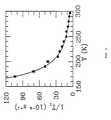
- the measured temperature dependence of the zero-field relaxation rate is shown in Figure 2 and it is indeed exponential.
- the width of the relaxation curve is independent of temperature, in further contradiction to the expected narrowing from increased 129 Xe surface dwell time at lower temperatures. It was, therefore, necessary to consider the possibility of xenon trapping in the coating for the microsecond time scales which would be needed for proton dipolar interactions to cause the observed effects.
- ⁇ I and ⁇ S are the 129 Xe and proton gyromagnetic ratios
- the r i are the distances to the neighboring protons.
- 1/ T 0 is the zero-field relaxation rate of Equation (4).
- Equation (6) Inspection of Equation (6) reveals that the 129 Xe spin locked relaxation rate can be slowed down by increasing the strength of the proton rf field H 1 S .
- the strength of the applied rf field H 1 S causes proton Rabi precession faster than the intrinsic frequency of the proton dipolar fluctuations ( ⁇ S H 1 S > 1/ ⁇ c )
- the 129 Xe relaxation rate is reduced.
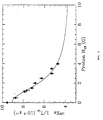
- Figure 3 shows the slowing of the spin locked 129 Xe relaxation rate as a function of the resonant proton field strength H 1 S at 297 K.
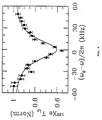
- Figure 4 shows that the slowing is dependent on detuning from the proton resonance with a width dominated by H 1S .
- Maximum slowing was found to occur when the proton rf was exactly on resonance.
- This signature unmistakably demonstrates that dipolar relaxation in the bulk of the coating is the cause of 129 Xe surface relaxation and confirms the surprisingly long trapping times of the xenon in the coating.
- S is the spin of the polymer nuclei
- ⁇ Xe is the gyromagnetic ratio of 129 Xe
- ⁇ S is the gyromagnetic ratio of the polymer nuclei
- ⁇ c is the correlation time of their interaction
- r i are the distances between the 129 Xe and the surrounding polymer nuclei (Ref. 27).
- the polarization lifetime of the 129 Xe in the deuterated polymer would be roughly 16 times longer than in the protonated polymer.
- Equation (9) requires measurement of the 129 Xe relaxation rates in identical vessels whose only difference is that one has been coated with a deuterated siloxane polymer, while the other is coated with protonated polymer.
- the procedure is as follows:
- the 129 Xe is polarized by standard optical pumping (Ref. 36) and spin exchange (Ref. 20) techniques.
- the cell containing polarized 129 Xe is then removed from the optical pumping apparatus to a nuclear magnetic resonance (NMR) apparatus, and the relaxation rates 1/T 1 are measured.
- NMR nuclear magnetic resonance
- the size of the NMR signals are proportional to the polarization of the 129 Xe.
- the rate of polarization decay in the sample can be measured by taking NMR signals at appropriate intervals.
- the decay rate of 1/T 1 of the 129 Xe polarization can be determined by fitting the NMR signal heights as a function of time to Equation (10).
- the measured relaxation rates for the three deuterated samples are up to 16 times longer than for the protonated samples.
- Example 5 An experiment is performed substantially as described in Example 5, but for the comparison of a protonated polymer with a fluorinated polymer prepared according to known methods. An increase in the lifetime of hyperpolarized 129 Xe of up to 16-fold is observed.
Landscapes
- Health & Medical Sciences (AREA)
- Engineering & Computer Science (AREA)
- Chemical & Material Sciences (AREA)
- Mechanical Engineering (AREA)
- Organic Chemistry (AREA)
- Physics & Mathematics (AREA)
- Public Health (AREA)
- Inorganic Chemistry (AREA)
- Nuclear Medicine, Radiotherapy & Molecular Imaging (AREA)
- Radiology & Medical Imaging (AREA)
- Epidemiology (AREA)
- Life Sciences & Earth Sciences (AREA)
- Animal Behavior & Ethology (AREA)
- General Health & Medical Sciences (AREA)
- General Physics & Mathematics (AREA)
- Veterinary Medicine (AREA)
- Condensed Matter Physics & Semiconductors (AREA)
- Dispersion Chemistry (AREA)
- General Engineering & Computer Science (AREA)
- Magnetic Resonance Imaging Apparatus (AREA)
- Application Of Or Painting With Fluid Materials (AREA)
- Details Of Rigid Or Semi-Rigid Containers (AREA)
- Physical Vapour Deposition (AREA)
- Treatments Of Macromolecular Shaped Articles (AREA)
- Inorganic Insulating Materials (AREA)
- Chemically Coating (AREA)
- Paints Or Removers (AREA)
- Containers Having Bodies Formed In One Piece (AREA)
- Solid-Sorbent Or Filter-Aiding Compositions (AREA)
Applications Claiming Priority (3)
| Application Number | Priority Date | Filing Date | Title |
|---|---|---|---|
| US478276 | 1995-06-07 | ||
| US08/478,276 US5612103A (en) | 1995-06-07 | 1995-06-07 | Coatings for production of hyperpolarized noble gases |
| PCT/US1996/009402 WO1996039912A1 (en) | 1995-06-07 | 1996-06-07 | Coatings for production of hyperpolarized noble gases |
Publications (3)
| Publication Number | Publication Date |
|---|---|
| EP0837641A1 EP0837641A1 (en) | 1998-04-29 |
| EP0837641A4 EP0837641A4 (en) | 2002-07-17 |
| EP0837641B1 true EP0837641B1 (en) | 2007-11-14 |
Family
ID=23899257
Family Applications (1)
| Application Number | Title | Priority Date | Filing Date |
|---|---|---|---|
| EP96918293A Expired - Lifetime EP0837641B1 (en) | 1995-06-07 | 1996-06-07 | Container for hyperpolarized noble gases having a surface coated with a modified polymer |
Country Status (12)
| Country | Link |
|---|---|
| US (1) | US5612103A (enExample) |
| EP (1) | EP0837641B1 (enExample) |
| JP (2) | JP3971799B2 (enExample) |
| CN (1) | CN1149165C (enExample) |
| AT (1) | ATE378366T1 (enExample) |
| BR (1) | BR9609064A (enExample) |
| CA (1) | CA2220349C (enExample) |
| DE (1) | DE69637324T2 (enExample) |
| DK (1) | DK0837641T3 (enExample) |
| MX (1) | MX9709600A (enExample) |
| NO (1) | NO324090B1 (enExample) |
| WO (1) | WO1996039912A1 (enExample) |
Families Citing this family (32)
| Publication number | Priority date | Publication date | Assignee | Title |
|---|---|---|---|---|
| US5642625A (en) * | 1996-03-29 | 1997-07-01 | The Trustees Of Princeton University | High volume hyperpolarizer for spin-polarized noble gas |
| NZ502784A (en) * | 1997-08-13 | 2002-06-28 | Univ Princeton | Sol-gel coated polarization vessels |
| US6318092B1 (en) | 1997-08-18 | 2001-11-20 | The Trustees Of Princeton University | Alkali metal hybrid spin-exchange optical pumping |
| PL340503A1 (en) | 1997-11-14 | 2001-02-12 | Norbert Weiler | Apparatus for administering fluids |
| US6079213A (en) * | 1997-12-12 | 2000-06-27 | Magnetic Imaging Technologies Incorporated | Methods of collecting, thawing, and extending the useful life of polarized gases and associated accumulators and heating jackets |
| CN1284158A (zh) * | 1997-12-12 | 2001-02-14 | 磁成象技术公司 | 极化气体储蓄器和加热夹套及相关的气体收集和熔化方法以及极化气体产品 |
| US6128918A (en) * | 1998-07-30 | 2000-10-10 | Medi-Physics, Inc. | Containers for hyperpolarized gases and associated methods |
| NZ508720A (en) * | 1998-06-17 | 2003-08-29 | Medi Physics Inc | Resilient containers for hyperpolarized gases |
| US6423387B1 (en) | 1998-06-17 | 2002-07-23 | Medi-Physics, Inc. | Resilient containers for hyperpolarized gases and associated methods |
| NZ508719A (en) * | 1998-06-17 | 2002-10-25 | Medi Physics Inc | Hyperpolarized gas transport device with at least one gas chamber and a electromagnet providing a magnetic holding field |
| US6237363B1 (en) | 1998-09-30 | 2001-05-29 | Medi-Physics, Inc. | Hyperpolarized noble gas extraction methods masking methods and associated transport containers |
| US6286319B1 (en) | 1998-09-30 | 2001-09-11 | Medi-Physics, Inc. | Meted hyperpolarized noble gas dispensing methods and associated devices |
| US6523356B2 (en) | 1998-09-30 | 2003-02-25 | Medi-Physics, Inc. | Meted hyperpolarized noble gas dispensing methods and associated devices |
| US6125654A (en) * | 1998-10-16 | 2000-10-03 | Syracuse University | Bulk production and usage of hyperpolarized 129 Xenon |
| US6284222B1 (en) | 1998-11-03 | 2001-09-04 | Medi--Physics, Inc. | Hyperpolarized helium-3 microbubble gas entrapment methods |
| US6566875B1 (en) | 1999-02-23 | 2003-05-20 | Medi-Physics, Inc. | Portable hyperpolarized gas monitoring systems, computer program products, and related methods using NMR and/or MRI during transport |
| DE19927788C2 (de) * | 1999-06-18 | 2003-03-06 | Forschungszentrum Juelich Gmbh | Polarisator für die Polarisation eines Edelgases |
| US6295834B1 (en) | 1999-06-30 | 2001-10-02 | Medi-Physics, Inc. | NMR polarization monitoring coils, hyperpolarizers with same, and methods for determining the polarization level of accumulated hyperpolarized noble gases during production |
| GB9920758D0 (en) | 1999-09-03 | 1999-11-03 | Nycomed Amersham Plc | Improved container composition for diagnostic agents |
| DE10000675C2 (de) | 2000-01-11 | 2001-11-15 | Otten Ernst Wilhelm | Lineardurchführung, Vorrichtung und Verfahren zur hochproduktiven Erzeugung von hoch kernspinpolarisiertem Helium-3 Gas |
| US7035518B2 (en) * | 2001-04-13 | 2006-04-25 | Hitachi Cable, Ltd. | Polymer waveguides and process for producing the same |
| US6830818B2 (en) * | 2001-04-13 | 2004-12-14 | Hitachi Cable, Ltd. | Polymer material and polymer film |
| CA2509801A1 (en) | 2003-01-17 | 2004-08-05 | Medi-Physics Inc. | Method of producing optically pumped hyperpolarized gas |
| US7275540B2 (en) * | 2003-04-22 | 2007-10-02 | Medi-Physics, Inc. | MRI/NMR-compatible, tidal volume control and measurement systems, methods, and devices for respiratory and hyperpolarized gas delivery |
| WO2009143368A2 (en) * | 2008-05-23 | 2009-11-26 | University Of Utah | Non-cryogenic storage cell for hyperpolarized 129xe |
| US9874622B2 (en) | 2013-09-27 | 2018-01-23 | General Electric Company | Hyperpolarized media transport vessel |
| CN106456808B (zh) | 2014-02-21 | 2019-11-19 | 杜克大学 | 具有纳米簇抑制、检测和/或过滤的超偏振稀有气体生产系统及相关的方法和装置 |
| CN104651905B (zh) * | 2015-01-28 | 2017-11-07 | 永保纳米科技(深圳)有限公司 | 一种阳极铝匀染缓染助剂及其操作液,和阳极铝匀染缓染处理工艺 |
| CN112833870B (zh) * | 2020-12-30 | 2023-01-06 | 中国人民解放军国防科技大学 | 核磁共振陀螺中抑制碱金属原子极化磁场影响的有效方法 |
| GB2612838A (en) * | 2021-11-15 | 2023-05-17 | Hyperspin Ltd | Apparatus for pumping hyperpolarised gas and method of handling hyperpolarised gas |
| CN114644322B (zh) * | 2022-04-15 | 2024-02-06 | 宁波诺丁汉大学 | 超极化稀有气体生产设备 |
| WO2025151298A1 (en) | 2024-01-10 | 2025-07-17 | Polarean, Inc. | Hyperpolarizers with a load-lock chamber for alkali metal |
Family Cites Families (10)
| Publication number | Priority date | Publication date | Assignee | Title |
|---|---|---|---|---|
| US3657363A (en) * | 1967-09-15 | 1972-04-18 | Us Army | Process for the deuteration of the hydroxyl position of organic alcohols |
| US3642851A (en) * | 1968-12-27 | 1972-02-15 | Union Carbide Corp | Preparation of linear halosiloxanes and compounds derived therefrom |
| US3646090A (en) * | 1969-05-29 | 1972-02-29 | Union Carbide Corp | Process for preparing linear chlorine terminated siloxane compounds |
| US3966781A (en) * | 1970-12-17 | 1976-06-29 | Merck Sharp & Dohme (I.A.) Corporation | Deuteration of functional group-containing hydrocarbons |
| US3989705A (en) * | 1974-04-01 | 1976-11-02 | Canadian Patents And Development Limited | Processes for the deuteration and/or tritiation of organic substrates by hydrogen substitution |
| US4586511A (en) * | 1983-03-04 | 1986-05-06 | Children's Hospital Medical Center | Methods and compositions for detecting and imaging a gas in an animal by nuclear magnetic resonance |
| US4882384A (en) * | 1988-02-01 | 1989-11-21 | Shell Oil Company | Modified block copolymers |
| US4914160A (en) * | 1988-06-23 | 1990-04-03 | Hormoz Azizian | Deuteration of unsaturated polymers and copolymers |
| JPH0731545A (ja) * | 1993-07-22 | 1995-02-03 | Toho Kasei Kk | フッ素樹脂塗膜を有する加熱容器 |
| JP2938727B2 (ja) * | 1993-09-14 | 1999-08-25 | 信越化学工業株式会社 | メチルジメトキシシランの保存方法 |
-
1995
- 1995-06-07 US US08/478,276 patent/US5612103A/en not_active Expired - Lifetime
-
1996
- 1996-06-07 WO PCT/US1996/009402 patent/WO1996039912A1/en not_active Ceased
- 1996-06-07 DK DK96918293T patent/DK0837641T3/da active
- 1996-06-07 CA CA002220349A patent/CA2220349C/en not_active Expired - Fee Related
- 1996-06-07 AT AT96918293T patent/ATE378366T1/de not_active IP Right Cessation
- 1996-06-07 EP EP96918293A patent/EP0837641B1/en not_active Expired - Lifetime
- 1996-06-07 BR BR9609064-2A patent/BR9609064A/pt not_active IP Right Cessation
- 1996-06-07 CN CNB961958804A patent/CN1149165C/zh not_active Expired - Fee Related
- 1996-06-07 DE DE69637324T patent/DE69637324T2/de not_active Expired - Lifetime
- 1996-06-07 JP JP50172797A patent/JP3971799B2/ja not_active Expired - Fee Related
-
1997
- 1997-12-05 NO NO19975725A patent/NO324090B1/no not_active IP Right Cessation
- 1997-12-05 MX MX9709600A patent/MX9709600A/es not_active IP Right Cessation
-
2007
- 2007-03-26 JP JP2007079422A patent/JP4584278B2/ja not_active Expired - Fee Related
Also Published As
| Publication number | Publication date |
|---|---|
| DE69637324D1 (de) | 2007-12-27 |
| CN1192128A (zh) | 1998-09-02 |
| JP3971799B2 (ja) | 2007-09-05 |
| AU695121B2 (en) | 1998-08-06 |
| CN1149165C (zh) | 2004-05-12 |
| EP0837641A1 (en) | 1998-04-29 |
| BR9609064A (pt) | 1999-09-21 |
| JPH11508354A (ja) | 1999-07-21 |
| MX9709600A (es) | 1998-10-31 |
| WO1996039912A1 (en) | 1996-12-19 |
| DE69637324T2 (de) | 2008-09-18 |
| AU6098396A (en) | 1996-12-30 |
| DK0837641T3 (da) | 2008-03-25 |
| EP0837641A4 (en) | 2002-07-17 |
| CA2220349C (en) | 2002-01-22 |
| ATE378366T1 (de) | 2007-11-15 |
| JP2007292739A (ja) | 2007-11-08 |
| US5612103A (en) | 1997-03-18 |
| NO975725L (no) | 1998-02-05 |
| CA2220349A1 (en) | 1996-12-19 |
| NO975725D0 (no) | 1997-12-05 |
| JP4584278B2 (ja) | 2010-11-17 |
| NO324090B1 (no) | 2007-08-13 |
Similar Documents
| Publication | Publication Date | Title |
|---|---|---|
| EP0837641B1 (en) | Container for hyperpolarized noble gases having a surface coated with a modified polymer | |
| Driehuys et al. | Surface relaxation mechanisms of laser-polarized 129 Xe | |
| US5785953A (en) | Magnetic resonance imaging using hyperpolarized noble gases | |
| Seydoux et al. | NMR with a continuously circulating flow of laser-polarized 129Xe | |
| Pietraiß et al. | Optically polarized 129Xe in NMR spectroscopy | |
| Anger et al. | Gas-phase spin relaxation of Xe 129 | |
| Moudrakovski et al. | Chemical shift imaging with continuously flowing hyperpolarized xenon for the characterization of materials | |
| Fitzgerald et al. | Cross-relaxation in laser-polarized liquid xenon | |
| Brunner | Enhancement of surface and biological magnetic resonance using laser‐polarized noble gases | |
| US7564243B2 (en) | Method for enhancing the NMR signal of a liquid solution | |
| CA2300147C (en) | Sol-gel coated polarization vessels | |
| US6123919A (en) | Magnetic resonance imaging using hyperpolarized noble gases | |
| US20070156046A1 (en) | Method of enriching hyperpolarized atom nuclei and an apparatus for implementing the method | |
| Shao et al. | Low readout field magnetic resonance imaging of hyperpolarized xenon and water in a single system | |
| Stith et al. | Consequences of 129Xe–1H cross relaxation in aqueous solutions | |
| AU695121C (en) | Coatings for production of hyperpolarized noble gases | |
| US9658300B1 (en) | Method and apparatus for preparation of spin polarized reagents | |
| US20120160710A1 (en) | Non-cryogenic storage cell for hyperpolarized 129xe | |
| Driehuys | Surface physics and new applications using laser-polarized xenon-129 | |
| Wang | Polarizing helium-3 by spin exchange with potassium | |
| Cleveland | Developing hyperpolarized krypton-83 for nuclear magnetic resonance spectroscopy and magnetic resonance imaging | |
| Sheth | Biomedical applications of NMR imaging and diffusion studies using thermal and hyperpolarized Xenon | |
| Pomeroy | Spin-exchange polarized (3) He using optically pumped alkali atoms for magnetic resonance imaging and neutron spin-filters | |
| Zook | Development of a spin polarized noble gas generator for sensitivity enhanced xenon-129 nuclear magnetic resonance spectroscopy and imaging | |
| MXPA00012737A (en) | Resilient containers for hyperpolarized gases |
Legal Events
| Date | Code | Title | Description |
|---|---|---|---|
| PUAI | Public reference made under article 153(3) epc to a published international application that has entered the european phase |
Free format text: ORIGINAL CODE: 0009012 |
|
| 17P | Request for examination filed |
Effective date: 19971212 |
|
| AK | Designated contracting states |
Kind code of ref document: A1 Designated state(s): AT BE CH DE DK ES FI FR GB GR IE IT LI LU MC NL PT SE |
|
| RIN1 | Information on inventor provided before grant (corrected) |
Inventor name: CATES, GORDON, D., JR. Inventor name: HAPPER, WILLIAM Inventor name: DRIEHUYS, BASTIAAN |
|
| RIN1 | Information on inventor provided before grant (corrected) |
Inventor name: CATES, GORDON, D., JR. Inventor name: HAPPER, WILLIAM Inventor name: DRIEHUYS, BASTIAAN |
|
| A4 | Supplementary search report drawn up and despatched |
Effective date: 20020603 |
|
| AK | Designated contracting states |
Kind code of ref document: A4 Designated state(s): AT BE CH DE DK ES FI FR GB GR IE IT LI LU MC NL PT SE |
|
| RIC1 | Information provided on ipc code assigned before grant |
Free format text: 7C 08G 77/12 A, 7C 08L 83/04 B, 7C 09D 183/04 B, 7A 47G 19/22 B, 7B 32B 1/08 B, 7B 32B 9/00 B, 7B 32B 17/06 B, 7B 05D 3/00 B |
|
| 17Q | First examination report despatched |
Effective date: 20030513 |
|
| 17Q | First examination report despatched |
Effective date: 20030513 |
|
| GRAP | Despatch of communication of intention to grant a patent |
Free format text: ORIGINAL CODE: EPIDOSNIGR1 |
|
| RTI1 | Title (correction) |
Free format text: CONTAINER FOR HYPERPOLARIZED NOBLE GASES HAVING A SURFACE COATED WITH A MODIFIED POLYMER |
|
| GRAS | Grant fee paid |
Free format text: ORIGINAL CODE: EPIDOSNIGR3 |
|
| GRAA | (expected) grant |
Free format text: ORIGINAL CODE: 0009210 |
|
| RIN1 | Information on inventor provided before grant (corrected) |
Inventor name: CATES, GORDON, D., JR. Inventor name: HAPPER, WILLIAM Inventor name: DRIEHUYS, BASTIAAN |
|
| AK | Designated contracting states |
Kind code of ref document: B1 Designated state(s): AT BE CH DE DK ES FI FR GB GR IE IT LI LU MC NL PT SE |
|
| REG | Reference to a national code |
Ref country code: GB Ref legal event code: FG4D |
|
| REG | Reference to a national code |
Ref country code: CH Ref legal event code: EP |
|
| REG | Reference to a national code |
Ref country code: IE Ref legal event code: FG4D |
|
| REF | Corresponds to: |
Ref document number: 69637324 Country of ref document: DE Date of ref document: 20071227 Kind code of ref document: P |
|
| REG | Reference to a national code |
Ref country code: SE Ref legal event code: TRGR |
|
| REG | Reference to a national code |
Ref country code: DK Ref legal event code: T3 |
|
| PG25 | Lapsed in a contracting state [announced via postgrant information from national office to epo] |
Ref country code: NL Free format text: LAPSE BECAUSE OF FAILURE TO SUBMIT A TRANSLATION OF THE DESCRIPTION OR TO PAY THE FEE WITHIN THE PRESCRIBED TIME-LIMIT Effective date: 20071114 Ref country code: LI Free format text: LAPSE BECAUSE OF FAILURE TO SUBMIT A TRANSLATION OF THE DESCRIPTION OR TO PAY THE FEE WITHIN THE PRESCRIBED TIME-LIMIT Effective date: 20071114 Ref country code: ES Free format text: LAPSE BECAUSE OF FAILURE TO SUBMIT A TRANSLATION OF THE DESCRIPTION OR TO PAY THE FEE WITHIN THE PRESCRIBED TIME-LIMIT Effective date: 20080225 Ref country code: CH Free format text: LAPSE BECAUSE OF FAILURE TO SUBMIT A TRANSLATION OF THE DESCRIPTION OR TO PAY THE FEE WITHIN THE PRESCRIBED TIME-LIMIT Effective date: 20071114 |
|
| NLV1 | Nl: lapsed or annulled due to failure to fulfill the requirements of art. 29p and 29m of the patents act | ||
| REG | Reference to a national code |
Ref country code: CH Ref legal event code: PL |
|
| PG25 | Lapsed in a contracting state [announced via postgrant information from national office to epo] |
Ref country code: AT Free format text: LAPSE BECAUSE OF FAILURE TO SUBMIT A TRANSLATION OF THE DESCRIPTION OR TO PAY THE FEE WITHIN THE PRESCRIBED TIME-LIMIT Effective date: 20071114 |
|
| ET | Fr: translation filed | ||
| PG25 | Lapsed in a contracting state [announced via postgrant information from national office to epo] |
Ref country code: BE Free format text: LAPSE BECAUSE OF FAILURE TO SUBMIT A TRANSLATION OF THE DESCRIPTION OR TO PAY THE FEE WITHIN THE PRESCRIBED TIME-LIMIT Effective date: 20071114 |
|
| PLBE | No opposition filed within time limit |
Free format text: ORIGINAL CODE: 0009261 |
|
| STAA | Information on the status of an ep patent application or granted ep patent |
Free format text: STATUS: NO OPPOSITION FILED WITHIN TIME LIMIT |
|
| PG25 | Lapsed in a contracting state [announced via postgrant information from national office to epo] |
Ref country code: PT Free format text: LAPSE BECAUSE OF FAILURE TO SUBMIT A TRANSLATION OF THE DESCRIPTION OR TO PAY THE FEE WITHIN THE PRESCRIBED TIME-LIMIT Effective date: 20080414 |
|
| 26N | No opposition filed |
Effective date: 20080815 |
|
| PG25 | Lapsed in a contracting state [announced via postgrant information from national office to epo] |
Ref country code: MC Free format text: LAPSE BECAUSE OF NON-PAYMENT OF DUE FEES Effective date: 20080630 Ref country code: GR Free format text: LAPSE BECAUSE OF FAILURE TO SUBMIT A TRANSLATION OF THE DESCRIPTION OR TO PAY THE FEE WITHIN THE PRESCRIBED TIME-LIMIT Effective date: 20080215 |
|
| PG25 | Lapsed in a contracting state [announced via postgrant information from national office to epo] |
Ref country code: IE Free format text: LAPSE BECAUSE OF NON-PAYMENT OF DUE FEES Effective date: 20080609 |
|
| PG25 | Lapsed in a contracting state [announced via postgrant information from national office to epo] |
Ref country code: FI Free format text: LAPSE BECAUSE OF FAILURE TO SUBMIT A TRANSLATION OF THE DESCRIPTION OR TO PAY THE FEE WITHIN THE PRESCRIBED TIME-LIMIT Effective date: 20071114 |
|
| PG25 | Lapsed in a contracting state [announced via postgrant information from national office to epo] |
Ref country code: LU Free format text: LAPSE BECAUSE OF NON-PAYMENT OF DUE FEES Effective date: 20080607 |
|
| PG25 | Lapsed in a contracting state [announced via postgrant information from national office to epo] |
Ref country code: IT Free format text: LAPSE BECAUSE OF NON-PAYMENT OF DUE FEES Effective date: 20080630 |
|
| PGFP | Annual fee paid to national office [announced via postgrant information from national office to epo] |
Ref country code: FR Payment date: 20110629 Year of fee payment: 16 Ref country code: SE Payment date: 20110629 Year of fee payment: 16 |
|
| PGFP | Annual fee paid to national office [announced via postgrant information from national office to epo] |
Ref country code: GB Payment date: 20110628 Year of fee payment: 16 Ref country code: DK Payment date: 20110627 Year of fee payment: 16 |
|
| PGFP | Annual fee paid to national office [announced via postgrant information from national office to epo] |
Ref country code: DE Payment date: 20110629 Year of fee payment: 16 |
|
| REG | Reference to a national code |
Ref country code: DK Ref legal event code: EBP |
|
| REG | Reference to a national code |
Ref country code: SE Ref legal event code: EUG |
|
| GBPC | Gb: european patent ceased through non-payment of renewal fee |
Effective date: 20120607 |
|
| PG25 | Lapsed in a contracting state [announced via postgrant information from national office to epo] |
Ref country code: SE Free format text: LAPSE BECAUSE OF NON-PAYMENT OF DUE FEES Effective date: 20120608 |
|
| REG | Reference to a national code |
Ref country code: FR Ref legal event code: ST Effective date: 20130228 |
|
| REG | Reference to a national code |
Ref country code: DE Ref legal event code: R119 Ref document number: 69637324 Country of ref document: DE Effective date: 20130101 |
|
| PG25 | Lapsed in a contracting state [announced via postgrant information from national office to epo] |
Ref country code: DE Free format text: LAPSE BECAUSE OF NON-PAYMENT OF DUE FEES Effective date: 20130101 Ref country code: FR Free format text: LAPSE BECAUSE OF NON-PAYMENT OF DUE FEES Effective date: 20120702 Ref country code: GB Free format text: LAPSE BECAUSE OF NON-PAYMENT OF DUE FEES Effective date: 20120607 |
|
| PG25 | Lapsed in a contracting state [announced via postgrant information from national office to epo] |
Ref country code: DK Free format text: LAPSE BECAUSE OF NON-PAYMENT OF DUE FEES Effective date: 20120702 |