EP0830866B1 - Verfahren zur Herstellung von Nahtmaterialien aus Copolymeren aus Glykolid und epsilon-Caprolacton - Google Patents
Verfahren zur Herstellung von Nahtmaterialien aus Copolymeren aus Glykolid und epsilon-Caprolacton Download PDFInfo
- Publication number
- EP0830866B1 EP0830866B1 EP97307312A EP97307312A EP0830866B1 EP 0830866 B1 EP0830866 B1 EP 0830866B1 EP 97307312 A EP97307312 A EP 97307312A EP 97307312 A EP97307312 A EP 97307312A EP 0830866 B1 EP0830866 B1 EP 0830866B1
- Authority
- EP
- European Patent Office
- Prior art keywords
- filament
- range
- zone
- drawn
- glycolide
- Prior art date
- Legal status (The legal status is an assumption and is not a legal conclusion. Google has not performed a legal analysis and makes no representation as to the accuracy of the status listed.)
- Expired - Lifetime
Links
- 229920001577 copolymer Polymers 0.000 title claims abstract description 23
- RKDVKSZUMVYZHH-UHFFFAOYSA-N 1,4-dioxane-2,5-dione Chemical compound O=C1COC(=O)CO1 RKDVKSZUMVYZHH-UHFFFAOYSA-N 0.000 title claims abstract description 22
- PAPBSGBWRJIAAV-UHFFFAOYSA-N ε-Caprolactone Chemical compound O=C1CCCCCO1 PAPBSGBWRJIAAV-UHFFFAOYSA-N 0.000 title claims abstract description 15
- 238000000034 method Methods 0.000 title claims description 24
- 238000004519 manufacturing process Methods 0.000 title abstract description 6
- 238000000137 annealing Methods 0.000 claims abstract description 15
- 238000010791 quenching Methods 0.000 claims abstract description 12
- 229920006026 co-polymeric resin Polymers 0.000 claims abstract description 3
- 230000000171 quenching effect Effects 0.000 claims abstract description 3
- 229920005989 resin Polymers 0.000 claims abstract description 3
- 239000011347 resin Substances 0.000 claims abstract description 3
- 230000002040 relaxant effect Effects 0.000 claims abstract 2
- 101100165186 Caenorhabditis elegans bath-34 gene Proteins 0.000 description 8
- 230000002093 peripheral effect Effects 0.000 description 7
- 229920000642 polymer Polymers 0.000 description 6
- 239000000835 fiber Substances 0.000 description 5
- 239000000523 sample Substances 0.000 description 5
- 239000008188 pellet Substances 0.000 description 4
- YXFVVABEGXRONW-UHFFFAOYSA-N Toluene Chemical compound CC1=CC=CC=C1 YXFVVABEGXRONW-UHFFFAOYSA-N 0.000 description 3
- 229910052739 hydrogen Inorganic materials 0.000 description 3
- 239000001257 hydrogen Substances 0.000 description 3
- XLYOFNOQVPJJNP-UHFFFAOYSA-N water Substances O XLYOFNOQVPJJNP-UHFFFAOYSA-N 0.000 description 3
- IJGRMHOSHXDMSA-UHFFFAOYSA-N Atomic nitrogen Chemical compound N#N IJGRMHOSHXDMSA-UHFFFAOYSA-N 0.000 description 2
- UFHFLCQGNIYNRP-UHFFFAOYSA-N Hydrogen Chemical compound [H][H] UFHFLCQGNIYNRP-UHFFFAOYSA-N 0.000 description 2
- 229920000954 Polyglycolide Polymers 0.000 description 2
- 238000010438 heat treatment Methods 0.000 description 2
- 239000007788 liquid Substances 0.000 description 2
- 229920001610 polycaprolactone Polymers 0.000 description 2
- 239000004632 polycaprolactone Substances 0.000 description 2
- 239000004633 polyglycolic acid Substances 0.000 description 2
- 239000013074 reference sample Substances 0.000 description 2
- 238000010998 test method Methods 0.000 description 2
- 230000007704 transition Effects 0.000 description 2
- BYEAHWXPCBROCE-UHFFFAOYSA-N 1,1,1,3,3,3-hexafluoropropan-2-ol Chemical compound FC(F)(F)C(O)C(F)(F)F BYEAHWXPCBROCE-UHFFFAOYSA-N 0.000 description 1
- VPVXHAANQNHFSF-UHFFFAOYSA-N 1,4-dioxan-2-one Chemical compound O=C1COCCO1 VPVXHAANQNHFSF-UHFFFAOYSA-N 0.000 description 1
- SJDLIJNQXLJBBE-UHFFFAOYSA-N 1,4-dioxepan-2-one Chemical compound O=C1COCCCO1 SJDLIJNQXLJBBE-UHFFFAOYSA-N 0.000 description 1
- AOLNDUQWRUPYGE-UHFFFAOYSA-N 1,4-dioxepan-5-one Chemical compound O=C1CCOCCO1 AOLNDUQWRUPYGE-UHFFFAOYSA-N 0.000 description 1
- NHBCKNKTNJHTFE-UHFFFAOYSA-N 6,6-dimethyl-1,4-dioxepan-2-one Chemical compound CC1(C)COCC(=O)OC1 NHBCKNKTNJHTFE-UHFFFAOYSA-N 0.000 description 1
- IAYPIBMASNFSPL-UHFFFAOYSA-N Ethylene oxide Chemical compound C1CO1 IAYPIBMASNFSPL-UHFFFAOYSA-N 0.000 description 1
- 238000002441 X-ray diffraction Methods 0.000 description 1
- 238000013019 agitation Methods 0.000 description 1
- -1 aliphatic ester Chemical class 0.000 description 1
- 125000001931 aliphatic group Chemical group 0.000 description 1
- 125000000217 alkyl group Chemical group 0.000 description 1
- 229920001400 block copolymer Polymers 0.000 description 1
- 125000004432 carbon atom Chemical group C* 0.000 description 1
- 238000006243 chemical reaction Methods 0.000 description 1
- 150000001875 compounds Chemical class 0.000 description 1
- 238000001816 cooling Methods 0.000 description 1
- 238000005520 cutting process Methods 0.000 description 1
- MTHSVFCYNBDYFN-UHFFFAOYSA-N diethylene glycol Chemical compound OCCOCCO MTHSVFCYNBDYFN-UHFFFAOYSA-N 0.000 description 1
- 238000001035 drying Methods 0.000 description 1
- 238000001125 extrusion Methods 0.000 description 1
- 238000005227 gel permeation chromatography Methods 0.000 description 1
- 229930182470 glycoside Natural products 0.000 description 1
- 150000002338 glycosides Chemical class 0.000 description 1
- 125000004435 hydrogen atom Chemical group [H]* 0.000 description 1
- JJTUDXZGHPGLLC-UHFFFAOYSA-N lactide Chemical compound CC1OC(=O)C(C)OC1=O JJTUDXZGHPGLLC-UHFFFAOYSA-N 0.000 description 1
- 230000002045 lasting effect Effects 0.000 description 1
- 239000000155 melt Substances 0.000 description 1
- 238000002844 melting Methods 0.000 description 1
- 230000008018 melting Effects 0.000 description 1
- 125000002496 methyl group Chemical group [H]C([H])([H])* 0.000 description 1
- 239000000178 monomer Substances 0.000 description 1
- 229910052757 nitrogen Inorganic materials 0.000 description 1
- 238000006116 polymerization reaction Methods 0.000 description 1
- 239000002994 raw material Substances 0.000 description 1
- 239000000126 substance Substances 0.000 description 1
- 238000005496 tempering Methods 0.000 description 1
- KSBAEPSJVUENNK-UHFFFAOYSA-L tin(ii) 2-ethylhexanoate Chemical compound [Sn+2].CCCCC(CC)C([O-])=O.CCCCC(CC)C([O-])=O KSBAEPSJVUENNK-UHFFFAOYSA-L 0.000 description 1
- YFHICDDUDORKJB-UHFFFAOYSA-N trimethylene carbonate Chemical compound O=C1OCCCO1 YFHICDDUDORKJB-UHFFFAOYSA-N 0.000 description 1
Images
Classifications
-
- A—HUMAN NECESSITIES
- A61—MEDICAL OR VETERINARY SCIENCE; HYGIENE
- A61L—METHODS OR APPARATUS FOR STERILISING MATERIALS OR OBJECTS IN GENERAL; DISINFECTION, STERILISATION OR DEODORISATION OF AIR; CHEMICAL ASPECTS OF BANDAGES, DRESSINGS, ABSORBENT PADS OR SURGICAL ARTICLES; MATERIALS FOR BANDAGES, DRESSINGS, ABSORBENT PADS OR SURGICAL ARTICLES
- A61L17/00—Materials for surgical sutures or for ligaturing blood vessels ; Materials for prostheses or catheters
- A61L17/06—At least partially resorbable materials
- A61L17/10—At least partially resorbable materials containing macromolecular materials
- A61L17/12—Homopolymers or copolymers of glycolic acid or lactic acid
-
- D—TEXTILES; PAPER
- D01—NATURAL OR MAN-MADE THREADS OR FIBRES; SPINNING
- D01F—CHEMICAL FEATURES IN THE MANUFACTURE OF ARTIFICIAL FILAMENTS, THREADS, FIBRES, BRISTLES OR RIBBONS; APPARATUS SPECIALLY ADAPTED FOR THE MANUFACTURE OF CARBON FILAMENTS
- D01F6/00—Monocomponent artificial filaments or the like of synthetic polymers; Manufacture thereof
- D01F6/78—Monocomponent artificial filaments or the like of synthetic polymers; Manufacture thereof from copolycondensation products
- D01F6/84—Monocomponent artificial filaments or the like of synthetic polymers; Manufacture thereof from copolycondensation products from copolyesters
-
- A—HUMAN NECESSITIES
- A61—MEDICAL OR VETERINARY SCIENCE; HYGIENE
- A61B—DIAGNOSIS; SURGERY; IDENTIFICATION
- A61B17/00—Surgical instruments, devices or methods
- A61B17/04—Surgical instruments, devices or methods for suturing wounds; Holders or packages for needles or suture materials
- A61B17/06—Needles ; Sutures; Needle-suture combinations; Holders or packages for needles or suture materials
- A61B17/06166—Sutures
-
- A—HUMAN NECESSITIES
- A61—MEDICAL OR VETERINARY SCIENCE; HYGIENE
- A61B—DIAGNOSIS; SURGERY; IDENTIFICATION
- A61B17/00—Surgical instruments, devices or methods
- A61B2017/00004—(bio)absorbable, (bio)resorbable or resorptive
Definitions
- This invention relates to the field of suture manufacture and more specifically it relates to a process for making sutures from copolymers of glycolide and ⁇ -caprolactone.
- Copolymers of glycolide and caprolactone have been described by Jamiolkowski et al. in U.S. Patent Nos. 4,605,730 and 4,700,704 and by Bezwada et al. in U.S. Patent No. 5,133,739 (all hereby incorporated by reference). As disclosed by Jamiolkowski and Bezwada, these copolymers may be processed into monofilament sutures which are exceptionally compliant while retaining significant straight tensile strength and knot strength.
- Jamiolkowski discloses that these glycolide/ ⁇ -caprolactone copolymers may be made into sutures by extruding the copolymer into a filament then orienting (stretching or drawing) the filament in a two-step process and annealing the filament for 5 to 16 hours.
- the fibers disclosed by Jamiolkowski with the lowest Young's Modulus values (under 200 Kpsi) would be expected to be the most compliant fibers.
- Bezwada et al. also discloses glycolide/ ⁇ -caprolactone copolymers which are produced by reacting a prepolymer of ⁇ -caprolactone and glycolide with additional glycolide.
- Bezwada describes these copolymer as having very low Young's Modulus values and desirable strength and knot tensile strengths.
- a process for producing a suture comprising the steps of (a) extruding melted copolymer composed substantially of glycoside and ⁇ -caprolactone resin through an orifice and rapidly quenching the melted copolymer resin to produce a filament; (b) drawing the filament in the range of from 4X to 7.5X in a first drawing zone to produce a drawn filament; (c) drawing the singly drawn filament in a second drawing zone in the range of from 1X to 4X while in a first heated zone being maintained at a temperature in the range of from 65.6°C (150°F) to 232.2°C (450°F), to form a doubly drawn filament; (d) in-line relaxation of the doubly drawn filament in the range of from 0.65X to 0.98X, in a second heated zone being maintained at a temperature in the range of from 37.8°C (100°F) to 204.4°C (400°F), to form a relaxed filament; then rack annealing the relaxed filament.
- the second heated zone is maintained at a temperature in the range of from 50°C (122°F) to 148.9°C (300°F).
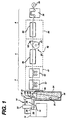
- FIGURE is a side elevation, partially schematic of an apparatus suitable for carrying out the process of the present invention.
- glycolide/ ⁇ -caprolactone copolymers shall include copolymers composed primarily of repeating units having the chemical formula I and II: [-O-(CH 2 ) 5 -C(O)-] A [-O-(CH 2 )-C(O)-] B
- glycolide/ ⁇ -caprolactone copolymers described in U.S. Patent Nos. 4,605,730; 4,700,704 and 5,133,739. However, minor amounts (i.e. less than 10% by weight and preferably less than 5% by weight) of other aliphatic ester monomers may also be present in these copolymers.
- Suitable additional repeating units include [-O-R 5 -C(O)-] where R 5 is selected from the group consisting of -C(R 6 )(R 7 )-, -(CH 2 ) 3 -O-, CH 2 -CH 2 -O-CH 2 -, -CR 8 H-CH 2 -, -(CH 2 ) F -O-C(O)- and -(CH 2 ) F -C(O)-CH 2 -; R 6 and R 7 are independently hydrogen or an alkyl containing from 1 to 8 carbon atoms, provided that R 6 and R 7 are not both hydrogen; R 8 is hydrogen or methyl and F is an integer in the range of from 2 to 6.
- Suitable aliphatic esters repeating units include but are not limited to repeating units selected from the group consisting of p-dioxanone, trimethylene carbonate, lactide, 1,5-dioxepan-2-one, 1,4-dioxepan-2-one and 6,6-dimethyl -1,4-dioxepan-2-one.
- the preferred method for preparing the flexible glycolide/ ⁇ -caprolactone sutures of the present invention utilizes as the raw material pellets of glycolide/ ⁇ -caprolactone copolymer (prepared as described by Bezwada) having a weight average molecular weight of from 59,000 MW to 100,000 MW and has a crystallinity of greater than 10 percent and preferably greater than 15 percent as measured by x-ray diffraction.
- An extruder 10 is terminated at one end with an extrusion die 12.
- a longitudinal extruder screw is mounted for rotation within the barrel 16 and is driven by a variable speed motor 18 through a gear 20.
- Polymer pellets are introduced into the extruder through hopper 22 which communicates with the barrel 16.
- the feeding zone 24 of the extruder is maintained at a temperature in the range of from 176.7°C (350°F) to 232.2°C (450°F)
- the transition zone 26 is maintained at a temperature in the range of from 176.7°C (350°F) to 232.2°C (450°F)
- the pump block 30, block 28 and die 12 are maintained at a temperature in the range of from 171.1°C (340°F) to 260°C (500°F).
- a pump 33 driven by a motor 32 pumps the molten copolymer through spinneret orifices in the die 12 to form a plurality of filaments 31 (for simplicity only one filament is shown in the FIGURE).
- the filament 31 is extruded into quench bath 34.
- the quench bath 34 is filled with a liquid heat exchange medium.
- the surface of the liquid in the quench bath 34 is preferably not more than a few centimeter below the die 12 in order to achieve rapid cooling of the extruded filament 31.
- the gap will be in the range of from 0.635 cm (1/4") to 17.78 cm (7").
- the quench bath 34 is maintained at a temperature below 48.9°C (120°F) and preferably the quench bath 34 is maintained at about room temperature.
- the filament 31 enters the quench bath 34 and travels around idler roll 36 in the quench bath 34 and then up out of the quench bath 34 to another idle roller 35 then to the first godet 37 in the first drawing zone 2.
- the filament 31 is drawn in the range of from 4X to 7.5X its original length.
- the filament 31 may be drawn incrementally or in several discrete steps in the first drawing zone 2.
- the drawing may preferably be performed in a heated cabinet, or by using heated godets).
- the filament 31 is drawn by a first godet 37 and a second godet 42.
- the first godet 37 includes several rolls 38.
- the first godet 37 is rotated at a peripheral speed that is equal to or slightly higher than the speed at which the filament 31 is extruded from the die orifice 12.
- the first godet 37 may be combined with a nip roller (not shown) to assure the filament 31 does not slip in the subsequent drawing to the extruded filament 31.
- the first draw of the extruded filament 31 will be performed by feeding the extruded filament 31 from the first godet 37 to second godet 42 which includes several rolls 43.
- the second godet 42 is rotated at a peripheral speed that is in the range of from about 4X to about 7.5X of the speed of the first godet 37.
- the filament 31 then passes into a second drawing zone 4, where the filament 31 is drawn again in the range of from 1X to 4X while in a first heated zone 46.
- the filament 31 may be drawn incrementally or in one or more discrete steps in the second drawing zone 4.
- the drawing will be performed in a first heated zone 46.
- the temperature of the first heated zone 46 will be in the range of from 65.6°C (150°F) to 232.2°C (450°F), preferably in the range of from 79.4°C (175°F) to 204.4°C (400°F).
- the filament 31 will remain in the first heated zone 46 generally only a short time preferably in the range of from 1.0 seconds to 30 seconds.
- the filament 31 passes through a first heated zone 46 to a third godet 50.
- the first heated zone 46 is preferably an orienting oven 48.
- the filament 31 is drawn in the range of from 1X to 4X, while traveling from the second godet 42 to the third godet 50 in the first heated zone 46.
- the third godet 50 includes a main roll 51 and an air bearing 52, that are rotating at a peripheral speed of 1X to 4X of the peripheral speed of the second godet 42.
- the draw ratio will be in the range of from 1X to 3X, preferably 1.0X to 1.9X.
- the filament 31 then passes from the second drawing zone 4 into an annealing zone 6, where the filament 31 is annealed and allowed to shrink.
- the filament 31 is placed in a second heated zone 54 that is maintained at a temperature in the range of from 37.8°C (100°F) to 204.4°C (400°F), preferably from 65.6°C (150°F) to 176.7°C (350°F), wherein the filament is allowed to shrink to the range of from 98 percent to 65 percent, preferably from 98 percent to 75 percent and more preferably from 95 to 75 percent of the filament original length.
- the filament 31 may be allowed to shrink incrementally or in one or more discrete steps in the second heated zone 54.
- the filament 31 will remain in the second heated zone 54 for a short time generally in the range of from 1.0 to 30 seconds and preferably in the range of from 3.0 seconds to 20 seconds.
- the filament 31 passes through a second heated zone 54 to a fourth godet 56.
- the heated zone 54 is preferably an annealing oven 60.
- the fourth godet 56 includes several rolls 57 that are rotating at a peripheral speed of 0.8X to about 0.98X of the peripheral speed of the third godet 50.
- the relaxation ratio will be in the range of from 0.75 to 0.9X.
- the overall draw ratio that is, the difference between the peripheral speed of the fourth godet 56 and the first godet 37, will ordinarily be from 6X to 8X and preferably the total draw ratio will be in the range of from 6.9X to 7.2X.
- the residence time of filament 31 within any of the heated zones can be optimized to improve fiber properties.
- the overall residence time that filament 31 is present in the first and second heated zones will preferably be in the range of from 2 seconds to 50 seconds and most preferably in the range of from 4 seconds to 30 seconds.
- the residence time can be increased with longer ovens or by having multiple wraps of the fiber in the oven.
- Suitable creels or racks for annealing filament 31 have been described in the art such as the creels disclosed by Listner et al. in U.S. Patent No. 3,630,205. However, unlike the creels disclosed by Listner which permit the filaments to contract as they are annealed in the present invention, it is preferred to fix both ends of the creel and anneal the filaments with no relaxation.
- the filament should be annealed in an oven at a temperature of in the range of from 85°C to from 125°C.
- the filaments should be annealed for in range of from 4 hours to 8 hours, preferably from 5 hours to 7 hours.
- the filaments may be removed from the creel by cutting the filaments at opposite ends of the creel.
- the filaments may be attached to needles, packaged and sterilized (by ethylene oxide or other appropriate techniques).
- a dyed 75/25 weight percent glycolide/caprolactone segmented block copolymer made as described in U.S.Patent No. 5,133,739 was used to produce surgical sutures under the conditions set forth in Table 1 below.
- the polymer was generally made by adding into a dry 56.78L (15 gallon) reactor provided with agitator and oil circulating jacket 7406 grams (64.9 moles) of ⁇ -caprolactone, 9205 grams (79.3 moles of glycolide), 19.71 ml. (0.207 moles) of diethylene glycol (DEG) and 13.68 ml. (0.0045 moles) of stannous octoate (0.33 molar solution in toluene). The reactor contents are evacuated and the vacuum is released with nitrogen. The evacuation and vacuum release cycle is repeated once more, each cycle lasting approximately 25 minutes. The circulating heating oil temperature is set at 195°C. and the batch temperature is monitored.
- This first stage polymerization reaction is allowed to proceed for 6 hours measured from the time that the batch temperature reaches 190°C.
- the oil temperature is increased to 216°C. and 13389 grams (115.4 moles) of molten glycolide is added from a melt tank with agitation. After 10 minutes the oil temperature is reset to 204°C. Approximately 60 minutes after the addition of the molten glycolide, the batch temperature begins to be greater than the oil temperature. This point is referred to as the crossover point (XO) and is selected as the"zero time" for the second stage exothermic reaction.
- the bottom gate of the reactor is opened, the oil is set at 212°C. and the polymer is forced into the pelletizer system. The reactor contents are discharged in 25 minutes.
- the polymer is then pelletized using a cutter speed maintained in the range of 3000 to 3100 RPM. A four blade cutter is used. The die holes are 0.2794 cm (0.11") in diameter and 12 open holes are used. The tempering water recirculation rate is 3.7854 L/s (60 gallons/minute) and the water is maintained at 13°C.
- the copolymer pellets are separated from the water by means of a centrifugal dryer. The pellets are dried in a vacuum tumble dryer provided with a heating jacket. The drying cycle is 18 hours at room temperature followed by 24 hours at 110°C.
- the copolymer had an inherent viscosity of 1.66 dl/g measured in hexafluoroisopropanol.
- Extruded filaments 1-6 were wound on racks and annealed.
- Sample I which is a reference sample, was wound on a rack which allowed the filaments to shrink 10% during the annealing process.
- Samples 2-5 were wound on racks which did not allow the filaments to shrink during the annealing process.
- Samples 14 were annealed at 105°C for six (6) hours.
- Samples 5 and 6 were annealed at 120°C and 125°C respectively for six (6) hours. All the samples were tested using the following test procedures. The data from these test are presented in Table 2.
- samples 1-6 were determined by conventional test procedures.
- the tensile properties i.e., straight and knot tensile strengths and elongation
- the settings used to determine the straight tensile, knot tensile and break elongation were the following, unless indicated: GAUGE LENGTH (cm) CHART SPEED(cm) CROSSHEAD SPEED (cm/min.) STRAIGHT TENSILE 12.7 30.5 30.5 KNOT TENSILE 12.7 30.5 30.5 BREAK ELONGATION 12.7 30.5 30.5
- the straight tensile strength was calculated by dividing the force to break by the initial cross-sectional area of the suture. The elongation at break was read directly from the stress-strain curve of the sample.
- the knot tensile strength of a suture was determined in separate tests.
- the surgeon's knot was a square knot in which the free end was first passed twice, instead of once, through the loop, and the ends drawn taut so that a single knot was superimposed upon a compound knot.
- the first knot was started with the left end over the right end and sufficient tension was exerted to tie the knot securely.
- the specimen was placed in the INSTRON Tensile Tester with the knot approximately midway between the clamps.
- the knot tensile strength was calculated by dividing the force required to break by the initial cross-sectional area of the fiber.
- Sample Numbers 2-6 were produced by the inventive in-line annealing process described above.
- Sample 1 which is a reference sample, was produced by rack annealing the sutures following conventional manufacturing procedures.
- the data above demonstrate that the inventive process produces sutures that have approximately a 10% increase in the tensile strengths without significantly increasing the Young's modulus of the sutures.
Landscapes
- Health & Medical Sciences (AREA)
- Chemical & Material Sciences (AREA)
- Engineering & Computer Science (AREA)
- Materials Engineering (AREA)
- Surgery (AREA)
- Vascular Medicine (AREA)
- Epidemiology (AREA)
- Life Sciences & Earth Sciences (AREA)
- Animal Behavior & Ethology (AREA)
- General Health & Medical Sciences (AREA)
- Public Health (AREA)
- Veterinary Medicine (AREA)
- Chemical Kinetics & Catalysis (AREA)
- General Chemical & Material Sciences (AREA)
- Textile Engineering (AREA)
- Materials For Medical Uses (AREA)
- Polyesters Or Polycarbonates (AREA)
- Yarns And Mechanical Finishing Of Yarns Or Ropes (AREA)
- Artificial Filaments (AREA)
Claims (10)
- Verfahren zum Herstellen eines Nahtmaterials aus einem Copolymer aus Glycolid und ε-Caprolacton, das die Schritte umfaßt (a) Extrudieren eines geschmolzenen Copolymers aus Glycolid und ε-Caprolacton, durch eine Düse und schnelles Abkühlen des geschmolzenen Copolymerharzes, um ein Filament herzustellen; (b) Ausziehen des Filaments im Bereich von 4X bis 7,5X in einem ersten Ausziehbereich, um ein ausgezogenes Filament herzustellen; (c) Ausziehen des einzeln-ausgezogenen Filaments in einem zweiten Ausziehbereich im Bereich von 1X bis 4X, während ein zuerst erhitzter Bereich auf einer Temperatur im Bereich von 65,6°C (150° F) bis 232,2°C (450°F) gehalten wird, um ein doppelt-ausgezogenes Filament zu bilden; (d) lineare Entspannung des doppelt-ausgezogenen Filaments im Bereich von 0,65X bis 0,98X, wobei eine zweite erhitzte Zone auf einer Temperatur im Bereich von 37,8°C (100°F) bis 204,4°C (400°F) gehalten wird, um ein entspanntes Filament zu bilden; dann "rack"-Härtung des entspannten Filaments, um ein Glycoid/ε-Caprolactonnahtmaterial zu bilden.
- Verfahren nach Anspruch 1, wobei das Filament im zweiten Ausziehbereich einer ersten geheizten Zone ausgesetzt ist, die auf einer Temperatur im Bereich von 79,4°C (175°F) bis 204,4°C (400°F) gehalten wird.
- Verfahren nach Anspruch 1, wobei das Filament in einem einzigen Schritt im ersten Ausziehbereich ausgezogen wird.
- Verfahren nach Anspruch 2, wobei das Filament durch eine zweite und eine dritte Galette ausgezogen wird.
- Verfahren nach Anspruch 4, wobei das doppelt-ausgezogene Filament in der zweiten erwärmten Zone im Bereich von 3 Sekunden bis 20 Sekunden gehalten wird.
- Verfahren nach Anspruch 4, wobei das einzeln-ausgezogene Filament im Bereich von 1X bis 3X im zweiten Ausziehbereich ausgezogen wird.
- Verfahren nach Anspruch 1, wobei in Schritt (c) das einzeln-ausgezogene Filament in einem zweiten Ausziehbereich im Bereich von 1,0X bis 1,9X ausgezogen wird; die zweite erhitzte Zone auf einer Temperatur im Bereich von 65,6°C (150°F) bis 176,7°C (350°F) gehalten wird; und das "rack"-Härten des entspannten Filaments bei einer Temperatur von 85°C bis 125°C für mindesten 4 bis 8 Stunden stattfindet.
- Verfahren nach Anspruch 7, wobei das gesamte Auszieh-Verhältnis des Nahtmaterials vom Ausziehen und Entspannen im Bereich von 6 bis 8 liegt.
- Verfahren nach Anspruch 7, wobei das entspannte Filament für den Bereich von 5 Stunden bis 7 Stunden gehärtet wird.
- Nahtmaterial, erhältlich nach dem Verfahren nach einem der Ansprüche 1 bis 9.
Applications Claiming Priority (2)
| Application Number | Priority Date | Filing Date | Title |
|---|---|---|---|
| US710613 | 1991-06-05 | ||
| US08/710,613 US5718716A (en) | 1996-09-20 | 1996-09-20 | Process for manufacturing sutures from copolymers of glycolide and E-caprolactone |
Publications (3)
| Publication Number | Publication Date |
|---|---|
| EP0830866A2 EP0830866A2 (de) | 1998-03-25 |
| EP0830866A3 EP0830866A3 (de) | 2000-01-12 |
| EP0830866B1 true EP0830866B1 (de) | 2002-12-11 |
Family
ID=24854791
Family Applications (1)
| Application Number | Title | Priority Date | Filing Date |
|---|---|---|---|
| EP97307312A Expired - Lifetime EP0830866B1 (de) | 1996-09-20 | 1997-09-19 | Verfahren zur Herstellung von Nahtmaterialien aus Copolymeren aus Glykolid und epsilon-Caprolacton |
Country Status (9)
| Country | Link |
|---|---|
| US (1) | US5718716A (de) |
| EP (1) | EP0830866B1 (de) |
| JP (1) | JPH10179712A (de) |
| AT (1) | ATE229349T1 (de) |
| AU (1) | AU723322B2 (de) |
| BR (1) | BR9704752A (de) |
| CA (1) | CA2215775A1 (de) |
| DE (1) | DE69717745T2 (de) |
| ES (1) | ES2188869T3 (de) |
Families Citing this family (21)
| Publication number | Priority date | Publication date | Assignee | Title |
|---|---|---|---|---|
| AU2006203366B2 (en) * | 1998-02-25 | 2010-03-18 | United States Surgical Corporation | Absorbable copolymers and surgical articles fabricated therefrom |
| WO1999043364A1 (en) * | 1998-02-25 | 1999-09-02 | Andres, John, C. | Absorbable copolymers and surgical articles fabricated thefefrom |
| US6165202A (en) * | 1998-07-06 | 2000-12-26 | United States Surgical Corporation | Absorbable polymers and surgical articles fabricated therefrom |
| US6235869B1 (en) | 1998-10-20 | 2001-05-22 | United States Surgical Corporation | Absorbable polymers and surgical articles fabricated therefrom |
| US6419866B1 (en) * | 1999-12-21 | 2002-07-16 | Ethicon, Inc. | Process of making synthetic absorbable autoclaveable monofilament fibers and brachytherapy seed spacers |
| US6719935B2 (en) | 2001-01-05 | 2004-04-13 | Howmedica Osteonics Corp. | Process for forming bioabsorbable implants |
| EP1545640A4 (de) * | 2002-10-04 | 2009-07-22 | Tyco Healthcare | Verfahren zur herstellung von biologisch resorbierbaren fäden |
| US8262963B2 (en) | 2002-10-04 | 2012-09-11 | Tyco Healthcare Group Lp | Process of making bioabsorbable filaments |
| JP4190918B2 (ja) * | 2003-03-11 | 2008-12-03 | シャープ株式会社 | 真空処理装置 |
| DE602005018338D1 (de) * | 2004-03-18 | 2010-01-28 | Kureha Corp | Filament aus polyglycolsäureharz und verfahren zu seiner herstellung |
| US20070182054A1 (en) * | 2006-01-12 | 2007-08-09 | Kachmar Wayne M | Method for manufacturing product markers |
| WO2007133777A1 (en) * | 2006-05-15 | 2007-11-22 | Tyco Healthcare Group Lp | Furanone endcapped polymers |
| EP2026825A4 (de) * | 2006-05-15 | 2012-07-04 | Tyco Healthcare | Furanon-initiierte polymere |
| US20090326128A1 (en) * | 2007-05-08 | 2009-12-31 | Javier Macossay-Torres | Fibers and methods relating thereto |
| WO2010008621A1 (en) * | 2008-03-17 | 2010-01-21 | The Board Of Regents Of The University Of Texas System | Superfine fiber creating spinneret and uses thereof |
| US8647541B2 (en) | 2011-02-07 | 2014-02-11 | Fiberio Technology Corporation | Apparatuses and methods for the simultaneous production of microfibers and nanofibers |
| WO2019049085A1 (en) | 2017-09-08 | 2019-03-14 | Board Of Regents Of The University Of Texas System | MECHANOLUMINESCENT POLYMER DOPED FABRICS AND METHODS |
| US11136696B2 (en) * | 2018-11-08 | 2021-10-05 | Ethicon, Inc. | Extrusion process for manufacturing of absorbable suture fibers |
| US11427937B2 (en) | 2019-02-20 | 2022-08-30 | The Board Of Regents Of The University Of Texas System | Handheld/portable apparatus for the production of microfibers, submicron fibers and nanofibers |
| CA3210262A1 (en) | 2021-03-02 | 2022-09-09 | Karen Lozano | Handheld/portable apparatus for the production of fine fibers |
| US12550916B2 (en) | 2022-06-28 | 2026-02-17 | Board Of Regents, The University Of Texas System | Nanofiber systems as meat substitute |
Citations (1)
| Publication number | Priority date | Publication date | Assignee | Title |
|---|---|---|---|---|
| US4700704A (en) * | 1982-10-01 | 1987-10-20 | Ethicon, Inc. | Surgical articles of copolymers of glycolide and ε-caprolactone and methods of producing the same |
Family Cites Families (11)
| Publication number | Priority date | Publication date | Assignee | Title |
|---|---|---|---|---|
| US4605730A (en) * | 1982-10-01 | 1986-08-12 | Ethicon, Inc. | Surgical articles of copolymers of glycolide and ε-caprolactone and methods of producing the same |
| US4911165A (en) * | 1983-01-12 | 1990-03-27 | Ethicon, Inc. | Pliabilized polypropylene surgical filaments |
| CA1337498C (en) * | 1989-09-01 | 1995-11-07 | Ephraim Broyer | Thermal treatment of thermoplastic filaments |
| US5133739A (en) * | 1990-02-06 | 1992-07-28 | Ethicon, Inc. | Segmented copolymers of ε-caprolactone and glycolide |
| US5217485A (en) * | 1991-07-12 | 1993-06-08 | United States Surgical Corporation | Polypropylene monofilament suture and process for its manufacture |
| CA2088458A1 (en) * | 1992-01-30 | 1993-07-31 | Cheng-Kung Liu | Polyamide monofilament suture manufactured from higher order polyamide |
| US5322925A (en) * | 1992-10-30 | 1994-06-21 | United States Surgical Corporation | Absorbable block copolymers and surgical articles made therefrom |
| US5403347A (en) * | 1993-05-27 | 1995-04-04 | United States Surgical Corporation | Absorbable block copolymers and surgical articles fabricated therefrom |
| US5587122A (en) * | 1995-02-10 | 1996-12-24 | Ethicon, Inc. | In-line annealing of sutures |
| JP3548873B2 (ja) * | 1995-05-25 | 2004-07-28 | グンゼ株式会社 | 手術用縫合糸及びその製造法 |
| CA2195384C (en) * | 1996-01-19 | 2007-06-05 | Kung Liu Cheng | Absorbable polymer blends and surgical articles fabricated therefrom |
-
1996
- 1996-09-20 US US08/710,613 patent/US5718716A/en not_active Expired - Lifetime
-
1997
- 1997-09-04 AU AU36830/97A patent/AU723322B2/en not_active Ceased
- 1997-09-17 JP JP9269162A patent/JPH10179712A/ja active Pending
- 1997-09-18 CA CA002215775A patent/CA2215775A1/en not_active Abandoned
- 1997-09-19 DE DE69717745T patent/DE69717745T2/de not_active Expired - Lifetime
- 1997-09-19 AT AT97307312T patent/ATE229349T1/de not_active IP Right Cessation
- 1997-09-19 BR BR9704752A patent/BR9704752A/pt not_active Application Discontinuation
- 1997-09-19 ES ES97307312T patent/ES2188869T3/es not_active Expired - Lifetime
- 1997-09-19 EP EP97307312A patent/EP0830866B1/de not_active Expired - Lifetime
Patent Citations (1)
| Publication number | Priority date | Publication date | Assignee | Title |
|---|---|---|---|---|
| US4700704A (en) * | 1982-10-01 | 1987-10-20 | Ethicon, Inc. | Surgical articles of copolymers of glycolide and ε-caprolactone and methods of producing the same |
Also Published As
| Publication number | Publication date |
|---|---|
| EP0830866A3 (de) | 2000-01-12 |
| AU723322B2 (en) | 2000-08-24 |
| EP0830866A2 (de) | 1998-03-25 |
| JPH10179712A (ja) | 1998-07-07 |
| BR9704752A (pt) | 1998-09-15 |
| AU3683097A (en) | 1998-03-26 |
| US5718716A (en) | 1998-02-17 |
| ATE229349T1 (de) | 2002-12-15 |
| DE69717745T2 (de) | 2003-06-12 |
| ES2188869T3 (es) | 2003-07-01 |
| DE69717745D1 (de) | 2003-01-23 |
| CA2215775A1 (en) | 1998-03-20 |
Similar Documents
| Publication | Publication Date | Title |
|---|---|---|
| EP0830866B1 (de) | Verfahren zur Herstellung von Nahtmaterialien aus Copolymeren aus Glykolid und epsilon-Caprolacton | |
| EP1778305B1 (de) | Nichtkräuselnde polyhydroxyalkanoatnähte | |
| AU710815B2 (en) | Improved process for manufacturing a polypropylene monofilament suture | |
| US5236444A (en) | Absorbable polymers and surgical articles made therefrom | |
| US5403347A (en) | Absorbable block copolymers and surgical articles fabricated therefrom | |
| JP2916419B2 (ja) | p−ジオキサノンとラクチドのコポリマー | |
| US5494620A (en) | Method of manufacturing a monofilament suture | |
| CA2109451C (en) | Absorbable block copolymers and surgical articles made therefrom | |
| JPS62164726A (ja) | 結晶性p―ジオキサノン/グリコリド共重合体の製造方法 | |
| US6287499B1 (en) | Process of making bioabsorbable block copolymer filaments | |
| US6048947A (en) | Triblock terpolymer, its use for surgical suture material and process for its production | |
| US6031069A (en) | Triblock terpolymer, its use in medical products and process for its production | |
| US6005019A (en) | Plasticizers for fibers used to form surgical devices | |
| US5585056A (en) | Plasticizers for fibers used to form surgical devices | |
| US5456696A (en) | Monofilament suture and process for its manufacture | |
| CN112969565B (zh) | 用于制造吸收性缝合线纤维的新型挤出方法 | |
| EP0726078B1 (de) | Inlinie-Glühen von Nähten |
Legal Events
| Date | Code | Title | Description |
|---|---|---|---|
| PUAI | Public reference made under article 153(3) epc to a published international application that has entered the european phase |
Free format text: ORIGINAL CODE: 0009012 |
|
| AK | Designated contracting states |
Kind code of ref document: A2 Designated state(s): AT DE ES FR GB IT |
|
| AX | Request for extension of the european patent |
Free format text: AL;LT;LV;RO;SI |
|
| RIN1 | Information on inventor provided before grant (corrected) |
Inventor name: SOSELY, OLIVER S. Inventor name: KEILMAN, KENNETH M. Inventor name: GODDARD, HWASON |
|
| PUAL | Search report despatched |
Free format text: ORIGINAL CODE: 0009013 |
|
| AK | Designated contracting states |
Kind code of ref document: A3 Designated state(s): AT BE CH DE DK ES FI FR GB GR IE IT LI LU MC NL PT SE |
|
| AX | Request for extension of the european patent |
Free format text: AL;LT;LV;RO;SI |
|
| 17P | Request for examination filed |
Effective date: 20000616 |
|
| AKX | Designation fees paid |
Free format text: AT DE ES FR GB IT |
|
| 17Q | First examination report despatched |
Effective date: 20010328 |
|
| GRAG | Despatch of communication of intention to grant |
Free format text: ORIGINAL CODE: EPIDOS AGRA |
|
| GRAG | Despatch of communication of intention to grant |
Free format text: ORIGINAL CODE: EPIDOS AGRA |
|
| GRAH | Despatch of communication of intention to grant a patent |
Free format text: ORIGINAL CODE: EPIDOS IGRA |
|
| GRAH | Despatch of communication of intention to grant a patent |
Free format text: ORIGINAL CODE: EPIDOS IGRA |
|
| GRAA | (expected) grant |
Free format text: ORIGINAL CODE: 0009210 |
|
| AK | Designated contracting states |
Kind code of ref document: B1 Designated state(s): AT DE ES FR GB IT |
|
| REF | Corresponds to: |
Ref document number: 229349 Country of ref document: AT Date of ref document: 20021215 Kind code of ref document: T |
|
| REG | Reference to a national code |
Ref country code: GB Ref legal event code: FG4D |
|
| REF | Corresponds to: |
Ref document number: 69717745 Country of ref document: DE Date of ref document: 20030123 |
|
| ET | Fr: translation filed | ||
| REG | Reference to a national code |
Ref country code: ES Ref legal event code: FG2A Ref document number: 2188869 Country of ref document: ES Kind code of ref document: T3 |
|
| PLBE | No opposition filed within time limit |
Free format text: ORIGINAL CODE: 0009261 |
|
| STAA | Information on the status of an ep patent application or granted ep patent |
Free format text: STATUS: NO OPPOSITION FILED WITHIN TIME LIMIT |
|
| 26N | No opposition filed |
Effective date: 20030912 |
|
| PGFP | Annual fee paid to national office [announced via postgrant information from national office to epo] |
Ref country code: AT Payment date: 20060913 Year of fee payment: 10 |
|
| PG25 | Lapsed in a contracting state [announced via postgrant information from national office to epo] |
Ref country code: AT Free format text: LAPSE BECAUSE OF NON-PAYMENT OF DUE FEES Effective date: 20070919 |
|
| REG | Reference to a national code |
Ref country code: FR Ref legal event code: PLFP Year of fee payment: 20 |
|
| PGFP | Annual fee paid to national office [announced via postgrant information from national office to epo] |
Ref country code: GB Payment date: 20160914 Year of fee payment: 20 Ref country code: IT Payment date: 20160921 Year of fee payment: 20 Ref country code: DE Payment date: 20160913 Year of fee payment: 20 |
|
| PGFP | Annual fee paid to national office [announced via postgrant information from national office to epo] |
Ref country code: FR Payment date: 20160816 Year of fee payment: 20 |
|
| PGFP | Annual fee paid to national office [announced via postgrant information from national office to epo] |
Ref country code: ES Payment date: 20160811 Year of fee payment: 20 |
|
| REG | Reference to a national code |
Ref country code: DE Ref legal event code: R071 Ref document number: 69717745 Country of ref document: DE |
|
| REG | Reference to a national code |
Ref country code: GB Ref legal event code: PE20 Expiry date: 20170918 |
|
| PG25 | Lapsed in a contracting state [announced via postgrant information from national office to epo] |
Ref country code: GB Free format text: LAPSE BECAUSE OF EXPIRATION OF PROTECTION Effective date: 20170918 |
|
| REG | Reference to a national code |
Ref country code: ES Ref legal event code: FD2A Effective date: 20180508 |
|
| PG25 | Lapsed in a contracting state [announced via postgrant information from national office to epo] |
Ref country code: ES Free format text: LAPSE BECAUSE OF EXPIRATION OF PROTECTION Effective date: 20170920 |