EP0824720B1 - Acid bleachable dye containing lithographic printing plate composition - Google Patents
Acid bleachable dye containing lithographic printing plate composition Download PDFInfo
- Publication number
- EP0824720B1 EP0824720B1 EP96908868A EP96908868A EP0824720B1 EP 0824720 B1 EP0824720 B1 EP 0824720B1 EP 96908868 A EP96908868 A EP 96908868A EP 96908868 A EP96908868 A EP 96908868A EP 0824720 B1 EP0824720 B1 EP 0824720B1
- Authority
- EP
- European Patent Office
- Prior art keywords
- article
- carbon atoms
- group
- atoms
- alkyl
- Prior art date
- Legal status (The legal status is an assumption and is not a legal conclusion. Google has not performed a legal analysis and makes no representation as to the accuracy of the status listed.)
- Expired - Lifetime
Links
Classifications
-
- G—PHYSICS
- G03—PHOTOGRAPHY; CINEMATOGRAPHY; ANALOGOUS TECHNIQUES USING WAVES OTHER THAN OPTICAL WAVES; ELECTROGRAPHY; HOLOGRAPHY
- G03F—PHOTOMECHANICAL PRODUCTION OF TEXTURED OR PATTERNED SURFACES, e.g. FOR PRINTING, FOR PROCESSING OF SEMICONDUCTOR DEVICES; MATERIALS THEREFOR; ORIGINALS THEREFOR; APPARATUS SPECIALLY ADAPTED THEREFOR
- G03F7/00—Photomechanical, e.g. photolithographic, production of textured or patterned surfaces, e.g. printing surfaces; Materials therefor, e.g. comprising photoresists; Apparatus specially adapted therefor
- G03F7/004—Photosensitive materials
- G03F7/09—Photosensitive materials characterised by structural details, e.g. supports, auxiliary layers
- G03F7/105—Photosensitive materials characterised by structural details, e.g. supports, auxiliary layers having substances, e.g. indicators, for forming visible images
-
- Y—GENERAL TAGGING OF NEW TECHNOLOGICAL DEVELOPMENTS; GENERAL TAGGING OF CROSS-SECTIONAL TECHNOLOGIES SPANNING OVER SEVERAL SECTIONS OF THE IPC; TECHNICAL SUBJECTS COVERED BY FORMER USPC CROSS-REFERENCE ART COLLECTIONS [XRACs] AND DIGESTS
- Y10—TECHNICAL SUBJECTS COVERED BY FORMER USPC
- Y10S—TECHNICAL SUBJECTS COVERED BY FORMER USPC CROSS-REFERENCE ART COLLECTIONS [XRACs] AND DIGESTS
- Y10S430/00—Radiation imagery chemistry: process, composition, or product thereof
- Y10S430/1053—Imaging affecting physical property or radiation sensitive material, or producing nonplanar or printing surface - process, composition, or product: radiation sensitive composition or product or process of making binder containing
- Y10S430/1055—Radiation sensitive composition or product or process of making
- Y10S430/114—Initiator containing
- Y10S430/115—Cationic or anionic
Definitions
- the present invention relates to dyes that are useful as visible imaging dyes in positive-acting no-process printing plate applications.
- a printing plate is exposed and developed before it is placed on press. It is desirable for the exposed plate to show a visible image (i.e., print-out image) to aid in alignment and registration. Also, the visible image can indicate to the operator whether or not a plate has been exposed.
- the photosensitive coating of a printing plate contains a colorant (pigment or dye) to give the unexposed plate an overall color. Since prior to development printing plates are typically handled under yellow safe lights, high contrast images cannot be achieved with yellow dyes. If the colorant changes hue upon exposure, it reveals where the plate has been exposed, and after development, where the plate no longer has coating.
- the visible image is typically rendered by use of a leuco dye, interacting with an appropriate oxidizing agent formed during exposure, to give a colored visible image in the exposed areas (e.g., see U.S. Pat. Nos. 5,141,842; 4,499,304; 5,141,839; 4,139,390; 4,425,424; 5,030,548; 4,598,036; Gr.Brit. Pat. Appl. No. 2,029,428; Eur. Pat. Publ. No. 434,968; and Jap. Pat. No. 2-058,573).
- a leuco dye interacting with an appropriate oxidizing agent formed during exposure
- the initial color of the colorant changes to another color (i.e., other than colorless) to indicate that the plate has been exposed, but not yet developed.
- dyes are acid indicator dyes (e.g., see Jap. Pat. No. 5-107,754).
- the exposed areas are gray or metallic in appearance due to the color of the aluminum. The non-exposed areas maintain the color of the colorant throughout the process.
- Colorants typically used in forming a positive visible image are pigments or dyes that change hue in the presence of a co-reactant that is formed or generated during exposure.
- co-reactants include acids, radicals, and photodecomposition products of o-naphthoquinonediazides (e.g., see Gr. Brit. Pat. Appl. No. 2,038,801; Jap. Pat. Nos. 4-153,655; 91-042,460; 92-002,179; and 5-150,455).
- Photosensitive compositions containing o-naphthoquinonediazides generate photodecomposition products (i.e, free-radicals) that are decolorizing agents for dyes such as Brilliant Green, Eosine, Ethyl Violet, Phenolphthalein, Quinaldine Red, Rose Bengal, Methyl Orange and others including pyrazolone derivatives. The decolorization of these dyes by strong acid is not suggested.
- disulfones are used to generate free radical species to interact with and discolor arylamines, leuco dyes, azomethine dyes, anthraquinone dyes, etc.
- dyes are used with a stabilized diazo light-sensitive composition to give a visible image (e.g., see U.S. Pat. No. 4,617,250).
- the plate is first developed, and then a dye is transferred from a donor sheet to the printing plate by intimate contact with heat (e.g., see Jap. Pat. No. 5-053,309).
- Positive-acting no-process printing plates i.e., photosensitive articles which do not have to be liquid-developed before being used on press
- These printing plates are prepared by coating on a substrate a photosensitive composition which comprises: (a) a photoinitiator which generates a strong acid upon exposure to radiation; and (b) a polymer having acid-labile groups pendant from the polymer backbone, said pendant groups being represented by the formula: wherein: R 6 and R 7 each represent H or an alkyl group with 1 to 18 carbon atoms with the proviso that at least one of R 6 and R 7 must be hydrogen; R 8 represents an alkyl group with 1 to 18 carbon atoms; or any two of R 6 , R 7 , and R 8 may together form a substituted or unsubstituted ring having from 3 to 36 carbon atoms; and T represents an optional divalent linking group bonded to the polymer backbone selected from the group consisting of O
- compositions are used on an imageable article which comprises a substrate coated with the above-described photosensitive composition.
- These articles are used in processes in which the imageable article is irradiated and then directly placed on press for use as a printing plate without liquid wash-off development.
- acid-base indicator dyes e.g., bromophenyl blue and ethyl violet
- acid-base indicator dyes may be used to give a visible image in no-process positive-acting printing plates
- the image is not stable when the plate comes into contact with basic materials (e.g., fountain solution, etc.) encountered during ordinary handling.
- basic materials e.g., fountain solution, etc.
- a positive-acting no-process printing plate comprising a substrate coated with a photosensitive composition comprising: (a) a photoinitiator which generates a strong acid upon exposure to radiation; (b) a polymer having acid-labile groups pendant from the polymer backbone; and (c) a dye capable of being irreversibly bleached by said acid, providing a visible image upon exposure to radiation.
- this invention provides a process for forming a visible image on a positive-acting no-process printing plate by irradiating a substrate coated with a photosensitive composition
- a photosensitive composition comprising: (a) a photoinitiator which generates a strong acid upon exposure to radiation; (b) a polymer having acid-labile groups pendant from the polymer backbone; and (c) a dye capable of being irreversibly bleached by said acid, providing a visible image.
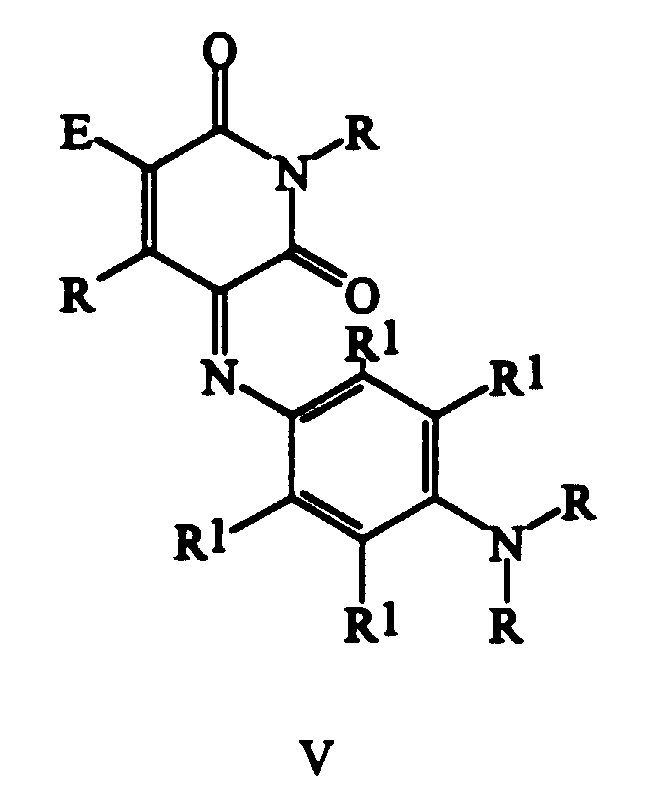
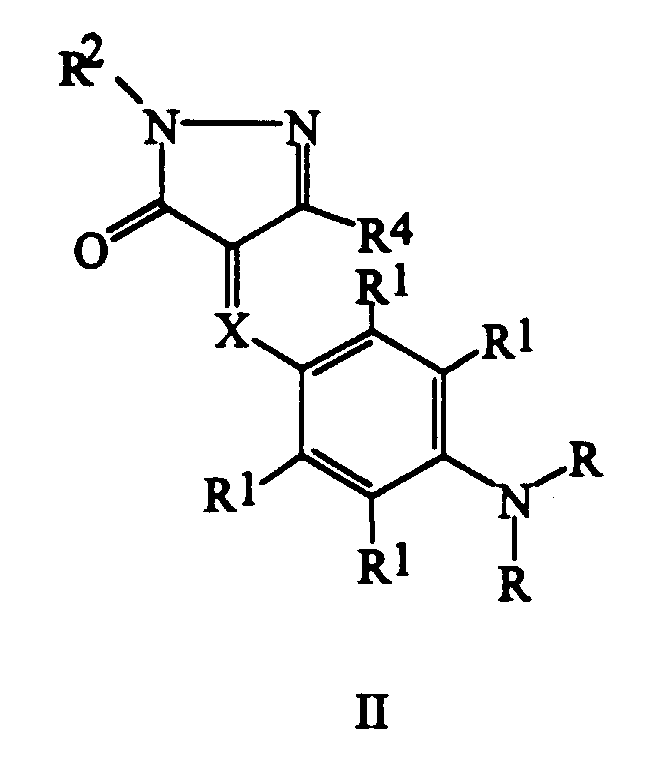
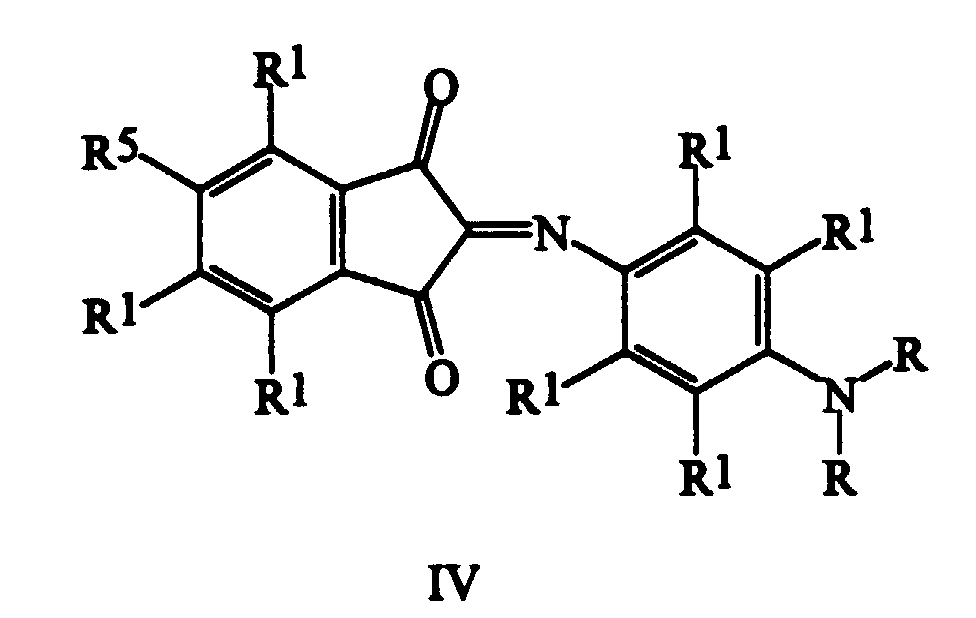
- Preferred dyes of the present invention capable of being irreversibly bleached by acid upon exposure of the printing plate to radiation have a central nucleus selected from the group of formulas consisting of: wherein R is independently an alkyl, cycloalkyl, alkaryl, or alkanoyl group having from 1 to 16 carbon atoms, or each R together with the nitrogen atom to which they are attached represents the necessary atoms to form a five- or six-membered ring; R 1 is independently hydrogen, halogen, cyano, or an alkyl, cycloalkyl, or alkoxy group having from 1 to 8 carbon atoms; or R and R 1 together with the nitrogen and two carbon atoms by which they are connected represent the necessary atoms to form a five- or six-membered ring; R 2 is Ar or an alkyl, cycloalkyl, or alkaryl group having from 1 to 16 carbon atoms; Ar is a substituted or unsubstituted aryl group, preferably
- Preferred polymers of the present invention having acid-labile groups are represented by the formula: wherein: R 6 and R 7 each represent H or an alkyl group with 1 to 18 carbon atoms with the proviso that at least one of R 6 and R 7 must be hydrogen; R 8 represents an alkyl group with 1 to 18 carbon atoms; or any two of R 6 , R 7 , and R 8 may together form a substituted or unsubstituted ring having from 3 to 36 carbon atoms; and T represents an optional divalent linking group bonded to the polymer backbone selected from the group consisting of O, NH, S, and an alkylene group containing from 1 to about 18 carbon atoms, where one or more carbon atoms may be replaced by oxygen, nitrogen, sulfur atoms, or chemically reasonable combinations thereof.
- irreversibly bleached means that in a printing plate construction, no visible, or only slight, recoloration (i.e., less than 50% of the initial optical density) occurs in the exposed areas, under environmental conditions which would typically recolor the exposed region in printing plate constructions using known acid-base indicator dyes (reversible dyes).
- no-process refers to a photosensitive element which can be irradiated and placed on press to be inked and run on press without any prior liquid or thermal development step to remove irradiated or non-irradiated areas from the photosensitive layer.
- group refers not only to pure hydrocarbon chains or structures such as methyl, ethyl, cyclohexyl, and the like, but also to chains or structures bearing conventional substituents in the art such as hydroxyl, alkoxy, phenyl, halo (F, Cl, Br, I), perhalo, cyano, nitro, amino, sulfonyl, etc.
- any substitution which does not alter the bond structure of the formula or the shown atoms within that structure is included within that structure.
- the chain may be rigidized by a cyclic group, and substituent groups may be placed on the chain, but the conjugation of the chain may not be altered and the atoms shown in the heterocyclic nuclei may not be replaced.
- the description of a formula as "a general formula” does not specifically allow for such broader substitution of the structure.
- the dyes of the present invention are capable of imparting a positive visible image to the printing plate after image-wise exposure (e.g., exposure through a mask).
- the image is suitable for locating the exposed regions of the plate, inspecting the plate, and determining the proper inking on press when used with plate scanners.
- the dyes change their absorption characteristics upon interaction with the strong protic acids that are generated during exposure. It is desirable for the dye to bleach (i.e., change to either colorless or yellow, which would appear to be colorless under yellow lights) so that the plate has the appearance of being developed immediately upon exposure.
- the visible absorption of the dye is dramatically reduced. In the most preferred case, the dye bleaches to colorless in an irreversible fashion in the exposed regions.
- Dyes that bleach irreversibly do not recolor after standing in air or upon treatment with basic solutions Irreversibility is important, since after exposure the coating may became more basic from contact with water and fountain solution, or from handling. The resulting basicity may cause an exposed plate to recolor if the dye changes color reversibly, as is the case with acid-base indicator dyes. It is also desirable to have a permanent image after exposure. Thus, the most preferred dyes change color irreversibly at low pH.
- the positive-acting no-process printing plates of the present invention comprise a substrate coated with a photosensitive composition comprising a photoinitiator which generates a strong acid upon exposure to radiation, a polymer having acid-labile groups pendant from the polymer backbone, and a dye capable of being irreversibly bleached by acid to form a visible image.
- R 6 and R 7 each represent H or an alkyl group with 1 to 18 carbon atoms with the proviso that at least one of R 6 and R 7 must be hydrogen
- R 8 represents an alkyl group with 1 to 18 carbon atoms
- T represents an optional divalent linking group bonded to the polymer backbone selected from the group consisting of O, NH, S, and an alkylene group containing from 1 to about 18 carbon atoms, where one or more carbon atoms may be replaced by oxygen, nitrogen, sulfur atoms, or chemically reasonable combinations thereof.
- the photoinitiator used herein is one which generates a strong acid upon exposure to radiation.
- Many such substances are known in the photoimaging art including, but not limited to, various onium compounds (e.g., sulfonium, iodonium, diazonium, etc.; particularly aryl derivatives thereof), and various organic compounds with photolabile halogen atoms ( ⁇ -halo- p -nitrotoluenes, halomethyl- s -triazines, carbon tetrabromide, etc.). While the choice of photoinitiator is not critical, it is desirable that the photoinitiator have limited solubility in water in order to provide maximal inkability.
- the photoinitiator is a substituted or unsubstituted diaryliodonium salt.
- suitable iodonium salts are salts of diphenyliodonium, ditolyliodonium, dinaphthyliodonium, di(4-chlorophenyl)iodonium, tolyl(dodecylphenyl)iodonium, naphthylphenyliodonium, 4-(trifluoromethylphenyl)phenyliodonium, 4-ethylphenylphenyliodonium, di(4-acetylphenyl)iodonium, tolylphenyliodonium, di(4-phenylphenyl)iodonium, di(carbomethoxyphenyl)iodonium, and the like.
- Diphenyliodonium salts and substituted derivatives thereof are preferred.
- the iodonium salts may be made with any anion capable of forming a stable salt with diphenyliodonium cation at room temperature, i.e., the anion must have a pKa less than about 16, and an oxidation potential of greater than about 0.7 V.
- Preferred anions are complex halogenated metal anions such as hexafluorophosphate, hexafluoroantimonate, hexafluoroarsenate; borates such as tetrafluoroborate and tetraphenylborate; and sulfonates such as p-toluenesulfonate.
- Particularly preferred anions are hexafluorophosphate, hexafluoroantimonate, and p-toluenesulfonate.
- the photolyzable organic halogen compounds which are useful in the present invention are those that upon exposure to radiation dissociate at one or more carbon-halogen bonds to form free radicals.
- the carbon-halogen bond dissociation energy should be between about 40 and 70 kcal/mole as taught in U.S. Pat. No. 3,515,552.
- Preferred photolyzable organic halogen compounds have from 1 to 40 carbon atoms, are non-gaseous at room temperature, and have a polarographic half-wave reduction potential greater than about -0.9 V as described in U.S. Pat. Nos. 3,640,718 and 3,617,288.
- photolyzable organic halogen compounds are hexabromoethane, ⁇ , ⁇ , ⁇ ', ⁇ '-tetrabromoxylene, carbon tetrabromide, m -nitro(tribromoacetyl)benzene, ⁇ , ⁇ , ⁇ -trichloroacetanilide, trichloromethylsulfonylbenzene, ⁇ , ⁇ , ⁇ -tribromoquinaldine, bis(pentachlorocyclopentadiene), tribromomethylquinoxaline, ⁇ , ⁇ -dibromo- p -nitrotoluene, ⁇ , ⁇ , ⁇ ', ⁇ ', ⁇ '-hexachloro- p -xylene, dibromotetrachloroethane, pentabromoethane, dibromodibenzoylmethane, carbon tetraiodide, halomethyl- s -triazines such as 2,4-
- the iodonium salts or photolyzable organic halogen compounds employed in the present invention may be either exposed to ultraviolet radiation or, when appropriately sensitized, to radiation in the visible or infrared spectrum. Wavelengths between 250 nm and 1200 nm inclusive may be used.
- Compounds useful as sensitizing dyes for this invention include, but are not limited to, substituted or unsubstituted anthracenes, aryl nitrones, xanthenes, anthraquinones, substituted diaryl- and triarylmethanes, methines, merocyanines, and polymethines, thiazoles, substituted and unsubstituted polycyclic aromatic hydrocarbons, and pyrylium dyes.
- the photosensitive compositions of the present invention are generally coated onto a substrate prior to use in an imaging application. Coating may be achieved by many methods well known in the imaging art (e.g., solvent casting, knife coating, extrusion, etc.).
- the coating weight of the photosensitive layer applied to the substrate will depend on the specific application and the desired processing requirements (e.g., light source, exposure time, etc.). However, typical dry coat weights will range from about 0.4 g/m 2 (40 mg/ft 2 ) to about 5.4 g/m 2 (500 mg/ft 2 ), preferably from about 0.6 g/m 2 (60 mg/ft 2 ) to about 1.1 g/m 2 (100 mg/ft 2 ).
- topcoat a non-photosensitive hydrophilic topcoat over the photosensitive layer as described in copending U.S. Pat. App. 08/311,510, filed September 23, 1994.
- the topcoat remains over the photosensitive layer after exposure until it is removed on press.
- the topcoat may improve the press performance (e.g., shorter roll-up time) of the resulting no-process positive-acting printing plate.
- Suitable substrates on which the photosensitive composition may be coated include, but are not limited to , metals or metal alloys, for example steel and aluminum plates, sheets or foils including aluminum treated with hydrophilic agents, such as silicates or polyacrylic acid and its derivatives; films or plates composed of various film-forming synthetic or natural based (e.g., cellulose acetate, gelatin, etc.) polymers including addition polymers (e.g., poly(vinylidene chloride), poly(vinyl chloride), poly(vinyl acetate), polystyrene, polyisobutylene polymers and copolymers), and linear condensation polymers (e.g., poly(ethylene terephthalate), poly(hexamethylene adipate), poly(hexamethylene adipamide/adipate)); paper or paper laminates.
- Aluminum and aluminum alloys are preferred substrates. Aluminum or aluminum alloys which have been electrochemically grained and anodized are particularly preferred.
- the photosensitive compositions of the present invention may contain various materials in combination with the essential ingredients of the present invention.
- plasticizers, coating aids, antioxidants, surfactants, antistatic agents, waxes, ultraviolet radiation absorbers, and brighteners may be used without adversely affecting the practice of the invention.
- the various materials preferably should not contain significant levels of functional groups (e.g., free amines, alkoxides, sulfides, amides, urethanes, imides, etc.) which are more basic than the alkoxyalkyl ester employed in the present invention as defined above.
- Preferred dyes of the present invention capable of being irreversibly bleached by acid upon exposure ofthe printing plate to radiation have a central nucleus selected from the group of formulas consisting of: wherein R is independently an alkyl, cycloalkyl, alkaryl, or alkanoyl group having from 1 to 16 carbon atoms, or each R together with the nitrogen atom to which they are attached represents the necessary atoms to form a five- or six-membered ring; R 1 is independently hydrogen, halogen, cyano, or an alkyl, cycloalkyl, or alkoxy group having from 1 to 8 carbon atoms; or R and R 1 together with the nitrogen and two carbon atoms by which they are connected represent the necessary atoms to form a five- or six-membered ring; R 2 is Ar or an alkyl, cycloalkyl, or alkaryl group having from 1 to 16 carbon atoms; Ar is a substituted or unsubstituted aryl group, preferably
- Dyes may be incorporated into the photosensitive coating formulation at any level desired, typically from about 0.1% to about 10% by weight based on the dry photosensitive coating weight, preferably from about 0.5% to about 5%, more preferably from about 1% to about 2.5%.
- N,N-Dibutyl-4-nitrosoaniline was prepared by following the procedure of Vogel's Textbook of Practical Organic Chemistry fourth edition, Logman (London) 1978 p723.
- the toluene layer was separated and the aqueous layer was washed twice with 600 mL of toluene.
- the aqueous layer was acidified with cooling with approximately 850 mL of 12M HCl to a pH of 1.
- An additional 500 mL of water was added to this mixture to help dissolve inorganic salts that tend to precipitate at this point.
- the solid was collected and again stirred with 500 mL of ether. This gave approximately 250 grams of solid.
- the ether filtrates were concentrated to give more product.
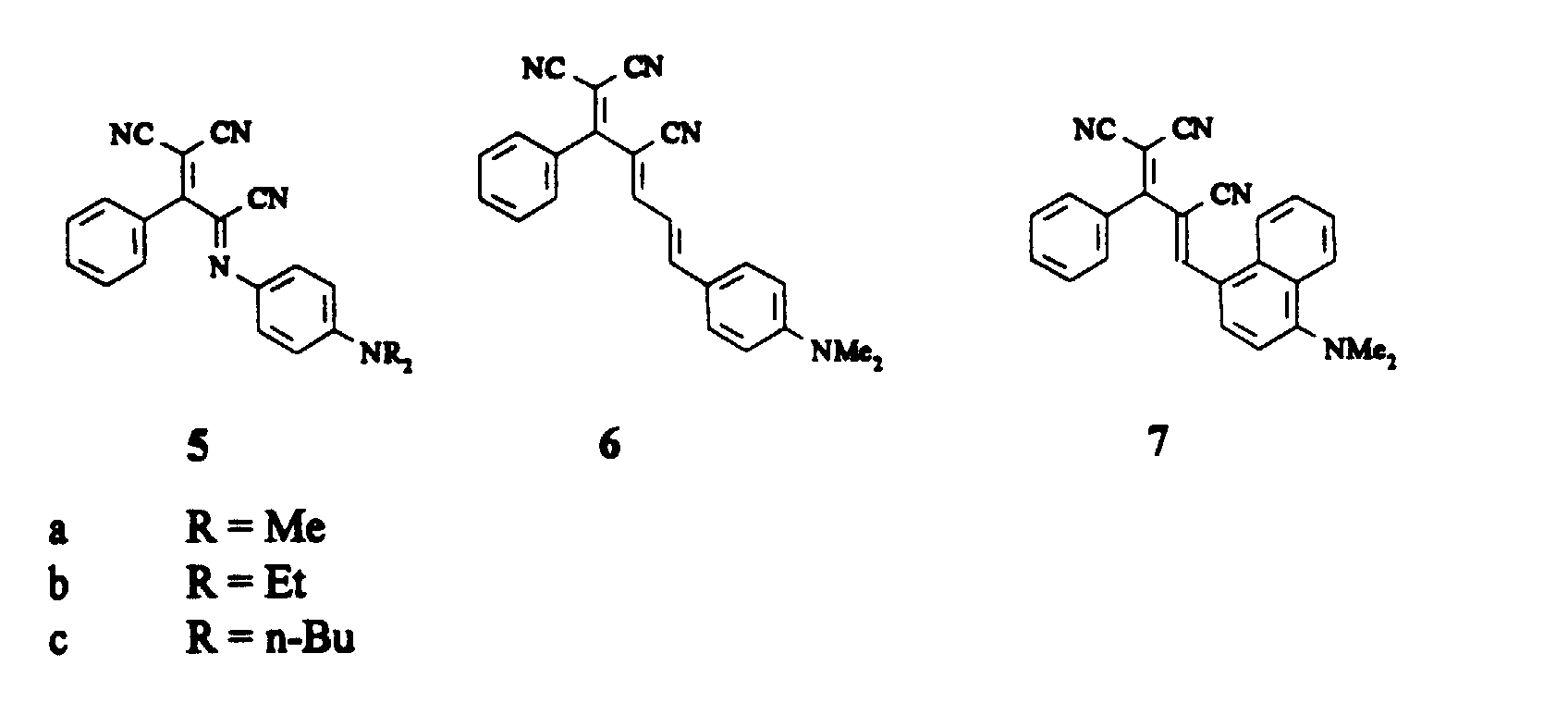
- Dyes 5a and 5b were prepared as described for 5c except N,N-dimethyl-4-nitrosoaniline and N,N-diethyl-4-nitrosoaniline were used instead of N,N-dibutyl-4-nitrosoaniline.
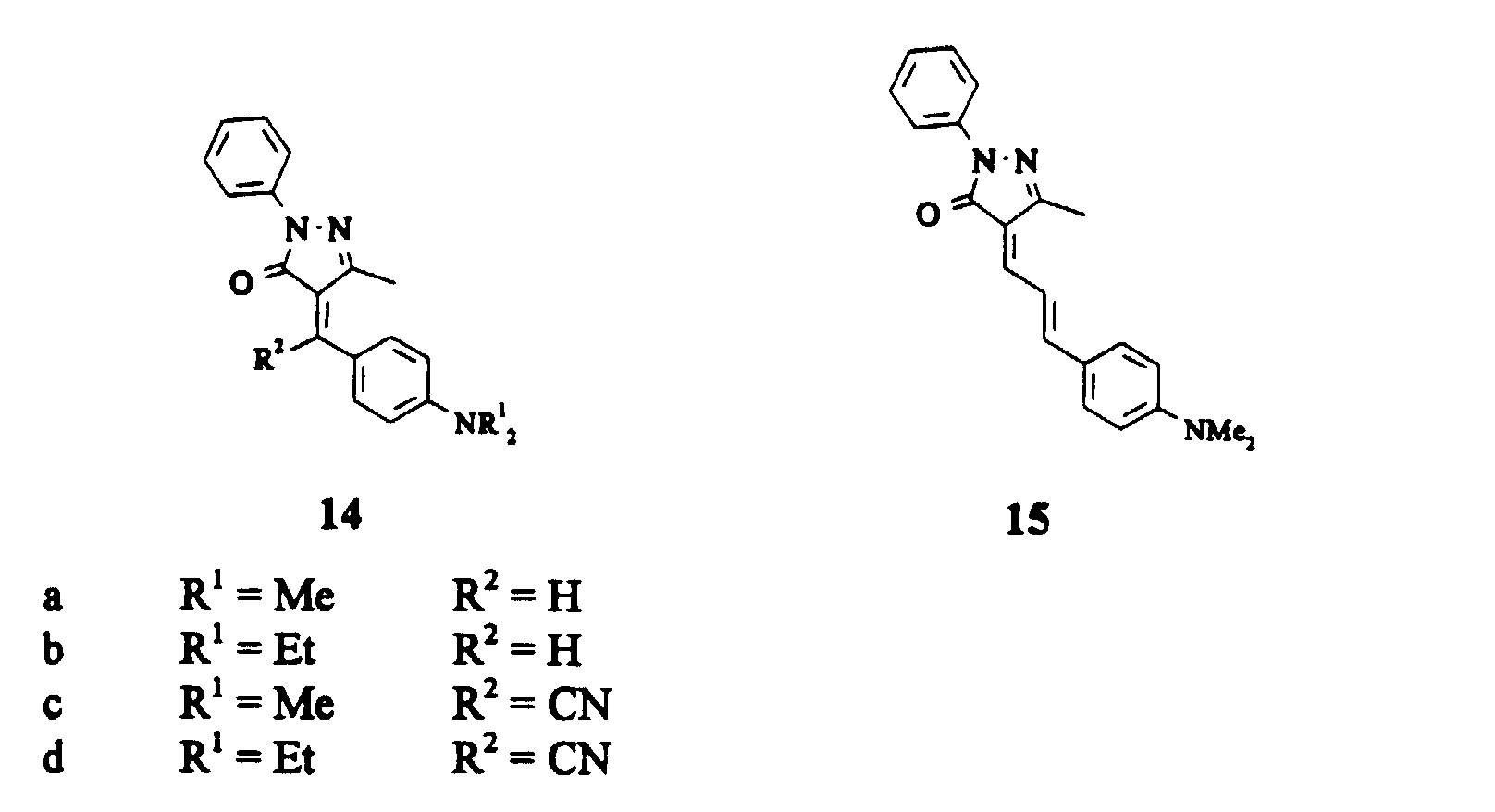
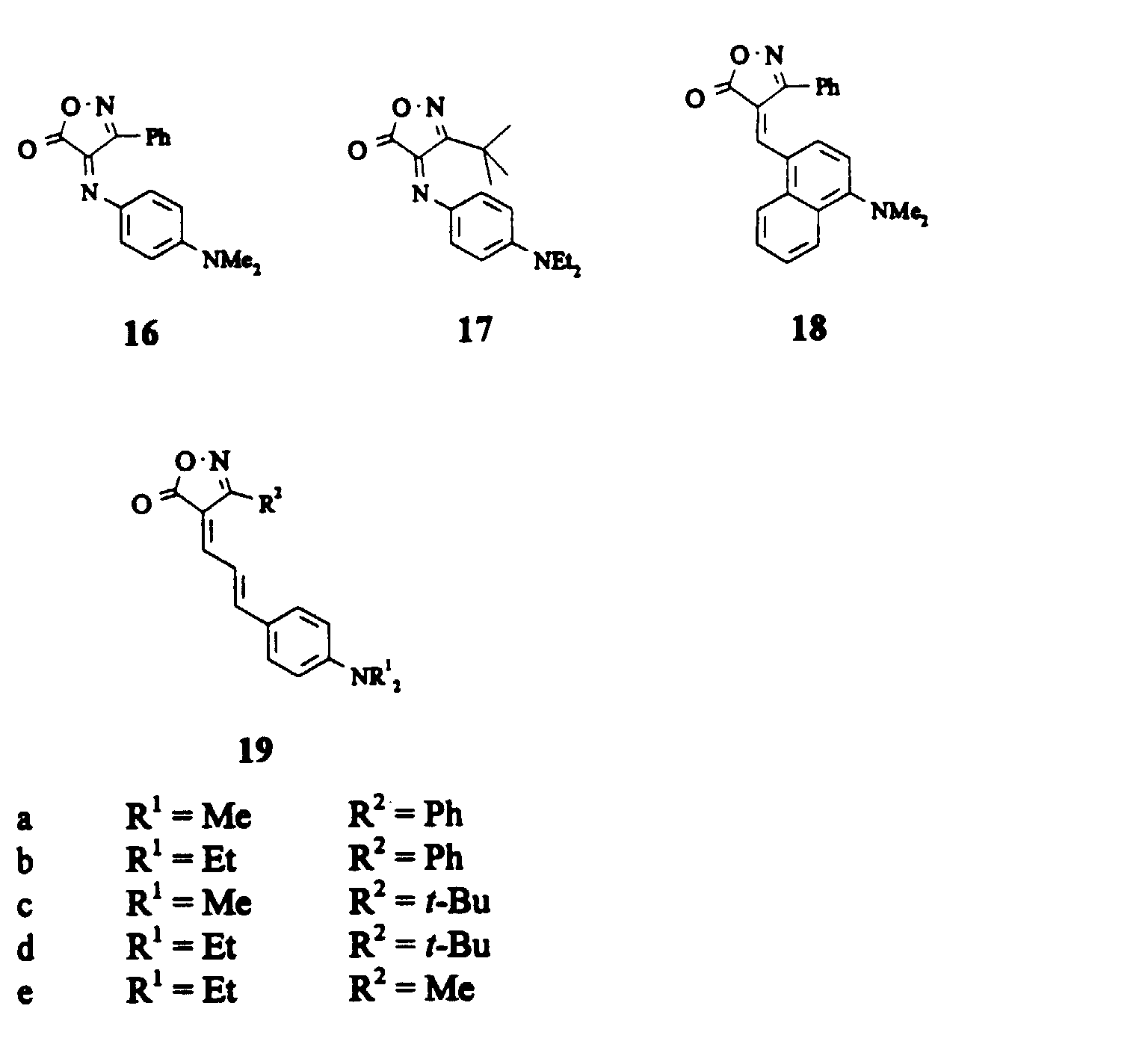
- Pyrazolinone dyes were prepared by either oxidative coupling between the pyrazolinone and the corresponding N,N-dialkyl p-phenylenediamine, or by the condensation of the pyrazolinone with the corresponding N,N-dialkyl-4-nitrosoaniline.
- Dyes also prepared by oxidative coupling were 11, 12, 13a .
- Dyes prepared by this method are: 8a,b , 13d-g , 16 , 17 .
- This material was prepared by a modification ofthe procedure in Synthetic Communications, 1993, 23 , 2231.
- This material was prepared in a manner similar to 27g .
- Compound 40 was prepared in a manner similar to 39 .
- Compound 45 was prepared in a manner similar to that described for Example 13 in U.S. Pat. No. 5,360,582.
- a mixture of 6.16 grams (37.5 mmol, 1 eq) of malonaldehyde tetramethylacetal (MTA) and 10.5 grams (37.5 mmol, 1 eq) of methylene bis(trifluoromethylsulfone) was stirred with 15.3 grams (150 mmol, 4 eq) of acetic anhydride at 70°C for 2 hours. The mixture turned deep red. The mixture was cooled and 10.0 grams (37.5 mmol, 1 eq) of 1,1-bis(4-dimethylaminophenyl)ethylene was added.
- Dyes were evaluated for utility in providing a visible image in positive-acting printing plate applications in the following manner.
- a solution was prepared with each dye of the general formulation: Tetrahydropyran ester of poly (methyl methacrylate) 0.355 g Ditolyliodonium hexafluorophosphate 0.09 g 2-Ethyl-9,10-dimethoxyanthracene 0.045 g 1-Methoxy-2-propanol 4.50 g
- Dye 0.01 g
- top coat solution was the following: Rohm & Haas AcusolTM 445 (purchased as 48% solids) 340 g Gum arabic 85.0 g Union Carbide TritonTM X-100 4.4 g Kathon CG/ICP 3.4 g 25% Sodium Hydroxide 160 g De-ionized Water 2,968 g
- the top coat solution was applied using a #5 wire wrapped rod (R&D Specialties, Webster, NY). After coating the samples were dried in an oven at a temperature between 65 and 107°C. Constructions were evaluated by exposure to actinic radiation in a vacuum frame. After exposure, the susceptibility of the bleached dye to revert to its colored form was determined by at least one ofthe following test methods A-C: A) Storage for 3 days at ambient and 60 °C conditions, B) Contact with fingers and expelled breath, and C) contact with a pH 7.5 solution. The results of the above tests for utility are listed in Tables 1-6.
- Test method D involves dissolving a sample of the dye in methanol, ethanol or 1-methoxy-2-propanol and observing the color ofthe solution. A drop of 12M hydrochloric acid was added and the behavior of the dye was observed. In some cases, sufficient aqueous sodium hydroxide was added to neutralize the acid and the ability of the dye to recolor was observed.
- Example Coated Color Exposed Color Top Coat Test method Recolor 5a blue colorless no A no 5b blue colorless yes A, B, C no 5c blue colorless yes A, B, C no Structure II
- Example Coated Color Exposed Color Top Coat Test method Recolor 10 magenta largely colorless - D no 11 magenta colorless no A, B slight 12 magenta colorless no A no 13a orange colorless - D no 13b magenta colorless yes A, B, C very slight 14a magenta colorless yes A, B, C very slight 14b magenta colorless yes A, B, C very slight Structure III
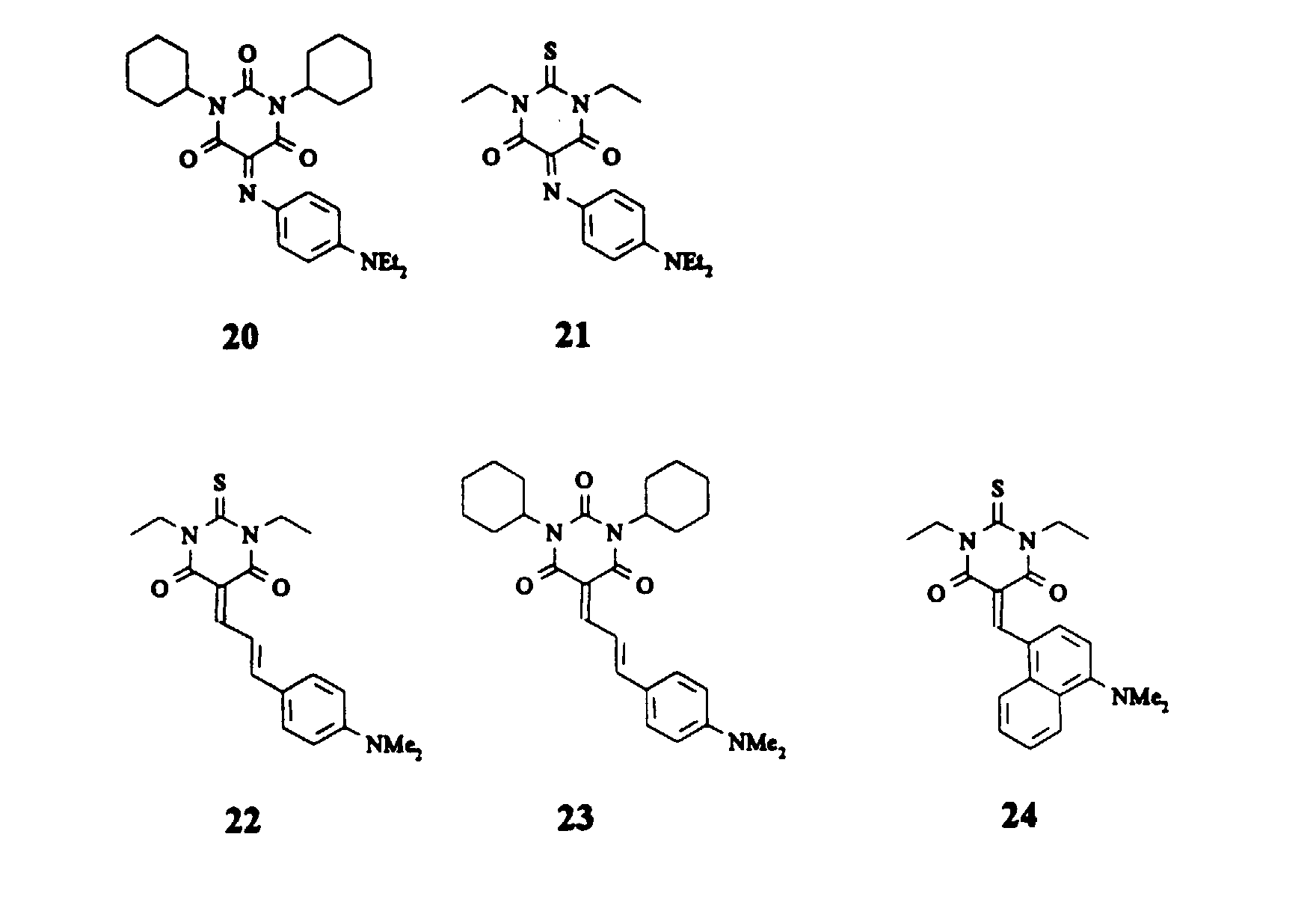
- Example Coated Color Exposed Color Top Coat Test method Recolor 20 very lt. purple colorless no B, C no 21 very lt.
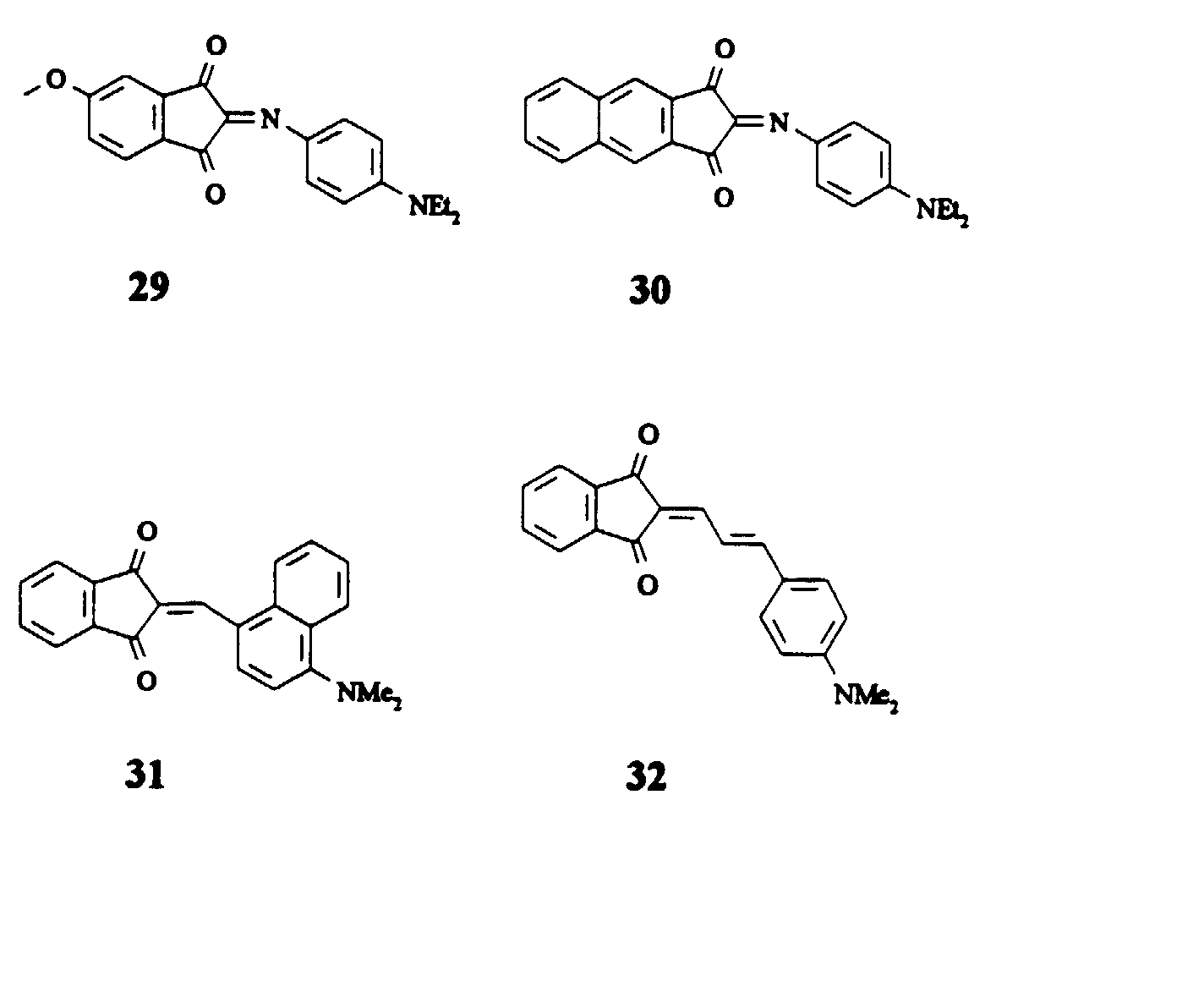
- Example Coated Color Exposed Color Top Coat Test method Recolor 27a purple colorless no A, B, C no 27b blue colorless no A, B, C no 27c purple colorless no A, B, C no 27f light purple colorless A no 28 light purple colorless no A, B, C no 29 purple colorless no A, B no 30 cyan colorless no A, B no Structures V and VI
- Example Coated Color Exposed Color Top Coat Test method Recolor 41 blue colorless no C slight 45 blue green colorless no A, B slight Comparative Examples
- Example Coated Color exposed color Top Coat Test method Recolor 1a light red colorless no A yes 1b magenta colorless no B, C yes 1c orange colorless no B, C yes 2 red colorless no B, C yes 6 blue yellow no A, B yes 13c magenta colorless yes A yes 13d magenta colorless yes A yes 13e magenta colorless yes A yes 13f magenta colorless yes A yes 13g magenta colorless
Landscapes
- Engineering & Computer Science (AREA)
- Architecture (AREA)
- Structural Engineering (AREA)
- Physics & Mathematics (AREA)
- General Physics & Mathematics (AREA)
- Materials For Photolithography (AREA)
- Printing Plates And Materials Therefor (AREA)
- Photosensitive Polymer And Photoresist Processing (AREA)
- Non-Silver Salt Photosensitive Materials And Non-Silver Salt Photography (AREA)
- Paints Or Removers (AREA)
Description
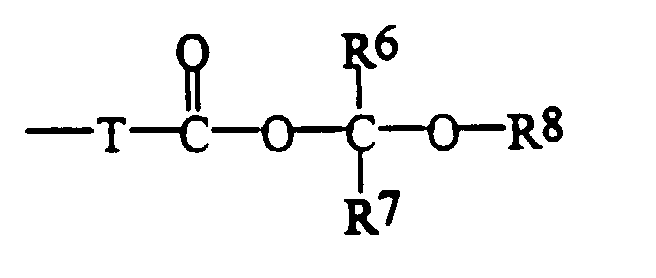
R6 and R7 each represent H or an alkyl group with 1 to 18 carbon atoms with the proviso that at least one of R6 and R7 must be hydrogen; R8 represents an alkyl group with 1 to 18 carbon atoms; or any two of R6 , R7 , and R8 may together form a substituted or unsubstituted ring having from 3 to 36 carbon atoms; and T represents an optional divalent linking group bonded to the polymer backbone selected from the group consisting of O, NH S, and an alkylene group containing from 1 to about 18 carbon atoms, where one or more carbon atoms may be replaced by oxygen, nitrogen, sulfur atoms, or chemically reasonable combinations thereof. These compositions are used on an imageable article which comprises a substrate coated with the above-described photosensitive composition. These articles are used in processes in which the imageable article is irradiated and then directly placed on press for use as a printing plate without liquid wash-off development. The incorporation of acid-base indicator dyes (e.g., bromophenyl blue and ethyl violet) to give a print-out image upon exposure is also disclosed.



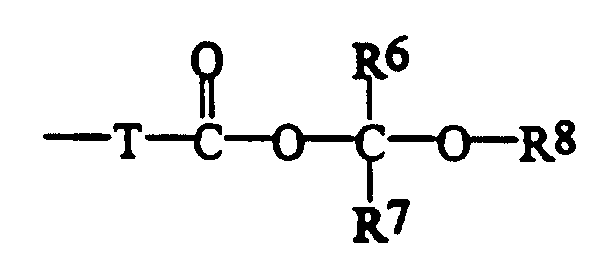
R6 and R7 each represent H or an alkyl group with 1 to 18 carbon atoms with the proviso that at least one of R6 and R7 must be hydrogen; R8 represents an alkyl group with 1 to 18 carbon atoms; or any two of R6 , R7 , and R8 may together form a substituted or unsubstituted ring having from 3 to 36 carbon atoms; and T represents an optional divalent linking group bonded to the polymer backbone selected from the group consisting of O, NH, S, and an alkylene group containing from 1 to about 18 carbon atoms, where one or more carbon atoms may be replaced by oxygen, nitrogen, sulfur atoms, or chemically reasonable combinations thereof.
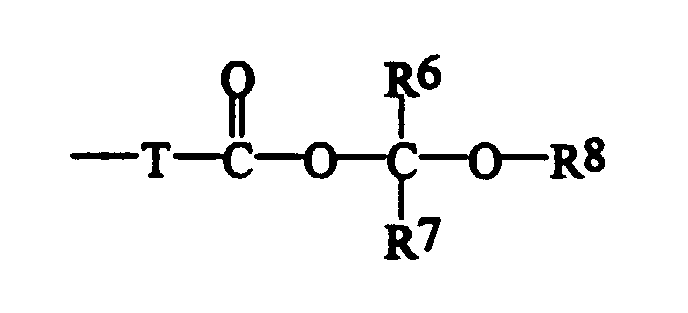
R6 and R7 each represent H or an alkyl group with 1 to 18 carbon atoms with the proviso that at least one of R6 and R7 must be hydrogen; R8 represents an alkyl group with 1 to 18 carbon atoms; or any two of R6, R7 , and R8 may together form a substituted or unsubstituted ring having from 3 to 36 carbon atoms; and T represents an optional divalent linking group bonded to the polymer backbone selected from the group consisting of O, NH, S, and an alkylene group containing from 1 to about 18 carbon atoms, where one or more carbon atoms may be replaced by oxygen, nitrogen, sulfur atoms, or chemically reasonable combinations thereof.









| Tetrahydropyran ester of poly (methyl methacrylate) | 0.355 g |
| Ditolyliodonium hexafluorophosphate | 0.09 g |
| 2-Ethyl-9,10-dimethoxyanthracene | 0.045 g |
| 1-Methoxy-2-propanol | 4.50 g |
| Dye | 0.01 g |
| Rohm & Haas AcusolTM 445 (purchased as 48% solids) | 340 g |
| Gum arabic | 85.0 g |
| Union Carbide TritonTM X-100 | 4.4 g |
| Kathon CG/ICP | 3.4 g |
| 25% Sodium Hydroxide | 160 g |
| De-ionized Water | 2,968 g |
| Structure I | |||||
| Example | Coated Color | Exposed Color | Top Coat | Test method | Recolor |
| 5a | blue | colorless | no | A | no |
| 5b | blue | colorless | yes | A, B, C | no |
| 5c | blue | colorless | yes | A, B, C | no |
| Structure II | |||||
| Example | Coated Color | Exposed Color | Top Coat | Test method | Recolor |
| 10 | magenta | largely colorless | - | D | no |
| 11 | magenta | colorless | no | A, B | slight |
| 12 | magenta | colorless | no | A | no |
| 13a | orange | colorless | - | D | no |
| 13b | magenta | colorless | yes | A, B, C | very slight |
| 14a | magenta | colorless | yes | A, B, C | very slight |
| 14b | magenta | colorless | yes | A, B, C | very slight |
| Structure III | |||||
| Example | Coated Color | Exposed Color | Top Coat | Test method | Recolor |
| 20 | very lt. purple | colorless | no | B, C | no |
| 21 | very lt. purple | colorless | no | B, C | no |
| 23 | red | colorless | no | A, B | slight |
| Structure IV | |||||
| Example | Coated Color | Exposed Color | Top Coat | Test method | Recolor |
| 27a | purple | colorless | no | A, B, C | no |
| 27b | blue | colorless | no | A, B, C | no |
| 27c | purple | colorless | no | A, B, C | no |
| 27f | light purple | colorless | A | no | |
| 28 | light purple | colorless | no | A, B, C | no |
| 29 | purple | colorless | no | A, B | no |
| 30 | cyan | colorless | no | A, B | no |
| Structures V and VI | |||||
| Example | Coated Color | Exposed Color | Top Coat | Test method | Recolor |
| 41 | blue | colorless | no | C | slight |
| 45 | blue green | colorless | no | A, B | slight |
| Comparative Examples | |||||
| Example | Coated Color | exposed color | Top Coat | Test method | Recolor |
| 1a | light red | colorless | no | A | yes |
| 1b | magenta | colorless | no | B, C | yes |
| 1c | orange | colorless | no | B, C | yes |
| 2 | red | colorless | no | B, C | yes |
| 6 | blue | yellow | no | A, B | yes |
| 13c | magenta | colorless | yes | A | yes |
| 13d | magenta | colorless | yes | A | yes |
| 13e | magenta | colorless | yes | A | yes |
| 13f | magenta | colorless | yes | A | yes |
| 13g | magenta | colorless | yes | A | yes |
| 16a | magenta | colorless | yes | A, B | yes |
| 16b | magenta | colorless | yes | A, B | yes |
| 19a | magenta | colorless | yes | A, B | yes |
| 19b | magenta | colorless | yes | A | yes |
| 19d | magenta | colorless | yes | A | yes |
| 19e | magenta | colorless | yes | A | yes |
| 22 | purple | yellow | no | A, B | yes |
| 24 | magenta | colorless | - | D | yes |
| 25 | magenta | largely colorless | - | D | yes |
| 26 | purple | largely colorless | - | D | yes |
| 31 | red | colorless | - | D | |
| 32 | red-orange | colorless | - | D | |
| 33 | red | colorless | - | D | yes |
| 34 | blue | colorless | - | D | |
| 35 | blue | partial decolor | - | D | |
| 36 | orange | largely colorless | - | D | |
| 37 | yellow | partial decolor | - | D | |
| 38 | orange | light yellow | - | D | |
| 39 | purple | yellow | no | A | yes |
| 40 | purple | yellow | no | A | yes |
| 42b | magenta | colorless | - | D | |
| 42c | magenta | colorless | - | D | |
| 42d | purple-blue | light yellow | - | D | |
| 43a | blue | partial decolor | - | D | yes |
| 43b | blue | yellow | no | A, B | yes |
| 44 | blue | light yellow | - | D | |
| 46a | magenta | lt. pink | no | A, B | yes |
| 46b | magenta | It. pink | no | A, B | yes |
| 46c | magenta | magenta | no | - | - |
Claims (19)
- An article comprising a substrate coated with a photosensitive composition comprising: (a) a photoinitiator which generates a strong acid upon exposure to radiation; (b) a polymer having acid-labile groups pendant from the polymer backbone; and (c) a dye capable of being irreversibly bleached by said acid, providing a visible image upon exposure to radiation.
- The article of claim 1 wherein said dye has a central nucleus selected from the group of formulas consisting of:wherein R is independently an alkyl, cycloalkyl, alkaryl, or alkanoyl group having from 1 to 16 carbon atoms, or each R together with the nitrogen atom to which they are attached represents the necessary atoms to form a five- or six-membered ring; R1 is independently hydrogen, halogen, cyano, or an alkyl, cycloalkyl, or alkoxy group having from 1 to 8 carbon atoms; or R and R1 together with the nitrogen and two carbon atoms by which they are connected represent the necessary atoms to form a five- or six-membered ring; R2 is Ar or an alkyl, cycloalkyl, or alkaryl group having from 1 to 16 carbon atoms; Ar is a substituted or unsubstituted aryl group; E is independently an electron withdrawing group selected from the group consisting of CN, SO2 R3, C(O)R3 , and NO2; and R3 is independently an alkyl, cycloalkyl, or alkaryl group having from 1 to 16 carbon atoms, or each R3 taken together with the atoms to which they are attached represent the necessary atoms to form a five- or six-membered ring;
 wherein X is N or CR1 ; R4 is H, CH3, NHR2, NHC(O)R2 , or NR2; and R, R1 and R2 are as previously defined;
 wherein Y is O or S; n is 0 or 1; and R, R1, and X are as previously defined with the proviso that when Y is S, then X is N;
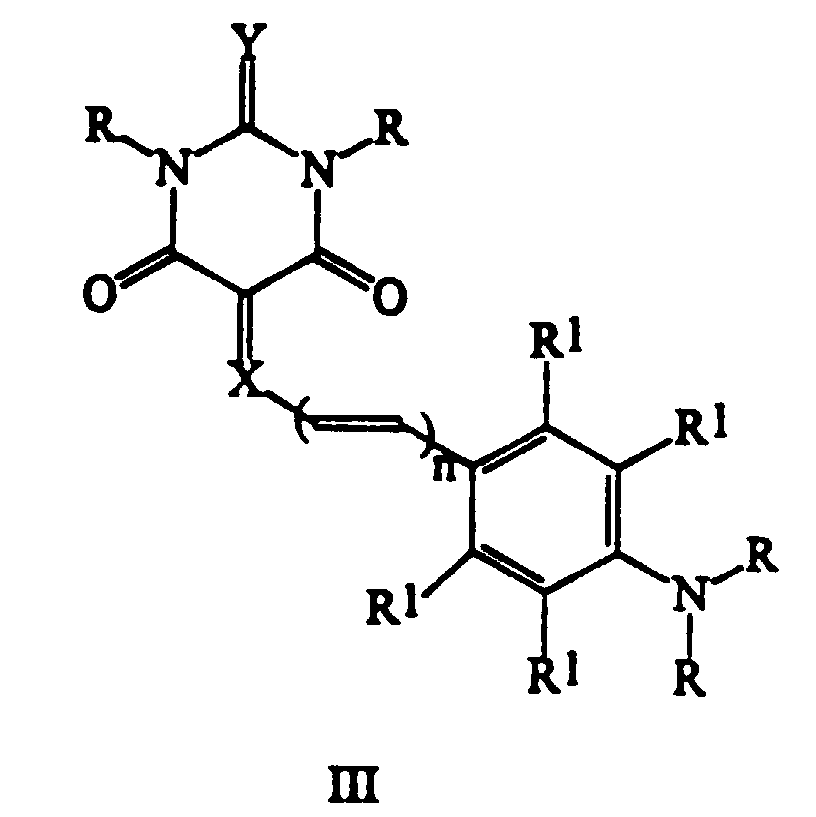 wherein R and R1 are as previously defined; R5 is R1 , or R5 and R1 taken together with the two carbon atoms by which they are connected represent the necessary atoms to form a five- or six-membered carbocyclic or heterocyclic, non-aromatic or aromatic ring;
 wherein R, R1 , and E are as previously defined; and
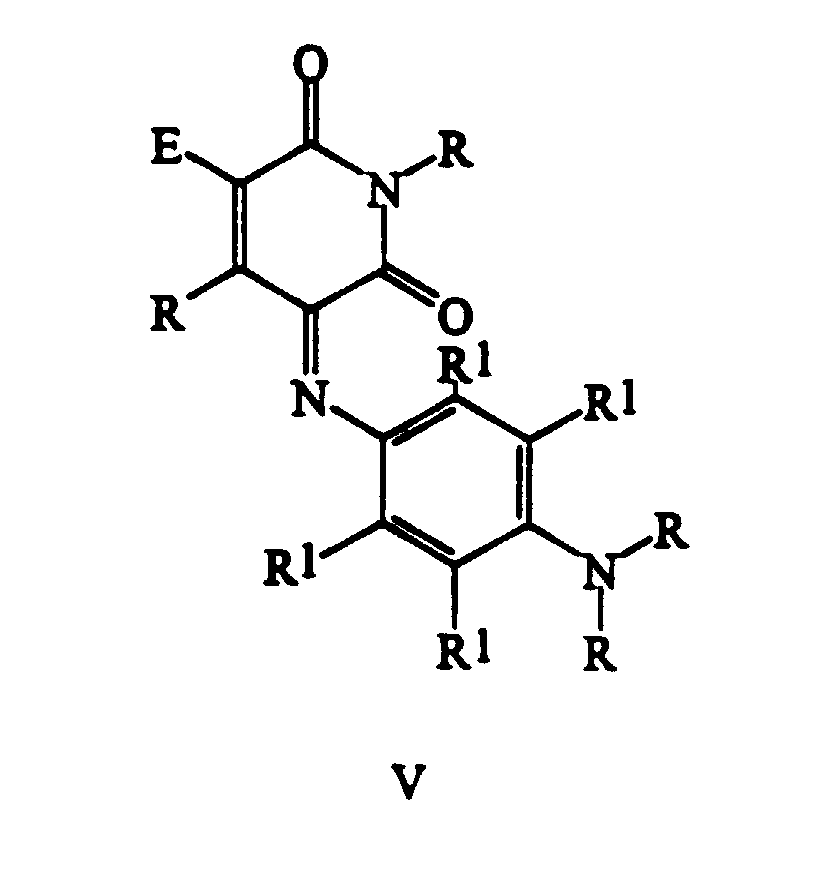 wherein R, R1 , and E are as previously defined.
- The article of claim 2 wherein said polymer is of the formula:wherein R6 and R7 each represent H or an alkyl group with 1 to 18 carbon atoms with the proviso that at least one of R6 and R7 must be hydrogen; R8 represents an alkyl group with 1 to 18 carbon atoms; or any two of R6 , R7, and R8 may together form a substituted or unsubstituted ring having from 3 to 36 carbon atoms; and T represents an optional divalent linking group bonded to the polymer backbone selected from the group consisting of O, NH, S, and an alkylene group containing from 1 to about 18 carbon atoms, where one or more carbon atoms may be replaced by oxygen, nitrogen, sulfur atoms, or chemically reasonable combinations thereof.

- The article of claim 3 wherein the article is a positive-acting no-process printing plate.
- The article of claim 3 wherein said dye is of the formula:wherein R is independently an alkyl, cycloalkyl, alkaryl, or alkanoyl group having from 1 to 16 carbon atoms, or each R together with the nitrogen atom to which they are attached represents the necessary atoms to form a five- or six-membered ring; R1 is independently hydrogen, halogen, cyano, or an alkyl, cycloalkyl, or alkoxy group having from 1 to 8 carbon atoms; or R and R1 together with the nitrogen and two carbon atoms by which they are connected represent the necessary atoms to form a five- or six-membered ring; R2 is Ar or an alkyl, cycloalkyl, or alkaryl group having from 1 to 16 carbon atoms; Ar is a substituted or unsubstituted aryl group; X is N or CR1 ; and R4 is H, CH3, NHR2 , NHC(O)R2, or NR2 .
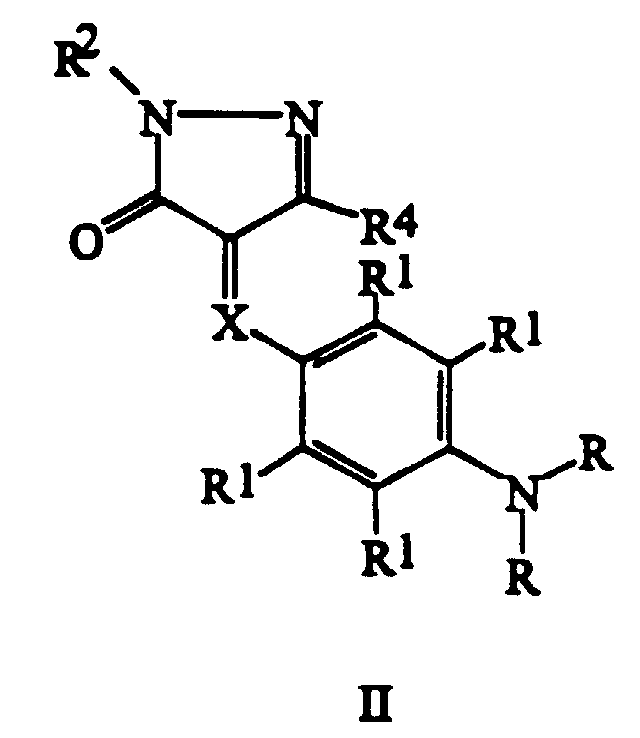
- The article of claim 5 wherein R is ethyl, R1 is hydrogen, R2 is phenyl, X is nitrogen, and R4 is methyl.
- The article of claim 3 wherein said photoinitiator is a diaryliodonium salt.
- The article of claim 7 wherein said photoinitiator is diphenyl or ditolyliodonium hexafluorophosphate.
- The article of claim 7 wherein said photosensitive composition further comprises a sensitizer.
- The article of claim 9 wherein said sensitizer comprises a substituted or unsubstituted anthracene.
- The article of claim 10 wherein said sensitizer is 2-ethyl-9,10-dimethoxyanthracene or 9,10-diethoxyanthracene.
- The article of claim 3 wherein said substrate is an aluminum sheet.
- The article of claim 12 wherein said substrate is an electrochemically grained and anodized aluminum sheet.
- A process for forming a visible image on an article comprising the steps of(a) providing a substrate coated with a photosensitive composition according to any one of claims 1 to 11; and(b) irradiating said article, thereby providing a visible image.
- The process of claim 14 wherein said article is exposed through a mask.
- The process of claim 14 wherein said article is a positive-acting no-process printing plate.
- The process of claim 14 wherein said article is exposed to actinic radiation of wavelength between 250 nm and 1200 nm.
- The process of claim 14 wherein said substrate is an aluminum sheet.
- The process of claim 18 wherein said substrate is an electrochemically grained and anodized aluminum sheet.
Applications Claiming Priority (3)
| Application Number | Priority Date | Filing Date | Title |
|---|---|---|---|
| US08/433,887 US5665522A (en) | 1995-05-02 | 1995-05-02 | Visible image dyes for positive-acting no-process printing plates |
| US433887 | 1995-05-02 | ||
| PCT/US1996/003759 WO1996035143A1 (en) | 1995-05-02 | 1996-03-21 | Acid bleachable dye containing lithographic printing plate composition |
Publications (2)
| Publication Number | Publication Date |
|---|---|
| EP0824720A1 EP0824720A1 (en) | 1998-02-25 |
| EP0824720B1 true EP0824720B1 (en) | 1999-09-22 |
Family
ID=23721935
Family Applications (1)
| Application Number | Title | Priority Date | Filing Date |
|---|---|---|---|
| EP96908868A Expired - Lifetime EP0824720B1 (en) | 1995-05-02 | 1996-03-21 | Acid bleachable dye containing lithographic printing plate composition |
Country Status (12)
| Country | Link |
|---|---|
| US (1) | US5665522A (en) |
| EP (1) | EP0824720B1 (en) |
| JP (1) | JPH11504439A (en) |
| CN (1) | CN1183146A (en) |
| AR (1) | AR001662A1 (en) |
| AT (1) | ATE185001T1 (en) |
| AU (1) | AU5256796A (en) |
| DE (1) | DE69604393T2 (en) |
| FI (1) | FI974108L (en) |
| NO (1) | NO975047L (en) |
| WO (1) | WO1996035143A1 (en) |
| ZA (1) | ZA963024B (en) |
Families Citing this family (41)
| Publication number | Priority date | Publication date | Assignee | Title |
|---|---|---|---|---|
| US7094517B1 (en) * | 1998-05-13 | 2006-08-22 | D Data Inc. | Recording layer with organic dye-in-polymer (DIP) medium for write-once-read-many (WORM) optical discs with fluorescent reading |
| DE19920808A1 (en) * | 1998-05-16 | 1999-11-18 | Basf Ag | Methine and azamethine dyes based on trifluoromethyl-substituted 5-membered heterocycles |
| US6235452B1 (en) | 1999-08-05 | 2001-05-22 | International Business Machines Corporation | Detection of a gaseous substance emanating from a layer of polymeric composition |
| JP4965052B2 (en) * | 2000-06-15 | 2012-07-04 | スリーエム イノベイティブ プロパティズ カンパニー | Processing method of three-dimensional optical element |
| US6852766B1 (en) | 2000-06-15 | 2005-02-08 | 3M Innovative Properties Company | Multiphoton photosensitization system |
| AU2001266918A1 (en) * | 2000-06-15 | 2001-12-24 | 3M Innovative Properties Company | Multidirectional photoreactive absorption method |
| JP4786858B2 (en) * | 2000-06-15 | 2011-10-05 | スリーエム イノベイティブ プロパティズ カンパニー | Multiphoton curing to provide encapsulated optics |
| US7166409B2 (en) * | 2000-06-15 | 2007-01-23 | 3M Innovative Properties Company | Multipass multiphoton absorption method and apparatus |
| EP1295180B1 (en) * | 2000-06-15 | 2013-05-22 | 3M Innovative Properties Company | Process for producing microfluidic articles |
| JP4472922B2 (en) * | 2000-06-15 | 2010-06-02 | スリーエム イノベイティブ プロパティズ カンパニー | Multicolor imaging using a multiphoton photochemical process |
| US6514664B1 (en) * | 2000-07-20 | 2003-02-04 | Arch Specialty Chemicals, Inc. | Radiation sensitive compositions containing image quality and profile enhancement additives |
| US6479217B1 (en) | 2001-02-22 | 2002-11-12 | Spectra Group Limited, Inc. | Method for producing selectively colorable printing plates |
| US20030087178A1 (en) * | 2001-04-20 | 2003-05-08 | Adrian Lungu | Photopolymerizable element for use as a flexographic printing plate and a process for preparing the plate from the element |
| US20040012872A1 (en) * | 2001-06-14 | 2004-01-22 | Fleming Patrick R | Multiphoton absorption method using patterned light |
| JP4617031B2 (en) * | 2001-08-24 | 2011-01-19 | 大日本印刷株式会社 | EL device using photodegradable dye |
| US6664025B2 (en) * | 2002-02-12 | 2003-12-16 | Kodak Polychrome Graphics Llc | Visible radiation sensitive composition |
| JP2005178238A (en) * | 2003-12-22 | 2005-07-07 | Konica Minolta Medical & Graphic Inc | Printing method and printing plate material employing therein |
| KR101125678B1 (en) * | 2004-02-06 | 2012-03-28 | 롬 앤드 하스 일렉트로닉 머트어리얼즈, 엘.엘.씨. | Improved imaging compositions and methods |
| US7270932B2 (en) * | 2004-02-06 | 2007-09-18 | Rohm And Haas Electronic Materials Llc | Imaging composition and method |
| US20050175941A1 (en) * | 2004-02-06 | 2005-08-11 | Rohm And Hass Electronic Materials, L.L.C. | Imaging composition and method |
| US7977026B2 (en) * | 2004-02-06 | 2011-07-12 | Rohm And Haas Electronic Materials Llc | Imaging methods |
| US7144676B2 (en) * | 2004-02-06 | 2006-12-05 | Rohm And Haas Electronic Materials Llc | Imaging compositions and methods |
| EP1754614B1 (en) | 2004-04-09 | 2009-06-17 | FUJIFILM Corporation | Lithographic printing plate precursor and lithographic printing method |
| EP1614541A3 (en) | 2004-07-08 | 2006-06-07 | Agfa-Gevaert | Method of making a lithographic printing plate. |
| EP1736312B1 (en) | 2005-06-21 | 2008-04-02 | Agfa Graphics N.V. | Heat-sensitive imaging element |
| JP4640764B2 (en) * | 2004-08-18 | 2011-03-02 | 株式会社Adeka | Materials for organic electroluminescence devices using methine compounds |
| JP2006062188A (en) | 2004-08-26 | 2006-03-09 | Fuji Photo Film Co Ltd | Color image forming material and original plate of lithographic printing plate |
| US20070117042A1 (en) * | 2005-11-23 | 2007-05-24 | Rohm And Haas Electronic Materials Llc | Imaging methods |
| JP4659770B2 (en) * | 2007-01-30 | 2011-03-30 | 信越化学工業株式会社 | Resist material and pattern forming method |
| ES2414654T3 (en) * | 2009-02-05 | 2013-07-22 | Danja Kaiser | Cleaning indicator and test body for cleaning process testing |
| US8900798B2 (en) | 2010-10-18 | 2014-12-02 | Eastman Kodak Company | On-press developable lithographic printing plate precursors |
| JP2015134904A (en) * | 2013-11-18 | 2015-07-27 | 東洋合成工業株式会社 | Compound for enhancing generation of chemical species |
| EP3431290B1 (en) | 2017-07-20 | 2021-09-08 | Agfa Nv | A lithographic printing plate precursor |
| EP3793829B1 (en) | 2018-05-14 | 2023-07-12 | Agfa Offset Bv | A lithographic printing plate precursor |
| EP3587112B1 (en) | 2018-06-21 | 2024-04-03 | Eco3 Bv | A lithographic printing plate precursor |
| EP3587113B1 (en) | 2018-06-21 | 2023-01-04 | Agfa Offset Bv | A lithographic printing plate precursor |
| US11465404B2 (en) | 2018-12-10 | 2022-10-11 | Agfa Offset Bv | On-press processing of a UV or violet-sensitized lithographic printing plate |
| EP3686011A1 (en) | 2019-01-23 | 2020-07-29 | Agfa Nv | A lithographic printing plate precursor |
| EP3875271B1 (en) | 2020-03-04 | 2025-10-15 | Eco3 Bv | A lithographic printing plate precursor |
| EP3892469B1 (en) | 2020-04-10 | 2023-11-08 | Eco3 Bv | Lithographic printing plate precursor |
| CN115697708B (en) | 2020-06-24 | 2026-02-17 | 易客发有限公司 | Pre-printing plate for lithography |
Family Cites Families (14)
| Publication number | Priority date | Publication date | Assignee | Title |
|---|---|---|---|---|
| JPS5023328B1 (en) * | 1971-06-25 | 1975-08-07 | ||
| US4139390A (en) * | 1977-02-10 | 1979-02-13 | Eastman Kodak Company | Presensitized printing plate having a print-out image |
| JPS6053300B2 (en) * | 1978-08-29 | 1985-11-25 | 富士写真フイルム株式会社 | Photosensitive resin composition |
| JPS5562444A (en) * | 1978-11-02 | 1980-05-10 | Konishiroku Photo Ind Co Ltd | Photosensitive composition |
| JPS57163234A (en) * | 1981-04-01 | 1982-10-07 | Fuji Photo Film Co Ltd | Photosensitive composition |
| US4499304A (en) * | 1981-07-06 | 1985-02-12 | Eastman Kodak Company | Color-forming sulfonamidodiphenylamines and corresponding sulfonimide dyes |
| US4425424A (en) * | 1982-04-08 | 1984-01-10 | Eastman Kodak Company | Dye-forming compositions |
| JPS59222842A (en) * | 1983-06-01 | 1984-12-14 | Fuji Photo Film Co Ltd | Photosensitive composition for lithographic plate |
| JPS6057340A (en) * | 1983-09-08 | 1985-04-03 | Fuji Photo Film Co Ltd | Composition for printing-out |
| JPH0820733B2 (en) * | 1988-08-11 | 1996-03-04 | 富士写真フイルム株式会社 | Photopolymerizable composition for dry film resist |
| US5225316A (en) * | 1990-11-26 | 1993-07-06 | Minnesota Mining And Manufacturing Company | An imagable article comprising a photosensitive composition comprising a polymer having acid labile pendant groups |
| US5102771A (en) * | 1990-11-26 | 1992-04-07 | Minnesota Mining And Manufacturing Company | Photosensitive materials |
| US5141839A (en) * | 1991-03-27 | 1992-08-25 | Eastman Kodak Company | Lithographic printing plates having a radiation-sensitive layer comprising a photocrosslinkable polymer, a leuco dye, a photooxidant and a heteroaromatic amine n-oxide |
| US5141842A (en) * | 1991-03-27 | 1992-08-25 | Eastman Kodak Company | Radiation-sensitive compositions comprising a photocrosslinkable polymer, a leuco dye, a photooxidant and a heteroaromatic amine n-oxide |
-
1995
- 1995-05-02 US US08/433,887 patent/US5665522A/en not_active Expired - Fee Related
-
1996
- 1996-03-21 JP JP8533292A patent/JPH11504439A/en active Pending
- 1996-03-21 EP EP96908868A patent/EP0824720B1/en not_active Expired - Lifetime
- 1996-03-21 AU AU52567/96A patent/AU5256796A/en not_active Abandoned
- 1996-03-21 CN CN96193639A patent/CN1183146A/en active Pending
- 1996-03-21 WO PCT/US1996/003759 patent/WO1996035143A1/en not_active Ceased
- 1996-03-21 AT AT96908868T patent/ATE185001T1/en not_active IP Right Cessation
- 1996-03-21 DE DE69604393T patent/DE69604393T2/en not_active Expired - Fee Related
- 1996-03-21 FI FI974108A patent/FI974108L/en unknown
- 1996-04-16 ZA ZA9603024A patent/ZA963024B/en unknown
- 1996-04-19 AR AR33621896A patent/AR001662A1/en unknown
-
1997
- 1997-10-31 NO NO975047A patent/NO975047L/en unknown
Also Published As
| Publication number | Publication date |
|---|---|
| NO975047L (en) | 1998-01-02 |
| FI974108A0 (en) | 1997-10-31 |
| DE69604393T2 (en) | 2000-05-11 |
| ZA963024B (en) | 1997-10-16 |
| AU5256796A (en) | 1996-11-21 |
| EP0824720A1 (en) | 1998-02-25 |
| WO1996035143A1 (en) | 1996-11-07 |
| FI974108A7 (en) | 1997-10-31 |
| CN1183146A (en) | 1998-05-27 |
| NO975047D0 (en) | 1997-10-31 |
| DE69604393D1 (en) | 1999-10-28 |
| JPH11504439A (en) | 1999-04-20 |
| ATE185001T1 (en) | 1999-10-15 |
| AR001662A1 (en) | 1997-11-26 |
| FI974108L (en) | 1997-10-31 |
| US5665522A (en) | 1997-09-09 |
Similar Documents
| Publication | Publication Date | Title |
|---|---|---|
| US5665522A (en) | Visible image dyes for positive-acting no-process printing plates | |
| US4251619A (en) | Process for forming photo-polymeric image | |
| US5187049A (en) | Photosensitive thermally developed compositions | |
| US5153104A (en) | Thermally developable light-sensitive layers containing photobleachable sensitizers | |
| JPH02289856A (en) | Photosensitive and thermosensitive composition and recording material and image forming method using the same | |
| JP4156069B2 (en) | Photoimageable / photopolymerizable compositions, media and related methods that are near infrared sensitive | |
| JPH06506784A (en) | squirrel printing version | |
| JP2002363209A (en) | Photopolymerizable composition and recording material using the same | |
| US6416922B2 (en) | Azomethine dye precursor, image-forming material, and image-forming method | |
| JP3625102B2 (en) | Thermal recording material | |
| JP2006021500A (en) | Heat-sensitive recording material | |
| JP2002326981A (en) | Diazonium salt and heat-sensitive recording material containing the same | |
| JPH05281654A (en) | Photosensitive recording body | |
| EP0462763A1 (en) | Thermally developable light-sensitive layers containing photobleachable sensitizers | |
| JP3905274B2 (en) | Photopolymerizable composition and recording material using the same | |
| JP2000212208A (en) | Photopolymerizable composition, image-forming material and image-forming process | |
| JPS58190947A (en) | Composition for formation of radiant sensitive image | |
| JPH10264532A (en) | Thermal recording material | |
| JP2001226605A (en) | Photopolymerizable composition and recording material | |
| JP2004188595A (en) | Thermal recording material | |
| JP2004091346A (en) | Diazonium salt and thermosensitive recording material using the same | |
| JP2002214737A (en) | Photofixing composition, recording material containing the same and image recording method | |
| JP2004149451A (en) | Diazonium salt and recording material | |
| JPH09301959A (en) | Benzotriazole compound and recording material | |
| JP2004189600A (en) | Indolyl phthalide compound and heat-sensitive recording material using the same |
Legal Events
| Date | Code | Title | Description |
|---|---|---|---|
| PUAI | Public reference made under article 153(3) epc to a published international application that has entered the european phase |
Free format text: ORIGINAL CODE: 0009012 |
|
| 17P | Request for examination filed |
Effective date: 19971119 |
|
| AK | Designated contracting states |
Kind code of ref document: A1 Designated state(s): AT BE CH DE DK ES FR GB IT LI NL PT SE |
|
| GRAG | Despatch of communication of intention to grant |
Free format text: ORIGINAL CODE: EPIDOS AGRA |
|
| 17Q | First examination report despatched |
Effective date: 19980805 |
|
| GRAG | Despatch of communication of intention to grant |
Free format text: ORIGINAL CODE: EPIDOS AGRA |
|
| GRAG | Despatch of communication of intention to grant |
Free format text: ORIGINAL CODE: EPIDOS AGRA |
|
| GRAH | Despatch of communication of intention to grant a patent |
Free format text: ORIGINAL CODE: EPIDOS IGRA |
|
| GRAH | Despatch of communication of intention to grant a patent |
Free format text: ORIGINAL CODE: EPIDOS IGRA |
|
| GRAA | (expected) grant |
Free format text: ORIGINAL CODE: 0009210 |
|
| AK | Designated contracting states |
Kind code of ref document: B1 Designated state(s): AT BE CH DE DK ES FR GB IT LI NL PT SE |
|
| PG25 | Lapsed in a contracting state [announced via postgrant information from national office to epo] |
Ref country code: SE Free format text: THE PATENT HAS BEEN ANNULLED BY A DECISION OF A NATIONAL AUTHORITY Effective date: 19990922 Ref country code: NL Free format text: LAPSE BECAUSE OF FAILURE TO SUBMIT A TRANSLATION OF THE DESCRIPTION OR TO PAY THE FEE WITHIN THE PRESCRIBED TIME-LIMIT Effective date: 19990922 Ref country code: LI Free format text: LAPSE BECAUSE OF FAILURE TO SUBMIT A TRANSLATION OF THE DESCRIPTION OR TO PAY THE FEE WITHIN THE PRESCRIBED TIME-LIMIT Effective date: 19990922 Ref country code: ES Free format text: THE PATENT HAS BEEN ANNULLED BY A DECISION OF A NATIONAL AUTHORITY Effective date: 19990922 Ref country code: AT Free format text: LAPSE BECAUSE OF FAILURE TO SUBMIT A TRANSLATION OF THE DESCRIPTION OR TO PAY THE FEE WITHIN THE PRESCRIBED TIME-LIMIT Effective date: 19990922 Ref country code: CH Free format text: LAPSE BECAUSE OF FAILURE TO SUBMIT A TRANSLATION OF THE DESCRIPTION OR TO PAY THE FEE WITHIN THE PRESCRIBED TIME-LIMIT Effective date: 19990922 Ref country code: BE Free format text: LAPSE BECAUSE OF FAILURE TO SUBMIT A TRANSLATION OF THE DESCRIPTION OR TO PAY THE FEE WITHIN THE PRESCRIBED TIME-LIMIT Effective date: 19990922 |
|
| REF | Corresponds to: |
Ref document number: 185001 Country of ref document: AT Date of ref document: 19991015 Kind code of ref document: T |
|
| REG | Reference to a national code |
Ref country code: CH Ref legal event code: EP |
|
| REF | Corresponds to: |
Ref document number: 69604393 Country of ref document: DE Date of ref document: 19991028 |
|
| ET | Fr: translation filed | ||
| ITF | It: translation for a ep patent filed | ||
| PG25 | Lapsed in a contracting state [announced via postgrant information from national office to epo] |
Ref country code: PT Free format text: LAPSE BECAUSE OF FAILURE TO SUBMIT A TRANSLATION OF THE DESCRIPTION OR TO PAY THE FEE WITHIN THE PRESCRIBED TIME-LIMIT Effective date: 19991222 Ref country code: DK Free format text: LAPSE BECAUSE OF FAILURE TO SUBMIT A TRANSLATION OF THE DESCRIPTION OR TO PAY THE FEE WITHIN THE PRESCRIBED TIME-LIMIT Effective date: 19991222 |
|
| NLV1 | Nl: lapsed or annulled due to failure to fulfill the requirements of art. 29p and 29m of the patents act | ||
| PGFP | Annual fee paid to national office [announced via postgrant information from national office to epo] |
Ref country code: BE Payment date: 20000328 Year of fee payment: 5 |
|
| REG | Reference to a national code |
Ref country code: CH Ref legal event code: PL |
|
| PLBE | No opposition filed within time limit |
Free format text: ORIGINAL CODE: 0009261 |
|
| STAA | Information on the status of an ep patent application or granted ep patent |
Free format text: STATUS: NO OPPOSITION FILED WITHIN TIME LIMIT |
|
| 26N | No opposition filed | ||
| PGFP | Annual fee paid to national office [announced via postgrant information from national office to epo] |
Ref country code: FR Payment date: 20001220 Year of fee payment: 6 |
|
| PGFP | Annual fee paid to national office [announced via postgrant information from national office to epo] |
Ref country code: DE Payment date: 20001229 Year of fee payment: 6 |
|
| PGFP | Annual fee paid to national office [announced via postgrant information from national office to epo] |
Ref country code: GB Payment date: 20010124 Year of fee payment: 6 |
|
| REG | Reference to a national code |
Ref country code: GB Ref legal event code: IF02 |
|
| PG25 | Lapsed in a contracting state [announced via postgrant information from national office to epo] |
Ref country code: GB Free format text: LAPSE BECAUSE OF NON-PAYMENT OF DUE FEES Effective date: 20020321 |
|
| PG25 | Lapsed in a contracting state [announced via postgrant information from national office to epo] |
Ref country code: DE Free format text: LAPSE BECAUSE OF NON-PAYMENT OF DUE FEES Effective date: 20021001 |
|
| GBPC | Gb: european patent ceased through non-payment of renewal fee |
Effective date: 20020321 |
|
| PG25 | Lapsed in a contracting state [announced via postgrant information from national office to epo] |
Ref country code: FR Free format text: LAPSE BECAUSE OF NON-PAYMENT OF DUE FEES Effective date: 20021129 |
|
| REG | Reference to a national code |
Ref country code: FR Ref legal event code: ST |
|
| PG25 | Lapsed in a contracting state [announced via postgrant information from national office to epo] |
Ref country code: IT Free format text: LAPSE BECAUSE OF NON-PAYMENT OF DUE FEES Effective date: 20050321 |