EP0819678B1 - Neue Nitropyrazolester, ein Verfahren zu ihrer Herstellung und ihre Verwendung zur Herstellung eines Nitropyrazolamids - Google Patents
Neue Nitropyrazolester, ein Verfahren zu ihrer Herstellung und ihre Verwendung zur Herstellung eines Nitropyrazolamids Download PDFInfo
- Publication number
- EP0819678B1 EP0819678B1 EP97111255A EP97111255A EP0819678B1 EP 0819678 B1 EP0819678 B1 EP 0819678B1 EP 97111255 A EP97111255 A EP 97111255A EP 97111255 A EP97111255 A EP 97111255A EP 0819678 B1 EP0819678 B1 EP 0819678B1
- Authority
- EP
- European Patent Office
- Prior art keywords
- nitropyrazole
- formula
- esters
- preparation
- ammonia
- Prior art date
- Legal status (The legal status is an assumption and is not a legal conclusion. Google has not performed a legal analysis and makes no representation as to the accuracy of the status listed.)
- Expired - Lifetime
Links
- 238000000034 method Methods 0.000 title claims description 15
- 238000002360 preparation method Methods 0.000 title claims description 9
- SVHOGXCJBBYKOT-UHFFFAOYSA-N 4-nitro-1h-pyrazole-5-carboxamide Chemical compound NC(=O)C=1NN=CC=1[N+]([O-])=O SVHOGXCJBBYKOT-UHFFFAOYSA-N 0.000 title description 10
- QGZKDVFQNNGYKY-UHFFFAOYSA-N Ammonia Chemical compound N QGZKDVFQNNGYKY-UHFFFAOYSA-N 0.000 claims description 34
- QAOWNCQODCNURD-UHFFFAOYSA-N Sulfuric acid Chemical compound OS(O)(=O)=O QAOWNCQODCNURD-UHFFFAOYSA-N 0.000 claims description 18
- 229910021529 ammonia Inorganic materials 0.000 claims description 17
- MZRUFMBFIKGOAL-UHFFFAOYSA-N 5-nitro-1h-pyrazole Chemical class [O-][N+](=O)C1=CC=NN1 MZRUFMBFIKGOAL-UHFFFAOYSA-N 0.000 claims description 16
- 239000000203 mixture Substances 0.000 claims description 11
- 238000006243 chemical reaction Methods 0.000 claims description 10
- 239000002904 solvent Substances 0.000 claims description 9
- GRYLNZFGIOXLOG-UHFFFAOYSA-N Nitric acid Chemical compound O[N+]([O-])=O GRYLNZFGIOXLOG-UHFFFAOYSA-N 0.000 claims description 8
- -1 Nitropyrazole ester Chemical class 0.000 claims description 7
- 229910017604 nitric acid Inorganic materials 0.000 claims description 7
- 238000006396 nitration reaction Methods 0.000 claims description 5
- 150000003217 pyrazoles Chemical class 0.000 claims description 5
- 239000003795 chemical substances by application Substances 0.000 claims description 4
- 230000000802 nitrating effect Effects 0.000 claims description 4
- 125000004169 (C1-C6) alkyl group Chemical group 0.000 claims description 2
- 229910001959 inorganic nitrate Inorganic materials 0.000 claims description 2
- 235000011149 sulphuric acid Nutrition 0.000 claims 2
- 239000001117 sulphuric acid Substances 0.000 claims 2
- YXFVVABEGXRONW-UHFFFAOYSA-N Toluene Chemical compound CC1=CC=CC=C1 YXFVVABEGXRONW-UHFFFAOYSA-N 0.000 description 9
- KOPFEFZSAMLEHK-UHFFFAOYSA-N 1h-pyrazole-5-carboxylic acid Chemical compound OC(=O)C=1C=CNN=1 KOPFEFZSAMLEHK-UHFFFAOYSA-N 0.000 description 6
- LFQSCWFLJHTTHZ-UHFFFAOYSA-N Ethanol Chemical compound CCO LFQSCWFLJHTTHZ-UHFFFAOYSA-N 0.000 description 6
- 238000005121 nitriding Methods 0.000 description 6
- 239000000543 intermediate Substances 0.000 description 5
- 238000004519 manufacturing process Methods 0.000 description 4
- 239000011541 reaction mixture Substances 0.000 description 4
- UHOVQNZJYSORNB-UHFFFAOYSA-N Benzene Chemical compound C1=CC=CC=C1 UHOVQNZJYSORNB-UHFFFAOYSA-N 0.000 description 3
- YMWUJEATGCHHMB-UHFFFAOYSA-N Dichloromethane Chemical compound ClCCl YMWUJEATGCHHMB-UHFFFAOYSA-N 0.000 description 3
- OKKJLVBELUTLKV-UHFFFAOYSA-N Methanol Chemical compound OC OKKJLVBELUTLKV-UHFFFAOYSA-N 0.000 description 3
- KWYUFKZDYYNOTN-UHFFFAOYSA-M Potassium hydroxide Chemical compound [OH-].[K+] KWYUFKZDYYNOTN-UHFFFAOYSA-M 0.000 description 3
- HEMHJVSKTPXQMS-UHFFFAOYSA-M Sodium hydroxide Chemical compound [OH-].[Na+] HEMHJVSKTPXQMS-UHFFFAOYSA-M 0.000 description 3
- ZMANZCXQSJIPKH-UHFFFAOYSA-N Triethylamine Chemical compound CCN(CC)CC ZMANZCXQSJIPKH-UHFFFAOYSA-N 0.000 description 3
- XLYOFNOQVPJJNP-UHFFFAOYSA-N water Substances O XLYOFNOQVPJJNP-UHFFFAOYSA-N 0.000 description 3
- RFFLAFLAYFXFSW-UHFFFAOYSA-N 1,2-dichlorobenzene Chemical compound ClC1=CC=CC=C1Cl RFFLAFLAYFXFSW-UHFFFAOYSA-N 0.000 description 2
- GQHTUMJGOHRCHB-UHFFFAOYSA-N 2,3,4,6,7,8,9,10-octahydropyrimido[1,2-a]azepine Chemical compound C1CCCCN2CCCN=C21 GQHTUMJGOHRCHB-UHFFFAOYSA-N 0.000 description 2
- IAZDPXIOMUYVGZ-UHFFFAOYSA-N Dimethylsulphoxide Chemical compound CS(C)=O IAZDPXIOMUYVGZ-UHFFFAOYSA-N 0.000 description 2
- CDBYLPFSWZWCQE-UHFFFAOYSA-L Sodium Carbonate Chemical compound [Na+].[Na+].[O-]C([O-])=O CDBYLPFSWZWCQE-UHFFFAOYSA-L 0.000 description 2
- WQDUMFSSJAZKTM-UHFFFAOYSA-N Sodium methoxide Chemical compound [Na+].[O-]C WQDUMFSSJAZKTM-UHFFFAOYSA-N 0.000 description 2
- MVPPADPHJFYWMZ-UHFFFAOYSA-N chlorobenzene Chemical compound ClC1=CC=CC=C1 MVPPADPHJFYWMZ-UHFFFAOYSA-N 0.000 description 2
- BWHMMNNQKKPAPP-UHFFFAOYSA-L potassium carbonate Chemical compound [K+].[K+].[O-]C([O-])=O BWHMMNNQKKPAPP-UHFFFAOYSA-L 0.000 description 2
- 230000035484 reaction time Effects 0.000 description 2
- SCYULBFZEHDVBN-UHFFFAOYSA-N 1,1-Dichloroethane Chemical compound CC(Cl)Cl SCYULBFZEHDVBN-UHFFFAOYSA-N 0.000 description 1
- NGNBDVOYPDDBFK-UHFFFAOYSA-N 2-[2,4-di(pentan-2-yl)phenoxy]acetyl chloride Chemical compound CCCC(C)C1=CC=C(OCC(Cl)=O)C(C(C)CCC)=C1 NGNBDVOYPDDBFK-UHFFFAOYSA-N 0.000 description 1
- DGAQECJNVWCQMB-PUAWFVPOSA-M Ilexoside XXIX Chemical compound C[C@@H]1CC[C@@]2(CC[C@@]3(C(=CC[C@H]4[C@]3(CC[C@@H]5[C@@]4(CC[C@@H](C5(C)C)OS(=O)(=O)[O-])C)C)[C@@H]2[C@]1(C)O)C)C(=O)O[C@H]6[C@@H]([C@H]([C@@H]([C@H](O6)CO)O)O)O.[Na+] DGAQECJNVWCQMB-PUAWFVPOSA-M 0.000 description 1
- VFKZTMPDYBFSTM-KVTDHHQDSA-N Mitobronitol Chemical compound BrC[C@@H](O)[C@@H](O)[C@H](O)[C@H](O)CBr VFKZTMPDYBFSTM-KVTDHHQDSA-N 0.000 description 1
- LRHPLDYGYMQRHN-UHFFFAOYSA-N N-Butanol Chemical class CCCCO LRHPLDYGYMQRHN-UHFFFAOYSA-N 0.000 description 1
- 239000002253 acid Substances 0.000 description 1
- 150000007513 acids Chemical class 0.000 description 1
- 239000008186 active pharmaceutical agent Substances 0.000 description 1
- 239000013543 active substance Substances 0.000 description 1
- 150000001298 alcohols Chemical class 0.000 description 1
- 230000029936 alkylation Effects 0.000 description 1
- 238000005804 alkylation reaction Methods 0.000 description 1
- 230000015572 biosynthetic process Effects 0.000 description 1
- 239000003054 catalyst Substances 0.000 description 1
- 239000003153 chemical reaction reagent Substances 0.000 description 1
- 239000012973 diazabicyclooctane Substances 0.000 description 1
- 150000004816 dichlorobenzenes Chemical class 0.000 description 1
- 150000005182 dinitrobenzenes Chemical class 0.000 description 1
- 238000001035 drying Methods 0.000 description 1
- 230000000694 effects Effects 0.000 description 1
- 230000032050 esterification Effects 0.000 description 1
- 238000005886 esterification reaction Methods 0.000 description 1
- 150000002148 esters Chemical class 0.000 description 1
- KCQWFZQMMAVRHG-UHFFFAOYSA-N ethyl 2-methyl-4-nitro-5-propylpyrazole-3-carboxylate Chemical compound CCCC1=NN(C)C(C(=O)OCC)=C1[N+]([O-])=O KCQWFZQMMAVRHG-UHFFFAOYSA-N 0.000 description 1
- ZPSRHLWRTVNGSM-UHFFFAOYSA-N ethyl 2-methyl-5-propylpyrazole-3-carboxylate Chemical compound CCCC=1C=C(C(=O)OCC)N(C)N=1 ZPSRHLWRTVNGSM-UHFFFAOYSA-N 0.000 description 1
- 125000001495 ethyl group Chemical group [H]C([H])([H])C([H])([H])* 0.000 description 1
- 239000005457 ice water Substances 0.000 description 1
- 238000009413 insulation Methods 0.000 description 1
- 125000000959 isobutyl group Chemical group [H]C([H])([H])C([H])(C([H])([H])[H])C([H])([H])* 0.000 description 1
- 125000001449 isopropyl group Chemical group [H]C([H])([H])C([H])(*)C([H])([H])[H] 0.000 description 1
- 238000002844 melting Methods 0.000 description 1
- 230000008018 melting Effects 0.000 description 1
- 125000002496 methyl group Chemical group [H]C([H])([H])* 0.000 description 1
- 125000004108 n-butyl group Chemical group [H]C([H])([H])C([H])([H])C([H])([H])C([H])([H])* 0.000 description 1
- 125000004123 n-propyl group Chemical group [H]C([H])([H])C([H])([H])C([H])([H])* 0.000 description 1
- 239000003960 organic solvent Substances 0.000 description 1
- 229910000027 potassium carbonate Inorganic materials 0.000 description 1
- LPNYRYFBWFDTMA-UHFFFAOYSA-N potassium tert-butoxide Chemical compound [K+].CC(C)(C)[O-] LPNYRYFBWFDTMA-UHFFFAOYSA-N 0.000 description 1
- BDERNNFJNOPAEC-UHFFFAOYSA-N propan-1-ol Chemical compound CCCO BDERNNFJNOPAEC-UHFFFAOYSA-N 0.000 description 1
- LMHHRCOWPQNFTF-UHFFFAOYSA-N s-propan-2-yl azepane-1-carbothioate Chemical compound CC(C)SC(=O)N1CCCCCC1 LMHHRCOWPQNFTF-UHFFFAOYSA-N 0.000 description 1
- 238000007127 saponification reaction Methods 0.000 description 1
- 125000002914 sec-butyl group Chemical group [H]C([H])([H])C([H])([H])C([H])(*)C([H])([H])[H] 0.000 description 1
- 229910052708 sodium Inorganic materials 0.000 description 1
- 239000011734 sodium Substances 0.000 description 1
- 229910000029 sodium carbonate Inorganic materials 0.000 description 1
- QDRKDTQENPPHOJ-UHFFFAOYSA-N sodium ethoxide Chemical compound [Na+].CC[O-] QDRKDTQENPPHOJ-UHFFFAOYSA-N 0.000 description 1
- JJZAWYXASMCCLB-UHFFFAOYSA-M sodium;3-methylbutanoate Chemical compound [Na+].CC(C)CC([O-])=O JJZAWYXASMCCLB-UHFFFAOYSA-M 0.000 description 1
- 239000011877 solvent mixture Substances 0.000 description 1
- 150000003462 sulfoxides Chemical class 0.000 description 1
- IMNIMPAHZVJRPE-UHFFFAOYSA-N triethylenediamine Chemical compound C1CN2CCN1CC2 IMNIMPAHZVJRPE-UHFFFAOYSA-N 0.000 description 1
Classifications
-
- C—CHEMISTRY; METALLURGY
- C07—ORGANIC CHEMISTRY
- C07D—HETEROCYCLIC COMPOUNDS
- C07D231/00—Heterocyclic compounds containing 1,2-diazole or hydrogenated 1,2-diazole rings
- C07D231/02—Heterocyclic compounds containing 1,2-diazole or hydrogenated 1,2-diazole rings not condensed with other rings
- C07D231/10—Heterocyclic compounds containing 1,2-diazole or hydrogenated 1,2-diazole rings not condensed with other rings having two or three double bonds between ring members or between ring members and non-ring members
- C07D231/14—Heterocyclic compounds containing 1,2-diazole or hydrogenated 1,2-diazole rings not condensed with other rings having two or three double bonds between ring members or between ring members and non-ring members with hetero atoms or with carbon atoms having three bonds to hetero atoms with at the most one bond to halogen, e.g. ester or nitrile radicals, directly attached to ring carbon atoms
- C07D231/16—Halogen atoms or nitro radicals
Definitions
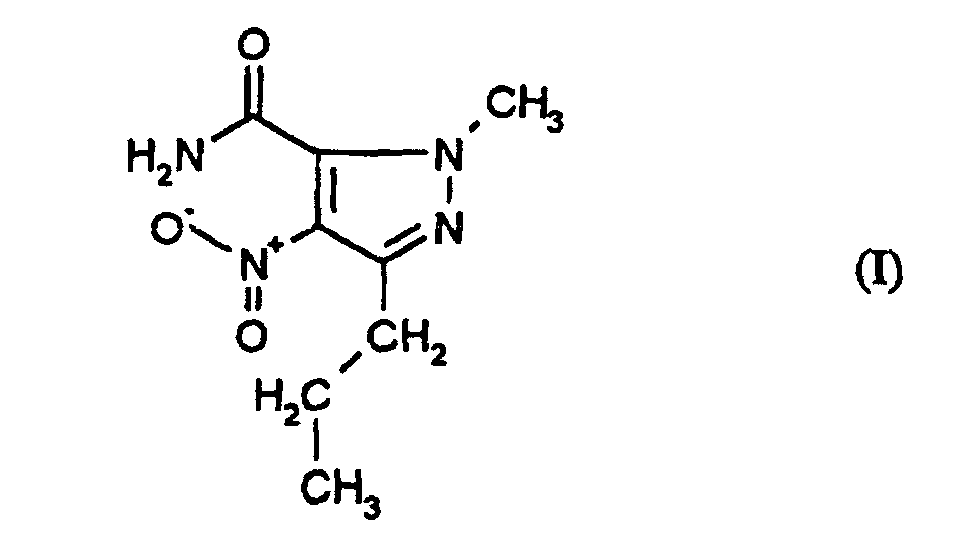
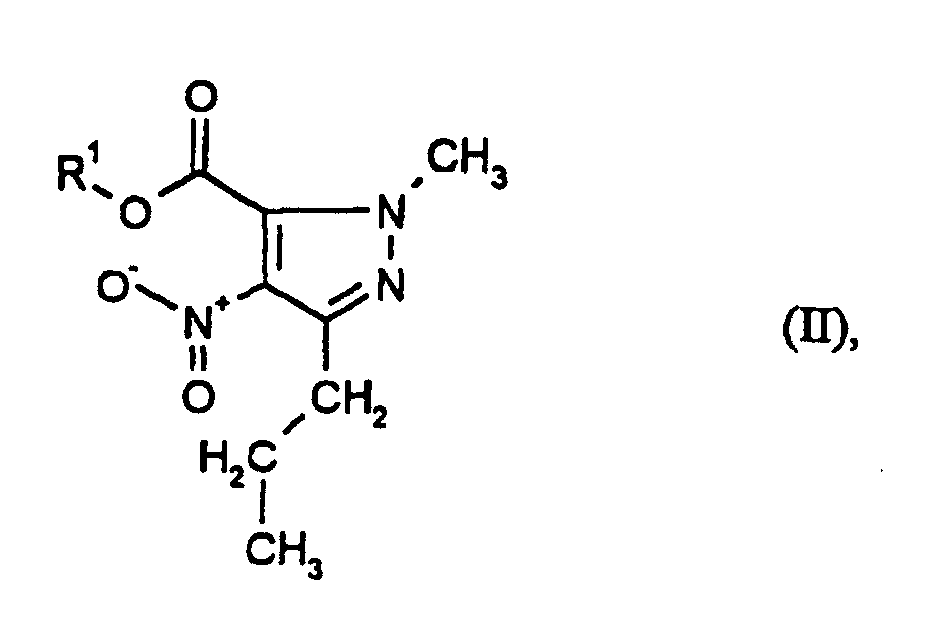
- the present invention relates to new nitropyrazolesters, a process for their use Production by nitration of corresponding pyrazole esters and their Use as intermediates for the production of a known nitropyrazolamide, which in turn is an intermediate for the production of Active pharmaceutical ingredients.
- alkyl-substituted nitropyrazole esters which differ from the nitropyrazole esters according to the invention can be prepared by esterification of the corresponding acids or by alkylation of non-alkylated nitropyrazole esters (see DE-A 30 29 281, Gazz. Chim. Ital. 75 , 121 to 130 (1945 ), J. Med. Chem. 37 , 4329 to 4337 (1994) and Acta Biochem. Pol. 27 , 35 to 56 (1980)).
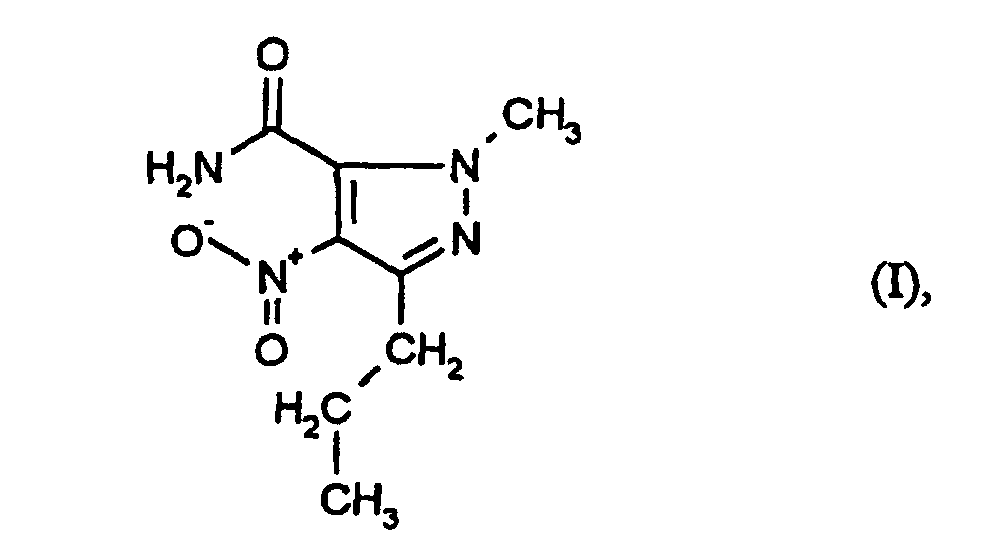
- nitropyrazolamide of the formula (I) can produce from the corresponding pyrazole carboxylic acid by nitration, formation of the acid chloride and reaction with ammonia (see EP-A 0 463 756).
- the pyrazole carboxylic acid in turn is obtained by saponification of an intermediate ester which occurs.
- R 1 is preferably methyl, ethyl, n-propyl, i-propyl, n-butyl, i-butyl or sec-butyl.
- the present invention also relates to mixtures of two or more Nitropyrazole esters of formula (II), in which the individual components in any relationships to one another can exist.
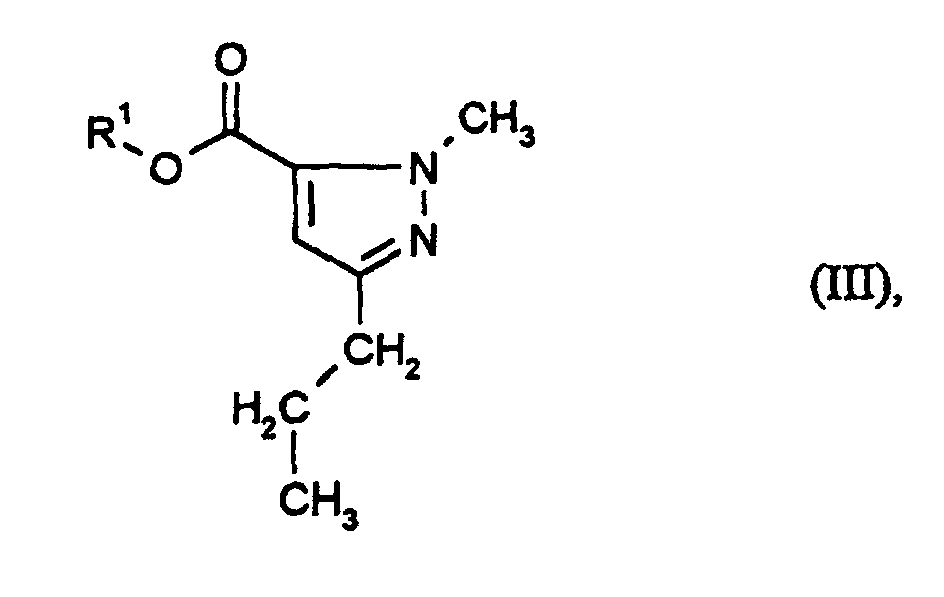
- Pyrazolesters of the formula (III) are known and can be obtained in a known manner or analogously thereto (see, for example, EP-A 463 756, CA 123 , 198 791 (1995), CA 114 , 185 497 (1991), EP-A 526 004 and CAS No. 133 261-07-1).
- the nitriding can be carried out, for example, with a mixture having a nitriding action Nitric acid and sulfuric acid, only with nitric acid or by introduction of an inorganic nitrate in sulfuric acid.
- mixtures of nitric and sulfuric acid can e.g. in weight ratio from nitric acid to sulfuric acid from 99.9: 0.1 to 1:99, preferably 90:10 to 10:90 are available.
- the nitriding agent can e.g. B. in the stoichiometrically required amount or use in excess, for example up to 50 times excess.
- P refer 1.1 to 10 times the stoichiometrically required amount is used.
- the water content is z. B. below 10 wt .-%, preferably between 0 and 5% by weight.
- the nitriding can take place, for example, at temperatures in the range -30 to + 100 ° C be performed. It is preferred to work at -10 to + 70 ° C, especially preferably at 0 to + 60 ° C.
- reaction time depends on the temperature in such a way that at higher Temperatures shorter reaction times can be selected. she can for example between 20 minutes and 24 hours. Are preferred Response times between 1 and 10 hours.
- nitriding can be carried out with or without the addition of a solvent become.
- Addition of a solvent is preferred.
- Suitable solvents are those that cannot be nitrided under the conditions used. examples are Sulfuric acid, oleum, o-dichlorobenzene, dinitrobenzenes, dichloromethane and Dichloroethane.
- the present invention also relates to the use of nitropyrazole esters of formula (II) for the preparation of the nitropyrazolamide of formula (I) by Reacts nitropyrazole esters of formula (II) with ammonia. You can do this Use also as a process for the preparation of the nitropyrazole amide Designate formula (I), which is characterized in that nitropyrazole esters of the formula (II) is reacted with ammonia.
- the reaction with ammonia can, for example, with aqueous or gaseous ammonia, for example at 0 to 250 ° C and for example in in an open reactor or in a closed autoclave under pressure up to for example, 50 bar.
- Preferred reaction conditions are temperatures in the range 20 to 120 ° C, in particular 30 to 100 ° C and pressures of Normal pressure up to that of itself at the respective reaction temperature adjusting pressure of the reaction system in an autoclave.
- ammonia may be required in amounts between the stoichiometric Amount and a 50-fold excess of it can be used.
- Prefers is 1.2 to 20 times the amount stoichiometrically required.
- the reaction with ammonia can be carried out with or without the addition of a solvent be performed.
- a solvent be performed.
- an inert organic solvent examples include: alcohols such as methanol, Ethanol, propanol and butanols, aromatics such as benzene, toluene, chlorobenzene and Dichlorobenzenes, and sulfoxides such as dimethyl sulfoxide. Solvent mixtures can also be used be used.
- Bases can optionally be used as catalysts for the reaction with ammonia e.g. be used in amounts of 0.05 to 5 mol%. Suitable are e.g. Alcoholates such as potassium tert-butoxide, sodium ethylate, sodium methylate, sodium isopentanoate and sodium isopropylate and other bases such as DABCO, sodium hydroxide, Potassium hydroxide, sodium carbonate, potassium carbonate, DBU, DBM and Triethylamine.
- Alcoholates such as potassium tert-butoxide, sodium ethylate, sodium methylate, sodium isopentanoate and sodium isopropylate
- other bases such as DABCO, sodium hydroxide, Potassium hydroxide, sodium carbonate, potassium carbonate, DBU, DBM and Triethylamine.
- nitropyrazolamide of formula (I) prepared can e.g. isolate by the volatile components of the reaction mixture are removed in vacuo.
- pyrazole esters of the formula (III) are used just a sufficient amount or a small excess Nitrating agent and then carries out the reaction without intermediate insulation with ammonia.
- Nitropyrazolamide of formula (I) prepared as in other ways obtained nitropyrazolamide of the formula (I) can be used, for example for Manufacture of active substances (see e.g. EP-A 463 756).
- the new nitropyrazole esters of the formula (II) can be prepared in one step from the corresponding Pyrazole esters of formula (III) are obtained and make the nitropyrazolamide of formula (I) also accessible in one step.
- the synthetic route to nitropyrazolamide the formula (I) is shortened compared to the prior art, the achievable space-time yields are improved and there are smaller amounts in reagents and energy than previously required. It is surprising that this advantageous effects with the less complex method according to the invention are feasible, because experts have so far only had more complicated procedures for Preparation of the nitropyrazolamide of formula (I) is considered.
Landscapes
- Chemical & Material Sciences (AREA)
- Organic Chemistry (AREA)
- Plural Heterocyclic Compounds (AREA)
- Nitrogen Condensed Heterocyclic Rings (AREA)
- Pharmaceuticals Containing Other Organic And Inorganic Compounds (AREA)
- Agricultural Chemicals And Associated Chemicals (AREA)
Description

- R1
- für C1-C6-Alkyl steht.
- R1
- die bei Formel (II) angegebene Bedeutung hat, nitriert.
Claims (10)
- Nitropyrazolester der Formelin der
- R1
- für C1-C6-Alkyl steht.
- Nitropyrazolester nach Anspruch 1, dadurch gekennzeichnet, daß es sich um Mischungen von zwei oder mehr Nitropyrazolestern der Formel (II) handelt.
- Verfahren zur Herstellung von Nitropyrazolestern des Anspruchs 1, dadurch gekennzeichnet, daß man Pyrazolester der Formelin der

- R1
- die im Anspruch 1 bei Formel (II) angegebene Bedeutung hat, nitriert.
- Verfahren nach Anspruch 3, dadurch gekennzeichnet, daß man die Nitrierung mit einer nitrierend wirkenden Mischung aus Salpetersäure und Schwefelsäure, nur mit Salpetersäure oder durch Einbringen eines anorganischen Nitrats in Schwefelsäure durchführt.
- Verfahren nach Ansprüchen 3 und 4, dadurch gekennzeichnet, daß man das Nitrieragens in einer Menge zwischen der stöchiometrisch erforderlichen Menge und einem 50-fachen Überschuß davon einsetzt.
- Verfahren nach Ansprüchen 3 bis 5, dadurch gekennzeichnet, daß man die Nitrierung bei Temperaturen im Bereich -30 bis +100°C und unter Zusatz eines Lösungsmittels durchführt.
- Verwendung von Nitropyrazolestern des Anspruchs 1 zur Herstellung des Nitropyrazolamids der Formelindem man Nitropyrazolester der Formel (II) mit Ammoniak umsetzt.
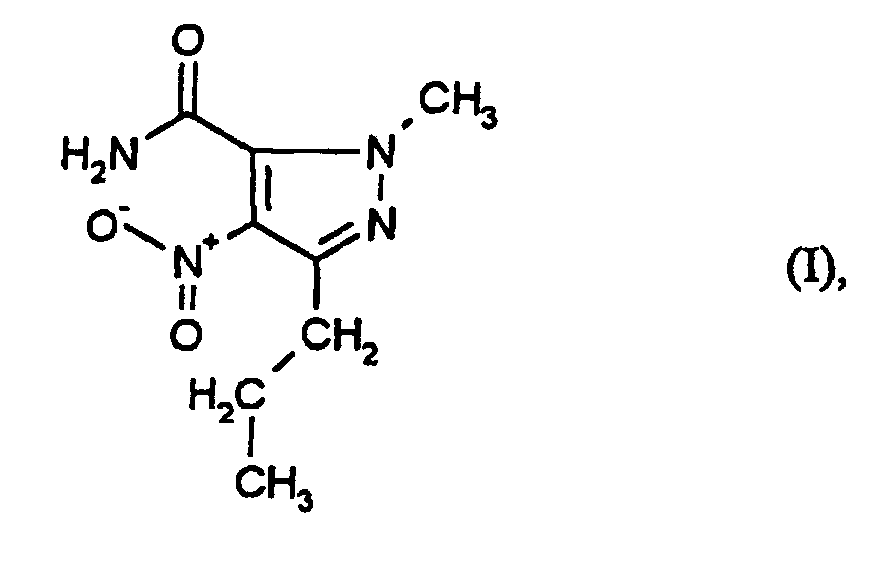
- Verfahren zur Herstellung des Nitropyrazolamids der Formeldas dadurch gekennzeichnet ist, daß man Nitropyrazolester des Anspruchs 1 mit Ammoniak umsetzt.
- Verfahren nach Anspruch 8, dadurch gekennzeichnet, daß man die Umsetzung mit Ammoniak mit wäßrigem oder gasförmigem Ammoniak bei 0 bis 250°C und Drucken bis 50 bar durchführt.
- Verfahren nach Ansprüchen 8 und 9, dadurch gekennzeichnet, daß man Ammoniak in Mengen von der stöchiometrisch erforderlichen Menge bis zu dem 50-fachen Überschuß davon einsetzt und ein Lösungsmittel zusetzt.
Applications Claiming Priority (4)
| Application Number | Priority Date | Filing Date | Title |
|---|---|---|---|
| DE19628778 | 1996-07-17 | ||
| DE19628778 | 1996-07-17 | ||
| DE19632920 | 1996-08-16 | ||
| DE19632920A DE19632920A1 (de) | 1996-07-17 | 1996-08-16 | Neue Nitropyrazolester, ein Verfahren zu ihrer Herstellung und ihre Verwendung zur Herstellung eines Nitropyrazolamids |
Publications (2)
| Publication Number | Publication Date |
|---|---|
| EP0819678A1 EP0819678A1 (de) | 1998-01-21 |
| EP0819678B1 true EP0819678B1 (de) | 2004-02-18 |
Family
ID=26027596
Family Applications (1)
| Application Number | Title | Priority Date | Filing Date |
|---|---|---|---|
| EP97111255A Expired - Lifetime EP0819678B1 (de) | 1996-07-17 | 1997-07-04 | Neue Nitropyrazolester, ein Verfahren zu ihrer Herstellung und ihre Verwendung zur Herstellung eines Nitropyrazolamids |
Country Status (11)
| Country | Link |
|---|---|
| US (2) | US5969152A (de) |
| EP (1) | EP0819678B1 (de) |
| JP (1) | JP4049415B2 (de) |
| CA (1) | CA2210443A1 (de) |
| CZ (1) | CZ225497A3 (de) |
| ES (1) | ES2213189T3 (de) |
| HR (1) | HRP970348A2 (de) |
| HU (1) | HUP9701216A3 (de) |
| IL (1) | IL121300A (de) |
| PL (1) | PL321130A1 (de) |
| PT (1) | PT819678E (de) |
Family Cites Families (7)
| Publication number | Priority date | Publication date | Assignee | Title |
|---|---|---|---|---|
| DE2212080A1 (de) * | 1971-03-15 | 1972-10-12 | Eli Lilly and Co., Indianapolis, Ind. (V.StA.) | 3-Nitropyrazolderivate |
| US4172136A (en) * | 1975-12-23 | 1979-10-23 | Boehringer Mannheim Gmbh | 3-Nitropyrazole compounds and anti-microbial compositions |
| US4282361A (en) * | 1978-03-16 | 1981-08-04 | Massachusetts Institute Of Technology | Synthesis for 7-alkylamino-3-methylpyrazolo [4,3-d]pyrimidines |
| CA1154762A (en) * | 1979-08-03 | 1983-10-04 | Georg Rainer | Substituted tetraazatricyclic compounds, a process for their preparation, their use and medicaments containing them |
| DE3538731A1 (de) * | 1985-10-31 | 1987-05-07 | Bayer Ag | 1-aryl-4-nitro-pyrazole |
| GB9013750D0 (en) * | 1990-06-20 | 1990-08-08 | Pfizer Ltd | Therapeutic agents |
| GB9114760D0 (en) * | 1991-07-09 | 1991-08-28 | Pfizer Ltd | Therapeutic agents |
-
1997
- 1997-06-26 HR HR19632920.5A patent/HRP970348A2/xx not_active Application Discontinuation
- 1997-07-04 EP EP97111255A patent/EP0819678B1/de not_active Expired - Lifetime
- 1997-07-04 PT PT97111255T patent/PT819678E/pt unknown
- 1997-07-04 ES ES97111255T patent/ES2213189T3/es not_active Expired - Lifetime
- 1997-07-07 US US08/888,889 patent/US5969152A/en not_active Expired - Lifetime
- 1997-07-14 IL IL12130097A patent/IL121300A/xx not_active IP Right Cessation
- 1997-07-14 CA CA002210443A patent/CA2210443A1/en not_active Abandoned
- 1997-07-14 JP JP20259097A patent/JP4049415B2/ja not_active Expired - Fee Related
- 1997-07-15 PL PL97321130A patent/PL321130A1/xx unknown
- 1997-07-16 CZ CZ972254A patent/CZ225497A3/cs unknown
- 1997-07-16 HU HU9701216A patent/HUP9701216A3/hu unknown
-
1999
- 1999-03-25 US US09/276,577 patent/US6025499A/en not_active Expired - Lifetime
Also Published As
| Publication number | Publication date |
|---|---|
| CA2210443A1 (en) | 1998-01-17 |
| JPH1067752A (ja) | 1998-03-10 |
| US5969152A (en) | 1999-10-19 |
| CZ225497A3 (cs) | 1998-02-18 |
| EP0819678A1 (de) | 1998-01-21 |
| HUP9701216A2 (hu) | 1998-06-29 |
| ES2213189T3 (es) | 2004-08-16 |
| PT819678E (pt) | 2004-06-30 |
| IL121300A (en) | 2000-08-31 |
| HRP970348A2 (en) | 1998-04-30 |
| IL121300A0 (en) | 1998-01-04 |
| HUP9701216A3 (en) | 1999-03-01 |
| HU9701216D0 (en) | 1997-08-28 |
| US6025499A (en) | 2000-02-15 |
| PL321130A1 (en) | 1998-01-19 |
| JP4049415B2 (ja) | 2008-02-20 |
Similar Documents
| Publication | Publication Date | Title |
|---|---|---|
| DE69731835T3 (de) | Verfahren zur herstellung von zwischenprodukten des florfenicols | |
| DE1795808C2 (de) | Verfahren zur Herstellung von 2,2,6,6-Tetramethyl-4-oxopiperidin | |
| DE3928182A1 (de) | Verfahren zur herstellung von gabapentin | |
| EP0132733A2 (de) | Neue Fluorpivalsäurefluoride und Verfahren zu ihrer Herstellung | |
| EP0048373A2 (de) | Verfahren zur Herstellung von Pyrazol | |
| EP0206147B1 (de) | Verfahren zur Herstellung von 4,4'-Dinitrodibenzylen | |
| DD150741A5 (de) | Verfahren zur herstellung von 2',6'-dialkyl-n-(alkoxymethyl)-2-chloracetaniliden | |
| EP0819678A1 (de) | Neue Nitropyrazolester, ein Verfahren zu ihrer Herstellung und ihre Verwendung zur Herstellung eines Nitropyrazolamids | |
| EP0216324A2 (de) | 4-Alkoxy-3-pyrrolin-2-on-1-yl-essigsäurealkyl- bzw. -benzylester sowie deren Herstellung | |
| EP0653423B1 (de) | Verfahren zur Herstellung von substituierten Chinazolin-2,4-dionen | |
| EP0347676B1 (de) | Verfahren zur Herstellung von N-Hydroxypyrazolen | |
| DE19632920A1 (de) | Neue Nitropyrazolester, ein Verfahren zu ihrer Herstellung und ihre Verwendung zur Herstellung eines Nitropyrazolamids | |
| DD206556A5 (de) | Verfahren zur herstellung von tetrahydro-5,6,7,7a-thieno(3,2-c)pyridinon-2-derivaten | |
| DE2345788A1 (de) | Verfahren zur herstellung eines alkylhalogennitrobenzoats in verbesserter ausbeute | |
| DE3122261C2 (de) | ||
| DE2059296C3 (de) | Verfahren zur Herstellung von Estern der 3-Methylflavon-8-carbonsäure mit N-tert-Aminoalkoholen | |
| DD233373A5 (de) | Verfahren zur herstellung von imidazolidinderivaten | |
| EP0230224B1 (de) | Verfahren zur Herstellung von Alkoxycarbonylisocyanaten | |
| EP0342532B1 (de) | Verfahren zur Herstellung von 4-Chlor-2-methyl-5-nitro-phenol | |
| EP0642511B1 (de) | Verfahren zur herstellung von 5-dichloracetyl-3,3,6-trimethyl-9-oxo-1,5-diazabycyclo 4,3,0]nonan | |
| DE2145660A1 (de) | Verfahren zur herstellung von acetondicarbonsaeureestern | |
| EP0148408A1 (de) | Verfahren zur Herstellung von 2-Isopropyl-4-methyl-6-hydroxy-pyrimidin | |
| DE2517918B2 (de) | Verfahren zur Herstellung von 1,4-Diaminoanthrachinon-2-carbonsäureestern | |
| DE1543869B1 (de) | Verfahren zur Herstellung von Hydroxybenzonitrilen | |
| EP0002477A1 (de) | Verfahren zur Herstellung von 1,1-Dihalogen-4-methyl-1,3-pentadienen |
Legal Events
| Date | Code | Title | Description |
|---|---|---|---|
| PUAI | Public reference made under article 153(3) epc to a published international application that has entered the european phase |
Free format text: ORIGINAL CODE: 0009012 |
|
| AK | Designated contracting states |
Kind code of ref document: A1 Designated state(s): BE CH DE ES FR GB IE IT LI NL PT |
|
| 17P | Request for examination filed |
Effective date: 19980721 |
|
| AKX | Designation fees paid |
Free format text: BE CH DE ES FR GB IE IT LI NL PT |
|
| RBV | Designated contracting states (corrected) |
Designated state(s): BE CH DE ES FR GB IE IT LI NL PT |
|
| GRAP | Despatch of communication of intention to grant a patent |
Free format text: ORIGINAL CODE: EPIDOSNIGR1 |
|
| GRAS | Grant fee paid |
Free format text: ORIGINAL CODE: EPIDOSNIGR3 |
|
| GRAA | (expected) grant |
Free format text: ORIGINAL CODE: 0009210 |
|
| RAP1 | Party data changed (applicant data changed or rights of an application transferred) |
Owner name: BAYER CHEMICALS AG |
|
| AK | Designated contracting states |
Kind code of ref document: B1 Designated state(s): BE CH DE ES FR GB IE IT LI NL PT |
|
| REG | Reference to a national code |
Ref country code: GB Ref legal event code: FG4D Free format text: NOT ENGLISH |
|
| REG | Reference to a national code |
Ref country code: CH Ref legal event code: EP |
|
| REG | Reference to a national code |
Ref country code: CH Ref legal event code: NV Representative=s name: E. BLUM & CO. PATENTANWAELTE |
|
| REG | Reference to a national code |
Ref country code: IE Ref legal event code: FG4D Free format text: GERMAN |
|
| REF | Corresponds to: |
Ref document number: 59711311 Country of ref document: DE Date of ref document: 20040325 Kind code of ref document: P |
|
| GBT | Gb: translation of ep patent filed (gb section 77(6)(a)/1977) |
Effective date: 20040319 |
|
| REG | Reference to a national code |
Ref country code: PT Ref legal event code: SC4A Free format text: AVAILABILITY OF NATIONAL TRANSLATION Effective date: 20040507 |
|
| REG | Reference to a national code |
Ref country code: ES Ref legal event code: FG2A Ref document number: 2213189 Country of ref document: ES Kind code of ref document: T3 |
|
| ET | Fr: translation filed | ||
| PLBE | No opposition filed within time limit |
Free format text: ORIGINAL CODE: 0009261 |
|
| STAA | Information on the status of an ep patent application or granted ep patent |
Free format text: STATUS: NO OPPOSITION FILED WITHIN TIME LIMIT |
|
| 26N | No opposition filed |
Effective date: 20041119 |
|
| REG | Reference to a national code |
Ref country code: GB Ref legal event code: 732E |
|
| REG | Reference to a national code |
Ref country code: PT Ref legal event code: PC4A Owner name: LANXESS DEUTSCHLAND GMBH, DE Effective date: 20061109 |
|
| NLS | Nl: assignments of ep-patents |
Owner name: LANXESS DEUTSCHLAND GMBH Effective date: 20070305 |
|
| REG | Reference to a national code |
Ref country code: CH Ref legal event code: PFA Owner name: BAYER CHEMICALS AG Free format text: BAYER CHEMICALS AG# #51368 LEVERKUSEN (DE) -TRANSFER TO- BAYER CHEMICALS AG# #51368 LEVERKUSEN (DE) |
|
| REG | Reference to a national code |
Ref country code: CH Ref legal event code: PUE Owner name: LANXESS DEUTSCHLAND GMBH Free format text: BAYER CHEMICALS AG# #51368 LEVERKUSEN (DE) -TRANSFER TO- LANXESS DEUTSCHLAND GMBH# #51369 LEVERKUSEN (DE) |
|
| REG | Reference to a national code |
Ref country code: FR Ref legal event code: TP |
|
| PGFP | Annual fee paid to national office [announced via postgrant information from national office to epo] |
Ref country code: PT Payment date: 20100622 Year of fee payment: 14 |
|
| PGFP | Annual fee paid to national office [announced via postgrant information from national office to epo] |
Ref country code: NL Payment date: 20100707 Year of fee payment: 14 Ref country code: ES Payment date: 20100813 Year of fee payment: 14 Ref country code: CH Payment date: 20100714 Year of fee payment: 14 |
|
| PGFP | Annual fee paid to national office [announced via postgrant information from national office to epo] |
Ref country code: GB Payment date: 20100630 Year of fee payment: 14 Ref country code: FR Payment date: 20100805 Year of fee payment: 14 |
|
| PGFP | Annual fee paid to national office [announced via postgrant information from national office to epo] |
Ref country code: BE Payment date: 20100714 Year of fee payment: 14 |
|
| REG | Reference to a national code |
Ref country code: PT Ref legal event code: MM4A Free format text: LAPSE DUE TO NON-PAYMENT OF FEES Effective date: 20120104 |
|
| BERE | Be: lapsed |
Owner name: *LANXESS DEUTSCHLAND G.M.B.H. Effective date: 20110731 |
|
| REG | Reference to a national code |
Ref country code: NL Ref legal event code: V1 Effective date: 20120201 |
|
| REG | Reference to a national code |
Ref country code: CH Ref legal event code: PL |
|
| GBPC | Gb: european patent ceased through non-payment of renewal fee |
Effective date: 20110704 |
|
| REG | Reference to a national code |
Ref country code: FR Ref legal event code: ST Effective date: 20120330 |
|
| PG25 | Lapsed in a contracting state [announced via postgrant information from national office to epo] |
Ref country code: BE Free format text: LAPSE BECAUSE OF NON-PAYMENT OF DUE FEES Effective date: 20110731 Ref country code: CH Free format text: LAPSE BECAUSE OF NON-PAYMENT OF DUE FEES Effective date: 20110731 Ref country code: LI Free format text: LAPSE BECAUSE OF NON-PAYMENT OF DUE FEES Effective date: 20110731 Ref country code: FR Free format text: LAPSE BECAUSE OF NON-PAYMENT OF DUE FEES Effective date: 20110801 |
|
| PG25 | Lapsed in a contracting state [announced via postgrant information from national office to epo] |
Ref country code: NL Free format text: LAPSE BECAUSE OF NON-PAYMENT OF DUE FEES Effective date: 20120201 Ref country code: PT Free format text: LAPSE BECAUSE OF NON-PAYMENT OF DUE FEES Effective date: 20120104 |
|
| PG25 | Lapsed in a contracting state [announced via postgrant information from national office to epo] |
Ref country code: GB Free format text: LAPSE BECAUSE OF NON-PAYMENT OF DUE FEES Effective date: 20110704 |
|
| REG | Reference to a national code |
Ref country code: ES Ref legal event code: FD2A Effective date: 20121122 |
|
| PG25 | Lapsed in a contracting state [announced via postgrant information from national office to epo] |
Ref country code: ES Free format text: LAPSE BECAUSE OF NON-PAYMENT OF DUE FEES Effective date: 20110705 |
|
| REG | Reference to a national code |
Ref country code: DE Ref legal event code: R082 Ref document number: 59711311 Country of ref document: DE Representative=s name: WICHMANN, BIRGID, DIPL.-CHEM. DR.RER.NAT., DE |
|
| REG | Reference to a national code |
Ref country code: DE Ref legal event code: R082 Ref document number: 59711311 Country of ref document: DE Representative=s name: WICHMANN, BIRGID, DIPL.-CHEM. DR.RER.NAT., DE Effective date: 20131213 Ref country code: DE Ref legal event code: R081 Ref document number: 59711311 Country of ref document: DE Owner name: SALTIGO GMBH, DE Free format text: FORMER OWNER: SALTIGO GMBH, 51371 LEVERKUSEN, DE Effective date: 20131213 |
|
| PGFP | Annual fee paid to national office [announced via postgrant information from national office to epo] |
Ref country code: DE Payment date: 20140702 Year of fee payment: 18 Ref country code: IE Payment date: 20140710 Year of fee payment: 18 |
|
| PGFP | Annual fee paid to national office [announced via postgrant information from national office to epo] |
Ref country code: IT Payment date: 20140718 Year of fee payment: 18 |
|
| REG | Reference to a national code |
Ref country code: DE Ref legal event code: R119 Ref document number: 59711311 Country of ref document: DE |
|
| REG | Reference to a national code |
Ref country code: IE Ref legal event code: MM4A |
|
| PG25 | Lapsed in a contracting state [announced via postgrant information from national office to epo] |
Ref country code: IT Free format text: LAPSE BECAUSE OF NON-PAYMENT OF DUE FEES Effective date: 20150704 Ref country code: DE Free format text: LAPSE BECAUSE OF NON-PAYMENT OF DUE FEES Effective date: 20160202 |
|
| PG25 | Lapsed in a contracting state [announced via postgrant information from national office to epo] |
Ref country code: IE Free format text: LAPSE BECAUSE OF NON-PAYMENT OF DUE FEES Effective date: 20150704 |