EP0817296A1 - Electrode de générateur électrochimique rechargeable à électrolyte liquide organique et son procédé de fabrication - Google Patents
Electrode de générateur électrochimique rechargeable à électrolyte liquide organique et son procédé de fabrication Download PDFInfo
- Publication number
- EP0817296A1 EP0817296A1 EP97401584A EP97401584A EP0817296A1 EP 0817296 A1 EP0817296 A1 EP 0817296A1 EP 97401584 A EP97401584 A EP 97401584A EP 97401584 A EP97401584 A EP 97401584A EP 0817296 A1 EP0817296 A1 EP 0817296A1
- Authority
- EP
- European Patent Office
- Prior art keywords
- electrode
- lithium
- chosen
- binder
- generator
- Prior art date
- Legal status (The legal status is an assumption and is not a legal conclusion. Google has not performed a legal analysis and makes no representation as to the accuracy of the status listed.)
- Withdrawn
Links
- 238000000034 method Methods 0.000 title claims description 5
- 239000007788 liquid Substances 0.000 title claims 2
- 239000005486 organic electrolyte Substances 0.000 title description 2
- 230000008569 process Effects 0.000 title description 2
- 239000011230 binding agent Substances 0.000 claims abstract description 34
- 239000000203 mixture Substances 0.000 claims abstract description 34
- 229920000642 polymer Polymers 0.000 claims abstract description 29
- NIXOWILDQLNWCW-UHFFFAOYSA-N 2-Propenoic acid Natural products OC(=O)C=C NIXOWILDQLNWCW-UHFFFAOYSA-N 0.000 claims abstract description 18
- SMZOUWXMTYCWNB-UHFFFAOYSA-N 2-(2-methoxy-5-methylphenyl)ethanamine Chemical compound COC1=CC=C(C)C=C1CCN SMZOUWXMTYCWNB-UHFFFAOYSA-N 0.000 claims abstract description 13
- PXHVJJICTQNCMI-UHFFFAOYSA-N Nickel Chemical compound [Ni] PXHVJJICTQNCMI-UHFFFAOYSA-N 0.000 claims abstract description 13
- HZAXFHJVJLSVMW-UHFFFAOYSA-N 2-Aminoethan-1-ol Chemical compound NCCO HZAXFHJVJLSVMW-UHFFFAOYSA-N 0.000 claims abstract description 10
- 229920001577 copolymer Polymers 0.000 claims abstract description 10
- 229910052759 nickel Inorganic materials 0.000 claims abstract description 6
- 239000011149 active material Substances 0.000 claims abstract description 5
- 230000007480 spreading Effects 0.000 claims abstract description 5
- 238000003892 spreading Methods 0.000 claims abstract description 5
- HRPVXLWXLXDGHG-UHFFFAOYSA-N Acrylamide Chemical compound NC(=O)C=C HRPVXLWXLXDGHG-UHFFFAOYSA-N 0.000 claims abstract description 4
- 229910052782 aluminium Inorganic materials 0.000 claims abstract description 4
- XAGFODPZIPBFFR-UHFFFAOYSA-N aluminium Chemical compound [Al] XAGFODPZIPBFFR-UHFFFAOYSA-N 0.000 claims abstract description 4
- 150000007514 bases Chemical class 0.000 claims abstract description 4
- 239000000843 powder Substances 0.000 claims abstract description 4
- 239000000654 additive Substances 0.000 claims abstract description 3
- 239000000908 ammonium hydroxide Substances 0.000 claims abstract description 3
- 229910052751 metal Inorganic materials 0.000 claims abstract description 3
- 239000002184 metal Substances 0.000 claims abstract description 3
- 125000001453 quaternary ammonium group Chemical group 0.000 claims abstract description 3
- OKTJSMMVPCPJKN-UHFFFAOYSA-N Carbon Chemical compound [C] OKTJSMMVPCPJKN-UHFFFAOYSA-N 0.000 claims description 21
- 239000002904 solvent Substances 0.000 claims description 13
- WHXSMMKQMYFTQS-UHFFFAOYSA-N Lithium Chemical compound [Li] WHXSMMKQMYFTQS-UHFFFAOYSA-N 0.000 claims description 12
- -1 hexafluoroarsenate lithium Chemical compound 0.000 claims description 12
- 229910052744 lithium Inorganic materials 0.000 claims description 12
- 229910002804 graphite Inorganic materials 0.000 claims description 10
- 239000010439 graphite Substances 0.000 claims description 10
- 229910052799 carbon Inorganic materials 0.000 claims description 8
- 239000003792 electrolyte Substances 0.000 claims description 7
- RYGMFSIKBFXOCR-UHFFFAOYSA-N Copper Chemical compound [Cu] RYGMFSIKBFXOCR-UHFFFAOYSA-N 0.000 claims description 5
- 239000000463 material Substances 0.000 claims description 5
- LSNNMFCWUKXFEE-UHFFFAOYSA-M Bisulfite Chemical compound OS([O-])=O LSNNMFCWUKXFEE-UHFFFAOYSA-M 0.000 claims description 4
- RTZKZFJDLAIYFH-UHFFFAOYSA-N Diethyl ether Chemical compound CCOCC RTZKZFJDLAIYFH-UHFFFAOYSA-N 0.000 claims description 4
- 229910052802 copper Inorganic materials 0.000 claims description 4
- 239000010949 copper Substances 0.000 claims description 4
- DDRJAANPRJIHGJ-UHFFFAOYSA-N creatinine Chemical compound CN1CC(=O)NC1=N DDRJAANPRJIHGJ-UHFFFAOYSA-N 0.000 claims description 4
- 150000002148 esters Chemical class 0.000 claims description 4
- 239000003960 organic solvent Substances 0.000 claims description 4
- JAHNSTQSQJOJLO-UHFFFAOYSA-N 2-(3-fluorophenyl)-1h-imidazole Chemical compound FC1=CC=CC(C=2NC=CN=2)=C1 JAHNSTQSQJOJLO-UHFFFAOYSA-N 0.000 claims description 3
- GSEJCLTVZPLZKY-UHFFFAOYSA-N Triethanolamine Chemical compound OCCN(CCO)CCO GSEJCLTVZPLZKY-UHFFFAOYSA-N 0.000 claims description 3
- QSZMZKBZAYQGRS-UHFFFAOYSA-N lithium;bis(trifluoromethylsulfonyl)azanide Chemical compound [Li+].FC(F)(F)S(=O)(=O)[N-]S(=O)(=O)C(F)(F)F QSZMZKBZAYQGRS-UHFFFAOYSA-N 0.000 claims description 3
- 150000002735 metacrylic acids Chemical class 0.000 claims description 3
- LVHBHZANLOWSRM-UHFFFAOYSA-N methylenebutanedioic acid Natural products OC(=O)CC(=C)C(O)=O LVHBHZANLOWSRM-UHFFFAOYSA-N 0.000 claims description 3
- 229910052723 transition metal Inorganic materials 0.000 claims description 3
- 229910000314 transition metal oxide Inorganic materials 0.000 claims description 3
- 150000003624 transition metals Chemical class 0.000 claims description 3
- QAOWNCQODCNURD-UHFFFAOYSA-L Sulfate Chemical compound [O-]S([O-])(=O)=O QAOWNCQODCNURD-UHFFFAOYSA-L 0.000 claims description 2
- UCKMPCXJQFINFW-UHFFFAOYSA-N Sulphide Chemical compound [S-2] UCKMPCXJQFINFW-UHFFFAOYSA-N 0.000 claims description 2
- 238000003490 calendering Methods 0.000 claims description 2
- 239000006229 carbon black Substances 0.000 claims description 2
- 239000003575 carbonaceous material Substances 0.000 claims description 2
- 239000010941 cobalt Substances 0.000 claims description 2
- 229910017052 cobalt Inorganic materials 0.000 claims description 2
- GUTLYIVDDKVIGB-UHFFFAOYSA-N cobalt atom Chemical compound [Co] GUTLYIVDDKVIGB-UHFFFAOYSA-N 0.000 claims description 2
- 239000000571 coke Substances 0.000 claims description 2
- 229940109239 creatinine Drugs 0.000 claims description 2
- 125000000118 dimethyl group Chemical group [H]C([H])([H])* 0.000 claims description 2
- MHCFAGZWMAWTNR-UHFFFAOYSA-M lithium perchlorate Chemical compound [Li+].[O-]Cl(=O)(=O)=O MHCFAGZWMAWTNR-UHFFFAOYSA-M 0.000 claims description 2
- 229910001486 lithium perchlorate Inorganic materials 0.000 claims description 2
- 229910003002 lithium salt Inorganic materials 0.000 claims description 2
- 159000000002 lithium salts Chemical class 0.000 claims description 2
- 229910001496 lithium tetrafluoroborate Inorganic materials 0.000 claims description 2
- MCVFFRWZNYZUIJ-UHFFFAOYSA-M lithium;trifluoromethanesulfonate Chemical compound [Li+].[O-]S(=O)(=O)C(F)(F)F MCVFFRWZNYZUIJ-UHFFFAOYSA-M 0.000 claims description 2
- 238000004519 manufacturing process Methods 0.000 claims description 2
- RUOJZAUFBMNUDX-UHFFFAOYSA-N propylene carbonate Chemical class CC1COC(=O)O1 RUOJZAUFBMNUDX-UHFFFAOYSA-N 0.000 claims description 2
- 229910001220 stainless steel Inorganic materials 0.000 claims description 2
- 239000010935 stainless steel Substances 0.000 claims description 2
- 239000011203 carbon fibre reinforced carbon Substances 0.000 claims 1
- 125000004177 diethyl group Chemical group [H]C([H])([H])C([H])([H])* 0.000 claims 1
- 239000011262 electrochemically active material Substances 0.000 claims 1
- WPBNNNQJVZRUHP-UHFFFAOYSA-L manganese(2+);methyl n-[[2-(methoxycarbonylcarbamothioylamino)phenyl]carbamothioyl]carbamate;n-[2-(sulfidocarbothioylamino)ethyl]carbamodithioate Chemical compound [Mn+2].[S-]C(=S)NCCNC([S-])=S.COC(=O)NC(=S)NC1=CC=CC=C1NC(=S)NC(=O)OC WPBNNNQJVZRUHP-UHFFFAOYSA-L 0.000 claims 1
- 229910052720 vanadium Inorganic materials 0.000 claims 1
- LEONUFNNVUYDNQ-UHFFFAOYSA-N vanadium atom Chemical compound [V] LEONUFNNVUYDNQ-UHFFFAOYSA-N 0.000 claims 1
- 238000001035 drying Methods 0.000 abstract description 7
- 239000011244 liquid electrolyte Substances 0.000 abstract description 7
- 239000004411 aluminium Substances 0.000 abstract description 2
- 239000011248 coating agent Substances 0.000 abstract description 2
- 238000000576 coating method Methods 0.000 abstract description 2
- 239000006181 electrochemical material Substances 0.000 abstract 1
- 239000011888 foil Substances 0.000 abstract 1
- XLYOFNOQVPJJNP-UHFFFAOYSA-M hydroxide Chemical compound [OH-] XLYOFNOQVPJJNP-UHFFFAOYSA-M 0.000 abstract 1
- BDHFUVZGWQCTTF-UHFFFAOYSA-N sulfonic acid Chemical compound OS(=O)=O BDHFUVZGWQCTTF-UHFFFAOYSA-N 0.000 abstract 1
- 125000005497 tetraalkylphosphonium group Chemical group 0.000 abstract 1
- 230000001351 cycling effect Effects 0.000 description 14
- 229920001519 homopolymer Polymers 0.000 description 14
- 229920002125 Sokalan® Polymers 0.000 description 10
- 239000004584 polyacrylic acid Substances 0.000 description 10
- 239000004480 active ingredient Substances 0.000 description 6
- 238000006243 chemical reaction Methods 0.000 description 6
- 238000006386 neutralization reaction Methods 0.000 description 6
- WGTYBPLFGIVFAS-UHFFFAOYSA-M tetramethylammonium hydroxide Chemical compound [OH-].C[N+](C)(C)C WGTYBPLFGIVFAS-UHFFFAOYSA-M 0.000 description 6
- 239000002253 acid Substances 0.000 description 5
- 238000001704 evaporation Methods 0.000 description 5
- 230000008020 evaporation Effects 0.000 description 5
- SECXISVLQFMRJM-UHFFFAOYSA-N N-Methylpyrrolidone Chemical compound CN1CCCC1=O SECXISVLQFMRJM-UHFFFAOYSA-N 0.000 description 4
- 239000002033 PVDF binder Substances 0.000 description 4
- 229920002981 polyvinylidene fluoride Polymers 0.000 description 4
- VDZOOKBUILJEDG-UHFFFAOYSA-M tetrabutylammonium hydroxide Chemical compound [OH-].CCCC[N+](CCCC)(CCCC)CCCC VDZOOKBUILJEDG-UHFFFAOYSA-M 0.000 description 4
- LFQSCWFLJHTTHZ-UHFFFAOYSA-N Ethanol Chemical compound CCO LFQSCWFLJHTTHZ-UHFFFAOYSA-N 0.000 description 3
- 238000004299 exfoliation Methods 0.000 description 3
- 230000002427 irreversible effect Effects 0.000 description 3
- 230000000670 limiting effect Effects 0.000 description 3
- 230000036961 partial effect Effects 0.000 description 3
- 238000002161 passivation Methods 0.000 description 3
- XLYOFNOQVPJJNP-UHFFFAOYSA-N water Substances O XLYOFNOQVPJJNP-UHFFFAOYSA-N 0.000 description 3
- FWMUWMCRWVRNRT-UHFFFAOYSA-N (2,3,4,5-tetramethylphenyl)azanium;hydroxide Chemical compound [OH-].CC1=CC([NH3+])=C(C)C(C)=C1C FWMUWMCRWVRNRT-UHFFFAOYSA-N 0.000 description 2
- 229910013870 LiPF 6 Inorganic materials 0.000 description 2
- 230000008901 benefit Effects 0.000 description 2
- 150000001768 cations Chemical class 0.000 description 2
- 238000004132 cross linking Methods 0.000 description 2
- 230000007423 decrease Effects 0.000 description 2
- IEJIGPNLZYLLBP-UHFFFAOYSA-N dimethyl carbonate Chemical compound COC(=O)OC IEJIGPNLZYLLBP-UHFFFAOYSA-N 0.000 description 2
- NUJOXMJBOLGQSY-UHFFFAOYSA-N manganese dioxide Chemical compound O=[Mn]=O NUJOXMJBOLGQSY-UHFFFAOYSA-N 0.000 description 2
- 230000009257 reactivity Effects 0.000 description 2
- 230000002829 reductive effect Effects 0.000 description 2
- 150000003467 sulfuric acid derivatives Chemical class 0.000 description 2
- LRGJRHZIDJQFCL-UHFFFAOYSA-M tetraethylazanium;hydroxide Chemical compound [OH-].CC[N+](CC)(CC)CC LRGJRHZIDJQFCL-UHFFFAOYSA-M 0.000 description 2
- RYHBNJHYFVUHQT-UHFFFAOYSA-N 1,4-Dioxane Chemical compound C1COCCO1 RYHBNJHYFVUHQT-UHFFFAOYSA-N 0.000 description 1
- VGGSQFUCUMXWEO-UHFFFAOYSA-N Ethene Chemical compound C=C VGGSQFUCUMXWEO-UHFFFAOYSA-N 0.000 description 1
- 239000005977 Ethylene Substances 0.000 description 1
- KMTRUDSVKNLOMY-UHFFFAOYSA-N Ethylene carbonate Chemical compound O=C1OCCO1 KMTRUDSVKNLOMY-UHFFFAOYSA-N 0.000 description 1
- 229910015015 LiAsF 6 Inorganic materials 0.000 description 1
- 229910013063 LiBF 4 Inorganic materials 0.000 description 1
- 229910013684 LiClO 4 Inorganic materials 0.000 description 1
- 229910012851 LiCoO 2 Inorganic materials 0.000 description 1
- 229910015643 LiMn 2 O 4 Inorganic materials 0.000 description 1
- 229910013290 LiNiO 2 Inorganic materials 0.000 description 1
- 239000004743 Polypropylene Substances 0.000 description 1
- XHCLAFWTIXFWPH-UHFFFAOYSA-N [O-2].[O-2].[O-2].[O-2].[O-2].[V+5].[V+5] Chemical compound [O-2].[O-2].[O-2].[O-2].[O-2].[V+5].[V+5] XHCLAFWTIXFWPH-UHFFFAOYSA-N 0.000 description 1
- AGCAVYNAKOJCPJ-UHFFFAOYSA-N [OH-].C(C)C=1C(=C(C(=C(C=1)[NH3+])CC)CC)CC Chemical compound [OH-].C(C)C=1C(=C(C(=C(C=1)[NH3+])CC)CC)CC AGCAVYNAKOJCPJ-UHFFFAOYSA-N 0.000 description 1
- 238000010669 acid-base reaction Methods 0.000 description 1
- 150000007513 acids Chemical class 0.000 description 1
- 230000001070 adhesive effect Effects 0.000 description 1
- 150000001408 amides Chemical class 0.000 description 1
- 150000001412 amines Chemical class 0.000 description 1
- 150000004649 carbonic acid derivatives Chemical class 0.000 description 1
- 125000003178 carboxy group Chemical group [H]OC(*)=O 0.000 description 1
- 230000015556 catabolic process Effects 0.000 description 1
- 239000003638 chemical reducing agent Substances 0.000 description 1
- 239000003795 chemical substances by application Substances 0.000 description 1
- 239000004020 conductor Substances 0.000 description 1
- 230000006378 damage Effects 0.000 description 1
- 230000003247 decreasing effect Effects 0.000 description 1
- 238000006731 degradation reaction Methods 0.000 description 1
- 239000006185 dispersion Substances 0.000 description 1
- 239000002019 doping agent Substances 0.000 description 1
- 230000000694 effects Effects 0.000 description 1
- 239000006260 foam Substances 0.000 description 1
- 229910021397 glassy carbon Inorganic materials 0.000 description 1
- 229910052739 hydrogen Inorganic materials 0.000 description 1
- 239000001257 hydrogen Substances 0.000 description 1
- 230000003993 interaction Effects 0.000 description 1
- 229910003473 lithium bis(trifluoromethanesulfonyl)imide Inorganic materials 0.000 description 1
- AMWRITDGCCNYAT-UHFFFAOYSA-L manganese oxide Inorganic materials [Mn].O[Mn]=O.O[Mn]=O AMWRITDGCCNYAT-UHFFFAOYSA-L 0.000 description 1
- PPNAOCWZXJOHFK-UHFFFAOYSA-N manganese(2+);oxygen(2-) Chemical class [O-2].[Mn+2] PPNAOCWZXJOHFK-UHFFFAOYSA-N 0.000 description 1
- 229910044991 metal oxide Inorganic materials 0.000 description 1
- 150000004706 metal oxides Chemical class 0.000 description 1
- 239000000178 monomer Substances 0.000 description 1
- 239000007800 oxidant agent Substances 0.000 description 1
- 229920000058 polyacrylate Polymers 0.000 description 1
- 229920002959 polymer blend Polymers 0.000 description 1
- 238000006116 polymerization reaction Methods 0.000 description 1
- 229920001155 polypropylene Polymers 0.000 description 1
- 238000002360 preparation method Methods 0.000 description 1
- 230000009467 reduction Effects 0.000 description 1
- 230000002441 reversible effect Effects 0.000 description 1
- 150000003839 salts Chemical class 0.000 description 1
- 238000007493 shaping process Methods 0.000 description 1
- 238000000935 solvent evaporation Methods 0.000 description 1
- 239000011877 solvent mixture Substances 0.000 description 1
- 230000008961 swelling Effects 0.000 description 1
- 230000002195 synergetic effect Effects 0.000 description 1
- 229940073455 tetraethylammonium hydroxide Drugs 0.000 description 1
- QEMXHQIAXOOASZ-UHFFFAOYSA-N tetramethylammonium Chemical compound C[N+](C)(C)C QEMXHQIAXOOASZ-UHFFFAOYSA-N 0.000 description 1
- LPSKDVINWQNWFE-UHFFFAOYSA-M tetrapropylazanium;hydroxide Chemical compound [OH-].CCC[N+](CCC)(CCC)CCC LPSKDVINWQNWFE-UHFFFAOYSA-M 0.000 description 1
- 150000003568 thioethers Chemical class 0.000 description 1
- 229910001935 vanadium oxide Inorganic materials 0.000 description 1
Images



Classifications
-
- H—ELECTRICITY
- H01—ELECTRIC ELEMENTS
- H01M—PROCESSES OR MEANS, e.g. BATTERIES, FOR THE DIRECT CONVERSION OF CHEMICAL ENERGY INTO ELECTRICAL ENERGY
- H01M10/00—Secondary cells; Manufacture thereof
- H01M10/05—Accumulators with non-aqueous electrolyte
-
- H—ELECTRICITY
- H01—ELECTRIC ELEMENTS
- H01M—PROCESSES OR MEANS, e.g. BATTERIES, FOR THE DIRECT CONVERSION OF CHEMICAL ENERGY INTO ELECTRICAL ENERGY
- H01M4/00—Electrodes
- H01M4/02—Electrodes composed of, or comprising, active material
- H01M4/04—Processes of manufacture in general
-
- H—ELECTRICITY
- H01—ELECTRIC ELEMENTS
- H01M—PROCESSES OR MEANS, e.g. BATTERIES, FOR THE DIRECT CONVERSION OF CHEMICAL ENERGY INTO ELECTRICAL ENERGY
- H01M4/00—Electrodes
- H01M4/02—Electrodes composed of, or comprising, active material
- H01M4/04—Processes of manufacture in general
- H01M4/0402—Methods of deposition of the material
-
- H—ELECTRICITY
- H01—ELECTRIC ELEMENTS
- H01M—PROCESSES OR MEANS, e.g. BATTERIES, FOR THE DIRECT CONVERSION OF CHEMICAL ENERGY INTO ELECTRICAL ENERGY
- H01M4/00—Electrodes
- H01M4/02—Electrodes composed of, or comprising, active material
- H01M4/04—Processes of manufacture in general
- H01M4/0402—Methods of deposition of the material
- H01M4/0404—Methods of deposition of the material by coating on electrode collectors
-
- H—ELECTRICITY
- H01—ELECTRIC ELEMENTS
- H01M—PROCESSES OR MEANS, e.g. BATTERIES, FOR THE DIRECT CONVERSION OF CHEMICAL ENERGY INTO ELECTRICAL ENERGY
- H01M4/00—Electrodes
- H01M4/02—Electrodes composed of, or comprising, active material
- H01M4/04—Processes of manufacture in general
- H01M4/0402—Methods of deposition of the material
- H01M4/0414—Methods of deposition of the material by screen printing
-
- H—ELECTRICITY
- H01—ELECTRIC ELEMENTS
- H01M—PROCESSES OR MEANS, e.g. BATTERIES, FOR THE DIRECT CONVERSION OF CHEMICAL ENERGY INTO ELECTRICAL ENERGY
- H01M4/00—Electrodes
- H01M4/02—Electrodes composed of, or comprising, active material
- H01M4/04—Processes of manufacture in general
- H01M4/0402—Methods of deposition of the material
- H01M4/0416—Methods of deposition of the material involving impregnation with a solution, dispersion, paste or dry powder
-
- H—ELECTRICITY
- H01—ELECTRIC ELEMENTS
- H01M—PROCESSES OR MEANS, e.g. BATTERIES, FOR THE DIRECT CONVERSION OF CHEMICAL ENERGY INTO ELECTRICAL ENERGY
- H01M4/00—Electrodes
- H01M4/02—Electrodes composed of, or comprising, active material
- H01M4/04—Processes of manufacture in general
- H01M4/043—Processes of manufacture in general involving compressing or compaction
- H01M4/0435—Rolling or calendering
-
- H—ELECTRICITY
- H01—ELECTRIC ELEMENTS
- H01M—PROCESSES OR MEANS, e.g. BATTERIES, FOR THE DIRECT CONVERSION OF CHEMICAL ENERGY INTO ELECTRICAL ENERGY
- H01M4/00—Electrodes
- H01M4/02—Electrodes composed of, or comprising, active material
- H01M4/04—Processes of manufacture in general
- H01M4/049—Manufacturing of an active layer by chemical means
-
- H—ELECTRICITY
- H01—ELECTRIC ELEMENTS
- H01M—PROCESSES OR MEANS, e.g. BATTERIES, FOR THE DIRECT CONVERSION OF CHEMICAL ENERGY INTO ELECTRICAL ENERGY
- H01M4/00—Electrodes
- H01M4/02—Electrodes composed of, or comprising, active material
- H01M4/62—Selection of inactive substances as ingredients for active masses, e.g. binders, fillers
- H01M4/621—Binders
-
- H—ELECTRICITY
- H01—ELECTRIC ELEMENTS
- H01M—PROCESSES OR MEANS, e.g. BATTERIES, FOR THE DIRECT CONVERSION OF CHEMICAL ENERGY INTO ELECTRICAL ENERGY
- H01M4/00—Electrodes
- H01M4/02—Electrodes composed of, or comprising, active material
- H01M4/62—Selection of inactive substances as ingredients for active masses, e.g. binders, fillers
- H01M4/621—Binders
- H01M4/622—Binders being polymers
-
- H—ELECTRICITY
- H01—ELECTRIC ELEMENTS
- H01M—PROCESSES OR MEANS, e.g. BATTERIES, FOR THE DIRECT CONVERSION OF CHEMICAL ENERGY INTO ELECTRICAL ENERGY
- H01M2300/00—Electrolytes
- H01M2300/0017—Non-aqueous electrolytes
- H01M2300/0025—Organic electrolyte
-
- Y—GENERAL TAGGING OF NEW TECHNOLOGICAL DEVELOPMENTS; GENERAL TAGGING OF CROSS-SECTIONAL TECHNOLOGIES SPANNING OVER SEVERAL SECTIONS OF THE IPC; TECHNICAL SUBJECTS COVERED BY FORMER USPC CROSS-REFERENCE ART COLLECTIONS [XRACs] AND DIGESTS
- Y02—TECHNOLOGIES OR APPLICATIONS FOR MITIGATION OR ADAPTATION AGAINST CLIMATE CHANGE
- Y02E—REDUCTION OF GREENHOUSE GAS [GHG] EMISSIONS, RELATED TO ENERGY GENERATION, TRANSMISSION OR DISTRIBUTION
- Y02E60/00—Enabling technologies; Technologies with a potential or indirect contribution to GHG emissions mitigation
- Y02E60/10—Energy storage using batteries
Definitions
- the present invention relates to an electrode intended to be used in an electrochemical generator with organic liquid electrolyte, such as a primary generator or a rechargeable lithium generator or a liquid electrolyte supercapacitor organic. It also extends to the preparation process and the applications of this electrode.
- organic liquid electrolyte such as a primary generator or a rechargeable lithium generator or a liquid electrolyte supercapacitor organic. It also extends to the preparation process and the applications of this electrode.
- Electrodes are of the type mashed. They consist of a conductive support electronics as a current collector, for example a felt, foam, expanded or perforated strip or no, which is coated with a paste.
- the dough includes mainly the active ingredient and a binder, to which add a conductive powder if necessary.
- the function of the binder is to ensure the cohesion of grains of active ingredient between them and adhesion to the electrode support, before assembling the accumulator and during its operation.
- the binder must be capable of accompanying and limiting variations in volume of the electrode. If we use a high proportion of binder, the amount of active ingredient is reduced accordingly. It is therefore essential to minimize the inevitable loss of capacity which results from the development of the electrode.
- the electrochemically active surface of an electrode depends on the surface accessible to the electrolyte. This surface therefore depends on the way in which the grains of matter active are coated and bound by the polymer. If the electrode is insufficiently wetted, the active surface is reduced which leads to an increase in current density local and lower loaded capacity.
- the binder must also maintain electrical contact between the grains of active ingredient. If we use a proportion of high binder, the electrical conductivity of the electrode is decreased, which produces a decrease in the voltage and capacity of the accumulator.
- the binder used must be compatible with the components of the organic liquid electrolyte (swelling, solubility, ...) and stable with respect to reducers and oxidants used, such as metal oxides of the positive electrode and the lithiated carbon of the electrode negative. It is particularly with respect to the electrode negative that the reactivity of the binder must be controlled. In presence of an organic solvent certain binders have degradation of their adhesive properties during cycling.
- EP-0 620 606 A solution to improve the stability of the electrode has been proposed (EP-0 620 606) which consists of make the dough with a binder which is polymerized after shaping of the electrode. This polymerization step made on the dough already containing the active ingredient can affect its electrochemical activity. In addition it is a step which is added to the process, increasing the cost and complexity.
- US Pat. No. 4,379,817 proposes the use of a wide range of polymers, for example acrylic polymers, as a binder for a cathode with manganese dioxide MnO 2 .
- US Pat. No. 4,465,747 discloses the particular use of a copolymer of ethylene and acrylic acid as a binder for the cathode of a generator with a metallic lithium anode.
- the object of the present invention is to provide a flexible liquid electrolyte generator electrode organic capable of operating at a voltage greater than 3 Volts remaining electrochemically and mechanically stable throughout its operating life.
- the object of the present invention is a generator electrochemical rechargeable with organic liquid electrolyte whose average discharge voltage is greater than 3 Volts, comprising at least one electrode comprising a current collector coated with a paste containing the material electrochemically active and a binder.
- Said binder is a polymer partially salified with a basic compound chosen from a quaternary ammonium hydroxide, such as tetramethylammonium hydroxide, hydroxide tetraethylammonium, tetrabutylammonium hydroxide, tetrapropylammonium hydroxide, hydroxide tetramethylphenylammonium or hydroxide tetraethylphenylammonium, hydroxide tetraalkylphosphonium, ethanolamine, triethanolamine, creatinine, said polymer being chosen from polymers of acrylic acid, metacrylic acid, acrylamide, itaconic acid, sulfonic acid, their copolymers and their mixtures, in particular the copolymers of previously mentioned monomers and polymer blends chosen from a polymer and a copolymer previously cited.
- a basic compound chosen from a quaternary ammonium hydroxide, such as tetramethyl
- the binder can be for example a homopolymer of acrylic acid, metacrylic acid, itaconic acid, or sulfonic acid, a polymer of the amide associated with these acids, a copolymer of sulfonic acid and acrylic acid, etc ... which have been partially salified.
- Neutralization is carried out by reaction with a basic compound having a sufficiently bulky cation to separate the polymer chains and to confer the necessary flexibility to the electrode.
- Said polymer is salified in a proportion between 5% and 90%. Partial neutralization of acid functions allows the viscosity of the dough to be adjusted increasing the contact surface of polymer chains with the solvent. By this means we can also improve the final flexibility of the electrode by reducing inter-chain interactions. Complete neutralization must be avoided as it results in loss of property adhesion linked to the presence of carboxyl groups.
- the binder is a polymer linear or crosslinked which preferably has a mass molecular between 1,000 and 10,000,000.
- polymers have the advantage of being easily soluble or dispersible in water, in certain solvents with hydrogen bonding and in mixtures of these solvents.
- solvents an alcohol, a amine, dioxane, N-methylpyrrolidone (NMP).
- NMP N-methylpyrrolidone
- the viscosity of the dough can be adjusted to facilitate coating by the choice of mass molecular of the polymer, the pH of the solution or dispersion of polymer, or by performing a partial crosslinking.
- the proportion of said binder is included between 1 and 20% by weight of said paste.
- Such a content gives the electrode cohesion and adhesion to the support that keeps for its entire duration of use while limiting the reduction in the amount of material active.
- said active material is a material capable of inserting lithium in its high potential structure (greater than 2.5V / Li) chosen from a transition metal oxide, a sulfide, a sulfate and their mixtures.
- the sulfides can be, for example, TaS 2 , NbS 2 , VS 2 , etc.
- the sulfates can be, for example, sulfates of transition metals such as Fe (SO 4 ) 2 or Ni (SO 4 ) 2 .
- said transition metal oxide is chosen from vanadium oxide, lithiated manganese oxides such as, for example, LiMn 2 O 4 , nickel LiNiO 2 , and cobalt LiCoO 2 , and mixtures thereof. These oxides can contain a minority proportion of one or more elements playing the role of dopant.
- said active material is a carbonaceous material capable of inserting lithium in its low potential structure (less than 1.5V / Li) chosen from a crystallized carbon like graphite, a little carbon crystallizable graphitable like coke, and a little carbon non-graphitable crystallized like carbon black and glassy carbon.
- the organic liquid electrolyte consists of a solvent, or mixture of solvents in which a salt is dissolved.
- said electrolyte comprises an organic solvent chosen from an ether, an ester and mixtures thereof, said esters being chosen from carbonates of propylene, ethylene, butylene, diethyl, dimethyl , and mixtures thereof.
- said electrolyte comprises a lithium salt chosen from lithium perchlorate LiClO 4 , lithium hexafluoroarsenate LiAsF 6 , lithium hexafluorophosphate LiPF 6 , lithium tetrafluoroborate LiBF 4 , lithium trifluoromethanesulfonate LiCF 3 SO 3 , lithium trifluoromethanesulfonimide LiN (CF 3 SO 2 ) 2 (LiTFSI), or lithium trifluoromethanesulfonemethide LiC (CF 3 SO 2 ) 3 (LiTFSM)
- a lithium salt chosen from lithium perchlorate LiClO 4 , lithium hexafluoroarsenate LiAsF 6 , lithium hexafluorophosphate LiPF 6 , lithium tetrafluoroborate LiBF 4 , lithium trifluoromethanesulfonate LiCF 3 SO 3 , lithium trifluoromethanesulfonimide LiN (CF
- said paste also contains additives, such as a conductive material or a texture agent. This is particularly the case of the electrode positive when the active ingredient is a lithiated oxide of transition metal.
- An electrode I is produced according to the prior art of the next way.
- a paste by adding 90g of graphite powder in 100g of a 10% by weight solution polyvinylidene fluoride (PVDF) in the N-methylpyrolidone (NMP).
- PVDF polyvinylidene fluoride
- NMP N-methylpyrolidone
- the electrode is shaped by spreading of the dough on a copper strip. After evaporation of the solvents by drying at 120 ° C., the composition is 90% by weight of graphite and 10% by weight of polymer.
- An electrode is obtained which has flexibility sufficient to be easy to handle.
- a rechargeable button-type electrochemical generator comprising the electrode prepared above, a metallic lithium counter electrode, a microporous polypropylene separator, and an electrolyte consisting of a 1M concentration solution of lithium hexafluorophosphate LiPF 6 in a mixture of organic solvents.
- the solvent mixture is composed by volume of 20% propylene carbonate PC, 20% ethylene carbonate EC, and 60% dimethyl carbonate DMC.
- the generator is cycled at a density of current of 20mA per gram of graphite.
- the first cycle is performed at room temperature (25 ° C) and cycles following at 60 ° C.
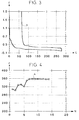
- Curve 1 in Figure 1 shows that the losses faradic in the first cycle corresponding to reactions irreversible (passivation, exfoliation) are important. Capacity loss during cycling is 23% in 20 cycles, as seen on curve 2 in Figure 2.
- An electrode II is produced according to the prior art of the following way.
- We prepare a paste by adding 100g of graphite powder in 200g of a 5% by weight solution of a polyacrylic acid homopolymer, by mass molecular 250,000, in a water-alcohol equimassic mixture (ethanol).
- the electrode is shaped by spreading the dough on a copper strip. After evaporation of solvents by drying at 60 ° C, the composition is 90% by weight of graphite and 10% by weight of polymer.
- the electrode obtained is brittle and difficult to handle.
- a rechargeable electrochemical generator is produced button type similar to that described in Example 1 but comprising the electrode previously prepared.
- the generator is cycled at a density of current of 20mA per gram of graphite.
- the first five cycles are carried out at room temperature (25 ° C) and the following cycles at 60 ° C.
- Curve 3 in Figure 3 shows that the losses faradic in the first cycle corresponding to reactions irreversible (passivation, exfoliation) are weak. The capacity is stable during cycling as seen on curve 4 of figure 4.
- An electrode III is produced according to the prior art of the same way as in Example 2, except for the composition of the dough which is prepared by adding 100g of graphite powder 175g of a 4% solution of a polyacrylic acid homopolymer, molecular weight 250,000, in an equimassic water-NMP mixture. After solvent evaporation by drying at 60 ° C, the composition is 93% by weight of graphite and 7% by weight of polymer. The electrode obtained is brittle and difficult manipulable.
- a cycling is carried out under the conditions described in Example 2, except that cycles 14 to 16 are carried out at 80 ° C and cycles 17 to 19 are carried out 100 ° C.
- Curve 5 in Figure 5 shows that the losses faradic in the first cycle corresponding to reactions irreversible (passivation, exfoliation) are weak.
- the capacity is stable during cycling even at a temperature of 100 ° C, as seen on curve 6 of the figure 6.
- An IV electrode is produced according to the invention of the same way as in Example 2, except for the composition of the dough which is prepared adding 150g of graphite powder in 307.5g of a 2.5% solution of a polyacrylic acid homopolymer, salified to 50% by ethanolamine and molecular weight 250,000, in a equimassic water-NMP mixture. After evaporation of the solvents by drying at 60 ° C, the composition is 92.5% by weight of graphite and 7.5% by weight of salified polymer. We obtain an electrode which has sufficient flexibility to be easy to handle.
- a cycling is carried out under the conditions described in Example 2, except that both first cycles are performed at room temperature and subsequent cycles are at 60 ° C.
- Curves 7 and 8 of Figures 7 and 8 show that the electrochemical performance was not affected by the partial neutralization of the acid, and advantageously the electrode has greater flexibility.
- An electrode VI according to the invention is produced in the same manner as in Example 2, with the exception of the composition of the paste which is prepared by adding 100 g of graphite powder to 200 g of a 5% solution in weight of a crosslinked homopolymer of polyacrylic acid in a water-NMP equimassic mixture. 50% of the carboxylic sites of the polymer are neutralized with 3.165 g of tetramethylammonium hydroxide N (CH 3 ) 4 OH in 40% solution in water. After evaporation of the solvents by drying at 60 ° C., the composition is 92.5% by weight of graphite, 4.6% by weight of tetramethylammonium and 2.9% by weight of polyacrylic acid. An electrode is obtained which has sufficient flexibility to be easy to handle.
- the composition of the paste which is prepared by adding 100 g of graphite powder to 200 g of a 5% solution in weight of a crosslinked homopolymer of polyacrylic acid in a water-NMP equimass
- Curve 9 in Figure 9 shows the first cycle.
- the capacity is particularly stable during cycling even at a temperature of 60 ° C, as seen on the curve 10 of figure 10.
- electrodes VII to XII are produced, the binder of which is a homopolymer of polyacrylic acid neutralized by tetramethylammonium hydroxide N (CH 3 ) 4 OH.
- the respective characteristics of the electrodes are collated below.
- the electrode present satisfactory flexibility and its characteristics electrochemicals in cycling are analogous to the electrodes of Example 5.
- Electrodes XIV and XV are produced according to the invention in the same way as in Example 5, except for the composition of the dough which is prepared using as binding a homopolymer of polyacrylic acid salified by tetrabutylammonium hydroxide, respectively at 10% and 90%.
- the electrodes have satisfactory flexibility and their electrochemical characteristics in cycling are analogous to the electrodes of Example 5.
- Electrodes XVI to XVIII are produced according to the invention in the same manner as in Example 5, with the exception of the composition of the paste which is prepared using as a binder a homopolymer of polyacrylic acid salified with tetramethylphenylammonium hydroxide. The respective characteristics of the electrodes are collated below. Their electrochemical performance in cycling is analogous to the electrodes of Example 5. electrode no. neutralization rate flexibility XVI 10% acceptable XVII 20% acceptable XVIII 40% acceptable XIX 70% good
- An electrode XX is produced according to the prior art of the same way as in Example 2, except for the composition of the dough which is prepared adding 100g of 5.5 g graphite powder of an acid copolymer polyacrylic and acrylamide in 5% solution in the water. After evaporation of the solvents by drying at 60 ° C, the composition is 90% by weight of graphite and 10% by weight of copolymer.
- a cycling is carried out under the conditions described in Example 2, except that the first cycle is carried out at a rate of 20mAh / g at temperature ambient (25 ° C). The following cycles are carried out at 60 ° C, at the same speed until cycle 22, then at 50mAh / g.
- Curve 11 in Figure 11 shows the first cycle. The capacity decreases little during cycling even at a temperature of 60 ° C, as seen on curve 12 of the figure 12.
Landscapes
- Chemical & Material Sciences (AREA)
- General Chemical & Material Sciences (AREA)
- Chemical Kinetics & Catalysis (AREA)
- Electrochemistry (AREA)
- Engineering & Computer Science (AREA)
- Manufacturing & Machinery (AREA)
- Dispersion Chemistry (AREA)
- Battery Electrode And Active Subsutance (AREA)
- Secondary Cells (AREA)
Abstract
La présente invention a pour objet un générateur électrochimique rechargeable à électrolyte liquide organique dont la tension moyenne en décharge est supérieure à 3 volts, comportant au moins une électrode comprenant un collecteur de courant revêtu d'une pâte contenant la matière électrochimiquement active et un liant, caractérisé par le fait que ledit liant est un polymère partiellement salifié par un composé basique choisi parmi un hydroxyde d'ammonium quaternaire, l'hydroxyde de tétraalkylphosphonium, l'éthanolamine, la triéthanolamine, la créatinine, ledit polymère étant choisi parmi les homopolymères de l'acide acrylique, l'acide métacrylique, l'acrylamide, l'acide itaconique, l'acide sulfonique, leurs copolymères et leurs mélanges.
Description
La présente invention concerne une électrode destinée
à être utilisée dans un générateur électrochimique à
électrolyte liquide organique, comme par exemple un
générateur primaire ou un générateur rechargeable au lithium
ou bien un supercondensateur à électrolyte liquide
organique. Elle s'étend en outre au procédé de préparation
et aux applications de cette électrode.
Aujourd'hui de nombreuses électrodes sont de type
empâtée. Elles se composent d'un support conducteur
électronique comme collecteur de courant, par exemple un
feutre, une mousse, un déployé ou un feuillard perforé ou
non, qui est revêtu d'une pâte. La pâte comprend
principalement la matière active et un liant, auxquels on
ajoute si nécessaire une poudre conductrice.
Le liant a pour fonction d'assurer la cohésion des
grains de matière active entre eux et l'adhésion sur le
support de l'électrode, avant l'assemblage de l'accumulateur
et durant son fonctionnement. Au cours du fonctionnement de
l'électrode, les transformations chimiques provoquent une
variation du volume de l'électrode. Le liant doit être
capable d'accompagner et de limiter les variations du volume
de l'électrode. Si on utilise une proportion de liant élevé,
la quantité de matière active est diminuée d'autant. Il est
donc indispensable de minimiser la perte inévitable de
capacité qui résulte de l'élaboration de l'électrode.
La surface électrochimiquement active d'une électrode
dépend de la surface accessible à l'électrolyte. Cette
surface dépend donc de la manière dont les grains de matière
active sont enrobés et liés par le polymère. Si l'électrode
est insuffisamment mouillée, la surface active est diminuée
ce qui entraíne une augmentation de la densité de courant
local et une plus faible capacité chargée.
Le liant doit aussi maintenir le contact électrique
entre les grains de matière active. Si on utilise une
proportion de liant élevé, la conductivité électrique de
l'électrode est diminuée, ce qui produit une baisse de la
tension et de la capacité de l'accumulateur.
Par conséquent on s'efforce d'introduire dans
l'électrode la plus petite quantité possible de liant
nécessaire mais suffisante pour assurer sa tenue mécanique.
Enfin le liant utilisé doit être compatible avec les
composants de l'électrolyte liquide organique (gonflement,
solubilité,...) et stable vis à vis des réducteurs et
oxydants utilisés, comme par exemple les oxydes métalliques
de l'électrode positive et le carbone lithié de l'électrode
négative. C'est particulièrement vis à vis de l'électrode
négative que la réactivité du liant doit être maítrisée. En
présence d'un solvant organique certains liants présentent
une dégradation de leurs propriétés adhésives au cours du
cyclage.
Une solution pour améliorer la stabilité de
l'électrode a été proposée (EP-0 620 606) qui consiste à
réaliser la pâte avec un liant qui est polymérisé après la
mise en forme de l'électrode. Cette étape de polymérisation
réalisée sur la pâte contenant déjà la matière active peut
en affecter l'activité électrochimique. En outre c'est une
étape qui s'ajoute au procédé, en augmentant le coût et la
complexité.
Le brevet US-4,379,817 propose l'utilisation d'une
large gamme de polymères, par exemple des polymères
acryliques, comme liant d'une cathode au bioxyde de
manganèse MnO2. Le brevet US-4,465,747 divulgue
l'utilisation particulière d'un copolymère d'éthylène et
d'acide acrylique comme liant de la cathode d'un générateur
à anode de lithium métallique.
La plupart de ces liants présentent l'inconvénient de
se dégrader dans l'électrolyte organique, notamment lorsque
la tension de fonctionnement est supérieure à 3V ou/et
lorsque la température du générateur devient supérieure à la
température ambiante. Il en résulte une perte d'adhésion et
la destruction de l'électrode.
La présente invention a pour but de proposer une
électrode flexible de générateur à électrolyte liquide
organique capable de fonctionner à une tension supérieure à
3 Volts en restant électrochimiquement et mécaniquement
stable pendant toute sa durée de fonctionnement.
L'objet de la présente invention est un générateur
électrochimique rechargeable à électrolyte liquide organique
dont la tension moyenne en décharge est supérieure à
3 Volts, comportant au moins une électrode comprenant un
collecteur de courant revêtu d'une pâte contenant la matière
électrochimiquement active et un liant. Ledit liant est un
polymère partiellement salifié par un composé basiquee
choisi parmi un hydroxyde d'ammonium quaternaire, comme
l'hydroxyde de tétraméthylammonium, l'hydroxyde de
tétraéthylammonium, l'hydroxyde de tétrabutylammonium,
l'hydroxyde de tétrapropylammonium, l'hydroxyde de
tétraméthylphénylammonium ou l'hydroxyde de
tétraéthylphénylammonium, l'hydroxyde de
tétraalkylphosphonium, l'éthanolamine, la triéthanolamine,
la créatinine, ledit polymère étant choisi parmi les
polymères de l'acide acrylique, l'acide métacrylique,
l'acrylamide, l'acide itaconique, l'acide sulfonique, leurs
copolymères et leurs mélanges, notamment les copolymères des
monomères précédemment cités et les mélanges de polymères
choisis parmi un polymère et un copolymère précédemment
cité.
Le liant peut être par exemple un homopolymère de
l'acide acrylique, l'acide métacrylique, l'acide itaconique,
ou de l'acide sulfonique, un polymère de l'amide associée à
ces acides, un copolymère de l'acide sulfonique et de
l'acide acrylique, etc... qui ont été partiellement
salifiés.
La neutralisation s'effectue par réaction avec un
composé basique possèdant un cation suffisamment volumineux
pour écarter les chaínes polymériques et conférer la
souplesse nécessaire à l'électrode. L'acide est
partiellement salifié par réaction acido-basique, selon la
réaction pour l'acide acrylique par exemple :
CH2=CH-CO-O-H + B-OH → CH2=CH-CO-O-,B+ + H2O
Ce qui conduit à la création d'une liaison ionique
avec le cation de la base. Cette liaison est réversible et
mobile le long de la chaíne polymérique.
Ledit polymère est salifié dans une proportion
comprise entre 5% et 90%. La neutralisation partielle des
fonctions acides permet d'ajuster la viscosité de la pâte en
augmentant la surface de contact des chaínes polymériques
avec le solvant. Par ce moyen on peut également améliorer la
flexibilité finale de l'électrode en réduisant les
interactions inter-chaínes. La neutralisation complète doit
être évitée car elle entraíne la perte de la propriété
d'adhérence liée à la présence de groupement carboxyles.
La réactivité de ces polymères vis à vis du lithium
est modérée et leur stabilité dimensionnelle peut rendre
superflue leur réticulation. Le liant est un polymère
linéaire ou réticulé qui a de préférence une masse
moléculaire comprise entre 1 000 et 10 000 000.
Ces polymères ont l'avantage d'être facilement
solubles ou dispersables dans l'eau, dans certains solvants
à liaison hydrogène et dans les mélanges de ces solvants. On
peut par exemple utiliser comme solvants un alcool, une
amine, le dioxane, la N-méthylpyrrolidone (NMP) . Les
mélanges de polymères de caractéristiques différentes
peuvent permettre d'obtenir un effet de synergie de leurs
propriétés.
Si nécessaire la viscosité de la pâte peut être
ajustée pour faciliter l'enduction par le choix de la masse
moléculaire du polymère, du pH de la solution ou dispersion
de polymère, ou en effectuant une réticulation partielle.
De préférence la proportion dudit liant est comprise
entre 1 et 20% en poids de ladite pâte. Une telle teneur
confère à l'électrode une cohésion et une adhérence au
support qui se conserve pendant toute sa durée d'utilisation
tout en limitant la réduction de la quantité de matière
active.
Dans le cas où l'électrode est la cathode d'un
générateur électrochimique au lithium, ladite matière active
est un matériau susceptible d'insérer du lithium dans sa
structure à haut potentiel (supérieur à 2,5V/Li) choisie
parmi un oxyde de métaux de transition, un sulfure, un
sulfate et leurs mélanges.
Les sulfures peuvent être par exemple TaS2, NbS2, VS2,
etc..., et les sulfates peuvent être par exemple des
sulfates de métaux de transition comme Fe(SO4)2 ou Ni(SO4)2.
De préférence ledit oxyde de métaux de transition est
choisi parmi l'oxyde de vanadium, les oxydes lithiés de
manganèse comme par exemple LiMn2O4, nickel LiNiO2, et cobalt
LiCoO2, et leurs mélanges. Ces oxydes peuvent contenir une
proportion minoritaire d'un ou plusieurs éléments jouant le
rôle de dopant.
Dans le cas où l'électrode est l'anode d'un générateur
électrochimique au lithium, ladite matière active est un
matériau carboné susceptible d'insérer du lithium dans sa
structure à bas potentiel (inférieur à 1,5V/Li) choisi parmi
un carbone cristallisé comme le graphite, un carbone peu
cristallisé graphitable comme le coke, et un carbone peu
cristallisé non-graphitable comme le noir de carbone et le
carbone vitreux.
L'électrolyte liquide organique est constitué d'un
solvant, ou mélange de solvants dans lequel est dissous un
sel. Dans le cas d'un générateur électrochimique au lithium,
ledit électrolyte comprend un solvant organique choisi parmi
un éther, un ester et leurs mélanges, lesdits esters étant
choisis parmi les carbonates de propylène, d'éthylène, de
butylène, de diéthyle, de diméthyle, et leurs mélanges. Dans
ce cas ledit électrolyte comprend un sel de lithium choisi
parmi le perchlorate de lithium LiClO4, l'hexafluoroarsénate
de lithium LiAsF6, l'hexafluorophosphate de lithium LiPF6,
le tétrafluoroborate de lithium LiBF4, le
trifluorométhanesulfonate de lithium LiCF3SO3, le
trifluorométhanesulfonimide de lithium LiN(CF3SO2)2
(LiTFSI), ou le trifluorométhanesulfoneméthide de lithium
LiC(CF3SO2)3 (LiTFSM)
La présente invention a également pour objet un
procédé de fabrication d'une électrode de générateur
comportant les étapes suivantes:
- on prépare une pâte en ajoutant ladite matière active en poudre à une solution dudit liant,
- on met en forme ladite électrode en étalant ladite pâte sur un feuillard d'un métal choisi de préférence parmi le cuivre, le nickel, l'aluminium, et l'acier inoxydable,
- on sèche ladite électrode à une température comprise entre 60°C et 120°C pour évaporer les solvants,
- on calandre ladite électrode jusqu'à l'obtention d'une porosité de préférence comprise entre 20% et 60%.
Selon une variante ladite pâte contient en outre des
additifs, comme par exemple un matériau conducteur ou un
agent de texture. C'est notamment le cas de l'électrode
positive lorsque la matière active est un oxyde lithié d'un
métal de transition.
D'autres caractéristiques et avantages de la présente
invention apparaítront au cours des exemples suivants de
réalisation, donnés bien entendu à titre illustratif et non
limitatif, et dans le dessin annexé sur lequel:
- la figure 1 représente le premier cycle d'une électrode selon l'art antérieur ayant comme liant du PVDF,
- la figure 2 représente l'évolution de la capacité en cyclage de l'électrode de la figure 1,
- la figure 3 est analogue à la figure 1 pour une électrode selon l'art antérieur ayant comme liant un homopolymère de l'acide acrylique non salifié,
- la figure 4 est analogue à la figure 2 pour l'électrode de la figure 3,
- la figure 5 est analogue à la figure 1 pour une électrode selon l'art antérieur ayant comme liant un homopolymère de l'acide acrylique non salifié,
- la figure 6 est analogue à la figure 2 pour l'électrode de la figure 5,
- la figure 7 est analogue à la figure 1 pour une électrode selon l'invention ayant comme liant un homopolymère de l'acide acrylique salifié par l'éthanolamine,
- la figure 8 est analogue à la figure 2 pour l'électrode de la figure 7,
- la figure 9 est analogue à la figure 1 pour une électrode selon l'invention ayant comme liant un homopolymère de l'acide acrylique salifié par N(CH3)4OH,
- la figure 10 est analogue à la figure 2 pour l'électrode de la figure 9,
- la figure 11 est analogue à la figure 1 pour une électrode selon l'art antérieur ayant comme liant un copolymère de l'acide acrylique non salifié,
- la figure 12 est analogue à la figure 2 pour l'électrode de la figure 11.
Sur les figures 1, 3, 5, 7, 9 et 11 la capacité
déchargée C en mAh/g est donné en abscisse et en ordonnée la
tension V en volts.
Sur les figures 2, 4, 6, 8, 10 et 12 la capacité
déchargée C en mAh/g est donné en ordonnée et en abscisse le
nombre de cycles N.
On réalise une électrode I selon l'art antérieur de la
manière suivante. On prépare une pâte en ajoutant 90g de
poudre de graphite dans 100g d'une solution à 10% en poids
de polyfluorure de vinylidène (PVDF) dans la
N-méthylpyrolidone (NMP). L'électrode est mise en forme par
étalement de la pâte sur un feuillard de cuivre. Après
évaporation des solvants par séchage à 120°C, la composition
est de 90% en poids de graphite et 10% en poids de polymère.
On obtient une électrode qui présente une souplesse
suffisante pour être aisément manipulable.
On réalise un générateur électrochimique rechargeable
de type bouton comportant l'électrode préparée précédemment,
une contre-électrode en lithium métallique, un séparateur de
polypropylène microporeux, et un électrolyte constitué d'une
solution de concentration 1M d'hexafluorophosphate de
lithium LiPF6 dans un mélange de solvants organiques. Le
mélange de solvants se compose en volume de 20% de carbonate
de propylène PC, de 20% de carbonate d'éthylène EC, et de
60% de carbonate de diméthyle DMC.
On effectue un cyclage du générateur à une densité de
courant de 20mA par gramme de graphite. Le premier cycle est
réalisé à la température ambiante (25°C) et les cycles
suivants à 60°C.
La courbe 1 de la figure 1 montre que les pertes
faradiques au premier cycle correspondant aux réactions
irréversibles (passivation, exfoliation) sont importantes.
La perte de capacité au cours du cyclage est de 23% en 20
cycles, comme on le voit sur la courbe 2 de la figure 2.
On réalise une électrode II selon l'art antérieur de
la manière suivante. On prépare une pâte en ajoutant 100g de
poudre de graphite dans 200g d'une solution à 5% en poids
d'un homopolymère de l'acide polyacrylique, de masse
moléculaire 250 000, dans un mélange équimassique eau-alcool
(éthanol). L'électrode est mise en forme par étalement de la
pâte sur un feuillard de cuivre. Après évaporation des
solvants par séchage à 60°C, la composition est de 90% en
poids de graphite et 10% en poids de polymère. L'électrode
obtenue est cassante et difficilement manipulable.
On réalise un générateur électrochimique rechargeable
de type bouton analogue à celui décrit dans l'exemple 1 mais
comportant l'électrode préparée précédemment.
On effectue un cyclage du générateur à une densité de
courant de 20mA par gramme de graphite. Les cinq premiers
cycles sont réalisé à la température ambiante (25°C) et les
cycles suivants à 60°C.
La courbe 3 de la figure 3 montre que les pertes
faradiques au premier cycle correspondant aux réactions
irréversibles (passivation, exfoliation) sont faibles. La
capacité est stable au cours du cyclage comme on le voit sur
la courbe 4 de la figure 4.
On réalise une électrode III selon l'art antérieur de
la même manière que dans l'exemple 2, à l'exception de la
composition de la pâte qui est préparée en ajoutant 100g de
poudre de graphite à 175g d'une solution à 4% d'un
homopolymère de l'acide polyacrylique, de masse moléculaire
250 000, dans un mélange équimassique eau-NMP. Après
évaporation des solvants par séchage à 60°C, la composition
est de 93% en poids de graphite et 7% en poids de polymère.
L'électrode obtenue est cassante et difficilement
manipulable.
Un cyclage est réalisé dans les conditions décrites
dans l'exemple 2, à l'exception du fait que les cycles 14 à
16 sont effectués à 80°C et les cycles 17 à 19 le sont à
100°C.
La courbe 5 de la figure 5 montre que les pertes
faradiques au premier cycle correspondant aux réactions
irréversibles (passivation, exfoliation) sont faibles. La
capacité est stable au cours du cyclage même à une
température de 100°C, comme on le voit sur la courbe 6 de la
figure 6.
On réalise une électrode IV selon l'invention de la
même manière que dans l'exemple 2, à l'exception de la
composition de la pâte qui est préparée ajoutant 150g de
poudre de graphite dans 307,5g d'une solution à 2,5% d'un
homopolymère de l'acide polyacrylique, salifié à 50% par
l'éthanolamine et de masse moléculaire 250 000, dans un
mélange équimassique eau-NMP. Après évaporation des solvants
par séchage à 60°C, la composition est de 92,5% en poids de
graphite et 7,5% en poids de polymère salifié. On obtient
une électrode qui présente une souplesse suffisante pour
être aisément manipulable.
Un cyclage est réalisé dans les conditions décrites
dans l'exemple 2, à l'exception du fait que les deux
premiers cycles sont effectués à la température ambiante et
les cycles suivants le sont à 60°C.
Les courbes 7 et 8 des figures 7 et 8 montrent que les
performances électrochimiques n'ont pas été modifiées par la
neutralisation partielle de l'acide, et avantageusement
l'électrode présente une plus grande souplesse.
De la même manière que précédemment, on réalise une
électrode V selon l'invention à l'exception de la
composition de la pâte qui contient un homopolymère de
l'acide polyacrylique salifié à 50% par la triéthanolamine.
Les performances électrochimiques n'ont pas été modifiées,
et l'électrode présente une bonne souplesse.
On réalise une électrode VI selon l'invention de la
même manière que dans l'exemple 2, à l'exception de la
composition de la pâte qui est préparée en ajoutant 100g de
poudre de graphite dans 200g d'une solution à 5% en poids
d'un homopolymère réticulé de l'acide polyacrylique dans un
mélange équimassique eau-NMP. 50% des sites carboxyliques du
polymère sont neutralisés par 3,165g d'hydroxyde de
tétraméthylammonium N(CH3)4OH en solution à 40% dans l'eau.
Après évaporation des solvants par séchage à 60°C, la
composition est de 92,5% en poids de graphite, 4,6% en poids
de tétraméthylammonium et 2,9% en poids d'acide
polyacrylique. On obtient une électrode qui présente une
souplesse suffisante pour être aisément manipulable.
Un cyclage est réalisé dans les conditions décrites
dans l'exemple 2, à l'exception du fait que les cycles sont
effectués dans les conditions suivantes de régime et de
température:
La courbe 9 de la figure 9 montre le premier cycle. La
capacité est particulièrement stable au cours du cyclage
même à une température de 60°C, comme on le voit sur la
courbe 10 de la figure 10.
De la même manière que précédemment, on réalise des
éklectrodes VII à XII dont le liant est un homopolymère de
l'acide polyacrylique neutralisé par l'hydroxyde de
tétraméthylammonium N(CH3)4OH. Les caractéristiques
respectives des électrodes sont rassemblées ci-dessous.
| électrode n° | taux de neutralisation par la base | composition de l'électrode en poids | flexibilité | |
| N(CH3)4OH | acide acrylique | |||
| VII | 10% | - | - | acceptable |
| VI | 50% | 4,6% | 2,9% | bonne |
| VIII | 50% | 2,9% | 1,8% | bonne |
| IX | 60% | 2,8% | 2,2% | bonne |
| X | 70% | 2,8% | 2,5% | bonne |
| XI | 80% | 2,8% | 2,9% | bonne |
| XII | 90% | 2,8% | 3,2% | bonne |
On réalise une électrode XIII selon l'invention de la
même manière que dans l'exemple 5, à l'exception de la
composition de la pâte qui est préparée en utilisant comme
liant un homopolymère de l'acide polyacrylique salifié à 50%
par l'hydroxyde de tétraéthylammonium. L'électrode présente
une flexibilité satisfaisante et ses caractéristiques
électrochimiques en cyclage sont analogues aux électrodes de
l'exemple 5.
On réalise des électrodes XIV et XV selon l'invention
de la même manière que dans l'exemple 5, à l'exception de la
composition de la pâte qui est préparée en utilisant comme
liant un homopolymère de l'acide polyacrylique salifié par
l'hydroxyde de tétrabutylammonium, respectivement à 10% et
90%. Les électrodes présentent une flexibilité satisfaisante
et leurs caractéristiques électrochimiques en cyclage sont
analogues aux électrodes de l'exemple 5.
On réalise des électrodes XVI à XVIII selon
l'invention de la même manière que dans l'exemple 5, à
l'exception de la composition de la pâte qui est préparée en
utilisant comme liant un homopolymère de l'acide
polyacrylique salifié par l'hydroxyde de
tétraméthylphénylammonium. Les caractéristiques respectives
des électrodes sont rassemblées ci-dessous. Leurs
performances électrochimiques en cyclage sont analogues aux
électrodes de l'exemple 5.
| électrode n° | taux de neutralisation | flexibilité |
| XVI | 10% | acceptable |
| XVII | 20% | acceptable |
| XVIII | 40% | acceptable |
| XIX | 70% | bonne |
On réalise une électrode XX selon l'art antérieur de
la même manière que dans l'exemple 2, à l'exception de la
composition de la pâte qui est préparée ajoutant 100g de
poudre de graphite à 5,5g d'un copolymère de l'acide
polyacrylique et de l'acrylamide en solution à 5% dans
l'eau. Après évaporation des solvants par séchage à 60°C, la
composition est de 90% en poids de graphite et 10% en poids
de copolymère.
Un cyclage est réalisé dans les conditions décrites
dans l'exemple 2, à l'exception du fait que le premier cycle
est effectué à un régime de 20mAh/g à la température
ambiante (25°C). Les cycles suivants sont effectués à 60°C,
au même régime jusqu'au cycle 22, puis à 50mAh/g.
La courbe 11 de la figure 11 montre le premier cycle.
La capacité décroít peu au cours du cyclage même à une
température de 60°C, comme on le voit sur la courbe 12 de la
figure 12.
Claims (10)
- Générateur électrochimique rechargeable à électrolyte liquide organique dont la tension moyenne en décharge est supérieure à 3 volts, comportant au moins une électrode comprenant un collecteur de courant revêtu d'une pâte contenant la matière électrochimiquement active et un liant, caractérisé par le fait que ledit liant est un polymère partiellement salifié par un composé basique choisi parmi un hydroxyde d'ammonium quaternaire, l'hydroxyde de tétraalkylphosphonium, l'éthanolamine, la triéthanolamine, la créatinine, ledit polymère étant choisi parmi les polymères de l'acide acrylique, l'acide métacrylique, l'acrylamide, l'acide itaconique, l'acide sulfonique, leurs copolymères et leurs mélanges.
- Générateur selon la revendication 1, dans lequel ledit polymère est salifié dans une proportion comprise entre 5% et 90%.
- Générateur selon l'une des revendications 1 et 2, dans lequel la proportion dudit liant est comprise entre 1% et 20% en poids de ladite pâte.
- Générateur selon l'une des revendications précédentes, dans lequel ladite matière active est choisie parmi un oxyde de métaux de transition, un sulfure, un sulfate et leurs mélanges.
- Générateur selon la revendication 4, dans lequel ledit oxyde de métaux de transition est choisi parmi l'oxyde de vanadium, les oxydes lithiés de manganèse, nickel, et cobalt, et leurs mélanges.
- Générateur selon l'une des revendications 1 à 3, dans lequel ladite matière active est un matériau carboné susceptible d'insérer du lithium dans sa structure choisi parmi le graphite, le coke, le noir de carbone et le carbone vitreux.
- Générateur selon l'une des revendications précédentes, dans lequel ledit électrolyte comprend un sel de lithium choisi parmi le perchlorate de lithium, l'hexafluoroarsénate de lithium, l'hexafluorophosphate de lithium, le tétrafluoroborate de lithium, le trifluorométhanesulfonate de lithium, le trifluorométhanesulfonimide de lithium, et le trifluorométhanesulfoneméthide de lithium.
- Générateur selon l'une des revendications précédentes, dans lequel ledit électrolyte comprend un solvant organique choisi parmi un éther, un ester et leurs mélanges, lesdits esters étant choisis parmi les carbonates de propylène, d'éthylène, de butylène, de diéthyle, de diméthyle, et leurs mélanges.
- Procédé de fabrication d'une électrode de générateur selon l'une des revendications précédentes, comportant les étapes suivantes:on prépare une pâte en ajoutant ladite matière active en poudre à une solution dudit liant,on met en forme ladite électrode en étalant ladite pâte sur un feuillard d'un métal choisi de préférence parmi le cuivre, le nickel, l'aluminium, et l'acier inoxydable,on sèche ladite électrode à une température comprise entre 60°C et 120°C pour évaporer les solvants,on calandre ladite électrode jusqu'à l'obtention d'une porosité de préférence comprise entre 20% et 60%.
- Procédé selon la revendication 9, dans lequel ladite pâte contient en outre des additifs.
Applications Claiming Priority (2)
| Application Number | Priority Date | Filing Date | Title |
|---|---|---|---|
| FR9608404A FR2750800B1 (fr) | 1996-07-05 | 1996-07-05 | Electrode de generateur electrochimique rechargeable a electrolyte liquide organique et son procede de fabrication |
| FR9608404 | 1996-07-05 |
Publications (1)
| Publication Number | Publication Date |
|---|---|
| EP0817296A1 true EP0817296A1 (fr) | 1998-01-07 |
Family
ID=9493756
Family Applications (1)
| Application Number | Title | Priority Date | Filing Date |
|---|---|---|---|
| EP97401584A Withdrawn EP0817296A1 (fr) | 1996-07-05 | 1997-07-03 | Electrode de générateur électrochimique rechargeable à électrolyte liquide organique et son procédé de fabrication |
Country Status (3)
| Country | Link |
|---|---|
| EP (1) | EP0817296A1 (fr) |
| CA (1) | CA2209478A1 (fr) |
| FR (1) | FR2750800B1 (fr) |
Cited By (2)
| Publication number | Priority date | Publication date | Assignee | Title |
|---|---|---|---|---|
| WO2011076692A1 (fr) | 2009-12-22 | 2011-06-30 | Basell Polyolefine Gmbh | Composants de catalyseur pour la polymérisation d'oléfines et catalyseurs ainsi obtenus |
| WO2022013070A1 (fr) * | 2020-07-16 | 2022-01-20 | Solvay Specialty Polymers Italy S.P.A. | Liant pour matériau d'anode à base de silicium |
Citations (11)
| Publication number | Priority date | Publication date | Assignee | Title |
|---|---|---|---|---|
| JPS58225567A (ja) * | 1982-06-23 | 1983-12-27 | Fuji Elelctrochem Co Ltd | 非水電解液電池 |
| GB2181884A (en) * | 1985-09-27 | 1987-04-29 | Ever Ready Ltd | Sheet electrode for electrochemical cells and manufacture thereof |
| JPH0282454A (ja) * | 1988-09-19 | 1990-03-23 | Furukawa Battery Co Ltd:The | 有機電解液二次電池用正極 |
| JPH04370661A (ja) * | 1991-06-20 | 1992-12-24 | Toshiba Battery Co Ltd | 非水溶媒二次電池 |
| EP0563988A1 (fr) * | 1992-04-02 | 1993-10-06 | Fuji Photo Film Co., Ltd. | Batterie secondaire non-aqueuse |
| JPH0696759A (ja) * | 1992-08-26 | 1994-04-08 | Seiko Instr Inc | 非水電解質二次電池及びそれに用いる活物質の製造方法 |
| EP0603397A1 (fr) * | 1991-09-13 | 1994-06-29 | Asahi Kasei Kogyo Kabushiki Kaisha | Accumulateur |
| EP0620606A2 (fr) * | 1993-03-16 | 1994-10-19 | Furukawa Denchi Kabushiki Kaisha | Electrode pour batterie rechargeable à électrolyte nonaqueuse et procédé de fabrication |
| EP0626734A2 (fr) * | 1993-05-21 | 1994-11-30 | VARTA Batterie Aktiengesellschaft | Pile galvanique rechargeable au lithium |
| US5399447A (en) * | 1993-12-06 | 1995-03-21 | Valence Technology, Inc. | Acidity reduction of adhesion promoter layer and electrolytic cells produced therefrom |
| JPH07105970A (ja) * | 1993-09-30 | 1995-04-21 | Matsushita Electric Ind Co Ltd | 非水電解液二次電池及びその製造法 |
Family Cites Families (2)
| Publication number | Priority date | Publication date | Assignee | Title |
|---|---|---|---|---|
| JPH0367462A (ja) * | 1989-08-07 | 1991-03-22 | Toshiba Battery Co Ltd | 非水溶媒二次電池 |
| JP3062304B2 (ja) * | 1991-07-16 | 2000-07-10 | 東芝電池株式会社 | 非水溶媒二次電池 |
-
1996
- 1996-07-05 FR FR9608404A patent/FR2750800B1/fr not_active Expired - Fee Related
-
1997
- 1997-07-03 EP EP97401584A patent/EP0817296A1/fr not_active Withdrawn
- 1997-07-04 CA CA002209478A patent/CA2209478A1/fr not_active Abandoned
Patent Citations (11)
| Publication number | Priority date | Publication date | Assignee | Title |
|---|---|---|---|---|
| JPS58225567A (ja) * | 1982-06-23 | 1983-12-27 | Fuji Elelctrochem Co Ltd | 非水電解液電池 |
| GB2181884A (en) * | 1985-09-27 | 1987-04-29 | Ever Ready Ltd | Sheet electrode for electrochemical cells and manufacture thereof |
| JPH0282454A (ja) * | 1988-09-19 | 1990-03-23 | Furukawa Battery Co Ltd:The | 有機電解液二次電池用正極 |
| JPH04370661A (ja) * | 1991-06-20 | 1992-12-24 | Toshiba Battery Co Ltd | 非水溶媒二次電池 |
| EP0603397A1 (fr) * | 1991-09-13 | 1994-06-29 | Asahi Kasei Kogyo Kabushiki Kaisha | Accumulateur |
| EP0563988A1 (fr) * | 1992-04-02 | 1993-10-06 | Fuji Photo Film Co., Ltd. | Batterie secondaire non-aqueuse |
| JPH0696759A (ja) * | 1992-08-26 | 1994-04-08 | Seiko Instr Inc | 非水電解質二次電池及びそれに用いる活物質の製造方法 |
| EP0620606A2 (fr) * | 1993-03-16 | 1994-10-19 | Furukawa Denchi Kabushiki Kaisha | Electrode pour batterie rechargeable à électrolyte nonaqueuse et procédé de fabrication |
| EP0626734A2 (fr) * | 1993-05-21 | 1994-11-30 | VARTA Batterie Aktiengesellschaft | Pile galvanique rechargeable au lithium |
| JPH07105970A (ja) * | 1993-09-30 | 1995-04-21 | Matsushita Electric Ind Co Ltd | 非水電解液二次電池及びその製造法 |
| US5399447A (en) * | 1993-12-06 | 1995-03-21 | Valence Technology, Inc. | Acidity reduction of adhesion promoter layer and electrolytic cells produced therefrom |
Non-Patent Citations (5)
| Title |
|---|
| CHEMICAL ABSTRACTS, vol. 113, no. 8, 20 August 1990, Columbus, Ohio, US; abstract no. 62635, OKAZAKI, YOJI: "Cathodes for organic-electrolyte secondary batteries" XP002028248 * |
| CHEMICAL ABSTRACTS, vol. 119, no. 20, 15 November 1993, Columbus, Ohio, US; abstract no. 207042, ISHIHARA, YOJI ET AL: "Secondary nonaqueous-electrolyte batteries with improved anode binder" XP002028247 * |
| CHEMICAL ABSTRACTS, vol. 121, no. 6, 8 August 1994, Columbus, Ohio, US; abstract no. 61489, SASAKI, YASUHIKO ET AL: "Secondary nonaqueous batteries and manufacture of electrode active mass for the batteries" XP002028249 * |
| CHEMICAL ABSTRACTS, vol. 123, no. 4, 24 July 1995, Columbus, Ohio, US; abstract no. 37256, OOHANA, YORITO ET AL: "Nonaqueous-electrolyte secondary batteries and their preparation" XP002028245 * |
| PATENT ABSTRACTS OF JAPAN vol. 008, no. 078 (E - 237) 10 April 1984 (1984-04-10) * |
Cited By (3)
| Publication number | Priority date | Publication date | Assignee | Title |
|---|---|---|---|---|
| WO2011076692A1 (fr) | 2009-12-22 | 2011-06-30 | Basell Polyolefine Gmbh | Composants de catalyseur pour la polymérisation d'oléfines et catalyseurs ainsi obtenus |
| WO2022013070A1 (fr) * | 2020-07-16 | 2022-01-20 | Solvay Specialty Polymers Italy S.P.A. | Liant pour matériau d'anode à base de silicium |
| CN115836412A (zh) * | 2020-07-16 | 2023-03-21 | 索尔维特殊聚合物意大利有限公司 | 用于硅基阳极材料的粘合剂 |
Also Published As
| Publication number | Publication date |
|---|---|
| CA2209478A1 (fr) | 1998-01-05 |
| FR2750800B1 (fr) | 1998-09-11 |
| FR2750800A1 (fr) | 1998-01-09 |
Similar Documents
| Publication | Publication Date | Title |
|---|---|---|
| EP3103155B1 (fr) | Batteries au lithium spécifiques comprenant des électrolytes non aqueux à base de composés sulfones | |
| KR100578803B1 (ko) | 비수 전해액 및 리튬 이차 전지 | |
| US20050186474A1 (en) | Positive electrodes for lithium batteries and their methods of fabrication | |
| FR3096512A1 (fr) | Electrolyte a base de sels de lithium | |
| EP1009057A1 (fr) | Générateur électrochimique rechargeable au lithium utilisable à basse temperature | |
| EP2721682B1 (fr) | Electrolyte liquide pour batterie au lithium, comprenant un mélange quaternaire de solvants organiques non-aqueux | |
| EP3345234A1 (fr) | Procede de formation d'une cellule de batterie li-ion equipee d'une electrode positive comprenant un sel sacrificiel | |
| EP0614240B1 (fr) | Générateur électrochimique rechargeable au lithium | |
| KR20140120751A (ko) | 음극 활물질, 이의 제조 방법, 및 상기 음극 활물질을 포함하는 전기 화학 소자 | |
| EP3298644A1 (fr) | Electrode positive pour generateur electrochimique au lithium | |
| CA2553201C (fr) | Procede d'elaboration d'un dispositif electrochimique | |
| EP4040529A1 (fr) | Anode pré-lithiée et batterie secondaire la comprenant | |
| US20230318037A1 (en) | Method for preparing a lithium ion secondary battery and a lithium ion secondary battery prepared therefrom | |
| FR2786029A1 (fr) | Batterie electrique a electrolyte non aqueux | |
| JP3968772B2 (ja) | 非水電解質電池 | |
| EP0817296A1 (fr) | Electrode de générateur électrochimique rechargeable à électrolyte liquide organique et son procédé de fabrication | |
| EP3898522B1 (fr) | Matériau actif d'électrode négative à base d'hydroxysulfure de fer et de lithium | |
| EP4562691A1 (fr) | Elément électrochimique au lithium comprenant une électrode positive à base d'un phosphate lithié de manganèse et de fer | |
| FR2819106A1 (fr) | Electrode pour generateur electrochimique rechargeable au lithium et son procede de fabrication | |
| FR2730988A1 (fr) | Oxyde amorphe suroxygene et son utilisation comme matiere active d'electrode | |
| EP3647443A1 (fr) | Électrode négative spécifique à base de lithium et générateur électrochimique au lithium comprenant une telle électrode négative | |
| EP3648206B1 (fr) | Accumulateur électrochimique au lithium du type lithium-soufre comprenant un matériau d'électrode négative spécifique | |
| FR3150641A1 (fr) | Electrolyte et accumulateur lithium-ion | |
| FR2725709A1 (fr) | Oxyde de lithium et son utilisation comme matiere active d'une electrode | |
| FR3150642A1 (fr) | Electrolyte et accumulateur lithium-ion |
Legal Events
| Date | Code | Title | Description |
|---|---|---|---|
| PUAI | Public reference made under article 153(3) epc to a published international application that has entered the european phase |
Free format text: ORIGINAL CODE: 0009012 |
|
| AK | Designated contracting states |
Kind code of ref document: A1 Designated state(s): DE ES FI FR GB IE IT NL SE |
|
| 17P | Request for examination filed |
Effective date: 19980707 |
|
| AKX | Designation fees paid |
Free format text: DE ES FI FR GB IE IT NL SE |
|
| RBV | Designated contracting states (corrected) |
Designated state(s): DE ES FI FR GB IE IT NL SE |
|
| STAA | Information on the status of an ep patent application or granted ep patent |
Free format text: STATUS: THE APPLICATION HAS BEEN WITHDRAWN |
|
| 18W | Application withdrawn |
Withdrawal date: 20000522 |