EP0815147B1 - Polymerisationsverfahren zur herstellung syndiotaktischer vinylaromatischer polymere unter anwendung niedriger wasserstoff- partialdrücke - Google Patents
Polymerisationsverfahren zur herstellung syndiotaktischer vinylaromatischer polymere unter anwendung niedriger wasserstoff- partialdrücke Download PDFInfo
- Publication number
- EP0815147B1 EP0815147B1 EP95928122A EP95928122A EP0815147B1 EP 0815147 B1 EP0815147 B1 EP 0815147B1 EP 95928122 A EP95928122 A EP 95928122A EP 95928122 A EP95928122 A EP 95928122A EP 0815147 B1 EP0815147 B1 EP 0815147B1
- Authority
- EP
- European Patent Office
- Prior art keywords
- hydrocarbyl
- vinylaromatic
- process according
- hydrogen
- catalyst
- Prior art date
- Legal status (The legal status is an assumption and is not a legal conclusion. Google has not performed a legal analysis and makes no representation as to the accuracy of the status listed.)
- Expired - Lifetime
Links
- UFHFLCQGNIYNRP-UHFFFAOYSA-N Hydrogen Chemical compound [H][H] UFHFLCQGNIYNRP-UHFFFAOYSA-N 0.000 title claims abstract description 29
- 238000006116 polymerization reaction Methods 0.000 title claims abstract description 28
- 239000001257 hydrogen Substances 0.000 title claims abstract description 24
- 229910052739 hydrogen Inorganic materials 0.000 title claims abstract description 24
- 239000003054 catalyst Substances 0.000 claims abstract description 28
- 229920000642 polymer Polymers 0.000 claims abstract description 22
- 239000000178 monomer Substances 0.000 claims abstract description 20
- 150000004696 coordination complex Chemical class 0.000 claims abstract description 15
- DPSOUODMTOWXTB-UHFFFAOYSA-N CC1=C(C)C(C)([Ti])C(C)=C1C Chemical compound CC1=C(C)C(C)([Ti])C(C)=C1C DPSOUODMTOWXTB-UHFFFAOYSA-N 0.000 claims abstract description 8
- 229920001576 syndiotactic polymer Polymers 0.000 claims abstract description 6
- 238000012718 coordination polymerization Methods 0.000 claims abstract description 4
- 238000004519 manufacturing process Methods 0.000 claims abstract 2
- -1 aluminum compound Chemical class 0.000 claims description 51
- 230000003213 activating effect Effects 0.000 claims description 24
- 238000000034 method Methods 0.000 claims description 22
- 150000001875 compounds Chemical class 0.000 claims description 19
- PPBRXRYQALVLMV-UHFFFAOYSA-N Styrene Natural products C=CC1=CC=CC=C1 PPBRXRYQALVLMV-UHFFFAOYSA-N 0.000 claims description 18
- 125000001183 hydrocarbyl group Chemical group 0.000 claims description 17
- 150000002500 ions Chemical class 0.000 claims description 9
- 239000000203 mixture Substances 0.000 claims description 9
- 125000004429 atom Chemical group 0.000 claims description 6
- 230000007935 neutral effect Effects 0.000 claims description 6
- 229910052782 aluminium Inorganic materials 0.000 claims description 5
- 125000000129 anionic group Chemical group 0.000 claims description 5
- 150000002170 ethers Chemical group 0.000 claims description 5
- JLBJTVDPSNHSKJ-UHFFFAOYSA-N 4-Methylstyrene Chemical compound CC1=CC=C(C=C)C=C1 JLBJTVDPSNHSKJ-UHFFFAOYSA-N 0.000 claims description 4
- VEXZGXHMUGYJMC-UHFFFAOYSA-M Chloride anion Chemical compound [Cl-] VEXZGXHMUGYJMC-UHFFFAOYSA-M 0.000 claims description 4
- 150000003863 ammonium salts Chemical class 0.000 claims description 4
- 125000003118 aryl group Chemical group 0.000 claims description 4
- 238000006758 bulk electrolysis reaction Methods 0.000 claims description 4
- 150000007527 lewis bases Chemical group 0.000 claims description 4
- 125000003808 silyl group Chemical group [H][Si]([H])([H])[*] 0.000 claims description 4
- UGFAIRIUMAVXCW-UHFFFAOYSA-N Carbon monoxide Chemical group [O+]#[C-] UGFAIRIUMAVXCW-UHFFFAOYSA-N 0.000 claims description 3
- 125000000217 alkyl group Chemical group 0.000 claims description 3
- 150000001412 amines Chemical group 0.000 claims description 3
- 229910002091 carbon monoxide Chemical group 0.000 claims description 3
- 150000003003 phosphines Chemical group 0.000 claims description 3
- AQSJGOWTSHOLKH-UHFFFAOYSA-N phosphite(3-) Chemical group [O-]P([O-])[O-] AQSJGOWTSHOLKH-UHFFFAOYSA-N 0.000 claims description 3
- 239000002841 Lewis acid Substances 0.000 claims description 2
- 239000007795 chemical reaction product Substances 0.000 claims description 2
- 150000001805 chlorine compounds Chemical group 0.000 claims description 2
- 125000004435 hydrogen atom Chemical group [H]* 0.000 claims description 2
- 150000007517 lewis acids Chemical class 0.000 claims description 2
- 125000002097 pentamethylcyclopentadienyl group Chemical group 0.000 claims description 2
- 238000002360 preparation method Methods 0.000 claims description 2
- 125000002924 primary amino group Chemical group [H]N([H])* 0.000 claims description 2
- 125000005843 halogen group Chemical group 0.000 claims 2
- 125000003368 amide group Chemical group 0.000 claims 1
- 125000003011 styrenyl group Chemical group [H]\C(*)=C(/[H])C1=C([H])C([H])=C([H])C([H])=C1[H] 0.000 claims 1
- 150000001450 anions Chemical class 0.000 description 15
- YXFVVABEGXRONW-UHFFFAOYSA-N Toluene Chemical compound CC1=CC=CC=C1 YXFVVABEGXRONW-UHFFFAOYSA-N 0.000 description 12
- 238000006243 chemical reaction Methods 0.000 description 12
- 238000005868 electrolysis reaction Methods 0.000 description 11
- 239000003115 supporting electrolyte Substances 0.000 description 11
- 229910052751 metal Inorganic materials 0.000 description 10
- 239000002184 metal Substances 0.000 description 10
- 150000001768 cations Chemical class 0.000 description 9
- 239000002904 solvent Substances 0.000 description 9
- AQZWEFBJYQSQEH-UHFFFAOYSA-N 2-methyloxaluminane Chemical compound C[Al]1CCCCO1 AQZWEFBJYQSQEH-UHFFFAOYSA-N 0.000 description 6
- UHOVQNZJYSORNB-UHFFFAOYSA-N Benzene Chemical compound C1=CC=CC=C1 UHOVQNZJYSORNB-UHFFFAOYSA-N 0.000 description 6
- VLKZOEOYAKHREP-UHFFFAOYSA-N n-Hexane Chemical compound CCCCCC VLKZOEOYAKHREP-UHFFFAOYSA-N 0.000 description 6
- OFBQJSOFQDEBGM-UHFFFAOYSA-N n-pentane Natural products CCCCC OFBQJSOFQDEBGM-UHFFFAOYSA-N 0.000 description 6
- 150000003839 salts Chemical class 0.000 description 6
- 239000000243 solution Substances 0.000 description 5
- WYURNTSHIVDZCO-UHFFFAOYSA-N Tetrahydrofuran Chemical compound C1CCOC1 WYURNTSHIVDZCO-UHFFFAOYSA-N 0.000 description 4
- 150000004820 halides Chemical class 0.000 description 4
- NFHFRUOZVGFOOS-UHFFFAOYSA-N palladium;triphenylphosphane Chemical compound [Pd].C1=CC=CC=C1P(C=1C=CC=CC=1)C1=CC=CC=C1.C1=CC=CC=C1P(C=1C=CC=CC=1)C1=CC=CC=C1.C1=CC=CC=C1P(C=1C=CC=CC=1)C1=CC=CC=C1.C1=CC=CC=C1P(C=1C=CC=CC=1)C1=CC=CC=C1 NFHFRUOZVGFOOS-UHFFFAOYSA-N 0.000 description 4
- BASFCYQUMIYNBI-UHFFFAOYSA-N platinum Chemical compound [Pt] BASFCYQUMIYNBI-UHFFFAOYSA-N 0.000 description 4
- ZOXJGFHDIHLPTG-UHFFFAOYSA-N Boron Chemical compound [B] ZOXJGFHDIHLPTG-UHFFFAOYSA-N 0.000 description 3
- 239000007848 Bronsted acid Substances 0.000 description 3
- OKKJLVBELUTLKV-UHFFFAOYSA-N Methanol Chemical compound OC OKKJLVBELUTLKV-UHFFFAOYSA-N 0.000 description 3
- ZMANZCXQSJIPKH-UHFFFAOYSA-N Triethylamine Chemical compound CCN(CC)CC ZMANZCXQSJIPKH-UHFFFAOYSA-N 0.000 description 3
- 239000003708 ampul Substances 0.000 description 3
- 229910052796 boron Inorganic materials 0.000 description 3
- 125000002091 cationic group Chemical group 0.000 description 3
- 239000004020 conductor Substances 0.000 description 3
- 239000011521 glass Substances 0.000 description 3
- 239000000463 material Substances 0.000 description 3
- 150000002738 metalloids Chemical group 0.000 description 3
- GYNNXHKOJHMOHS-UHFFFAOYSA-N methyl-cycloheptane Natural products CC1CCCCCC1 GYNNXHKOJHMOHS-UHFFFAOYSA-N 0.000 description 3
- 239000007800 oxidant agent Substances 0.000 description 3
- 230000000737 periodic effect Effects 0.000 description 3
- 239000000047 product Substances 0.000 description 3
- 239000012429 reaction media Substances 0.000 description 3
- 239000011541 reaction mixture Substances 0.000 description 3
- SCABQASLNUQUKD-UHFFFAOYSA-N silylium Chemical compound [SiH3+] SCABQASLNUQUKD-UHFFFAOYSA-N 0.000 description 3
- 239000010936 titanium Substances 0.000 description 3
- MCULRUJILOGHCJ-UHFFFAOYSA-N triisobutylaluminium Chemical compound CC(C)C[Al](CC(C)C)CC(C)C MCULRUJILOGHCJ-UHFFFAOYSA-N 0.000 description 3
- XKRFYHLGVUSROY-UHFFFAOYSA-N Argon Chemical compound [Ar] XKRFYHLGVUSROY-UHFFFAOYSA-N 0.000 description 2
- IJGRMHOSHXDMSA-UHFFFAOYSA-N Atomic nitrogen Chemical compound N#N IJGRMHOSHXDMSA-UHFFFAOYSA-N 0.000 description 2
- BTBUEUYNUDRHOZ-UHFFFAOYSA-N Borate Chemical compound [O-]B([O-])[O-] BTBUEUYNUDRHOZ-UHFFFAOYSA-N 0.000 description 2
- XTHFKEDIFFGKHM-UHFFFAOYSA-N Dimethoxyethane Chemical compound COCCOC XTHFKEDIFFGKHM-UHFFFAOYSA-N 0.000 description 2
- YNQLUTRBYVCPMQ-UHFFFAOYSA-N Ethylbenzene Chemical compound CCC1=CC=CC=C1 YNQLUTRBYVCPMQ-UHFFFAOYSA-N 0.000 description 2
- 239000002879 Lewis base Substances 0.000 description 2
- KWYHDKDOAIKMQN-UHFFFAOYSA-N N,N,N',N'-tetramethylethylenediamine Chemical compound CN(C)CCN(C)C KWYHDKDOAIKMQN-UHFFFAOYSA-N 0.000 description 2
- IMNFDUFMRHMDMM-UHFFFAOYSA-N N-Heptane Chemical compound CCCCCCC IMNFDUFMRHMDMM-UHFFFAOYSA-N 0.000 description 2
- CTQNGGLPUBDAKN-UHFFFAOYSA-N O-Xylene Chemical compound CC1=CC=CC=C1C CTQNGGLPUBDAKN-UHFFFAOYSA-N 0.000 description 2
- KDLHZDBZIXYQEI-UHFFFAOYSA-N Palladium Chemical compound [Pd] KDLHZDBZIXYQEI-UHFFFAOYSA-N 0.000 description 2
- JUJWROOIHBZHMG-UHFFFAOYSA-N Pyridine Chemical compound C1=CC=NC=C1 JUJWROOIHBZHMG-UHFFFAOYSA-N 0.000 description 2
- VYPSYNLAJGMNEJ-UHFFFAOYSA-N Silicium dioxide Chemical compound O=[Si]=O VYPSYNLAJGMNEJ-UHFFFAOYSA-N 0.000 description 2
- RTAQQCXQSZGOHL-UHFFFAOYSA-N Titanium Chemical compound [Ti] RTAQQCXQSZGOHL-UHFFFAOYSA-N 0.000 description 2
- PNEYBMLMFCGWSK-UHFFFAOYSA-N aluminium oxide Inorganic materials [O-2].[O-2].[O-2].[Al+3].[Al+3] PNEYBMLMFCGWSK-UHFFFAOYSA-N 0.000 description 2
- 150000001491 aromatic compounds Chemical class 0.000 description 2
- 239000012298 atmosphere Substances 0.000 description 2
- 239000001273 butane Substances 0.000 description 2
- DMEGYFMYUHOHGS-UHFFFAOYSA-N cycloheptane Chemical compound C1CCCCCC1 DMEGYFMYUHOHGS-UHFFFAOYSA-N 0.000 description 2
- BOXSCYUXSBYGRD-UHFFFAOYSA-N cyclopenta-1,3-diene;iron(3+) Chemical compound [Fe+3].C=1C=C[CH-]C=1.C=1C=C[CH-]C=1 BOXSCYUXSBYGRD-UHFFFAOYSA-N 0.000 description 2
- 150000001983 dialkylethers Chemical class 0.000 description 2
- 239000003085 diluting agent Substances 0.000 description 2
- 125000001475 halogen functional group Chemical group 0.000 description 2
- 229920001519 homopolymer Polymers 0.000 description 2
- 229930195733 hydrocarbon Natural products 0.000 description 2
- NNPPMTNAJDCUHE-UHFFFAOYSA-N isobutane Chemical compound CC(C)C NNPPMTNAJDCUHE-UHFFFAOYSA-N 0.000 description 2
- QWTDNUCVQCZILF-UHFFFAOYSA-N isopentane Chemical compound CCC(C)C QWTDNUCVQCZILF-UHFFFAOYSA-N 0.000 description 2
- 239000007788 liquid Substances 0.000 description 2
- UAEPNZWRGJTJPN-UHFFFAOYSA-N methylcyclohexane Chemical compound CC1CCCCC1 UAEPNZWRGJTJPN-UHFFFAOYSA-N 0.000 description 2
- IJDNQMDRQITEOD-UHFFFAOYSA-N n-butane Chemical compound CCCC IJDNQMDRQITEOD-UHFFFAOYSA-N 0.000 description 2
- 125000000538 pentafluorophenyl group Chemical group FC1=C(F)C(F)=C(*)C(F)=C1F 0.000 description 2
- 125000001997 phenyl group Chemical group [H]C1=C([H])C([H])=C(*)C([H])=C1[H] 0.000 description 2
- 229910052697 platinum Inorganic materials 0.000 description 2
- HJWLCRVIBGQPNF-UHFFFAOYSA-N prop-2-enylbenzene Chemical compound C=CCC1=CC=CC=C1 HJWLCRVIBGQPNF-UHFFFAOYSA-N 0.000 description 2
- 238000000926 separation method Methods 0.000 description 2
- YLQBMQCUIZJEEH-UHFFFAOYSA-N tetrahydrofuran Natural products C=1C=COC=1 YLQBMQCUIZJEEH-UHFFFAOYSA-N 0.000 description 2
- 229910052719 titanium Inorganic materials 0.000 description 2
- YWWDBCBWQNCYNR-UHFFFAOYSA-N trimethylphosphine Chemical compound CP(C)C YWWDBCBWQNCYNR-UHFFFAOYSA-N 0.000 description 2
- RIOQSEWOXXDEQQ-UHFFFAOYSA-N triphenylphosphine Chemical compound C1=CC=CC=C1P(C=1C=CC=CC=1)C1=CC=CC=C1 RIOQSEWOXXDEQQ-UHFFFAOYSA-N 0.000 description 2
- OBAJXDYVZBHCGT-UHFFFAOYSA-N tris(pentafluorophenyl)borane Chemical compound FC1=C(F)C(F)=C(F)C(F)=C1B(C=1C(=C(F)C(F)=C(F)C=1F)F)C1=C(F)C(F)=C(F)C(F)=C1F OBAJXDYVZBHCGT-UHFFFAOYSA-N 0.000 description 2
- 239000008096 xylene Substances 0.000 description 2
- GOYDNIKZWGIXJT-UHFFFAOYSA-N 1,2-difluorobenzene Chemical compound FC1=CC=CC=C1F GOYDNIKZWGIXJT-UHFFFAOYSA-N 0.000 description 1
- BHNQYGJTXLQHMK-UHFFFAOYSA-N 2,6-bis(2-methylpropyl)oxaluminane Chemical compound CC(C)CC1CCC[Al](CC(C)C)O1 BHNQYGJTXLQHMK-UHFFFAOYSA-N 0.000 description 1
- SBYMUDUGTIKLCR-UHFFFAOYSA-N 2-chloroethenylbenzene Chemical compound ClC=CC1=CC=CC=C1 SBYMUDUGTIKLCR-UHFFFAOYSA-N 0.000 description 1
- DXIJHCSGLOHNES-UHFFFAOYSA-N 3,3-dimethylbut-1-enylbenzene Chemical compound CC(C)(C)C=CC1=CC=CC=C1 DXIJHCSGLOHNES-UHFFFAOYSA-N 0.000 description 1
- 229910000897 Babbitt (metal) Inorganic materials 0.000 description 1
- ROFVEXUMMXZLPA-UHFFFAOYSA-N Bipyridyl Chemical compound N1=CC=CC=C1C1=CC=CC=N1 ROFVEXUMMXZLPA-UHFFFAOYSA-N 0.000 description 1
- CPELXLSAUQHCOX-UHFFFAOYSA-M Bromide Chemical compound [Br-] CPELXLSAUQHCOX-UHFFFAOYSA-M 0.000 description 1
- XDTMQSROBMDMFD-UHFFFAOYSA-N Cyclohexane Chemical compound C1CCCCC1 XDTMQSROBMDMFD-UHFFFAOYSA-N 0.000 description 1
- RWSOTUBLDIXVET-UHFFFAOYSA-N Dihydrogen sulfide Chemical class S RWSOTUBLDIXVET-UHFFFAOYSA-N 0.000 description 1
- OTMSDBZUPAUEDD-UHFFFAOYSA-N Ethane Chemical compound CC OTMSDBZUPAUEDD-UHFFFAOYSA-N 0.000 description 1
- KRHYYFGTRYWZRS-UHFFFAOYSA-M Fluoride anion Chemical compound [F-] KRHYYFGTRYWZRS-UHFFFAOYSA-M 0.000 description 1
- OAICVXFJPJFONN-UHFFFAOYSA-N Phosphorus Chemical compound [P] OAICVXFJPJFONN-UHFFFAOYSA-N 0.000 description 1
- XUIMIQQOPSSXEZ-UHFFFAOYSA-N Silicon Chemical compound [Si] XUIMIQQOPSSXEZ-UHFFFAOYSA-N 0.000 description 1
- BQCADISMDOOEFD-UHFFFAOYSA-N Silver Chemical compound [Ag] BQCADISMDOOEFD-UHFFFAOYSA-N 0.000 description 1
- 229920010524 Syndiotactic polystyrene Polymers 0.000 description 1
- YMOONIIMQBGTDU-VOTSOKGWSA-N [(e)-2-bromoethenyl]benzene Chemical compound Br\C=C\C1=CC=CC=C1 YMOONIIMQBGTDU-VOTSOKGWSA-N 0.000 description 1
- 230000004913 activation Effects 0.000 description 1
- 239000012190 activator Substances 0.000 description 1
- 150000001298 alcohols Chemical class 0.000 description 1
- 150000007824 aliphatic compounds Chemical class 0.000 description 1
- 150000001338 aliphatic hydrocarbons Chemical class 0.000 description 1
- 229910052783 alkali metal Inorganic materials 0.000 description 1
- 150000001340 alkali metals Chemical class 0.000 description 1
- 229910052784 alkaline earth metal Inorganic materials 0.000 description 1
- 150000004703 alkoxides Chemical class 0.000 description 1
- XAGFODPZIPBFFR-UHFFFAOYSA-N aluminium Chemical compound [Al] XAGFODPZIPBFFR-UHFFFAOYSA-N 0.000 description 1
- 229910052786 argon Inorganic materials 0.000 description 1
- 150000004945 aromatic hydrocarbons Chemical class 0.000 description 1
- QVGXLLKOCUKJST-UHFFFAOYSA-N atomic oxygen Chemical compound [O] QVGXLLKOCUKJST-UHFFFAOYSA-N 0.000 description 1
- 230000015572 biosynthetic process Effects 0.000 description 1
- 238000009835 boiling Methods 0.000 description 1
- 150000001642 boronic acid derivatives Chemical class 0.000 description 1
- 239000006227 byproduct Substances 0.000 description 1
- 238000001460 carbon-13 nuclear magnetic resonance spectrum Methods 0.000 description 1
- 150000007942 carboxylates Chemical class 0.000 description 1
- 239000000919 ceramic Substances 0.000 description 1
- 239000003153 chemical reaction reagent Substances 0.000 description 1
- 230000000052 comparative effect Effects 0.000 description 1
- 238000010276 construction Methods 0.000 description 1
- 229920001577 copolymer Polymers 0.000 description 1
- 150000004292 cyclic ethers Chemical class 0.000 description 1
- 125000004122 cyclic group Chemical group 0.000 description 1
- 125000005131 dialkylammonium group Chemical group 0.000 description 1
- AFABGHUZZDYHJO-UHFFFAOYSA-N dimethyl butane Natural products CCCC(C)C AFABGHUZZDYHJO-UHFFFAOYSA-N 0.000 description 1
- XLGKKDZDZBIMRD-UHFFFAOYSA-N dimethyl phenyl phosphite Chemical compound COP(OC)OC1=CC=CC=C1 XLGKKDZDZBIMRD-UHFFFAOYSA-N 0.000 description 1
- QKIUAMUSENSFQQ-UHFFFAOYSA-N dimethylazanide Chemical compound C[N-]C QKIUAMUSENSFQQ-UHFFFAOYSA-N 0.000 description 1
- WEHWNAOGRSTTBQ-UHFFFAOYSA-N dipropylamine Chemical compound CCCNCCC WEHWNAOGRSTTBQ-UHFFFAOYSA-N 0.000 description 1
- 239000003792 electrolyte Substances 0.000 description 1
- 238000006056 electrooxidation reaction Methods 0.000 description 1
- RTZKZFJDLAIYFH-UHFFFAOYSA-N ether Substances CCOCC RTZKZFJDLAIYFH-UHFFFAOYSA-N 0.000 description 1
- 125000001033 ether group Chemical group 0.000 description 1
- 238000000605 extraction Methods 0.000 description 1
- 238000001914 filtration Methods 0.000 description 1
- PCHJSUWPFVWCPO-UHFFFAOYSA-N gold Chemical compound [Au] PCHJSUWPFVWCPO-UHFFFAOYSA-N 0.000 description 1
- 229910052737 gold Inorganic materials 0.000 description 1
- 239000010931 gold Substances 0.000 description 1
- 125000001188 haloalkyl group Chemical group 0.000 description 1
- 150000005826 halohydrocarbons Chemical class 0.000 description 1
- 239000001307 helium Substances 0.000 description 1
- 229910052734 helium Inorganic materials 0.000 description 1
- SWQJXJOGLNCZEY-UHFFFAOYSA-N helium atom Chemical compound [He] SWQJXJOGLNCZEY-UHFFFAOYSA-N 0.000 description 1
- 150000004678 hydrides Chemical group 0.000 description 1
- 150000002430 hydrocarbons Chemical class 0.000 description 1
- 150000002431 hydrogen Chemical class 0.000 description 1
- XMBWDFGMSWQBCA-UHFFFAOYSA-N hydrogen iodide Chemical compound I XMBWDFGMSWQBCA-UHFFFAOYSA-N 0.000 description 1
- 239000003701 inert diluent Substances 0.000 description 1
- 239000012442 inert solvent Substances 0.000 description 1
- 239000001282 iso-butane Substances 0.000 description 1
- 230000008018 melting Effects 0.000 description 1
- 238000002844 melting Methods 0.000 description 1
- 239000012528 membrane Substances 0.000 description 1
- 229910052752 metalloid Inorganic materials 0.000 description 1
- 150000002739 metals Chemical class 0.000 description 1
- YALAVAYMNJCEBU-UHFFFAOYSA-N n-(2-chloro-3-formylpyridin-4-yl)-2,2-dimethylpropanamide Chemical compound CC(C)(C)C(=O)NC1=CC=NC(Cl)=C1C=O YALAVAYMNJCEBU-UHFFFAOYSA-N 0.000 description 1
- 150000002825 nitriles Chemical class 0.000 description 1
- 229910052757 nitrogen Inorganic materials 0.000 description 1
- TVMXDCGIABBOFY-UHFFFAOYSA-N octane Chemical compound CCCCCCCC TVMXDCGIABBOFY-UHFFFAOYSA-N 0.000 description 1
- 125000002524 organometallic group Chemical group 0.000 description 1
- 230000003647 oxidation Effects 0.000 description 1
- 238000007254 oxidation reaction Methods 0.000 description 1
- 230000001590 oxidative effect Effects 0.000 description 1
- 150000002923 oximes Chemical class 0.000 description 1
- 239000001301 oxygen Substances 0.000 description 1
- 229910052760 oxygen Inorganic materials 0.000 description 1
- 229910052763 palladium Inorganic materials 0.000 description 1
- 229910052698 phosphorus Inorganic materials 0.000 description 1
- 239000011574 phosphorus Substances 0.000 description 1
- WKFBZNUBXWCCHG-UHFFFAOYSA-N phosphorus trifluoride Chemical compound FP(F)F WKFBZNUBXWCCHG-UHFFFAOYSA-N 0.000 description 1
- 239000004033 plastic Substances 0.000 description 1
- 229920003023 plastic Polymers 0.000 description 1
- 230000000379 polymerizing effect Effects 0.000 description 1
- 229920001343 polytetrafluoroethylene Polymers 0.000 description 1
- 239000004810 polytetrafluoroethylene Substances 0.000 description 1
- 229920006216 polyvinyl aromatic Polymers 0.000 description 1
- 239000002244 precipitate Substances 0.000 description 1
- 239000002243 precursor Substances 0.000 description 1
- UMJSCPRVCHMLSP-UHFFFAOYSA-N pyridine Natural products COC1=CC=CN=C1 UMJSCPRVCHMLSP-UHFFFAOYSA-N 0.000 description 1
- 150000003254 radicals Chemical class 0.000 description 1
- 238000011084 recovery Methods 0.000 description 1
- 150000004819 silanols Chemical class 0.000 description 1
- 229910052710 silicon Inorganic materials 0.000 description 1
- 239000010703 silicon Substances 0.000 description 1
- 239000000377 silicon dioxide Substances 0.000 description 1
- 125000004469 siloxy group Chemical group [SiH3]O* 0.000 description 1
- 229910052709 silver Inorganic materials 0.000 description 1
- 239000004332 silver Substances 0.000 description 1
- 230000000087 stabilizing effect Effects 0.000 description 1
- 150000003440 styrenes Chemical class 0.000 description 1
- BDHFUVZGWQCTTF-UHFFFAOYSA-M sulfonate Chemical compound [O-]S(=O)=O BDHFUVZGWQCTTF-UHFFFAOYSA-M 0.000 description 1
- 238000010408 sweeping Methods 0.000 description 1
- DZLFLBLQUQXARW-UHFFFAOYSA-N tetrabutylammonium Chemical compound CCCC[N+](CCCC)(CCCC)CCCC DZLFLBLQUQXARW-UHFFFAOYSA-N 0.000 description 1
- BDZBKCUKTQZUTL-UHFFFAOYSA-N triethyl phosphite Chemical compound CCOP(OCC)OCC BDZBKCUKTQZUTL-UHFFFAOYSA-N 0.000 description 1
- RXJKFRMDXUJTEX-UHFFFAOYSA-N triethylphosphine Chemical compound CCP(CC)CC RXJKFRMDXUJTEX-UHFFFAOYSA-N 0.000 description 1
- CXKQHHJKHZXXPZ-UHFFFAOYSA-N triethylsilanylium Chemical compound CC[Si+](CC)CC CXKQHHJKHZXXPZ-UHFFFAOYSA-N 0.000 description 1
- CYTQBVOFDCPGCX-UHFFFAOYSA-N trimethyl phosphite Chemical compound COP(OC)OC CYTQBVOFDCPGCX-UHFFFAOYSA-N 0.000 description 1
- GETQZCLCWQTVFV-UHFFFAOYSA-N trimethylamine Chemical compound CN(C)C GETQZCLCWQTVFV-UHFFFAOYSA-N 0.000 description 1
- VOYMPSZBODLRKS-UHFFFAOYSA-N trimethylsilanylium Chemical compound C[Si+](C)C VOYMPSZBODLRKS-UHFFFAOYSA-N 0.000 description 1
- OLFPYUPGPBITMH-UHFFFAOYSA-N tritylium Chemical group C1=CC=CC=C1[C+](C=1C=CC=CC=1)C1=CC=CC=C1 OLFPYUPGPBITMH-UHFFFAOYSA-N 0.000 description 1
- 238000009834 vaporization Methods 0.000 description 1
- 230000008016 vaporization Effects 0.000 description 1
- XLYOFNOQVPJJNP-UHFFFAOYSA-N water Substances O XLYOFNOQVPJJNP-UHFFFAOYSA-N 0.000 description 1
Images

Classifications
-
- C—CHEMISTRY; METALLURGY
- C08—ORGANIC MACROMOLECULAR COMPOUNDS; THEIR PREPARATION OR CHEMICAL WORKING-UP; COMPOSITIONS BASED THEREON
- C08F—MACROMOLECULAR COMPOUNDS OBTAINED BY REACTIONS ONLY INVOLVING CARBON-TO-CARBON UNSATURATED BONDS
- C08F12/00—Homopolymers and copolymers of compounds having one or more unsaturated aliphatic radicals, each having only one carbon-to-carbon double bond, and at least one being terminated by an aromatic carbocyclic ring
- C08F12/02—Monomers containing only one unsaturated aliphatic radical
- C08F12/04—Monomers containing only one unsaturated aliphatic radical containing one ring
-
- C—CHEMISTRY; METALLURGY
- C08—ORGANIC MACROMOLECULAR COMPOUNDS; THEIR PREPARATION OR CHEMICAL WORKING-UP; COMPOSITIONS BASED THEREON
- C08F—MACROMOLECULAR COMPOUNDS OBTAINED BY REACTIONS ONLY INVOLVING CARBON-TO-CARBON UNSATURATED BONDS
- C08F12/00—Homopolymers and copolymers of compounds having one or more unsaturated aliphatic radicals, each having only one carbon-to-carbon double bond, and at least one being terminated by an aromatic carbocyclic ring
- C08F12/02—Monomers containing only one unsaturated aliphatic radical
- C08F12/04—Monomers containing only one unsaturated aliphatic radical containing one ring
- C08F12/06—Hydrocarbons
- C08F12/08—Styrene
-
- C—CHEMISTRY; METALLURGY
- C08—ORGANIC MACROMOLECULAR COMPOUNDS; THEIR PREPARATION OR CHEMICAL WORKING-UP; COMPOSITIONS BASED THEREON
- C08F—MACROMOLECULAR COMPOUNDS OBTAINED BY REACTIONS ONLY INVOLVING CARBON-TO-CARBON UNSATURATED BONDS
- C08F2420/00—Metallocene catalysts
- C08F2420/04—Cp or analog not bridged to a non-Cp X ancillary anionic donor
-
- Y—GENERAL TAGGING OF NEW TECHNOLOGICAL DEVELOPMENTS; GENERAL TAGGING OF CROSS-SECTIONAL TECHNOLOGIES SPANNING OVER SEVERAL SECTIONS OF THE IPC; TECHNICAL SUBJECTS COVERED BY FORMER USPC CROSS-REFERENCE ART COLLECTIONS [XRACs] AND DIGESTS
- Y10—TECHNICAL SUBJECTS COVERED BY FORMER USPC
- Y10S—TECHNICAL SUBJECTS COVERED BY FORMER USPC CROSS-REFERENCE ART COLLECTIONS [XRACs] AND DIGESTS
- Y10S526/00—Synthetic resins or natural rubbers -- part of the class 520 series
- Y10S526/905—Polymerization in presence of transition metal containing catalyst in presence of hydrogen
Definitions
- the present invention relates to a process for producing vinylaromatic polymers having a high degree of syndiotacticity. More particularly, the present invention relates to such a process that is capable of forming such polymers in an efficient manner using hydrogen gas to improve catalyst efficiency.
- an improved polymerization process for preparing syndiotactic polymers of vinylaromatic monomers comprising contacting one or more vinylaromatic monomers and one or more catalyst systems comprising a pentamethylcyclopentadienyltitanium based metal complex capable of preparing syndiotactic vinylaromatic polymers under coordination polymerization conditions characterized in that the polymerization is conducted in the presence of hydrogen gas at a hydrogen partial pressure from 10 to 45 kPa.
- the pressure of hydrogen used during the polymerization of vinylaromatic monomers to form syndiotactic polymers thereof using pentamethylcyclopentadienyltitanium based metal complexes should be extremely low.
- improved catalyst efficiencies are achieved by operation in the above mentioned range and by use of the specifically recited pentamethylcyclopentadienyltitanium based metal complexes.
- polymer refers to a polymeric compound prepared by polymerizing monomers alone or in combination.
- the generic term polymer thus embraces the term “homopolymer”, employed to refer to polymers prepared from only one monomer, and the term interpolymer which refers to polymers prepared by the polymerization of at least two different monomers.
- exemplary vinylaromatic monomers include styrene, vinyl toluene, t-butyl styrene, chlorostyrene and bromostyrene (with respect to substituted styrene monomers, all isomers individually or in admixture are included).
- Preferred syndiotactic vinylaromatic polymers include syndiotactic polystyrene and syndiotactic copolymers of styrene and p-vinyltoluene containing up to 25 percent vinyltoluene by weight.
- Preferred syndiotactic polymers are such polymers having a degree of syndiotacticity as measured by a racemic triad of the 13 C NMR spectrum of at least 75 percent, and most preferably at least 90 percent.
- the resulting syndiotactic vinylaromatic polymer preferably has a weight-average molecular weight of 10,000 to 2,000,000, more preferably from 20,000 to 1,000,000 with a number-average molecular weight of 5,000 to 1,000,000, more preferably 5,000 to 500,000.
- the syndiotactic vinylaromatic polymer preferably has a crystalline melting point from 150 to 270°C.
- Suitable catalyst systems employed in the present polymerization process include any pentamethylcyclopentadienyltitanium based metal complex that is active in the polymerization of vinylaromatic monomers to form polymers of high syndiotacticity.
- Such catalyst systems comprise such a metal complex and one or more activating cocatalysts.
- catalyst systems comprise the following component or components:
- the metal complexes used in the present invention may be formed by reacting a metal precursor compound lacking the present Cp* group and containing one or two leaving groups, with Group 1 or 2 metalated derivative of such Cp* group.
- Suitable leaving groups include halide, hydrocarbyloxy, siloxy, sulfonate and carboxylate leaving groups. The procedure is analogous to those disclosed in J. Am. Chem. Soc. 107, 5016 (1985) or Angew. Chem., Intr. Ed. Engl. , 27, 1099 (1988) and J. Am. Chem. Soc., 104, 3737 (1982).
- one or more neutral ligating compounds such as phosphines, phosphites, amines, carbon monoxide, or ethers may be present during the reaction or may be added later.
- the reaction is conducted in a suitable noninterfering solvent at a temperature from -100°C to 300°C, preferably from -78 to 100°C, most preferably from 0 to 80°C.
- Suitable reaction media for the formation of the complexes are aliphatic and aromatic hydrocarbons and halohydrocarbons, ethers, and cyclic ethers.
- Examples include straight and branched-chain hydrocarbons such as isobutane, butane, pentane, hexane, heptane, octane, and mixtures thereof; cyclic and alicyclic hydrocarbons such as cyclohexane, cycloheptane, methylcyclohexane, methylcycloheptane, and mixtures thereof; aromatic and hydrocarbyl-substituted aromatic compounds such as benzene, toluene, xylene, and styrene, C 1-4 dialkyl ethers, C 1-4 dialkyl ether derivatives of (poly)alkylene glycols, and tetrahydrofuran. Mixtures of the foregoing are also suitable.
- the recovery procedure involves separation of the resulting alkali metal or alkaline earth metal salt and devolatilization of the reaction medium. Extraction into a secondary solvent may be employed if desired. Alternatively, if the desired product is an insoluble precipitate, filtration or other separation technique may be employed.
- Suitable X groups include: halide (fluoride, chloride, bromide and iodide, especially chloride), hydrocarbyl, hydrocarbyloxy, di(hydrocarbyl)-amido, di(hydrocarbyl)phosphido, hydrocarbylsulfido, and silyl groups, as well as halo-, di(hydrocarbyl)amino-, hydrocarbyloxy- and di(hydrocarbyl)-phosphino-substituted derivatives thereof, said X group having up to 20 nonhydrogen atoms.
- Preferred X groups are chloride, OR, and NR 2 , where R independently each occurrence is a hydrocarbyl or silyl group of up to 10 nonhydrogen atoms.
- Especially suited X groups are methoxy, phenoxy, isopropoxy, and dimethylamide.
- Preferred X' groups are phosphines, especially trimethylphosphine, triethylphosphine, triphenylphosphine, trifluorophosphine and bis(1,2-dimethylphosphino)ethane; phosphites, especially trimethyl phosphite, triethyl phosphite, and dimethylphenyl phosphite; ethers, especially tetrahydrofuran; amines, especially pyridine, bipyridine, tetramethylethylenediamine (TMEDA), and triethylamine; and carbon monoxide.
- phosphines especially trimethylphosphine, triethylphosphine, triphenylphosphine, trifluorophosphine and bis(1,2-dimethylphosphino)ethane
- phosphites especially trimethyl phosphite, triethyl phosphite, and dimethylphen
- Preferred coordination complexes used according to the present invention are complexes corresponding to the formula: Cp * TiX 3 , wherein: X is chloride or C 1-6 hydrocarbyloxy.
- the complexes are rendered catalytically active by combination with an activating cocatalyst or by use of an activating technique.
- Suitable activating cocatalysts for use herein include polymeric or oligomeric alumoxanes, especially methylalumoxane, triisobutyl aluminum modified methylalumoxane, or diisobutylalumoxane; strong Lewis acids, such as, C 1-30 hydrocarbyl substituted Group 13 compounds, especially tri(hydrocarbyl)aluminum- or tri(hydrocarbyl)boron- compounds and halogenated derivatives thereof, having from 1 to 10 carbons in each hydrocarbyl or halogenated hydrocarbyl group, especially tris(pentafluorophenyl)borane; and nonpolymeric, inert, compatible, noncoordinating, ion forming compounds (including the use of such compounds under oxidizing conditions).
- a suitable activating technique is bulk electrolysis. Combinations of the foregoing activating cocatalysts and techniques may also be employed if desired.
- the foregoing activating cocatalysts and activating techniques have been previously taught with respect to different metal complexes in the following references: EP-A-277,003, US-A-5,153,157, US-A-5,064,802, EP-A-468,651, EP-A-520,732, and WO-A-93/03250.
- Suitable nonpolymeric, inert, compatible, noncoordinating, ion forming compounds useful as cocatalysts in one embodiment of the present invention comprise a cation which is a Bronsted acid capable of donating a proton, and an inert, compatible, noncoordinating, anion, A - .
- Preferred anions are those containing a single coordination complex comprising a charge-bearing metal or metalloid core which anion is capable of balancing the charge of the active catalyst species (the metal cation) which is formed when the two components are combined.
- said anion should be sufficiently labile to be displaced by olefinic, diolefinic and acetylenically unsaturated compounds or other neutral Lewis bases such as ethers or nitriles.
- Suitable metals include aluminum, gold and platinum.
- Suitable metalloids include boron, phosphorus, and silicon.
- Compounds containing anions which comprise coordination complexes containing a single metal or metalloid atom are, of course, well known and many, particularly such compounds containing a single boron atom in the anion portion, are available commercially.
- cocatalysts may be represented by the following general formula: (L*-H) + f(A f- ) wherein:
- f is one, that is A f- is A-.
- a - corresponds to the formula: [BQ 4 ] - wherein:
- Q is a fluorinated C 1-20 hydrocarbyl group, most highly preferably, a fluorinated aryl group, especially, pentafluorophenyl.
- Illustrative, but not limiting, examples of ion forming compounds comprising proton donatable cations which may be used as activating cocatalysts in the preparation of the catalysts of this invention are trisubstituted ammonium salts such as: trimethylammonium tetraphenylborate, triethylammonium tetraphenylborate,
- Preferred are N,N-dimethylanilinium tetrakis(pentafluorophenyl)borate and tributylammonium tetrakis(pentafluorophenyl)borate.
- Another suitable nonpolymeric, inert, compatible, noncoordinating, ion forming, activating cocatalyst comprises a salt of a cationic oxidizing agent and a noncoordinating, compatible anion represented by the formula: (Ox e + ) f (A f- ) e wherein:
- cationic oxidizing agents include: ferrocenium, hydrocarbyl-substituted ferrocenium, Ag + , or Pb + 2 .
- Preferred embodiments of A f- are those anions previously defined with respect to the Bronsted acid containing activating cocatalysts, especially tetrakis(pentafluorophenyl)borate.
- Another suitable ion forming, activating cocatalyst comprises a compound which is a salt of a carbenium ion and a noncoordinating, compatible anion represented by the formula: ⁇ + A - wherein:
- a further suitable ion forming, activating cocatalyst comprises a compound which is a salt of a silylium ion and a noncoordinating, compatible anion represented by the formula: R 1 3 Si(X')h + A - wherein:
- silylium salt activating cocatalysts are trimethylsilylium tetrakispentafluorophenylborate, triethylsilylium tetrakispentafluorophenylborate and ether substituted adducts thereof.
- Silylium salts have been previously generically disclosed in J. Chem Soc. Chem.Comm., 1993, 383-384, as well as Lambert, J. B., et al., Organometallics, 1994, 13, 2430-2443.
- the foregoing activating techniques and ion forming cocatalysts are also preferably used in combination with a tri(hydrocarbyl)aluminum compound having from 1 to 4 carbons in each hydrocarbyl group, an oligomeric or polymeric alumoxane compound, or a mixture of a tri(hydrocarbyl)aluminum compound having from 1 to 4 carbons in each hydrocarbyl group and a polymeric or oligomeric alumoxane.
- An especially preferred activating cocatalyst comprises the combination of a trialkyl aluminum compound having from 1 to 4 carbons in each alkyl group and an ammonium salt of tetrakis(pentafluorophenyl)borate, in a molar ratio from 0.1:1 to 1:0.1, optionally containing up to 1000 mole percent of an alkylaluminoxane.
- the technique of bulk electrolysis involves the electrochemical oxidation of the metal complex under electrolysis conditions in the presence of a supporting electrolyte comprising a noncoordinating, inert anion.
- solvents, supporting electrolytes and electrolytic potentials for the electrolysis are used such that electrolysis byproducts that would render the metal complex catalytically inactive are not substantially formed during the reaction.
- suitable solvents are materials that are liquids under the conditions of the electrolysis (generally temperatures from 0 to 100°C), capable of dissolving the supporting electrolyte, and inert.
- “Inert solvents” are those that are not reduced or oxidized under the reaction conditions employed for the electrolysis.
- Preferred solvents include difluorobenzene (all isomers), dimethoxyethane (DME), and mixtures thereof.
- the electrolysis may be conducted in a standard electrolytic cell containing an anode and cathode (also referred to as the working electrode and counter electrode respectively).
- materials of construction for the cell are glass, plastic, ceramic and glass coated metal.
- the electrodes are prepared from inert conductive materials, by which are meant conductive materials that are unaffected by the reaction mixture or reaction conditions. Platinum or palladium are preferred inert conductive materials.
- an ion permeable membrane such as a fine glass frit separates the cell into separate compartments, the working electrode compartment and counter electrode compartment.
- the working electrode is immersed in a reaction medium comprising the metal complex to be activated, solvent, supporting electrolyte, and any other materials desired for moderating the electrolysis or stabilizing the resulting complex.
- the counter electrode is immersed in a mixture of the solvent and supporting electrolyte.
- the desired voltage may be determined by theoretical calculations or experimentally by sweeping the cell using a reference electrode such as a silver electrode immersed in the cell electrolyte.
- the background cell current the current draw in the absence of the desired electrolysis, is also determined.
- the electrolysis is completed when the current drops from the desired level to the background level. In this manner, complete conversion of the initial metal complex can be easily detected.
- Suitable supporting electrolytes are salts comprising a cation and an inert, compatible, noncoordinating anion, A - .
- Preferred supporting electrolytes are salts corresponding to the formula G + A - ; wherein:
- Examples of cations, G + include tetrahydrocarbyl substituted ammonium or phosphonium cations having up to 40 nonhydrogen atoms.
- a preferred cation is the tetra-n-butylammonium cation.
- the cation of the supporting electrolyte passes to the counter electrode and A - migrates to the working electrode to become the anion of the resulting oxidized product. Either the solvent or the cation of the supporting electrolyte is reduced at the counter electrode in equal molar quantity with the amount of oxidized metal complex formed at the working electrode.
- Preferred supporting electrolytes are tetrahydrocarbylammonium salts of tetrakis(perfluoroaryl) borates having from 1 to 10 carbons in each hydrocarbyl group, especially tetra-n-butylammonium tetrakis(pentafluorophenyl) borate.
- the molar ratio of catalyst/cocatalyst employed preferably ranges from 1:10,000 to 100:1, more preferably from 1:5000 to 10:1, most preferably from 1:200 to 1:1.
- Preferred activating cocatalysts are methylalumoxane (MAO), C 1-10 trihydrocarbylammonium tetrakis(pentafluorophenyl)borate compounds, perfluorinated triarylborane compounds, or mixtures thereof.
- MAO methylalumoxane
- C 1-10 trihydrocarbylammonium tetrakis(pentafluorophenyl)borate compounds perfluorinated triarylborane compounds, or mixtures thereof.
- the polymerization is conducted at temperatures from 25-85°C and pressures from atmospheric to 50 psi (345 kPa).
- a support for the catalyst especially silica, alumina, or a polymer (especially polytetrafluoroethylene or a syndiotactic polyvinylaromatic compound) may be employed, if desired.
- the catalyst system is employed in a homogeneous manner. In most polymerization reactions the molar ratio of catalyst:vinylaromatic monomer is from 10 -12 :1 to 10 -1 :1, more preferably from 10 -12 :1 to 10 -5 :1.
- Suitable diluents for use in the polymerization are inert liquids especially aromatic compounds such as benzene, toluene, ethylbenzene, and xylene. Additional diluents that may be used to cool the reaction through the latent heat of vaporization, especially low boiling aliphatic compounds such as butane, pentane, isopentane, and hexane may also be present if desired. Finally, gaseous, inert diluents, especially nitrogen, argon or helium may be present in the reaction mixture to assist in preventing oxygen entry to the reactor. Preferably a positive pressure from 0.1 to 100 psi (0.7 to 700 kPa) above ambient is desirable inside the reactor to retain the reaction mixture under inert reaction conditions.
- Polymerizations were carried out in septum capped, crimp sealed ampoules.
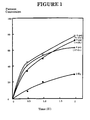
- the ampoules were charged with 5 ml of a mixture of styrene and p-methylstyrene (4 weight percent). Hydrogen was introduced into the ampoule throughout the polymerization via a needle connected to a hydrogen gas manifold of known pressure.
- polymerizations were also conducted in the absence of hydrogen. The ampoules were then equilibrated for 10 minutes at 50°C in a water bath. The polymerization was initiated by addition of the desired amount of catalyst solution described above. The mole ratio of styrene to titanium was 700,000:1.
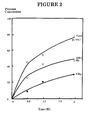
- Example 2 The reaction conditions of Example 1 were substantially repeated using either 6 psi (41 kPa) of hydrogen pressure throughout the polymerization, no hydrogen, or by introducing a known volume of hydrogen into the ampoule headspace prior to polymerization to give a molar ratio, H 2 :monomer, of 400:1. Results are depicted in Figure 2, where it may be seen that the best performance was obtained at hydrogen pressures of 6 psi (41 kPa).
- Example 2 The reaction conditions of Example 2 were substantially repeated using styrene as the only monomer. Hydrogen under 6 psi (41 kPa). pressure introduced throughout the polymerization and the use of a known initial volume of hydrogen in the ampoule headspace (400:1 mole ratio based on styrene) were used. Results are depicted in Figure 3, where it may be seen that the best performance was obtained using hydrogen pressures of 6 psi (41 kPa) continuously during the polymerization.
Landscapes
- Chemical & Material Sciences (AREA)
- Health & Medical Sciences (AREA)
- Chemical Kinetics & Catalysis (AREA)
- Medicinal Chemistry (AREA)
- Polymers & Plastics (AREA)
- Organic Chemistry (AREA)
- Addition Polymer Or Copolymer, Post-Treatments, Or Chemical Modifications (AREA)
- Transition And Organic Metals Composition Catalysts For Addition Polymerization (AREA)
Claims (10)
- Verfahren zur Herstellung von syndiotaktischen Polymeren aus aromatischen Vinylmonomeren, umfassend Inberührungbringen eines oder mehrerer aromatischer Vinylmonomere und eines oder mehrerer Katalysatorsysteme, die einen Metallkomplex auf der Basis von Pentamethylcyclopentadienyltitan enthalten, der fähig ist, syndiotaktische aromatische Vinylpolymere herzustellen unter Koordinationspolymerisationsbedingungen, dadurch gekennzeichnet, daß die Polymerisation in Gegenwart von Wasserstoffgas bei einem Wasserstoffpartialdruck von 10 bis 45 kPa durchgeführt wird.
- Verfahren nach Anspruch 1, wobei das aromatische Vinylmonomer Styrol, p-Methylstyrol oder eine Mischung davon ist.
- Verfahren nach Anspruch 1, wobei das Katalysatorsystem die folgenden Komponenten enthält:A)1) mindestens einen Metallkomplex entsprechend der FormelCp* Pentamethylcyclopentadienyl ist,X unabhängig voneinander bei jedem Auftreten eine monovalente anionische Einheit mit bis zu 20 Nichtwasserstoffatomen ist, unter der Voraussetzung, daß jedoch X bei keinem Auftreten eine aromatische oder nichtaromatische anionische Gruppe ist, die an M π-gebunden ist, alternativ hierzu können zwei X-Gruppen zusammen eine divalente dianionische Einheit bilden, bei der beide Valenzen an M gebunden sind, oder als weitere Alternative können eine oder mehrere X-Gruppen an eine oder mehrere X'-Gruppen gebunden sein und dabei eine Einheit bilden, die sowohl kovalent an M als auch koordinativ daran mittels Lewis-Basen-Funktionalität gebunden ist,X' unabhängig bei jedem Auftreten eine neutrale Donorverbindung mit bis zu 20 Nichtwasserstoffatomen ist undq gleich 0, 1 oder 2 ist, und2) einen aktivierenden Cokatalysator,
wobei das Molverhältnis von 1):2) von 1:10.000 bis 100:1 reicht, oderB) das Reaktionsprodukt gebildet wird, indem 1) durch Verwendung von Aktivierungstechniken in einen aktiven Katalysator verwandelt wird. - Verfahren nach Anspruch 3, wobei die monovalente anionische Einheit X ausgewählt ist aus Halogenid, Kohlenwasserstoff, Hydrocarbyloxy, Di(hydrocarbyl)amido, Di(hydrocarbyl)phosphido, Hydrocarbylsulfido und Silylgruppen und halogen-, di(hydrocarbyl)amino-, hydrocarbyloxy- und di(hydrocarbyl)phosphinosubstituierten Derivaten davon, und die neutrale Donorverbindung X' aus Phosphinen, Phosphiten, Ethern, Aminen und Kohlenmonoxid ausgewählt ist.
- Verfahren nach Anspruch 3, wobei X aus Chlorid, OR und NR2 ausgewählt ist, worin R unabhängig bei jedem Auftreten eine Hydrocarbyl- oder Silylgruppe mit bis zu 10 Nichtwasserstoffatomen ist.
- Verfahren nach Anspruch 3, wobei das Katalysatorsystem einen Metallkomplex entsprechend der Formel Cp*TiX3 enthält, worin X Chlorid oder C1-6-Hydrocarbyloxy ist.
- Verfahren nach Anspruch 3, wobei der aktivierende Cokatalysator ausgewählt ist aus polymeren oder oligomeren Aluminoxanen, starken Lewis-Säuren und nichtpolymeren inerten kompatiblen nichtkoordinierenden ionenbildenden Verbindungen und die Aktivierungstechnik Substanzelektrolyse ist.
- Verfahren nach Anspruch 7, wobei der aktivierende Cokatalysator die Kombination einer Trialkylaluminiumverbindung mit 1 bis 4 Kohlenstoffatomen in jeder Alkylgruppe und eines Ammoniumsalzes von Tetrakis(pentafluorphenyl)borat in einem Molverhältnis von 0,1:1 bis 1:0,1 umfaßt und fakultativ bis zu 1.000 Mol.% eines Alkylaluminoxans enthalten sind.
- Verwendung von Wasserstoff bei einem Partialdruck von 10 bis 45 kPa, um die Katalysatorwirksamkeit zu verbessern, bei der Herstellung von syndiotaktischen Polymeren aus aromatischen Vinylmonomeren, indem unter Koordinationspolymerisationsbedingungen ein oder mehrere aromatische Vinylmonomere und ein oder mehrere Katalysatorsysteme, die einen Metallkomplex auf der Basis von Pentamethylcyclopentadienyltitan enthalten, der fähig ist, syndiotaktische aromatische Vinylpolymere herzustellen, in Berührung gebracht werden.
- Verwendung nach Anspruch 9, wobei das Katalysatorsystem ist, wie es in einem der Ansprüche 2 bis 8 definiert ist.
Applications Claiming Priority (3)
| Application Number | Priority Date | Filing Date | Title |
|---|---|---|---|
| US402446 | 1982-07-27 | ||
| US08/402,446 US5468818A (en) | 1995-03-13 | 1995-03-13 | Syndiotactic vinylaromatic polymerization process using low hydrogen partial pressures |
| PCT/US1995/009317 WO1996028481A1 (en) | 1995-03-13 | 1995-07-24 | Syndiotactic vinylaromatic polymerization process using low hydrogen partial pressures |
Publications (2)
| Publication Number | Publication Date |
|---|---|
| EP0815147A1 EP0815147A1 (de) | 1998-01-07 |
| EP0815147B1 true EP0815147B1 (de) | 1998-11-25 |
Family
ID=23591912
Family Applications (1)
| Application Number | Title | Priority Date | Filing Date |
|---|---|---|---|
| EP95928122A Expired - Lifetime EP0815147B1 (de) | 1995-03-13 | 1995-07-24 | Polymerisationsverfahren zur herstellung syndiotaktischer vinylaromatischer polymere unter anwendung niedriger wasserstoff- partialdrücke |
Country Status (6)
| Country | Link |
|---|---|
| US (1) | US5468818A (de) |
| EP (1) | EP0815147B1 (de) |
| JP (1) | JPH11501962A (de) |
| AT (1) | ATE173745T1 (de) |
| DE (1) | DE69506287T2 (de) |
| WO (1) | WO1996028481A1 (de) |
Families Citing this family (3)
| Publication number | Priority date | Publication date | Assignee | Title |
|---|---|---|---|---|
| US5824753A (en) * | 1995-05-02 | 1998-10-20 | Idemitsu Kosan Co., Ltd. | Process for producing a styrenic polymer |
| AU2411897A (en) * | 1996-05-03 | 1997-11-26 | Dsm N.V. | Process for the polymerization of vinyl aromatic monomers |
| CN1615320A (zh) * | 2002-01-22 | 2005-05-11 | 陶氏环球技术公司 | 具有高熔体流动的乙烯基芳族聚合物 |
Family Cites Families (4)
| Publication number | Priority date | Publication date | Assignee | Title |
|---|---|---|---|---|
| JPH085929B2 (ja) * | 1987-01-22 | 1996-01-24 | 出光興産株式会社 | スチレン系重合体の製造法 |
| US5153157A (en) * | 1987-01-30 | 1992-10-06 | Exxon Chemical Patents Inc. | Catalyst system of enhanced productivity |
| JPH0637534B2 (ja) * | 1988-09-28 | 1994-05-18 | 出光石油化学株式会社 | スチレン系重合体の製造方法 |
| JP2735596B2 (ja) * | 1989-01-20 | 1998-04-02 | 出光石油化学株式会社 | スチレン系重合体の製造方法 |
-
1995
- 1995-03-13 US US08/402,446 patent/US5468818A/en not_active Expired - Fee Related
- 1995-07-24 AT AT95928122T patent/ATE173745T1/de not_active IP Right Cessation
- 1995-07-24 DE DE69506287T patent/DE69506287T2/de not_active Expired - Fee Related
- 1995-07-24 EP EP95928122A patent/EP0815147B1/de not_active Expired - Lifetime
- 1995-07-24 JP JP8527548A patent/JPH11501962A/ja active Pending
- 1995-07-24 WO PCT/US1995/009317 patent/WO1996028481A1/en not_active Ceased
Also Published As
| Publication number | Publication date |
|---|---|
| EP0815147A1 (de) | 1998-01-07 |
| US5468818A (en) | 1995-11-21 |
| WO1996028481A1 (en) | 1996-09-19 |
| JPH11501962A (ja) | 1999-02-16 |
| DE69506287T2 (de) | 1999-07-08 |
| ATE173745T1 (de) | 1998-12-15 |
| DE69506287D1 (de) | 1999-01-07 |
Similar Documents
| Publication | Publication Date | Title |
|---|---|---|
| US5543480A (en) | Polymerization process using diene containing catalysts | |
| EP0656075A1 (de) | Elektrochemische herstellung von additionspolymerisationskatalysatoren | |
| EP1015462A1 (de) | Bimetallische komplexe und diese enthaltende polymerisationskatalysatoren | |
| EP0275943B1 (de) | Verfahren zur Herstellung von Styrolpolymeren | |
| EP0813556B1 (de) | Syndiotaktische vinylaromatische polymerisation mittels staubbett in flüssiger phase | |
| US5536797A (en) | Syndiotactic prochiral olefin polymerization process | |
| EP0722467B1 (de) | Verfahren zur herstellung von syndiotaktischen vinylaromatischen polymeren unter anwendung eines kettenübertragungsmittels | |
| US5468818A (en) | Syndiotactic vinylaromatic polymerization process using low hydrogen partial pressures | |
| US6362293B1 (en) | Syndiotactic vinylidene aromatic polymerization process | |
| EP0897396B1 (de) | Syndiotaktisches vinylaromatisches polymerisationsverfahren | |
| US5990033A (en) | Syndiotactic prochiral olefin polymerization using non-aromatic, anionic, dienyl group containing complexes | |
| WO1997043294A1 (en) | Yttrium containing metal complexes and olefin polymerization process | |
| US6867276B2 (en) | Vinylaromatic polymers having high melt flow | |
| WO1995010551A1 (en) | Process for preparation of syndiotactic vinyl aromatic polymers using reduced metal cationic catalyst | |
| KR100474129B1 (ko) | 비닐리덴방향족단량체의신디오택틱중합체의제조방법 | |
| CA2259428A1 (en) | Saturated tricyclic ligand containing metal complexes and olefin polymerization process | |
| JPH0812711A (ja) | アレン含有触媒を使用する重合方法 |
Legal Events
| Date | Code | Title | Description |
|---|---|---|---|
| PUAI | Public reference made under article 153(3) epc to a published international application that has entered the european phase |
Free format text: ORIGINAL CODE: 0009012 |
|
| 17P | Request for examination filed |
Effective date: 19970830 |
|
| AK | Designated contracting states |
Kind code of ref document: A1 Designated state(s): AT BE CH DE DK ES FR GB GR IE IT LI LU MC NL PT SE |
|
| GRAG | Despatch of communication of intention to grant |
Free format text: ORIGINAL CODE: EPIDOS AGRA |
|
| GRAG | Despatch of communication of intention to grant |
Free format text: ORIGINAL CODE: EPIDOS AGRA |
|
| GRAH | Despatch of communication of intention to grant a patent |
Free format text: ORIGINAL CODE: EPIDOS IGRA |
|
| 17Q | First examination report despatched |
Effective date: 19980414 |
|
| GRAH | Despatch of communication of intention to grant a patent |
Free format text: ORIGINAL CODE: EPIDOS IGRA |
|
| GRAA | (expected) grant |
Free format text: ORIGINAL CODE: 0009210 |
|
| AK | Designated contracting states |
Kind code of ref document: B1 Designated state(s): AT BE CH DE DK ES FR GB GR IE IT LI LU MC NL PT SE |
|
| PG25 | Lapsed in a contracting state [announced via postgrant information from national office to epo] |
Ref country code: SE Free format text: THE PATENT HAS BEEN ANNULLED BY A DECISION OF A NATIONAL AUTHORITY Effective date: 19981125 Ref country code: NL Free format text: LAPSE BECAUSE OF FAILURE TO SUBMIT A TRANSLATION OF THE DESCRIPTION OR TO PAY THE FEE WITHIN THE PRESCRIBED TIME-LIMIT Effective date: 19981125 Ref country code: LI Free format text: LAPSE BECAUSE OF FAILURE TO SUBMIT A TRANSLATION OF THE DESCRIPTION OR TO PAY THE FEE WITHIN THE PRESCRIBED TIME-LIMIT Effective date: 19981125 Ref country code: IT Free format text: LAPSE BECAUSE OF FAILURE TO SUBMIT A TRANSLATION OF THE DESCRIPTION OR TO PAY THE FEE WITHIN THE PRE;WARNING: LAPSES OF ITALIAN PATENTS WITH EFFECTIVE DATE BEFORE 2007 MAY HAVE OCCURRED AT ANY TIME BEFORE 2007. THE CORRECT EFFECTIVE DATE MAY BE DIFFERENT FROM THE ONE RECORDED.SCRIBED TIME-LIMIT Effective date: 19981125 Ref country code: GR Free format text: LAPSE BECAUSE OF NON-PAYMENT OF DUE FEES Effective date: 19981125 Ref country code: FR Free format text: LAPSE BECAUSE OF FAILURE TO SUBMIT A TRANSLATION OF THE DESCRIPTION OR TO PAY THE FEE WITHIN THE PRESCRIBED TIME-LIMIT Effective date: 19981125 Ref country code: ES Free format text: THE PATENT HAS BEEN ANNULLED BY A DECISION OF A NATIONAL AUTHORITY Effective date: 19981125 Ref country code: CH Free format text: LAPSE BECAUSE OF FAILURE TO SUBMIT A TRANSLATION OF THE DESCRIPTION OR TO PAY THE FEE WITHIN THE PRESCRIBED TIME-LIMIT Effective date: 19981125 Ref country code: AT Free format text: LAPSE BECAUSE OF FAILURE TO SUBMIT A TRANSLATION OF THE DESCRIPTION OR TO PAY THE FEE WITHIN THE PRESCRIBED TIME-LIMIT Effective date: 19981125 |
|
| REF | Corresponds to: |
Ref document number: 173745 Country of ref document: AT Date of ref document: 19981215 Kind code of ref document: T |
|
| REG | Reference to a national code |
Ref country code: CH Ref legal event code: EP |
|
| REF | Corresponds to: |
Ref document number: 69506287 Country of ref document: DE Date of ref document: 19990107 |
|
| REG | Reference to a national code |
Ref country code: IE Ref legal event code: FG4D |
|
| PG25 | Lapsed in a contracting state [announced via postgrant information from national office to epo] |
Ref country code: PT Free format text: LAPSE BECAUSE OF FAILURE TO SUBMIT A TRANSLATION OF THE DESCRIPTION OR TO PAY THE FEE WITHIN THE PRESCRIBED TIME-LIMIT Effective date: 19990225 Ref country code: DK Free format text: LAPSE BECAUSE OF FAILURE TO SUBMIT A TRANSLATION OF THE DESCRIPTION OR TO PAY THE FEE WITHIN THE PRESCRIBED TIME-LIMIT Effective date: 19990225 |
|
| EN | Fr: translation not filed | ||
| NLV1 | Nl: lapsed or annulled due to failure to fulfill the requirements of art. 29p and 29m of the patents act | ||
| REG | Reference to a national code |
Ref country code: CH Ref legal event code: PL |
|
| PG25 | Lapsed in a contracting state [announced via postgrant information from national office to epo] |
Ref country code: LU Free format text: LAPSE BECAUSE OF NON-PAYMENT OF DUE FEES Effective date: 19990724 Ref country code: IE Free format text: LAPSE BECAUSE OF NON-PAYMENT OF DUE FEES Effective date: 19990724 Ref country code: GB Free format text: LAPSE BECAUSE OF NON-PAYMENT OF DUE FEES Effective date: 19990724 |
|
| PLBE | No opposition filed within time limit |
Free format text: ORIGINAL CODE: 0009261 |
|
| STAA | Information on the status of an ep patent application or granted ep patent |
Free format text: STATUS: NO OPPOSITION FILED WITHIN TIME LIMIT |
|
| 26N | No opposition filed | ||
| PG25 | Lapsed in a contracting state [announced via postgrant information from national office to epo] |
Ref country code: MC Free format text: LAPSE BECAUSE OF NON-PAYMENT OF DUE FEES Effective date: 20000131 |
|
| GBPC | Gb: european patent ceased through non-payment of renewal fee |
Effective date: 19990724 |
|
| REG | Reference to a national code |
Ref country code: IE Ref legal event code: MM4A |
|
| PGFP | Annual fee paid to national office [announced via postgrant information from national office to epo] |
Ref country code: DE Payment date: 20010615 Year of fee payment: 7 |
|
| PGFP | Annual fee paid to national office [announced via postgrant information from national office to epo] |
Ref country code: BE Payment date: 20010816 Year of fee payment: 7 |
|
| PG25 | Lapsed in a contracting state [announced via postgrant information from national office to epo] |
Ref country code: BE Free format text: LAPSE BECAUSE OF NON-PAYMENT OF DUE FEES Effective date: 20020731 |
|
| BERE | Be: lapsed |
Owner name: THE *DOW CHEMICAL CY Effective date: 20020731 |
|
| PG25 | Lapsed in a contracting state [announced via postgrant information from national office to epo] |
Ref country code: DE Free format text: LAPSE BECAUSE OF NON-PAYMENT OF DUE FEES Effective date: 20030201 |