EP0809873B1 - Steuerradverbinder mit mehrfachbürste - Google Patents
Steuerradverbinder mit mehrfachbürste Download PDFInfo
- Publication number
- EP0809873B1 EP0809873B1 EP96905392A EP96905392A EP0809873B1 EP 0809873 B1 EP0809873 B1 EP 0809873B1 EP 96905392 A EP96905392 A EP 96905392A EP 96905392 A EP96905392 A EP 96905392A EP 0809873 B1 EP0809873 B1 EP 0809873B1
- Authority
- EP
- European Patent Office
- Prior art keywords
- electrical
- contact
- plates
- recited
- commutator
- Prior art date
- Legal status (The legal status is an assumption and is not a legal conclusion. Google has not performed a legal analysis and makes no representation as to the accuracy of the status listed.)
- Expired - Lifetime
Links
Images

Classifications
-
- H—ELECTRICITY
- H01—ELECTRIC ELEMENTS
- H01R—ELECTRICALLY-CONDUCTIVE CONNECTIONS; STRUCTURAL ASSOCIATIONS OF A PLURALITY OF MUTUALLY-INSULATED ELECTRICAL CONNECTING ELEMENTS; COUPLING DEVICES; CURRENT COLLECTORS
- H01R35/00—Flexible or turnable line connectors, i.e. the rotation angle being limited
- H01R35/04—Turnable line connectors with limited rotation angle with frictional contact members
-
- B—PERFORMING OPERATIONS; TRANSPORTING
- B60—VEHICLES IN GENERAL
- B60Q—ARRANGEMENT OF SIGNALLING OR LIGHTING DEVICES, THE MOUNTING OR SUPPORTING THEREOF OR CIRCUITS THEREFOR, FOR VEHICLES IN GENERAL
- B60Q1/00—Arrangement of optical signalling or lighting devices, the mounting or supporting thereof or circuits therefor
- B60Q1/0076—Switches therefor
- B60Q1/0082—Switches therefor mounted on the steering wheel
-
- H—ELECTRICITY
- H01—ELECTRIC ELEMENTS
- H01R—ELECTRICALLY-CONDUCTIVE CONNECTIONS; STRUCTURAL ASSOCIATIONS OF A PLURALITY OF MUTUALLY-INSULATED ELECTRICAL CONNECTING ELEMENTS; COUPLING DEVICES; CURRENT COLLECTORS
- H01R39/00—Rotary current collectors, distributors or interrupters
- H01R39/02—Details for dynamo electric machines
- H01R39/18—Contacts for co-operation with commutator or slip-ring, e.g. contact brush
-
- H—ELECTRICITY
- H01—ELECTRIC ELEMENTS
- H01R—ELECTRICALLY-CONDUCTIVE CONNECTIONS; STRUCTURAL ASSOCIATIONS OF A PLURALITY OF MUTUALLY-INSULATED ELECTRICAL CONNECTING ELEMENTS; COUPLING DEVICES; CURRENT COLLECTORS
- H01R39/00—Rotary current collectors, distributors or interrupters
- H01R39/02—Details for dynamo electric machines
- H01R39/18—Contacts for co-operation with commutator or slip-ring, e.g. contact brush
- H01R39/24—Laminated contacts; Wire contacts, e.g. metallic brush, carbon fibres
Definitions
- rotating electrical commutators are utilized to transfer electrical communication between two parts that rotate relative to each other.
- electrical communication between a steering wheel and the fixed steering column is provided by any one of several types of commutators. Since the steering wheel must rotate through several rotations relative to the fixed steering column, some method of communicating electrical signals between the steering wheel and the fixed steering column is necessary that can accommodate relative rotation.
- a wire ribbon physically connects a rotating member to a connection on a fixed member.
- the wire ribbon is coiled such that several complete relative rotations are allowed.
- Prior art wire ribbons accommodate approximately three and one-half complete rotations of the steering wheel relative to the fixed steering column in either direction. While this may be adequate rotation, there are some deficiencies in the wire ribbon type of connection.
- wire ribbons do not allow the use of more than one connection at any axial space.
- the required axial length for a commutator utilizing wire ribbons also increases dramatically.
- Modern vehicle steering systems must communicate many distinct electrical signals between the steering wheel and the fixed steering column.
- steering wheels now must carry signals from the cruise control, the air bag system, and the horn.
- other controls such as those for the radio or lights are being designed into the steering wheel.
- electrical commutators are needed that will reliably communicate many electrical signals between the rotating steering wheel and the fixed steering column.
- the relatively large wire ribbons would require excessive amounts of axial space to communicate all of the required signals.
- wire ribbons are capable of providing acceptable amounts of relative rotation, they may only do so when they have been precisely mounted between the rotating and fixed members. That is, the wire ribbon may be able to provide three and one-half complete rotations in either the clockwise or counterclockwise direction, but only when the wire ribbon has been properly mounted between the rotating and non-rotating members. Should the wire ribbon be mounted improperly, it could, as an example, allow six complete rotations in a first direction, but only one in the other direction. This would, of course, be undesirable.
- the other main type of steering wheel commutator has been a single connection point that rotates with the rotating member along a ring on the fixed member.
- Such commutators do not require the precise positioning of wire ribbons, nor do they require large amounts of axial space.
- the single contact point rotary commutators have not always operated as desired. As one example, should the single contact point break or bend out of contact with the ring, there is no longer any electrical communication between the rotating and fixed member.
- the prior art single contact points extend at an angle toward the other ring.
- the angle orientation in the clockwise direction could cause more resistance to turning in the counter-clockwise direction and vice versa.
- the integrity of the electrical connection would also be different between the clockwise and counter-clockwise directions.
- Patent No. FR-A-2 568 421 discloses an electrical commutator having a plurality of contact plates spaced radially about a central rotation axis.
- FR-A-2 404 936 discloses the use of a multiple wire to provide an electrical connection where the connection is maintained with a single rotating contact ring.
- an electrical commutator contains a non-rotating plate and a rotating plate.
- One of the plates is provided with a plurality of radially spaced co-planar electrical contact members.
- the plurality of electrical contact members each individually contact a contact ring to provide electrical communication between the rotating and non-rotating plates.
- Several circuits are provided by using plural radially spaced co-planar contact rings. Should one of the plurality of electrical contact members bend or break, the other electrical contact members still provide an electric circuit.
- other contact members would be in a radial position where there is no such discontinuity. Those other contact members remain in contact with the ring keeping the electrical circuit intact.
- the plurality of electrical contact members are provided by a wire brush containing ten separate wires welded to a contact tab fixed to one of the rotating and non-rotating plates.
- the single contact tab provides a more secure connection than the prior art plural wires.
- Other numbers of wires may be used, but preferably more than five are used to increase the number of separate electric connectors.
- the plate which does not include the contact members includes several co-planar electrical contact rings extending about the entire circumferential extent of that plate.
- the plurality of contact members may rotate through a complete rotation, but will remain in contact with the contact rings throughout each rotation. There is no limit on the number of rotations, as the plurality of contact members can continue to rotate along the ring.
- a stamped conductive member has a contact tab formed with integral fingers that provide the electrical connection.
- one contact ring may have sets of the plurality of contact members at two locations spaced by 180°.
- the wire brushes or fingers extend from a plate at an angle that is not directly perpendicular to the other plate.
- the wire brushes approach the associated contact ring at a non-perpendicular angle.
- the wires are preferably maintained against the contact ring with a small spring force.
- an end of the wire brush or finger is bent perpendicularly relative to the angled portion to be in contact with its associated contact ring.
- an end of the brush or finger contacts the contact ring and then bends back upwardly away from the contact ring.
- the angled wire brushes or fingers are mounted such that at least some of the sets of brushes or fingers extend in different directions from others of the sets of brushes or fingers. That is, while a first set of brushes or fingers associated with one of the contact rings may extend counter-clockwise from its plate. another of the sets of brushes associated with that same contact ring may extend counter-clockwise from its plate. In this way, the brushes or fingers are properly positioned to provide good electrical contact whether the two plates are rotating counter-clockwise or clockwise relative to each other.
- the contact rings may be insert molded into the plate.
- the brushes are preferably welded to the mounting tabs, which are then connected into the associated plate.
- the wire or fingers are preferably formed of a metal that has both good electrical conduction properties and spring properties.
- the plate which receives the brushes or fingers also includes rings that extend between each of the several sets of brushes to provide electrical communication between the sets of brushes or fingers. Known electrical contacts extend from each of the plates to their associated destinations.
- Figure 1 is a perspective schematic view showing a steering wheel system incorporating the present invention.
- Figure 2 is a cross-sectional view through an electrical commutator according to the present invention along line 2-2 of Figure 1.
- Figure 3 is a plan view of a first plate incorporated into the present invention.
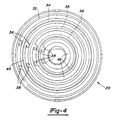
- Figure 4 is a plan view of a second plate of the present invention.
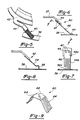
- Figure 5 shows a connection of the electrical brushes according to the present invention.
- Figure 6 is a side view of a first embodiment of a wire brush.
- Figure 7 is a view along line 7-7 as shown in Figure 6.
- Figure 8 is a side view of a second embodiment of a wire brush.
- Figure 9 is a perspective of an alternative to the wire brush embodiments.
- FIG. 1 schematically shows a vehicle steering system 20 incorporating a steering wheel 22.
- a panel 23 associated with the steering wheel may include several electrical signalling buttons, and also the air bag system.
- a portion of the steering wheel system here shown schematically at 24, rotates with the steering wheel, while the steering column 25 remains fixed.
- An electrical commutator 28 is shown schematically including a rotating plate 27 and a fixed plate 29. The electrical commutator 28 allows communication of electrical signals between the electrical switches and components associated with the steering wheel 22 to the vehicle control.
- plate 27 incorporates a hole 30 to receive a shaft for mounting the plate 27 to a rotating member for rotation relative to the fixed plate 29 and tabs 31 holding the plates 27 and 29 in proximity to each other.
- a plurality, of co-planar contact rings 32, 34, 35 and 36 are formed on plate 29, and are each associated with a separate electric circuit.
- ring 32 may be associated with a vehicle horn
- ring 34 may be associated with the air bag
- ring 36 may be associated with the cruise control. It should be understood that practical applications of this invention may include more than four circuits; however, for the sake of simplicity, only four circuits are illustrated in this Figure.
- Electrical connections 38 extend from each of the rings 32, 34 and 36, to associated connections in the steering wheel 22.
- the present invention includes a plurality of sets of electrical connections 40 extending from one of the plates, here 27, to the other plate 29. It should also be understood that while the electrical connections 40 are shown extending from the rotating plate 27 to the non-rotating plate 29, the electrical connections 40 could also be mounted on the non-rotating plate, and the co-planar rings 32, 34 and 36 mounted on the rotating plate.
- the electrical connections 40 preferably include wire brushes or fingers.
- one contact point system if there was a failure rate of one in a thousand, the use of ten contacts, each having a failure rate of one in a thousand, should decrease the failure rate to an infinitesimally small number.
- walls 41 may be integrally molded with plate 29 to provide separation between the co-planar contact rings. Again, for simplicity, walls 41 are not illustrated between each of the rings, although they may be used between each contact ring.
- the plate 27 incorporates rings 42 extending between sets of brush mount tab locations 44.
- Each brush mount tab 44 mounts one of the sets 40 of the wire brushes.
- the rings 42 may mount sets of brushes 40 at only two locations spaced circumferentially by 180° as shown at 41. However, other rings 42 may have greater numbers of sets of brushes 40. In the other rings shown, there are sets of brushes 40 mounted at each 90° increment. Typically, additional sets are used for the more critical functions, such as the air bag connections.
- connections shown at 43 and 47 associated with one of the rings 42 face each other.
- the wire brushes 40 extend at an angle from plate 27 towards plate 29.
- one of the sets will be angled into the rotation whether the rotation is in a clockwise or a counter-clockwise direction.
- the reliability of the electrical connection will not differ between rotation in the clockwise or counter-clockwise directions.
- Figure 4 is a plan view of the plate 29 having the contact rings.
- the rings 32, 34, 35 and 36 extend around the entire circumference of the plate 29.
- the connection portions of 38 extend through the plate, and are connected to other electrical members to pass the electrical communication on.
- the details of the connection between connection portions 38 and the remaining electrical portions, and the details of the other electrical portions of the system, are as known in the art, and form no portion of this invention. Also, since the rings are co-planar, a large number of rings can be placed in a limited axial space.
- the plate 29 can be formed with many radially spaced co-planar contact rings.
- Contact rings 45 are shown at the innermost radial portion of the plate 29, and also spaced slightly radially inwardly from each of the rings 32, 34, 35 and 36. For the sake of simplicity, fewer rings were illustrated in Figure 2; however, Figure 4 does show the ability to communicate many electrical circuits through the inventive commutator 28 in a small axial space.
- Figure 5 is a view looking downwardly at the wire brush connections, with the plate 27 removed for clarity.
- the brush mount tab 44 mounts a set of thin wires 40.
- the wires are mounted side by side relative to each other in a direction extending radially outwardly relative to an axis of rotation. As one plate rotates, the wires slide along ring 36, maintaining an electric circuit.
- the greater number of individual wires increase the reliability of the overall connection by providing additional separate connections.
- the use of the single tab 44 to connect to the ring provides a more secure connection than the prior art use of connecting several individual wires.
- the wire brush sets 40 include wires 46 extending at an angle that is non-perpendicular to the plate 29.
- the wire brushes 46 are welded at two weld points 47 to the tab 44.
- a bend portion 49 is in contact portion with ring 29.
- the wire brush contact portions 49 move along the contact ring 36 on the plate 29.
- the plates 27 and 29 are mounted sufficiently close axially such that the contact portion 49 is held by a small spring bias force in contact with the ring 36, assuring a good electrical connection.
- Figure 7 is a view along line 7-7 as shown in Figure 6.
- wire brush set 40 includes a top portion 46a welded at 47 to the tab 44.
- Wire brush set 40 can be formed with a solid top portion 46a and with a plurality of separate wire ends 46b at the contact end.
- the plurality of wire ends 46b allow any one of the brush ends to come out of contact with the contact ring 36, while still providing other brush ends that will remain in contact.
- a discontinuity 36d at a particular radial portion of contact ring 36 could cause the leftmost two of the wire ends 46b to come out of contact with the contact ring 36.
- Figure 8 shows an alternative embodiment 52 wherein the wire brush 54 extends at an angle relative to the plate 29 to an end 56 that is bent to extend perpendicularly into contact with a ring, here 36. Again, a small spring bias force maintains end 56 in contact with ring 36.
- FIG. 9 An alternative embodiment 60 is shown in Figure 9.
- contact member 60 is stamped from a single piece of metal.
- a central tab portion 62 is connected to the rotating plate, and a plurality of fingers 64 are individually stamped out of the single piece of metal to extend from tab 62.
- fingers 64 extend in both directions at an angle from central tab 62.
- the plates 27 and 29 are formed of a non-conductive material.
- the rings 32, 34, 36 and 42 may be insert molded into the plates. Electrical connections extending away from the plates have appropriate connections or terminals.
- Either of the rotating or fixed plates 27 and 29 may be part of another assembly such as a multi-function switch or housing. Further, either or both plates 27, 29 could be the rotating plate.
- the rotating plates may be formed of self-lubricating material, such as PTFE.
- the circuit material formed on the plates may be known substrate material with copper lamina. One such material might be FR-4 substrate with a two-ounce copper laminate.
- the cooper traces may be electroplated with five micro-inches of nickel to create a base for a 7.62 x 10 -4 mm (30-micro-inch) of rhodium, which is then plated over the nickel for a final finish.
- the circuit spacing has some design minimum between each of the contact rings. In one embodiment, the minimum circuit spacing was found to be .635 millimeter. To determine the required spacing, a dielectric strength test may be required. In such tests, 440 volts of DC current may be applied for one second.
- the dielectric strength of adjacent circuits must not exceed 500 micro amps leakage at room temperature. If this test is passed, then one can determine that a minimum spacing may well be provided.
- the substrate thickness for the plate is preferably between 0.51 mm to 6.35 mm (.020 to .250 inch).
- Known rigid boards typically have a thickness of about 0.413 mm (.01625 inch (1/16 inch)).
- the width of the ring should be as generous as possible to accommodate nominal amounts of nicks, etc., and still function. At the same time, the width of the circuit increases the required radial space for each contact ring and thus decreases the available number of contact rings in any one application. Z-wire or plated through hole connections may be utilized.
- the substrate material may be any one of several known base materials.
- known base materials include phenolic-resin impregnated paper, acrylic-polyester impregnated random glass mats, epoxy-impregnated paper, or epoxy-impregnated fiberglass cloth.
- phenolic-resin impregnated paper acrylic-polyester impregnated random glass mats
- epoxy-impregnated paper or epoxy-impregnated fiberglass cloth.
- the material for the multi-finger members may be selected from three main groups, including coppers, precious metal alloys, and bi-metals.
- Suggested copper alloys to be used for the contacts are beryllium copper, nickel silvers, phosphorous bronze, and pfinodal materials.
- the precious metal alloys may include palladium-silver-platinum alloys or palladium-silver-platinum-gold alloys.
- the bi-metals may include combinations of the low cost copper alloys with the performance advantages of the precious metal alloys.
- One example would be a pfinodal and palladium-silver-platinum combination.
- the pfinodal would be the base metal and the palladium-silver-platinum would provide a precious metal outer surface. It has also been considered that it might be valuable to provide a heating element within one of the plates to prevent icing over of the contact rings directly on the surface.
Landscapes
- Engineering & Computer Science (AREA)
- Mechanical Engineering (AREA)
- Motor Or Generator Current Collectors (AREA)
Claims (15)
- Drehbarer elektrischer Kommutator zur Anwendung in einem Lenkrad eines Fahrzeugs, umfassend:dadurch gekennzeichnet, daßeine erste Platte (27), die einer zweiten Platte (29) gegenüberliegt, wobei die erste und die zweite Platte so angebracht sind, daß sie sich um eine Achse relativer Drehung relativ zueinander drehen, wobeieine der ersten und zweiten Platten eine Mehrzahl koplanarer elektrischer Kontaktringe (38) aufweist, die sich jeweilsumfangsmäßig um die Achse herum erstrecken, und die andere der ersten und zweiten Platten Sätze elektrischer Kontaktelemente (43) aufweist,
jeder Satz (40) eine auf der anderen Platte getragene und zu einer Fläche auf der anderen Platte parallele Zunge (44) aufweist, eine Mehrzahl elektrischer Kontaktelemente Seite an Seite ausgerichtet sind und sich von der Zunge aus erstrecken, und jeder der Sätze sich in Kontakt mit einem der elektrischen Kontaktringe erstreckt, wobei die Mehrzahl elektrischer Kontaktelemente die Wahrscheinlichkeit der Kontaktunterbrechung zwischen irgendeinem der Sätze und den ko-planaren elektrischen Kontaktringen verringert. - Elektrischer Kommutator nach Anspruch 1, wobei die Mehrzahl elektrischer Kontaktelemente eine Mehrzahl von Drähten enthält.
- Elektrischer Kommutator nach Anspruch 2, wobei mehrere Sätze (43,47,64) der Mehrzahl von Drähten an beabstandeten Umfangsstellen in Kontakt mit mindestens einem der Kontaktringe sind.
- Elektrischer Kommutator nach Anspruch 3, wobei mindestens einer der Mehrzahl von Kontaktringen in Kontakt mit einer größeren Anzahl der Sätze ist als andere der Mehrzahl von Kontaktringen, wobei jeder Satz der größeren Anzahl von Sätzen von der Drehachse der Platten gleichmäßig radial beabstandet ist.
- Elektrischer Kommutator nach Anspruch 3, wobei die Mehrzahl von Drähten in jedem der Sätze Drähte enthält, die in einer Seite-an-Seite-Beziehung im wesentlichen in radialer Auswärtsrichtung stehen.
- Elektrischer Kommutator nach Anspruch 3, wobei sich die Drähte in einem Winkel erstrecken, der nicht parallel zu der Achse ist.
- Elektrischer Kommutator nach Anspruch 6, wobei mindestens einige der umfangsmäßig beabstandeten Sätze von Drahtbürsten sich in Winkeln derart aufeinander zu erstrecken, daß sich ein erster Teilsatz der Sätze von Drahtbürsten im Gegenuhrzeigersinn von den anderen der Platten erstreckt, und sich ein zweiter Teilsatz der Sätze von Drahtbürsten, der umfangsmäßig von dem ersten Satz beabstandet ist, im Uhrzeigersinn von den anderen der Platten erstreckt.
- Elektrischer Kommutator nach Anspruch 6, wobei sich die Drähte (54) in einen Winkel von der anderen der Platten zu einem Endabschnitt (56) erstrecken und sich der Endabschnitt im wesentlichen parallel zu derr Achse und zu der einen der Platten hin erstreckt, um mit dem Kontaktring in Kontakt zu sein.
- Elektrischer Kommutator nach Anspruch 6, wobei sich die Drähte (46) unter dem Winkel direkt in Kontakt mit der einen der Platten erstrecken, und sich ein Ende (49) der Drahtbürste sodann unter einem Winkel axial von der einen der Platten weg erstreckt.
- Elektrischer Kommutator nach Anspruch 3, wobei ein Kontaktring elektrische Verbindungen zwischen einander zugeordneten der Sätze elektrischer Bürsten herstellt.
- Elektrischer Kommutator nach Anspruch 2, wobei die Drahtbürsten (46) an die Zungen angeschweißt sind.
- Elektrischer Kommutator nach Anspruch 1, wobei die eine der Platten aus Kunststoffmaterial gebildet ist und die Kontaktringe in das Kunststoffmaterial einsatzgeformt sind.
- Elektrischer Kommutator nach Anspruch 1, wobei Wände (41) auf der einen der Platten ausgebildet sind und sich zwischen den ko-planaren elektrischen Kontaktringen zur anderen der Platten hin erstrecken, um eine Trennung zwischen der Mehrzahl ko-planarer elektrischer Kontaktringe vorzusehen.
- Elektrischer Kommutator nach Anspruch 1, wobei die Mehrzahl der elektrischen Kontaktelemente aus einem einzelnen gestanzten Metallstück (60,64) gebildet sind und das einzelne gestanzte Metallstück die Zunge aufweist, die an der anderen der Platten befestigt ist und eine Mehrzahl von einzelnen Metallfingern aufweist, die sich von der Zunge in Kontakt mit den ko-planaren elektrischen Kontaktringen erstrecken.
- Elektrischer Kommutator nach Anspruch 14, wobei sich die Finger (64) von der Zunge (62) aus in entgegengesetzten Richtungen erstrecken.
Applications Claiming Priority (5)
| Application Number | Priority Date | Filing Date | Title |
|---|---|---|---|
| US39003495A | 1995-02-17 | 1995-02-17 | |
| US390034 | 1995-02-17 | ||
| US435869 | 1995-05-04 | ||
| US08/435,869 US6007344A (en) | 1995-02-17 | 1995-05-04 | Multiple brush steering wheel commutator |
| PCT/US1996/001625 WO1996025777A1 (en) | 1995-02-17 | 1996-02-05 | Multiple brush steering wheel commutator |
Publications (2)
| Publication Number | Publication Date |
|---|---|
| EP0809873A1 EP0809873A1 (de) | 1997-12-03 |
| EP0809873B1 true EP0809873B1 (de) | 1999-09-08 |
Family
ID=27012957
Family Applications (1)
| Application Number | Title | Priority Date | Filing Date |
|---|---|---|---|
| EP96905392A Expired - Lifetime EP0809873B1 (de) | 1995-02-17 | 1996-02-05 | Steuerradverbinder mit mehrfachbürste |
Country Status (4)
| Country | Link |
|---|---|
| EP (1) | EP0809873B1 (de) |
| JP (1) | JPH11502050A (de) |
| DE (1) | DE69604156T2 (de) |
| WO (1) | WO1996025777A1 (de) |
Families Citing this family (2)
| Publication number | Priority date | Publication date | Assignee | Title |
|---|---|---|---|---|
| DE10111400B4 (de) * | 2001-03-09 | 2008-09-25 | Hella Kgaa Hueck & Co. | Stellantrieb für Heizungs-, Lüftungs- oder Klimaklappen in einem Kraftfahrzeug |
| DE102018213999A1 (de) * | 2018-08-20 | 2020-02-20 | Spinner Gmbh | Gleitkontaktkörper sowie elektrischer Drehübertrager |
Family Cites Families (5)
| Publication number | Priority date | Publication date | Assignee | Title |
|---|---|---|---|---|
| US1975964A (en) * | 1931-04-17 | 1934-10-09 | Willard H Mayhew | Electrical swivel connecter |
| NL142024B (nl) * | 1964-06-12 | 1974-04-16 | Philips Nv | Kleine elektrische machine met vlakke commutator en uit bladveren gevormde borstel. |
| FR1414008A (fr) * | 1964-09-02 | 1965-10-15 | Articulation à rotules pour contact électrique circulaire | |
| FR2404936A1 (fr) * | 1977-10-03 | 1979-04-27 | Anvar | Perfectionnements aux dispositifs de contact electrique glissant |
| DE3427588A1 (de) * | 1984-07-26 | 1986-02-06 | Franz Kirsten Elektrotechnische Spezialfabrik, 6530 Bingen | Einrichtung zur stromuebertragung zwischen einem feststehenden und einem verdrehbaren teil |
-
1996
- 1996-02-05 EP EP96905392A patent/EP0809873B1/de not_active Expired - Lifetime
- 1996-02-05 WO PCT/US1996/001625 patent/WO1996025777A1/en not_active Ceased
- 1996-02-05 JP JP8525002A patent/JPH11502050A/ja active Pending
- 1996-02-05 DE DE69604156T patent/DE69604156T2/de not_active Expired - Fee Related
Also Published As
| Publication number | Publication date |
|---|---|
| EP0809873A1 (de) | 1997-12-03 |
| WO1996025777A1 (en) | 1996-08-22 |
| JPH11502050A (ja) | 1999-02-16 |
| DE69604156D1 (de) | 1999-10-14 |
| DE69604156T2 (de) | 2000-03-09 |
Similar Documents
| Publication | Publication Date | Title |
|---|---|---|
| US6007344A (en) | Multiple brush steering wheel commutator | |
| US5587890A (en) | Vehicle electric power distribution system | |
| EP0706727B1 (de) | Bürstenhalter | |
| CA1167891A (en) | Column mounted switch for vehicles and the like | |
| EP0716481B1 (de) | Drehbarer elektrischen Verbinder | |
| EP0767525B1 (de) | Bürstenhalter für elektrischen Motor | |
| US5429508A (en) | Automobile steering column interconnector | |
| EP0809873B1 (de) | Steuerradverbinder mit mehrfachbürste | |
| US6259184B1 (en) | Load shifting device | |
| JP4625016B2 (ja) | 電気機器用の整流子 | |
| EP1182737B1 (de) | Gehäuse für elektrischen Verbinder | |
| US3501598A (en) | Electric switch assembly for printed circuit installations | |
| US11527841B2 (en) | Electrical connection system for connecting a printed circuit board to a plug connector by way of an electical connection device | |
| JP2704492B2 (ja) | プログラマブル入出力電気コネクタ | |
| US7686325B2 (en) | Gas generator and device for electrically contacting a gas generator | |
| US6849815B2 (en) | Steering column switch for motor vehicles | |
| US6770991B2 (en) | Roll connector structure for a vehicle | |
| US6994557B2 (en) | Electrical connector between two end points | |
| US11296438B1 (en) | Electrical connector assembly having a terminal-less connection system | |
| WO2001061791A1 (en) | Flat conductor termination device | |
| US6851972B2 (en) | Connector device and wiper drive motor having connector device | |
| US6752637B2 (en) | Flexible circuit relay | |
| EP0599572B1 (de) | Elektrodynamische Maschine mit Blechbügelbürsten | |
| CN113363769A (zh) | 用于传输电流的部件的布置 | |
| US6220877B1 (en) | Monolithic terminal interface |
Legal Events
| Date | Code | Title | Description |
|---|---|---|---|
| PUAI | Public reference made under article 153(3) epc to a published international application that has entered the european phase |
Free format text: ORIGINAL CODE: 0009012 |
|
| 17P | Request for examination filed |
Effective date: 19970801 |
|
| AK | Designated contracting states |
Kind code of ref document: A1 Designated state(s): DE ES FR GB IT SE |
|
| 17Q | First examination report despatched |
Effective date: 19980102 |
|
| GRAG | Despatch of communication of intention to grant |
Free format text: ORIGINAL CODE: EPIDOS AGRA |
|
| GRAG | Despatch of communication of intention to grant |
Free format text: ORIGINAL CODE: EPIDOS AGRA |
|
| GRAH | Despatch of communication of intention to grant a patent |
Free format text: ORIGINAL CODE: EPIDOS IGRA |
|
| GRAH | Despatch of communication of intention to grant a patent |
Free format text: ORIGINAL CODE: EPIDOS IGRA |
|
| GRAA | (expected) grant |
Free format text: ORIGINAL CODE: 0009210 |
|
| RAP1 | Party data changed (applicant data changed or rights of an application transferred) |
Owner name: UT AUTOMOTIVE DEARBORN, INC. |
|
| AK | Designated contracting states |
Kind code of ref document: B1 Designated state(s): DE ES FR GB IT SE |
|
| PG25 | Lapsed in a contracting state [announced via postgrant information from national office to epo] |
Ref country code: IT Free format text: LAPSE BECAUSE OF FAILURE TO SUBMIT A TRANSLATION OF THE DESCRIPTION OR TO PAY THE FEE WITHIN THE PRE;WARNING: LAPSES OF ITALIAN PATENTS WITH EFFECTIVE DATE BEFORE 2007 MAY HAVE OCCURRED AT ANY TIME BEFORE 2007. THE CORRECT EFFECTIVE DATE MAY BE DIFFERENT FROM THE ONE RECORDED.SCRIBED TIME-LIMIT Effective date: 19990908 Ref country code: ES Free format text: THE PATENT HAS BEEN ANNULLED BY A DECISION OF A NATIONAL AUTHORITY Effective date: 19990908 |
|
| REF | Corresponds to: |
Ref document number: 69604156 Country of ref document: DE Date of ref document: 19991014 |
|
| ET | Fr: translation filed | ||
| PGFP | Annual fee paid to national office [announced via postgrant information from national office to epo] |
Ref country code: FR Payment date: 20000119 Year of fee payment: 5 |
|
| PGFP | Annual fee paid to national office [announced via postgrant information from national office to epo] |
Ref country code: SE Payment date: 20000120 Year of fee payment: 5 Ref country code: GB Payment date: 20000120 Year of fee payment: 5 Ref country code: DE Payment date: 20000120 Year of fee payment: 5 |
|
| PLBE | No opposition filed within time limit |
Free format text: ORIGINAL CODE: 0009261 |
|
| STAA | Information on the status of an ep patent application or granted ep patent |
Free format text: STATUS: NO OPPOSITION FILED WITHIN TIME LIMIT |
|
| 26N | No opposition filed | ||
| PG25 | Lapsed in a contracting state [announced via postgrant information from national office to epo] |
Ref country code: GB Free format text: LAPSE BECAUSE OF NON-PAYMENT OF DUE FEES Effective date: 20010205 |
|
| PG25 | Lapsed in a contracting state [announced via postgrant information from national office to epo] |
Ref country code: SE Free format text: LAPSE BECAUSE OF NON-PAYMENT OF DUE FEES Effective date: 20010206 |
|
| GBPC | Gb: european patent ceased through non-payment of renewal fee |
Effective date: 20010205 |
|
| EUG | Se: european patent has lapsed |
Ref document number: 96905392.5 |
|
| PG25 | Lapsed in a contracting state [announced via postgrant information from national office to epo] |
Ref country code: FR Free format text: LAPSE BECAUSE OF NON-PAYMENT OF DUE FEES Effective date: 20011031 |
|
| REG | Reference to a national code |
Ref country code: FR Ref legal event code: ST |
|
| PG25 | Lapsed in a contracting state [announced via postgrant information from national office to epo] |
Ref country code: DE Free format text: LAPSE BECAUSE OF NON-PAYMENT OF DUE FEES Effective date: 20011201 |