EP0809309A1 - Positive plate active material for alkaline storage battery and positive electrode - Google Patents
Positive plate active material for alkaline storage battery and positive electrode Download PDFInfo
- Publication number
- EP0809309A1 EP0809309A1 EP96935481A EP96935481A EP0809309A1 EP 0809309 A1 EP0809309 A1 EP 0809309A1 EP 96935481 A EP96935481 A EP 96935481A EP 96935481 A EP96935481 A EP 96935481A EP 0809309 A1 EP0809309 A1 EP 0809309A1
- Authority
- EP
- European Patent Office
- Prior art keywords
- active material
- positive electrode
- solid solution
- nickel hydroxide
- manganese
- Prior art date
- Legal status (The legal status is an assumption and is not a legal conclusion. Google has not performed a legal analysis and makes no representation as to the accuracy of the status listed.)
- Granted
Links
Images
Classifications
-
- C—CHEMISTRY; METALLURGY
- C01—INORGANIC CHEMISTRY
- C01G—COMPOUNDS CONTAINING METALS NOT COVERED BY SUBCLASSES C01D OR C01F
- C01G53/00—Compounds of nickel
-
- C—CHEMISTRY; METALLURGY
- C01—INORGANIC CHEMISTRY
- C01G—COMPOUNDS CONTAINING METALS NOT COVERED BY SUBCLASSES C01D OR C01F
- C01G53/00—Compounds of nickel
- C01G53/04—Oxides
-
- H—ELECTRICITY
- H01—ELECTRIC ELEMENTS
- H01M—PROCESSES OR MEANS, e.g. BATTERIES, FOR THE DIRECT CONVERSION OF CHEMICAL ENERGY INTO ELECTRICAL ENERGY
- H01M4/00—Electrodes
- H01M4/02—Electrodes composed of, or comprising, active material
- H01M4/36—Selection of substances as active materials, active masses, active liquids
- H01M4/48—Selection of substances as active materials, active masses, active liquids of inorganic oxides or hydroxides
- H01M4/52—Selection of substances as active materials, active masses, active liquids of inorganic oxides or hydroxides of nickel, cobalt or iron
-
- C—CHEMISTRY; METALLURGY
- C01—INORGANIC CHEMISTRY
- C01P—INDEXING SCHEME RELATING TO STRUCTURAL AND PHYSICAL ASPECTS OF SOLID INORGANIC COMPOUNDS
- C01P2002/00—Crystal-structural characteristics
- C01P2002/50—Solid solutions
-
- C—CHEMISTRY; METALLURGY
- C01—INORGANIC CHEMISTRY
- C01P—INDEXING SCHEME RELATING TO STRUCTURAL AND PHYSICAL ASPECTS OF SOLID INORGANIC COMPOUNDS
- C01P2004/00—Particle morphology
- C01P2004/30—Particle morphology extending in three dimensions
- C01P2004/45—Aggregated particles or particles with an intergrown morphology
-
- C—CHEMISTRY; METALLURGY
- C01—INORGANIC CHEMISTRY
- C01P—INDEXING SCHEME RELATING TO STRUCTURAL AND PHYSICAL ASPECTS OF SOLID INORGANIC COMPOUNDS
- C01P2006/00—Physical properties of inorganic compounds
- C01P2006/40—Electric properties
-
- H—ELECTRICITY
- H01—ELECTRIC ELEMENTS
- H01M—PROCESSES OR MEANS, e.g. BATTERIES, FOR THE DIRECT CONVERSION OF CHEMICAL ENERGY INTO ELECTRICAL ENERGY
- H01M2300/00—Electrolytes
- H01M2300/0002—Aqueous electrolytes
- H01M2300/0014—Alkaline electrolytes
-
- Y—GENERAL TAGGING OF NEW TECHNOLOGICAL DEVELOPMENTS; GENERAL TAGGING OF CROSS-SECTIONAL TECHNOLOGIES SPANNING OVER SEVERAL SECTIONS OF THE IPC; TECHNICAL SUBJECTS COVERED BY FORMER USPC CROSS-REFERENCE ART COLLECTIONS [XRACs] AND DIGESTS
- Y02—TECHNOLOGIES OR APPLICATIONS FOR MITIGATION OR ADAPTATION AGAINST CLIMATE CHANGE
- Y02E—REDUCTION OF GREENHOUSE GAS [GHG] EMISSIONS, RELATED TO ENERGY GENERATION, TRANSMISSION OR DISTRIBUTION
- Y02E60/00—Enabling technologies; Technologies with a potential or indirect contribution to GHG emissions mitigation
- Y02E60/10—Energy storage using batteries
Definitions
- the present invention relates to a positive electrode active material for alkaline storage batteries and a positive electrode for alkaline storage batteries using the same.
- High-capacity electrodes have been developed and used as nickel positive electrodes for alkaline storage batteries for such purposes. They include sintered type electrodes prepared by filling a sintered nickel plaque with nickel hydroxide in a chemical process or electrochemical process and non-sintered type electrodes prepared by filling nickel hydroxide into high-porous foamed nickel or porous nickel fabrics.
- the object of the present invention is to provide a positive electrode active material for an alkaline storage battery with high charge efficiency at a high temperature without a substantial reduction in the percentage of nickel which determines the discharge capacity.
- Another object of the present invention is to provide a positive electrode for an alkaline storage battery including the above-mentioned active material.
- the present invention provides a positive electrode active material for an alkaline storage battery, comprising particles formed by agglomeration of crystals of nickel hydroxide active material, at least the surface layer of the particles containing a solid solution nickel hydroxide with manganese incorporated therein.
- the solid solution is present as crystals growing on the crystal surface of the nickel hydroxide active material and/or crystals independent of the crystals of the nickel hydroxide active material.
- the content of manganese in the solid solution is at least one mole percent of the total content of metal ions in the solid solution.
- the content of manganese in the solid solution is preferably not lower than 3 mole percent, more preferably not lower than 10 mole percent of the overall metal ion content in the solid solution.
- the ratio of manganese in the solid solution is preferably not higher than 10 mole percent of the combined amount of the metal ions in the nickel hydroxide active material and solid solution.
- the positive electrode active material of the present invention can be prepared by a step of producing particles of nickel hydroxide active material and a subsequent step in which an aqueous solution containing bivalent nickel ions and manganese ions is reacted with caustic alkali in the presence of the particles of the nickel hydroxide active material to form a solid solution nickel hydroxide with manganese incorporated therein on the surface of the nickel hydroxide active material.
- the present invention provides a positive electrode for an alkaline storage battery comprising, in addition to the above-mentioned materials, a compound of at least one element selected from the group consisting of Ca, Sr, Ba, Cu, Ag, Cd, Y and Yb.
- the content of the compound is preferably 0.1 to 5 parts by weight per 100 parts by weight of the active material.
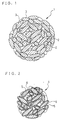
- FIG. 1 is a schematic diagram showing a particle model of the positive electrode active material of the present invention.
- FIG. 2 is a schematic diagram showing another particle model of the positive electrode active material of the present invention.
- the present invention is anodiced on a discovery that incorporation of manganese into nickel hydroxide to produce a solid solution can shift the oxidation potential of nickel hydroxide toward the "anodic" direction.
- the inventors discovered that the charge efficiency at a high temperature can be improved with incorporation of a small amount of manganese not by turning all the nickel hydroxide into a solid solution with manganese but by having a solid solution of nickel hydroxide with manganese contained at least in the surface layer of particles which are accumulated crystals of nickel hydroxide active material.
- the positive electrode active material of the present invention can be manufactured by a step of producing particles of nickel hydroxide active material and a subsequent step in which an aqueous solution containing bivalent nickel ions and manganese ions is reacted with caustic alkali in the presence of the above-mentioned particles of the nickel hydroxide active material to form a solid solution nickel hydroxide with manganese incorporated therein on the surface of the nickel hydroxide active material.
- the nickel hydroxide active material is obtained preferably by reacting an aqueous solution containing bivalent nickel ions with caustic alkali.
- FIG. 1 and FIG. 2 show particle models of the positive electrode active material for alkaline storage batteries, the material made up of particles formed by agglomeration of nickel hydroxide active material and at least the surface layer of the particles containing a solid solution nickel hydroxide with manganese incorporated therein.
- FIG. 1 and FIG. 2 are provided merely for the purpose of illustrating the present invention and that the shape and relative size of individual particles and crystals forming particles and the number of crystals forming particles are not always identical with those found in practice.
- Particle 1 of the active material shown as a model in FIG. 1 is composed of a large number of agglomerated crystals 2 of nickel hydroxide active material. And the surface layer of the particle 1 is covered mainly with crystals 3 of a solid solution nickel hydroxide with manganese incorporated therein.
- Active material particle 4 illustrated in a model in FIG. 2 is formed by agglomeration of a large number of crystals 5 of nickel hydroxide active material. On the surface of each crystal there grows crystal 6 of a solid solution nickel hydroxide with manganese incorporated therein.
- secondary or tertiary particles are first formed by agglomeration of crystals of nickel hydroxide active material. Then, an aqueous solution containing bivalent nickel ions and manganese ions is reacted with caustic alkali in the presence of the above-mentioned particles to grow crystals of a manganese-incorporated solid solution of nickel hydroxide. Thus, a solid solution nickel hydroxide with manganese incorporated therein is formed on the surface of the secondary or tertiary particles.
- the aqueous solution of nickel ions and manganese ions penetrates between the crystals forming secondary or tertiary particles, and reacts with caustic alkali to produce a solid solution of nickel hydroxide containing manganese inside the particles.
- a solid solution nickel hydroxide with manganese incorporated therein forms independent crystals and also grows on the surface of crystals which agglomerate into secondary or tertiary particles.
- the active material obtained by the method of the present invention is considered to be something like a combination of the models illustrated in FIG. 1 and FIG. 2. In the figures, crystals 2 and 5 are illustrated as smallest units but there can be cases where the crystals 2 and 5 are secondary particles.
- Manganese incorporated into nickel hydroxide in a solid solution state which is contained in the positive electrode active material of the present invention is responsible for shifting the charge potential of active material toward the "anodic" direction. That decreases the oxidation-reduction equilibrium potential of the active material, and hence the charge voltage.
- the charge reaction starts on the surface layer of active material particles which forms an interface with electrolyte, that is, the surface layer comprising a solid solution of nickel hydroxide incorporated with manganese, thus improving the charge acceptance and utilization of the active material.
- the ratio of manganese incorporated into the solid solution nickel hydroxide should be at least 1 mole percent of the total metal ions in the solid solution, preferably not lower than 3 mole percent, more preferably not lower than 10 mole percent if the charge potential is to be effectively shifted to the "anodic" direction.
- the amount of manganese in the solid solution could be raised up to 50 mole percent or so. But as the percentage of manganese in the active material increases, that of nickel which is responsible for discharge reaction decreases, resulting in a reduced capacity. For this reason, the ratio of manganese in the solid solution is preferably not larger than 10 mole percent of the overall metal ions in the nickel hydroxide active material and the solid solution.
- the most typical process of manufacturing the positive electrode active material of the present invention is the reaction crystallization method which has just been outlined and will be described later in an embodiment of the present invention. While the embodiment describes a two-step synthesis process in which two reaction vessels are used, a multi-step process with more reaction vessels is possible. Also, practical are the synthesis method described in Comparative Example 1 in which nickel salt solution is changed into an aqueous mixture solution containing manganese salt in the course of synthesis and a method in which nickel hydroxide active material as anodic phase is first produced in the form of dry powder, which is then dispersed in a liquid and is given an addition of the aqueous solution containing nickel salt and manganese salt and aqueous alkaline solution.
- the intended active material or positive electrode also can be obtained in such a process in which a nickel hydroxide active material or positive electrode using the active material is impregnated with an aqueous mixture solution containing nickel salt and manganese salt, followed by treatment with an aqueous alkaline solution.
- the positive electrode of the present invention by the following two-step process: the first step comprising filling a sintered nickel plaque with nickel hydroxide by chemical impregnation or electrolytic deposition method, and the second step comprising filling said plaque with a solid solution nickel hydroxide having manganese incorporated therein either by a chemical impregnation of an aqueous mixed solution containing nickel salt and manganese salt followed by treatment in an aqueous alkaline solution or by an electrolytic deposition involving electrolysis in an aqueous mixed solution containing nickel salt and manganese salt.
- Still another method of producing the aimed active material comprises treatment of nickel hydroxide as anodic phase in a hot aqueous alkaline solution containing manganese salt.
- the hot aqueous alkaline solution is an aqueous solution at 30 to 120°C containing 5 to 50 percent by weight of at least one hydroxide out of Li, Na and K.
- the positive electrode which is made of an active material containing a solid solution nickel hydroxide with manganese incorporated therein and a compound of at least one element selected from the group consisting of Ca, Sr, Ba, Cu, Ag, Cd, Y and Yb, is effective for lowering the charge potential and raising the oxygen evolution potential.
- This synergistic effect can further improve the charge efficiency at a high temperature.
- the foregoing compounds include preferably Ca(OH) 2 , CaO, CaF 2 , CaS, CaSO 4 , CaSi 2 O 5 , CaC 2 O 4 , CaWO 4 , SrCO 3 , Sr(OH) 2 , BaO, Cu 2 O, Ag 2 O, CdO, YF 3 , Y(OH) 3 , Y 2 (CO 3 ) 3 , Y 2 O 3 , YbF 3 , Yb(OH) 3 , Yb 2 O 3 and the like.
- the nickel hydroxide active material can be kept from swelling by incorporating the whole active material with at least one element selected from the group consisting of Mg, Zn, Cd and Ca to form a solid solution and that the utilization can be improved by incorporating cobalt into the whole active material in a solid solution state.
- the anodic phase nickel hydroxide has those elements incorporated therein.
- a 1 M aqueous solution of NiSO 4 , a 2 M aqueous solution of sodium hydroxide and a 2 M aqueous ammonia solution were all continuously pumped into a reaction vessel at the same flow rate using a metering pump, and the three solutions were continuously stirred in the vessel.
- a suspension containing active material particles and other reaction products continuously overflowing the reaction vessel was poured into a second reaction vessel.
- the active material particles were then placed in a hot aqueous alkaline solution containing 25 percent by weight of NaOH at 60°C, stirred for 24 hours, washed with water and dried at 90°C. Thus, a positive electrode material was obtained.
- the positive electrode active material thus prepared is made up of particles formed by agglomeration of crystals of nickel hydroxide active material, the particles containing at least on the surface a solid solution nickel hydroxide with manganese incorporated therein.
- the content of manganese in the solid solution is 20 mole percent of the total amount of metal ions contained in the solid solution, the rest of 80 mole percent being nickel.
- the positive electrode active material obtained here shall be coded "d".
- Active materials "a” to “c” were produced in the same manner but by varying the ratio of nickel to manganese ions in an aqueous mixture solution of NiSO 4 and MnSO 4 that were pumped into the second reaction vessel. Table 1 shows the ratios of metal ions in the solid solution. Table 1 Active material Contents in solid solution (mole percent) Ni Mn a 99 1 b 97 3 c 90 10 d 80 20
- a 1 M aqueous solution of NiSO 4 , a 2 M aqueous solution of sodium hydroxide and a 2 M aqueous ammonia solution were all continuously pumped into a reaction vessel at the same flow rate using a metering pump, and the three solutions were continuously stirred in the vessel. Then the active material particles were separated from a suspension containing active material particles and other reaction products continuously overflowing the reaction vessel. The active material particles were placed in a hot aqueous alkaline solution containing 25 percent by weight of NaOH at 60°C, then stirred for 24 hours, washed with water and dried at 90°C. Thus, a positive electrode material was obtained.
- Each of the active material powders "a” to “d” was mixed with a cobalt hydroxide powder in a weight ratio of 85 : 15, and then kneaded with water into a paste. The paste was then filled into a foamed nickel electrode substrate, dried and pressed into positive electrodes "A” to “D” with a capacity of about 1 Ah. Similarly, electrodes were made using the active materials of Comparative Examples 1 and 2.
- Half cells were fabricated with those positive electrodes, counter electrodes made of a hydrogen storage alloy and having a larger capacity than the positive electrodes, and an electrolyte of 31 percent by weight of an aqueous KOH solution.
- the cells were charged at a 10-hour rate for 15 hours, stood still for 3 hours, and then discharged down to 0.9 volt at a 5-hour rate. Measurements were performed on the discharge capacity of a group of cells after they were charged at an ambient temperature of 10°C and discharged at 20°C (C 10 ) and another group that were charged at 40°C and discharged at 20°C (C 40 ).
- the ratios of discharge capacity C 40 to discharge capacity C 10 were calculated. The results are given in Table 2.
- Table 2 Positive electrode Discharge capacity ratio (%) (C 40 / C 10 ) A 61 B 64 C 68 D 72 Comparative Example 1 60 Comparative Example 2 75
- the positive electrode active material "d”, cobalt hydroxide and CaF 2 were mixed in a proportion of 84 : 15 : 1, and the mixture was kneaded with water into a paste. From this paste, a positive electrode "E” was made in the same manner as in the foregoing. With this positive electrode, a half cell was fabricated in the same way as in the foregoing, and the ratios of C 40 / C 10 were calculated. The results are shown in Table 4 in comparison with those of the positive electrode "D". Table 4 Positive electrode Discharge capacity ratio (%) (C 40 / C 10 ) D 72 E 82
- the charge efficiency at a high temperature is further improved with the nickel positive electrode made of an active material which contains a solid solution nickel hydroxide with manganese incorporated therein that is furthermore mixed with a Ca compound. It is also confirmed that the addition of the Ca compound is most preferably 0.1 to 5 parts by weight per 100 parts by weight of the active material containing a solid solution nickel hydroxide with manganese incorporated therein.
- Example 2 CaF 2 was used as a compound to raise the oxygen evolution potential.
- the identical results can be obtained using the following compounds in place of CaF 2 : Ca(OH) 2 , CaO, CaS, CaSO 4 , CaSi 2 O 5 , CaC 2 O 4 , CaWO 4 , SrCO 3 , Sr(OH) 2 , BaO, Cu 2 O, Ag 2 O, CdO, YF 3 , Y(OH) 3 , Y 2 (CO 3 ) 3 , Y 2 O 3 , YbF 3 , Yb(OH) 3 or Y 2 O 3 .
- the present invention provides a high-performance positive electrode active material which can achieve high charge efficiency at a high temperature with a small amount of manganese.
- the positive electrode comprising this active material produces an alkaline storage battery with high charge efficiency at a high temperature.
Landscapes
- Chemical & Material Sciences (AREA)
- Organic Chemistry (AREA)
- Inorganic Chemistry (AREA)
- Chemical Kinetics & Catalysis (AREA)
- Electrochemistry (AREA)
- General Chemical & Material Sciences (AREA)
- Battery Electrode And Active Subsutance (AREA)
Abstract
Description
- The present invention relates to a positive electrode active material for alkaline storage batteries and a positive electrode for alkaline storage batteries using the same.
- With a recent trend toward the value addition, size and weight reduction of portable appliances, there is a growing demand for high-energy secondary batteries. In such applications as electric vehicles, too, alkaline storage batteries are used as a mobile power source, and the development of high-energy secondary batteries has been hoped for. In answer to that market demand, research has been conducted on improvement of nickel-cadmium storage batteries and nickel-metal hydride storage batteries.
- High-capacity electrodes have been developed and used as nickel positive electrodes for alkaline storage batteries for such purposes. They include sintered type electrodes prepared by filling a sintered nickel plaque with nickel hydroxide in a chemical process or electrochemical process and non-sintered type electrodes prepared by filling nickel hydroxide into high-porous foamed nickel or porous nickel fabrics.
- The problem with those nickel electrodes is that the charge efficiency drops under a high-temperature atmosphere.
- Attempts to overcome the problem have led to a new idea that cobalt is incorporated into nickel hydroxide to form a solid solution so as to shift the oxidation potential toward the "anodic" direction thereby improving the charge efficiency of nickel electrodes at high temperatures (Japanese Laid-Open Patent Publications Sho 59-68168 and Sho 63-152866).
- Indeed, the charge efficiency of nickel electrodes at high temperatures can be raised that way. In this method, however, cobalt is incorporated uniformly in the nickel hydroxide for electrodes to form a solid solution, and has to be added in a large quantity in order to achieve a desired results. The problem with this is that a large amount of cobalt induces a reduction of nickel which is directly responsible for discharge capacity in the active material. In addition, the use of cobalt pushes up the production cost.
- The object of the present invention is to provide a positive electrode active material for an alkaline storage battery with high charge efficiency at a high temperature without a substantial reduction in the percentage of nickel which determines the discharge capacity.
- Another object of the present invention is to provide a positive electrode for an alkaline storage battery including the above-mentioned active material.
- The present invention provides a positive electrode active material for an alkaline storage battery, comprising particles formed by agglomeration of crystals of nickel hydroxide active material, at least the surface layer of the particles containing a solid solution nickel hydroxide with manganese incorporated therein.
- In one aspect of the present invention, the solid solution is present as crystals growing on the crystal surface of the nickel hydroxide active material and/or crystals independent of the crystals of the nickel hydroxide active material. The content of manganese in the solid solution is at least one mole percent of the total content of metal ions in the solid solution.
- The content of manganese in the solid solution is preferably not lower than 3 mole percent, more preferably not lower than 10 mole percent of the overall metal ion content in the solid solution.
- The ratio of manganese in the solid solution is preferably not higher than 10 mole percent of the combined amount of the metal ions in the nickel hydroxide active material and solid solution.
- The positive electrode active material of the present invention can be prepared by a step of producing particles of nickel hydroxide active material and a subsequent step in which an aqueous solution containing bivalent nickel ions and manganese ions is reacted with caustic alkali in the presence of the particles of the nickel hydroxide active material to form a solid solution nickel hydroxide with manganese incorporated therein on the surface of the nickel hydroxide active material.
- The present invention provides a positive electrode for an alkaline storage battery comprising, in addition to the above-mentioned materials, a compound of at least one element selected from the group consisting of Ca, Sr, Ba, Cu, Ag, Cd, Y and Yb.
- The content of the compound is preferably 0.1 to 5 parts by weight per 100 parts by weight of the active material.
- FIG. 1 is a schematic diagram showing a particle model of the positive electrode active material of the present invention.
- FIG. 2 is a schematic diagram showing another particle model of the positive electrode active material of the present invention.
- The present invention is anodiced on a discovery that incorporation of manganese into nickel hydroxide to produce a solid solution can shift the oxidation potential of nickel hydroxide toward the "anodic" direction.
- Further, the inventors discovered that the charge efficiency at a high temperature can be improved with incorporation of a small amount of manganese not by turning all the nickel hydroxide into a solid solution with manganese but by having a solid solution of nickel hydroxide with manganese contained at least in the surface layer of particles which are accumulated crystals of nickel hydroxide active material.
- The positive electrode active material of the present invention can be manufactured by a step of producing particles of nickel hydroxide active material and a subsequent step in which an aqueous solution containing bivalent nickel ions and manganese ions is reacted with caustic alkali in the presence of the above-mentioned particles of the nickel hydroxide active material to form a solid solution nickel hydroxide with manganese incorporated therein on the surface of the nickel hydroxide active material.
- The nickel hydroxide active material is obtained preferably by reacting an aqueous solution containing bivalent nickel ions with caustic alkali.
- FIG. 1 and FIG. 2 show particle models of the positive electrode active material for alkaline storage batteries, the material made up of particles formed by agglomeration of nickel hydroxide active material and at least the surface layer of the particles containing a solid solution nickel hydroxide with manganese incorporated therein.
- It is to be understood that the models in FIG. 1 and FIG. 2 are provided merely for the purpose of illustrating the present invention and that the shape and relative size of individual particles and crystals forming particles and the number of crystals forming particles are not always identical with those found in practice.
- Particle 1 of the active material shown as a model in FIG. 1 is composed of a large number of
agglomerated crystals 2 of nickel hydroxide active material. And the surface layer of the particle 1 is covered mainly with crystals 3 of a solid solution nickel hydroxide with manganese incorporated therein. - Active material particle 4 illustrated in a model in FIG. 2 is formed by agglomeration of a large number of
crystals 5 of nickel hydroxide active material. On the surface of each crystal there growscrystal 6 of a solid solution nickel hydroxide with manganese incorporated therein. - In the manufacturing process of the present invention, secondary or tertiary particles are first formed by agglomeration of crystals of nickel hydroxide active material. Then, an aqueous solution containing bivalent nickel ions and manganese ions is reacted with caustic alkali in the presence of the above-mentioned particles to grow crystals of a manganese-incorporated solid solution of nickel hydroxide. Thus, a solid solution nickel hydroxide with manganese incorporated therein is formed on the surface of the secondary or tertiary particles. In addition, the aqueous solution of nickel ions and manganese ions penetrates between the crystals forming secondary or tertiary particles, and reacts with caustic alkali to produce a solid solution of nickel hydroxide containing manganese inside the particles. A solid solution nickel hydroxide with manganese incorporated therein forms independent crystals and also grows on the surface of crystals which agglomerate into secondary or tertiary particles. The active material obtained by the method of the present invention is considered to be something like a combination of the models illustrated in FIG. 1 and FIG. 2. In the figures,
crystals crystals - Manganese incorporated into nickel hydroxide in a solid solution state which is contained in the positive electrode active material of the present invention is responsible for shifting the charge potential of active material toward the "anodic" direction. That decreases the oxidation-reduction equilibrium potential of the active material, and hence the charge voltage. The charge reaction starts on the surface layer of active material particles which forms an interface with electrolyte, that is, the surface layer comprising a solid solution of nickel hydroxide incorporated with manganese, thus improving the charge acceptance and utilization of the active material.
- The ratio of manganese incorporated into the solid solution nickel hydroxide should be at least 1 mole percent of the total metal ions in the solid solution, preferably not lower than 3 mole percent, more preferably not lower than 10 mole percent if the charge potential is to be effectively shifted to the "anodic" direction.
- The amount of manganese in the solid solution could be raised up to 50 mole percent or so. But as the percentage of manganese in the active material increases, that of nickel which is responsible for discharge reaction decreases, resulting in a reduced capacity. For this reason, the ratio of manganese in the solid solution is preferably not larger than 10 mole percent of the overall metal ions in the nickel hydroxide active material and the solid solution.
- The most typical process of manufacturing the positive electrode active material of the present invention is the reaction crystallization method which has just been outlined and will be described later in an embodiment of the present invention. While the embodiment describes a two-step synthesis process in which two reaction vessels are used, a multi-step process with more reaction vessels is possible. Also, practical are the synthesis method described in Comparative Example 1 in which nickel salt solution is changed into an aqueous mixture solution containing manganese salt in the course of synthesis and a method in which nickel hydroxide active material as anodic phase is first produced in the form of dry powder, which is then dispersed in a liquid and is given an addition of the aqueous solution containing nickel salt and manganese salt and aqueous alkaline solution.
- The intended active material or positive electrode also can be obtained in such a process in which a nickel hydroxide active material or positive electrode using the active material is impregnated with an aqueous mixture solution containing nickel salt and manganese salt, followed by treatment with an aqueous alkaline solution.
- It is also possible to produce the positive electrode of the present invention by the following two-step process: the first step comprising filling a sintered nickel plaque with nickel hydroxide by chemical impregnation or electrolytic deposition method, and the second step comprising filling said plaque with a solid solution nickel hydroxide having manganese incorporated therein either by a chemical impregnation of an aqueous mixed solution containing nickel salt and manganese salt followed by treatment in an aqueous alkaline solution or by an electrolytic deposition involving electrolysis in an aqueous mixed solution containing nickel salt and manganese salt. Still another method of producing the aimed active material comprises treatment of nickel hydroxide as anodic phase in a hot aqueous alkaline solution containing manganese salt. The hot aqueous alkaline solution is an aqueous solution at 30 to 120°C containing 5 to 50 percent by weight of at least one hydroxide out of Li, Na and K.
- It is known that the oxygen evolution potential will rise if a compound of an element selected from the group consisting of Ca, Sr, Ba, Cu, Ag, Cd, Y and Yb is added to the positive electrode (Japanese Laid-Open Patent Publication Hei 5-28992, for example). This means that there will be a rise in overpotential to trigger an oxygen-generating competitive reaction during charging under a high-temperature atmosphere. The reaction is expressed by the reaction formula (2). As a result, the charge reaction of formula (1) to convert nickel hydroxide into nickel oxyhydroxide will proceed well enough, raising the positive electrode utilization even under a high temperature atmosphere. In summary, the positive electrode, which is made of an active material containing a solid solution nickel hydroxide with manganese incorporated therein and a compound of at least one element selected from the group consisting of Ca, Sr, Ba, Cu, Ag, Cd, Y and Yb, is effective for lowering the charge potential and raising the oxygen evolution potential. This synergistic effect can further improve the charge efficiency at a high temperature.


- The foregoing compounds include preferably Ca(OH)2, CaO, CaF2, CaS, CaSO4, CaSi2O5, CaC2O4, CaWO4, SrCO3, Sr(OH)2, BaO, Cu2O, Ag2O, CdO, YF3, Y(OH)3, Y2(CO3)3, Y2O3, YbF3, Yb(OH)3, Yb2O3 and the like.
- It is widely known that the nickel hydroxide active material can be kept from swelling by incorporating the whole active material with at least one element selected from the group consisting of Mg, Zn, Cd and Ca to form a solid solution and that the utilization can be improved by incorporating cobalt into the whole active material in a solid solution state. In the positive electrode of the present invention, too, it is desirable that the anodic phase nickel hydroxide has those elements incorporated therein.
- The invention will be further illustrated by the following examples.
- A 1 M aqueous solution of NiSO4, a 2 M aqueous solution of sodium hydroxide and a 2 M aqueous ammonia solution were all continuously pumped into a reaction vessel at the same flow rate using a metering pump, and the three solutions were continuously stirred in the vessel. A suspension containing active material particles and other reaction products continuously overflowing the reaction vessel was poured into a second reaction vessel.
- Then, to the second vessel was given a continuous flow at the same rate with stirring of the following solutions, each by a metering pump: an aqueous solution prepared by mixing a 1 M aqueous solution of NiSO4 and a 1 M aqueous solution of MnSO4 in a volume ratio of 4 to 1 (metal ion molar ratio of Ni : Mn = 80 : 20), a 2 M aqueous solution of sodium hydroxide and a 2 M aqueous ammonia solution. Active material particles were then separated from a suspension containing active material particles and other reaction products continuously over flowing the second reaction vessel.
- The active material particles were then placed in a hot aqueous alkaline solution containing 25 percent by weight of NaOH at 60°C, stirred for 24 hours, washed with water and dried at 90°C. Thus, a positive electrode material was obtained.
- The positive electrode active material thus prepared is made up of particles formed by agglomeration of crystals of nickel hydroxide active material, the particles containing at least on the surface a solid solution nickel hydroxide with manganese incorporated therein. The content of manganese in the solid solution is 20 mole percent of the total amount of metal ions contained in the solid solution, the rest of 80 mole percent being nickel. The positive electrode active material obtained here shall be coded "d".
- Active materials "a" to "c" were produced in the same manner but by varying the ratio of nickel to manganese ions in an aqueous mixture solution of NiSO4 and MnSO4 that were pumped into the second reaction vessel. Table 1 shows the ratios of metal ions in the solid solution.
Table 1 Active material Contents in solid solution (mole percent) Ni Mn a 99 1 b 97 3 c 90 10 d 80 20 - A 1 M aqueous solution of NiSO4, a 2 M aqueous solution of sodium hydroxide and a 2 M aqueous ammonia solution were all continuously pumped into a reaction vessel at the same flow rate using a metering pump, and the three solutions were continuously stirred in the vessel. Then the active material particles were separated from a suspension containing active material particles and other reaction products continuously overflowing the reaction vessel. The active material particles were placed in a hot aqueous alkaline solution containing 25 percent by weight of NaOH at 60°C, then stirred for 24 hours, washed with water and dried at 90°C. Thus, a positive electrode material was obtained.
- The following aqueous solutions were pumped into a reaction vessel at the same flow rate, each by a metering pump, with continuous stirring of solutions: an aqueous solution prepared by mixing a 1 M aqueous solution of NiSO4 and a 1 M solution of MnSO4 in a volume ratio of 4 to 1 (metal ion molar ratio of Ni : Mn = 80 : 20), a 2 M aqueous solution of sodium hydroxide and a 2 M aqueous ammonia solution. Active material particles were then separated from a suspension containing active material particles and other reaction products continuously overflowing the reaction vessel. The active material particles were then placed in a hot aqueous alkaline solution containing 25 percent by weight of NaOH at 60°C, then stirred for 24 hours, washed with water and dried at 90°C. Thus, a positive electrode material was obtained.
- Each of the active material powders "a" to "d" was mixed with a cobalt hydroxide powder in a weight ratio of 85 : 15, and then kneaded with water into a paste. The paste was then filled into a foamed nickel electrode substrate, dried and pressed into positive electrodes "A" to "D" with a capacity of about 1 Ah. Similarly, electrodes were made using the active materials of Comparative Examples 1 and 2.
- Half cells were fabricated with those positive electrodes, counter electrodes made of a hydrogen storage alloy and having a larger capacity than the positive electrodes, and an electrolyte of 31 percent by weight of an aqueous KOH solution. The cells were charged at a 10-hour rate for 15 hours, stood still for 3 hours, and then discharged down to 0.9 volt at a 5-hour rate. Measurements were performed on the discharge capacity of a group of cells after they were charged at an ambient temperature of 10°C and discharged at 20°C (C10) and another group that were charged at 40°C and discharged at 20°C (C40). The ratios of discharge capacity C40 to discharge capacity C10 were calculated. The results are given in Table 2.
Table 2 Positive electrode Discharge capacity ratio (%) (C40 / C10) A 61 B 64 C 68 D 72 Comparative Example 1 60 Comparative Example 2 75 - The results indicate that the positive electrodes made of an active material containing a solid solution of nickel hydroxide incorporated with manganese are improved in charge efficiency at a high temperature. It is also shown that higher efficiency is achieved when the percentage of manganese in the solid solution is not lower than 3 mole percent of the total metal ions therein. The efficiency is still higher when the manganese content exceeds 10 mole percent of the total metal ions in the solid solution.
- In another test, determinations were made by atomic absorption spectrophotometry on the ratios of nickel to manganese in the metal ions contained in the whole positive electrode active material "d" and that of Comparative Example 2. The results are shown in Table 3.
Table 3 Active material Molar ratios (%) in 100 g of active material Ni Mn d 93 7 Comparative Example 2 80 20 - Anodiced on the results in Table 2 and Table 3, a comparison was is made between the positive electrode active material "d" comprising in part a solid solution nickel hydroxide with manganese incorporated therein and the positive electrode active material of Comparative Example 2, which is entirely made up of a solid solution nickel hydroxide with manganese incorporated therein. It shows that the positive electrode active material "d" achieves with a much less content of manganese the same efficiency as that of Comparative Example 2.
- The positive electrode active material "d", cobalt hydroxide and CaF2 were mixed in a proportion of 84 : 15 : 1, and the mixture was kneaded with water into a paste. From this paste, a positive electrode "E" was made in the same manner as in the foregoing. With this positive electrode, a half cell was fabricated in the same way as in the foregoing, and the ratios of C40 / C10 were calculated. The results are shown in Table 4 in comparison with those of the positive electrode "D".
Table 4 Positive electrode Discharge capacity ratio (%) (C40 / C10) D 72 E 82 - It is evident from the results that the charge efficiency at a high temperature is further improved with the nickel positive electrode made of an active material which contains a solid solution nickel hydroxide with manganese incorporated therein that is furthermore mixed with a Ca compound. It is also confirmed that the addition of the Ca compound is most preferably 0.1 to 5 parts by weight per 100 parts by weight of the active material containing a solid solution nickel hydroxide with manganese incorporated therein.
- In Example 2, CaF2 was used as a compound to raise the oxygen evolution potential. The identical results can be obtained using the following compounds in place of CaF2: Ca(OH)2, CaO, CaS, CaSO4, CaSi2O5, CaC2O4, CaWO4, SrCO3, Sr(OH)2, BaO, Cu2O, Ag2O, CdO, YF3, Y(OH)3, Y2(CO3)3, Y2O3, YbF3, Yb(OH)3 or Y2O3.
- The present invention provides a high-performance positive electrode active material which can achieve high charge efficiency at a high temperature with a small amount of manganese. The positive electrode comprising this active material produces an alkaline storage battery with high charge efficiency at a high temperature.
Claims (10)
- A positive electrode active material for an alkaline storage battery comprising particles formed by agglomeration of crystals of a nickel hydroxide active material, at least the surface layer of said particles containing a solid solution nickel hydroxide with manganese incorporated therein.
- The positive electrode active material for an alkaline storage battery in accordance with claim 1, wherein said solid solution is present as crystals growing on the crystal surface of said nickel hydroxide active material and/or crystals independent of the crystals of said nickel hydroxide active material.
- The positive electrode active material for an alkaline storage battery in accordance with claim 1, wherein the content of manganese in said solid solution is at least one mole percent on the whole metal ions in said solid solution.
- The positive electrode active material for an alkaline storage battery in accordance with claim 3, wherein the content of manganese in said solid solution is not lower than three mole percent on the whole metal ions in said solid solution.
- The positive electrode active material for an alkaline storage battery in accordance with claim 3, wherein the content of manganese in said solid solution is not lower than 10 mole percent on the whole metal ions in said solid solution.
- The positive electrode active material for an alkaline storage battery in accordance with claim 3, wherein the content of manganese in said solid solution is not higher than 10 mole percent on the combined amount of the metal ions in said nickel hydroxide active material and said solid solution.
- A process of making a positive electrode active material for an alkaline storage battery comprising a step of producing particles of nickel hydroxide active material and a subsequent step in which an aqueous solution containing bivalent nickel ions and manganese ions is reacted with caustic alkali in the presence of said particles of nickel hydroxide active material to form a solid solution nickel hydroxide with manganese incorporated therein on the surface of said nickel hydroxide active material.
- A positive electrode for an alkaline storage battery containing the active material in accordance with claim 1.
- The positive electrode for an alkaline storage battery in accordance with claim 8, further comprising a compound of at least one element selected from the group consisting of Ca, Sr, Ba, Cu, Ag, Cd, Y and Yb.
- The positive electrode for an alkaline storage battery in accordance with claim 9, wherein the content of said compound is 0.1 to 5 parts by weight per 100 parts by weight of said active material.
Applications Claiming Priority (7)
| Application Number | Priority Date | Filing Date | Title |
|---|---|---|---|
| JP30446395 | 1995-11-22 | ||
| JP304463/95 | 1995-11-22 | ||
| JP30446395 | 1995-11-22 | ||
| JP17008696 | 1996-06-28 | ||
| JP170086/96 | 1996-06-28 | ||
| JP17008696 | 1996-06-28 | ||
| PCT/JP1996/003159 WO1997019479A1 (en) | 1995-11-22 | 1996-10-28 | Positive plate active material for alkaline storage battery and positive electrode |
Publications (3)
| Publication Number | Publication Date |
|---|---|
| EP0809309A1 true EP0809309A1 (en) | 1997-11-26 |
| EP0809309A4 EP0809309A4 (en) | 1999-02-24 |
| EP0809309B1 EP0809309B1 (en) | 2003-03-05 |
Family
ID=26493202
Family Applications (1)
| Application Number | Title | Priority Date | Filing Date |
|---|---|---|---|
| EP96935481A Expired - Lifetime EP0809309B1 (en) | 1995-11-22 | 1996-10-28 | Electrode with positive plate active material for alkaline storage battery |
Country Status (4)
| Country | Link |
|---|---|
| US (1) | US6066416A (en) |
| EP (1) | EP0809309B1 (en) |
| DE (1) | DE69626495T2 (en) |
| WO (1) | WO1997019479A1 (en) |
Cited By (5)
| Publication number | Priority date | Publication date | Assignee | Title |
|---|---|---|---|---|
| EP0834945A1 (en) * | 1996-09-30 | 1998-04-08 | Matsushita Electric Industrial Co., Ltd. | Nickel positive electrode and alkaline storage battery using the same |
| EP0986120A1 (en) * | 1998-09-10 | 2000-03-15 | VARTA Gerätebatterie GmbH | Nickel hydroxide active mass for alkaline secondary batterries and process of preparing it |
| EP0872904A3 (en) * | 1997-04-14 | 2005-09-28 | Matsushita Electric Industrial Co., Ltd. | Nickel/metal hydride storage battery |
| EP0975036A4 (en) * | 1997-01-30 | 2005-11-23 | Sanyo Electric Co | Enclosed alkali storage battery |
| EP1708297A1 (en) * | 1996-12-27 | 2006-10-04 | Canon Kabushiki Kaisha | Powdery material, electrode member, method for manufacturing same and secondary cell |
Families Citing this family (9)
| Publication number | Priority date | Publication date | Assignee | Title |
|---|---|---|---|---|
| US6566008B2 (en) * | 1997-01-30 | 2003-05-20 | Sanyo Electric Co., Ltd. | Sealed alkaline storage battery |
| EP1044927B1 (en) * | 1998-06-10 | 2012-07-25 | Sakai Chemical Industry Co., Ltd. | Nickel hydroxide particles and production and use thereof |
| JP4252641B2 (en) * | 1998-06-15 | 2009-04-08 | パナソニック株式会社 | Positive electrode for alkaline storage battery and positive electrode active material |
| JP3744716B2 (en) * | 1999-03-30 | 2006-02-15 | 三洋電機株式会社 | Sealed alkaline storage battery |
| US7718315B2 (en) | 2003-11-06 | 2010-05-18 | Panasonic Corporation | Alkaline battery and positive electrode material for alkaline battery comprising nickel oxyhydroxide and manganese dioxide |
| JPWO2005104272A1 (en) | 2004-04-23 | 2008-03-13 | 松下電器産業株式会社 | Alkaline primary battery and method for producing positive electrode material thereof |
| JP2006012670A (en) * | 2004-06-28 | 2006-01-12 | Matsushita Electric Ind Co Ltd | Alkaline battery |
| CN109935799A (en) * | 2017-12-19 | 2019-06-25 | 宁波高新区锦众信息科技有限公司 | A kind of preparation method of alkaline secondary cell multi-layer alpha-nickel hydroxide composite material |
| CN114613950B (en) * | 2022-03-08 | 2024-04-19 | 三峡大学 | Preparation method of high-capacity composite positive electrode material of water-based zinc-nickel battery |
Family Cites Families (40)
| Publication number | Priority date | Publication date | Assignee | Title |
|---|---|---|---|---|
| JPS51122737A (en) * | 1975-04-18 | 1976-10-27 | Matsushita Electric Industrial Co Ltd | Method of producing nickel plate for battery |
| JPS5514666A (en) * | 1978-07-17 | 1980-02-01 | Matsushita Electric Ind Co Ltd | Electric pole of nickel |
| JPS56102076A (en) * | 1980-01-16 | 1981-08-15 | Matsushita Electric Ind Co Ltd | Electrode |
| US4251603A (en) * | 1980-02-13 | 1981-02-17 | Matsushita Electric Industrial Co., Ltd. | Battery electrode |
| JPS5968168A (en) * | 1982-10-08 | 1984-04-18 | Yuasa Battery Co Ltd | Manufacture of positive plate for alkaline battery |
| JPS61104565A (en) * | 1984-10-25 | 1986-05-22 | Matsushita Electric Ind Co Ltd | Manufacturing method of active material powder for nickel positive electrode of battery |
| JPS62237667A (en) * | 1986-04-08 | 1987-10-17 | Yuasa Battery Co Ltd | Nickel positive electrode for alkaline storage battery |
| JPS63152866A (en) * | 1986-12-16 | 1988-06-25 | Yuasa Battery Co Ltd | Nickel active material for storage battery and its manufacture |
| JPS63152886A (en) * | 1986-12-17 | 1988-06-25 | Sanyo Electric Co Ltd | Nonaqueous electrolyte secondary battery |
| EP0342654B1 (en) * | 1988-05-17 | 1993-09-15 | Mitsubishi Materials Corporation | Hydrogen absorbing ni-based alloy and rechargeable alkaline battery |
| JP2609911B2 (en) * | 1988-10-19 | 1997-05-14 | 三洋電機株式会社 | Alkaline storage battery |
| US4898794A (en) * | 1988-12-27 | 1990-02-06 | Mitsubishi Metal Corporation | Hydrogen absorbing Ni,Zr-based alloy and rechargeable alkaline battery |
| JPH0393161A (en) * | 1989-09-04 | 1991-04-18 | Matsushita Electric Ind Co Ltd | Nickel positive electrode for battery and manufacture thereof |
| US5281494A (en) * | 1990-05-04 | 1994-01-25 | Inco Limited | Nickel hydroxide |
| JP2889669B2 (en) * | 1990-08-09 | 1999-05-10 | 三洋電機株式会社 | Non-sintered nickel positive electrode plate for alkaline storage batteries |
| US5366831A (en) * | 1991-06-14 | 1994-11-22 | Yuasa Corporation | Nickel electrode for alkaline battery |
| US5700596A (en) * | 1991-07-08 | 1997-12-23 | Matsushita Electric Industrial Co., Ltd. | Nickel hydroxide active material powder and nickel positive electrode and alkali storage battery using them |
| JP3042043B2 (en) * | 1991-07-18 | 2000-05-15 | 松下電器産業株式会社 | Nickel positive electrode for alkaline storage battery and nickel-hydrogen storage battery using the same |
| JP3097347B2 (en) * | 1992-09-18 | 2000-10-10 | 松下電器産業株式会社 | Nickel-metal hydride battery |
| US5348822A (en) * | 1992-11-12 | 1994-09-20 | Ovonic Battery Company, Inc. | Chemically and compositionally modified solid solution disordered multiphase nickel hydroxide positive electrode for alkaline rechargeable electrochemical cells |
| US5344728A (en) * | 1992-11-12 | 1994-09-06 | Ovonic Battery Company, Inc. | Compositionally and structurally disordered multiphase nickel hydroxide positive electrode for alkaline rechargeable electrochemical cells |
| US5569563A (en) * | 1992-11-12 | 1996-10-29 | Ovshinsky; Stanford R. | Nickel metal hybride battery containing a modified disordered multiphase nickel hydroxide positive electrode |
| US5523182A (en) * | 1992-11-12 | 1996-06-04 | Ovonic Battery Company, Inc. | Enhanced nickel hydroxide positive electrode materials for alkaline rechargeable electrochemical cells |
| US5567549A (en) * | 1992-11-12 | 1996-10-22 | Ovonic Battery Company, Inc. | Nickel metal hydride battery containing a modified disordered multiphase nickel aluminum based positive electrode |
| JPH0714578A (en) * | 1993-04-28 | 1995-01-17 | Matsushita Electric Ind Co Ltd | Nickel positive electrode for alkaline storage battery and sealed nickel-hydrogen storage battery |
| US5506076A (en) * | 1993-06-30 | 1996-04-09 | Toshiba Battery Co., Ltd. | Alkali secondary battery |
| DE4323007C2 (en) * | 1993-07-09 | 1995-06-08 | Starck H C Gmbh Co Kg | Manganese (III) -containing nickel (II) hydroxide, a process for its production and its use as an electrode material for secondary batteries |
| JPH0773876A (en) * | 1993-09-02 | 1995-03-17 | Furukawa Battery Co Ltd:The | Nickel electrode for secondary battery and manufacture thereof |
| JPH07122271A (en) * | 1993-10-25 | 1995-05-12 | Furukawa Electric Co Ltd:The | Method for producing nickel hydroxide for nickel electrode, method for producing nickel electrode using the nickel hydroxide, and alkaline secondary battery incorporating the nickel electrode |
| US5501917A (en) * | 1994-01-28 | 1996-03-26 | Hong; Kuochih | Hydrogen storage material and nickel hydride batteries using same |
| US5508121A (en) * | 1994-02-25 | 1996-04-16 | Furukawa Denchi Kabushiki Kaisha | Nickel hydroxide electrode for use in an alkaline secondary battery |
| DE69505911T2 (en) * | 1994-08-04 | 1999-04-08 | Sanyo Electric Co., Ltd., Moriguchi, Osaka | Active mass powder for non-sintered nickel electrode, non-sintered nickel electrode for alkaline battery and process for their production |
| JP2802482B2 (en) * | 1994-10-28 | 1998-09-24 | 古河電池株式会社 | Nickel electrode for alkaline secondary batteries |
| DE4439987C2 (en) * | 1994-11-09 | 1997-02-27 | Starck H C Gmbh Co Kg | Process for the preparation of manganese (III) -containing nickel hydroxide and its use |
| DE4439989C2 (en) * | 1994-11-09 | 1997-06-19 | Starck H C Gmbh Co Kg | Manganese-containing nickel (II) hydroxide powder, process for their preparation and their use |
| JPH08222215A (en) * | 1995-02-14 | 1996-08-30 | Sanyo Electric Co Ltd | Nonsintered nickel electrode for alkaline storage battery |
| KR100385479B1 (en) * | 1995-04-11 | 2003-08-21 | 산요 덴키 가부시키가이샤 | Manufacturing Method of Alkaline Battery and Nickel Electrode for Alkaline Battery with High Cycle Life |
| JPH0950805A (en) * | 1995-08-03 | 1997-02-18 | Sanyo Electric Co Ltd | Nickel electrode for alkaline storage battery and active material for nickel electrode and its manufacturing method and alkaline storage battery |
| JP3541090B2 (en) * | 1995-09-08 | 2004-07-07 | 三洋電機株式会社 | Positive active material for alkaline storage battery and method for producing the same |
| JPH09115543A (en) * | 1995-10-20 | 1997-05-02 | Sanyo Electric Co Ltd | Alkaline storage battery |
-
1996
- 1996-10-28 DE DE69626495T patent/DE69626495T2/en not_active Expired - Lifetime
- 1996-10-28 WO PCT/JP1996/003159 patent/WO1997019479A1/en not_active Ceased
- 1996-10-28 EP EP96935481A patent/EP0809309B1/en not_active Expired - Lifetime
-
1998
- 1998-07-22 US US09/120,544 patent/US6066416A/en not_active Expired - Lifetime
Cited By (5)
| Publication number | Priority date | Publication date | Assignee | Title |
|---|---|---|---|---|
| EP0834945A1 (en) * | 1996-09-30 | 1998-04-08 | Matsushita Electric Industrial Co., Ltd. | Nickel positive electrode and alkaline storage battery using the same |
| EP1708297A1 (en) * | 1996-12-27 | 2006-10-04 | Canon Kabushiki Kaisha | Powdery material, electrode member, method for manufacturing same and secondary cell |
| EP0975036A4 (en) * | 1997-01-30 | 2005-11-23 | Sanyo Electric Co | Enclosed alkali storage battery |
| EP0872904A3 (en) * | 1997-04-14 | 2005-09-28 | Matsushita Electric Industrial Co., Ltd. | Nickel/metal hydride storage battery |
| EP0986120A1 (en) * | 1998-09-10 | 2000-03-15 | VARTA Gerätebatterie GmbH | Nickel hydroxide active mass for alkaline secondary batterries and process of preparing it |
Also Published As
| Publication number | Publication date |
|---|---|
| DE69626495D1 (en) | 2003-04-10 |
| EP0809309A4 (en) | 1999-02-24 |
| WO1997019479A1 (en) | 1997-05-29 |
| EP0809309B1 (en) | 2003-03-05 |
| US6066416A (en) | 2000-05-23 |
| DE69626495T2 (en) | 2003-12-24 |
Similar Documents
| Publication | Publication Date | Title |
|---|---|---|
| EP1195824B1 (en) | Positive electrode active material for alkaline storage batteries | |
| EP0869565B1 (en) | Alkaline storage battery | |
| KR100327056B1 (en) | Enhanced nickel hydroxide positive electrode materials for alkaline rechargeable electrochemical cells | |
| EP0809309B1 (en) | Electrode with positive plate active material for alkaline storage battery | |
| EP0727835A1 (en) | Nickel active material for use in alkali storage cells and its manufacturing method | |
| EP0817292B1 (en) | Alkaline storage battery and method of producing Ni/Co hydroxide active mass for positive electrode | |
| CN101188292B (en) | Sealed alkaline battery | |
| EP0881698B1 (en) | Alkaline storage battery | |
| KR100454542B1 (en) | Non-Sintered Nickel Electrode For Alkaline Battery | |
| JP4321997B2 (en) | Positive electrode active material for alkaline storage battery, and positive electrode and alkaline storage battery using the same | |
| JP4412936B2 (en) | Cobalt oxyhydroxide, method for producing the same, and alkaline storage battery using the same | |
| JP4403594B2 (en) | Cathode active material for alkaline storage battery and method for producing the same | |
| JPH10125318A (en) | Cathode active material and cathode for alkaline storage batteries | |
| JP2002216752A (en) | Cobalt compound, method for producing the same, positive electrode plate for alkaline storage battery using the same, and alkaline storage battery | |
| KR100404658B1 (en) | Nickel-Metal Hydride Batteries and Manufacturing Method | |
| EP0801431A1 (en) | Nickel hydroxide active material for alkaline storage battery and positive plate | |
| US7147676B2 (en) | Method of preparing a nickel positive electrode active material | |
| US6608465B2 (en) | Positive electrode for alkaline storage battery and alkaline storage battery using the same | |
| JP3744642B2 (en) | Nickel-metal hydride storage battery and method for manufacturing the same | |
| JPH0576745B2 (en) | ||
| JPH0917429A (en) | Nickel hydroxide for non-sintered nickel positive electrode of alkaline storage battery | |
| JPH10172559A (en) | Nickel active material for alkaline storage battery and method for producing the same | |
| JP2006179429A (en) | Alkaline battery | |
| JPWO1997019479A1 (en) | Positive electrode active material and positive electrode for alkaline storage battery | |
| JP4162341B2 (en) | Positive electrode active material for alkaline storage battery and method for producing the same, positive electrode for alkaline storage battery and alkaline storage battery |
Legal Events
| Date | Code | Title | Description |
|---|---|---|---|
| PUAI | Public reference made under article 153(3) epc to a published international application that has entered the european phase |
Free format text: ORIGINAL CODE: 0009012 |
|
| 17P | Request for examination filed |
Effective date: 19970703 |
|
| AK | Designated contracting states |
Kind code of ref document: A1 Designated state(s): DE FR GB |
|
| A4 | Supplementary search report drawn up and despatched |
Effective date: 19990111 |
|
| AK | Designated contracting states |
Kind code of ref document: A4 Designated state(s): DE FR GB |
|
| 17Q | First examination report despatched |
Effective date: 20000209 |
|
| GRAH | Despatch of communication of intention to grant a patent |
Free format text: ORIGINAL CODE: EPIDOS IGRA |
|
| RTI1 | Title (correction) |
Free format text: ELECTRODE WITH POSITIVE PLATE ACTIVE MATERIAL FOR ALKALINE STORAGE BATTERY |
|
| GRAH | Despatch of communication of intention to grant a patent |
Free format text: ORIGINAL CODE: EPIDOS IGRA |
|
| GRAA | (expected) grant |
Free format text: ORIGINAL CODE: 0009210 |
|
| AK | Designated contracting states |
Designated state(s): DE FR GB |
|
| REG | Reference to a national code |
Ref country code: GB Ref legal event code: FG4D |
|
| REF | Corresponds to: |
Ref document number: 69626495 Country of ref document: DE Date of ref document: 20030410 Kind code of ref document: P |
|
| ET | Fr: translation filed | ||
| PLBE | No opposition filed within time limit |
Free format text: ORIGINAL CODE: 0009261 |
|
| STAA | Information on the status of an ep patent application or granted ep patent |
Free format text: STATUS: NO OPPOSITION FILED WITHIN TIME LIMIT |
|
| 26N | No opposition filed |
Effective date: 20031208 |
|
| REG | Reference to a national code |
Ref country code: DE Ref legal event code: R082 Ref document number: 69626495 Country of ref document: DE Representative=s name: ADVOTEC. PATENT- UND RECHTSANWAELTE, DE |
|
| REG | Reference to a national code |
Ref country code: FR Ref legal event code: PLFP Year of fee payment: 20 |
|
| PGFP | Annual fee paid to national office [announced via postgrant information from national office to epo] |
Ref country code: FR Payment date: 20150908 Year of fee payment: 20 |
|
| PGFP | Annual fee paid to national office [announced via postgrant information from national office to epo] |
Ref country code: GB Payment date: 20151028 Year of fee payment: 20 Ref country code: DE Payment date: 20151020 Year of fee payment: 20 |
|
| REG | Reference to a national code |
Ref country code: DE Ref legal event code: R071 Ref document number: 69626495 Country of ref document: DE |
|
| REG | Reference to a national code |
Ref country code: GB Ref legal event code: PE20 Expiry date: 20161027 |
|
| PG25 | Lapsed in a contracting state [announced via postgrant information from national office to epo] |
Ref country code: GB Free format text: LAPSE BECAUSE OF EXPIRATION OF PROTECTION Effective date: 20161027 |