EP0809268B1 - High voltage circuit breaker with a nozzle made of insulating material - Google Patents
High voltage circuit breaker with a nozzle made of insulating material Download PDFInfo
- Publication number
- EP0809268B1 EP0809268B1 EP97250162A EP97250162A EP0809268B1 EP 0809268 B1 EP0809268 B1 EP 0809268B1 EP 97250162 A EP97250162 A EP 97250162A EP 97250162 A EP97250162 A EP 97250162A EP 0809268 B1 EP0809268 B1 EP 0809268B1
- Authority
- EP
- European Patent Office
- Prior art keywords
- nozzle
- clamping ring
- circuit breaker
- voltage circuit
- dielectric material
- Prior art date
- Legal status (The legal status is an assumption and is not a legal conclusion. Google has not performed a legal analysis and makes no representation as to the accuracy of the status listed.)
- Expired - Lifetime
Links
- 239000011810 insulating material Substances 0.000 title description 9
- 239000011324 bead Substances 0.000 claims description 10
- 230000005489 elastic deformation Effects 0.000 claims description 3
- 238000010791 quenching Methods 0.000 claims description 3
- 230000000171 quenching effect Effects 0.000 claims description 3
- 239000003989 dielectric material Substances 0.000 claims 7
- 230000002093 peripheral effect Effects 0.000 claims 1
- 230000008878 coupling Effects 0.000 description 6
- 238000010168 coupling process Methods 0.000 description 6
- 238000005859 coupling reaction Methods 0.000 description 6
- 239000007789 gas Substances 0.000 description 4
- 238000000926 separation method Methods 0.000 description 4
- 230000001133 acceleration Effects 0.000 description 2
- 230000005540 biological transmission Effects 0.000 description 2
- 241000722921 Tulipa gesneriana Species 0.000 description 1
- 238000007664 blowing Methods 0.000 description 1
- 230000006835 compression Effects 0.000 description 1
- 238000007906 compression Methods 0.000 description 1
- 238000010276 construction Methods 0.000 description 1
- 238000005553 drilling Methods 0.000 description 1
- 230000005684 electric field Effects 0.000 description 1
- 230000002349 favourable effect Effects 0.000 description 1
- 238000010438 heat treatment Methods 0.000 description 1
- 238000002955 isolation Methods 0.000 description 1
Images

Classifications
-
- H—ELECTRICITY
- H01—ELECTRIC ELEMENTS
- H01H—ELECTRIC SWITCHES; RELAYS; SELECTORS; EMERGENCY PROTECTIVE DEVICES
- H01H33/00—High-tension or heavy-current switches with arc-extinguishing or arc-preventing means
- H01H33/70—Switches with separate means for directing, obtaining, or increasing flow of arc-extinguishing fluid
- H01H33/7015—Switches with separate means for directing, obtaining, or increasing flow of arc-extinguishing fluid characterised by flow directing elements associated with contacts
- H01H33/7023—Switches with separate means for directing, obtaining, or increasing flow of arc-extinguishing fluid characterised by flow directing elements associated with contacts characterised by an insulating tubular gas flow enhancing nozzle
-
- H—ELECTRICITY
- H01—ELECTRIC ELEMENTS
- H01H—ELECTRIC SWITCHES; RELAYS; SELECTORS; EMERGENCY PROTECTIVE DEVICES
- H01H33/00—High-tension or heavy-current switches with arc-extinguishing or arc-preventing means
- H01H33/02—Details
- H01H2033/028—Details the cooperating contacts being both actuated simultaneously in opposite directions
-
- H—ELECTRICITY
- H01—ELECTRIC ELEMENTS
- H01H—ELECTRIC SWITCHES; RELAYS; SELECTORS; EMERGENCY PROTECTIVE DEVICES
- H01H33/00—High-tension or heavy-current switches with arc-extinguishing or arc-preventing means
- H01H33/02—Details
- H01H33/24—Means for preventing discharge to non-current-carrying parts, e.g. using corona ring
- H01H33/245—Means for preventing discharge to non-current-carrying parts, e.g. using corona ring using movable field electrodes
-
- H—ELECTRICITY
- H01—ELECTRIC ELEMENTS
- H01H—ELECTRIC SWITCHES; RELAYS; SELECTORS; EMERGENCY PROTECTIVE DEVICES
- H01H33/00—High-tension or heavy-current switches with arc-extinguishing or arc-preventing means
- H01H33/70—Switches with separate means for directing, obtaining, or increasing flow of arc-extinguishing fluid
- H01H33/88—Switches with separate means for directing, obtaining, or increasing flow of arc-extinguishing fluid the flow of arc-extinguishing fluid being produced or increased by movement of pistons or other pressure-producing parts
- H01H33/90—Switches with separate means for directing, obtaining, or increasing flow of arc-extinguishing fluid the flow of arc-extinguishing fluid being produced or increased by movement of pistons or other pressure-producing parts this movement being effected by or in conjunction with the contact-operating mechanism
- H01H33/901—Switches with separate means for directing, obtaining, or increasing flow of arc-extinguishing fluid the flow of arc-extinguishing fluid being produced or increased by movement of pistons or other pressure-producing parts this movement being effected by or in conjunction with the contact-operating mechanism making use of the energy of the arc or an auxiliary arc
Definitions
- the invention relates to a high-voltage circuit breaker with a first and a second, coaxial with each other opposing arcing contact piece, at least of which the first by a switch drive in the course of a Switching movement is drivable and in the off state are separated by a separation section and with a hollow cylindrical Insulating material nozzle with the first arcing contact is connected and the blowing of one if necessary burning between the arcing contact pieces Arc is used with an extinguishing gas, and to which one on the the side of the isolating section opposite the switch drive arranged component to be driven in the switching case coupled is.
- FR 2 491 675 is a high-voltage circuit breaker known with two coaxial arcing contact pieces and with an insulating nozzle, which with a drivable arcing contact piece is connected.
- the other arcing contact piece is by means of a reversing gear driven by a drive element, which in turn is connected to the switch drive and the isolating section bridged between the arcing contact pieces.
- the Coupling of the second drivable arcing contact piece can also be connected to the switch drive by means of the insulating material nozzle respectively. For this purpose it is necessary to use the insulating nozzle to attach a transmission element itself.
- the insulating nozzle is made of a plastic with limited strength and the corrosive influences the arc or hot extinguishing gases. Moreover the forces to be transmitted are very high when switching large, so that the coupling is mechanically stable have to be.
- the present invention is therefore based on the object a high-voltage circuit breaker of the type mentioned Kind of creating a stable coupling of a driven one Component allowed to the insulating nozzle.
- the insulating nozzle on its first, facing away from the drive side End has a bead arranged on a lateral surface, behind the one from the first end of the insulating nozzle Slid on first clamping ring with temporary radial elastic deformation of the first clamping ring and / or the Snap end of the nozzle and that a second clamping ring is provided, the first clamping ring and / or that Nozzle end to prevent unlocking the first Clamping ring supports and that the component to be driven at least one of the clamping rings can be coupled.
- the coupling of a component to be driven to the insulating nozzle allows without drilling holes in the nozzle must be the stability of the nozzle body if necessary could affect. Since all components from have to be pushed on the first end of the insulating material nozzle, because the other end of the insulating nozzle has a larger one Has diameter, elastic deformability must be provided be the sliding of the first tension ring allowed behind the bulge of the insulating material nozzle. After this The second clamping ring is put on and if necessary with the first clamping ring Screws or connected by another type of fastening.
- the first clamping ring is on the outside Slide on nozzle.
- the first tension ring will either do this expanded and / or the first end of the nozzle is compressed radially. This is due to radial slots at the end of the nozzle allows.
- the second clamping ring is put on, the in this case the radial compression of the nozzle end or must prevent the expansion of the first clamping ring.
- the second clamping ring has a nozzle that either inserted into the inside of the nozzle end or in a circumferential groove on the face of the nozzle body is inserted. The second clamping ring prevents the first clamping ring pushed over the bead and thus unlocked can be.
- the second clamping ring is either also into one on the front of the insulating nozzle circumferential groove inserted or on the outside of the nozzle body placed.
- the second clamping ring allows in particular the coupling of a transmission element, in particular one Insulating rod that drives a drive movement across the Isolation path over to the second arcing contact piece can transmit.
- a reversing gear provided in the form of a lever be actuated by the insulating rod so that the second arcing contact piece in the event of a shutdown of the the first arcing contact piece is moved away.
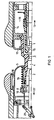
- FIG. 1 shows a first arcing contact piece 1 in one Half cut and a second arcing contact piece 2, wherein the first arcing contact 1 as a tulip contact and the second arcing contact piece 2 is designed as a contact pin is.
- the first arcing contact 1 is with a not shown Switch drive connected to the first arcing contact 1 when switching off in the direction of the arrow 13 moves.
- the first arcing contact 1 is with a metallic Connected hollow cylinder 14 which carries an insulating nozzle 3. Another insulating nozzle body 15 is directly on the first arcing contact piece 1 placed. Moved when switching the insulating material nozzle 3 with the first arcing contact piece 1 together.
- first and the second arcing contact pieces 1, 2 are separated from one another, an arc is drawn in the separating section 4 between them, which expands the quenching gas located there, for example SF 6 .
- the hot quenching gas can flow out into a heating chamber 16, from which it flows back at a suitable time, for example directly after a current zero crossing of the current to be switched, in order to blow the arc.
- the insulating material nozzle 3 bridges the separation path 4 both in the on state as well as in the off state.
- On the Drive opposite side of the separation section 4 is the Body of the insulating material surrounded by a field electrode 5, which is pressed towards the separation section by means of a spring 19 is going to be there in the on state for a dielectrically favorable Design of the electrical field between the contacts to care.
- the spring 19 is supported on the first clamping ring 8, which is attached to the first end 6 of the insulating nozzle 3 is.
- the spring 19 could also be on an outer bead support the insulating material nozzle itself.
- the field electrode 5 is through the continuous current contact piece 17 pushed back so far that this continuous current contact piece in contact with the other continuous current contact piece 18 can kick.
- the field electrode 5 is by means of a Slide contact performed in the continuous current contact piece 17 and contacted.
- a Drive rod 20 coupled, which is a deflection gear in the form a two-armed lever 21 operated on the other arm the second arcing contact piece 2 is coupled.
- first clamping ring 8 which the bead 7 pushed over from the first end 6 of the insulating nozzle 3 can be and snaps behind the bead 7. This is either by an elastic design of the nozzle, for example through radial slots at the nozzle end or through a slit of the first clamping ring 8 is reached.
- the both stabilizes the nozzle body 3 and the first clamping ring 8 in such a way that there is no elastic deformation and therefore no sliding over the first clamping ring 8 over the bead 7 more is possible.
- the second clamping ring 10 has a nozzle 11, which in the groove 12 engages on the end face of the nozzle body 3 and a radial deformation of the nozzle body both towards the inside and also prevented to the outside.
Landscapes
- Circuit Breakers (AREA)
Description
Die Erfindung bezieht sich auf einen Hochspannungs-Leistungsschalter mit einem ersten und einem zweiten, einander koaxial gegenüberstehenden Lichtbogenkontaktstück, von denen wenigstens das erste durch einen Schalterantrieb im Zuge einer Schaltbewegung antreibbar ist und die im Ausschaltzustand durch eine Trennstrecke getrennt sind sowie mit einer hohlzylindrischen Isolierstoffdüse, die mit dem ersten Lichtbogenkontaktstück verbunden ist und der Beblasung eines gegebenenfalls zwischen den Lichtbogenkontaktstücken brennenden Lichtbogens mit einem Löschgas dient, und an die ein auf der dem Schalterantrieb gegenüberliegenden Seite der Trennstrecke angeordnetes, im Schaltfall anzutreibendes Bauteil angekoppelt ist.The invention relates to a high-voltage circuit breaker with a first and a second, coaxial with each other opposing arcing contact piece, at least of which the first by a switch drive in the course of a Switching movement is drivable and in the off state are separated by a separation section and with a hollow cylindrical Insulating material nozzle with the first arcing contact is connected and the blowing of one if necessary burning between the arcing contact pieces Arc is used with an extinguishing gas, and to which one on the the side of the isolating section opposite the switch drive arranged component to be driven in the switching case coupled is.
Aus der FR 2 491 675 ist ein Hochspannungs-Leistungsschalter
bekannt mit zwei einander koaxial gegenüberstehenden Lichtbogenkontaktstücken
und mit einer Isolierstoffdüse, die mit einem
antreibbaren Lichtbogenkontaktstück verbunden ist. Das
andere Lichtbogenkontaktstück wird mittels eines Umlenkgetriebes
durch ein Antriebselement angetrieben, das seinerseits
mit dem Schalterantrieb verbunden ist und die Trennstrecke
zwischen den Lichtbogenkontaktstücken überbrückt. Die
Ankopplung des zweiten antreibbaren Lichtbogenkontaktstücks
an den Schalterantrieb kann auch mittels der Isolierstoffdüse
erfolgen. Zu diesem Zweck ist es notwendig, an der Isolierstoffdüse
selbst ein Übertragungselement zu befestigen. Dies
ist schwierig, da die Isolierstoffdüse aus einem Kunststoff
mit begrenzter Festigkeit besteht und den korrosiven Einflüssen
des Lichtbogens bzw. heißer Löschgase ausgesetzt ist. Außerdem
sind die zu übertragenden Kräfte im Schaltfall sehr
groß, so daß die Ankopplung entsprechend mechanisch stabil
sein muß.
Der vorliegenden Erfindung liegt daher die Aufgabe zugrunde, einen Hochspannungs-Leistungsschalter der eingangs genannten Art zu schaffen, der eine stabile Ankopplung eines anzutreibenden Bauteils an die Isolierstoffdüse erlaubt.The present invention is therefore based on the object a high-voltage circuit breaker of the type mentioned Kind of creating a stable coupling of a driven one Component allowed to the insulating nozzle.
Die Aufgabe wird erfindungsgemäß dadurch gelöst, daß die Isolierstoffdüse an ihrem der Antriebsseite abgewandten ersten Ende eine an einer Mantelfläche angeordnete Wulst aufweist, hinter der ein von dem ersten Ende der Isolierstoffdüse her aufgeschobener erster Spannring unter vorübergehender radialer elastischer Verformung des ersten Spannrings und/oder des Düsenendes einschnappbar ist und daß ein zweiter Spannring vorgesehen ist, der den ersten Spannring und/oder das Düsenende zur Verhinderung der Entriegelung des ersten Spannrings stützt und daß das anzutreibende Bauteil an wenigstens einen der Spannringe ankoppelbar ist.The object is achieved in that the insulating nozzle on its first, facing away from the drive side End has a bead arranged on a lateral surface, behind the one from the first end of the insulating nozzle Slid on first clamping ring with temporary radial elastic deformation of the first clamping ring and / or the Snap end of the nozzle and that a second clamping ring is provided, the first clamping ring and / or that Nozzle end to prevent unlocking the first Clamping ring supports and that the component to be driven at least one of the clamping rings can be coupled.
Durch erfindungsgemäße Konstruktion wird einerseits das Düsenende selbst gegen Verformung geschützt, andererseits wird die Ankopplung eines anzutreibenden Bauteils an die Isolierstoffdüse ermöglicht, ohne daß Bohrungen in die Düse eingebracht werden müssen, die die Stabilität des Düsenkörpers gegebenenfalls beeinträchtigen könnten. Da alle Bauteile vom ersten Ende der Isolierstoffdüse her aufgeschoben werden müssen, weil das andere Ende der Isolierstoffdüse einen größeren Durchmesser aufweist, muß eine elastische Verformbarkeit vorgesehen werden, die das Aufschieben des ersten Spannrings hinter die Wulst der Isolierstoffdüse erlaubt. Nachdem dieser Spannring aufgeschoben ist, wird der zweite Spannring aufgesetzt und gegebenenfalls mit dem ersten Spannring mittels Schrauben oder durch eine andere Befestigungungsart verbunden. Wenn die Wulst an der Außenseite der Isolierstoffdüse angeordnet ist, wird auch der erste Spannring außen auf die Düse aufgeschoben. Der erste Spannring wird hierzu entweder aufgeweitet und/oder das erste Ende der Düse wird radial zusammengedrückt. Dies wird durch radiale Schlitze am Düsenende ermöglicht. Danach wird der zweite Spannring aufgesetzt, der in diesem Fall das radial Zusammendrücken des Düsenendes oder das Aufweiten des ersten Spannrings verhindern muß. Zu diesem Zweck weist der zweite Spannring einen Stutzen auf, der entweder in das Innere des Düsenendes hineingesteckt oder in eine an der Stirnseite des Düsenkörpers umlaufende Nut eingeschoben wird. Der zweite Spannring verhindert, daß der erste Spannring über die Wulst geschoben und damit entriegelt werden kann.Through construction according to the invention, on the one hand, the nozzle end itself protected against deformation, on the other hand the coupling of a component to be driven to the insulating nozzle allows without drilling holes in the nozzle must be the stability of the nozzle body if necessary could affect. Since all components from have to be pushed on the first end of the insulating material nozzle, because the other end of the insulating nozzle has a larger one Has diameter, elastic deformability must be provided be the sliding of the first tension ring allowed behind the bulge of the insulating material nozzle. After this The second clamping ring is put on and if necessary with the first clamping ring Screws or connected by another type of fastening. If the bead is on the outside of the insulating nozzle is arranged, the first clamping ring is on the outside Slide on nozzle. The first tension ring will either do this expanded and / or the first end of the nozzle is compressed radially. This is due to radial slots at the end of the nozzle allows. Then the second clamping ring is put on, the in this case the radial compression of the nozzle end or must prevent the expansion of the first clamping ring. To this Purpose, the second clamping ring has a nozzle that either inserted into the inside of the nozzle end or in a circumferential groove on the face of the nozzle body is inserted. The second clamping ring prevents the first clamping ring pushed over the bead and thus unlocked can be.
Ist die Wulst an der Innenseite des Düsenkörpers, an der inneren Mantelfläche angeordnet, so kann der erste Spannring dadurch befestigt werden, daß die Düse an ihrem Ende aufgeweitet wird, oder daß der erste Spannring zusammengedrückt wird. Der zweite Spannring wird in diesem Fall entweder ebenfalls in eine an der Stirnseite der Isolierstoffdüse eingebrachte umlaufende Nut eingeschoben oder außen auf den Düsenkörper aufgesetzt. Der zweite Spannring erlaubt insbesondere die Ankopplung eines Übertragungselementes, insbesondere einer Isolierstoffstange, die eine Antriebsbewegung über die Trennstrecke hinüber zu dem zweiten Lichtbogenkontaktstück übertragen kann. Beispielsweise kann von dem ersten Lichtbogenkontaktstück aus gesehen hinter dem zweiten Lichtbogenkontaktstück ein Umlenkgetriebe in Form eines Hebels vorgesehen sein, der durch die Isolierstoffstange betätigbar ist, so daß das zweite Lichtbogenkontaktstück im Ausschaltfall von dem ersten Lichtbogenkontaktstück wegbewegt wird.Is the bead on the inside of the nozzle body, on the inside Shell surface arranged, so the first clamping ring be attached by expanding the nozzle at its end or that the first clamping ring is compressed becomes. In this case, the second clamping ring is either also into one on the front of the insulating nozzle circumferential groove inserted or on the outside of the nozzle body placed. The second clamping ring allows in particular the coupling of a transmission element, in particular one Insulating rod that drives a drive movement across the Isolation path over to the second arcing contact piece can transmit. For example, from the first arcing contact seen from behind the second arcing contact a reversing gear provided in the form of a lever be actuated by the insulating rod so that the second arcing contact piece in the event of a shutdown of the the first arcing contact piece is moved away.
Es ist auch möglich, an einen der Spannringe eine Feldelektrode anzukoppeln, die im Falle einer Schaltbewegung mitbewegt werden soll. It is also possible to attach a field electrode to one of the clamping rings to couple, which moves in the event of a switching movement shall be.
Die beschriebenen vorteilhaften Ausgestaltungen der Erfindung bilden Gegenstände der Unteransprüche.The described advantageous embodiments of the invention form objects of the subclaims.
Im folgenden wird die Erfindung anhand eines Ausführungsbeispiels in einer Zeichnung gezeigt und anschließend beschrieben.The invention is described below using an exemplary embodiment shown in a drawing and then described.
Dabei zeigt
Die Figur 1 zeigt ein erstes Lichtbogenkontaktstück 1 in einem
Halbschnitt sowie ein zweites Lichtbogenkontaktstück 2,
wobei das erste Lichtbogenkontaktstück 1 als Tulpenkontakt
und das zweite Lichtbogenkontaktstück 2 als Kontaktstift ausgebildet
ist.FIG. 1 shows a first arcing
Das erste Lichtbogenkontaktstück 1 ist mit einem nicht dargestellten
Schalterantrieb verbunden, der das erste Lichtbogenkontaktstück
1 beim Ausschaltvorgang in Richtung des Pfeiles
13 bewegt.The first arcing
Das erste Lichtbogenkontaktstück 1 ist mit einem metallischen
Hohlzylinder 14 verbunden, der eine Isolierstoffdüse 3 trägt.
Ein weiterer Isolierstoffdüsenkörper 15 ist direkt auf das
erste Lichtbogenkontaktstück 1 aufgesetzt. Im Schaltfall bewegt
sich die Isolierstoffdüse 3 mit dem ersten Lichtbogenkontaktstück
1 zusammen.The first arcing
Wenn das erste und das zweite Lichtbogenkontaktstück 1, 2
voneinander getrennt werden, so wird in der Trennstrecke 4
zwischen diesen ein Lichtbogen gezogen, der das dort befindliche
Löschgas, beispielsweise SF6, expandiert. Das heiße
Löschgas kann in einen Heizraum 16 abströmen, aus dem es zu
geeigneter Zeit, beispielsweise direkt nach einem Stromnulldurchgang
des zu schaltenden Stromes, zurückfließt, um den
Lichtbogen zu beblasen.If the first and the second arcing
Im Einschaltzustand wird der Dauerstrom von den Dauerstromkontaktstücken
17, 18 getragen.In the on state, the continuous current from the continuous
Die Isolierstoffdüse 3 überbrückt die Trennstrecke 4 sowohl
im Einschaltzustand als auch im Ausschaltzustand. Auf der dem
Antrieb gegenüberliegenden Seite der Trennstrecke 4 ist der
Körper der Isolierstoffdüse von einer Feldelektrode 5 umgeben,
die mittels einer Feder 19 zur Trennstrecke hin gedrückt
wird, um dort im Einschaltzustand für eine dielektrisch günstige
Gestaltung des elektrischen Feldes zwischen den Kontakten
zu sorgen. Die Feder 19 stützt sich an dem ersten Spannring
8 ab, der am ersten Ende 6 der Isolierstoffdüse 3 befestigt
ist. Die Feder 19 könnte sich auch an einer Außenwulst
der Isolsierstoffdüse selbst abstützen.The insulating
Im Einschaltzustand ist die Feldelektrode 5 durch das Dauerstromkontaktstück
17 soweit zurückgedrückt, daß dieses Dauerstromkontaktstück
in Kontakt mit dem anderen Dauerstromkontaktstück
18 treten kann. Die Feldelektrode 5 ist mittels eines
Gleitkontaktes in dem Dauerstromkontaktstück 17 geführt
und kontaktiert.In the switched-on state, the field electrode 5 is through the continuous
An das erste Ende 6 der Isolierstoffdüse 3 ist außerdem eine
Antriebsstange 20 angekoppelt, die ein Umlenkgetriebe in Form
eines zweiarmigen Hebels 21 betätigt, an dessen anderem Arm
das zweite Lichtbogenkontaktstück 2 angekoppelt ist. At the
Auf diese Weise wird erreicht, daß eine Bewegung des ersten
Lichtbogenkontaktstücks in Richtung des Pfeiles 13 gleichzeitig
eine Bewegung des zweiten Lichtbogenkontaktstücks 2 in
Richtung des Pfeiles 22 bewirkt.In this way it is achieved that a movement of the first
Arcing contact piece in the direction of
Da bei der Betätigung eines derartigen Hochspannungs-Leistungsschalters
sehr große Beschleunigungen erreicht werden
müssen und entsprechend große Beschleunigungskräfte übertragen
werden, ist für die Ankopplung an das erste Ende der Isolierstoffdüse
3 eine hohe mechanische Stabilität erforderlich.Because when operating such a high-voltage circuit breaker
very large accelerations can be achieved
have to transfer and correspondingly large acceleration forces
is for coupling to the first end of the insulating
Diese wird erreicht durch einen ersten Spannring 8, der über
die Wulst 7 vom ersten Ende 6 der Isolierstoffdüse 3 hinübergeschoben
werden kann und hinter der Wulst 7 einrastet. Dies
wird entweder durch eine elastische Gestaltung der Düse, beispielsweise
durch radiale Schlitze am Düsenende oder durch
eine Schlitzung des ersten Spannringes 8 erreicht.This is achieved by a
Um nach dem Einrasten des ersten Spannrings 8 hinter der
Wulst 7 eine Entriegelung zu vermeiden, wird ein zweiter
Spannring 10 an dem ersten Spannring 8 befestigt, der sowohl
den Düsenkörper 3 als auch den ersten Spannring 8 so stabilisiert,
daß keine elastische Verformung und somit kein Hinübergleiten
des ersten Spannrings 8 über die Wulst 7 mehr
möglich ist.To after locking the
An den zweiten Spannring 10 oder den ersten Spannring 8 kann
dann eine Antriebsstange 20 in mechanisch hochbelastbarer
Weise angekoppelt werden.On the
Der zweite Spannring 10 weist einen Stutzen 11 auf, der in
die Nut 12 an der Stirnseite des Düsenkörpers 3 eingreift und
eine radiale Verformung des Düsenkörpers sowohl zur Innenals
auch zur Außenseite hin verhindert.The
Claims (6)
- High-voltage circuit breaker having a first and a second arcing contact piece (1, 2), which are positioned coaxially opposite one another, of which at least the first (1) can be driven by a switch drive in the course of a switching movement, and which are separated, in the disconnected state, by an isolating path (4), and having a hollow-cylindrical nozzle (3) made of dielectric material, which is connected to the first arcing contact piece (1), is used to blow an arc which may be burning between the arcing contact pieces using a quenching gas, and to which is coupled a component which is arranged on the opposite side of the isolating path (4) to the switch drive and which is to be driven in the event of the breaker operating, characterized in that the nozzle (3) made of dielectric material has, at its first end (6) which is remote from the drive side, a bead, which is arranged on an outer surface and behind which a first clamping ring (8), which is pushed on from the first end (6) of the nozzle (3) made of dielectric material, can be latched in with temporary, radial, elastic deformation of the first clamping ring (8) and/or of the nozzle end (6), and in that a second clamping ring (10) is provided which supports the first clamping ring (8) and/or the nozzle end (6) for the purpose of preventing the first clamping ring (8) from being unlatched, and in that the component to be driven can be coupled to at least one of the clamping rings (8, 10).
- High-voltage circuit breaker according to Claim 1, characterized in that the first end (6) of the nozzle (3) made of dielectric material has radial slots distributed over the circumference of the nozzle.
- High-voltage circuit breaker according to Claim 2, characterized in that the second clamping ring (10) has a stub (11) which surrounds the first end (6) of the nozzle (3) made of dielectric material.
- High-voltage circuit breaker according to Claim 2, characterized in that the second clamping ring (10) has a stub (11) which can be pushed into the first end (6) of the nozzle (3) made of dielectric material.
- High-voltage circuit breaker according to Claim 2, characterized in that the second clamping ring (10) has a stub (11) which can be pushed into a peripheral groove (12) in the end side of the first end (6) of the nozzle (3) made of dielectric material.
- High-voltage circuit breaker according to Claim 1 or one of the following claims, characterized in that the first clamping ring (8) can be extended by a radial slot.
Applications Claiming Priority (2)
| Application Number | Priority Date | Filing Date | Title |
|---|---|---|---|
| DE29609909U DE29609909U1 (en) | 1996-05-24 | 1996-05-24 | High-voltage circuit breaker with an insulating nozzle |
| DE29609909U | 1996-05-24 |
Publications (3)
| Publication Number | Publication Date |
|---|---|
| EP0809268A2 EP0809268A2 (en) | 1997-11-26 |
| EP0809268A3 EP0809268A3 (en) | 1998-12-02 |
| EP0809268B1 true EP0809268B1 (en) | 2004-08-18 |
Family
ID=8024802
Family Applications (1)
| Application Number | Title | Priority Date | Filing Date |
|---|---|---|---|
| EP97250162A Expired - Lifetime EP0809268B1 (en) | 1996-05-24 | 1997-05-23 | High voltage circuit breaker with a nozzle made of insulating material |
Country Status (2)
| Country | Link |
|---|---|
| EP (1) | EP0809268B1 (en) |
| DE (2) | DE29609909U1 (en) |
Cited By (1)
| Publication number | Priority date | Publication date | Assignee | Title |
|---|---|---|---|---|
| EP1686602A1 (en) * | 2005-02-01 | 2006-08-02 | ABB Technology AG | Blast nozzle mounting means for electrical circuit breaker |
Families Citing this family (7)
| Publication number | Priority date | Publication date | Assignee | Title |
|---|---|---|---|---|
| DE29609909U1 (en) * | 1996-05-24 | 1996-08-22 | Siemens AG, 80333 München | High-voltage circuit breaker with an insulating nozzle |
| DE19631323C1 (en) * | 1996-08-01 | 1997-10-16 | Aeg Energietechnik Gmbh | Pressure gas switch e.g. for outdoor switching stations with porcelain insulators |
| DE19948687C1 (en) * | 1999-09-30 | 2001-02-15 | Siemens Ag | High-voltage power switch comprises a gas flow-off channel whose proportions are specified together with the maximum diameter over a part of its length |
| EP2325859B1 (en) | 2009-11-24 | 2013-04-17 | ABB Technology AG | Gas-isolated high voltage switch |
| DE102015205388A1 (en) * | 2015-03-25 | 2016-09-29 | Siemens Aktiengesellschaft | Insulating nozzle and electrical switching device with the insulating nozzle |
| CN109192597B (en) * | 2018-10-11 | 2020-02-04 | 西安西电开关电气有限公司 | Circuit breaker and double-acting transmission device thereof |
| DE102019214432B4 (en) * | 2019-09-23 | 2024-02-08 | Siemens Energy Global GmbH & Co. KG | Assembly for a high-voltage circuit breaker and corresponding high-voltage circuit breaker |
Family Cites Families (3)
| Publication number | Priority date | Publication date | Assignee | Title |
|---|---|---|---|---|
| FR2491675A1 (en) * | 1980-10-07 | 1982-04-09 | Alsthom Atlantique | Gas blast type high voltage circuit breaker - has operating piston moving contact ring axially into set of contacts held on hemispherical support |
| CH675175A5 (en) * | 1987-10-27 | 1990-08-31 | Bbc Brown Boveri & Cie | |
| DE29609909U1 (en) * | 1996-05-24 | 1996-08-22 | Siemens AG, 80333 München | High-voltage circuit breaker with an insulating nozzle |
-
1996
- 1996-05-24 DE DE29609909U patent/DE29609909U1/en not_active Expired - Lifetime
-
1997
- 1997-05-23 DE DE59711853T patent/DE59711853D1/en not_active Expired - Lifetime
- 1997-05-23 EP EP97250162A patent/EP0809268B1/en not_active Expired - Lifetime
Cited By (4)
| Publication number | Priority date | Publication date | Assignee | Title |
|---|---|---|---|---|
| EP1686602A1 (en) * | 2005-02-01 | 2006-08-02 | ABB Technology AG | Blast nozzle mounting means for electrical circuit breaker |
| WO2006081697A1 (en) * | 2005-02-01 | 2006-08-10 | Abb Technology Ag | Nozzle fastening system for electric circuit-breakers |
| US7619177B2 (en) | 2005-02-01 | 2009-11-17 | Abb Technology Ag | Nozzle fastening for electrical switching apparatus |
| CN101111915B (en) * | 2005-02-01 | 2012-04-18 | Abb技术有限公司 | Interrupter Units for Electric Switchgear |
Also Published As
| Publication number | Publication date |
|---|---|
| DE29609909U1 (en) | 1996-08-22 |
| DE59711853D1 (en) | 2004-09-23 |
| EP0809268A3 (en) | 1998-12-02 |
| EP0809268A2 (en) | 1997-11-26 |
Similar Documents
| Publication | Publication Date | Title |
|---|---|---|
| EP0809269B1 (en) | High voltage circuit breaker with two driven switch contact pieces | |
| EP0435865B1 (en) | Load-break switch containing a vacuum switch tube and process for operating saidload said load-break switch | |
| EP1306868B1 (en) | High voltage power circuit breaker with insulating nozzle | |
| DE60223766T2 (en) | Contact arrangement for a vacuum switch and vacuum switch with such a contact arrangement | |
| DE19803974C1 (en) | Contact arrangement for an electrical circuit breaker | |
| EP0500550B1 (en) | Isolator switch for metal-clad, compressed-gas-insulated high-voltage switchgear | |
| DE29609909U1 (en) | High-voltage circuit breaker with an insulating nozzle | |
| DE3319010A1 (en) | GAS INSULATED SWITCH | |
| EP0593498B1 (en) | Isolating switch with a main switch pin and an auxiliary contact pin | |
| CH660814A5 (en) | ELECTRIC CIRCUIT BREAKER. | |
| DE3341903C3 (en) | High voltage circuit breakers | |
| EP1443537B1 (en) | Arrangement with a vacuum switch tube | |
| DE10345657B4 (en) | switching chamber | |
| DE19850430A1 (en) | Circuit breaker screening section | |
| EP0734580A1 (en) | High-voltage power switch with a field electrode | |
| EP2718950A1 (en) | Switching device | |
| DE8119801U1 (en) | Contact system for compressed gas circuit breakers | |
| DE3242467C2 (en) | Auto-pneumatic pressure gas switch | |
| EP1011121A1 (en) | Gas blast switch | |
| EP3659163B1 (en) | A module kit for the construction of circuit breakers | |
| EP1837889A2 (en) | Interrupter unit with switch-on resistance | |
| DE19849295C2 (en) | High-voltage circuit breaker with an insulating nozzle | |
| EP1218906B1 (en) | High voltage circuit breaker | |
| DE102020116097A1 (en) | Tool for disconnecting a locked, two-part connector | |
| DE3622494A1 (en) | CONTACT SYSTEM FOR AN ELECTRIC CIRCUIT BREAKER |
Legal Events
| Date | Code | Title | Description |
|---|---|---|---|
| PUAI | Public reference made under article 153(3) epc to a published international application that has entered the european phase |
Free format text: ORIGINAL CODE: 0009012 |
|
| AK | Designated contracting states |
Kind code of ref document: A2 Designated state(s): CH DE FR GB LI |
|
| PUAL | Search report despatched |
Free format text: ORIGINAL CODE: 0009013 |
|
| AK | Designated contracting states |
Kind code of ref document: A3 Designated state(s): CH DE FR GB LI |
|
| 17P | Request for examination filed |
Effective date: 19990105 |
|
| GRAP | Despatch of communication of intention to grant a patent |
Free format text: ORIGINAL CODE: EPIDOSNIGR1 |
|
| GRAA | (expected) grant |
Free format text: ORIGINAL CODE: 0009210 |
|
| GRAS | Grant fee paid |
Free format text: ORIGINAL CODE: EPIDOSNIGR3 |
|
| AK | Designated contracting states |
Kind code of ref document: B1 Designated state(s): CH DE FR GB LI |
|
| PG25 | Lapsed in a contracting state [announced via postgrant information from national office to epo] |
Ref country code: GB Free format text: LAPSE BECAUSE OF FAILURE TO SUBMIT A TRANSLATION OF THE DESCRIPTION OR TO PAY THE FEE WITHIN THE PRESCRIBED TIME-LIMIT Effective date: 20040818 |
|
| REG | Reference to a national code |
Ref country code: GB Ref legal event code: FG4D Free format text: NOT ENGLISH |
|
| REG | Reference to a national code |
Ref country code: CH Ref legal event code: NV Representative=s name: SIEMENS SCHWEIZ AG Ref country code: CH Ref legal event code: EP |
|
| REF | Corresponds to: |
Ref document number: 59711853 Country of ref document: DE Date of ref document: 20040923 Kind code of ref document: P |
|
| GBV | Gb: ep patent (uk) treated as always having been void in accordance with gb section 77(7)/1977 [no translation filed] |
Effective date: 20040818 |
|
| PLBE | No opposition filed within time limit |
Free format text: ORIGINAL CODE: 0009261 |
|
| STAA | Information on the status of an ep patent application or granted ep patent |
Free format text: STATUS: NO OPPOSITION FILED WITHIN TIME LIMIT |
|
| ET | Fr: translation filed | ||
| 26N | No opposition filed |
Effective date: 20050519 |
|
| REG | Reference to a national code |
Ref country code: CH Ref legal event code: PCAR Free format text: SIEMENS SCHWEIZ AG;INTELLECTUAL PROPERTY FREILAGERSTRASSE 40;8047 ZUERICH (CH) |
|
| PGFP | Annual fee paid to national office [announced via postgrant information from national office to epo] |
Ref country code: FR Payment date: 20130618 Year of fee payment: 17 |
|
| PGFP | Annual fee paid to national office [announced via postgrant information from national office to epo] |
Ref country code: CH Payment date: 20130812 Year of fee payment: 17 Ref country code: DE Payment date: 20130719 Year of fee payment: 17 |
|
| REG | Reference to a national code |
Ref country code: DE Ref legal event code: R119 Ref document number: 59711853 Country of ref document: DE |
|
| REG | Reference to a national code |
Ref country code: CH Ref legal event code: PL |
|
| PG25 | Lapsed in a contracting state [announced via postgrant information from national office to epo] |
Ref country code: LI Free format text: LAPSE BECAUSE OF NON-PAYMENT OF DUE FEES Effective date: 20140531 Ref country code: CH Free format text: LAPSE BECAUSE OF NON-PAYMENT OF DUE FEES Effective date: 20140531 |
|
| REG | Reference to a national code |
Ref country code: DE Ref legal event code: R119 Ref document number: 59711853 Country of ref document: DE Effective date: 20141202 |
|
| REG | Reference to a national code |
Ref country code: FR Ref legal event code: ST Effective date: 20150130 |
|
| PG25 | Lapsed in a contracting state [announced via postgrant information from national office to epo] |
Ref country code: DE Free format text: LAPSE BECAUSE OF NON-PAYMENT OF DUE FEES Effective date: 20141202 |
|
| PG25 | Lapsed in a contracting state [announced via postgrant information from national office to epo] |
Ref country code: FR Free format text: LAPSE BECAUSE OF NON-PAYMENT OF DUE FEES Effective date: 20140602 |