EP0809200A2 - Méthode et système de calcul concurrent entre des simulateurs hétérogènes - Google Patents
Méthode et système de calcul concurrent entre des simulateurs hétérogènes Download PDFInfo
- Publication number
- EP0809200A2 EP0809200A2 EP97303493A EP97303493A EP0809200A2 EP 0809200 A2 EP0809200 A2 EP 0809200A2 EP 97303493 A EP97303493 A EP 97303493A EP 97303493 A EP97303493 A EP 97303493A EP 0809200 A2 EP0809200 A2 EP 0809200A2
- Authority
- EP
- European Patent Office
- Prior art keywords
- heterogeneous
- simulators
- parameter
- equation
- calculation unit
- Prior art date
- Legal status (The legal status is an assumption and is not a legal conclusion. Google has not performed a legal analysis and makes no representation as to the accuracy of the status listed.)
- Withdrawn
Links
Images




Classifications
-
- G—PHYSICS
- G06—COMPUTING OR CALCULATING; COUNTING
- G06F—ELECTRIC DIGITAL DATA PROCESSING
- G06F30/00—Computer-aided design [CAD]
- G06F30/20—Design optimisation, verification or simulation
- G06F30/23—Design optimisation, verification or simulation using finite element methods [FEM] or finite difference methods [FDM]
-
- G—PHYSICS
- G06—COMPUTING OR CALCULATING; COUNTING
- G06F—ELECTRIC DIGITAL DATA PROCESSING
- G06F2111/00—Details relating to CAD techniques
- G06F2111/10—Numerical modelling
Definitions
- the present invention relates to a simulator or a CAD (Computer Aided Design) system used widely for analysis and designing in all fields of advanced science and technologies including the nanometeric devices, the extremely high-speed fluid dynamics, the milliwave monolithic integrated circuits and the magnetic memory units, or more in particular to a method and a system for concurrent computing between heterogenous simulators in which heterogeneous simulators are efficiently coupled and a globally consistent solution is determined in order to analyze complicated physical phenomena, and which is capable of concurrent computing with an extremely high speed, a very high stability and a scalability. More specifically, the invention relates to an algorithm for the concurrent computing.
- CAD Computer Aided Design
- a numerical calculation unit 3 including a CPU (Central Processing Unit), a memory and a network performs computations on a simulation program and determines a self-consistent solution of variables x, y of nonlinear simultaneous equations formed of the parameter p.
- the results of the variables x, y are displayed in the form of data or graphics on an output display unit 2 including a display unit and support the analysis and designing work by the operator.
- a simulator A has a parameter p and a variable x
- a simulator B has a parameter p and a variable y.
- the complication of the physical phenomena has formed a heterogeneous coupled equation 6 correlating the parameter p and the variables x, y.
- the general traditional fluid simulators are still applicable to substantially all the domains including the electrodes of the nanometeric devices.
- the very infinitesimal domains of the nanometeric structure requires application of a quantum transportation simulator such as the tunnel effect.
- a coupled equation is formed which guarantees the current continuity in the boundary domain between the classic theory and the quantum theory.
- J. F. Bourgat, et al. describe a coupled equation as a boundary condition and a problem of combination of Boltzmann equation and Euler equation or Navier Stokes equation to be applied to the extremely high-speed aerodynamics.
- the milliwave monolithic integrated circuits involves a general fluid simulator applicable to the electronic devices, a simulator based on the Maxwell equation applicable to the milliwave propagating in space and the coupled equation in the boundary domain. Further, a register simulator, a reproduce simulator and the coupled equation are formed for the register and reproduce simulation of magnetic memory. All of theme are the problems encountered in all the fields of advanced science and technologies with the progress of complication of the physical phenomena.
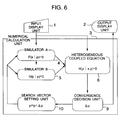
- a parameter p is set in a numerical calculation unit 3 through an input display unit 1.
- a locally consistent solution x obtained from the simulator A and a locally consistent solution y obtained from the simulator B for the parameter p are sent to the heterogeneous coupled equation 6, which is solved to determine an increment ⁇ p of the parameter p.
- a convergence decision unit 9 decides on the convergence of ⁇ p.
- a search vector setting unit 10 sets a new parameter p by increasing the parameter p by ⁇ p. This process is repeated, and if a convergence is obtained, a value p, x, y of a globally consistent solution is displayed on an output display unit 2.
- Fig. 6 The method shown in Fig. 6 is called the uncoupled method. Since the heterogeneous coupled equation 6 can be developed individually, the program development involved is not so extensive, and each iteration requires only a small length of time. In view of the fact that the increment of the parameter p and the variables x, y are independently determined, however, the number of iterations increases, resulting in a very low convergence and a high risk of divergence.
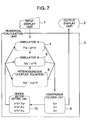
- the method shown in Fig. 7 is called the coupled method.
- this method has the disadvantage that the restructuring of the heterogeneous coupled equation 6 including the simulator A and the simulator B greatly increases the scale of program development while at the same time considerably increasing the time required for each iteration.
- the object of the present invention is to consider the above-mentioned problems of the prior art and to provide a method and a system for concurrent computing between heterogeneous simulators having an extremely high speed, a very high stability and a superior scalability.
- a method and a system for concurrent computing between heterogeneous simulators according to this invention are very superior in speed, stability and scalability and can couple heterogeneous simulators to each other very efficiently as compared with the conventional noncoupled method (Fig. 6) and the coupled method (Fig. 7).
- equation 4 is obtained when equation 3 is solved for ⁇ p.
- equation 5 is obtained from the simulator A and equation 6 from the simulator B, so that the linear variational equation for the heterogeneous coupled equation is given as equation 1.
- equation 5 is obtained by using the locally consistent solutions x + ⁇ x1,...., x + ⁇ xm, x, which in turn are obtained by the concurrent processing with the (l + 1) simulators A for the parameters p + ⁇ p1,...., p + ⁇ pl and p.
- equation 6 is obtained by using the locally consistent solutions y + ⁇ y1,..., y + ⁇ yn, y, which in turn are obtained by the concurrent processing with (l + 1) simulators B for the parameters p + ⁇ p1,...., p + ⁇ pl and p.
- the combinations of the parameter p and the variables x, y including (p + ⁇ p 1, x, y),...., (P + ⁇ pl, x, y), (p, x + ⁇ x1, y), Vietnamese (p, x + ⁇ xm, y), (px, x, y + ⁇ y1),...., (p, x, y + ⁇ yn) , (p, x, y) are applied to (l + m + n + 1) heterogeneous coupled equations and the substitutes H + ⁇ H1,...., H obtained by the concurrent processing thereof are used to form the heterogenenous coupling variational equation 1.
- the linear variational equation for heterogeneous coupling according to equation 1 is formed from the locally consistent solutions x ⁇ 1, x ⁇ 2 and so on and y ⁇ 1, y ⁇ 2 and so on obtained by the concurrent processing with a plurality of the simulators A and a plurality of the simulators B and from the substitutes H ⁇ 1, H ⁇ 2 and so on obtained by the concurrent processing with a plurality of the heterogeneous coupled equations 6 with respect to a plurality of the parameters p ⁇ 1, p ⁇ 2 and so on (p + ⁇ 1 ⁇ p, p + ⁇ 2 ⁇ p and so on).
- the linear variational equation for the heterogeneous coupling according to equation 2 is set in the numerical calculation unit for the heterogeneous coupling variational equation.
- the simulator engineer can produce a higher speed than in the conventional noncoupled method (Fig. 6) and a higher convergence than in the conventional coupled method (Fig. 7) simply by setting a heterogeneous coupled equation. Therefore, the system having the feature of (6) or (7) above is an extremely high-speed, a very stable system having a high scalability for concurrent computing between heterogeneous simulators.
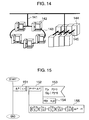
- Fig. 14 shows an environment for executing the concurrent computing between heterogeneous simulators. This represents an environment for concurrent operation in coordination between heterogeneous simulators implemented in a network comprising hardware such as a cluster 143 of a plurality of work stations 142 connected to an Ethernet 141 and a massively parallel computer 144 including a multiplicity of RISC processors connected to an intracompany communication bus 145.
- Fig. 1 is a block diagram showing a configuration of a system for concurrent computing between heterogeneous simulators according to a first embodiment of the invention.
- a simulator A including a parameter p and a variable x, a simulator B including the parameter p and a variable y are set together with the parameter p in a numerical calculation unit 3 through an input display unit 1.
- the numerical calculation unit 3 executes the calculation operation on the basis of a simulator program and determines self-consistent solutions x, y of the nonlinear simultaneous equations formed of the parameter p.
- the variables x, y are displayed in the form of data or graphics on the output display unit 2.
- a heterogeneous coupled equation 6 is set again in the numerical calculation unit 3 through the input display unit 1 to determine globally consistent solutions p, x, y.
- the numerical calculation unit 3 includes a calculation control unit 7 having a heterogeneous coupling variational equation calculation unit 8, a convergence decision unit 9 for the parameter p, and a search vector setting unit 10 for the parameter p.
- the heterogenous coupling variational equation calculation unit 8 retrieves a locally consistent solution x obtained from the simulator A and a locally consistent solution y obtained from the simulator B for the parameter p.
- the numerical calculation unit 8 applies the parameter p and the variables x, y to the heterogeneous coupled equation 6 and retrieves the substitute H.
- the linear variational equation for heterogeneous coupling according to equation 1 formed of the values of the parameter p, the variables x, y and H is solved thereby to determine the increment ⁇ p of the parameter p.
- the convergence decision unit 9 decides on the convergence of ⁇ p.
- the search vector setting unit 10 sets a new parameter p by increasing the preceding parameter by ⁇ p and repeats the steps for retrieving locally consistent solutions from the simulators.
- the output display unit 2 can display the values of the globally consistent solutions p, x, y.
- the linear variational equation for heterogeneous coupling according to equation 1 is equivalent to equation 3 for the conventional stable coupled method shown in Fig. 7. In addition, it is in the same dimension as the heterogeneous coupled equation 6 for the conventional noncoupled method shown in Fig. 6. Therefore, this system is a high-speed, stable system for concurrent computing between heterogeneous simulators.
- FIG. 3 The processing steps for a calculation control unit of a numerical calculation unit 3 according to this invention is shown in Fig. 3 (block 1).
- the steps of processing (block 152) for setting a new parameter p are repeated until the increment ⁇ p of the parameter p converges (block 151).
- the parameter p and the variables x, y are substituted into H (p ⁇ x, y) of the heterogeneous coupled equation 6 thereby to determine the value H (block 154).
- the step (block 155) is executed for solving the linear variational equation for heterogeneous coupling formed of the parameter p, the variables x, y and the value H thereby to determine ⁇ p.
- Fig. 2 is a block diagram showing a system for concurrent computing between heterogeneous simulators according to a second embodiment of the invention.
- the calculation control unit according to the first embodiment shown in Fig. 1 includes a concurrent differential calculation control unit 11.
- the concurrent differential calculation control unit 11 sets p + ⁇ p1,...., p + ⁇ pl, together with p, by modulating the infinitesimal amounts ⁇ p1,...., ⁇ pl with the parameter p (p1,...., pl). Also, (l + 1) simulators A and (l + 1) simulators B are set in the numerical calculation unit 3. Then, the parameters p + ⁇ p1,..
- the heterogeneous coupling variational equation calculation unit 8 sets the parameters p + ⁇ p1,...., p + ⁇ pl, p, the variables x + ⁇ x1,...., x + ⁇ x m, x and the variables y + ⁇ yl,...., y + ⁇ yn, y again in the concurrent differential calculation control unit 11.
- the concurrent differential calculation control unit 11 sets combinations of the parameter p and the variables x, y including (p + ⁇ p1, x, y) (p + ⁇ pl, x, y), (p, x + ⁇ x1, y),...., (p, x + ⁇ xm, y), (p, x, y + ⁇ y1),...., (p, x, y + ⁇ yn), (p, x, y). Also, the (l + m + n + 1) heterogeneous coupled equations 6 are set in the numerical calculation unit 3.
- the time required for each iteration is substantially the same as in the conventional noncoupled method, in view of the fact that the linear variational equation for heterogeneous coupling according to equation 1 is in the same dimension as the heterogeneous coupled equation 6.
- the system according to this embodiment is an extremely high-speed, stable system for concurrent computing between heterogeneous simulators.
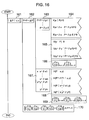
- FIG. 16 The processing steps for the numerical calculation unit 3 including the concurrent differential calculation control unit according to the invention are shown in Fig. 16.
- a new parameter p is set (block 162) by increasing the increment ⁇ p of the prevailing parameter p until the increment ⁇ p converges (block 161). This step is repeated.
- the first step is to set p + ⁇ p1,...., p + ⁇ pl and p by modulating the parameter p (p1,...., pl) by infinitesimal amounts ⁇ p1,...., ⁇ pl (block 163).
- combinations of the parameter p and the variables x, y including (p + ⁇ p1, x, y) (p + ⁇ pl, x, y), (p, x + ⁇ x1, y) (p, x + ⁇ xm, y), (p, x, y + ⁇ y1), ...., (p, x, y + ⁇ yn), (p, x, y) are set (block 167).
- the step (block 170) is executed for solving the linear variational equation for heterogeneous coupling according to equation 1 formed by the values of ( ⁇ x/ ⁇ p)m ⁇ l, ( ⁇ y/ ⁇ p)n ⁇ l, ( ⁇ H/ ⁇ x)l ⁇ m, ( ⁇ H/ ⁇ y)l ⁇ n, ( ⁇ H/ ⁇ p) and H thereby to produce ⁇ p.
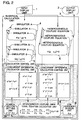
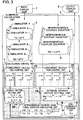
- Fig. 3 is a block diagram showing a configuration of a system for concurrent computing between heterogeneous simulators according to a third embodiment of the invention.
- This embodiment is equivalent to the first embodiment shown in Fig. 1 in which the calculation control unit further includes a concurrent calculation control unit 12 and an optimum search vector setting section 13.
- the search vector setting unit 10 sets new parameters p ⁇ 1, p ⁇ 2 and so on, i.e., p + ⁇ 1 ⁇ p, p + ⁇ 2 ⁇ p and so on including a plurality of increment coefficients ⁇ ( ⁇ 1, ⁇ 2, and so on) for the increment ⁇ p of the parameter p in the concurrent calculation control unit 12. Also, as shown in Fig. 4, three increment coefficients 0.5 ⁇ , ⁇ , 2.0 ⁇ are set on the basis of the value ⁇ (0 ⁇ ⁇ ⁇ 1).
- the concurrent calculation control unit 12 sets a plurality of simulators A and a plurality of simulators B in the numerical calculation unit 3. Then, the parameters p ⁇ 1, p ⁇ 2 and so on are applied to a plurality of the simulators A and a plurality of the simulators B, so that the locally consistent solutions x ⁇ 1, x ⁇ 2 and so on and y ⁇ 1, y ⁇ 2 and so on obtained by concurrent processing are retrieved and applied to the numerical calculation unit 8 for the heterogeneous coupling variational equation.
- the numerical calculation unit 8 of the heterogeneous coupling variational equation sets the parameters p ⁇ 1, p ⁇ 2 and so on, and the variables x ⁇ 1, x ⁇ 2 and so on, and y ⁇ 1, y ⁇ 2 and so on, again in the concurrent calculation control unit 12.
- the concurrent calculation control unit 12 sets the combinations of the parameter p and the variables x, y including (p ⁇ 1, x ⁇ 1, y ⁇ 1), (p ⁇ 2, x ⁇ 2, y ⁇ 2), and so on. Also, a plurality of heterogeneous coupled equations 6 are set in the numerical calculation unit 3. The combinations of the parameter p and the variables x, y including (p ⁇ 1, x ⁇ 1, y ⁇ 1), (p ⁇ 2, x ⁇ 2, y ⁇ 2) and so on thus set are applied to a plurality of the heterogeneous coupled equations 6, and the concurrently processed values of H including H ⁇ 1, H ⁇ 2 and so on, are retrieved and applied to the optimum search vector setting unit 13.
- the optimum search vector unit 13 applies the value H ⁇ associated with a minimum norm among H ⁇ 1, H ⁇ 2 and so on, which is smaller than the minimum norm of H in the preceding iterative calculation to the numerical calculation unit 8 for the heterogeneous coupling variational equation.
- the numerical calculation unit 8 for the heterogeneous coupling variational equation solves only the linear variational equation for heterogeneous coupling according to equation 1 formed from the parameter p ⁇ , the variables x ⁇ , y ⁇ , and the H value H ⁇ for the set value ⁇ thereby to produce the increment ⁇ p of the optimum parameter p. Also, as shown in Fig. 4, in the case where the value H ⁇ associated with a minimum norm among H ⁇ 1, H ⁇ 2 and so on is smaller than the minimum norm of H in the preceding iterative calculation, the value a is multipled by 1/8 in order to reduce the nonlinearity, and then the above-mentioned process is repeated.
- the superscripts "k" shown in Fig. 3 indicate the value for the k-th iteration.
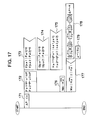
- FIG. 17 The processing steps for the concurrent calculation control unit and the optimum vector setting unit in the calculation control unit of the numerical calculation unit 3 according to the invention are shown in Fig. 17.
- a new parameter p is set by increasing the increment ⁇ p of the parameter p until the increment ⁇ p converges (block 171), and this step is repeated.
- new parameters p ⁇ 1, p ⁇ 2 and so on p + ⁇ 1 ⁇ p, p + ⁇ 2 ⁇ p and so on
- ⁇ increment coefficients
- step (block 175) is executed in which the combinations of the parameter p and the variables x, y including (p ⁇ 1, x ⁇ 1, y ⁇ 1), (p ⁇ 2, x ⁇ 2, y ⁇ 2), and so forth are substituted into H(p ⁇ x, y) of a plulrality of the heterogeneous coupled equations 6 thereby to obtain H ⁇ 1, H ⁇ 2 and so forth.
- a value H ⁇ associated with the minimum norm smaller than the minumum value of the norm of H in the preceding iterative calculation is selected (block 176).
- the step (block 178) is executed for solving the linear variational equation for heterogeneous coupling according to equation 1 formed of the parameter p ⁇ , the variabls x ⁇ , y ⁇ and the value H ⁇ for the sete value ⁇ thereby to produce the increment ⁇ p of the optimum parameter p.
- Fig. 5 is a block diagram showing a system for concurrent computing between heterogeneous simulators according to a fourth embodiment of the invention.
- heterogeneous simulators 4, 5 and other simulators 5' and so forth including the parameter p and the variables x, y and so on and a heterogeneous coupled equation 6' correlating the parameter p and the variables x, y, z, and so on are set in the numerical calculation unit 3 from the input display unit 1. Also, a variational equation corresponding to the heterogeneous coupled equation 6' is set in the numerical calculation unit 8'.
- the heterogeneous coupling variational calculation unit 8' forms a linear variational equation for the heterogenerous coupled equation according to equation 2 and determines the increment ⁇ p of the parameter p thereby to produce the globally consistent solutions p, x, y.
- the simulation engineer can obtain a higher speed than the conventional noncoupled method and a higher convergence than the conventional coupled method simply by seting the heterogeneous coupling variation equation 8' of equation 2 anew. Consequently, the present system is an extremely high-speed, very stable system with a very high scalability for concurrent computing between heterogeneous simulators.
- Fig. 8 is a block diagram showing a simulation of a nanometric device of a system for concurrent computing between heterogeneous simulators according to a fifth embodiment of the invention.
- a quantum transportation simulator 4 and a traditional transportation simulator 5 are set in the numerical calculation unit 3.
- the numerical calculation unit 3 executes the calculation process according to a simulation program and determines self-consistent solutions for the variables of nonlinear simultaneous equations. These variables are displayed on an output display unit 2 in the form of data or graphics.
- a quantum distribution function f(x, k) for a potential ⁇ (x) is determined based on an imbalanced quantum distribution funtional equation W and a quantum distribution function f(xb, kb) constituting a boundary condition (block 121).
- the potential ⁇ (x) is obtained (block 123) for the electron density n(x) (block 122) from the quantum distribution function f(x, k) on the basis of the potential ⁇ (xb) for the boundary condition and the Poison's equation ⁇ .
- This process is repeated ntil the convergence conditions are met for both the increment ⁇ n(x) and the increment ⁇ (x) of the electron density and the potential (block 124). If the convergence conditions are met, a current density Jq(x) is obtained from the quantum distribution function f(x, k) providing a self-consistent solution (block 125).
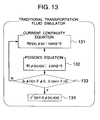
- the traditional transportation simulator 5 is shown in detail in the flowchart of Fig. 13.
- the electron density n(x) for the potential ⁇ (x) is obtained (block 131).
- the potential ⁇ (x) for the electron density n(x) is determined on the basis of the potential ⁇ (xb) for the boundary conditions of the Poison's equation as in the case of the quantum transportation simulator 4 (block 132). This process is repeated until both the increments ⁇ (x) and ⁇ n(x) of the potential and the electron density, respectively, and come to satisfy the convergence conditions (block 133). Once the convergence conditions are met, the current density Jx(x) can be obtained from the potential ⁇ (x) and the electron density n(x) providing self-consistent solutions (block 134).
- a heterogeneous coupled equation according to equation 7 can be formed for guaranteeing the current continuity for the the current density Jq(xb) obtained from the quantum transportation simulator 4 and the current density Jc(xb) obtained from the traditional transportation simulator 5 in the boundary domain xb.
- the numerical calculation unit 3 includes a calculation control unit 7 having a heterogeneous coupling variational equation calculation unit 8, a convergence decision unit 9 for the parameter p and a search vector setting unit 10 for the parameter p.
- the heterogeneous coupling variational equation calculation unit 8 retrieves the locally consistent solution Jq(x) obtained from the quantum transporation simulator 4 and the locally consistent solution Jc(x) obtained from the traditional transportation simulator 5 for the parameter ⁇ (xb). Also, the numerical calculation unit 8 retrieves the value H of Jc(xb) - Jq(xb) by applying the parameter ⁇ (xb) and the variables Jq(x), Jc(x) to the heterogeneous coupled equation 6.
- the convergence decision unit 9 decides on the convergence of the increment ⁇ (xb). In the absence of convergence, the process is repeated in which the search vector setting unit 10 sets a new parameter ⁇ (xb) by increasing the prevailing parameter by ⁇ f(xb), and retrieves the locally consistent solutions from the simulators. In the presence of convergence, on the other hand, the values of the globally consistent solutons ⁇ (x), Jq(x), Jc(x) can be displayed on the output display unit 2. This system is equivalent to the conventional stable coupled method.
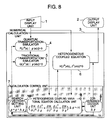
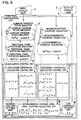
- Fig. 9 is a block diagram showing a nanometric device simulation in a system for concurrent computing between heterogeneous simulators according to a sixth embodiment of the invention.
- This embodiment further includes the concurrent differential calculation control unit 11 in the calculation control unit in the fifth embodiment shown in Fig. 8.
- the concurrent differential calculation control unit 11 sets ⁇ (xb) + ⁇ (xb1),...., ⁇ (xb) + ⁇ (xbl) and ⁇ (xb) obtained by modulating infinitesimal amounts ⁇ (xb1),...., ⁇ (xbl) for the parameters ⁇ (xb) ⁇ (xb1),...., ⁇ (xbl) ⁇ . Also, (l + 1) quantum transportation simulators 4 and (l + 1) traditional transportation simulators 5 are set in the numerical calculation unit 3.
- the heterogeneous coupling variational calculation unit 8 sets the parameters ⁇ (xb) + ⁇ (xb1),...., ⁇ (xb) + ⁇ (xbl) and ⁇ (xb1) and the variables Jq(xb) + ⁇ Jq(xb1),..., Jq(xb) + ⁇ Jq(xbl - 1) and Jc(xb) + ⁇ Jc(xb1),...., Jc(xb) + ⁇ Jc(xbl - 1) in the concurrent differential calculation control unit 11.
- the concurrent differential calculation control unit 11 combines the parameter ⁇ (xb) and the variables Jq(xb), Jc(xb), and sets ⁇ (xb) + ⁇ (xb1), Jq(xb), Jc(xb) ⁇ ,...., ⁇ (xb) + ⁇ (xbl), Jq(xb), Jc(xb) ⁇ , ⁇ (xb), Jq(xb) + ⁇ Jq(xb1), Jc(xb) ⁇ ,...., ⁇ (xb), Jq(xb) + ⁇ Jq(xbl - 1), Jc(xb) ⁇ , ⁇ (xb), Jq(xb), Jc(xb) + ⁇ Jc(xb1) ⁇ ,...., ⁇ (xb), Jq( xb), Jc(xb) + ⁇ Jq (xbl - 1) ⁇ , ⁇ (xb), Jq(xb), Jc(xb) ⁇ .
- (3l - 1) heterogeneous coupled equations 6 are set in the numerical calculation unit 3.
- the combinations of the parameter ⁇ (xb) and the variables Jq(xb), Jc(xb) thus set are applied to the (3l -1) heterogeneous coupled equations 6, and the concurrenty-processed values H of H + ⁇ H1,...., H are retrieved thereby to form ⁇ H/ ⁇ (xb) ⁇ l ⁇ l, ⁇ H/ ⁇ Jq(xb) ⁇ l ⁇ l - 1, ⁇ H/ ⁇ Jc(xb) ⁇ l ⁇ l - 1, which are applied to the numerical calculation unit for the heterogeneous coupling variational equation.
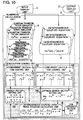
- Fig. 10 is a block diagram showing a nanometric device simulation for a system for concurrent computing between heterogeneous simulators according to a seventh embodiment of the present invention.
- This embodiment is equivalent to the fifth embodiment shown in Fig. 8 in which the calculation control unit further includes the concurrent calculation control unit 12 and the optimum search vector setting section 13.
- the search vector setting unit 10 sets new parameters ⁇ (xb) ⁇ 1, ⁇ (xb ) ⁇ 2,... ⁇ (xb) + ⁇ 1 ⁇ (xb), ⁇ (xb) + ⁇ 2 ⁇ (xb) and so on ⁇ including a plurality of increment coefficients ⁇ ( ⁇ 1, ⁇ 2,.7) for the increment ⁇ (xb) of the parameter ⁇ (xb) in the concurrent calculation control unit 12. Also, as shown in Fig. 11, three increment coefficients 0.5 ⁇ , ⁇ , 2.0 ⁇ are set according to the increment coefficient of ⁇ (0 ⁇ ⁇ ⁇ 1).
- the concurrent calculation control uni 12 sets a plurality of the quantum transportation simualtors 4 and a plurality of the traditional transportation simulators 5 in the numerical calculation unit 3. Then, the parameters ⁇ (xb) ⁇ 1, ⁇ (xb) ⁇ 2 and so forth are applied to a plurality of the quantum transportation simulators and the traditional transportation simulators 5.
- the locally consistent solutions Jq(xb) ⁇ 1, Jq(xb) ⁇ 2 and so forth and Jc(xb) ⁇ 1, Jc(xb) ⁇ 2 and so forth obtained by concurrent processing are retrieved and applied to the heterogeneous coupling variational equation calculation unit 8.
- the heterogeneous coupling variational equation calculation unit 8 sets the parameters ⁇ (xb) ⁇ 1, ⁇ (xb) ⁇ 2 and so forth, the variables Jq(xb) ⁇ 1, Jq(xb) ⁇ 2 and so forth, and the variables Jc(xb) ⁇ 1, Jc(xb) ⁇ 2 and so forth in the concurrent calculation control unit 12.
- the concurrent calculation control unit 12 sets the combinations of the parameter ⁇ (xb) and the variables Jq(xb), Jc(xb) including ⁇ (xb) ⁇ 1, Jq(xb) ⁇ 1, Jc(xb) ⁇ 1 ⁇ , ⁇ (xb) ⁇ 2, Jq(xb) ⁇ 2, Jc(xb) ⁇ 2 ⁇ , and so forth. Also, a plurality of the heterogeneous coupled equations 6 are set in the numerical calculation unit 3.
- the optimum search vector setting unit 13 applies the value Ha associated with the minimum norm smaller than the minimum norm of H in the preceding iterative calculation among H ⁇ 1, H ⁇ 2 and so on to the numerical calculation unit 8 for heterogeneous couple equation.
Landscapes
- Engineering & Computer Science (AREA)
- Physics & Mathematics (AREA)
- Theoretical Computer Science (AREA)
- Computer Hardware Design (AREA)
- Evolutionary Computation (AREA)
- Geometry (AREA)
- General Engineering & Computer Science (AREA)
- General Physics & Mathematics (AREA)
- Management, Administration, Business Operations System, And Electronic Commerce (AREA)
- Complex Calculations (AREA)
Applications Claiming Priority (3)
| Application Number | Priority Date | Filing Date | Title |
|---|---|---|---|
| JP12811196 | 1996-05-23 | ||
| JP128111/96 | 1996-05-23 | ||
| JP12811196A JPH09311852A (ja) | 1996-05-23 | 1996-05-23 | ヘテロジーニアスなシミュレータ間の協調分散コンピューティング方法及びシステム |
Publications (2)
| Publication Number | Publication Date |
|---|---|
| EP0809200A2 true EP0809200A2 (fr) | 1997-11-26 |
| EP0809200A3 EP0809200A3 (fr) | 2000-02-09 |
Family
ID=14976661
Family Applications (1)
| Application Number | Title | Priority Date | Filing Date |
|---|---|---|---|
| EP97303493A Withdrawn EP0809200A3 (fr) | 1996-05-23 | 1997-05-22 | Méthode et système de calcul concurrent entre des simulateurs hétérogènes |
Country Status (3)
| Country | Link |
|---|---|
| US (1) | US5926403A (fr) |
| EP (1) | EP0809200A3 (fr) |
| JP (1) | JPH09311852A (fr) |
Families Citing this family (11)
| Publication number | Priority date | Publication date | Assignee | Title |
|---|---|---|---|---|
| JP3352936B2 (ja) * | 1997-04-18 | 2002-12-03 | 株式会社東芝 | 電気特性評価装置、電気特性評価方法、及び、電気特性評価プログラムを記録したコンピュータ読み取り可能な記録媒体 |
| US6425762B1 (en) * | 1998-02-24 | 2002-07-30 | Wind River Systems, Inc. | System and method for cosimulation of heterogeneous systems |
| US20040158443A1 (en) * | 2003-02-11 | 2004-08-12 | Texas Instruments Incorporated | Functional verification using heterogeneous simulators |
| US7987073B2 (en) | 2003-04-04 | 2011-07-26 | Canon Kabushiki Kaisha | Method and apparatus of optimally designing a structure |
| US10817628B1 (en) | 2005-05-13 | 2020-10-27 | The Mathworks, Inc. | System and method for graphical model processing |
| US7979243B1 (en) * | 2005-05-13 | 2011-07-12 | The Mathworks, Inc. | System and method for graphical model processing |
| DE102009043425A1 (de) * | 2009-09-29 | 2011-04-07 | Siemens Aktiengesellschaft | Simulationssystem und Verfahren für eine technische Anlage |
| JP5451329B2 (ja) * | 2009-11-17 | 2014-03-26 | キヤノン株式会社 | シミュレーション装置およびその制御方法 |
| AT514854A2 (de) * | 2013-04-15 | 2015-04-15 | Kompetenzzentrum Das Virtuelle Fahrzeug Forschungsgmbh | Verfahren und Vorrichtung zur Co-Simulation von zwei Teilsystemen |
| US20150103698A1 (en) * | 2013-10-10 | 2015-04-16 | GM Global Technology Operations LLC | System and method for topology optimization with a plurality of materials |
| EP3454234A1 (fr) * | 2017-09-06 | 2019-03-13 | dSPACE digital signal processing and control engineering GmbH | Procédé de fourniture d'une simulation en temps réel pour le développement des appareils de commande et dispositif de simulation pour le développement des appareils de commande |
Family Cites Families (5)
| Publication number | Priority date | Publication date | Assignee | Title |
|---|---|---|---|---|
| US5191578A (en) * | 1990-06-14 | 1993-03-02 | Bell Communications Research, Inc. | Packet parallel interconnection network |
| US5317568A (en) * | 1991-04-11 | 1994-05-31 | Galileo International Partnership | Method and apparatus for managing and facilitating communications in a distributed hetergeneous network |
| US5369570A (en) * | 1991-11-14 | 1994-11-29 | Parad; Harvey A. | Method and system for continuous integrated resource management |
| US5844553A (en) * | 1993-08-30 | 1998-12-01 | Hewlett-Packard Company | Mechanism to control and use window events among applications in concurrent computing |
| US5566349A (en) * | 1994-05-16 | 1996-10-15 | Trout; Ray C. | Complementary concurrent cooperative multi-processing multi-tasking processing system using shared memories with a minimum of four complementary processors |
-
1996
- 1996-05-23 JP JP12811196A patent/JPH09311852A/ja active Pending
-
1997
- 1997-05-22 US US08/861,849 patent/US5926403A/en not_active Expired - Lifetime
- 1997-05-22 EP EP97303493A patent/EP0809200A3/fr not_active Withdrawn
Non-Patent Citations (2)
| Title |
|---|
| CHESSHIRE G ET AL: "An environment for parallel and distributed computation with application to overlapping grids" IBM JOURNAL OF RESEARCH AND DEVELOPMENT, MAY 1994, USA, vol. 38, no. 3, pages 285-300, XP000861529 ISSN: 0018-8646 * |
| DRASHANSKY T T ET AL: "SciAgents-an agent based environment for distributed, cooperative scientific computing" PROCEEDINGS. SEVENTH INTERNATIONAL CONFERENCE ON TOOLS WITH ARTIFICIAL INTELLIGENCE (CAT. NO.95CB35878), PROCEEDINGS OF 7TH IEEE INTERNATIONAL CONFERENCE ON TOOLS WITH ARTIFICIAL INTELLIGENCE, HERNDON, VA, USA, 5-8 NOV. 1995, pages 452-459, XP002125618 1995, Los Alamitos, CA, USA, IEEE Comput. Soc. Press, USA ISBN: 0-8186-7312-5 * |
Also Published As
| Publication number | Publication date |
|---|---|
| EP0809200A3 (fr) | 2000-02-09 |
| JPH09311852A (ja) | 1997-12-02 |
| US5926403A (en) | 1999-07-20 |
Similar Documents
| Publication | Publication Date | Title |
|---|---|---|
| Zhang et al. | Stress-related topology optimization of shell structures using IGA/TSA-based Moving Morphable Void (MMV) approach | |
| Mavriplis et al. | A 3D agglomeration multigrid solver for the Reynolds–averaged Navier–Stokes equations on unstructured meshes | |
| US5926403A (en) | Method and system for concurrent computing between heterogeneous simulators | |
| JP3195498B2 (ja) | 三次元形状作成方法及びその装置 | |
| Mahdavi et al. | Topology optimization of 2D continua for minimum compliance using parallel computing | |
| Gamache et al. | Image-based truss recognition for density-based topology optimization approach | |
| US7444312B2 (en) | Method and arrangement for designing a technical system | |
| Eldahshan et al. | Phase field modeling of ductile fracture at large plastic strains using adaptive isotropic remeshing | |
| JPH0816629A (ja) | 解析用メッシュ作成方法及び装置 | |
| Yue et al. | Probabilistic framework for reliability analysis of gas turbine blades under combined loading conditions | |
| CN113987856A (zh) | 一种基于标架场的复杂多约束结构网格生成方法 | |
| Glamsch et al. | Methods for increased efficiency of FEM-based topology optimization | |
| Cuillière et al. | Automatic mesh generation and transformation for topology optimization methods | |
| Ding et al. | Exact and efficient isogeometric reanalysis of accurate shape and boundary modifications | |
| Hwang et al. | An unstructured quadrilateral mesh generation algorithm for aircraft structures | |
| Sirola et al. | Multi-joint topology optimization for stiffness constrained design problems | |
| Fihri-Fassi et al. | An integrated method involving design-manufacturing-environment applied in strutural optimization | |
| El Samrout et al. | A new hybrid method to solve the multi-objective optimization problem for a composite hat-stiffened panel | |
| Kennedy et al. | Topology optimization with natural frequency constraints using a quadratic approximation of a spectral aggregate | |
| Jia et al. | A high-order isogeometric collocation method with adaptive refinement and multi-patch geometric modeling | |
| Spekreijse et al. | Semi-automatic domain decomposition based on potential theory | |
| KIM et al. | Jacobian update strategies for quadratic and near-quadratic convergence of Newton and Newton-like implicit schemes | |
| CN115461739A (zh) | 分层降阶矩阵生成装置 | |
| JPH11203330A (ja) | 形状変形モード生成システムと形状最適化解析システムおよびそれに用いるプログラムを記録した記録媒体 | |
| Allmaras et al. | Output-based Mesh Adaptation Using Commercial Mesh Generation Software |
Legal Events
| Date | Code | Title | Description |
|---|---|---|---|
| PUAI | Public reference made under article 153(3) epc to a published international application that has entered the european phase |
Free format text: ORIGINAL CODE: 0009012 |
|
| AK | Designated contracting states |
Kind code of ref document: A2 Designated state(s): GB |
|
| PUAL | Search report despatched |
Free format text: ORIGINAL CODE: 0009013 |
|
| AK | Designated contracting states |
Kind code of ref document: A3 Designated state(s): GB |
|
| 17P | Request for examination filed |
Effective date: 20000330 |
|
| 17Q | First examination report despatched |
Effective date: 20020828 |
|
| STAA | Information on the status of an ep patent application or granted ep patent |
Free format text: STATUS: THE APPLICATION IS DEEMED TO BE WITHDRAWN |
|
| 18D | Application deemed to be withdrawn |
Effective date: 20031202 |