EP0808532B1 - Frequenzsprung-rückverbindung mit netzzugangskanal für ein satellitengestütztes persönliches nachrichtenübertragungssystem - Google Patents
Frequenzsprung-rückverbindung mit netzzugangskanal für ein satellitengestütztes persönliches nachrichtenübertragungssystem Download PDFInfo
- Publication number
- EP0808532B1 EP0808532B1 EP96909483A EP96909483A EP0808532B1 EP 0808532 B1 EP0808532 B1 EP 0808532B1 EP 96909483 A EP96909483 A EP 96909483A EP 96909483 A EP96909483 A EP 96909483A EP 0808532 B1 EP0808532 B1 EP 0808532B1
- Authority
- EP
- European Patent Office
- Prior art keywords
- frequency
- subscriber
- hop
- signals
- control channel
- Prior art date
- Legal status (The legal status is an assumption and is not a legal conclusion. Google has not performed a legal analysis and makes no representation as to the accuracy of the status listed.)
- Expired - Lifetime
Links
- 238000004891 communication Methods 0.000 title claims abstract description 27
- 238000012937 correction Methods 0.000 claims abstract description 27
- 238000001228 spectrum Methods 0.000 claims abstract description 14
- 230000005540 biological transmission Effects 0.000 claims abstract description 11
- 230000007704 transition Effects 0.000 description 12
- 238000010586 diagram Methods 0.000 description 7
- 238000000034 method Methods 0.000 description 7
- 230000001360 synchronised effect Effects 0.000 description 7
- 235000008694 Humulus lupulus Nutrition 0.000 description 5
- 238000013459 approach Methods 0.000 description 3
- 230000001413 cellular effect Effects 0.000 description 3
- 230000011664 signaling Effects 0.000 description 3
- 230000015556 catabolic process Effects 0.000 description 2
- 238000006731 degradation reaction Methods 0.000 description 2
- 230000002452 interceptive effect Effects 0.000 description 2
- VYPSYNLAJGMNEJ-UHFFFAOYSA-N Silicium dioxide Chemical compound O=[Si]=O VYPSYNLAJGMNEJ-UHFFFAOYSA-N 0.000 description 1
- 101000985500 Staphylococcus saprophyticus subsp. saprophyticus (strain ATCC 15305 / DSM 20229 / NCIMB 8711 / NCTC 7292 / S-41) 3-hexulose-6-phosphate synthase 3 Proteins 0.000 description 1
- 206010042618 Surgical procedure repeated Diseases 0.000 description 1
- 230000006978 adaptation Effects 0.000 description 1
- 230000003044 adaptive effect Effects 0.000 description 1
- 239000000969 carrier Substances 0.000 description 1
- 238000005562 fading Methods 0.000 description 1
- 238000012986 modification Methods 0.000 description 1
- 230000004048 modification Effects 0.000 description 1
- 238000012544 monitoring process Methods 0.000 description 1
- 230000008569 process Effects 0.000 description 1
- 230000035945 sensitivity Effects 0.000 description 1
- 230000007480 spreading Effects 0.000 description 1
Images


Classifications
-
- H—ELECTRICITY
- H04—ELECTRIC COMMUNICATION TECHNIQUE
- H04B—TRANSMISSION
- H04B1/00—Details of transmission systems, not covered by a single one of groups H04B3/00 - H04B13/00; Details of transmission systems not characterised by the medium used for transmission
- H04B1/69—Spread spectrum techniques
- H04B1/713—Spread spectrum techniques using frequency hopping
- H04B1/7156—Arrangements for sequence synchronisation
-
- H—ELECTRICITY
- H04—ELECTRIC COMMUNICATION TECHNIQUE
- H04J—MULTIPLEX COMMUNICATION
- H04J13/00—Code division multiplex systems
-
- H—ELECTRICITY
- H04—ELECTRIC COMMUNICATION TECHNIQUE
- H04B—TRANSMISSION
- H04B7/00—Radio transmission systems, i.e. using radiation field
- H04B7/14—Relay systems
- H04B7/15—Active relay systems
- H04B7/204—Multiple access
- H04B7/216—Code division or spread-spectrum multiple access [CDMA, SSMA]
-
- H—ELECTRICITY
- H04—ELECTRIC COMMUNICATION TECHNIQUE
- H04J—MULTIPLEX COMMUNICATION
- H04J13/00—Code division multiplex systems
- H04J13/10—Code generation
- H04J13/12—Generation of orthogonal codes
-
- H—ELECTRICITY
- H04—ELECTRIC COMMUNICATION TECHNIQUE
- H04W—WIRELESS COMMUNICATION NETWORKS
- H04W84/00—Network topologies
- H04W84/02—Hierarchically pre-organised networks, e.g. paging networks, cellular networks, WLAN [Wireless Local Area Network] or WLL [Wireless Local Loop]
- H04W84/04—Large scale networks; Deep hierarchical networks
- H04W84/06—Airborne or Satellite Networks
-
- Y—GENERAL TAGGING OF NEW TECHNOLOGICAL DEVELOPMENTS; GENERAL TAGGING OF CROSS-SECTIONAL TECHNOLOGIES SPANNING OVER SEVERAL SECTIONS OF THE IPC; TECHNICAL SUBJECTS COVERED BY FORMER USPC CROSS-REFERENCE ART COLLECTIONS [XRACs] AND DIGESTS
- Y02—TECHNOLOGIES OR APPLICATIONS FOR MITIGATION OR ADAPTATION AGAINST CLIMATE CHANGE
- Y02D—CLIMATE CHANGE MITIGATION TECHNOLOGIES IN INFORMATION AND COMMUNICATION TECHNOLOGIES [ICT], I.E. INFORMATION AND COMMUNICATION TECHNOLOGIES AIMING AT THE REDUCTION OF THEIR OWN ENERGY USE
- Y02D30/00—Reducing energy consumption in communication networks
- Y02D30/70—Reducing energy consumption in communication networks in wireless communication networks
Definitions
- Spread spectrum communications is presently being used for a number of commercial applications and is expected to proliferate as the demand for untethered communications increases.
- PCS Personal Communications Systems
- Some examples of these systems include Globalstar (Globalstar System Application before the FCC by Loral Cellular Systems, Corp., June 3, 1991) and Odyssey (Application of TRW Inc. before the FCC to Construct a New Communications Satellite System "Odyssey,” May 31, 1991), among others.
- the intent of these systems is that a subscriber can place telephone calls directly through the satellite network from almost anywhere on the Earth, using a portable handset much like the present cellular telephones. Both of the systems mentioned intend to use spread spectrum CDMA techniques for a number of reasons.
- the return link signal is direct sequence (DS) CDMA spread spectrum.
- DS direct sequence
- Frequency-hopped communication systems are disclosed in LOYD J. MASON AND E. BARRY FELSTEAD: Probing Techniques and Estimation Processes for Fine-Time Synchronization of FH Systems' IEEE TRANSACTIONS ON COMMUNICATIONS, vol. 41, no.6, June 1993 (1993-06), pages 962-974, XP002180103 New York. It is disclosed that, for frequency-hopped communication systems, the hop patterns of the transmitter and receiver must be closely aligned in time to prevent performance degradation.
- a satellite network communication system in which a plurality of subscriber handset terminals communicate with a ground hub station on a net entry channel and traffic frequency channels using orthogonally frequency hopped, spread spectrum orthogonal CDMA transmissions, characterised in that said net entry channel has a selected number of frequency hop slots, and said hub station includes a plurality of control channel generators for generating a net entry control channel for communicating synchronization correction signals (initial timing, frequency and power) and available net entry channel frequency hop sequences to said subscriber handset terminals and a plurality of return link receiver means, each subscriber handset terminal having a subscriber unit control channel receiver for receiving said net entry control channel synchronization correction signals and available net entry channel frequency hop slots, a subscriber unit return link transmitter controlled by said synchronization correction signals and net entry channel frequency hop sequences so that signals from all subscriber handset terminals arrive at said hub station in time and frequency synchronism, each said subscriber unit return link transmitter including frequency hopped spread spectrum carrier such that none of the signals occupies
- the satellite network communication system may be further characterised in that the frequency hopping is at a relatively slow hop rate in order to enhance performance when receiving the same user signal from two satellites simultaneously.
- the satellite network communication system may be further characterised in that the network entry control channel at the ground hub station may include means for providing time and frequency corrections to subscriber hand set terminals necessary to establish subscriber to ground hub station communications on the traffic channel.
- the hop rate on the net entry channels may be lower than the hop rate on the traffic frequency channel.
- Each hub station and subscriber handset terminal may include means to modulate the signals on a carrier using orthogonal QPSK.
- the satellite network communication system of the present invention may provide one or more of the following:
- the hub station of a satellite communication network receives a multiplicity of spread spectrum signals from the subscriber terminals.
- Each of these signals (on a particular frequency channel) is composed of data symbols which are transmitted via a FH carrier.
- These signals are synchronized to arrive at the hub station in time and frequency synchronism.
- the signal carriers employ orthogonal hopping patterns, i.e. none of the signals occupies the same frequency bin at the same time.
- the orthogonal properties of the signals allow them to be demodulated without access noise from co-channel signals. This is called orthogonal frequency hopping (OFH).
- OFH orthogonal frequency hopping
- a separate in-band Net Entry Channel is provided for initial synchronism of users.
- Spread spectrum signals on this channel can be received by the hub station free of access noise from the traffic channels. Further, the NEC signals do not interfere with the traffic channel users despite initial timing and frequency errors.
- the return link signals are maintained in synchronism by transmitting small time and frequency corrections to each user from the GS via the inband control data on the outbound signal. The correction gain and update rate may be different for each user and may even be adaptive if user dynamics vary widely. Efficient data demodulation is performed despite phase discontinuities at the hop transitions by the use of block frequency and phase estimation techniques (i. e.
- the decoder operates efficiently despite phase discontinuities at the hop transitions through a novel arrangement of parallel decoders as described below.
- the use of slow hopping can result in signals that are received at two different satellites being perceived as orthogonal signal sets although they are synchronized for a single satellite.
- the ground station GS can determine the necessary time and frequency corrections that the new user must employ in order to enter the network in synchronism. This is performed on the net entry channel NEC and is necessary to establish user-GS communications on the traffic channel.
- the NEC provides a means for the user to transmit a net entry request with high probability of success using the time and frequency information derived by tracking the outbound signal.
- the use of a lower hop rate on the NEC allows rapid acquisition of the PN signal despite timing uncertainties.
- the present invention provides a satellite network communication system in which a plurality of subscriber handset terminals (14) communicate with a ground hub station (12) on a net entry channel (NEC) and traffic channels using orthogonally frequency hopped spread spectrum orthogonal CDMA transmissions such that none of the signals occupies the same frequency bin at the same time, characterized in that, said hub station (12) includes a control channel generator (16-1, 16-2...16-N) for generating a net entry control channel, each subscriber handset terminal has a subscriber unit control channel receiver (19) and a subscriber unit return link transmitter (20), said NEC having a selected number of frequency hop slots, each hop slot of the NEC being longer than that of a traffic channel and the frequency bandwidth of each hop bin of the NEC being twice the bandwidth of a traffic bin, so as to take account of initial timing and frequency uncertainties, whereby when entering the network each subscriber handset monitors the outbound signals from the hub station, selects an unused NEC hop sequence as signalled via a net entry control channel and begins transmission on
- NEC net
- the forward communications link 10 includes user signals transmitted from a hub ground station (GS) 12 through a satellite 11 which transponds them to individual users on the ground.
- GS hub ground station
- the system will typically employ a multibeam antenna 13 which illuminates contiguous "cells" on earth.
- the hub ground station 12 includes antenna means 15 broadcasting the forward link signals 10 (which include the net entry control channel) from a plurality of control channel signal generators 16-1, 16-2...16-N to the satellite which transponds the signals to a cell on earth where the destination handset 14 is located.
- Hub ground station 12 also includes a plurality of return link receivers 17-1, 17-2...17-N (the details of which are shown in Fig. 4), which are coupled to a system controller 18 to provide time, frequency and power correction signals to the control channel generator and the forward link 10.
- the circuits for providing time, frequency and power correction are illustrated in the functional block diagram of Fig. 4.
- Each subscriber station 14 includes a control channel receiver 19 which provides the time, frequency and power correction signal from the hub ground station to the subscriber unit return link transmitter 20 )which is shown in detail in the functional block diagram of Fig. 3).
- the forward link signals 10 are assumed to be spread spectrum orthogonal CDMA (OCDMA) in nature, and occupying approximately 2.5 MHz. It is further assumed, for illustrative purposes, that as many as 256 CDMA signals may occupy one of the 2.5 MHz subbands.
- CDMA signals is used by the GS as a "Control Channel" for communication with subscriber handsets (HS) 14 for call set up and network synchronization purposes.
- HS subscriber handsets
- each outbound signal contains in-band control data by which the GS 12 can send synchronization and power control data to the HS while the HS is in active conversation.
- the system may employ several of the 2.5 MHz subbands.
- the GS 12 transmits in several subbands which are "stacked" into an appropriate bandwidth for transmission on the uplink to the satellite. Groups of subbands are then routed to different antenna beams or antennas 13 on the satellite for transmission to individual users on the ground.
- the fundamental purpose of the return link 15 is to transmit data from the user handset HS 14 to the ground station GS 12.
- the data transmission rate will be taken to be 4800 bps for illustrative purposes.
- a summary of signal parameters for this illustrative embodiment are shown in Table 1. Table 1. Summary of example signal parameters for preferred embodiment.
- the return link 10 employs Orthogonal FH (OFH) over a 1.25 MHz subband. Hop bins are spaced by 9900 Hz and there are 126 bins in the subband, accommodating a maximum of 126 orthogonal signals.
- OFH Orthogonal FH
- the hop rate is 150 HPS, giving a hop period of 6.7 ms. All signals in the subband are received in synchronism at the GS. This is achieved by closing "long" time and frequency tracking loops through the GS by way of the outbound signal control channel.
- the hop bins to be used for traffic signaling are numbered from 0 to 113 (the 12 additional bins are used for network entry as discussed below). All subscribers in a frequency subband use the same hop code sequence (h1, h2, ... hk whil hK ).
- the user is assigned a Traffic Channel Number (TCN) from 0 to 113.
- TCN Traffic Channel Number
- the user adds the TCN to the hop code sequence Mod (114) to determine the transmit hop bin sequence.
- Modulation is OQPSK which is bandwidth efficient, power efficient, and relatively tolerant of amplifier nonlinearities.
- the channel transmission rate is 4950 SPS which allows one symbol guard time between hops. There are 33 symbols per hop of which 32 are data symbols.
- the data is detected using quasi-coherent block phase and frequency estimation techniques.
- the Viterbi decoder is implemented in a novel fashion to operate in the presence of a phase discontinuity at the hop transition.
- a Viterbi decoder has been successfully decoding the data up to the beginning of the present hop.
- the 32 bits of this hop are demodulated as soft decision symbols, however with a phase ambiguity of ninety degree multiples due to the phase discontinuity at the hop transition and ambiguity of the carrier phase estimator.
- Each of these sets of data is decoded by an independent decoder (total of four), each of which has been initialized to the state of the decoder which successfully decoded the data from the last hop.
- the branch metrics of the four decoders are checked to find which decoder is most likely correct.
- the other three decoders are then set to the same state as the successful decoder and this procedure repeated for the next hop.
- the decoding device will resolve the initial phase ambiguity after a few hops (as long as the hop period is at least a few decoder constraint lengths long). This relationship will then be maintained by the decoder device.
- This system may be used with either transparent or non-transparent codes.
- a second novel way to implement the Viterbi decoder operation in the presence of a phase discontinuity at the hop transition is as follows. Because the signal is OQPSK, the phase transitions on the two signal quadratures occur with a time offset of one half symbol. A device which synchronizes to the phase transitions on the received signal can then identify whether the transitions agree with the prior hop or whether there is a 90° rotation. If there is a 90° rotation, this is accounted for by swapping the data on the two signal quadratures. This leaves either a properly aligned signal in phase, or a 180° error. Similar to the above, multiple decoders are used, but now two rather than four are used. All other discussion of the prior paragraph applies to the two decoders, other than the last step where one (rather than three) decoders is set to the same state as the successful decoder.
- Both approaches for implementing the Viterbi decoder operation in the presence of a phase discontinuity at the hop transition are applicable to a broad set of applications for burst signals.
- These include any communication system using any form of phase-shift-keyed modulation (e.g., OQPSK, QPSK, BPSK, multi-level PSK, QASM) where the signals occur in bursts, for the first approach and OQPSK only for the second approach.
- phase-shift-keyed modulation e.g., OQPSK, QPSK, BPSK, multi-level PSK, QASM
- These include, but are not limited to, Time Division Multiple Access, packet switching, polled networks.
- These systems may or may not be spread spectrum.
- These communication system include but are not limited to satellite, terrestrial cellular, terrestrial radio local area networks, and in-building local area networks.
- An important feature of this invention is when multiple satellites are to receive and relay the same signal for multi-satellite diversity, either switched or combining. Then by using a slow hop rate in the vicinity of, but not limited to, 1-20 hops/sec, the signals are, in a practical case, non-interfering.
- the user links to be synchronized and operating through a satellite. All of the signals arrive at the satellite with the same timing and do not interfere with each other (they are orthogonal). When these same signals are seen at a second satellite, their relative timing is different and they interfere with one another, during the time they overlap due to relative timing offsets resulting from different locations on the earth.
- the hop dwell time is longer (100 ms vs. 6.7 ms for the 150 HPS example).
- the remaining (central) portion of each dwell which may be in excess of 90% of each hop dwell time may be used for communications with no interference.
- the signals could be left on with a synchronization pattern at each end to provide robust synchronization.
- the overlap sections at each end will not both totally be interfered with.
- One or the other or portions of both synchronization sections will always be observable and usable.
- the signals could be turned off in the overlap sections to conserve power to the transmitter.
- the return link described above depends on all user HS signals arriving in time and frequency synchronism to remain orthogonal. Once a HS is in the network, synchronism is maintained by detecting small time and frequency errors for each user signal at the GS and sending corrections by way of the in-band control data on the outbound signal. However, initial entry of a HS into the network to place or answer a call is a problem since the HS does not have adequate information to transmit a signal which will arrive at the GS in synchronism with other traffic signals.
- the GS compensates the outbound signal to remove the satellite Doppler for users in the center of the antenna beam.
- the user HS acquires the outbound signal and monitors the control channel before using the NEC.
- the NEC employs OFH over six frequency hop slots 25-1, 25-2...25-6 that are uniformly spaced over the 1.25 MHz traffic subband as shown in Figure 2.
- Each hop slot 25 is 19.8 KHz wide (two contiguous 9.9 KHz traffic hop bins).
- the hop rate is 37.5 Hz ( 150/4), and the transmit frequency starts at 1 KHz above the nominal bin center frequency and is stepped to 1 KHz below the center frequency at the middle of the hop. This transition is used for time tracking.
- the hop code is formed in a similar manner to that for the traffic channels, i. e. six orthogonal hop frequency sequences are generated by adding the NEC number to a hop code sequence.
- the NEC is used by the subscriber to place or answer a call.
- the user HS In order to use the NEC, the user HS must have acquired the outbound signal and be monitoring the control channel. Identifiers for unoccupied NEC codes are transmitted to the HS on the control channel. There are a total of 6 codes. The HS selects one of the unoccupied NEC codes and begins to transmit using frequency and time corrections based on the outbound signal.
- the GS 12 performs a fast fourier transform FFT (Fig. 4) centered on each of the NEC frequency bins and:
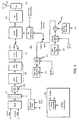
- FIG. 3 A block diagram of the subscriber unit return link transmitter is shown in Figure 3.
- the multiplexed input data (control and traffice) is buffered 27 and then covered with a long security code 28 which is synchronized with the system clock 29.
- the data is coded 30, interleaved 31 and then OQPSK modulated 32 onto the hopped carrier 33, after which it is upconverted 34 and amplified 35 for transmission via antenna 36.
- the hop timing is synchronized with the symbol timing.
- the return link receiver is implemented in the ground station GS, and a functional block diagram is shown in Figure 4.
- the received signal is first down converted 40 and dehopped with the hop sequence synchronized to the station clock as shown.
- the dehopped signal is converted 41 to baseband using I and Q mixers, where it is then digitized 42.
- the sampled signal is passed through a fourth power nonlinearity 43 to remove the data modulation.
- the frequency error (referenced to zero) of the resulting cw signal which is four times that of the carrier, is measured with a frequency discriminator 44 (typically a Cross Product Discriminator or an FFT based discriminator) and passed to the system controller which computes a correction to be transmitted to the user HS 14 on the outbound control link.
- a frequency discriminator 44 typically a Cross Product Discriminator or an FFT based discriminator
- the frequency error is also averaged and passed to an Number Controlled Oscillator (NCO) 45 and complex multiplier which removes the estimated error in a feed-forward manner.
- NCO Number Controlled Oscillator
- BPE Block Phase Estimator
- the NCO 45 output frequency is also divided 46 by four and mixed 47 with the baseband signal to yield a frequency corrected baseband signal with data modulation.
- This signal is demodulated 49 using the phase estimate from the BPE. As illustrated, the necessary symbol timing is also derived from the baseband signal.
- the symbol synchronizer output is used in conjunction with the hop timing discriminator 63 to calculate a very accurate estimate of the hop timing offset. This estimate is forwarded to the system controller 18 which computes a correction to be transmitted to the user HS on the outbound control link 10.
- the soft-decision demodulated data is deinterleaved 60 and decoded on a hop basis using four decoders 61-1...61-4 to resolve the phase ambiguity after the hop transition as described above.
- the selected correct output 64 is differentially decoded 65.
- a security code 66 is mixed with the output and demultiplexed 67 to provide the traffic data and control data.
Landscapes
- Engineering & Computer Science (AREA)
- Computer Networks & Wireless Communication (AREA)
- Signal Processing (AREA)
- Physics & Mathematics (AREA)
- Astronomy & Astrophysics (AREA)
- General Physics & Mathematics (AREA)
- Radio Relay Systems (AREA)
- Mobile Radio Communication Systems (AREA)
- Digital Transmission Methods That Use Modulated Carrier Waves (AREA)
Claims (5)
- Satellitennetz-Nachrichtenübermittlungssystem, in dem mehrere Teilnehmer-Handapparatendgeräte (14) auf einem Netzzugangskanal (NEC) und Verkehrskanälen mit einer Boden-Netzknotenstation (12) kommunizieren, wobei orthogonale CDMA-Übertragungen mit orthogonalem Frequenzsprungspreizspektrum verwendet werden, so daß keines der Signale gleichzeitig denselben Frequenzplatz belegt,
dadurch gekennzeichnet, daß
die Netzknotenstation (12) einen Steuerkanalgenerator (16-1, 16-2...16-N) zur Erzeugung eines Netzzugangssteuerkanals aufweist,
jedes Teilnehmer-Handapparatendgerät einen Teilnehmereinheit-Steuerkanalempfänger (19) und einen Teilnehmereinheit-Rückverbindungssender (20) aufweist,
wobei der NEC eine ausgewählte Anzahl von Frequenzsprungschlitzen aufweist, wobei jeder Sprungschlitz des NEC länger als jener eines Verkehrskanals ist und die Frequenzbandbreite jedes Sprungplatzes des NEC das doppelte der Bandbreite eines Verkehrsplatzes beträgt, um anfängliche Timing- und Frequenzunsicherheiten zu berücksichtigen, wodurch jeder Teilnehmer-Handapparat beim Zugang zum Netz die abgehenden Signale von der Netzknotenstation überwacht, eine unbenutzte NEC-Sprungsequenz auswählt, die über einen Netzzugangssteuerkanal signalisiert wird, und die Übertragung auf dem NEC beginnt, wobei Frequenz- und Zeitkorrekturen verwendet werden, die auf dem abgehenden Signal beruhen,
die Netzknotenstation Timing- und Frequenzkorrekturen an den Teilnehmer-Handapparat sendet, um den Teilnehmereinheit-Rückverbindungssender (20) zu steuern,
und wodurch, wenn die Netzknotenstation feststellt, daß der Teilnehmer-Handapparat zeit- und frequenzsynchron ist, dem Teilnehmer-Handapparat eine Verkehrskanalzuweisung erteilt wird, und wodurch ferner, nachdem der Teilnehmer-Handapparat so Zugang zum Netz erhalten hat, kleine Zeit- und Frequenzkorrektursignale über den Netzzugangssteuerkanal an den Teilnehmer-Handapparat gesendet werden,
wodurch Signale von allen Teilnehmer-Handapparaten zeit- und frequenzsynchron an der Netzknotenstation ankommen. - Satellitennetz-Nachrichtenübermittlungssystem nach Anspruch 1, ferner dadurch gekennzeichnet, daß das Frequenzspringen im NEC bei einer verhältnismäßig niedrigen Sprungfrequenz stattfindet, um die Leistung zu erhöhen, wenn von zwei Satelliten gleichzeitig dasselbe Benutzersignal empfangen wird.
- Satellitennetz-Nachrichtenübermittlungssystem nach Anspruch 1, ferner dadurch gekennzeichnet, daß der Netzzugangssteuerkanal an der Boden-Netzknotenstation Einrichtungen (61) zur Lieferung von Zeit- und Frequenzkorrekturen an Teilnehmer-Handapparatendgeräte aufweist, die notwendig sind, um Verbindungen vom Teilnehmer zur Boden- Netzknotenstation auf dem Verkehrskanal aufzubauen.
- Satellitennetz-Nachrichtenübermittlungssystem nach Anspruch 2, ferner dadurch gekennzeichnet, daß die Sprungfrequenz auf den Netzzugangskanälen niedriger als die Sprungfrequenz auf dem Verkehrsfrequenzkanal ist.
- Satellitennetz-Nachrichtenübermittlungssystem nach einem der Ansprüche 1 - 4, ferner dadurch gekennzeichnet, daß jede Netzknotenstation und jedes Teilnehmer-Handapparatendgerät Einrichtungen aufweist, um die Signale unter Verwendung orthogonaler QPSK auf einen Träger zu modulieren.
Applications Claiming Priority (3)
| Application Number | Priority Date | Filing Date | Title |
|---|---|---|---|
| US08/384,537 US5638361A (en) | 1995-02-08 | 1995-02-08 | Frequency hopped return link with net entry channel for a satellite personal communications system |
| PCT/US1996/001715 WO1996024992A1 (en) | 1995-02-08 | 1996-02-08 | Frequency hopped return link with net entry channel for a satellite personal communications system |
| US384537 | 1999-08-27 |
Publications (3)
| Publication Number | Publication Date |
|---|---|
| EP0808532A1 EP0808532A1 (de) | 1997-11-26 |
| EP0808532A4 EP0808532A4 (de) | 2002-01-02 |
| EP0808532B1 true EP0808532B1 (de) | 2006-04-19 |
Family
ID=23517712
Family Applications (1)
| Application Number | Title | Priority Date | Filing Date |
|---|---|---|---|
| EP96909483A Expired - Lifetime EP0808532B1 (de) | 1995-02-08 | 1996-02-08 | Frequenzsprung-rückverbindung mit netzzugangskanal für ein satellitengestütztes persönliches nachrichtenübertragungssystem |
Country Status (8)
| Country | Link |
|---|---|
| US (1) | US5638361A (de) |
| EP (1) | EP0808532B1 (de) |
| JP (1) | JP3209751B2 (de) |
| KR (1) | KR100354957B1 (de) |
| AT (1) | ATE323983T1 (de) |
| CA (1) | CA2210920A1 (de) |
| DE (1) | DE69636051T2 (de) |
| WO (1) | WO1996024992A1 (de) |
Families Citing this family (38)
| Publication number | Priority date | Publication date | Assignee | Title |
|---|---|---|---|---|
| JP3244610B2 (ja) * | 1995-01-27 | 2002-01-07 | 株式会社日立製作所 | 周波数ホッピング方式無線lanシステム |
| ZA965340B (en) | 1995-06-30 | 1997-01-27 | Interdigital Tech Corp | Code division multiple access (cdma) communication system |
| FR2739244B1 (fr) * | 1995-09-26 | 1997-11-14 | Alcatel Mobile Comm France | Station de base pour systeme cellulaire de radiocommunications mobiles et systeme de synchronisation de telles stations de base |
| US5894473A (en) * | 1996-02-29 | 1999-04-13 | Ericsson Inc. | Multiple access communications system and method using code and time division |
| WO1997035432A1 (en) * | 1996-03-19 | 1997-09-25 | Vistar Telecommunications Inc. | Interactive satellite broadcast system |
| US5802044A (en) * | 1996-04-26 | 1998-09-01 | Motorola, Inc. | Multicarrier reverse link timing synchronization system, device and method |
| US5910945A (en) * | 1996-04-30 | 1999-06-08 | Trw Inc. | Method and apparatus for synchronizing communications in a satellite based telecommunications system |
| JP2000501271A (ja) * | 1996-09-17 | 2000-02-02 | コーニンクレッカ、フィリップス、エレクトロニクス、エヌ.ヴィ. | 改善されたロック検出を用いる伝送システム |
| US5953327A (en) * | 1996-10-29 | 1999-09-14 | Stanford Telecommunications, Inc. | Class of low cross correlation non-palindromic synchronization sequences for code tracking in synchronous multiple access communication systems |
| US6002664A (en) * | 1997-02-24 | 1999-12-14 | At&T Wireless Services Inc. | Method to gain access to a base station in a discrete multitone spread spectrum communications system |
| US6351503B1 (en) | 1997-09-12 | 2002-02-26 | Stanford Telecommunications, Inc. | Threshold extension block phase estimator for quasi-coherent communications systems |
| US6075781A (en) * | 1997-12-12 | 2000-06-13 | Stanford Telecommunications, Inc. | Flux density reduction in OCDMA satellite communication system |
| CN1134937C (zh) | 1998-07-21 | 2004-01-14 | 塔奇昂公司 | 通信系统内用于多址接入的方法和装置 |
| US6674730B1 (en) | 1998-08-04 | 2004-01-06 | Tachyon, Inc. | Method of and apparatus for time synchronization in a communication system |
| US6396825B1 (en) * | 1998-08-18 | 2002-05-28 | Motorola, Inc. | Method and apparatus for using a pseudo-random signal in a communication system |
| US6256483B1 (en) * | 1998-10-28 | 2001-07-03 | Tachyon, Inc. | Method and apparatus for calibration of a wireless transmitter |
| US6982969B1 (en) | 1999-09-28 | 2006-01-03 | Tachyon, Inc. | Method and system for frequency spectrum resource allocation |
| US6218896B1 (en) | 1999-08-27 | 2001-04-17 | Tachyon, Inc. | Vectored demodulation and frequency estimation apparatus and method |
| US6735188B1 (en) | 1999-08-27 | 2004-05-11 | Tachyon, Inc. | Channel encoding and decoding method and apparatus |
| US6674731B1 (en) | 1999-08-27 | 2004-01-06 | Tachyon, Inc. | Transmission and reception of TCP/IP data over a wireless communication channel |
| US6532220B1 (en) | 1999-08-27 | 2003-03-11 | Tachyon, Inc. | System and method for efficient channel assignment |
| US6665292B1 (en) | 1999-08-27 | 2003-12-16 | Tachyon, Inc. | Transmission and reception of TCP/IP data over a wireless communication channel |
| US6650636B1 (en) | 1999-08-27 | 2003-11-18 | Tachyon, Inc. | Transmission and reception of TCP/IP data over a wireless communication channel |
| US6463070B1 (en) | 1999-08-27 | 2002-10-08 | Tachyon, Inc. | System and method for clock correlated data flow in a multi-processor communication system |
| RU2168866C1 (ru) * | 1999-10-26 | 2001-06-10 | Военный университет связи | Формирователь многочастотных сигналов |
| JP2001285927A (ja) * | 2000-03-29 | 2001-10-12 | Matsushita Electric Ind Co Ltd | 通信端末装置及び無線通信方法 |
| DE10103926A1 (de) * | 2001-01-30 | 2002-09-05 | Infineon Technologies Ag | Frequenzschema für Datenübertragungssysteme |
| US7012972B1 (en) * | 2002-04-27 | 2006-03-14 | Wideband Semiconductors, Inc. | Minimization of phase equivocation in burst modems |
| WO2004002022A1 (en) * | 2002-06-24 | 2003-12-31 | Qualcomm Incorporated | Method for return link sychronisation in an orthogonal cdma satellite system |
| AU2003904339A0 (en) * | 2003-08-04 | 2003-08-28 | Barrett Communications Pty Ltd | Method and system for synchronising stations within communications networks and stations for use therein |
| US8238957B2 (en) * | 2005-06-17 | 2012-08-07 | Nec Corporation | Communication control method, communication control system and its control program |
| CN101675606A (zh) * | 2007-03-08 | 2010-03-17 | 维尔塞特公司 | 卫星参考终端系统和方法 |
| US8532498B2 (en) * | 2008-02-08 | 2013-09-10 | Celight | Secure orthogonal frequency multiplexed optical communications |
| FR2994367B1 (fr) | 2012-08-03 | 2016-07-15 | Thales Sa | Procede et systeme de synchronisation |
| RU2534938C1 (ru) * | 2013-09-10 | 2014-12-10 | Негосударственное образовательное учреждение "Саранский Дом науки и техники Российского Союза научных и инженерных общественных организаций" | Многочастотный функциональный генератор |
| RU2534939C1 (ru) * | 2013-09-13 | 2014-12-10 | Негосударственное образовательное учреждение "Саранский Дом науки и техники Российского Союза научных и инженерных общественных организаций" | Функциональный генератор |
| RU2573281C1 (ru) * | 2014-12-03 | 2016-01-20 | Жанна Артуровна Сухинец | Функциональный преобразователь синусоидальных сигналов частота-код |
| CN106559103B (zh) * | 2016-12-08 | 2019-03-29 | 西安烽火电子科技有限责任公司 | 一种基于北斗授时的大规模跳频组网系统 |
Family Cites Families (9)
| Publication number | Priority date | Publication date | Assignee | Title |
|---|---|---|---|---|
| US5351269A (en) * | 1990-12-05 | 1994-09-27 | Scs Mobilecom, Inc. | Overlaying spread spectrum CDMA personal communications system |
| AU636190B2 (en) * | 1991-01-21 | 1993-04-22 | Nec Corporation | Spread packet communication system |
| IL100029A (en) * | 1991-11-11 | 1994-02-27 | Motorola Inc | Method and apparatus for improving detection of data bits in a slow frequency hopping communication system |
| US5392450A (en) * | 1992-01-08 | 1995-02-21 | General Electric Company | Satellite communications system |
| US5245634A (en) * | 1992-03-23 | 1993-09-14 | Motorola, Inc. | Base-site synchronization in a communication system |
| JPH06186317A (ja) * | 1992-04-23 | 1994-07-08 | Mitsubishi Electric Corp | 人工衛星を用いた測位システム |
| GB9225879D0 (en) * | 1992-12-11 | 1993-02-03 | Reilor Holdings Ltd | Improved pet door |
| US5506863A (en) * | 1993-08-25 | 1996-04-09 | Motorola, Inc. | Method and apparatus for operating with a hopping control channel in a communication system |
| US5463659A (en) * | 1994-07-05 | 1995-10-31 | At&T Ipm Corp. | Apparatus and method of configuring a cordless telephone for operating in a frequency hopping system |
-
1995
- 1995-02-08 US US08/384,537 patent/US5638361A/en not_active Expired - Lifetime
-
1996
- 1996-02-08 DE DE69636051T patent/DE69636051T2/de not_active Expired - Lifetime
- 1996-02-08 AT AT96909483T patent/ATE323983T1/de not_active IP Right Cessation
- 1996-02-08 JP JP52442196A patent/JP3209751B2/ja not_active Expired - Fee Related
- 1996-02-08 EP EP96909483A patent/EP0808532B1/de not_active Expired - Lifetime
- 1996-02-08 CA CA002210920A patent/CA2210920A1/en not_active Abandoned
- 1996-02-08 KR KR1019970705367A patent/KR100354957B1/ko not_active Expired - Fee Related
- 1996-02-08 WO PCT/US1996/001715 patent/WO1996024992A1/en not_active Ceased
Also Published As
| Publication number | Publication date |
|---|---|
| ATE323983T1 (de) | 2006-05-15 |
| JP3209751B2 (ja) | 2001-09-17 |
| KR100354957B1 (ko) | 2002-12-16 |
| KR19980701970A (ko) | 1998-06-25 |
| WO1996024992A1 (en) | 1996-08-15 |
| DE69636051T2 (de) | 2006-11-30 |
| AU692383B2 (en) | 1998-06-04 |
| DE69636051D1 (de) | 2006-05-24 |
| JPH11509378A (ja) | 1999-08-17 |
| EP0808532A1 (de) | 1997-11-26 |
| AU5296296A (en) | 1996-08-27 |
| CA2210920A1 (en) | 1996-08-15 |
| US5638361A (en) | 1997-06-10 |
| EP0808532A4 (de) | 2002-01-02 |
Similar Documents
| Publication | Publication Date | Title |
|---|---|---|
| US5638361A (en) | Frequency hopped return link with net entry channel for a satellite personal communications system | |
| US7532891B2 (en) | Method and apparatus for timing correction in communications systems | |
| KR100506579B1 (ko) | 통신 시스템에서 주파수 오프셋 결정 | |
| US5764630A (en) | Forward link carrier recovery in an OCDMA spread spectrum communication system without a pilot tone | |
| US6501955B1 (en) | RF signal repeater, mobile unit position determination system using the RF signal repeater, and method of communication therefor | |
| EP0553952B1 (de) | Satellitenübertragungsanordnung mit Reservierungsprotokol das mindestens drei Datakanäle verwendet | |
| EP0951763A2 (de) | Verfahren für fdd (frequency division duplex) kommunikation | |
| US4763129A (en) | SS-TDMA technique telecommunication satellite systems | |
| JP2000503827A (ja) | 専用搬送波周波数を用いた高電力短メッセージサービス | |
| EP1205040B1 (de) | Verfahren zu weitreichendem funkruf | |
| KR100791824B1 (ko) | 통신 시스템에서 타이밍 및 주파수를 예비정정하는 방법 | |
| EP1077006B1 (de) | Reduzierung der flussdichte in einem ocdma-satellitenkommunikationssystem | |
| AU692383C (en) | Frequency hopped return link with net entry channel for a satellite personal communications system | |
| AU2004203062B2 (en) | Method for deep paging | |
| EP1052788A1 (de) | Empfang eines Rundfunkkontrolkanals in einem mobilen Satelliten Telefonsystem | |
| AU713299C (en) | Forward link carrier recovery in an OCDMA spread spectrum communication system without a pilot tone | |
| CA2248625C (en) | Forward link carrier recovery in an ocdma spread spectrum communication system without a pilot tone | |
| Vernucci | Channel-Access Schemes | |
| HK1122144B (en) | Method for deep paging | |
| HK1089005B (en) | Method for deep paging |
Legal Events
| Date | Code | Title | Description |
|---|---|---|---|
| PUAI | Public reference made under article 153(3) epc to a published international application that has entered the european phase |
Free format text: ORIGINAL CODE: 0009012 |
|
| 17P | Request for examination filed |
Effective date: 19970804 |
|
| AK | Designated contracting states |
Kind code of ref document: A1 Designated state(s): AT BE CH DE DK ES FR GB GR IE IT LI NL PT SE |
|
| RIN1 | Information on inventor provided before grant (corrected) |
Inventor name: NATALI, FRANCIS, D. Inventor name: OHLSON, JOHN |
|
| RIC1 | Information provided on ipc code assigned before grant |
Free format text: 7H 04J 3/06 A, 7H 04J 13/06 B, 7H 04B 1/713 B, 7H 04B 7/216 B |
|
| A4 | Supplementary search report drawn up and despatched |
Effective date: 20011109 |
|
| AK | Designated contracting states |
Kind code of ref document: A4 Designated state(s): AT BE CH DE DK ES FR GB GR IE IT LI NL PT SE |
|
| 17Q | First examination report despatched |
Effective date: 20020325 |
|
| GRAP | Despatch of communication of intention to grant a patent |
Free format text: ORIGINAL CODE: EPIDOSNIGR1 |
|
| GRAS | Grant fee paid |
Free format text: ORIGINAL CODE: EPIDOSNIGR3 |
|
| GRAA | (expected) grant |
Free format text: ORIGINAL CODE: 0009210 |
|
| RAP1 | Party data changed (applicant data changed or rights of an application transferred) |
Owner name: ALCATEL USA SOURCING, L.P. |
|
| AK | Designated contracting states |
Kind code of ref document: B1 Designated state(s): AT BE CH DE DK ES FR GB GR IE IT LI NL PT SE |
|
| PG25 | Lapsed in a contracting state [announced via postgrant information from national office to epo] |
Ref country code: NL Free format text: LAPSE BECAUSE OF FAILURE TO SUBMIT A TRANSLATION OF THE DESCRIPTION OR TO PAY THE FEE WITHIN THE PRESCRIBED TIME-LIMIT Effective date: 20060419 Ref country code: LI Free format text: LAPSE BECAUSE OF FAILURE TO SUBMIT A TRANSLATION OF THE DESCRIPTION OR TO PAY THE FEE WITHIN THE PRESCRIBED TIME-LIMIT Effective date: 20060419 Ref country code: IT Free format text: LAPSE BECAUSE OF FAILURE TO SUBMIT A TRANSLATION OF THE DESCRIPTION OR TO PAY THE FEE WITHIN THE PRE;WARNING: LAPSES OF ITALIAN PATENTS WITH EFFECTIVE DATE BEFORE 2007 MAY HAVE OCCURRED AT ANY TIME BEFORE 2007. THE CORRECT EFFECTIVE DATE MAY BE DIFFERENT FROM THE ONE RECORDED.SCRIBED TIME-LIMIT Effective date: 20060419 Ref country code: CH Free format text: LAPSE BECAUSE OF FAILURE TO SUBMIT A TRANSLATION OF THE DESCRIPTION OR TO PAY THE FEE WITHIN THE PRESCRIBED TIME-LIMIT Effective date: 20060419 Ref country code: BE Free format text: LAPSE BECAUSE OF FAILURE TO SUBMIT A TRANSLATION OF THE DESCRIPTION OR TO PAY THE FEE WITHIN THE PRESCRIBED TIME-LIMIT Effective date: 20060419 Ref country code: AT Free format text: LAPSE BECAUSE OF FAILURE TO SUBMIT A TRANSLATION OF THE DESCRIPTION OR TO PAY THE FEE WITHIN THE PRESCRIBED TIME-LIMIT Effective date: 20060419 |
|
| REG | Reference to a national code |
Ref country code: GB Ref legal event code: FG4D |
|
| REF | Corresponds to: |
Ref document number: 69636051 Country of ref document: DE Date of ref document: 20060524 Kind code of ref document: P |
|
| REG | Reference to a national code |
Ref country code: IE Ref legal event code: FG4D |
|
| PG25 | Lapsed in a contracting state [announced via postgrant information from national office to epo] |
Ref country code: SE Free format text: LAPSE BECAUSE OF FAILURE TO SUBMIT A TRANSLATION OF THE DESCRIPTION OR TO PAY THE FEE WITHIN THE PRESCRIBED TIME-LIMIT Effective date: 20060719 Ref country code: DK Free format text: LAPSE BECAUSE OF FAILURE TO SUBMIT A TRANSLATION OF THE DESCRIPTION OR TO PAY THE FEE WITHIN THE PRESCRIBED TIME-LIMIT Effective date: 20060719 |
|
| PG25 | Lapsed in a contracting state [announced via postgrant information from national office to epo] |
Ref country code: ES Free format text: LAPSE BECAUSE OF FAILURE TO SUBMIT A TRANSLATION OF THE DESCRIPTION OR TO PAY THE FEE WITHIN THE PRESCRIBED TIME-LIMIT Effective date: 20060730 |
|
| PG25 | Lapsed in a contracting state [announced via postgrant information from national office to epo] |
Ref country code: PT Free format text: LAPSE BECAUSE OF FAILURE TO SUBMIT A TRANSLATION OF THE DESCRIPTION OR TO PAY THE FEE WITHIN THE PRESCRIBED TIME-LIMIT Effective date: 20060919 |
|
| NLV1 | Nl: lapsed or annulled due to failure to fulfill the requirements of art. 29p and 29m of the patents act | ||
| REG | Reference to a national code |
Ref country code: CH Ref legal event code: PL |
|
| ET | Fr: translation filed | ||
| PLBE | No opposition filed within time limit |
Free format text: ORIGINAL CODE: 0009261 |
|
| STAA | Information on the status of an ep patent application or granted ep patent |
Free format text: STATUS: NO OPPOSITION FILED WITHIN TIME LIMIT |
|
| 26N | No opposition filed |
Effective date: 20070122 |
|
| PG25 | Lapsed in a contracting state [announced via postgrant information from national office to epo] |
Ref country code: IE Free format text: LAPSE BECAUSE OF NON-PAYMENT OF DUE FEES Effective date: 20070208 |
|
| PG25 | Lapsed in a contracting state [announced via postgrant information from national office to epo] |
Ref country code: GR Free format text: LAPSE BECAUSE OF FAILURE TO SUBMIT A TRANSLATION OF THE DESCRIPTION OR TO PAY THE FEE WITHIN THE PRESCRIBED TIME-LIMIT Effective date: 20060720 |
|
| REG | Reference to a national code |
Ref country code: FR Ref legal event code: PLFP Year of fee payment: 20 |
|
| PGFP | Annual fee paid to national office [announced via postgrant information from national office to epo] |
Ref country code: DE Payment date: 20150203 Year of fee payment: 20 |
|
| PGFP | Annual fee paid to national office [announced via postgrant information from national office to epo] |
Ref country code: GB Payment date: 20150204 Year of fee payment: 20 Ref country code: FR Payment date: 20150210 Year of fee payment: 20 |
|
| REG | Reference to a national code |
Ref country code: DE Ref legal event code: R071 Ref document number: 69636051 Country of ref document: DE |
|
| REG | Reference to a national code |
Ref country code: GB Ref legal event code: PE20 Expiry date: 20160207 |
|
| PG25 | Lapsed in a contracting state [announced via postgrant information from national office to epo] |
Ref country code: GB Free format text: LAPSE BECAUSE OF EXPIRATION OF PROTECTION Effective date: 20160207 |