EP0808313B1 - Antipsychotische 4-(1h-indolyl-1-yl)-1-substituierte piperidine derivate - Google Patents
Antipsychotische 4-(1h-indolyl-1-yl)-1-substituierte piperidine derivate Download PDFInfo
- Publication number
- EP0808313B1 EP0808313B1 EP96902258A EP96902258A EP0808313B1 EP 0808313 B1 EP0808313 B1 EP 0808313B1 EP 96902258 A EP96902258 A EP 96902258A EP 96902258 A EP96902258 A EP 96902258A EP 0808313 B1 EP0808313 B1 EP 0808313B1
- Authority
- EP
- European Patent Office
- Prior art keywords
- alkyl
- formula
- hydrogen
- compound
- compounds
- Prior art date
- Legal status (The legal status is an assumption and is not a legal conclusion. Google has not performed a legal analysis and makes no representation as to the accuracy of the status listed.)
- Expired - Lifetime
Links
- 0 CC1(NC(*)=C2C)SC(C)=NN1C2=O Chemical compound CC1(NC(*)=C2C)SC(C)=NN1C2=O 0.000 description 2
Classifications
-
- C—CHEMISTRY; METALLURGY
- C07—ORGANIC CHEMISTRY
- C07D—HETEROCYCLIC COMPOUNDS
- C07D401/00—Heterocyclic compounds containing two or more hetero rings, having nitrogen atoms as the only ring hetero atoms, at least one ring being a six-membered ring with only one nitrogen atom
- C07D401/14—Heterocyclic compounds containing two or more hetero rings, having nitrogen atoms as the only ring hetero atoms, at least one ring being a six-membered ring with only one nitrogen atom containing three or more hetero rings
-
- A—HUMAN NECESSITIES
- A61—MEDICAL OR VETERINARY SCIENCE; HYGIENE
- A61P—SPECIFIC THERAPEUTIC ACTIVITY OF CHEMICAL COMPOUNDS OR MEDICINAL PREPARATIONS
- A61P25/00—Drugs for disorders of the nervous system
- A61P25/18—Antipsychotics, i.e. neuroleptics; Drugs for mania or schizophrenia
-
- C—CHEMISTRY; METALLURGY
- C07—ORGANIC CHEMISTRY
- C07D—HETEROCYCLIC COMPOUNDS
- C07D471/00—Heterocyclic compounds containing nitrogen atoms as the only ring hetero atoms in the condensed system, at least one ring being a six-membered ring with one nitrogen atom, not provided for by groups C07D451/00 - C07D463/00
- C07D471/02—Heterocyclic compounds containing nitrogen atoms as the only ring hetero atoms in the condensed system, at least one ring being a six-membered ring with one nitrogen atom, not provided for by groups C07D451/00 - C07D463/00 in which the condensed system contains two hetero rings
- C07D471/04—Ortho-condensed systems
-
- C—CHEMISTRY; METALLURGY
- C07—ORGANIC CHEMISTRY
- C07D—HETEROCYCLIC COMPOUNDS
- C07D487/00—Heterocyclic compounds containing nitrogen atoms as the only ring hetero atoms in the condensed system, not provided for by groups C07D451/00 - C07D477/00
- C07D487/02—Heterocyclic compounds containing nitrogen atoms as the only ring hetero atoms in the condensed system, not provided for by groups C07D451/00 - C07D477/00 in which the condensed system contains two hetero rings
- C07D487/04—Ortho-condensed systems
-
- C—CHEMISTRY; METALLURGY
- C07—ORGANIC CHEMISTRY
- C07D—HETEROCYCLIC COMPOUNDS
- C07D513/00—Heterocyclic compounds containing in the condensed system at least one hetero ring having nitrogen and sulfur atoms as the only ring hetero atoms, not provided for in groups C07D463/00, C07D477/00 or C07D499/00 - C07D507/00
- C07D513/02—Heterocyclic compounds containing in the condensed system at least one hetero ring having nitrogen and sulfur atoms as the only ring hetero atoms, not provided for in groups C07D463/00, C07D477/00 or C07D499/00 - C07D507/00 in which the condensed system contains two hetero rings
- C07D513/04—Ortho-condensed systems
Definitions
- the present invention concerns 4-(1 H -indol-1-yl)-1-piperidinyl derivatives having therapeutic potential in psychotic disorders. It further relates to their preparation, compositions comprising them and their use as a medicine.
- the compounds of the present invention differ therefrom in that the 4 position of their piperidine moiety is invariably substituted by a 1 H -indol-1-yl derivative.
- EP-A-0,470,039 discloses 4-(3-aryl-1 H -indol-1-yl)-1-piperidinyl derivatives as selective antagonists of the serotonin 5-HT 2 receptor without substantial dopamine D-2 antagonistic activity both in vivo and in vitro. Said selective antagonistic property is measured as the ratio between the dopamine D-2 receptor and the serotonin 5-HT 2 receptor antagonistic activities.
- the compounds of the present invention differ therefrom in that they exhibit central dopamine and central serotonin antagonistic activity in vivo in similar dose-ranges, i.e. the ratio between central dopaminergic and central serotonergic activity is about unity.
- the compounds of the present invention show antipsychotic activity with an unexpected increased cardiovascular safety, i.e. they show an improved dissociation between the peripheral ⁇ -adrenergic antagonistic activity and the central dopamine and serotonin antagonistic activity.
- the present invention concerns the compounds of formula the pharmaceutically acceptable addition salts and the stereochemically isomeric forms thereof, wherein:
- halogen is generic to fluoro, chloro, bromo and iodo.
- C 1-4 alkyl defines straight and branched saturated hydrocarbons, having from 1 to 4 carbon atoms such as, for example, methyl, ethyl, propyl, butyl, 1-methylethyl, 1,1-dimethylethyl, 2-methylpropyl.
- C 1-6 alkyl is meant to include C 1-4 alkyl radicals and the higher homologues thereof having 5 or 6 carbon atoms such as, for example, pentyl, hexyl and the like.
- C 1-10 alkyl is meant to include C 1-6 alkyl radicals and the higher homologues thereof having 7 to 10 carbon atoms such as, for example, heptyl, octyl, nonyl, decyl and the like.
- C 2-4 alkanediyl defines bivalent straight or branch chained alkanediyl radicals having from 2 to 4 carbon atoms such as, for example, 1,2-ethanediyl, 1,3-propanediyl, or 1,4-butanediyl .
- C 1-4 alkanediyl is meant to include C 2-4 alkanediyl radicals and the lower homologue, i.e. 1,1-methanediyl.
- addition salts as mentioned herein are meant to comprise the therapeutically active addition salt forms which the compounds of formula (I) are able to form with appropriate acids, such as, for example, inorganic acids such as hydrohalic acids, e.g. hydrochloric or hydrobromic acid; sulfuric; nitric; phosphoric and the like acids; or organic acids such as, for example, acetic, propanoic, hydroxyacetic, lactic, pyruvic, oxalic, malonic, succinic, maleic, fumaric, malic, tartaric, citric, methanesulfonic, ethanesulfonic, benzenesulfonic, p -toluenesulfonic, cyclamic, salicylic, p -aminosalicylic or, pamoic acids.
- inorganic acids such as hydrohalic acids, e.g. hydrochloric or hydrobromic acid
- sulfuric nitric
- the pharmaceutically acceptable addition salts as mentioned hereinabove are also meant to comprise the therapeutically active non-toxic base, in particular, a metal or amine addition salt forms which the compounds of formula (I) are able to form.
- Said salts can conveniently be obtained by treating the compounds of formula (I) containing acidic hydrogen atoms with appropriate organic and inorganic bases such as, for example, the ammonium salts, the alkali and earth alkaline metal salts, e.g. the lithium, sodium, potassium, magnesium, calcium salts and the like, salts with organic bases, e.g. the benzathine, N -methyl-D-glucamine, hydrabamine salts, and salts with amino acids such as, for example, arginine or, lysine.
- organic bases e.g. the benzathine, N -methyl-D-glucamine, hydrabamine salts
- amino acids such as, for example, arginine or, lysine.
- salt forms can be converted by treatment with an appropriate base or acid into the free acid or base form.
- addition salt as used hereinabove also comprises the solvates which the compounds of formula (I) are able to form and said solvates are meant to be included within the scope of the present invention.
- solvates are, e.g. the hydrates, or alcoholates.
- stereochemically isomeric forms as used herein defines all the possible isomeric forms in which the compounds of formula (I) may occur. Unless otherwise mentioned or indicated, the chemical designation of compounds denotes the mixture of all possible stereochemically isomeric forms, said mixtures containing all diastereomers and enantiomers of the basic molecular structure.
- D is a radical of formula or wherein R 5 is hydrogen or C 1-6 alkyl and preferably is methyl; R 9 and R 10 each independently are hydrogen or C 1-6 alkyl; R 11 is C 1-6 alkyl, hydroxy, C 1-6 alkyloxy or C 1-10 alkylcarbonyloxy, and preferably is hydroxy, C 1-6 alkyloxy or C 1-10 alkylcarbonyloxy; and R 12 is hydrogen, C 1-6 alkyl, C 1-6 alkyloxy, C 1-6 alkylthio, amino or mono- or di(C 1-6 alkyl)amino.
- Alk is C 2-4 alkanediyl.
- R 1 is hydrogen or halogen and R 2 is hydrogen.
- the substituent on the 4 position of the piperidinyl is an 1 H -indole, i.e. the dashed line represents an extra bond.
- the substituent on the 4 position of the piperidinyl is an 2,3-dihydro-1 H -indole.
- Preferred compounds are those compounds of formula (I) wherein R 1 is hydrogen or fluor, R 2 , R 3 and R 4 are hydrogen; Alk is 1,2-ethanediyl; D is a radical of formula (a) wherein R 5 is methyl; R 6 is C 1-6 alkylamino and R 7 is C 1-6 alkyl; or R 6 and R 7 taken together may form a bivalent radical of formula (a-2) or (a-5) wherein one hydrogen atom of said radicals (a-2) and (a-5) may be replaced by C 1-6 alkyl, hydroxy or C 1-6 alkyloxy; or R 6 and R 7 taken together may form a bivalent radical of formula (a-6), (a-7), (a-8), (a-13) or (a-14) wherein one or where possible two hydrogen atoms may be replaced by C 1-6 alkyl.
- More preferred compounds are those preferred compounds wherein the substituent on the 4 position of the piperidinyl is an indole wherein R 1 is substituted in the 5 position and stands for hydrogen or fluor.
- Most preferred compounds are selected from 3-[2-[4-(5-fluoro-1 H -indol-1-yl)-1-piperidinyl]ethyl]-6,7,8,9-tetrahydro-2-methyl-4 H -pyrido[1,2-a]pyrimidin-4-one; 6-[2-[4-(5-fluoro-1 H -indol-1-yl)-1-piperidinyl]ethyl]-7-methyl-5 H -thiazolo[3,2-a]pyrimidin-5-one; 5-[2-[4-(5-fluoro-1H-indol-1-yl)-1-piperidinyl]ethyl]-3,6-dimethyl-2-(methylamino)-4(3 H )-pyrimidinone; and 2,3-dihydro-6-[2-[4-(1 H -indol-1-yl)-1-piperidinyl]ethyl]-7-methyl-5 H -thi
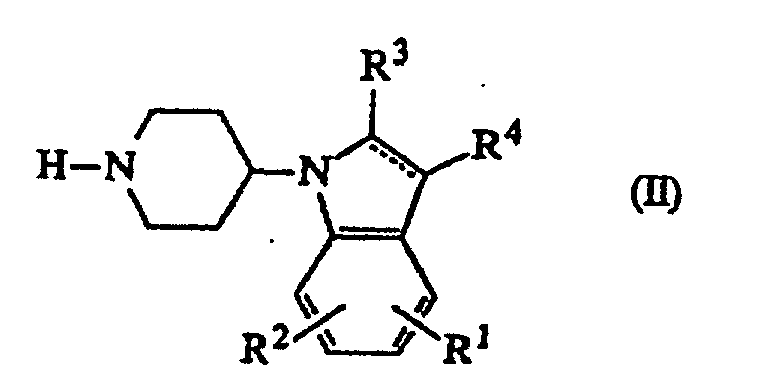
- the compounds of formula (I) can generally be prepared by N -alkylating a 1-(piperidin-4-yl)-1 H -indole derivative of formula (II) with an alkylating reagent of formula (III) following the procedure described in EP-A-0,037,265, EP-A-0,070,053, EP-A-0,196,132 and in EP-A-0,378,255.
- W represents an appropriate reactive leaving group such as, for example, halo, e.g. chloro, bromo or iodo; sulfonyloxy, e.g. methanesulfonyloxy, 4-methylbenzenesulfonyloxy.
- reaction products may be isolated from the reaction medium and, if necessary, further purified according to methodologies generally known in the art such as, for example, extraction, crystallization, trituration and chromatography.
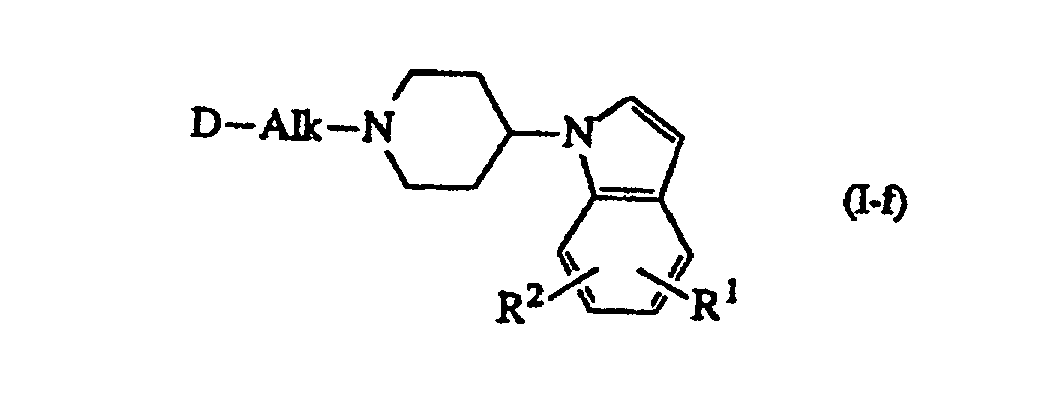
- Compounds of formula (I) wherein R 3 and R 4 are hydrogen and the heterocyclic moiety in the 4 position of the piperidine ring is an 1 H -indole, said compounds being represented by formula (I-f), may alternatively be prepared by cyclizing an intermediate of formula (IV) wherein W is a reactive leaving group such as, for example, halo, e.g. chloro, bromo or iodo; sulfonyloxy, e.g. methanesulfonyloxy, 4-methylbenzenesulfonyloxy, in the presence of a reductant such as, for example, a complex metal hydride, e.g. sodium borohydride. Said procedure is described in Synthetic Communications, 18(3) , 265-273 (1988).
- EP-A-0,037,265, EP-A-0,070,053, EP-A-0,196,132 and EP-A-0,378,255 describe other alternative procedures to prepare compounds of formula (I). Furthermore, the compounds of formula (I) may be converted into each other following art-known functional group transformation reactions.
- Said reductive amination may conveniently be carried out by mixing the reactants in a suitable reaction-inert solvent such as, for example, methanol or toluene, with an appropriate reductant.
- a suitable reaction-inert solvent such as, for example, methanol or toluene
- the ketone of formula (V) is first reacted with the indole derivative of formula (VI) to form an enamine, which is subsequently reduced.
- Hydrogen in the presence of a suitable catalyst such as, for example, palladium or platinum supported on for instance charcoal may be used as an appropriate reductant.
- Elevated pressure and/or temperature may enhance the rate of the reaction.
- an appropriate catalyst poison to the reaction mixture such as, for example, thiophene.
- Some of the compounds of formula (I) and some of the intermediates in the present invention contain at least one asymmetric carbon atom. Pure stereochemically isomeric forms of said compounds and said intermediates can be obtained by the application of art-known procedures. For example, diastereoisomers can be separated by physical methods such as selective crystallization or chromatographic techniques, e.g. counter current distribution, liquid chromatography and the like methods.
- Enantiomers can be obtained from racemic mixtures by first converting said racemic mixtures with suitable resolving agents such as, for example, chiral acids, to mixtures of diastereomeric salts or compounds; then physically separating said mixtures of diastereomeric salts or compounds by, for example, selective crystallization or chromatographic techniques, e.g. liquid chromatography and the like methods; and finally converting said separated diastereomeric salts or compounds into the corresponding enantiomers.
- suitable resolving agents such as, for example, chiral acids
- Pure stereochemically isomeric forms of the compounds of formula (I) may also be obtained from the pure stereochemically isomeric forms of the appropriate intermediates and starting materials, provided that the intervening reactions occur stereospecifically.
- the pure and mixed stereochemically isomeric forms of the compounds of formula (I) are intended to be embraced within the scope of the present invention.
- the compounds of formula (I), the pharmaceutically acceptable addition salts and stereochemically isomeric forms thereof, are antagonists of neurotransmitters and in particular of the mediators serotonin and dopamine. Antagonizing said mediators will suppress or relieve a variety of symptoms associated with phenomena induced by the release, in particular the excessive release, of these mediators.
- Therapeutic indications for using the present compounds are mainly in the CNS area, especially in psychotic disorders. Further, serotonin is a potent broncho- and vasoconstrictor and thus the present antagonists may be used against hypertension and vascular disorders.
- serotonin antagonists have been associated with a number of other properties such as, the suppression of appetite and promotion of weight loss, which may prove effective in combatting obesity; and also the alleviation of withdrawal symptoms in addicts trying to discontinue drinking and smoking habits.
- the present compounds also appear to be useful therapeutic agents for combatting autism.
- the present invention provides a method of treating warm-blooded animals suffering from such diseases, in particular psychotic diseases, said method comprising the systemic administration of an antipsychotic amount of a compound of formula (I) or a pharmaceutically acceptable addition salt thereof, effective in treating diseases associated with the release of neurotransmitters, in particular psychotic diseases.
- an effective antipsychotic daily amount would be from about 0.01 mg/kg to about 4 mg/kg body weight, more preferably from about 0.04 mg/kg to about 2 mg/kg body weight.
- the present invention thus also relates to compounds of formula (I) as defined hereinabove for use as a medicine. Further, the present invention also relates to the use of a compound of formula (I) for the manufacture of a medicament for treating psychotic diseases.
- the "apomorphine, tryptamine, norepinephrine (ATN) test in rats” is used to evaluate dopamine antagonism, serotonin antagonism and ⁇ -adrenergic antagonistic properties of the compounds of formula (I).
- rats are observed for effects which are indicative for peripheral and central activity of the tested compounds.
- Centrally acting serotonin antagonists are potential antipsychotic drugs, in particular when simultaneously displaying dopamine antagonism.
- Peripheral serotonin antagonists are potentially useful in the gastro-intestinal and cardiovascular field, in particular when simultaneously displaying ⁇ -adrenergic antagonistic activity.
- the compounds of the present invention show a strong central dopamine and serotonin antagonism and little peripheral ⁇ -adrenergic antagonistic activity.
- the central dopamine and serotonin antagonistic activity of the compounds of formula (I) are particularly useful in combatting psychoses, aggressive behaviour, anxiety, depression and migraine.
- the improved dissociation between peripheral ⁇ -adrenergic antagonistic activity and central dopamine and serotonin antagonistic activity of the compounds of formula (I) over prior known antipsychotic agents leads to an increased cardiovascular safety, i.e. a decreased likelihood of hypotension.
- the subject compounds may be formulated into various pharmaceutical forms.
- an effective amount of the particular compound, in addition salt or in free acid or base form, as the active ingredient is combined in intimate admixture with a pharmaceutically acceptable carrier, which may take a wide variety of forms depending on the form of preparation desired for administration.
- a pharmaceutically acceptable carrier which may take a wide variety of forms depending on the form of preparation desired for administration.
- These pharmaceutical compositions are desirably in unitary dosage form suitable, preferably, for administration orally, percutaneously, or by parenteral injection.
- any of the usual pharmaceutical media may be employed, such as, for example, water, glycols, oils, alcohols and the like in the case of oral liquid preparations such as suspensions, syrups, elixirs and solutions; or solid carriers such as starches, sugars, kaolin, lubricants, binders, disintegrating agents and the like in the case of powders, pills, capsules and tablets. Because of their ease in administration, tablets and capsules represent the most advantageous oral dosage unit form, in which case solid pharmaceutical carriers are obviously employed.
- the carrier will usually comprise sterile water, at least in large part, though other ingredients, for example, to aid solubility, may be included.
- Injectable solutions may be prepared in which the carrier comprises saline solution, glucose solution or a mixture of saline and glucose solution.
- Injectable solutions containing compounds of formula (I) may be formulated in an oil for prolonged action.
- Appropriate oils for this purpose are, for example, peanut oil, sesame oil, cottonseed oil, corn oil, soy bean oil, synthetic glycerol esters of long chain fatty acids and mixtures of these and other oils.
- Injectable suspensions may also be prepared in which case appropriate liquid carriers, suspending agents and the like may be employed.
- the carrier optionally comprises a penetration enhancing agent and/or a suitable wettable agent, optionally combined with suitable additives of any nature in minor proportions, which additives do not cause any significant deleterious effects on the skin. Said additives may facilitate the administration to the skin and/or may be helpful for preparing the desired compositions.
- These compositions may be administered in various ways, e.g., as a transdermal patch, as a spot-on or as an ointment. Addition salts of (I) due to their increased water solubility over the corresponding free base or free acid form, are obviously more suitable in the preparation of aqueous compositions.
- Dosage unit form as used in the specification and claims herein refers to physically discrete units suitable as unitary dosages, each unit containing a predetermined quantity of active ingredient calculated to produce the desired therapeutic effect, in association with the required pharmaceutical carrier.
- dosage unit forms are tablets (including scored or coated tablets), capsules, pills, powder packets, wafers, injectable solutions or suspensions, teaspoonfuls, tablespoonfuls and the like, and segregated multiples thereof.
- RT room temperature
- DIPE diisopropyl ether
- Methanesulfonyl chloride (3.43 g) was added dropwise to a stirred and cooled (ice water bath) mixture of intermediate 13 (7 g) and N,N -diethylethanamine (3 g) in dichloromethane (50 ml). The reaction mixture was stirred for 2 hours at RT.
- 6-[2-[4-(1 H -indol-1-yl)-1-piperidinyl]ethyl]-3,7-dimethyl-5 H -thiazolo[3,2-a]pyrimidin-5-one was prepared according to the procedure described in example 7 without the presence of potassium iodide (compound 6; mp. 189.8 °C).
- Tables 1 to 4 list similar compounds that were prepared according to one of the above described examples.
- the antipsychotic activity of the subject compounds is evidenced by the experimental data obtained in the combined apomorphine (APO), tryptamine (TRY) and norepinephrine (NOR) test in rats.
- APO apomorphine
- TRY tryptamine
- NOR norepinephrine
- Said combined apomorphine, tryptamine and norepinephrine test is described in Arch. Int. Pharmacodyn., 227 , 238-253 (1977) and provides an empirical evaluation of the relative specificity with which drugs may effect particular neurotransmitter systems centrally (CNS) as well as peripherally.
- the test demonstrates the antagonistic activity of the tested compounds of formula (I) on dopamine (by preventing the symptoms elicited with the dopamine agonist apomorphine), on serotonin (by preventing the central symptoms (convulsions) and peripheral symptoms (hyperaemia) elicited with serotonin or tryptamine), and on norepinephrine (by preventing or delaying death upon administration of the ⁇ -agonist norepinephrine).
- Active ingredient as used throughout these examples relates to a compound of formula (I), a pharmaceutically acceptable addition salt or a stereochemically isomeric form thereof.
- a mixture of 100 g of the A.I., 570 g lactose and 200 g starch is mixed well and thereafter humidified with a solution of 5 g sodium dodecyl sulfate and 10 g polyvinylpyrrolidone in about 200 ml of water.
- the wet powder mixture is sieved, dried and sieved again.
- 100 g microcrystalline cellulose and 15 g hydrogenated vegetable oil are added.
- the whole is mixed well and compressed into tablets, giving 10.000 tablets, each comprising 10 mg of the active ingredient.
Landscapes
- Chemical & Material Sciences (AREA)
- Organic Chemistry (AREA)
- Health & Medical Sciences (AREA)
- Engineering & Computer Science (AREA)
- Bioinformatics & Cheminformatics (AREA)
- Medicinal Chemistry (AREA)
- Life Sciences & Earth Sciences (AREA)
- Neurology (AREA)
- Chemical Kinetics & Catalysis (AREA)
- General Chemical & Material Sciences (AREA)
- Biomedical Technology (AREA)
- Nuclear Medicine, Radiotherapy & Molecular Imaging (AREA)
- Psychiatry (AREA)
- Pharmacology & Pharmacy (AREA)
- Neurosurgery (AREA)
- Animal Behavior & Ethology (AREA)
- General Health & Medical Sciences (AREA)
- Public Health (AREA)
- Veterinary Medicine (AREA)
- Pharmaceuticals Containing Other Organic And Inorganic Compounds (AREA)
- Plural Heterocyclic Compounds (AREA)
- Nitrogen And Oxygen Or Sulfur-Condensed Heterocyclic Ring Systems (AREA)
- Nitrogen Condensed Heterocyclic Rings (AREA)
Claims (10)
- Verbindung der Formelein pharmazeutisch unbedenkliches Additionssalz oder eine stereochemisch isomere Form davon, wobei die gestrichelte Linie für eine fakultative Bindung steht;
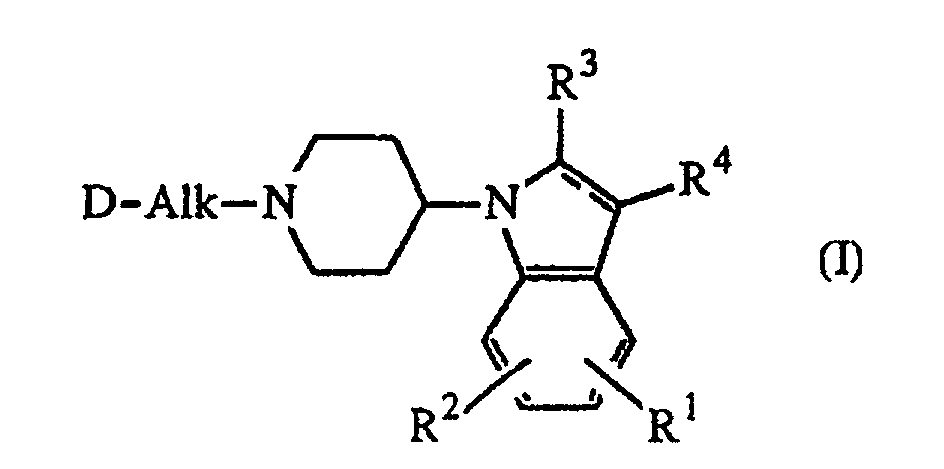
R1 und R2 jeweils unabhängig voneinander für Wasserstoff, Halogen, C1-6-Alkyl oder C1-6-Alkyloxy stehen;
R3 für Wasserstoff, C1-6-Alkyl oder gegebenenfalls mit einem, zwei oder drei unter Halogen, Hydroxy, Nitro, Cyano, Trifluormethyl, C1-6-Alkyl, C1-6-Alkyloxy, C1-6-Alkylthio, Mercapto, Amino, Monound Di(C1-6-alkyl)amino, Carboxyl, C1-6-Alkyloxycarbonyl und C1-6-Alkylcarbonyl ausgewählten Substituenten substituiertes Phenyl steht;
R4 für Wasserstoff oder C1-6-Alkyl steht;
Alk für C1-4-Alkandiyl steht;
D für einen Rest der Formelworin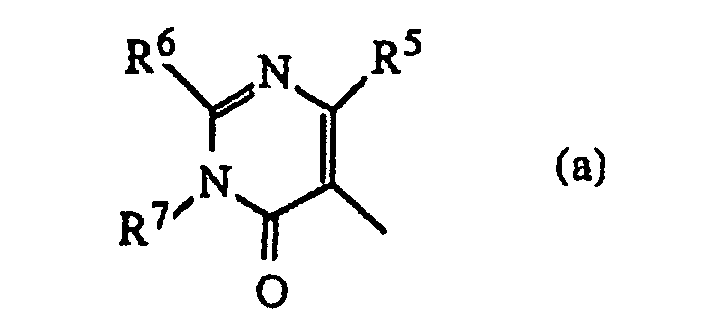
R5 Wasserstoff oder C1-6-Alkyl bedeutet;
R6 Wasserstoff, C1-6-Alkyl, C1-6-Alkyloxy, C1-6-Alkylthio, Amino oder Mono- oder Di(C1-6-alkyl)amino bedeutet und
R7 Wasserstoff oder C1-6-Alkyl bedeutet; oder
R6 und R7 zusammengenommen einen zweiwertigen Rest -R6-R7- bilden können, welcher insbesondere
-R6-R7- auch
oder einen Rest der Formelworin R8 Wasserstoff oder C1-6-Alkyl bedeutet; steht.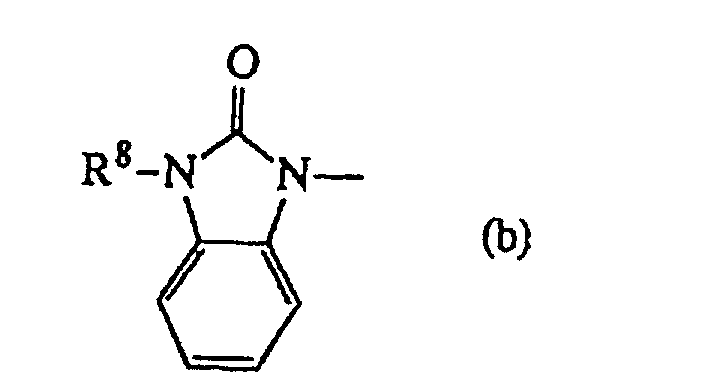
- Verbindung nach Anspruch 1, in der D für einen Rest der Formel

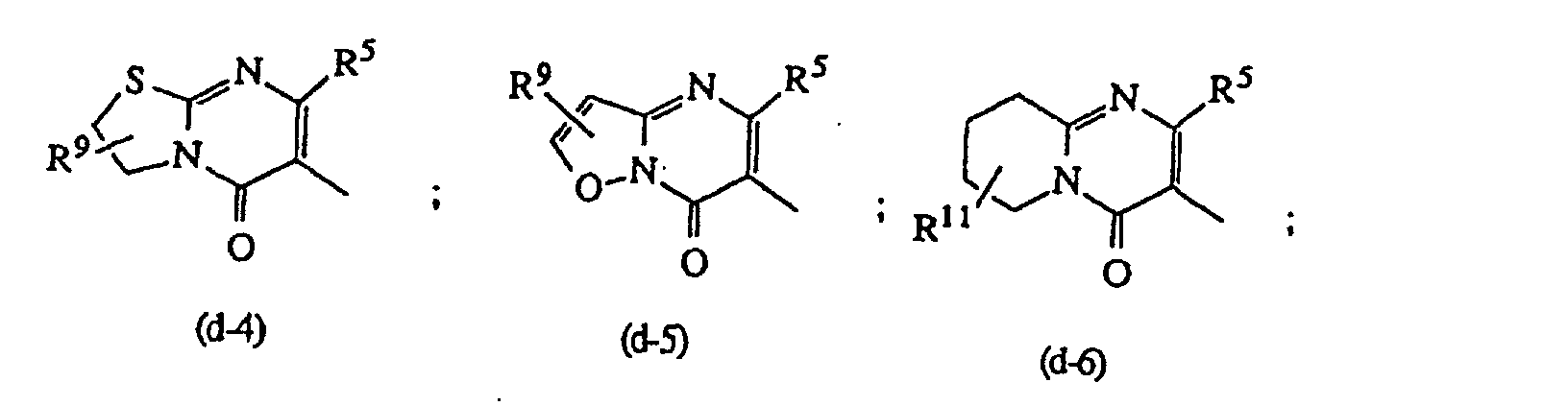 oder
oder worin R5 die in Anspruch 1 angegebene Bedeutung besitzt, R9 und R10 jeweils unabhängig voneinander Wasserstoff oder C1-6-Alkyl bedeuten; R11 C1-6-Alkyl, Hydroxy, C1-6-Alkyloxy oder C1-10-Alkylcarbonyloxy bedeutet und R12 Wasserstoff, C1-6-Alkyl, C1-6-Alkyloxy, C1-6-Alkylthio, Amino oder Mono- oder Di(C1-6-alkyl)amino bedeutet; steht.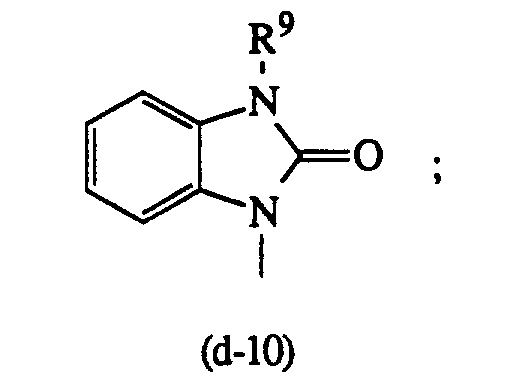
- Verbindung nach Anspruch 1, in der Alk für C2-4-Alkandiyl steht,
- Verbindung nach Anspruch 1, in der R1 für Wasserstoff oder Halogen steht und R2 für Wasserstoff steht.
- Verbindung nach Anspruch 1, ausgewählt unter
3-[2-[4-(5-Fluor-1H-indol-1-yl)-1-piperidinyl]-ethyl]-6,7,8,9-tetrahydro-2-methyl-4H-pyrido-[1,2-a]pyrimidin-4-on;
6-[2-[4-(5-Fluor-1H-indol-1-yl)-1-piperidinyl]-ethyl]-7-methyl-5H-thiazolo-[3,2-a]pyrimidin-5-on;
5-[2-[4-(5-Fluor-1H-indol-1-yl)-1-piperidinyl]-ethyl]-3,6-dimethyl-2-(methylamino)-4(3H)-pyrimidinon und
2,3-Dihydro-6-[2-[4-(1H-indol-1-yl)-1-piperidinyl]ethyl]-7-methyl-5H-thiazolo-[3,2-a]-pyrimidin-5-on; einem pharmazeutisch unbedenklichen Additionssalz oder einer stereochemisch isomeren Form davon. - Pharmazeutische Zusammensetzung, enthaltend als Wirkstoff eine therapeutisch wirksame Menge einer Verbindung nach einem der Ansprüche 1 bis 5 und einen pharmazeutisch unbedenklichen Träger.
- Verfahren zur Herstellung einer pharmazeutischen Zusammensetzung nach Anspruch 6, dadurch gekennzeichnet, daß man eine therapeutisch wirksame Menge einer Verbindung nach einem der Ansprüche 1 bis 5 innig mit einem pharmazeutisch unbedenklichen Träger vermischt.
- Verbindung nach einem der Ansprüche 1 bis 5 zur Verwendung als Arzneimittel.
- Verwendung einer Verbindung nach einem der Ansprüche 1 bis 5 zur Herstellung eines Arzneimittels zur Behandlung von psychotischen Krankheiten.
- Verfahren zur Herstellung einer Verbindung nach Anspruch 1, dadurch gekennzeichnet, daß mana) ein Zwischenprodukt der Formelworin die gestrichelte Linie, R1, R2, R3 und R4 die in Anspruch 1 angegebene Bedeutung besitzen, mit einem Zwischenprodukt der Formel D-Alk-W (III), worin D die in Anspruch 1 angegebene Bedeutung besitzt und W für eine geeignete reaktive Abgangsgruppe steht, N-alkyliert;
 b) ein Zwischenprodukt der Formelworin D, Alk, R1 und R2 die in Anspruch 1 angegebene Bedeutung haben und W für eine reaktive Abgangsgruppe steht, in einem unter den Reaktionsbedingungen inerten Lösungsmittel und in Gegenwart eines Reduktionsmittels cyclisiert, wobei man eine Verbindung der Formel
 worin D, Alk, R1 und R2 die in Anspruch 1 angegebene Bedeutung haben, erhält;
 c) die Verbindungen der Formel (I) durch an sich bekannte Transformationen ineinander umwandelt und gegebenenfalls ferner die Verbindungen der Formel (I) durch Behandlung mit einer Säure in ein therapeutisch wirksames, nicht toxisches Säureadditionssalz oder durch Behandlung mit einer Base in ein therapeutisch wirksames, nicht toxisches Basenadditionssalz umwandelt oder umgekehrt das Säureadditionssalz durch Behandlung mit Alkali in die freie Base oder das Basenadditionssalz durch Behandlung mit Säure in die freie Säure umwandelt und gegebenenfalls sterochemisch isomere Formen davon herstellt.
Priority Applications (1)
| Application Number | Priority Date | Filing Date | Title |
|---|---|---|---|
| EP96902258A EP0808313B1 (de) | 1995-01-31 | 1996-01-23 | Antipsychotische 4-(1h-indolyl-1-yl)-1-substituierte piperidine derivate |
Applications Claiming Priority (4)
| Application Number | Priority Date | Filing Date | Title |
|---|---|---|---|
| EP95200229 | 1995-01-31 | ||
| EP95200229 | 1995-01-31 | ||
| EP96902258A EP0808313B1 (de) | 1995-01-31 | 1996-01-23 | Antipsychotische 4-(1h-indolyl-1-yl)-1-substituierte piperidine derivate |
| PCT/EP1996/000363 WO1996023784A1 (en) | 1995-01-31 | 1996-01-23 | Antipsychotic 4-(1h-indolyl-1-yl)-1-substituted piperidine derivatives |
Publications (2)
| Publication Number | Publication Date |
|---|---|
| EP0808313A1 EP0808313A1 (de) | 1997-11-26 |
| EP0808313B1 true EP0808313B1 (de) | 2003-08-13 |
Family
ID=8219983
Family Applications (1)
| Application Number | Title | Priority Date | Filing Date |
|---|---|---|---|
| EP96902258A Expired - Lifetime EP0808313B1 (de) | 1995-01-31 | 1996-01-23 | Antipsychotische 4-(1h-indolyl-1-yl)-1-substituierte piperidine derivate |
Country Status (21)
| Country | Link |
|---|---|
| US (1) | US5919788A (de) |
| EP (1) | EP0808313B1 (de) |
| JP (1) | JP3980054B2 (de) |
| KR (1) | KR100415391B1 (de) |
| CN (1) | CN1152874C (de) |
| AR (1) | AR002025A1 (de) |
| AT (1) | ATE247105T1 (de) |
| AU (1) | AU702931B2 (de) |
| BR (1) | BR9606815A (de) |
| CA (1) | CA2210913C (de) |
| DE (1) | DE69629454T2 (de) |
| ES (1) | ES2205015T3 (de) |
| FI (1) | FI973164L (de) |
| IL (1) | IL116930A (de) |
| MY (1) | MY130950A (de) |
| NO (1) | NO308537B1 (de) |
| NZ (1) | NZ301264A (de) |
| PL (1) | PL183291B1 (de) |
| TW (1) | TW421649B (de) |
| WO (1) | WO1996023784A1 (de) |
| ZA (1) | ZA96702B (de) |
Families Citing this family (15)
| Publication number | Priority date | Publication date | Assignee | Title |
|---|---|---|---|---|
| TWI242011B (en) | 1997-03-31 | 2005-10-21 | Eisai Co Ltd | 1,4-substituted cyclic amine derivatives |
| US7189753B1 (en) | 1997-11-06 | 2007-03-13 | Cady Roger K | Preemptive prophylaxis of migraine |
| TW528754B (en) * | 1998-04-29 | 2003-04-21 | Wyeth Corp | Indolyl derivatibes as serotonergic agents |
| US6204274B1 (en) | 1998-04-29 | 2001-03-20 | American Home Products Corporation | Indolyl derivatives as serotonergic agents |
| GB9810886D0 (en) * | 1998-05-13 | 1998-07-22 | Lilly Industries Ltd | Pharmaceutical compounds |
| WO2006027370A1 (en) * | 2004-09-09 | 2006-03-16 | Janssen Pharmaceutica N.V. | PREPARATION OF 9-HYDROXY-3- (2-HYDROXYETHYL) -2-METHYL-4H-PYRID0[1, 2-a] PYRIMIDIN-4-ONE AND CRYSTALS THEREOF |
| US7820816B2 (en) | 2006-08-23 | 2010-10-26 | Teva Pharmaceutical Industries Ltd. | Process for the synthesis of CMHTP and intermediates thereof |
| JP2009524574A (ja) * | 2006-08-23 | 2009-07-02 | テバ ファーマシューティカル インダストリーズ リミティド | Cmhtp及びその中間体の合成方法 |
| WO2008087557A2 (en) * | 2007-01-08 | 2008-07-24 | Actavis Group Ptc Ehf | An improved process for preparation of 9-hydroxy-3-(2-chloroethyl)- 2-methyl-4h-pyrido[1,2-a]pyrimidin-4-one hydrochloride |
| WO2008126886A1 (ja) * | 2007-04-12 | 2008-10-23 | Taisho Pharmaceutical Co., Ltd. | インドール又はインドリン誘導体 |
| WO2009010988A1 (en) * | 2007-07-19 | 2009-01-22 | Natco Pharma Limited | An improved, industrially viable process for the preparation of high purity paliperidone |
| WO2012177708A1 (en) | 2011-06-20 | 2012-12-27 | Ratiopharm Gmbh | Paliperidone oleate |
| US9963458B2 (en) | 2012-12-27 | 2018-05-08 | Purdue Pharma L.P. | Indole and indoline-type piperidine compounds and uses thereof |
| US9951038B2 (en) | 2012-12-27 | 2018-04-24 | Purdue Pharma L.P. | Quinazolin-4(3H)-one-type piperidine compounds and uses thereof |
| CN117700410B (zh) * | 2023-05-20 | 2025-07-04 | 山东康诺生物工程有限公司 | 一种3-(2-氯乙基)-2-甲基-9-羟基-4H-吡啶并[1,2-a]嘧啶-4-酮的制备方法 |
Family Cites Families (9)
| Publication number | Priority date | Publication date | Assignee | Title |
|---|---|---|---|---|
| US4342870A (en) * | 1980-03-28 | 1982-08-03 | Janssen Pharmaceutica N.V. | Novel 3-(1-piperidinylalkyl)-4H-pyrido[1,2-a]pyrimidin-4-one derivatives |
| US4443451A (en) * | 1981-07-15 | 1984-04-17 | Janssen Pharmaceutica N.V. | Bicyclic pyrimidin-5-one derivatives |
| US5256659A (en) * | 1989-01-09 | 1993-10-26 | Janssen Pharmaceutica N.V. | 2-aminopyrimidinone derivatives |
| US5140029A (en) * | 1989-01-09 | 1992-08-18 | Janssen Pharmaceutica N.V. | 2-aminopyrimidinone derivatives |
| GB8900382D0 (en) * | 1989-01-09 | 1989-03-08 | Janssen Pharmaceutica Nv | 2-aminopyrimidinone derivatives |
| JP2800953B2 (ja) * | 1990-07-06 | 1998-09-21 | 住友製薬株式会社 | 新規なイミド誘導体 |
| US5360807A (en) * | 1990-07-19 | 1994-11-01 | Janssen Pharmaceutica N.V. | Substituted thiazolyl and substituted pyridinyl derivatives |
| DK181190D0 (da) * | 1990-07-30 | 1990-07-30 | Lundbeck & Co As H | 3-aryl-indol- eller 3-aryl-indazolderivater |
| GB9305641D0 (en) * | 1993-03-18 | 1993-05-05 | Merck Sharp & Dohme | Therapeutic agents |
-
1996
- 1996-01-09 TW TW085100173A patent/TW421649B/zh not_active IP Right Cessation
- 1996-01-23 NZ NZ301264A patent/NZ301264A/en not_active IP Right Cessation
- 1996-01-23 FI FI973164A patent/FI973164L/fi not_active Application Discontinuation
- 1996-01-23 CN CNB961917016A patent/CN1152874C/zh not_active Expired - Fee Related
- 1996-01-23 CA CA002210913A patent/CA2210913C/en not_active Expired - Fee Related
- 1996-01-23 DE DE69629454T patent/DE69629454T2/de not_active Expired - Fee Related
- 1996-01-23 ES ES96902258T patent/ES2205015T3/es not_active Expired - Lifetime
- 1996-01-23 EP EP96902258A patent/EP0808313B1/de not_active Expired - Lifetime
- 1996-01-23 KR KR1019970705088A patent/KR100415391B1/ko not_active Expired - Fee Related
- 1996-01-23 US US08/860,380 patent/US5919788A/en not_active Expired - Fee Related
- 1996-01-23 BR BR9606815A patent/BR9606815A/pt not_active IP Right Cessation
- 1996-01-23 AU AU46645/96A patent/AU702931B2/en not_active Ceased
- 1996-01-23 AT AT96902258T patent/ATE247105T1/de not_active IP Right Cessation
- 1996-01-23 PL PL96321565A patent/PL183291B1/pl not_active IP Right Cessation
- 1996-01-23 WO PCT/EP1996/000363 patent/WO1996023784A1/en not_active Ceased
- 1996-01-23 JP JP52324396A patent/JP3980054B2/ja not_active Expired - Lifetime
- 1996-01-29 IL IL11693096A patent/IL116930A/xx not_active IP Right Cessation
- 1996-01-30 AR ARP960101210A patent/AR002025A1/es unknown
- 1996-01-30 ZA ZA9600702A patent/ZA96702B/xx unknown
- 1996-01-31 MY MYPI96000364A patent/MY130950A/en unknown
-
1997
- 1997-07-30 NO NO973508A patent/NO308537B1/no not_active IP Right Cessation
Also Published As
| Publication number | Publication date |
|---|---|
| IL116930A (en) | 2000-06-29 |
| ATE247105T1 (de) | 2003-08-15 |
| NO973508D0 (no) | 1997-07-30 |
| MX9705821A (es) | 1997-10-31 |
| NO308537B1 (no) | 2000-09-25 |
| ZA96702B (en) | 1997-07-30 |
| TW421649B (en) | 2001-02-11 |
| US5919788A (en) | 1999-07-06 |
| CN1152874C (zh) | 2004-06-09 |
| DE69629454D1 (en) | 2003-09-18 |
| PL183291B1 (pl) | 2002-06-28 |
| JPH10512893A (ja) | 1998-12-08 |
| NZ301264A (en) | 1998-07-28 |
| IL116930A0 (en) | 1996-05-14 |
| CA2210913A1 (en) | 1996-08-08 |
| AU702931B2 (en) | 1999-03-11 |
| AR002025A1 (es) | 1998-01-07 |
| WO1996023784A1 (en) | 1996-08-08 |
| CN1172482A (zh) | 1998-02-04 |
| FI973164A7 (fi) | 1997-07-30 |
| FI973164A0 (fi) | 1997-07-30 |
| NO973508L (no) | 1997-07-30 |
| EP0808313A1 (de) | 1997-11-26 |
| JP3980054B2 (ja) | 2007-09-19 |
| CA2210913C (en) | 2008-10-21 |
| FI973164L (fi) | 1997-07-30 |
| MY130950A (en) | 2007-07-31 |
| KR100415391B1 (ko) | 2004-05-06 |
| BR9606815A (pt) | 1997-12-30 |
| DE69629454T2 (de) | 2004-06-17 |
| AU4664596A (en) | 1996-08-21 |
| ES2205015T3 (es) | 2004-05-01 |
| KR19980701692A (ko) | 1998-06-25 |
| PL321565A1 (en) | 1997-12-08 |
Similar Documents
| Publication | Publication Date | Title |
|---|---|---|
| EP0730594B1 (de) | 9-HYDROXY-PYRIDO [1,2-a] PYRIMIDIN-4-ON-ETHER-DERIVATE | |
| EP0196132B1 (de) | 1,2-Benzisoxazol-3-yl- und 1,2-Benzisothiazol-3-yl-Derivate | |
| EP0378255A2 (de) | 2-Aminopyrimidinon-Derivate | |
| US5919788A (en) | 4-(1H-indol-1-yl)-1-piperidinyl derivatives | |
| EP0353821B1 (de) | Antipsychotische 3-Piperazinylbenzazolderivate | |
| US6506768B2 (en) | Tetrahydro γ-carbolines | |
| EP0902684B1 (de) | Hexahydro-pyrido (4,3-b)indolderivate als antipsychotische arzneimittel | |
| US20040204402A1 (en) | Substituted-3-indolyl-4-piperidino-alkyl heterocycles for the treatment of depression | |
| HK1039113A1 (en) | Benzothieno[3,2-c]pyridines as alpha2 antagonists | |
| HK1029107B (en) | Tetrahydro gamma-carbolines | |
| HK1039113B (en) | Benzothieno[3,2-c]pyridines as alpha2 antagonists |
Legal Events
| Date | Code | Title | Description |
|---|---|---|---|
| PUAI | Public reference made under article 153(3) epc to a published international application that has entered the european phase |
Free format text: ORIGINAL CODE: 0009012 |
|
| 17P | Request for examination filed |
Effective date: 19970901 |
|
| AK | Designated contracting states |
Kind code of ref document: A1 Designated state(s): AT BE CH DE DK ES FR GB GR IE IT LI LU NL PT SE |
|
| 17Q | First examination report despatched |
Effective date: 19991001 |
|
| GRAH | Despatch of communication of intention to grant a patent |
Free format text: ORIGINAL CODE: EPIDOS IGRA |
|
| GRAH | Despatch of communication of intention to grant a patent |
Free format text: ORIGINAL CODE: EPIDOS IGRA |
|
| GRAA | (expected) grant |
Free format text: ORIGINAL CODE: 0009210 |
|
| AK | Designated contracting states |
Designated state(s): AT BE CH DE DK ES FR GB GR IE IT LI LU NL PT SE |
|
| PG25 | Lapsed in a contracting state [announced via postgrant information from national office to epo] |
Ref country code: NL Free format text: LAPSE BECAUSE OF FAILURE TO SUBMIT A TRANSLATION OF THE DESCRIPTION OR TO PAY THE FEE WITHIN THE PRESCRIBED TIME-LIMIT Effective date: 20030813 Ref country code: AT Free format text: LAPSE BECAUSE OF FAILURE TO SUBMIT A TRANSLATION OF THE DESCRIPTION OR TO PAY THE FEE WITHIN THE PRESCRIBED TIME-LIMIT Effective date: 20030813 |
|
| REG | Reference to a national code |
Ref country code: GB Ref legal event code: FG4D |
|
| REG | Reference to a national code |
Ref country code: CH Ref legal event code: EP |
|
| REG | Reference to a national code |
Ref country code: IE Ref legal event code: FG4D |
|
| REF | Corresponds to: |
Ref document number: 69629454 Country of ref document: DE Date of ref document: 20030918 Kind code of ref document: P |
|
| PG25 | Lapsed in a contracting state [announced via postgrant information from national office to epo] |
Ref country code: SE Free format text: LAPSE BECAUSE OF FAILURE TO SUBMIT A TRANSLATION OF THE DESCRIPTION OR TO PAY THE FEE WITHIN THE PRESCRIBED TIME-LIMIT Effective date: 20031113 Ref country code: GR Free format text: LAPSE BECAUSE OF FAILURE TO SUBMIT A TRANSLATION OF THE DESCRIPTION OR TO PAY THE FEE WITHIN THE PRESCRIBED TIME-LIMIT Effective date: 20031113 Ref country code: DK Free format text: LAPSE BECAUSE OF FAILURE TO SUBMIT A TRANSLATION OF THE DESCRIPTION OR TO PAY THE FEE WITHIN THE PRESCRIBED TIME-LIMIT Effective date: 20031113 |
|
| PG25 | Lapsed in a contracting state [announced via postgrant information from national office to epo] |
Ref country code: PT Free format text: LAPSE BECAUSE OF FAILURE TO SUBMIT A TRANSLATION OF THE DESCRIPTION OR TO PAY THE FEE WITHIN THE PRESCRIBED TIME-LIMIT Effective date: 20040113 |
|
| PG25 | Lapsed in a contracting state [announced via postgrant information from national office to epo] |
Ref country code: LU Free format text: LAPSE BECAUSE OF NON-PAYMENT OF DUE FEES Effective date: 20040123 Ref country code: IE Free format text: LAPSE BECAUSE OF NON-PAYMENT OF DUE FEES Effective date: 20040123 |
|
| NLV1 | Nl: lapsed or annulled due to failure to fulfill the requirements of art. 29p and 29m of the patents act | ||
| REG | Reference to a national code |
Ref country code: ES Ref legal event code: FG2A Ref document number: 2205015 Country of ref document: ES Kind code of ref document: T3 |
|
| ET | Fr: translation filed | ||
| PLBE | No opposition filed within time limit |
Free format text: ORIGINAL CODE: 0009261 |
|
| STAA | Information on the status of an ep patent application or granted ep patent |
Free format text: STATUS: NO OPPOSITION FILED WITHIN TIME LIMIT |
|
| 26N | No opposition filed |
Effective date: 20040514 |
|
| REG | Reference to a national code |
Ref country code: IE Ref legal event code: MM4A |
|
| PGFP | Annual fee paid to national office [announced via postgrant information from national office to epo] |
Ref country code: BE Payment date: 20081215 Year of fee payment: 14 |
|
| PGFP | Annual fee paid to national office [announced via postgrant information from national office to epo] |
Ref country code: ES Payment date: 20090218 Year of fee payment: 14 |
|
| PGFP | Annual fee paid to national office [announced via postgrant information from national office to epo] |
Ref country code: DE Payment date: 20090115 Year of fee payment: 14 |
|
| PGFP | Annual fee paid to national office [announced via postgrant information from national office to epo] |
Ref country code: GB Payment date: 20090121 Year of fee payment: 14 Ref country code: CH Payment date: 20090126 Year of fee payment: 14 |
|
| PGFP | Annual fee paid to national office [announced via postgrant information from national office to epo] |
Ref country code: IT Payment date: 20090127 Year of fee payment: 14 |
|
| PGFP | Annual fee paid to national office [announced via postgrant information from national office to epo] |
Ref country code: FR Payment date: 20090113 Year of fee payment: 14 |
|
| BERE | Be: lapsed |
Owner name: *JANSSEN PHARMACEUTICA N.V. Effective date: 20100131 |
|
| REG | Reference to a national code |
Ref country code: CH Ref legal event code: PL |
|
| GBPC | Gb: european patent ceased through non-payment of renewal fee |
Effective date: 20100123 |
|
| REG | Reference to a national code |
Ref country code: FR Ref legal event code: ST Effective date: 20100930 |
|
| PG25 | Lapsed in a contracting state [announced via postgrant information from national office to epo] |
Ref country code: LI Free format text: LAPSE BECAUSE OF NON-PAYMENT OF DUE FEES Effective date: 20100131 Ref country code: FR Free format text: LAPSE BECAUSE OF NON-PAYMENT OF DUE FEES Effective date: 20100201 Ref country code: CH Free format text: LAPSE BECAUSE OF NON-PAYMENT OF DUE FEES Effective date: 20100131 |
|
| PG25 | Lapsed in a contracting state [announced via postgrant information from national office to epo] |
Ref country code: DE Free format text: LAPSE BECAUSE OF NON-PAYMENT OF DUE FEES Effective date: 20100803 |
|
| PG25 | Lapsed in a contracting state [announced via postgrant information from national office to epo] |
Ref country code: GB Free format text: LAPSE BECAUSE OF NON-PAYMENT OF DUE FEES Effective date: 20100123 |
|
| PG25 | Lapsed in a contracting state [announced via postgrant information from national office to epo] |
Ref country code: BE Free format text: LAPSE BECAUSE OF NON-PAYMENT OF DUE FEES Effective date: 20100131 |
|
| REG | Reference to a national code |
Ref country code: ES Ref legal event code: FD2A Effective date: 20110228 |
|
| PG25 | Lapsed in a contracting state [announced via postgrant information from national office to epo] |
Ref country code: IT Free format text: LAPSE BECAUSE OF NON-PAYMENT OF DUE FEES Effective date: 20100123 |
|
| PG25 | Lapsed in a contracting state [announced via postgrant information from national office to epo] |
Ref country code: ES Free format text: LAPSE BECAUSE OF NON-PAYMENT OF DUE FEES Effective date: 20110224 |
|
| PG25 | Lapsed in a contracting state [announced via postgrant information from national office to epo] |
Ref country code: ES Free format text: LAPSE BECAUSE OF NON-PAYMENT OF DUE FEES Effective date: 20100124 |