EP0807641B1 - Verfahren zur Herstellung von mittelmolekularem, hochreaktivem Polyisobuten - Google Patents
Verfahren zur Herstellung von mittelmolekularem, hochreaktivem Polyisobuten Download PDFInfo
- Publication number
- EP0807641B1 EP0807641B1 EP97107812A EP97107812A EP0807641B1 EP 0807641 B1 EP0807641 B1 EP 0807641B1 EP 97107812 A EP97107812 A EP 97107812A EP 97107812 A EP97107812 A EP 97107812A EP 0807641 B1 EP0807641 B1 EP 0807641B1
- Authority
- EP
- European Patent Office
- Prior art keywords
- isobutene
- polyisobutene
- boron trifluoride
- polymerization
- molecular weight
- Prior art date
- Legal status (The legal status is an assumption and is not a legal conclusion. Google has not performed a legal analysis and makes no representation as to the accuracy of the status listed.)
- Expired - Lifetime
Links
- 229920002367 Polyisobutene Polymers 0.000 title claims abstract description 59
- 238000000034 method Methods 0.000 title claims description 25
- 238000002360 preparation method Methods 0.000 title claims description 3
- VQTUBCCKSQIDNK-UHFFFAOYSA-N Isobutene Chemical compound CC(C)=C VQTUBCCKSQIDNK-UHFFFAOYSA-N 0.000 claims abstract description 91
- WTEOIRVLGSZEPR-UHFFFAOYSA-N boron trifluoride Chemical compound FB(F)F WTEOIRVLGSZEPR-UHFFFAOYSA-N 0.000 claims abstract description 55
- 229910015900 BF3 Inorganic materials 0.000 claims abstract description 27
- 239000003054 catalyst Substances 0.000 claims abstract description 15
- 229930195733 hydrocarbon Natural products 0.000 claims abstract description 15
- 150000002430 hydrocarbons Chemical class 0.000 claims abstract description 14
- 239000000203 mixture Substances 0.000 claims abstract description 11
- 239000004215 Carbon black (E152) Substances 0.000 claims abstract description 10
- 239000007791 liquid phase Substances 0.000 claims abstract description 3
- 238000006116 polymerization reaction Methods 0.000 claims description 22
- XLYOFNOQVPJJNP-UHFFFAOYSA-N water Substances O XLYOFNOQVPJJNP-UHFFFAOYSA-N 0.000 claims description 11
- KFZMGEQAYNKOFK-UHFFFAOYSA-N Isopropanol Chemical compound CC(C)O KFZMGEQAYNKOFK-UHFFFAOYSA-N 0.000 claims description 8
- 150000001298 alcohols Chemical class 0.000 claims description 8
- 239000008139 complexing agent Substances 0.000 claims description 8
- BTANRVKWQNVYAZ-UHFFFAOYSA-N butan-2-ol Chemical compound CCC(C)O BTANRVKWQNVYAZ-UHFFFAOYSA-N 0.000 claims description 6
- QVGXLLKOCUKJST-UHFFFAOYSA-N atomic oxygen Chemical compound [O] QVGXLLKOCUKJST-UHFFFAOYSA-N 0.000 claims description 3
- 238000010538 cationic polymerization reaction Methods 0.000 claims description 3
- 150000001983 dialkylethers Chemical class 0.000 claims description 3
- 239000000314 lubricant Substances 0.000 claims description 3
- 229910052760 oxygen Inorganic materials 0.000 claims description 3
- 239000001301 oxygen Substances 0.000 claims description 3
- 239000002253 acid Substances 0.000 claims description 2
- 150000001875 compounds Chemical class 0.000 claims description 2
- 238000011065 in-situ storage Methods 0.000 claims description 2
- 150000002989 phenols Chemical class 0.000 claims description 2
- 150000007513 acids Chemical class 0.000 claims 1
- 239000003879 lubricant additive Substances 0.000 claims 1
- 238000004519 manufacturing process Methods 0.000 abstract description 18
- 125000002091 cationic group Chemical group 0.000 abstract 1
- 238000006243 chemical reaction Methods 0.000 description 11
- 229920000642 polymer Polymers 0.000 description 11
- VLKZOEOYAKHREP-UHFFFAOYSA-N n-Hexane Chemical compound CCCCCC VLKZOEOYAKHREP-UHFFFAOYSA-N 0.000 description 10
- 239000000243 solution Substances 0.000 description 10
- 238000001816 cooling Methods 0.000 description 9
- 150000001768 cations Chemical class 0.000 description 8
- YCKRFDGAMUMZLT-UHFFFAOYSA-N Fluorine atom Chemical compound [F] YCKRFDGAMUMZLT-UHFFFAOYSA-N 0.000 description 7
- 229910052731 fluorine Inorganic materials 0.000 description 7
- 239000011737 fluorine Substances 0.000 description 7
- KRHYYFGTRYWZRS-UHFFFAOYSA-M Fluoride anion Chemical compound [F-] KRHYYFGTRYWZRS-UHFFFAOYSA-M 0.000 description 6
- 230000015572 biosynthetic process Effects 0.000 description 6
- QGZKDVFQNNGYKY-UHFFFAOYSA-N Ammonia Chemical compound N QGZKDVFQNNGYKY-UHFFFAOYSA-N 0.000 description 5
- 239000000654 additive Substances 0.000 description 5
- 238000009826 distribution Methods 0.000 description 5
- -1 aluminum alkyl chlorides Chemical class 0.000 description 4
- 238000004821 distillation Methods 0.000 description 4
- NNPPMTNAJDCUHE-UHFFFAOYSA-N isobutane Chemical compound CC(C)C NNPPMTNAJDCUHE-UHFFFAOYSA-N 0.000 description 4
- FPYJFEHAWHCUMM-UHFFFAOYSA-N maleic anhydride Chemical compound O=C1OC(=O)C=C1 FPYJFEHAWHCUMM-UHFFFAOYSA-N 0.000 description 4
- 239000002904 solvent Substances 0.000 description 4
- WEVYAHXRMPXWCK-UHFFFAOYSA-N Acetonitrile Chemical compound CC#N WEVYAHXRMPXWCK-UHFFFAOYSA-N 0.000 description 3
- YMWUJEATGCHHMB-UHFFFAOYSA-N Dichloromethane Chemical compound ClCCl YMWUJEATGCHHMB-UHFFFAOYSA-N 0.000 description 3
- KRHYYFGTRYWZRS-UHFFFAOYSA-N Fluorane Chemical compound F KRHYYFGTRYWZRS-UHFFFAOYSA-N 0.000 description 3
- OKKJLVBELUTLKV-UHFFFAOYSA-N Methanol Chemical compound OC OKKJLVBELUTLKV-UHFFFAOYSA-N 0.000 description 3
- 239000006227 byproduct Substances 0.000 description 3
- 230000000694 effects Effects 0.000 description 3
- 125000002573 ethenylidene group Chemical group [*]=C=C([H])[H] 0.000 description 3
- 229910000040 hydrogen fluoride Inorganic materials 0.000 description 3
- 238000006317 isomerization reaction Methods 0.000 description 3
- 229920002521 macromolecule Polymers 0.000 description 3
- 230000008707 rearrangement Effects 0.000 description 3
- 239000007858 starting material Substances 0.000 description 3
- VXNZUUAINFGPBY-UHFFFAOYSA-N 1-Butene Chemical class CCC=C VXNZUUAINFGPBY-UHFFFAOYSA-N 0.000 description 2
- KAKZBPTYRLMSJV-UHFFFAOYSA-N Butadiene Chemical compound C=CC=C KAKZBPTYRLMSJV-UHFFFAOYSA-N 0.000 description 2
- RTZKZFJDLAIYFH-UHFFFAOYSA-N Diethyl ether Chemical compound CCOCC RTZKZFJDLAIYFH-UHFFFAOYSA-N 0.000 description 2
- NHTMVDHEPJAVLT-UHFFFAOYSA-N Isooctane Chemical compound CC(C)CC(C)(C)C NHTMVDHEPJAVLT-UHFFFAOYSA-N 0.000 description 2
- OFBQJSOFQDEBGM-UHFFFAOYSA-N Pentane Chemical compound CCCCC OFBQJSOFQDEBGM-UHFFFAOYSA-N 0.000 description 2
- RAHZWNYVWXNFOC-UHFFFAOYSA-N Sulphur dioxide Chemical compound O=S=O RAHZWNYVWXNFOC-UHFFFAOYSA-N 0.000 description 2
- VSCWAEJMTAWNJL-UHFFFAOYSA-K aluminium trichloride Chemical compound Cl[Al](Cl)Cl VSCWAEJMTAWNJL-UHFFFAOYSA-K 0.000 description 2
- 229910021529 ammonia Inorganic materials 0.000 description 2
- 238000002485 combustion reaction Methods 0.000 description 2
- 238000010924 continuous production Methods 0.000 description 2
- 230000007797 corrosion Effects 0.000 description 2
- 238000005260 corrosion Methods 0.000 description 2
- 238000006356 dehydrogenation reaction Methods 0.000 description 2
- 230000005595 deprotonation Effects 0.000 description 2
- 238000010537 deprotonation reaction Methods 0.000 description 2
- 238000000605 extraction Methods 0.000 description 2
- 230000002349 favourable effect Effects 0.000 description 2
- 239000000446 fuel Substances 0.000 description 2
- 238000005227 gel permeation chromatography Methods 0.000 description 2
- 239000001282 iso-butane Substances 0.000 description 2
- 239000011968 lewis acid catalyst Substances 0.000 description 2
- 239000000155 melt Substances 0.000 description 2
- 238000002156 mixing Methods 0.000 description 2
- 239000002808 molecular sieve Substances 0.000 description 2
- 239000000178 monomer Substances 0.000 description 2
- 239000000565 sealant Substances 0.000 description 2
- URGAHOPLAPQHLN-UHFFFAOYSA-N sodium aluminosilicate Chemical compound [Na+].[Al+3].[O-][Si]([O-])=O.[O-][Si]([O-])=O URGAHOPLAPQHLN-UHFFFAOYSA-N 0.000 description 2
- 238000010626 work up procedure Methods 0.000 description 2
- SNICXCGAKADSCV-JTQLQIEISA-N (-)-Nicotine Chemical compound CN1CCC[C@H]1C1=CC=CN=C1 SNICXCGAKADSCV-JTQLQIEISA-N 0.000 description 1
- IXHWZHXLJJPXIS-UHFFFAOYSA-N 2-fluorobutane Chemical compound CCC(C)F IXHWZHXLJJPXIS-UHFFFAOYSA-N 0.000 description 1
- OKTJSMMVPCPJKN-UHFFFAOYSA-N Carbon Chemical group [C] OKTJSMMVPCPJKN-UHFFFAOYSA-N 0.000 description 1
- CURLTUGMZLYLDI-UHFFFAOYSA-N Carbon dioxide Chemical compound O=C=O CURLTUGMZLYLDI-UHFFFAOYSA-N 0.000 description 1
- HEDRZPFGACZZDS-UHFFFAOYSA-N Chloroform Chemical compound ClC(Cl)Cl HEDRZPFGACZZDS-UHFFFAOYSA-N 0.000 description 1
- LFQSCWFLJHTTHZ-UHFFFAOYSA-N Ethanol Chemical compound CCO LFQSCWFLJHTTHZ-UHFFFAOYSA-N 0.000 description 1
- 206010016352 Feeling of relaxation Diseases 0.000 description 1
- BZLVMXJERCGZMT-UHFFFAOYSA-N Methyl tert-butyl ether Chemical compound COC(C)(C)C BZLVMXJERCGZMT-UHFFFAOYSA-N 0.000 description 1
- 206010034016 Paronychia Diseases 0.000 description 1
- ISWSIDIOOBJBQZ-UHFFFAOYSA-N Phenol Chemical compound OC1=CC=CC=C1 ISWSIDIOOBJBQZ-UHFFFAOYSA-N 0.000 description 1
- XUIMIQQOPSSXEZ-UHFFFAOYSA-N Silicon Chemical compound [Si] XUIMIQQOPSSXEZ-UHFFFAOYSA-N 0.000 description 1
- 239000004809 Teflon Substances 0.000 description 1
- 229920006362 Teflon® Polymers 0.000 description 1
- 239000008186 active pharmaceutical agent Substances 0.000 description 1
- 230000000996 additive effect Effects 0.000 description 1
- 229910000272 alkali metal oxide Inorganic materials 0.000 description 1
- 150000001340 alkali metals Chemical class 0.000 description 1
- 229910001860 alkaline earth metal hydroxide Inorganic materials 0.000 description 1
- 229910052782 aluminium Inorganic materials 0.000 description 1
- 150000001412 amines Chemical class 0.000 description 1
- 238000004458 analytical method Methods 0.000 description 1
- 239000002830 appetite depressant Substances 0.000 description 1
- 239000007864 aqueous solution Substances 0.000 description 1
- 239000002585 base Substances 0.000 description 1
- 238000009835 boiling Methods 0.000 description 1
- 238000011088 calibration curve Methods 0.000 description 1
- 229910052799 carbon Inorganic materials 0.000 description 1
- 235000011089 carbon dioxide Nutrition 0.000 description 1
- 150000004649 carbonic acid derivatives Chemical class 0.000 description 1
- 150000001735 carboxylic acids Chemical class 0.000 description 1
- 238000006555 catalytic reaction Methods 0.000 description 1
- 239000007795 chemical reaction product Substances 0.000 description 1
- 229940112822 chewing gum Drugs 0.000 description 1
- 235000015218 chewing gum Nutrition 0.000 description 1
- 229960001701 chloroform Drugs 0.000 description 1
- 238000003776 cleavage reaction Methods 0.000 description 1
- 230000002153 concerted effect Effects 0.000 description 1
- 239000002826 coolant Substances 0.000 description 1
- 229920001577 copolymer Polymers 0.000 description 1
- 238000005336 cracking Methods 0.000 description 1
- 230000007423 decrease Effects 0.000 description 1
- 238000007872 degassing Methods 0.000 description 1
- 230000029087 digestion Effects 0.000 description 1
- JVSWJIKNEAIKJW-UHFFFAOYSA-N dimethyl-hexane Natural products CCCCCC(C)C JVSWJIKNEAIKJW-UHFFFAOYSA-N 0.000 description 1
- 150000002009 diols Chemical class 0.000 description 1
- 238000001035 drying Methods 0.000 description 1
- 238000000921 elemental analysis Methods 0.000 description 1
- 150000002170 ethers Chemical class 0.000 description 1
- 238000001704 evaporation Methods 0.000 description 1
- 230000008020 evaporation Effects 0.000 description 1
- 239000012530 fluid Substances 0.000 description 1
- 150000002222 fluorine compounds Chemical group 0.000 description 1
- 239000002816 fuel additive Substances 0.000 description 1
- 229940052308 general anesthetics halogenated hydrocarbons Drugs 0.000 description 1
- 150000008282 halocarbons Chemical class 0.000 description 1
- 229910052736 halogen Inorganic materials 0.000 description 1
- 150000002367 halogens Chemical class 0.000 description 1
- 229920006158 high molecular weight polymer Polymers 0.000 description 1
- 239000012535 impurity Substances 0.000 description 1
- 229910052500 inorganic mineral Inorganic materials 0.000 description 1
- 239000000543 intermediate Substances 0.000 description 1
- 239000007788 liquid Substances 0.000 description 1
- 239000010687 lubricating oil Substances 0.000 description 1
- 239000000463 material Substances 0.000 description 1
- 229910052751 metal Inorganic materials 0.000 description 1
- 239000002184 metal Substances 0.000 description 1
- 150000002739 metals Chemical class 0.000 description 1
- 239000011707 mineral Substances 0.000 description 1
- 229960002715 nicotine Drugs 0.000 description 1
- SNICXCGAKADSCV-UHFFFAOYSA-N nicotine Natural products CN1CCCC1C1=CC=CN=C1 SNICXCGAKADSCV-UHFFFAOYSA-N 0.000 description 1
- 239000011368 organic material Substances 0.000 description 1
- 239000012074 organic phase Substances 0.000 description 1
- 229920002959 polymer blend Polymers 0.000 description 1
- 230000037048 polymerization activity Effects 0.000 description 1
- 239000002685 polymerization catalyst Substances 0.000 description 1
- 239000000047 product Substances 0.000 description 1
- 230000005588 protonation Effects 0.000 description 1
- 239000002994 raw material Substances 0.000 description 1
- 239000011541 reaction mixture Substances 0.000 description 1
- 230000009257 reactivity Effects 0.000 description 1
- 230000002441 reversible effect Effects 0.000 description 1
- 229930195734 saturated hydrocarbon Natural products 0.000 description 1
- 230000007017 scission Effects 0.000 description 1
- 229910052710 silicon Inorganic materials 0.000 description 1
- 239000010703 silicon Substances 0.000 description 1
- RINCXYDBBGOEEQ-UHFFFAOYSA-N succinic anhydride Chemical class O=C1CCC(=O)O1 RINCXYDBBGOEEQ-UHFFFAOYSA-N 0.000 description 1
- 230000008646 thermal stress Effects 0.000 description 1
- 230000007306 turnover Effects 0.000 description 1
- 125000000391 vinyl group Chemical group [H]C([*])=C([H])[H] 0.000 description 1
- 238000005406 washing Methods 0.000 description 1
Classifications
-
- C—CHEMISTRY; METALLURGY
- C08—ORGANIC MACROMOLECULAR COMPOUNDS; THEIR PREPARATION OR CHEMICAL WORKING-UP; COMPOSITIONS BASED THEREON
- C08F—MACROMOLECULAR COMPOUNDS OBTAINED BY REACTIONS ONLY INVOLVING CARBON-TO-CARBON UNSATURATED BONDS
- C08F110/00—Homopolymers of unsaturated aliphatic hydrocarbons having only one carbon-to-carbon double bond
- C08F110/04—Monomers containing three or four carbon atoms
- C08F110/08—Butenes
- C08F110/10—Isobutene
Definitions
- the present invention relates to a process for the production of medium-molecular, highly reactive polyisobutene with an average molecular weight M n in the range from 5,000 to 80,000 daltons and a content of terminal double bonds (vinylidene groups) of at least 50 mol%, and the polyisobutenes obtainable thereby.
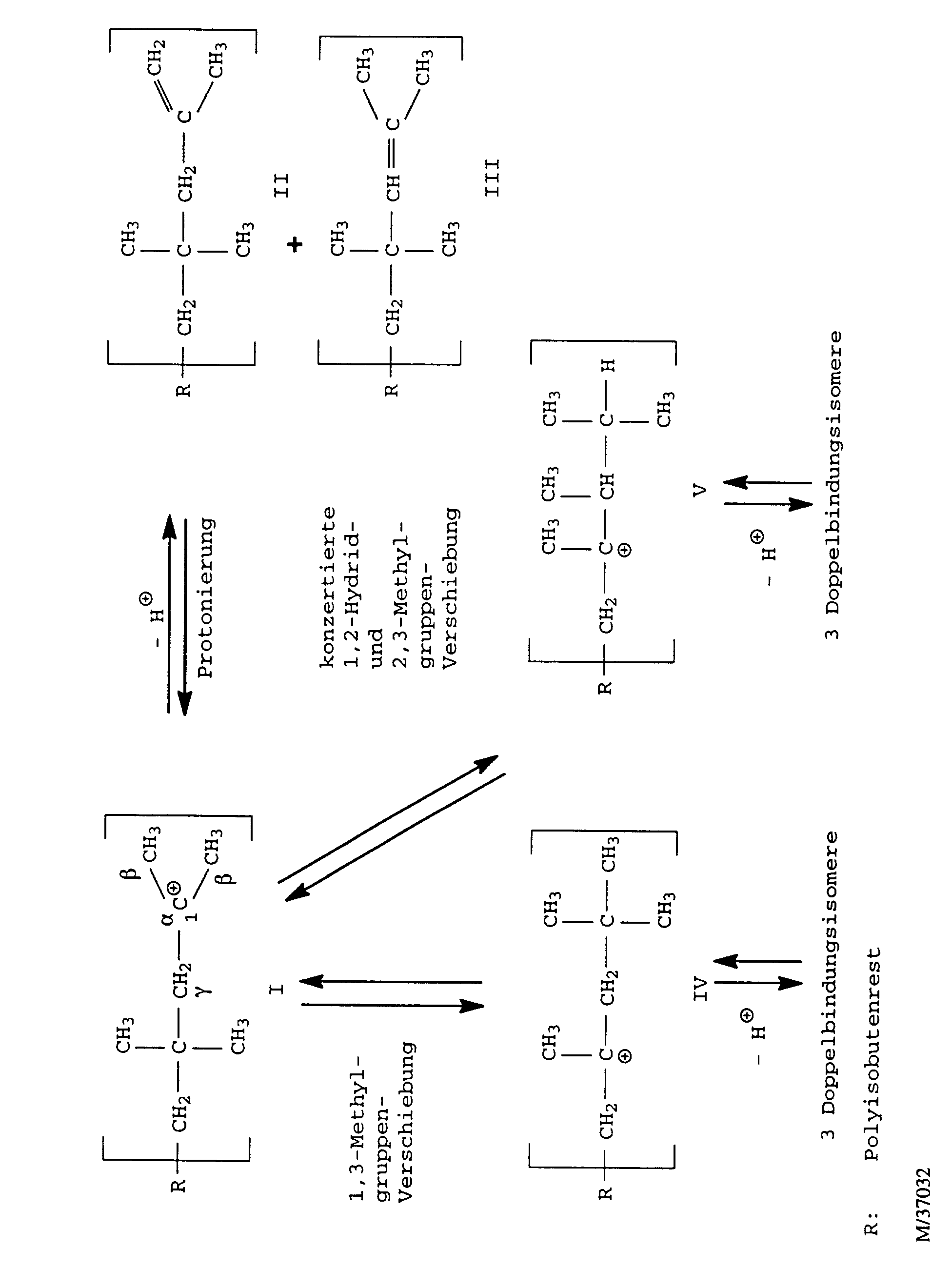
- the polyisobutene cation formed in the course of the polymerization reaction I can by splitting a proton into that skip the polyisobutene in question.
- the proton can both from one of the ⁇ -methyl groups or from the internal ⁇ -methylene group be split off.
- the polyisobutene cation I is relatively unstable and tries stabilize by rearrangement into higher substituted cations. Both 1,3-methyl group shifts to the polyisobutene cation IV as well as successive or concerted 1,2-hydride and 2,3-methyl group shifts to the polyisobutene cation V occur. Cations IV and V can, depending on from which position the proton is split off, three each form different double bond isomers polyisobutenes. It exists but also the possibility that the cations IV and V rearrange, with the effect that the double bond still migrates further inside the polyisobutene macromolecule.
- C 4 The production of low molecular weight, highly reactive polyisobutene from isobutene or hydrocarbon streams containing isobutene, in particular from C 4 cuts largely freed of 1,3-butadiene originally contained therein, from steam crackers, FCC crackers (FCC: Fluid Catalyzed Cracking), so-called C 4 - Raffinates are known from a number of property rights, for example from EP-A 145 235, EP-A 481 297, DE-A 27 02 604, EP-A 628 575, EP-A 322 241 and WO 93/10063.
- a disadvantage of these processes is that fluorine-containing by-products are formed due to the use of a BF 3 complex catalyst.
- the fluorine contents of the polyisobutenes produced by these processes can be up to 200 ppm.
- hydrogen fluoride is split off, which is highly corrosive in the presence of water.
- This problem is particularly serious when using isobutene-containing C 4 cuts as the starting material, since - due to the content of n-butenes - relatively stable secondary fluorides of polyisobutene are formed, which then further derivatize the polyisobutene to form fuel. and lubricating oil additives or when later using these fuel additives in the engine with the formation of hydrogen fluoride and thereby cause corrosion damage.
- the corrosion problem also extends to the application.
- WO 85/01942 describes a process for the production of polyisobutene with molecular weights M n in the range from 100 to 15,000, preferably 500 to 5,000, and in particular in the range from 750 to 2,500 daltons.
- a value of 1,500 daltons was estimated as the upper limit for the molecular weights of the polymers described there.
- the process mentioned has also not proven to be suitable for the production of polyisobutene with molecular weights above 5,000.
- the object of the present invention to provide a process for the production of medium molecular polyisobutene with a high content of terminal double bonds. Furthermore, the process should also allow the production of polyisobutenes with the properties mentioned from hydrocarbon mixtures, for example C 4 raffinates, which still contain polymerizable impurities. In addition, the polyisobutene obtained should have a narrow molecular weight distribution.
- This object was surprisingly achieved by a process for the preparation of medium-molecular, highly reactive polyisobutene with an average molecular weight M n of more than 5000 and up to 80,000 daltons and a content of terminal vinyl groups of at least 50 mol% by cationic polymerization of isobutene or isobutene-containing hydrocarbon mixtures in the liquid phase in the presence of boron trifluoride complex catalysts, composed of boron trifluoride A and at least one oxygen-containing compound B as a complexing agent, selected from water, alcohols, dialkyl ethers, alkane carboxylic acids or phenols, at temperatures below 0 ° C and a pressure in Range from 0.5 to 20 bar, which is characterized in that the polymerization is carried out in one stage at a stationary isobutene concentration of 20 to 80% by weight and a boron trifluoride concentration of 50 to 500 ppm, based in each case on the reactor, carries out.
- the aim of a high content of terminal double bonds and a narrow molecular weight distribution is achieved according to the invention by using isobutene or hydrocarbon mixtures containing isobutene by a continuous process at stationary isobutene concentrations in the range from 20 to 80% by weight, preferably 30 to 70% by weight. %, based on the reactor content, polymerized.
- the catalyst concentration in the reactor is in the range from 50 to 500 ppm (parts by weight of BF 3 based on the reactor content).
- the stationary concentration of the further liquid hydrocarbons can be up to 60% by weight, preferably 10 to 40% by weight.
- the polyisobutene concentration is generally in the range from 10 to 30% by weight, based in each case on the reactor content.
- the starting materials (isobutene feedstock) for the process according to the invention are both pure isobutene and isobutene-containing hydrocarbon mixtures, for example butadiene-free C 4 raffinates from crackers or C 4 cuts of isobutane dehydrogenation with isobutene contents above 40% by weight. in question.
- the isobutene concentration in the reactor can be predetermined by the hydrocarbon mixture used or can be adjusted by adding solvents which are inert under the reaction conditions, such as saturated hydrocarbons, for example pentane, hexane, isooctane or halogenated hydrocarbons, such as dichloromethane or trichloromethane.
- Boron trifluoride complexes with complexing agents are used as catalysts in the process according to the invention which influence the polymerization activity of the boron trifluoride in such a way that, on the one hand, the polymerization results in a low molecular weight polyisobutene and, on the other hand, the isomerization activity of the boron trifluoride with regard to the isomerization of terminal residues to those located inside the polyisobutene molecule is not or only slightly reactive double bonds is reduced.
- Suitable complexing agents are, for example, water, C 1 to C 20 alcohols, phenol, which optionally carries one or more alkyl substituents, C 2 to C 10 diols, C 1 to C 20 carboxylic acids and unsymmetrical C 3 to C 20 Dialkyl ethers, especially those with at least one tertiary carbon adjacent to the ether oxygen.
- Complexing agents from the class of the C 1 to C 20 alcohols, in particular the C 1 -C 4 alcohols are preferred in the process according to the invention.
- Ethers as described in WO 93/10063, react after cleavage via the alcohol complex.
- the monohydric, secondary C 3 to C 20 alcohols as described in EP-A 628 575, have a particularly favorable influence as a complexing agent on the polymerization and isomerization activity of the boron trifluoride catalyst, isopropanol and 2- Butanol are particularly noteworthy.
- Boron trifluoride complex catalysts are preferably used in the process according to the invention in which the molar ratio boron trifluoride / complexing agent A: B is in the range from 1: 1 to 1: 3, in particular from 1: 1.05 to 1: 2.5 and particularly preferably from 1: 1.25 to 1: 2.
- the boron trifluoride complex catalysts can be preformed before use, as described, for example, in EP-A 145 235, or can be generated in situ in the polymerization reactor, as described in EP-A 628 575.
- Gaseous boron trifluoride is expediently used as the raw material for producing the boron trifluoride complex catalysts, technical boron trifluoride still containing small amounts of sulfur dioxide (purity: 96.5% by weight), but preferably high-purity boron trifluoride (purity: 99.5% by weight). %) can be used.
- Silicon tetrafluoride-free boron trifluoride is particularly preferably used for catalyst production.
- the isobutene is polymerized after a continuous process.
- Reactors such as tubular reactors, tube bundle reactors or Mixing kettles are worked.
- the polymerization is preferably carried out in a loop reactor, i.e. a tube or tube bundle reactor with constant circulation of the reaction material, in which Usually the ratio of inlet to circulation Z / U in the range of 1: 5 up to 1: 500, preferably in the range from 1:10 to 1: 200 v / v, can be varied.
- the polymerization is advantageously carried out at temperatures below 0 ° C.
- temperatures in the range of 0 to -40 ° C in particular in the range from -10 to -40 ° C and particularly preferred worked in the range of -20 to -40 ° C.
- the Polymerization at a pressure in the range of 0.5 to 20 bar carried out.
- the choice of printing range is based on the first Line according to the procedural conditions. So it recommends with stirred tanks, under evaporative cooling and thus under autogenous pressure, i.e. Negative pressure to work, whereas circulation reactors (Loop reactors) work better at overpressure. At the same time there accelerates the boron trifluoride mixing, so that this Reactor type is preferred.
- the result of the polymerization reaction however, the choice of print is usually irrelevant.
- Polymerization is preferred under isothermal conditions carried out. Since the polymerization reaction is exothermic, In this case, the heat of polymerization must be removed. This is usually done with the help of a cooling device that operated, for example, with liquid ammonia as a coolant can be. Another possibility is the heat of polymerization by evaporative cooling on the product side of the reactor dissipate. This is done by evaporation of the isobutene and / or other, volatile components of the isobutene feedstock. The type of cooling depends on the particular one used Reactor type. Tube reactors are preferably by means of external cooling cooled, the reaction tubes using, for example a cooling jacket can be cooled with boiling ammonia. Stirred tank reactors are preferred by internal cooling, e.g. by means of Cooling coils, or thermostatted by product cooling.
- the residence time of the isobutene to be polymerized in the reactor lies depending on the reaction conditions and desired properties of the polymer to be prepared in the range from 1 to 120 minutes, preferably in the range of 8 to 60 minutes.
- the reaction conditions and the residence time so combine that the isobutene content in the reactor discharge in the range from 30 to 70% by weight, based on the total reactor discharge, lies.
- the unreacted isobutene is worked up by separated from the reaction products and the catalysts and can after removal of those resulting from the workup Traces of moisture, for example by drying over molecular sieves, be returned to the reaction.
- the reaction discharge is expediently in passed a medium that deactivates the polymerization catalyst and in this way the polymerization stops.
- a medium that deactivates the polymerization catalyst For working up, the reaction discharge is expediently in passed a medium that deactivates the polymerization catalyst and in this way the polymerization stops.
- a medium that deactivates the polymerization catalyst For example, water, alcohols, acetonitrile, ammonia or aqueous solutions of mineral bases, such as alkali metal and Alkaline earth metal hydroxide solutions, solutions of carbonates of these Metals and the like be used.
- Water with a Temperature of 20 to 40 ° C for example in the form of a pressure wash used.
- this will be Polymerization mixture optionally one or more extractions to remove residual amounts of catalyst - usually Methanol or water washes - subjected.
- isobutene is used as the starting material, this, like isobutene oligomers and solvents, can be recycled into the polymerization.
- isobutene C 4 cuts the unreacted isobutene and other C 4 hydrocarbons are not recirculated in general, but fed to other uses such as the production of low molecular weight polyisobutene or of methyl t-butyl ether.
- Highly volatile by-products containing fluorine, such as sec-butyl fluoride can be removed from the polyisobutene together with the other hydrocarbons and separated from these hydrocarbons by distillation or extraction.
- the method according to the invention makes it possible to produce medium-molecular, highly reactive polyisobutenes both from pure isobutene and from isobutene-containing hydrocarbon mixtures.
- the process according to the invention enables molecular weights in the range from 5,000 to 80,000 daltons, preferably 8,000 to 25,000 daltons, with a content of terminal double bonds of 50 mol%, preferably above 70 mol%, in particular above 80 mol%, and high isobutene yield .
- the polyisobutenes obtained are characterized by a narrow molecular weight distribution. They preferably have a dispersity M w / M n in the range from 2 to 4, in particular from 2 to 3.
- the melt viscosity of the polyisobutenes obtainable according to the invention is above 30 Pa ⁇ s (at 100 ° C.).
- the kinematic solution viscosity ⁇ (determined as Ubbeloh viscosity in 2,2,4-trimethylpentane at 20 ° C, see DIN 51562) is in the range from 0.88 mm 2 / s (1% by weight solution) to 1 mm 2 / s (0.2% by weight solution).
- polymers according to the invention Due to the high content of terminal double bonds are the polymers according to the invention in particular for polymer-analogs Implementations usable.
- the polyisobutenes according to the invention are suitable themselves as additives for lubricants, which are also the subject of present application are, as sealants and sealants for double glazing and as a basis for chewing gum. These can e.g. also as a carrier for active pharmaceutical ingredients, such as Appetite suppressants, nicotine etc. can be used.
- the average molecular weights (M n ) of the polymers prepared according to the examples were determined by means of gel permeation chromatography (GPC), using standardized polyisobutenes for calibration.
- the content of organically bound fluorine in the polymerization solution as well as in polyisobutene was made according to conventional elemental analytical methods determined: For this, the organic Material by combustion digestion according to Wickbold or Nicely opened up, the fluoride released in water absorbed and the fluoride content of the aqueous obtained Potentiometric fluoride solution with the help of commercial, for Fluoride ion selective electrodes determined using a calibration curve. From the fluoride content of the solution measured in this way and the the amount of sample used for combustion can be the Simply calculate organically bound fluoride in the sample (Lit .: F. Ehrenberger: Quantitative Elemental Analysis; VCH Publishing company, Weinheim, p. 436 ff, p. 424 ff, p. 617 ff).
- Example 1 a 50% isobutene from the isobutane dehydrogenation was polymerized at -30 ° C.
- a boron trifluoride feed of 2.2 mmol / h and an isopropanol feed of 2.9 mmol / h resulted in a stationary isobutene concentration of 40% by weight with a Z / U ratio of 1: 100 and a residence time of 9.8 sec. set.
- the workup was carried out as described in Example 1, but the unconverted isobutene was not recycled.
- the colorless distillation residue contained an isobutene with a molecular weight M n of 14,000 and a dispersity D of 2.4 at a fluorine content below 3 ppm. 135 / hz
Landscapes
- Chemical & Material Sciences (AREA)
- Health & Medical Sciences (AREA)
- Chemical Kinetics & Catalysis (AREA)
- Medicinal Chemistry (AREA)
- Polymers & Plastics (AREA)
- Organic Chemistry (AREA)
- Addition Polymer Or Copolymer, Post-Treatments, Or Chemical Modifications (AREA)
Description
135/hz
Claims (8)
- Verfahren zur Herstellung von mittelmolekularem, hochreaktivem Polyisobuten mit einem mittleren Molekulargewicht Mn von mehr als 5.000 und bis 80.000 Dalton und einem Gehalt an endständigen Doppelbindungen von wenigstens 50 mol-% durch kationische Polymerisation von Isobuten oder isobutenhaltigen Kohlenwasserstoffgemischen in flüssiger Phase in Gegenwart von Bortrifluorid-Komplex-Katalysatoren, aufgebaut aus Bortrifluorid A und wenigstens einer sauerstoffhaltigen Verbindung B als Komplexbildner, ausgewählt unter Wasser, Alkoholen, Dialkylethern, Alkancarbonsäuren oder Phenolen, bei Temperaturen unterhalb von 0°C und einem Druck im Bereich von 0,5 bis 20 bar, dadurch gekennzeichnet, daß man die Polymerisation einstufig bei einer stationären Isobutenkonzentration von 20 bis 80 Gew.-% und einer Bortrifluoridkonzentration von 50 bis 500 ppm, jeweils bezogen auf den Reaktorinhalt, durchführt.
- Verfahren gemäß Anspruch 1, dadurch gekennzeichnet, daß die Isobutenkonzentration im Reaktoraustrag im Bereich von 30 bis 70 Gew.-% liegt.
- Verfahren nach einem der vorhergehenden Ansprüche, dadurch gekennzeichnet, daß die Polymerisation nach einem Umlauf-Verfahren mit einem Zulauf-/Umlaufverhältnis Z/U im Bereich von 1:5 bis 1:500 (v/v) durchgeführt wird.
- Verfahren nach einem der vorhergehenden Ansprüche, dadurch gekennzeichnet, daß der Komplex aus Bortrifluorid A und Komplexbildner B in situ generiert wird, wobei das Molverhältnis A:B im Bereich von 1:1 bis 1:3 liegt.
- Verfahren nach einem der vorhergehenden Ansprüche, dadurch gekennzeichnet, daß man als Bortrifluorid-Komplex-Katalysator einen Komplex aus Bortrifluorid und Isopropanol oder 2-Butanol einsetzt.
- Polyisobutene mit einer Dispersität Mw/Mn im Bereich von 2 bis 4, erhältlich durch ein Verfahren nach einem der Ansprüche 1 bis 5.
- Verwendung der Polyisobutene aus Anspruch 6 als Schmierstoffadditive.
- Schmierstoffe, enthaltend wenigstens ein Polyisobuten aus Anspruch 6.
135/ew
Applications Claiming Priority (2)
| Application Number | Priority Date | Filing Date | Title |
|---|---|---|---|
| DE19619267 | 1996-05-13 | ||
| DE19619267A DE19619267A1 (de) | 1996-05-13 | 1996-05-13 | Verfahren zur Herstellung von mittelmolekularem, hochreaktivem Polyisobuten |
Publications (3)
| Publication Number | Publication Date |
|---|---|
| EP0807641A2 EP0807641A2 (de) | 1997-11-19 |
| EP0807641A3 EP0807641A3 (de) | 1998-04-22 |
| EP0807641B1 true EP0807641B1 (de) | 2001-08-16 |
Family
ID=7794196
Family Applications (1)
| Application Number | Title | Priority Date | Filing Date |
|---|---|---|---|
| EP97107812A Expired - Lifetime EP0807641B1 (de) | 1996-05-13 | 1997-05-13 | Verfahren zur Herstellung von mittelmolekularem, hochreaktivem Polyisobuten |
Country Status (5)
| Country | Link |
|---|---|
| US (1) | US5910550A (de) |
| EP (1) | EP0807641B1 (de) |
| AT (1) | ATE204305T1 (de) |
| DE (2) | DE19619267A1 (de) |
| ES (1) | ES2162153T3 (de) |
Families Citing this family (40)
| Publication number | Priority date | Publication date | Assignee | Title |
|---|---|---|---|---|
| DE19645430A1 (de) * | 1996-11-04 | 1998-05-07 | Basf Ag | Polyolefine und deren funktionalisierte Derivate |
| US6407170B1 (en) | 1999-06-24 | 2002-06-18 | The Lubrizol Corporation | Dispersants prepared from high polydispersity olefin polymers |
| US6884858B2 (en) * | 1999-10-19 | 2005-04-26 | Texas Petrochemicals Lp | Process for preparing polyolefin products |
| US6562913B1 (en) | 1999-09-16 | 2003-05-13 | Texas Petrochemicals Lp | Process for producing high vinylidene polyisobutylene |
| WO2001019873A1 (en) | 1999-09-16 | 2001-03-22 | Texas Petrochemicals Lp | Process for preparing polyolefin products |
| DE19948947A1 (de) * | 1999-10-11 | 2001-04-12 | Basf Ag | Verfahren zur kontinuierlichen Herstellung von Polyisobutenen |
| US6858188B2 (en) * | 2003-05-09 | 2005-02-22 | Texas Petrochemicals, Lp | Apparatus for preparing polyolefin products and methodology for using the same |
| US6992152B2 (en) * | 1999-10-19 | 2006-01-31 | Texas Petrochemicals Lp | Apparatus and method for controlling olefin polymerization process |
| US7037999B2 (en) | 2001-03-28 | 2006-05-02 | Texas Petrochemicals Lp | Mid-range vinylidene content polyisobutylene polymer product and process for producing the same |
| DE19952030A1 (de) | 1999-10-28 | 2001-05-03 | Basf Ag | Verfahren zur Herstellung von hochreaktiven Polyisobutenen |
| DE19952031A1 (de) | 1999-10-28 | 2001-05-03 | Basf Ag | Verfahren zur Herstellung hochreaktiver Polyisobutene |
| KR100486044B1 (ko) * | 2000-11-13 | 2005-04-29 | 대림산업 주식회사 | 폴리부텐의 제조방법 |
| DE10061727A1 (de) * | 2000-12-12 | 2002-06-13 | Basf Ag | Verfahren zur Herstellung von Polyisobutenen |
| DE10061715A1 (de) * | 2000-12-12 | 2002-06-13 | Basf Ag | Verfahren zur Herstellung von Homo- und Copolymeren des Isobutens |
| DE10125583A1 (de) | 2001-05-25 | 2002-11-28 | Basf Ag | Verfahren zur Herstellung von Homo- und Copolymeren des Isobutens |
| CA2447029A1 (en) * | 2001-06-08 | 2002-12-19 | Texas Petrochemicals Lp | Improved cling film with enhanced polyisobutylene tackifier |
| DE10142285A1 (de) * | 2001-08-29 | 2003-03-20 | Basf Ag | Polymerzusammensetzung, enthaltend wenigstens ein mittelmolekulares reaktives Polyisobuten |
| DE10162567A1 (de) | 2001-12-19 | 2003-07-03 | Basf Ag | Polyisobutene und Polyisobutenderivate für Schmierstoffzusammensetzungen |
| DE10215108A1 (de) * | 2002-04-05 | 2003-10-16 | Basf Ag | Polyisobutenamine |
| DE10243576A1 (de) * | 2002-09-19 | 2004-04-01 | Basf Ag | Verfahren zur Herstellung von Polyisobuten |
| DE10250468A1 (de) * | 2002-10-30 | 2004-05-19 | Basf Ag | Verfahren zur Herstellung von Oligomeren abgeleitet von Butenen |
| US20070173635A1 (en) * | 2004-01-29 | 2007-07-26 | Tomoyuki Yoshimi | Method for producing isobutylene resin powder |
| JP2009511690A (ja) * | 2005-10-11 | 2009-03-19 | ビーエーエスエフ ソシエタス・ヨーロピア | ポリイソブテンの製造法 |
| US20090202770A1 (en) * | 2008-02-08 | 2009-08-13 | Fengkui Li | Polypropylene/polyisobutylene blends and films prepared from same |
| US20100298507A1 (en) * | 2009-05-19 | 2010-11-25 | Menschig Klaus R | Polyisobutylene Production Process With Improved Efficiencies And/Or For Forming Products Having Improved Characteristics And Polyisobutylene Products Produced Thereby |
| US8710147B2 (en) | 2009-12-18 | 2014-04-29 | Chevron Oronite Company Llc. | Carbonyl-ene functionalized polyolefins |
| US8673275B2 (en) | 2010-03-02 | 2014-03-18 | Basf Se | Block copolymers and their use |
| EP2542206B1 (de) | 2010-03-02 | 2015-05-13 | Basf Se | Blockcopolymere und deren verwendung |
| US20110218295A1 (en) * | 2010-03-02 | 2011-09-08 | Basf Se | Anionic associative rheology modifiers |
| CN102775534B (zh) * | 2011-05-13 | 2014-05-07 | 北京化工大学 | 一种制备高反应活性聚异丁烯的引发体系及应用 |
| EP2802610B1 (de) * | 2012-01-09 | 2018-11-07 | Basf Se | Verfahren zur kontinuierlichen herstellung von polyisobutylen |
| US11072570B2 (en) | 2012-01-09 | 2021-07-27 | Basf Se | Process for continuously preparing polyisobutylene |
| BR112015030132B1 (pt) | 2013-06-05 | 2022-02-22 | Daelim Industrial Co., Ltd | Aparelho e método para preparar polibuteno com vários pesos moleculares |
| US10640590B2 (en) | 2017-02-21 | 2020-05-05 | Ntp Tec, Llc | Processes for making polyisobutylene compositions |
| EP3813968A4 (de) | 2018-06-29 | 2022-08-17 | NTP Tec, LLC | Verfahren zur herstellung von isobutylen, polyisobutylen und derivaten davon |
| WO2023152033A1 (en) | 2022-02-11 | 2023-08-17 | Basf Se | Medium molecular polyisobutene with a certain distribution of double bond isomers |
| KR20240144399A (ko) | 2022-02-11 | 2024-10-02 | 바스프 에스이 | 이중 결합 이성질체의 특정 분포를 갖는 중간 분자 폴리이소부텐 |
| WO2024242906A1 (en) | 2023-05-19 | 2024-11-28 | Ntp Tec, Llc | Processes for converting c4 feeds to isobutylene, polyisobutylene, or derivatives thereof |
| CN122055391A (zh) | 2023-10-18 | 2026-05-15 | 巴斯夫欧洲公司 | 用于提高聚异丁烯的稳定性的方法 |
| WO2026131321A1 (en) | 2024-12-18 | 2026-06-25 | Basf Se | Process for manufacturing polyisobutene with a higher efficiency |
Family Cites Families (11)
| Publication number | Priority date | Publication date | Assignee | Title |
|---|---|---|---|---|
| US2727022A (en) * | 1952-04-16 | 1955-12-13 | Standard Oil Co | Process for polymerizing iso-olefin polymers with isopentane diluent |
| JPH0651752B2 (ja) * | 1987-02-20 | 1994-07-06 | 鐘淵化学工業株式会社 | 官能性末端を有するイソブチレン系ポリマ−の製造法 |
| US4914166A (en) * | 1988-01-20 | 1990-04-03 | The University Of Akron | Non-fouling liquid nitrogen cooled polymerization process |
| US4943616A (en) * | 1988-07-26 | 1990-07-24 | Polysar Limited | Living cationic polymerization process |
| CA1336281C (en) * | 1988-07-26 | 1995-07-11 | Munmaya Kumar Mishra | Polymerization process and catalyst system therefor |
| DE4033195A1 (de) * | 1990-10-19 | 1992-04-23 | Basf Ag | Verfahren zur herstellung von polyisobuten |
| US5254649A (en) * | 1990-11-28 | 1993-10-19 | Bp Chemicals Limited | Cationic polymerization of 1-olefins |
| BE1006694A5 (fr) * | 1991-06-22 | 1994-11-22 | Basf Ag | Procede de preparation de polyisobutenes extremement reactifs. |
| US5288677A (en) * | 1991-06-28 | 1994-02-22 | Exxon Chemical Patents Inc. | Immobilized Lewis acid catalysts |
| GB9404368D0 (en) * | 1994-03-07 | 1994-04-20 | Bp Chem Int Ltd | Production of polyisobutenes |
| US5448001A (en) * | 1994-10-07 | 1995-09-05 | Queen's University At Kingston | Polymerization of iso-butylene |
-
1996
- 1996-05-13 DE DE19619267A patent/DE19619267A1/de not_active Withdrawn
-
1997
- 1997-05-06 US US08/851,351 patent/US5910550A/en not_active Expired - Lifetime
- 1997-05-13 AT AT97107812T patent/ATE204305T1/de not_active IP Right Cessation
- 1997-05-13 DE DE59704270T patent/DE59704270D1/de not_active Expired - Lifetime
- 1997-05-13 EP EP97107812A patent/EP0807641B1/de not_active Expired - Lifetime
- 1997-05-13 ES ES97107812T patent/ES2162153T3/es not_active Expired - Lifetime
Also Published As
| Publication number | Publication date |
|---|---|
| EP0807641A2 (de) | 1997-11-19 |
| DE19619267A1 (de) | 1997-11-20 |
| EP0807641A3 (de) | 1998-04-22 |
| DE59704270D1 (de) | 2001-09-20 |
| ATE204305T1 (de) | 2001-09-15 |
| ES2162153T3 (es) | 2001-12-16 |
| US5910550A (en) | 1999-06-08 |
Similar Documents
| Publication | Publication Date | Title |
|---|---|---|
| EP0807641A2 (de) | Verfahren zur Herstellung von mittelmolekularem, hochreaktivem Polyisobuten | |
| EP0628575B2 (de) | Verfahren zur Herstellung hochreaktiver Polyisobutene | |
| WO1996040808A1 (de) | Verfahren zur herstellung von niedermolekularem, hochreaktivem polyisobuten | |
| DE19825334A1 (de) | Verfahren zur Herstellung hochreaktiver Polyisobutene | |
| EP1301546B1 (de) | Verfahren zur herstellung von polyisobutenen | |
| EP1311565B1 (de) | Verfahren zur herstellung von polyisobutenen | |
| EP1337564B1 (de) | Verfahren zur desaktivierung und rückgewinnung von bortrifluorid bei der herstellung von polyisobutenen | |
| EP1240216B1 (de) | Verfahren zur kontinuierlichen herstellung von polyisobuten | |
| EP1458770B1 (de) | Polyisobutene und polyisobutenderivate für schmierstoffzusammensetzungen | |
| EP1040143A1 (de) | Verfahren zur herstellung von niedermolekularem, hochreaktivem polyisobutylen | |
| EP2536768B1 (de) | Verfahren zur herstellung von hochreaktiven isobutenhomo- oder -copolymeren | |
| EP1224229B1 (de) | Verfahren zur herstellung von hochreaktiven polyisobutenen | |
| EP1590381B1 (de) | Verfahren zur herstellung von polyisobuten | |
| DE2904314A1 (de) | Verfahren zur herstellung von polyisobutenen | |
| EP1224230B1 (de) | Verfahren zur herstellung hochreaktiver polyisobutene | |
| EP2814852B1 (de) | Bortrifluorid-katalysatorkomplex und verfahren zur herstellung von hochreaktiven isobutenho-mopolymeren | |
| EP1546213B1 (de) | Verfahren zur herstellung von polyisobuten | |
| EP1701985A1 (de) | Herstellung hochreaktiver polyisobutene mit niedrigem halogengehalt | |
| WO2001096421A1 (de) | Verfahren zur herstellung von polyisobutenen | |
| EP1362063A1 (de) | Verfahren zur herstellung hochreaktiver polyisobutene | |
| DE10361638A1 (de) | Herstellung hochreaktiver Polyisobutene mit niedrigem Fluorgehalt unter Verwendung eines Moderators | |
| DE102004033988A1 (de) | Herstellung hochreaktiver Polyisobutene mit niedrigem Fluorgehalt unter Verwendung eines Moderators |
Legal Events
| Date | Code | Title | Description |
|---|---|---|---|
| PUAI | Public reference made under article 153(3) epc to a published international application that has entered the european phase |
Free format text: ORIGINAL CODE: 0009012 |
|
| AK | Designated contracting states |
Kind code of ref document: A2 Designated state(s): AT BE DE ES FR GB IT NL SE |
|
| PUAL | Search report despatched |
Free format text: ORIGINAL CODE: 0009013 |
|
| AK | Designated contracting states |
Kind code of ref document: A3 Designated state(s): AT BE DE ES FR GB IT NL SE |
|
| 17P | Request for examination filed |
Effective date: 19980903 |
|
| 17Q | First examination report despatched |
Effective date: 19990722 |
|
| GRAG | Despatch of communication of intention to grant |
Free format text: ORIGINAL CODE: EPIDOS AGRA |
|
| GRAG | Despatch of communication of intention to grant |
Free format text: ORIGINAL CODE: EPIDOS AGRA |
|
| GRAH | Despatch of communication of intention to grant a patent |
Free format text: ORIGINAL CODE: EPIDOS IGRA |
|
| GRAH | Despatch of communication of intention to grant a patent |
Free format text: ORIGINAL CODE: EPIDOS IGRA |
|
| GRAA | (expected) grant |
Free format text: ORIGINAL CODE: 0009210 |
|
| AK | Designated contracting states |
Kind code of ref document: B1 Designated state(s): AT BE DE ES FR GB IT NL SE |
|
| REF | Corresponds to: |
Ref document number: 204305 Country of ref document: AT Date of ref document: 20010915 Kind code of ref document: T |
|
| REF | Corresponds to: |
Ref document number: 59704270 Country of ref document: DE Date of ref document: 20010920 |
|
| GBT | Gb: translation of ep patent filed (gb section 77(6)(a)/1977) |
Effective date: 20011003 |
|
| REG | Reference to a national code |
Ref country code: ES Ref legal event code: FG2A Ref document number: 2162153 Country of ref document: ES Kind code of ref document: T3 |
|
| REG | Reference to a national code |
Ref country code: GB Ref legal event code: IF02 |
|
| ET | Fr: translation filed | ||
| PLBE | No opposition filed within time limit |
Free format text: ORIGINAL CODE: 0009261 |
|
| STAA | Information on the status of an ep patent application or granted ep patent |
Free format text: STATUS: NO OPPOSITION FILED WITHIN TIME LIMIT |
|
| 26N | No opposition filed | ||
| PGFP | Annual fee paid to national office [announced via postgrant information from national office to epo] |
Ref country code: ES Payment date: 20080619 Year of fee payment: 12 |
|
| PGFP | Annual fee paid to national office [announced via postgrant information from national office to epo] |
Ref country code: AT Payment date: 20080514 Year of fee payment: 12 |
|
| PGFP | Annual fee paid to national office [announced via postgrant information from national office to epo] |
Ref country code: SE Payment date: 20080509 Year of fee payment: 12 Ref country code: NL Payment date: 20080501 Year of fee payment: 12 |
|
| PG25 | Lapsed in a contracting state [announced via postgrant information from national office to epo] |
Ref country code: AT Free format text: LAPSE BECAUSE OF NON-PAYMENT OF DUE FEES Effective date: 20090513 |
|
| NLV4 | Nl: lapsed or anulled due to non-payment of the annual fee |
Effective date: 20091201 |
|
| PG25 | Lapsed in a contracting state [announced via postgrant information from national office to epo] |
Ref country code: NL Free format text: LAPSE BECAUSE OF NON-PAYMENT OF DUE FEES Effective date: 20091201 |
|
| PGFP | Annual fee paid to national office [announced via postgrant information from national office to epo] |
Ref country code: GB Payment date: 20100330 Year of fee payment: 14 |
|
| REG | Reference to a national code |
Ref country code: ES Ref legal event code: FD2A Effective date: 20090514 |
|
| PG25 | Lapsed in a contracting state [announced via postgrant information from national office to epo] |
Ref country code: ES Free format text: LAPSE BECAUSE OF NON-PAYMENT OF DUE FEES Effective date: 20090514 |
|
| PG25 | Lapsed in a contracting state [announced via postgrant information from national office to epo] |
Ref country code: SE Free format text: LAPSE BECAUSE OF NON-PAYMENT OF DUE FEES Effective date: 20090514 |
|
| GBPC | Gb: european patent ceased through non-payment of renewal fee |
Effective date: 20110513 |
|
| PG25 | Lapsed in a contracting state [announced via postgrant information from national office to epo] |
Ref country code: GB Free format text: LAPSE BECAUSE OF NON-PAYMENT OF DUE FEES Effective date: 20110513 |
|
| REG | Reference to a national code |
Ref country code: FR Ref legal event code: PLFP Year of fee payment: 19 |
|
| PGFP | Annual fee paid to national office [announced via postgrant information from national office to epo] |
Ref country code: BE Payment date: 20150529 Year of fee payment: 19 Ref country code: IT Payment date: 20150526 Year of fee payment: 19 Ref country code: FR Payment date: 20150529 Year of fee payment: 19 |
|
| PGFP | Annual fee paid to national office [announced via postgrant information from national office to epo] |
Ref country code: DE Payment date: 20150730 Year of fee payment: 19 |
|
| PG25 | Lapsed in a contracting state [announced via postgrant information from national office to epo] |
Ref country code: BE Free format text: LAPSE BECAUSE OF NON-PAYMENT OF DUE FEES Effective date: 20160531 |
|
| REG | Reference to a national code |
Ref country code: DE Ref legal event code: R119 Ref document number: 59704270 Country of ref document: DE |
|
| PG25 | Lapsed in a contracting state [announced via postgrant information from national office to epo] |
Ref country code: IT Free format text: LAPSE BECAUSE OF NON-PAYMENT OF DUE FEES Effective date: 20160513 |
|
| REG | Reference to a national code |
Ref country code: FR Ref legal event code: ST Effective date: 20170131 |
|
| PG25 | Lapsed in a contracting state [announced via postgrant information from national office to epo] |
Ref country code: DE Free format text: LAPSE BECAUSE OF NON-PAYMENT OF DUE FEES Effective date: 20161201 Ref country code: FR Free format text: LAPSE BECAUSE OF NON-PAYMENT OF DUE FEES Effective date: 20160531 |