EP0807216B1 - Vorrichtung zur vibrationsverminderung durch aktive regelung, bestehend aus in zwei oder drei achsrichtungen elektromagnetisch erregten, schwingenden massen - Google Patents
Vorrichtung zur vibrationsverminderung durch aktive regelung, bestehend aus in zwei oder drei achsrichtungen elektromagnetisch erregten, schwingenden massen Download PDFInfo
- Publication number
- EP0807216B1 EP0807216B1 EP96903040A EP96903040A EP0807216B1 EP 0807216 B1 EP0807216 B1 EP 0807216B1 EP 96903040 A EP96903040 A EP 96903040A EP 96903040 A EP96903040 A EP 96903040A EP 0807216 B1 EP0807216 B1 EP 0807216B1
- Authority
- EP
- European Patent Office
- Prior art keywords
- electromagnets
- masses
- vibration
- cylindrical
- reducing apparatus
- Prior art date
- Legal status (The legal status is an assumption and is not a legal conclusion. Google has not performed a legal analysis and makes no representation as to the accuracy of the status listed.)
- Expired - Lifetime
Links
- 238000013016 damping Methods 0.000 title description 4
- 230000008878 coupling Effects 0.000 claims description 6
- 238000010168 coupling process Methods 0.000 claims description 6
- 238000005859 coupling reaction Methods 0.000 claims description 6
- 229910045601 alloy Inorganic materials 0.000 claims description 4
- 239000000956 alloy Substances 0.000 claims description 4
- 230000035939 shock Effects 0.000 claims description 4
- 230000003068 static effect Effects 0.000 claims description 4
- 238000005452 bending Methods 0.000 claims description 2
- 239000011810 insulating material Substances 0.000 claims description 2
- 238000002485 combustion reaction Methods 0.000 claims 1
- 230000009467 reduction Effects 0.000 description 7
- 238000006073 displacement reaction Methods 0.000 description 6
- 230000005520 electrodynamics Effects 0.000 description 4
- 229910001004 magnetic alloy Inorganic materials 0.000 description 4
- 239000000463 material Substances 0.000 description 4
- 230000005284 excitation Effects 0.000 description 3
- 239000000725 suspension Substances 0.000 description 3
- 239000006096 absorbing agent Substances 0.000 description 2
- 230000009471 action Effects 0.000 description 2
- 230000008901 benefit Effects 0.000 description 2
- 238000005219 brazing Methods 0.000 description 2
- 239000002131 composite material Substances 0.000 description 2
- 230000000694 effects Effects 0.000 description 2
- 238000003754 machining Methods 0.000 description 2
- 239000000696 magnetic material Substances 0.000 description 2
- 238000011144 upstream manufacturing Methods 0.000 description 2
- 239000000853 adhesive Substances 0.000 description 1
- 230000001070 adhesive effect Effects 0.000 description 1
- 230000032683 aging Effects 0.000 description 1
- 230000033228 biological regulation Effects 0.000 description 1
- 150000001875 compounds Chemical class 0.000 description 1
- 238000010276 construction Methods 0.000 description 1
- 238000001816 cooling Methods 0.000 description 1
- 230000006378 damage Effects 0.000 description 1
- 230000007423 decrease Effects 0.000 description 1
- 229920001971 elastomer Polymers 0.000 description 1
- 239000000806 elastomer Substances 0.000 description 1
- 238000010292 electrical insulation Methods 0.000 description 1
- 230000005611 electricity Effects 0.000 description 1
- 238000005516 engineering process Methods 0.000 description 1
- 239000000835 fiber Substances 0.000 description 1
- 239000012530 fluid Substances 0.000 description 1
- 238000010438 heat treatment Methods 0.000 description 1
- 239000012212 insulator Substances 0.000 description 1
- 239000007788 liquid Substances 0.000 description 1
- 238000005259 measurement Methods 0.000 description 1
- 238000000034 method Methods 0.000 description 1
- 239000010445 mica Substances 0.000 description 1
- 229910052618 mica group Inorganic materials 0.000 description 1
- 229920002635 polyurethane Polymers 0.000 description 1
- 239000004814 polyurethane Substances 0.000 description 1
- 238000003825 pressing Methods 0.000 description 1
- 239000003507 refrigerant Substances 0.000 description 1
- 239000011347 resin Substances 0.000 description 1
- 229920005989 resin Polymers 0.000 description 1
- 239000011359 shock absorbing material Substances 0.000 description 1
- 238000005476 soldering Methods 0.000 description 1
- 239000002470 thermal conductor Substances 0.000 description 1
- 229920001187 thermosetting polymer Polymers 0.000 description 1
Images




Classifications
-
- F—MECHANICAL ENGINEERING; LIGHTING; HEATING; WEAPONS; BLASTING
- F16—ENGINEERING ELEMENTS AND UNITS; GENERAL MEASURES FOR PRODUCING AND MAINTAINING EFFECTIVE FUNCTIONING OF MACHINES OR INSTALLATIONS; THERMAL INSULATION IN GENERAL
- F16F—SPRINGS; SHOCK-ABSORBERS; MEANS FOR DAMPING VIBRATION
- F16F7/00—Vibration-dampers; Shock-absorbers
- F16F7/10—Vibration-dampers; Shock-absorbers using inertia effect
- F16F7/1005—Vibration-dampers; Shock-absorbers using inertia effect characterised by active control of the mass
- F16F7/1011—Vibration-dampers; Shock-absorbers using inertia effect characterised by active control of the mass by electromagnetic means
-
- F—MECHANICAL ENGINEERING; LIGHTING; HEATING; WEAPONS; BLASTING
- F16—ENGINEERING ELEMENTS AND UNITS; GENERAL MEASURES FOR PRODUCING AND MAINTAINING EFFECTIVE FUNCTIONING OF MACHINES OR INSTALLATIONS; THERMAL INSULATION IN GENERAL
- F16F—SPRINGS; SHOCK-ABSORBERS; MEANS FOR DAMPING VIBRATION
- F16F15/00—Suppression of vibrations in systems; Means or arrangements for avoiding or reducing out-of-balance forces, e.g. due to motion
- F16F15/02—Suppression of vibrations of non-rotating, e.g. reciprocating systems; Suppression of vibrations of rotating systems by use of members not moving with the rotating systems
- F16F15/03—Suppression of vibrations of non-rotating, e.g. reciprocating systems; Suppression of vibrations of rotating systems by use of members not moving with the rotating systems using magnetic or electromagnetic means
-
- F—MECHANICAL ENGINEERING; LIGHTING; HEATING; WEAPONS; BLASTING
- F16—ENGINEERING ELEMENTS AND UNITS; GENERAL MEASURES FOR PRODUCING AND MAINTAINING EFFECTIVE FUNCTIONING OF MACHINES OR INSTALLATIONS; THERMAL INSULATION IN GENERAL
- F16F—SPRINGS; SHOCK-ABSORBERS; MEANS FOR DAMPING VIBRATION
- F16F2222/00—Special physical effects, e.g. nature of damping effects
- F16F2222/02—Special physical effects, e.g. nature of damping effects temperature-related
-
- F—MECHANICAL ENGINEERING; LIGHTING; HEATING; WEAPONS; BLASTING
- F16—ENGINEERING ELEMENTS AND UNITS; GENERAL MEASURES FOR PRODUCING AND MAINTAINING EFFECTIVE FUNCTIONING OF MACHINES OR INSTALLATIONS; THERMAL INSULATION IN GENERAL
- F16F—SPRINGS; SHOCK-ABSORBERS; MEANS FOR DAMPING VIBRATION
- F16F2222/00—Special physical effects, e.g. nature of damping effects
- F16F2222/06—Magnetic or electromagnetic
-
- F—MECHANICAL ENGINEERING; LIGHTING; HEATING; WEAPONS; BLASTING
- F16—ENGINEERING ELEMENTS AND UNITS; GENERAL MEASURES FOR PRODUCING AND MAINTAINING EFFECTIVE FUNCTIONING OF MACHINES OR INSTALLATIONS; THERMAL INSULATION IN GENERAL
- F16F—SPRINGS; SHOCK-ABSORBERS; MEANS FOR DAMPING VIBRATION
- F16F2222/00—Special physical effects, e.g. nature of damping effects
- F16F2222/08—Inertia
Definitions
- the present invention relates to vibration reduction devices made up of mobile masses suspended elastically and displaced by electromagnetic motors in opposite directions to the directions of vibration at reduce, the control of the electromagnetic motor being subject to vibration at reduce so that the latter decreases by a value imposed in advance.
- the invention finds its application wherever the reduction of vibrations is a strategic or economic necessity: navy, land vehicles or sailors, civil aircraft and generally wherever the presence of vibrations is annoying.
- FIGS. 1A and 1B A usual arrangement is shown diagrammatically in FIGS. 1A and 1B, the Figure 1B showing an enlarged sectional view of part of Figure 1A.
- the movable mass (1) is suspended by the springs (2).
- the electrodynamic motor consists of a coil (3) traversed by a homologous alternating current of the displacement of the frame and a magnet (4) providing a magnetic field in the air gap (5).
- the moving mass (1) is then stressed in the same way as the diaphragm of a speaker.
- the regulator (6) and the amplifier (7) supply the coil control (3), calculated according to the vibration amplitudes measured by the accelerometer (8), placed on the machine structure (9).
- the device according to the invention provides an economical solution to faults of the previous devices: it is reliable and enduring, compact and light and capable of use at high temperature: it uses adopted technologies universally by industry for their robustness.
- the invention provides a vibration reduction device consisting of at least one active mass animated by a planar or triaxial movement and several motors consisting of electromagnets, this mass being supported by means elastic.
- a vibration reduction device consisting of at least one active mass animated by a planar or triaxial movement and several motors consisting of electromagnets, this mass being supported by means elastic.
- Such a device is known from document EP-A-0509911.
- the invention is characterized in that two active masses driven by a planar or triaxial movement are provided supported by said elastic means consisting of two flexible cylindrical plates or a rod flexible cylindrical and two elastic joints.
- the invention has the advantage of reducing the weight and the volume in a ratio from 3 to 4, compared to the weight and volume of traditional devices, because only one device according to the invention replaces 2 or 3 traditional devices.
- the invention also covers the application of the device for reducing vibrations to the propagation of vibrations of parts or machines, such as pipes, in particular steam supply pipes to power turbines, heat engine exhaust pipes, elastic supports, shafts layer.
- parts or machines such as pipes, in particular steam supply pipes to power turbines, heat engine exhaust pipes, elastic supports, shafts layer.
- the first provision relates to high temperature applications.
- the device according to the invention combines' coupled and animated masses of a planar movement and 2 or 4 electromagnets placed at the most distant end from the heat source.
- the second provision relates to lower temperature applications.
- the device according to the invention then associates 1 mass animated by a movement triaxial and several electromagnets with attraction forces oriented along 3 axes perpendicular, causing the movement of said mass.
- the attraction of the electromagnets taking place according to a nonlinear law varying approximately as a second degree power of the electric control current, the excitation current of the electromagnets is therefore corrected accordingly.
- the first description corresponds to a variant of the applicable device reducing the propagation of vibrations of parts or machines subject to at high temperatures such as the steam supply lines to the power turbines, or the exhaust pipes of heat engines, by example. It of course applies to other cases.
- the second description corresponds to a temperature application medium or low, and concerns all the areas through which the vibrations propagate: pipes, elastic supports, layer trees, etc.
- FIG. 4A represents a perspective view
- FIG. 4B a view in section of a planar device made up of 2 active masses (11) and (12), linked to a central support (13) by 2 elastic arms (14) and (15), joined to the central support by a thin cylindrical plate (16), of which they form an integral part.
- This plate cylindrical (16) is linked to its periphery by known means, such as brazing, to central support (13).
- This cylindrical plate (16) by its own elasticity, causes a coupling of the 2 arms (14) and (15) which can only have one mode of symmetrical vibrational displacement relative to the plane of symmetry of the support central (13) as shown in Figures 5 and 6.
- this device cannot therefore act alone as a shock absorber dynamic plan (or bi-axial).
- the length of the elastic arms (14) and (15) makes the device very bulky. Finally, its operation is limited to a frequency domain reduced, close to the frequency of the fo resonance.
- FIG 7A is a longitudinal section and 7B which is a view of the electromagnets and their fixing provides a solution to these 3 disadvantages.
- the elastic arms (14) and (15) Figure 4 are replaced by ( Figure 7) 2 thin cylindrical plates, therefore flexible (26) and (27) forming a one-piece assembly with the cylindrical core (23), the cylindrical coupling plate (24) and the cylindrical core (28) machined with precision in an alloy with high mechanical characteristics.
- the 2 cylindrical plates (26) and (27) have a symmetrical arrangement by relative to the plane of the cylindrical plate (24) and are fixed by brazing or all other known means each with 2 tubes (29) and (30) each having a end a flange (31) and (32) and at the other end a male threaded part (33) and (34).
- the 2 masses (19) and (22) of cylindrical shape also include a female thread allowing them to be screwed on the tubes (29) and (30), so as to adjust the natural frequencies of the whole.
- this arrangement condenses the dimensions while now the coupling between the 2 dynamic systems made up of the masses (19) and (22) and stiffnesses due to the plates (26) and (27), provided by the plate cylindrical (24), fixed at its periphery intimately by soldering or any other means to the support (25).
- the device according to the invention comprises at least 2 electromagnets (17) and (18) which - in the case in point - use the same cylinder head consisting of a stack of sheets of soft magnetic material (37), and 2 coils (35) and (36). These 2 electromagnets (17) and (18) attract the mass (19) according to 2 perpendicular directions via 2 circular segments made up a stack of sheets of soft magnetic material (20) and (21) integral with the mass (19).
- the 2 electromagnets are fixed to a cylindrical core (23), part integral with the cylindrical coupling plate (24) and therefore with the support (25), chosen for its position furthest from the heat source.
- control of the current of the 2 coils (35) and (36) provides a force control of the vibratory movement of the mass (19), the movement of which causes a symmetrical movement with respect to the plane of the cylindrical plate (24) of the mass (22).
- the constant k1 is a proportionality factor.
- the electromagnets (17) and (18) being placed at the end of the assembly, are integral with a cylindrical part (38) of a highly heat conductive alloy forming an air convection cooler, fixed by known means (39).
- the support (25) is fixed to the frame or structure (41) which must be reduced vibrations via a sole made of heat insulating material (40), excellent mechanical qualities, for example a mica-based composite.
- This structure thus allows, for a high frame temperature, by example, from 300 ° C not to exceed 100 ° C at the level of the coils (35) and (36), this which allows a large control force, the heating of the coils from to the Joule effect, which can then be 100 ° C without altering the electrical insulation of conducting wires.
- this large control force makes it possible to cause a vibratory movement of the masses (19) and (22) sufficient for the device to be effective in a very broad frequency domain, ranging from a few Hertz to several hundred Hertz. So this significant driving force allows the unit to operate below and beyond its frequency of resonance, which has the incomparable advantage of using a frequency of high resonance, and therefore avoid excessive static arrows of the devices with low resonant frequencies, such as the devices previously used.
- the radial clearance between the 2 cylindrical cores (23) and (28) and the 2 tubes (29) and (30) is sufficiently weak so that in the event of an impact, the 2 tubes (29) and (30) come to rest on the 2 cylindrical cores (23) and (28) in order to limit the deformations in the plates (26) and (27) to the elastic range of the material.
- the second preferred description corresponds to a device for 3-axis vibration reduction for temperature applications medium or low, robust and compact economical construction. Well heard, the device can also be limited to a planar movement.
- FIGS. 9A and 9B represent a cylindrical mass (42) hollowed out at center and fixed at its 2 ends to a base (45) by 2 elastic connections (46) and (47), by example 2 cylinders of adhesive elastomers on the one hand to the rod (43) and on the other hand to this base (45).
- f1 and f2 can be made almost identical, and the device could be used as a tri-axial dynamic damper, very condensed, and very space-saving.
- the resonance frequency is not adjustable, the use of the device is very limited.
- the device according to the invention eliminates this drawback:
- the device By adding an electrodynamic motor composed of electromagnets powerful acting on 3 axes, stationary and fixed on the base, therefore well cooled, the device covers a large frequency range, not limited to natural frequencies f1 and f2 above.
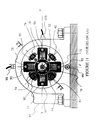
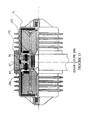
- FIG. 10 is a longitudinal section
- FIG. 11 a view along AA
- Figure 12 a section along the plane Y
- Figure 13 a half-section along a plane passing through the axis XX and the axis of one of the electromagnets of active axis XX '.
- It comprises a cylindrical rod (48) made of high-strength alloy mechanical, variable section with 2 cylindrical-conical parts (55) and (56) on which are fixed 2 cylindrical masses (49) and (50) each having a tapered bore.
- Four tie rods (51 to 54) ensure precise centering and immobilization of these 2 masses (49) and (50) and of the pressed cylindrical rod (48) against the 2 cylindro-conical parts (55) and (56) of the cylindrical rod (48).
- the cylindrical rod (48) has 2 long thin cylindrical parts and flexible, each terminated by a reduced diameter shouldered cylinder on which an elastic joint (57) on the left and (58) on the right of the design figure 10.
- These elastic joints of which a commercial variety is known under the name of "silentbloc" ensure the immobilization of the rod (4g), slightly compressed axially and without play by these 2 elastic joints (57) and (58) themselves blocked by the stepped bores (59) and (60) of the cowlings (61) and (62), themselves fixed to the support (67), which ensures the general alignment and the respect of the lengths and is rigidly fixed to the frame which must be reduced vibrations (110).
- the cylindrical rod (48) can therefore oscillate axially and flex radially while remaining centered by the 2 joints (57) and (58).
- the flexibility of the rod supporting the masses suspended (49) and (50) causes a static deflection such that the masses (49) and (50) can come into contact with the radial shock absorbers (65) and (66).
- the axes of machining of the shouldered bores (59) and (60) are therefore offset axes of machining of the centering surfaces (68) and (69) when the operation takes place in a horizontal position.
- the removable wedges (101) and (102) which provide a means of correcting arrows static when used vertically.
- the space left free between the 2 cowlings (61) and (62) and the moving parts may include a volume of damping fluid dosed to adjust the quality factor to the desired value.
- It essentially comprises 3 groups of electromagnets forming a monobloc assembly ensuring the displacements along the axes XX ', YY' and ZZ ' totally impregnated with a compound based on thermosetting resin of electrotechnical quality and rigidly fixed to the support (67), thus ensuring optimal heat flow to the outside and to the covers (61) and (62) serving as coolers by the fins (70).
- This set is inserted in space free separating the 2 masses (49) and (50).
- connection wires of the electromagnets are not shown.
- the radial magnetic attraction takes place through the air gap on the stack of soft magnetic alloy sheets (71) blocked on the central part of the cylindrical rod (48) by the ring (72) and a set of tie rods (103), (104), (105) and (106) pressing the stack on the shoulder of the rod cylindrical (48) provided for this purpose.
- the axial attraction is carried out on the 2 tori (73) and (74) made of soft magnetic alloy sheet wound using a known technique, coated in toroidal cells machined in the masses (49) and (50) with axis coincident with the axis of revolution of the said masses.
- the electromagnets (75) and (76) provide the vibratory movements along the axis ZZ '
- the electromagnets (77) and (7g) ensure the vibrational displacements along the axis YY '
- the 8 electromagnets (79 to 86) ensure the vibratory displacements along the axis XX '.
- the electromagnets (83 to 86) occupy symmetrical arrangements with the electromagnets (79 to 82) compared to the ZY plane. They are properly impregnated and glued to the support (67) in order to ensure high mechanical rigidity and a very high thermal conduction between the coils of the electromagnets and the support (67).
- the cylinder head of the electromagnets (75), (76) * (77) and (78) consisting of stacking of soft magnetic alloy sheets is rigidly fixed to the base (67) by via 2 O-rings (88) and (89) and 4 fasteners of a known type (90 to 93), and a shape piece (94) with a contour matching the external shape of the electromagnets (75 to 78) and also electromagnets (79 to 86) and having a toroidal recess (95) intended for the passage of the wires (96) of coil connections so-called electromagnets.
- a housing (97) connects the wires of the coils to the cables of link coming from the 3 regulation channels XX ', YY' and ZZ '.
- Three accelerometers servo (98), (99) and (100) are visible in Figure 11. They are intended to the servo not described in this invention.
- each electromagnet in a group only works during the half the time of a cycle, like electronic amplifiers class C power.
- a single device according to the invention is sufficient (FIGS. 14A and 148), on the other hand, reducing the propagation of vibrations along pipes, beams etc. requires 2 devices according to the invention which blocks the 6 degrees of freedom of the vibration (figure 15).
Landscapes
- Engineering & Computer Science (AREA)
- General Engineering & Computer Science (AREA)
- Physics & Mathematics (AREA)
- Electromagnetism (AREA)
- Mechanical Engineering (AREA)
- Acoustics & Sound (AREA)
- Aviation & Aerospace Engineering (AREA)
- Vibration Prevention Devices (AREA)
Claims (8)
- Vorrichtung zur Schwingungsverringerung, die aus zwei aktiven Massen, die in eine ebene (19, 22) oder dreiachsige Bewegung (49, 50) versetzt werden, und aus mehreren, von Elektromagneten (17) und (18) und (75 bis 86) gebildeten Antriebselementen besteht, wobei die Massen von elastischen Mitteln getragen werden, die aus zwei biegsamen, zylindrischen Platten (26) und (27) oder einem biegsamen zylindrischen Stab und zwei elastischen Gelenken (48)(57) und (58) bestehen.
- Vorrichtung zur Schwingungsverringerung nach Anspruch 1, die in einer Ebene des Raums wirkt und bei hohen Temperaturen arbeiten kann, dadurch gekennzeichnet, daß sie zwei Massen (19) und (22) (Figur 7) enthält, die auf zwei Rohre (29) und (30) geschraubt sind, welche um zwei Punkte M und M' schwenken, die die Mitte von zwei biegsamen Platten (26) und (27) bilden, an denen Kragen (31) und (32) befestigt sind, die das Ende der beiden Rohre (29) und (30) bilden, wobei die beiden zylindrischen Platten (26) und (27) von zwei zylindrischen Kernen (23) und (28) mit einer dritten zylindrischen Koppelplatte (24) verbunden werden, die fest mit einem Träger (25) verbunden ist, welcher an der Struktur (41), deren Schwingungen verringert werden sollen, mittels einer Sohlplatte (40) aus wärmeisolierendem Material befestigt ist, die an einem Ende des am weitesten von der Wärmequelle entfernten Kerns, zum Beispiel des Kerns (23), zwei Elektromagneten (17) und (18) aufweist, deren Achsen senkrecht zueinander liegen und die die vor ihnen liegende Masse (19) dazu zwingen, eine ebene Schwingungsbewegung auszuführen, die sich über die Koppelplatte (24) symmetrisch auf die Masse (22) überträgt.
- Vorrichtung nach Anspruch 2, dadurch gekennzeichnet, daß die Steuerung der Elektromagneten durchgeführt wird, indem man einen Strom zuführt, der der folgenden Gleichung gehorcht:
- Vorrichtung zur Schwingungsverringerung nach Anspruch 1, die gemäß den drei Dimensionen des Raums wirkt und bei mittleren oder niedrigen Temperaturen arbeitet, dadurch gekennzeichnet, daß sie einen zylindrischen Stab (48) (Figuren 10, 11, 12 und 13) aus einer Legierung mit guten mechanischen Eigenschaften aufweist, der zwei zylindro-konische Bereiche (55) und (56) besitzt, an denen zwei zylindrische Massen (49) und (50) mit konischer Bohrung befestigt sind, wobei der biegsame Stab (48) in zwei elastischen Gelenken (57) und (58) endet, die mit zwei Verkleidungen (61) und (62) verbunden sind, welche mit einem Träger (67) verbunden sind, wobei die Ausschläge der Massen (49) und (50) durch multidirektionale Stoßdämpferanschläge (63), (64), (65) und (66) begrenzt werden, und der Träger (67) eine Einheit von Elektromagneten (75) bis (86) aufweist, die eine einstückige Einheit bilden, welche sich zwischen die beiden Massen (49) und (50) schiebt.
- Vorrichtung zur Schwingungsverringerung nach Anspruch 4, dadurch gekennzeichnet, daß sie ein Mittel zur Kompensierung der statischen Durchbiegungen aufweist.
- Vorrichtung zur Schwingungsverringerung nach Anspruch 4, dadurch gekennzeichnet, daß sie eine Gruppe von zwei Elektromagneten (75) und (76), die die beiden Massen gemäß einer zum zylindrischen Stab (48) senkrechten Achse in Schwingung versetzen, eine Gruppe von zwei Elektromagneten (77) und (78), die die beiden Massen gemäß einer zum zylindrischen Stab (4X) und zur Aktionsachse der ersten Gruppe senkrechten Achse in Schwingung versetzen, und eine Gruppe von acht Elektromagneten (79 bis 86) aufweist, die die beiden Massen gemäß einer zur Achse des zylindrischen Stabs (48) parallelen Achse in Schwingung versetzen.
- Vorrichtung zur Schwingungsverringerung nach den Ansprüchen 4, 5 oder 6, dadurch gekennzeichnet, daß die Steuerung des Stroms jedes Elektromagneten gleich dem Betrieb der elektronischen Verstärker der Klasse C gemäß dem nachfolgenden Gesetz ist:
Wenn F die von einem Elektromagneten zu liefernde Anziehungskraft ist, wird der Steuerstrom durch I = k - Anwendung der Vorrichtung zur Schwingungsverringerung nach einem der Ansprüche 1 bis 7 auf die Reduzierung der Ausbreitung von Schwingungen von Bauteilen oder Maschinen wie z.B. Leitungen, insbesondere Dampfzufuhrleitungen zu Antriebsturbinen, Auspuffleitungen von Verbrennungsmotoren, elastische Träger, Mittelstücke einer Welle.
Applications Claiming Priority (3)
| Application Number | Priority Date | Filing Date | Title |
|---|---|---|---|
| FR9501260A FR2730288B1 (fr) | 1995-02-03 | 1995-02-03 | Dispositifs de reduction de vibrations a commande active constitues de masses mobiles excitees par des electro aimants selon 2 ou 3 axes |
| FR9501260 | 1995-02-03 | ||
| PCT/FR1996/000176 WO1996023986A1 (fr) | 1995-02-03 | 1996-02-02 | Dispositifs de reduction de vibrations a commande active constitues de masses mobiles excitees par des electro-aimants selon 2 ou 3 axes |
Publications (2)
| Publication Number | Publication Date |
|---|---|
| EP0807216A1 EP0807216A1 (de) | 1997-11-19 |
| EP0807216B1 true EP0807216B1 (de) | 1999-07-07 |
Family
ID=9475809
Family Applications (1)
| Application Number | Title | Priority Date | Filing Date |
|---|---|---|---|
| EP96903040A Expired - Lifetime EP0807216B1 (de) | 1995-02-03 | 1996-02-02 | Vorrichtung zur vibrationsverminderung durch aktive regelung, bestehend aus in zwei oder drei achsrichtungen elektromagnetisch erregten, schwingenden massen |
Country Status (6)
| Country | Link |
|---|---|
| US (1) | US5883447A (de) |
| EP (1) | EP0807216B1 (de) |
| JP (1) | JPH10513246A (de) |
| DE (1) | DE69603156T2 (de) |
| FR (1) | FR2730288B1 (de) |
| WO (1) | WO1996023986A1 (de) |
Families Citing this family (14)
| Publication number | Priority date | Publication date | Assignee | Title |
|---|---|---|---|---|
| FR2765647B1 (fr) * | 1997-07-07 | 2002-01-11 | Jacques Clausin | Reducteur de vibrations monoaxe accorde a bande large et de grande legerete |
| DE19832697C2 (de) * | 1998-07-21 | 2000-11-16 | Eurocopter Deutschland | Vorrichtung und Verfahren zur Reduktion von Schwingungen längs einer Schwingungsausbreitung, insbesondere in einem Hubschrauber |
| DE19842729C1 (de) * | 1998-09-18 | 2000-02-17 | Freudenberg Carl Fa | Lagerung für ein schwingendes Bauteil |
| FR2784350B1 (fr) * | 1998-10-12 | 2000-12-08 | Eurocopter France | Dispositif pour reduire des vibrations engendrees sur la structure d'un aeronef a voilure tournante |
| GB2361757B (en) | 2000-04-28 | 2003-12-03 | Bae Sys Electronics Ltd | Improvements in or relating to the damping of vibration |
| GB2401922A (en) * | 2003-05-17 | 2004-11-24 | Arvin Internat | An engine exhaust damping device |
| CN100535473C (zh) * | 2004-06-10 | 2009-09-02 | 洛德公司 | 控制直升机振动的方法和系统 |
| KR20090086566A (ko) * | 2006-12-06 | 2009-08-13 | 신포니아 테크놀로지 가부시끼가이샤 | 제진 장치, 제진 장치의 제어 방법, 제진 장치의 오프셋 보정 방법 및 판 스프링 |
| US9024777B2 (en) | 2010-12-09 | 2015-05-05 | Schlumberger Technology Corporation | Active compensation for mud telemetry modulator and turbine |
| FR2979065A1 (fr) * | 2011-08-18 | 2013-02-22 | Peugeot Citroen Automobiles Sa | Batteur actif a guidage ameliore |
| EP2824360A1 (de) * | 2013-07-12 | 2015-01-14 | BAE Systems PLC | Verbesserungen an und in Zusammenhang mit Vibrationssteuerung |
| CA2917786C (en) * | 2013-07-12 | 2019-06-04 | Bae Systems Plc | Improvements in and relating to vibration control |
| EP2998611B1 (de) * | 2014-09-18 | 2019-07-24 | Integrated Dynamics Engineering GmbH | Schwingungsisolator mit pneumatischer Feder |
| US10037660B2 (en) * | 2016-12-30 | 2018-07-31 | Immersion Corporation | Flexible haptic actuator |
Family Cites Families (14)
| Publication number | Priority date | Publication date | Assignee | Title |
|---|---|---|---|---|
| US2785386A (en) * | 1955-02-28 | 1957-03-12 | Elmer L Mason | Electric plug construction |
| US3690414A (en) * | 1970-11-04 | 1972-09-12 | Cincinnati Milacron Inc | Vibration absorber for a supported member |
| DE2122602A1 (de) * | 1971-05-07 | 1972-11-16 | Maschinenfabrik Augsburg-Nürnberg AG, 8000 München | Dämpfungsvorrichtung für einen inhomogenen Rotor einer Zentrifuge |
| US4169234A (en) * | 1975-02-14 | 1979-09-25 | Yonkers Edward H | Reciprocating motor |
| JPS5874931A (ja) * | 1981-10-30 | 1983-05-06 | Hitachi Ltd | 慣性反力式加振機 |
| US4455496A (en) * | 1982-02-25 | 1984-06-19 | Fmc Corporation | Electromagnetic vibratory exciter |
| US4710656A (en) * | 1986-12-03 | 1987-12-01 | Studer Philip A | Spring neutralized magnetic vibration isolator |
| GB8710998D0 (en) * | 1987-05-08 | 1987-06-10 | Btr Plc | Vehicle engine suspension systems |
| US4922159A (en) * | 1988-05-09 | 1990-05-01 | Harris Corporation | Linear precision actuator with accelerometer feedback |
| US4963804A (en) * | 1989-07-10 | 1990-10-16 | Westinghouse Electric Corp. | Apparatus and method for reducing vibration of rotating machinery |
| GB9015983D0 (en) * | 1990-07-20 | 1990-09-05 | Anvt Europ Limited | Electromagnetic actuator |
| FR2675559B1 (fr) * | 1991-04-16 | 1993-08-27 | Mecanique Magnetique Sa | Amortisseur de vibrations hybride a vibrateur magnetique actif. |
| FR2692329B1 (fr) * | 1992-06-15 | 1996-01-26 | Clausin Jacques | Dispositif d'amortissement dynamique a frequence et a amortissement variables destine a la reduction des vibrations de machines ou d'elements vibrants. |
| DE4301845C1 (de) * | 1993-01-23 | 1994-03-31 | Freudenberg Carl Fa | Aktiver Schwingungstilger |
-
1995
- 1995-02-03 FR FR9501260A patent/FR2730288B1/fr not_active Expired - Fee Related
-
1996
- 1996-02-02 EP EP96903040A patent/EP0807216B1/de not_active Expired - Lifetime
- 1996-02-02 DE DE69603156T patent/DE69603156T2/de not_active Expired - Fee Related
- 1996-02-02 US US08/875,493 patent/US5883447A/en not_active Expired - Fee Related
- 1996-02-02 WO PCT/FR1996/000176 patent/WO1996023986A1/fr not_active Ceased
- 1996-02-02 JP JP8523322A patent/JPH10513246A/ja active Pending
Also Published As
| Publication number | Publication date |
|---|---|
| EP0807216A1 (de) | 1997-11-19 |
| WO1996023986A1 (fr) | 1996-08-08 |
| FR2730288A1 (fr) | 1996-08-09 |
| DE69603156T2 (de) | 2000-01-27 |
| US5883447A (en) | 1999-03-16 |
| FR2730288B1 (fr) | 1997-04-18 |
| DE69603156D1 (de) | 1999-08-12 |
| JPH10513246A (ja) | 1998-12-15 |
Similar Documents
| Publication | Publication Date | Title |
|---|---|---|
| EP0807216B1 (de) | Vorrichtung zur vibrationsverminderung durch aktive regelung, bestehend aus in zwei oder drei achsrichtungen elektromagnetisch erregten, schwingenden massen | |
| WO1996023986A9 (fr) | Dispositifs de reduction de vibrations a commande active constitues de masses mobiles excitees par des electro-aimants selon 2 ou 3 axes | |
| US5880542A (en) | Light reaction mass actuator | |
| EP0431514B1 (de) | Motor mit Magneten der Flusskonzentrationsbauart | |
| US5697848A (en) | Compound shaft with flexible disk coupling | |
| EP2175282B1 (de) | Mikromechanischer Beschleunigungssensor | |
| JP2005532516A (ja) | 永久磁石を用いた、回転子軸受システム用のスラスト荷重緩和装置 | |
| US20020074881A1 (en) | Passive magnetic support and damping system | |
| EP0903466A2 (de) | Verbundwelle mit Doppelmembrane | |
| FR2797790A1 (fr) | Generateur de force oscillante et amortisseur a l'egard des vibrations utilisant un tel generateur | |
| CN115325086B (zh) | 一种刚度和阻尼可调的新型组合减振装置 | |
| US20050212385A1 (en) | Vibration element and vibration wave driving apparatus | |
| CA2687070A1 (fr) | Actionneur electromagnetique a reluctance variable | |
| EP0457666A1 (de) | Tieffrequenzschwinger mit grosser Amplitude | |
| FR2929753A1 (fr) | Actionneur magnetique controlable a fer mobile. | |
| US6307292B1 (en) | Galvanometer with axial symmetry and improved bearing design | |
| FR3083388A1 (fr) | Machine electrique tournante comportant un stator monte elastiquement entre deux paliers | |
| WO1999002890A1 (fr) | Reducteur de vibrations monoaxe accorde a bande large et de grande legerete | |
| FR2913782A1 (fr) | Procede d'equilibrage du mouvement des masses mobiles d'un moteur electrodynamique bilineaire | |
| WO2021224378A1 (fr) | Barre d'alesage munie d'actionneurs electrodynamiques pour contrer les vibrations et machine-outil munie d'une telle barre | |
| JP2576691B2 (ja) | 振動アイソレーション装置 | |
| CN117075328B (zh) | 激光扫描器中的多面体反射镜柔顺消热支撑组件 | |
| EP0871284A2 (de) | X-Y Kreuztisch zur Verstellung von Lasten mit hoher Genauigkeit und sehr hoher Dynamik | |
| JP3024283B2 (ja) | 軸受装置 | |
| EP0122184A1 (de) | Antischwingungsaufhängung durch Gummifedern mit Nachstellung des Fliessens |
Legal Events
| Date | Code | Title | Description |
|---|---|---|---|
| PUAI | Public reference made under article 153(3) epc to a published international application that has entered the european phase |
Free format text: ORIGINAL CODE: 0009012 |
|
| 17P | Request for examination filed |
Effective date: 19970801 |
|
| AK | Designated contracting states |
Kind code of ref document: A1 Designated state(s): DE ES FR GB IT NL SE |
|
| GRAG | Despatch of communication of intention to grant |
Free format text: ORIGINAL CODE: EPIDOS AGRA |
|
| 17Q | First examination report despatched |
Effective date: 19980602 |
|
| GRAG | Despatch of communication of intention to grant |
Free format text: ORIGINAL CODE: EPIDOS AGRA |
|
| GRAH | Despatch of communication of intention to grant a patent |
Free format text: ORIGINAL CODE: EPIDOS IGRA |
|
| GRAH | Despatch of communication of intention to grant a patent |
Free format text: ORIGINAL CODE: EPIDOS IGRA |
|
| GRAA | (expected) grant |
Free format text: ORIGINAL CODE: 0009210 |
|
| AK | Designated contracting states |
Kind code of ref document: B1 Designated state(s): DE ES FR GB IT NL SE |
|
| PG25 | Lapsed in a contracting state [announced via postgrant information from national office to epo] |
Ref country code: NL Free format text: LAPSE BECAUSE OF FAILURE TO SUBMIT A TRANSLATION OF THE DESCRIPTION OR TO PAY THE FEE WITHIN THE PRESCRIBED TIME-LIMIT Effective date: 19990707 Ref country code: ES Free format text: THE PATENT HAS BEEN ANNULLED BY A DECISION OF A NATIONAL AUTHORITY Effective date: 19990707 |
|
| REF | Corresponds to: |
Ref document number: 69603156 Country of ref document: DE Date of ref document: 19990812 |
|
| ITF | It: translation for a ep patent filed | ||
| NLV1 | Nl: lapsed or annulled due to failure to fulfill the requirements of art. 29p and 29m of the patents act | ||
| PG25 | Lapsed in a contracting state [announced via postgrant information from national office to epo] |
Ref country code: GB Free format text: LAPSE BECAUSE OF NON-PAYMENT OF DUE FEES Effective date: 20000202 |
|
| PG25 | Lapsed in a contracting state [announced via postgrant information from national office to epo] |
Ref country code: SE Free format text: LAPSE BECAUSE OF NON-PAYMENT OF DUE FEES Effective date: 20000203 |
|
| PLBE | No opposition filed within time limit |
Free format text: ORIGINAL CODE: 0009261 |
|
| STAA | Information on the status of an ep patent application or granted ep patent |
Free format text: STATUS: NO OPPOSITION FILED WITHIN TIME LIMIT |
|
| 26N | No opposition filed | ||
| GBPC | Gb: european patent ceased through non-payment of renewal fee |
Effective date: 20000202 |
|
| EUG | Se: european patent has lapsed |
Ref document number: 96903040.2 |
|
| PG25 | Lapsed in a contracting state [announced via postgrant information from national office to epo] |
Ref country code: DE Free format text: LAPSE BECAUSE OF NON-PAYMENT OF DUE FEES Effective date: 20001201 |
|
| PG25 | Lapsed in a contracting state [announced via postgrant information from national office to epo] |
Ref country code: FR Free format text: LAPSE BECAUSE OF NON-PAYMENT OF DUE FEES Effective date: 20001229 |
|
| REG | Reference to a national code |
Ref country code: FR Ref legal event code: ST |
|
| PG25 | Lapsed in a contracting state [announced via postgrant information from national office to epo] |
Ref country code: IT Free format text: LAPSE BECAUSE OF NON-PAYMENT OF DUE FEES;WARNING: LAPSES OF ITALIAN PATENTS WITH EFFECTIVE DATE BEFORE 2007 MAY HAVE OCCURRED AT ANY TIME BEFORE 2007. THE CORRECT EFFECTIVE DATE MAY BE DIFFERENT FROM THE ONE RECORDED. Effective date: 20050202 |
|
| PG25 | Lapsed in a contracting state [announced via postgrant information from national office to epo] |
Ref country code: FR Free format text: LAPSE BECAUSE OF NON-PAYMENT OF DUE FEES Effective date: 20000229 |