EP0807137B1 - Composition polymerisable, procede de production de polymeres reticules, et polymeres reticulables - Google Patents
Composition polymerisable, procede de production de polymeres reticules, et polymeres reticulables Download PDFInfo
- Publication number
- EP0807137B1 EP0807137B1 EP96900594A EP96900594A EP0807137B1 EP 0807137 B1 EP0807137 B1 EP 0807137B1 EP 96900594 A EP96900594 A EP 96900594A EP 96900594 A EP96900594 A EP 96900594A EP 0807137 B1 EP0807137 B1 EP 0807137B1
- Authority
- EP
- European Patent Office
- Prior art keywords
- alkyl
- substituted
- unsubstituted
- alkoxy
- composition according
- Prior art date
- Legal status (The legal status is an assumption and is not a legal conclusion. Google has not performed a legal analysis and makes no representation as to the accuracy of the status listed.)
- Expired - Lifetime
Links
- 239000000203 mixture Substances 0.000 title claims abstract description 133
- 229920000642 polymer Polymers 0.000 title claims abstract description 127
- 238000000034 method Methods 0.000 title claims description 39
- 230000008569 process Effects 0.000 title claims description 27
- 229920006037 cross link polymer Polymers 0.000 title claims description 7
- 239000003054 catalyst Substances 0.000 claims abstract description 80
- 150000001925 cycloalkenes Chemical class 0.000 claims abstract description 48
- 229910052707 ruthenium Inorganic materials 0.000 claims abstract description 42
- 238000006116 polymerization reaction Methods 0.000 claims abstract description 36
- KJTLSVCANCCWHF-UHFFFAOYSA-N Ruthenium Chemical group [Ru] KJTLSVCANCCWHF-UHFFFAOYSA-N 0.000 claims abstract description 34
- 238000005649 metathesis reaction Methods 0.000 claims abstract description 29
- 150000002908 osmium compounds Chemical class 0.000 claims abstract description 29
- 230000003197 catalytic effect Effects 0.000 claims abstract description 9
- -1 4-methylcumyl Chemical group 0.000 claims description 312
- 125000001997 phenyl group Chemical group [H]C1=C([H])C([H])=C(*)C([H])=C1[H] 0.000 claims description 174
- 229910052736 halogen Inorganic materials 0.000 claims description 172
- 125000004432 carbon atom Chemical group C* 0.000 claims description 165
- 239000000460 chlorine Substances 0.000 claims description 156
- 150000002367 halogens Chemical class 0.000 claims description 150
- 239000003446 ligand Substances 0.000 claims description 137
- 125000001797 benzyl group Chemical group [H]C1=C([H])C([H])=C(C([H])=C1[H])C([H])([H])* 0.000 claims description 128
- 125000000217 alkyl group Chemical group 0.000 claims description 106
- 229910052739 hydrogen Inorganic materials 0.000 claims description 94
- 125000000058 cyclopentadienyl group Chemical group C1(=CC=CC1)* 0.000 claims description 87
- ZSWFCLXCOIISFI-UHFFFAOYSA-N endo-cyclopentadiene Natural products C1C=CC=C1 ZSWFCLXCOIISFI-UHFFFAOYSA-N 0.000 claims description 86
- 229910052760 oxygen Inorganic materials 0.000 claims description 85
- 125000004178 (C1-C4) alkyl group Chemical group 0.000 claims description 84
- 230000009021 linear effect Effects 0.000 claims description 83
- 229910052731 fluorine Inorganic materials 0.000 claims description 80
- 125000004169 (C1-C6) alkyl group Chemical group 0.000 claims description 78
- 229910052801 chlorine Inorganic materials 0.000 claims description 74
- XYFCBTPGUUZFHI-UHFFFAOYSA-N phosphine group Chemical group P XYFCBTPGUUZFHI-UHFFFAOYSA-N 0.000 claims description 70
- 229910052717 sulfur Inorganic materials 0.000 claims description 61
- 125000000229 (C1-C4)alkoxy group Chemical group 0.000 claims description 60
- 125000003118 aryl group Chemical group 0.000 claims description 59
- 125000002496 methyl group Chemical group [H]C([H])([H])* 0.000 claims description 59
- 229910052757 nitrogen Inorganic materials 0.000 claims description 58
- 125000004093 cyano group Chemical group *C#N 0.000 claims description 55
- 125000005842 heteroatom Chemical group 0.000 claims description 52
- 229910052751 metal Inorganic materials 0.000 claims description 46
- 239000001257 hydrogen Substances 0.000 claims description 45
- 230000007935 neutral effect Effects 0.000 claims description 45
- 239000002184 metal Substances 0.000 claims description 44
- 125000002924 primary amino group Chemical group [H]N([H])* 0.000 claims description 44
- 229910052794 bromium Inorganic materials 0.000 claims description 42
- IAZDPXIOMUYVGZ-UHFFFAOYSA-N Dimethylsulphoxide Chemical compound CS(C)=O IAZDPXIOMUYVGZ-UHFFFAOYSA-N 0.000 claims description 38
- 150000001875 compounds Chemical class 0.000 claims description 38
- 125000006552 (C3-C8) cycloalkyl group Chemical group 0.000 claims description 37
- 125000001072 heteroaryl group Chemical group 0.000 claims description 36
- ZMXDDKWLCZADIW-UHFFFAOYSA-N N,N-Dimethylformamide Chemical compound CN(C)C=O ZMXDDKWLCZADIW-UHFFFAOYSA-N 0.000 claims description 35
- UFHFLCQGNIYNRP-UHFFFAOYSA-N Hydrogen Chemical compound [H][H] UFHFLCQGNIYNRP-UHFFFAOYSA-N 0.000 claims description 34
- 125000002993 cycloalkylene group Chemical group 0.000 claims description 33
- 125000001424 substituent group Chemical group 0.000 claims description 32
- 125000004191 (C1-C6) alkoxy group Chemical group 0.000 claims description 31
- 229910052799 carbon Inorganic materials 0.000 claims description 31
- 239000001301 oxygen Substances 0.000 claims description 31
- 229910000073 phosphorus hydride Inorganic materials 0.000 claims description 31
- 125000004400 (C1-C12) alkyl group Chemical group 0.000 claims description 30
- 150000001450 anions Chemical class 0.000 claims description 30
- JFDZBHWFFUWGJE-UHFFFAOYSA-N benzonitrile Chemical compound N#CC1=CC=CC=C1 JFDZBHWFFUWGJE-UHFFFAOYSA-N 0.000 claims description 30
- WEVYAHXRMPXWCK-UHFFFAOYSA-N Acetonitrile Chemical compound CC#N WEVYAHXRMPXWCK-UHFFFAOYSA-N 0.000 claims description 29
- 125000002723 alicyclic group Chemical group 0.000 claims description 27
- 125000002947 alkylene group Chemical group 0.000 claims description 27
- 125000003710 aryl alkyl group Chemical group 0.000 claims description 27
- 239000010955 niobium Substances 0.000 claims description 27
- 125000004642 (C1-C12) alkoxy group Chemical group 0.000 claims description 26
- 125000000286 phenylethyl group Chemical group [H]C1=C([H])C([H])=C(C([H])=C1[H])C([H])([H])C([H])([H])* 0.000 claims description 26
- 239000010936 titanium Substances 0.000 claims description 26
- 125000004429 atom Chemical group 0.000 claims description 24
- 125000003178 carboxy group Chemical group [H]OC(*)=O 0.000 claims description 23
- 150000002009 diols Chemical class 0.000 claims description 23
- IJGRMHOSHXDMSA-UHFFFAOYSA-N Atomic nitrogen Chemical compound N#N IJGRMHOSHXDMSA-UHFFFAOYSA-N 0.000 claims description 22
- NINIDFKCEFEMDL-UHFFFAOYSA-N Sulfur Chemical compound [S] NINIDFKCEFEMDL-UHFFFAOYSA-N 0.000 claims description 22
- 150000002825 nitriles Chemical class 0.000 claims description 22
- 239000002904 solvent Substances 0.000 claims description 22
- 150000004945 aromatic hydrocarbons Chemical class 0.000 claims description 20
- QVGXLLKOCUKJST-UHFFFAOYSA-N atomic oxygen Chemical compound [O] QVGXLLKOCUKJST-UHFFFAOYSA-N 0.000 claims description 20
- 125000005724 cycloalkenylene group Chemical group 0.000 claims description 20
- 239000000178 monomer Substances 0.000 claims description 20
- 125000000449 nitro group Chemical group [O-][N+](*)=O 0.000 claims description 20
- 125000000592 heterocycloalkyl group Chemical group 0.000 claims description 19
- ZOKXTWBITQBERF-UHFFFAOYSA-N Molybdenum Chemical compound [Mo] ZOKXTWBITQBERF-UHFFFAOYSA-N 0.000 claims description 18
- 125000004475 heteroaralkyl group Chemical group 0.000 claims description 18
- 150000002390 heteroarenes Chemical class 0.000 claims description 18
- 125000004435 hydrogen atom Chemical group [H]* 0.000 claims description 18
- OKKJLVBELUTLKV-UHFFFAOYSA-N Methanol Chemical compound OC OKKJLVBELUTLKV-UHFFFAOYSA-N 0.000 claims description 17
- 125000000753 cycloalkyl group Chemical group 0.000 claims description 17
- 229910052750 molybdenum Inorganic materials 0.000 claims description 17
- 125000003367 polycyclic group Chemical group 0.000 claims description 17
- UFWIBTONFRDIAS-UHFFFAOYSA-N Naphthalene Chemical compound C1=CC=CC2=CC=CC=C21 UFWIBTONFRDIAS-UHFFFAOYSA-N 0.000 claims description 16
- 238000010438 heat treatment Methods 0.000 claims description 16
- 229910052762 osmium Inorganic materials 0.000 claims description 15
- 125000003837 (C1-C20) alkyl group Chemical group 0.000 claims description 14
- 125000000171 (C1-C6) haloalkyl group Chemical group 0.000 claims description 14
- 125000001118 alkylidene group Chemical group 0.000 claims description 14
- 125000004122 cyclic group Chemical group 0.000 claims description 14
- 239000011733 molybdenum Substances 0.000 claims description 14
- 125000001931 aliphatic group Chemical group 0.000 claims description 13
- 241001120493 Arene Species 0.000 claims description 12
- LCKIEQZJEYYRIY-UHFFFAOYSA-N Titanium ion Chemical compound [Ti+4] LCKIEQZJEYYRIY-UHFFFAOYSA-N 0.000 claims description 12
- 229920001577 copolymer Polymers 0.000 claims description 12
- 125000000113 cyclohexyl group Chemical group [H]C1([H])C([H])([H])C([H])([H])C([H])(*)C([H])([H])C1([H])[H] 0.000 claims description 12
- 125000000843 phenylene group Chemical group C1(=C(C=CC=C1)*)* 0.000 claims description 12
- 125000000467 secondary amino group Chemical group [H]N([*:1])[*:2] 0.000 claims description 12
- 239000011593 sulfur Substances 0.000 claims description 12
- 238000005698 Diels-Alder reaction Methods 0.000 claims description 11
- ZUOUZKKEUPVFJK-UHFFFAOYSA-N diphenyl Chemical compound C1=CC=CC=C1C1=CC=CC=C1 ZUOUZKKEUPVFJK-UHFFFAOYSA-N 0.000 claims description 11
- 229910052758 niobium Inorganic materials 0.000 claims description 11
- GUCVJGMIXFAOAE-UHFFFAOYSA-N niobium atom Chemical compound [Nb] GUCVJGMIXFAOAE-UHFFFAOYSA-N 0.000 claims description 11
- 125000006588 heterocycloalkylene group Chemical group 0.000 claims description 10
- 150000003658 tungsten compounds Chemical class 0.000 claims description 10
- 125000002030 1,2-phenylene group Chemical group [H]C1=C([H])C([*:1])=C([*:2])C([H])=C1[H] 0.000 claims description 9
- OKTJSMMVPCPJKN-UHFFFAOYSA-N Carbon Chemical group [C] OKTJSMMVPCPJKN-UHFFFAOYSA-N 0.000 claims description 9
- 239000004952 Polyamide Substances 0.000 claims description 9
- 125000004450 alkenylene group Chemical group 0.000 claims description 9
- 125000002619 bicyclic group Chemical group 0.000 claims description 9
- WDECIBYCCFPHNR-UHFFFAOYSA-N chrysene Chemical compound C1=CC=CC2=CC=C3C4=CC=CC=C4C=CC3=C21 WDECIBYCCFPHNR-UHFFFAOYSA-N 0.000 claims description 9
- 125000001511 cyclopentyl group Chemical group [H]C1([H])C([H])([H])C([H])([H])C([H])(*)C1([H])[H] 0.000 claims description 9
- 125000002950 monocyclic group Chemical group 0.000 claims description 9
- 229920002647 polyamide Polymers 0.000 claims description 9
- OFOBLEOULBTSOW-UHFFFAOYSA-N Malonic acid Chemical compound OC(=O)CC(O)=O OFOBLEOULBTSOW-UHFFFAOYSA-N 0.000 claims description 8
- 229910052783 alkali metal Inorganic materials 0.000 claims description 8
- 150000001340 alkali metals Chemical class 0.000 claims description 8
- 229910052784 alkaline earth metal Inorganic materials 0.000 claims description 8
- 150000001342 alkaline earth metals Chemical class 0.000 claims description 8
- 239000012876 carrier material Substances 0.000 claims description 8
- 125000002933 cyclohexyloxy group Chemical group C1(CCCCC1)O* 0.000 claims description 8
- 150000004985 diamines Chemical class 0.000 claims description 8
- 239000000463 material Substances 0.000 claims description 8
- 229920000647 polyepoxide Polymers 0.000 claims description 8
- 229910052710 silicon Inorganic materials 0.000 claims description 8
- 125000003031 C5-C7 cycloalkylene group Chemical group 0.000 claims description 7
- 125000001887 cyclopentyloxy group Chemical group C1(CCCC1)O* 0.000 claims description 7
- 150000001993 dienes Chemical class 0.000 claims description 7
- 125000005442 diisocyanate group Chemical group 0.000 claims description 7
- SUSQOBVLVYHIEX-UHFFFAOYSA-N phenylacetonitrile Chemical compound N#CCC1=CC=CC=C1 SUSQOBVLVYHIEX-UHFFFAOYSA-N 0.000 claims description 7
- 229920000728 polyester Polymers 0.000 claims description 7
- 229920002635 polyurethane Polymers 0.000 claims description 7
- 239000004814 polyurethane Substances 0.000 claims description 7
- 238000002360 preparation method Methods 0.000 claims description 7
- 150000003304 ruthenium compounds Chemical class 0.000 claims description 7
- 229920002396 Polyurea Polymers 0.000 claims description 6
- 229910006069 SO3H Inorganic materials 0.000 claims description 6
- RTAQQCXQSZGOHL-UHFFFAOYSA-N Titanium Chemical compound [Ti] RTAQQCXQSZGOHL-UHFFFAOYSA-N 0.000 claims description 6
- 239000002253 acid Substances 0.000 claims description 6
- 235000010290 biphenyl Nutrition 0.000 claims description 6
- 239000004305 biphenyl Substances 0.000 claims description 6
- 125000000000 cycloalkoxy group Chemical group 0.000 claims description 6
- 125000002887 hydroxy group Chemical group [H]O* 0.000 claims description 6
- 125000005702 oxyalkylene group Chemical group 0.000 claims description 6
- 239000000758 substrate Substances 0.000 claims description 6
- WTKKCYNZRWIVKL-UHFFFAOYSA-N tantalum Chemical compound [Ta+5] WTKKCYNZRWIVKL-UHFFFAOYSA-N 0.000 claims description 6
- 229910052715 tantalum Inorganic materials 0.000 claims description 6
- 229910052719 titanium Inorganic materials 0.000 claims description 6
- 150000001298 alcohols Chemical class 0.000 claims description 5
- 125000000051 benzyloxy group Chemical group [H]C1=C([H])C([H])=C(C([H])=C1[H])C([H])([H])O* 0.000 claims description 5
- 150000001721 carbon Chemical group 0.000 claims description 5
- GYZLOYUZLJXAJU-UHFFFAOYSA-N diglycidyl ether Chemical compound C1OC1COCC1CO1 GYZLOYUZLJXAJU-UHFFFAOYSA-N 0.000 claims description 5
- 125000004474 heteroalkylene group Chemical group 0.000 claims description 5
- QUWPZPLTANKXAM-UHFFFAOYSA-N niobium(5+) Chemical compound [Nb+5] QUWPZPLTANKXAM-UHFFFAOYSA-N 0.000 claims description 5
- RGSFGYAAUTVSQA-UHFFFAOYSA-N pentamethylene Natural products C1CCCC1 RGSFGYAAUTVSQA-UHFFFAOYSA-N 0.000 claims description 5
- 125000004817 pentamethylene group Chemical group [H]C([H])([*:2])C([H])([H])C([H])([H])C([H])([H])C([H])([H])[*:1] 0.000 claims description 5
- 229920006149 polyester-amide block copolymer Polymers 0.000 claims description 5
- FVSKHRXBFJPNKK-UHFFFAOYSA-N propionitrile Chemical compound CCC#N FVSKHRXBFJPNKK-UHFFFAOYSA-N 0.000 claims description 5
- 239000010703 silicon Substances 0.000 claims description 5
- 150000003482 tantalum compounds Chemical class 0.000 claims description 5
- IYULAUPEFMQEKK-UHFFFAOYSA-N 2,3,4,5-tetramethylthiophene Chemical compound CC=1SC(C)=C(C)C=1C IYULAUPEFMQEKK-UHFFFAOYSA-N 0.000 claims description 4
- 125000003860 C1-C20 alkoxy group Chemical group 0.000 claims description 4
- PMPVIKIVABFJJI-UHFFFAOYSA-N Cyclobutane Chemical compound C1CCC1 PMPVIKIVABFJJI-UHFFFAOYSA-N 0.000 claims description 4
- 150000003951 lactams Chemical class 0.000 claims description 4
- 150000003457 sulfones Chemical class 0.000 claims description 4
- 150000003462 sulfoxides Chemical class 0.000 claims description 4
- RAOIDOHSFRTOEL-UHFFFAOYSA-N tetrahydrothiophene Chemical compound C1CCSC1 RAOIDOHSFRTOEL-UHFFFAOYSA-N 0.000 claims description 4
- 150000003573 thiols Chemical class 0.000 claims description 4
- 125000004765 (C1-C4) haloalkyl group Chemical group 0.000 claims description 3
- RWSOTUBLDIXVET-UHFFFAOYSA-N Dihydrogen sulfide Chemical compound S RWSOTUBLDIXVET-UHFFFAOYSA-N 0.000 claims description 3
- 229920001153 Polydicyclopentadiene Polymers 0.000 claims description 3
- 150000001732 carboxylic acid derivatives Chemical class 0.000 claims description 3
- 150000001733 carboxylic acid esters Chemical class 0.000 claims description 3
- 150000002596 lactones Chemical class 0.000 claims description 3
- 150000003568 thioethers Chemical class 0.000 claims description 3
- BPRYUXCVCCNUFE-UHFFFAOYSA-N 2,4,6-trimethylphenol Chemical compound CC1=CC(C)=C(O)C(C)=C1 BPRYUXCVCCNUFE-UHFFFAOYSA-N 0.000 claims description 2
- 150000001299 aldehydes Chemical class 0.000 claims description 2
- 125000003277 amino group Chemical group 0.000 claims description 2
- 150000004982 aromatic amines Chemical class 0.000 claims description 2
- 150000008378 aryl ethers Chemical class 0.000 claims description 2
- XLJMAIOERFSOGZ-UHFFFAOYSA-M cyanate group Chemical group [O-]C#N XLJMAIOERFSOGZ-UHFFFAOYSA-M 0.000 claims description 2
- 229940083124 ganglion-blocking antiadrenergic secondary and tertiary amines Drugs 0.000 claims description 2
- YUWFEBAXEOLKSG-UHFFFAOYSA-N hexamethylbenzene Chemical compound CC1=C(C)C(C)=C(C)C(C)=C1C YUWFEBAXEOLKSG-UHFFFAOYSA-N 0.000 claims description 2
- 150000002576 ketones Chemical class 0.000 claims description 2
- 229920005684 linear copolymer Polymers 0.000 claims description 2
- 125000001302 tertiary amino group Chemical group 0.000 claims description 2
- KAKZBPTYRLMSJV-UHFFFAOYSA-N Butadiene Chemical compound C=CC=C KAKZBPTYRLMSJV-UHFFFAOYSA-N 0.000 claims 2
- RRHGJUQNOFWUDK-UHFFFAOYSA-N Isoprene Chemical compound CC(=C)C=C RRHGJUQNOFWUDK-UHFFFAOYSA-N 0.000 claims 2
- QMMFVYPAHWMCMS-UHFFFAOYSA-N Dimethyl sulfide Chemical compound CSC QMMFVYPAHWMCMS-UHFFFAOYSA-N 0.000 claims 1
- YACLQRRMGMJLJV-UHFFFAOYSA-N chloroprene Chemical compound ClC(=C)C=C YACLQRRMGMJLJV-UHFFFAOYSA-N 0.000 claims 1
- 125000005112 cycloalkylalkoxy group Chemical group 0.000 claims 1
- 238000004519 manufacturing process Methods 0.000 abstract description 21
- 238000000576 coating method Methods 0.000 abstract description 5
- GJVFBWCTGUSGDD-UHFFFAOYSA-L pentamethonium bromide Chemical class [Br-].[Br-].C[N+](C)(C)CCCCC[N+](C)(C)C GJVFBWCTGUSGDD-UHFFFAOYSA-L 0.000 description 86
- YXFVVABEGXRONW-UHFFFAOYSA-N Toluene Chemical compound CC1=CC=CC=C1 YXFVVABEGXRONW-UHFFFAOYSA-N 0.000 description 81
- 150000003254 radicals Chemical class 0.000 description 79
- 125000003545 alkoxy group Chemical group 0.000 description 39
- SNOOUWRIMMFWNE-UHFFFAOYSA-M sodium;6-[(3,4,5-trimethoxybenzoyl)amino]hexanoate Chemical compound [Na+].COC1=CC(C(=O)NCCCCCC([O-])=O)=CC(OC)=C1OC SNOOUWRIMMFWNE-UHFFFAOYSA-M 0.000 description 39
- RYHBNJHYFVUHQT-UHFFFAOYSA-N 1,4-Dioxane Chemical compound C1COCCO1 RYHBNJHYFVUHQT-UHFFFAOYSA-N 0.000 description 29
- WYURNTSHIVDZCO-UHFFFAOYSA-N Tetrahydrofuran Chemical compound C1CCOC1 WYURNTSHIVDZCO-UHFFFAOYSA-N 0.000 description 27
- UHOVQNZJYSORNB-UHFFFAOYSA-N Benzene Chemical compound C1=CC=CC=C1 UHOVQNZJYSORNB-UHFFFAOYSA-N 0.000 description 26
- 150000002431 hydrogen Chemical class 0.000 description 26
- 239000000243 solution Substances 0.000 description 25
- 125000005843 halogen group Chemical group 0.000 description 21
- 229910005965 SO 2 Inorganic materials 0.000 description 20
- 239000011521 glass Substances 0.000 description 20
- 125000002023 trifluoromethyl group Chemical group FC(F)(F)* 0.000 description 20
- 0 CC[C@]([C@]1*C[C@@]2C1)C2=CC Chemical compound CC[C@]([C@]1*C[C@@]2C1)C2=CC 0.000 description 19
- 125000001495 ethyl group Chemical group [H]C([H])([H])C([H])([H])* 0.000 description 17
- 239000010410 layer Substances 0.000 description 17
- PXGOKWXKJXAPGV-UHFFFAOYSA-N Fluorine Chemical compound FF PXGOKWXKJXAPGV-UHFFFAOYSA-N 0.000 description 16
- YTPLMLYBLZKORZ-UHFFFAOYSA-N Thiophene Chemical compound C=1C=CSC=1 YTPLMLYBLZKORZ-UHFFFAOYSA-N 0.000 description 16
- RTZKZFJDLAIYFH-UHFFFAOYSA-N ether Substances CCOCC RTZKZFJDLAIYFH-UHFFFAOYSA-N 0.000 description 15
- 125000005913 (C3-C6) cycloalkyl group Chemical group 0.000 description 14
- 229910002091 carbon monoxide Inorganic materials 0.000 description 14
- 239000011737 fluorine Substances 0.000 description 14
- 125000001188 haloalkyl group Chemical group 0.000 description 14
- 125000002768 hydroxyalkyl group Chemical group 0.000 description 14
- 150000003003 phosphines Chemical group 0.000 description 14
- 238000006243 chemical reaction Methods 0.000 description 13
- 125000000392 cycloalkenyl group Chemical group 0.000 description 13
- 125000000999 tert-butyl group Chemical group [H]C([H])([H])C(*)(C([H])([H])[H])C([H])([H])[H] 0.000 description 13
- GBXQPDCOMJJCMJ-UHFFFAOYSA-M trimethyl-[6-(trimethylazaniumyl)hexyl]azanium;bromide Chemical compound [Br-].C[N+](C)(C)CCCCCC[N+](C)(C)C GBXQPDCOMJJCMJ-UHFFFAOYSA-M 0.000 description 13
- YMWUJEATGCHHMB-UHFFFAOYSA-N Dichloromethane Chemical compound ClCCl YMWUJEATGCHHMB-UHFFFAOYSA-N 0.000 description 12
- 125000001449 isopropyl group Chemical group [H]C([H])([H])C([H])(*)C([H])([H])[H] 0.000 description 12
- 125000003518 norbornenyl group Chemical class C12(C=CC(CC1)C2)* 0.000 description 12
- MYMOFIZGZYHOMD-UHFFFAOYSA-N Dioxygen Chemical compound O=O MYMOFIZGZYHOMD-UHFFFAOYSA-N 0.000 description 11
- YLQBMQCUIZJEEH-UHFFFAOYSA-N Furan Chemical compound C=1C=COC=1 YLQBMQCUIZJEEH-UHFFFAOYSA-N 0.000 description 11
- ABLZXFCXXLZCGV-UHFFFAOYSA-N Phosphorous acid Chemical class OP(O)=O ABLZXFCXXLZCGV-UHFFFAOYSA-N 0.000 description 10
- 125000004956 cyclohexylene group Chemical group 0.000 description 10
- 125000001153 fluoro group Chemical group F* 0.000 description 10
- 125000000959 isobutyl group Chemical group [H]C([H])([H])C([H])(C([H])([H])[H])C([H])([H])* 0.000 description 10
- 125000000956 methoxy group Chemical group [H]C([H])([H])O* 0.000 description 10
- SYQBFIAQOQZEGI-UHFFFAOYSA-N osmium atom Chemical compound [Os] SYQBFIAQOQZEGI-UHFFFAOYSA-N 0.000 description 10
- 230000005855 radiation Effects 0.000 description 10
- XLYOFNOQVPJJNP-UHFFFAOYSA-N water Substances O XLYOFNOQVPJJNP-UHFFFAOYSA-N 0.000 description 10
- HEDRZPFGACZZDS-UHFFFAOYSA-N Chloroform Chemical compound ClC(Cl)Cl HEDRZPFGACZZDS-UHFFFAOYSA-N 0.000 description 9
- LFQSCWFLJHTTHZ-UHFFFAOYSA-N Ethanol Chemical compound CCO LFQSCWFLJHTTHZ-UHFFFAOYSA-N 0.000 description 9
- 125000000118 dimethyl group Chemical group [H]C([H])([H])* 0.000 description 9
- 150000002170 ethers Chemical class 0.000 description 9
- 229920006395 saturated elastomer Polymers 0.000 description 9
- 150000003335 secondary amines Chemical class 0.000 description 9
- MWPLVEDNUUSJAV-UHFFFAOYSA-N anthracene Chemical compound C1=CC=CC2=CC3=CC=CC=C3C=C21 MWPLVEDNUUSJAV-UHFFFAOYSA-N 0.000 description 8
- 125000004979 cyclopentylene group Chemical group 0.000 description 8
- 229930192474 thiophene Natural products 0.000 description 8
- 125000006702 (C1-C18) alkyl group Chemical group 0.000 description 7
- XEEYBQQBJWHFJM-UHFFFAOYSA-N Iron Chemical compound [Fe] XEEYBQQBJWHFJM-UHFFFAOYSA-N 0.000 description 7
- RWRDLPDLKQPQOW-UHFFFAOYSA-N Pyrrolidine Chemical compound C1CCNC1 RWRDLPDLKQPQOW-UHFFFAOYSA-N 0.000 description 7
- 239000000853 adhesive Substances 0.000 description 7
- 230000001070 adhesive effect Effects 0.000 description 7
- 150000001412 amines Chemical class 0.000 description 7
- RWGFKTVRMDUZSP-UHFFFAOYSA-N cumene Chemical compound CC(C)C1=CC=CC=C1 RWGFKTVRMDUZSP-UHFFFAOYSA-N 0.000 description 7
- 125000004108 n-butyl group Chemical group [H]C([H])([H])C([H])([H])C([H])([H])C([H])([H])* 0.000 description 7
- 125000004123 n-propyl group Chemical group [H]C([H])([H])C([H])([H])C([H])([H])* 0.000 description 7
- JFNLZVQOOSMTJK-KNVOCYPGSA-N norbornene Chemical compound C1[C@@H]2CC[C@H]1C=C2 JFNLZVQOOSMTJK-KNVOCYPGSA-N 0.000 description 7
- 238000003860 storage Methods 0.000 description 7
- 238000005160 1H NMR spectroscopy Methods 0.000 description 6
- CSCPPACGZOOCGX-UHFFFAOYSA-N Acetone Chemical compound CC(C)=O CSCPPACGZOOCGX-UHFFFAOYSA-N 0.000 description 6
- 125000006577 C1-C6 hydroxyalkyl group Chemical group 0.000 description 6
- ZAMOUSCENKQFHK-UHFFFAOYSA-N Chlorine atom Chemical compound [Cl] ZAMOUSCENKQFHK-UHFFFAOYSA-N 0.000 description 6
- XEKOWRVHYACXOJ-UHFFFAOYSA-N Ethyl acetate Chemical compound CCOC(C)=O XEKOWRVHYACXOJ-UHFFFAOYSA-N 0.000 description 6
- SIKJAQJRHWYJAI-UHFFFAOYSA-N Indole Chemical compound C1=CC=C2NC=CC2=C1 SIKJAQJRHWYJAI-UHFFFAOYSA-N 0.000 description 6
- SJRJJKPEHAURKC-UHFFFAOYSA-N N-Methylmorpholine Chemical compound CN1CCOCC1 SJRJJKPEHAURKC-UHFFFAOYSA-N 0.000 description 6
- JUJWROOIHBZHMG-UHFFFAOYSA-N Pyridine Chemical compound C1=CC=NC=C1 JUJWROOIHBZHMG-UHFFFAOYSA-N 0.000 description 6
- KAESVJOAVNADME-UHFFFAOYSA-N Pyrrole Chemical compound C=1C=CNC=1 KAESVJOAVNADME-UHFFFAOYSA-N 0.000 description 6
- SMWDFEZZVXVKRB-UHFFFAOYSA-N Quinoline Chemical compound N1=CC=CC2=CC=CC=C21 SMWDFEZZVXVKRB-UHFFFAOYSA-N 0.000 description 6
- XUIMIQQOPSSXEZ-UHFFFAOYSA-N Silicon Chemical compound [Si] XUIMIQQOPSSXEZ-UHFFFAOYSA-N 0.000 description 6
- 125000002102 aryl alkyloxo group Chemical group 0.000 description 6
- WERYXYBDKMZEQL-UHFFFAOYSA-N butane-1,4-diol Chemical compound OCCCCO WERYXYBDKMZEQL-UHFFFAOYSA-N 0.000 description 6
- 238000004132 cross linking Methods 0.000 description 6
- 125000001891 dimethoxy group Chemical group [H]C([H])([H])O* 0.000 description 6
- 238000000921 elemental analysis Methods 0.000 description 6
- GVEPBJHOBDJJJI-UHFFFAOYSA-N fluoranthrene Natural products C1=CC(C2=CC=CC=C22)=C3C2=CC=CC3=C1 GVEPBJHOBDJJJI-UHFFFAOYSA-N 0.000 description 6
- 125000002485 formyl group Chemical group [H]C(*)=O 0.000 description 6
- RAXXELZNTBOGNW-UHFFFAOYSA-N imidazole Natural products C1=CNC=N1 RAXXELZNTBOGNW-UHFFFAOYSA-N 0.000 description 6
- 229910001507 metal halide Inorganic materials 0.000 description 6
- 150000005309 metal halides Chemical class 0.000 description 6
- 125000004957 naphthylene group Chemical group 0.000 description 6
- 229920003245 polyoctenamer Polymers 0.000 description 6
- 150000003512 tertiary amines Chemical class 0.000 description 6
- CYRMSUTZVYGINF-UHFFFAOYSA-N trichlorofluoromethane Chemical compound FC(Cl)(Cl)Cl CYRMSUTZVYGINF-UHFFFAOYSA-N 0.000 description 6
- RIOQSEWOXXDEQQ-UHFFFAOYSA-N triphenylphosphine Chemical compound C1=CC=CC=C1P(C=1C=CC=CC=1)C1=CC=CC=C1 RIOQSEWOXXDEQQ-UHFFFAOYSA-N 0.000 description 6
- 125000004641 (C1-C12) haloalkyl group Chemical group 0.000 description 5
- YBYIRNPNPLQARY-UHFFFAOYSA-N 1H-indene Chemical compound C1=CC=C2CC=CC2=C1 YBYIRNPNPLQARY-UHFFFAOYSA-N 0.000 description 5
- IUVCFHHAEHNCFT-INIZCTEOSA-N 2-[(1s)-1-[4-amino-3-(3-fluoro-4-propan-2-yloxyphenyl)pyrazolo[3,4-d]pyrimidin-1-yl]ethyl]-6-fluoro-3-(3-fluorophenyl)chromen-4-one Chemical compound C1=C(F)C(OC(C)C)=CC=C1C(C1=C(N)N=CN=C11)=NN1[C@@H](C)C1=C(C=2C=C(F)C=CC=2)C(=O)C2=CC(F)=CC=C2O1 IUVCFHHAEHNCFT-INIZCTEOSA-N 0.000 description 5
- RYGMFSIKBFXOCR-UHFFFAOYSA-N Copper Chemical compound [Cu] RYGMFSIKBFXOCR-UHFFFAOYSA-N 0.000 description 5
- 238000009750 centrifugal casting Methods 0.000 description 5
- 238000001816 cooling Methods 0.000 description 5
- 230000000694 effects Effects 0.000 description 5
- 238000005227 gel permeation chromatography Methods 0.000 description 5
- 238000012545 processing Methods 0.000 description 5
- 239000011541 reaction mixture Substances 0.000 description 5
- 238000007152 ring opening metathesis polymerisation reaction Methods 0.000 description 5
- 238000003756 stirring Methods 0.000 description 5
- GUVRBAGPIYLISA-UHFFFAOYSA-N tantalum atom Chemical compound [Ta] GUVRBAGPIYLISA-UHFFFAOYSA-N 0.000 description 5
- 229910052721 tungsten Inorganic materials 0.000 description 5
- IANQTJSKSUMEQM-UHFFFAOYSA-N 1-benzofuran Chemical compound C1=CC=C2OC=CC2=C1 IANQTJSKSUMEQM-UHFFFAOYSA-N 0.000 description 4
- FCEHBMOGCRZNNI-UHFFFAOYSA-N 1-benzothiophene Chemical compound C1=CC=C2SC=CC2=C1 FCEHBMOGCRZNNI-UHFFFAOYSA-N 0.000 description 4
- HECLRDQVFMWTQS-RGOKHQFPSA-N 1755-01-7 Chemical compound C1[C@H]2[C@@H]3CC=C[C@@H]3[C@@H]1C=C2 HECLRDQVFMWTQS-RGOKHQFPSA-N 0.000 description 4
- YEJRWHAVMIAJKC-UHFFFAOYSA-N 4-Butyrolactone Chemical compound O=C1CCCO1 YEJRWHAVMIAJKC-UHFFFAOYSA-N 0.000 description 4
- KDCGOANMDULRCW-UHFFFAOYSA-N 7H-purine Chemical compound N1=CNC2=NC=NC2=C1 KDCGOANMDULRCW-UHFFFAOYSA-N 0.000 description 4
- UJOBWOGCFQCDNV-UHFFFAOYSA-N 9H-carbazole Chemical compound C1=CC=C2C3=CC=CC=C3NC2=C1 UJOBWOGCFQCDNV-UHFFFAOYSA-N 0.000 description 4
- QOSSAOTZNIDXMA-UHFFFAOYSA-N Dicylcohexylcarbodiimide Chemical compound C1CCCCC1N=C=NC1CCCCC1 QOSSAOTZNIDXMA-UHFFFAOYSA-N 0.000 description 4
- LCGLNKUTAGEVQW-UHFFFAOYSA-N Dimethyl ether Chemical compound COC LCGLNKUTAGEVQW-UHFFFAOYSA-N 0.000 description 4
- IAZDPXIOMUYVGZ-WFGJKAKNSA-N Dimethyl sulfoxide Chemical compound [2H]C([2H])([2H])S(=O)C([2H])([2H])[2H] IAZDPXIOMUYVGZ-WFGJKAKNSA-N 0.000 description 4
- SNRUBQQJIBEYMU-UHFFFAOYSA-N Dodecane Natural products CCCCCCCCCCCC SNRUBQQJIBEYMU-UHFFFAOYSA-N 0.000 description 4
- 238000003747 Grignard reaction Methods 0.000 description 4
- YNAVUWVOSKDBBP-UHFFFAOYSA-N Morpholine Chemical compound C1COCCN1 YNAVUWVOSKDBBP-UHFFFAOYSA-N 0.000 description 4
- PCNDJXKNXGMECE-UHFFFAOYSA-N Phenazine Natural products C1=CC=CC2=NC3=CC=CC=C3N=C21 PCNDJXKNXGMECE-UHFFFAOYSA-N 0.000 description 4
- GLUUGHFHXGJENI-UHFFFAOYSA-N Piperazine Chemical compound C1CNCCN1 GLUUGHFHXGJENI-UHFFFAOYSA-N 0.000 description 4
- NQRYJNQNLNOLGT-UHFFFAOYSA-N Piperidine Chemical compound C1CCNCC1 NQRYJNQNLNOLGT-UHFFFAOYSA-N 0.000 description 4
- KYQCOXFCLRTKLS-UHFFFAOYSA-N Pyrazine Chemical compound C1=CN=CC=N1 KYQCOXFCLRTKLS-UHFFFAOYSA-N 0.000 description 4
- ZMANZCXQSJIPKH-UHFFFAOYSA-N Triethylamine Chemical group CCN(CC)CC ZMANZCXQSJIPKH-UHFFFAOYSA-N 0.000 description 4
- DZBUGLKDJFMEHC-UHFFFAOYSA-N acridine Chemical compound C1=CC=CC2=CC3=CC=CC=C3N=C21 DZBUGLKDJFMEHC-UHFFFAOYSA-N 0.000 description 4
- 125000004849 alkoxymethyl group Chemical group 0.000 description 4
- 125000000732 arylene group Chemical group 0.000 description 4
- 125000004104 aryloxy group Chemical group 0.000 description 4
- 230000008901 benefit Effects 0.000 description 4
- HUMNYLRZRPPJDN-UHFFFAOYSA-N benzaldehyde Chemical compound O=CC1=CC=CC=C1 HUMNYLRZRPPJDN-UHFFFAOYSA-N 0.000 description 4
- GDTBXPJZTBHREO-UHFFFAOYSA-N bromine Substances BrBr GDTBXPJZTBHREO-UHFFFAOYSA-N 0.000 description 4
- 239000011889 copper foil Substances 0.000 description 4
- 125000002704 decyl group Chemical group [H]C([H])([H])C([H])([H])C([H])([H])C([H])([H])C([H])([H])C([H])([H])C([H])([H])C([H])([H])C([H])([H])C([H])([H])* 0.000 description 4
- TXCDCPKCNAJMEE-UHFFFAOYSA-N dibenzofuran Chemical compound C1=CC=C2C3=CC=CC=C3OC2=C1 TXCDCPKCNAJMEE-UHFFFAOYSA-N 0.000 description 4
- IYYZUPMFVPLQIF-UHFFFAOYSA-N dibenzothiophene Chemical compound C1=CC=C2C3=CC=CC=C3SC2=C1 IYYZUPMFVPLQIF-UHFFFAOYSA-N 0.000 description 4
- 125000003438 dodecyl group Chemical group [H]C([H])([H])C([H])([H])C([H])([H])C([H])([H])C([H])([H])C([H])([H])C([H])([H])C([H])([H])C([H])([H])C([H])([H])C([H])([H])C([H])([H])* 0.000 description 4
- 125000001301 ethoxy group Chemical group [H]C([H])([H])C([H])([H])O* 0.000 description 4
- 239000000945 filler Substances 0.000 description 4
- 125000003187 heptyl group Chemical group [H]C([*])([H])C([H])([H])C([H])([H])C([H])([H])C([H])([H])C([H])([H])C([H])([H])[H] 0.000 description 4
- NAQMVNRVTILPCV-UHFFFAOYSA-N hexane-1,6-diamine Chemical compound NCCCCCCN NAQMVNRVTILPCV-UHFFFAOYSA-N 0.000 description 4
- 125000004051 hexyl group Chemical group [H]C([H])([H])C([H])([H])C([H])([H])C([H])([H])C([H])([H])C([H])([H])* 0.000 description 4
- 125000003454 indenyl group Chemical group C1(C=CC2=CC=CC=C12)* 0.000 description 4
- AWJUIBRHMBBTKR-UHFFFAOYSA-N isoquinoline Chemical compound C1=NC=CC2=CC=CC=C21 AWJUIBRHMBBTKR-UHFFFAOYSA-N 0.000 description 4
- 125000002960 margaryl group Chemical group [H]C([*])([H])C([H])([H])C([H])([H])C([H])([H])C([H])([H])C([H])([H])C([H])([H])C([H])([H])C([H])([H])C([H])([H])C([H])([H])C([H])([H])C([H])([H])C([H])([H])C([H])([H])C([H])([H])C([H])([H])[H] 0.000 description 4
- 150000002736 metal compounds Chemical class 0.000 description 4
- 238000002156 mixing Methods 0.000 description 4
- 238000000465 moulding Methods 0.000 description 4
- 125000001421 myristyl group Chemical group [H]C([*])([H])C([H])([H])C([H])([H])C([H])([H])C([H])([H])C([H])([H])C([H])([H])C([H])([H])C([H])([H])C([H])([H])C([H])([H])C([H])([H])C([H])([H])C([H])([H])[H] 0.000 description 4
- 125000001400 nonyl group Chemical group [H]C([*])([H])C([H])([H])C([H])([H])C([H])([H])C([H])([H])C([H])([H])C([H])([H])C([H])([H])C([H])([H])[H] 0.000 description 4
- 125000002347 octyl group Chemical group [H]C([*])([H])C([H])([H])C([H])([H])C([H])([H])C([H])([H])C([H])([H])C([H])([H])C([H])([H])[H] 0.000 description 4
- 125000000913 palmityl group Chemical group [H]C([*])([H])C([H])([H])C([H])([H])C([H])([H])C([H])([H])C([H])([H])C([H])([H])C([H])([H])C([H])([H])C([H])([H])C([H])([H])C([H])([H])C([H])([H])C([H])([H])C([H])([H])C([H])([H])[H] 0.000 description 4
- 125000002958 pentadecyl group Chemical group [H]C([*])([H])C([H])([H])C([H])([H])C([H])([H])C([H])([H])C([H])([H])C([H])([H])C([H])([H])C([H])([H])C([H])([H])C([H])([H])C([H])([H])C([H])([H])C([H])([H])C([H])([H])[H] 0.000 description 4
- 125000001147 pentyl group Chemical group C(CCCC)* 0.000 description 4
- 125000005010 perfluoroalkyl group Chemical group 0.000 description 4
- YNPNZTXNASCQKK-UHFFFAOYSA-N phenanthrene Chemical compound C1=CC=C2C3=CC=CC=C3C=CC2=C1 YNPNZTXNASCQKK-UHFFFAOYSA-N 0.000 description 4
- AQSJGOWTSHOLKH-UHFFFAOYSA-N phosphite(3-) Chemical class [O-]P([O-])[O-] AQSJGOWTSHOLKH-UHFFFAOYSA-N 0.000 description 4
- 238000007639 printing Methods 0.000 description 4
- BBEAQIROQSPTKN-UHFFFAOYSA-N pyrene Chemical compound C1=CC=C2C=CC3=CC=CC4=CC=C1C2=C43 BBEAQIROQSPTKN-UHFFFAOYSA-N 0.000 description 4
- 239000004065 semiconductor Substances 0.000 description 4
- 239000012453 solvate Substances 0.000 description 4
- 125000004079 stearyl group Chemical group [H]C([*])([H])C([H])([H])C([H])([H])C([H])([H])C([H])([H])C([H])([H])C([H])([H])C([H])([H])C([H])([H])C([H])([H])C([H])([H])C([H])([H])C([H])([H])C([H])([H])C([H])([H])C([H])([H])C([H])([H])C([H])([H])[H] 0.000 description 4
- HHVIBTZHLRERCL-UHFFFAOYSA-N sulfonyldimethane Chemical compound CS(C)(=O)=O HHVIBTZHLRERCL-UHFFFAOYSA-N 0.000 description 4
- 238000012719 thermal polymerization Methods 0.000 description 4
- 125000002889 tridecyl group Chemical group [H]C([*])([H])C([H])([H])C([H])([H])C([H])([H])C([H])([H])C([H])([H])C([H])([H])C([H])([H])C([H])([H])C([H])([H])C([H])([H])C([H])([H])C([H])([H])[H] 0.000 description 4
- FZFRVZDLZISPFJ-UHFFFAOYSA-N tungsten(6+) Chemical class [W+6] FZFRVZDLZISPFJ-UHFFFAOYSA-N 0.000 description 4
- 125000002948 undecyl group Chemical group [H]C([*])([H])C([H])([H])C([H])([H])C([H])([H])C([H])([H])C([H])([H])C([H])([H])C([H])([H])C([H])([H])C([H])([H])C([H])([H])[H] 0.000 description 4
- PBKONEOXTCPAFI-UHFFFAOYSA-N 1,2,4-trichlorobenzene Chemical compound ClC1=CC=C(Cl)C(Cl)=C1 PBKONEOXTCPAFI-UHFFFAOYSA-N 0.000 description 3
- DURPTKYDGMDSBL-UHFFFAOYSA-N 1-butoxybutane Chemical compound CCCCOCCCC DURPTKYDGMDSBL-UHFFFAOYSA-N 0.000 description 3
- ZWEHNKRNPOVVGH-UHFFFAOYSA-N 2-Butanone Chemical compound CCC(C)=O ZWEHNKRNPOVVGH-UHFFFAOYSA-N 0.000 description 3
- WKBOTKDWSSQWDR-UHFFFAOYSA-N Bromine atom Chemical compound [Br] WKBOTKDWSSQWDR-UHFFFAOYSA-N 0.000 description 3
- PEDCQBHIVMGVHV-UHFFFAOYSA-N Glycerine Chemical compound OCC(O)CO PEDCQBHIVMGVHV-UHFFFAOYSA-N 0.000 description 3
- SECXISVLQFMRJM-UHFFFAOYSA-N N-Methylpyrrolidone Chemical compound CN1CCCC1=O SECXISVLQFMRJM-UHFFFAOYSA-N 0.000 description 3
- CTQNGGLPUBDAKN-UHFFFAOYSA-N O-Xylene Chemical compound CC1=CC=CC=C1C CTQNGGLPUBDAKN-UHFFFAOYSA-N 0.000 description 3
- ZCQWOFVYLHDMMC-UHFFFAOYSA-N Oxazole Chemical compound C1=COC=N1 ZCQWOFVYLHDMMC-UHFFFAOYSA-N 0.000 description 3
- 239000004793 Polystyrene Substances 0.000 description 3
- CZPWVGJYEJSRLH-UHFFFAOYSA-N Pyrimidine Chemical compound C1=CN=CN=C1 CZPWVGJYEJSRLH-UHFFFAOYSA-N 0.000 description 3
- FZWLAAWBMGSTSO-UHFFFAOYSA-N Thiazole Chemical compound C1=CSC=N1 FZWLAAWBMGSTSO-UHFFFAOYSA-N 0.000 description 3
- 238000010521 absorption reaction Methods 0.000 description 3
- 125000003342 alkenyl group Chemical group 0.000 description 3
- 125000000484 butyl group Chemical group [H]C([*])([H])C([H])([H])C([H])([H])C([H])([H])[H] 0.000 description 3
- 238000005266 casting Methods 0.000 description 3
- 125000002091 cationic group Chemical group 0.000 description 3
- 125000001995 cyclobutyl group Chemical group [H]C1([H])C([H])([H])C([H])(*)C1([H])[H] 0.000 description 3
- 125000000582 cycloheptyl group Chemical group [H]C1([H])C([H])([H])C([H])([H])C([H])([H])C([H])(*)C([H])([H])C1([H])[H] 0.000 description 3
- HGCIXCUEYOPUTN-UHFFFAOYSA-N cyclohexene Chemical compound C1CCC=CC1 HGCIXCUEYOPUTN-UHFFFAOYSA-N 0.000 description 3
- URYYVOIYTNXXBN-UPHRSURJSA-N cyclooctene Chemical compound C1CCC\C=C/CC1 URYYVOIYTNXXBN-UPHRSURJSA-N 0.000 description 3
- 239000004913 cyclooctene Substances 0.000 description 3
- 125000000640 cyclooctyl group Chemical group [H]C1([H])C([H])([H])C([H])([H])C([H])([H])C([H])(*)C([H])([H])C([H])([H])C1([H])[H] 0.000 description 3
- 150000001991 dicarboxylic acids Chemical class 0.000 description 3
- 238000001035 drying Methods 0.000 description 3
- 230000007717 exclusion Effects 0.000 description 3
- 238000001914 filtration Methods 0.000 description 3
- 150000004820 halides Chemical class 0.000 description 3
- PZOUSPYUWWUPPK-UHFFFAOYSA-N indole Natural products CC1=CC=CC2=C1C=CN2 PZOUSPYUWWUPPK-UHFFFAOYSA-N 0.000 description 3
- RKJUIXBNRJVNHR-UHFFFAOYSA-N indolenine Natural products C1=CC=C2CC=NC2=C1 RKJUIXBNRJVNHR-UHFFFAOYSA-N 0.000 description 3
- 150000002484 inorganic compounds Chemical class 0.000 description 3
- 229910052740 iodine Inorganic materials 0.000 description 3
- VLKZOEOYAKHREP-UHFFFAOYSA-N n-Hexane Chemical compound CCCCCC VLKZOEOYAKHREP-UHFFFAOYSA-N 0.000 description 3
- 125000001624 naphthyl group Chemical group 0.000 description 3
- 125000001196 nonadecyl group Chemical group [H]C([*])([H])C([H])([H])C([H])([H])C([H])([H])C([H])([H])C([H])([H])C([H])([H])C([H])([H])C([H])([H])C([H])([H])C([H])([H])C([H])([H])C([H])([H])C([H])([H])C([H])([H])C([H])([H])C([H])([H])C([H])([H])C([H])([H])[H] 0.000 description 3
- 150000002894 organic compounds Chemical class 0.000 description 3
- 125000002097 pentamethylcyclopentadienyl group Chemical group 0.000 description 3
- 239000000843 powder Substances 0.000 description 3
- 230000001681 protective effect Effects 0.000 description 3
- UMJSCPRVCHMLSP-UHFFFAOYSA-N pyridine Natural products COC1=CC=CN=C1 UMJSCPRVCHMLSP-UHFFFAOYSA-N 0.000 description 3
- HNJBEVLQSNELDL-UHFFFAOYSA-N pyrrolidin-2-one Chemical compound O=C1CCCN1 HNJBEVLQSNELDL-UHFFFAOYSA-N 0.000 description 3
- 239000000126 substance Substances 0.000 description 3
- RMVRSNDYEFQCLF-UHFFFAOYSA-N thiophenol Chemical compound SC1=CC=CC=C1 RMVRSNDYEFQCLF-UHFFFAOYSA-N 0.000 description 3
- JOXIMZWYDAKGHI-UHFFFAOYSA-M toluene-4-sulfonate Chemical compound CC1=CC=C(S([O-])(=O)=O)C=C1 JOXIMZWYDAKGHI-UHFFFAOYSA-M 0.000 description 3
- GETQZCLCWQTVFV-UHFFFAOYSA-N trimethylamine Chemical group CN(C)C GETQZCLCWQTVFV-UHFFFAOYSA-N 0.000 description 3
- WFKWXMTUELFFGS-UHFFFAOYSA-N tungsten Chemical compound [W] WFKWXMTUELFFGS-UHFFFAOYSA-N 0.000 description 3
- 239000010937 tungsten Substances 0.000 description 3
- 239000008096 xylene Substances 0.000 description 3
- 125000000027 (C1-C10) alkoxy group Chemical group 0.000 description 2
- QPFMBZIOSGYJDE-UHFFFAOYSA-N 1,1,2,2-tetrachloroethane Chemical compound ClC(Cl)C(Cl)Cl QPFMBZIOSGYJDE-UHFFFAOYSA-N 0.000 description 2
- FYGHSUNMUKGBRK-UHFFFAOYSA-N 1,2,3-trimethylbenzene Chemical compound CC1=CC=CC(C)=C1C FYGHSUNMUKGBRK-UHFFFAOYSA-N 0.000 description 2
- RFFLAFLAYFXFSW-UHFFFAOYSA-N 1,2-dichlorobenzene Chemical compound ClC1=CC=CC=C1Cl RFFLAFLAYFXFSW-UHFFFAOYSA-N 0.000 description 2
- 125000001989 1,3-phenylene group Chemical group [H]C1=C([H])C([*:1])=C([H])C([*:2])=C1[H] 0.000 description 2
- 125000001140 1,4-phenylene group Chemical group [H]C1=C([H])C([*:2])=C([H])C([H])=C1[*:1] 0.000 description 2
- MBDUIEKYVPVZJH-UHFFFAOYSA-N 1-ethylsulfonylethane Chemical compound CCS(=O)(=O)CC MBDUIEKYVPVZJH-UHFFFAOYSA-N 0.000 description 2
- PAMIQIKDUOTOBW-UHFFFAOYSA-N 1-methylpiperidine Chemical compound CN1CCCCC1 PAMIQIKDUOTOBW-UHFFFAOYSA-N 0.000 description 2
- WJFKNYWRSNBZNX-UHFFFAOYSA-N 10H-phenothiazine Chemical compound C1=CC=C2NC3=CC=CC=C3SC2=C1 WJFKNYWRSNBZNX-UHFFFAOYSA-N 0.000 description 2
- TZMSYXZUNZXBOL-UHFFFAOYSA-N 10H-phenoxazine Chemical compound C1=CC=C2NC3=CC=CC=C3OC2=C1 TZMSYXZUNZXBOL-UHFFFAOYSA-N 0.000 description 2
- HYZJCKYKOHLVJF-UHFFFAOYSA-N 1H-benzimidazole Chemical compound C1=CC=C2NC=NC2=C1 HYZJCKYKOHLVJF-UHFFFAOYSA-N 0.000 description 2
- VEPOHXYIFQMVHW-XOZOLZJESA-N 2,3-dihydroxybutanedioic acid (2S,3S)-3,4-dimethyl-2-phenylmorpholine Chemical compound OC(C(O)C(O)=O)C(O)=O.C[C@H]1[C@@H](OCCN1C)c1ccccc1 VEPOHXYIFQMVHW-XOZOLZJESA-N 0.000 description 2
- XLLIQLLCWZCATF-UHFFFAOYSA-N 2-methoxyethyl acetate Chemical compound COCCOC(C)=O XLLIQLLCWZCATF-UHFFFAOYSA-N 0.000 description 2
- OJWYYSVOSNWCCE-UHFFFAOYSA-N 2-methoxyethyl hypofluorite Chemical compound COCCOF OJWYYSVOSNWCCE-UHFFFAOYSA-N 0.000 description 2
- NWPNXBQSRGKSJB-UHFFFAOYSA-N 2-methylbenzonitrile Chemical compound CC1=CC=CC=C1C#N NWPNXBQSRGKSJB-UHFFFAOYSA-N 0.000 description 2
- GQCOYUXUYOTFRM-UHFFFAOYSA-N 3,10-dioxatricyclo[5.2.1.01,5]dec-5-ene-2,4-dione Chemical compound C1CC2C=C3C(=O)OC(=O)C13O2 GQCOYUXUYOTFRM-UHFFFAOYSA-N 0.000 description 2
- OZJPLYNZGCXSJM-UHFFFAOYSA-N 5-valerolactone Chemical compound O=C1CCCCO1 OZJPLYNZGCXSJM-UHFFFAOYSA-N 0.000 description 2
- KWOLFJPFCHCOCG-UHFFFAOYSA-N Acetophenone Chemical compound CC(=O)C1=CC=CC=C1 KWOLFJPFCHCOCG-UHFFFAOYSA-N 0.000 description 2
- CPELXLSAUQHCOX-UHFFFAOYSA-M Bromide Chemical compound [Br-] CPELXLSAUQHCOX-UHFFFAOYSA-M 0.000 description 2
- OYPRJOBELJOOCE-UHFFFAOYSA-N Calcium Chemical compound [Ca] OYPRJOBELJOOCE-UHFFFAOYSA-N 0.000 description 2
- 239000004215 Carbon black (E152) Substances 0.000 description 2
- VEXZGXHMUGYJMC-UHFFFAOYSA-M Chloride anion Chemical compound [Cl-] VEXZGXHMUGYJMC-UHFFFAOYSA-M 0.000 description 2
- XTHFKEDIFFGKHM-UHFFFAOYSA-N Dimethoxyethane Chemical compound COCCOC XTHFKEDIFFGKHM-UHFFFAOYSA-N 0.000 description 2
- LELOWRISYMNNSU-UHFFFAOYSA-N Hydrocyanic acid Natural products N#C LELOWRISYMNNSU-UHFFFAOYSA-N 0.000 description 2
- DGAQECJNVWCQMB-PUAWFVPOSA-M Ilexoside XXIX Chemical compound C[C@@H]1CC[C@@]2(CC[C@@]3(C(=CC[C@H]4[C@]3(CC[C@@H]5[C@@]4(CC[C@@H](C5(C)C)OS(=O)(=O)[O-])C)C)[C@@H]2[C@]1(C)O)C)C(=O)O[C@H]6[C@@H]([C@H]([C@@H]([C@H](O6)CO)O)O)O.[Na+] DGAQECJNVWCQMB-PUAWFVPOSA-M 0.000 description 2
- WHXSMMKQMYFTQS-UHFFFAOYSA-N Lithium Chemical compound [Li] WHXSMMKQMYFTQS-UHFFFAOYSA-N 0.000 description 2
- FYYHWMGAXLPEAU-UHFFFAOYSA-N Magnesium Chemical compound [Mg] FYYHWMGAXLPEAU-UHFFFAOYSA-N 0.000 description 2
- FXHOOIRPVKKKFG-UHFFFAOYSA-N N,N-Dimethylacetamide Chemical compound CN(C)C(C)=O FXHOOIRPVKKKFG-UHFFFAOYSA-N 0.000 description 2
- AMQJEAYHLZJPGS-UHFFFAOYSA-N N-Pentanol Chemical compound CCCCCO AMQJEAYHLZJPGS-UHFFFAOYSA-N 0.000 description 2
- OFBQJSOFQDEBGM-UHFFFAOYSA-N Pentane Chemical compound CCCCC OFBQJSOFQDEBGM-UHFFFAOYSA-N 0.000 description 2
- ISWSIDIOOBJBQZ-UHFFFAOYSA-N Phenol Chemical compound OC1=CC=CC=C1 ISWSIDIOOBJBQZ-UHFFFAOYSA-N 0.000 description 2
- OAICVXFJPJFONN-UHFFFAOYSA-N Phosphorus Chemical compound [P] OAICVXFJPJFONN-UHFFFAOYSA-N 0.000 description 2
- ZLMJMSJWJFRBEC-UHFFFAOYSA-N Potassium Chemical compound [K] ZLMJMSJWJFRBEC-UHFFFAOYSA-N 0.000 description 2
- NBBJYMSMWIIQGU-UHFFFAOYSA-N Propionic aldehyde Chemical compound CCC=O NBBJYMSMWIIQGU-UHFFFAOYSA-N 0.000 description 2
- WTKZEGDFNFYCGP-UHFFFAOYSA-N Pyrazole Chemical compound C=1C=NNC=1 WTKZEGDFNFYCGP-UHFFFAOYSA-N 0.000 description 2
- DKGAVHZHDRPRBM-UHFFFAOYSA-N Tert-Butanol Chemical compound CC(C)(C)O DKGAVHZHDRPRBM-UHFFFAOYSA-N 0.000 description 2
- CWRYPZZKDGJXCA-UHFFFAOYSA-N acenaphthene Chemical compound C1=CC(CC2)=C3C2=CC=CC3=C1 CWRYPZZKDGJXCA-UHFFFAOYSA-N 0.000 description 2
- 125000000304 alkynyl group Chemical group 0.000 description 2
- 238000007112 amidation reaction Methods 0.000 description 2
- 150000001408 amides Chemical class 0.000 description 2
- WGQKYBSKWIADBV-UHFFFAOYSA-N benzylamine Chemical compound NCC1=CC=CC=C1 WGQKYBSKWIADBV-UHFFFAOYSA-N 0.000 description 2
- 229910052791 calcium Inorganic materials 0.000 description 2
- 239000011575 calcium Substances 0.000 description 2
- 150000003857 carboxamides Chemical class 0.000 description 2
- 150000001768 cations Chemical class 0.000 description 2
- MVPPADPHJFYWMZ-UHFFFAOYSA-N chlorobenzene Chemical compound ClC1=CC=CC=C1 MVPPADPHJFYWMZ-UHFFFAOYSA-N 0.000 description 2
- QZHPTGXQGDFGEN-UHFFFAOYSA-N chromene Chemical compound C1=CC=C2C=C[CH]OC2=C1 QZHPTGXQGDFGEN-UHFFFAOYSA-N 0.000 description 2
- 239000012043 crude product Substances 0.000 description 2
- 125000004802 cyanophenyl group Chemical group 0.000 description 2
- 125000004427 diamine group Chemical group 0.000 description 2
- 125000004177 diethyl group Chemical group [H]C([H])([H])C([H])([H])* 0.000 description 2
- VURFVHCLMJOLKN-UHFFFAOYSA-N diphosphane Chemical compound PP VURFVHCLMJOLKN-UHFFFAOYSA-N 0.000 description 2
- POLCUAVZOMRGSN-UHFFFAOYSA-N dipropyl ether Chemical compound CCCOCCC POLCUAVZOMRGSN-UHFFFAOYSA-N 0.000 description 2
- JBKVHLHDHHXQEQ-UHFFFAOYSA-N epsilon-caprolactam Chemical compound O=C1CCCCCN1 JBKVHLHDHHXQEQ-UHFFFAOYSA-N 0.000 description 2
- 230000032050 esterification Effects 0.000 description 2
- 238000005886 esterification reaction Methods 0.000 description 2
- DNJIEGIFACGWOD-UHFFFAOYSA-N ethanethiol Chemical compound CCS DNJIEGIFACGWOD-UHFFFAOYSA-N 0.000 description 2
- MTZQAGJQAFMTAQ-UHFFFAOYSA-N ethyl benzoate Chemical compound CCOC(=O)C1=CC=CC=C1 MTZQAGJQAFMTAQ-UHFFFAOYSA-N 0.000 description 2
- 238000001704 evaporation Methods 0.000 description 2
- 230000008020 evaporation Effects 0.000 description 2
- 239000000835 fiber Substances 0.000 description 2
- 239000000706 filtrate Substances 0.000 description 2
- RMBPEFMHABBEKP-UHFFFAOYSA-N fluorene Chemical compound C1=CC=C2C3=C[CH]C=CC3=CC2=C1 RMBPEFMHABBEKP-UHFFFAOYSA-N 0.000 description 2
- ZSIAUFGUXNUGDI-UHFFFAOYSA-N hexan-1-ol Chemical compound CCCCCCO ZSIAUFGUXNUGDI-UHFFFAOYSA-N 0.000 description 2
- 229930195733 hydrocarbon Natural products 0.000 description 2
- XMBWDFGMSWQBCA-UHFFFAOYSA-N hydrogen iodide Chemical compound I XMBWDFGMSWQBCA-UHFFFAOYSA-N 0.000 description 2
- 238000009776 industrial production Methods 0.000 description 2
- 229910010272 inorganic material Inorganic materials 0.000 description 2
- 229910052500 inorganic mineral Inorganic materials 0.000 description 2
- 238000011835 investigation Methods 0.000 description 2
- 150000002500 ions Chemical class 0.000 description 2
- 229910052742 iron Inorganic materials 0.000 description 2
- ZLTPDFXIESTBQG-UHFFFAOYSA-N isothiazole Chemical compound C=1C=NSC=1 ZLTPDFXIESTBQG-UHFFFAOYSA-N 0.000 description 2
- CTAPFRYPJLPFDF-UHFFFAOYSA-N isoxazole Chemical compound C=1C=NOC=1 CTAPFRYPJLPFDF-UHFFFAOYSA-N 0.000 description 2
- 239000007788 liquid Substances 0.000 description 2
- 229910052744 lithium Inorganic materials 0.000 description 2
- 229910052749 magnesium Inorganic materials 0.000 description 2
- 239000011777 magnesium Substances 0.000 description 2
- 238000002844 melting Methods 0.000 description 2
- 230000008018 melting Effects 0.000 description 2
- 229910044991 metal oxide Inorganic materials 0.000 description 2
- 150000004706 metal oxides Chemical class 0.000 description 2
- UAEPNZWRGJTJPN-UHFFFAOYSA-N methylcyclohexane Chemical compound CC1CCCCC1 UAEPNZWRGJTJPN-UHFFFAOYSA-N 0.000 description 2
- 125000000325 methylidene group Chemical group [H]C([H])=* 0.000 description 2
- 239000011707 mineral Substances 0.000 description 2
- 150000007522 mineralic acids Chemical class 0.000 description 2
- 150000004767 nitrides Chemical class 0.000 description 2
- LQNUZADURLCDLV-UHFFFAOYSA-N nitrobenzene Chemical compound [O-][N+](=O)C1=CC=CC=C1 LQNUZADURLCDLV-UHFFFAOYSA-N 0.000 description 2
- 239000012299 nitrogen atmosphere Substances 0.000 description 2
- NIHNNTQXNPWCJQ-UHFFFAOYSA-N o-biphenylenemethane Natural products C1=CC=C2CC3=CC=CC=C3C2=C1 NIHNNTQXNPWCJQ-UHFFFAOYSA-N 0.000 description 2
- 150000007524 organic acids Chemical class 0.000 description 2
- 150000002926 oxygen Chemical class 0.000 description 2
- 239000003973 paint Substances 0.000 description 2
- QNGNSVIICDLXHT-UHFFFAOYSA-N para-ethylbenzaldehyde Natural products CCC1=CC=C(C=O)C=C1 QNGNSVIICDLXHT-UHFFFAOYSA-N 0.000 description 2
- FDPIMTJIUBPUKL-UHFFFAOYSA-N pentan-3-one Chemical compound CCC(=O)CC FDPIMTJIUBPUKL-UHFFFAOYSA-N 0.000 description 2
- LLYCMZGLHLKPPU-UHFFFAOYSA-M perbromate Chemical compound [O-]Br(=O)(=O)=O LLYCMZGLHLKPPU-UHFFFAOYSA-M 0.000 description 2
- 230000035699 permeability Effects 0.000 description 2
- 229950000688 phenothiazine Drugs 0.000 description 2
- QCCDLTOVEPVEJK-UHFFFAOYSA-N phenylacetone Chemical compound CC(=O)CC1=CC=CC=C1 QCCDLTOVEPVEJK-UHFFFAOYSA-N 0.000 description 2
- JLTDJTHDQAWBAV-UHFFFAOYSA-N phenyldimethylamine Natural products CN(C)C1=CC=CC=C1 JLTDJTHDQAWBAV-UHFFFAOYSA-N 0.000 description 2
- 239000000049 pigment Substances 0.000 description 2
- 229920003023 plastic Polymers 0.000 description 2
- 239000004033 plastic Substances 0.000 description 2
- 229910052700 potassium Inorganic materials 0.000 description 2
- 239000011591 potassium Substances 0.000 description 2
- 150000003141 primary amines Chemical class 0.000 description 2
- 239000000047 product Substances 0.000 description 2
- 239000011241 protective layer Substances 0.000 description 2
- WQGWDDDVZFFDIG-UHFFFAOYSA-N pyrogallol Chemical compound OC1=CC=CC(O)=C1O WQGWDDDVZFFDIG-UHFFFAOYSA-N 0.000 description 2
- CYIDZMCFTVVTJO-UHFFFAOYSA-N pyromellitic acid Chemical compound OC(=O)C1=CC(C(O)=O)=C(C(O)=O)C=C1C(O)=O CYIDZMCFTVVTJO-UHFFFAOYSA-N 0.000 description 2
- 239000012763 reinforcing filler Substances 0.000 description 2
- 229910052708 sodium Inorganic materials 0.000 description 2
- 239000011734 sodium Substances 0.000 description 2
- 230000003595 spectral effect Effects 0.000 description 2
- 125000005346 substituted cycloalkyl group Chemical group 0.000 description 2
- 238000006467 substitution reaction Methods 0.000 description 2
- HXJUTPCZVOIRIF-UHFFFAOYSA-N sulfolane Chemical compound O=S1(=O)CCCC1 HXJUTPCZVOIRIF-UHFFFAOYSA-N 0.000 description 2
- GVIJJXMXTUZIOD-UHFFFAOYSA-N thianthrene Chemical compound C1=CC=C2SC3=CC=CC=C3SC2=C1 GVIJJXMXTUZIOD-UHFFFAOYSA-N 0.000 description 2
- IMFACGCPASFAPR-UHFFFAOYSA-N tributylamine Chemical group CCCCN(CCCC)CCCC IMFACGCPASFAPR-UHFFFAOYSA-N 0.000 description 2
- 125000003866 trichloromethyl group Chemical group ClC(Cl)(Cl)* 0.000 description 2
- WLPUWLXVBWGYMZ-UHFFFAOYSA-N tricyclohexylphosphine Chemical compound C1CCCCC1P(C1CCCCC1)C1CCCCC1 WLPUWLXVBWGYMZ-UHFFFAOYSA-N 0.000 description 2
- IGNTWNVBGLNYDV-UHFFFAOYSA-N triisopropylphosphine Chemical compound CC(C)P(C(C)C)C(C)C IGNTWNVBGLNYDV-UHFFFAOYSA-N 0.000 description 2
- ARCGXLSVLAOJQL-UHFFFAOYSA-N trimellitic acid Chemical compound OC(=O)C1=CC=C(C(O)=O)C(C(O)=O)=C1 ARCGXLSVLAOJQL-UHFFFAOYSA-N 0.000 description 2
- BWHDROKFUHTORW-UHFFFAOYSA-N tritert-butylphosphane Chemical compound CC(C)(C)P(C(C)(C)C)C(C)(C)C BWHDROKFUHTORW-UHFFFAOYSA-N 0.000 description 2
- 239000002023 wood Substances 0.000 description 2
- LYNDWSARZJHIKU-UHFFFAOYSA-N (4-methylphenyl)phosphonic acid Chemical compound CC1=CC=C(P(O)(O)=O)C=C1 LYNDWSARZJHIKU-UHFFFAOYSA-N 0.000 description 1
- 125000004209 (C1-C8) alkyl group Chemical group 0.000 description 1
- UOCLXMDMGBRAIB-UHFFFAOYSA-N 1,1,1-trichloroethane Chemical compound CC(Cl)(Cl)Cl UOCLXMDMGBRAIB-UHFFFAOYSA-N 0.000 description 1
- AVQQQNCBBIEMEU-UHFFFAOYSA-N 1,1,3,3-tetramethylurea Chemical compound CN(C)C(=O)N(C)C AVQQQNCBBIEMEU-UHFFFAOYSA-N 0.000 description 1
- JYEUMXHLPRZUAT-UHFFFAOYSA-N 1,2,3-triazine Chemical compound C1=CN=NN=C1 JYEUMXHLPRZUAT-UHFFFAOYSA-N 0.000 description 1
- WSLDOOZREJYCGB-UHFFFAOYSA-N 1,2-Dichloroethane Chemical compound ClCCCl WSLDOOZREJYCGB-UHFFFAOYSA-N 0.000 description 1
- QWUWMCYKGHVNAV-UHFFFAOYSA-N 1,2-dihydrostilbene Chemical group C=1C=CC=CC=1CCC1=CC=CC=C1 QWUWMCYKGHVNAV-UHFFFAOYSA-N 0.000 description 1
- 125000005838 1,3-cyclopentylene group Chemical group [H]C1([H])C([H])([H])C([H])([*:2])C([H])([H])C1([H])[*:1] 0.000 description 1
- YLHUPYSUKYAIBW-UHFFFAOYSA-N 1-acetylpyrrolidin-2-one Chemical compound CC(=O)N1CCCC1=O YLHUPYSUKYAIBW-UHFFFAOYSA-N 0.000 description 1
- RRQYJINTUHWNHW-UHFFFAOYSA-N 1-ethoxy-2-(2-ethoxyethoxy)ethane Chemical compound CCOCCOCCOCC RRQYJINTUHWNHW-UHFFFAOYSA-N 0.000 description 1
- AVFZOVWCLRSYKC-UHFFFAOYSA-N 1-methylpyrrolidine Chemical compound CN1CCCC1 AVFZOVWCLRSYKC-UHFFFAOYSA-N 0.000 description 1
- ZHKJHQBOAJQXQR-UHFFFAOYSA-N 1H-azirine Chemical compound N1C=C1 ZHKJHQBOAJQXQR-UHFFFAOYSA-N 0.000 description 1
- 125000000453 2,2,2-trichloroethyl group Chemical group [H]C([H])(*)C(Cl)(Cl)Cl 0.000 description 1
- JVTSHOJDBRTPHD-UHFFFAOYSA-N 2,2,2-trifluoroacetaldehyde Chemical compound FC(F)(F)C=O JVTSHOJDBRTPHD-UHFFFAOYSA-N 0.000 description 1
- 125000004206 2,2,2-trifluoroethyl group Chemical group [H]C([H])(*)C(F)(F)F 0.000 description 1
- IKMBXKGUMLSBOT-UHFFFAOYSA-N 2,3,4,5,6-pentafluorobenzenesulfonic acid Chemical compound OS(=O)(=O)C1=C(F)C(F)=C(F)C(F)=C1F IKMBXKGUMLSBOT-UHFFFAOYSA-N 0.000 description 1
- ZFFMLCVRJBZUDZ-UHFFFAOYSA-N 2,3-dimethylbutane Chemical group CC(C)C(C)C ZFFMLCVRJBZUDZ-UHFFFAOYSA-N 0.000 description 1
- YHGKEORTCHVBQH-UHFFFAOYSA-N 2,4,6-tri(propan-2-yl)benzenesulfonic acid Chemical compound CC(C)C1=CC(C(C)C)=C(S(O)(=O)=O)C(C(C)C)=C1 YHGKEORTCHVBQH-UHFFFAOYSA-N 0.000 description 1
- JECYNCQXXKQDJN-UHFFFAOYSA-N 2-(2-methylhexan-2-yloxymethyl)oxirane Chemical compound CCCCC(C)(C)OCC1CO1 JECYNCQXXKQDJN-UHFFFAOYSA-N 0.000 description 1
- XNWFRZJHXBZDAG-UHFFFAOYSA-N 2-METHOXYETHANOL Chemical group COCCO XNWFRZJHXBZDAG-UHFFFAOYSA-N 0.000 description 1
- TXBCBTDQIULDIA-UHFFFAOYSA-N 2-[[3-hydroxy-2,2-bis(hydroxymethyl)propoxy]methyl]-2-(hydroxymethyl)propane-1,3-diol Chemical compound OCC(CO)(CO)COCC(CO)(CO)CO TXBCBTDQIULDIA-UHFFFAOYSA-N 0.000 description 1
- 125000004974 2-butenyl group Chemical group C(C=CC)* 0.000 description 1
- 125000001340 2-chloroethyl group Chemical group [H]C([H])(Cl)C([H])([H])* 0.000 description 1
- 125000001731 2-cyanoethyl group Chemical group [H]C([H])(*)C([H])([H])C#N 0.000 description 1
- ZNQVEEAIQZEUHB-UHFFFAOYSA-N 2-ethoxyethanol Chemical group CCOCCO ZNQVEEAIQZEUHB-UHFFFAOYSA-N 0.000 description 1
- 125000004777 2-fluoroethyl group Chemical group [H]C([H])(F)C([H])([H])* 0.000 description 1
- HFHFGHLXUCOHLN-UHFFFAOYSA-N 2-fluorophenol Chemical compound OC1=CC=CC=C1F HFHFGHLXUCOHLN-UHFFFAOYSA-N 0.000 description 1
- QTWJRLJHJPIABL-UHFFFAOYSA-N 2-methylphenol;3-methylphenol;4-methylphenol Chemical compound CC1=CC=C(O)C=C1.CC1=CC=CC(O)=C1.CC1=CC=CC=C1O QTWJRLJHJPIABL-UHFFFAOYSA-N 0.000 description 1
- 125000000094 2-phenylethyl group Chemical group [H]C1=C([H])C([H])=C(C([H])=C1[H])C([H])([H])C([H])([H])* 0.000 description 1
- ULKFLOVGORAZDI-UHFFFAOYSA-N 3,3-dimethyloxetan-2-one Chemical compound CC1(C)COC1=O ULKFLOVGORAZDI-UHFFFAOYSA-N 0.000 description 1
- 125000004975 3-butenyl group Chemical group C(CC=C)* 0.000 description 1
- 125000006201 3-phenylpropyl group Chemical group [H]C1=C([H])C([H])=C(C([H])=C1[H])C([H])([H])C([H])([H])C([H])([H])* 0.000 description 1
- LFBALUPVVFCEPA-UHFFFAOYSA-N 4-(3,4-dicarboxyphenyl)phthalic acid Chemical compound C1=C(C(O)=O)C(C(=O)O)=CC=C1C1=CC=C(C(O)=O)C(C(O)=O)=C1 LFBALUPVVFCEPA-UHFFFAOYSA-N 0.000 description 1
- PXACTUVBBMDKRW-UHFFFAOYSA-M 4-bromobenzenesulfonate Chemical compound [O-]S(=O)(=O)C1=CC=C(Br)C=C1 PXACTUVBBMDKRW-UHFFFAOYSA-M 0.000 description 1
- ZHNFOHFZWIRCNY-UHFFFAOYSA-N 4-ethoxybenzenesulfonic acid Chemical compound CCOC1=CC=C(S(O)(=O)=O)C=C1 ZHNFOHFZWIRCNY-UHFFFAOYSA-N 0.000 description 1
- 125000000590 4-methylphenyl group Chemical group [H]C1=C([H])C(=C([H])C([H])=C1*)C([H])([H])[H] 0.000 description 1
- YCNYCBYHUAGZIZ-UHFFFAOYSA-N 7-oxabicyclo[2.2.1]hept-2-ene Chemical group O1C2CCC1C=C2 YCNYCBYHUAGZIZ-UHFFFAOYSA-N 0.000 description 1
- ZCYVEMRRCGMTRW-UHFFFAOYSA-N 7553-56-2 Chemical compound [I] ZCYVEMRRCGMTRW-UHFFFAOYSA-N 0.000 description 1
- HBAQYPYDRFILMT-UHFFFAOYSA-N 8-[3-(1-cyclopropylpyrazol-4-yl)-1H-pyrazolo[4,3-d]pyrimidin-5-yl]-3-methyl-3,8-diazabicyclo[3.2.1]octan-2-one Chemical class C1(CC1)N1N=CC(=C1)C1=NNC2=C1N=C(N=C2)N1C2C(N(CC1CC2)C)=O HBAQYPYDRFILMT-UHFFFAOYSA-N 0.000 description 1
- QTBSBXVTEAMEQO-UHFFFAOYSA-M Acetate Chemical compound CC([O-])=O QTBSBXVTEAMEQO-UHFFFAOYSA-M 0.000 description 1
- DJHGAFSJWGLOIV-UHFFFAOYSA-K Arsenate3- Chemical compound [O-][As]([O-])([O-])=O DJHGAFSJWGLOIV-UHFFFAOYSA-K 0.000 description 1
- 229910017008 AsF 6 Inorganic materials 0.000 description 1
- 229910052582 BN Inorganic materials 0.000 description 1
- PZNSFCLAULLKQX-UHFFFAOYSA-N Boron nitride Chemical compound N#B PZNSFCLAULLKQX-UHFFFAOYSA-N 0.000 description 1
- FERIUCNNQQJTOY-UHFFFAOYSA-M Butyrate Chemical compound CCCC([O-])=O FERIUCNNQQJTOY-UHFFFAOYSA-M 0.000 description 1
- FERIUCNNQQJTOY-UHFFFAOYSA-N Butyric acid Natural products CCCC(O)=O FERIUCNNQQJTOY-UHFFFAOYSA-N 0.000 description 1
- 125000000041 C6-C10 aryl group Chemical group 0.000 description 1
- SBKPSHZVULRXED-UHFFFAOYSA-N CC1C(C2C(O3)=O)C=CC1C2C3=O Chemical compound CC1C(C2C(O3)=O)C=CC1C2C3=O SBKPSHZVULRXED-UHFFFAOYSA-N 0.000 description 1
- UJDNPQZXKMGSEX-UHFFFAOYSA-N CC1C=C2C=CC1C2 Chemical compound CC1C=C2C=CC1C2 UJDNPQZXKMGSEX-UHFFFAOYSA-N 0.000 description 1
- RVEPMIBMNAXTKE-UITAMQMPSA-N CCC(C(C)C1C2C1)/C2=C/C Chemical compound CCC(C(C)C1C2C1)/C2=C/C RVEPMIBMNAXTKE-UITAMQMPSA-N 0.000 description 1
- ZPAYYEYKVHVUSI-UHFFFAOYSA-N CCC(C1)C=CC1C=C Chemical compound CCC(C1)C=CC1C=C ZPAYYEYKVHVUSI-UHFFFAOYSA-N 0.000 description 1
- JGLMVXWAHNTPRF-CMDGGOBGSA-N CCN1N=C(C)C=C1C(=O)NC1=NC2=CC(=CC(OC)=C2N1C\C=C\CN1C(NC(=O)C2=CC(C)=NN2CC)=NC2=CC(=CC(OCCCN3CCOCC3)=C12)C(N)=O)C(N)=O Chemical compound CCN1N=C(C)C=C1C(=O)NC1=NC2=CC(=CC(OC)=C2N1C\C=C\CN1C(NC(=O)C2=CC(C)=NN2CC)=NC2=CC(=CC(OCCCN3CCOCC3)=C12)C(N)=O)C(N)=O JGLMVXWAHNTPRF-CMDGGOBGSA-N 0.000 description 1
- GAWIXWVDTYZWAW-UHFFFAOYSA-N C[CH]O Chemical group C[CH]O GAWIXWVDTYZWAW-UHFFFAOYSA-N 0.000 description 1
- BIHGTFCHPREDNL-UHFFFAOYSA-N C[Si](C)(C)[Ti+2]C Chemical compound C[Si](C)(C)[Ti+2]C BIHGTFCHPREDNL-UHFFFAOYSA-N 0.000 description 1
- 229920000049 Carbon (fiber) Polymers 0.000 description 1
- BVKZGUZCCUSVTD-UHFFFAOYSA-L Carbonate Chemical compound [O-]C([O-])=O BVKZGUZCCUSVTD-UHFFFAOYSA-L 0.000 description 1
- ZIGOIURFWQWIFR-UHFFFAOYSA-N Cc1cccc(c1C#[C-])C(C)(C)C Chemical compound Cc1cccc(c1C#[C-])C(C)(C)C ZIGOIURFWQWIFR-UHFFFAOYSA-N 0.000 description 1
- XDTMQSROBMDMFD-UHFFFAOYSA-N Cyclohexane Chemical compound C1CCCCC1 XDTMQSROBMDMFD-UHFFFAOYSA-N 0.000 description 1
- FBPFZTCFMRRESA-KVTDHHQDSA-N D-Mannitol Chemical compound OC[C@@H](O)[C@@H](O)[C@H](O)[C@H](O)CO FBPFZTCFMRRESA-KVTDHHQDSA-N 0.000 description 1
- RPNUMPOLZDHAAY-UHFFFAOYSA-N Diethylenetriamine Chemical compound NCCNCCN RPNUMPOLZDHAAY-UHFFFAOYSA-N 0.000 description 1
- ZAFNJMIOTHYJRJ-UHFFFAOYSA-N Diisopropyl ether Chemical compound CC(C)OC(C)C ZAFNJMIOTHYJRJ-UHFFFAOYSA-N 0.000 description 1
- 239000004593 Epoxy Substances 0.000 description 1
- MGVLQGGDEXTVKS-UHFFFAOYSA-N FC(C(C1OC2C=C1)=C2C(F)(F)F)(F)F Chemical compound FC(C(C1OC2C=C1)=C2C(F)(F)F)(F)F MGVLQGGDEXTVKS-UHFFFAOYSA-N 0.000 description 1
- BDAGIHXWWSANSR-UHFFFAOYSA-M Formate Chemical compound [O-]C=O BDAGIHXWWSANSR-UHFFFAOYSA-M 0.000 description 1
- KFZMGEQAYNKOFK-UHFFFAOYSA-N Isopropanol Chemical compound CC(C)O KFZMGEQAYNKOFK-UHFFFAOYSA-N 0.000 description 1
- 238000005684 Liebig rearrangement reaction Methods 0.000 description 1
- AFVFQIVMOAPDHO-UHFFFAOYSA-M Methanesulfonate Chemical compound CS([O-])(=O)=O AFVFQIVMOAPDHO-UHFFFAOYSA-M 0.000 description 1
- AFVFQIVMOAPDHO-UHFFFAOYSA-N Methanesulfonic acid Chemical compound CS(O)(=O)=O AFVFQIVMOAPDHO-UHFFFAOYSA-N 0.000 description 1
- XOBKSJJDNFUZPF-UHFFFAOYSA-N Methoxyethane Chemical compound CCOC XOBKSJJDNFUZPF-UHFFFAOYSA-N 0.000 description 1
- NTIZESTWPVYFNL-UHFFFAOYSA-N Methyl isobutyl ketone Chemical compound CC(C)CC(C)=O NTIZESTWPVYFNL-UHFFFAOYSA-N 0.000 description 1
- UIHCLUNTQKBZGK-UHFFFAOYSA-N Methyl isobutyl ketone Natural products CCC(C)C(C)=O UIHCLUNTQKBZGK-UHFFFAOYSA-N 0.000 description 1
- RJUFJBKOKNCXHH-UHFFFAOYSA-N Methyl propionate Chemical compound CCC(=O)OC RJUFJBKOKNCXHH-UHFFFAOYSA-N 0.000 description 1
- SUAKHGWARZSWIH-UHFFFAOYSA-N N,N‐diethylformamide Chemical compound CCN(CC)C=O SUAKHGWARZSWIH-UHFFFAOYSA-N 0.000 description 1
- LRHPLDYGYMQRHN-UHFFFAOYSA-N N-Butanol Chemical compound CCCCO LRHPLDYGYMQRHN-UHFFFAOYSA-N 0.000 description 1
- AHVYPIQETPWLSZ-UHFFFAOYSA-N N-methyl-pyrrolidine Natural products CN1CC=CC1 AHVYPIQETPWLSZ-UHFFFAOYSA-N 0.000 description 1
- ZWXPDGCFMMFNRW-UHFFFAOYSA-N N-methylcaprolactam Chemical compound CN1CCCCCC1=O ZWXPDGCFMMFNRW-UHFFFAOYSA-N 0.000 description 1
- LRNAHSCPGKWOIY-UHFFFAOYSA-N N=C=O.N=C=O.N=C=O.C1=CC=CC=C1 Chemical compound N=C=O.N=C=O.N=C=O.C1=CC=CC=C1 LRNAHSCPGKWOIY-UHFFFAOYSA-N 0.000 description 1
- 229910002651 NO3 Inorganic materials 0.000 description 1
- NHNBFGGVMKEFGY-UHFFFAOYSA-N Nitrate Chemical compound [O-][N+]([O-])=O NHNBFGGVMKEFGY-UHFFFAOYSA-N 0.000 description 1
- 229910003849 O-Si Inorganic materials 0.000 description 1
- QDTXFJMDGQJMCS-UHFFFAOYSA-N OC1C(C2C(O3)=O)C=CC1C2C3=O Chemical compound OC1C(C2C(O3)=O)C=CC1C2C3=O QDTXFJMDGQJMCS-UHFFFAOYSA-N 0.000 description 1
- BPQQTUXANYXVAA-UHFFFAOYSA-N Orthosilicate Chemical compound [O-][Si]([O-])([O-])[O-] BPQQTUXANYXVAA-UHFFFAOYSA-N 0.000 description 1
- 229910003872 O—Si Inorganic materials 0.000 description 1
- 229910019142 PO4 Inorganic materials 0.000 description 1
- 239000004698 Polyethylene Substances 0.000 description 1
- 239000004743 Polypropylene Substances 0.000 description 1
- XBDQKXXYIPTUBI-UHFFFAOYSA-M Propionate Chemical compound CCC([O-])=O XBDQKXXYIPTUBI-UHFFFAOYSA-M 0.000 description 1
- 229910052581 Si3N4 Inorganic materials 0.000 description 1
- 229910004298 SiO 2 Inorganic materials 0.000 description 1
- QAOWNCQODCNURD-UHFFFAOYSA-L Sulfate Chemical compound [O-]S([O-])(=O)=O QAOWNCQODCNURD-UHFFFAOYSA-L 0.000 description 1
- 239000004809 Teflon Substances 0.000 description 1
- 229920006362 Teflon® Polymers 0.000 description 1
- DHXVGJBLRPWPCS-UHFFFAOYSA-N Tetrahydropyran Chemical compound C1CCOCC1 DHXVGJBLRPWPCS-UHFFFAOYSA-N 0.000 description 1
- GWEVSGVZZGPLCZ-UHFFFAOYSA-N Titan oxide Chemical compound O=[Ti]=O GWEVSGVZZGPLCZ-UHFFFAOYSA-N 0.000 description 1
- GTTSNKDQDACYLV-UHFFFAOYSA-N Trihydroxybutane Chemical compound CCCC(O)(O)O GTTSNKDQDACYLV-UHFFFAOYSA-N 0.000 description 1
- ZJCCRDAZUWHFQH-UHFFFAOYSA-N Trimethylolpropane Chemical compound CCC(CO)(CO)CO ZJCCRDAZUWHFQH-UHFFFAOYSA-N 0.000 description 1
- 229920002522 Wood fibre Polymers 0.000 description 1
- HCHKCACWOHOZIP-UHFFFAOYSA-N Zinc Chemical compound [Zn] HCHKCACWOHOZIP-UHFFFAOYSA-N 0.000 description 1
- IKHGUXGNUITLKF-XPULMUKRSA-N acetaldehyde Chemical compound [14CH]([14CH3])=O IKHGUXGNUITLKF-XPULMUKRSA-N 0.000 description 1
- IPBVNPXQWQGGJP-UHFFFAOYSA-N acetic acid phenyl ester Natural products CC(=O)OC1=CC=CC=C1 IPBVNPXQWQGGJP-UHFFFAOYSA-N 0.000 description 1
- 150000000476 acetylides Chemical class 0.000 description 1
- 230000003213 activating effect Effects 0.000 description 1
- 238000012644 addition polymerization Methods 0.000 description 1
- 239000000654 additive Substances 0.000 description 1
- 150000001335 aliphatic alkanes Chemical class 0.000 description 1
- 150000001338 aliphatic hydrocarbons Chemical class 0.000 description 1
- 238000005865 alkene metathesis reaction Methods 0.000 description 1
- 125000004453 alkoxycarbonyl group Chemical group 0.000 description 1
- 125000004848 alkoxyethyl group Chemical group 0.000 description 1
- 125000004414 alkyl thio group Chemical group 0.000 description 1
- 229910052782 aluminium Inorganic materials 0.000 description 1
- XAGFODPZIPBFFR-UHFFFAOYSA-N aluminium Chemical compound [Al] XAGFODPZIPBFFR-UHFFFAOYSA-N 0.000 description 1
- 230000009435 amidation Effects 0.000 description 1
- 150000008064 anhydrides Chemical class 0.000 description 1
- 125000000129 anionic group Chemical group 0.000 description 1
- 238000000137 annealing Methods 0.000 description 1
- 125000004653 anthracenylene group Chemical group 0.000 description 1
- 239000003963 antioxidant agent Substances 0.000 description 1
- 239000002216 antistatic agent Substances 0.000 description 1
- 239000000010 aprotic solvent Substances 0.000 description 1
- 125000001204 arachidyl group Chemical class [H]C([*])([H])C([H])([H])C([H])([H])C([H])([H])C([H])([H])C([H])([H])C([H])([H])C([H])([H])C([H])([H])C([H])([H])C([H])([H])C([H])([H])C([H])([H])C([H])([H])C([H])([H])C([H])([H])C([H])([H])C([H])([H])C([H])([H])C([H])([H])[H] 0.000 description 1
- 229940000489 arsenate Drugs 0.000 description 1
- 239000010425 asbestos Substances 0.000 description 1
- 229910052788 barium Inorganic materials 0.000 description 1
- DSAJWYNOEDNPEQ-UHFFFAOYSA-N barium atom Chemical compound [Ba] DSAJWYNOEDNPEQ-UHFFFAOYSA-N 0.000 description 1
- TZCXTZWJZNENPQ-UHFFFAOYSA-L barium sulfate Chemical compound [Ba+2].[O-]S([O-])(=O)=O TZCXTZWJZNENPQ-UHFFFAOYSA-L 0.000 description 1
- 239000010428 baryte Substances 0.000 description 1
- 229910052601 baryte Inorganic materials 0.000 description 1
- 238000005452 bending Methods 0.000 description 1
- 239000000440 bentonite Substances 0.000 description 1
- 229910000278 bentonite Inorganic materials 0.000 description 1
- SVPXDRXYRYOSEX-UHFFFAOYSA-N bentoquatam Chemical compound O.O=[Si]=O.O=[Al]O[Al]=O SVPXDRXYRYOSEX-UHFFFAOYSA-N 0.000 description 1
- SRSXLGNVWSONIS-UHFFFAOYSA-M benzenesulfonate Chemical class [O-]S(=O)(=O)C1=CC=CC=C1 SRSXLGNVWSONIS-UHFFFAOYSA-M 0.000 description 1
- 125000005605 benzo group Chemical group 0.000 description 1
- WPYMKLBDIGXBTP-UHFFFAOYSA-N benzoic acid Chemical compound OC(=O)C1=CC=CC=C1 WPYMKLBDIGXBTP-UHFFFAOYSA-N 0.000 description 1
- UENWRTRMUIOCKN-UHFFFAOYSA-N benzyl thiol Chemical compound SCC1=CC=CC=C1 UENWRTRMUIOCKN-UHFFFAOYSA-N 0.000 description 1
- OGBVRMYSNSKIEF-UHFFFAOYSA-L benzyl-dioxido-oxo-$l^{5}-phosphane Chemical compound [O-]P([O-])(=O)CC1=CC=CC=C1 OGBVRMYSNSKIEF-UHFFFAOYSA-L 0.000 description 1
- 229910052790 beryllium Inorganic materials 0.000 description 1
- ATBAMAFKBVZNFJ-UHFFFAOYSA-N beryllium atom Chemical compound [Be] ATBAMAFKBVZNFJ-UHFFFAOYSA-N 0.000 description 1
- 239000011230 binding agent Substances 0.000 description 1
- 230000015572 biosynthetic process Effects 0.000 description 1
- 125000006267 biphenyl group Chemical group 0.000 description 1
- 125000002529 biphenylenyl group Chemical group C1(=CC=CC=2C3=CC=CC=C3C12)* 0.000 description 1
- 229920001400 block copolymer Polymers 0.000 description 1
- 229910052796 boron Inorganic materials 0.000 description 1
- 125000001246 bromo group Chemical group Br* 0.000 description 1
- 230000001680 brushing effect Effects 0.000 description 1
- QDHFHIQKOVNCNC-UHFFFAOYSA-N butane-1-sulfonic acid Chemical compound CCCCS(O)(=O)=O QDHFHIQKOVNCNC-UHFFFAOYSA-N 0.000 description 1
- UOKRBSXOBUKDGE-UHFFFAOYSA-N butylphosphonic acid Chemical compound CCCCP(O)(O)=O UOKRBSXOBUKDGE-UHFFFAOYSA-N 0.000 description 1
- ZTQSAGDEMFDKMZ-UHFFFAOYSA-N butyric aldehyde Natural products CCCC=O ZTQSAGDEMFDKMZ-UHFFFAOYSA-N 0.000 description 1
- 229930188620 butyrolactone Natural products 0.000 description 1
- KVNRLNFWIYMESJ-UHFFFAOYSA-N butyronitrile Chemical compound CCCC#N KVNRLNFWIYMESJ-UHFFFAOYSA-N 0.000 description 1
- 239000006227 byproduct Substances 0.000 description 1
- 229910052792 caesium Inorganic materials 0.000 description 1
- TVFDJXOCXUVLDH-UHFFFAOYSA-N caesium atom Chemical compound [Cs] TVFDJXOCXUVLDH-UHFFFAOYSA-N 0.000 description 1
- 235000013877 carbamide Nutrition 0.000 description 1
- 239000004917 carbon fiber Substances 0.000 description 1
- 150000004649 carbonic acid derivatives Chemical class 0.000 description 1
- 125000002915 carbonyl group Chemical group [*:2]C([*:1])=O 0.000 description 1
- 150000001735 carboxylic acids Chemical class 0.000 description 1
- 239000000919 ceramic Substances 0.000 description 1
- 239000003795 chemical substances by application Substances 0.000 description 1
- 125000004218 chloromethyl group Chemical group [H]C([H])(Cl)* 0.000 description 1
- 238000007796 conventional method Methods 0.000 description 1
- 229910052802 copper Inorganic materials 0.000 description 1
- 239000010949 copper Substances 0.000 description 1
- PMHQVHHXPFUNSP-UHFFFAOYSA-M copper(1+);methylsulfanylmethane;bromide Chemical compound Br[Cu].CSC PMHQVHHXPFUNSP-UHFFFAOYSA-M 0.000 description 1
- 238000005260 corrosion Methods 0.000 description 1
- 230000007797 corrosion Effects 0.000 description 1
- 239000010431 corundum Substances 0.000 description 1
- 229910052593 corundum Inorganic materials 0.000 description 1
- 125000004966 cyanoalkyl group Chemical group 0.000 description 1
- 150000004292 cyclic ethers Chemical class 0.000 description 1
- 125000001047 cyclobutenyl group Chemical group C1(=CCC1)* 0.000 description 1
- 125000001162 cycloheptenyl group Chemical group C1(=CCCCCC1)* 0.000 description 1
- 125000003678 cyclohexadienyl group Chemical group C1(=CC=CCC1)* 0.000 description 1
- MNUSMUGFHGAOIW-UHFFFAOYSA-N cyclohexane-1,1,2-tricarboxylic acid Chemical compound OC(=O)C1CCCCC1(C(O)=O)C(O)=O MNUSMUGFHGAOIW-UHFFFAOYSA-N 0.000 description 1
- FNTHQRXVZDCWSP-UHFFFAOYSA-N cyclohexane-1,1,2-triol Chemical compound OC1CCCCC1(O)O FNTHQRXVZDCWSP-UHFFFAOYSA-N 0.000 description 1
- CMKBCTPCXZNQKX-UHFFFAOYSA-N cyclohexanethiol Chemical compound SC1CCCCC1 CMKBCTPCXZNQKX-UHFFFAOYSA-N 0.000 description 1
- HPXRVTGHNJAIIH-UHFFFAOYSA-N cyclohexanol Chemical compound OC1CCCCC1 HPXRVTGHNJAIIH-UHFFFAOYSA-N 0.000 description 1
- 125000000522 cyclooctenyl group Chemical group C1(=CCCCCCC1)* 0.000 description 1
- XCIXKGXIYUWCLL-UHFFFAOYSA-N cyclopentanol Chemical compound OC1CCCC1 XCIXKGXIYUWCLL-UHFFFAOYSA-N 0.000 description 1
- 125000002433 cyclopentenyl group Chemical group C1(=CCCC1)* 0.000 description 1
- 125000000298 cyclopropenyl group Chemical group [H]C1=C([H])C1([H])* 0.000 description 1
- 125000001559 cyclopropyl group Chemical group [H]C1([H])C([H])([H])C1([H])* 0.000 description 1
- 238000011161 development Methods 0.000 description 1
- AQEFLFZSWDEAIP-UHFFFAOYSA-N di-tert-butyl ether Chemical compound CC(C)(C)OC(C)(C)C AQEFLFZSWDEAIP-UHFFFAOYSA-N 0.000 description 1
- 150000001983 dialkylethers Chemical class 0.000 description 1
- 125000000664 diazo group Chemical group [N-]=[N+]=[*] 0.000 description 1
- 125000004772 dichloromethyl group Chemical group [H]C(Cl)(Cl)* 0.000 description 1
- LJSQFQKUNVCTIA-UHFFFAOYSA-N diethyl sulfide Chemical compound CCSCC LJSQFQKUNVCTIA-UHFFFAOYSA-N 0.000 description 1
- CCAFPWNGIUBUSD-UHFFFAOYSA-N diethyl sulfoxide Chemical compound CCS(=O)CC CCAFPWNGIUBUSD-UHFFFAOYSA-N 0.000 description 1
- 229940019778 diethylene glycol diethyl ether Drugs 0.000 description 1
- 125000001028 difluoromethyl group Chemical group [H]C(F)(F)* 0.000 description 1
- XXBDWLFCJWSEKW-UHFFFAOYSA-N dimethylbenzylamine Chemical compound CN(C)CC1=CC=CC=C1 XXBDWLFCJWSEKW-UHFFFAOYSA-N 0.000 description 1
- QLZHNIAADXEJJP-UHFFFAOYSA-L dioxido-oxo-phenyl-$l^{5}-phosphane Chemical compound [O-]P([O-])(=O)C1=CC=CC=C1 QLZHNIAADXEJJP-UHFFFAOYSA-L 0.000 description 1
- 238000007598 dipping method Methods 0.000 description 1
- WEHWNAOGRSTTBQ-UHFFFAOYSA-N dipropylamine Chemical group CCCNCCC WEHWNAOGRSTTBQ-UHFFFAOYSA-N 0.000 description 1
- 239000010459 dolomite Substances 0.000 description 1
- 229910000514 dolomite Inorganic materials 0.000 description 1
- 239000000975 dye Substances 0.000 description 1
- 238000004870 electrical engineering Methods 0.000 description 1
- 238000005538 encapsulation Methods 0.000 description 1
- 150000002118 epoxides Chemical class 0.000 description 1
- 150000002148 esters Chemical class 0.000 description 1
- CCIVGXIOQKPBKL-UHFFFAOYSA-M ethanesulfonate Chemical compound CCS([O-])(=O)=O CCIVGXIOQKPBKL-UHFFFAOYSA-M 0.000 description 1
- 238000006266 etherification reaction Methods 0.000 description 1
- GATNOFPXSDHULC-UHFFFAOYSA-N ethylphosphonic acid Chemical compound CCP(O)(O)=O GATNOFPXSDHULC-UHFFFAOYSA-N 0.000 description 1
- 235000013312 flour Nutrition 0.000 description 1
- 125000004216 fluoromethyl group Chemical group [H]C([H])(F)* 0.000 description 1
- 238000009472 formulation Methods 0.000 description 1
- 125000002541 furyl group Chemical group 0.000 description 1
- 238000001879 gelation Methods 0.000 description 1
- 239000003365 glass fiber Substances 0.000 description 1
- 239000010440 gypsum Substances 0.000 description 1
- 229910052602 gypsum Inorganic materials 0.000 description 1
- 150000008282 halocarbons Chemical class 0.000 description 1
- GNOIPBMMFNIUFM-UHFFFAOYSA-N hexamethylphosphoric triamide Chemical compound CN(C)P(=O)(N(C)C)N(C)C GNOIPBMMFNIUFM-UHFFFAOYSA-N 0.000 description 1
- TZMQHOJDDMFGQX-UHFFFAOYSA-N hexane-1,1,1-triol Chemical compound CCCCCC(O)(O)O TZMQHOJDDMFGQX-UHFFFAOYSA-N 0.000 description 1
- 229920001519 homopolymer Polymers 0.000 description 1
- 150000004678 hydrides Chemical class 0.000 description 1
- 150000002430 hydrocarbons Chemical class 0.000 description 1
- 125000004029 hydroxymethyl group Chemical group [H]OC([H])([H])* 0.000 description 1
- 239000007943 implant Substances 0.000 description 1
- 230000006872 improvement Effects 0.000 description 1
- 239000012442 inert solvent Substances 0.000 description 1
- 239000000976 ink Substances 0.000 description 1
- 239000011810 insulating material Substances 0.000 description 1
- 239000011630 iodine Substances 0.000 description 1
- ZXEKIIBDNHEJCQ-UHFFFAOYSA-N isobutanol Chemical compound CC(C)CO ZXEKIIBDNHEJCQ-UHFFFAOYSA-N 0.000 description 1
- 239000012948 isocyanate Substances 0.000 description 1
- 150000002513 isocyanates Chemical class 0.000 description 1
- ZFSLODLOARCGLH-UHFFFAOYSA-N isocyanuric acid Chemical compound OC1=NC(O)=NC(O)=N1 ZFSLODLOARCGLH-UHFFFAOYSA-N 0.000 description 1
- 125000000555 isopropenyl group Chemical group [H]\C([H])=C(\*)C([H])([H])[H] 0.000 description 1
- 239000004611 light stabiliser Substances 0.000 description 1
- 239000000314 lubricant Substances 0.000 description 1
- 125000000040 m-tolyl group Chemical group [H]C1=C([H])C(*)=C([H])C(=C1[H])C([H])([H])[H] 0.000 description 1
- 238000003754 machining Methods 0.000 description 1
- 150000001247 metal acetylides Chemical class 0.000 description 1
- 150000002739 metals Chemical class 0.000 description 1
- AFZYPTAGRSUKTR-UHFFFAOYSA-N methyl 4-[2-hydroxy-3-[4-[2-hydroxy-3-(4-methoxycarbonylphenoxy)propyl]piperazin-1-yl]propoxy]benzoate Chemical compound C1=CC(C(=O)OC)=CC=C1OCC(O)CN1CCN(CC(O)COC=2C=CC(=CC=2)C(=O)OC)CC1 AFZYPTAGRSUKTR-UHFFFAOYSA-N 0.000 description 1
- LSDPWZHWYPCBBB-UHFFFAOYSA-N methyl mercaptane Natural products SC LSDPWZHWYPCBBB-UHFFFAOYSA-N 0.000 description 1
- 229940017219 methyl propionate Drugs 0.000 description 1
- GYNNXHKOJHMOHS-UHFFFAOYSA-N methyl-cycloheptane Natural products CC1CCCCCC1 GYNNXHKOJHMOHS-UHFFFAOYSA-N 0.000 description 1
- YACKEPLHDIMKIO-UHFFFAOYSA-N methylphosphonic acid Chemical compound CP(O)(O)=O YACKEPLHDIMKIO-UHFFFAOYSA-N 0.000 description 1
- 239000006082 mold release agent Substances 0.000 description 1
- NBFRQCOZERNGEX-UHFFFAOYSA-N n,n,3,5-tetramethylaniline Chemical compound CN(C)C1=CC(C)=CC(C)=C1 NBFRQCOZERNGEX-UHFFFAOYSA-N 0.000 description 1
- FRQONEWDWWHIPM-UHFFFAOYSA-N n,n-dicyclohexylcyclohexanamine Chemical compound C1CCCCC1N(C1CCCCC1)C1CCCCC1 FRQONEWDWWHIPM-UHFFFAOYSA-N 0.000 description 1
- 125000003136 n-heptyl group Chemical group [H]C([H])([H])C([H])([H])C([H])([H])C([H])([H])C([H])([H])C([H])([H])C([H])([H])* 0.000 description 1
- 125000001280 n-hexyl group Chemical group C(CCCCC)* 0.000 description 1
- 125000006608 n-octyloxy group Chemical group 0.000 description 1
- 125000000740 n-pentyl group Chemical group [H]C([H])([H])C([H])([H])C([H])([H])C([H])([H])C([H])([H])* 0.000 description 1
- 125000005186 naphthyloxy group Chemical group C1(=CC=CC2=CC=CC=C12)O* 0.000 description 1
- 230000006855 networking Effects 0.000 description 1
- 239000012454 non-polar solvent Substances 0.000 description 1
- 125000003261 o-tolyl group Chemical group [H]C1=C([H])C(*)=C(C([H])=C1[H])C([H])([H])[H] 0.000 description 1
- 230000003287 optical effect Effects 0.000 description 1
- 235000005985 organic acids Nutrition 0.000 description 1
- OOFGXDQWDNJDIS-UHFFFAOYSA-N oxathiolane Chemical compound C1COSC1 OOFGXDQWDNJDIS-UHFFFAOYSA-N 0.000 description 1
- 125000003854 p-chlorophenyl group Chemical group [H]C1=C([H])C(*)=C([H])C([H])=C1Cl 0.000 description 1
- 238000010422 painting Methods 0.000 description 1
- BNIXVQGCZULYKV-UHFFFAOYSA-N pentachloroethane Chemical compound ClC(Cl)C(Cl)(Cl)Cl BNIXVQGCZULYKV-UHFFFAOYSA-N 0.000 description 1
- WXZMFSXDPGVJKK-UHFFFAOYSA-N pentaerythritol Chemical compound OCC(CO)(CO)CO WXZMFSXDPGVJKK-UHFFFAOYSA-N 0.000 description 1
- 125000003538 pentan-3-yl group Chemical group [H]C([H])([H])C([H])([H])C([H])(*)C([H])([H])C([H])([H])[H] 0.000 description 1
- FVGBHSIHHXTYTH-UHFFFAOYSA-N pentane-1,1,1-triol Chemical compound CCCCC(O)(O)O FVGBHSIHHXTYTH-UHFFFAOYSA-N 0.000 description 1
- VLTRZXGMWDSKGL-UHFFFAOYSA-M perchlorate Inorganic materials [O-]Cl(=O)(=O)=O VLTRZXGMWDSKGL-UHFFFAOYSA-M 0.000 description 1
- VLTRZXGMWDSKGL-UHFFFAOYSA-N perchloric acid Chemical compound OCl(=O)(=O)=O VLTRZXGMWDSKGL-UHFFFAOYSA-N 0.000 description 1
- 125000005004 perfluoroethyl group Chemical group FC(F)(F)C(F)(F)* 0.000 description 1
- KHIWWQKSHDUIBK-UHFFFAOYSA-N periodic acid Chemical compound OI(=O)(=O)=O KHIWWQKSHDUIBK-UHFFFAOYSA-N 0.000 description 1
- 239000003208 petroleum Substances 0.000 description 1
- NFBAXHOPROOJAW-UHFFFAOYSA-N phenindione Chemical class O=C1C2=CC=CC=C2C(=O)C1C1=CC=CC=C1 NFBAXHOPROOJAW-UHFFFAOYSA-N 0.000 description 1
- WVDDGKGOMKODPV-ZQBYOMGUSA-N phenyl(114C)methanol Chemical compound O[14CH2]C1=CC=CC=C1 WVDDGKGOMKODPV-ZQBYOMGUSA-N 0.000 description 1
- WLJVXDMOQOGPHL-UHFFFAOYSA-M phenylacetate Chemical compound [O-]C(=O)CC1=CC=CC=C1 WLJVXDMOQOGPHL-UHFFFAOYSA-M 0.000 description 1
- 229940049953 phenylacetate Drugs 0.000 description 1
- NIXKBAZVOQAHGC-UHFFFAOYSA-N phenylmethanesulfonic acid Chemical class OS(=O)(=O)CC1=CC=CC=C1 NIXKBAZVOQAHGC-UHFFFAOYSA-N 0.000 description 1
- 239000010452 phosphate Substances 0.000 description 1
- NBIIXXVUZAFLBC-UHFFFAOYSA-K phosphate Chemical compound [O-]P([O-])([O-])=O NBIIXXVUZAFLBC-UHFFFAOYSA-K 0.000 description 1
- 125000004437 phosphorous atom Chemical group 0.000 description 1
- 229910052698 phosphorus Inorganic materials 0.000 description 1
- 239000011574 phosphorus Chemical group 0.000 description 1
- 230000001699 photocatalysis Effects 0.000 description 1
- 239000004014 plasticizer Substances 0.000 description 1
- 239000002798 polar solvent Substances 0.000 description 1
- 229920003050 poly-cycloolefin Polymers 0.000 description 1
- 150000004291 polyenes Chemical class 0.000 description 1
- 229920000570 polyether Polymers 0.000 description 1
- 229920000573 polyethylene Polymers 0.000 description 1
- 230000000379 polymerizing effect Effects 0.000 description 1
- 229920005862 polyol Polymers 0.000 description 1
- 150000003077 polyols Chemical class 0.000 description 1
- 229920001155 polypropylene Polymers 0.000 description 1
- 229920002223 polystyrene Polymers 0.000 description 1
- 238000001556 precipitation Methods 0.000 description 1
- BDERNNFJNOPAEC-UHFFFAOYSA-N propan-1-ol Chemical compound CCCO BDERNNFJNOPAEC-UHFFFAOYSA-N 0.000 description 1
- KCXFHTAICRTXLI-UHFFFAOYSA-N propane-1-sulfonic acid Chemical compound CCCS(O)(=O)=O KCXFHTAICRTXLI-UHFFFAOYSA-N 0.000 description 1
- 125000004368 propenyl group Chemical group C(=CC)* 0.000 description 1
- 125000002572 propoxy group Chemical group [*]OC([H])([H])C(C([H])([H])[H])([H])[H] 0.000 description 1
- NSETWVJZUWGCKE-UHFFFAOYSA-N propylphosphonic acid Chemical compound CCCP(O)(O)=O NSETWVJZUWGCKE-UHFFFAOYSA-N 0.000 description 1
- 108090000623 proteins and genes Proteins 0.000 description 1
- 239000003586 protic polar solvent Substances 0.000 description 1
- DNXIASIHZYFFRO-UHFFFAOYSA-N pyrazoline Chemical compound C1CN=NC1 DNXIASIHZYFFRO-UHFFFAOYSA-N 0.000 description 1
- PBMFSQRYOILNGV-UHFFFAOYSA-N pyridazine Chemical compound C1=CC=NN=C1 PBMFSQRYOILNGV-UHFFFAOYSA-N 0.000 description 1
- 125000004076 pyridyl group Chemical group 0.000 description 1
- 238000000197 pyrolysis Methods 0.000 description 1
- 125000000168 pyrrolyl group Chemical group 0.000 description 1
- 239000010453 quartz Substances 0.000 description 1
- 238000010107 reaction injection moulding Methods 0.000 description 1
- 230000009257 reactivity Effects 0.000 description 1
- 229910052895 riebeckite Inorganic materials 0.000 description 1
- 125000006413 ring segment Chemical group 0.000 description 1
- 239000011435 rock Substances 0.000 description 1
- 238000005096 rolling process Methods 0.000 description 1
- 229910052701 rubidium Inorganic materials 0.000 description 1
- IGLNJRXAVVLDKE-UHFFFAOYSA-N rubidium atom Chemical compound [Rb] IGLNJRXAVVLDKE-UHFFFAOYSA-N 0.000 description 1
- VIHDTGHDWPVSMM-UHFFFAOYSA-N ruthenium;triphenylphosphane Chemical compound [Ru].C1=CC=CC=C1P(C=1C=CC=CC=1)C1=CC=CC=C1 VIHDTGHDWPVSMM-UHFFFAOYSA-N 0.000 description 1
- 238000007650 screen-printing Methods 0.000 description 1
- 125000002914 sec-butyl group Chemical group [H]C([H])([H])C([H])([H])C([H])(*)C([H])([H])[H] 0.000 description 1
- 230000035945 sensitivity Effects 0.000 description 1
- 150000004760 silicates Chemical class 0.000 description 1
- VYPSYNLAJGMNEJ-UHFFFAOYSA-N silicon dioxide Inorganic materials O=[Si]=O VYPSYNLAJGMNEJ-UHFFFAOYSA-N 0.000 description 1
- HQVNEWCFYHHQES-UHFFFAOYSA-N silicon nitride Chemical compound N12[Si]34N5[Si]62N3[Si]51N64 HQVNEWCFYHHQES-UHFFFAOYSA-N 0.000 description 1
- 229920002379 silicone rubber Polymers 0.000 description 1
- 239000004945 silicone rubber Substances 0.000 description 1
- 229910000679 solder Inorganic materials 0.000 description 1
- 239000007787 solid Substances 0.000 description 1
- 238000004528 spin coating Methods 0.000 description 1
- 239000003381 stabilizer Substances 0.000 description 1
- 229920006301 statistical copolymer Polymers 0.000 description 1
- 229910052712 strontium Inorganic materials 0.000 description 1
- CIOAGBVUUVVLOB-UHFFFAOYSA-N strontium atom Chemical compound [Sr] CIOAGBVUUVVLOB-UHFFFAOYSA-N 0.000 description 1
- 125000003107 substituted aryl group Chemical group 0.000 description 1
- BDHFUVZGWQCTTF-UHFFFAOYSA-M sulfonate Chemical compound [O-]S(=O)=O BDHFUVZGWQCTTF-UHFFFAOYSA-M 0.000 description 1
- 150000003871 sulfonates Chemical class 0.000 description 1
- 150000003467 sulfuric acid derivatives Chemical class 0.000 description 1
- 239000000454 talc Substances 0.000 description 1
- 229910052623 talc Inorganic materials 0.000 description 1
- 238000010345 tape casting Methods 0.000 description 1
- 238000003419 tautomerization reaction Methods 0.000 description 1
- 238000005496 tempering Methods 0.000 description 1
- 238000009864 tensile test Methods 0.000 description 1
- YTZKOQUCBOVLHL-UHFFFAOYSA-N tert-butylbenzene Chemical compound CC(C)(C)C1=CC=CC=C1 YTZKOQUCBOVLHL-UHFFFAOYSA-N 0.000 description 1
- ISXOBTBCNRIIQO-UHFFFAOYSA-N tetrahydrothiophene 1-oxide Chemical compound O=S1CCCC1 ISXOBTBCNRIIQO-UHFFFAOYSA-N 0.000 description 1
- 125000000383 tetramethylene group Chemical group [H]C([H])([*:1])C([H])([H])C([H])([H])C([H])([H])[*:2] 0.000 description 1
- BUGOPWGPQGYYGR-UHFFFAOYSA-N thiane 1,1-dioxide Chemical compound O=S1(=O)CCCCC1 BUGOPWGPQGYYGR-UHFFFAOYSA-N 0.000 description 1
- NNLBRYQGMOYARS-UHFFFAOYSA-N thiane 1-oxide Chemical compound O=S1CCCCC1 NNLBRYQGMOYARS-UHFFFAOYSA-N 0.000 description 1
- 125000001544 thienyl group Chemical group 0.000 description 1
- FCFMKFHUNDYKEG-UHFFFAOYSA-N thietane 1,1-dioxide Chemical compound O=S1(=O)CCC1 FCFMKFHUNDYKEG-UHFFFAOYSA-N 0.000 description 1
- 229910052718 tin Inorganic materials 0.000 description 1
- 150000003609 titanium compounds Chemical class 0.000 description 1
- OGIDPMRJRNCKJF-UHFFFAOYSA-N titanium oxide Inorganic materials [Ti]=O OGIDPMRJRNCKJF-UHFFFAOYSA-N 0.000 description 1
- 238000007056 transamidation reaction Methods 0.000 description 1
- 238000005809 transesterification reaction Methods 0.000 description 1
- 229910052723 transition metal Inorganic materials 0.000 description 1
- 150000003624 transition metals Chemical class 0.000 description 1
- 150000003918 triazines Chemical class 0.000 description 1
- 150000003628 tricarboxylic acids Chemical class 0.000 description 1
- DHWBYAACHDUFAT-UHFFFAOYSA-N tricyclopentylphosphane Chemical compound C1CCCC1P(C1CCCC1)C1CCCC1 DHWBYAACHDUFAT-UHFFFAOYSA-N 0.000 description 1
- ITMCEJHCFYSIIV-UHFFFAOYSA-M triflate Chemical compound [O-]S(=O)(=O)C(F)(F)F ITMCEJHCFYSIIV-UHFFFAOYSA-M 0.000 description 1
- ITMCEJHCFYSIIV-UHFFFAOYSA-N triflic acid Chemical compound OS(=O)(=O)C(F)(F)F ITMCEJHCFYSIIV-UHFFFAOYSA-N 0.000 description 1
- 125000000876 trifluoromethoxy group Chemical group FC(F)(F)O* 0.000 description 1
- 125000006493 trifluoromethyl benzyl group Chemical group 0.000 description 1
- YFNKIDBQEZZDLK-UHFFFAOYSA-N triglyme Chemical compound COCCOCCOCCOC YFNKIDBQEZZDLK-UHFFFAOYSA-N 0.000 description 1
- 150000004072 triols Chemical class 0.000 description 1
- ODHXBMXNKOYIBV-UHFFFAOYSA-N triphenylamine Chemical compound C1=CC=CC=C1N(C=1C=CC=CC=1)C1=CC=CC=C1 ODHXBMXNKOYIBV-UHFFFAOYSA-N 0.000 description 1
- YFTHZRPMJXBUME-UHFFFAOYSA-N tripropylamine Chemical compound CCCN(CCC)CCC YFTHZRPMJXBUME-UHFFFAOYSA-N 0.000 description 1
- 150000003672 ureas Chemical class 0.000 description 1
- 239000010456 wollastonite Substances 0.000 description 1
- 229910052882 wollastonite Inorganic materials 0.000 description 1
- 239000002025 wood fiber Substances 0.000 description 1
- 229910052724 xenon Inorganic materials 0.000 description 1
- FHNFHKCVQCLJFQ-UHFFFAOYSA-N xenon atom Chemical compound [Xe] FHNFHKCVQCLJFQ-UHFFFAOYSA-N 0.000 description 1
- 125000006839 xylylene group Chemical group 0.000 description 1
- 229910052725 zinc Inorganic materials 0.000 description 1
- 239000011701 zinc Substances 0.000 description 1
Classifications
-
- C—CHEMISTRY; METALLURGY
- C08—ORGANIC MACROMOLECULAR COMPOUNDS; THEIR PREPARATION OR CHEMICAL WORKING-UP; COMPOSITIONS BASED THEREON
- C08G—MACROMOLECULAR COMPOUNDS OBTAINED OTHERWISE THAN BY REACTIONS ONLY INVOLVING UNSATURATED CARBON-TO-CARBON BONDS
- C08G18/00—Polymeric products of isocyanates or isothiocyanates
- C08G18/06—Polymeric products of isocyanates or isothiocyanates with compounds having active hydrogen
- C08G18/28—Polymeric products of isocyanates or isothiocyanates with compounds having active hydrogen characterised by the compounds used containing active hydrogen
- C08G18/40—High-molecular-weight compounds
- C08G18/62—Polymers of compounds having carbon-to-carbon double bonds
- C08G18/6204—Polymers of olefins
-
- C—CHEMISTRY; METALLURGY
- C08—ORGANIC MACROMOLECULAR COMPOUNDS; THEIR PREPARATION OR CHEMICAL WORKING-UP; COMPOSITIONS BASED THEREON
- C08G—MACROMOLECULAR COMPOUNDS OBTAINED OTHERWISE THAN BY REACTIONS ONLY INVOLVING UNSATURATED CARBON-TO-CARBON BONDS
- C08G61/00—Macromolecular compounds obtained by reactions forming a carbon-to-carbon link in the main chain of the macromolecule
Definitions
- the present invention relates to a composition of unsaturated polymers, a strained cycloalkenylene is bound in the polymer backbone with a one-component catalyst for those induced thermally or by actinic radiation Metathesis polymerization; a method of polymerizing the composition; With materials coated with the composition or the polymerized composition and molded articles from the crosslinked polymers; and crosslinkable polymers.
- reaction injection molding processes Another disadvantage is the strong heating of the reaction mixture by the heat of reaction, which places very high technical demands on a controlled reaction temperature. Compliance with a polymer specification is therefore difficult.
- WO 93/13171 describes air- and water-stable one-component and two-component catalysts based on molybdenum and tungsten compounds containing carbonyl groups as well as ruthenium and osmium compounds with at least one polyene ligand for thermal metathesis polymerization and a photoactivated metathesis polymerization of strained cycloolefins, especially norbornene described.
- Other polycyclic - especially uncondensed polycyclic cycloolefins are not mentioned.
- the one-component catalysts used for the ruthenium compounds namely [Ru (Cumen) Cl 2 ] 2 and [(C 6 H 6 ) Ru (CH 3 CN) 2 Cl] + PF 6 - can indeed be activated by UV radiation; however, the storage stability of the compositions with norbornene is completely inadequate. These catalysts are unable to adequately replace the known two-component catalysts.
- a first object of the invention is a composition containing (a) catalytic Amounts of a one-component catalyst for metathesis polymerization and (b) at least one polymer with strained cycloalkenylene radicals bound in the polymer backbone alone or in a mixture with strained cycloolefins.
- the polymers are those with recurring structural units of the formula (a) in the polymer backbone, wherein R 01 and R 02 independently of one another represent H or C 1 -C 6 alkyl, or R 01 and R 02 together represent a bond, and A together with the CC group forms an unsubstituted or substituted strained cycloolefin ring.
- the structural units of the formula (a) can be connected directly or via bridge groups, preferably identical bridge groups.
- R 01 and R 02 preferably contain 1 to 4 C atoms as alkyl; the alkyl is preferably methyl or ethyl.
- R 01 and R 02 represent H particularly preferably.
- the substituents for the cycloolefin ring can be, for example, C 1 -C 8 - and preferably C 1 -C 4 alkyl or alkoxy such as methyl, ethyl, n- or i-propyl, n-, i- or t-butyl, methoxy, ethoxy or propyloxy; C 1 -C 4 haloalkyl or alkoxy such as trifluoromethyl, trichloromethyl, perfluoroethyl, bis (trifluoromethyl) methyl, trifluoromethoxy or bis (trifluoromethyl) methoxy; Halogen such as F, Cl or B r , -CN; -NH 2 ; Secondary amino with 2 to 18 carbon atoms; Tertiary amino with 3 to 18 carbon atoms; -C (O) -OR 03 or -C (O) -NRO 03 R 04 , in which R 03 is H, C 1 -C 18 al
- the strained cycloolefin ring can be monocyclic or polycyclic condensed and / or bridged ring systems, for example with 2 to 6, preferably 2 to 4, and particularly preferably 2 or 3 rings, which are unsubstituted or substituted are and heteroatoms such as O, S, N or Si in one or more rings and / or fused aromatic or heteroaromatic rings such as May contain o-phenylene, o-naphthylene, o-pyridinylene or o-pyrimidinylene.
- the individual cyclic rings can have 3 to 16, preferably 4 to 12 and particularly preferred 5 to 8 ring links included.
- the cyclic olefins can be other non-aromatic Double bonds contain, depending on the ring size, preferably 2 to 4 such additional ones Double bonds.
- Fused-on alicyclic rings preferably contain 3 to 8, particularly preferably 4 to 7 and particularly preferably 5 or 6 ring C atoms. With condensed aromatics it is preferably naphthylene and especially phenylene.
- R 01 and R 02 together form a bond and A is unsubstituted or substituted C 1 -C 12 alkylene, preferably C 2 -C 6 alkylene; unsubstituted or substituted C 2 -C 12 heteroalkylene, preferably C 3 -C 6 heteroalkylene with at least one heteroatom from the group O, S and N; unsubstituted or substituted C 5 -C 12 cycloalkylene, preferably C 5 -C 7 cycloalkylene; unsubstituted or substituted C 4 -C 12 heterocycloalkylene, preferably C 4 -C 7 heterocycloalkylene with at least one heteroatom from the group O, S and N; unsubstituted or substituted C 2 -C 12 alkenylene, preferably C 2 -C 6 alkenylene; unsubstituted or substituted C 3 -C 12 heteroalkenylene, preferably C 3 -C 6 heteroalken
- R 01 and R 02 together particularly preferably denote a bond and A is unsubstituted or substituted C 2 -C 6 alkylene, unsubstituted or substituted C 3 -C 7 cycloalkylene, unsubstituted or substituted C 2 -C 6 alkenylene , unsubstituted or substituted C 5 -C 7 cycloalkenylene; or R 01 and R 02 independently of one another are H or C 1 -C 4 alkyl and A are unsubstituted or substituted C 5 -C 7 cycloalkenylene; or R 01 together with a terminal C atom of the radical A form a double bond; R 02 H or C 1 -C 4 alkyl; and A is unsubstituted or substituted C 2 -C 6 alkenylene, unsubstituted or substituted C 5 -C 7 cycloalkylene, unsubstituted or substituted C 2 -C 6 alkenylene or
- the polymer backbone of the polymers to be used according to the invention can vary be constructed. It can be homo- or copolymers, with structural elements of the formula (a) at least 5 mol%, preferably 5 to 100 mol%, more preferably 5 to 80 mol%, more preferably 10 to 70 mol%, particularly preferably 10 to 60 Mol%, and particularly preferably 20 to 50 mol% are contained, based on the polymer.
- the polymers can be statistical copolymers or block copolymers act.
- the polymers used in the composition according to the invention include oligomers and polymers.
- the number of repeating structural units can accordingly 2 to 10,000, preferably 5 to 5,000, particularly preferably 10 to 1,000 and in particular preferably 20 to 500.
- a group of polymers in question for the compositions according to the invention come, for example, from the homopolymers and copolymers of linear polyepoxides, Polyesters, polyamides, polyesteramides, polyurethanes and polyureas, in which the bivalent diepoxide, dicarboxylic acid or diisocyanate residues, or in which the contain bivalent diol or diamine residues or both of these residues strained cycloolefin residues, and, in the case of the copolymers, the diepoxide, Contain dicarboxylic acid or diisocyanate, diol or diamine residues.
- the tense Cycloolefin ring preferably corresponds to formula (a), including the preferences.
- the polyepoxides can preferably be from 6 to 40 from diepoxides as comonomers ( ⁇ ) and particularly preferably 8 to 30 carbon atoms and diols are preferred as comonomers ( ⁇ ) 2 to 200, more preferably 2 to 100 and particularly preferably 2 to 50 carbon atoms be.
- the epoxides with a strained cycloolefin ring preferably contain 6 to 40 and particularly preferably 10 to 30 carbon atoms.
- the diepoxides are preferably around the easily prepared diglycidyl ethers.
- the monomeric diepoxides can be, for example, the diglycidyl ethers of aliphatic, cycloaliphatic, act aromatic or araliphatic diols.
- Diols with a strained cycloolefin ring preferably contain 5 to 40 and particularly preferably 7 to 30 carbon atoms.
- At the diols can be, for example, aliphatic, cycloaliphatic, aromatic or araliphatic diols.
- the skilled worker is familiar with diols and diepoxides and are not listed here.
- the diglycidyl ethers and diglycidyl esters are among the diepoxides prefers.
- Diepoxides and diols with a strained cycloolefin ring included preferably a structural element of the formula (a), including the preferences.
- the polyepoxides can, for example, recurring structural elements selected from the group of structural elements of the formulas (b), (c), (d) and (e) [-CH 2 -CH (OH) -CH 2 -OR 05 -O-CH 2 -CH (OH) -CH 2 -O- -R 06 -O- [-CH 2 -CH (OH) -CH 2 -OR 07 -O-CH 2 -CH (OH) -CH 2 -O- -R 08 -O- with the proviso that at least structural elements of the formulas (b) or (c) or both are contained, in which R 05 and R 06 independently of one another are a bivalent radical of a strained cycloolefin or a bivalent radical with a strained cycloolefin, R 07 um the glycidyloxy groups reduced bivalent radical of a diglycidyl ether and R 08 are a bivalent radical of the diol reduced by the hydroxyl
- the structural elements of the Formulas (b) and (c) may be contained in the polymer.
- structural elements of the formulas (b) and (d) or (c) and (e) are present, so advantageous mixing ratios 5 to 95, preferably 10 to 80 mol% of structural elements of the formulas (b) or (c) and 95 to 5, preferably 90 to 20 mol% of the structural elements of the formulas (c) and (e) based on 1 mole of the polymer.
- the polyepoxides are linear polyethers and are accessible in various ways, for example either by reacting the diepoxides with the diols or by Diels-Alder reaction of polyepoxides with olefinically unsaturated diepoxide and / or diol structural units with open-chain or preferably cyclic 1,3-dienes to form strained cycloolefin rings.
- R 05 and R 06 can be, for example, mono- or di-olefinically unsaturated C 5 -C 8 cycloalkylene or condensed polycyclic, preferably bi- or tricyclic C 7 -C 18 cycloalkylene. Examples are cyclopentenylene, cycloheptenylene and cyclooctenylene.
- R 05 and R 06 independently of one another represent a norbornene radical of the formula (nr 1 ) or (nr 2 )
- R 07 and R 08 are preferably C 2 -C 18 , preferably C 2 -C 12 alkylene, polyoxaalkylene with 2 to 50, preferably 2 to 10 oxaalkylene units and 2 to 6, preferably 2 to 4, carbon atoms in oxyalkylene, C 3 -C 12 -, preferably C 5 -C 8 cycloalkylene, C 5 -C 8 cycloalkylene-CH 2 -, -CH 2 - (C 5 -C 8 cycloalkylene) -CH 2 -, C 6 -C 14 arylene, bisphenylene, benzylene, xylylene, -C 6 H 4 -X 01 -C 6 H 4 - with X 01 being O, S, SO, SO 2 , CO, CO 2 , NH, N (C 1 -C 4 alkyl), alkylidene having 1 to 18, preferably 1 to 12 C atoms, or C 5 -C 7 cycloalkylid
- Some examples are ethylene, propylene, butylene, di-, tri- and tetraoxethylene, cyclopentylene, cyclohexylene, cyclohexylene-CH 2 -, -CH 2 -cyclohexylene-CH 2 -, phenylene, -C 6 H 4 -OC 6 H 4 - , -C 6 H 4 -CH 2 -C 6 H 4 -, -C 6 H 4 -CH (CH 3 ) -C 6 H 4 -, -C 6 H 4 -C (CH 3 ) 2 -C 6 H 4 - and -C 6 H 4 -C 6 H 10 -C 6 H 4 -.
- the polyepoxides are new polymers that are also part of the Are invention.
- the polyesters can contain identical or different structural elements selected from the group of structural elements of the formulas (f), (g), (h) and (i), it being necessary for at least the structural elements of the formulas (f) or (g) or both to be present , -C (O) -R 09 -C (O) - -OR 010 -O- -C (O) -R 011 -C (O) - -OR 012 -O- in which R 09 and R 010 independently of one another are a bivalent radical of a strained cycloolefin or a divalent radical with a strained cycloolefin, R 011 is a bivalent radical of a dicarboxylic acid which is reduced by the carboxyl groups and R 012 is a bivalent radical of a diol which is reduced by the hydroxyl group.
- the structural elements of the Formulas (f) and (g) may be contained in the polymer.
- the polyesters are preferably linear and either by esterification or transesterification processes of the corresponding monomers accessible or by Diels-Alder reaction of polyesters with olefinically unsaturated dicarboxylic acid and / or diol structural units with open-chain or preferably cyclic 1,3-dienes to form strained cycloolefin rings.
- Mono-, di- or tricyclic reactions are preferably used for the Diels-Alder reaction Serve.
- R 09 and R 010 can be, for example, mono- or di-olefinically unsaturated C 5 -C 8 cycloalkylene or condensed polycyclic, preferably bi- or tricyclic C 7 -C 18 cycloalkylene.
- Examples are cyclopentenylene, cycloheptenylene, cyclooctenylene and especially norbornene radicals of the formulas (nr 1 ) and (nr 2 ).
- R 011 is preferably C 2 -C 18 , preferably C 2 -C 12 alkylene or alkenylene, C 3 -C 12 , preferably C 5 -C 8 cycloalkylene or cycloalkenylene, C 5 -C 8- Cycloalkylene-CH 2 -, -CH 2 - (C 5 -C 8 -cycloalkylene) -CH 2 -, C 6 -C 18 -arylene, bisphenylene, benzylene, xylylene, -C 6 H 4 -X 01 -C 6 H 4 - with X 01 equal to O, S, SO, SO 2 , CO, CO 2 , NH, N (C 1 -C 4 alkyl), alkylidene with 1 to 18, preferably 1 to 12, C atoms, or C 5 -C 7 cycloalkylidene.
- R 011 is preferably C 2 -C 8 -alkylene, cyclohexylene or o-, m- or p-phenylene.
- R 012 can preferably be C 2 -C 18 , preferably C 2 -C 12 alkylene, polyoxaalkylene having 2 to 50, preferably 2 to 10 oxaalkylene units and 2 to 6, preferably 2 to 4, carbon atoms in the oxyalkylene, C 3 -C 12 -, preferably C 5 -C 8 cycloalkylene, C 5 -C 8 cycloalkylene-CH 2 -, -CH 2 - (C 5 -C 8 cycloalkylene) -CH 2 -, C 6 -C 14- arylene, bisphenylene, benzylene, xylylene, -C 6 H 4 -X 01 -C 6 H 4 - with X 01 being O, S, SO, SO 2 , CO, CO 2 , NH, N (C 1 -C 4- alkyl), alkylidene having 1 to 18, preferably 1 to 12, carbon atoms, or C 5 -C 7 -cycloal
- R 012 is particularly preferably C 2 -C 6 -alkylene, which is in particular linear.
- polyesters are new polymers that are also part of the Are invention.
- the polyamides can contain identical or different structural elements selected from the group of structural elements of the formulas (j), (k), (l) and (m), it being necessary for at least the structural elements of the formulas (j) or (k) or both to be present , -C (O) -R 013 -C (O) - -NH-R 014 -NH -C (O) -R 015 -C (O) - -NH-R 016 -NH- in which R 013 and R 014 independently of one another are a bivalent radical of a strained cycloolefin or a divalent radical with a strained cycloolefin, R 015 is a bivalent radical of a dicarboxylic acid which is reduced by the carboxyl groups and R 016 is a bivalent radical of a diamine which is reduced by the amino groups.
- the structural elements of the Formulas (j) and (k) may be contained in the polymer.
- the polyamides are preferably linear and either by amidation or transamidation processes of the corresponding monomers, or by Diels-Alder reaction of polyamides with olefinically unsaturated dicarboxylic acid and / or diamine structural units with open-chain or preferably cyclic 1,3-dienes to form strained Cycloolefin rings.
- Diels-Alder reaction preference is given to using mono-, di- or tricyclic dienes.
- R 013 and R 014 can be, for example, mono- or di-olefinically unsaturated C 5 -C 8 cycloalkylene or condensed polycyclic, preferably bi- or tricyclic C 7 -C 18 cycloalkylene.
- Examples are cyclopentenylene, cycloheptenylene, cyclooctenylene and especially norbornene radicals of the formulas (nr 1 ) and (nr 2 ).
- R 015 is preferably C 2 -C 18 , preferably C 2 -C 12 alkylene or alkenylene, C 3 -C 12 , preferably C 5 -C 8 cycloalkylene or cycloalkenylene, C 5 -C 8- Cycloalkylene-CH 2 -, -CH 2 - (C 5 -C 8 -cycloalkylene) -CH 2 -, C 6 -C 18 -arylene, bisphenylene, benzylene, xylylene, -C 6 H 4 -X 01 -C 6 H 4 - with X 01 equal to O, S, SO, SO 2 , CO, CO 2 , NH, N (C 1 -C 4 alkyl), alkylidene with 1 to 18, preferably 1 to 12, C atoms, or C 5 -C 7 cycloalkylidene.
- R 015 is preferably C 2 -C 8 -alkylene, cyclohexylene or o-, m- or p-phenylene.
- R 016 can preferably be C 2 -C 18 , preferably C 2 -C 12 alkylene, C 3 -C 12 , preferably C 5 -C 8 cycloalkylene, C 5 -C 8 cycloalkylene-CH 2 -, -CH 2 - (C 5 -C 8 cycloalkylene) -CH 2 -, C 6 -C 14 arylene, bisphenylene, benzylene, xylylene, -C 6 H 4 -X 01 -C 6 H 4 - with X 01 is O, S, SO, SO 2 , CO, CO 2 , NH, N (C 1 -C 4 alkyl), alkylidene with 1 to 18, preferably 1 to 12 C atoms, or C 5 -C 7 - Act cycloalkylidene.
- R 016 is particularly preferably C 2 -C 6 -alkylene, which is in particular linear.
- the polyamides can also structural units of 4 to 12-membered lactams such as Example ⁇ -caprolactam included.
- the polyamides are new polymers that are also part of the Are invention.
- Polyester amides are mixed polymers with diamines and diols, for example the ones previously for the polyester and polyamide mentioned structural elements in any combination can.
- polyester amides are new polymers that are also an object of the invention.
- the polyurethanes and polyureas can contain identical or different structural elements selected from the group of structural elements of the formulas (n), (o), (p) and (q), at least the structural elements of the formulas (n) or (o) or both being present have to be -C (O) -NH-R 017 -NH-C (O) - -X 02 -R 018 -X 02 - -C (O) -NH-R 019 -NH-C (O) - -X 02 -R 020 -X 02 - wherein R 017 and R 018 independently of one another are a bivalent radical of a strained cycloolefin or a divalent radical with a strained cycloolefin, R 019 is a bivalent radical of a diisocyanate reduced by the cyanate groups and R 020 is a bivalent radical of a diamine or the amino or hydroxyl groups reduced of a diol, and the X 02 independently represent
- the polyurethanes and ureas are preferably linear and either by addition polymerization of the corresponding monomers accessible or by Diels-Alder reaction of polyurethanes or polyureas with olefinically unsaturated diisocyanate, Diol and / or diamine structural units with open-chain or preferably cyclic 1,3-dienes to form strained cycloolefin rings. It is preferred to use for the Diels-Alder reaction mono-, di- or tricyclic dienes.
- the structural elements of the Formulas (n) and (o) may be contained in the polymer.
- R 017 and R 018 can be, for example, mono- or di-olefinically unsaturated C 5 -C 8 cycloalkylene or condensed polycyclic, preferably bi- or tricyclic C 7 -C 18 cycloalkylene.
- Examples are cyclopentenylene, cycloheptenylene, cyclooctenylene and especially norbornene radicals of the formulas (nr 1 ) and (nr 2 ).
- R 019 is preferably C 2 -C 18 , preferably C 2 -C 12 alkylene or alkenylene, C 3 -C 12 , preferably C 5 -C 8 cycloalkylene or cycloalkenylene, C 5 -C 8- Cycloalkylene-CH 2 -, -CH 2 - (C 5 -C 8 -cycloalkylene) -CH 2 -, C 6 -C 18 -arylene, bisphenylene, benzylene, xylylene, -C 6 H 4 -X 01 -C 6 H 4 - with X 01 equal to O, S, SO, SO 2 , CO, CO 2 , NH, N (C 1 -C 4 alkyl), alkylidene with 1 to 18, preferably 1 to 12, C atoms, or C 5 -C 7 cycloalkylidene.
- Some examples are ethylene, propylene, butylene, hexylene, cyclopentylene, cyclohexylene, isophoronylene, cyclohexylene-CH 2 -, -CH 2 -cyclohexylene-CH 2 -, phenylene, naphthylene, toluene, xylylene, -C 6 H 4 -C 6 H 4 -, -C 6 H 4 -CH 2 -C 6 H 4 -, -C 6 H 4 -SO 2 -C 6 H 4 -, -C 6 H 4 -CO-C 6 H 4 - and -C 6 H 4 -OC 6 H 4 -.
- R 020 can preferably be C 2 -C 18 , preferably C 2 -C 12 alkylene, polyoxaalkylene having 2 to 50, preferably 2 to 10 oxaalkylene units and 2 to 6, preferably 2 to 4, carbon atoms in the oxyalkylene, C 3 -C 12 -, preferably C 5 -C 8 cycloalkylene, C 5 -C 8 cycloalkylene-CH 2 -, -CH 2 - (C 5 -C 8 cycloalkylene) -CH 2 -, C 6 -C 14- arylene, bisphenylene, benzylene, xylylene, -C 6 H 4 -X 01 -C 6 H 4 - with X 01 being O, S, SO, SO 2 , CO, CO 2 , NH, N (C 1 -C 4- alkyl), alkylidene having 1 to 18, preferably 1 to 12, carbon atoms, or C 5 -C 7 -cycloal
- R 020 is particularly preferably C 2 -C 6 -alkylene, which is in particular linear.
- the polyurethanes and polyureas are new polymers that also are an object of the invention.
- it can be an essentially or completely linear metathesis polymer of condensed at least bicyclic cycloaliphatic dienes which contain two olefinic double bonds in different rings.
- the individual rings can contain 3 to 12, preferably 5 to 8 ring C atoms.
- Preferred examples are linear polynorbornadiene with recurring structural elements of the formula (r ') or linear polydicyclopentadiene with recurring structural elements of the formula (r ”) or copolymers with these two recurring structural elements.
- Preferred examples of recurring structural elements of the formula (r) are structural elements of the formula (r ') and (r ").
- the structural elements of the formula (r) can be present in an amount of 5 to 100, preferably 10 up to 80, and particularly preferably 20 to 60 mol%, based on 1 mol of polymer.
- Strained cycloolefins which act as comonomers in the composition according to the invention can be included, are known in large numbers.
- the cyclic olefins can be monocyclic or polycyclic condensed and / or bridged ring systems, for example with two to four rings, which are unsubstituted or substituted and heteroatoms such as O, S, N or Si in one or more rings and / or condensed aromatic or heteroaromatic Rings such as o-phenylene, o-naphthylene, o-pyridinylene or o-pyrimidinylene can contain.
- the individual cyclic rings can have 3 to 16, preferably 3 to Contain 12 and particularly preferably 3 to 8 ring members.
- the cyclic olefins can contain further non-aromatic double bonds, preferably 2 to, depending on the ring size 4 such additional double bonds.
- the ring substituents are those that are inert, that is, the chemical stability and the thermal stability of the Do not affect catalysts.
- the cycloolefins are strained Rings or ring systems.
- cyclic olefins contain more than one double bond, for example 2 to 4 Double bonds, depending on the reaction conditions, can be chosen Monomer and the amount of catalyst, also form crosslinked polymers.
- Fused-on alicyclic rings preferably contain 3 to 8, particularly preferably 4 to 7 and particularly preferably 5 or 6 ring C atoms.
- Fused-on alicyclic rings preferably contain 3 to 8, particularly preferably 4 to 7 and particularly preferably 5 or 6 ring C atoms.
- alkyl, alkenyl and alkynyl groups straight chain or branched. The same also applies to the or each alkyl part of alkoxy, Alkylthio, alkoxycarbonyl and other alkyl-containing groups.
- This Alkyl groups preferably contain 1 to 12, more preferably 1 to 8 and particularly preferably 1 up to 4 carbon atoms.
- These alkenyl and alkynyl groups preferably contain 2 to 12, more preferably 2 to 8 and particularly preferably 2 to 4 carbon atoms.
- Alkyl includes, for example, methyl, ethyl, isopropyl, n-propyl, n-butyl, iso-butyl, sekButyl, ten-butyl and the various isomeric pentyl, hexyl, heptyl, octyl, Nonyl, decyl, undecyl, dodecyl, tridecyl, tetradecyl, pentadecyl, hexadecyl, Heptadecyl, octadecyl, nonadecyl and eicosyl radicals.
- Hydroxyalkyl includes, for example, hydroxymethyl, hydroxyethyl, 1-hydroxyisopropyl, 1-hydroxy-n-propyl, 2-hydroxy-n-butyl, 1-hydroxy-iso-butyl, 1-hydroxy-sec-butyl, 1-hydroxy-tert-butyl and the various isomeric pentyl, hexyl, heptyl, octyl, Nonyl, decyl, undecyl, dodecyl, tridecyl, tetradecyl, pentadecyl, hexadecyl, Heptadecyl, octadecyl, nonadecyl and eicosyl radicals.
- Haloalkyl includes, for example, fluoromethyl, difluoromethyl, trifluoromethyl, chloromethyl, Dichloromethyl, trichloromethyl, 2,2,2-trifluoroethyl, 2-fluoroethyl, 2-chloroethyl, 2,2,2-trichloroethyl and halogenated, especially fluorinated or chlorinated alkanes, such as for example the isopropyl, n-propyl, n-butyl, iso-butyl, sec-butyl, tert-butyl, and the various isomeric pentyl, hexyl, heptyl, octyl, nonyl, decyl, undecyl, Dodecyl, tridecyl, tetradecyl, pentadecyl, hexadecyl, heptadecyl, octadecyl, Nonadec
- Alkenyl includes, for example, propenyl, isopropenyl, 2-butenyl, 3-butenyl, isobutenyl, n-penta-2,4-dienyl, 3-methyl-but-2-enyl, n-oct-2-enyl, n-dodec-2-enyl, iso-dodecenyl, n-octadec-2-enyl, n-octadec-4-enyl.
- Cycloalkyl is preferably C 5 -C 8 cycloalkyl, especially C 5 or C 6 cycloalkyl. Some examples are cyclopropyl, dimethylcyclopropyl, cyclobutyl, cyclopentyl, methylcyclopentyl, cyclohexyl, cycloheptyl and cyclooctyl.
- Cyanoalkyl includes, for example, cyanomethyl (methyl nitrile), cyanoethyl (ethyl nitrile), 1-cyanoisoprcpyl, 1-cyano-n-propyl, 2-cyano-n-butyl, 1-cyano-iso-butyl, 1-cyano-sec-butyl, 1-cyano-tert-butyl and the various isomeric cyanopentyl and -hexyl residues.
- Aralkyl preferably contains 7 to 12 carbon atoms and particularly preferably 7 to 10 carbon atoms.
- it can be benzyl, phenethyl, 3-phenylpropyl, ⁇ -methylbenzyl, phenbutyl or act ⁇ , ⁇ -dimethylbenzyl.
- Aryl preferably contains 6 to 10 carbon atoms.
- phenyl pentaline, Trade indene, naphthalene, azuline or anthracene.
- Heteroaryl preferably contains 4 or 5 carbon atoms and one or two heteroatoms from the Group O, S and N.
- Heterocycloalkyl preferably contains 4 or 5 carbon atoms and one or two heteroatoms from groups O, S and N.
- oxirane, azirine, 1,2-oxathiolane, Pyrazoline, pyrrolidine, piperidine, piperazine, morpholine, tetrahydrofuran or tetrahydrothiophene act.
- Alkoxy is, for example, methoxy, ethoxy, propyloxy, i-propyloxy, n-butyloxy, i-butyloxy, sec-butyloxy and t-butyloxy.
- alkali metal is lithium, sodium, potassium, Rubidium and cesium, especially lithium, sodium and potassium to understand.
- alkaline earth metal includes beryllium, magnesium, Understand calcium, strontium and barium, especially magnesium and calcium.
- halogen fluorine, chlorine, bromine and iodine are preferred to understand fluorine, chlorine and bromine.
- the comonomeric polyfunctional strained cycloolefins can be compounds of the formula (f1) (T) n -U wherein T represents the residue of a strained cycloolefin, U represents a direct bond or an n-valent bridging group, and n represents an integer from 2 to 8.
- the cyclic olefins can be monocyclic or polycyclic condensed and / or bridged ring systems, for example with two to four rings, which are unsubstituted or substituted and heteroatoms such as O, S, N or Si in one or more rings and / or condensed alicyclic, aromatic or heteroaromatic rings such as o-cyclopentylene, o-phenylene, o-naphthylene, May contain o-pyridinylene or o-pyrimidinylene.
- the individual cyclic rings can contain 3 to 16, preferably 3 to 12 and particularly preferably 3 to 8 ring members.
- the cyclic olefins can contain further non-aromatic double bonds, depending on the ring size, preferably 2 to 4 such additional double bonds.
- the ring substituents are those which are inert, that is to say those which are chemical Do not affect the stability of the one-component catalysts.
- Fused-on alicyclic rings preferably contain 3 to 8, particularly preferably 4 to 7 and particularly preferably 5 or 6 ring C atoms.
- radicals T in formula (f1) correspond to cycloolefin radicals of the formula (f2) wherein Q 1 and Q 2 have the meanings given above, including the preferences.
- the position of the double bond in the ring of formula (f2) to the free bond depends essentially on the ring size and method of preparation of the compounds of formula I. from.
- the cycloalkenyl radical of the formula (f2) is particularly preferably unsubstituted or substituted cyclopropenyl, cyclobutenyl, cyclopentenyl, cycloheptenyl, cyclooctenyl, cyclopentadienyl, cyclohexadienyl, cycloheptadienyl, cyclooctadienyl and norbornenyl or norbornenyl derivatives, such as 2,2-norbornenyl derivatives, for example 2,2-norbornenyl derivative -cycloheptene and the corresponding benzo derivatives.
- Substituents are preferably C 1 -C 4 alkyl and C 1 -C 4 alkoxy.
- the cycloalkenyl radical T in the formula (f1) is particularly preferably norbornenyl of the formula (nr 4 )
- n is preferably an integer from 2 to 6, particularly preferably 2 to 4 and particularly preferably 2 or 3.
- U preferably denotes an n-valent bridge group.
- R 028 preferably contains 2 to 12 and particularly preferably 2 to 8 C atoms as alkylene.
- the alkylene can be linear or branched.
- Preferred cycloalkylene is cyclopentylene and especially cyclohexylene.
- Some examples of arylene are phenylene, naphthylene, biphenylene, biphenylene ether and anthracenylene.
- An example of aralkylene is benzylene.
- the polyoxaalkylene preferably contains 2 to 6 and particularly preferably 2 to 4 units, and preferably 2 or 3 carbon atoms in the alkylene.
- the compounds of the formula (f1) with a bridging group of the formula (f5) which is a pure hydrocarbon bridge, can be obtained, for example, by means of Diels-Alder reaction of a cyclic diene with a linear or branched aliphatic diene (see also EP 287.762), often Mixtures of substances are created that are either used directly or separated beforehand using conventional methods.
- Compounds of formula (f1) with a bridging group of formula (f5), in which X 5 and X 6 do not represent a direct bond, are composed of the corresponding halides or dihalides, alcohols or diols, amines or diamines, carboxylic acids or dicarboxylic acids, or isocyanates or diisocyanates obtainable in a manner known per se via etherification, esterification or amidation reactions.
- X 5 , X 6 and X 7 represent -O-, -CH 2 -O-, -C (O) O-, -O (O) C-, -CH 2 -O (O) C- , -C (O) -NR 029 -, -OC (O) -NH- or -CH 2 -OC (O) -NH-.
- Preferred radicals R 031 are derived, for example, from triols such as glycerol, trimethylolpropane, butanetriol, pentanetriol, hexanetriol, trihydroxycyclohexane, trihydroxybenzene and cyanuric acid; Triamines such as diethylene triamine; Tricarboxylic acids such as cyclohexane tricarboxylic acid or trimellitic acid; and triisocyanates such as benzene triisocyanate or cyanuric triisocyanate.
- triols such as glycerol, trimethylolpropane, butanetriol, pentanetriol, hexanetriol, trihydroxycyclohexane, trihydroxybenzene and cyanuric acid
- Triamines such as diethylene triamine
- Tricarboxylic acids such as cyclohexane tricarboxylic acid or trimellitic acid
- triisocyanates such as benzene triiso
- tetrafunctional compounds from which R 032 can be derived are pentaerythritol, pyromellitic acid and 3,4,3 ', 4'-biphenyltetracarboxylic acid.
- polyols such as dipentaerythritol or hexahydroxyhexane, which with corresponding cycloolefin monocarboxylic acids can be implemented.
- polymers and comonomers that only contain carbon and hydrogen.
- Norbornene is very particularly preferred contained as a comonomer in amounts of, for example, 20 to 60% by weight.
- the comonomeric cycloolefins can be used in an amount of 0.01 to 99% by weight 0.1 to 95% by weight, particularly preferably 1 to 90% by weight, and particularly preferably 5 to 80 wt .-% be included, based on those present in the composition Polymers and monomers.
- composition according to the invention can contain solvents, especially if it is used for the production of coatings.
- Suitable inert solvents are, for example, protic-polar and aprotic solvents, used alone or in mixtures of at least two solvents can be.
- examples are: ethers (dibutyl ether, tetrahydrofuran, dioxane, ethylene glycol monomethyl or dimethyl ether, ethylene glycol monoethyl or diethyl ether, Diethylene glycol diethyl ether, triethylene glycol dimethyl ether), halogenated hydrocarbons (Methylene chloride, chloroform, 1,2-dichloroethane, 1,1,1-trichloroethane, 1,1,2,2-tetrachloroethane), Carboxylic acid esters and lactones (ethyl acetate, methyl propionate, Ethyl benzoate, 2-methoxyethyl acetate, ⁇ -butyrolactone, ⁇ -valerolactone, Pivalolactone), carboxamides and lactams (N
- solvents depends mainly on the properties of the one-component catalysts, which is not deactivated by the solvents used may be.
- Ruthenium and osmium catalysts can be used together with polar protic ones Solvents such as water or alkanols can be used.
- This Catalysts are also insensitive to air, oxygen and moisture, and corresponding crosslinkable compositions can be used without special protective measures are processed.
- the other one-component catalysts the is recommended Exclusion of oxygen and moisture.
- the compositions are stable on storage, storage in the dark is recommended due to the sensitivity to light.
- composition according to the invention can contain formulation auxiliaries and additives for Improvement of the physical or mechanical properties included.
- auxiliaries are stabilizers such as antioxidants and light stabilizers, plasticizers, Dyes, pigments, tixotropic agents, toughness improvers, antistatic agents, lubricants and mold release agents.
- compositions according to the invention can be polymerized even if if it contains fillers or reinforcing fillers in larger quantities.
- These fillers can in amounts of 0.1 to 90 wt .-%, preferably 0.5 to 80 wt .-%, more preferred 1 to 70% by weight, particularly preferably 5 to 60% by weight and particularly preferably 10 up to 50 wt .-%, based on the monomers present.
- Suitable reinforcing fillers are especially those with a length to width ratio of at least 2. Often it is fibrous or needle-shaped fillers. Some examples are plastic fibers, carbon fibers, glass fibers, silicate Fibers such as asbestos, whiskers and wood fibers.
- Suitable fillers are metal powder, wood powder, glass powder, glass balls, semimetal and metal oxides such as SiO 2 (aerosils, quartz), corundum and titanium oxide, semimetal and metal nitrides such as silicon nitride, boron nitride and aluminum nitride, semimetal and metal carbides (SiC), metal carbonates (Dolomite, CaCO 3 ), metal sulfates (barite, gypsum), rock flour and natural or synthetic minerals mainly from the silicate series such as talc, wollastonite, bentonite and others.
- Catalytic amounts for the one-component catalyst means in the context of the present The invention preferably has an amount of 0.001 to 20 mol%, more preferably 0.01 to 15 Mol%, particularly preferably 0.01 to 10 mol%, and very particularly preferably 0.01 to 5 Mol% based on the amount of the monomer. Due to the high photocatalytic Activity with ruthenium and osmium catalysts containing phosphine groups are shown in In this case, amounts of 0.001 to 2% by weight are very particularly preferred.
- compositions according to the invention advantageously contain the following new thermal and / or photochemical one-component catalysts:
- thermostability means that the photocatalytically active Metal compounds under heating are not active species for ring opening metathesis polymerization form.
- the catalyst can, for example, at room temperature to slightly elevated temperature such as + 40 ° C within weeks with the exclusion of light do not initiate ring opening metathesis polymerization. During this time only an insignificant amount of monomer (less than 0.2 wt .-%) implemented.
- thermostability can be determined by using a toluene solution 20 wt .-% monomer and 0.33 wt .-% metal catalyst at 50 ° C for 96 hours in the Darkness is stored and a possibly formed amount of polymer, recognizable by the viscosity build-up and by precipitation in a precipitant, e.g. ethanol, filtration and drying can be determined quantitatively, not more than 0.5% by weight and preferably not is more than 0.2% by weight.
- a precipitant e.g. ethanol
- ligands for the ruthenium and osmium compounds to be used according to the invention become organic or inorganic compounds, atoms or ions referred to, which are coordinated to a metal center.
- photolabile ligand means that when irradiated of the catalyst by light in the visible or ultraviolet spectral range of the ligand dissociated from the catalyst and a catalytically active species for metathesis polymerization forms.
- Nonionic photolabile ligands are preferred according to the invention.
- the photolabile ligands can be, for example, nitrogen (N 2 ), unsubstituted or monocyclic, substituted by OH, C 1 -C 4 alkyl, C 1 -C 4 alkoxy, C 6 -C 12 aryl or halogen, polycyclic or condensed arenes having 6 to 24, preferably 6 to 18 and particularly preferably 6 to 12 carbon atoms or monocyclic heteroarenes, condensed heteroarenes, which are unsubstituted or substituted by C 1 -C 4 alkyl, C 1 -C 4 alkoxy or halogen or condensed arene heteroarenes having 3 to 22, preferably 4 to 16 and in particular 4 to 10 C atoms and 1 to 3 heteroatoms selected from the group O, S and N; or aliphatic, cycloaliphatic, aromatic or araliphatic nitriles with 1 to 22, preferably 1 to 18, particularly preferably 1 to 12 and very particularly preferably unsubstituted or substituted with C 1
- the preferred substituents are methyl, ethyl, methoxy, ethoxy, fluorine, chlorine and bromine.
- the arenes and heteroarenes are preferably substituted with one or two radicals and particularly preferably unsubstituted.
- the electron rich heteroarenes are preferred.
- the arenes and heteroarenes can be both n- and ⁇ -bonded; in the latter case, the corresponding aryl and heteroaryl residues are involved.
- the aryl preferably contains 6 to 18, particularly preferably 6 to 12, carbon atoms.
- the heteroaryl preferably contains 4 to 16 carbon atoms.
- Some examples of arenes and heteroarenes are benzene, p-cumen, biphenyl, naphthalene, Anthracene, acenaphthene, fluorene, phenanthrene, pyrene, chrysene, fluoranthrene, furan, Thiophene, pyrrole, pyridine, ⁇ -PyTan, ⁇ -thiopyran, pyrimidine, pyrazine, indole, coumarone, Thionaphthene, carbazole, dibenzofuran, dibenzothiophene, pyrazole, imidazole, Benzimidazole, oxazole, thiazole, isoxazole, isothiazole, quinoline, isoquinoline, acridine, Chromene, phenazine, phenoxazine, phenothiazine, triazines, thianthrene and purine.
- the nitriles can be substituted, for example, with methoxy, ethoxy, fluorine or chlorine; the nitriles are preferably unsubstituted.
- the alkyl nitriles are preferably linear. Some examples of nitriles are acetonitrile, propionitrile, butyronitrile, pentyl nitrile, hexyl nitrile, cyclopentyl and cyclohexyl nitrile, benzonitrile, methylbenzonitrile, benzyl nitrile and naphthyl nitrile.
- the nitriles are preferably linear C 1 -C 4 alkyl nitriles or benzonitrile. Of the alkyl nitriles, acetonitrile is particularly preferred.
- the photolabile ligands are N 2 , unsubstituted or substituted by one to three C 1 -C 4 alkyl benzene, thiophene, benzonitrile or acetonitrile.
- Non-photolabile ligand also known as a strongly coordinating ligand means im Within the scope of the present invention that the ligand in the irradiation of the catalyst Visible or near ultraviolet spectral range or only in insignificant Extent dissociated from the catalyst.
- the non-photolabile ligands can be, for example, the heteroatoms O, S or N containing and solvating inorganic and organic compounds, which are often also used as solvents, or unsubstituted or with C 1 -C 4 alkyl, C 1 -C 4 -alkoxy, (C 1 -C 4 -alkyl) 3 Si or (C 1 -C 4 -alkyl) 3 SiO- substituted cyclopentadienyl or indenyl.
- the heteroatoms O, S or N containing and solvating inorganic and organic compounds which are often also used as solvents, or unsubstituted or with C 1 -C 4 alkyl, C 1 -C 4 -alkoxy, (C 1 -C 4 -alkyl) 3 Si or (C 1 -C 4 -alkyl) 3 SiO- substituted cyclopentadienyl or indenyl.
- Examples of such compounds are H 2 O, H 2 S, NH 3 ; optionally halogenated, especially fluorinated or chlorinated aliphatic or cycloaliphatic alcohols or mercaptans with 1 to 18, preferably 1 to 12 and particularly preferably 1 to 6 carbon atoms, aromatic alcohols or thiols with 6 to 18, preferably 6 to 12 carbon atoms, araliphatic Alcohols or thiols with 7 to 18, preferably 7 to 12, carbon atoms; aliphatic, cycloaliphatic, araliphatic or aromatic ethers, thioethers, sulfoxides, sulfones, ketones, aldehydes, carboxylic acid esters, lactones, optionally NC 1 -C 4 -mono- or -dialkylated carboxamides with 2 to 20, preferably 2 to 12 and especially 2 to 6 Carbon atoms, and optionally NC 1 -C 4 -alkylienes lactams; aliphatic,
- non-photolabile ligands examples include methanol, ethanol, n- and i-propanol, n-, i- and t-butanol, 1,1,1-trifluoroethanol, bistrifluoromethylmethanol, tristrifluoromethylnethanol, Pentanol, hexanol, methyl or ethyl mercaptan, cyclopentanol, Cyclohexanol, cyclohexyl mercaptan, phenol, methylphenol, fluorophenol, phenyl mercaptan, Benzyl mercaptan, benzyl alcohol, diethyl ether, dimethyl ether, diisopropyl ether, Di-n- or di-t-butyl ether, tetrahydrofuran, tetrahydropyran, dioxane, diethyl thioether, Tetrahydrothiophene, dimethyl sulfox
- the primary amines can correspond to the formula R 25 NH 2 , the secondary amines to the formula R 25 R 26 NH and the tertiary amines to the formula R 25 R 26 R 27 N, where R 25 is C 1 -C 18 alkyl, unsubstituted or with C 1 -C 4 alkyl or C 1 -C 4 alkoxy-substituted C 5 or C 6 cycloalkyl, or C 6 -C 18 unsubstituted or substituted by C 1 -C 4 alkyl or C 1 -C 4 alkoxy Aryl or C 7 -C 12 aralkyl, R 26 independently has the meaning of R 25 or R 25 and R 26 together tetramethylene, pentamethylene, 3-oxa-1,5-pentylene or -CH 2 -CH 2 -NH -CH 2 -CH 2 - or -CH 2 -CH 2 -N (C 1 -C 4 alkyl) -CH 2 -CH
- the alkyl preferably contains 1 to 12 and particularly preferably 1 to 6 carbon atoms.
- the aryl preferably contains 6 to 12 carbon atoms and the aralkyl preferably contains 7 to 9 carbon atoms.
- Examples of amines are methyl, dimethyl, trimethyl, ethyl, diethyl, triethyl, methyl ethyl, dimethyl ethyl, n-propyl, di-n-propyl, tri-n-butyl, Cyclohexyl, phenyl and benzylamine, as well as pyrrolidine, N-methylpyrrolidine, piperidine, piperazine, morpholine and N-methylmorpholine.
- the non-photolabile ligands are H 2 O, NH 3 and unsubstituted or partially or fully fluorinated C 1 -C 4 alkanols.
- H 2 O, NH 3 , cyclopentadienyl, methanol and ethanol are very particularly preferred.
- L 7 preferably represents halogen (for example Cl, Br and I), the anion of an oxygen acid, BF 4 , PF 6 , SiF 6 or AsF 6 .
- the anions of oxygen acids can be, for example, sulfate, phosphate, perchlorate, perbromate, periodate, antimonate, arsenate, nitrate, carbonate, the anion of a C 1 -C 8 -carboxylic acid such as, for example, formate, acetate, propionate, butyrate, Benzoate, phenyl acetate, mono-, di- or trichloro- or -fluoroacetate, sulfonates such as, for example, methyl sulfonate, ethyl sulfonate, propyl sulfonate, butyl sulfonate, trifluoromethyl sulfonate (triflate), optionally with C 1 -C 4 alkyl, C 1 -C 4 alkoxy or halogen, especially fluorine, chlorine or bromine substituted phenyl sulfonate or benzyl sulfonate,
- Me preferably represents ruthenium, especially Ru 2+ .
- a particularly noteworthy group of compounds of formula IX is that in which the ligands L 1 , L 2 , L 3 , L 4 , L 5 and L 6 independently of one another are unsubstituted or with C 1 -C 4 alkyl, C 1 -C 4 -Alkoxy or halogen substituted aliphatic, cycloaliphatic, aromatic or araliphatic nitriles with 1 to 22 carbon atoms or C 6 -C 18 aryl mean; or L 1 , L 2 and L 3 together unsubstituted or substituted with -OH, C 1 -C 4 alkyl, C 1 -C 4 alkoxy, C 6 -C 12 aryl or halogen monocyclic, polycyclic or condensed arenes with 6 to 24, preferably 6 to 18 and particularly preferably 6 to 12 carbon atoms or unsubstituted or monocyclic heteroarenes, condensed heteroarenes or condensed arenes or substituted with -OH, C 1
- L 1 , L 2 , L 3 , L 4 , L 5 and L 6 independently of one another are C 1 -C 12 alkynitrile, C 6 -C 12 aryitritrile or L 1 , L 2 and L 3 each together the groups A 1 or A 2 mean and L 4 , L 5 and L 6 also together have this meaning or each individually represent N 2 , said nitrile or said arene or heteroarene of the formulas A 1 and A 2 , in which R 28 , R 29 , R 30 , R 31 , R 32 , R 33 , R 34 , R 35 , R 36 and R 37 independently of one another represent hydrogen, C 1 -C 6 alkyl, C 1 -C 6 alkoxy, SiR 38 R 39 R 40 or phenyl, where groups A 1 and A 2 may have a benzene ring fused to adjacent carbon atoms, and R 38 , R 39 and R 40 are
- the catalyst used corresponds to the formula IX in which L 1 , L 2 , L 3 , L 4 , L 5 and L 6 independently of one another are methyl nitrile, ethyl nitrile or phenyl nitrile, or L 1 , L 2 and L 3 each together represent the groups A 1 or A 2 and L 4 , L 5 and L 6 likewise have this meaning together or each represent said nitriles, where R 28 , R 29 , R 30 , R 31 , R 32 , R 33 , R 34 , R 35 , R 36 and R 37 independently of one another for hydrogen, Methyl, methoxy or phenyl, it being possible for groups A 1 and A 2 to have a benzene ring fused to adjacent carbon atoms.
- Another particularly preferred subgroup of the compounds of formula IX are those in which L 1 , L 2 and L 3 together are unsubstituted or with C 1 -C 4 alkyl, C 1 -C 4 alkoxy, C 6 -C 12 aryl or Halogen substituted monocyclic, polycyclic or condensed arenes having 6 to 24, preferably 6 to 18 and particularly preferably 6 to 12 carbon atoms or unsubstituted or substituted by C 1 -C 4 alkyl, C 1 -C 4 alkoxy or halogen monocyclic heteroarenes , condensed heteroarenes or condensed arene heteroarenes having 4 to 22, preferably 4 to 16 and particularly 4 to 10 C atoms and 1 to 3 heteroatoms selected from the group O, S and N, and L 4 , L 5 and L 6 is a non-photolabile ligand, the previous preferences also apply here.
- L 1 , L 2 and L 3 preferably represent benzene or naphthalene in this subgroup, and the non-photolabile ligand preferably denotes H 2 O, NH 3 , unsubstituted or fluorine-substituted C 1 -C 4 alkanol or alkanethiol, aliphatic Ethers, thioethers, sulfoxides or sulfones with 2 to 8 carbon atoms, dimethylformamide or N-methylpyrrolidone.
- Another preferred subgroup of compounds of the formula X is ruthenium and osmium compounds of the formula X.
- L 1 is a photolabile ligand and L 8 is a non-photolabile ligand
- Y 1 represents a non-coordinating anion
- x represents the numbers 1, 2 or 3.
- the preferences listed above apply to the photolabile ligands, non-photolabile ligands, Me and Y 1 .
- a nitrile such as, for example, C 1 -C 4 alkyl nitrile (acetonitrile), benzonitrile or benzyl nitrile, L 8 NH 3 or an amine having 1 to 12 C atoms
- Y 1 is a non-coordinating anion and is particularly preferred x the number 1 or 2.
- Catalysts which are particularly suitable for the present invention are (tos means tosylate and tis means 2,4,6-triisopropylphenylsulfonate): Ru (CH 3 CN) 6 (tos) 2 , Ru (CH 3 CH 2 CN) 6 (tos) 2 , Ru (CH 3 CN) 6 (CF 3 SO 3 ) 2 , Ru (CH 3 CH 2 CN) 6 (CF 3 SO 3 ) 2 , Ru (C 6 H 6 ) 2 (tos) 2 , [Ru (C 6 H 6 ) (C 6 H 5 OCH 3 )] (BF 4 ) 2 , [Ru (C 6 H 6 ) (C 6 H 5 i-propyl)] (BF 4 ) 2 , [Ru (C 6 H 6 ) (1,3,5-trimethylphenol)] (BF 4 ) 2 , [Ru (C 6 H 6 ) (hexamethylbenzene)] (BF 4 ) 2 , [Ru (C 6 H 6
- Ruthenium and osmium catalysts to be used according to the invention are either known and partly commercially available or can be produced analogously to known processes. Such catalysts and their manufacture are described, for example, in Gilkerson, W.R., Jackson, M.D., J. Am. Chem. Soc. 101: 4096-411 (1979), Bennett, M.A., Matheson, T.W., J. Organomet. Chem. 175: 87-93 (1979), Moorehouse, S., Wilkinson, G., J. Chem. Soc .; Dalton Trans., 2187-2190 (1974) and Luo, S., Rauchfuss, T.B., Wilson, S.R., J. Am. Chem. Soc. 114: 8515-8520 (1992).
- thermostable ones Saturated neutral ligands, which are known in large numbers.
- the number of neutral ligands can also exceed the stoichiometrically possible number (solvates). Thermostability has been explained above. At temperatures above 50 ° C, for example 60 to 300 ° C, these molybdenum and tungsten compounds are also thermally activated.
- R 38 to R 43 are alkyl, this can be linear or branched and preferably contain 1 to 8 and particularly preferably 1 to 4 carbon atoms. If R 38 to R 43 are aryl, it is preferably phenyl or naphthyl.
- R in formula XI is aryl, it is preferably phenyl or naphthyl. If R in formula XI is heteroaryl, it is preferably pyridinyl, furanyl, Thiophenyl or pyrrolyl.
- R 38 to R 43 are methyl, ethyl, methoxy and ethoxy in the context of the definitions. Examples of the radicals R 38 to R 43 have previously been given among the compounds of the formula I.
- the group R in formula XI denotes H, -C (CH 3 ) 3 , -C (CH 3 ) 2 C 6 H 5 , phenyl which is unsubstituted or substituted by methyl, ethyl, methoxy or ethoxy, -CF 3 or -Si (CH 3 ) 3 .
- Secondary amines are preferably those of the formula R 46 R 47 N-, in which R 46 and R 47 independently of one another are linear or branched C 1 -C 18 -alkyl; C 5 or C 6 cycloalkyl; unsubstituted or with C 1 -C 6 alkoxy, or halogen substituted benzyl or phenylethyl or (C 1 -C 6 alkyl) 3 Si; or R 46 and R 47 together mean tetramethylene, pentamethylene or 3-oxapentane-1,5-diyl.
- the alkyl preferably contains 1 to 12 and particularly preferably 1 to 6 carbon atoms.
- Some examples are dimethyl, diethyl, di-n-propyl, di-i-propyl, di-n-butyl, methyl-ethyl, dibenzyl, benzyl-methyl, diphenyl, phenylmethylamino and di ( trimethylsilyl) amino.
- Halogen as a ligand or substituent is preferably F or Cl and particularly preferably Cl.
- the cyclopentadienyl can be unsubstituted or substituted with one to five C 1 -C 4 alkyl, especially methyl, or -Si (C 1 -C 4 alkyl), especially -Si (CH 3 ) 3 .
- Bridged cyclopentadienyls are especially those of the formula R 48 -AR 48 , in which R 48 is unsubstituted or with one to five C 1 -C 4 -alkyl, especially methyl, or -Si (C 1 -C 4 -alkyl), especially -Si ( CH 3 ) 3 represents substituted cyclopentadienyl and A is -CH 2 -, -CH 2 -CH 2 -, -Si (CH 3 ) 2 -, -Si (CH 3 ) 2 -Si (CH 3 ) 2 - or -Si (CH 3 ) 2 -O-Si (CH 3 ) 2 -.
- Ethers as neutral ligands can be dialkyl ethers with 2 to 8 carbon atoms or act cyclic ethers with 5 or 6 ring members. Some examples are diethyl ether, Methyl ethyl ether, diethyl ether, di-n-propyl ether, di-i-propyl ether, di-n-butyl ether, Ethylene glycol dimethyl ether, tetrahydroforan and dioxane.
- Nitriles as neutral ligands can be aliphatic or aromatic nitriles Act 1 to 12, preferably 1 to 8 carbon atoms. Some examples are acetonitrile, Propionitrile, butyl nitrile, benzonitrile and benzyl nitrile.
- Tertiary amines and phosphines as neutral ligands can be those with 3 act to 24, preferably 3 to 18 carbon atoms.
- Some examples are trimethylamine and -phosphine, triethylamine and -phosphine, tri-n-propylamine and -phosphine, tri-n-butylamine and phosphine, triphenylamine and phosphine, tricyclohexylamine and phosphine, Phenyldimethylamine and phosphine, benzyldimethylamine and phosphine, 3,5-dimethylphenyldimethylamine and phosphine.
- the tridentate monoanionic ligands can be, for example, hydro (tris-pyrazol-1-yl) borates or alkyl (trispyrazol-1-yl) borates, which are unsubstituted or substituted by one to three C 1 -C 4 -alkyl [ see Trofimenko, S., Chem.
- Halogen as a substituent for the radicals R 44 and R 45 is preferably fluorine and particularly preferably chlorine.
- the substituents alkyl, alkoxy or alkoxy in the alkoxymethyl or -ethyl preferably contain 1 to 4 and in particular 1 or 2 carbon atoms. Examples are methyl, ethyl, n- and i-propyl, n-, i- and t-butyl, methoxy, ethoxy, n- and i-propyloxy and n-, i- and t-butyloxy.
- R 44 and R 45 preferably contain 1 to 12, particularly preferably 1 to 8, and particularly preferably 1 to 4 C atoms. It is preferably branched alkyl.
- Some examples of R 44 are methoxy, ethoxy, n- and i-propyloxy, n-, i- and t-butyloxy, hexafluoro-i-propyloxy and hexa- and perfluorobutyloxy.
- substituted phenyl and benzyl for R 44 and R 45 are p-methylphenyl or benzyl, p-fluoro- or p-chlorophenyl or -benzyl, p-ethylphenyl or -benzyl, pn- or i-propylphenyl or -benzyl, pi -Butylphenyl or -benzyl, 3-methylphenyl or -benzyl, 3-i-propylphenyl or -benzyl, 2,6-dimethylphenyl or -benzyl, 2,6-di-i-propylphenyl or -benzyl, 2,6-di- n- or t-butylphenyl and benzyl.
- R 45 particularly preferably represents phenyl which is unsubstituted or substituted by C 1 -C 4 -alkyl or C 1 -C 4 -alkoxy.
- R 53 , R 54 and R 55 represent a radical of the formula XI are particularly preferred, the radical of the formula XI particularly preferably being -CH 2 -Si (C 1 -C 4 Alkyl) 3 .
- the molybdenum and tungsten catalysts to be used according to the invention are known or by known and analogous processes starting from the metal halides can be produced by Grignard reactions [see for example Huq, F., Mowat, W., Shortland, A., Skapski, A.C., Wilkinson, G., J. Chem. Soc., Chem. Commun. 1079-1080 (1971) or Schrock, R.R., Murdzeck, J.S., Bazan, G.C., Robbins, J., DiMare, M., O'Regan, M., J. Am. Chem. Soc., 112: 3875-3886 (1990)].
- Grignard reactions see for example Huq, F., Mowat, W., Shortland, A., Skapski, A.C., Wilkinson, G., J. Chem. Soc., Chem. Commun. 1079-1080 (1971) or Schrock, R.R.
- R 38 to R 40 are alkyl, this can be linear or branched and preferably contain 1 to 12, particularly preferably 1 to 8 and in particular 1 to 4 carbon atoms. Particularly preferred alkyl is methyl and ethyl.
- R 38 to R 40 Preferred substituents for R 38 to R 40 as phenyl and benzyl are within the scope of the definitions methyl, ethyl, methoxy and ethoxy.
- R 38 to R 40 are C 1 -C 4 alkyl, phenyl or benzyl.
- Some examples of the group of the formula XIV are -CH 2 -Si (CH 3 ) 3 , -CH 2 -Si (C 2 H 5 ) 3 , -CH 2 -Si (nC 3 H 7 ) 3 , -CH 2 - Si (nC 4 H 9 ) 3 , -CH 2 -Si (CH 3 ) 2 (nC 4 H 9 ), -CH 2 -Si (CH 3 ) 2 (tC 4 H 9 ), -CH 2 -Si (CH 3 ) 2 (C 2 H 5 ), -CH 2 -Si (CH 3 ) 2 [C (CH 3 ) 2 CH (CH 3 ) 2 ], -CH 2 -Si (CH 3 ) 2 (nC 12 H 25 ), -CH 2 -Si (CH 3 ) 2 (nC 18 H 37 ), -CH 2 -Si (C 6 H 5) 3 , -CH 2 -Si (CH 2 -C
- R 44 and R 45 of secondary amines, of halogen as a further ligand on the metal atoms or as a substituent, of cyclopentadienyl, ethers, nitriles, tertiary amines and phosphines as neutral ligands and of tridentate monoanionic ligands have been stated above.
- the meanings and preferences of alkyl, alkoxy or alkoxy as substituents in alkoxymethyl or -ethyl have also been given above.
- titanium (IV), niobium (V), tantalum (V), molybdenum (VI) and tungsten (VI) compounds are [Cp means cyclopentadienyl and Me means Nb (V) or Ta (V) ]: Ti [CH 2 Si (CH 3 ) 3 ] Cl 3 , Ti [CH 2 Si (CH 3 ) 3 ] Br 3 , Cp 2 Ti [CH 2 Si (CH 3 ) 3 ] Cl, (CH 3 ) 2 Ti [ CH 2 Si (CH 3 ) 3 ] Cl, Cp 2 Ti [CH 2 Si (CH 3 ) 3 ] Br, Cp 2 Ti [CH 2 Si (CH 3 b] I, CpTi [CH 2 Si (CH 3 ) 3 ] [CH 3 ] Cl, CpTi [CH 2 Si (CH 3 ) 3 ] Br 2 , [(CH 3 ) 2 CHO] 2 Ti [CH 2 Si (CH 3 ) 3 ] Cl, [(CF 3 ) 2 CHO ] 2 Ti [
- the titanium, niobium, tantalum to be used according to the invention Molybdenum and tungsten compounds are known or based on known and analogous processes optionally appropriately substituted metal halides by means of Grignard reactions producible [Schrock, R.R., Murdzeck, J.S., Bazan, G.C., Robbins, J., DiMare, M., O'Regan, M., J. Am. Chem. Soc., 112: 3875-3886 (1990)].
- Suitable photoactive one-component catalysts are niobium (V) - or Tantalum (V) compounds containing at least two methyl groups or two monosubstituted Have methyl groups bonded to the metal, the substituent having no hydrogen atom contains in the ⁇ -position. These compounds are also thermal catalysts.
- the niobium (V) and tantalum (V) compounds to be used according to the invention contain a metal atom.
- the methyl group or monosubstituted methyl group bonded to the metal is bonded as a ligand at least twice, particularly preferably two to five times and particularly preferably two or three times.
- This ligand preferably corresponds to formula XI -CH 2 -R wherein R has the meanings and preferences given above.
- thermostable Saturated neutral ligands which are known in large numbers.
- the number of neutral ligands can also exceed the stoichiometrically possible number (solvates). The The definition of thermal stability was given at the beginning.
- R 44 and R 45 of secondary amines, of halogen as a further ligand on the metal atoms or as a substituent, of cyclopentadienyl, ethers, nitriles, tertiary amines and phosphines as neutral ligands and of tridentate monoanionic ligands have been stated above.
- the meanings and preferences of alkyl, alkoxy or alkoxy as substituents in alkoxymethyl or -ethyl have also been given above.
- niobium and tantalum compounds to be used according to the invention are known or according to known and analogous processes, starting from the optionally substituted ones
- Metal halides can be produced via Grignard reactions and / or substitution reactions [Schrock, R.R., Murdzeck, J.S., Bazan, G.C., Robbins, J., DiMare, M., O'Regan, M., J. At the. Chem. Soc., 112: 3875-3886 (1990)].
- photoactive one-component catalysts are titanium (IV) compounds, the at least two methyl groups or two monosubstituted methyl groups contain bound to the metal, the substituent having no hydrogen atom in the ⁇ -position contains. These compounds are also thermal catalysts.
- the titanium (IV) compounds to be used according to the invention contain a metal atom.
- the methyl group or monosubstituted methyl group bonded to the metal is bonded as a ligand at least twice, particularly preferably two to four times and particularly preferably two or three times.
- This ligand preferably corresponds to the formula XI, -CH 2 -R wherein R has the meanings and preferences mentioned above.
- thermostable neutral ligands saturated, which are known in large variety.
- the number of neutral ligands can also exceed the stoichiometrically possible number (solvates).
- thermal stability was given at the beginning.
- the other valences of the Ti (IV) atoms are optionally saturated with the same or different neutral ligands, for example selected from the group consisting of secondary amines with 2 to 18 C atoms, R 45 O, R 45 S, halogen, if appropriate substituted cyclopentadienyl, bridged biscyclopentadienyl, tridentate monoanionic ligands and neutral ligands such as ethers, nitriles, CO and tertiary phosphines and amines, wherein the R 45 substituted independently of each other unsubstituted or C 1 -C 6 alkoxy or halogen, linear or branched C 1 - C 18 alkyl, unsubstituted or with C 1 -C 6 alkyl, C 1 -C 6 alkoxy or halogen substituted C 5 or C 6 cycloalkyl, unsubstituted or with C 1 -C 6 alkyl, C 1 -C 6
- R 45 of secondary amines, of halogen as a further ligand on the metal atoms or as a substituent, of cyclopentadienyl, ethers, nitriles, tertiary amines and phosphines as neutral ligands and of tridentate monoanionic ligands have been stated above.
- alkyl, alkoxy or alkoxy as substituents in alkoxymethyl or -ethyl have also been given above.
- the titanium (IV) compounds correspond in particular to formula XX, wherein at least two, preferably 2 or 3 of the radicals R 87 to R 90 represent a radical -CH 2 -R of the formula XI, in which R has the meanings and preferences mentioned above; and the remaining radicals R 87 to R 90 are secondary amino having 2 to 18 carbon atoms, R 45 O, R 45 S, halogen, cyclopentadienyl or bridged biscyclopentadienyl or a neutral ligand, in which the R 45 independently of one another are unsubstituted or with C 1 -C 6 alkoxy or halogen substituted linear or branched C 1 -C 18 alkyl, unsubstituted or substituted by C 1 -C 6 alkyl, C 1 -C 6 alkoxy or halogen substituted C 5 - or C 6 cycloalkyl, unsubstituted or with C 1 -C 6 alkyl, C 1 -
- Titanium (IV) compounds of the formulas XXIa or XXIb are very particularly preferably used in the process according to the invention, wherein R v represents H, -C (CH 3 ) 3 , -C (CH 3 ) 2 -C 6 H 5 , -C 6 H 5 or -Si (C 1 -C 4 alkyl) 3 , and R 87 and R 88 independently of one another F, Cl, Br, unsubstituted or substituted or fluorine-substituted linear or particularly branched C 1 -C 4 alkoxy, unsubstituted or substituted by C 1 -C 4 alkyl or C 1 -C 4 alkoxy or phenyloxy or unsubstituted or by C 1 -C 4 alkyl substituted cyclopentadienyl.
- the alkoxy is particularly preferably branched alkoxy which is optionally partially or completely substituted by F, for example i-propyloxy, i- and t-butyloxy, hexafluoropropyloxy and nonafluoropropyloxy.
- titanium (IV) compounds are [Cp means cyclopentadienyl]: Ti [CH 2 Si (CH 3 ) 3 ] 4 , Ti [OCH (CF 3 ) 2 ] 2 [(CH 2 Si (CH 3 ) 3 )] 2 , CpTi [(CH 2 C (CH 3 ) 2 -C 6 H 5 )] 2 Cl, CpTi [(CH 2 -C 6 H 5 )] 3 , TiCl 2 [CH 2 Si (CH 3 ) 3 )] 2 , [OCH (CF 3 ) 2 ] Ti [(CH 2 -C 6 H 5 )] 3 , CpBrTi [(CH 2 C (CH 3 ) 2 -C 6 H 5 )] 2 , CpTi [2,6- dimethylC 6 H 3 O)] [(CH 2 Si (CH 3 ) 3 )] 2 , Ti [OCH (CH 3 ) 2 ] 2 [(CH 2 -C 6 H 5 )] 2 ,
- titanium (IV) compounds to be used according to the invention are known or according to known and analogous processes starting from the metal halides via Grignard reactions or other known substitution reactions can be prepared [see Clauss, K., Bestian, H., Justus Liebigs Ann. Chem. 654: 8-19 (1962)].
- Suitable photocatalytically active compounds are ruthenium or Osmium compounds that have at least one phosphine group, at least one photolabile Contain ligands, and optionally neutral ligands bound to the metal atom, wherein a total of 2 to 5 ligands are bound, and the acid anions to Charge balancing included.
- the total means the Phosphine groups, photolabile ligands and neutral ligands.
- the neutral ligands are also referred to as non-photolabile ligands. In total, 2 to 4 are preferred, and particularly preferably 2 or 3 ligands bound.
- the osmium compounds are also thermally active catalysts.
- the ruthenium compounds are also thermal catalysts if the phosphine group does not contain linear alkyl or alkoxy groups, but instead bulky groups, for example secondary and tertiary alkyl or alkoxy groups (i-propyl, i- and t-butyl), or cycloalkyl groups, or unsubstituted or phenyl groups or phenyloxy groups substituted with 1 to 3 C 1 -C 4 alkyl or alkoxy.
- the phosphine group is preferably tertiary phosphine and phosphite with 3 to 40, more preferably 3 to 30 and particularly preferably 3 to 24 carbon atoms.
- the other valencies of ruthenium and osmium are preferably thermostable Saturated neutral ligands, which are known in large numbers.
- the number of neutral ligands can also exceed the stoichiometrically possible number (solvates).
- a monophosphine can be bound to the metal atom one to three times, preferably two or three times, and a diphosphine once.
- 1 to 2 photolabile ligands are preferably bound in the ruthenium and osmium catalysts.
- the phosphine ligands preferably correspond to the formulas XXIII and XXIIIa, PR 91 R 92 R 93 R 91 R 92 PZ 1 -PR 91 R 92 wherein R 91 , R 92 and R 93 independently of one another are H, C 1 -C 20 alkyl, C 1 -C 20 alkoxy, unsubstituted or with C 1 -C 6 alkyl, C 1 -C 6 haloalkyl or C 1 -C 6 -alkoxy substituted C 4 -C 12 cycloalkyl or cycloalkoxy, or C 6 -C 16 unsubstituted or substituted by C 1 -C 6 alkyl, C 1 -C 6 haloalkyl or C 1 -C 6 alkoxy - Aryl or C 6 -C 16 aryloxy, or C 7 -C 16 aralkyl or C 7 -C unsubstituted or substituted by C 1
- radicals R 91 , R 92 and R 93 are preferably identical radicals.
- R 91 , R 92 and R 93 are substituted, the substituents are preferably C 1 -C 4 alkyl, C 1 -C 4 haloalkyl or C 1 -C 4 alkoxy.
- Halogen is preferably Cl and particularly preferably F. Examples of preferred substituents are methyl, methoxy, ethyl, ethoxy and trifluoromethyl.
- R 91 , R 92 and R 93 are preferably substituted with 1 to 3 substituents.
- R 91 , R 92 and R 93 can be linear or branched as alkyl and preferably contain 1 to 12, more preferably 1 to 8, and particularly preferably 1 to 6 carbon atoms.
- alkyl are methyl, ethyl, n- and i-propyl, n-, i- and t-butyl, the isomers of pentyl, hexyl, heptyl, octyl, nonyl, decyl, undecyl, dodecyl, tridecyl, tetradecyl, pentadecyl, Hexadecyl, Heptadecyl, Octadecyl and Eicosyl.
- Preferred examples are methyl, ethyl, n- and i-propyl, n-, i- and t-butyl, 1-, 2- or 3-pentyl and 1-, 2-, 3- or 4-hexyl.
- R 91 , R 92 and R 93 can be linear or branched as alkoxy and preferably contain 1 to 12, more preferably 1 to 8, and particularly preferably 1 to 6 carbon atoms.
- alkoxy are methoxy, ethoxy, n- and i-propyloxy, n-, i- and t-butyloxy, the isomers of pentyloxy, hexyloxy, heptyloxy, octyloxy, nonyloxy, decyloxy, undecyloxy, dodecyloxy, tridecyloxy, tetradecyloxy, pentadecyloxy, Hexadecyloxy, heptadecyloxy, octadecyloxy and eicosyloxy.
- Preferred examples are methoxy, ethoxy, n- and i-propyloxy, n-, i- and t-butyloxy, 1-, 2- or 3-pentyloxy and 1-, 2-, 3- or 4-hexyloxy.
- R 91 , R 92 and R 93 are cycloalkyl, it is preferably C 5 -C 8 cycloalkyl, and particularly preferably C 5 or C 6 cycloalkyl. Some examples are cyclobutyl, cycloheptyl, cyclooctyl and especially cyclopentyl and cyclohexyl. Examples of substituted cycloalkyl are methyl, dimethyl, trimethyl, methoxy, dimethoxy, trimethoxy, trifluoromethyl, bistrifluoromethyl and tristrifluoromethylcyclopentyl and cyclohexyl.
- R 91 , R 92 and R 93 are cycloalkyloxy, they are preferably C 5 -C 8 cycloalkyloxy, and particularly preferably C 5 - or C 6 cycloalkyloxy. Some examples are cyclobutyloxy, cycloheptyloxy, cyclooctyloxy and especially cyclopentyloxy and cyclohexyloxy. Examples of substituted cycloalkyl are methyl, dimethyl, trimethyl, methoxy, dimethoxy, trimethoxy, trifluoromethyl, bistrifluoromethyl and tristrifluoromethylcyclopentyloxy and cyclohexyloxy.
- R 91 , R 92 and R 93 are aryl, it is preferably C 6 -C 12 aryl and particularly preferably phenyl or naphthyl.
- substituted aryl are methyl, dimethyl, trimethyl, methoxy, dimethoxy, trimethoxy, trifluoromethyl, bistrifluoromethyl and tristrifluoromethylphenyl.
- R 91 , R 92 and R 93 are aryloxy, it is preferably C 6 -C 12 aryloxy and particularly preferably unsubstituted or substituted phenyloxy or naphthyloxy.
- substituted aryloxy are methyl, dimethyl, trimethyl, methylisopropyl, isopropyl, diisopropyl, triisopropyl, tertiary butyl, methyl tertiary butyl, ditertiary butyl, tritertiary butyl, methoxy, dimethoxy, trimethoxy, trifluoro Bistrifluoromethyl and tristrifluoromethylphenyloxy.
- R 91 , R 92 and R 93 are aralkyl, it is preferably C 7 -C 13 aralkyl, the alkylene group in the aralkyl preferably being methylene.
- the aralkyl is particularly preferably benzyl.
- substituted aralkyl are methyl, dimethyl, trimethyl, methoxy, dimethoxy, trimethoxy, trifluoromethyl, bistrifluoromethyl and tristrifluoromethylbenzyl.
- R 91 , R 92 and R 93 are aralkyloxy, they are preferably unsubstituted or substituted C 7 -C 13 aralkyloxy, the alkylene group in the aralkyloxy preferably representing methylene.
- the aralkyloxy is particularly preferably unsubstituted or substituted benzyloxy.
- substituted Aralkyloxy are methyl, dimethyl, trimethyl, methoxy, dimethoxy, trimethoxy, trifluoromethyl, bistrifluoromethyl and tristrifluoromethylbenzyloxy.
- tetramethylene or pentamethylene which are bonded to the P atom and are optionally substituted or condensed
- Z 1 as linear or branched alkylene is preferably 1,2-alkylene or 1,3-alkylene with preferably 2 to 6 carbon atoms, for example ethylene, 1,2-propylene or 1,2-butylene.
- Z 1 as cycloalkylene are 1,2- and 1,3-cyclopentylene and 1,2- or 1,3-cyclohexylene.
- Z 1 as heterocycloalkylene are 1,2- and 1,3-pyrrolidine, 1,2- and 1,3-piperidine, and 1,2- and 1,3-tetrahydrofuran.
- the phosphine ligands correspond to the formula XXIII, in which R 91 , R 92 and R 93 independently of one another are H, C 1 -C 6 -alkyl, unsubstituted or substituted by C 1 -C 4 -alkyl, cyclopentyl or cyclohexyl, or unsubstituted or represent phenyl substituted by C 1 -C 4 alkyl, C 1 -C 4 alkoxy or trifluoromethyl or unsubstituted or substituted by C 1 -C 4 alkyl, C 1 -C 4 alkoxy or trifluoromethyl benzyl.
- phosphine ligands of the formula XXIII are (C 6 H 5 ) 3 P, (C 6 H 5 CH 2 ) 3 P, (C 5 H 11 ) 3 P, (CH 3 ) 3 P, (C 2 H 5 ) 3 P, (nC 3 H 7 ) 3 P, (iC 3 H 7 ) 3 P, (nC 4 H 9 ) 3 P, (C 6 H 5 ) 2 HP, (C 6 H 5 CH 2 ) 2 HP , (C 5 H 11 ) 2 HP, (C 2 H 5 ) 2 HP, (nC 3 H 7 ) 2 HP, (iC 3 H 7 ) 2 HP, (nC 4 H 9 ) 2 HP, (C 6 H 5 ) H 2 P, (nC 4 H 9 ) H 2 P, (C 6 H 5 CH 2 ) H 2 P, (C 5 H 11 ) H 2 P, (CH 3 ) H 2 P, (CH 3 ) 2 HP, (C 2 H 5 ) H 2 P, (CH 3
- the phosphine ligands correspond to the formula XXIII, in which R 91 , R 92 and R 93 independently of one another are H, C 1 -C 6 alkoxy, unsubstituted or substituted by C 1 -C 4 alkyl or cyclopentyloxy or cyclohexyloxy, or unsubstituted or phenyloxy or phenyl substituted with C 1 -C 4 alkyl, C 1 -C 4 alkoxy or trifluoromethyl or unsubstituted or with C 1 -C 4 alkyl, C 1 -C 4 alkyl, C 1 -C 4 alkoxy or trifluoromethyl substituted benzyloxy.
- Examples of phosphites are (CH 3 O) 3 P, (C 2 H 5 O) 3 P, (nC 3 H 7 O) 3 P, (iC 3 H 7 O) 3 P, (nC 4 H 9 O) 3 P, (iC 4 H 9 O) 3 P, (tC 4 H 9 O) 3 P, (C 6 H 5 O) 3 P, (3-CH 3 -6-tC 4 H 9 -C 6 H 3 O ) 3 P, (2-CH 3 -C 6 H 4 O) 3 P, (3-CH 3 -C 6 H 4 O) 3 P, (4-CH 3 -C 6 H 4 O) 3 P, ( 2,4-Di-CH 3 -C 6 H 3 O) 3 P, (2,6-Di-CH 3 -C 6 H 3 O) 3 P, (2-C 2 H 5 -C 6 H 4 O ) 3 P, (3-C 2 H 5 -C 6 H 4 O) 3 P, (4-C 2 H 5 -C 6 H 4 O) 3 P, (2-
- Particularly preferred phosphines are tri-i-propylphosphine, tri-t-butylphosphine, tricyclopentylphosphine and tricyclohexylphosphine.
- ligands for the ruthenium and osmium compounds to be used according to the invention become organic or inorganic compounds, atoms or ions referred to, which are coordinated to a metal center.
- those to be used according to the invention contain Ru and Os catalysts only photolabile ligands, phosphine groups and anions Charge balancing.
- the catalysts containing an arene group are very particularly preferred as photolabile ligands, a tertiary phosphine group and mono- or divalent anions included for charge balancing.
- Suitable anions of inorganic or organic acids are, for example, hydride (H ⁇ ), halide (for example F ⁇ , Cl ⁇ , Br ⁇ and I ⁇ ), the anion of an oxygen acid, and BF 4 ⁇ , PF 6 ⁇ , Sbf 6 ⁇ or Asf 6 ⁇ . It should be noted that the aforementioned cyclopentadienyl is ligand and anion.
- Suitable anions are C 1 -C 12 -, preferably C 1 -C 6 - and particularly preferably C 1 -C 4 alcoholates, which are in particular branched, for example corresponding to the formula R x R y R z CO ⁇ , in which R x represents H or C 1 -C 10 alkyl, R y C 1 -C 10 alkyl and R z C 1 -C 10 alkyl or phenyl, and the sum of the C atoms of R x , R y and R z Is 11. Examples are especially i-propyloxy and t-butyloxy.
- Suitable anions are C 3 -C 18 -, preferably C 5 -C 14 - and particularly preferably C 5 -C 12 acetylides , which can correspond to the formula R w -C ⁇ C ⁇ , where R w is C 1 -C 16 -Alkyl, preferably ⁇ -branched C 3 -C 12 alkyl, for example of the formula R x R y R z C-, or unsubstituted or with 1 to 3 C 1 -C 4 alkyl or C 1 -C 4 Represent alkoxy substituted phenyl or benzyl.
- Some examples are i-propyl, i and t-butyl, phenyl, benzyl, 2-methyl, 2,6-dimethyl, 2-i-propyl, 2-i-propyl-6-methyl -, 2-t-butyl, 2,6-di-t-butyl and 2-methyl-6-t-butylphenylacetylide.
- the number of non-photolabile ligands depends on the number of phosphine groups, the size of the non-photolabile ligands and the number of photolabile ligands.
- n is preferably 1 or 2 and very particularly 1.
- the preferences given for the phosphine ligands of the formula XXIII apply to R 97 , in particular they are tertiary phosphines.
- Preferred arenes and heteroarenes are benzene, toluene, xylene, trimethylbenzene, naphthalene, biphenyl, anthracene, acenaphthene, fluorene, phenanthrene, pyrene, chrysene, fluoranthrene, furan, thiophene, pyrrole, pyridine, ⁇ -pyran, ⁇ -thiopyran, pyrimidine , Indole, coumarone, thionaphthene, carbazole, dibenzofuran, dibenzothiophene, pyrazole, imidazole, benzimidazole, oxazole, thiazole, isoxazole, isothiazole, quinoline, isoquinoline, acridine, chromene, phenazine, phenoxazine, phenothiazine, triazine and thianthrene.
- More preferred arenes and heteroarenes are benzene, naphthalene, cumene, thiophene and benzthiophene.
- Arene is very particularly preferably benzene or a benzene substituted by C 1 -C 4 -alkyl, such as, for example, toluene, xylene, isopropylbenzene, tertiary butylbenzene or cumene
- the heteroarene is preferably thiophene.
- ruthenium and osmium compounds to be used according to the invention are [Tos is equal to tosylate]: (C 6 H 11 ) 2 HPRu (p-cumen) Cl 2 , (C 6 H 11 ) 3 PRu (p-cumen) Cl 2 , (C 6 H 11 ) 3 PRu (p-cumen) (Tos) 2 , (C 6 H 11 ) 3 PRu (p-cumen) Br 2 , (C 6 H 11 ) 3 PRu (p-cumen) ClF , (C 6 H 11 ) 3 PRu (C 6 H 6 ) (Tos) 2 , (C 6 H 11 ) 3 PRu (CH 3 -C 6 H 5 ) (Tos) 2 , (C 6 H 11 ) 3 PRu (iC 3 H 7 -C 6 H 5 ) (Tos) 2 , (C 6 H 11 ) 3 PRu (Chrysen) (Tos) 2 , (C 6 H 11 ) 3 PRu (B
- the ruthenium and osmium compounds to be used according to the invention are known or can be prepared from the metal halides (for example MeX 3 or [MeArenX 2 ] 2) and reaction with phosphines and ligand formers by known and analogous processes.
- metal halides for example MeX 3 or [MeArenX 2 ] 2
- reaction with phosphines and ligand formers by known and analogous processes.
- Suitable one-component catalysts are divalent cationic ruthenium or osmium compounds with a metal atom, to which 1 to 3 tertiary phosphine ligands are bound with substituents which are sterically demanding in the case of the ruthenium compounds, optionally non-photolabile neutral ligands and anions for charge balancing, with which Providing that in ruthenium (trisphenylphosphine) dihalides or hydride halides the phenyl groups are substituted with C 1 -C 18 alkyl, C 1 -C 18 haloalkyl or C 1 -C 18 alkoxy.
- the ruthenium and osmium compounds preferably contain 2 or 3 tertiary phosphine groups.
- phosphine groups include tertiary phosphines and understood phosphites.
- the number of additional non-photolabile neutral ligands depends on the one hand on the number of phosphine and phosphite ligands, and on the other hand according to the value of the neutral ligands. Single-column or double-column Neutral ligands are preferred.
- those to be used according to the invention contain divalent cationic ruthenium and osmium compounds 3 phosphine or phosphite groups and two monovalent anions to balance the charge; or 3 phosphine or Phosphite groups, two monovalent or one double-bonded non-photolabile neutral ligands, and two monovalent anions to balance the charge; or 2 phosphine or Phosphite groups, a monoanionic, additionally monovalent non-photolabile neutral ligand, and a monovalent anion for charge balancing.
- non-photolabile ligands also as strong coordinating ligands
- sterically demanding substituents are such understood that sterically shield the ruthenium and osmium atoms. So it was surprising found linear alkyl groups as substituents in the phosphine and phosphite ligands Ruthenium compounds without any thermal activity for metathesis polymerization of strained cycloolefins.
- R 91 , R 92 and R 93 as alkyl are particularly preferably O-branched alkyl, for example of the formula -CR b R c R d , in which R b is H or C 1 -C 12 -alkyl, R c C Represent 1 -C 12 alkyl, and R d is C 1 -C 12 alkyl or unsubstituted or substituted with C 1 -C 4 alkyl or C 1 -C 4 alkoxy, and the sum of the C atoms in the rest - CR b R c R d is 3 to 18.
- alkyl examples include i-propyl, i- and t-butyl, 1-methyl- or 1,1-dimethylprop-1-yl, 1-methyl- or 1,1-dimethylbut-1-yl, 1-methyl- or 1,1-dimethylpent-1-yl, 1-methyl- or 1,1-dimethylhex-1-yl, 1-methyl- or 1,1-dimethylheptl-1yl, 1-methyl- or 1,1-dimethyloct-1 -yl, 1-methyl- or 1,1-dimethylnon-1-yl, 1-methyl- or 1,1-dimethyldec-1-yl, 1-methyl- or 1,1-dimethylundec-1-yl, 1- Methyl- or 1,1-dimethyldodcc-1-yl, 1-methyl- or 1,1-dimethyltridec-1-yl, 1-methyl- or 1,1-dimethyltetradec-1-yl, 1-methyl- or 1, 1-dimethylpentadec-1-y
- R 91 , R 92 and R 93 can also represent linear alkyl having 1 to 18, preferably 1 to 12, more preferably 1 to 8, and particularly preferably 1 to 6 carbon atoms, for example methyl, ethyl, n- Propyl, n-butyl, n-pentyl, n-hexyl, n-heptyl and n-octyl.
- R 91 , R 92 and R 93 may contain 3 to 12, more preferably 3 to 8, and particularly preferably 3 to 6 C atoms as alkoxy. It is particularly preferably ⁇ -branched alkoxy, for example of the formula -OCR b R c R d , in which R b H or C 1 -C 12 alkyl, R c C 1 -C 12 alkyl, and R d C 1 -C 12 alkyl or unsubstituted or substituted with C 1 -C 4 alkyl or C 1 -C 4 alkoxy phenyl, and the sum of the C atoms in the radical -CR b R c R d is 3 to 18.
- alkoxy examples are i-propyloxy, i- and t-butyloxy, 1-methyl- or 1,1-dimethylprop-1-oxyl, 1-methyl- or 1,1-dimethylbut-1-oxyl, 1-methyl- or 1,1-dimethylpent-1-oxyl, 1-methyl or 1,1-dimethylhex-1-oxyl, 1-methyl or 1,1-dimethylhept-1-oxyl, 1-methyl or 1,1-dimethyloct -1-oxyl, 1-methyl- or 1,1-dimethylnon-1-oxyl, 1-methyl- or 1,1-dimethyldec-1-oxyl, 1-methyl- or 1,1-dimethylundec-1-oxyl, 1-methyl- or 1,1-dimethyldodec-1-oxyl, 1-methyl- or 1,1-dimethyltridec-1-oxyl, 1-methyl- or 1,1-dimethyltetradec-1-oxyl, 1-methyl- or 1,1-dimethylpentadec-1-oxyl, 1-methyl
- R 91 , R 92 and R 93 can also represent linear alkoxy having 1 to 18, preferably 1 to 12, more preferably 1 to 8 and particularly preferably 1 to 6 carbon atoms, for example methoxy, ethoxy, n- Propyloxy, n-butyloxy, n-pentyloxy, n-hexyloxy, n-heptyloxy and n-octyloxy.
- R 91 , R 92 and R 93 are cycloalkyl, it is preferably C 5 -C 8 cycloalkyl, and particularly preferably C 5 or C 6 cycloalkyl.
- Some examples are cyclobutyl, cycloheptyl, cyclooctyl and especially cyclopentyl and cyclohexyl, which are preferably unsubstituted or substituted with 1 to 3 alkyl, haloalkyl or alkoxy groups.
- R 91 , R 92 and R 93 are cycloalkyloxy, they are preferably C 5 -C 8 cycloalkyloxy, and particularly preferably C 5 - or C 6 cycloalkyloxy. Some examples are cyclobutyloxy, cycloheptyloxy, cyclooctyloxy and especially cyclopentyloxy and cyclohexyloxy, which are preferably unsubstituted or substituted with 1 to 3 alkyl, haloalkyl or alkoxy groups.
- the phosphine ligands correspond to the formula XXIII, in which R 91 , R 92 and R 93 independently of one another are ⁇ -branched C 3 -C 8 -alkyl, unsubstituted or substituted by C 1 -C 4 -alkyl or cyclopentyl or cyclohexyl or unsubstituted or represent phenyl substituted with C 1 -C 4 alkyl, C 1 -C 4 alkyl, C 1 -C 4 alkoxy or trifluoromethyl.
- phosphine ligands of the formula XXIII are (C 6 H 5 ) 3 P, (C 5 H 9 ) 3 P, (C 6 H 11 ) 3 P, (iC 3 H 7 ) 3 P, (iC 4 H 9 ) 3 P, (tC 4 H 9 ) 3 P, [C 2 H 5 -CH (CH 3 )] 3 P, [C 2 H 5 -C (CH 3 ) 2 ] 3 P, (2-methylphenyl) 3 P, (2,3-dimethylphenyl) 3 P, (2,4-dimethylphenyl) 3 P, (2,6-dimethylphenyl) 3 P, (2-methyl-4-i-propylphenyl) 3 P, (2-methyl -3-i-propylphenyl) 3 P, (2-methyl-5-i-propylphenyl) 3 P, (2,4-di-t-butylphenyl) 3 P, (2-methyl-6-i-propylphen
- the phosphite ligands correspond to the formula XXIII, in which R 91 , R 92 and R 93 independently of one another are ⁇ -branched C 3 -C 8 alkoxy, unsubstituted or substituted by C 1 -C 4 alkyl or cyclopentyloxy or cyclohexyloxy represent unsubstituted or substituted with C 1 -C 4 alkyl, C 1 -C 4 alkoxy or trifluoromethyl. Examples of phosphites have been mentioned above.
- XXVI L 12 is a C 1 -C 4 alkanol, in formula XXVIb Y 1 for Cl or Br, in formula XXVIc Y 1 for H, and in the formulas XXVI to XXVIc L 11 for tri -i-propylphosphine, tricyclohexylphosphine, triphenylphosphine or in the phenyl groups with 1 to 3 C 1 -C 4 alkyl substituted triphenylphosphine.
- ruthenium and osmium compounds to be used according to the invention are [(C 6 H 11 ) 3 P] 2 Ru (CH 3 OH) 2 (Tos) 2 , [(C 6 H 11 ) 3 P] 2 RuCl 2 and [(C 6 H 11 ) 3 P] 3 Ru (CH 3 OH) 2 .
- the ruthenium and osmium compounds to be used according to the invention are known or can be prepared by known and analogous processes starting from the metal halides (for example MeX 3 , [Me (diolefin) X 2 ] 2 or [MeArenX 2 ] 2 and reaction with phosphines and ligand formers.
- the metal halides for example MeX 3 , [Me (diolefin) X 2 ] 2 or [MeArenX 2 ] 2 and reaction with phosphines and ligand formers.
- compositions according to the invention are surprisingly stable in storage and can to be put on the market as such. But it is also possible to use the individual components mix together before processing.
- air and / or Storage under exclusion is recommended for moisture-sensitive catalysts of air and moisture.
- anionic or cationic reaction is based when carrying out the polymerization virtually no reaction termination or slowdown observed in air, which offers considerable advantages in processing, for example no complex protective measures.
- a great surprising advantage is the possibility of using it solvent-free systems for liquid polymers with low molecular weight or in solutions with reactive strains capable of metathesis polymerization Cycloolefins as comonomers.
- Heating can be a temperature of 50 to 300 ° C, preferably 60 to 250 ° C, particularly preferably 60 to 200 ° C, and particularly preferably 60 to 150 ° C mean.
- the polymerization times depend essentially on the catalyst activity and the times can range from several seconds to minutes and hours.
- the reaction mixture it is not necessary to irradiate the reaction mixture to be maintained over the entire duration of the reaction. Is the polymerization once initiated photochemically, the further course of the reaction takes place even in the dark independently.
- the irradiation with light of the wavelength is advantageously in the Range from 50 nm to 1000 nm, preferably in the range from 200 nm to 500 nm and entirely carried out particularly preferably in the UV range.
- the duration of the radiation is of the type depending on the light source. Suitable sources of radiation are, for example, the sun, Laser, X-ray and especially UV radiation sources. Preferably according to the invention UV lasers or UV lamps used. Irradiation of the catalyst can both before, during and after the addition of monomers.
- Suitable irradiation times are in particular from one second to several hours Minutes to hours.
- the order of addition of monomers and catalyst is not critical.
- the monomer can either be initially introduced or after the Catalyst are added.
- the catalyst can also be pre-irradiated and then the monomer can be added. Furthermore, the catalyst and monomer containing solution are irradiated.
- the process according to the invention is carried out using photoactive catalysts
- Irradiation is preferably carried out at room temperature to slightly elevated temperature.
- an increase in temperature essentially serves to increase the reaction rate.
- the catalysts by sufficient irradiation or elevated temperature in thermoactive Catalysts can be converted. It should also be noted that some Catalysts to initiate metathesis polymerization both thermally and by radiation capital.
- the method according to the invention under irradiation is preferred at temperatures from -20 to + 110 ° C, particularly preferably 20 to 80 ° C.
- the irradiation time essentially depends on the desired reaction procedure.
- a short-term irradiation is chosen, for example, when the polymerization only initiate by radiation and end by heating. Briefly can an irradiation time up to 60 seconds, preferably 5 to 60 seconds and particularly preferred Mean 10 to 40 seconds.
- a longer exposure time for example then selected if the polymerization is carried out predominantly under irradiation and only wants to end the final polymerization by post-annealing.
- materials for machining can be produced of moldings or directly moldings of all kinds, as well as coatings and relief images getting produced.
- the invention also relates to molded articles from crosslinked metathesis polymers of the composition according to the invention.
- the polymers can be very different Have properties. Some are characterized by very high oxygen permeability, low dielectric constant, good heat stability and low water absorption out. Others have excellent optical properties such as high transparency and low refractive indices. Furthermore, the low shrinkage is particularly noteworthy. Therefore, they can be used in very different technical fields Find.
- compositions according to the invention are distinguished as layers on the surfaces of carrier materials due to their high adhesive strength. Furthermore, the coated materials with a very high surface smoothness and gloss. Under The good mechanical properties are particularly low shrinkage and high To highlight impact strength, but also the thermal resistance. Furthermore, the easy release from molds and high solvent resistance to mention.
- compositions according to the invention can also be used for the production of paints by photopolymerization, where on the one hand, clear (transparent) and even pigmented compositions are used can be. Both white and colored pigments can be used.
- the photocurable compositions according to the invention are particularly suitable for Production of protective layers and relief images.
- Another object of the invention is a variant of the method according to the invention for the production of coated Materials or relief images on carrier materials, in which one composition according to the invention and optionally solvent as a layer a carrier, for example by dipping, brushing, casting, rolling, knife or Centrifugal casting, optionally removing the solvent, and the layer for Polymerization irradiated or heated, or the layer irradiated through a photomask and then the non-irradiated portions are removed with a solvent. After that can be followed by a tempering. With this procedure, surfaces can modified or protected by substrates, or, for example, printed ones Circuits, printing plates or printing rollers are manufactured.
- Solder resists are used. Manufacturing is another application of screen printing masks, the use as radiation-curable printing inks for offset, Screen and flexographic printing.
- the protective layers on carrier materials are suitable because of the high adhesion and the low water absorption, especially for corrosion protection.
- the present invention also relates to a coated carrier material which characterized in that on a substrate a layer of an inventive Composition is applied.
- the present invention also relates to a coated substrate with a hardened layer of a composition according to the invention.
- the extraordinary high adhesive strength of the layers, even on metal surfaces, is particularly noteworthy, even if they are pure hydrocarbon polymers.
- Suitable substrates are, for example, those made of glass, minerals, Ceramics, plastics, wood, semi-metals, metals, metal oxides and metal nitrides.
- the layer thicknesses depend essentially on the desired use and can e.g. 0.1 to 1000 ⁇ m, preferably 0.5 to 500 ⁇ m, particularly preferably 1 to 100 ⁇ m.
- the coated materials are characterized by high adhesive strength and good thermal and mechanical properties.
- coated materials according to the invention can be produced according to known methods Methods such as painting, knife coating, casting processes such as curtain casting or Centrifugal casting take place.
- compositions according to the invention can also be used thermally or by means of Radiation-curable adhesives for the permanent connection of different materials can be used, whereby excellent peel strengths can be achieved.
- the polymers are characterized not only by their high adhesive strengths, excellent workability, good surface properties (smoothness, gloss), the high cross-linking density and the resistance to solvents and other liquids especially with very good physical-mechanical properties such as for example high temperature resistance, fracture and bending strength and impact resistance and excellent electrical properties such as low surface tensions and charges (very low ⁇ and tan ⁇ values). Furthermore, the high To mention oxygen permeability and the low water absorption. Made of carbon only and hydrogen-based polymers are ecologically particularly valuable because they for example by pyrolysis or without the formation of harmful by-products can be burned. These polymers are excellent because of their electrical properties particularly for applications in the field of electrical engineering and Electronics particularly suitable as insulating materials (e.g. coil encapsulation).
- Example A1 Production of 55.1 g (0.5 mol) of Vestenamer® 6213 (metathesis-polymerized cyclooctene, Huls AG) are dissolved in 200 ml of toluene, mixed with 33.05 g (0.25 mol) of dicyclopentadiene and heated in an autoclave at 190 ° C. for 8 hours.
- the dicyclopentadiene is cleaved to cyclopentadiene, which reacts with the vestenamer to form norbornene groups.
- the reaction mixture is then poured into methanol / acetone (1: 1) with stirring, the precipitated polymer is filtered off and then dried. Yield 50.4 g (76%).
- Example A3 Production of linear polydicyclopentadiene with structural elements
- the crude product is mixed with 200 ml of toluene and stirred for 3 days at room temperature.
- the mixture is centrifuged and the toluene solution is decanted off, which is then stirred into 1.5 l of methanol.
- the precipitated white polymer is filtered off and dried in vacuo.
- the yield of polymer is 5.62 g (19%).
- the polymer is very soluble in toluene.
- the films have a modulus of elasticity of 2 MPa (minimat tensile testing machine).
- Example B1 5 mg of Ru [p-Cumen] [P (C 6 H 11 ) 3 ] 3 Cl 2 as a catalyst are dissolved in 1 g of the polymer according to Example A2 while heating to 60 ° C. and the solvent-free mixture is warmed with a doctor blade applied to a heated glass plate. The coated plate is heated at 80 ° C for 2 hours. After cooling, a slightly yellow, transparent and self-supporting film is removed from the glass plate. The film is insoluble in toluene.
- a 5% solution of the polymer according to example A3 is dissolved in toluene with 0.5% by weight Ru [p-cumene] [P (C 6 H 11 ) 3 ] 3 Cl 2 as catalyst and the mixture applied with a squeegee to a heated glass plate with a layer thickness of 20 ⁇ m.
- the coated plate is heated at 80 ° C for 2 hours. After cooling, a transparent and self-supporting film is removed from the glass plate, which swells only very slightly in toluene.
- the procedure is analogous to example B3 and a film is formed on a copper foil. After the polymerization adheres well to the copper foil. The coated Copper foil is placed in water for a week; even after that the film can't detached from the copper foil.
- Ta [CH 2 -Si (CH 3 ) 3 is placed on a Si semiconductor plate (wafer) by means of spin coating with a 10% solution of the polymer according to Example A1 and and 1% by weight (based on the polymer) ] 3 Cl 2 applied as a catalyst in toluene an approximately 1 micron thick layer. It is exposed for 15 s with an Oriel 350W UV lamp under a mask, then heated at 80 ° C for 30 s, and then developed with dichloromethane. A relief image with a resolution of approximately 1 ⁇ m is obtained.
- the solution used according to example B5 is coated with a doctor blade (slot width 500 ⁇ m) with a layer thickness of 50 ⁇ m on a copper-coated epoxy laminate (printed circuit board) applied.
- the mixture is then heated to 70 ° C. for 1 min and then exposed 3 min with a Höhnle 3000W UV lamp under a circuit board mask. Subsequently heated to 70 ° C for 3 min and then developed with methylene chloride. You get a negative relief image with high resolution.
- Example B17 Thermal crosslinking
- a 500 ⁇ m thick layer of a 10% solution of the polymer according to Example A1 and 1% [(C 6 H 11 ) 3 P] 2 Ru (CH 3 OH) 2 (Tos) 2 in toluene is applied to an iron sheet. After the toluene has evaporated, the polymer is crosslinked at 80 ° C. for 1 hour. The resulting film is insoluble in CH 2 Cl 2 .
- a 500 ⁇ m thick layer of a 10% solution of the polymer according to Example A1 and 1% [(C 6 H 11 ) 3 P] 2 RuCl 2 in toluene is applied to an iron sheet. After the toluene has evaporated, the polymer is crosslinked at 80 ° C. for 1 hour. The resulting film is insoluble in CH 2 Cl 2 .
Landscapes
- Chemical & Material Sciences (AREA)
- Health & Medical Sciences (AREA)
- Chemical Kinetics & Catalysis (AREA)
- Medicinal Chemistry (AREA)
- Polymers & Plastics (AREA)
- Organic Chemistry (AREA)
- Organic Low-Molecular-Weight Compounds And Preparation Thereof (AREA)
- Polyoxymethylene Polymers And Polymers With Carbon-To-Carbon Bonds (AREA)
- Paints Or Removers (AREA)
- Addition Polymer Or Copolymer, Post-Treatments, Or Chemical Modifications (AREA)
- Graft Or Block Polymers (AREA)
- Polyamides (AREA)
- Polyesters Or Polycarbonates (AREA)
- Polyurethanes Or Polyureas (AREA)
- Application Of Or Painting With Fluid Materials (AREA)
- Laminated Bodies (AREA)
- Compositions Of Macromolecular Compounds (AREA)
Claims (78)
- Composition contenant des quantités catalytiques d'un catalyseur à un composant pour la polymérisation par métathèse et au moins un polymère avec des groupes cycloalkylène sous tension liés à un squelette polymérique seul ou en mélange avec des cyclooléfines sous tension, caractérisée en ce qu'elle contient comme catalyseur à un composant(a) un dérivé du ruthénium ou de l'osmium choisi parmi les composés Ru(CH3CN)6(tos)2, Ru(CH3CH2CN)6(tos)2, Ru(CH3CN)6(CF3SO3)2, Ru(CH3CH2CN)6(CF3SO3)2, Ru(C6H6)2(tos)2, [Ru(C6H6)(C6H5OCH3)](BF4)2, [Ru(C6H6)(C6H5i-propyl)](BF4)2, [Ru(C6H6)(1,3,5-triméthylphénol)](BF4)2, [Ru(C6H6) (hexaméthylbenzène)](BF4)2, [Ru(C6H6)(biphényle)](BF4)2, [Ru(C6H6)(chrysène)](BF4)2, [Ru(C6H6)(naphtalène)](BF4)2, [Ru(cyclopentadiényle)(4-méthylcumyle)PF6, Ru(cyanophényl)6(tos)2, Ru(cyanophényl)6(CF3SO3)2, [Ru(C6H6)(tétraméthylthiophène)3](tos)2, [Ru(C6H6)(CH3CN)3](tos)2, [Ru(C6H6)(tétraméthylthiophène)3](CF3SO3)2, [Ru(C6H6)(CH3CN)3](CF3SO3)2, [Ru(C6H6)(CH3OH)3](tos)2, [Ru(C6H6) (CH3OH)3](tis)2, [Os (NH3)5N2] (PF6)2, [Ru(NH3)5N2](PF6)2, [Ru(NH3)5(CH3CN)]BF4, [Ru(C6H6)(NH3)3](tis)2, [Ru(C6H6)(tétrahydrothiophène)3](CF3SO3)2, Ru((CH3)3S)3C6H6](PF6)2, [Ru(diméthylsulfoxyde)3C6H6](PF6)2, [Ru(diméthylformamide)3C6H6](PF6)2, [Ru(C6H6)Cl2]2 et [Os(C6H6)Cl2]2 ou(b) un dérivé du molybdène (VI) ou du tungstène (VI), qui a au moins deux groupes méthyle ou deux groupes méthyle monosubsitués liés au métal, le substituant ne contenant pas d'atome d'hydrogène en position a; ou(c) contient un dérivé du titane (IV), niobium (V), tantale (V), molybdène (VI) ou tungstène (VI), dans lequel un groupe silylméthyle et au moins un atome d'halogène sont liés au métal; ou(d) contient un dérivé du niobium (V) ou du tantale (V), qui a deux groupes méthyle ou deux groupes méthyle monosubstitués liés au métal, le substituant ne contenant pas d'atome d'hydrogène en position α; ou(e) un dérivé du titane (IV), qui a deux groupes méthyle ou deux groupes méthyle monosubstitués liés au métal, le substituant ne contenant pas d'atome d'hydrogène en position α; ou(f) un dérivé du ruthénium ou de l'osmium, qui contient au moins un groupe phosphine, au moins un ligand photolabile, et éventuellement des ligands neutres liés à l'atome de métal, dans lequel 2 à 6 ligands sont liés en tout, et les anions d'acide pour l'équilibrage de la charge; ou(g) contient un dérivé cationique bivalent du ruthénium ou de l'osmium, avec un atome de métal, auquel sont liés 1 à 3 ligands phosphine avec dans le cas du dérivé du ruthénium des substituants exigeants sur le plan stérique, éventuellement des ligands neutres non photolabiles et des anions pour l'équilibrage de la charge, à la condition que dans les dihalogénures ou les hydrure-halogénures de ruthénium(triphénylphosphine) les groupes phényle soient substitués avec un groupe alkyle en C1-C18, halogénoalkyle en C1-C18 ou alcoxy en C1-C18.
- Composition selon la revendication 1, caractérisée en ce qu'il s'agit des polymères avec des motifs de structure de répétition de formule (a) dans le squelette polymériquedans laquelle R01 et R02 représentent indépendamment l'un de l'autre un atome d'hydrogène ou un groupe alkyle en C1-C6 ou R01 et R02 représentent ensemble une liaison, et A forme avec le groupe C-C un cycle cyclooléfinique sous tension non substitué ou substitué.

- Composition selon la revendication 2, caractérisée en ce que les motifs de structure de formule (a) sont liés directement ou par l'intermédiaire de groupements pontants.
- Composition selon la revendication 2, caractérisée en ce que R01 et R02 représentent un atome d'hydrogène.
- Composition selon la revendication 2, caractérisée en ce qu'il s'agit pour les substituants pour le cycle oléfinique d'un groupe un groupe alkyle ou alcoxy en C1-C8; halogénoalkyle ou -alcoxy en C1-C4; d'un atome d'halogène; du groupe -CN; -NH2; amine secondaire avec 2 à 18 atomes de carbone; amine tertiaire avec 3 à 18 atomes de carbone; -C(O)-OR03 ou -C(O)-NR03R04 dans lesquelles R03 et R04 représentent indépendamment l'un de l'autre un atome d'hydrogène, un groupe alkyle en C1-C18, phényle ou benzyle.
- Composition selon la revendication 2, caractérisée en ce que dans la formule (a)R01 et R02 représentent tous les deux une liaison et A un groupe alkylène en C1-C12 non substitué ou substitué; hétéroalkylène en C2-C12 non substitué ou substitué, avec au moins un hétéroatome choisi parmi O, S et N; cycloalkylène en C5-C12 non substitué ou substitué; hétérocycloalkylène en C4-C12 non substitué ou substitué, avec au moins un hétéroatome choisi parmi O, S et N; alcénylène en C2-C12 non substitué ou substitué; hétéroalcénylène en C3-C12 non substitué ou substitué avec au moins un hétéroatome choisi parmi O, S et N; cycloalcénylène en C5-C12 non substitué ou substitué; ou hétérocycloalcénylène en C4-C12 non substitué ou substitué, avec au moins un hétéroatome choisi parmi O, S et N; ouR01 et R02 représentent indépendamment l'un de l'autre un atome d'hydrogène ou un groupe alkyle en C1-C6 et A un groupe cycloalcénylène en C5-C12 non substitué ou substitué; hétérocycloalcénylène en C4-C12 non substitué ou substitué, avec au moins un hétéroatome choisi parmi O, S et N; ou cycloalcdiénylène en C5-C12 non substitué ou substitué; ouR01 représente une double liaison avec un atome de carbone en bout de chaíne du groupe A; R02 représente un atome d'hydrogène ou un groupe alkyle en C1-C6; et A représente un groupe hétéroarylène en C3-C12, avec au moins un hétéroatome choisi parmi O, S et N;cycloalkylène en C5-C12 non substitué ou substitué; hétérocycloalkylène en C4-C12 non substitué ou substitué, avec au moins un hétéroatome choisi parmi O, S et N; alcénylène en C2-C12 non substitué ou substitué; hétéroalcénylène en C3-C12 non substitué ou substitué, avec au moins un hétéroatome choisi parmi O, S et N; cycloalcénylène en C5-C12 non substitué ou substitué; hétérocycloalcénylène en C4-C12 non substitué ou substitué, avec au moins un hétéroatome choisi parmi O, S et N; ouR01 et R02 représentent ensemble respectivement une double liaison avec un atome de carbone en bout de chaíne du groupe A et A un groupe alkylène en C3-C12 non substitué ou substitué; hétéroalkylène en C3-C12 non substitué ou substitué, avec au moins un hétéroatome choisi parmi O, S et N; cycloalkylène en C5-C12 non substitué ou substitué; hétérocycloalkylène en C4-C12 non substitué ou substitué, avec au moins un hétéroatome choisi parmi O, S et N; dans laquelle les groupes alkylène, hétéroalkylène, cycloalkylène, hétérocycloalkylène, alcénylène, hétéroalcénylène, cycloalcénylène, hétérocycloalcénylène, alcdiénylène, hétéroalcdiénylène, cycloalcdiénylène et hétérocycloalcdiénylène étant éventuellement condensés à un groupe phénylène, cycloalkylène en C4-C8 ou hétérocycloalkylène en C4-C8.
- Composition selon la revendication 6, caractérisée en ce queR01 et R02 représentent ensemble une liaison et A un groupe alkylène en C2-C6 non substitué ou substitué, cycloalkylène en C3-C7 non substitué ou substitué, alcénylène en C2-C6 non substitué ou substitué, cycloalcénylène en C5-C7 non substitué ou substitué; ou R01 et R02 représentent indépendamment l'un de l'autre un atome d'hydrogène ou un groupe alkyle en C1-C4 et A un groupe cycloalcénylène en C5-C7 non substitué ou substitué; ouR01 représente une double liaison avec un atome en bout de chaíne du groupe A; R02 représente un atome d'hydrogène ou un groupe alkyle en C1-C4; et A un groupe alcénylène en C2-C6 non substitué ou substitué, cycloalkylène en C5-C7 non substitué ou substitué, alcénylène en C2-C6 non substitué ou substitué ou cycloalcénylène en C5-C7 non substitué ou substitué; ouR01 et R02 représentent respectivement ensemble avec un atome de carbone en bout de chaíne du groupe A une double liaison et A représente un groupe alkylène en C3-C6 non substitué ou substitué, cycloalkylène en C5-C7 non substitué ou substitué.
- Composition selon la revendication 1, caractérisée en ce que les polymères sont des homo ou des copolymères.
- Composition selon la revendication 2, caractérisée en ce que les éléments de structure de formule (a) sont contenus dans le polymère à au moins 5% en mole, par rapport au polymère.
- Composition selon la revendication 9, caractérisée en ce que les éléments de structure de formule (a) sont contenus dans le polymère jusqu'à 5 à 100% en mole.
- Composition selon la revendication 1, caractérisée en ce que les polymères sont choisis parmi les homo et copolymères des polyépoxydes, polyesters, polyamides, polyesteramides, polyuréthannes et polyurées linéaires, dans lesquels les groupes divalents diépoxyde, acide dicarboxylique ou diisocyanate, ou dans lesquels les groupes diol ou diamine divalents ou ces deux groupes contiennent des groupes cyclooléfine sous tension, et qui contiennent dans le cas des copolymères de ces groupes bivalents différents groupes diépoxyde, acide dicarboxylique ou diisocyanate, diol ou diamine.
- Composition selon la revendication 1, caractérisée en ce que les polyépoxydes contiennent des motifs de structure de répétition choisis parmi les éléments de structure de formules (b), (c), (d) et (e)
- Composition selon la revendication 12, caractérisée en ce que R05 et R06 représentent indépendamment l'un de l'autre un groupe cycloalkylène en C5-C8 une ou deux fois oléfiniquement insaturé ou cycloalkylène polycyclique condensé en C7-C8.
- Composition selon la revendication 12, caractérisée en ce que R05 et R06 représentent indépendamment l'un de l'autre un groupe un groupe norbornène de formule (nr1) ou (nr2)

- Composition selon la revendication 12, caractérisée en ce que R07 et R08 représentent un groupe alkylène en C2-C18, polyoxaalkylène avec 2 à 50, et de 2 à 6, atomes de carbone dans le groupe oxyalkylène, cycloalkylène en C3-C12, cycloalkylène en C5-C8-CH2-, CH2- (cycloalkylène en C5-C8) -CH2-, arylène en C6-C14, bisphénylène, benzylène, xylylène, -C6H4-X01-C6H4- avec X01 égal à O, S, SO, SO2, CO, CO2, NH, N(alkyle en C1-C4), alkylidène avec 1 à 18 atomes de carbone, ou cycloalkylidène en C5-C7.
- Composition selon la revendication 11, caractérisée en ce que les polyesters contiennent des motifs de structure identiques ou différents choisis parmi les éléments de structure de formules (f), (g), (h) et (i), dans laquelle au moins les éléments de structure de formules (f) ou (g) ou les deux doivent être présents,
- Composition selon la revendication 16, caractérisée en ce que R09 et R010 représentent indépendamment l'un de l'autre un groupe cycloalkylène en C5-C8 une ou deux fois oléfiniquement insaturé ou un groupe cycloalkylène polycyclique condensé en C7-C18.
- Composition selon la revendication 16, caractérisée en ce que R09 et R010 représentent indépendamment l'un de l'autre un groupe norbornène de formule (nr1) ou (nr2)
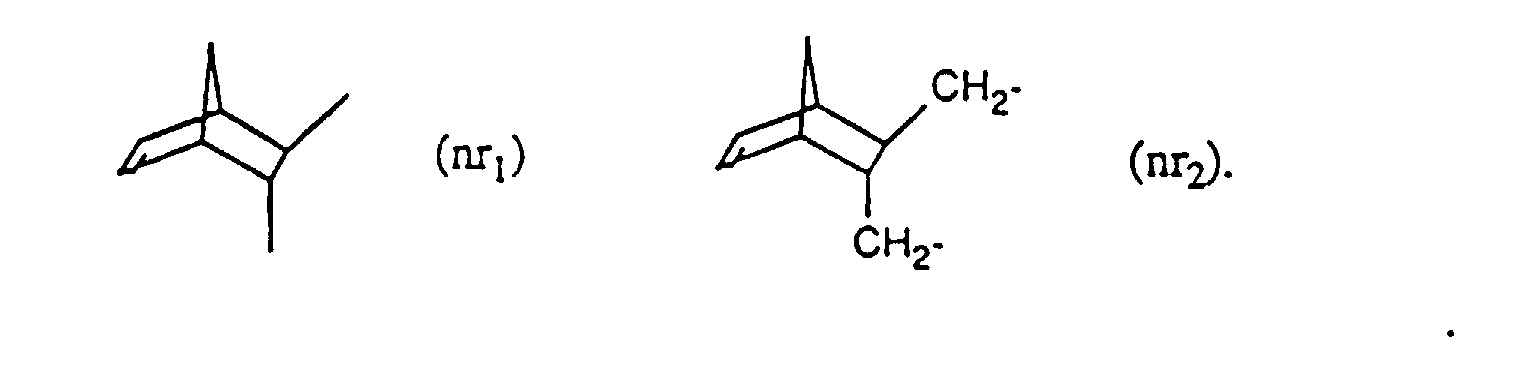
- Composition selon la revendication 16, caractérisée en ce que R011 représente un groupe alkylène ou alcénylène en C2-C18, cycloalkylène ou cycloalcénylène en C3-C12, cycloalkylène en C5-C8-CH2-, CH2-(cycloalkylène en C5-C8)-CH2-, arylène en C6-C18, bisphénylène, benzylène, xylylène, -C6H4-X01-C6H4- avec X01 égal à O, S, SO, SO2, CO, CO2, NH, N(alkyle en C1-C4), alkylidène avec 1 à 18 atomes de carbone, ou cycloalkylidène en C5-C7.
- Composition selon la revendication 16, caractérisée en ce que R012 représente un groupe alkylène en C2-C18, polyoxaalkylène avec 2 à 50 motifs oxaalkylène, et de 2 à 6, atomes de carbone dans le groupe oxyalkylène, cycloalkylène en C3-C12, cycloalkylène en C5-C8-CH2-, CH2- (cycloalkylène en C5-C8) -CH2-, arylène en C6-C14, bisphénylène, benzylène, xylylène, -C6H4-X01-C6H4- avec X01 égal à O, S, SO, SO2, CO, CO2, NH, N(alkyle en C1-C4), alkylidène avec 1 à 18 atomes de carbone, ou cycloalkylidène en C5-C7.
- Composition selon la revendication 11, caractérisée en ce que les polyamides contiennent des motifs de structure identiques ou différents choisis parmi les éléments de structure de formules (j), (k), (l) et (m), dans laquelle au moins les éléments de structure des formules (j) ou (k) ou les deux doivent être présents,
- Composition selon la revendication 21, caractérisée en ce que R013 et R014 représentent indépendamment l'un de l'autre un groupe cycloalkylène en C5-C8 une ou deux fois oléfiniquement insaturé ou un groupe cycloalkylène polycyclique condensé en C7-C18.
- Composition selon la revendication 21, caractérisée en ce que R013 et R014 représentent indépendamment l'un de l'autre un groupe norbornène de formule (nr1) ou (nr2)

- Composition selon la revendication 21, caractérisée en ce que R015 représente un groupe alkylène ou alcénylène en C2-C18, cycloalkylène ou cycloalcénylène en C3-C12, cycloalkylène en C5-C8-CH2-, CH2-(cycloalkyléne en C5-C8)-CH2-, arylène en C6-C18, bisphénylène, benzylène, xylylène, -C6H4-X01-C6H4- avec X01 égal à O, S, SO, SO2, CO, CO2, NH, N(alkyle en C1-C4), alkylidène avec 1 à 18 atomes de carbone, ou cycloalkylidène en C5-C7.
- Composition selon la revendication 21, caractérisée en ce que R016 représente un groupe alkylène en C2-C18, cycloalkylène en C3-C12, cycloalkylène en C5-C8-CH2-, CH2-(cycloalkylène en C5-C8)-CH2-, arylène en C6-C14, bisphénylène, benzylène, xylylène, -C6H4-X01-C6H4- avec X01 égal à O, S, SO, SO2, CO, CO2, NH, N(alkyle en C1-C4), alkylidène avec 1 à 18 atomes de carbone, ou cycloalkylidène en C5-C7.
- Composition selon la revendication 11, caractérisée en ce que les polyuréthannes et polyurées contiennent des motifs de structure identiques ou différents choisis parmi les éléments de structure de formules (n), (o), (p) et (q), dans lesquelles au moins les éléments de structure des formules (n) ou (o) ou les deux doivent être présents,
- Composition selon la revendication 26, caractérisée en ce que R017 et R018 représentent indépendamment l'un de l'autre un groupe cycloalkylène en C5-C8 une ou deux fois oléfiniquement insaturé ou un groupe cycloalkylène polycyclique condensé en C7-C18.
- Composition selon la revendication 27, caractérisée en ce que R017 et R018 représentent indépendamment l'un de l'autre un groupe cyclopenténylène, cyclohepténylène, cycloocténylène ou norbornène de formule (nr1) ou (nr2)
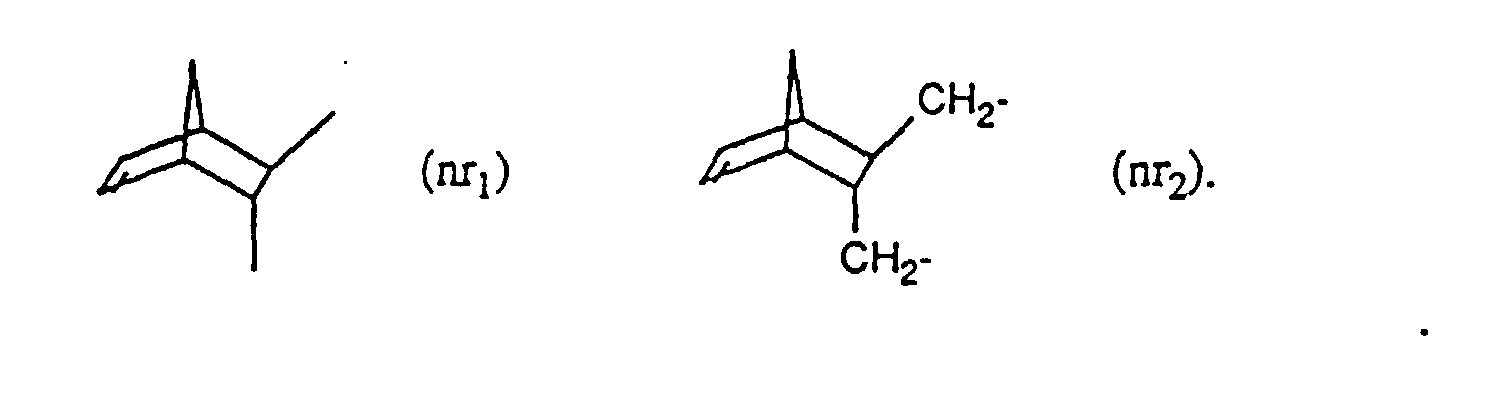
- Composition selon la revendication 26, caractérisée en ce que R019 représente un groupe alkylène ou alcénylène en C2-C18, cycloalkylène ou cycloalcénylène en C3-C12, cycloalkylène en C5-C8-CH2-, CH2- (cycloalkylène en C5-C8) -CH2-, arylène en C6-C18, bisphénylène, benzylène, xylylène, -C6H4-x01-C6H4- avec X01 égal à O, S, SO, SO2, CO, CO2, NH, N(alkyle en C1-C4), alkylidène avec 1 à 18 atomes de carbone, ou cycloalkylidène en C5-C7.
- Composition selon la revendication 26, caractérisée en ce que R020 représente un groupe alkylène en C2-C18, polyoxaalkylène avec 2 à 50 motifs oxaalkylène, et de 2 à 6, atomes de carbone dans le groupe oxyalkylène, cycloalkylène en C3-C12, cycloalkylène en C5-C8-CH2-, CH2- (cycloalkylène en C5-C8)-CH2-, arylène en C6-C14, bisphénylène, benzylène, xylylène, -C6H4-X01-C6H4- avec X01 égal à O, S, SO, SO2, CO, CO2, NH, N(alkyle en C1-C4), alkylidène avec 1 à 18 atomes de carbone, ou cycloalkylidène en C5-C7.
- Composition selon la revendication 1, caractérisée en ce qu'il s'agit des polymères avec un squelette carboné.
- Composition selon la revendication 31, caractérisée en ce que les polymères sont des composés de polymérisation par métathèse essentiellement ou complètement linéaires de diènes cycloaliphatiques au moins bicycliques, qui contiennent deux double liaisons oléfiniques dans différents cycles.
- Composition selon la revendication 31, caractérisée en ce que les polymères contiennent des éléments de structure de répétition de formule (r),
- Composition selon la revendication 31, caractérisée en ce que le polymère représente un polynorbornadiène linéaire avec des motifs de structure de répétition de formule (r')ou le polydicyclopentadiène linéaire avec des motifs de structure de répétition de formule (r")
 ou des copolymères avec ces deux éléments de structure de répétition.
- Composition selon la revendication 34, caractérisée en ce que le polymère est un copolymère linéaire avec un élément de structure de répétition de formule (r), respectivement un ou deux des éléments de structure (r') et (r") et des éléments de structure de formule (r"')forme une cyclooléfine sous tension, dans laquelle
 formules dans lesquelles les groupes cycloalkyle, hétérocycloalkyle, aryle, hétéroaryle, aralkyle et hétéroalkyle précités sont non substitués ou substitués avec un groupe alkyle en C1-C12, alcoxy en C1-C12, -NO2, -CN ou un atome d'halogène, et dans lesquelles les hétéroatomes des groupes hétérocycloalkyle, hétéroaryle, et hétéroaralkyle précités sont choisis parmi -O-, -S-,-NR9- et -N=; etQ3 représente un groupe alkylène en C1-C18 linéaire ou ramifié qui est éventuellement substitué par un atome d'halogène, =O, -CN, -NO2, -COOM, -SO3M, -PO3M, -COO(M1)1/2, -SO3(M1)1/2, -PO3(M1)1/2, alkyle en C1-C20, R1R2R3Si-(O)u-, hydroxyalkyle en C1-C20, halogénoalkyle en C1-C20, cyanoalkyle en C1-C6, cycloalkyle en C3-C8, aryle en C6-C16, aralkyle en C7-C16, hétérocycloalkyle en C3-C6, hétéroaryle en C3-C16, hétéroaralkyle en C4-C16 ou R4X-; ou dans lequel deux atomes de carbone voisins sont substitués avec -CO-O-CO- ou -CO-NR5-CO-; ou dans lequel est éventuellement condensé sur des atomes de carbone voisins un cycle alicyclique, aromatique ou hétéroaromatique, qui est non substitué ou substitué avec un atome d'halogène, -CN, -NO2, R6R7R8Si-(O)u-, -COOM, -SO3M, -PO3M, -COO(M1)1/2, -SO3(M1)1/2, -PO3(M1)1/2, alkyle en C1-C20, halogénoalkyle en C1-C20, hydroxyalkyle en C1-C20, cyanoalkyle en C1-C6, cycloalkyle en C3-C8, aryle en C6-C16, aralkyle en C7-C16, hétérocycloalkyle en C3-C6, hétéroaryle en C3-C16, hétéroaralkyle en C4-C16 ou R13X1-.X et X1 représentent indépendamment l'un de l'autre -O-, -S-, -CO-, -SO-, -SO2-, -O-C(O)-, -C(O)-O-, -C(O)- NR5-, -NR10-C(O)-, -SO2-O- ou -O-SO2-;R1, R2 et R3 représentent indépendamment les uns des autres un groupe alkyle en C1-C12, perfluoroalkyle en C1-C12, phényle ou benzyle;R4 et R13 représentent indépendamment un groupe alkyle en C1-C20, halogénoalkyle en C1-C20, hydroxyalkyle en C1-C20, cycloalkyle en C3-C8, aryle en C6-C16, aralkyle en C7-C16;R5 et R10 représentent indépendamment les uns des autres un atome d'hydrogène, un groupe alkyle en C1-C12, phényle ou benzyle, dans lesquels les groupes alkyle sont quant à eux non substitués ou substitués avec un groupe alcoxy en C1-C12 ou cycloalkyle en C3-C8;R6, R7 et R8 représentent indépendamment les uns des autres un groupe alkyle en C1-C12, perfluoroalkyle en C1-C12, phényle ou benzyle;M représente un métal alcalin et M1 un métal alcalinoterreux; etn représente 0 ou 1;le noyau alicyclique formé avec Q3 contenant éventuellement d'autres double liaisons non aromatiques;Q2 représente un atome d'hydrogène, un groupe alkyle en C1-C20, halogénoalkyle en C1-C20, alcoxy en C1-C12, un atome d'halogène, -CN, R11X2-;R11 représente un groupe alkyle en C1-C20, halogénoalkyle en C1-C20, hydroxyalkyle en C1-C20, cycloalkyle en C3-C8, aryle en C6-C16 ou aralkyle en C7-C16;X2 représente -C(O)-O- ou -C(O)-NR12-;R12 représente un atome d'hydrogène, un groupe alkyle en C1-C12, phényle ou benzyle;R9 représente un atome d'hydrogène, un groupe alkyle en C1-C12, phényle ou benzyle.
 - Composition selon la revendication 35, caractérisée en ce que Q2 représente un atome d'hydrogène.
- Composition selon la revendication 31, caractérisée en ce que les polymères avec un squelette carboné sont des copolymères de cyclooléfines sous tension avec des diènes cycloaliphatiques condensés au moins bicycliques, qui contiennent au moins deux doubles liaisons oléfiniques dans des cycles différents, et des comonomères éthyléniquement insaturés.
- Composition selon la revendication 31, caractérisée en ce que les polymères contiennent des éléments de structure de répétition de formule (r) et de formule (s),dans lesquelles R021 représente un groupe alkylène en C2-C10, auquel est lié un groupe alcénylène avec 2 à 6 atomes de carbone, directement ou par l'intermédiaire d'un cycle cycloalkylène condensé avec 5 à 8 atomes de carbone; R022 représente H, F, un groupe alkyle en C1-C12, -COOH, -C(O)-O-alkyle en C1-C12, -C(O)-NH2, ou -C(O)-NH-alkyle en C1-C12; R023 représente H, F, Cl, CN ou un groupe alkyle en C1-C12; R024 représente H, F, Cl, CN, OH, un groupe alkyle en C1-C12, alcoxy en C1-C12, phényle non substitué ou substitué avec OH, Cl, Br, un groupe alkyle en C1-C4, alcoxy en C1-C4, -COOH, -C(O)O-alkyle en C1-C12, -C(O)-NH2, -C(O)-NH-alkyle en C1-C12, -SO3H ou -SO3-alkyle en C1-C12, -C(O)OH, -C(O)O-hydroxyalkyle en C2-C12, C(O)O-alkyle en C1-C12, -C(O)-NH2 ou -C(O)-NH-alkyle en C1-C12; et R025 représente H, F ou un groupe alkyle en C1-C12.
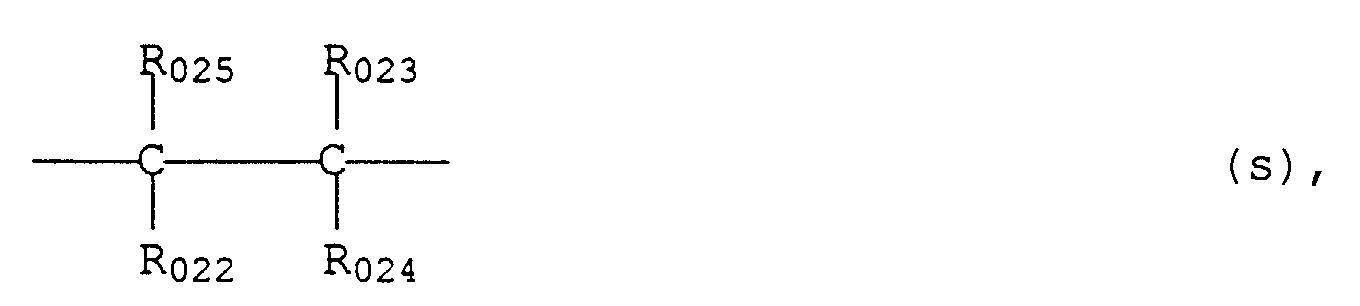
- Composition selon la revendication 38, caractérisée en ce que R022 représente H, F, un groupe alkyle en C1-C4, -COOH ou -C(O)-O-alkyle en C1-C6.
- Composition selon la revendication 38, caractérisée en ce que R023 représente H, F, Cl ou un groupe alkyle en C1-C4.
- Composition selon la revendication 38, caractérisée en ce que R024 représente H, F, Cl, CN, OH, un groupe alkyle en C1-C4, alcoxy en C1-C4, phényle non substitué ou substitué avec OH, Cl, Br, un groupe alkyle en C1-C4, alcoxy en C1-C4, -COOH, -C(O)O-alkyle en C1-C14, -C(O)-NH2, -C(O)-NH-alkyle en C1-C4, -SO3H ou -SO3-alkyle en C1-C4, un groupe -COOH, C(O)O-alkyle en C1-C4, -C(O)-NH2, -C(O)O-hydroxyalkyle en C2-C6 ou -C(O)-NH-alkyle en C1-C4.
- Composition selon la revendication 38, caractérisée en ce que R025 représente H ou F.
- Composition selon la revendication 37, caractérisée en ce que les éléments de structure de formule (r) sont choisis parmi les éléments de structure de formules (r) et (r')et


- Composition selon la revendication 21, caractérisée en ce que les polymères avec un squelette carboné sont des composés de polymérisation par métathèse ou des copolymères decyclooléfines sous tension avec une double liaison dans le cycle et des comonomères oléfiniquement insaturés, dont les double liaisons oléfiniques dans le squelette carboné du polymère sont mises à réagir partiellement ou totalement avec des 1,3-diènes à chaíne ouverte ou cycliques ayant 4 à 12 atomes de carbone dans une réaction de Diels-Alder pour donner des groupes cycloalcényle ayant 6 à 14 atomes de carbone.
- Composition selon la revendication 44, caractérisée en ce qu'on fait réagir 5 à 80% des double liaisons.
- Composition selon la revendication 44, caractérisée en ce les composés de polymérisation par métathèse contiennent des éléments de structure de répétition de formule (t),dans laquelle A1 représente un groupe cycloalcénylène en C5-C8 mono ou bicyclique.

- Composition selon la revendication 46, caractérisée en ce que l'élément de structure de formule (t) représente le norborn-1,2-énylène de formule (nr3)

- Composition selon la revendication 44, caractérisée en ce que le polymère par métathèse contient des motifs de structure de répétition de formule (u)et des motifs de structure de répétition de formule (w)
 dans laquelle R022 représente H, F, un groupe alkyle en C1-C12, -COOH, -C(O)-O-alkyle en C1-C12, -C(O)-NH2, ou -C(O)-NH-alkyle en C1-C12; R023 représente H, F, Cl, CN ou un groupe alkyle en C1-C12; R024 représente H, F, Cl, CN, OH, un groupe alkyle en C1-C12, alcoxy en C1-C12, phényle non substitué ou substitué avec OH, Cl, Br, un groupe alkyle en C1-C4, alcoxy en C1-C4, -COOH, -C(O)O-alkyle en C1-C12, -C(O)-NH2, -C(O)-NH-alkyle en C1-C12, -SO3H ou -SO3-alkyle en C1-C12, un groupe -C (O) OH, -C(O)O-hydroxyalkyle en C2-C12, C(O)O-alkyle en C1-C12, -C(O)-NH2 ou -C(O)-NH-alkyle en C1-C12; et R025 représente H, F ou un groupe alkyle en C1-C12.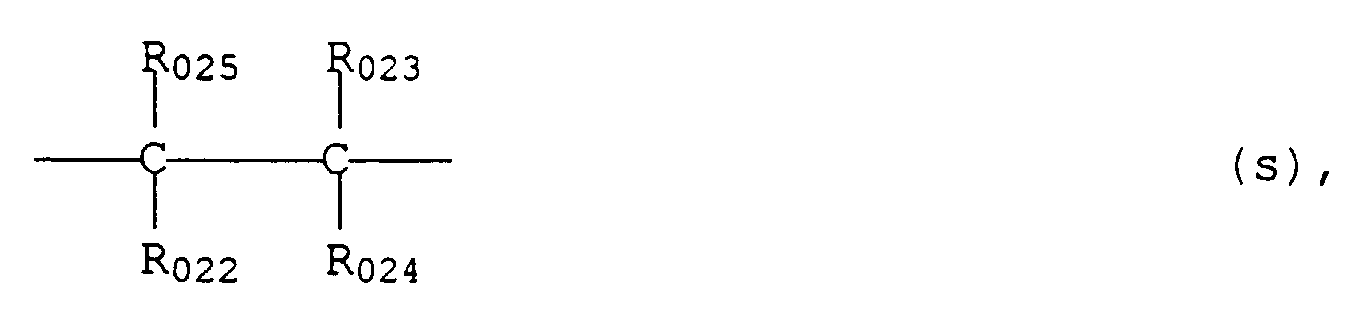
- Composition selon la revendication 31, caractérisée en ce que les polymères avec un squelette carboné sont des composés d'homo et de copolymérisation de 1,3-diènes et éventuellement de monomères oléfiniquement insaturés, dont les double liaisons oléfiniques dans le squelette du polymère sont mises à réagir partiellement ou totalement avec des 1,3-diènes à chaíne ouverte ou cycliques ayant 4 à 12 atomes de carbone dans une réaction de Diels-Alder pour donner des groupes cycloalcénylène ayant 6 à 14 atomes de carbone.
- Composition selon la revendication 49, caractérisée en ce qu'on fait réagir 5 à 80% des double liaisons.
- Composition selon la revendication 49, caractérisée en ce les 1,3-diènes sont choisis entre le 1,3-butadiène, l'isoprène et le chloroprène.
- Composition selon la revendication 49, caractérisée en ce les polymères contiennent des éléments de structure de répétition de formule (t),dans laquelle A1 représente un groupe cycloalcénylène en C5-C8 mono ou bicyclique.
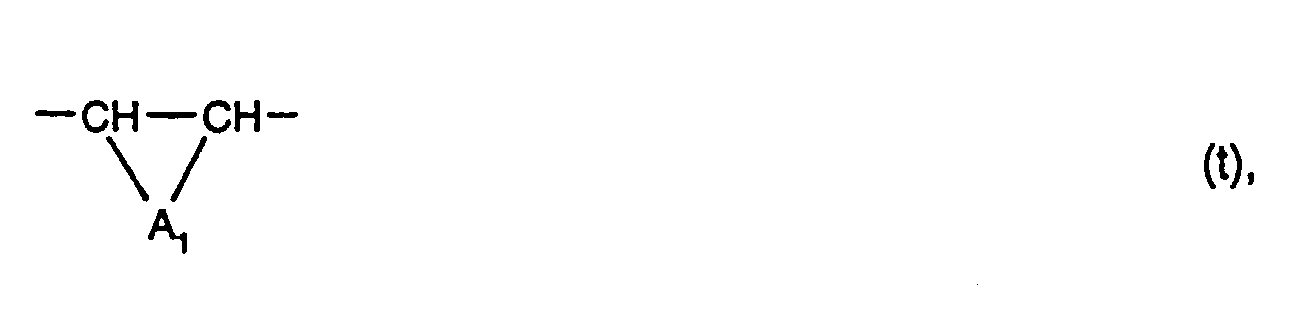
- Composition selon la revendication 52, caractérisée en ce que l'élément de structure de formule (t) représente le norborn-1,2-énylène de formule (nr3)

- Composition selon la revendication 49, caractérisée en ce que le polymère contient des motifs de structure de répétition de formule (y)et des motifs de structure de répétition de formule (z)
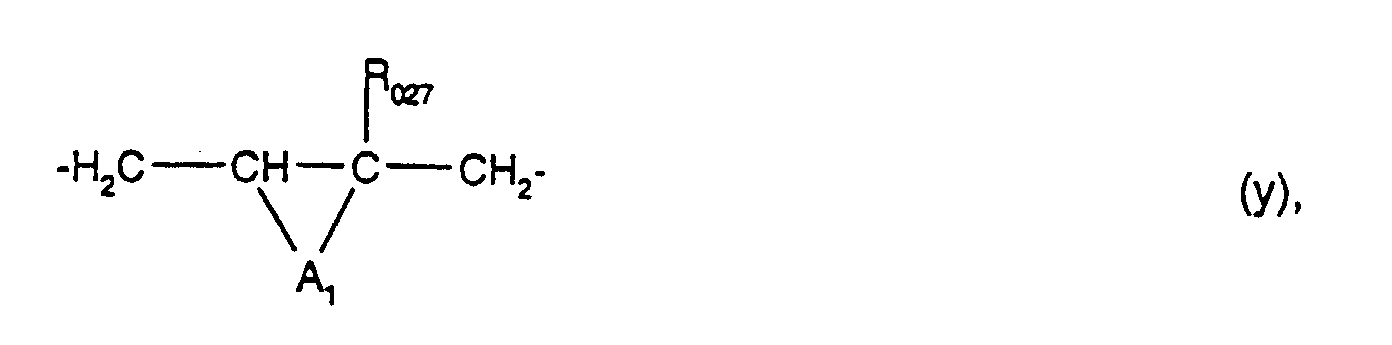 dans laquelle R022 représente H, F, un groupe alkyle en C1-C12, -COOH, -C(O)-O-alkyle en C1-C12, -C(O)-NH2, ou -C(O)-NH-alkyle en C1-C12; R023 représente H, F, Cl, CN ou un groupe alkyle en C1-C12; R024 représente H, F, Cl, CN, OH, un groupe alkyle en C1-C12, alcoxy en C1-C12, phényle non substitué ou substitué avec OH, Cl, Br, un groupe alkyle en C1-C4, alcoxy en C1-C4, -COOH, -C(O)O-alkyle en C1-C12, -C(O)-NH2, -C(O)-NH-alkyle en C1-C12, -SO3H ou -SO3-alkyle en C1-C12, un groupe -C(O)OH, -C(O)O-hydroxyalkyle en C2-C12, C(O)O-alkyle en C1-C12, -C(O)-NH2 ou -C(O)-NH-alkyle en C1-C12; et R025 représente H, F ou un groupe alkyle en C1-C12.
- Composition selon la revendication 1, caractérisée en ce que les cyclooléfines comonomères sous tension correspondent à la formule I,dans laquelle
 formules dans lesquelles les groupes cycloalkyle, hétérocycloalkyle, aryle, hétéroaryle, aralkyle et hétéroalkyle précités sont non substitués ou substitués avec un groupe alkyle en C1-C12, alcoxy en C1-C12, -NO2, -CN ou un atome d'halogène, et dans lesquelles les hétéroatomes des groupes hétérocycloalkyle, hétéroaryle et hétéroaralkyle précités sont choisis parmi -O-, -S-, -NR9- et -N=; etQ1 représente un groupe avec au moins un atome de carbone, qui forme ensemble avec le groupe -CH=CQ2 un noyau alicyclique d'au moins 3 chaínons, qui contient éventuellement un ou plusieurs hétéroatomes choisis parmi le silicium, le phosphore, l'oxygène, l'azote et le soufre; et qui est non substitué ou substitué avec un atome d'halogène, =O, -CN, -NO2, R1R2R3Si-(O)u-, -COOM, -SO3M, -PO3M, -COO(M1)1/2, -SO3(M1)1/2, -PO3(M1)1/2, alkyle en C1-C20, hydroxyalkyle en C1-C20, halogénoalkyle en C1-C20, cyanoalkyle en C1-C6, cycloalkyle en C3-C8, aryle en C6-C16, aralkyle en C7-C16, hétérocycloalkyle en C3C6, hétéroaryle en C3-C16, hétéroaralkyle en C4-C16 ou R4X-; ou dans lequel deux atomes de carbone voisins sont substitués avec -CO-O-CO- ou -CO-NR5-CO-; ou dans lequel est éventuellement condensé sur des atomes de carbone voisins du noyau alicyclique un cycle alicyclique, aromatique ou hétéroaromatique, qui est non substitué ou substitué avec un atome d'halogène, -CN, -NO2, R6R7R8Si-(O)u-, -COOM, -SO3M, -PO3M, -COO(M1)1/2, -SO3(M1)1/2, -PO3(M1)1/2, alkyle en C1-C20, halogénoalkyle en C1-C20, hydroxyalkyle en C1-C20, cyanoalkyle en C1-C6, cycloalkyle en C3-C8, aryle en C6-C16, aralkyle en C7-C16, hétérocycloalkyle en C3-C6, hétéroaryle en C3-C16, hétéroaralkyle en C4-C16 ou R13X1-;X et X1 représentent indépendamment l'un de l'autre -O-, -S-, -CO-, -SO-, -SO2-, -O-C(O)-, -C(O)-O-, -C(O)-NR5-, -NR10-C(O)-, -SO2-O- ou -O-SO2-;R1, R2 et R3 représentent indépendamment les uns des autres un groupe alkyle en C1-C12, perfluoroalkyle en C1-C12, phényle ou benzyle;R4 et R13 représentent indépendamment un groupe alkyle en C1-C20, halogénoalkyle en C1-C20, hydroxyalkyle en C1-C20, cycloalkyle en C3-C8, aryle en C6-C16, aralkyle en C7-C16;R5 et R10 représentent indépendamment l'un de l'autre un atome d'hydrogène, un groupe alkyle en C1-C12, phényle ou benzyle, dans lesquels les groupes alkyle sont quant à eux non substitués ou substitués avec un groupe alcoxy en C1-C12 ou cycloalkyle en C3-C8;R6, R7 et R8 représentent indépendamment les uns des autres un groupe alkyle en C1-C12, perfluoroalkyle en C1-C12, phényle ou benzyle;M représente un métal alcalin et M1 un métal alcalino-terreux; et u représente 0 ou 1;le noyau alicyclique formé avec Q1 contenant éventuellement d'autres double liaisons non aromatiques;Q2 représente un atome d'hydrogène, un groupe alkyle en C1-C20, halogénoalkyle en C1-C20, alcoxy en C1-C12, un atome d'halogène, -CN, R11X2-;R11 représente un groupe alkyle en C1-C20, halogénoalkyle en C1-C20, hydroxyalkyle en C1-C20, cycloalkyle en C3-C8, aryle en C6-C16 ou aralkyle en C7-C16;X2 représente -C(O)-O- ou -C(O)-NR12-;R12 représente un atome d'hydrogène, un groupe alkyle en C1-C12, phényle ou benzyle;R9 représente un atome d'hydrogène, un groupe alkyle en C1-C12, phényle ou benzyle.
 - Composition selon la revendication 1, caractérisée en ce qu'elle contient des cyclooléfines comonomères polyfonctionnelles, qui correspondent à la formule (f1),
- Composition selon la revendication 56, caractérisée en ce que les groupes cyclooléfine T correspondent à la formule (f2),dans laquelle
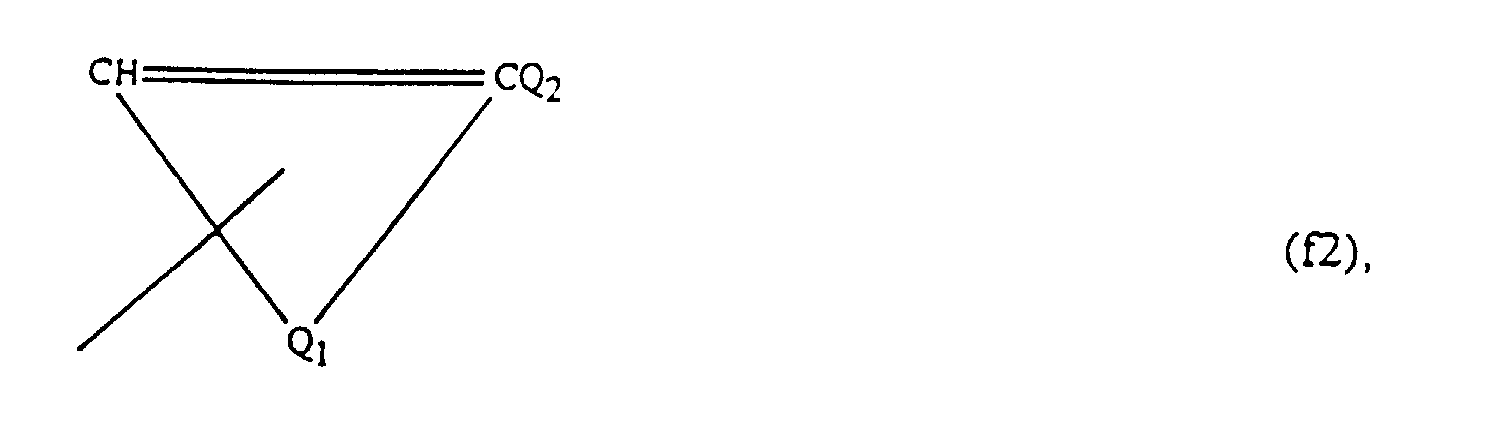 formules dans lesquelles les groupes cycloalkyle, hétérocycloalkyle, aryle, hétéroaryle, aralkyle et hétéroalkyle précités sont non substitués ou substitués avec un groupe alkyle en C1-C12, alcoxy en C1-C12, -NO2, -CN ou un atome d'halogène, et dans lesquelles les hétéroatomes des groupes hétérocycloalkyle, hétéroaryle et hétéroaralkyle précités sont choisis parmi -O-, -S-, -NR9- et -N=; etQ1 représente un groupe avec au moins un atome de carbone, qui forme ensemble avec le groupe -CH=CQ2 un noyau alicyclique d'au moins 3 chaínons, qui contient éventuellement un ou plusieurs hétéroatomes choisis parmi le silicium, le phosphore, l'oxygène, l'azote et le soufre; et qui est non substitué ou substitué avec un atome d'halogène, =O, -CN, -NO2, R1R2R3Si-(O)u-, -COOM, -SO3M, -PO3M, -COO(M1)1/2, -SO3(M1)1/2, -PO3(M1)1/2, alkyle en C1-C20, hydroxyalkyle en C1-C20, halogénoalkyle en C1-C20, cyanoalkyle en C1-C6, cycloalkyle en C3-C8, aryle en C6-C16, aralkyle en C7-C16, hétérocycloalkyle en C3-C6, hétéroaryle en C3-C16, hétéroaralkyle en C4-C16 ou R4X-; ou dans lequel deux atomes de carbone voisins sont substitués avec -CO-O-CO- ou -CO-NR5-CO-; ou dans lequel est éventuellement condensé sur des atomes de carbone voisins du noyau alicyclique un cycle alicyclique, aromatique ou hétéroaromatique, qui est non substitué ou substitué avec un atome d'halogène, -CN, -NO2, R6R7R8Si-(O)u-, -COOM, -SO3M, -PO3M, -COO(M1)1/2, -SO3(M1)1/2, -PO3(M1)1/2, alkyle en C1-C20, halogénoalkyle en C1-C20, hydroxyalkyle en C1-C20, cyanoalkyle en C1-C6, cycloalkyle en C3-C8, aryle en C6-C16, aralkyle en C7-C16, hétérocycloalkyle en C3-C6, hétéroaryle en C3-C16, hétéroaralkyle en C4-C16 ou R13X1-;X et X1 représentent indépendamment l'un de l'autre -O-, -S-, -CO-, -SO-, -SO2-, -O-C(O)-, -C(O)-O-, -C(O)-NR5-, -NR10-C(O)-, -SO2-O- ou -O-SO2-;R1, R2 et R3 représentent indépendamment les uns des autres un groupe alkyle en C1-C12, perfluoroalkyle en C1-C12, phényle ou benzyle;R4 et R13 représentent indépendamment un groupe alkyle en C1-C20, halogénoalkyle en C1-C20, hydroxyalkyle en C1-C20, cycloalkyle en C3-C8, aryle en C6-C16, aralkyle en C7-C16;R5 et R10 représentent indépendamment l'un de l'autre un atome d'hydrogène, un groupe alkyle en C1-C12, phényle ou benzyle, dans lesquels les groupes alkyle sont quant à eux non substitués ou substitués avec un groupe alcoxy en C1-C12 ou cycloalkyle en C3-C8;R6, R7 et R8 représentent indépendamment les uns des autres un groupe alkyle en C1-C12, perfluoroalkyle en C1-C12, phényle ou benzyle;M représente un métal alcalin et M1 un métal alcalino-terreux; etu représente 0 ou 1;le noyau alicyclique formé avec Q1 contenant éventuellement d'autres double liaisons non aromatiques;Q2 représente un atome d'hydrogène, un groupe alkyle en C1-C20, halogénoalkyle en C1-C20, alcoxy en C1-C12, un atome d'halogène, -CN, R11X2-;R11 représente un groupe alkyle en C1-C20, halogénoalkyle en C1-C20, hydroxyalkyle en C1-C20, cycloalkyle en C3-C8, aryle en C6-C16 ou aralkyle en C7-C16;X2 représente -C(O)-O- ou -C(O)-NR12-;R12 représente un atome d'hydrogène, un groupe alkyle en C1-C12, phényle ou benzyle;R9 représente un atome d'hydrogène, un groupe alkyle en C1-C12, phényle ou benzyle.
 - Composition selon la revendication 56, caractérisée en ce que U représente (a) un groupement pontant divalent de formule (f5)X5 et X6 représentent indépendamment l'un de l'autre une simple liaison, -O-, -CH2-O, -C(O)O-, -O(O)C-, -CH2-O (O) C-, -C (O) -NR029-, -R029N-(O)C-, -NH-C- (O) -NR029-, -O-C(O)-NH-, -CH2-O-C(O)-NH-, ou -NH-C(O)-O-, etR028 représente un groupe alkylène en C2-C18, cycloalkylène en C5-C8 non substitué ou substitué avec un groupe alkyle en C1-C4 ou alcoxy en C1-C4, arylène en C6-C18 ou aralkylène en C7-C19 non substitué ou substitué avec un groupe alkyle en C1-C4 ou alcoxy en C1-C4, oupolyoxaalkylène avec 2 à 12 motifs oxaalkylène et 2 à 6 atomes de carbone dans le groupe alkylène, etR029 est un atome d'hydrogène ou un groupe alkyle en C1-C8; ou(b) un groupement pontant trivalent de formule (f6)dans laquelle
 X5, X6 et X7 représentent -O-, CH2-O-, -C(O)O-, -O(O)C-, -CH2-O(O)C-, -C(O)-NR029-, -R029N-(O)C-, -NH-C(O)-NR029-, -O-C(O)-NH-, CH2-O-C(O)-NH- ou -NH-C(O)O-, etR031 représente un groupe hydrocarboné aliphatique trivalent avec 3 à 20 atomes de carbone, un groupe cycloaliphatique trivalent non substitué ou substitué avec un groupe alkyle en C1-C4 ou alcoxy en C1-C4, ayant 3 à 8, de préférence 5 ou 6 atomes de carbone dans le cycle, ou un groupe aromatique trivalent non substitué ou substitué avec un groupe alkyle en C1-C4 ou alcoxy en C1-C4, ayant 6 à 18 atomes de carbone, un groupe araliphatique trivalent non substitué ou substitué avec un groupe alkyle en C1-C4, ou alcoxy en C1-C4, ayant 7 à 19 atomes de carbone, ou un groupe hétéroaromatique trivalent non substitué ou substitué avec un groupe alkyle en C1-C4, ou alcoxy en C1-C4, ayant 3 à 13 atomes de carbone et 1 à 3 hétéroatomes choisis parmi -O-, -N- et -S-, etR031 représente un atome d'hydrogène ou un groupe alkyle en C1-C6; ou(c) un groupement pontant tétravalent de formule (f7),dans laquelle
 X5, X6, X7 et X8 représentent -C(O)O-, -CH2-O(O)C- ou -C(O)-NR029-, etR032 représente un groupe hydrocarboné aliphatique tétravalent avec 4 à 20 atomes de carbone, un groupe cycloaliphatique tétravalent non substitué ou substitué avec un groupe alkyle en C1-C4, ou alcoxy en C1-C4, ayant 4 à 8 atomes de carbone dans le cycle, ou un groupe aromatique tétravalent non substitué ou substitué avec un groupe alkyle en C1-C4, ou alcoxy en C1-C4, ayant 6 à 18 atomes de carbone, un groupe araliphatique tétravalent non substitué ou substitué avec un groupe alkyle en C1-C4, ou alcoxy en C1-C4, ayant 7 à 19 atomes de carbone, ou un groupe hétéroaromatique tétravalent non substitué ou substitué avec un groupe alkyle en C1-C4, ou alcoxy en C1-C4, ayant 3 à 13 atomes de carbone et 1 à 3 hétéroatomes choisis parmi -O-, -N- et -S-, etR029 représente un atome d'hydrogène ou un groupe alkyle en C1-C6.
 - Composition selon la revendication 1, caractérisée en ce qu'elle contient des polymères et éventuellement des monomères qui sont construits seulement à partir de carbone et d'hydrogène.
- Composition selon la revendication 1, caractérisée en ce qu'elle contient le catalyseur à un composant en une quantité de 0,001 à 20% en mole, par rapport à la quantité du monomère.
- Composition selon la revendication 60, caractérisée en ce qu'elle contient le catalyseur à un composant en une quantité de 0,01 à 10% en mole, par rapport à la quantité du monomère.
- Composition selon la revendication 1, caractérisée en ce que les ligands photolabiles sont par exemple de l'azote (N2), des arènes monocycliques, polycycliques ou condensés, non substitués ou substitués avec OH, un groupe alkyle en C1-C4, alcoxy en C1-C4, aryle en C6-C12 ou un atome d'halogène, ayant 6 à 24 atomes de carbone ou des hétéroarènes monocycliques, des hétéroarènes condensés ou des hétéroarènes-arènes condensés non substitués ou substitués avec un groupe alkyle en C1-C4, alcoxy en C1-C4, aryle en C6-C12 ou un atome d'halogène, ayant 3 à 22 atomes de carbone et 1 à 3 hétéroatomes choisis parmi O, S et N; ou des nitriles aliphatiques, cycloaliphatiques, aromatiques ou araliphatiques non substitués ou substitués avec un groupe alkyle en C1-C4, alcoxy en C1-C4, aryle en C6-C12, ou un atome d'halogène, ayant 1 à 22 atomes de carbone.
- Composition selon la revendication 1, caractérisée en ce que les ligands non photolabiles sont H2O, H2S, NH3; des alcools ou de mercaptans aliphatiques ou cycloaliphatiques éventuellement halogénés ayant 1 à 18 atomes de carbone, des alcools ou des thiols aromatiques avec 6 à 18 atomes de carbone; des éthers, thioéthers, sulfoxydes, sulfones, cétones, aldéhydes, esters carboxyliques, lactones, carboxamides éventuellement mono ou dialkylés en C1-C4 sur l'azote aliphatiques, cycloaliphatiques, araliphatiques ou aromatiques, ayant 2 à 20 atomes de carbone, et des lactames éventuellement alkylés en C1-C4 sur l'azote; des amines primaires, secondaires ou tertiaires aliphatiques, cycloaliphatiques, araliphatiques ou aromatiques, ayant 1 à 20 atomes de carbone; et des cyclopentadiènyles éventuellement substitués.
- Composition selon la revendication 1, caractérisée en ce que le dérivé du molybdène ou du tungstène correspond à l'une des formules XII à XIIc
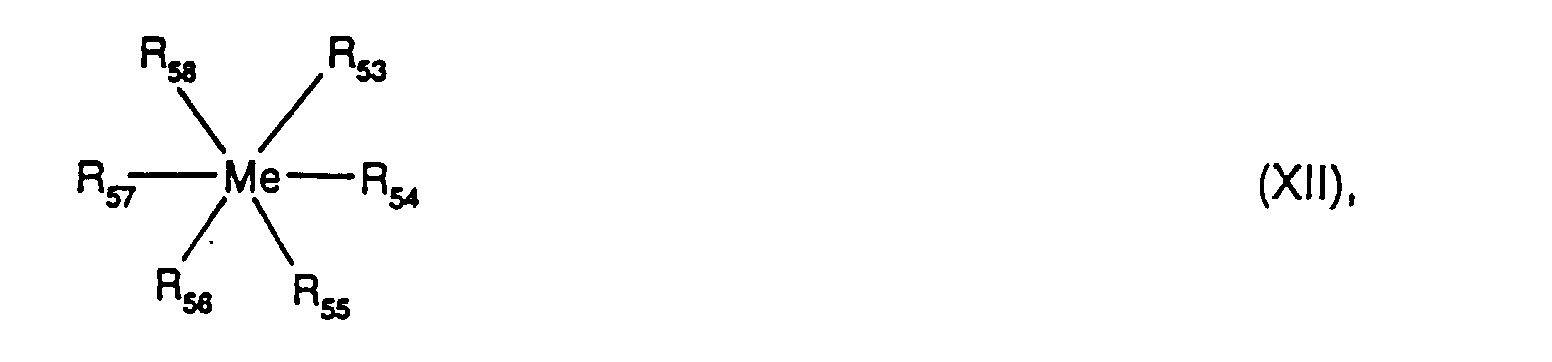
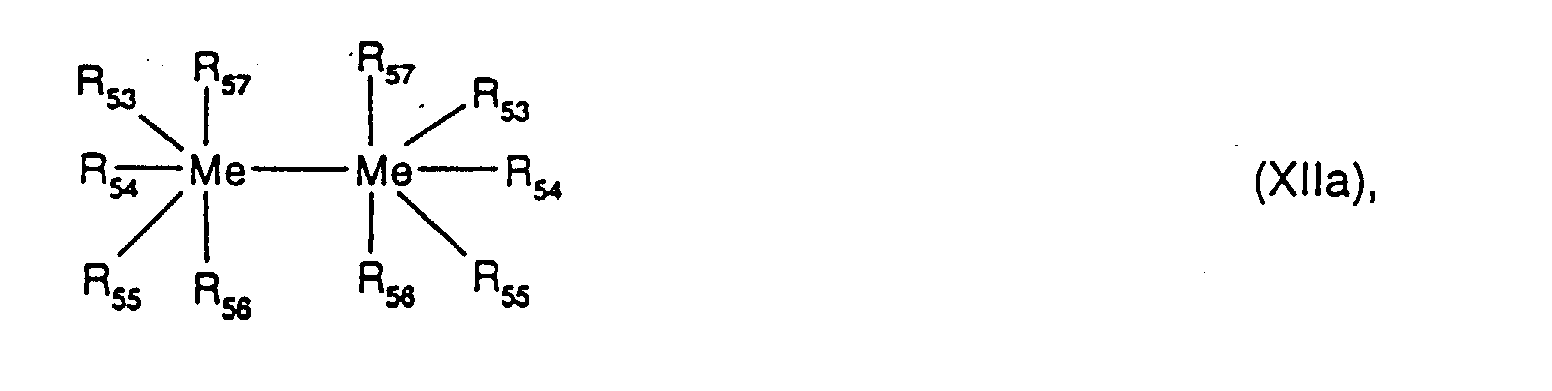
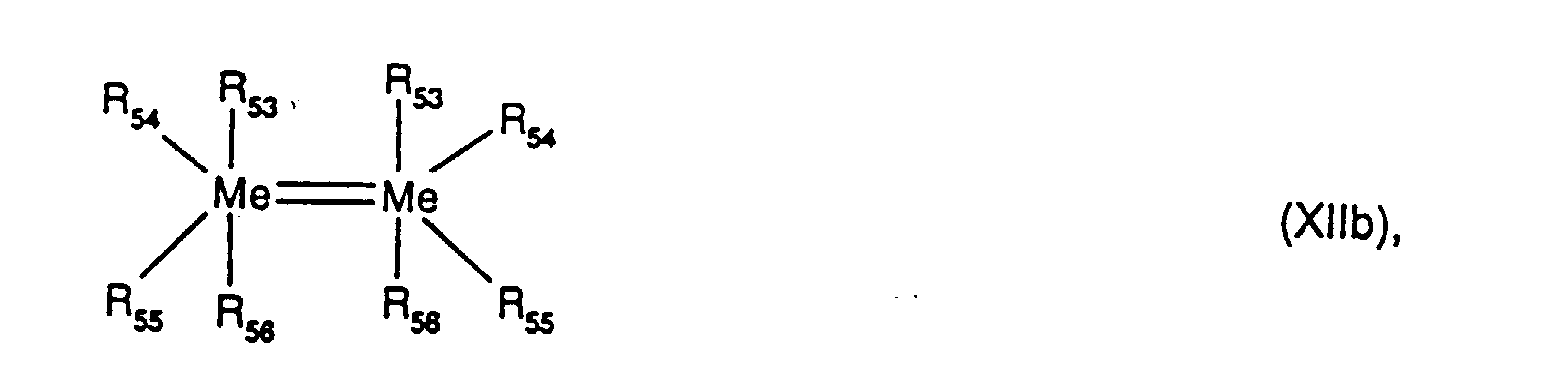 dans lesquelles
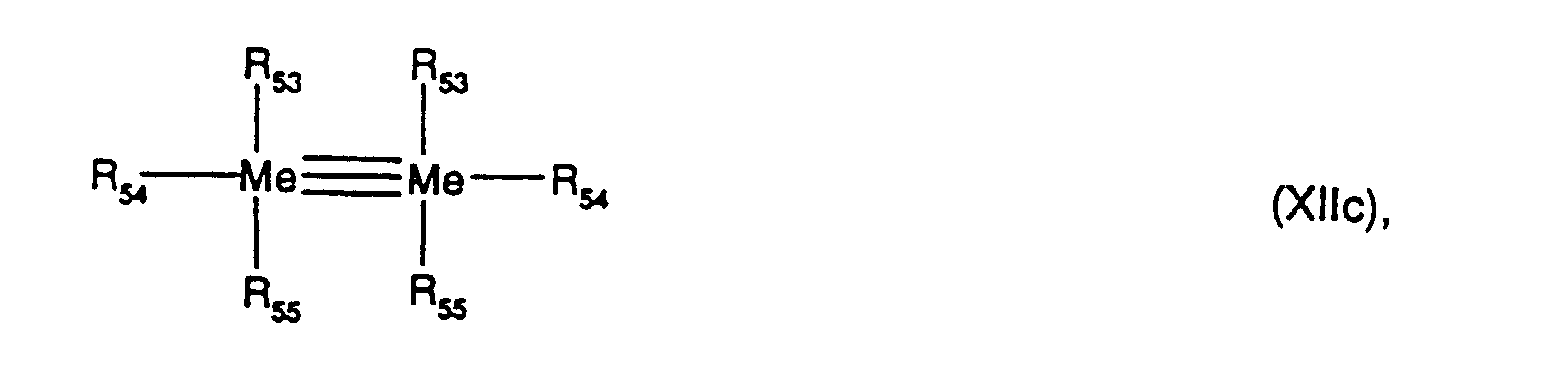 au moins deux des groupes R53 à R68 représentent un groupe CH2-R de formule XI selon la revendication 66;Me représente Mo(VI) ou W(VI);
respectivement deux des groupes restants de R53 à R68 représentent =O ou =NR44 et R44 représente un groupe alkyle en C1-C18, linéaire ou ramifié, non substitué ou substitué avec un groupe alcoxy en C1-C6, cycloalkyle en C5 ou C6 non substitué avec un groupe alkyle en C1-C6, alcoxy en C1-C6 ou un atome d'halogène, phényle non substitué ou substitué avec un groupe alkyle en C1-C6, alcoxy en C1-C6, alcoxyméthyle en C1-C6, alcoxyéthyle en C1-C6, di(alkyle en C1-C6)amino, di(alkyle en C1-C6)aminoalkyle en C1-C3, ou un atome d'halogène, ou benzyle ou phényléthyle non substitué ou substitué avec un groupe alkyle en C1-C6, alcoxy en C1-C6, alcoxyméthyle en C1-C6, alcoxyéthyle en C1-C6 ou un atome d'halogène; et/ou les groupes restants de R53 à R68 représentent un groupe amino secondaire avec 2 à 18 atomes de carbone, R45O- ou R45S-, un atome d'halogène, un groupe cyclopentadiényle ou biscyclopentadiényle ponté ou un ligand neutre, formules dans lesquelles R45 représente un groupe alkyle en C1-C18, linéaire ou ramifié, non substitué ou substitué avec un groupe alcoxy en C1-C6 ou un atome d'halogène ou un groupe cycloalkyle en C5 ou C6 non substitué ou substitué avec un groupe alkyle en C1-C6, alcoxy en C1-C6 ou un atome d'halogène, phényle non substitué ou substitué avec un groupe alkyle en C1-C6, alcoxy en C1-C6, alcoxyméthyle en C1-C6, alcoxyéthyle en C1-C6 ou un atome d'halogène, ou benzyle ou phényléthyle non substitué ou substitué un groupe alkyle en C1-C6, alcoxy en C1-C6, alcoxyméthyle en C1-C6, alcoxyéthyle en C1-C6 ou un atome d'halogène. - Composition selon la revendication 1, caractérisée en ce que le groupe silylméthyle correspond à la formule XIV
R38, R39 et R40 représentent indépendamment les uns des autres un groupe alkyle en C1-C18, cycloalkyle en C5 ou C6 ou phényle ou benzyle non substitué ou substitué avec un groupe alkyle en C1-C6 ou alcoxy en C1-C6. - Composition selon la revendication 1, caractérisée en ce que le dérivé du titane, du niobium, du tantale, du molybdène ou du tungstène correspond à l'une des formules XV, XVa ou XVb
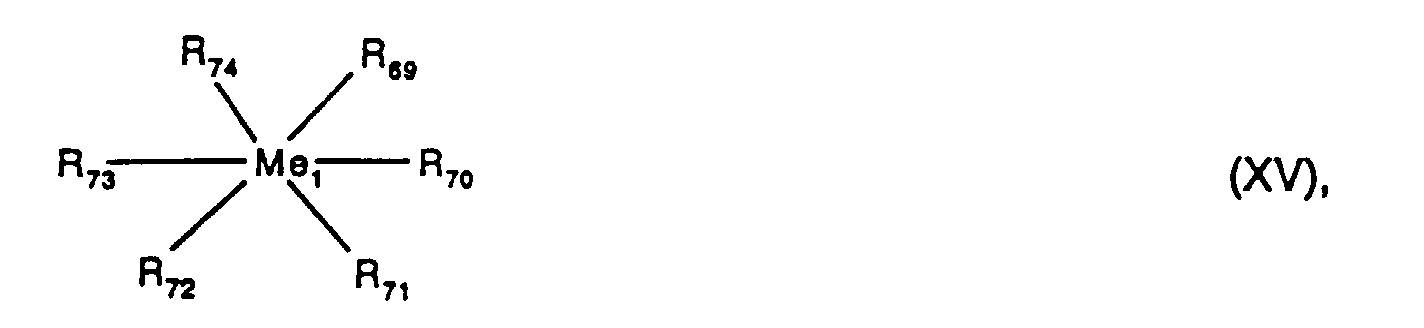 dans lesquelles
 un des groupes R69 à R74 représente un groupe -CH2-SiR38R39R40 de formule XIV selon la revendication 68;Me1 représente Mo(VI) ou W(VI);Me2 représente Nb(V) ou Ta(V);
un des groupes R69 à R74 représente un groupe -CH2-SiR38R39R40 de formule XIV selon la revendication 68; au moins un des groupes R69 à R74 représente F, Cl ou Br; R38, R39 et R40 représentent indépendamment les uns des autres un groupe alkyle en C1-C6, cycloalkyle en C5 ou C6, ou phényle ou benzyle non substitué ou substitué avec un groupe alkyle en C1-C6 ou alcoxy en C1-C6;
deux dans la formule XV, ou respectivement deux dans la formule XV et deux dans la formule XVa des groupes restants de R69 à R74 représentent respectivement en même temps =O ou =N-R44, et R44 représente un groupe alkyle en C1-C18, linéaire ou ramifié, non substitué ou substitué avec un groupe alcoxy en C1-C6, cycloalkyle en C5 ou C6 non substitué ou substitué avec un groupe alkyle en C1-C6, alcoxy en C1-C6 ou un atome d'halogène, phényle non substitué ou substitué avec un groupe alkyle en C1-C6, alcoxy en C1-C6, alcoxyméthyle en C1-C6, alcoxyéthyle en C1-C6, di(alkyle en C1-C6)amino, di(alkyle en C1-C6)aminoalkyle en C1-C3 ou un atome d'halogène, ou benzyle ou phényléthyle non substitué ou substitué avec un groupe alkyle en C1-C6, alcoxy en C1-C6, alcoxyméthyle en C1-C6, alcoxyéthyle en C1-C6, di(alkyle en C1-C6)amino, di(alkyle en C1-C6)amino-alkyle en C1-C3 ou un atome d'halogène, et les groupes restants représentent des groupes amino secondaires avec 2 à 18 atomes de carbone, R45O- ou R45S-, un atome d'halogène, un groupe cyclopentadiényle ou biscyclopentadiényle ponté ou un ligand neutre non substitué ou substitué, dans lesquels les groupes R45 représentent indépendamment les uns des autres un groupe alkyle en C1-C18, linéaire ou ramifié, non substitué ou substitué avec un groupe alcoxy en C1-C6 ou un atome d'halogène ou un groupe cycloalkyle en C5 ou C6 non substitué avec un groupe alkyle en C1-C6, alcoxy en C1-C6 ou un atome d'halogène, phényle non substitué ou substitué avec un groupe alkyle en C1-C6, alcoxy en C1-C6, alcoxyméthyle en C1-C6, alcoxyéthyle en C1-C6, di(alkyle en C1-C6)amino, di(alkyle en C1-C6)amino-alkyle en C1-C3, ou un atome d'halogène, ou benzyle ou phényléthyle non substitué ou substitué avec un groupe alkyle en C1-C6, alcoxy en C1-C6, alcoxyméthyle en C1-C6, alcoxyéthyle en C1-C6, di(alkyle en C1-C6)amino, di(alkyle en C1-C6)aminoalkyle en C1-C3, ou
dans les formules XV, XVa et XVb les groupes restants représentent indépendamment les uns des autres un groupe amino secondaire avec 2 à 18 atomes de carbone, R45O- ou R45S-, un atome d'halogène, un groupe cyclopentadiényle ou biscyclopentadiényle ponté ou un ligand neutre non substitué ou substitué, formules dans lesquelles les groupes R45 représentent indépendamment les uns des autres un groupe alkyle en C1-C18, linéaire ou ramifié, non substitué ou substitué avec un groupe alcoxy en C1-C6 ou un atome d'halogène ou un groupe cycloalkyle en C5 ou C6 non substitué avec un groupe alkyle en C1-C6, alcoxy en C1-C6 ou un atome d'halogène, phényle non substitué ou substitué avec un groupe alkyle en C1-C6, alcoxy en C1-C6, alcoxyméthyle en C1-C6, alcoxyéthyle en C1-C6, di(alkyle en C1-C6)amino, di(alkyle en C1-C6)amino-alkyle en C1-C3, ou un atome d'halogène, ou benzyle ou phényléthyle non substitué ou substitué avec un groupe alkyle en C1-C6, alcoxy en C1-C6, alcoxyméthyle en C1-C6, alcoxyéthyle en C1-C6, di(alkyle en C1-C6)amino, di(alkyle en C1-C6)aminoalkyle en C1-C3 ou un atome d'halogène. - Composition selon la revendication 1, caractérisée en ce que le dérivé du niobium ou du tantale correspond à la formule XVIIIdans laquelle
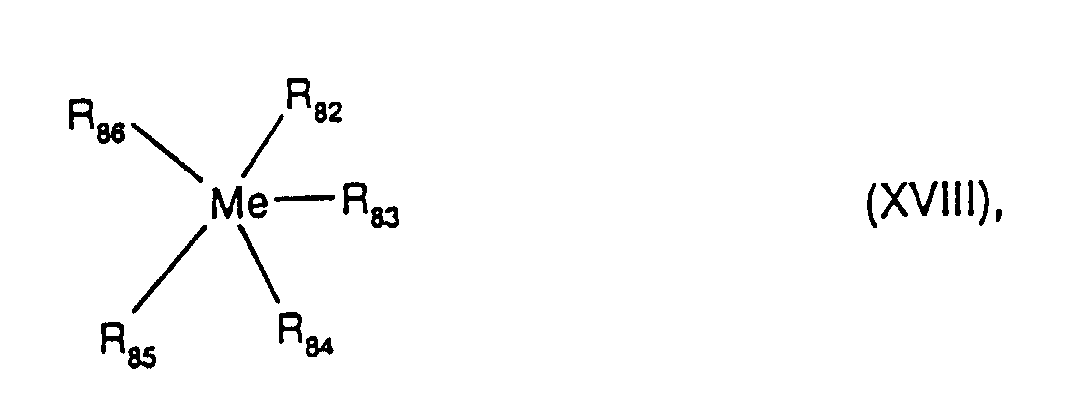 au moins deux des groupes R82 à R86 représentent un groupe -CH2-R de formule XI selon la revendication 66;Me représente Nb(V) ou Ta(V),
deux des groupes restants de R82 à R86 représentent ensemble =O ou =N-R44, et R44 représente un groupe alkyle en C1-C18, linéaire ou ramifié, non substitué ou substitué avec un groupe alcoxy en C1-C6, cycloalkyle en C5 ou C6 non substitué avec un groupe alkyle en C1-C6, alcoxy en C1-C6 ou un atome d'halogène, phényle non substitué ou substitué avec un groupe alkyle en C1-C6, alcoxy en C1-C6, alcoxyméthyle en C1-C6, alcoxyéthyle en C1-C6, di(alkyle en C1-C6)amino, di(alkyle en C1-C6)aminoalkyle en C1-C3, ou un atome d'halogène, ou un groupe benzyle ou phényléthyle non substitué ou substitué avec un groupe alkyle en C1-C6, alcoxy en C1-C6, alcoxyméthyle en C1-C6, alcoxyéthyle en C1-C6, di(alkyle en C1-C6)amino, di(alkyle en C1-C6)amino-alkyle en C1-C3 ou un atome d'halogène, et/ou
les groupes restants de R82 à R86 représentent indépendamment les uns des autres un groupe amino secondaire avec 2 à 18 atomes de carbone, R45O- ou R45S-, un atome d'halogène, un groupe cyclopentadiényle ou biscyclopentadiényle ponté ou un ligand neutre, dans lesquels les groupes R45 représentent indépendamment les uns des autres un groupe alkyle en C1-C18, linéaire ou ramifié, non substitué ou substitué avec un groupe alcoxy en C1-C6 ou un atome d'halogène ou un groupe cycloalkyle en C5 ou C6 non substitué avec un groupe alkyle en C1-C6, alcoxy en C1-C6 ou un atome d'halogène, phényle non substitué ou substitué avec un groupe alkyle en C1-C6, alcoxy en C1-C6, alcoxyméthyle en C1-C6, alcoxyéthyle en C1-C6, di(alkyle en C1-C6)amino, di(alkyle en C1-C6)aminoalkyle en C1-C3 ou un atome d'halogène, ou benzyle ou phényléthyle non substitué ou substitué avec un groupe alkyle en C1-C6, alcoxy en C1-C6, alcoxyméthyle en C1-C6, alcoxyéthyle en C1-C6, di(alkyle en C1-C6)amino, di(alkyle en C1-C6)amino-alkyle en C1-C3 ou un atome d'halogène. - Composition selon la revendication 1, caractérisée en ce que le dérivé du titane (IV) correspond à la formule XXdans laquelle
 au moins deux, de préférence 2 ou 3, des groupes R87 à R90 représentent un groupe -CH2-R de formule XI selon la revendication 66,; etles groupes restants R87 à R90 représentent un groupe amino secondaire avec 2 à 18 atomes de carbone, R45O-, R45S-, un atome d'halogène, un groupe cyclopentadiényle ou biscyclopentadiényle ponté ou un ligand neutre, dans lesquels les groupes R45 représentent indépendamment les uns des autres un groupe alkyle en C1-C18, linéaire ou ramifié, non substitué ou substitué avec un groupe alcoxy en C1-C6 ou un atome d'halogène ou un groupe cycloalkyle en C5 ou C6 non substitué avec un groupe alkyle en C1-C6, alcoxy en C1-C6 ou un atome d'halogène, phényle non substitué ou substitué avec un groupe alkyle en C1-C6, alcoxy en C1-C6, alcoxyméthyle en C1-C6, alcoxyéthyle en C1-C6, di(alkyle en C1-C6)amino, di(alkyle en C1-C6)aminoalkyle en C1-C3, ou un atome d'halogène, ou benzyle ou phényléthyle non substitué ou substitué avec un groupe alkyle en C1-C6, alcoxy en C1-C6, alcoxyméthyle en C1-C6, alcoxyéthyle en C1-C6, di(alkyle en C1-C6)amino, di(alkyle en C1-C6)amino-alkyle en C1-C3 ou un atome d'halogène.
 - Composition selon la revendication 1, caractérisée en ce que les ligands phosphine correspondent aux formules XXIII ou XXIIIaR91, R92 et R93 représentent indépendamment les uns des autres un atome d'hydrogène, un groupe alkyle en C1-C20, alcoxy en C1-C20, cycloalkyle ou cycloalcoxy en C4-C12 non substitué ou substitué avec un groupe alkyle en C1-C6, halogénoalkyle en C1-C6 ou alcoxy en C1-C6, aryle en C6-C16 ou aryloxy en C6-C16 non substitué ou substitué avec un groupe alkyle en C1-C6, halogénoalkyle en C1-C6 ou alcoxy en C1-C6, ou aralkyle en C7-C16 ou aralkyloxy en C7-C16 non substitué ou substitué avec un groupe alkyle en C1-C6, halogénoalkyle en C1-C6 ou alcoxy en C1-C6; les groupes R92 et R93 représentent ensemble un groupe tétra ou pentaméthylène ou tétra ou pentaméthylènedioxyle non substitué ou substitué avec un groupe alkyle en C1-C6, halogénoalkyle en C1-C6 ou alcoxy en C1-C6, ou un groupe tétra ou pentaméthylène, ou tétra ou pentaméthylènedioxyle non substitué ou substitué avec un groupe alkyle en C1-C6, halogénoalkyle en C1-C6 ou alcoxy en C1-C6, et condensé avec 1 ou 2 groupes 1,2-phénylène, ou tétraméthylènedioxyle non substitué ou substitué avec un groupe alkyle en C1-C6, halogénoalkyle en C1-C6 ou alcoxy en C1-C6, et condensé en positions 1,2 et 3,4 avec un groupe 1,2-phénylène, et R93 a la signification indiquée précédemment; etZ1 représente un groupe alkylène en C2-C12, linéaire ou ramifié, non substitué ou substitué avec un groupe alcoxy en C1-C4, 1,2- ou 1,3-cycloalkylène non substitué ou substitué avec un groupe alkyle en C1-C4 ou alcoxy en C1-C4 ou, ayant 4 à 8 atomes de carbone, ou un groupe 1,2-ou 1,3-hétérocycloalkylène non substitué ou substitué avec un groupe alkyle en C1-C4 ou alcoxy en C1-C4 ayant 5 ou 6 chaínons par cycle et un hétéroatome choisi entre O ou N.
- Composition selon la revendication 1, caractérisée en ce que le dérivé du ruthénium ou de l'osmium correspond à l'une des formules XXV à XXVfMe représente Ru ou Os;Z dans les formules XXV à XXVe représente H-, un groupe cyclopentadiényle, Cl-, Br-, BF4 -, PF6 -, SbF6 -, AsF6 -, CF3SO3 -, C6H5-SO3 -, 4-méthyl-C6H5-SO3 -, 3,5-diméthyl-C6H5-SO3 -, 2,4,6-triméthyl-C6H5-SO3 - et 4-CF3-C6H5-SO3 - et dans la formule XXVf H-, un groupe cyclopentdiényle, BF4 -, PF6 -, SbF6 -, AsF6 -, CF3SO3 -, C6H5-SO3 -, 4-méthyl-C6H5-SO3 -, 2, 6-diméthyl-C6H5-SO3 -, 2,4, 6-triméthyl-C6H5-SO3 - ou 4-CF3-C6H5-SO3 - ;R94, R95 et R96 représentent indépendamment les uns des autres un groupe alkyle en C1-C6, cyclopentyle ou cyclohexyle ou cyclopentyloxy ou cyclohexyloxy non substitué ou substitué avec 1 à 3 groupes alkyle en C1-C4, ou phényle ou phényloxy ou benzyle ou benzyloxy non substitué ou substitué avec 1 à 3 groupes alkyle en C1-C4;L8 représente un groupe arène en C6-C16 ou hétéroarène en C5-C16 non substitué ou substitué avec 1 à 3 groupes alkyle en C1-C4, alcoxy en C1-C4, -OH, -F ou Cl;L9 représente un groupe alkyle en C1-C6-CN, benzonitrile ou benzylnitrile; etL10 est H2O ou un groupe alcanol en C1-C6.
- Composition selon la revendication 1, caractérisée en ce que le dérivé du ruthénium ou de l'osmium correspond à l'une des formules XXVI, XXVIa, XXVIb, XXVIc et XXVIdMe représente Ru ou Os;Y1 l'anion d'un acide monofonctionnel;L11 une phosphine de formule XXIII ou XXIIIa selon la revendication 72,L12 un ligand neutre;L13 représente un groupe cyclopentadiènyle non substitué ou substitué avec un groupe alkyle en C1-C4,; etL13 représente CO.
- Procédé de préparation de polymères réticulés par polymérisation par métathèse, qui est caractérisé en ce qu'à partir d'une composition selon la revendication 1, constituée(a) d'une quantité catalytique d'un catalyseur à un composant pour la polymérisation par métathèse et(b) d'au moins un polymère avec des groupes cycloalcénylène sous tension liés chimiquement dans le squelette de base, seul ou en mélange avec des cyclooléfines sous tension,(c) on réalise la polymérisation par chauffage,(d) on réalise la polymérisation par irradiation,(e) on réalise la polymérisation par chauffage et irradiation,(f) on active le catalyseur à un composant par chauffage de courte durée et on termine la polymérisation par irradiation, ou(g) on active le catalyseur à un composant par irradiation de courte durée et on termine la polymérisation par chauffage.
- Procédé selon la revendication 72, caractérisé en ce que le chauffage est réalisé à une température de 50 à 300°C.
- Composés de polymérisation par métathèse réticulés constitués d'au moins un polymère avec des groupes cyclalcénylène sous tension liés chimiquement dans le squelette du polymère, seuls ou en mélange avec des cyclooléfines sous tension, préparé conformément au procédé selon la revendication 72.
- Matériau support revêtu, caractérisé en ce qu'on dépose sur un substrat une couche constituée d'une composition selon la revendication 1.
- Matériau support revêtu avec une couche réticulée d'une composition selon la revendication 1;
- Pièces formées à partir de polymères réticulés par métathèse constituées d'au moins un polymère avec des groupes cyclalcénylène sous tension liés chimiquement dans le squelette du polymère, seuls ou en mélange avec des cyclooléfines sous tension, préparées conformément au procédé selon la revendication 72.
- Procédé de préparation de matériaux revêtus ou d'images en relief sur des matériaux support, dans lequel on dépose une composition selon la revendication 1 et éventuellement un solvant comme couche sur un substrat, on élimine éventuellement le solvant, et on insole ou chauffe la couche pour la polymérisation, ou on insole la couche à travers un photomasque et ensuite on élimine les parties non insolées avec un solvant, et on réalise éventuellement un post-traitement thermique de l'image en relief obtenue.
Applications Claiming Priority (4)
| Application Number | Priority Date | Filing Date | Title |
|---|---|---|---|
| CH26195 | 1995-01-31 | ||
| CH26195 | 1995-01-31 | ||
| CH261/95 | 1995-01-31 | ||
| PCT/EP1996/000195 WO1996023829A1 (fr) | 1995-01-31 | 1996-01-18 | Composition polymerisable, procede de production de polymeres reticules, et polymeres reticulables |
Publications (2)
| Publication Number | Publication Date |
|---|---|
| EP0807137A1 EP0807137A1 (fr) | 1997-11-19 |
| EP0807137B1 true EP0807137B1 (fr) | 1999-08-04 |
Family
ID=4182978
Family Applications (1)
| Application Number | Title | Priority Date | Filing Date |
|---|---|---|---|
| EP96900594A Expired - Lifetime EP0807137B1 (fr) | 1995-01-31 | 1996-01-18 | Composition polymerisable, procede de production de polymeres reticules, et polymeres reticulables |
Country Status (15)
| Country | Link |
|---|---|
| US (1) | US6281307B1 (fr) |
| EP (1) | EP0807137B1 (fr) |
| JP (1) | JPH10512913A (fr) |
| KR (1) | KR100402707B1 (fr) |
| CN (1) | CN1092212C (fr) |
| AT (1) | ATE182905T1 (fr) |
| AU (1) | AU702949B2 (fr) |
| BR (1) | BR9606818A (fr) |
| CA (1) | CA2212012A1 (fr) |
| DE (1) | DE59602618D1 (fr) |
| EA (1) | EA000643B1 (fr) |
| ES (1) | ES2136970T3 (fr) |
| MX (1) | MX9705825A (fr) |
| TW (1) | TW350851B (fr) |
| WO (1) | WO1996023829A1 (fr) |
Families Citing this family (37)
| Publication number | Priority date | Publication date | Assignee | Title |
|---|---|---|---|---|
| DE19742981B4 (de) * | 1997-09-29 | 2013-07-25 | 3M Deutschland Gmbh | Durch ROMP härtbare Dentalmassen |
| DE19846559A1 (de) * | 1998-10-09 | 2000-04-20 | Aventis Res & Tech Gmbh & Co | Substituierte Isophosphindoline und ihre Verwendung |
| KR100400293B1 (ko) * | 1998-11-27 | 2004-03-22 | 주식회사 하이닉스반도체 | 포토레지스트단량체,그의중합체및이를이용한포토레지스트조성물 |
| US6962729B2 (en) | 1998-12-11 | 2005-11-08 | Lord Corporation | Contact metathesis polymerization |
| US7025851B2 (en) | 1998-12-11 | 2006-04-11 | Lord Corporation | Contact metathesis polymerization |
| DE10018918C2 (de) * | 2000-04-17 | 2002-07-18 | 3M Espe Ag | Katalysatorkomponente |
| US6872792B2 (en) | 2001-06-25 | 2005-03-29 | Lord Corporation | Metathesis polymerization adhesives and coatings |
| US7154004B2 (en) * | 2003-02-24 | 2006-12-26 | Wisconsin Alumni Research Foundation | Catalytic transamidation and amide metathesis under moderate conditions |
| US20060280899A1 (en) * | 2005-06-14 | 2006-12-14 | United States Gypsum Company | Method of making a gypsum slurry with modifiers and dispersants |
| US7544242B2 (en) | 2005-06-14 | 2009-06-09 | United States Gypsum Company | Effective use of dispersants in wallboard containing foam |
| US7572328B2 (en) * | 2005-06-14 | 2009-08-11 | United States Gypsum Company | Fast drying gypsum products |
| KR20080032094A (ko) * | 2005-06-14 | 2008-04-14 | 유나이티드 스테이츠 집섬 컴파니 | 2-반복하는 단위 분산제를 활용한 석고 제품 및 이들을제조하기 위한 방법 |
| US20060280898A1 (en) * | 2005-06-14 | 2006-12-14 | United States Gypsum Company | Modifiers for gypsum slurries and method of using them |
| US8088218B2 (en) * | 2005-06-14 | 2012-01-03 | United States Gypsum Company | Foamed slurry and building panel made therefrom |
| US20060278127A1 (en) | 2005-06-14 | 2006-12-14 | United States Gypsum Company | Gypsum products utilizing a two-repeating unit dispersant and a method for making them |
| US7875114B2 (en) * | 2005-06-14 | 2011-01-25 | United States Gypsum Company | Foamed slurry and building panel made therefrom |
| US7504165B2 (en) * | 2005-06-14 | 2009-03-17 | United States Gypsum Company | High strength flooring compositions |
| US20060278128A1 (en) * | 2005-06-14 | 2006-12-14 | United States Gypsum Company | Effective use of dispersants in wallboard containing foam |
| CN102186900B (zh) * | 2008-10-21 | 2013-06-05 | 日本瑞翁株式会社 | 聚合性组合物、树脂成形体及叠层体 |
| US8283410B2 (en) * | 2009-03-30 | 2012-10-09 | Isp Investments Inc. | Ring-opening metathesis polymerization of norbornene and oxanorbornene moieties and uses thereof |
| EP2428199A1 (fr) | 2010-09-09 | 2012-03-14 | 3M Innovative Properties Company | Composition durcissable, son procédé de production et son utilisation |
| RU2523321C1 (ru) | 2013-05-15 | 2014-07-20 | Открытое акционерное общество "Нефтяная компания "Роснефть" | Материал для проппанта и способ его получения |
| RU2524722C1 (ru) | 2013-05-15 | 2014-08-10 | Открытое акционерное общество "Нефтяная компания "Роснефть" | Полимерный проппант повышенной термопрочности и способ его получения |
| RU2523320C1 (ru) | 2013-05-31 | 2014-07-20 | Открытое акционерное общество "Нефтяная компания "Роснефть" | Полимерный проппант и способ его получения |
| BR112016029766A2 (pt) | 2014-06-23 | 2017-08-22 | Carbon Inc | métodos de produção de objetos tridimensionais de poliuretano a partir de materiais tendo múltiplos mecanismos de endurecimento |
| CN107108833B (zh) | 2014-11-24 | 2022-06-14 | Ppg工业俄亥俄公司 | 通过挤出用于反应性三维打印的方法 |
| CN113325664B (zh) | 2014-12-23 | 2024-07-19 | 普利司通美国轮胎运营有限责任公司 | 聚合物产品的增材制造方法 |
| US10344118B2 (en) | 2015-02-14 | 2019-07-09 | Materia, Inc. | Romp polymers having improved resistance to hydrocarbon fluids |
| JP2016190987A (ja) * | 2015-03-31 | 2016-11-10 | 日本ゼオン株式会社 | 架橋性樹脂成形体、架橋樹脂成形体、及び積層体 |
| US10501488B2 (en) | 2015-09-24 | 2019-12-10 | Umicore Ag & Co. Kg | Metal carbene olefin metathesis catalysts |
| EP3390006B1 (fr) | 2015-12-17 | 2021-01-27 | Bridgestone Americas Tire Operations, LLC | Cartouches de fabrication additive et procédés pour produire des produits polymères durcis par fabrication additive |
| US20160136884A1 (en) * | 2016-01-27 | 2016-05-19 | Topas Advanced Polymers Inc. | Articles Produced by Three-Dimensional Printing with Cycloolefin Copolymers |
| WO2018081053A1 (fr) | 2016-10-27 | 2018-05-03 | Bridgestone Americas Tire Operations, Llc | Procédés de production de produits polymères durcis par fabrication additive |
| US10316213B1 (en) | 2017-05-01 | 2019-06-11 | Formlabs, Inc. | Dual-cure resins and related methods |
| WO2021074734A1 (fr) | 2019-10-14 | 2021-04-22 | 3M Innovative Properties Company | Compositions comprenant des oléfines cycliques et une charge thermoconductrice |
| KR102915528B1 (ko) | 2019-12-20 | 2026-01-21 | 쓰리엠 이노베이티브 프로퍼티즈 캄파니 | 중합체 및 중합성 환형 올레핀을 포함하는 접착제 물품, 접착제 조성물 및 방법 |
| WO2021124156A1 (fr) * | 2019-12-20 | 2021-06-24 | 3M Innovative Properties Company | Procédé de revêtement de motif d'une composition adhésive comprenant une oléfine cyclique non polymérisée et un catalyseur latent, compositions adhésives et articles |
Family Cites Families (13)
| Publication number | Priority date | Publication date | Assignee | Title |
|---|---|---|---|---|
| GB8526539D0 (en) * | 1985-10-28 | 1985-12-04 | Shell Int Research | Bulk polymerization of dicyclopentadiene |
| EP0283719A3 (fr) * | 1987-02-23 | 1989-06-14 | Hercules Incorporated | Copolymère halogéné polymérisé, et réticulé par métathèse |
| US5011730A (en) * | 1987-08-14 | 1991-04-30 | The B. F. Goodrich Company | Bulk polymerized cycloolefin circuit boards |
| EP0305933A3 (fr) * | 1987-08-31 | 1991-01-23 | Hercules Incorporated | Procédé de préparation d'objets formés à base de polymères préparés par métathèse |
| US4851498A (en) * | 1987-12-16 | 1989-07-25 | General Electric Company | Thermoplastic molding resins having dicyclopentadienyl derivative radical in polymer backbone |
| US4945144A (en) * | 1988-07-25 | 1990-07-31 | California Institute Of Technology | Ring opening methathesis polymerization of strained cyclic ethers |
| US4945141A (en) * | 1988-07-25 | 1990-07-31 | California Institute Of Technology | Ring opening metathesis polymerization of strained cyclic ethers |
| US4883851A (en) * | 1988-07-25 | 1989-11-28 | California Institute Of Technology | Ring opening metathesis polymerization of strained cyclic ethers |
| US4943621A (en) * | 1988-08-04 | 1990-07-24 | The B. F. Goodrich Company | Storage stable components of reactive formulations for bulk polymerization of cycloolefin monomers |
| US4923936A (en) * | 1989-02-21 | 1990-05-08 | The Bfgoodrich Company | Heteropolymetallate metathesis catalysts for cycloolefin polymerization |
| US5019544A (en) * | 1989-02-24 | 1991-05-28 | Hercules Incorporated | Discrete tungsten complexes as oxygen and water resistant DCPD polymerization catalysts |
| US5100972A (en) * | 1990-07-16 | 1992-03-31 | General Electric Company | Cycloalkene terminated polyarylene ether |
| US5198511A (en) * | 1991-12-20 | 1993-03-30 | Minnesota Mining And Manufacturing Company | Polymerizable compositions containing olefin metathesis catalysts and cocatalysts, and methods of use therefor |
-
1996
- 1996-01-17 TW TW085100520A patent/TW350851B/zh active
- 1996-01-18 KR KR1019970705223A patent/KR100402707B1/ko not_active Expired - Fee Related
- 1996-01-18 CA CA002212012A patent/CA2212012A1/fr not_active Abandoned
- 1996-01-18 US US08/875,529 patent/US6281307B1/en not_active Expired - Fee Related
- 1996-01-18 MX MX9705825A patent/MX9705825A/es not_active IP Right Cessation
- 1996-01-18 ES ES96900594T patent/ES2136970T3/es not_active Expired - Lifetime
- 1996-01-18 EP EP96900594A patent/EP0807137B1/fr not_active Expired - Lifetime
- 1996-01-18 JP JP8523203A patent/JPH10512913A/ja not_active Withdrawn
- 1996-01-18 WO PCT/EP1996/000195 patent/WO1996023829A1/fr not_active Ceased
- 1996-01-18 DE DE59602618T patent/DE59602618D1/de not_active Expired - Fee Related
- 1996-01-18 BR BR9606818A patent/BR9606818A/pt not_active IP Right Cessation
- 1996-01-18 AU AU44382/96A patent/AU702949B2/en not_active Ceased
- 1996-01-18 EA EA199700141A patent/EA000643B1/ru not_active IP Right Cessation
- 1996-01-18 AT AT96900594T patent/ATE182905T1/de not_active IP Right Cessation
- 1996-01-18 CN CN96191706A patent/CN1092212C/zh not_active Expired - Fee Related
Also Published As
| Publication number | Publication date |
|---|---|
| CN1173884A (zh) | 1998-02-18 |
| US6281307B1 (en) | 2001-08-28 |
| WO1996023829A1 (fr) | 1996-08-08 |
| EA000643B1 (ru) | 1999-12-29 |
| ES2136970T3 (es) | 1999-12-01 |
| EA199700141A1 (ru) | 1997-12-30 |
| BR9606818A (pt) | 1997-12-30 |
| KR100402707B1 (ko) | 2004-02-11 |
| EP0807137A1 (fr) | 1997-11-19 |
| TW350851B (en) | 1999-01-21 |
| AU702949B2 (en) | 1999-03-11 |
| AU4438296A (en) | 1996-08-21 |
| CA2212012A1 (fr) | 1996-08-08 |
| MX9705825A (es) | 1997-11-29 |
| ATE182905T1 (de) | 1999-08-15 |
| DE59602618D1 (de) | 1999-09-09 |
| KR19980701826A (ko) | 1998-06-25 |
| JPH10512913A (ja) | 1998-12-08 |
| CN1092212C (zh) | 2002-10-09 |
Similar Documents
| Publication | Publication Date | Title |
|---|---|---|
| EP0808338B1 (fr) | Composition polymerisable, procede de preparation de polymeres reticules, et polymeres reticulables | |
| EP0792252B1 (fr) | Monomeres reticulables et compositions et polymeres reticules | |
| EP0807137A1 (fr) | Composition polymerisable, procede de production de polymeres reticules, et polymeres reticulables | |
| EP0799266B1 (fr) | Composition polymerisable et procede de polymerisation | |
| WO1996016100A1 (fr) | Procede de polymerisation thermique par metathese et composition polymerisable | |
| EP0771830B1 (fr) | Composition durcissable contenant des cyclooléfines, silane et une charge minérale | |
| EP0792307A1 (fr) | Composition polymerisable et procede de polymerisation d'olefines cycliques | |
| EP0792306B1 (fr) | Procede de polymerisation d'olefines cycliques et composition photopolymerisable | |
| EP0792308B1 (fr) | Procede pour la polymerisation d'olefines cycliques et composition photopolymerisable | |
| EP0799284B1 (fr) | Composition polymerisable d'acetylenes et procede de photopolymerisation d'acetylenes | |
| RU2171815C2 (ru) | Состав для получения метатезисных полимеризатов | |
| WO1996016101A1 (fr) | Procede pour la polymerisation d'olefines cycliques et composition photopolymerisable | |
| WO1996016102A1 (fr) | Procede de polymerisation thermique d'olefines cycliques |
Legal Events
| Date | Code | Title | Description |
|---|---|---|---|
| PUAI | Public reference made under article 153(3) epc to a published international application that has entered the european phase |
Free format text: ORIGINAL CODE: 0009012 |
|
| 17P | Request for examination filed |
Effective date: 19970703 |
|
| AK | Designated contracting states |
Kind code of ref document: A1 Designated state(s): AT BE CH DE ES FR GB IT LI NL SE |
|
| 17Q | First examination report despatched |
Effective date: 19971208 |
|
| GRAG | Despatch of communication of intention to grant |
Free format text: ORIGINAL CODE: EPIDOS AGRA |
|
| GRAG | Despatch of communication of intention to grant |
Free format text: ORIGINAL CODE: EPIDOS AGRA |
|
| GRAG | Despatch of communication of intention to grant |
Free format text: ORIGINAL CODE: EPIDOS AGRA |
|
| GRAH | Despatch of communication of intention to grant a patent |
Free format text: ORIGINAL CODE: EPIDOS IGRA |
|
| GRAH | Despatch of communication of intention to grant a patent |
Free format text: ORIGINAL CODE: EPIDOS IGRA |
|
| GRAA | (expected) grant |
Free format text: ORIGINAL CODE: 0009210 |
|
| AK | Designated contracting states |
Kind code of ref document: B1 Designated state(s): AT BE CH DE ES FR GB IT LI NL SE |
|
| REF | Corresponds to: |
Ref document number: 182905 Country of ref document: AT Date of ref document: 19990815 Kind code of ref document: T |
|
| REG | Reference to a national code |
Ref country code: CH Ref legal event code: EP |
|
| REF | Corresponds to: |
Ref document number: 59602618 Country of ref document: DE Date of ref document: 19990909 |
|
| GBT | Gb: translation of ep patent filed (gb section 77(6)(a)/1977) |
Effective date: 19990922 |
|
| ITF | It: translation for a ep patent filed | ||
| ET | Fr: translation filed | ||
| REG | Reference to a national code |
Ref country code: ES Ref legal event code: FG2A Ref document number: 2136970 Country of ref document: ES Kind code of ref document: T3 |
|
| PLBE | No opposition filed within time limit |
Free format text: ORIGINAL CODE: 0009261 |
|
| STAA | Information on the status of an ep patent application or granted ep patent |
Free format text: STATUS: NO OPPOSITION FILED WITHIN TIME LIMIT |
|
| 26N | No opposition filed | ||
| PGFP | Annual fee paid to national office [announced via postgrant information from national office to epo] |
Ref country code: CH Payment date: 20001129 Year of fee payment: 6 |
|
| REG | Reference to a national code |
Ref country code: GB Ref legal event code: IF02 |
|
| PG25 | Lapsed in a contracting state [announced via postgrant information from national office to epo] |
Ref country code: LI Free format text: LAPSE BECAUSE OF NON-PAYMENT OF DUE FEES Effective date: 20020131 Ref country code: CH Free format text: LAPSE BECAUSE OF NON-PAYMENT OF DUE FEES Effective date: 20020131 |
|
| REG | Reference to a national code |
Ref country code: CH Ref legal event code: PL |
|
| PGFP | Annual fee paid to national office [announced via postgrant information from national office to epo] |
Ref country code: FR Payment date: 20041214 Year of fee payment: 10 |
|
| PGFP | Annual fee paid to national office [announced via postgrant information from national office to epo] |
Ref country code: SE Payment date: 20041216 Year of fee payment: 10 Ref country code: NL Payment date: 20041216 Year of fee payment: 10 |
|
| PGFP | Annual fee paid to national office [announced via postgrant information from national office to epo] |
Ref country code: GB Payment date: 20041221 Year of fee payment: 10 |
|
| PGFP | Annual fee paid to national office [announced via postgrant information from national office to epo] |
Ref country code: DE Payment date: 20050106 Year of fee payment: 10 |
|
| PGFP | Annual fee paid to national office [announced via postgrant information from national office to epo] |
Ref country code: ES Payment date: 20050112 Year of fee payment: 10 |
|
| PG25 | Lapsed in a contracting state [announced via postgrant information from national office to epo] |
Ref country code: IT Free format text: LAPSE BECAUSE OF NON-PAYMENT OF DUE FEES;WARNING: LAPSES OF ITALIAN PATENTS WITH EFFECTIVE DATE BEFORE 2007 MAY HAVE OCCURRED AT ANY TIME BEFORE 2007. THE CORRECT EFFECTIVE DATE MAY BE DIFFERENT FROM THE ONE RECORDED. Effective date: 20050118 |
|
| PGFP | Annual fee paid to national office [announced via postgrant information from national office to epo] |
Ref country code: AT Payment date: 20050126 Year of fee payment: 10 |
|
| PGFP | Annual fee paid to national office [announced via postgrant information from national office to epo] |
Ref country code: BE Payment date: 20050408 Year of fee payment: 10 |
|
| PG25 | Lapsed in a contracting state [announced via postgrant information from national office to epo] |
Ref country code: GB Free format text: LAPSE BECAUSE OF NON-PAYMENT OF DUE FEES Effective date: 20060118 Ref country code: AT Free format text: LAPSE BECAUSE OF NON-PAYMENT OF DUE FEES Effective date: 20060118 |
|
| PG25 | Lapsed in a contracting state [announced via postgrant information from national office to epo] |
Ref country code: SE Free format text: LAPSE BECAUSE OF NON-PAYMENT OF DUE FEES Effective date: 20060119 Ref country code: ES Free format text: LAPSE BECAUSE OF NON-PAYMENT OF DUE FEES Effective date: 20060119 |
|
| PG25 | Lapsed in a contracting state [announced via postgrant information from national office to epo] |
Ref country code: FR Free format text: LAPSE BECAUSE OF NON-PAYMENT OF DUE FEES Effective date: 20060131 Ref country code: BE Free format text: LAPSE BECAUSE OF NON-PAYMENT OF DUE FEES Effective date: 20060131 |
|
| PG25 | Lapsed in a contracting state [announced via postgrant information from national office to epo] |
Ref country code: NL Free format text: LAPSE BECAUSE OF NON-PAYMENT OF DUE FEES Effective date: 20060801 Ref country code: DE Free format text: LAPSE BECAUSE OF NON-PAYMENT OF DUE FEES Effective date: 20060801 |
|
| EUG | Se: european patent has lapsed | ||
| GBPC | Gb: european patent ceased through non-payment of renewal fee |
Effective date: 20060118 |
|
| NLV4 | Nl: lapsed or anulled due to non-payment of the annual fee |
Effective date: 20060801 |
|
| REG | Reference to a national code |
Ref country code: FR Ref legal event code: ST Effective date: 20060929 |
|
| REG | Reference to a national code |
Ref country code: ES Ref legal event code: FD2A Effective date: 20060119 |
|
| BERE | Be: lapsed |
Owner name: *CIBA SPECIALTY CHEMICALS HOLDING INC. Effective date: 20060131 |