EP0806646A2 - Verfahren und Vorrichtung zur Erwärmung und Ausgabe einer flüssigen Probe - Google Patents
Verfahren und Vorrichtung zur Erwärmung und Ausgabe einer flüssigen Probe Download PDFInfo
- Publication number
- EP0806646A2 EP0806646A2 EP97302978A EP97302978A EP0806646A2 EP 0806646 A2 EP0806646 A2 EP 0806646A2 EP 97302978 A EP97302978 A EP 97302978A EP 97302978 A EP97302978 A EP 97302978A EP 0806646 A2 EP0806646 A2 EP 0806646A2
- Authority
- EP
- European Patent Office
- Prior art keywords
- container
- flame
- test tube
- heat
- liquid
- Prior art date
- Legal status (The legal status is an assumption and is not a legal conclusion. Google has not performed a legal analysis and makes no representation as to the accuracy of the status listed.)
- Withdrawn
Links
- 238000010438 heat treatment Methods 0.000 title claims abstract description 42
- 239000007788 liquid Substances 0.000 title claims description 35
- 238000000034 method Methods 0.000 title claims description 20
- 238000012360 testing method Methods 0.000 claims abstract description 42
- 238000004891 communication Methods 0.000 claims description 2
- 238000001816 cooling Methods 0.000 claims 1
- 239000000126 substance Substances 0.000 abstract description 9
- 231100001261 hazardous Toxicity 0.000 abstract description 6
- 239000000523 sample Substances 0.000 description 19
- 229920001971 elastomer Polymers 0.000 description 5
- 239000008280 blood Substances 0.000 description 4
- 210000004369 blood Anatomy 0.000 description 4
- 208000015181 infectious disease Diseases 0.000 description 4
- 238000009413 insulation Methods 0.000 description 4
- 241000725303 Human immunodeficiency virus Species 0.000 description 3
- 201000010099 disease Diseases 0.000 description 3
- 208000037265 diseases, disorders, signs and symptoms Diseases 0.000 description 3
- 239000011521 glass Substances 0.000 description 3
- 238000003780 insertion Methods 0.000 description 3
- 230000037431 insertion Effects 0.000 description 3
- 238000011109 contamination Methods 0.000 description 2
- 239000012530 fluid Substances 0.000 description 2
- 239000000383 hazardous chemical Substances 0.000 description 2
- 239000004816 latex Substances 0.000 description 2
- 229920000126 latex Polymers 0.000 description 2
- 241000700605 Viruses Species 0.000 description 1
- 239000012472 biological sample Substances 0.000 description 1
- 230000036760 body temperature Effects 0.000 description 1
- 238000010276 construction Methods 0.000 description 1
- 238000002788 crimping Methods 0.000 description 1
- 238000013461 design Methods 0.000 description 1
- 238000002474 experimental method Methods 0.000 description 1
- 239000006260 foam Substances 0.000 description 1
- 230000005484 gravity Effects 0.000 description 1
- 230000002489 hematologic effect Effects 0.000 description 1
- 230000002458 infectious effect Effects 0.000 description 1
- 238000009533 lab test Methods 0.000 description 1
- 239000000463 material Substances 0.000 description 1
- 230000013011 mating Effects 0.000 description 1
- 238000004806 packaging method and process Methods 0.000 description 1
- 229920003223 poly(pyromellitimide-1,4-diphenyl ether) Polymers 0.000 description 1
- 238000005057 refrigeration Methods 0.000 description 1
- 238000005476 soldering Methods 0.000 description 1
- 239000000758 substrate Substances 0.000 description 1
- 238000012956 testing procedure Methods 0.000 description 1
- 238000012546 transfer Methods 0.000 description 1
- 210000000707 wrist Anatomy 0.000 description 1
Images


Classifications
-
- B—PERFORMING OPERATIONS; TRANSPORTING
- B01—PHYSICAL OR CHEMICAL PROCESSES OR APPARATUS IN GENERAL
- B01L—CHEMICAL OR PHYSICAL LABORATORY APPARATUS FOR GENERAL USE
- B01L3/00—Containers or dishes for laboratory use, e.g. laboratory glassware; Droppers
- B01L3/50—Containers for the purpose of retaining a material to be analysed, e.g. test tubes
- B01L3/502—Containers for the purpose of retaining a material to be analysed, e.g. test tubes with fluid transport, e.g. in multi-compartment structures
-
- B—PERFORMING OPERATIONS; TRANSPORTING
- B01—PHYSICAL OR CHEMICAL PROCESSES OR APPARATUS IN GENERAL
- B01L—CHEMICAL OR PHYSICAL LABORATORY APPARATUS FOR GENERAL USE
- B01L3/00—Containers or dishes for laboratory use, e.g. laboratory glassware; Droppers
- B01L3/02—Burettes; Pipettes
- B01L3/0289—Apparatus for withdrawing or distributing predetermined quantities of fluid
- B01L3/0293—Apparatus for withdrawing or distributing predetermined quantities of fluid for liquids
-
- B—PERFORMING OPERATIONS; TRANSPORTING
- B01—PHYSICAL OR CHEMICAL PROCESSES OR APPARATUS IN GENERAL
- B01L—CHEMICAL OR PHYSICAL LABORATORY APPARATUS FOR GENERAL USE
- B01L7/00—Heating or cooling apparatus; Heat insulating devices
-
- G—PHYSICS
- G01—MEASURING; TESTING
- G01N—INVESTIGATING OR ANALYSING MATERIALS BY DETERMINING THEIR CHEMICAL OR PHYSICAL PROPERTIES
- G01N35/00—Automatic analysis not limited to methods or materials provided for in any single one of groups G01N1/00 - G01N33/00; Handling materials therefor
- G01N2035/00346—Heating or cooling arrangements
- G01N2035/00425—Heating or cooling means associated with pipettes or the like, e.g. for supplying sample/reagent at given temperature
-
- G—PHYSICS
- G01—MEASURING; TESTING
- G01N—INVESTIGATING OR ANALYSING MATERIALS BY DETERMINING THEIR CHEMICAL OR PHYSICAL PROPERTIES
- G01N35/00—Automatic analysis not limited to methods or materials provided for in any single one of groups G01N1/00 - G01N33/00; Handling materials therefor
- G01N35/10—Devices for transferring samples or any liquids to, in, or from, the analysis apparatus, e.g. suction devices, injection devices
- G01N35/1079—Devices for transferring samples or any liquids to, in, or from, the analysis apparatus, e.g. suction devices, injection devices with means for piercing stoppers or septums
Definitions
- the present invention relates to a method and apparatus for use in dispensing a liquid sample.
- the present invention is directed to heating biological and chemical substances and dispensing biological and chemical samples from a container, such as a test tube.
- the present invention has particular application to medical and laboratory diagnostics. It is often necessary to perform testing and analysis of biological and chemical substances which are routinely stored within conventional containers such as test tubes.
- the invention further relates to the dispensing of hazardous liquids from containers without a risk of exposure to the technician who is handling the container. Therefore, the invention is generally related to the field of laboratory and worker safety.
- a method of dispensing a liquid sample from within a container closed by a stopper at one end comprising the steps of:
- an apparatus for generating heat, for heating a test tube comprising:
- the present invention thus provides a unique, flame-free heater to allow laboratory technicians to easily heat samples which are to be tested, and to monitor samples which are undergoing testing, as well as monitor the testing procedures.
- the present invention may thus be used to safely dispense samples of liquid onto a glass slide without the application of physical force.
- a heating element is placed on a finger of a laboratory technician and the finger of the technician is moved into contact with, or in the vicinity of, the sample to be heated.
- the heating element which is flame-free, is insulated from the finger of the laboratory technician and energized by a portable power source, such as a battery.
- the power source may be located on a hand covering such as a glove or wrist support worn by the technician.
- Another aspect of the present invention is to provide an inexpensive, portable, heating element which is easily use to heat samples, and which is safe yet powerful enough to provide the necessary amount of heat.
- the heating element may be used to safely dispense hazardous biological and chemical samples, without the application of physical force.
- a cannula is inserted though a rubber stopper of a sealed container, such as a test tube.
- the container is then inverted and placed over the surface on which the liquid is to be dispensed. Because pressure is equalized, the liquid within the container does not immediately dispense through the cannula.
- the heating element of the present invention is then applied to the exterior surface of the container. As the heat is conducted through the container wall, the temperature of the contents will increase and the volume of the contents will expand. A positive pressure differential is created between the inside of the container and the outside of the container by the expanding volume of the contents within the container. This pressure differential forces some of the liquid from inside the container to flow through the cannula.
- the body heat from the hand of the technician may provide a sufficient temperature gradient to cause liquid from the container to be dispensed through the cannula.
- the effectiveness of this technique is increased by refrigerating the container and its contents prior to applying heat.
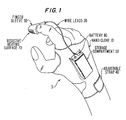
- heating apparatus 5 used in the present invention includes a glove 10, flexible and insulated wire leads 20 and finger sleeve 30.
- the wire leads 20 are preferably flexible and insulated.
- the glove 10 covers the palm and back of the hand and includes an adjustable strap 40 so that the glove may be snugly secured over the hand.
- the strap may be of the hook and loop type fastener or other conventional design.
- the glove 10 also contains a storage compartment 50 to hold an energy source in the form of a battery 60, although other energy sources may be alternatively employed.
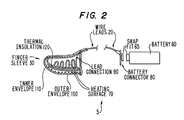
- the finger sleeve 30 includes a resistive heating surface 70 which generates heat in response to the energy from the battery 60.
- the resistive heating surface 70 is constructed of a material such as Kapton® which provides suitable heat in response to a low (9 volt) voltage from the battery 60.
- the battery 60 is connected through a snap-fit connector 65 to wire leads 20.
- the wire leads 20 connect through lead connection 90 to heating surface 70 at the finger sleeve 30.
- the lead connection 90 is permanent, as by crimping or soldering, or alternatively may be removable as with a mating plug.
- an outer latex envelope 100 and inner latex envelope 110 surround the heating surface 70.
- Thermal insulation 120 is placed between the inner envelope 110 and the heating surface 70.
- the finger of the laboratory technician is thus insulated fran any heat generated by the heating element by thermal insulation 120.
- the thermal insulation 120 is preferably foam or other conventional insulation.
- the heating surface 70 increases in temperature.
- the heat from surface 70 radiates through the outer envelope 100, and the technician may heat samples by merely touching the outer envelope 100 to the sample, or placing the outer envelope 100 in close proximity to the sample.
- the heating surface 70 is preferably contoured such that it conforms to surfaces which are perpendicular or parallel to the finger of the laboratory technician.
- Figure 3 is an example of use of the apparatus with a test tube 130 which has a drip gravity feed 140, and where the fluid is received in a petri dish 150. If it is desired to heat the contents of the test tube 130, to immediately obtain fluid for testing purposes, it is undesirable to use a conventional burner. This is because conventional burners are impractical in that the burner would have to be set up at the test tube location and adjusted to provide the proper temperature at the proper distance. Additionally, a burner would require proper orientation to prevent drops from the test tube from falling into the burner itself. Of course the flame from the burner, if not carefully controlled, could crack or break the test tube.
- the laboratory technician touches the outer envelope 100 of heating surface 70 to the test tube.
- the heat transfer causes the temperature of the contents of the test tube to rise and the drops of liquid are dispensed at an accelerated rate.
- the heating surface 70 is removed, the liquid cools to ambient temperature and resumes its prior output rate.
- the use of the present invention quickly increases the temperature of the sample to ambient temperature for dispensing of the sample.
- one laboratory technician may monitor numerous experiments in a quick and efficient manner, simply by contacting various containers with the heated finger sleeve.
- the present invention contemplates alterative methods for heating the sample.
- the heating element may be placed on the palm portion of the glove 10, rather than on a finger sleeve 30.
- the finger sleeve 30 may be supplied in a sterile packaging prior to use, to ensure that the sample is not contaminated.
- Multiple finger sleeves connected to one or more power sources may be used such that more than one finger sleeve contains a heating surface.
- a control may be installed to vary the current from the power source and consequently the temperature of the heating surface 70.
- An on/off switch may also be provided to the heating apparatus 5.
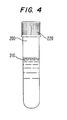
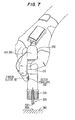
- a test tube 200 contains liquid 210 which may be blood that is suspected to contain a disease or infection, including the HIV virus.
- a rubber stopper 220 seals the test tube to prevent accidental spillage and to prevent contamination of the liquid 210.
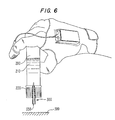
- a technician holds the test tube 200 and a cannula 300 is placed through the rubber stopper 220.
- This cannula 300 has a hollow channel 350 bored or formed therein and a pointed tip 354 to pierce through the rubber stopper 220.
- the stopper 220 may have a preformed hole therein for allowing insertion of the cannula 300.
- the term "pierce" is intended to cover all methods of inserting the cannula 300 through the rubber stopper 220. and includes both manual insertion of the cannula and insertion with a mechanized apparatus.
- the test tube 200 is inverted but the pressure inside of the test tube is equal to the pressure outside the test tube and no liquid is dispensed.
- the outer envelope 100 of the finger sleeve 30 is then placed in contact with the outer surface of the test tube 200. Heat from heating surface 70 is conducted onto the outer surface of the test tube 200. This heat is transferred though the wall of the test tube 200 and conducted to the liquid 210 within the test tube 200 to the liquid 210 which expands, causing an increase in pressure inside the test tube 200.
- a pressure differential is created between the inside and outside of the test tube 200, which forces liquid 210 to flow through channel 350 onto surface 380 as a sample 390.
- the apparatus and method include heating an air pocket 395 in the test tube in addition to, or instead of, heating the liquid 210. The expansion of heated air causes the creation of a pressure differential and forces liquid 210 through the channel 350.
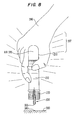
- the heating apparatus 5 has been eliminated and the technician holds the test tube 200.
- the body heat 397 from the hand of the technician heats the contents of the test tube 200, particularly the air pocket 395 and liquid 210.
- the resulting pressure differential forces sample liquid through channel 350.
- a sample 390 is disposed onto surface 380.
- a human hand wrapped around the test tube can provide a sufficient temperature differential to cause liquid to flow through the cannula 300.
- the test tube and its contents may be stored in a refrigerator.
- the resulting temperature differential when the refrigerated test tube 200 (containing refrigerated liquid 210) is held by a human hand will be higher than if the test tube 200 and liquid 210 were at room temperature.
- the refrigeration method may also be used to increase the effectiveness of dispensing a liquid sample when using the heating apparatus 5, as described with respect to Figures 4, 5, 6, and 7.
Landscapes
- Chemical & Material Sciences (AREA)
- Health & Medical Sciences (AREA)
- Clinical Laboratory Science (AREA)
- Chemical Kinetics & Catalysis (AREA)
- Analytical Chemistry (AREA)
- General Health & Medical Sciences (AREA)
- Hematology (AREA)
- Devices For Use In Laboratory Experiments (AREA)
- Sampling And Sample Adjustment (AREA)
Applications Claiming Priority (4)
| Application Number | Priority Date | Filing Date | Title |
|---|---|---|---|
| US1694296P | 1996-05-06 | 1996-05-06 | |
| US16942 | 1996-05-06 | ||
| US74704596A | 1996-11-12 | 1996-11-12 | |
| US747045 | 1996-11-12 |
Publications (2)
| Publication Number | Publication Date |
|---|---|
| EP0806646A2 true EP0806646A2 (de) | 1997-11-12 |
| EP0806646A3 EP0806646A3 (de) | 1998-09-09 |
Family
ID=26689248
Family Applications (1)
| Application Number | Title | Priority Date | Filing Date |
|---|---|---|---|
| EP97302978A Withdrawn EP0806646A3 (de) | 1996-05-06 | 1997-05-01 | Verfahren und Vorrichtung zur Erwärmung und Ausgabe einer flüssigen Probe |
Country Status (2)
| Country | Link |
|---|---|
| EP (1) | EP0806646A3 (de) |
| JP (1) | JPH10185771A (de) |
Family Cites Families (8)
| Publication number | Priority date | Publication date | Assignee | Title |
|---|---|---|---|---|
| DE3704757A1 (de) * | 1987-02-16 | 1988-08-25 | Klaus Winkler | Heizvorrichtung fuer laborgefaesse |
| GB8724618D0 (en) * | 1987-10-21 | 1987-11-25 | Deft Ltd | Micropipette |
| US5400923A (en) * | 1988-06-20 | 1995-03-28 | Helena Laboratories Corporation | Apparatus for discharging contents of a sealed container |
| FR2645410A1 (fr) * | 1989-04-10 | 1990-10-12 | Gonzalez Eric | Sous-gant chauffant autonome |
| FI89563C (fi) * | 1990-12-04 | 1993-10-25 | P Antti Manninen | El-uppvaermt reaktionskaerl |
| US5286453A (en) * | 1992-04-02 | 1994-02-15 | Pope Carolyn M | Device for dispensing a biological fluid from a sealed vacuum tube |
| US5397026A (en) * | 1993-01-21 | 1995-03-14 | Helena Laboratories Corporation | Method for discharging contents of a sealed container |
| US5700695A (en) * | 1994-06-30 | 1997-12-23 | Zia Yassinzadeh | Sample collection and manipulation method |
-
1997
- 1997-05-01 EP EP97302978A patent/EP0806646A3/de not_active Withdrawn
- 1997-05-06 JP JP11568097A patent/JPH10185771A/ja active Pending
Also Published As
| Publication number | Publication date |
|---|---|
| EP0806646A3 (de) | 1998-09-09 |
| JPH10185771A (ja) | 1998-07-14 |
Similar Documents
| Publication | Publication Date | Title |
|---|---|---|
| US6235010B1 (en) | Closed system specimen collection container | |
| US5700695A (en) | Sample collection and manipulation method | |
| DK169741B1 (da) | Prøvebeholder til legemsvæskeprøver | |
| CA1121681A (en) | Syringe like apparatus with removable capillary cartridge | |
| CN112790769B (zh) | 用于提取和收集使用者体液样本的样本收集装置、系统及方法 | |
| US5078970A (en) | Apparatus for withdrawing a liquid sample from a sample vessel and transferring it | |
| US20020041621A1 (en) | Temperature sensing device for selectively measuring temperature at desired locations along an intravenous fluid line | |
| US7845206B2 (en) | System, apparatus and method for dispensing chemical vapor | |
| US4244917A (en) | Sample pyrolysis oven | |
| JPS58129362A (ja) | オンカラム毛管ガスクロマトグラフ用インゼクタ | |
| BRPI0609898A2 (pt) | aparelho de recuperação e manchamento de antìgeno in situ, módulo de reação, método para tratar uma lámina de microscópio, e, tira de dispensação de reagente reconfigurável | |
| US12527555B2 (en) | Self-contained sampling device for processing whole blood | |
| EP1698354B1 (de) | Sterilisation bestätigendes testelement und testpackung | |
| NZ336056A (en) | Reaction elements for PCR amplification heated using conductive polymer films | |
| BR112019027771A2 (pt) | método, instrumento de extração, instrumento de distribuição e um kit para pré-tratamento de uma amostra biológica em particular | |
| CN113711056B (zh) | 具有移液器适配性的集成微流控设备 | |
| US6939514B1 (en) | Method and apparatus for dispensing and distributing biological sample | |
| US11690545B2 (en) | Systems and methods for mixing drawn fluids | |
| EP0806647A2 (de) | Verfahren und Vorrichtung zur Erwärmung und Ausgabe einer flüssigen Probe | |
| JP4354459B2 (ja) | 試薬収容容器 | |
| JPH10185771A (ja) | 液体サンプル分注方法及びこの方法を実施する加熱装置 | |
| EP0371574B1 (de) | Tupfer-Transportvorrichtung | |
| US20250146983A1 (en) | Device for a gas chromatograph, in particular a temperature gradient gas chromatograph, and gas chromatograph having such a device | |
| JPS60111958A (ja) | 試料びん保温装置 | |
| JPH1010104A (ja) | シリンジ計量器 |
Legal Events
| Date | Code | Title | Description |
|---|---|---|---|
| PUAI | Public reference made under article 153(3) epc to a published international application that has entered the european phase |
Free format text: ORIGINAL CODE: 0009012 |
|
| AK | Designated contracting states |
Kind code of ref document: A2 Designated state(s): DE FR GB IT |
|
| PUAL | Search report despatched |
Free format text: ORIGINAL CODE: 0009013 |
|
| AK | Designated contracting states |
Kind code of ref document: A3 Designated state(s): DE FR GB IT |
|
| 16A | New documents despatched to applicant after publication of the search report | ||
| STAA | Information on the status of an ep patent application or granted ep patent |
Free format text: STATUS: THE APPLICATION HAS BEEN WITHDRAWN |
|
| 18W | Application withdrawn |
Withdrawal date: 19981008 |