EP0805989B1 - Verfahren zur verbesserung von durch radar erfassten daten - Google Patents
Verfahren zur verbesserung von durch radar erfassten daten Download PDFInfo
- Publication number
- EP0805989B1 EP0805989B1 EP95937276A EP95937276A EP0805989B1 EP 0805989 B1 EP0805989 B1 EP 0805989B1 EP 95937276 A EP95937276 A EP 95937276A EP 95937276 A EP95937276 A EP 95937276A EP 0805989 B1 EP0805989 B1 EP 0805989B1
- Authority
- EP
- European Patent Office
- Prior art keywords
- radar
- function
- frequency
- interference
- fourier
- Prior art date
- Legal status (The legal status is an assumption and is not a legal conclusion. Google has not performed a legal analysis and makes no representation as to the accuracy of the status listed.)
- Expired - Lifetime
Links
- 238000000034 method Methods 0.000 title claims description 19
- 238000001228 spectrum Methods 0.000 claims description 9
- 238000012544 monitoring process Methods 0.000 claims description 4
- 230000006870 function Effects 0.000 description 12
- 230000005540 biological transmission Effects 0.000 description 6
- 238000001914 filtration Methods 0.000 description 4
- 230000035772 mutation Effects 0.000 description 4
- 230000015556 catabolic process Effects 0.000 description 2
- 238000006731 degradation reaction Methods 0.000 description 2
- 230000001419 dependent effect Effects 0.000 description 2
- 230000000694 effects Effects 0.000 description 1
- 238000002474 experimental method Methods 0.000 description 1
- 238000002310 reflectometry Methods 0.000 description 1
- 230000011514 reflex Effects 0.000 description 1
- 230000000717 retained effect Effects 0.000 description 1
- 230000035945 sensitivity Effects 0.000 description 1
- 230000003595 spectral effect Effects 0.000 description 1
- 230000001131 transforming effect Effects 0.000 description 1
- 239000011800 void material Substances 0.000 description 1
Images


Classifications
-
- G—PHYSICS
- G01—MEASURING; TESTING
- G01S—RADIO DIRECTION-FINDING; RADIO NAVIGATION; DETERMINING DISTANCE OR VELOCITY BY USE OF RADIO WAVES; LOCATING OR PRESENCE-DETECTING BY USE OF THE REFLECTION OR RERADIATION OF RADIO WAVES; ANALOGOUS ARRANGEMENTS USING OTHER WAVES
- G01S7/00—Details of systems according to groups G01S13/00, G01S15/00, G01S17/00
- G01S7/02—Details of systems according to groups G01S13/00, G01S15/00, G01S17/00 of systems according to group G01S13/00
- G01S7/36—Means for anti-jamming, e.g. ECCM, i.e. electronic counter-counter measures
-
- G—PHYSICS
- G01—MEASURING; TESTING
- G01S—RADIO DIRECTION-FINDING; RADIO NAVIGATION; DETERMINING DISTANCE OR VELOCITY BY USE OF RADIO WAVES; LOCATING OR PRESENCE-DETECTING BY USE OF THE REFLECTION OR RERADIATION OF RADIO WAVES; ANALOGOUS ARRANGEMENTS USING OTHER WAVES
- G01S13/00—Systems using the reflection or reradiation of radio waves, e.g. radar systems; Analogous systems using reflection or reradiation of waves whose nature or wavelength is irrelevant or unspecified
- G01S13/88—Radar or analogous systems specially adapted for specific applications
- G01S13/89—Radar or analogous systems specially adapted for specific applications for mapping or imaging
- G01S13/90—Radar or analogous systems specially adapted for specific applications for mapping or imaging using synthetic aperture techniques, e.g. synthetic aperture radar [SAR] techniques
-
- G—PHYSICS
- G01—MEASURING; TESTING
- G01S—RADIO DIRECTION-FINDING; RADIO NAVIGATION; DETERMINING DISTANCE OR VELOCITY BY USE OF RADIO WAVES; LOCATING OR PRESENCE-DETECTING BY USE OF THE REFLECTION OR RERADIATION OF RADIO WAVES; ANALOGOUS ARRANGEMENTS USING OTHER WAVES
- G01S7/00—Details of systems according to groups G01S13/00, G01S15/00, G01S17/00
- G01S7/02—Details of systems according to groups G01S13/00, G01S15/00, G01S17/00 of systems according to group G01S13/00
- G01S7/28—Details of pulse systems
- G01S7/285—Receivers
- G01S7/288—Coherent receivers
- G01S7/2883—Coherent receivers using FFT processing
Definitions
- the present invention relates to a method of improving data obtained by radar.
- a problem that may arise in the context of radars is that the reception of radar signals can be jammed by radio and television transmissions.
- CARABAS® wide band low-frequency radar of the type that is called CARABAS® and is the subject matter of Swedish Patent No. 8406007-8 (456,117) and European Patent 86900306.1 (202,320)
- the signal intensity of at least local radio and TV stations is, at the frequencies thereof, much higher than the signal intensity of CARABAS at the corresponding frequencies.
- the received radar data will be fragmented into a number of bands which are independent of each other and between which interference from radio transmissions etc. has caused gaps void of relevant radar data.
- radar data from which the actual image is obtained by an inverse two-dimensional Fourier transform.
- the SAR image is obtained from radar raw data by a process which associates the transmitted frequency and the Doppler frequency of these data with the azimuth and radial frequencies of the image spectrum, respectively.
- Radio transmissions etc. will appear as concentric rings of destroyed data in this two-dimensional spectrum. The radial frequency of the rings will correspond to the transmitted frequencies at which interference occurs.
- the image is characterised by a highly non-uniform amplitude distribution, which in the ideal case consists of discrete, stronger reflectors against a background of weak reflectors of uniform strength.
- the strong reflectors are the targets that are to be detected by the radar.
- the amplitude value therefore is set to zero in these points.
- Radar data may then be considered the joint result of two processes, viz. one corresponding to ideal radar data, and another which is an error process which precisely cancels these data in the jammed intervals. Both processes have a random phase. Because of the random phase, the power ratio between the error process and the ideal process is the ratio between the missing points and all points. If half of the points are missing, the relative error thus is - 3 dB. This ratio is here called relative error power which is abbreviated to REP.
- the situation may therefore be improved by assuming that the strongest reflectors are the only ones.
- the side lobes from the strongest reflectors will diminish, such that the threshold for eliminating false values can be lowered. It is then possible to make a second iteration, including a wider range of strong reflectors to establish a better estimate of the spectrum at the missing frequencies. This entails that the side lobe levels drop further etc.
- the invention thus relates to a method of improving data obtained by radar by interpolating over frequency bands jammed by narrow-band interference, i.e. interference having a smaller band width than the band width of the received radar reflex, and may in a concentrated fashion be described as follows.
- narrow-band interference i.e. interference having a smaller band width than the band width of the received radar reflex
- a radar signal is produced in a radar transmitter and is transmitted via an aerial system.
- the radar return is received via an aerial system in a radar receiver and is processed in a signal processing device. Then the following steps (A) - (J) are carried out.
- the corresponding steps can be carried out in two dimensions.
- the narrow-band interference occurs as jammed intervals in the Fourier transform of the SAR image.
- the jammed intervals have the character of concentric rings in the two-dimensional spectrum, i.e. they appear as jammed intervals in the interval ⁇ ⁇ ⁇ i 2 + ⁇ j 2 ⁇ ⁇ ', wherein the pairs of values ⁇ , ⁇ ' represent each individual interference band.
- Steps (A) - (J) will have the following contents.
- N M the closest integer of i.e. such that N M ⁇ N/2.
- N the closest integer of i.e. such that N M ⁇ N/2.
- NxN square
- N'xN rectangular image
- a rectangular image can be seen as the interesting part of a larger square image.
- the missing rings are to be found as segments of a circle in the image.
- it is always possible to go from a rectangular image to a square by embedding the rectangular image in a square image and filling the rest of the square image with zeros in respect of signals.
- the invention has been implemented by means of the graphic shell LabView 2 from National Instruments to the programming language C and will be described by using symbols created by means of this program.
- the names of the various subroutines included in the program have been inspired by a superficial analogy with Darwinistic evolution. There is, of course, no real connection.
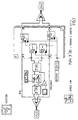
- the basic subroutine is in this spirit called "Jungle Law" and is graphically represented in Fig. 1.
- the program is composed of routines that either retain the various values in a real bipolar array or set them to zero. The fact that decides whether an element in the array is to be retained or not is whether the value exceeds a threshold value or not.
- the array is sorted in order of increasing magnitude and is reversed to be sorted in order of rank.
- a predetermined rank number sets the threshold value above which data values will be left unchanged. Thus assuming that two similar array values do not exist, the number of non-zero values will agree with the rank number of the threshold value.
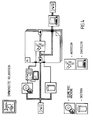
- the next level is the program "Mutation”, which fills in the missing frequency data and is shown in Fig. 2.
- the input value is the complex array of frequency-dependent data, the rank number of the threshold value and the array of missing frequencies.
- an image array is obtained as the real part after an inverse FFT (Fast Fourier Transform).
- the "Jungle Law” is allowed to have effect on this to keep only the strongest image array values non-zero.
- frequency data are obtained by a forward FFT. Values are picked from this array and are allowed to replace the values that are to be found in the array positions that have been listed as points having no frequency data.
- the positions are obtained from the program "Dustbin", see below.
- the program that lowers the rank number of the threshold value in the iteration is called "Geometric Machine” and is shown in Fig. 3.
- the input value of the program is again the complex array of frequency data. The only information from these data that is used is the length of the array.
- the rank number of the threshold value is obtained from a shift register, which is originally set to unity. When the program is activated, it replaces the value in the shift register by this value multiplied by two as long as this value is less than half the length of the array. All the values occurring in the shift register are collected to an output array representing the sequence of the rank numbers of the threshold values.
- the last step is the main routine "Darwinistic Relaxation” which is shown in Fig. 4.
- the programs “Mutation” and “Geometric Machine” it also uses the programs “Dustbin” and “Inversion”. In their present form, they are easily described.
- Dustbin is a subroutine which checks in which array positions the frequency-dependent data array is zero, and returns them as an array.
- "Inversion” contains a one-dimensional FFT only and picks out the real part of the FFT which it adapts to graphical display after selecting a suitable parameter.
- a simple technique of determining where interference occurs is to quite simply listen to received signals parallel to the radar receiver. It is also possible to detect broadcast interference by transforming a SAR image into histograms of frequency data. These would yield a sharp threshold value which divides received amplitudes into probable radar data and probable interference.
- the filtering program implemented in LabView as above has been tested on simulated data.
- the input values were histograms of SAR images and their one-dimensional counterparts and radio transmission statistics.
- a REP value which is tolerable for SAR images is less than -10 dB.
- the result of the filtering by "Darwinistic Relaxation” meant a reduction of REP, in such a manner that if 30-40% of the available bandwidth is jammed by radio interference, “Darwinistic Relaxation” results all the same in usable images. Without filtering, only 5-10% of the bandwidth can be missing. In other words, at 30-40% fallout, the REP value is reduced by the filtering so as to be comparable with the REP value at 5-10% fallout without filtering.
Landscapes
- Engineering & Computer Science (AREA)
- Computer Networks & Wireless Communication (AREA)
- Physics & Mathematics (AREA)
- General Physics & Mathematics (AREA)
- Radar, Positioning & Navigation (AREA)
- Remote Sensing (AREA)
- Radar Systems Or Details Thereof (AREA)
- Complex Calculations (AREA)
Claims (6)
- Verfahren zur Verbesserung von mit Hilfe von Radar erfaßten Daten durch Interpolation über Frequenzbänder, welche durch eine eine kleinere Bandbreite als die Bandbreite der empfangenen Radarinformation aufweisende Interferenz gestört ist, wobei das Verfahren die Erzeugung eines Radarsignals in einem Radarsender, die Übertragung des Radarsignals über ein Antennensystem, den Empfang der Radarinformationen über ein Antennensystem in einem Radarempfänger und die Verarbeitung der Radarinformation in einer Signalverarbeitungsvorrichtung umfaßt und durch Überwachung oder auf andere Art und Weise bestimmt, welche Frequenzwerte durch die Interferenz beeinträchtigt sind, wobei das Verfahren gekennzeichnet ist durch:(A) eine Fourier-Transformation einer jeden Radarinformation, welche kontinuierlich rechtzeitig verbunden wird und durch ein zeitdiskretes echtes oder komplexes Signal f(ti), das den Abtastwert N aufweist, i = 1, 2,..., N, dargestellt ist, in eine frequenzdiskrete Funktion F(ωi), welche durch den Abtastwert N, wobei i = 1,2,...,N ist, gegeben ist.(B) Festlegen einer Reihe von ganzen Zahlen N1, N2,..., NM, so daß 1 ≤ N1 < N2 < ... <NM<N;(C) Modifizieren von F(ωi) auf eine Funktion Fk(ωi) durch die Signalverarbeitungsvorrichtung, welche die Funktion Fk(ωi) = F(ωi) außerhalb von eine Interferenz aufweisenden Intervallen und die Funktion Fk(ωi) = Hk(ωi) innerhalb von Intervallen mit einer Interferenz einstellt;(D) Gleichsetzen von H1(ωi) mit 0 und Festlegen von Hk(ωi) für k ≥ 2 gemäß den nachfolgenden Schritten (E) - (G);(E) umgekehrte Fourier-Transformation von Fk-1(ωi) in eine zeitdiskrete Funktion fk-1(ti);(F) Modifizieren von fk-1(ti) in eine Funktion hk(ti) durch die Signalverarbeitungsvorrichtung, die hk(ti) = fk-1(ti) für i = 1, 2, ..., Nk-1 setzt, wobei |fk-1(ti)| die Nk-1 größten Werte für |fk-1(ti)| darstellt und hk(ti) = 0 für die verbleibenden N - Nk-1 Werte der Funktion;(G) eine Fourier-Transformation von hk(ti) in eine frequenzdiskrete Funktion Hk(ωi);(H) und die Wiederholung der Schritte (C) - (G) M-mal, wobei 1 ≤ k ≤ M ist; und schließlich(I) eine umgekehrte Fourier-Transformation der Funktion FN
M (ωi) zur Ausgabe der schließlich ausgefilterten Radarinformation fNM (ti). - Verfahren nach Anspruch 1, dadurch gekennzeichnet, daß die Zahlen N1, N2,..., NM in Schritt (A) gemäß der Gleichung Nk = 2k-1 selektiert werden, wobei k die ganze Zahl 1 ≤ k ≤ M ist.
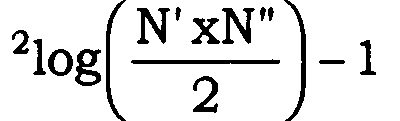
- Verfahren nach Anspruch 2, dadurch gekennzeichnet, daß die Anzahl M als die nächstliegende ganze Zahl vonselektiert wird.

- Verfahren zur Verbesserung eines Radarbildes in einem SAR-Radargerät durch Interpolation über Frequenzbänder in Form von gestörten Intervallen, welche den Charakter konzentrischer Ringe in einem zweidimensionalen Frequenzspektrum aufweisen, in welchem die Radialfrequenz der Ringe den übertragenen Frequenzen, bei welchen die Störung auftritt, entsprechen, wobei das Verfahren die Erzeugung eines Radarsignals in einem Radarsender, die Übertragung des Radarsignals über ein Antennensystem, den Empfang der Radarinformation über ein Antennensystem in einem Radarempfänger und die Verarbeitung der Radarinformation in einer Signalverarbeitungsvorrichtung umfaßt, welche unter anderem die Bildung eines zweidimensionalen Radarbildes aufweist, und durch Überwachung oder auf andere Art und Weise bestimmt, welche Frequenzwerte durch die Interferenz beeinträchtigt sind, wobei das Verfahren
gekennzeichnet ist durch:(A) die Beschreibung des Bildes mit Hilfe eines zeitdiskreten echten oder komplexen Signals f(xi,yj), welches den N' x N" Abtastwert aufweist, wobei i = 1, 2,..., N', j = 1, 2,..., N" ist, und in eine frequenzdiskrete Funktion F(ωi, µj) Fourier-transformiert wird, welche durch den N' x N"-Abtastwert dargestellt ist, wobei i = 1, 2,..., N', j = 1, 2,..., N" ist;(B) die Festlegung einer Reihe von ganzen Zahlen N1, N2,...NM, so daß 1 ≤ N1 < N2<....<NM<N'xN";(C) die Modifizierung von F(ωi, µj) auf eine Funktion Fk(ωi, µj) mit Hilfe der Signalverarbeitungsvorrichtung, welche die Funktion Fk(ωi,µj) = F(ωi, µj) außerhalb von Intervallen festlegt, welche eine Interferenz aufweisen, und die Funktion Fk(ωi, µj) = Hk(ωi, µj) innerhalb von Intervallen mit Interferenz;(D) die Gleichsetzung von H1(wi, µj) mit 0 und die Bildung von Hk(ωi, µj) für k ≥ 2 gemäß den folgenden Schritten (E) - (G);(E) eine umgekehrte Fourier-Transformation der Funktion Fk-1(ωi, µj) in eine zeitdiskrete Funktion fk-1(xi, yj);(F) die Modifikation von fk-1(xi, yj) in eine Funktion hk(xi, yj) durch die Signalverarbeitungsvorrichtung, die hk(xi, yj) = fk-1(xi, yj) für i = 1,2,..., Nk-1 setzt, wobei |fk-1(xi, yj)| die Nk-1 größten Werte von |fk-1(xi, yj)| darstellt und hk(xi, yj) = 0 für die verbleibenden N-Nk-1 Werte der Funktion ist;(G) eine Fourier-Transformation von hk(xi, yj) in eine frequenz-diskrete Funktion Hk(ωi, µj);(H) und die Wiederholung der Schritte (C) - (G) M-mal, wobei 1 ≤ k ≤ M ist, und schließlich(I) eine umgekehrte Fourier-Transformation FNM (ωi, µj) zur Ausgabe des schließlich ausgefilterten Radarbildes fNM (xi, yj). - Verfahren nach Anspurch 4, dadurch gekennzeichnet, daß die Zahlen N1, N2,..., NM in Schritt (A) gemäß der Gleichung Nk = 2k-1 selektiert werden, wobei k die ganze Zahl 1 ≤ k ≤ M ist.
- Verfahren nach Anspruch 5, dadurch gekennzeichnet, daß die Anzahl M als die nächstgelegene ganze Zahl vonselektiert wird.
Applications Claiming Priority (3)
| Application Number | Priority Date | Filing Date | Title |
|---|---|---|---|
| SE9403872 | 1994-11-10 | ||
| SE9403872A SE503650C2 (sv) | 1994-11-10 | 1994-11-10 | Sätt att vid en radar förbättra radardata |
| PCT/SE1995/001339 WO1996015462A1 (en) | 1994-11-10 | 1995-11-10 | Method of improving data obtained by a radar |
Publications (2)
| Publication Number | Publication Date |
|---|---|
| EP0805989A1 EP0805989A1 (de) | 1997-11-12 |
| EP0805989B1 true EP0805989B1 (de) | 2001-03-28 |
Family
ID=20395925
Family Applications (1)
| Application Number | Title | Priority Date | Filing Date |
|---|---|---|---|
| EP95937276A Expired - Lifetime EP0805989B1 (de) | 1994-11-10 | 1995-11-10 | Verfahren zur verbesserung von durch radar erfassten daten |
Country Status (7)
| Country | Link |
|---|---|
| US (1) | US5861835A (de) |
| EP (1) | EP0805989B1 (de) |
| JP (1) | JP3532924B2 (de) |
| CA (1) | CA2204742C (de) |
| DE (1) | DE69520508T2 (de) |
| SE (1) | SE503650C2 (de) |
| WO (1) | WO1996015462A1 (de) |
Families Citing this family (8)
| Publication number | Priority date | Publication date | Assignee | Title |
|---|---|---|---|---|
| GB2299214B (en) * | 1995-03-24 | 1999-09-15 | Commw Of Australia | Signal processing |
| KR100488028B1 (ko) * | 1996-10-17 | 2005-05-09 | 사브테크 일렉트로닉스 아베 | Fmcw형 레이더 유닛에서의 간섭 제거 방법 |
| DE19822957C1 (de) * | 1998-05-22 | 2000-05-25 | Deutsch Zentr Luft & Raumfahrt | Verfahren zur Detektion und Unterdrückung von Störsignalen in SAR-Daten und Einrichtung zur Durchführung des Verfahrens |
| US6094160A (en) * | 1999-06-10 | 2000-07-25 | Delco Electronics Corp. | Interference rejection method for an automotive radar CW/ICC system |
| US6608586B1 (en) * | 2002-07-25 | 2003-08-19 | Sandia Corporation | Method for removing RFI from SAR images |
| US7397418B1 (en) * | 2006-06-05 | 2008-07-08 | Sandia Corporation | SAR image formation with azimuth interpolation after azimuth transform |
| CN103163505B (zh) * | 2013-01-31 | 2014-12-03 | 西安电子科技大学 | 基于jade的时变窄带干扰抑制方法 |
| CN106950554B (zh) * | 2017-03-21 | 2019-04-12 | 中国人民解放军国防科学技术大学 | 实现振动干扰条件下旋转目标参数估计的方法 |
Family Cites Families (18)
| Publication number | Priority date | Publication date | Assignee | Title |
|---|---|---|---|---|
| US4471357A (en) * | 1981-10-26 | 1984-09-11 | The United States Of America As Represented By The Administrator Of The National Aeronautics And Space Administration | Pipelined digital SAR azimuth correlator using hybrid FFT/transversal filter |
| US4612545A (en) * | 1981-12-03 | 1986-09-16 | Itek Corporation | Automatic frequency identifier for radar signals |
| JPS6020162A (ja) * | 1983-07-15 | 1985-02-01 | Hitachi Ltd | 合成開口レ−ダ画像再生処理方式 |
| USH741H (en) * | 1984-07-12 | 1990-02-06 | The United States Of America As Represented By The Secretary Of The Air Force | Discrete complex correlation device for obtaining subpixel accuracy |
| GB8700973D0 (en) * | 1987-01-17 | 1987-07-08 | Scicon Ltd | Aperture synthesis |
| US4901082A (en) | 1988-11-17 | 1990-02-13 | Grumman Aerospace Corporation | Adaptive waveform radar |
| US5128679A (en) * | 1989-02-21 | 1992-07-07 | Moffat William V | Electronic combat effectiveness monitor |
| US5061931A (en) * | 1990-07-23 | 1991-10-29 | Selenia Industrie Elettroniche Associate S.P.A. | Recursive system for image forming by means of a spotlight synthetic aperture radar |
| US5235338A (en) * | 1990-10-31 | 1993-08-10 | Hsiao Stephen S | Moving target detection through range cell migration radar |
| GB9103945D0 (en) * | 1991-02-26 | 1991-06-12 | Philips Electronic Associated | Linearizing a swept-frequency radar |
| DE4122592C1 (de) * | 1991-07-08 | 1993-01-28 | Deutsche Forschungsanstalt Fuer Luft- Und Raumfahrt Ev, 5300 Bonn, De | |
| US5179383A (en) * | 1991-07-15 | 1993-01-12 | Raney R K | Synthetic aperture radar processor to handle large squint with high phase and geometric accuracy |
| US5138322A (en) * | 1991-08-20 | 1992-08-11 | Matrix Engineering, Inc. | Method and apparatus for radar measurement of ball in play |
| US5248976A (en) * | 1991-11-27 | 1993-09-28 | Hughes Aircraft Company | Multiple discrete autofocus |
| US5410750A (en) * | 1992-02-24 | 1995-04-25 | Raytheon Company | Interference suppressor for a radio receiver |
| US5508605A (en) * | 1994-05-24 | 1996-04-16 | Alliedsignal Inc. | Method for measuring RF pulse frequency |
| DE4427657C2 (de) * | 1994-08-05 | 1996-10-24 | Deutsche Forsch Luft Raumfahrt | Verfahren zur Bilderzeugung mittels einer zweidimensionalen Datenverarbeitung bei einem Radar mit synthetischer Apertur |
| US5592170A (en) * | 1995-04-11 | 1997-01-07 | Jaycor | Radar system and method for detecting and discriminating targets from a safe distance |
-
1994
- 1994-11-10 SE SE9403872A patent/SE503650C2/sv not_active IP Right Cessation
-
1995
- 1995-11-10 EP EP95937276A patent/EP0805989B1/de not_active Expired - Lifetime
- 1995-11-10 CA CA002204742A patent/CA2204742C/en not_active Expired - Lifetime
- 1995-11-10 WO PCT/SE1995/001339 patent/WO1996015462A1/en not_active Ceased
- 1995-11-10 US US08/836,353 patent/US5861835A/en not_active Expired - Lifetime
- 1995-11-10 JP JP51598496A patent/JP3532924B2/ja not_active Expired - Fee Related
- 1995-11-10 DE DE69520508T patent/DE69520508T2/de not_active Expired - Lifetime
Also Published As
| Publication number | Publication date |
|---|---|
| WO1996015462A1 (en) | 1996-05-23 |
| US5861835A (en) | 1999-01-19 |
| SE503650C2 (sv) | 1996-07-22 |
| JP3532924B2 (ja) | 2004-05-31 |
| CA2204742C (en) | 2007-01-09 |
| DE69520508T2 (de) | 2001-10-11 |
| DE69520508D1 (de) | 2001-05-03 |
| SE9403872L (sv) | 1996-05-11 |
| CA2204742A1 (en) | 1996-05-23 |
| JPH10508941A (ja) | 1998-09-02 |
| EP0805989A1 (de) | 1997-11-12 |
Similar Documents
| Publication | Publication Date | Title |
|---|---|---|
| DE69937268T2 (de) | Funkkommunikationssystem mit einer Raum-Zeit-Architektur unter Verwendung von Multielementantennen sowohl beim Sender als auch beim Empfänger | |
| EP0805989B1 (de) | Verfahren zur verbesserung von durch radar erfassten daten | |
| DE4447230A1 (de) | Aufwärtsverbindungs-Zugriffsvorrichtung in einem Direktsequenz-Codeunterteilungs-Mehrfach- zugriffs-System | |
| CN102279389A (zh) | 雷达接收信号处理装置及其方法 | |
| EP0396662A1 (de) | Radar mit anpassbarer wellenform. | |
| DE102015210454A1 (de) | Verfahren zum Betreiben einer Radarvorrichtung | |
| CN112881984B (zh) | 一种雷达信号抗干扰处理方法、装置及存储介质 | |
| WO2001057955A1 (en) | Partially coherent beamformer for sparse, irregular arrays | |
| WO2021161551A1 (ja) | レーダ装置 | |
| US6400779B1 (en) | Estimating CIR using correlation with line removal | |
| CN87103288A (zh) | 在短波无线电网络中进行通信的方法和所使用的设备 | |
| DE112018007500B4 (de) | Radareinrichtung | |
| RU2216748C2 (ru) | Способ распознавания сигналов систем радиосвязи | |
| Suzuki et al. | Optimizing PN-Sequences with Genetic Algorithm for SAR Waveform Diversity | |
| DE112018006295T5 (de) | Radarvorrichtung und anomaliebestimmungsprogramm | |
| JP4377772B2 (ja) | レーダ装置 | |
| JPH10206524A (ja) | 目標検出装置 | |
| WO2025217913A1 (en) | Passive intermodulation avoidance in a radio transceiver device | |
| US4371973A (en) | Apparatus for transforming, transferring and re-transforming of a sampled signal | |
| RU2731132C1 (ru) | Способ передачи дискретной информации по каналу связи с многолучевым распространением с использованием результатов его тестирования | |
| JP3886797B2 (ja) | トーン検出器 | |
| Chandler et al. | Development and evaluation of an LPI figure of merit for direct-sequence and frequency-hop systems | |
| AU651663B2 (en) | Back-scatter sounding | |
| Tian et al. | Statistical analysis of split spectrum processing | |
| RU2633984C1 (ru) | Способ оценки помехозащищенности линий радиосвязи приемного радиоцентра |
Legal Events
| Date | Code | Title | Description |
|---|---|---|---|
| PUAI | Public reference made under article 153(3) epc to a published international application that has entered the european phase |
Free format text: ORIGINAL CODE: 0009012 |
|
| 17P | Request for examination filed |
Effective date: 19970606 |
|
| AK | Designated contracting states |
Kind code of ref document: A1 Designated state(s): CH DE FR GB IT LI |
|
| 17Q | First examination report despatched |
Effective date: 19991108 |
|
| GRAG | Despatch of communication of intention to grant |
Free format text: ORIGINAL CODE: EPIDOS AGRA |
|
| GRAG | Despatch of communication of intention to grant |
Free format text: ORIGINAL CODE: EPIDOS AGRA |
|
| GRAH | Despatch of communication of intention to grant a patent |
Free format text: ORIGINAL CODE: EPIDOS IGRA |
|
| GRAH | Despatch of communication of intention to grant a patent |
Free format text: ORIGINAL CODE: EPIDOS IGRA |
|
| GRAA | (expected) grant |
Free format text: ORIGINAL CODE: 0009210 |
|
| AK | Designated contracting states |
Kind code of ref document: B1 Designated state(s): CH DE FR GB IT LI |
|
| PG25 | Lapsed in a contracting state [announced via postgrant information from national office to epo] |
Ref country code: IT Free format text: LAPSE BECAUSE OF FAILURE TO SUBMIT A TRANSLATION OF THE DESCRIPTION OR TO PAY THE FEE WITHIN THE PRESCRIBED TIME-LIMIT;WARNING: LAPSES OF ITALIAN PATENTS WITH EFFECTIVE DATE BEFORE 2007 MAY HAVE OCCURRED AT ANY TIME BEFORE 2007. THE CORRECT EFFECTIVE DATE MAY BE DIFFERENT FROM THE ONE RECORDED. Effective date: 20010328 |
|
| REG | Reference to a national code |
Ref country code: CH Ref legal event code: EP |
|
| REF | Corresponds to: |
Ref document number: 69520508 Country of ref document: DE Date of ref document: 20010503 |
|
| ET | Fr: translation filed | ||
| REG | Reference to a national code |
Ref country code: CH Ref legal event code: NV Representative=s name: MICHELI & CIE INGENIEURS-CONSEILS |
|
| REG | Reference to a national code |
Ref country code: GB Ref legal event code: IF02 |
|
| PLBE | No opposition filed within time limit |
Free format text: ORIGINAL CODE: 0009261 |
|
| STAA | Information on the status of an ep patent application or granted ep patent |
Free format text: STATUS: NO OPPOSITION FILED WITHIN TIME LIMIT |
|
| 26N | No opposition filed | ||
| PGFP | Annual fee paid to national office [announced via postgrant information from national office to epo] |
Ref country code: GB Payment date: 20141128 Year of fee payment: 20 Ref country code: CH Payment date: 20141120 Year of fee payment: 20 Ref country code: DE Payment date: 20141122 Year of fee payment: 20 |
|
| PGFP | Annual fee paid to national office [announced via postgrant information from national office to epo] |
Ref country code: FR Payment date: 20141127 Year of fee payment: 20 |
|
| REG | Reference to a national code |
Ref country code: DE Ref legal event code: R071 Ref document number: 69520508 Country of ref document: DE |
|
| REG | Reference to a national code |
Ref country code: CH Ref legal event code: PL |
|
| REG | Reference to a national code |
Ref country code: GB Ref legal event code: PE20 Expiry date: 20151109 |
|
| PG25 | Lapsed in a contracting state [announced via postgrant information from national office to epo] |
Ref country code: GB Free format text: LAPSE BECAUSE OF EXPIRATION OF PROTECTION Effective date: 20151109 |