EP0805877B1 - Verbesserte methode zur selektion spezifischer bakteriophagen - Google Patents
Verbesserte methode zur selektion spezifischer bakteriophagen Download PDFInfo
- Publication number
- EP0805877B1 EP0805877B1 EP96901168A EP96901168A EP0805877B1 EP 0805877 B1 EP0805877 B1 EP 0805877B1 EP 96901168 A EP96901168 A EP 96901168A EP 96901168 A EP96901168 A EP 96901168A EP 0805877 B1 EP0805877 B1 EP 0805877B1
- Authority
- EP
- European Patent Office
- Prior art keywords
- ligand
- phage
- protein
- gene iii
- gene
- Prior art date
- Legal status (The legal status is an assumption and is not a legal conclusion. Google has not performed a legal analysis and makes no representation as to the accuracy of the status listed.)
- Expired - Lifetime
Links
Images
Classifications
-
- C—CHEMISTRY; METALLURGY
- C40—COMBINATORIAL TECHNOLOGY
- C40B—COMBINATORIAL CHEMISTRY; LIBRARIES, e.g. CHEMICAL LIBRARIES
- C40B40/00—Libraries per se, e.g. arrays, mixtures
- C40B40/02—Libraries contained in or displayed by microorganisms, e.g. bacteria or animal cells; Libraries contained in or displayed by vectors, e.g. plasmids; Libraries containing only microorganisms or vectors
-
- C—CHEMISTRY; METALLURGY
- C12—BIOCHEMISTRY; BEER; SPIRITS; WINE; VINEGAR; MICROBIOLOGY; ENZYMOLOGY; MUTATION OR GENETIC ENGINEERING
- C12N—MICROORGANISMS OR ENZYMES; COMPOSITIONS THEREOF; PROPAGATING, PRESERVING, OR MAINTAINING MICROORGANISMS; MUTATION OR GENETIC ENGINEERING; CULTURE MEDIA
- C12N15/00—Mutation or genetic engineering; DNA or RNA concerning genetic engineering, vectors, e.g. plasmids, or their isolation, preparation or purification; Use of hosts therefor
- C12N15/09—Recombinant DNA-technology
- C12N15/10—Processes for the isolation, preparation or purification of DNA or RNA
- C12N15/1034—Isolating an individual clone by screening libraries
- C12N15/1037—Screening libraries presented on the surface of microorganisms, e.g. phage display, E. coli display
Definitions
- This invention relates to the selection of specific binding proteins and their genes using a new mutant bacteriophage in phage display techniques.
- WO 95/16027 we described a method of selection of antigenic or other specific binding protein molecules, and their encoding DNA, by means of a phage display package produced by co-expression of a phagemid vector and a helper phage, in which the DNA encoding the binding peptide is inserted into the phagemid vector so as to be expressed as a fusion with a truncated phage gene III protein.
- the resulting display package lacks functional protein III, and is therefore not infectious, but it can be selectively rendered infectious by means of a fusion protein comprising functional protein III and the complementary binding partner for the specific binding protein present on the surface of the phage display package.
- the function of the helper phage is to provide the genes necessary for packaging the expression products of the phagemid; but it will be deficient in gene III so that the resulting phage display package will not contain functional gene III.
- helper phage used was a derivative of phage Fd tet, known as fKN16, which had a deletion of 507 nucleotides in gene III.
- fKN16 a derivative of phage Fd tet having a 1121 nucleotide deletion in gene III between nucleotides 1525 and 2646.
- This region contains a number of functional motifs. For example, as well as the promoter for gene III, there is at least one transcription termination sequence. Precisely what aspect of the small IG region is important remains to be seen, but the minimum sequence required from this region could if desired be determined by routine experimentation.
- the M13 KO7 phage contains the kanamycin resistance gene and the p15A origin of replication inserted in the large IG region of the phage. It is believed that this too could play a significant part in the advantage which the M13 phage has over the Fd phage in the procedure of the present invention. In that case, Fd-type or other phages could be modified to incorporate an insert into the large IG region which is similar to part or all of that present in M13 KO7.
- the main aim of the present invention is to make available a highly efficient helper phage . It has been found that a surprisingly much more efficient selection of the phages expressing a specific binding protein or ligand I on their surface can be achieved by using a bacteriophage mutant, wherein the gene III promoter (included a small intergenic region between gene VIII and gene III) is retained, whereas gene III is deleted.
- Another aspect of the invention is the use of the new mutant in a method for the improved selection of a specific binding protein or ligand I, which is expressed together with a phage coat protein on the surface of a phage characterised by, linking of specific phage replication and recognition of ligand I on the phage surface by:
- a further aspect of the invention is a kit comprising the new mutant.
- Ligand I is represented by a peptide, a protein, an antibody or an antigen or another specific binding molecule.
- Ligand I is preferably an antibody and more preferably a human antibody.
- Ligand II is a molecule such as a peptide, protein, organic molecule, hormone or other molecule specifically interacting with ligand I and capable of being linked to protein 3 in the fusion protein.
- Ligand I and II are thus referring to receptor-ligand pair of molecules such as antibody-antigen, hormone-receptor-hormone, growth factor-receptor-growth factor, substrate-enzyme or avidine-biotin.
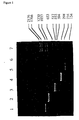
- Figure 1 PCR amplification of the deleted phages from residue 1301 to 2871, which included gene VIII and m, with the intergenic region.
- Lane 1 M13 KO7
- Lane 2 fKN 16
- Lane 3 fCA 55
- Lane 4 M13MD ⁇ 3
- Lane 5 M13MD ⁇ 3.2
- Lane 6 Negative Control
- Lane 7 Molecular mass markers (bp).
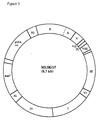
- FIG. 1 The genetic map of the vector M13KO7 (Vieira and Messing 1987).
- Phagemid vectors for display of proteins/peptides on the surface of filamentous phage utilize a plasmid genome carrying the phage origin of replication, along with the gene fused to a fragment of gene III. Generation of phage particles displaying the fusion protein also requires superinfection of the host bacterium with a helper virus.
- helper phages in SAP-selection, where non-infectious helpher phage, expressing antibody fragments but not protein 3, still can infect by first reacting with a soluble antigen-protein3 fusion protein.
- Gene III mutants were found to be non-infectious and high titer of infective particles were obtained only when the helper phage was grown in cells harbouring a gene III-containing plasmid. Amplification of phage titer of 10 6 times were achieved in M13-derived phages, when used for the selection of specific antibody fragments.
- Phage display of antibody fragments (1), peptides (2) and hormones (3) has been demonstrated to be a very useful technology for the rescue of specific binders from large combinatorial libraries.
- Two of the bacteriophage coat proteins, the major protein encoded by gene VIII (p8) and the minor protein encoded by gene III (p3), have surface-exposed N-terminal domains that tolerate foreign protein inserts and have been used to display fusion proteins.
- the p3 molecule has predominantly been used as fusion partner since only three or five copies are packed per virion.
- many improvements of the original display approach have been reported.
- the use of small phagemid vectors that allows packing of a mixture of wild type p3 and fusion protein has faciliated the approach.
- Bacterial and phage strains Escherichia coli K-12 strain XL1-Blue (6)
- F' Tn10 pro A + B + lacI q ⁇ (lac Z) M15/ rec A1 end A1 gyr A96 (Nal r ) thi hsd R17 (r k - m k + ) sup E44 relA1 lac and TG1 (7)
- F' traD36 lac I q ⁇ (lacZ)M15 pro A + B + / sup E ⁇ ( hsd M- mcr B)5(r k - m k - McrB - ) thi ⁇ ( lac -proAB) were used as indicator bacteria and/or producer of bacteriophages.
- M13-derived gene III mutant The deleted phage, denoted M13MD ⁇ 3.2 was constructed by a complete PCR amplification of the genome of the M13 KO7 bacteriophage, excluding only gene III, thus, keeping the IG region between genes VIII and III intact.
- the primers used for the PCT amplification were the 5' (BamHI) CGGGATCCGTTGAAAATCTCCAAAAAAAAA GGCT the reaction was done in 30 cycles of 1 min. 94°C, 1 min. 55°C and 9 min. 72°C.
- the PCR product was digested BamHI over night at 37°C and ligated and transformed into TG1 cells containing a pUC-gIII plasmid (kindly provided by Dr. H. Hoogenboom.)
- M13MD ⁇ 3 phage containing a deletion of 1121 bp (from 1525 to 2646), can be used as a helper phage for superinfection if initially produced by a cell transcribing the gene III product on a separate plasmid.
- the amount of infectious particles formed was very low and only 10 5 cfu/ml could be obtained.
- M13MD ⁇ 3.2 This second mutant M13 lacked only gene III, i.e., from residue 1579 to 2851.
- M13MD ⁇ 3, M13MD ⁇ 3.2 and two derivatives of Fd tet bacteriophages were used in order to examine their ability to infect E. coli expressing F'pili. All deletions were verified by PCR of the relevant phenotypes ( Figure 1).
- the progeny phages were thus able to infect only once since non-infectious particles were subsequently assembled.
- Table I shows the yield of infectious particles obtained with or without the co-expression of p3. Even though the infectivity of all mutant phages was restored by incorporating p3, not all of them were efficiently assembled.
- the M13MD ⁇ 3 phage formed only 10 5 cfu/ml in contrast to M13MD ⁇ 3.2, which was assembled similarily to the fCA 55 phage.
- Helper phage and noninfective phage stocks were prepared as described (4), using the four mutant helper phages derived from M13 and Fd, tet. of Example 1. Briefly, E. coli containing a plasmid carrying gene III were transformed with the differently deleted bacteriophages. After over night incubation the supernatant containing the helper phages was titrated using XL1-Blue as indicator bacteria.
- HEL anti-hen egg lysozyme
- Fab fragments fused with the carboxy-terminal part of p3
- a gene coding for HEL and a 98 amino acid fragment of M13 p3 was assembled by PCR, using the primers described in (4) and cloned into a pUC19-based plasmid.
- the fusion protein was expressed as a soluble periplasmic protein.
- the characterization of the fusion protein as a bridging molecule and the SAP procedure was performed, as previously described. (4).
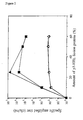
- the specific amplification was determined as the increase in titer of the anti-HEL phage preparation over the non-specific anti-phenyloxazolone, using different amounts of fusion protein.
- the amount of fusion protein is given in % (v/v).
- Phagemid stocks were prepared displaying antibody Fab fragments specific for HEL and phenyloxazolone. These were specifically amplified and selected using a HEL-p3 fusion protein as a bridging molecule between the F'pili and the non-infectious phagemid particle (4). Different dilutions of the fusion protein were used and the phage titers are shown in Figure 2. M13MD ⁇ 3 and M13MD ⁇ 3.2 yielded a specific phage amplification of 5 x 10 5 and 2 x 10 6 -fold, respectively, whereas the Fd-derived phages only gave 100-fold amplification over a high background of non specific infections. High concentrations of the fusion protein (above 30%) caused an inhibitory effect most probably due to a depolymerization of the bacterial pili by the p3 fragment, thus, limiting the infection process.
- the first construction carrying a deletion comprising the small intergenic region between gene VIII and gene III, did not pack efficiently which resulted in a 10 4 -fold reduction in phage titer, as compared to wildtype M13 KO7.
- This non-coding region contains the central terminator of transcription (5). This was shown by analysis of in vitro transcripts coupled to transcription-translation, where initiation occur at nine different sites along the viral genome but, in absence of rho , all in vitro transcripts terminated at this unique terminator site (11). Also, this region contains the promoter preceding gene III, that can generate differences in the amount of gene VI, I and IV transcripts. Consequently the M13MD ⁇ 3.2 helper phage was constructed where the IG region was kept intact.
- M13-derived mutant bacteriophages could be efficiently used as helper phages in a method for the selection and amplification of a specific binding protein and preferably in the SAP selection and that the IG region between gene VIII and gene III was needed for an efficient assembly of the phage particle.
Landscapes
- Life Sciences & Earth Sciences (AREA)
- Chemical & Material Sciences (AREA)
- Organic Chemistry (AREA)
- Health & Medical Sciences (AREA)
- Engineering & Computer Science (AREA)
- Genetics & Genomics (AREA)
- Zoology (AREA)
- Wood Science & Technology (AREA)
- Molecular Biology (AREA)
- Microbiology (AREA)
- Bioinformatics & Cheminformatics (AREA)
- Biochemistry (AREA)
- General Engineering & Computer Science (AREA)
- Biotechnology (AREA)
- Biomedical Technology (AREA)
- General Chemical & Material Sciences (AREA)
- Biophysics (AREA)
- Physics & Mathematics (AREA)
- Crystallography & Structural Chemistry (AREA)
- Plant Pathology (AREA)
- Virology (AREA)
- Medicinal Chemistry (AREA)
- Chemical Kinetics & Catalysis (AREA)
- General Health & Medical Sciences (AREA)
- Micro-Organisms Or Cultivation Processes Thereof (AREA)
- Measuring Or Testing Involving Enzymes Or Micro-Organisms (AREA)
Claims (12)
- Bakteriophage mit einer verbesserten Wirksamkeit als Helfer-Phage bei der Selektion und Vervielfältigung eines Gens, das für ein spezifisches Bindungsprotein, oder einen funktionellen Teil davon, kodiert, dadurch gekennzeichnet, daß der Gen III-Promotor und der kleine Zwischengen-Abschnitt zwischen Gen VIII und Gen III, oder ein funktionelles Fragment davon, erhalten sind, während die Gen III-Kodiersequenz deletiert ist.
- Bakteriophage nach Anspruch 1, bei dem der Phage eine Mutante eines filamentösen Bakteriophagen wie beispielsweise M13, fd, f1, 1f1, 1ke, ZJ/2, Xf, Ff, Pf1 und Pf3 ist.
- Bakteriophage nach Anspruch 1 oder 2, wobei der Phage eine Mutante des Bakteriophagen M13 ist, bei der ein kleiner Zwischengen-Abschnitt, oder ein funktionelles Fragment davon, zwischen Gen VIII und Gen III erhalten ist.
- Bakteriophage nach irgend einem vorausgehenden Anspruch, bei dem der Bakteriophage die Mutante M13MDΔ3.2 des Bakteriophagen M13KO7 ist, die eine Gen III-Deletion von Rest 1579 bis 2851 enthält.
- Verfahren zur verbesserten Selektion eines spezifischen Bindungsproteins oder Liganden I, die zusammen mit einem Phagen-Hüllprotein auf der Oberfläche eines Phagen exprimiert werden, gekennzeichnet durch ein Verknüpfen der spezifischen Phagenreplikation und der Erkennung von Ligand I auf der Phagenoberfläche durch:a) Bewirken einer Infektion eines Bakteriums, das einen Phagemid-Vektor mit dem klonierten Liganden I enthält, mit einem Helfer-Phagen-Stammmaterial, wobei bei den Phagen der Gen III-Promotor und der kleine Zwischengen-Abschnitt zwischen Gen VIII und Gen III, oder ein funktionelles Fragment davon, erhalten sind, während die Gen III-Kodiersequenz deletiert ist, sie jedoch Protein 3 auf ihren Hüllen tragen,b) Zugeben eines Fusionsproteins von Protein 3 oder einem Teil davon mit einem Liganden II, der spezifisch mit dem genannten Liganden I so wechselwirkt, daß Ligand I und Ligand II spezifisch aneinander binden, und auf diese Weise Hinzufügen auch von Protein 3 zu denjenigen spezifischen Phagen, die den Liganden I tragen,c) Bewirken einer Infektion von Bakterien mit den Phagen, die den Liganden I, den Liganden II und Protein 3 auf ihrer Oberfläche tragen, und dadurch Ermöglichung ihrer Replikation und Multiplikation.
- Verfahren nach Anspruch 5, bei dem der Helfer-Phage ein Bakteriophage nach den Ansprüchen 1 bis 4 ist.
- Verfahren nach Anspruch 5, dadurch gekennzeichnet, daß Ligand I aus der Gruppe von Peptid, Protein, Antikörper, Antigen oder Fragmenten davon ausgewählt ist.
- Verfahren nach Anspruch 5, dadurch gekennzeichnet, daß Ligand II aus der Gruppe von Peptid, Protein oder einem Fragment davon, einem organischen Molekül, Hormon oder einem anderen Molekül, das spezifisch mit Ligand I wechselwirkt und in dem Fusionsprotein mit Protein 3 verknüpft ist, ausgewählt ist.
- Verfahren nach Anspruch 5 und 7, dadurch gekennzeichnet, daß man einen humanen Antikörper oder ein funktionales Fragment davon als Ligand I auf der Phagenoberfläche verwendet.
- Kit zur verbesserten Selektion und Vervielfältigung von Genen, die für ein spezifisches Bindungsprotein oder einen Liganden I kodieren, der umfaßt:
wenigstensa) ein Helfer-Phagen-Stammmaterial, wobei bei den Phagen der Gen III-Promotor und der kleine Zwischengen-Abschnitt zwischen Gen VIII und Gen III, oder ein funktionelles Fragment davon, erhalten sind, während die Gen III-Kodiersequenz deletiert ist, sie jedoch auf ihren Hüllen Protein 3 tragen, was es ihnen ermöglicht, einen Bakterienwirt einmal zu infizieren,
und gegebenenfallsb) ein Bakterium, das einen Phagemid-Vektor mit einem klonierten Liganden I aufweist
und/oderc) ein Fusionsprotein von Protein 3 oder einem Teil davon mit einem Liganden II, der spezifisch mit dem Liganden I wechselwirkt, der auf der Bakterienoberfläche exprimiert ist,
und/oderd) ein Bakterium, das von den Phagen infiziert werden kann, die den Liganden I, den Liganden II und Protein 3 auf ihrer Oberfläche tragen und sich dadurch in dem genannten Bakterium replizieren und multiplizieren. - Kit nach Anspruch 10, in dem der genannte Helfer-Phage aus den Bakteriophagen der Ansprüche 1 bis 4 ausgewählt ist.
- Kit nach Anspruch 11, bei dem der genannte Helfer-Phage die Mutante M13MD▵3.2 des Bakteriophagen M13K7 ist, die eine Gen III-Deletion von Rest 1579 bis 2851 enthält.
Applications Claiming Priority (3)
| Application Number | Priority Date | Filing Date | Title |
|---|---|---|---|
| GBGB9500851.2A GB9500851D0 (en) | 1995-01-17 | 1995-01-17 | Method of selecting specific bacteriophages |
| GB9500851 | 1995-01-17 | ||
| PCT/SE1996/000030 WO1996022393A1 (en) | 1995-01-17 | 1996-01-15 | Improved method of selecting specific bacteriophages |
Publications (2)
| Publication Number | Publication Date |
|---|---|
| EP0805877A1 EP0805877A1 (de) | 1997-11-12 |
| EP0805877B1 true EP0805877B1 (de) | 2001-08-16 |
Family
ID=10768125
Family Applications (1)
| Application Number | Title | Priority Date | Filing Date |
|---|---|---|---|
| EP96901168A Expired - Lifetime EP0805877B1 (de) | 1995-01-17 | 1996-01-15 | Verbesserte methode zur selektion spezifischer bakteriophagen |
Country Status (9)
| Country | Link |
|---|---|
| US (1) | US6027930A (de) |
| EP (1) | EP0805877B1 (de) |
| JP (1) | JPH11503001A (de) |
| AT (1) | ATE204336T1 (de) |
| AU (1) | AU705802B2 (de) |
| CA (1) | CA2210567A1 (de) |
| DE (1) | DE69614510T2 (de) |
| GB (1) | GB9500851D0 (de) |
| WO (1) | WO1996022393A1 (de) |
Cited By (2)
| Publication number | Priority date | Publication date | Assignee | Title |
|---|---|---|---|---|
| WO2019017967A1 (en) * | 2017-07-21 | 2019-01-24 | Angela Belcher | MODIFIED BACTERIOPHAGE SYSTEMS |
| US10987388B2 (en) | 2017-07-21 | 2021-04-27 | Massachusetts Institute Of Technology | Homogeneous engineered phage populations |
Families Citing this family (24)
| Publication number | Priority date | Publication date | Assignee | Title |
|---|---|---|---|---|
| DE69129154T2 (de) * | 1990-12-03 | 1998-08-20 | Genentech, Inc., South San Francisco, Calif. | Verfahren zur anreicherung von proteinvarianten mit geänderten bindungseigenschaften |
| GB9716900D0 (en) * | 1997-08-08 | 1997-10-15 | Bioinvent Int Ab | Method for selecting phage displaying ligand binders |
| US7435549B1 (en) * | 1997-11-17 | 2008-10-14 | Micromet Ag | Method of identifying binding site domains that retain the capacity of binding to an epitope |
| WO2000006717A2 (en) | 1998-07-27 | 2000-02-10 | Genentech, Inc. | Improved transformation efficiency in phage display through modification of a coat protein |
| EP2039368A3 (de) | 1999-04-30 | 2009-04-01 | La Jolla Institute For Allergy And Immunology | Verfahren zur Vorbeugung der Reaktivierung von latenten Viren und Überwachung der Virenreplikation |
| US6472147B1 (en) | 1999-05-25 | 2002-10-29 | The Scripps Research Institute | Methods for display of heterodimeric proteins on filamentous phage using pVII and pIX, compositions, vectors and combinatorial libraries |
| US7070926B2 (en) * | 2001-06-15 | 2006-07-04 | Crucell Holland B.V. | Chimaeric phages |
| US7329530B2 (en) * | 2001-06-15 | 2008-02-12 | Crucell Holland B.V. | Chimaeric phages |
| WO2003008564A2 (en) * | 2001-07-18 | 2003-01-30 | Instytut Immunologii I Terapii Doswiadczalnej Pan | Methods of polyvalent bacteriophage preparation for the treatment of bacterial infections |
| US6833441B2 (en) | 2001-08-01 | 2004-12-21 | Abmaxis, Inc. | Compositions and methods for generating chimeric heteromultimers |
| KR100458083B1 (ko) * | 2001-08-29 | 2004-11-18 | 주식회사 아이지세라피 | 파아지 디스플레이 라이브러리로부터 특정 이종 단백질의효율적인 분리를 위한 개선된 헬퍼 파아지 시스템 |
| US7175983B2 (en) * | 2001-11-02 | 2007-02-13 | Abmaxis, Inc. | Adapter-directed display systems |
| DE10238846A1 (de) * | 2002-08-20 | 2004-03-04 | Nemod Immuntherapie Ag | Aktive Fusionsproteine und Verfahren zu ihrer Herstellung |
| MY155049A (en) | 2008-03-14 | 2015-08-28 | Allergan Inc | Immuno-based botolinum toxin serotype a activity assay |
| PL215522B1 (pl) | 2008-09-29 | 2013-12-31 | Inst Immunologii I Terapii Doswiadczalnej Pan | Nowe szczepy bakteriofagów do leczenia zakazen bakteryjnych, zwlaszcza szczepami bakterii lekoopornych rodzaju Enterococcus |
| JP5826635B2 (ja) | 2009-03-13 | 2015-12-02 | アラーガン、インコーポレイテッドAllergan,Incorporated | 免疫系調節エンドペプチターゼ活性アッセイ |
| PL212258B1 (pl) | 2010-06-20 | 2012-09-28 | Inst Immunologii I Terapii Doswiadczalnej Pan | Nowe szczepy bakteriofagów do leczenia zakazen bakteryjnych, zwlaszcza szczepami bakterii lekoopornych rodzaju Stenotrophomonas |
| US9433239B2 (en) | 2013-03-15 | 2016-09-06 | Altria Client Services Llc | Bacteriophage and methods of making and using |
| CN105980405A (zh) | 2013-12-08 | 2016-09-28 | 派特塞尔有限公司 | Hiv抗原和抗体及其组合物、方法和用途 |
| WO2016123427A1 (en) | 2015-01-29 | 2016-08-04 | Altria Client Services Llc | Bacteriophage and methods of using |
| WO2016123425A1 (en) | 2015-01-29 | 2016-08-04 | Altria Client Services Llc | Endolysin from bacteriophage against geobacillus and methods of using |
| EP3312290A1 (de) | 2016-10-18 | 2018-04-25 | Ipsen Biopharm Limited | Zellulärer vamp-spaltungstest |
| AU2018344859A1 (en) | 2017-10-04 | 2020-04-30 | Hesperix SA | Articles and methods directed to personalized therapy of cancer |
| CN113388585B (zh) * | 2021-06-10 | 2024-05-14 | 江苏农牧科技职业学院 | 一种噬菌体高滴度培养方法与应用 |
Family Cites Families (2)
| Publication number | Priority date | Publication date | Assignee | Title |
|---|---|---|---|---|
| EP0614989A1 (de) * | 1993-02-17 | 1994-09-14 | MorphoSys AG | Verfahren für in vivo Selektion von Ligandenbindende Proteine |
| SE9304060D0 (sv) * | 1993-12-06 | 1993-12-06 | Bioinvent Int Ab | Sätt att selektera specifika bakteriofager |
-
1995
- 1995-01-17 GB GBGB9500851.2A patent/GB9500851D0/en active Pending
-
1996
- 1996-01-15 AT AT96901168T patent/ATE204336T1/de not_active IP Right Cessation
- 1996-01-15 CA CA002210567A patent/CA2210567A1/en not_active Abandoned
- 1996-01-15 WO PCT/SE1996/000030 patent/WO1996022393A1/en not_active Ceased
- 1996-01-15 JP JP8522196A patent/JPH11503001A/ja not_active Ceased
- 1996-01-15 AU AU44992/96A patent/AU705802B2/en not_active Ceased
- 1996-01-15 DE DE69614510T patent/DE69614510T2/de not_active Expired - Lifetime
- 1996-01-15 US US08/875,069 patent/US6027930A/en not_active Expired - Lifetime
- 1996-01-15 EP EP96901168A patent/EP0805877B1/de not_active Expired - Lifetime
Cited By (3)
| Publication number | Priority date | Publication date | Assignee | Title |
|---|---|---|---|---|
| WO2019017967A1 (en) * | 2017-07-21 | 2019-01-24 | Angela Belcher | MODIFIED BACTERIOPHAGE SYSTEMS |
| US10987388B2 (en) | 2017-07-21 | 2021-04-27 | Massachusetts Institute Of Technology | Homogeneous engineered phage populations |
| US11896633B2 (en) | 2017-07-21 | 2024-02-13 | Massachusetts Institute Of Technology | Homogeneous engineered phage populations |
Also Published As
| Publication number | Publication date |
|---|---|
| AU4499296A (en) | 1996-08-07 |
| JPH11503001A (ja) | 1999-03-23 |
| WO1996022393A1 (en) | 1996-07-25 |
| DE69614510D1 (de) | 2001-09-20 |
| US6027930A (en) | 2000-02-22 |
| ATE204336T1 (de) | 2001-09-15 |
| EP0805877A1 (de) | 1997-11-12 |
| CA2210567A1 (en) | 1996-07-25 |
| DE69614510T2 (de) | 2002-05-08 |
| GB9500851D0 (en) | 1995-03-08 |
| AU705802B2 (en) | 1999-06-03 |
Similar Documents
| Publication | Publication Date | Title |
|---|---|---|
| US6027930A (en) | Method of selecting specific bacteriophages | |
| Kay et al. | Phage display of peptides and proteins: a laboratory manual | |
| Rakonjac et al. | Roles of pIII in filamentous phage assembly | |
| CA2372464C (en) | Isolating biological modulators from biodiverse gene fragment libraries | |
| US7704953B2 (en) | Phage displayed cell binding peptides | |
| AU2002345421B2 (en) | Chimaeric phages | |
| US20120165226A1 (en) | Phage display | |
| Dueñas et al. | Novel helper phage design: intergenic region affects the assembly of bacteriophages and the size of antibody libraries | |
| JP2002501721A (ja) | 多量体(ポリ)ペプチドコンプレックスのメンバーをコードする核酸配列を同定するための新規方法およびファージ | |
| EP0883686A1 (de) | Methode zur identifikation von nukleinsäuren für zwei oder mehreren interagierenden (poly)peptiden | |
| US20020025536A1 (en) | Methods and reagents for isolating biologically active antibodies | |
| JP2002527098A (ja) | 生物学的に活性なペプチドを単離するための方法及び試薬 | |
| Garufi et al. | Display libraries on bacteriophage lambda capsid | |
| Kwaśnikowski et al. | Multivalent display system on filamentous bacteriophage pVII minor coat protein | |
| Marvik et al. | Bacteriophage P2 and P4 assembly: alternative scaffolding proteins regulate capsid size | |
| Alting-Mees et al. | Polycos vectors: a system for packaging filamentous phage and phagemid vectors using lambda phage packaging extracts | |
| US20050130124A1 (en) | Phagemid display system | |
| Rondot et al. | Epitopes fused to F-pilin are incorporated into functional recombinant pili | |
| EP1266963A1 (de) | Chimäre Phagen | |
| US20030054495A1 (en) | Chimaeric phages | |
| WO2002081635A9 (en) | Phage display vector, phages encoded thereby, and methods of use thereof | |
| Huang | A combinatorial approach towards DNA recognition | |
| Miertus et al. | Peptide Display Libraries: Design and Construction Maria Dani | |
| Glass | Bacteriophages | |
| Rakonjac | The roles ofpIII in termination of filamentous phage assembly |
Legal Events
| Date | Code | Title | Description |
|---|---|---|---|
| PUAI | Public reference made under article 153(3) epc to a published international application that has entered the european phase |
Free format text: ORIGINAL CODE: 0009012 |
|
| 17P | Request for examination filed |
Effective date: 19970806 |
|
| AK | Designated contracting states |
Kind code of ref document: A1 Designated state(s): AT BE CH DE DK ES FR GB GR IE IT LI LU MC NL PT SE |
|
| 17Q | First examination report despatched |
Effective date: 19990609 |
|
| GRAG | Despatch of communication of intention to grant |
Free format text: ORIGINAL CODE: EPIDOS AGRA |
|
| GRAG | Despatch of communication of intention to grant |
Free format text: ORIGINAL CODE: EPIDOS AGRA |
|
| GRAH | Despatch of communication of intention to grant a patent |
Free format text: ORIGINAL CODE: EPIDOS IGRA |
|
| GRAH | Despatch of communication of intention to grant a patent |
Free format text: ORIGINAL CODE: EPIDOS IGRA |
|
| GRAA | (expected) grant |
Free format text: ORIGINAL CODE: 0009210 |
|
| AK | Designated contracting states |
Kind code of ref document: B1 Designated state(s): AT BE CH DE DK ES FR GB GR IE IT LI LU MC NL PT SE |
|
| PG25 | Lapsed in a contracting state [announced via postgrant information from national office to epo] |
Ref country code: NL Free format text: LAPSE BECAUSE OF FAILURE TO SUBMIT A TRANSLATION OF THE DESCRIPTION OR TO PAY THE FEE WITHIN THE PRESCRIBED TIME-LIMIT Effective date: 20010816 Ref country code: LI Free format text: LAPSE BECAUSE OF FAILURE TO SUBMIT A TRANSLATION OF THE DESCRIPTION OR TO PAY THE FEE WITHIN THE PRESCRIBED TIME-LIMIT Effective date: 20010816 Ref country code: CH Free format text: LAPSE BECAUSE OF FAILURE TO SUBMIT A TRANSLATION OF THE DESCRIPTION OR TO PAY THE FEE WITHIN THE PRESCRIBED TIME-LIMIT Effective date: 20010816 Ref country code: BE Free format text: LAPSE BECAUSE OF FAILURE TO SUBMIT A TRANSLATION OF THE DESCRIPTION OR TO PAY THE FEE WITHIN THE PRESCRIBED TIME-LIMIT Effective date: 20010816 Ref country code: AT Free format text: LAPSE BECAUSE OF FAILURE TO SUBMIT A TRANSLATION OF THE DESCRIPTION OR TO PAY THE FEE WITHIN THE PRESCRIBED TIME-LIMIT Effective date: 20010816 |
|
| REF | Corresponds to: |
Ref document number: 204336 Country of ref document: AT Date of ref document: 20010915 Kind code of ref document: T |
|
| REG | Reference to a national code |
Ref country code: CH Ref legal event code: EP |
|
| REF | Corresponds to: |
Ref document number: 69614510 Country of ref document: DE Date of ref document: 20010920 |
|
| REG | Reference to a national code |
Ref country code: IE Ref legal event code: FG4D |
|
| PG25 | Lapsed in a contracting state [announced via postgrant information from national office to epo] |
Ref country code: PT Free format text: LAPSE BECAUSE OF FAILURE TO SUBMIT A TRANSLATION OF THE DESCRIPTION OR TO PAY THE FEE WITHIN THE PRESCRIBED TIME-LIMIT Effective date: 20011116 Ref country code: DK Free format text: LAPSE BECAUSE OF FAILURE TO SUBMIT A TRANSLATION OF THE DESCRIPTION OR TO PAY THE FEE WITHIN THE PRESCRIBED TIME-LIMIT Effective date: 20011116 |
|
| PG25 | Lapsed in a contracting state [announced via postgrant information from national office to epo] |
Ref country code: GR Free format text: LAPSE BECAUSE OF FAILURE TO SUBMIT A TRANSLATION OF THE DESCRIPTION OR TO PAY THE FEE WITHIN THE PRESCRIBED TIME-LIMIT Effective date: 20011117 |
|
| ET | Fr: translation filed | ||
| REG | Reference to a national code |
Ref country code: GB Ref legal event code: IF02 |
|
| PG25 | Lapsed in a contracting state [announced via postgrant information from national office to epo] |
Ref country code: LU Free format text: LAPSE BECAUSE OF NON-PAYMENT OF DUE FEES Effective date: 20020115 Ref country code: IE Free format text: LAPSE BECAUSE OF NON-PAYMENT OF DUE FEES Effective date: 20020115 |
|
| NLV1 | Nl: lapsed or annulled due to failure to fulfill the requirements of art. 29p and 29m of the patents act | ||
| PG25 | Lapsed in a contracting state [announced via postgrant information from national office to epo] |
Ref country code: ES Free format text: LAPSE BECAUSE OF FAILURE TO SUBMIT A TRANSLATION OF THE DESCRIPTION OR TO PAY THE FEE WITHIN THE PRESCRIBED TIME-LIMIT Effective date: 20020228 |
|
| REG | Reference to a national code |
Ref country code: CH Ref legal event code: PL |
|
| PLBE | No opposition filed within time limit |
Free format text: ORIGINAL CODE: 0009261 |
|
| STAA | Information on the status of an ep patent application or granted ep patent |
Free format text: STATUS: NO OPPOSITION FILED WITHIN TIME LIMIT |
|
| PG25 | Lapsed in a contracting state [announced via postgrant information from national office to epo] |
Ref country code: MC Free format text: LAPSE BECAUSE OF NON-PAYMENT OF DUE FEES Effective date: 20020801 |
|
| 26N | No opposition filed | ||
| REG | Reference to a national code |
Ref country code: IE Ref legal event code: MM4A |
|
| PGFP | Annual fee paid to national office [announced via postgrant information from national office to epo] |
Ref country code: SE Payment date: 20040107 Year of fee payment: 9 |
|
| PGFP | Annual fee paid to national office [announced via postgrant information from national office to epo] |
Ref country code: FR Payment date: 20040108 Year of fee payment: 9 |
|
| PG25 | Lapsed in a contracting state [announced via postgrant information from national office to epo] |
Ref country code: IT Free format text: LAPSE BECAUSE OF NON-PAYMENT OF DUE FEES;WARNING: LAPSES OF ITALIAN PATENTS WITH EFFECTIVE DATE BEFORE 2007 MAY HAVE OCCURRED AT ANY TIME BEFORE 2007. THE CORRECT EFFECTIVE DATE MAY BE DIFFERENT FROM THE ONE RECORDED. Effective date: 20050115 |
|
| PG25 | Lapsed in a contracting state [announced via postgrant information from national office to epo] |
Ref country code: SE Free format text: LAPSE BECAUSE OF NON-PAYMENT OF DUE FEES Effective date: 20050116 |
|
| EUG | Se: european patent has lapsed | ||
| PG25 | Lapsed in a contracting state [announced via postgrant information from national office to epo] |
Ref country code: FR Free format text: LAPSE BECAUSE OF NON-PAYMENT OF DUE FEES Effective date: 20050930 |
|
| REG | Reference to a national code |
Ref country code: FR Ref legal event code: ST |
|
| PGFP | Annual fee paid to national office [announced via postgrant information from national office to epo] |
Ref country code: DE Payment date: 20120111 Year of fee payment: 17 |
|
| PGFP | Annual fee paid to national office [announced via postgrant information from national office to epo] |
Ref country code: GB Payment date: 20120111 Year of fee payment: 17 |
|
| GBPC | Gb: european patent ceased through non-payment of renewal fee |
Effective date: 20130115 |
|
| PG25 | Lapsed in a contracting state [announced via postgrant information from national office to epo] |
Ref country code: DE Free format text: LAPSE BECAUSE OF NON-PAYMENT OF DUE FEES Effective date: 20130801 |
|
| REG | Reference to a national code |
Ref country code: DE Ref legal event code: R119 Ref document number: 69614510 Country of ref document: DE Effective date: 20130801 |
|
| PG25 | Lapsed in a contracting state [announced via postgrant information from national office to epo] |
Ref country code: GB Free format text: LAPSE BECAUSE OF NON-PAYMENT OF DUE FEES Effective date: 20130115 |