EP0803989A1 - Verfahren und Apparat zur Kodierung eines digitalen Audiosignals - Google Patents
Verfahren und Apparat zur Kodierung eines digitalen Audiosignals Download PDFInfo
- Publication number
- EP0803989A1 EP0803989A1 EP97106313A EP97106313A EP0803989A1 EP 0803989 A1 EP0803989 A1 EP 0803989A1 EP 97106313 A EP97106313 A EP 97106313A EP 97106313 A EP97106313 A EP 97106313A EP 0803989 A1 EP0803989 A1 EP 0803989A1
- Authority
- EP
- European Patent Office
- Prior art keywords
- psycho acoustic
- data rate
- audio signal
- masking threshold
- masking
- Prior art date
- Legal status (The legal status is an assumption and is not a legal conclusion. Google has not performed a legal analysis and makes no representation as to the accuracy of the status listed.)
- Granted
Links
- 238000000034 method Methods 0.000 title claims abstract description 28
- 230000005236 sound signal Effects 0.000 title claims abstract description 18
- 230000000873 masking effect Effects 0.000 claims abstract description 53
- 238000004364 calculation method Methods 0.000 claims abstract description 13
- 238000011946 reduction process Methods 0.000 claims abstract 4
- 230000000694 effects Effects 0.000 claims description 5
- 230000001419 dependent effect Effects 0.000 claims description 4
- 101100269850 Caenorhabditis elegans mask-1 gene Proteins 0.000 claims 3
- 238000013139 quantization Methods 0.000 description 6
- 238000001228 spectrum Methods 0.000 description 5
- 238000004590 computer program Methods 0.000 description 4
- 238000004422 calculation algorithm Methods 0.000 description 3
- 238000010586 diagram Methods 0.000 description 3
- 101000969688 Homo sapiens Macrophage-expressed gene 1 protein Proteins 0.000 description 2
- 102100021285 Macrophage-expressed gene 1 protein Human genes 0.000 description 2
- 230000003247 decreasing effect Effects 0.000 description 2
- 238000001514 detection method Methods 0.000 description 2
- 102100030891 Actin-associated protein FAM107A Human genes 0.000 description 1
- 101001063917 Homo sapiens Actin-associated protein FAM107A Proteins 0.000 description 1
- 101150016871 LTI6B gene Proteins 0.000 description 1
- 101100370098 Saccharomyces cerevisiae (strain ATCC 204508 / S288c) TOR2 gene Proteins 0.000 description 1
- 230000005540 biological transmission Effects 0.000 description 1
- 230000004384 eye physiology Effects 0.000 description 1
- 238000012986 modification Methods 0.000 description 1
- 230000004048 modification Effects 0.000 description 1
- 238000010606 normalization Methods 0.000 description 1
Images

Classifications
-
- H—ELECTRICITY
- H04—ELECTRIC COMMUNICATION TECHNIQUE
- H04B—TRANSMISSION
- H04B1/00—Details of transmission systems, not covered by a single one of groups H04B3/00 - H04B13/00; Details of transmission systems not characterised by the medium used for transmission
- H04B1/66—Details of transmission systems, not covered by a single one of groups H04B3/00 - H04B13/00; Details of transmission systems not characterised by the medium used for transmission for reducing bandwidth of signals; for improving efficiency of transmission
- H04B1/665—Details of transmission systems, not covered by a single one of groups H04B3/00 - H04B13/00; Details of transmission systems not characterised by the medium used for transmission for reducing bandwidth of signals; for improving efficiency of transmission using psychoacoustic properties of the ear, e.g. masking effect
Definitions
- the present invention relates to a method and an apparatus for encoding of a digitalized audio signal.
- the psycho acoustic model in an audio encoder calculates a masking threshold for data reduction purposes.
- the masking threshold may vary for each subband of the audio signal.
- the so called bit allocation process defines for each subband due to the determined masking threshold, with which resolution the subband samples should be quantized. This will vary in time with each block of audio signal samples. Therefore the necessary bitrate for an optimal sound quality should also vary for the different blocks.
- the available desired bitrate is normally fixed for each audio channel. Because, with respect to the desired bitrate, the exact number of bits for the various parameters and data required for transmission cannot be estimated exactly in advance some bits are left over or some bits are missing. Usually a simple allocation strategy is used to overcome this problem, e.g. by assigning a nearly equal number of such bits for each subband.
- encoders are optimised for a small range of bitrates.
- audio coders are used also for operation in a larger range of bit rates, but they are not optimised for doing so.
- the different bitrates may occur between the left and right channel and/or additional channels (left surround, right surround, center) and/or in MPEG LayerIII where the desired bit rate can vary from frame to frame.
- At least three psycho acoustic models are used instead of one, each of which is optimised for a certain bitrate or range of bitrates.
- the encoder selects the appropriate one of the psycho acoustic models.
- the output of one of the psycho acoustic models can be regarded as a standard masking threshold for a certain desired bitrate.
- the second psycho acoustic model When the present number of bits is to high, the second psycho acoustic model is used which has in general a higher masking threshold.
- This higher threshold is not the standard threshold being lifted equally over the spectrum like in the prior art, but lifted in relation to a psycho acoustic model which is still adapted to the present input spectrum.
- the third psycho acoustic model When the present number of bits is to low, the third psycho acoustic model is used which has in general a lower masking threshold. Again, this lower threshold is not the standard threshold being decreased equally over the spectrum like in the prior art, but decreased in relation to a psycho acoustic model which is still adapted to the present input spectrum.
- a second embodiment of the invention solves the problems of the hard switching between the different psycho acoustic models, e.g. between the left and right channel and/or in MPEG LayerI to LayerIII where the desired data rate may vary from frame to frame. Instead of using binary logic for switching a fuzzy logic is performed.
- the inventive method is suited for audio coding in MPEG2 LayerI to LayerIII and/or MPEG 2 NBC systems.
- Valuable information about audio encoding technique is included in the International Standard ISO/IEC 11172-3, First Edition 1993-08-01, 'Information technology- Coding of moving pictures and associated audio for digital storage media at up to about 1,5 MBit/s', Part 3 Audio.
- the inventive method uses more than one psycho acoustic model.
- three different psycho acoustic models are used.
- Each one of the psycho acoustic models is adapted to a specific predefined data rate of the audio bit stream.
- the different psycho acoustic models are abbreviated PSM_Low, PAM_Mid, PAM_High.
- PAM_Low is adapted to the low data rate of 32 kBit/s
- PAM_Mid is adapted to the mid data rate of 56 kBit/s
- PAM_High to the high data rate of 80 kBit/s.
- Fig. 1 it shows, in which areas which psycho acoustic model is used.
- the range of possible data rates which can be used by the audio encoder is stipulated.
- the share of each psycho acoustic model is given for each possible data rate.
- the psycho acoustic model PAM_Low is used for the calculation of the masking threshold. So the sharing factor is 1, i.e. 100% for PAM_Low and 0% for PAM_Mid and PAM_High.
- the psycho acoustic model PAM_MID is used for the calculation of the masking threshold.
- the sharing factor is 1, i.e. 100% for PAM_Mid and 0% for PAM_Low and PAM_High.
- the psycho acoustic model PAM_High is used for the calculation of the masking threshold.
- the sharing factor is again 1, i.e. 100% for PAM_High and 0% for PAM_Low and PAM_Mid. This kind of switching between the different psycho acoustic models will be referred to as 'Hard Switching' from now on.
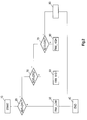
- Reference numeral 10 denotes the starting point of the program.
- Reference numeral 20 denotes a decision step, where it is determined, if the available data rate ADR is less than the data rate value DR1 shown in Fig. 1. If this is the case, the program proceeds with step 30. Therein the masking threshold is determined by usage of the psycho acoustic model PAM_Low. After this step the program will end in step 40. If in decision step 20 it is decided that the available data rate ADR is greater than data rate value DR1, it is analysed in decision step 50, whether the available data rate ADR is less than data rate value DR2 or not.
- step 60 the program proceeds with step 60 and the psycho acoustic model PAM_Mid is used for the calculation of the masking threshold.
- step 70 the program proceeds to decision step 70. There it is analysed, whether the available data rate is less than or equal to the data rate value DR3. If this is the case, the program proceeds to step 80 where the psycho acoustic model PAM_High is used for the calculation of the masking threshold.
- step 90 which includes an appropriate error detection algorithm. After program steps 60, 80, 90 the program will be finished in step 40.
- Fig. 3 there are three different ranges for the available data rate shown, named DRR4, DRR5 and DRR6. If the available data rate is within range DRR4, then the psycho acoustic model PAM_Low will be used only, i.e. with 100% share for the calculation of the masking threshold. If the available data rate is within range DRR7, then the psycho acoustic model PAM_High is used only. If the available data rate is within range DRR5, then both psycho acoustic models PAM_Low and PAM_Mid are used for the calculation of the corresponding masking threshold.
- the two psycho acoustic models PAM_Mid and PAM_High are used for the calculation of the masking threshold.
- the available data rate ADR is within range DRR5.
- ⁇ is the sharing factor for the psycho acoustic model PAM_Mid and ⁇ the sharing factor for the psycho acoustic model PAM_Low. Both sharing factors are shown in Fig. 3. They are determined by looking up in tables which contain the values for representing the respective Curves L and M at the point of the available data rate ADR. With these technique it is possible to design an audio encoder which is capable of generating bit streams with a wide range of data rates.
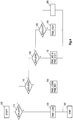
- step 110 it is analysed whether the available data rate ADR is less than the data rate DR4 or not. A positive result leads to step 120 as the next program step. There, the masking threshold will be calculated only on the basis of the psycho acoustic model PAM_Low. After this step the program will be finished in step 130. In case of a negative result in step 110, the program proceeds with step 140. There it is determined, if the available data rate is less than data rate value DR5 or not. If this is the case, then in step 150 two masking thresholds are calculated.
- step 160 One on accord of psycho acoustic model PAM_Low and the other on accord of psycho acoustic model PAM_Mid. Both masking thresholds are then combined to a resulting masking threshold. For this purpose both masking thresholds are weighted with their corresponding weighting factors ⁇ and ⁇ as shown in Fig. 3. The combination operation makes use of the above mentioned formula 1 as described above.
- decision step 160 There it is determined, whether the available data rate is less than data rate value DR6. When this is true, the next step is step 170.
- step 150 There the two masking thresholds Mask_Mid and Mask_High are calculated based on the corresponding psycho acoustic models PAM_Mid and PAM_High. Also, they are weighted and combined as described for step 150.
- a negative result in decision step 160 leads to a decision step 180. Here it is analysed, whether the available data rate ADR is less than or equal to the data rate value DR7, shown in Fig. 3. After a positive decision program step 190 will be executed. There, the masking threshold is calculated based on psycho acoustic model PAM_High.
- a negative decision in step 180 leads to step 200 where an error detection algorithm is executed. After execution of one of the steps 150, 170, 190 and 200 the program is finished in step 130.
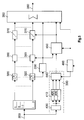
- This apparatus is based on the well known subband coding technique.
- the digitalized audio signal is fed via data bus 300 to filter bank 310.
- filter bank 310 the audio signal is divided in 32 subbands.
- the subband samples are fed to blocks 320.
- scale factors are calculated. They are used for data reduction purposes namely for suppressing leading '0'- and '1'-Bits of the subband samples.
- the scale factors of each subband block are fed to a scale factor quantization apparatus 330. There they are quantized, e.g. with 6 Bits resolution.
- the quantized scale factors are forwarded to a multiplexing device 350.
- the subband samples are input in normalisation circuits 360 after they have passed block 320.
- the samples are multiplied by appropriate factors 1/U s , determined based on the quantized scale factors, which are input via busline 340.
- the normalised subband samples are fed to quantization circuits 370.
- quantization circuits 370 Here, data reduction based on psycho acoustic effects is carried out.
- the bit resolution for quantization purposes is determined due to psycho acoustic models, which will be described hereinafter, so that quantization noise is not perceivable for the human ear.
- the subband samples are forwarded to multiplexing device 350. Multiplexing device 350 creates the output bit stream of the encoding apparatus including all synchronisation and ancillary data.
- the bit stream is outputted via data bus 380.
- the incoming bit stream via data bus 300 is fed to block 390.
- the frequency spectrum of the signal is calculated via a FFT-algorithm (Fast Fourier Transform) in block 400.
- FFT-algorithm Fast Fourier Transform
- the first one PAM_Low is adapted and optimised for a specific output bit stream of low bitrate, e.g. 32 kBit/s.
- the second one is adapted and optimised for an output bit stream of middle bitrate, e.g. 56 kBit/s.
- the third one is adapted and optimised for an output bit stream of high bitrate, e.g. 80 kBit/s.
- Each one of the psycho acoustic models is capable of determining a masking threshold Mask_Low, Mask_Mid, Mask_High.
- 'Hard Switching' mode combining device 450 works as a selecting device for selecting the appropriate masking threshold data and forwarding it to bit allocation unit 450.
- the bit allocation unit calculates the bit allocation and controls the quantization circuits 370.
- Bit allocation data is forwarded to multiplexing device 350.
- Control circuit 460 predefines the available data rate, e.g. on accord of an input by a user and controls in dependence thereof combining device 440 and bit allocation unit 450. It also inputs ancillary data to multiplexing device 350.
- the invention can be used in nearly all audio systems like MPEG, DAB, DCC, MD.
- the invention can also be used for video coding like MPEG 1 or MPEG 2.
Landscapes
- Engineering & Computer Science (AREA)
- Computer Networks & Wireless Communication (AREA)
- Signal Processing (AREA)
- Compression, Expansion, Code Conversion, And Decoders (AREA)
Priority Applications (1)
| Application Number | Priority Date | Filing Date | Title |
|---|---|---|---|
| EP19970106313 EP0803989B1 (de) | 1996-04-26 | 1997-04-17 | Verfahren und Apparat zur Kodierung eines digitalen Audiosignals |
Applications Claiming Priority (3)
| Application Number | Priority Date | Filing Date | Title |
|---|---|---|---|
| EP96106678 | 1996-04-26 | ||
| EP96106678 | 1996-04-26 | ||
| EP19970106313 EP0803989B1 (de) | 1996-04-26 | 1997-04-17 | Verfahren und Apparat zur Kodierung eines digitalen Audiosignals |
Publications (2)
| Publication Number | Publication Date |
|---|---|
| EP0803989A1 true EP0803989A1 (de) | 1997-10-29 |
| EP0803989B1 EP0803989B1 (de) | 1999-06-16 |
Family
ID=26141894
Family Applications (1)
| Application Number | Title | Priority Date | Filing Date |
|---|---|---|---|
| EP19970106313 Expired - Lifetime EP0803989B1 (de) | 1996-04-26 | 1997-04-17 | Verfahren und Apparat zur Kodierung eines digitalen Audiosignals |
Country Status (1)
| Country | Link |
|---|---|
| EP (1) | EP0803989B1 (de) |
Cited By (3)
| Publication number | Priority date | Publication date | Assignee | Title |
|---|---|---|---|---|
| EP1187101A3 (de) * | 2000-09-07 | 2002-07-17 | Lucent Technologies Inc. | Verfahren zur Vorklassifikation von Audiosignalen für die Audio-Komprimierung |
| EP0966109A3 (de) * | 1998-06-15 | 2002-10-16 | Matsushita Electric Industrial Co., Ltd. | Audiokodierungsmethode, Audiokodierungsvorrichtung und Datenspeichermedium |
| US8589155B2 (en) | 2007-10-31 | 2013-11-19 | Cambridge Silicon Radio Ltd. | Adaptive tuning of the perceptual model |
Citations (3)
| Publication number | Priority date | Publication date | Assignee | Title |
|---|---|---|---|---|
| WO1994007313A1 (de) * | 1992-09-24 | 1994-03-31 | Ant Nachrichtentechnik Gmbh | Sprachcodec |
| DE4345171A1 (de) * | 1993-09-15 | 1995-03-16 | Fraunhofer Ges Forschung | Verfahren zum Bestimmen der zu wählenden Codierungsart für die Codierung von wenigstens zwei Signalen |
| EP0655876A1 (de) * | 1993-11-23 | 1995-05-31 | AT&T Corp. | Wahrnehmungsgebundene Kodierung von Audiosignalen |
-
1997
- 1997-04-17 EP EP19970106313 patent/EP0803989B1/de not_active Expired - Lifetime
Patent Citations (3)
| Publication number | Priority date | Publication date | Assignee | Title |
|---|---|---|---|---|
| WO1994007313A1 (de) * | 1992-09-24 | 1994-03-31 | Ant Nachrichtentechnik Gmbh | Sprachcodec |
| DE4345171A1 (de) * | 1993-09-15 | 1995-03-16 | Fraunhofer Ges Forschung | Verfahren zum Bestimmen der zu wählenden Codierungsart für die Codierung von wenigstens zwei Signalen |
| EP0655876A1 (de) * | 1993-11-23 | 1995-05-31 | AT&T Corp. | Wahrnehmungsgebundene Kodierung von Audiosignalen |
Cited By (5)
| Publication number | Priority date | Publication date | Assignee | Title |
|---|---|---|---|---|
| EP0966109A3 (de) * | 1998-06-15 | 2002-10-16 | Matsushita Electric Industrial Co., Ltd. | Audiokodierungsmethode, Audiokodierungsvorrichtung und Datenspeichermedium |
| US6697775B2 (en) | 1998-06-15 | 2004-02-24 | Matsushita Electric Industrial Co., Ltd. | Audio coding method, audio coding apparatus, and data storage medium |
| EP1187101A3 (de) * | 2000-09-07 | 2002-07-17 | Lucent Technologies Inc. | Verfahren zur Vorklassifikation von Audiosignalen für die Audio-Komprimierung |
| US6813600B1 (en) | 2000-09-07 | 2004-11-02 | Lucent Technologies Inc. | Preclassification of audio material in digital audio compression applications |
| US8589155B2 (en) | 2007-10-31 | 2013-11-19 | Cambridge Silicon Radio Ltd. | Adaptive tuning of the perceptual model |
Also Published As
| Publication number | Publication date |
|---|---|
| EP0803989B1 (de) | 1999-06-16 |
Similar Documents
| Publication | Publication Date | Title |
|---|---|---|
| US6115688A (en) | Process and device for the scalable coding of audio signals | |
| CA2090159C (en) | Method and apparatus for coding audio signals based on perceptual model | |
| JP4095679B2 (ja) | 冗長性低減方法 | |
| JP3942634B2 (ja) | 信号の、符号化の際の冗長度低減方法及び冗長度を低減された信号の復号化装置 | |
| US5717764A (en) | Global masking thresholding for use in perceptual coding | |
| EP1107232A2 (de) | Kombinierte Stereokodierung von Audiosignalen | |
| JP3186292B2 (ja) | 高能率符号化方法及び装置 | |
| JP3552232B2 (ja) | 数個の相互依存チャンネルのデジタル信号の送信及び/又は記憶時のデータ整理方法 | |
| US20140257824A1 (en) | Apparatus and a method for encoding an input signal | |
| JPH06149292A (ja) | 高能率符号化方法及び装置 | |
| CA2118916C (en) | Process for reducing data in the transmission and/or storage of digital signals from several dependent channels | |
| HU215685B (hu) | Eljárás és berendezés széles sávú digitális adatjelek kódolására és dekódolására | |
| JP2001094433A (ja) | サブバンド符号化・復号方法 | |
| JP2001236099A (ja) | 知覚品質の一貫性を改善する知覚音声符号器ビット割付けスキーム | |
| JP4063508B2 (ja) | ビットレート変換装置およびビットレート変換方法 | |
| KR100472442B1 (ko) | 웨이브렛 패킷 변환을 이용한 오디오 압축 방법 및 그시스템 | |
| KR0134318B1 (ko) | 채널간의 마스킹특성을 고려한 비트할당장치 및 그 방법과 복호화장치 | |
| US6009399A (en) | Method and apparatus for encoding digital signals employing bit allocation using combinations of different threshold models to achieve desired bit rates | |
| EP0803989B1 (de) | Verfahren und Apparat zur Kodierung eines digitalen Audiosignals | |
| JP4618873B2 (ja) | オーディオ信号符号化方法、オーディオ信号符号化装置、音楽配信方法、および、音楽配信システム | |
| JP2776300B2 (ja) | 音声信号処理回路 | |
| US6012025A (en) | Audio coding method and apparatus using backward adaptive prediction | |
| KR101078378B1 (ko) | 오디오 부호화기의 양자화 방법 및 장치 | |
| US6161088A (en) | Method and system for encoding a digital audio signal | |
| US20010056343A1 (en) | Sound signal encoding apparatus and method |
Legal Events
| Date | Code | Title | Description |
|---|---|---|---|
| PUAI | Public reference made under article 153(3) epc to a published international application that has entered the european phase |
Free format text: ORIGINAL CODE: 0009012 |
|
| AK | Designated contracting states |
Kind code of ref document: A1 Designated state(s): DE FR GB IT |
|
| GRAG | Despatch of communication of intention to grant |
Free format text: ORIGINAL CODE: EPIDOS AGRA |
|
| 17P | Request for examination filed |
Effective date: 19980409 |
|
| 17Q | First examination report despatched |
Effective date: 19980529 |
|
| GRAG | Despatch of communication of intention to grant |
Free format text: ORIGINAL CODE: EPIDOS AGRA |
|
| GRAG | Despatch of communication of intention to grant |
Free format text: ORIGINAL CODE: EPIDOS AGRA |
|
| GRAH | Despatch of communication of intention to grant a patent |
Free format text: ORIGINAL CODE: EPIDOS IGRA |
|
| GRAH | Despatch of communication of intention to grant a patent |
Free format text: ORIGINAL CODE: EPIDOS IGRA |
|
| GRAA | (expected) grant |
Free format text: ORIGINAL CODE: 0009210 |
|
| AK | Designated contracting states |
Kind code of ref document: B1 Designated state(s): DE FR GB IT |
|
| REF | Corresponds to: |
Ref document number: 69700274 Country of ref document: DE Date of ref document: 19990722 |
|
| ET | Fr: translation filed | ||
| PLBE | No opposition filed within time limit |
Free format text: ORIGINAL CODE: 0009261 |
|
| STAA | Information on the status of an ep patent application or granted ep patent |
Free format text: STATUS: NO OPPOSITION FILED WITHIN TIME LIMIT |
|
| 26N | No opposition filed | ||
| REG | Reference to a national code |
Ref country code: GB Ref legal event code: 746 Effective date: 20010808 |
|
| REG | Reference to a national code |
Ref country code: GB Ref legal event code: IF02 |
|
| REG | Reference to a national code |
Ref country code: DE Ref legal event code: R082 Ref document number: 69700274 Country of ref document: DE Representative=s name: ROSSMANITH, MANFRED, DIPL.-PHYS. DR.RER.NAT., DE Effective date: 20110915 Ref country code: DE Ref legal event code: R081 Ref document number: 69700274 Country of ref document: DE Owner name: THOMSON LICENSING, FR Free format text: FORMER OWNER: DEUTSCHE THOMSON-BRANDT GMBH, 78048 VILLINGEN-SCHWENNINGEN, DE Effective date: 20110915 |
|
| PGFP | Annual fee paid to national office [announced via postgrant information from national office to epo] |
Ref country code: DE Payment date: 20120424 Year of fee payment: 16 |
|
| PG25 | Lapsed in a contracting state [announced via postgrant information from national office to epo] |
Ref country code: DE Free format text: LAPSE BECAUSE OF NON-PAYMENT OF DUE FEES Effective date: 20111031 |
|
| REG | Reference to a national code |
Ref country code: DE Ref legal event code: R119 Ref document number: 69700274 Country of ref document: DE Effective date: 20111102 |
|
| REG | Reference to a national code |
Ref country code: FR Ref legal event code: PLFP Year of fee payment: 20 |
|
| PGFP | Annual fee paid to national office [announced via postgrant information from national office to epo] |
Ref country code: GB Payment date: 20160421 Year of fee payment: 20 |
|
| PGFP | Annual fee paid to national office [announced via postgrant information from national office to epo] |
Ref country code: IT Payment date: 20160418 Year of fee payment: 20 Ref country code: FR Payment date: 20160420 Year of fee payment: 20 |
|
| REG | Reference to a national code |
Ref country code: GB Ref legal event code: PE20 Expiry date: 20170416 |
|
| PG25 | Lapsed in a contracting state [announced via postgrant information from national office to epo] |
Ref country code: GB Free format text: LAPSE BECAUSE OF EXPIRATION OF PROTECTION Effective date: 20170416 |