EP0803344A1 - Verfahren zur Herstellung einer Membranblase für ein Ausdehnungsgefäss - Google Patents
Verfahren zur Herstellung einer Membranblase für ein Ausdehnungsgefäss Download PDFInfo
- Publication number
- EP0803344A1 EP0803344A1 EP97201037A EP97201037A EP0803344A1 EP 0803344 A1 EP0803344 A1 EP 0803344A1 EP 97201037 A EP97201037 A EP 97201037A EP 97201037 A EP97201037 A EP 97201037A EP 0803344 A1 EP0803344 A1 EP 0803344A1
- Authority
- EP
- European Patent Office
- Prior art keywords
- pieces
- membrane
- bag
- edges
- connection
- Prior art date
- Legal status (The legal status is an assumption and is not a legal conclusion. Google has not performed a legal analysis and makes no representation as to the accuracy of the status listed.)
- Withdrawn
Links
- 239000012528 membrane Substances 0.000 title claims abstract description 40
- 238000000034 method Methods 0.000 title claims abstract description 20
- 238000004519 manufacturing process Methods 0.000 title claims abstract description 10
- 238000004073 vulcanization Methods 0.000 claims description 10
- 229920001971 elastomer Polymers 0.000 claims description 7
- 239000005060 rubber Substances 0.000 claims description 5
- 239000000725 suspension Substances 0.000 claims description 3
- 235000009508 confectionery Nutrition 0.000 description 10
- 239000000243 solution Substances 0.000 description 5
- 238000010438 heat treatment Methods 0.000 description 4
- 229920001296 polysiloxane Polymers 0.000 description 3
- 238000005452 bending Methods 0.000 description 2
- 238000005520 cutting process Methods 0.000 description 2
- 230000007547 defect Effects 0.000 description 2
- 239000000806 elastomer Substances 0.000 description 2
- 239000012530 fluid Substances 0.000 description 2
- 238000001746 injection moulding Methods 0.000 description 2
- 239000007788 liquid Substances 0.000 description 2
- 229920003052 natural elastomer Polymers 0.000 description 2
- 229920001194 natural rubber Polymers 0.000 description 2
- 230000035699 permeability Effects 0.000 description 2
- 229920003051 synthetic elastomer Polymers 0.000 description 2
- 239000005061 synthetic rubber Substances 0.000 description 2
- 230000008719 thickening Effects 0.000 description 2
- 238000003466 welding Methods 0.000 description 2
- 108010053481 Antifreeze Proteins Proteins 0.000 description 1
- 229920002943 EPDM rubber Polymers 0.000 description 1
- 238000005299 abrasion Methods 0.000 description 1
- 230000002528 anti-freeze Effects 0.000 description 1
- 229920005549 butyl rubber Polymers 0.000 description 1
- 230000002950 deficient Effects 0.000 description 1
- 238000005485 electric heating Methods 0.000 description 1
- 239000000463 material Substances 0.000 description 1
- 229920003031 santoprene Polymers 0.000 description 1
- 229920002725 thermoplastic elastomer Polymers 0.000 description 1
- XLYOFNOQVPJJNP-UHFFFAOYSA-N water Substances O XLYOFNOQVPJJNP-UHFFFAOYSA-N 0.000 description 1
- 230000003313 weakening effect Effects 0.000 description 1
Images


Classifications
-
- B—PERFORMING OPERATIONS; TRANSPORTING
- B29—WORKING OF PLASTICS; WORKING OF SUBSTANCES IN A PLASTIC STATE IN GENERAL
- B29C—SHAPING OR JOINING OF PLASTICS; SHAPING OF MATERIAL IN A PLASTIC STATE, NOT OTHERWISE PROVIDED FOR; AFTER-TREATMENT OF THE SHAPED PRODUCTS, e.g. REPAIRING
- B29C66/00—General aspects of processes or apparatus for joining preformed parts
- B29C66/50—General aspects of joining tubular articles; General aspects of joining long products, i.e. bars or profiled elements; General aspects of joining single elements to tubular articles, hollow articles or bars; General aspects of joining several hollow-preforms to form hollow or tubular articles
- B29C66/51—Joining tubular articles, profiled elements or bars; Joining single elements to tubular articles, hollow articles or bars; Joining several hollow-preforms to form hollow or tubular articles
- B29C66/54—Joining several hollow-preforms, e.g. half-shells, to form hollow articles, e.g. for making balls, containers; Joining several hollow-preforms, e.g. half-cylinders, to form tubular articles
-
- B—PERFORMING OPERATIONS; TRANSPORTING
- B29—WORKING OF PLASTICS; WORKING OF SUBSTANCES IN A PLASTIC STATE IN GENERAL
- B29C—SHAPING OR JOINING OF PLASTICS; SHAPING OF MATERIAL IN A PLASTIC STATE, NOT OTHERWISE PROVIDED FOR; AFTER-TREATMENT OF THE SHAPED PRODUCTS, e.g. REPAIRING
- B29C65/00—Joining or sealing of preformed parts, e.g. welding of plastics materials; Apparatus therefor
- B29C65/48—Joining or sealing of preformed parts, e.g. welding of plastics materials; Apparatus therefor using adhesives, i.e. using supplementary joining material; solvent bonding
- B29C65/4805—Joining or sealing of preformed parts, e.g. welding of plastics materials; Apparatus therefor using adhesives, i.e. using supplementary joining material; solvent bonding characterised by the type of adhesives
- B29C65/483—Reactive adhesives, e.g. chemically curing adhesives
- B29C65/4835—Heat curing adhesives
-
- B—PERFORMING OPERATIONS; TRANSPORTING
- B29—WORKING OF PLASTICS; WORKING OF SUBSTANCES IN A PLASTIC STATE IN GENERAL
- B29C—SHAPING OR JOINING OF PLASTICS; SHAPING OF MATERIAL IN A PLASTIC STATE, NOT OTHERWISE PROVIDED FOR; AFTER-TREATMENT OF THE SHAPED PRODUCTS, e.g. REPAIRING
- B29C66/00—General aspects of processes or apparatus for joining preformed parts
- B29C66/01—General aspects dealing with the joint area or with the area to be joined
- B29C66/05—Particular design of joint configurations
- B29C66/10—Particular design of joint configurations particular design of the joint cross-sections
- B29C66/11—Joint cross-sections comprising a single joint-segment, i.e. one of the parts to be joined comprising a single joint-segment in the joint cross-section
- B29C66/116—Single bevelled joints, i.e. one of the parts to be joined being bevelled in the joint area
- B29C66/1162—Single bevel to bevel joints, e.g. mitre joints
-
- B—PERFORMING OPERATIONS; TRANSPORTING
- B29—WORKING OF PLASTICS; WORKING OF SUBSTANCES IN A PLASTIC STATE IN GENERAL
- B29C—SHAPING OR JOINING OF PLASTICS; SHAPING OF MATERIAL IN A PLASTIC STATE, NOT OTHERWISE PROVIDED FOR; AFTER-TREATMENT OF THE SHAPED PRODUCTS, e.g. REPAIRING
- B29C66/00—General aspects of processes or apparatus for joining preformed parts
- B29C66/01—General aspects dealing with the joint area or with the area to be joined
- B29C66/05—Particular design of joint configurations
- B29C66/10—Particular design of joint configurations particular design of the joint cross-sections
- B29C66/12—Joint cross-sections combining only two joint-segments; Tongue and groove joints; Tenon and mortise joints; Stepped joint cross-sections
- B29C66/128—Stepped joint cross-sections
- B29C66/1282—Stepped joint cross-sections comprising at least one overlap joint-segment
-
- B—PERFORMING OPERATIONS; TRANSPORTING
- B29—WORKING OF PLASTICS; WORKING OF SUBSTANCES IN A PLASTIC STATE IN GENERAL
- B29C—SHAPING OR JOINING OF PLASTICS; SHAPING OF MATERIAL IN A PLASTIC STATE, NOT OTHERWISE PROVIDED FOR; AFTER-TREATMENT OF THE SHAPED PRODUCTS, e.g. REPAIRING
- B29C66/00—General aspects of processes or apparatus for joining preformed parts
- B29C66/01—General aspects dealing with the joint area or with the area to be joined
- B29C66/05—Particular design of joint configurations
- B29C66/10—Particular design of joint configurations particular design of the joint cross-sections
- B29C66/12—Joint cross-sections combining only two joint-segments; Tongue and groove joints; Tenon and mortise joints; Stepped joint cross-sections
- B29C66/128—Stepped joint cross-sections
- B29C66/1284—Stepped joint cross-sections comprising at least one butt joint-segment
- B29C66/12841—Stepped joint cross-sections comprising at least one butt joint-segment comprising at least two butt joint-segments
-
- B—PERFORMING OPERATIONS; TRANSPORTING
- B29—WORKING OF PLASTICS; WORKING OF SUBSTANCES IN A PLASTIC STATE IN GENERAL
- B29C—SHAPING OR JOINING OF PLASTICS; SHAPING OF MATERIAL IN A PLASTIC STATE, NOT OTHERWISE PROVIDED FOR; AFTER-TREATMENT OF THE SHAPED PRODUCTS, e.g. REPAIRING
- B29C66/00—General aspects of processes or apparatus for joining preformed parts
- B29C66/50—General aspects of joining tubular articles; General aspects of joining long products, i.e. bars or profiled elements; General aspects of joining single elements to tubular articles, hollow articles or bars; General aspects of joining several hollow-preforms to form hollow or tubular articles
- B29C66/51—Joining tubular articles, profiled elements or bars; Joining single elements to tubular articles, hollow articles or bars; Joining several hollow-preforms to form hollow or tubular articles
- B29C66/54—Joining several hollow-preforms, e.g. half-shells, to form hollow articles, e.g. for making balls, containers; Joining several hollow-preforms, e.g. half-cylinders, to form tubular articles
- B29C66/545—Joining several hollow-preforms, e.g. half-shells, to form hollow articles, e.g. for making balls, containers; Joining several hollow-preforms, e.g. half-cylinders, to form tubular articles one hollow-preform being placed inside the other
-
- B—PERFORMING OPERATIONS; TRANSPORTING
- B29—WORKING OF PLASTICS; WORKING OF SUBSTANCES IN A PLASTIC STATE IN GENERAL
- B29C—SHAPING OR JOINING OF PLASTICS; SHAPING OF MATERIAL IN A PLASTIC STATE, NOT OTHERWISE PROVIDED FOR; AFTER-TREATMENT OF THE SHAPED PRODUCTS, e.g. REPAIRING
- B29C66/00—General aspects of processes or apparatus for joining preformed parts
- B29C66/70—General aspects of processes or apparatus for joining preformed parts characterised by the composition, physical properties or the structure of the material of the parts to be joined; Joining with non-plastics material
- B29C66/71—General aspects of processes or apparatus for joining preformed parts characterised by the composition, physical properties or the structure of the material of the parts to be joined; Joining with non-plastics material characterised by the composition of the plastics material of the parts to be joined
-
- B—PERFORMING OPERATIONS; TRANSPORTING
- B29—WORKING OF PLASTICS; WORKING OF SUBSTANCES IN A PLASTIC STATE IN GENERAL
- B29C—SHAPING OR JOINING OF PLASTICS; SHAPING OF MATERIAL IN A PLASTIC STATE, NOT OTHERWISE PROVIDED FOR; AFTER-TREATMENT OF THE SHAPED PRODUCTS, e.g. REPAIRING
- B29C65/00—Joining or sealing of preformed parts, e.g. welding of plastics materials; Apparatus therefor
- B29C65/02—Joining or sealing of preformed parts, e.g. welding of plastics materials; Apparatus therefor by heating, with or without pressure
- B29C65/18—Joining or sealing of preformed parts, e.g. welding of plastics materials; Apparatus therefor by heating, with or without pressure using heated tools
- B29C65/20—Joining or sealing of preformed parts, e.g. welding of plastics materials; Apparatus therefor by heating, with or without pressure using heated tools with direct contact, e.g. using "mirror"
-
- B—PERFORMING OPERATIONS; TRANSPORTING
- B29—WORKING OF PLASTICS; WORKING OF SUBSTANCES IN A PLASTIC STATE IN GENERAL
- B29C—SHAPING OR JOINING OF PLASTICS; SHAPING OF MATERIAL IN A PLASTIC STATE, NOT OTHERWISE PROVIDED FOR; AFTER-TREATMENT OF THE SHAPED PRODUCTS, e.g. REPAIRING
- B29C65/00—Joining or sealing of preformed parts, e.g. welding of plastics materials; Apparatus therefor
- B29C65/02—Joining or sealing of preformed parts, e.g. welding of plastics materials; Apparatus therefor by heating, with or without pressure
- B29C65/18—Joining or sealing of preformed parts, e.g. welding of plastics materials; Apparatus therefor by heating, with or without pressure using heated tools
- B29C65/24—Joining or sealing of preformed parts, e.g. welding of plastics materials; Apparatus therefor by heating, with or without pressure using heated tools characterised by the means for heating the tool
- B29C65/30—Electrical means
-
- B—PERFORMING OPERATIONS; TRANSPORTING
- B29—WORKING OF PLASTICS; WORKING OF SUBSTANCES IN A PLASTIC STATE IN GENERAL
- B29K—INDEXING SCHEME ASSOCIATED WITH SUBCLASSES B29B, B29C OR B29D, RELATING TO MOULDING MATERIALS OR TO MATERIALS FOR MOULDS, REINFORCEMENTS, FILLERS OR PREFORMED PARTS, e.g. INSERTS
- B29K2021/00—Use of unspecified rubbers as moulding material
-
- B—PERFORMING OPERATIONS; TRANSPORTING
- B29—WORKING OF PLASTICS; WORKING OF SUBSTANCES IN A PLASTIC STATE IN GENERAL
- B29L—INDEXING SCHEME ASSOCIATED WITH SUBCLASS B29C, RELATING TO PARTICULAR ARTICLES
- B29L2022/00—Hollow articles
- B29L2022/02—Inflatable articles
- B29L2022/025—Bladders
Definitions
- the invention concerns a method for manufacturing, by confection, i.e. connecting pieces to each other, a flexible membrane of the type which, in use, has the shape of an oblong bag which is provided with an inlet and which is suspended in a vessel.
- Such membranes separate the liquid part from the gas part.
- the volume in the membrane bag continuously changes.
- the membrane must therefore show a low gas permeability, resist to abrasion, mostly be resistant to anti-freeze products and have good bending properties.
- the membranes are generally manufactured from natural or synthetic rubber or elastomer such as butyl-IRR or SBR rubber or EPDM.
- such membranes are manufactured from rolled rubber sheets which are cut to measure in unvulcanized condition, and subsequently attached to each other by means of a vulcanisation solution, whereupon the whole is vulcanized.
- the vulcanisation solution is only applied at the spot of a connection or seam transverse to the longitudinal direction of the bag. There are, however, also connections or seams which are directed in the longitudinal direction of the bag. At these spots also a silicone ring is applied.
- the silicone ring avoids that during the connection the longitudinally directed edges of the sheets are folded too sharply. Sharp folds increase the risk of defects.
- the membrane after confection, the membrane must be vulcanized as a whole, which requires a lengthy post-treatment in an autoclave.
- the invention relates to a method for manufacturing, by confection, a membrane for an expansion vessel which does not have these and other inconveniences and which is relatively simple, quick and cheap and which offers above all a membrane that is safe, that does not imply the danger of leakages or cracks and that therefore has a relative long life.
- this aim is realized by a method whereby the membrane is made of pieces which are connected to each other, whereby the pieces are manufactured separately in a mould and correspond with the pieces of the bag which is divided lengthwise in pieces and which thus extend after connection with each other over the transverse circumference of the bag in such a manner that all seams where the pieces are connected with each other all exclusively extend transversely to the longitudinal direction of the bag.
- the pieces can be cylindrical whereby two pieces which form the extremities, have the shape of a round barrel with a bottom.
- connection flange is integrated in one of the two pieces.
- the parts prior to the confection, can be vulcanized completely or with the exception of the edges where the seams are formed, while the connnection at the spot of the seams is realized by means of a vulcanisation solution and the post-vulcanisation.
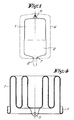
- a flexible membrane for an expansion vessel is manufactured by confection in the shape of an oblong bag, starting from a number of pieces 1 and 2, in the given example two pieces, which form the pieces of the bag which is divided in pieces transversely to its longitudinal direction, whereby this bag is considered in unfolded condition and ready for use, such as represented in figure 1.
- Pieces 1 and 2 are connected to each other with their edges 3 and 4 which, with an unfolded membrane, are directed transversely to the longitudinal direction.
- the membrane does not have one single seam extending lengthwise.
- the two pieces 1-2 of the membrane are manufactured separately.
- the vessel is round and closed at the extremities such as represented in figure 1, and the pieces 1 and 2 form cylindrical barrels with a different diameter.
- the pieces 1 and 2 can, however, also have the same diameter or another section than a round one.
- the one piece 1, which is represented in detail in figure 2, is provided with a suspension loop 5, for suspending the membrane to a hook in the vessel 6, while the other piece 2, as represented in detail in figure 3, is provided with an integrated connection flange 7 for the connection to a conduit-pipe 8, such as represented in figure 1.
- Both pieces 1 and 2 are separately made in a mould, preferably by injection moulding.
- this piece 1 or 2 can be made, according to a variant of the method, with folds such as represented in figure 4 for the piece 1. Afterwards these folds are unfolded whereby this piece 1 takes a much greater length.
- the pieces 1 and 2 are manufactured from natural or synthetic rubber such as butyl rubber.
- the chosen material must evidently have the required properties, namely the desired permeability, flexibility and resistance to the fluids used during its application.
- the pieces 1 and 2 are first vulcanized, either completely or excluding the edges 3 or 4.
- edges 3 and 4 can be beveled at the inner side of the membrane, in such a manner that when the edges 3 and 4 are brought against each other such as represented in figures 5 and 6, they have a greater surface of contact and almost do not form a thickening of the wall of the membrane.
- connection of the edges 3 and 4 of the pieces 1 and 2 is realised by applying a vulcanisation solution 9 and by heating it, for instance by means of a mirror welding apparatus 10 with electric heating resistances.
- a vulcanisation solution 9 for instance by means of a mirror welding apparatus 10 with electric heating resistances.
- Such apparatus can be used because only a local heating and vulcanisation is required.
- the edges 3 and 4 to be connected can easily be approached by the welding apparatus 10 and it is even easy to apply pressure during the connection.
- the pieces 1 and 2 are pulled away from each other and the bag is formed, whereupon one extremity therof is suspended by means of the suspension loop 5 in the vessel 6 and the connection flange is applied in an opening in the vessel 6 and connected to the conduit-pipe 8.
- the space between the membrane 1-2 and the vessel 6 is filled with gas under pressure while the expanding fluid, such as for instance water, runs through the connection flange 7 into the membrane.
- the expanding fluid such as for instance water
- the membrane 1-2 instead of being made of rubber, can be made of a thermoplastic elastomer, for example the elastomer known under the trade mark Santoprene.
- a thermoplastic elastomer for example the elastomer known under the trade mark Santoprene.
- no vulcanisation of the pieces is necessary and for connecting the edges 3 and 4 no vulcanisation solution either. It suffices to weld these edges 3 and 4 to each other.
- a third ring-shaped piece can be manufactured which is applied between the pieces 1 and 2 and which is fixed with its edges to the edges 3 and 4 in the manner described hereabove.
- edges 3 and 4 of the pieces 1 and 2 need not necessarily be beveled such as represented in detail in figure 6. They can also be shaped stepwise such as represented in detail in figure 7. Other shapes are also possible.
- a defective membrane can mostly be entirely or partly recycled.
- connection flange 7 is integrated so that no separate confection is necessary therefor.
- the post-treatment is very short on account of the fact that only local heating is required to connect the edges 3 and 4.
- the dimensions of the pieces of the membrane are determined by the mould in which they are manufactured and not by the cutting to measure, so that the risk of deviations in dimensions on account of erroneous cutting and a great number of connections is avoided.
Landscapes
- Engineering & Computer Science (AREA)
- Mechanical Engineering (AREA)
- Chemical & Material Sciences (AREA)
- Chemical Kinetics & Catalysis (AREA)
- General Chemical & Material Sciences (AREA)
- Separation Using Semi-Permeable Membranes (AREA)
Applications Claiming Priority (2)
| Application Number | Priority Date | Filing Date | Title |
|---|---|---|---|
| BE9600371A BE1010201A3 (nl) | 1996-04-26 | 1996-04-26 | Werkwijze voor het vervaardigen van een membraan voor een expansievat. |
| BE9600371 | 1996-04-26 |
Publications (1)
| Publication Number | Publication Date |
|---|---|
| EP0803344A1 true EP0803344A1 (de) | 1997-10-29 |
Family
ID=3889705
Family Applications (1)
| Application Number | Title | Priority Date | Filing Date |
|---|---|---|---|
| EP97201037A Withdrawn EP0803344A1 (de) | 1996-04-26 | 1997-04-05 | Verfahren zur Herstellung einer Membranblase für ein Ausdehnungsgefäss |
Country Status (2)
| Country | Link |
|---|---|
| EP (1) | EP0803344A1 (de) |
| BE (1) | BE1010201A3 (de) |
Cited By (3)
| Publication number | Priority date | Publication date | Assignee | Title |
|---|---|---|---|---|
| WO2004065108A1 (de) * | 2003-01-22 | 2004-08-05 | Hydac Technology Gmbh | Verfahren zum herstellen einer speicherblase |
| EP2110226A1 (de) * | 2008-04-14 | 2009-10-21 | Medibeg N.V. | Vorrichtung und Verfahren zur Herstellung von Membranen für Ausdehnungsgefäße |
| EP3000585A1 (de) | 2014-09-25 | 2016-03-30 | Société Auxiliare de Fabrication de la Sacatec | Verfahren und gerät zum zusammenfügen von blasenteilen |
Citations (11)
| Publication number | Priority date | Publication date | Assignee | Title |
|---|---|---|---|---|
| US2389791A (en) * | 1944-04-06 | 1945-11-27 | Ideal Roller & Mfg Company | Accumulator |
| GB853082A (en) * | 1957-12-13 | 1960-11-02 | Meyer Horst | Improvements in or relating to inflatable balls |
| US3067776A (en) * | 1956-04-09 | 1962-12-11 | Ideal Roller And Mfg Company | Hydraulic accumulator |
| US3220544A (en) * | 1963-04-26 | 1965-11-30 | Walter C Lovell | Packaging and novel container employed therewith |
| US3299193A (en) * | 1961-04-12 | 1967-01-17 | Luis Vergara | Process for making pneumatic balls |
| DE1601250A1 (de) * | 1968-02-16 | 1970-11-05 | Draegerwerk Ag | Druckgasflasche aus einem Kunststoffmantel |
| US3705224A (en) * | 1971-07-06 | 1972-12-05 | Goodrich Co B F | Method of making a jack |
| US3946759A (en) * | 1972-02-09 | 1976-03-30 | Mercier Jacques H | Pressure vessel having a deformable bladder therein |
| US4130619A (en) * | 1977-06-16 | 1978-12-19 | Ektelon | Apparatus and method of making hollow articles |
| US4174245A (en) * | 1977-02-24 | 1979-11-13 | Regie Nationale Des Usines Renault | Method of fabricating a flexible fuel tank |
| US4784181A (en) * | 1985-10-07 | 1988-11-15 | Flamco B.V. | Expansion tank with a bladder-type diaphragm |
-
1996
- 1996-04-26 BE BE9600371A patent/BE1010201A3/nl not_active IP Right Cessation
-
1997
- 1997-04-05 EP EP97201037A patent/EP0803344A1/de not_active Withdrawn
Patent Citations (11)
| Publication number | Priority date | Publication date | Assignee | Title |
|---|---|---|---|---|
| US2389791A (en) * | 1944-04-06 | 1945-11-27 | Ideal Roller & Mfg Company | Accumulator |
| US3067776A (en) * | 1956-04-09 | 1962-12-11 | Ideal Roller And Mfg Company | Hydraulic accumulator |
| GB853082A (en) * | 1957-12-13 | 1960-11-02 | Meyer Horst | Improvements in or relating to inflatable balls |
| US3299193A (en) * | 1961-04-12 | 1967-01-17 | Luis Vergara | Process for making pneumatic balls |
| US3220544A (en) * | 1963-04-26 | 1965-11-30 | Walter C Lovell | Packaging and novel container employed therewith |
| DE1601250A1 (de) * | 1968-02-16 | 1970-11-05 | Draegerwerk Ag | Druckgasflasche aus einem Kunststoffmantel |
| US3705224A (en) * | 1971-07-06 | 1972-12-05 | Goodrich Co B F | Method of making a jack |
| US3946759A (en) * | 1972-02-09 | 1976-03-30 | Mercier Jacques H | Pressure vessel having a deformable bladder therein |
| US4174245A (en) * | 1977-02-24 | 1979-11-13 | Regie Nationale Des Usines Renault | Method of fabricating a flexible fuel tank |
| US4130619A (en) * | 1977-06-16 | 1978-12-19 | Ektelon | Apparatus and method of making hollow articles |
| US4784181A (en) * | 1985-10-07 | 1988-11-15 | Flamco B.V. | Expansion tank with a bladder-type diaphragm |
Cited By (3)
| Publication number | Priority date | Publication date | Assignee | Title |
|---|---|---|---|---|
| WO2004065108A1 (de) * | 2003-01-22 | 2004-08-05 | Hydac Technology Gmbh | Verfahren zum herstellen einer speicherblase |
| EP2110226A1 (de) * | 2008-04-14 | 2009-10-21 | Medibeg N.V. | Vorrichtung und Verfahren zur Herstellung von Membranen für Ausdehnungsgefäße |
| EP3000585A1 (de) | 2014-09-25 | 2016-03-30 | Société Auxiliare de Fabrication de la Sacatec | Verfahren und gerät zum zusammenfügen von blasenteilen |
Also Published As
| Publication number | Publication date |
|---|---|
| BE1010201A3 (nl) | 1998-03-03 |
Similar Documents
| Publication | Publication Date | Title |
|---|---|---|
| EP0464121B1 (de) | Relining von pipelines und kanälen | |
| FI76035C (fi) | Anordning foer formning och insaettning av ett internt lock i en behaollare. | |
| US2312993A (en) | Method of lining pipe | |
| US4202379A (en) | Sealing arrangement | |
| RU1831634C (ru) | Устройство дл ремонта труб дл использовани внутри трубы и способ ремонта труб | |
| US2399544A (en) | Pipe-line repair plug | |
| US5503188A (en) | Inflatable air bag pipeline stopper | |
| US4979532A (en) | Jointing device for tents, covers etc. | |
| CN107614953B (zh) | 重量轻的高流量软管组件及制造方法 | |
| US4377184A (en) | Plug | |
| US4209352A (en) | Methods for sealing closure members to substrates | |
| US4818314A (en) | Process for lining a high pressure pipeline | |
| JPH01501562A (ja) | チューブを接続する方法 | |
| EP0803344A1 (de) | Verfahren zur Herstellung einer Membranblase für ein Ausdehnungsgefäss | |
| EP0362576B1 (de) | Gerät zum Halten eines Gegenstandes | |
| US4070904A (en) | Pipeline joint tester | |
| US5306449A (en) | Process for lining high pressure pipeline | |
| US2339696A (en) | Tire retreading mold | |
| EP0583819A1 (de) | Vorrichtung zum Verschliessen des Durchgangs in einem Rohr | |
| JP5313520B2 (ja) | 流体遮断用バッグ | |
| US2381074A (en) | Method of making inflatable hose | |
| US1554316A (en) | Inflatable bag | |
| KR100308002B1 (ko) | 튜브관연결체,튜브관커넥터및튜브관연결방법 | |
| GB2054020A (en) | Flexible structure for the separation of phases inside containers for storing fluids and process for obtaining that structure | |
| US4435351A (en) | Method of breaking loose vulcanized hose from a rigid mandrel |
Legal Events
| Date | Code | Title | Description |
|---|---|---|---|
| PUAI | Public reference made under article 153(3) epc to a published international application that has entered the european phase |
Free format text: ORIGINAL CODE: 0009012 |
|
| AK | Designated contracting states |
Kind code of ref document: A1 Designated state(s): DE ES FR GB IT NL |
|
| 17P | Request for examination filed |
Effective date: 19980423 |
|
| STAA | Information on the status of an ep patent application or granted ep patent |
Free format text: STATUS: THE APPLICATION HAS BEEN WITHDRAWN |
|
| 18W | Application withdrawn |
Withdrawal date: 19990508 |