EP0802894B1 - Verfahren zur herstellung von alkyl-tertiär-alkylethern - Google Patents
Verfahren zur herstellung von alkyl-tertiär-alkylethern Download PDFInfo
- Publication number
- EP0802894B1 EP0802894B1 EP96900607A EP96900607A EP0802894B1 EP 0802894 B1 EP0802894 B1 EP 0802894B1 EP 96900607 A EP96900607 A EP 96900607A EP 96900607 A EP96900607 A EP 96900607A EP 0802894 B1 EP0802894 B1 EP 0802894B1
- Authority
- EP
- European Patent Office
- Prior art keywords
- iso
- reagent
- stream
- distillation column
- reaction mixture
- Prior art date
- Legal status (The legal status is an assumption and is not a legal conclusion. Google has not performed a legal analysis and makes no representation as to the accuracy of the status listed.)
- Expired - Lifetime
Links
- 125000000217 alkyl group Chemical group 0.000 title claims description 15
- 238000004519 manufacturing process Methods 0.000 title claims description 6
- 229930195733 hydrocarbon Natural products 0.000 claims description 48
- 150000002430 hydrocarbons Chemical class 0.000 claims description 48
- 239000003153 chemical reaction reagent Substances 0.000 claims description 40
- 238000004821 distillation Methods 0.000 claims description 31
- 239000004215 Carbon black (E152) Substances 0.000 claims description 21
- 238000000034 method Methods 0.000 claims description 21
- 239000011541 reaction mixture Substances 0.000 claims description 21
- LFQSCWFLJHTTHZ-UHFFFAOYSA-N Ethanol Chemical compound CCO LFQSCWFLJHTTHZ-UHFFFAOYSA-N 0.000 claims description 18
- 239000000203 mixture Substances 0.000 claims description 12
- 238000006243 chemical reaction Methods 0.000 claims description 7
- 125000004432 carbon atom Chemical group C* 0.000 claims description 5
- 238000006266 etherification reaction Methods 0.000 claims description 4
- 230000002378 acidificating effect Effects 0.000 claims description 3
- 238000004064 recycling Methods 0.000 claims description 3
- 239000011949 solid catalyst Substances 0.000 claims description 2
- OKKJLVBELUTLKV-UHFFFAOYSA-N Methanol Chemical compound OC OKKJLVBELUTLKV-UHFFFAOYSA-N 0.000 description 54
- VQTUBCCKSQIDNK-UHFFFAOYSA-N Isobutene Chemical compound CC(C)=C VQTUBCCKSQIDNK-UHFFFAOYSA-N 0.000 description 20
- BZLVMXJERCGZMT-UHFFFAOYSA-N Methyl tert-butyl ether Chemical compound COC(C)(C)C BZLVMXJERCGZMT-UHFFFAOYSA-N 0.000 description 14
- 238000000926 separation method Methods 0.000 description 6
- 125000000542 sulfonic acid group Chemical group 0.000 description 6
- 239000003054 catalyst Substances 0.000 description 5
- 239000003456 ion exchange resin Substances 0.000 description 5
- 229920003303 ion-exchange polymer Polymers 0.000 description 5
- 239000007788 liquid Substances 0.000 description 5
- NWUYHJFMYQTDRP-UHFFFAOYSA-N 1,2-bis(ethenyl)benzene;1-ethenyl-2-ethylbenzene;styrene Chemical class C=CC1=CC=CC=C1.CCC1=CC=CC=C1C=C.C=CC1=CC=CC=C1C=C NWUYHJFMYQTDRP-UHFFFAOYSA-N 0.000 description 4
- 150000002170 ethers Chemical class 0.000 description 4
- 150000003138 primary alcohols Chemical class 0.000 description 4
- BKOOMYPCSUNDGP-UHFFFAOYSA-N 2-methylbut-2-ene Chemical compound CC=C(C)C BKOOMYPCSUNDGP-UHFFFAOYSA-N 0.000 description 3
- 229920002125 Sokalan® Polymers 0.000 description 3
- 229920001429 chelating resin Polymers 0.000 description 3
- 238000010438 heat treatment Methods 0.000 description 3
- -1 methanol Chemical class 0.000 description 3
- OFBQJSOFQDEBGM-UHFFFAOYSA-N n-pentane Natural products CCCCC OFBQJSOFQDEBGM-UHFFFAOYSA-N 0.000 description 3
- 238000011084 recovery Methods 0.000 description 3
- NUMQCACRALPSHD-UHFFFAOYSA-N tert-butyl ethyl ether Chemical compound CCOC(C)(C)C NUMQCACRALPSHD-UHFFFAOYSA-N 0.000 description 3
- 238000005406 washing Methods 0.000 description 3
- VXNZUUAINFGPBY-UHFFFAOYSA-N 1-Butene Chemical compound CCC=C VXNZUUAINFGPBY-UHFFFAOYSA-N 0.000 description 2
- YZUPZGFPHUVJKC-UHFFFAOYSA-N 1-bromo-2-methoxyethane Chemical compound COCCBr YZUPZGFPHUVJKC-UHFFFAOYSA-N 0.000 description 2
- RTZKZFJDLAIYFH-UHFFFAOYSA-N Diethyl ether Chemical compound CCOCC RTZKZFJDLAIYFH-UHFFFAOYSA-N 0.000 description 2
- DKGAVHZHDRPRBM-UHFFFAOYSA-N Tert-Butanol Chemical compound CC(C)(C)O DKGAVHZHDRPRBM-UHFFFAOYSA-N 0.000 description 2
- 239000003377 acid catalyst Substances 0.000 description 2
- 238000005094 computer simulation Methods 0.000 description 2
- 238000010586 diagram Methods 0.000 description 2
- 238000005265 energy consumption Methods 0.000 description 2
- 238000002156 mixing Methods 0.000 description 2
- 229920001467 poly(styrenesulfonates) Polymers 0.000 description 2
- HVZJRWJGKQPSFL-UHFFFAOYSA-N tert-Amyl methyl ether Chemical compound CCC(C)(C)OC HVZJRWJGKQPSFL-UHFFFAOYSA-N 0.000 description 2
- 150000003509 tertiary alcohols Chemical class 0.000 description 2
- CHRJZRDFSQHIFI-UHFFFAOYSA-N 1,2-bis(ethenyl)benzene;styrene Chemical class C=CC1=CC=CC=C1.C=CC1=CC=CC=C1C=C CHRJZRDFSQHIFI-UHFFFAOYSA-N 0.000 description 1
- MHNNAWXXUZQSNM-UHFFFAOYSA-N 2-methylbut-1-ene Chemical compound CCC(C)=C MHNNAWXXUZQSNM-UHFFFAOYSA-N 0.000 description 1
- WVDDGKGOMKODPV-UHFFFAOYSA-N Benzyl alcohol Chemical compound OCC1=CC=CC=C1 WVDDGKGOMKODPV-UHFFFAOYSA-N 0.000 description 1
- BPQQTUXANYXVAA-UHFFFAOYSA-N Orthosilicate Chemical compound [O-][Si]([O-])([O-])[O-] BPQQTUXANYXVAA-UHFFFAOYSA-N 0.000 description 1
- 239000002253 acid Substances 0.000 description 1
- 239000000654 additive Substances 0.000 description 1
- 230000001476 alcoholic effect Effects 0.000 description 1
- 239000011959 amorphous silica alumina Substances 0.000 description 1
- 125000003118 aryl group Chemical group 0.000 description 1
- 239000001273 butane Substances 0.000 description 1
- 238000006555 catalytic reaction Methods 0.000 description 1
- 238000002485 combustion reaction Methods 0.000 description 1
- 150000001875 compounds Chemical class 0.000 description 1
- 238000000605 extraction Methods 0.000 description 1
- 238000005194 fractionation Methods 0.000 description 1
- 239000000446 fuel Substances 0.000 description 1
- 125000000524 functional group Chemical group 0.000 description 1
- 238000006317 isomerization reaction Methods 0.000 description 1
- IJDNQMDRQITEOD-UHFFFAOYSA-N n-butane Chemical compound CCCC IJDNQMDRQITEOD-UHFFFAOYSA-N 0.000 description 1
- 238000006116 polymerization reaction Methods 0.000 description 1
- 238000010992 reflux Methods 0.000 description 1
- 229920005989 resin Polymers 0.000 description 1
- 239000011347 resin Substances 0.000 description 1
- 150000003333 secondary alcohols Chemical class 0.000 description 1
- 239000010457 zeolite Substances 0.000 description 1
Images

Classifications
-
- C—CHEMISTRY; METALLURGY
- C07—ORGANIC CHEMISTRY
- C07C—ACYCLIC OR CARBOCYCLIC COMPOUNDS
- C07C41/00—Preparation of ethers; Preparation of compounds having groups, groups or groups
- C07C41/01—Preparation of ethers
- C07C41/34—Separation; Purification; Stabilisation; Use of additives
- C07C41/40—Separation; Purification; Stabilisation; Use of additives by change of physical state, e.g. by crystallisation
- C07C41/42—Separation; Purification; Stabilisation; Use of additives by change of physical state, e.g. by crystallisation by distillation
-
- C—CHEMISTRY; METALLURGY
- C07—ORGANIC CHEMISTRY
- C07C—ACYCLIC OR CARBOCYCLIC COMPOUNDS
- C07C41/00—Preparation of ethers; Preparation of compounds having groups, groups or groups
- C07C41/01—Preparation of ethers
- C07C41/05—Preparation of ethers by addition of compounds to unsaturated compounds
- C07C41/06—Preparation of ethers by addition of compounds to unsaturated compounds by addition of organic compounds only
-
- Y—GENERAL TAGGING OF NEW TECHNOLOGICAL DEVELOPMENTS; GENERAL TAGGING OF CROSS-SECTIONAL TECHNOLOGIES SPANNING OVER SEVERAL SECTIONS OF THE IPC; TECHNICAL SUBJECTS COVERED BY FORMER USPC CROSS-REFERENCE ART COLLECTIONS [XRACs] AND DIGESTS
- Y02—TECHNOLOGIES OR APPLICATIONS FOR MITIGATION OR ADAPTATION AGAINST CLIMATE CHANGE
- Y02P—CLIMATE CHANGE MITIGATION TECHNOLOGIES IN THE PRODUCTION OR PROCESSING OF GOODS
- Y02P20/00—Technologies relating to chemical industry
- Y02P20/50—Improvements relating to the production of bulk chemicals
- Y02P20/582—Recycling of unreacted starting or intermediate materials
Definitions
- the invention relates to a process for preparing alkyl tertiary-alkyl ethers such as methyl tert-butyl ether (“MTBE”), ethyl tert-butyl ether (“ETBE”), tert-amyl methyl ether (“TAME”), etc.
- MTBE methyl tert-butyl ether
- ETBE ethyl tert-butyl ether
- TAME tert-amyl methyl ether
- MTBE and other ethers are known in the art. Thus, they may be made by reacting an alcohol (typically a primary alcohol such as methanol, hereinafter “MeOH") with an iso-olefin (e.g., isobutene) or the corresponding tertiary alcohol (e.g., tert-butanol) in the presence of an acid catalyst. As 100% conversion is not achieved, the reaction mixture comprises the product ether but also starting reagents. Unfortunately, MTBE and MeOH are hard to separate by distillation as an MeOH/MTBE azeotrope is formed.
- MeOH a primary alcohol
- iso-olefin e.g., isobutene
- tert-butanol tertiary alcohol
- the invention provides a process for preparing an alkyl tertiary-alkyl ether by
- the iso-olefin reagent-containing stream is formed by the distillation recycle and, optionally, a stream of fresh reagent.
- a stream of fresh reagent Preferably (since economically more attractive), at least 50 %wt, more preferably at least 80 %wt, of the iso-olefin reagent-containing stream is formed by the distillation recycle. Most preferably, all of the iso-olefin reagent that is fed into the reactor stems from the distillation recycle.
- the hydrocarbon feed stream may further comprise inert hydrocarbons such as butane, pentane, etc., and essentially inert hydrocarbons such as 1-butene, etc.
- the hydrocarbon feed stream comprises at least 50 %wt of the iso-olefin reagent.
- a bleed stream may be introduced downstream of the reactor and/or the distillation column.
- a conventional isomerization unit as disclosed in for instance US patents Nos.
- 5,243,090, 5,254,748 and 5,254,764) may be used to isomerize (part of) the inert hydrocarbons into the iso-olefin reagent.
- hydrocarbon feed streams comprising C3- or C9+ hydrocarbons are used as these components do not facilitate the fractionation of the reaction mixture in the distillation column.
- the hydrocarbon feed stream comprises at least 80 %wt, most preferably at least 99 %wt of the iso-olefin reagent.
- Build-up of inert hydrocarbons in this most preferred embodiment is very small, if any. Accordingly, the overhead mixture may be recycled in total to the reactor without need of a bleed stream. Loss of reagents/products is then negligible, whereas the elevated temperature of this overhead mixture is optimally used.
- the hydrocarbon feed stream is passed into the distillation column through a separate inlet that is located below the inlet of the reaction mixture, whereby nearly all of the alcohol reagent may be removed from the bottom product comprising the alkyl tertiary-alkyl ether.
- the amount of hydrocarbon feed stream is such as to introduce at least sufficient hydrocarbons into the distillation column to separate the alcohol in the form of an azeotrope of the alcohol and the hydrocarbons from the produced alkyl tertiary-alkyl ether.
- This amount is related to the internal pressure in the distillation column. For instance, from US patent No. 4,198,530 it is known that at a pressure of 5 atm (5.07 bar a), the MeOH contents in the azeotrope is about 4 mol%, but at a pressure of 10 atm (10.1 bar a), it is about 9 mol%.
- the amount is also related to the content of hydrocarbons in the reaction mixture, for instance, of excess iso-olefin reagent and inert hydrocarbons due to build-up, if any.
- Suitable iso-olefin reagents used in the present process have up to 8 carbon atoms and are more suitably selected from isobutene and isoamylenes (2-methyl-1-butene, 2-methyl-2-butene and dimethylpropene).
- the alcohol reagent suitably has up to 8 carbon atoms and is more suitable a primary alcohol, such as methanol and ethanol, but may also be a secondary, tertiary or aromatic alcohol.
- a primary alcohol such as methanol and ethanol
- Tertiary-alkyl ethers of primary alcohols generally have the better combustion properties and are therefore preferred.
- the molar ratio wherein the iso-olefin reagent and the alcohol reagent are allowed to react ranges from 1:0.9 to 1:1.1, and is more preferably about 1:1.02.
- Using more than the stoichiometric amount of one of the reagents allows improved conversion in respect of the other reagent.
- excess alcohol reagent is used, the difficulty in obtaining sufficiently pure alkyl tertiary-alkyl ether is aggrevated, whereas in case excess iso-olefin reagent is used, large volumes thereof will be recirculated, increasing the costs of equipment.
- the catalyst typically is an acidic solid catalyst such as a sulfonic acid substituted ion exchange resin or an acidic natural or synthetic silicate (e.g., amorphous silica-alumina or acid zeolites).
- the catalyst is an ion exchange resin, e.g., produced by polymerization of aromatic vinyl compounds to which catalytically active functional groups are covalently bonded.
- Suitable sulfonic acid substituted ion exchange resins are disclosed in European patent application No. 102,840 and in International application No. 90/08758.
- a very suitable catalyst is a sulfonic acid substituted ion exchange resin having at least 1.2, more preferably about 1.2 to 1.8 sulfonic acid groups for each aromatic ring system.
- Typical examples of very suitable catalysts are sulfonic acid substituted divinylbenzene-styrene resins sold under the trademarks DUOLITE C20, DUOLITE C26, AMBERLYST 15, AMBERLITE IR-120, AMBERLITE 200 and DOWEX 50 (DUOLITE, AMBERLITE and DOWEX are trade marks).
- the reaction usually is conducted at a temperature between 30 and 120 °C, preferably between 45 and 100 °C, and a pressure between 5 and 40 bar g, preferably between 10 and 20 bar g.
- the reagents are supplied and made to flow continuously through the sulfonic acid substituted ion exchange resin which is disposed in the form of a fixed bed, at a liquid hourly space velocity (LHSV) that is generally less than 80 hr -1 .
- LHSV liquid hourly space velocity
- the distillation is suitably carried out in a distillation tower having 30 to 50 theoretical plates (“TPs") that is, for instance, operated at a pressure between 6 and 12 bar g, a bottom temperature (T B ) between 130 and 150 °C, and a top temperature (T T ) between 50 and 70 °C.
- TPs theoretical plates
- the invention may quite suitably be carried out with a distillation tower of 40 TPs, operating at a pressure of 9 bar g, a T B of 140 °C, and a T T of 65 °C (all approximations).
- reaction mixture is employed in indirect heat transfer with the (hot) bottom product comprising the alkyl tertiary-alkyl ether.
- bottom product is also employed in indirect heat transfer with the hydrocarbon feed stream further downstream of the distillation column.
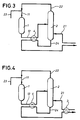
- the hydrocarbon feed stream introduced via inlet 21, is composed of isobutene.
- the reagents introduced via inlet 11 essentially comprise isobutene as iso-olefin and MeOH as primary alcohol in a molar ratio of 1:1.02. It is passed to reactor 1 containing an acid catalyst (e.g., "AMBERLYST 15") for etherification at an LHSV of about 20 hr -1 , a pressure of 20 bar g and a temperature of 50 °C.
- an acid catalyst e.g., "AMBERLYST 15”
- the reaction mixture essentially comprising isobutene, MeOH and MTBE (conversion of about 99%), is passed to the mid-portion of distillation column 2 (a column counting 37 TPs).
- the distillation is carried out at an internal pressure of 9 bar g, a T B of 141 °C and a T T of 63 °C.
- the inlet 21 of the hydrocarbon feed stream is below the inlet of the reaction mixture.
- the amount of hydrocarbon feed stream is sufficient to compensate the amount of isobutene converted into MTBE (about 40,000 kg (40 ton) per hour).
- the overhead mixture obtained at the top of the distillation column 2, via outlet 22, is essentially composed of isobutene and MeOH (about 47,000 kg (47 ton) per hour, ratio isobutene to MeOH of about 97:3 m/m).
- An alcoholic feed stream of fresh MeOH is introduced via inlet 23 in an amount sufficient to change the molar ratio to that of the reaction feedstock (about 23,000 kg (23 ton) per hour).
- the bottom product, obtained at outlet 24 is essentially composed of the alkyl tertiary-alkyl ether, MTBE (about 63,000 kg (63 ton) per hour).
- a preferred embodiment (B) of the present invention is illustrated as a schematic diagram in Figure 2.
- the bottom product, obtained at outlet 24, is cooled in heat exchanger 3 by indirect heat exchange with the hydrocarbon feed stream, introduced via inlet 21.
- the bottom product is cooled in heat exchanger 4 by indirect heat exchange with the reaction mixture, transported via pipe 12.
- the bottom product is first cooled in heat exchanger 4 by indirect heat exchange with the reaction mixture and subsequently (downstream) in heat exchanger 3 with the hydrocarbon feed stream.
- each of the embodiments (A) to (D) is that no extraction of recycle methanol is required.
- required to prepare 1000 kg of MTBE per hour for embodiment (A) is small, and that of embodiments (B) to (D) smaller still.
- the results of a computer simulation have been summarized in the Table.
- the Table is completed with results of computer simulations that are based on a process (C1) wherein the iso-olefin reagent is heated to the same temperature as in embodiments (A) to (D), however now heating the iso-olefin externally (requiring about 1 MJ/s (1 MW) to bring the 40 ton isobutene to the same temperature as that of the distillation recycle).
- the distillation column is fed with a separate flow of liquid hydrocarbons.
- the overhead mixture is then led to a separation unit (i.e., a washing unit with a duty of about 3.5 MJ/s (3.5 MW)) where the alcohol and the liquid hydrocarbons are separated.
Landscapes
- Chemical & Material Sciences (AREA)
- Organic Chemistry (AREA)
- Crystallography & Structural Chemistry (AREA)
- Organic Low-Molecular-Weight Compounds And Preparation Thereof (AREA)
Claims (10)
- Verfahren zur Herstellung eines Alkyl-tert.alkylethers durchwobei der Kohlenwasserstoffspeisestrom das Isoolefinreagens enthält, wobei wenigstens ein Teil des dem Reaktor zugeführten Isoolefinreagens-hältigen Stroms aus dem Überkopfgemisch gebildet wird, und wobei der Kohlenwasserstoffspeisestrom in die Destillationskolonne durch einen gesonderten Einlaß eingeführt wird, der unter jenem des Reaktionsgemisches angeordnet ist.(a) Einspeisen eines Isoolefinreagens-hältigen Stroms und eines Alkoholreagens in einen Reaktor und Reagierenlassen dieser Reagentien unter Veretherungsbedingungen zur Ausbildung eines einen Alkyl-tert.alkylether enthaltenden Reaktionsgemisches,(b) Überführen des in (a) gebildeten Reaktionsproduktes und eines C4-bis C9-Kohlenwasserstoffe enthaltenden Speisestroms (nachfolgend der "Kohlenwasserstoffspeisestrom") zu einer Destillationskolonne,(c) Fraktionieren des Reaktionsgemisches und der Kohlenwasserstoffe zur Ausbildung eines Stromes, der im wesentlichen reinen Alkyl-tert.alkylether enthält, am Sumpf der Destillationskolonne, und eines Stromes, der Alkohol und Kohlenwasserstoffe enthält, am Kopf der Destillationskolonne, und(d) Recyclieren wenigstens eines Teiles des Überkopfproduktes zum Reaktor,
- Verfahren nach Anspruch 1, worin wenigstens 50 Gew.-% des Isoolefinreagens-hältigen Stroms aus dem Überkopfgemisch bestehen.
- Verfahren nach Anspruch 1 oder 2, worin der Kohlenwasserstoffspeisestrom zu wenigstens 80 Gew.-% aus Isoolefinreagens besteht.
- Verfahren nach einem der Ansprüche 1 bis 3, worin das Isoolefinreagens bis zu 8 Kohlenstoffatome enthält.
- Verfahren nach einem der Ansprüche 1 bis 4, worin das Alkoholreagens bis zu 8 Kohlenstoffatome enthält.
- Verfahren nach einem der Ansprüche 1 bis 5, worin das Isoolefinreagens und das Alkoholreagens in einem Molverhältnis im Bereich von 1:0,9 bis 1:1,1 reagieren gelassen werden.
- Verfahren nach einem der Ansprüche 1 bis 6, worin die Veretherung in Gegenwart eines sauren festen Katalysators ausgeführt wird.
- Verfahren nach einem der Ansprüche 1 bis 7, worin die Umsetzung bei einer Temperatur von 30 bis 120°C und unter einem Druck von 5 bis 40 bar g ausgeführt wird.
- Verfahren nach einem der Ansprüche 1 bis 8, worin die Destillation in einer Destillationskolonne mit 30 bis 50 theoretischen Böden ausgeführt wird.
- Verfahren nach einem der Ansprüche 1 bis 9, worin zwischen dem am Boden der Destillationskolonne abgenommenen Strom, der den Alkyl-tert.alkylether enthält, und (i) dem Reaktionsgemisch und/oder (ii) dem Kohlenwasserstoffspeisestrom ein indirekter Wärmeaustausch vorgenommen wird.
Priority Applications (1)
| Application Number | Priority Date | Filing Date | Title |
|---|---|---|---|
| EP96900607A EP0802894B1 (de) | 1995-01-13 | 1996-01-11 | Verfahren zur herstellung von alkyl-tertiär-alkylethern |
Applications Claiming Priority (4)
| Application Number | Priority Date | Filing Date | Title |
|---|---|---|---|
| EP95200086 | 1995-01-13 | ||
| EP95200086 | 1995-01-13 | ||
| EP96900607A EP0802894B1 (de) | 1995-01-13 | 1996-01-11 | Verfahren zur herstellung von alkyl-tertiär-alkylethern |
| PCT/EP1996/000264 WO1996021635A1 (en) | 1995-01-13 | 1996-01-11 | Process for preparing alkyl tertiary-alkyl ether |
Publications (2)
| Publication Number | Publication Date |
|---|---|
| EP0802894A1 EP0802894A1 (de) | 1997-10-29 |
| EP0802894B1 true EP0802894B1 (de) | 1999-04-28 |
Family
ID=8219959
Family Applications (1)
| Application Number | Title | Priority Date | Filing Date |
|---|---|---|---|
| EP96900607A Expired - Lifetime EP0802894B1 (de) | 1995-01-13 | 1996-01-11 | Verfahren zur herstellung von alkyl-tertiär-alkylethern |
Country Status (9)
| Country | Link |
|---|---|
| EP (1) | EP0802894B1 (de) |
| JP (1) | JPH10511975A (de) |
| CN (1) | CN1173860A (de) |
| AU (1) | AU688192B2 (de) |
| BR (1) | BR9606913A (de) |
| CA (1) | CA2210230A1 (de) |
| DE (1) | DE69602252T2 (de) |
| ES (1) | ES2130782T3 (de) |
| WO (1) | WO1996021635A1 (de) |
Cited By (1)
| Publication number | Priority date | Publication date | Assignee | Title |
|---|---|---|---|---|
| TWI506014B (zh) * | 2014-08-29 | 2015-11-01 | Cpc Corp Taiwan | 使用第三丁醇混合物聯產異丁烯與乙基第三丁基醚之方法 |
Families Citing this family (3)
| Publication number | Priority date | Publication date | Assignee | Title |
|---|---|---|---|---|
| FR2757851B1 (fr) * | 1996-12-31 | 1999-12-31 | Total Raffinage Distribution | Procede et dispositif d'etherification d'une charge olefinique hydrocarbonee |
| RU2262503C1 (ru) * | 2004-07-08 | 2005-10-20 | Общество с ограниченной ответственностью "Корпорация Уралтехнострой" (ООО "Корпорация Уралтехнострой") | Способ получения этилтретбутилового эфира |
| WO2022189218A1 (en) * | 2021-03-08 | 2022-09-15 | Basf Se | Process for obtaining isobutene from a c4-hydrocarbon mixture |
Family Cites Families (6)
| Publication number | Priority date | Publication date | Assignee | Title |
|---|---|---|---|---|
| DE2705538A1 (de) * | 1977-02-10 | 1978-08-17 | Basf Ag | Verfahren zur reindarstellung von methyl-tert.-butylaether |
| GB2010323B (en) * | 1977-12-16 | 1982-05-06 | Gulf Canada Ltd | Preparation of gasoline containing tertiaryamyl methyl ether |
| US4198530A (en) * | 1978-06-29 | 1980-04-15 | Atlantic Richfield Company | Production of tertiary butyl methyl ether |
| US4371718A (en) * | 1981-07-02 | 1983-02-01 | Phillips Petroleum Company | Using butenes to fractionate methanol from methyl-tertiary-butyl ether |
| IT1139253B (it) * | 1981-10-20 | 1986-09-24 | Euteco Impianti Spa | Procedimento per la preparazione e la separazione di metil ter-butil etere |
| US4820877A (en) * | 1987-12-28 | 1989-04-11 | Mobil Oil Corporation | Etherification process improvement |
-
1996
- 1996-01-11 CN CN96191822A patent/CN1173860A/zh active Pending
- 1996-01-11 WO PCT/EP1996/000264 patent/WO1996021635A1/en not_active Ceased
- 1996-01-11 DE DE69602252T patent/DE69602252T2/de not_active Expired - Fee Related
- 1996-01-11 ES ES96900607T patent/ES2130782T3/es not_active Expired - Lifetime
- 1996-01-11 JP JP8521454A patent/JPH10511975A/ja active Pending
- 1996-01-11 CA CA002210230A patent/CA2210230A1/en not_active Abandoned
- 1996-01-11 BR BR9606913A patent/BR9606913A/pt not_active Application Discontinuation
- 1996-01-11 AU AU44389/96A patent/AU688192B2/en not_active Ceased
- 1996-01-11 EP EP96900607A patent/EP0802894B1/de not_active Expired - Lifetime
Cited By (1)
| Publication number | Priority date | Publication date | Assignee | Title |
|---|---|---|---|---|
| TWI506014B (zh) * | 2014-08-29 | 2015-11-01 | Cpc Corp Taiwan | 使用第三丁醇混合物聯產異丁烯與乙基第三丁基醚之方法 |
Also Published As
| Publication number | Publication date |
|---|---|
| AU688192B2 (en) | 1998-03-05 |
| WO1996021635A1 (en) | 1996-07-18 |
| AU4438996A (en) | 1996-07-31 |
| JPH10511975A (ja) | 1998-11-17 |
| CN1173860A (zh) | 1998-02-18 |
| EP0802894A1 (de) | 1997-10-29 |
| CA2210230A1 (en) | 1996-07-18 |
| ES2130782T3 (es) | 1999-07-01 |
| DE69602252T2 (de) | 1999-08-19 |
| DE69602252D1 (de) | 1999-06-02 |
| BR9606913A (pt) | 1997-11-11 |
Similar Documents
| Publication | Publication Date | Title |
|---|---|---|
| US5041690A (en) | Conversion of alcohols to ether-rich gasoline | |
| US5130101A (en) | Reactor system for conversion of alcohols to ether-rich gasoline | |
| AU704729B2 (en) | Process for preparing alkyl ethers and mixtures thereof | |
| US4820877A (en) | Etherification process improvement | |
| CA2099751C (en) | Etherification process | |
| US5237109A (en) | Etherification process | |
| RU98117406A (ru) | Способ получения алкиловых эфиров и их смесей | |
| AU5442690A (en) | Conversion of alcohols to ether-rich gasoline | |
| AU688192B2 (en) | Process for preparing alkyl tertiary-alkyl ether | |
| US5078751A (en) | Process for upgrading olefinic gasoline by etherification wherein asymmetrical dialkyl ethers are produced | |
| US5011506A (en) | Integrated etherification and alkene hydration process | |
| KR100466035B1 (ko) | 3차알킬에테르를제조하는방법 | |
| JPS6133877B2 (de) | ||
| WO1992003401A1 (en) | Etherification process | |
| US4988366A (en) | High conversion TAME and MTBE production process | |
| US5108719A (en) | Reactor system for ether production | |
| EP0071032B1 (de) | Verfahren zur Herstellung von Äthyl Tert-Butyl Äther | |
| EP0556174B1 (de) | Veretherungsprozess | |
| WO1990011267A1 (en) | Novel integrated separation method for di-isopropyl ether and methyl tertiary alkyl ether processes |
Legal Events
| Date | Code | Title | Description |
|---|---|---|---|
| PUAI | Public reference made under article 153(3) epc to a published international application that has entered the european phase |
Free format text: ORIGINAL CODE: 0009012 |
|
| 17P | Request for examination filed |
Effective date: 19970711 |
|
| AK | Designated contracting states |
Kind code of ref document: A1 Designated state(s): BE DE ES FR GB IT NL |
|
| 17Q | First examination report despatched |
Effective date: 19971009 |
|
| GRAG | Despatch of communication of intention to grant |
Free format text: ORIGINAL CODE: EPIDOS AGRA |
|
| GRAG | Despatch of communication of intention to grant |
Free format text: ORIGINAL CODE: EPIDOS AGRA |
|
| GRAH | Despatch of communication of intention to grant a patent |
Free format text: ORIGINAL CODE: EPIDOS IGRA |
|
| GRAH | Despatch of communication of intention to grant a patent |
Free format text: ORIGINAL CODE: EPIDOS IGRA |
|
| GRAA | (expected) grant |
Free format text: ORIGINAL CODE: 0009210 |
|
| AK | Designated contracting states |
Kind code of ref document: B1 Designated state(s): BE DE ES FR GB IT NL |
|
| ITF | It: translation for a ep patent filed | ||
| REF | Corresponds to: |
Ref document number: 69602252 Country of ref document: DE Date of ref document: 19990602 |
|
| REG | Reference to a national code |
Ref country code: ES Ref legal event code: FG2A Ref document number: 2130782 Country of ref document: ES Kind code of ref document: T3 |
|
| ET | Fr: translation filed | ||
| PLBE | No opposition filed within time limit |
Free format text: ORIGINAL CODE: 0009261 |
|
| STAA | Information on the status of an ep patent application or granted ep patent |
Free format text: STATUS: NO OPPOSITION FILED WITHIN TIME LIMIT |
|
| 26N | No opposition filed | ||
| PGFP | Annual fee paid to national office [announced via postgrant information from national office to epo] |
Ref country code: NL Payment date: 20010131 Year of fee payment: 6 |
|
| PGFP | Annual fee paid to national office [announced via postgrant information from national office to epo] |
Ref country code: DE Payment date: 20010202 Year of fee payment: 6 |
|
| PGFP | Annual fee paid to national office [announced via postgrant information from national office to epo] |
Ref country code: FR Payment date: 20011129 Year of fee payment: 7 |
|
| PGFP | Annual fee paid to national office [announced via postgrant information from national office to epo] |
Ref country code: GB Payment date: 20011221 Year of fee payment: 7 |
|
| REG | Reference to a national code |
Ref country code: GB Ref legal event code: IF02 |
|
| PGFP | Annual fee paid to national office [announced via postgrant information from national office to epo] |
Ref country code: ES Payment date: 20020118 Year of fee payment: 7 |
|
| PGFP | Annual fee paid to national office [announced via postgrant information from national office to epo] |
Ref country code: BE Payment date: 20020213 Year of fee payment: 7 |
|
| PG25 | Lapsed in a contracting state [announced via postgrant information from national office to epo] |
Ref country code: NL Free format text: LAPSE BECAUSE OF NON-PAYMENT OF DUE FEES Effective date: 20020801 Ref country code: DE Free format text: LAPSE BECAUSE OF NON-PAYMENT OF DUE FEES Effective date: 20020801 |
|
| NLV4 | Nl: lapsed or anulled due to non-payment of the annual fee |
Effective date: 20020801 |
|
| PG25 | Lapsed in a contracting state [announced via postgrant information from national office to epo] |
Ref country code: GB Free format text: LAPSE BECAUSE OF NON-PAYMENT OF DUE FEES Effective date: 20030111 |
|
| PG25 | Lapsed in a contracting state [announced via postgrant information from national office to epo] |
Ref country code: ES Free format text: LAPSE BECAUSE OF NON-PAYMENT OF DUE FEES Effective date: 20030113 |
|
| PG25 | Lapsed in a contracting state [announced via postgrant information from national office to epo] |
Ref country code: BE Free format text: LAPSE BECAUSE OF NON-PAYMENT OF DUE FEES Effective date: 20030131 |
|
| GBPC | Gb: european patent ceased through non-payment of renewal fee | ||
| PG25 | Lapsed in a contracting state [announced via postgrant information from national office to epo] |
Ref country code: FR Free format text: LAPSE BECAUSE OF NON-PAYMENT OF DUE FEES Effective date: 20030930 |
|
| REG | Reference to a national code |
Ref country code: FR Ref legal event code: ST |
|
| REG | Reference to a national code |
Ref country code: ES Ref legal event code: FD2A Effective date: 20030113 |
|
| PG25 | Lapsed in a contracting state [announced via postgrant information from national office to epo] |
Ref country code: IT Free format text: LAPSE BECAUSE OF NON-PAYMENT OF DUE FEES Effective date: 20050111 |