EP0802802B1 - Vernetzte polymere, hergestellt aus 1,3,7-octatrien und ähnlichen konjugierten polyenen - Google Patents
Vernetzte polymere, hergestellt aus 1,3,7-octatrien und ähnlichen konjugierten polyenen Download PDFInfo
- Publication number
- EP0802802B1 EP0802802B1 EP96902589A EP96902589A EP0802802B1 EP 0802802 B1 EP0802802 B1 EP 0802802B1 EP 96902589 A EP96902589 A EP 96902589A EP 96902589 A EP96902589 A EP 96902589A EP 0802802 B1 EP0802802 B1 EP 0802802B1
- Authority
- EP
- European Patent Office
- Prior art keywords
- foam
- absorbent
- octatriene
- water
- weight
- Prior art date
- Legal status (The legal status is an assumption and is not a legal conclusion. Google has not performed a legal analysis and makes no representation as to the accuracy of the status listed.)
- Expired - Lifetime
Links
Images


Classifications
-
- C—CHEMISTRY; METALLURGY
- C08—ORGANIC MACROMOLECULAR COMPOUNDS; THEIR PREPARATION OR CHEMICAL WORKING-UP; COMPOSITIONS BASED THEREON
- C08F—MACROMOLECULAR COMPOUNDS OBTAINED BY REACTIONS ONLY INVOLVING CARBON-TO-CARBON UNSATURATED BONDS
- C08F236/00—Copolymers of compounds having one or more unsaturated aliphatic radicals, at least one having two or more carbon-to-carbon double bonds
- C08F236/22—Copolymers of compounds having one or more unsaturated aliphatic radicals, at least one having two or more carbon-to-carbon double bonds the radical having three or more carbon-to-carbon double bonds
-
- A—HUMAN NECESSITIES
- A61—MEDICAL OR VETERINARY SCIENCE; HYGIENE
- A61L—METHODS OR APPARATUS FOR STERILISING MATERIALS OR OBJECTS IN GENERAL; DISINFECTION, STERILISATION OR DEODORISATION OF AIR; CHEMICAL ASPECTS OF BANDAGES, DRESSINGS, ABSORBENT PADS OR SURGICAL ARTICLES; MATERIALS FOR BANDAGES, DRESSINGS, ABSORBENT PADS OR SURGICAL ARTICLES
- A61L15/00—Chemical aspects of, or use of materials for, bandages, dressings or absorbent pads
- A61L15/16—Bandages, dressings or absorbent pads for physiological fluids such as urine or blood, e.g. sanitary towels, tampons
- A61L15/22—Bandages, dressings or absorbent pads for physiological fluids such as urine or blood, e.g. sanitary towels, tampons containing macromolecular materials
- A61L15/24—Macromolecular compounds obtained by reactions only involving carbon-to-carbon unsaturated bonds; Derivatives thereof
-
- A—HUMAN NECESSITIES
- A61—MEDICAL OR VETERINARY SCIENCE; HYGIENE
- A61L—METHODS OR APPARATUS FOR STERILISING MATERIALS OR OBJECTS IN GENERAL; DISINFECTION, STERILISATION OR DEODORISATION OF AIR; CHEMICAL ASPECTS OF BANDAGES, DRESSINGS, ABSORBENT PADS OR SURGICAL ARTICLES; MATERIALS FOR BANDAGES, DRESSINGS, ABSORBENT PADS OR SURGICAL ARTICLES
- A61L15/00—Chemical aspects of, or use of materials for, bandages, dressings or absorbent pads
- A61L15/16—Bandages, dressings or absorbent pads for physiological fluids such as urine or blood, e.g. sanitary towels, tampons
- A61L15/42—Use of materials characterised by their function or physical properties
- A61L15/425—Porous materials, e.g. foams or sponges
-
- C—CHEMISTRY; METALLURGY
- C08—ORGANIC MACROMOLECULAR COMPOUNDS; THEIR PREPARATION OR CHEMICAL WORKING-UP; COMPOSITIONS BASED THEREON
- C08F—MACROMOLECULAR COMPOUNDS OBTAINED BY REACTIONS ONLY INVOLVING CARBON-TO-CARBON UNSATURATED BONDS
- C08F2/00—Processes of polymerisation
- C08F2/32—Polymerisation in water-in-oil emulsions
-
- C—CHEMISTRY; METALLURGY
- C08—ORGANIC MACROMOLECULAR COMPOUNDS; THEIR PREPARATION OR CHEMICAL WORKING-UP; COMPOSITIONS BASED THEREON
- C08F—MACROMOLECULAR COMPOUNDS OBTAINED BY REACTIONS ONLY INVOLVING CARBON-TO-CARBON UNSATURATED BONDS
- C08F236/00—Copolymers of compounds having one or more unsaturated aliphatic radicals, at least one having two or more carbon-to-carbon double bonds
- C08F236/02—Copolymers of compounds having one or more unsaturated aliphatic radicals, at least one having two or more carbon-to-carbon double bonds the radical having only two carbon-to-carbon double bonds
- C08F236/04—Copolymers of compounds having one or more unsaturated aliphatic radicals, at least one having two or more carbon-to-carbon double bonds the radical having only two carbon-to-carbon double bonds conjugated
-
- F—MECHANICAL ENGINEERING; LIGHTING; HEATING; WEAPONS; BLASTING
- F02—COMBUSTION ENGINES; HOT-GAS OR COMBUSTION-PRODUCT ENGINE PLANTS
- F02B—INTERNAL-COMBUSTION PISTON ENGINES; COMBUSTION ENGINES IN GENERAL
- F02B75/00—Other engines
- F02B75/02—Engines characterised by their cycles, e.g. six-stroke
- F02B2075/022—Engines characterised by their cycles, e.g. six-stroke having less than six strokes per cycle
- F02B2075/027—Engines characterised by their cycles, e.g. six-stroke having less than six strokes per cycle four
-
- Y—GENERAL TAGGING OF NEW TECHNOLOGICAL DEVELOPMENTS; GENERAL TAGGING OF CROSS-SECTIONAL TECHNOLOGIES SPANNING OVER SEVERAL SECTIONS OF THE IPC; TECHNICAL SUBJECTS COVERED BY FORMER USPC CROSS-REFERENCE ART COLLECTIONS [XRACs] AND DIGESTS
- Y10—TECHNICAL SUBJECTS COVERED BY FORMER USPC
- Y10S—TECHNICAL SUBJECTS COVERED BY FORMER USPC CROSS-REFERENCE ART COLLECTIONS [XRACs] AND DIGESTS
- Y10S428/00—Stock material or miscellaneous articles
- Y10S428/913—Material designed to be responsive to temperature, light, moisture
-
- Y—GENERAL TAGGING OF NEW TECHNOLOGICAL DEVELOPMENTS; GENERAL TAGGING OF CROSS-SECTIONAL TECHNOLOGIES SPANNING OVER SEVERAL SECTIONS OF THE IPC; TECHNICAL SUBJECTS COVERED BY FORMER USPC CROSS-REFERENCE ART COLLECTIONS [XRACs] AND DIGESTS
- Y10—TECHNICAL SUBJECTS COVERED BY FORMER USPC
- Y10T—TECHNICAL SUBJECTS COVERED BY FORMER US CLASSIFICATION
- Y10T428/00—Stock material or miscellaneous articles
- Y10T428/249921—Web or sheet containing structurally defined element or component
- Y10T428/249953—Composite having voids in a component [e.g., porous, cellular, etc.]
Definitions
- This application relates to crosslinked polymers made from 1,3,7-octatriene or like conjugated polyenes. This application particularly relates to absorbent foams made from such polymers that are useful in absorbent articles such as diapers.
- Polymers are used in a wide range of applications due to their stability, elasticity, light weight, strength, ease of fabrication and formulation, and low cost.
- amorphous polymers having glass transition temperatures (Tg) below use temperatures typically about 25 °C or below
- Tg glass transition temperatures
- certain types of monomers are selected, often dienes such as isoprene and butadiene. These diene monomers are readily available at low cost and produce low Tg polymers.
- isoprene and 1,3-butadiene have relatively high vapor pressures at ambient temperatures (i.e., 20 °-25 °C).
- 1,3-butadiene is tumorigenic, is explosive when mixed with air, and readily forms the undesired dimer 1-vinyl-4-cyclohexene when heated. These factors make the polymerization of these diene monomers challenging in large scale processes. Accordingly, it would be desirable to use diene monomers that are less volatile and more stable than isoprene or 1,3-butadiene that also produce low Tg polymers.
- polymeric foams are useful in many applications, and comprise a variety of forms, including films, fibers, foams and bulk items such as tires.
- polymeric foams are used as absorbents in absorbent articles such as diapers and catamenial products. See, for example, U.S. Patent 4,029,100 (Karami), issued June 14, 1977, that discloses a shape-retaining diaper that can employ a foam element in the crotch area of the absorbent pad assembly in order to provide high wet resilience.
- Certain types of polymeric foams have been used in these absorbent articles for the purpose of imbibing, wicking and/or retaining aqueous body fluids.
- absorbent foams in absorbent articles can be highly desirable. If made appropriately, open-celled hydrophilic polymeric foams can provide features of capillary fluid acquisition, transport and storage required for use in high performance absorbent cores. Absorbent articles containing such foams can possess desirable wet integrity, can provide suitable fit throughout the entire period the article is worn, and can minimize changes in shape during use (e.g., due to swelling, bunching). In addition, absorbent articles containing such foams can be easier to manufacture on a commercial scale. For example, absorbent diaper cores can simply be stamped out of continuous foam sheets and can have considerably greater integrity and uniformity than absorbent fibrous webs. Such foams can also be molded into any desired shape, or even formed into integral, unitary diapers.
- polymers that: (1) are flexible, elastic and resilient so as to be useful in making films, adhesives and elastics; (2) can be made using monomers that are less volatile than isoprene or butadiene; (3) provide low Tg polymers. It would be particularly desirable to be able to make absorbent foams from such polymers that: (a) have adequate or preferably superior absorbency characteristics, including capillary fluid transport capability, so as to be desirable in high performance absorbent cores used in absorbent articles such as diapers, adult incontinence pads or briefs and sanitary napkins ; (b) are sufficiently flexible and soft so as to provide a high degree of comfort to the wearer of the absorbent article; and (c) can be manufactured on a commercial scale, at relatively low cost.
- the present invention relates to polymers that have relatively low Tgs, are flexible, elastic and resilient, and are made with polyene monomers that are less volatile than isoprene or butadiene. These polymers are made by polymerizing a monomer mixture comprising:
- the polymers of the present invention have potentially many uses where flexibility, elasticity and resilience are desired. These polymers are especially useful in the form of open-celled foams for absorbent core structures use in a variety of absorbent articles such as diapers, adult incontinence pads or briefs and sanitary napkins. These preferred open-celled foams can be prepared by polymerizing a specific type of water-in-oil emulsion having a relatively small amount of an oil phase and a relatively greater amount of a water phase.
- HIPE h igh i nternal p hase e mulsion
- the oil phase of these HIPEs comprises the monomer mixture of polyene crosslinking agent and optional compatible monomer(s), as well as other oil-soluble or miscible adjuvants such as polymerization initiators, antioxidants and plasticizers.
- polyene refers to a compound having two or more carbon-to-carbon double bonds, where two of these double bonds are conjugated in the 1,3-position.
- polyene includes dienes, trienes, tetraenes.
- the double bonds of the polyene can be cis or trans in the case of dienes, or combinations of cis and trans double bonds in the case of trienes, tetraenes.
- thermoplastic refers to polymers that flow and deform under high temperature and pressure without recovery of their original shape.
- thermoset refers to a polymer that cannot flow under thermal or mechanical stress and is usually crosslinked. See Odian, G. "Principles of Polymerization” 3rd ed.; Wiley & Sons: NY, NY, 1991, page 109.
- the terms "elastomer” and “elastomeric” refer to polymers that can undergo very large reversible deformations under applied load. This property appears when either chemical or physical crosslinks are present in the polymeric system.
- polyisoprene natural rubber
- polyisoprene natural rubber
- It is amorphous, easily crosslinked, and has a low Tg. See Odian, G., "Principles of Polymerization” 3rd ed.; Wiley & Sons: NY, NY, 1991, pp 35-37.
- the term “comprising” means that the various monomers, and other components, or steps, can be conjointly employed in practicing the present invention. Accordingly, the term “comprising” encompasses the more restrictive terms: “consisting essentially of” and “consisting of.”
- the polymers of the present invention are made from a monomer mixture that comprises: (1) a polyene; (2) a crosslinking agent; and (3) optionally other compatible comonomers.
- the key monomer used in making the polymers of the present invention is a polyene having at least 6 carbon atoms (preferably from 6 to 20 carbon atoms, most preferably from 6 to 10 carbon atoms) and having the formula: wherein R 1 are H, halo, carboxy, C 1 -C 4 alkyl, C 1 -C 4 alkoxy, C 1 -C 4 ester, C 6 -C 12 aryl, C 4 -C 12 heteroaryl, or mixtures thereof; R 2 is H, halo, carboxy, C 1 -C 16 alkyl, C 1 -C 4 alkoxy, C 1 -C 4 ester, C 6 -C 12 aryl, C 4 -C 12 heteroaryl, or C 2 -C 12 alkenyl.
- R 1 and R 2 substituents can be substituted (e.g., hydroxyalkyl) can be unsubstituted, or can be mixtures of substituted and unsubstituted.
- Suitable polyenes according to the above formula include 1,3-hexadiene, 1,3-heptadiene, 1,3-octadiene, 1,3-nonadiene, 1,3-decadiene, 1,3-undecadiene, 1,3-dodecadiene, 2-methyl-1,3-hexadiene, 6-methyl-1,3-heptadiene 7-methyl-1,3-octadiene 1,3,7-octatriene, 1,3,9-decatriene, 1,3,6-octatriene, 2,3-dimethyl-1,3-butadiene 2-amyl-1,3-butadiene 2,6-dimethyl-1,3,7-octatriene, 2,7-dimethyl-1,3,7-octatrien
- Preferred polyenes for making polymers according to the present invention have from 6 to 10 carbon atoms and have the formula: wherein R 1 is H, C 1 -C 4 alkyl, C 1 -C 4 alkenyl, or C 1 -C 4 alkoxy; R 2 is H, C 1 -C 4 alkyl, C 1 -C 4 alkenyl or C 1 -C 4 alkoxy.
- R 1 is H, C 1 -C 4 alkyl, C 1 -C 4 alkenyl, or C 1 -C 4 alkoxy
- Examples of preferred polyenes include 1,3-hexadiene, 1,3-octadiene, 2,3-dimethyl-1,3-butadiene, 2-ethyl-1,3-butadiene, 2-amyl-1,3-butadiene, myrcene and particularly 1,3,7-octatriene.
- Another monomer used in making the polymers of the present invention is a crosslinking agent having at least 2 activated double bonds.
- activated double bonds is meant that the crosslinking agent has a moiety adjacent to the double bond capable of stabilizing the incipient radical or charge on the carbons of the double bond.
- Suitable crosslinking agents useful in polymers of the present invention include any of those that can be employed in crosslinking diene monomers, such as divinylbenzenes, divinyltoluenes, divinylxylenes, divinylnaphthalenes divinylalkylbenzenes, divinylphenanthrenes trivinylbenzenes, divinylbiphenyls divinyldiphenylmethanes, divinylbenzyls, divinylphenylethers, divinyldiphenylsulfides, divinylfurans, divinylsulfone divinylsulfide, divinyldimethylsilane 1,1'-divinylferrocene, 2-vinylbutadiene, di-, tri-, tetra-, penta- and higher acrylates, acrylamides, methacrylates, and methacrylamides, N-methylolacrylamide, N-methylolmethacryl
- a particularly suitable class of crosslinking agents according to the present invention have following formula: wherein A is a linking group that activates the double bond; R 3 is C 1 -C 12 alkylene, C 2 -C 12 alkenylene, C 6 -C 12 arylene, C 7 -C 18 arylalkylene C 4 -C 12 heteroarylene, C 6 -C 18 heteroarylalkylene, C 8 -C 18 arylalkenylene, or C 8 -C 18 heteroarylalkenylene; R 4 is H, halo, carboxy, C 1 -C 4 alkyl, C 1 -C 4 alkoxy, C 1 -C 4 ester, C 6 -C 12 aryl or C 4 -C 12 heteroaryl; n is at least 2.
- R 3 and various R 4 substituents can be substituted (e.g., hydroxyalkyl), can be unsubstituted, or can be mixtures of substituted and unsubstituted.
- Linking groups A are typically carboxy ester groups amide groups, carbonate ester groups, sulfonate ester groups, phosphonate ester groups, carboxy anhydride groups, sulfonic anhydride groups, ether groups, thioether groups and carbon-to-carbon double bond (e.g., olefinic) groups.
- linking groups A include carboxy ester groups, amide groups, and ether groups.
- Particularly preferred crosslinking agents having carboxy ester or amide linking groups include di-, tri-, and tetra- (meth)acrylates and di-, tri-, and tetra-(meth)acrylamides.
- crosslinking agents include ethylene glycol dimethacrylate, neopentyl glycol dimethacrylate, 1,3-butanediol dimethacrylate, 1,4-butanediol dimethacrylate, diethylene glycol dimethacrylate, hydroquinone dimethacrylate, catechol dimethacrylate, resorcinol dimethacrylate, triethylene glycol dimethacrylate, polyethylene glycol dimethacrylate; trimethylolpropane trimethacrylate, pentaerythritol tetramethacrylate, 1,3-butanediol diacrylate, 1,4-butanediol diacrylate, 1,6-hexanediol diacrylate, tetramethylene diacrylate, trimethyolpropane triacrylate, pentaerythritol tetraacrylate, N-methylolacrylamide, 1,2-ethylene bisacrylamide, 1,
- crosslinking agents according to the present invention having carboxy ester linking groups are acrylates or methacrylates having the formula: wherein R 3 is C 2 -C 6 alkylene or oxyalkylene; R 4 is H or methyl; and n is 2 to 4.
- Particularly preferred crosslinking agents according to the above formula include ethylene glycol diacrylate and dimethacrylate, diethylene glycol diacrylate and dimethacrylate, 1,6-hexanediol diacrylate and dimethacrylate, 2-butenediol diacrylate and dimethacrylate, ethylene glycol trimethylolpropane triacrylate and trimethacrylate, and mixtures thereof.
- Polymers according to the present invention can be made using other compatible comonomers in addition to the polyene and optional crosslinking agents. These optional compatible comonomers typically modify the glass transition (Tg) properties of the resulting polymer, its modulus (strength), and its toughness. Suitable optional comonomers include those having a double bond that will copolymerize with the polyene, and/or crosslinking agent.
- Illustrative copolymerizable monomers of this type include chloroprene, tetrafluoroethylene, chlorotrifluoroethylene, hexafluoropropylene, styrene, o-methoxystyrene, p-methoxystyrene, m-methoxystyrene, o-methyl styrene, o-phenyl styrene, vinyl naphthalene, vinyl chloride, vinyl fluoride, vinylidene chloride, vinylidene fluoride, vinylidene bromide, acrylic and alpha-alkyl acrylic acids, and the esters, amides and nitriles thereof; such as acrylic acid, chloroacrylic acid, methacrylic acid, methyl acrylate, ethyl acrylate, butyl acrylate, n-octyl acrylate, 2-ethylhexyl acrylate, methyl methacrylate
- Polymers according to the present invention are generally prepared from a monomer, or combination of monomers, with a suitable initiator. Polymerization can take place in one phase or two, with the initiator in either phase.
- Suitable initiators include anionic initiators (e.g., alkyl lithium), cationic initiators (e.g. metal chlorides), coordination catalysts, or free radical initiators.
- Anionic initiators in inert solvents are useful for preparing block copolymers such as those used as elastomers and adhesives.
- Free radical initiators are useful in solution and bulk polymerizations, as well as two phase systems comprising monomers dispersed in water (latex, emulsion, or suspension type). Typically, heat and/or certain transition metals are used to activate this free radical system.
- HALS Hindered Amine Light Stabilizers
- HPS Hindered Phenolic Stabilizers
- adjuvants include, dyes, pigments, flame retardants fillers such as carbon black, calcium carbonate, silicates, and other particulate additives well known to those skilled in the art, preformed polymers such as polyisoprene, and plasticizers.
- plasticizers include dioctyl azelate, dioctyl sebacate, or dioctyl adipate and other long chain length alkyl esters of di-, tri-, and tetra-carboxylic acids such as azelaic, sebacic, adipic, phthalic, terephthalic and isophthalic.
- Effective amounts of these plasticizers are typically in the range of from 3 to 30 % by weight of the polymer, more typically from 7 to 15 % by weight of the polymer.
- a mixture of polymerizable monomers comprising from 50 to 95 % by weight of a polyene, from 5 to 50 % by weight of a crosslinking agent and up to 25 % by weight of other compatible comonomer (as previously described) is polymerized in the presence of an antioxidant (as previously described) and a polymerization initiator (as previously described).
- the polymers prepared according to the present invention are thermosetting. These thermosetting polymers will not flow at higher temperatures to any large degree, are generally not extrudable and are generally amorphous. Thermosets have the advantage of being relatively immune to stress relaxation or creep at temperatures above the Tg of the polymer. To the extent that creep or stress relaxation occur in these thermosets, the effect is not permanent and upon release of the deforming load, the thermoset will return to its original shape and strength. Thermosets also have the property of being insoluble in any solvent unless chemical degradation occurs. When exposed to some solvents, thermosets can swell considerably and imbibe the solvent. However, no true solution can occur as long as the crosslinks remain intact.
- Emulsified polymers or latexes according to the present invention can be prepared by polymerization of certain oil-in-water emulsions having about equal volumes of water and oil. Emulsions of this general type are well known in the art. See Encyclopedia of Polymer Science and Engineering , Volume 8, (Second Edition, Wiley & Sons, New York, NY, 1988), page 647. The chemical nature and properties of the latex are determined by the type of polyenes, crosslinking agents, and comonomers present in the emulsion:
- the monomer component present in the oil phase of the emulsion normally comprises: (1) from 50 to 98 %, more preferably from 60 to 75 %, most preferably from 65 to 70 %, of one or more polyenes as previously described; (2) from 2 to 50 %, more preferably from 5 to 20 %, most preferably from 6 to 10 %, of one or more of the crosslinking agents as previously described; and (3) optionally a comonomer as previously described in amounts ranging up to 25 %.
- the oil phase can optionally comprise an oil soluble free radical initiator, such as azoisobutyronitrile (AIBN).
- AIBN azoisobutyronitrile
- the initiator can be present at up to 20 mole percent based on the total moles of polymerizable monomers present in the oil phase. More preferably, the initiator is present in an amount of from 0.001 to 10 mole percent based on the total moles of polymerizable monomers in the oil phase.
- Other optional adjuvants include antioxidants, fillers, dyes, pigments, plasticizers and processing aids, well known to those skilled in the art. See Encyclopedia of Polymer Science and Engineering , ibid. , pp. 665-666.
- the continuous water phase of the emulsion generally comprises one or more dissolved components.
- a surfactant usually a hydrophilic surfactant having a high HLB value, i.e., from 10 to 20, preferably from 15 to 20.
- LAS sulfonated linear alkyl benzene sulfonate
- Other optional components include water soluble free radical initiators such as potassium persulfate (if no oil soluble initiator is used), and electrolytes.
- the electrolyte can be any inorganic salt capable of imparting ionic strength to the aqueous phase. Preferred electrolytes are those discussed hereafter in the section on HIPE-type emulsions.
- Emulsion polymerization typically involves the steps of: 1) forming an oil-in-water emulsion; and 2) polymerizing or curing the emulsion.
- the emulsion is typically formed by combining the water and oil phases under high shear to make a thin, generally white emulsion roughly the consistency and appearance of milk.
- the polymerization or curing step typically involves storage at elevated temperatures for a period of time sufficient to complete the free radical polymerization process. This yields a generally phase stable milky emulsion of cured colloidal polymer particles in a continuous water phase.
- Bulk polymers according to the present invention can be prepared by simply combining the monomers with a suitable initiator, often followed by heating to expedite the polymerization reaction.
- a representative example would be the combination of 1,3,7-octatriene and ethylene glycol dimethacrylate (70:30 weight ratio) with azoisobutyronitrile (AIBN) as the initiator, followed by heating overnight at 60 °C.
- AIBN azoisobutyronitrile
- the resulting product is a clear flexible polymer.
- Antioxidants such as Tinuvin 765 or Irganox 1076 can be added prior to polymerization.
- the flexibility of the product can be modified by addition of plasticizer(s) prior to the polymerization, as described above.
- the product can also be allowed conform to the shape of the reaction vessel if a specific shape is desired.
- Solution polymers according to the present invention can be prepared much like bulk polymers except that the precursor monomers and initiator(s) are dissolved in an unreactive solvent phase such as tetrahydrofuran or benzene (to be chemically compatible with the initiating species). Removal of solvent yields the final polymeric product.
- an unreactive solvent phase such as tetrahydrofuran or benzene (to be chemically compatible with the initiating species). Removal of solvent yields the final polymeric product.
- Suspension polymers according to the present invention can be prepared much like emulsion polymers, except that polyvinyl alcohol or other suspending agents are used to suspend the forming polymer.
- the reaction mixture is also agitated throughout the reaction.
- Polymeric foams according to the present invention can be prepared by polymerization of certain water-in-oil emulsions having a relatively high ratio of water phase to oil phase. Emulsions of this type that have these relatively high water to oil phase ratios are commonly known in the art as h igh i nternal p hase e mulsions ("HIPEs" or "HIPE” emulsions).
- HIPE foams The polymeric foam materials which result from the polymerization of such emulsions are referred to hereafter as "HIPE foams.”
- the relative amounts of the water and oil phases used to form the HIPEs are important in determining the structural, mechanical and performance properties of the resulting polymeric foams.
- the ratio of water to oil in the emulsion can influence the density, cell size, and capillary absorption pressure of the foam, as well as the dimensions of the struts that form the foam.
- the emulsions used to prepare these HIPE foams will generally have water-to-oil phase ratios ranging from 12:1 to 100:1, more preferably from 20:1 to 70:1, most preferably from 25:1 to 50:1.
- the monomer component present in the oil phase of the HIPE comprises one or more polyenes as previously described.
- the polyene(s) will normally comprise from 30 to 95 %, more preferably from 60 to 90 %, most preferably from 65 to 80 %, of the monomer component.
- the monomer component also optionally comprises one or more crosslinking agents.
- the crosslinking agent will generally comprise from 5 to 70 %, more preferably from 10 to 40 %, most preferably from 20 to 35 %, of the monomer component.
- the comonomers can be selected from any of those previously described.
- the comonomer of whatever type will generally be employed in the oil phase of the HIPE in an amount up to 25 %, more preferably up to 20 %, of the monomer component
- Another essential component of the oil phase is an emulsifier that permits the formation of stable HIPEs.
- emulsifiers include those which are soluble in the oil phase of the emulsion. These emulsifiers can also plasticize and/or hydrophilize the resulting polymeric foam.
- emulsifiers are typically nonionic and include the diglycerol monoesters of branched C 16 -C 24 fatty acids, linear unsaturated C 16 -C 22 fatty acids, or linear saturated C 12 -C 14 fatty acids, such as diglycerol monooleate (i.e., diglycerol monoesters of C 18:1 fatty acids), diglycerol monomyristate, diglycerol monoisostearate, and diglycerol monoesters of coconut fatty acids; sorbitan monoesters of branched C 16 -C 24 fatty acids, linear unsaturated C 16 -C 22 fatty acids, and linear saturated C 12 -C 14 fatty acids, such as sorbitan monooleate, sorbitan monomyristate, and sorbitan monoesters derived from coconut fatty acids; diglycerol monoaliphatic ethers of branched C 16 -C 24 alcohols (e.g.
- emulsifiers include diglycerol monooleate, diglycerol monoisostearate, diglycerol monomyristate, the cocoyl (e.g., lauryl and myristoyl) ethers of diglycerol, sorbitan laurate (e.g., SPAN® 20), sorbitan monooleate (e.g. SPAN® 80), and mixtures thereof.
- coemulsifiers such as diglycerol monoisostearate can be employed, usually at a weight ratio of diglycerol monooleate:diglycerol monoisostearate within the range of from 10:1 to 1:10. Preferably, this weight ratio is in the range of from 4:1 to 1:1.
- Diglycerol monoesters of linear unsaturated and branched fatty acids useful as emulsifiers in the present invention can be prepared by esterifying diglycerol with fatty acids, using procedures well known in the art. See, for example, the method for preparing polyglycerol esters disclosed in copending U.S. application Serial No. 989,270 (Dyer et al), filed December 11, 1992.
- Diglycerol can be obtained commercially or can be separated from polyglycerols that are high in diglycerol.
- Linear unsaturated and branched fatty acids can be obtained commercially.
- the mixed ester product of the esterification reaction can be fractionally distilled under vacuum one or more times to yield distillation fractions that are high in diglycerol monoesters.
- a A CMS-15A (C.V.C. Products Inc.; Rochester, N.Y.) continuous 14 inch (35,56 mm) centrifugal molecular still can be used for fractional distillation.
- the polyglycerol ester feedstock, while being heated, is first metered through a degasser unit and then to the heated evaporator cone of the still, where the vacuum distillation takes place. Distillate is collected on the bell jar surface, which can be heated to facilitate distillate removal. Distillate and residue are continuously removed by transfer pumps.
- the fatty acid composition of the resultant mixed ester product can be determined using high resolution gas chromatography. See copending U.S. application Serial No. 989,270 (Dyer et al), filed December 11, 1992.
- Polyglycerol and polyglycerol ester distribution of the resultant mixed ester product can be determined by capillary supercritical chromatography. See copending U.S. application Serial No. 989,270 (Dyer et al), filed December 11, 1992
- Linear saturated, linear unsaturated, or branched diglycerol monoaliphatic ethers can also be prepared and their composition determined using procedures well known in the art. See also copending U.S. application Serial No. 08/37092 0 (Stephen A. Goldman et al), filed Jan. 10, 1995 Case No. 5540 .
- Sorbitan monoesters of linear unsaturated and branched fatty acids can be obtained commercially or prepared using methods known in the art. See, for example, U.S. Patent 4,103,047 (Zaki et al), issued July 25, 1978 especially column 4, line 32 to column 5, line 13.
- the mixed sorbitan ester product can be fractionally vacuum distilled to yield compositions that are high in sorbitan monoesters.
- Sorbitan ester compositions can be determined by methods well known in the art such as small molecule gel permeation chromatography. See copending U..S. application Serial No. 08/37092 0 (Stephen A. Goldman et al), filed Jan. 10, 1995 , Case No. 5540 which describes the use of this method for polyglycerol monoaliphatic ethers.
- the oil phase used to form the HIPEs will generally comprise from 65 to 98 % by weight monomer component and from 2 to 35 % by weight emulsifier component.
- the oil phase will comprise from 80 to 97 % by weight monomer component and from 3 to 20 % by weight emulsifier component.
- the oil phase can contain other optional components.
- One such optional component is an oil soluble polymerization initiator of the general type well known to those skilled in the art, such as described in U.S. patent 5,290,820 (Bass et al), issued March 1, 1994.
- a preferred optional component is an antioxidant such as a Hindered Amine Light Stabilizer (HALS) and Hindered Phenolic Stabilizers (HPS) as previously described or any other antioxidant compatible with the initiator system to be employed.
- Another preferred optional component is a plasticizer such as dioctyl azelate, dioctyl sebacate or dioctyl adipate, as previously described.
- Other optional components include fillers, colorants, fluorescent agents, opacifying agents and chain transfer agents as described above.
- the dispersed internal water phase of the HIPE is generally an aqueous solution containing one or more dissolved components.
- One essential dissolved component of the water phase is a water-soluble electrolyte.
- the dissolved electrolyte minimizes the tendency of polyenes crosslinkers, and comonomers that are primarily oil soluble to also dissolve in the water phase. This, in turn, is believed to minimize the extent to which polymeric material fills the cell windows at the oil/water interfaces formed by the water phase droplets during polymerization.
- the presence of electrolyte and the resulting ionic strength of the water phase is believed to determine whether and to what degree the resulting preferred polymeric foams can be open-celled.
- electrolyte capable of imparting ionic strength to the water phase
- Preferred electrolytes are mono-, di-, or trivalent inorganic salts such as the water-soluble halides, e.g., chlorides, nitrates and sulfates of alkali metals and alkaline earth metals. Examples include sodium chloride, calcium chloride, sodium sulfate and magnesium sulfate. Calcium chloride is the most preferred for use in the present invention.
- the electrolyte will be utilized in the water phase of the HIPEs in a concentration in the range of from 0.2 to 20 % by weight of the water phase. More preferably, the electrolyte will comprise from about 1 to about 10 % by weight of the water phase.
- the HIPEs will also typically contain a polymerization initiator.
- a polymerization initiator is generally added to the water phase of the HIPE and can be any conventional water-soluble free radical initiator.
- These include peroxygen compounds such as sodium potassium and ammonium persulfates, hydrogen peroxide, sodium peracetate and sodium percarbonate.
- Conventional redox initiator systems can also be used. Such systems are formed by combining the foregoing peroxygen compounds with reducing agents such as sodium bisulfite, L-ascorbic acid or ferrous salts.
- the initiator material can be present at up to 20 mole percent based on the total moles of polymerizable monomers present in the oil phase. More preferably, the initiator is present in an amount of from 0.001 to 10 mole percent based on the total moles of polymerizable monomers in the oil phase.
- the polymer forming the HIPE foam structure will preferably be substantially free of polar functional groups. This means the polymeric foam will be relatively hydrophobic in character. These hydrophobic foams can find utility where the absorption of hydrophobic fluids is desired. Uses of this sort include those where an oily component is mixed with water and it is desired to separate and isolate the oily component, such as in the case of oil spills.
- foams When these foams are to be used as absorbents for aqueous fluids such as juice spills and milk and/or body fluids such as urine and/or menses, they generally require further treatment to render the foam relatively more hydrophilic. This can generally be accomplished by treating the HIPE foam with a hydrophilizing surfactant in a manner described more fully hereafter.
- hydrophilizing surfactants can be any material that enhances the water wettability of the polymeric foam. They are well known in the art, and can include a variety of surfactants, preferably of the nonionic type. They will generally be liquid form, and can be dissolved or dispersed in a hydrophilizing solution that is applied to the HIPE foam surface. In this manner, hydrophilizing surfactants can be adsorbed by the preferred HIPE foams in amounts suitable for rendering the surfaces thereof substantially hydrophilic, but without substantially impairing the desired flexibility and compression deflection characteristics of the foam. Such surfactants can include all of those previously described for use as the oil phase emulsifier for the HIPE, such as diglycerol monooleate and diglycerol monoisostearate.
- hydrophilizing surfactants can be incorporated into the foam during HIPE formation and polymerization, or can be incorporated by treatment of the polymeric foam with a solution or suspension of the surfactant in a suitable carrier or solvent.
- the hydrophilizing surfactant is incorporated such that residual amounts of the surfactant that remain in the foam structure are in the range from 0.5 to 10 %, preferably from 0.5 to 6%, by weight of the foam.
- a hydratable, and preferably hygroscopic or deliquescent, water soluble inorganic salt especially if the foam is to remain in a relatively thin (collapsed) state after drying.
- Such salts include, for example, toxicologically acceptable alkaline earth metal salts. Salts of this type and their use with oil-soluble surfactants as the foam hydrophilizing agent is described in greater detail in U.S. Patent 5,352,711 (DesMarais) issued October 4, 1994. Preferred salts of this type include the calcium halides such as calcium chloride that, as previously noted, can also be employed as the water phase electrolyte in the HIPE.
- Hydratable inorganic salts can easily be incorporated by treating the foams with aqueous solutions of such salts. These salt solutions can generally be used to treat the foams after completion of or as part of; the process of removing the residual water phase from the just-polymerized foams. Treatment of foams with such solutions preferably deposits hydratable inorganic salts such as calcium chloride in residual amounts of at least 0.1 % by weight of the foam, and typically in the range of from 0.1 to 12 %, preferably from 7 to 10 %, by weight of the foam.
- foams of the preferred HIPE type are suitably hydrophilic as prepared, and can have incorporated therein sufficient amounts of hydratable salts, thus requiring no additional treatment with hydrophilizing surfactants or hydratable salts.
- preferred HIPE foams include those where certain oil phase emulsifiers previously described and calcium chloride are used in the HIPE.
- the foam will be suitably hydrophilic, and will include residual water-phase liquid containing or depositing sufficient amounts of calcium chloride, even after the foam has been dewatered to a practicable extent.
- Foam preparation typically involves the steps of: 1) forming a stable high internal phase emulsion (HIPE); 2) polymerizing/curing this stable emulsion under conditions suitable for forming a solid polymeric foam structure; 3) optionally washing the solid polymeric foam structure to remove the original residual water phase from the polymeric foam structure and, if necessary, treating the polymeric foam structure with a hydrophilizing agent and/or hydratable salt to deposit any needed hydrophilizing agent/hydratable salt, and 4) thereafter dewatering this polymeric foam structure.
- HIPE high internal phase emulsion
- the HIPE is formed by combining the oil and water phase components in the previously specified weight ratios.
- the oil phase will typically contain the requisite polyenes, crosslinkers, comonomers and emulsifiers, as well as optional components such as plasticizers, antioxidants, flame retardants, and chain transfer agents.
- the water phase will typically contain electrolytes and polymerization initiators, as well as optional components such as water-soluble emulsifiers.
- the HIPE can be formed by subjecting the combined oil and water phases to shear agitation.
- Shear agitation is generally applied to the extent and for a time period necessary to form a stable emulsion.
- Such a process can be conducted in either batchwise or continuous fashion and is generally carried out under conditions suitable for forming an emulsion where the water phase droplets are dispersed to such an extent that the resulting polymeric foam will have the requisite cell size and other structural characteristics.
- Emulsification of the oil and water phase combination will frequently involve the use of a mixing or agitation device such as a pin impeller.
- One preferred method of forming such HIPEs involves a continuous process that combines and emulsifies the requisite oil and water phases.
- a liquid stream comprising the oil phase is formed.
- a separate liquid stream comprising the water phase is also formed.
- the two separate streams are then combined in a suitable mixing chamber or zone such that the desired water to oil phase weight ratios are achieved.
- the combined streams are generally subjected to shear agitation provided, for example, by a pin impeller of suitable configuration and dimensions.
- shear agitation provided, for example, by a pin impeller of suitable configuration and dimensions.
- the stable liquid HIPE can be withdrawn from the mixing chamber or zone.
- This preferred method for forming HIPEs via a continuous process is described in greater detail in U.S. Patent 5,149,720 (DesMarais et al), issued September 22, 1992, which is incorporated by reference. See also copending U.S. application Serial No. 08/370694 (Thomas A. DesMarais), filed Jan. 10, 1995 Case No. 5543 which describes an improved continuous process having a recirculation loop for the HIPE.
- the HIPE formed will generally be collected in a suitable reaction vessel.
- the reaction vessel comprises a tub constructed of polyethylene from which the eventually polymerized/cured solid foam material can be easily removed for further processing after polymerization/curing has been carried out to the extent desired.
- the temperature at which the HIPE is poured into the vessel is preferably approximately the same as the polymerization/curing temperature.
- Suitable polymerization/curing conditions will vary depending upon the monomer and other makeup of the oil and water phases of the emulsion (especially the emulsifier systems used), and the type and amounts of polymerization initiators used. Frequently, however, suitable polymerization/curing conditions will involve maintaining the HIPE at temperatures above 30 °C, more preferably above 35 °C, for a time period ranging from 2 to 64 hours, more preferably from 4 to 48 hours.
- the HIPE can also be cured in stages such as descried in U.S. patent 5,189,070 (Brownscombe et al), issued February 23, 1993.
- a porous water-filled open-celled HIPE foam is typically obtained after polymerization/curing in a reaction vessel, such as a tub.
- This polymerized HIPE foam is typically cut or sliced into a sheet-like form. Sheets of polymerized HIPE foam are easier to process during subsequent treating/ washing and dewatering steps, as well as to prepare the HIPE foam for use in absorbent articles.
- the polymerized HIPE foam is typically cut/sliced to provide a cut thickness in the range of from 0.08 to 2.5 cm. During subsequent dewatering, this can lead to collapsed HIPE foams having a thickness of from 10 to 17 % of this cut thickness.
- the polymerized HIPE foam formed will generally be filled with residual water phase material used to prepare the HIPE.
- This residual water phase material (generally an aqueous solution of electrolyte, residual emulsifier, and polymerization initiator) should be at least partially removed prior to further processing and use of the foam. Removal of this original water phase material can be conveniently carried out by compressing the foam structure to squeeze out residual liquid and/or by washing the foam structure with water or other aqueous washing solutions. Frequently several compressing and washing steps, e.g., from 2 to 4 cycles, can be used.
- the dewatered HIPE foam can be treated by continued washing, with an aqueous solution of a suitable hydrophilizing surfactant and/or hydratable salt.
- Hydrophilizing surfactants and hydratable salts that can be employed have been previously described and include sorbitan laurate (e.g. SPAN® 20) and calcium chloride. See U.S. patent 5,292,777 (DesMarais et al), issued March 8, 1994.
- Dewatering can be achieved by compressing the foam to squeeze out residual water, by subjecting the foam, or the water therein to temperatures of from 60 °C to 200 °C, or to microwave treatment, by vacuum dewatering or by a combination of compression and thermal drying/microwave/vacuum dewatering techniques.
- the dewatering step will generally be carried out until the HIPE foam is ready for use and is as dry as practicable. Frequently such compression dewatered foams will have a water (moisture) content of from 50 to 500 %, more preferably from 50 to 200 %, by weight on a dry weight basis.
- the compressed foams can be thermally dried to a moisture content of from 5 to 40 %, more preferably from 5 to 15 %, on a dry weight basis.
- Polymeric foams according to the present invention useful in absorbent articles and structures are those which are relatively open-celled. This means the individual cells of the foam are in complete, unobstructed communication with adjoining cells.
- the cells in such substantially open-celled foam structures have intercellular openings or "windows" that are large enough to permit ready fluid transfer from one cell to the other within the foam structure.
- substantially open-celled foam structures will generally have a reticulated character with the individual cells being defined by a plurality of mutually connected, three dimensionally branched webs.
- the strands of polymeric material making up these branched webs can be referred to as "struts.”
- Open-celled foams having a typical strut-type structure are shown by way of example in the photomicrographs of Figures 1-2 and 5-6.
- a foam material is "open-celled” if at least 80% of the cells in the foam structure that are at least 1 ⁇ m size are in fluid communication with at least one adjacent cell.
- these polymeric foams can be sufficiently hydrophilic to permit the foam to absorb aqueous fluids.
- the foam structures are rendered hydrophilic by residual hydrophilizing agents left therein after polymerization, or by selected post-polymerization foam treatment procedures as previously described.
- the extent to which these polymeric foams are "hydrophilic” can be quantified by the "adhesion tension" value exhibited when in contact with an absorbable test liquid. Such a procedure is described in the TEST METHODS section of copending U.S. application Serial No. 989,270 (Dyer et al), filed December 11, 1992.
- Foams which are useful as absorbents in the present invention are generally those which exhibit an adhesion tension value of from 15 to 65 dynes/cm, more preferably from 20 to 65 dynes/cm, as determined by capillary absorption of synthetic urine having a surface tension of 65 ⁇ 5 dynes/cm.
- the polymeric foams of the present invention can be prepared in the form of collapsed (i.e. unexpanded), polymeric foams that, upon contact with aqueous fluids, expand and absorb such fluids.
- collapsed polymeric foams are usually obtained by expressing water from the resultant polymerized HIPE through compressive forces, and/or thermal drying or vacuum dewatering. After compression, and/or thermal drying/vacuum dewatering, the polymeric foam is in a collapsed, or unexpanded state.
- FIG. 3 and 4 The cellular structure of a representative collapsed HIPE foam from which water has been expressed by compression is shown in the photomicrographs of Figures 3 and 4. As shown in Figures 3 and 4, the cellular structure of the foam is distorted, especially when compared to the HIPE foam structure shown in Figures 1 and 2. (The foam structure shown in Figures 1 and 2 is in its expanded state.) As can also be seen in Figures 3 and 4, the voids or pores (dark areas) in the foam structure have been flattened or elongated.
- these polymeric foams After compression, and/or thermal drying/vacuum dewatering to a practicable extent, these polymeric foams have residual water that includes both the water of hydration associated with the hydroscopic, hydrated salt incorporated therein , as well as free water absorbed within the foam. It is this residual water (assisted by the hydrated salts) that is believed to exert capillary pressures on the resulting collapsed foam structure.
- Collapsed polymeric foams of the present invention can have residual water contents of at least 4 %, typically from 4 to 30 %, by weight of the foam when stored at ambient conditions of 72 °F (22 °C) and 50 % relative humidity.
- Preferred collapsed polymeric foams have residual water contents of from 5 to 15 % by weight of the foam.
- the capillary pressures developed within the foam structure at least equal the forces exerted by the elastic recovery or modulus of the compressed polymer.
- the elastic recovery tendency of polymeric foams can be determined from stress-strain experiments where the expanded foam is compressed to about 25 % of its original, expanded caliper (thickness) and then held in this compressed state until an equilibrium or relaxed stress value is measured.
- the equilibrium relaxed stress value is determined from measurements on the polymeric foam in its collapsed state when in contact with aqueous fluids, e.g., water and is hereafter referred to as the "expansion pressure" of the foam.
- the expansion pressure for collapsed polymeric foams of the present invention is 30 kiloPascals (kPa) or less and typically from 7 to 20 kPa, i.e. the expansion pressure is within a relatively narrow range.
- specific surface area per foam volume is particularly useful for empirically defining foam structures that will remain in a collapsed state. See copending U.S. application Serial No. 989,270 (Dyer et al), filed December 11, 1992 where specific area per foam volume is discussed in detail.
- specific surface area per foam volume refers to the capillary suction specific surface area of the foam structure times its foam density.
- Polymeric foams according to the present invention having specific surface area per foam volume values of at least 0.025 m 2 /cc, preferably at least 0.05 m 2 /cc, most preferably at least 0.07 m 2 /cc, have been found empirically to remain in a collapsed state.
- Capillary suction specific surface area is, in general, a measure of the test-liquid-accessible surface area of the polymeric network forming a particular foam per unit mass of the bulk foam material (polymer structural material plus solid residual material).
- the capillary suction specific surface area is a key feature that influences the capillarity (or capillary absorption pressure) exhibited by an open-celled foam, including those of the present invention.
- capillary suction specific surface area is determined by measuring the amount of capillary absorption of a low surface tension liquid (e.g., ethanol) which occurs within a foam sample of a known mass and dimensions.
- a low surface tension liquid e.g., ethanol
- capillary suction specific surface area Any reasonable alternative method for determining capillary suction specific surface area can also be utilized.
- the collapsed polymeric foams of the present invention useful as absorbents are those that have a capillary suction specific surface area of at least 0.3 m 2 /g.
- the capillary suction specific surface area is in the range from 0.7 to 8 m 2 /g, preferably from 1 to 7 m 2 /g, most preferably from 1.5 to 6 m 2 /g.
- a feature that can be useful in defining preferred collapsed polymeric foams is cell size.
- Foam cells, and especially cells that are formed by polymerizing a monomer-containing oil phase that surrounds relatively monomer-free water-phase droplets, will frequently be substantially spherical in shape.
- the size or "diameter" of such spherical cells is a commonly used parameter for characterizing foams in general. Since cells in a given sample of polymeric foam will not necessarily be of approximately the same size, an average cell size, i.e., average cell diameter, will often be specified.
- the foams useful as absorbents for aqueous body fluids in accordance with the present invention will preferably have a number average cell size of about 50 ⁇ m or less and typically in the range of from 5 to 50 ⁇ m. More preferably, the number average cell size will be in the range from 5 to 40 ⁇ m, most preferably, from 5 to 35 ⁇ m.
- Foam density (i.e., in grams of foam per cubic centimeter of foam volume in air) is specified herein on a dry basis.
- Foam density does include, however, other residual materials such as emulsifiers present in the polymerized foam. Such residual materials can, in fact, contribute significant mass to the foam material.
- any suitable gravimetric procedure that will provide a determination of mass of solid foam material per unit volume of foam structure can be used to measure foam density.
- an ASTM gravimetric procedure described more fully in the TEST METHODS section of copending U.S. application Serial No. 989,270 (Dyer et al), filed December 11, 1992 is one method that can be employed for density determination.
- polymeric foams of the present invention useful as absorbents have dry basis density values in the range of from 0.01 to 0.05 g/cc, preferably from 0.02 to 0.03 g/cc.
- a particularly important property of absorbent foams of the present invention in their expanded state is their density upon saturation with aqueous body fluids, relative to the dry basis density of the absorbent foam in its collapsed state.
- the density of the expanded foam, relative to its dry basis density in its collapsed (compressed) state provides a measure of the relative thickness of the foam in its expanded state. This provides a particularly relevant measure of how thin the foam is when expanded and when saturated with aqueous body fluids.
- the density of the absorbent foams in their expanded state is measured by the procedure described more fully in the Test Methods section of copending U.S. application Serial No. 989,270 (Dyer et al), filed December 11, 1992.
- the density of the foam measured in its expanded state i.e., after being wetted with aqueous fluid
- the density of the foam in its expanded state is then related, as a percentage, to the dry basis density of the foam in its collapsed state.
- the density of the foam in its expanded state can be in the range of from 10 to 50 % of its dry basis density in its collapsed state, and is preferably in the range of from 10 to 30 %, most preferably from 15 to 25 %.
- RTCD resistance to compression deflection
- the foams of the present invention must be suitably resistant to deformation or compression by forces encountered in use when such absorbent materials are engaged in the absorption and retention of fluids.
- Foams which do not possess sufficient foam strength in terms of RTCD may be able to acquire and store acceptable amounts of body fluid under no-load conditions but will too easily give up such fluid under the compressive stress caused by the motion and activity of the user of the absorbent articles that contain the foam.
- the RTCD exhibited by the polymeric foams of the present invention can be quantified by determining the amount of strain produced in a sample of saturated foam held under a certain confining pressure for a specified temperature and period of time. The method for carrying out this particular type of test is described hereafter in the TEST METHODS section.
- the foams useful as absorbents are those which exhibit a resistance to compression deflection such that a confining pressure of 0.74 psi (5.1 kPa) produces a strain of typically from 2 to 80 % compression of the foam structure when it has been saturated to its free absorbent capacity with synthetic urine having a surface tension of 65 ⁇ 5 dynes/cm.
- the strain produced under such conditions will be in the range from 5 to 40 %, most preferably from 5 to 25 %.
- Suitable absorbent foams will in general exhibit especially desirable and useful body fluid handling and absorbency characteristics.
- the fluid handling and absorbency characteristics that are most relevant to the realization of suitable absorbent foams are: A) the free absorbent capacity of the foam; B) the rate of vertical wicking of fluid through the foam structure; and C) the absorbent capacity of the foam at specific reference wicking heights.
- Free absorbent capacity is the total amount of test fluid (synthetic urine) which a given foam sample will absorb into its cellular structure per unit mass of solid material in the sample.
- the absorbent foams of the present invention should have a free capacity of at least 12, and preferably at least 20 mL of synthetic urine per gram of dry foam material. The procedure for determining the free absorbent capacity of the foam is described hereafter in the TEST METHODS section.
- the foam absorbents of the present invention will preferably vertically wick synthetic urine (65 ⁇ 5 dynes/cm) to a height of 5 cm in no more than 30 minutes. More preferably, the preferred foam absorbents of the present invention will vertically wick synthetic urine to height of 5 cm in no more than 5 minutes.
- the vertical wicking absorbent capacity test measures the amount of test fluid per gram of absorbent foam that is held within each one inch (2.54 cm) vertical section of the same standard size foam sample used in the vertical wicking rate test. Such a determination is generally made after the sample has been allowed to vertically wick test fluid to equilibrium (e.g., after about 18 hours). Like the vertical wicking rate test, the vertical wicking absorbent capacity test is described in greater detail in the TEST METHODS section of copending U.S. application Serial No. 989,270 (Dyer et al), filed December 11, 1992.
- the preferred absorbent foams of the present invention will generally have a vertical wicking absorbent capacity such that, at 11.4 cm (4.5 inches) of vertical wicking height, the foam test strip wicks to at least 50 %, most preferably at 75 %, of its free absorbent capacity.
- Polymers according to the present invention are broadly useful in a variety of applications, including packaging wraps, insulating cup and food containers used in the fast food industry, microwave dinner containers (plates, utensils), disposable diaper backsheets, binders for nonwovens, paints, agricultural films and coverings.
- Latexes according to the present invention can be used in a myriad of commercial products and applications where emulsions of this general type are employed. Encyclopedia of Polymer Science and Engineering , Vol. 8, (Second Edition Wiley & Sons, New York, NY, 1988), p 647. Representative examples include nonwovens where latexes are used as binders; paper where latexes are used as coatings; adhesive applications. Latexes according to the present invention can also be processed into the form of a film by the addition of a coagulant and/or removal of water.
- any application where a coating or a binder is desired would be suitable for latexes according to the present invention.
- a paper substrate can be coated with the latex by spraying, dipping or other means so as to produce a stronger, water-proof fiber-reinforced film.
- the latex is formed using a cationic surfactant (or if a cationic retention aid is used), the latex can be incorporated into the paper web by wet end addition during the forming process.
- the dried paper reinforced with latex forms a product useful in coated paper applications.
- Latex adhesives according to the present invention can provide bonding of substrates and materials.
- Latex binders according to present invention can also be formulated from “latent crosslinkers,” typically combinations of an aldehyde with an amide, as exemplified by N-methylolacrylamide (NMA).
- “Latent crosslinkers” such as NMA crosslink the latex polymer during drying or water removal.
- the latexes of the present invention can be made as an uncrosslinked copolymer from, for example, 1,3,7-octatriene and NMA. Upon drying , the NMA reacts to form crosslinks required for strength purposes, among other properties.
- polymers according to the present invention prepared as open-celled foams are also broadly useful.
- these open-celled polymeric foams can be employed as absorbent cores in disposable diapers, as well as other absorbent articles.
- These open-celled foams can also be employed as environmental waste oil sorbents; as absorbent components in bandages or dressings; to apply paint to various surfaces; in dust mop heads; in wet mop heads; in dispensers of fluids; in packaging; in odor/moisture sorbents; in cushions; in gloves, and for many other uses.
- the polymeric foams of the present invention can also be used as at least a portion of the absorbent structures (e.g., absorbent cores) for various absorbent articles.
- absorbent article herein is meant a consumer product that is capable of absorbing significant quantities of urine or other fluids (i.e., liquids), like aqueous fecal matter (runny bowel movements), discharged by an incontinent wearer.
- absorbent articles include disposable diapers, incontinence garments and pads, catamenials such as tampons and sanitary napkins, disposable training pants, bed pads and clothing shields.
- an absorbent article of the present invention need only include a backing sheet, typically relatively liquid-impervious and one or more absorbent foam structures associated with this backing sheet.
- the absorbent foam structure and the backing sheet will be associated in such a manner that the absorbent foam structure is situated between the backing sheet and the fluid discharge region of the wearer of the absorbent article.
- Liquid impervious backing sheets can comprise any material, for example polyethylene or polypropylene which will help retain fluid within the absorbent article.
- the absorbent articles herein will also include a liquid-pervious topsheet element that covers the side of the absorbent article that touches the skin of the wearer.
- the article includes an absorbent core comprising one or more absorbent foam structures of the present invention positioned between the backing sheet and the topsheet.
- Liquid-pervious topsheets can comprise any material such as polyester, polyolefin and rayon that is substantially porous and permits body fluid to readily pass there through and into the underlying absorbent core.
- the topsheet material will preferably have no propensity for holding aqueous body fluids in the area of contact between the topsheet and the wearer's skin.
- the absorbent core of the absorbent article embodiments of this invention can consist solely of one or more of the foam structures herein.
- the absorbent core can comprise a single unitary piece of foam shaped as desired or needed to best fit the type of absorbent article in which it is to be used.
- the absorbent core can comprise a plurality of foam pieces or particles that can be adhesively bonded together or which can simply be constrained into an unbonded aggregate held together by means of the topsheet and backing sheet of the absorbent article.
- absorbent core of the absorbent articles herein can also comprise other conventional, elements or materials in addition to one or more absorbent foam structures of the present invention.
- absorbent articles herein can utilize an absorbent core that comprises a combination, e.g., an air-laid mixture, of particles or pieces of the absorbent foam structures herein and conventional absorbent materials such as wood pulp or other cellulosic fibers, as well as particles or fibers of hydrogel-forming absorbent polymers.
- the absorbent articles herein can employ a multi-layer absorbent core configuration wherein a core layer containing one or more foam structures of this invention can be used in combination with one or more additional separate core layers comprising conventional absorbent structures or materials.
- conventional absorbent structures or materials for example, can include air-laid or wet-laid webs of wood pulp or other cellulosic fibers.
- Such conventional structures can also comprise conventional, e.g., large cell, absorbent foams or even sponges.
- the conventional absorbent structures used with the absorbent foam herein can also contain, for example up to 80 % by weight, of particles or fibers of hydrogel-forming absorbent polymers of the type commonly used in absorbent articles that are to acquire and retain aqueous body fluids. Hydrogel-forming absorbent polymers of this type and their use in absorbent articles are more fully described in U.S. Reissue Patent 32,649 (Brandt et al), reissued April 19, 1988.
- One preferred type of absorbent article herein is one that utilizes a multi-layer absorbent core having fluid handling layer positioned in the fluid discharge region of the wearer of the article.
- This fluid-handling layer can be in the form of a high loft nonwoven, but is preferably in the form of a fluid acquisition/distribution layer comprising a layer of modified cellulosic fibers, e.g., stiffened curled cellulosic fibers, and optionally up to about 10 % by weight of this fluid acquisition/distribution layer of polymeric gelling agent.
- the modified cellulosic fibers used in the fluid acquisition/distribution layer of such a preferred absorbent article are preferably wood pulp fibers that have been stiffened and curled by means of chemical and/or thermal treatment.
- Such modified cellulosic fibers are of the same type as are employed in the absorbent articles described in U.S. Patent No. 4,935,622 (Lash et al), issued June 19, 1990.
- These multi-layer absorbent cores also comprise a second lower, fluid storage/redistribution layer comprising a foam structure of the present invention.
- an "upper" layer of a multi-layer absorbent core is a layer that is relatively closer to the body of the wearer, e.g., the layer closest to the article topsheet.
- the term “lower” layer conversely means a layer of a multi-layer absorbent core that is relatively further away from the body of the wearer, e.g., the layer closest to the article backsheet.
- This lower fluid storage/redistribution layer is typically positioned within the absorbent core so as to underlie the (upper) fluid-handling layer and be in fluid communication therewith.
- Disposable diapers comprising the absorbent foam structures of the present invention can be made by using conventional diaper making techniques, but by replacing or supplementing the wood pulp fiber web ("airfelt") or modified cellulosic core absorbents typically used in conventional diapers with one or more foam structures of the present invention.
- Foam structures of this invention can thus be used in diapers in single layer or, as noted hereinbefore, in various multiple layer core configurations. Articles in the form of disposable diapers are more fully described in U.S. Reissue Patent 26,151 (Duncan et al), reissued January 31, 1967; U.S.
- Patent 3,592,194 (Duncan), issued July 13, 1971; U.S. Patent 3,489,148 (Duncan et al), issued January 13, 1970; U.S. Patent 3,860,003, issued January 14, 1975; and U.S. Patent 4,834,735 (Alemany et al), issued May 30, 1989.
- Such a diaper includes an absorbent core 50, comprising an upper fluid acquisition layer 51, and an underlying fluid storage/distribution layer 52 comprising an absorbent foam structure of this invention.
- a topsheet 53 is superposed and co-extensive with one face of the core, and a liquid impervious backsheet 54 is superposed and coextensive with the face of the core opposite the face covered by the topsheet.
- the backsheet most preferably has a width greater than that of the core thereby providing side marginal portions of the backsheet which extend beyond the core.
- the diaper is preferably constructed in an hourglass configuration.
- Such form-fitting articles will generally include a nonwoven, flexible substrate fashioned into a chassis in the form of briefs or shorts.
- An absorbent foam structure according to the present invention can then be affixed in the crotch area of such a chassis in order to serve as an absorbent "core".
- This absorbent core will frequently be over-wrapped with envelope tissue or other liquid pervious, nonwoven material. Such core overwrapping thus serves as the "topsheet” for the form-fitting absorbent article.
- the flexible substrate which forms the chassis of the form-fitting article can comprise cloth or paper or other kinds of nonwoven substrate or formed films and can be elasticized or otherwise stretchable. Leg bands or waist bands of such training pants articles can be elasticized in conventional fashion to improve fit of the article.
- Such a substrate will generally be rendered relatively liquid-impervious, or at least not readily liquid-pervious, by treating or coating one surface thereof or by laminating this flexible substrate with another relatively liquid-impervious substrate to thereby render the total chassis relatively liquid-impervious.
- the chassis itself serves as the "backsheet" for the form-fitting article.
- Typical training pants products of this kind are described in U.S. Patent 4,619,649 (Roberts), issued October 28, 1986.
- FIG. 8 of the drawings A typical form-fitting article in the form of a disposable training pants product is shown in Figure 8 of the drawings.
- a product comprises an outer layer 60 affixed to a lining layer 61 by adhesion along the peripheral zones thereof
- the inner lining 61 can be affixed to the outer layer 60, along the periphery of one leg band area 62, along the periphery of the other leg band area 63, and along the periphery of waistband area 64.
- Affixed to the crotch area of the article is a generally rectangular absorbent core 65 comprising an absorbent foam structure of the present invention.
- RTCD Resistance to Compression Deflection
- Resistance to compression deflection can be quantified by measuring the amount of strain (% reduction in thickness) produced in a foam sample which has been saturated and expanded with synthetic urine, after a confining pressure of 0.74 psi (5.1 kPa) has been applied to the sample.
- Jayco synthetic urine used in this method is prepared by dissolving a mixture of 2.0 g KCl, 2.0 g Na 2 SO 4 , 0.85 g NH 4 H 2 PO 4 , 0.15 g (NH 4 ) 2 HPO 4 , 0.19 g CaCl 2 , and 0.23 g MgCl 2 to 1.0 liters with distilled water.
- the salt mixture can be purchased from Endovations, Reading, Pa (cat No. JA-00131-000-01)
- a foam sample sheet in its collapsed state is expanded and saturated to its free absorbent capacity by soaking in a bath of Jayco synthetic urine. After 3 minutes, a cylinder having a 1 in 2 (6.5 cm 2 ) circular surface area is cut out of the saturated, expanded sheet with a sharp circular die. The cylindrical sample is soaked in synthetic urine at 31 °C for a further 6 minutes. The sample is then removed from the synthetic urine and is placed on a flat granite base under a gauge suitable for measuring the sample thickness. The gauge is set to exert a pressure of 0,55 kPa (0.08 psi) on the sample.
- Any gauge fitted with a foot having a circular surface area of at least 1 in 2 (6.5 cm 2 ) and capable of measuring thickness to 0.001 in (0.025 mm) can be employed.
- Examples of such gauges are an Ames model 482 (Ames Co.; Waltham, MA) or an Ono-Sokki model EG-225 (Ono-Sokki Co., Ltd.; Japan).
- the expanded thickness (X1) is recorded.
- a force is then applied to the foot so that the saturated foam sample is subjected to a pressure of 0.74 psi (5.1 kPa) for 15 minutes.
- Free absorbent capacity can be quantified by measuring the amount synthetic urine absorbed in a foam sample which has been saturated and expanded with synthetic urine.
- the foam samples and Jayco synthetic urine are equilibrated to a temperature of 31 °C. Measurements are performed at ambient temperature.
- a foam sample sheet in its collapsed state is expanded and saturated to its free absorbent capacity by soaking in a bath of Jayco synthetic urine. After 3 minutes, a cylinder having a 1 in 2 (6.5 cm 2 ) circular surface area is cut out of the saturated, expanded sheet with a sharp circular die. The cylindrical sample is soaked in synthetic urine at 31 °C for a further 3 minutes. The sample is then removed from the synthetic urine and is placed on a digital balance. Any balance fitted with a weighing pan having an area larger than that of the sample and with a resolution of 1 milligram or less can be employed. Examples of such balances are the Mettler PM 480 and Mettler PC 440 (Mettler Instrument Corp: Hightstown NJ).
- the wet foam sample After determining the weight of the wet foam sample (Ww), it is placed between 2 fine plastic mesh screens on top of 4 disposable paper towels. The sample is squeezed 3 times by firmly rolling a plastic roller over the top screen. The sample is then removed, soaked in distilled water for approximately 2 minutes, and squeezed between mesh screens as before. It is then placed between 8 layers of disposable paper towels (4 on each side) and pressed with 9072 Kg (20,000 lbs.) of force in a Carver Laboratory Press. The sample is then removed from the paper towels, dried in a Fisher convection oven at 82 °C for 20 minutes, and its dry weight recorded (Wd).
- Ww weight of the wet foam sample
- a HIPE is prepared from an oil phase consisting of 7.0 g 1,3,7-octatriene, 3.0 g ethylene glycol dimethacrylate, 0.05 g Tinuvin 765, and 0.6 g polyglycerol ether emulsifier comprising primarily diglycerol ethers of coconut fatty alcohols.
- an aqueous solution consisting of 300 mL water containing 3.0 g calcium chloride (anhydrous) and 0.45 g potassium persulfate in rapid dropwise fashion with stirring using a 4 prong flat-bladed paddle at 300 rpm. The addition takes approximately 5-7 minutes and results in a white creamy emulsion.
- the emulsion container is capped and placed in an oven set at 65 °C for 48 hrs.
- the container is then cut away from the water-logged foam.
- the foam can then be sliced and dewatered by a combination of pressure and heat resulting in a dry porous open-celled foam having a density of approximately 30 mg/cc in its expanded state.
- Example 1 The procedure of Example 1 is generally used in preparing foams with the following crosslinking agents substituted for ethylene glycol dimethacrylate: (2a) trimethylolpropane dimethacrylate; (2b) 1,6-hexanediol diacrylate; (2c) 1,4-butanediol dimethacrylate; (2d) 2-butene-1,4-diol dimethacrylate; (2e) diethylene glycol dimethacrylate. Following curing and dewatering, open-celled porous foams having a density of approximately 30 mg/cc are obtained.
- Example 1 The procedure of Example 1 is generally used in preparing foams with the following polyenes being substituted for 1,3,7-octatriene: (3a) 1,3-octadiene; (3b) 2,3-dimethylbutadiene (cure temperature reduced to 50 °C); (3c) 1,3-hexadiene; (3d) 2-amylbutadiene; (3d) ⁇ -myrcene. Following curing and dewatering, open-celled porous foams having a density of approximately 30 mg/cc are obtained.
- Tg glass transition temperatures
- Sample Polyene wt.%) Crosslinker (wt.%) Adjuvant (wt.%) Tg (°C) 1 1,3,7-octatriene (65% (35% none 28 2 1,3,7-octatriene (60%) (40%) none 40 3 1,3,7-octatriene (70%) (30% none 53 4 1,3,7-octatriene (80%) (20%) none 15 5 1,3,7-octatriene (65%) (20%) (15%) 32 6 1,3,7-octatriene (60%) (30%) (10% 41 7 1,3,7-octatriene (58%) (32%) (10% 20 8 1,3,7-octatriene (75%) (25%) none 46 9 (75%) (25%) none 71 10 (70%) (30%) none 67 11 (80%) (20%) none 54
- Tg values are determined using samples cut to 25 mm diameter ca. 5 mm thick cylinders in parallel plate compression mode using a Rheometrics RSA2 dynamic mechanical analyzer. Instrument parameters are set at 0.1% dynamic strain, 1 radian/second dynamic frequency, 20-50 g static force autotension, sweeping from -50 °C to 100 °C in 2.5 °C increments with a soak time of 125 seconds. The Tg value is taken as the peak in the tan[ ⁇ ] curve in the temperature sweep.
- Example 4 Preparation of Foam from a HIPE.
- OT 1,3,7-octatriene
- TMPTMA trimethylolpropane trimethacrylate
- antioxidant Irganox 1076 [octadecyl 3,5-di-t-butyl-4-hydroxyhydrocinnanate] or Tinuvin 765 [bis(1,2,2,6,6-pentamethyl-4-piperidinyl)sebacate as major component]
- Table 2 9 parts of cocoyl diglycerol ether.
- the contents are stirred with a Teflon-coated spashless paint stirrer by an overhead stirring motor at a speed of 200 rpm.
- An aqueous phase 300 g containing 90 parts by weight of water, 10 parts of calcium chloride, and 0.15 parts of potassium persulfate is added dropwise over a period of about 30 minutes.
- the resulting creamy white emulsions are poured into polyethylene containers and cured in a forced air oven at 65 °C for 48 hours.
- a HIPE is prepared with an oil phase containing 70 parts of 1,3,7-octatriene (OT), 30 parts ethylene glycol dimethacrylate (EGDMA), and 6 parts cocoyl diglycerol ether emulsifier; and a water phase containing 10% calcium chloride and 0.15% potassium persulfate.
- a second HIPE is made using the same monomer formulation but with 0.1 parts of an antioxidant (Irganox 1076) in the oil phase.
- the HIPEs are prepared by adding the water phase to the oil phase at a water:oil ratio of 30:1 and then stirring this mixture with a splashless paint mixer at 200 rpm.
- the HIPEs are cured at 65 °C for 48 hours. After curing, each HIPE foam is sliced and washed twice with water and squeezed to remove excess fluid. Approximately 6-7 grams of moist foam is weighed into a headspace vial and capped with a crimp top. Total ion chromatograms of the headspace components of each foam are determined after the samples are equilibrated for one hour at 100 °C. Analysis shows the presence of acrolein, an oxygenate, in the vapor phase The amount of acrolein decreased significantly, close to the detection limit, for the HIPE foam containing the antioxidant.
- Example 7 Preparation of a Multiple-Armed Polydiene.
- a multiple-armed polydiene is prepared by anionic polymerization of 2,3-dimethylbutadiene followed by coupling with ethylene glycol dimethacrylate as follows: To a 250 mL glass bottle in an oxygen and moisture-free chamber is added 10 g of 2,3-dimethylbutadiene, 100 mL of cyclohexane, and 5.1 g of diethyl ether. The resulting mixture is titrated with 1.3 M sec -butyl lithium solution in cyclohexane until a persistent yellow color is obtained An additional 1.22 mmol of sec -butyl lithium is added as initiator.
- the polymer solution is treated with 0.5 g of ethylene glycol dimethacrylate and stirred for an additional 48 hr prior to termination with 1 mL of methanol. Removal of solvent by rotary evaporation and further drying in a vacuum oven to constant weight yields 8.51 g of a white solid.
- a 20 % by weight solution of the polymer in cyclohexane has a room temperature viscosity of 69 centipoise.
- Example 8 HIPE Foams Made by Continuous Process
- HIPE foams are prepared generally according to the continuous process described in U.S. Patent 5,149,720.
- the monomer formulations used in the HIPEs, as well as the processing conditions used to prepare the HIPEs and the resulting foams, are shown in Table 3 below: Sample W:O Ratio Pour Temp (°F)°C Impeller (rpm) 1 60% 30% 10% - 30.2 (110°)43.3 900 2 60% 30% 10% - 29.9 (89)31.7 600 3 60% 30% 10% - 30.0 (89)31.7 500 4 58% 32% 10% 35.2 (111)43.9 1200 5 58% 32% 10% 30.4 (116)46.7 1200 6 58% 32% 10% 35.3 (117)47.2 1200 7 58% 32% 10% 40.3 (116)46.7 1200
- Each HIPE is prepared with 0.5% Tinuvin 765 antioxidant and 6% cocoyl diglycerol ether emulsifier in the oil phase and 10% calcium chloride and 0.15% potassium persulfate in the water phase.
- the properties of the resultant HIPE foams are shown in Table 4 below: Sample Collapsed Thickness (in)mm Expanded Thickness (in)mm Expansion Factor FAC % RTCD 1 (.031) 0.787 (.144) 3.658 4.6 31.4 6.3% 2 (.032) 0,813 (.138) 3.505 4.3 28.9 7.2% 3 (.034) 0.864 (.142) 3.607 4.2 29.1 4.2% 4 (.040) 1.016 (.140) 3.556 3.5 28.5 4.1% 5 (.034) 0.864 (.145) 3.683 4.3 26.0 12.2% 6 (.029) 0.737 (.150) 3.,810 4.4 31.2 23.0% 7 (.022) 0.559 (.118) 2.997
- a disposable diaper is prepared using the configuration and components shown in expanded and blown-apart depiction in Figure 9.
- Such a diaper comprises a topsheet 70, a fluid-impervious backsheet 71, and a dual layer absorbent core positioned between the topsheet and the backing sheet.
- the dual layer absorbent core comprises a modified hourglass-shaped, fluid storage/redistribution layer 72 comprising the collapsed HIPE foams according to Examples 1, 2 or 3 positioned below a modified-hourglass shaped fluid acquisition layer 73.
- the topsheet contains two substantially parallel barrier leg cuff strips 74 with elastic.
- Affixed to the diaper backsheet are two rectangular elasticized waistband members 75.
- Also affixed to each end of the backsheet 71 are two waistshield elements 76 constructed of polyethylene.
- a sheet of polyethylene 78 is affixed to the outside of the backsheet as a dedicated fastening surface for two pieces 79 of Y-tape which can be used to fasten the diaper around the wearer.
- the acquisition layer of the diaper core comprises a 92 %/8 % wet-laid mixture of stiffened, twisted, curled cellulosic fibers and conventional non-stiffened cellulosic fibers.
- the stiffened, twisted, curled cellulosic fibers are made from southern softwood kraft pulp (Foley fluff) which has been crosslinked with glutaraldehyde to the extent of about 2.5 mole percent on a dry fiber cellulose anhydroglucose basis.
- the fibers are crosslinked according to the "dry crosslinking process" as described in U.S. Patent 4,822,453 (Dean et al), issued April 18, 1989.
- the conventional non-stiffened cellulose fibers used in combination with the STCC fibers are also made from Foley fluff. These non-stiffened cellulose fibers are refined to about 200 CSF (Canadian Standard Freeness).
- the acquisition layer has an average dry density of about 0.01 g/cc, an average density upon saturation with synthetic urine, dry weight basis, of about 0.08 g/cc, and an average basis weight of about 0.03 g/cc.
- About 8 grams of the fluid acquisition layer are used in the diaper core.
- the surface area of the acquisition layer is about 46.8 in 2 (302 cm 2 ). It has a caliper of about 0.44 cm.
- the fluid storage/redistribution layer of the diaper core comprises a modified hourglass shaped piece of collapsed HIPE foam of the type described in Examples 1, 2 or 3. About 8 grams of HIPE foam are used to form this storage/distribution layer which has a surface area of about 52.5 in 2 (339 cm 2 ) and a caliper of about 0.1 in (0.25 cm).
- air-laid stiffened fibers are substituted for the wet-laid stiffened fibers in the acquisition layer of the absorbent core.
- a latex is prepared in the following manner: A monomer solution of 28.0 g of 1,3,7-octatriene, 12.0 g of ethylene glycol dimethacrylate, and 0.2 g of Tinuvin 765 is prepared at room temperature. A 50 mL aqueous solution containing 5 g of dodecylbenzenesulfonic acid, sodium salt and 0.1 g of potassium persulfate is prepared separately and transferred to a 100 mL resin kettle equipped with a magnetic stirrer, condenser, addition funnel and a thermometer. The kettle is heated in an oil bath until the internal temperature is about 85 °C. The monomer solution is then added dropwise with stirring over a period of ca. 1 hr.
- the resulting latex is coated onto a number of surfaces, and allowed to dry Clear transparent films are formed on smooth glass and aluminum substrates.
- a tough flexible glossy film is obtained by coating a piece of white printer paper.
- the latex is also used as an adhesive between two plastic weigh boats, and between two painted metal lids. Impregnating tissue paper with the latex yields a translucent thin film on drying.
- a 1 square foot handsheet is prepared using 2.5 g unrefined bleached Northern softwood Kraft cellulose fiber using a deckle box containing 22.71 l (6 gal) water.
- the fiber is suspended in the water in the deckle box, the pH is adjusted to near 8, and Kymene 557H resin (Hercules) is added (1 % on an active basis by weight of pulp fiber).
- the suspension is agitated for 5 minutes to allow deposition of the resin onto the pulp fibers.
- the latex of Example 10 is then added (10 % on an active basis by weight of pulp fiber).
- the suspension is gently agitated another 5 minutes to allow for adsorption of the anionic latex on the now cationic fiber surface.
- the suspension is then vacuum drained through the screen in the deckle box.
- the wet cellulosic web is passed three times through a drum dryer at 120 °C to produce a strong, soft, paper product reinforced with latex binder. This product, when produced continuously in long sheets, can be useful as an agricultural
Landscapes
- Chemical & Material Sciences (AREA)
- Health & Medical Sciences (AREA)
- Chemical Kinetics & Catalysis (AREA)
- Medicinal Chemistry (AREA)
- Polymers & Plastics (AREA)
- Organic Chemistry (AREA)
- Veterinary Medicine (AREA)
- Hematology (AREA)
- Engineering & Computer Science (AREA)
- Materials Engineering (AREA)
- Epidemiology (AREA)
- Life Sciences & Earth Sciences (AREA)
- Animal Behavior & Ethology (AREA)
- General Health & Medical Sciences (AREA)
- Public Health (AREA)
- Dispersion Chemistry (AREA)
- Oil, Petroleum & Natural Gas (AREA)
- Addition Polymer Or Copolymer, Post-Treatments, Or Chemical Modifications (AREA)
- Polyoxymethylene Polymers And Polymers With Carbon-To-Carbon Bonds (AREA)
- Processes Of Treating Macromolecular Substances (AREA)
- Absorbent Articles And Supports Therefor (AREA)
- Manufacture Of Porous Articles, And Recovery And Treatment Of Waste Products (AREA)
- Polymerisation Methods In General (AREA)
- Orthopedics, Nursing, And Contraception (AREA)
- Macromolecular Compounds Obtained By Forming Nitrogen-Containing Linkages In General (AREA)
- Polymers With Sulfur, Phosphorus Or Metals In The Main Chain (AREA)
Claims (12)
- Ein Polymer, das dadurch gekennzeichnet ist, daß es durch Polymerisation einer Monomermischung hergestellt ist, welche umfaßt:A. zu 30 bis 98 Gew.-%, vorzugsweise zu 60 bis 90 Gew.%, ein Polyen, das mindestens 6, vorzugsweise 6 bis 20, am bevorzugtesten 6 bis 10, Kohlenstoffatome enthält und der Formelentspricht, worin R1 für H, Halogen, Amino, Cyano, Carboxy, C1-C4-Alkyl, C1-C4-Alkoxy, C1-C4-Ester, C6-C12-Aryl, C6-C12-Heteroaryl oder Mischungen hievon steht, R2 für H, Halogen, Amino, Hydroxy, Cyano, Carboxy, C1-C16-Alkyl, C1-C4-Alkoxy, C1-C4-Ester, C6-C12-Aryl, C4-C12-Heteroaryl oder C2-C12-Alkenyl steht;
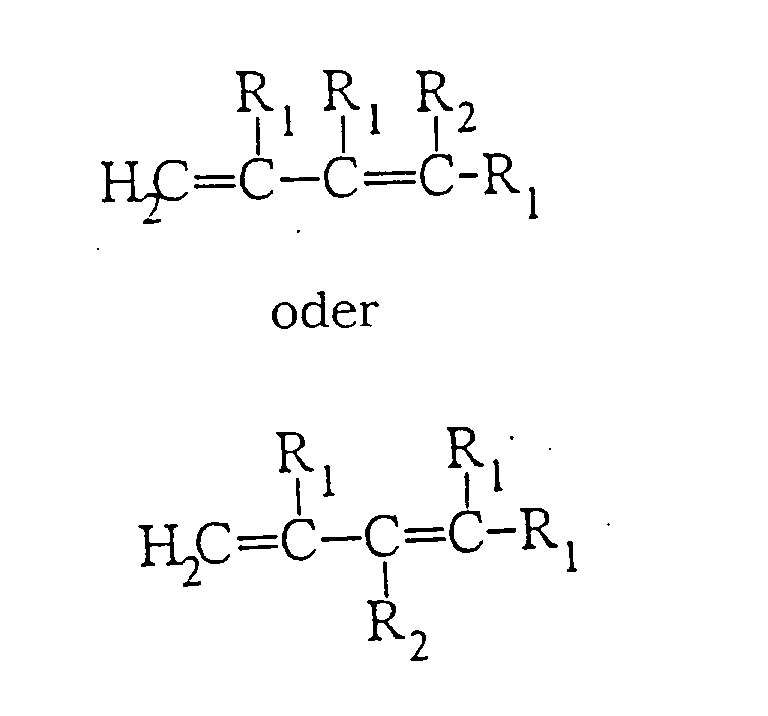 B. zu 2 bis 70 Gew.-%, vorzugsweise zu 10 bis 40 Gew.-%, ein Vernetzungsmittel mit mindestens 2 aktivierten Doppelbindungen;C. bis zu 25 Gew.-%, vorzugsweise bis zu 20 Gew.-%, andere kompatible Comonomere.
 - Das Polymer nach Anspruch 1, dadurch gekennzeichnet, daß das genannte Polyen aus der Gruppe, die aus 1,3-Hexadien, 1,3-Heptadien, 1,3-Octadien, 1,3-Nonadien, 1,3-Decadien, 1,3-Undecadien, 1,3-Dodecadien, 2-Methyl-1,3-hexadien, 6-Methyl-1,3-heptadien, 7-Methyl-1,3-octadien, 1,3,7-Octatrien, 1,3,9-Decatrien, 1,3,6-Octatrien, 2,3-Dimethyl-1,3-butadien, 2-Amyl-1,3-butadien, 2,6-Dimethyl-1,3-7-octatrien, 2,7-Dimethyl-1,3,7-octatrien, 2,6-Dimethyl-1,3,6-Octatrien, 2,7-Dimethyl-1,3,6-octatrien, 7-Methyl-3-methylen-1,6-octadien, 2,6-Dimethyl-1,5,7-octatrien, 1-Methyl-2-vinyl-4,6-heptadienyl-3,8-nonadienoat, 5-Methyl-1,3,6-heptatrien, 2-Ethyl-1,3-butadien und Mischungen hievon besteht, ausgewählt ist.
- Das Polymer nach Anspruch 2, dadurch gekennzeichnet, daß das genannte Polyen das 1,3,7-Octatrien ist.
- Das Polymer nach einem der Ansprüche 1 bis 3, dadurch gekennzeichnet, daß das genannte Vernetzungsmittel aus der Gruppe, die aus Divinylbenzolen, Divinyltoluolen, Divinylxylolen, Divinylnaphthalinen, Divinylethylbenzolen, Divinylphenathrenen, Trivinylbenzolen, Divninylbiphenylen, Divinyldiphenylmethanen, Divinylbenzylen, Divinylphenylethern, Divinyldiphenylsulfiden, Divinylfuranen, Divinylsulfon, Divinylsulfid, Divinyldimethylsilan, Diallyldimethylammoniumchlorid, 1,1'-Divinylferrocen, 2-Vinylbutadien und Mischungen hievon besteht, ausgewählt ist.
- Das Polymer nach einem der Ansprüche 1 bis 3, dadurch gekennzeichnet, daß das genannte Vernetzungsmittel die Formelhat, worin jedes A eine verbindende Gruppe ist; R3 für C1-C12-Alkylen, C2-C12-Alkenylen, C6-C12-Arylen, C7-C18-Arylalkylen, C4-C12-Heteroarylen, C6-C18-Heteroarylalkylen, C8-C18-Arylalkenylen oder C8-C18-Heteroarylalkenylen steht; R4 für H, Halogen, Carboxy, C1-C4-Alkyl, C1-C4-Alkoxy, C1-C4-Ester, C6-C12-Aryl, C6-C12-Heteroaryl steht; n mindestens 2 bedeutet.

- Das Polymer nach Anspruch 5, dadurch gekennzeichnet, daß das genannte Vernetzungsmittel aus der Gruppe, die aus Ethylenglykol-dimethacrylat, Neopentylglykol-dimethacrylat, 1,3-Butandiol-dimethacrylat, Diethylenglykol-dimethacrylat, Hydrochinon-dimethacrylat, Catechol-dimethacrylat, Resorcin-dimethacrylat, Triethylenglykol-dimethacrylat, Polyethylenglykol-dimethacrylat, Trimethylolpropan-trimethacrylat, Pentaerythrit-tetramethacrylat, 1,4-Butandiol-dimethacrylat, 1,6-Hexandiol-diacrylat, 1,4-Butandiol-diacrylat, Tetramethylen-diacrylat, Trimethylolpropan-triacrylat, Pentaerythrit-tetraacrylat, N-Methylolacrylamid, 1,2-Ethylenbisacrylamid, 1,4-Butanbisacrylamid und Mischungen hievon besteht, ausgewählt ist.
- Das Polymer nach Anspruch 6, dadurch gekennzeichnet, daß das genannte Vernetzungsmittel aus der Gruppe, die aus Ethylenglykol-dimethacrylat, Diethylenglykol-dimethacrylat, 1,6-Hexandiol-diacrylat, 2-Butandiol-dimethacrylat, Ethylenglykol-diacrylat, Trimethylolpropan-triacrylat und -trimethacrylat und Mischungen hievon besteht, ausgewählt ist.
- Ein polymerer Schaumstoff, der wässerige Fluide absorbiert, wobei der genannte polymere Schaumstoff eine hydrophile, flexible, nichtionische Schaumstoffstruktur von miteinander in Verbindung stehenden offenen Zellen umfaßt, und der dadurch gekennzeichnet ist, daß er aus einer Wasser-in-Öl-Emulsion hergestellt ist, die aufweist:1) eine Ölphase, die umfaßt:a) zu 65 bis 98 Gew.-%, vorzugsweise zu 80 bis 97 Gew.- %, die Monomermischung nach einem der Ansprüche 1 bis 7;b) zu 2 bis 35 Gew.-%, vorzugsweise zu 3 bis 20 Gew.-%, eine Emulgator-Komponente, die in der Ölphase löslich ist und die eine stabile Wasser-in-Öl-Emulsion bildet; und2) eine Wasserphase, die zu 0,2 bis 20 Gew.-% einen wasserlöslichen Elektrolyt enthält;3) ein Gewichtsverhältnis von Wasserphase zu Ölphase von 12:1 bis 100:1, vorzugsweise von 20:1 bis 70:1, am bevorzugtesten von 25:1 bis 50:1.
- Der Schaumstoff nach Anspruch 8, der dadurch gekennzeichnet ist, daß er in einem kollabierten Zustand vorliegt, der beim Kontakt mit den genannten Fluiden expandiert und die genannten Fluide absorbiert, und der weiters dadurch gekennzeichnet ist, daß die genannte Schaumstoffstruktur aufweist:A) eine spezifische Oberfläche pro Schaumstoffvolumen von mindestens 0,025 m2/cm3;B) zu mindestens 0,1 Gew.-% ein toxikologisch annehmbares hygroskopisches hydratisiertes Salz, das darin eingebaut ist;C) in ihrem kollabierten Zustand einen Expansionsdruck von 30 kPa oder weniger; undD) in ihrem expandierten Zustand, wenn sie mit synthetischem Urin mit einer Oberflächenspannung von 65 ± 5 dyn/cm bei 31 °C bis zu ihrer freien Absorptionskapazität gesättigt ist, eine Dichte, die 10 bis 50 % der Dichte auf Trockenbasis in ihrem kollabierten Zustand beträgt.
- Der Schaumstoff nach einem der Ansprüche 8 bis 9, der dadurch gekennzeichnet ist, daß die Ölphase weiters zu 3 bis 15 Gew.-% einen Weichmacher enthält, der aus der Gruppe, die aus Dioctylazelat, Dioctylsebacat und Dioctyladipat besteht, ausgewählt ist.
- Ein absorbierender Artikel, der insbesondere zur Absorption und Zurückhaltung wässeriger Körperfluide geeignet ist, welcher Artikel umfaßt:I) ein Rückenblatt; undII) einen absorbierenden Kern, der mit dem genannten Rückenblatt verbunden ist, sodaß der genannte absorbierende Kern zwischen dem genannten Rückenblatt und dem Fluidausscheidungsbereich des Trägers des Artikels angeordnet ist, wobei der genannte absorbierende Kern dadurch gekennzeichnet ist, daß er den Schaumstoff nach einem der Ansprüche 8 bis 10 umfaßt.
- Ein Verfahren zur Herstellung des polymeren Schaumstoffs nach einem der Ansprüche 8 bis 10, wobei das genannte Verfahren dadurch gekennzeichnet ist, daß es folgende Stufen umfaßt:A. Bilden einer Wasser-in-Öl-Emulsion; undB. Polymerisieren der Monomer-Komponente in der Ölphase der Wasser-in-Öl-Emulsion zur Bildung eines polymeren Schaumstoffmateris, vorzugsweise in Anwesenheit eines Polymerisationsinitiators und eines Antioxidans, wobei das Antioxidans vorzugsweise aus der Gruppe, die aus gehinderten Amino-Lichtstabilisatoren und gehinderten phenolischen Stabilisatoren besteht, ausgewählt ist.
Applications Claiming Priority (3)
| Application Number | Priority Date | Filing Date | Title |
|---|---|---|---|
| US08/370,691 US5922780A (en) | 1995-01-10 | 1995-01-10 | Crosslinked polymers made from 1,3,7-octatriene and like conjugated polyenes |
| US370691 | 1995-01-10 | ||
| PCT/US1996/000087 WO1996021474A1 (en) | 1995-01-10 | 1996-01-11 | Cross-linked polymers made from 1,3,7-octatriene and like conjugated polyenes |
Publications (2)
| Publication Number | Publication Date |
|---|---|
| EP0802802A1 EP0802802A1 (de) | 1997-10-29 |
| EP0802802B1 true EP0802802B1 (de) | 1999-04-14 |
Family
ID=23460752
Family Applications (1)
| Application Number | Title | Priority Date | Filing Date |
|---|---|---|---|
| EP96902589A Expired - Lifetime EP0802802B1 (de) | 1995-01-10 | 1996-01-11 | Vernetzte polymere, hergestellt aus 1,3,7-octatrien und ähnlichen konjugierten polyenen |
Country Status (10)
| Country | Link |
|---|---|
| US (2) | US5922780A (de) |
| EP (1) | EP0802802B1 (de) |
| JP (1) | JPH11502541A (de) |
| KR (2) | KR19980701305A (de) |
| AT (1) | ATE178804T1 (de) |
| AU (1) | AU4693696A (de) |
| CA (1) | CA2210315A1 (de) |
| DE (1) | DE69602076D1 (de) |
| WO (1) | WO1996021474A1 (de) |
| ZA (1) | ZA96136B (de) |
Families Citing this family (48)
| Publication number | Priority date | Publication date | Assignee | Title |
|---|---|---|---|---|
| WO1998043579A1 (en) † | 1997-03-27 | 1998-10-08 | The Procter & Gamble Company | Absorbent article having improved comfort during use by improved fit even when loaded and improved rewet performance |
| US6048908A (en) * | 1997-06-27 | 2000-04-11 | Biopore Corporation | Hydrophilic polymeric material |
| EP1003788A1 (de) * | 1997-08-15 | 2000-05-31 | The Dow Chemical Company | Emulsionen mit grosser innerer phase und daraus hergestellte poröse materialien |
| SE515235C2 (sv) * | 1998-05-12 | 2001-07-02 | Sca Hygiene Prod Ab | Absorberande struktur i ett absorberande alster, metod att tillverka en dylik absorberande struktur samt absorberande alster innefattande en sådan struktur |
| US6160028A (en) * | 1998-07-17 | 2000-12-12 | The Procter & Gamble Company | Flame retardant microporous polymeric foams |
| RU2140980C1 (ru) * | 1998-12-07 | 1999-11-10 | Инженерно-маркетинговая фирма "Биотех-Сэприс лимитед" (акционерное общество закрытого типа) | Штамм гриба mortierella alpina peyronel бс-2 для производства полиненасыщенных высших жирных кислот и их производных |
| US6369154B1 (en) * | 1999-07-26 | 2002-04-09 | Reichhold, Inc. | Compositions suitable for making elastomeric articles of manufacture |
| US6297293B1 (en) | 1999-09-15 | 2001-10-02 | Tda Research, Inc. | Mesoporous carbons and polymers |
| US6420023B1 (en) * | 2000-06-20 | 2002-07-16 | Ashland Chemical Company | Plasticizer resistant latex emulsion pressure sensitive adhesive and its production |
| JP4749531B2 (ja) * | 2000-07-05 | 2011-08-17 | 株式会社日本触媒 | 多孔質重合体の製造方法 |
| JP4908674B2 (ja) * | 2000-10-24 | 2012-04-04 | 株式会社日本触媒 | 多孔質架橋ポリマー材料の製法 |
| MXPA03003836A (es) * | 2000-11-08 | 2003-07-28 | Kimberly Clark Co | Tratamiento de espuma de productos de tisu. |
| US7138436B2 (en) * | 2001-06-13 | 2006-11-21 | 3M Innovative Properties Company | Uncrosslinked foams made from emulsions |
| CN1646306A (zh) * | 2002-10-02 | 2005-07-27 | 超级吸收体公司 | 辐射处理的吸收材料 |
| US6750261B1 (en) | 2003-04-08 | 2004-06-15 | 3M Innovative Properties Company | High internal phase emulsion foams containing polyelectrolytes |
| US7358282B2 (en) * | 2003-12-05 | 2008-04-15 | Kimberly-Clark Worldwide, Inc. | Low-density, open-cell, soft, flexible, thermoplastic, absorbent foam and method of making foam |
| US7541312B2 (en) * | 2004-03-18 | 2009-06-02 | Tda Research, Inc. | Porous carbons from carbohydrates |
| US7291382B2 (en) * | 2004-09-24 | 2007-11-06 | Kimberly-Clark Worldwide, Inc. | Low density flexible resilient absorbent open-cell thermoplastic foam |
| US8158689B2 (en) * | 2005-12-22 | 2012-04-17 | Kimberly-Clark Worldwide, Inc. | Hybrid absorbent foam and articles containing it |
| US20070148433A1 (en) * | 2005-12-27 | 2007-06-28 | Mallory Mary F | Elastic laminate made with absorbent foam |
| MX380311B (es) | 2015-11-03 | 2025-03-12 | Kimberly Clark Co | Papel tisu con gran volumen y pocas pelusas. |
| CN110088148B (zh) * | 2016-12-28 | 2022-05-10 | 株式会社可乐丽 | 1,3,7-辛三烯聚合物和其氢化物、以及该聚合物的制造方法 |
| EP4163311A1 (de) * | 2016-12-28 | 2023-04-12 | Kuraray Co., Ltd. | Copolymer aus 1,3,7-octatrien und isopren, hydrid davon und verfahren zur herstellung des besagten copolymers |
| FI4056604T3 (fi) * | 2016-12-28 | 2023-10-10 | Kuraray Co | Menetelmä 1,3,7-oktratrieenin ja styreenin kopolymeerin valmistamiseksi |
| EP3564278A4 (de) * | 2016-12-28 | 2020-07-29 | Kuraray Co., Ltd. | Copolymer von 1, 3, 7-octatriene und butadien, hydrid dafür sowie verfahren zur herstellung dieses copolymers |
| BR112019021283B1 (pt) | 2017-04-28 | 2023-02-28 | Kimberly-Clark Worldwide, Inc | Método para produzir um substrato, e, substrato |
| CN111247280B (zh) | 2017-11-29 | 2021-08-17 | 金伯利-克拉克环球有限公司 | 具有改善的性能的纤维片材 |
| JP7321191B2 (ja) | 2018-06-19 | 2023-08-04 | ザ プロクター アンド ギャンブル カンパニー | 機能形成されたトップシートを有する吸収性物品 |
| MX2021000980A (es) | 2018-07-25 | 2021-04-12 | Kimberly Clark Co | Proceso para fabricar no tejidos tridimensionales colocados en espuma. |
| JP7328339B2 (ja) | 2019-01-23 | 2023-08-16 | ザ プロクター アンド ギャンブル カンパニー | 目立たない持ち運び及びアクセスに適合された包装された女性用衛生パッド製品、並びに製造プロセス |
| HUE068911T2 (hu) | 2019-02-13 | 2025-02-28 | Procter & Gamble | Nõi higiéniai betét nem szõtt fedõlappal, kellemesebb bõrérzettel |
| JP2022519607A (ja) | 2019-02-13 | 2022-03-24 | ザ プロクター アンド ギャンブル カンパニー | 改善された皮膚感触及び不明瞭化性能を有する親水性不織布トップシートを備えた女性用衛生パッド |
| WO2020256714A1 (en) | 2019-06-19 | 2020-12-24 | The Procter & Gamble Company | Absorbent article with function-formed topsheet, and method for manufacturing |
| EP3986352A1 (de) | 2019-06-19 | 2022-04-27 | The Procter & Gamble Company | Saugfähiger artikel mit funktionsgeformter deckschicht und verfahren zu seiner herstellung |
| KR102421536B1 (ko) * | 2019-07-15 | 2022-07-15 | 주식회사 엘지화학 | 변성 공액디엔계 중합체, 이의 제조방법 및 이를 포함하는 고무 조성물 |
| WO2021022547A1 (en) | 2019-08-08 | 2021-02-11 | The Procter & Gamble Company | Feminine hygiene pad and method for isolating microorganisms from a wearer's skin |
| EP4171669B1 (de) | 2020-06-26 | 2024-12-11 | The Procter & Gamble Company | Absorbierende artikel mit hipe-schaum mit tonnanoplättchen und verfahren zur herstellung |
| EP4262658A1 (de) | 2020-12-18 | 2023-10-25 | The Procter & Gamble Company | Vliesstoffe mit visuell erkennbaren mustern und gemusterten tensiden |
| USD990173S1 (en) * | 2021-04-28 | 2023-06-27 | Sekisui Chemical Co., Ltd. | Foam sheet |
| US20240115436A1 (en) | 2022-10-10 | 2024-04-11 | The Procter & Gamble Company | Feminine hygiene pad with foam absorbent and reservoir spacer layer |
| WO2024107669A1 (en) | 2022-11-14 | 2024-05-23 | The Procter & Gamble Company | Body-conformable absorbent article |
| WO2024243007A1 (en) | 2023-05-19 | 2024-11-28 | The Procter & Gamble Company | Feminine hygiene pad with foam absorbent layer component and improved body conformity |
| US20250073093A1 (en) | 2023-09-01 | 2025-03-06 | The Procter & Gamble Company | Low caliper feminine hygiene pad with textured topsheet |
| US20250352409A1 (en) | 2024-05-14 | 2025-11-20 | The Procter & Gamble Company | Body-conformable absorbent articles with an elastic backsheet |
| US20260102535A1 (en) | 2024-10-16 | 2026-04-16 | The Procter & Gamble Company | Absorbent articles including hipe foam imparted with color, and method of manufacture |
| US20260138767A1 (en) | 2024-11-18 | 2026-05-21 | The Procter & Gamble Company | Packaged feminine hygiene pad product adapted for discreet carry and access, and manufacturing process |
| US20260137565A1 (en) | 2024-11-18 | 2026-05-21 | The Procter & Gamble Company | Packaged feminine hygiene pad product adapted for discreet carry and access, and manufacturing process |
| WO2026117978A1 (en) | 2024-12-04 | 2026-06-11 | The Procter & Gamble Company | Low caliper absorbent article with lofty topsheet |
Family Cites Families (108)
| Publication number | Priority date | Publication date | Assignee | Title |
|---|---|---|---|---|
| DE1420831B2 (de) * | 1959-07-28 | 1972-04-20 | Will, Günther, Dr , 6100 Darmstadt | Verfahren zur herstellung von poroesen formkoerpern |
| DE1137554B (de) * | 1961-06-21 | 1962-10-04 | Bayer Ag | Verfahren zur Polymerisation von wasserunloeslichen Monomeren |
| US3886225A (en) * | 1965-09-28 | 1975-05-27 | Studiengesellschaft Kohle Mbh | Process for the catalytic oligomerization of 1,3-diolefins to form open-chain compounds |
| US3431911A (en) * | 1966-06-17 | 1969-03-11 | Scott Paper Co | Absorbent pad |
| US3563243A (en) * | 1968-01-19 | 1971-02-16 | Johnson & Johnson | Absorbent pad |
| US3565817A (en) * | 1968-08-15 | 1971-02-23 | Petrolite Corp | Continuous process for the preparation of emuisions |
| DE1806652C3 (de) * | 1968-11-02 | 1974-07-25 | Basf Ag | Verfahren zur Herstellung von Polymerisaten mit faseriger und poriger Struktur |
| JPS4830603B1 (de) * | 1969-12-24 | 1973-09-21 | ||
| JPS507565B1 (de) * | 1969-12-24 | 1975-03-27 | ||
| US3925497A (en) * | 1970-10-09 | 1975-12-09 | Du Pont | Substituted 1,3,7-octatrienes and their preparation |
| US3806474A (en) * | 1970-11-23 | 1974-04-23 | Princeton Polymer Sponge Corp | Hydrophilic polyester urethane foam |
| US3673270A (en) * | 1970-12-11 | 1972-06-27 | Du Pont | Hydrogenation of 1,3,7-octatriene to 1,6-octadiene and 1,5-octadiene with certain chromium carbonyl catalysts |
| US3763056A (en) * | 1971-06-02 | 1973-10-02 | G Will | Porous polymeric compositions processes and products |
| US3734867A (en) * | 1971-12-17 | 1973-05-22 | G Will | Method of producing porous polymerizates from water-in-oil emulsions |
| US3778390A (en) * | 1972-07-17 | 1973-12-11 | Procter & Gamble | Hydrolytically unstable polyurethane foams |
| FR2202061B1 (de) * | 1972-10-10 | 1975-03-14 | Elf Aquitaine Union Chimique | |
| CH576923A5 (de) * | 1973-02-02 | 1976-06-30 | Givaudan & Cie Sa | |
| US3988508A (en) * | 1973-03-08 | 1976-10-26 | Petrolite Corporation | High internal phase ratio emulsion polymers |
| FR2225401B1 (de) * | 1973-04-12 | 1976-05-21 | Aquitaine Petrole | |
| US3796767A (en) * | 1973-04-19 | 1974-03-12 | Gulf Research Development Co | Process for preparing diolefins |
| GB1493356A (en) | 1973-12-13 | 1977-11-30 | Ici Ltd | Water-extended polymeric materials |
| US3903189A (en) * | 1974-06-21 | 1975-09-02 | Goodyear Tire & Rubber | Oxidative dehydrogenation of olefins to diolefins |
| US4093570A (en) * | 1975-05-01 | 1978-06-06 | Asahi Kasei Kogyo Kabushiki Kaisha | Production of porous polymers |
| US4154917A (en) * | 1975-05-01 | 1979-05-15 | Asahi Chemical Ind | Production of porous polymers |
| US4049592A (en) * | 1975-07-18 | 1977-09-20 | W. R. Grace & Co. | Biodegradable hydrophilic foams and method |
| CA1071659A (en) * | 1975-09-18 | 1980-02-12 | Goodyear Tire And Rubber Company (The) | Oxidative dehydrogenation of olefins to diolefins |
| US4144153A (en) * | 1975-10-03 | 1979-03-13 | Takiron Co., Ltd. | Radiation process for producing 1,2-polybutadiene foamed products |
| US4029100A (en) * | 1976-01-05 | 1977-06-14 | Colgate-Palmolive Company | Shape retaining diaper |
| US4243829A (en) * | 1976-10-04 | 1981-01-06 | Charles U. Pittman, Jr. | Production of 1,7-octadiene from butadiene |
| US4132839A (en) * | 1976-10-12 | 1979-01-02 | W. R. Grace & Co. | Biodegradable hydrophilic foams and method |
| US4229549A (en) * | 1977-04-08 | 1980-10-21 | Kureha Kagaku Kogyo Kabushiki Kaisha | Thermoplastic resin composition comprising a rigid thermoplastic resin and a graft copolymer |
| JPS53144552A (en) * | 1977-05-18 | 1978-12-15 | Kureha Chem Ind Co Ltd | Palladium complexes |
| US4219660A (en) * | 1977-06-24 | 1980-08-26 | Hoffmann-La Roche Inc. | Conjugated diene derivatives |
| US4144278A (en) * | 1977-07-20 | 1979-03-13 | Phillips Petroleum Company | Diolefin dimerization using nitrosyl halides of iron triad metals |
| JPS54114547A (en) * | 1978-02-27 | 1979-09-06 | Sekisui Plastics | Preparation of formed body coated with polyester resin |
| US4687876A (en) * | 1978-03-27 | 1987-08-18 | Shell Oil Company | Production of 1,7-octadiene from butadiene |
| US4180694A (en) * | 1978-07-24 | 1979-12-25 | Shell Oil Company | Production of 1,7-octadiene from butadiene |
| US4309387A (en) * | 1978-08-14 | 1982-01-05 | Phillips Petroleum Company | Olefin dimerization |
| US4242531A (en) * | 1978-08-14 | 1980-12-30 | Phillips Petroleum Company | Olefin dimerization |
| JPS6030326B2 (ja) * | 1978-08-17 | 1985-07-16 | 三井化学株式会社 | エチレン共重合ゴムの製造方法 |
| US4283499A (en) * | 1978-10-13 | 1981-08-11 | Rohm And Haas Company | Resins |
| US4229606A (en) * | 1978-12-13 | 1980-10-21 | Shell Oil Company | 1,7-Octadiene process |
| GB2047254B (en) * | 1979-04-13 | 1983-03-09 | Mitsui Petrochemical Ind | Rubbery ethylene/1-butene/polyene copolymers and process for production thereof |
| US4234454A (en) * | 1979-07-27 | 1980-11-18 | Phillips Petroleum Company | Diolefin dimerization catalyst and method for producing nitrosyl halides of iron triad metals |
| JPS5710334A (en) | 1980-06-23 | 1982-01-19 | Kao Corp | Absorptive article |
| US4394930A (en) * | 1981-03-27 | 1983-07-26 | Johnson & Johnson | Absorbent foam products |
| NZ199916A (en) * | 1981-03-11 | 1985-07-12 | Unilever Plc | Low density polymeric block material for use as carrier for included liquids |
| CA1196620A (en) * | 1981-06-26 | 1985-11-12 | Donald Barby | Substrate carrying a porous polymeric material |
| US4412089A (en) * | 1981-08-24 | 1983-10-25 | Shell Oil Company | Process for the preparation of dienes and/or trienes |
| US4346199A (en) * | 1981-09-30 | 1982-08-24 | Monsanto Company | Process for a polymeric polyblend composition comprising a matrix phase terpolymer of alkenyl aromatic alkenyl nitrile and myrcene monomers and a diene rubber phase grafted with said monomers |
| US4443568A (en) * | 1981-10-26 | 1984-04-17 | Scm Corporation | Polymerization process and product |
| US4460748A (en) * | 1982-07-06 | 1984-07-17 | Luperox Gmbh | Process for crosslinking and, if desired, foaming natural or synthetic homo- and/or copolymers |
| NZ205449A (en) * | 1982-09-07 | 1986-10-08 | Unilever Plc | Sulphonated,porous,cross-linked polymeric material |
| NZ206331A (en) * | 1982-11-26 | 1986-05-09 | Unilever Plc | Liquid-permeable,flexible,sheet-like articles |
| US4473611A (en) * | 1982-11-26 | 1984-09-25 | Lever Brothers Company | Porous polymeric material containing a reinforcing and heat-sealable material |
| GB2133314B (en) * | 1982-12-28 | 1986-02-26 | Dainippon Toryo Kk | Process for forming a corrosion resistant coating |
| GB8317428D0 (en) * | 1983-06-27 | 1983-07-27 | Unilever Plc | Highly absorbent substrate articles |
| JPS60155260A (ja) * | 1984-01-24 | 1985-08-15 | Mitsubishi Gas Chem Co Inc | ポリフエニレンエ−テル系樹脂組成物 |
| DE3403576A1 (de) * | 1984-02-02 | 1985-08-08 | Basf Ag, 6700 Ludwigshafen | Elastomere thermoplastische formmassen und deren herstellung |
| GB8405680D0 (en) * | 1984-03-05 | 1984-04-11 | Unilever Plc | Porous polymers |
| US4536604A (en) * | 1984-03-15 | 1985-08-20 | Texaco Inc. | Butadiene reductive dimerization using a platinum catalyst and polymeric amine promoter |
| JPS60202128A (ja) * | 1984-03-27 | 1985-10-12 | Kyowa Gas Chem Ind Co Ltd | メタクリル系樹脂成形材料およびその製造方法 |
| DE3560049D1 (en) * | 1984-05-10 | 1987-02-19 | Charbonnages Ste Chimique | Process for dimerizung a conjugated diene |
| CA1267241A (en) * | 1985-01-23 | 1990-03-27 | Hideki Endo | Polycarbonate resin composition |
| US4818785A (en) * | 1985-04-16 | 1989-04-04 | Mitsui Petrochemical Industries, Ltd. | Fine particulate crosslinked amorphous copolymer and preparation and use thereof |
| US4709084A (en) * | 1985-09-23 | 1987-11-24 | Union Camp Corporation | Terpene-based ester tackifiers |
| US4634729A (en) * | 1985-09-23 | 1987-01-06 | Union Camp Corporation | Terpene-based ester tackifiers |
| GB2188055B (en) | 1986-03-20 | 1989-12-28 | Smith & Nephew Ass | Hydrophilic polyurethane foams |
| GB8607535D0 (en) * | 1986-03-26 | 1986-04-30 | Unilever Plc | Elastic cross-linked polymeric materials |
| US4961982A (en) * | 1986-09-25 | 1990-10-09 | Standard Textile Company, Inc. | Liquid-absorbing pad assembly and method of making same |
| US5006415A (en) * | 1987-01-16 | 1991-04-09 | Kyowa Gas Chemical Industry Co., Ltd. | Molded article of methacrylic resin |
| KR880010065A (ko) * | 1987-02-16 | 1988-10-06 | 아사쿠라 다쯔오 | 고무조성물, 가교될 수 있는 고무조성물 및 그로부터 제조되는 오일시일 및 고무호오스 |
| US4900706A (en) * | 1987-03-17 | 1990-02-13 | Sumitomo Chemical Company, Limited | Process for producing olefin polymers and catalyst used therein |
| GB8709688D0 (en) * | 1987-04-24 | 1987-05-28 | Unilever Plc | Porous material |
| NZ224284A (en) * | 1987-04-24 | 1990-11-27 | Unilever Plc | Porous substrate containing gel for use in chemical synthesis, separation etc |
| JP2537877B2 (ja) * | 1987-06-12 | 1996-09-25 | 株式会社クラレ | メタクリル系樹脂成形物品の製造方法 |
| US5065752A (en) * | 1988-03-29 | 1991-11-19 | Ferris Mfg. Co. | Hydrophilic foam compositions |
| CA1335908C (en) * | 1988-10-07 | 1995-06-13 | Junji Oshima | Core-shell polymer, composition containing the polymers and its molded articles. |
| US5093426A (en) * | 1988-10-22 | 1992-03-03 | Japan Synthetic Rubber Co., Ltd. | Hydrogenated copolymer rubber, rubber composition comprising said rubber and rubber product obtained from the rubber |
| EP0367577B1 (de) * | 1988-10-31 | 1994-01-05 | Japan Synthetic Rubber Co., Ltd. | Estergruppen enthaltende (Meth-)acrylsäureester, ihre (Co-)polymere, den (Co)polymer enthaltende Komposition und die Estergruppe aufweisende (Meth)acrylsäureester enthaltende Komposition |
| US4985467A (en) * | 1989-04-12 | 1991-01-15 | Scotfoam Corporation | Highly absorbent polyurethane foam |
| US4966919A (en) * | 1989-06-20 | 1990-10-30 | The United States Of America As Represented By The United States Department Of Energy | Composite foams |
| US5037859A (en) * | 1989-06-20 | 1991-08-06 | The United States Of America As Represented By The United States Department Of Energy | Composite foams |
| US4990541A (en) * | 1989-11-09 | 1991-02-05 | Hoechst Celanese Corp. | Water absorbent latex polymer foams |
| US4943670A (en) * | 1989-11-22 | 1990-07-24 | Shell Oil Company | Preparation of conjugated dienes |
| JPH03199245A (ja) * | 1989-12-27 | 1991-08-30 | Agency Of Ind Science & Technol | 微生物崩壊性熱可塑性樹脂発泡体及びその製造方法 |
| US5200469A (en) * | 1990-04-18 | 1993-04-06 | Exxon Chemical Patents Inc. | Crosslinked elastomeric polymers and process for producing the same |
| US5221726A (en) * | 1990-10-09 | 1993-06-22 | Mcneil-Ppc, Inc. | Hydrophilic materials useful in preparing fluid-absorbent products |
| US5166224A (en) * | 1991-01-02 | 1992-11-24 | Hoechst Celanese Corp. | Vulcanizable non-crystalline acetal elastomers |
| US5198472A (en) * | 1991-08-12 | 1993-03-30 | The Procter & Gamble Company | Process for preparing emulsions that are polymerizable to absorbent foam materials |
| US5147345A (en) | 1991-08-12 | 1992-09-15 | The Procter & Gamble Company | High efficiency absorbent articles for incontinence management |
| US5268224A (en) | 1991-08-12 | 1993-12-07 | The Procter & Gamble Company | Absorbent foam materials for aqueous body fluids and absorbent articles containing such materials |
| US5250576A (en) * | 1991-08-12 | 1993-10-05 | The Procter & Gamble Company | Process for preparing emulsions that are polymerizable to absorbent foam materials |
| US5149720A (en) * | 1991-08-12 | 1992-09-22 | The Procter & Gamble Company | Process for preparing emulsions that are polymerizable to absorbent foam materials |
| US5352711A (en) | 1991-08-12 | 1994-10-04 | The Proctor & Gamble Company | Method for hydrophilizing absorbent foam materials |
| US5387207A (en) * | 1991-08-12 | 1995-02-07 | The Procter & Gamble Company | Thin-unit-wet absorbent foam materials for aqueous body fluids and process for making same |
| US5260345A (en) | 1991-08-12 | 1993-11-09 | The Procter & Gamble Company | Absorbent foam materials for aqueous body fluids and absorbent articles containing such materials |
| US5200433A (en) * | 1992-04-20 | 1993-04-06 | Shell Oil Company | Process for preparing low density porous crosslinked polymeric materials |
| US5252619A (en) | 1992-05-29 | 1993-10-12 | Shell Oil Company | Process for preparing low density porous crosslinked polymeric materials |
| US5189070A (en) * | 1992-05-29 | 1993-02-23 | Shell Oil Company | Process for preparing low density porous crosslinked polymeric materials |
| US5210104A (en) * | 1992-10-15 | 1993-05-11 | Shell Oil Company | Process for preparing low density porous crosslinked polymeric materials |
| US5290820A (en) | 1993-07-29 | 1994-03-01 | Shell Oil Company | Process for preparing low density porous crosslinked polymeric materials |
| US5306733A (en) | 1993-08-30 | 1994-04-26 | Shell Oil Company | Low density porous crosslinked polymeric materials |
| US5500451A (en) | 1995-01-10 | 1996-03-19 | The Procter & Gamble Company | Use of polyglycerol aliphatic ether emulsifiers in making high internal phase emulsions that can be polymerized to provide absorbent foams |
| US5650222A (en) | 1995-01-10 | 1997-07-22 | The Procter & Gamble Company | Absorbent foam materials for aqueous fluids made from high internal phase emulsions having very high water-to-oil ratios |
| US5563179A (en) | 1995-01-10 | 1996-10-08 | The Proctor & Gamble Company | Absorbent foams made from high internal phase emulsions useful for acquiring and distributing aqueous fluids |
| US5633291A (en) | 1995-06-07 | 1997-05-27 | The Procter & Gamble Company | Use of foam materials derived from high internal phase emulsions for insulation |
| US5550167A (en) | 1995-08-30 | 1996-08-27 | The Procter & Gamble Company | Absorbent foams made from high internal phase emulsions useful for acquiring aqueous fluids |
-
1995
- 1995-01-10 US US08/370,691 patent/US5922780A/en not_active Expired - Lifetime
-
1996
- 1996-01-09 ZA ZA96136A patent/ZA96136B/xx unknown
- 1996-01-11 JP JP8521728A patent/JPH11502541A/ja active Pending
- 1996-01-11 WO PCT/US1996/000087 patent/WO1996021474A1/en not_active Ceased
- 1996-01-11 AU AU46936/96A patent/AU4693696A/en not_active Abandoned
- 1996-01-11 CA CA002210315A patent/CA2210315A1/en not_active Abandoned
- 1996-01-11 AT AT96902589T patent/ATE178804T1/de not_active IP Right Cessation
- 1996-01-11 DE DE69602076T patent/DE69602076D1/de not_active Expired - Lifetime
- 1996-01-11 KR KR1019970704694A patent/KR19980701305A/ko not_active Ceased
- 1996-01-11 EP EP96902589A patent/EP0802802B1/de not_active Expired - Lifetime
-
1997
- 1997-07-09 KR KR19977004694A patent/KR19987001305A/ko active Pending
- 1997-09-19 US US08/934,420 patent/US5863958A/en not_active Expired - Lifetime
Also Published As
| Publication number | Publication date |
|---|---|
| CA2210315A1 (en) | 1996-07-18 |
| US5863958A (en) | 1999-01-26 |
| WO1996021474A1 (en) | 1996-07-18 |
| ZA96136B (en) | 1996-08-28 |
| EP0802802A1 (de) | 1997-10-29 |
| ATE178804T1 (de) | 1999-04-15 |
| HK1004119A1 (en) | 1998-11-20 |
| KR19987001305A (en) | 1998-05-15 |
| US5922780A (en) | 1999-07-13 |
| KR19980701305A (ko) | 1998-05-15 |
| MX9705236A (es) | 1997-10-31 |
| DE69602076D1 (de) | 1999-05-20 |
| JPH11502541A (ja) | 1999-03-02 |
| AU4693696A (en) | 1996-07-31 |
Similar Documents
| Publication | Publication Date | Title |
|---|---|---|
| US5863958A (en) | Absorbent article containing a foam comprising crosslinked polymers made from 1,3,7-octatriene and like conjugated polyenes | |
| US6231960B1 (en) | Biodegradable and/or compostable polymers made from conjugated dienes such as isoprene and 2,3-dimethyl-1,3-butadiene | |
| EP0802929B1 (de) | Absorbierende materialien für wässrige flüssigkeiten hergestellt in umgekehrten emulsionen mit hohem wasser/öl verhältnis | |
| EP0802928B1 (de) | Verwendung von aliphatischen polyglycerin ethern als emulgatoren in wasser-in-öl emulsionen, welche zu absorbierenden schäumen polymerisierbar sind | |
| AU728334B2 (en) | Absorbent foams made from high internal phase emulsions useful for acquiring aqueous fluids | |
| US5786395A (en) | Absorbent foams made from high internal phase emulsions useful for acquiring and distributing aqueous fluids | |
| MXPA97005238A (en) | Absorbent foam materials for aqueous fluids, made of useful high-phase emulsions that have very high relations of water to ace | |
| JPH08504474A (ja) | 湿潤までは薄い、水性体液用の吸収体フォーム材料及びその製造方法 | |
| US6372852B2 (en) | Water-absorbing composition and production process for water-absorbing agent | |
| HK1004119B (en) | Cross-linked polymers made from 1,3,7-octatriene and like conjugated polyenes | |
| MXPA97005236A (en) | Interlimited polymers made of 1,3,7-octatrienoy polyenos conjugados simila | |
| HK1004120B (en) | Biodegradable and/or compostable polymers made from conjugated dienes such as isoprene and 2,3-dimethyl-1,3-butadiene | |
| AU5714299A (en) | Process for preparation of absorbent foam materials | |
| HK1004139B (en) | Use of polyglycerol aliphatic ether emulsifiers in making high internal phase emulsions that can be polymerized to provide absorbent foams |
Legal Events
| Date | Code | Title | Description |
|---|---|---|---|
| PUAI | Public reference made under article 153(3) epc to a published international application that has entered the european phase |
Free format text: ORIGINAL CODE: 0009012 |
|
| 17P | Request for examination filed |
Effective date: 19970703 |
|
| AK | Designated contracting states |
Kind code of ref document: A1 Designated state(s): AT BE CH DE DK ES FR GB GR IE IT LI LU NL PT SE |
|
| 17Q | First examination report despatched |
Effective date: 19971016 |
|
| GRAG | Despatch of communication of intention to grant |
Free format text: ORIGINAL CODE: EPIDOS AGRA |
|
| GRAG | Despatch of communication of intention to grant |
Free format text: ORIGINAL CODE: EPIDOS AGRA |
|
| GRAH | Despatch of communication of intention to grant a patent |
Free format text: ORIGINAL CODE: EPIDOS IGRA |
|
| GRAH | Despatch of communication of intention to grant a patent |
Free format text: ORIGINAL CODE: EPIDOS IGRA |
|
| GRAA | (expected) grant |
Free format text: ORIGINAL CODE: 0009210 |
|
| AK | Designated contracting states |
Kind code of ref document: B1 Designated state(s): AT BE CH DE DK ES FR GB GR IE IT LI LU NL PT SE |
|
| PG25 | Lapsed in a contracting state [announced via postgrant information from national office to epo] |
Ref country code: SE Free format text: THE PATENT HAS BEEN ANNULLED BY A DECISION OF A NATIONAL AUTHORITY Effective date: 19990414 Ref country code: NL Free format text: LAPSE BECAUSE OF FAILURE TO SUBMIT A TRANSLATION OF THE DESCRIPTION OR TO PAY THE FEE WITHIN THE PRESCRIBED TIME-LIMIT Effective date: 19990414 Ref country code: LI Free format text: LAPSE BECAUSE OF FAILURE TO SUBMIT A TRANSLATION OF THE DESCRIPTION OR TO PAY THE FEE WITHIN THE PRESCRIBED TIME-LIMIT Effective date: 19990414 Ref country code: IT Free format text: LAPSE BECAUSE OF FAILURE TO SUBMIT A TRANSLATION OF THE DESCRIPTION OR TO PAY THE FEE WITHIN THE PRESCRIBED TIME-LIMIT;WARNING: LAPSES OF ITALIAN PATENTS WITH EFFECTIVE DATE BEFORE 2007 MAY HAVE OCCURRED AT ANY TIME BEFORE 2007. THE CORRECT EFFECTIVE DATE MAY BE DIFFERENT FROM THE ONE RECORDED. Effective date: 19990414 Ref country code: GR Free format text: LAPSE BECAUSE OF NON-PAYMENT OF DUE FEES Effective date: 19990414 Ref country code: FR Free format text: LAPSE BECAUSE OF FAILURE TO SUBMIT A TRANSLATION OF THE DESCRIPTION OR TO PAY THE FEE WITHIN THE PRESCRIBED TIME-LIMIT Effective date: 19990414 Ref country code: ES Free format text: THE PATENT HAS BEEN ANNULLED BY A DECISION OF A NATIONAL AUTHORITY Effective date: 19990414 Ref country code: CH Free format text: LAPSE BECAUSE OF FAILURE TO SUBMIT A TRANSLATION OF THE DESCRIPTION OR TO PAY THE FEE WITHIN THE PRESCRIBED TIME-LIMIT Effective date: 19990414 Ref country code: BE Free format text: LAPSE BECAUSE OF FAILURE TO SUBMIT A TRANSLATION OF THE DESCRIPTION OR TO PAY THE FEE WITHIN THE PRESCRIBED TIME-LIMIT Effective date: 19990414 Ref country code: AT Free format text: LAPSE BECAUSE OF FAILURE TO SUBMIT A TRANSLATION OF THE DESCRIPTION OR TO PAY THE FEE WITHIN THE PRESCRIBED TIME-LIMIT Effective date: 19990414 |
|
| REF | Corresponds to: |
Ref document number: 178804 Country of ref document: AT Date of ref document: 19990415 Kind code of ref document: T |
|
| REG | Reference to a national code |
Ref country code: CH Ref legal event code: EP |
|
| REG | Reference to a national code |
Ref country code: IE Ref legal event code: FG4D |
|
| REF | Corresponds to: |
Ref document number: 69602076 Country of ref document: DE Date of ref document: 19990520 |
|
| PG25 | Lapsed in a contracting state [announced via postgrant information from national office to epo] |
Ref country code: PT Free format text: LAPSE BECAUSE OF FAILURE TO SUBMIT A TRANSLATION OF THE DESCRIPTION OR TO PAY THE FEE WITHIN THE PRESCRIBED TIME-LIMIT Effective date: 19990714 Ref country code: DK Free format text: LAPSE BECAUSE OF FAILURE TO SUBMIT A TRANSLATION OF THE DESCRIPTION OR TO PAY THE FEE WITHIN THE PRESCRIBED TIME-LIMIT Effective date: 19990714 |
|
| PG25 | Lapsed in a contracting state [announced via postgrant information from national office to epo] |
Ref country code: DE Free format text: LAPSE BECAUSE OF FAILURE TO SUBMIT A TRANSLATION OF THE DESCRIPTION OR TO PAY THE FEE WITHIN THE PRESCRIBED TIME-LIMIT Effective date: 19990715 |
|
| NLV1 | Nl: lapsed or annulled due to failure to fulfill the requirements of art. 29p and 29m of the patents act | ||
| EN | Fr: translation not filed | ||
| REG | Reference to a national code |
Ref country code: CH Ref legal event code: PL |
|
| PG25 | Lapsed in a contracting state [announced via postgrant information from national office to epo] |
Ref country code: LU Free format text: LAPSE BECAUSE OF NON-PAYMENT OF DUE FEES Effective date: 20000111 Ref country code: IE Free format text: LAPSE BECAUSE OF NON-PAYMENT OF DUE FEES Effective date: 20000111 Ref country code: GB Free format text: LAPSE BECAUSE OF NON-PAYMENT OF DUE FEES Effective date: 20000111 |
|
| PLBE | No opposition filed within time limit |
Free format text: ORIGINAL CODE: 0009261 |
|
| STAA | Information on the status of an ep patent application or granted ep patent |
Free format text: STATUS: NO OPPOSITION FILED WITHIN TIME LIMIT |
|
| 26N | No opposition filed | ||
| GBPC | Gb: european patent ceased through non-payment of renewal fee |
Effective date: 20000111 |
|
| REG | Reference to a national code |
Ref country code: IE Ref legal event code: MM4A |