EP0797992B1 - Verwendung von Taurin zur Behandlung oder Vorbeugung von ischämischen Verletzungen - Google Patents
Verwendung von Taurin zur Behandlung oder Vorbeugung von ischämischen Verletzungen Download PDFInfo
- Publication number
- EP0797992B1 EP0797992B1 EP97104868A EP97104868A EP0797992B1 EP 0797992 B1 EP0797992 B1 EP 0797992B1 EP 97104868 A EP97104868 A EP 97104868A EP 97104868 A EP97104868 A EP 97104868A EP 0797992 B1 EP0797992 B1 EP 0797992B1
- Authority
- EP
- European Patent Office
- Prior art keywords
- taurine
- adenosine
- effects
- ischemia
- protective
- Prior art date
- Legal status (The legal status is an assumption and is not a legal conclusion. Google has not performed a legal analysis and makes no representation as to the accuracy of the status listed.)
- Expired - Lifetime
Links
Images


Classifications
-
- A—HUMAN NECESSITIES
- A61—MEDICAL OR VETERINARY SCIENCE; HYGIENE
- A61K—PREPARATIONS FOR MEDICAL, DENTAL OR TOILETRY PURPOSES
- A61K31/00—Medicinal preparations containing organic active ingredients
- A61K31/185—Acids; Anhydrides, halides or salts thereof, e.g. sulfur acids, imidic, hydrazonic or hydroximic acids
- A61K31/19—Carboxylic acids, e.g. valproic acid
- A61K31/195—Carboxylic acids, e.g. valproic acid having an amino group
-
- A—HUMAN NECESSITIES
- A61—MEDICAL OR VETERINARY SCIENCE; HYGIENE
- A61K—PREPARATIONS FOR MEDICAL, DENTAL OR TOILETRY PURPOSES
- A61K31/00—Medicinal preparations containing organic active ingredients
- A61K31/185—Acids; Anhydrides, halides or salts thereof, e.g. sulfur acids, imidic, hydrazonic or hydroximic acids
-
- A—HUMAN NECESSITIES
- A61—MEDICAL OR VETERINARY SCIENCE; HYGIENE
- A61K—PREPARATIONS FOR MEDICAL, DENTAL OR TOILETRY PURPOSES
- A61K31/00—Medicinal preparations containing organic active ingredients
- A61K31/185—Acids; Anhydrides, halides or salts thereof, e.g. sulfur acids, imidic, hydrazonic or hydroximic acids
- A61K31/19—Carboxylic acids, e.g. valproic acid
- A61K31/195—Carboxylic acids, e.g. valproic acid having an amino group
- A61K31/197—Carboxylic acids, e.g. valproic acid having an amino group the amino and the carboxyl groups being attached to the same acyclic carbon chain, e.g. gamma-aminobutyric acid [GABA], beta-alanine, epsilon-aminocaproic acid or pantothenic acid
- A61K31/198—Alpha-amino acids, e.g. alanine or edetic acid [EDTA]
-
- A—HUMAN NECESSITIES
- A61—MEDICAL OR VETERINARY SCIENCE; HYGIENE
- A61P—SPECIFIC THERAPEUTIC ACTIVITY OF CHEMICAL COMPOUNDS OR MEDICINAL PREPARATIONS
- A61P23/00—Anaesthetics
-
- A—HUMAN NECESSITIES
- A61—MEDICAL OR VETERINARY SCIENCE; HYGIENE
- A61P—SPECIFIC THERAPEUTIC ACTIVITY OF CHEMICAL COMPOUNDS OR MEDICINAL PREPARATIONS
- A61P25/00—Drugs for disorders of the nervous system
-
- A—HUMAN NECESSITIES
- A61—MEDICAL OR VETERINARY SCIENCE; HYGIENE
- A61P—SPECIFIC THERAPEUTIC ACTIVITY OF CHEMICAL COMPOUNDS OR MEDICINAL PREPARATIONS
- A61P25/00—Drugs for disorders of the nervous system
- A61P25/04—Centrally acting analgesics, e.g. opioids
-
- A—HUMAN NECESSITIES
- A61—MEDICAL OR VETERINARY SCIENCE; HYGIENE
- A61P—SPECIFIC THERAPEUTIC ACTIVITY OF CHEMICAL COMPOUNDS OR MEDICINAL PREPARATIONS
- A61P9/00—Drugs for disorders of the cardiovascular system
-
- A—HUMAN NECESSITIES
- A61—MEDICAL OR VETERINARY SCIENCE; HYGIENE
- A61P—SPECIFIC THERAPEUTIC ACTIVITY OF CHEMICAL COMPOUNDS OR MEDICINAL PREPARATIONS
- A61P9/00—Drugs for disorders of the cardiovascular system
- A61P9/10—Drugs for disorders of the cardiovascular system for treating ischaemic or atherosclerotic diseases, e.g. antianginal drugs, coronary vasodilators, drugs for myocardial infarction, retinopathy, cerebrovascula insufficiency, renal arteriosclerosis
Definitions
- This invention is applicable in all fields of medicine, but more particularly, in the specialties of anesthesiology, neurology, neurosurgery, internal medicine, pediatrics, oncology, obstetrics, neo-natology, cardiology, cardiac surgery, radiology, critical care medicine and transplantation in general.
- exogenous taurine to protect organs in general and particularly the central nervous system (CNS) in patients (in-vivo conditions), or explanted donor organs (including the liver, pancreas, small bowel, lungs, kidneys or the heart) (in vitro conditions) to be used for transplantation from the ravaging effects of hypoxia or ischemia (lack of or decreased oxygenation or blood flow) caused by vascular severance, such as during organ harvesting for transplantation, primary or secondary intra-vascular obstructions (such as in stroke) or extra-vascular factors accompanying trauma to the tissue (head trauma or during neurosurgical procedures).
- CNS central nervous system
- EAAs excitatory aminoacids
- inhibitory and potentially protective aminoacids such as taurine increase 4-20 fold during or shortly after ischemic injury (Benveniste, 1984; Hillered, 1989; Simpson, 1992) or head trauma (Nilsson, 1990; Persson, 1992); likewise there is a similar outpour of adenosine (Nilsson, 1990; Van Wylen, 1986).
- EAAs receptors phenomenon known as excitotoxicity
- NMDA N-methyl-D-aspartate, activated by glutamate and aspartate
- AMPA alpha-amino-3-hydroxy-5-methyl-4-isoxazole propionic acid
- KA kainate
- This elevation of (interstitial) extracellular EAAs levels is thought to be part of the periphenomena of most acute CNS injury events leading to cell damage (Choi, 1990; DeLeo, 1987; Rothman, 1986).
- glycine Even though the exact physiopathologic role glycine plays is not fully known, for NMDA receptors to become fully activated seems to require the presence of glycine in addition to the EAAs (glutamate or aspartate) (Johnson, 1987).
- Purinergic compounds which may interact with these adenosine receptors include the naturally present adenosine and adenosine tri-phosphate (ATP) or the synthetic adenosine analogues, and are well known to exert multiple functions in almost every tissue of the body, but are particularly conspicuous and therefore have been extensively studied in the brain where general antinociceptive (analgesic or even anesthetic), antiepileptic and tissue protective effects are well documented.
- adenosinergic approach may include the administration of adenosine itself or ATP, or metabolically stable synthetic adenosine analogues, or therapy directed to increasing tissular adenosine concentration either by inhibiting its reuptake by the cells, or by inhibiting the destruction of the endogenously formed adenosine, or by the administration of precursors or prodrugs of adenosine to enhance its endogenous production.
- the common denominator of a number of protective pharmacological agents including barbiturates, benzodiazepines, isoflurane (all with anesthetic and anticonvulsant properties) and anticonvulsants (such as MK 801) is precisely the anticonvulsant action when used in therapeutically effective doses, and typically they induce marked EEG quiescence or functional depression (Kato, 1990; McDonald, 1990; Michenfelder [a], 1988).
- the inventors have further demonstrated that exogeneously administered taurine could mimic many if not all of the effects elicited by systemic administration of purinergic compounds, including those of anti-nociception with minimal or no cardiovascular effects.
- adenosine in pain perception as anti-nociceptive was summarized by Fredholm (1995).
- analgesic effects of morphine and morphine-like narcotics seem to be exerted via stimulation of adenosine release (Stone, 1981), and those of benzodiazepines via inhibition of adenosine uptake mechanisms.
- the administration of intravenous adenosine (Sollevi, 1992) or ATP (which is degraded to adenosine at the tissue level) proved to markedly decrease the requirements for anesthetic agents (Fukunaga, 1994) transoperatively, and notably the requirements for postoperative analgesics (Sollevi, 1992)
- This invention is therefore aimed at solving the above-mentioned shortcoming of adenosinergic approaches, while obtaining protective effects, thus providing similar or even greater beneficial effects than adenosinergic approaches without the troublesome hypotension.
- Ischemic injury involves Ca ++ overload of cells and subsequent oxidation of lipid membrane and cytoskeleton structures; this phenomenon is particularly conspicuous in the excitable CNS tissue (Wieloch, 1982).
- the anticalcic and antioxidant effects of taurine have been shown in the retina and various neural preparations (cultures, slices, synaptosomes) as well as in cardiac tissue, thus establishing the grounds for extending the protective effects to tissues other than the CNS as well, for the treatment or prevention of ischemic injury of a variety of organs.
- taurine in the manufacture of a pharmaceutical formulation for treating or preventing ischemic injury of mammalian tissues, including human tissues said formulation comprising a hypertonic solution of taurine at 7-10% in an amount to be administered intravenously at 10 mmol/Kg bodyweight of taurine.
- a pharmaceutical formulation for treating or preventing ischemic injury of tissues in general in a mammal including the human comprising a therapeutically effective amount for treating or preventing the ischemic injury of taurine, at 7-10% in an amount to be administered intravenously at 10 mmol/kg bodyweight either alone or may comprise another supplementing agent (generally an anesthetic or anticonvulsant).
- a therapeutically effective amount of exogenous taurine is administered to a mammal including the human to mimic the keenly sought beneficial effects of adenosinergic approaches without the undesirable cardiovascular side-effects.
- beneficial effects are not limited to the CNS but are effects observable in other tissues as well, the indications for protective effects can be extended to many target organs, either in situ such as for resuscitation, or during cardiac, liver, renal or pancreatic surgery or in explanted organs such as for harvesting and preserving of donor organs for transplantation, for which perfusion solutions containing at least 1 or 2 mmol/L or more, are recommended.
- the parenteral intravenous route is the preferred route, given as an initial loading bolus and then either repeated periodically or preferably as a continuous drip using any of the commonly available delivery devices.
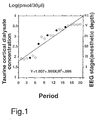
- it is necessary to attain interstitial concentrations of taurine sufficient to obtain a quiescent EEG and to maintain these concentrations of taurine in the brain extracellular fluid for an extended period of time, preferably over 8 hours, and still more preferably greater than the length thought to be under the danger of excitotoxicity, which might be 48 to 72 hours.
- Taurine is a naturally present aminoacid in practically every tissue. Taurine is especially well known to be used normally as a detoxifying substrate by the liver. Although toxicological studies have not been made, it is most likely that taurine, is devoid of toxic effects when used at the therapeutically useful dosages or at least will have wide margins of safety which is a highly desirable feature for any substance to be used as a therapeutic agent.
- taurine may contain a number of other already available drugs [including but not limited to adenine nucleosides (adenosine or adenosine analogues) and nucleotides (ATP or ATP analogues), mannitol, vitamin C, glutathione, vitamin E and related compounds, magnesium, dantrolene, corticosteroids, promazine and related compounds, nicholin, 21-amino steroids, non-steroidal anti-inflammatory agents, other anti-inflammatory agents, calcium antagonists (nifedipine, diltiazim, nicardipine, etc), openers of K ATP channels in general with representatives such as pinacidil, nicorandil, chromakalim, among others or physical means such as hypothermia to mutually potentiate their protective effect.
- drugs including but not limited to adenine nucleosides (adenosine or adenosine analogues) and nucleotides (ATP or
- hypothermia which is well characterized by the increasing protective efficacy, within a certain range, with the degree of hypothermia established at the time ischemia occurs.
- the therapeutically effective taurine doses for clinical use is 10 mmol/kg of body weight, when administered as a hypertonic solution.
- the blood flow effects of topical taurine solution to the dorsal aspect of the toes were examined by measuring skin temperature with an infra-red camera in a patient with frostbite of the left foot (4th toe), without and with iced cold water immersion challenge for 5 seconds.
- the skin temperature reflects the blood flow to the area, the warmer the greater blood flow.
- topical taurine increases the temperature of the toes where it was applied, whether it is applied without or with prior challenge of exposure to cold.
- the maximal effects are seen between 15 to 20 minutes after its topical application in both situations.
- Previous studies of spinal cord ischemia have shown the most protective effects of hypertonic solutions as compared to isotonic or hypotonic solutions, and similar correlation is predicted for the vascular effects, though only a 10% solution was tested.
Landscapes
- Health & Medical Sciences (AREA)
- Life Sciences & Earth Sciences (AREA)
- Medicinal Chemistry (AREA)
- Public Health (AREA)
- Pharmacology & Pharmacy (AREA)
- Veterinary Medicine (AREA)
- Chemical & Material Sciences (AREA)
- General Health & Medical Sciences (AREA)
- Animal Behavior & Ethology (AREA)
- Epidemiology (AREA)
- Chemical Kinetics & Catalysis (AREA)
- Nuclear Medicine, Radiotherapy & Molecular Imaging (AREA)
- General Chemical & Material Sciences (AREA)
- Bioinformatics & Cheminformatics (AREA)
- Engineering & Computer Science (AREA)
- Organic Chemistry (AREA)
- Biomedical Technology (AREA)
- Heart & Thoracic Surgery (AREA)
- Cardiology (AREA)
- Neurology (AREA)
- Neurosurgery (AREA)
- Pain & Pain Management (AREA)
- Vascular Medicine (AREA)
- Anesthesiology (AREA)
- Urology & Nephrology (AREA)
- Acyclic And Carbocyclic Compounds In Medicinal Compositions (AREA)
- Medicinal Preparation (AREA)
- Medicines That Contain Protein Lipid Enzymes And Other Medicines (AREA)
Claims (2)
- Verwendung von Taurin zur Herstellung einer pharmazeutischen Formulierung zur Behandlung oder Prävention von ischämischer Verletzung von Säugetiergeweben, einschliesslich humanen Geweben, worin die pharmazeutische Formulierung zur intravenösen Verabreichung ist und eine hypertonische Lösung von Taurin mit 7-10 % in einer intravenös mit 10 mmol/kg Körpergewicht zu verabreichenden Menge umfasst.
- Verwendung gemäss Anspruch 1, worin die ischämische Verletzung eine des Zentralnervensystems ist.
Priority Applications (1)
| Application Number | Priority Date | Filing Date | Title |
|---|---|---|---|
| EP04018545A EP1473032B1 (de) | 1996-03-26 | 1997-03-21 | Verwendung von Taurin, Homotaurin und/oder Methionin zur Erzeugung von Narkose. |
Applications Claiming Priority (2)
| Application Number | Priority Date | Filing Date | Title |
|---|---|---|---|
| US62260696A | 1996-03-26 | 1996-03-26 | |
| US622606 | 1996-03-26 |
Related Child Applications (1)
| Application Number | Title | Priority Date | Filing Date |
|---|---|---|---|
| EP04018545A Division EP1473032B1 (de) | 1996-03-26 | 1997-03-21 | Verwendung von Taurin, Homotaurin und/oder Methionin zur Erzeugung von Narkose. |
Publications (3)
| Publication Number | Publication Date |
|---|---|
| EP0797992A2 EP0797992A2 (de) | 1997-10-01 |
| EP0797992A3 EP0797992A3 (de) | 1998-06-03 |
| EP0797992B1 true EP0797992B1 (de) | 2005-05-25 |
Family
ID=24494811
Family Applications (2)
| Application Number | Title | Priority Date | Filing Date |
|---|---|---|---|
| EP04018545A Expired - Lifetime EP1473032B1 (de) | 1996-03-26 | 1997-03-21 | Verwendung von Taurin, Homotaurin und/oder Methionin zur Erzeugung von Narkose. |
| EP97104868A Expired - Lifetime EP0797992B1 (de) | 1996-03-26 | 1997-03-21 | Verwendung von Taurin zur Behandlung oder Vorbeugung von ischämischen Verletzungen |
Family Applications Before (1)
| Application Number | Title | Priority Date | Filing Date |
|---|---|---|---|
| EP04018545A Expired - Lifetime EP1473032B1 (de) | 1996-03-26 | 1997-03-21 | Verwendung von Taurin, Homotaurin und/oder Methionin zur Erzeugung von Narkose. |
Country Status (6)
| Country | Link |
|---|---|
| US (2) | US6015835A (de) |
| EP (2) | EP1473032B1 (de) |
| JP (1) | JPH1045578A (de) |
| AU (1) | AU703540B2 (de) |
| CA (1) | CA2200795C (de) |
| DE (2) | DE69739306D1 (de) |
Families Citing this family (40)
| Publication number | Priority date | Publication date | Assignee | Title |
|---|---|---|---|---|
| US20040208875A1 (en) * | 1995-03-15 | 2004-10-21 | Queen's University At Kingston | Method for treating amyloidosis |
| FR2772271B1 (fr) * | 1997-12-11 | 2000-09-01 | Union Pharma Scient Appl | Nouvelle association pharmaceutique a activite analgesique |
| US20020022657A1 (en) * | 1998-02-11 | 2002-02-21 | Francine Gervais | Methods for modulating neuronal cell death |
| IT1298758B1 (it) * | 1998-03-19 | 2000-02-02 | Angelini Ricerche Spa | Soluzione umettante e lubrificante per uso oftalmico |
| ATE298205T1 (de) * | 1999-01-29 | 2005-07-15 | Sportmedizin Team Vertriebs Gm | Zusammensetzung zur leistungsförderung bei sportlicher tätigkeit, ihre herstellung und verwendung als diätetisches lebensmittel |
| CA2369997C (en) * | 1999-04-28 | 2009-11-17 | Queen's University At Kingston | Compositions and methods for treating amyloidosis |
| US6562836B1 (en) | 1999-05-24 | 2003-05-13 | Queen's University Of Kingston | Methods and compounds for inhibiting amyloid deposits |
| CA2320556A1 (en) | 1999-09-29 | 2001-03-29 | Queen's University At Kingston | N,n-dichlorinated omega amino acids and uses thereof |
| AU6124401A (en) * | 2000-05-09 | 2001-11-20 | Nitromed Inc | Infrared thermography and methods of use |
| EP1256360A1 (de) * | 2001-05-10 | 2002-11-13 | Université de Liège | Hypertonisches Medikament insbesondere zur Verwendung in der Flüssigkeitstherapie |
| JP5084089B2 (ja) * | 2001-06-14 | 2012-11-28 | 大塚製薬株式会社 | 医薬組成物 |
| JP5028639B2 (ja) * | 2001-08-02 | 2012-09-19 | 成男 太田 | ミトコンドリア病の予防又は治療薬 |
| FR2833840B1 (fr) * | 2001-12-21 | 2010-06-18 | Rytek | Methodes et compositions pour le traitement de pathologies respiratoires |
| FR2833839A1 (fr) * | 2001-12-21 | 2003-06-27 | Rytek | Methodes et compositions pour le traitement de pathologies respiratoires |
| JP2005526772A (ja) * | 2002-03-15 | 2005-09-08 | リテック | 消化機能病理を処置するための組成物 |
| FR2844201A1 (fr) * | 2002-09-06 | 2004-03-12 | Rytek | Compositions pour le traitement de pathologies fonctionnelles digestives |
| FR2837103B1 (fr) * | 2002-03-15 | 2004-07-09 | Rytek | Compositions pour le traitement de pathologies fonctionelles digestives |
| US20070010573A1 (en) * | 2003-06-23 | 2007-01-11 | Xianqi Kong | Methods and compositions for treating amyloid-related diseases |
| US7244764B2 (en) | 2003-06-23 | 2007-07-17 | Neurochem (International) Limited | Methods and compositions for treating amyloid-related diseases |
| US7414076B2 (en) | 2003-06-23 | 2008-08-19 | Neurochem (International) Limited | Methods and compositions for treating amyloid-related diseases |
| US20050142191A1 (en) | 2003-06-23 | 2005-06-30 | Neurochem (International) Limited | Pharmaceutical formulations of amyloid inhibiting compounds |
| WO2005120489A2 (en) * | 2004-06-04 | 2005-12-22 | Molecular Therapeutics, Inc. | Treatment of central nervous system disorders or injuries with d-methionine |
| AU2005310986A1 (en) * | 2004-11-12 | 2006-06-08 | Bellus Health (International) Limited | Methods and fluorinated compositions for treating amyloid-related diseases |
| AU2005310979A1 (en) * | 2004-11-16 | 2006-06-08 | Bellus Health (International) Limited | Compounds for the treatment of CNS and amyloid associated diseases |
| FR2879100B1 (fr) | 2004-12-09 | 2007-07-06 | Lionel Bueno | Compositions pour le traitement des pathologies oculaires de surface et de la retine |
| EP1836161B1 (de) | 2004-12-22 | 2016-07-20 | BHI Limited Partnership | Verfahren und zusammensetzungen zur behandlung von amyloidassoziierten krankheiten |
| TW200716088A (en) | 2005-04-15 | 2007-05-01 | Neurochem Int Ltd | Formulations and methods for treating amyloidosis |
| ATE481094T1 (de) | 2005-12-22 | 2010-10-15 | Kiacta Sarl | Behandlung von diabetischer nephropathie |
| SI2089417T1 (sl) | 2006-10-12 | 2015-04-30 | Bhi Limited Partnership | Metode, spojine, sestavki in vektorji za dostavo 3-amino-1-propansulfonske kisline |
| CA2673022A1 (en) * | 2006-12-22 | 2008-07-03 | Bellus Health (International) Limited | Methods, compounds, and compositions for treating metabolic disorders and diabetes |
| US8466187B2 (en) * | 2007-09-18 | 2013-06-18 | Thermolife International, Llc | Amino acid compositions |
| MX349176B (es) | 2008-09-22 | 2017-07-14 | Biochemics Inc | Suministro transdermico de farmaco empleando un osmolito y un agente vasoactivo. |
| CA2739732A1 (en) * | 2008-11-14 | 2010-05-20 | Bellus Health (International) Limited | Organic nutrient salts, methods of preparation and uses |
| FR2953411B1 (fr) * | 2009-12-03 | 2012-02-03 | Biocodex | Combinaison synergique de composes analgesiques |
| US12612370B2 (en) | 2011-03-02 | 2026-04-28 | Thermolife International, Llc | Amino acid compositions |
| US10918612B2 (en) * | 2013-01-22 | 2021-02-16 | Markus Zwickl | Combinations with 2-aminoethanesulfonic acid |
| ITUA20161679A1 (it) * | 2016-03-15 | 2017-09-15 | Neuraxpharm Italy S P A | Composizione per prevenire e trattare patologie neurodegenerative e disturbi cognitivi |
| JP2024541338A (ja) | 2020-11-12 | 2024-11-08 | サーモライフ インターナショナル, エルエルシー | 血中酸素飽和度を増大させる方法 |
| US11865139B2 (en) | 2020-11-12 | 2024-01-09 | Thermolife International, Llc | Method of treating migraines and headaches |
| EP4291206A4 (de) | 2021-02-11 | 2025-01-08 | Thermolife International, LLC | Verfahren zur verabreichung von stickoxidgas |
Family Cites Families (4)
| Publication number | Priority date | Publication date | Assignee | Title |
|---|---|---|---|---|
| FR2457281A1 (fr) * | 1979-05-23 | 1980-12-19 | Meram Lab | Nouveaux derives de l'acide 3-aminopropanesulfonique ayant une activite membranaire renforcee |
| US5084007A (en) * | 1989-08-11 | 1992-01-28 | Malin David H | Method for chemical promotion of the effects of low current transcranial electrostimulation |
| AU646840B2 (en) * | 1990-02-05 | 1994-03-10 | Board Of Regents, The University Of Texas System | Dietary supplements comprising vitamins and minerals |
| US5084482A (en) * | 1990-04-10 | 1992-01-28 | The Lithox Corporation | Methods for inhibiting inflammatory ischemic, thrombotic and cholesterolemic disease response with methionine compounds |
-
1997
- 1997-03-19 AU AU16392/97A patent/AU703540B2/en not_active Ceased
- 1997-03-21 DE DE69739306T patent/DE69739306D1/de not_active Expired - Lifetime
- 1997-03-21 EP EP04018545A patent/EP1473032B1/de not_active Expired - Lifetime
- 1997-03-21 DE DE69733329T patent/DE69733329T2/de not_active Expired - Lifetime
- 1997-03-21 EP EP97104868A patent/EP0797992B1/de not_active Expired - Lifetime
- 1997-03-24 CA CA002200795A patent/CA2200795C/en not_active Expired - Fee Related
- 1997-03-26 JP JP9113310A patent/JPH1045578A/ja active Pending
-
1998
- 1998-02-24 US US09/028,482 patent/US6015835A/en not_active Expired - Fee Related
-
1999
- 1999-11-09 US US09/436,761 patent/US6316501B1/en not_active Expired - Fee Related
Non-Patent Citations (2)
| Title |
|---|
| "Webster's third new international dictionary", WEBSTER, , * |
| WRIGHT ET AL: "Taurine: biological update", REV. BIOCHEM., vol. 55, 1986, pages 427 - 453, XP000675083, DOI: doi:10.1146/annurev.bi.55.070186.002235 * |
Also Published As
| Publication number | Publication date |
|---|---|
| AU1639297A (en) | 1997-10-09 |
| EP0797992A2 (de) | 1997-10-01 |
| EP0797992A3 (de) | 1998-06-03 |
| DE69739306D1 (de) | 2009-04-23 |
| DE69733329D1 (de) | 2005-06-30 |
| DE69733329T2 (de) | 2006-02-02 |
| AU703540B2 (en) | 1999-03-25 |
| EP1473032A1 (de) | 2004-11-03 |
| US6316501B1 (en) | 2001-11-13 |
| CA2200795A1 (en) | 1997-09-26 |
| CA2200795C (en) | 2000-11-28 |
| JPH1045578A (ja) | 1998-02-17 |
| EP1473032B1 (de) | 2009-03-11 |
| US6015835A (en) | 2000-01-18 |
Similar Documents
| Publication | Publication Date | Title |
|---|---|---|
| AU703540B2 (en) | Methods for inducing analgesia or anesthesia and treating or preventing ischemic injury of tissues in general | |
| Busija et al. | Mitochondrial-mediated suppression of ROS production upon exposure of neurons to lethal stress: mitochondrial targeted preconditioning | |
| US20130029989A1 (en) | Topical treatments for pain | |
| Miura et al. | ATP-sensitive K+ channel openers: old drugs with new clinical benefits for the heart | |
| Willmot et al. | The potential of nitric oxide therapeutics in stroke | |
| EP1827298A2 (de) | Pharmazeutische zusätze zur erhöhung der organschutzeffekte von nachkonditionierung | |
| JP2005519906A (ja) | インスリン抵抗性の処置のためのコリンエステラーゼアンタゴニストの使用 | |
| Balgobin et al. | Hypertension in diabetes | |
| McCully et al. | Mitochondrial ATP-sensitive potassium channels in surgical cardioprotection | |
| US7323461B2 (en) | Use of methylene blue and related compounds to prevent or reverse an exaggerated hemodynamic reaction | |
| CA2381095C (en) | Method for treating insulin resistance through hepatic nitric oxide | |
| US20240252457A1 (en) | Treatment or Prevention of Ischaemia Reperfusion Injury | |
| US7622447B2 (en) | Use of glutathione synthesis stimulating compounds in reducing insulin resistance | |
| EP4072522B1 (de) | Malonatsalz zur verwendung in der behandlung oder vorbeugung von ischämischen schlaganfallreperfusionsverletzungen | |
| Zlotnik et al. | Regulation of blood L-glutamate levels by stress as a possible brain defense mechanism | |
| WO2006117165A2 (en) | Means and methods for the treatment of head injuries and stroke | |
| US20040151785A1 (en) | Method for treating insulin resistance through hepatic nitric oxide | |
| Akiyode et al. | Diabetic neuropathy: what’s in the pipeline? | |
| CA2424000C (en) | Use of methylene blue and related compounds to prevent or reverse an exaggerated hemodynamic reaction | |
| WO2025125766A1 (en) | Treatment or prevention of ischaemia reperfusion injury | |
| Rimpiläinen | Biochemical and reperfusion targeting strategies to improve brain protection during prolonged hypothermic circulatory arrest | |
| Reynolds et al. | Pharmaceutical metabolic down-regulation by protein synthesis inhibition in a conscious rat model | |
| Chaves et al. | P-469: Downregulation of cytoplasmic antioxidant enzymes contributes to the oxidative stress in human hypertension | |
| Hoekstra et al. | Articles in PresS. Am J Physiol Lung Cell Mol Physiol (January 10, 2014). doi: 10.1152/ajplung. 00057.2013 | |
| Ashkenazy et al. | Generation and roles of nitric oxide in anaphylaxis |
Legal Events
| Date | Code | Title | Description |
|---|---|---|---|
| PUAI | Public reference made under article 153(3) epc to a published international application that has entered the european phase |
Free format text: ORIGINAL CODE: 0009012 |
|
| 17P | Request for examination filed |
Effective date: 19970321 |
|
| AK | Designated contracting states |
Kind code of ref document: A2 Designated state(s): DE FR GB IT SE |
|
| PUAL | Search report despatched |
Free format text: ORIGINAL CODE: 0009013 |
|
| AK | Designated contracting states |
Kind code of ref document: A3 Designated state(s): DE FR GB IT SE |
|
| 17Q | First examination report despatched |
Effective date: 20020111 |
|
| RTI1 | Title (correction) |
Free format text: USE OF TAURINE FOR TREATING OR PREVENTING ISCHAEMIC INJURY |
|
| RTI1 | Title (correction) |
Free format text: USE OF TAURINE FOR TREATING OR PREVENTING ISCHAEMIC INJURY |
|
| RIC1 | Information provided on ipc code assigned before grant |
Ipc: 7A 61P 25/00 B Ipc: 7A 61K 31/185 A |
|
| RTI1 | Title (correction) |
Free format text: USE OF TAURINE FOR TREATING OR PREVENTING ISCHAEMIC INJURY |
|
| RIC1 | Information provided on ipc code assigned before grant |
Ipc: 7A 61P 25/00 B Ipc: 7A 61K 31/185 A |
|
| RTI1 | Title (correction) |
Free format text: USE OF TAURINE FOR TREATING OR PREVENTING ISCHAEMIC INJURY |
|
| RIC1 | Information provided on ipc code assigned before grant |
Ipc: 7A 61P 25/00 B Ipc: 7A 61K 31/185 A |
|
| RTI1 | Title (correction) |
Free format text: USE OF TAURINE FOR TREATING OR PREVENTING ISCHAEMIC INJURY |
|
| GRAP | Despatch of communication of intention to grant a patent |
Free format text: ORIGINAL CODE: EPIDOSNIGR1 |
|
| RIC1 | Information provided on ipc code assigned before grant |
Ipc: 7A 61P 25/00 B Ipc: 7A 61K 31/185 A |
|
| RTI1 | Title (correction) |
Free format text: USE OF TAURINE FOR TREATING OR PREVENTING ISCHAEMIC INJURY |
|
| RIC1 | Information provided on ipc code assigned before grant |
Ipc: 7A 61P 25/00 B Ipc: 7A 61K 31/185 A |
|
| RTI1 | Title (correction) |
Free format text: USE OF TAURINE FOR TREATING OR PREVENTING ISCHAEMIC INJURY |
|
| GRAS | Grant fee paid |
Free format text: ORIGINAL CODE: EPIDOSNIGR3 |
|
| GRAA | (expected) grant |
Free format text: ORIGINAL CODE: 0009210 |
|
| AK | Designated contracting states |
Kind code of ref document: B1 Designated state(s): DE FR GB IT SE |
|
| REG | Reference to a national code |
Ref country code: GB Ref legal event code: FG4D |
|
| REF | Corresponds to: |
Ref document number: 69733329 Country of ref document: DE Date of ref document: 20050630 Kind code of ref document: P |
|
| REG | Reference to a national code |
Ref country code: SE Ref legal event code: TRGR |
|
| ET | Fr: translation filed | ||
| PLBE | No opposition filed within time limit |
Free format text: ORIGINAL CODE: 0009261 |
|
| STAA | Information on the status of an ep patent application or granted ep patent |
Free format text: STATUS: NO OPPOSITION FILED WITHIN TIME LIMIT |
|
| 26N | No opposition filed |
Effective date: 20060228 |
|
| PGFP | Annual fee paid to national office [announced via postgrant information from national office to epo] |
Ref country code: IT Payment date: 20100323 Year of fee payment: 14 |
|
| PGFP | Annual fee paid to national office [announced via postgrant information from national office to epo] |
Ref country code: GB Payment date: 20100215 Year of fee payment: 14 |
|
| PGFP | Annual fee paid to national office [announced via postgrant information from national office to epo] |
Ref country code: FR Payment date: 20100415 Year of fee payment: 14 |
|
| PGFP | Annual fee paid to national office [announced via postgrant information from national office to epo] |
Ref country code: DE Payment date: 20100429 Year of fee payment: 14 |
|
| PGFP | Annual fee paid to national office [announced via postgrant information from national office to epo] |
Ref country code: SE Payment date: 20100317 Year of fee payment: 14 |
|
| REG | Reference to a national code |
Ref country code: SE Ref legal event code: EUG |
|
| GBPC | Gb: european patent ceased through non-payment of renewal fee |
Effective date: 20110321 |
|
| REG | Reference to a national code |
Ref country code: FR Ref legal event code: ST Effective date: 20111130 |
|
| PG25 | Lapsed in a contracting state [announced via postgrant information from national office to epo] |
Ref country code: DE Free format text: LAPSE BECAUSE OF NON-PAYMENT OF DUE FEES Effective date: 20111001 Ref country code: FR Free format text: LAPSE BECAUSE OF NON-PAYMENT OF DUE FEES Effective date: 20110331 |
|
| REG | Reference to a national code |
Ref country code: DE Ref legal event code: R119 Ref document number: 69733329 Country of ref document: DE Effective date: 20111001 |
|
| PG25 | Lapsed in a contracting state [announced via postgrant information from national office to epo] |
Ref country code: GB Free format text: LAPSE BECAUSE OF NON-PAYMENT OF DUE FEES Effective date: 20110321 Ref country code: IT Free format text: LAPSE BECAUSE OF NON-PAYMENT OF DUE FEES Effective date: 20110321 |
|
| PG25 | Lapsed in a contracting state [announced via postgrant information from national office to epo] |
Ref country code: SE Free format text: LAPSE BECAUSE OF NON-PAYMENT OF DUE FEES Effective date: 20110322 |