EP0796225B1 - Using an improved expansion section as the inlet to the flue in a titanium dioxide process - Google Patents
Using an improved expansion section as the inlet to the flue in a titanium dioxide process Download PDFInfo
- Publication number
- EP0796225B1 EP0796225B1 EP95940787A EP95940787A EP0796225B1 EP 0796225 B1 EP0796225 B1 EP 0796225B1 EP 95940787 A EP95940787 A EP 95940787A EP 95940787 A EP95940787 A EP 95940787A EP 0796225 B1 EP0796225 B1 EP 0796225B1
- Authority
- EP
- European Patent Office
- Prior art keywords
- flue
- conduit
- finned
- truncated cone
- protuberances
- Prior art date
- Legal status (The legal status is an assumption and is not a legal conclusion. Google has not performed a legal analysis and makes no representation as to the accuracy of the status listed.)
- Expired - Lifetime
Links
Images

Classifications
-
- F—MECHANICAL ENGINEERING; LIGHTING; HEATING; WEAPONS; BLASTING
- F28—HEAT EXCHANGE IN GENERAL
- F28F—DETAILS OF HEAT-EXCHANGE AND HEAT-TRANSFER APPARATUS, OF GENERAL APPLICATION
- F28F1/00—Tubular elements; Assemblies of tubular elements
- F28F1/10—Tubular elements and assemblies thereof with means for increasing heat-transfer area, e.g. with fins, with projections, with recesses
- F28F1/40—Tubular elements and assemblies thereof with means for increasing heat-transfer area, e.g. with fins, with projections, with recesses the means being only inside the tubular element
-
- C—CHEMISTRY; METALLURGY
- C01—INORGANIC CHEMISTRY
- C01G—COMPOUNDS CONTAINING METALS NOT COVERED BY SUBCLASSES C01D OR C01F
- C01G23/00—Compounds of titanium
- C01G23/04—Oxides; Hydroxides
- C01G23/047—Titanium dioxide
- C01G23/07—Producing by vapour phase processes, e.g. halide oxidation
-
- C—CHEMISTRY; METALLURGY
- C01—INORGANIC CHEMISTRY
- C01P—INDEXING SCHEME RELATING TO STRUCTURAL AND PHYSICAL ASPECTS OF SOLID INORGANIC COMPOUNDS
- C01P2004/00—Particle morphology
- C01P2004/60—Particles characterised by their size
- C01P2004/62—Submicrometer sized, i.e. from 0.1-1 micrometer
Definitions
- Substantial quantities of titanium diode pigment are produced commercially by reacting titanium tetrachloride with oxygen in the vapor phase. After such reaction, the titanium dioxide reaction mass is cooled by passing it through a conduit, i.e., flue, where growth of the titanium diode pigment particles takes place and agglomeration of such particles takes place.
- a conduit i.e., flue
- CBU carbon black undertone
- the cooling of the titanium dioxide can take place in a conventional flue, i.e., a conduit having a substantially smooth interior.
- a finned flue can be used, i.e., a conduit having a plurality of substantially longitudinal, internal, protuberances, depressions or both. Suitable finned flues are described in U.S. Patent 4,937,064, which is hereby incorporated by reference.
- the interior diameter of the flue sometimes needs to be increased so that it is larger than the interior diameter of the outlet of the reactor to oxidize TiCl 4 to TiO 2 .
- the improvement comprising passing the titanium dioxide through a truncated cone-shaped finned flue conduit, the smaller diameter end of the truncated cone-shaped finned flue conduit receiving titanium dioxide produced by the reactor and the larger diameter end of the truncated cone-shaped finned flue conduit discharging titanium dioxide that is received by the flue.
- the process of this invention can reduce the amount of large particles of TiO 2 , and especially those in excess of 0.6 micron in diameter.
- the process of this invention can also permit higher production rates while maintaining acceptable CBU and particle size.
- Such reaction typically takes place in a reactor in the form of a pipe or conduit, wherein oxygen and titanium tetrachloride are introduced at a suitable temperature and pressure for production of the titanium dioxide. In such reaction, a flame generally is produced.
- the titanium dioxide produced Downstream from the flame, the titanium dioxide produced is fed through an additional length of conduit wherein cooling takes place.
- conduit For the purposes herein, such conduit will be referred to as the flue.
- the flue should be as long as necessary to accomplish the desired cooling.
- the flue is water cooled and can be about 50-3000, preferably about 100-2500, and most preferably about 200-2000 feet long.
- the flue can be a conventional flue, a finned flue or combinations thereof.
- a preferred finned flue is described in U.S. Patent 4,937,064, which is hereby incorporated by reference.
- the finned flue will have a plurality of substantially longitudinal internal protuberances, depressions or both.
- suitable protuberances include ridges and/or fins.
- depressions include grooves and/or cuts.
- both protuberances and depressions include a conduit having similar shaped protuberances and depressions such as a pipe having a corrugated surface.
- Preferred is a finned flue having protuberances; especially preferred is a finned flue having internal fins.
- Another preferred embodiment is a finned flue having with internal, hollow fins.
- the finned flue used in this invention can be any suitable shape that does not cause excessive turbulence.
- the finned flue will be round, i.e., in the form of a pipe.
- the finned flue used in this invention can be more expensive than a conventional flue, typically, only a portion of the flue will be a finned flue. Also, because most of the cooling of the TiO 2 will take place in close proximity to the flame of the titanium dioxide reaction, preferably, the finned flue will be used in close proximity to the reaction flame, and continue thereafter until the point is reached where substantially all or most of the growth and/or agglomeration of the pigment particles ceases. Typically, the length of the finned flue used will be about 5-500, more preferably about 5-300, and most preferably about 5-100 feet. If desired, however, all or most of the flue can be finned flue; and, if so, this can decrease the required length because of the more efficient cooling it provides.
- the truncated cone-shaped finned flue conduit will have a plurality of internal, substantially longitudinal protuberances, depressions or both.
- the factors and considerations for designing the protuberances and depressions for the truncated cone-shaped finned flue conduit are similar to those described above for the finned flue.
- the truncated cone-shaped finned flue conduit will have its protuberances and depressions aligned with those of the finned flue.
- the length of such truncated, cone-shaped finned conduit typically will be about 5-500, more preferably about 5-300, and most preferably about 5-100 feet. If a finned flue is used in conjunction with a truncated cone-shaped finned flue conduit, then the length of such truncated cone-shaped finned flue conduit can be shorter, i.e., typically about 0.5-100, preferably about 1-50, and most preferably about 1-20 feet.
- the length of the truncated cone-shaped finned flue conduit, if used alone, or (2) the combined length of the truncated cone-shaped finned flue conduit plus the finned flue, if used in combination, should be sufficient to permit all or most of the agglomeration and growth of the particle size of the TiO 2 to take place.
- the smaller diameter end of the truncated cone-shaped finned flue conduit has an interior diameter about equal to the interior diameter of the outlet for the reactor in step (a).
- the larger diameter end of the truncated cone-shaped finned flue conduit has an interior diameter about equal to the interior diameter of the flue.
- scrubs conduit typically, the inlet thereof is connected to the outlet for the reactor, and the outlet for such scrubs conduit is connected to the smaller diameter end of the truncated cone-shaped finned flue conduit.
- outlet for the reactor means the actual outlet for the reactor when no scrubs conduit is connected to such reactor and the outlet for the scrubs conduit when a scrubs conduit is connected to the outlet for the reactor.
- the smaller diameter end of the truncated cone-shaped finned flue conduit will be connected to the outlet of the reactor, and the larger diameter end of the truncated cone-shaped finned flue conduit will be connected to the inlet for the flue.
- composition of the truncated, cone-shaped finned flue conduit should be any material that is chlorine resistant and has good heat transfer properties.
- Preferred is nickel or nickel alloys such as commercially available Nickel 200 or Nickel 201.
- TiCl 4 vapor containing vaporized AlCl 3 was heated and continuously admitted to the upstream portion of a vapor phase reactor of the type disclosed in U.S.P. 3,203,763. Simultaneously, preheated oxygen was metered through a separate inlet adjacent to the TiCl 4 inlet and was continuously admitted to the reactor. Connected to the reactor was a scrubs conduit that introduced particulate scrubbing material.
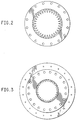
- Attached to the downstream end of the scrubs conduit was either (a) a truncated cone-shaped finned flue conduit of this invention depicted in Figs. 1, 2 and 3, or (b) essentially the same conduit but having a smooth interior rather than fins (hereinafter referred to as a conventional truncated cone-shaped conduit).
- the interior diameter of both the conventional truncated cone-shaped conduit and the truncated cone-shaped finned flue conduit increased about 30 percent from the small diameter end to the large diameter end.
- the outlet for the finned flue was connected to a conventional flue.
- Run 1 was made with the conventional truncated cone-shaped conduit
- Run 2 was made with the truncated cone-shaped finned flue conduit of this invention shown in Figs. 1, 2 and 3. It was found that use of the truncated cone-shaped finned flue conduit of this invention decreased the amount of titanium dioxide having a particle size in excess of 0.6 microns by 5.6 percent.
- the variance in certain conditions from Run 1 to Run 2 was as follows: • absolute pressure - 5.0 percent increase, • CBU - 1.6 percent decrease, • alkali metal nucleant - 19.3 percent decrease.
Landscapes
- Physics & Mathematics (AREA)
- Organic Chemistry (AREA)
- Chemical & Material Sciences (AREA)
- Engineering & Computer Science (AREA)
- Mechanical Engineering (AREA)
- General Engineering & Computer Science (AREA)
- Life Sciences & Earth Sciences (AREA)
- Environmental & Geological Engineering (AREA)
- General Life Sciences & Earth Sciences (AREA)
- Geology (AREA)
- Thermal Sciences (AREA)
- Inorganic Chemistry (AREA)
- Geometry (AREA)
- Inorganic Compounds Of Heavy Metals (AREA)
- Catalysts (AREA)
- Treating Waste Gases (AREA)
- Physical Or Chemical Processes And Apparatus (AREA)
Description
the improvement comprising passing the titanium dioxide through a truncated cone-shaped finned flue conduit, the smaller diameter end of the truncated cone-shaped finned flue conduit receiving titanium dioxide produced by the reactor and the larger diameter end of the truncated cone-shaped finned flue conduit discharging titanium dioxide that is received by the flue.
- To enhance cooling, there generally should be as many protuberances and/or depressions as possible, provided, however, that (1) there are not too many which would cause close spacing and consequently adherence between them of pigment or the particles of any material that are injected to scour the flue, and (2) the protuberances are not so thin that they substantially erode or corrode. Preferably, the spacings between the protuberances and/or depressions will be about equal.
- Generally, the protuberances and/or depressions should be substantially longitudinal, i.e., located along the length of the finned flue. By the term "substantially longitudinal" is meant that the protuberances and/or depressions should be substantially parallel (i.e., parallel to the axis of the conduit) or somewhat angled, (i.e., similar to the grooves in a rifle barrel). Preferably, the protuberances and/or depressions will be substantially parallel.
- In regard to the height of the protuberances, they preferably should be as high as possible to enhance cooling, but not so high that they seriously erode (due to a high tip temperature) or cause increased turbulence.
- The composition of the finned flue should be any material that is chlorine resistant and has good heat transfer properties; preferred is nickel or a nickel alloy such as alloys commercially available as Nickel 200 or Nickel 201. Nickel 200 is commercially pure wrought nickel having a minimum of 99% nickel. Nickel 201 is the low carbon version of Nickel 200.
- Preferably, the tips of the protuberances should be thinner than the base of the protuberances; preferred are protuberances of a trapezoidal shape where the spaces between the protuberances are depressions which are rounded.
- Preferably, the protuberances are tapered, i.e., the inlet and outlet portions of the flue will have a protuberance height less than that at the highest point of the protuberances; especially preferred are protuberances that are tapered and flush with the interior of the flue at its inlet and outlet.
- Preferably, the interior diameter of the finned flue of this invention should be that which does not in itself cause substantial turbulence with the velocity and other conditions for the TiO2 and other materials in the flue. Typical interior diameters of the finned flue are about 2-50 inches, preferably about 5-30 inches, and most preferably about 6-20 inches. Often, the finned flue will have a conduit interior diameter that is greater than that of the conventional flue to which it is attached. In the foregoing and as elsewhere used herein, (a) "interior diameter" means the distance between the two lowest points in the flue that are opposite each other, and (b) "upstream" or "downstream" are in reference to the flow of titanium dioxide pigment through the flue. Preferably, the diameter of the finned flue, when measured from tip to tip of protuberances which are opposite each other, will be greater than or approximately equal to the diameter of the conventional flue to which it is attached.
- If it is desired to optimize the gloss properties of the TiO2 pigment, the protuberances and/or depressions should be designed to reduce turbulence without reducing the cooling rate. Conversely, if it is desired to optimize the CBU of the TiO2 pigment, the cooling rate should be improved without increasing turbulence.
| • absolute pressure - | 5.0 percent increase, |
| • CBU - | 1.6 percent decrease, |
| • alkali metal nucleant - | 19.3 percent decrease. |
Claims (8)
- A process for producing titanium dioxide by (a) reacting titanium tetrachloride and oxygen in the vapor phase in a reactor to produce titanium dioxide, and (b) subsequently cooling the titanium dioxide by passing it through a flue consisting of a conventional flue, a finned flue, or combinations thereof, wherein the outlet for the reactor in step (a) has a smaller interior diameter than the inlet for the flue in step (b),
comprising passing the titanium dioxide through a truncated cone-shaped finned flue conduit, the smaller diameter end of the truncated cone-shaped finned flue conduit receiving titanium dioxide produced by the reactor and the larger diameter end of the truncated cone-shaped finned flue conduit discharging titanium dioxide that is received by the flue. - The process of claim 1 wherein the flue consists of a finned flue attached to a conventional flue and the inlet for the flue is the finned flue.
- The process of claim 1 wherein the finned flue and the truncated cone-shaped finned flue conduit have a plurality of substantially longitudinal protuberances having tips and bases, and wherein the tips of the protuberances are thinner than the bases of the protuberances.
- The process of claim 3 wherein the protuberances are trapezoidal in shape, there are spaces between the protuberances, and the spaces between such protuberances are rounded depressions.
- The process of claim 1 wherein the interior diameter of the flue is about 2-50 inches.
- The process of claim 1 wherein the substantially longitudinal protuberances and depressions for the finned flue and the truncated cone-shaped finned flue conduit are aligned.
- The process of any one of claims 1-6 wherein the flue and cone-shaped finned flue conduit comprise nickel or a nickel alloy.
- The process of any one of claims 1-6 wherein:the small diameter end of the truncated cone-shaped finned flue conduit has an interior diameter about equal to the interior diameter of the outlet for the reactor in step (a), andthe larger diameter end of the truncated cone-shaped finned flue conduit has an interior diameter about equal to the interior diameter of the flue.
Applications Claiming Priority (3)
| Application Number | Priority Date | Filing Date | Title |
|---|---|---|---|
| US350350 | 1994-12-06 | ||
| US08/350,350 US5538708A (en) | 1994-12-06 | 1994-12-06 | Expansion section as the inlet to the flue in a titanium dioxide process |
| PCT/US1995/015159 WO1996017804A1 (en) | 1994-12-06 | 1995-11-21 | Using an improved expansion section as the inlet to the flue in a titanium dioxide process |
Publications (2)
| Publication Number | Publication Date |
|---|---|
| EP0796225A1 EP0796225A1 (en) | 1997-09-24 |
| EP0796225B1 true EP0796225B1 (en) | 1999-03-03 |
Family
ID=23376340
Family Applications (1)
| Application Number | Title | Priority Date | Filing Date |
|---|---|---|---|
| EP95940787A Expired - Lifetime EP0796225B1 (en) | 1994-12-06 | 1995-11-21 | Using an improved expansion section as the inlet to the flue in a titanium dioxide process |
Country Status (7)
| Country | Link |
|---|---|
| US (1) | US5538708A (en) |
| EP (1) | EP0796225B1 (en) |
| JP (1) | JP3615221B2 (en) |
| AU (1) | AU703683B2 (en) |
| CA (1) | CA2206836A1 (en) |
| DE (1) | DE69508109T2 (en) |
| WO (1) | WO1996017804A1 (en) |
Families Citing this family (8)
| Publication number | Priority date | Publication date | Assignee | Title |
|---|---|---|---|---|
| US6236460B1 (en) | 1999-01-29 | 2001-05-22 | E. I. Du Pont De Nemours And Company | Method to determine light scattering efficiency of pigments |
| TWI272251B (en) * | 2000-02-04 | 2007-02-01 | Showa Denko Kk | Process for producing ultrafine mixed-crystal oxide |
| US6572964B2 (en) | 2000-02-04 | 2003-06-03 | Showa Denko K.K. | Ultrafine mixed-crystal oxide, production process and use thereof |
| US6419893B1 (en) | 2000-09-18 | 2002-07-16 | Kerr-Mcgee Chemical Llc | Process for producing and cooling titanium dioxide |
| US7371275B2 (en) * | 2004-07-02 | 2008-05-13 | E.I. Du Pont De Nemours And Company | Titanium dioxide pigment and polymer compositions |
| AU2010245769A1 (en) * | 2009-05-08 | 2011-11-03 | E. I. Du Pont De Nemours And Company | Process of using an improved flue in a titanium dioxide process |
| AU2013251393B2 (en) | 2012-04-27 | 2016-03-31 | Tronox Llc | TiO2 based scrubbing granules, and methods of making and using such TiO2 based scrubbing granules |
| CN112503973A (en) * | 2020-12-22 | 2021-03-16 | 云南丰普科技有限公司 | Crude gas waste heat recovery device with fins with unequal heights and ascending flues on inner walls |
Family Cites Families (7)
| Publication number | Priority date | Publication date | Assignee | Title |
|---|---|---|---|---|
| CA815976A (en) * | 1969-06-24 | Fabriques De Produits Chimiques De Thann Et De Mulhouse | Apparatus suitable for the production of metal oxides | |
| FR71777E (en) * | 1957-07-05 | 1960-01-19 | Tube with variable intensity exchange surface | |
| GB1047713A (en) * | 1962-07-17 | 1966-11-09 | Thann Fab Prod Chem | Improvements in or relating to the production of finely divided metal oxides |
| DE3205213C2 (en) * | 1982-02-13 | 1985-08-22 | Kronos Titan-Gmbh, 5090 Leverkusen | Device for cooling hot gas-TiO? 2? Suspensions from titanium dioxide production by vapor phase oxidation of titanium tetrachloride |
| US4462979A (en) * | 1982-02-25 | 1984-07-31 | E. I. Du Pont De Nemours And Company | Process for preparing soft TiO2 agglomerates |
| US4803056A (en) * | 1983-07-22 | 1989-02-07 | Kerr-Mcgee Chemical Corporation | System for increasing the capacity of a titanium dioxide producing process |
| US4937064A (en) * | 1987-11-09 | 1990-06-26 | E. I. Du Pont De Nemours And Company | Process of using an improved flue in a titanium dioxide process |
-
1994
- 1994-12-06 US US08/350,350 patent/US5538708A/en not_active Expired - Lifetime
-
1995
- 1995-11-21 WO PCT/US1995/015159 patent/WO1996017804A1/en not_active Ceased
- 1995-11-21 DE DE69508109T patent/DE69508109T2/en not_active Expired - Lifetime
- 1995-11-21 CA CA002206836A patent/CA2206836A1/en not_active Abandoned
- 1995-11-21 JP JP51761696A patent/JP3615221B2/en not_active Expired - Fee Related
- 1995-11-21 EP EP95940787A patent/EP0796225B1/en not_active Expired - Lifetime
- 1995-11-21 AU AU42424/96A patent/AU703683B2/en not_active Ceased
Also Published As
| Publication number | Publication date |
|---|---|
| CA2206836A1 (en) | 1996-06-13 |
| AU4242496A (en) | 1996-06-26 |
| DE69508109T2 (en) | 1999-09-30 |
| EP0796225A1 (en) | 1997-09-24 |
| JPH10509687A (en) | 1998-09-22 |
| AU703683B2 (en) | 1999-04-01 |
| MX9704153A (en) | 1997-09-30 |
| WO1996017804A1 (en) | 1996-06-13 |
| JP3615221B2 (en) | 2005-02-02 |
| DE69508109D1 (en) | 1999-04-08 |
| US5538708A (en) | 1996-07-23 |
Similar Documents
| Publication | Publication Date | Title |
|---|---|---|
| US4937064A (en) | Process of using an improved flue in a titanium dioxide process | |
| US5538708A (en) | Expansion section as the inlet to the flue in a titanium dioxide process | |
| JP3577101B2 (en) | Waste heat boiler | |
| US6835361B2 (en) | Processes and apparatus for reacting gaseous reactants containing solid particles | |
| US4569387A (en) | Device for the cooling of hot gaseous solids suspensions | |
| US6419893B1 (en) | Process for producing and cooling titanium dioxide | |
| AU2001295046A1 (en) | Process for producing and cooling titanium dioxide | |
| US3615202A (en) | Process for the manufacture of titanium dioxide | |
| CA2008192C (en) | Process of using an improved flue in a titanium dioxide process | |
| AU2007338499B2 (en) | Method for the production of titanium dioxide by oxygenating titanium tetrachloride | |
| MXPA97004153A (en) | Use of an improved section of expansion as lainned to the channel of smoke in a process of dioxide deproduction of tita | |
| JPH03242324A (en) | Preparation of titanium dioxide | |
| AU7680494A (en) | Use of a bimodal distribution of scrubs in a process for cooling a hot gaseous suspension | |
| PL93931B1 (en) | ||
| US3443630A (en) | Magnesium surface for cooling tio2 | |
| US20120058044A1 (en) | Process of using an improved flue in a titanium dioxide process | |
| FI97376B (en) | Process for the preparation of titanium dioxide | |
| CN217220815U (en) | Turbulent flow type cooling spray device | |
| CN119022650A (en) | An oxidation furnace | |
| JP2008521751A (en) | Method and apparatus for cooling inorganic pigments | |
| WO2006052126A2 (en) | Process and apparatus for producing purified titanium tetrachloride |
Legal Events
| Date | Code | Title | Description |
|---|---|---|---|
| PUAI | Public reference made under article 153(3) epc to a published international application that has entered the european phase |
Free format text: ORIGINAL CODE: 0009012 |
|
| 17P | Request for examination filed |
Effective date: 19970515 |
|
| AK | Designated contracting states |
Kind code of ref document: A1 Designated state(s): DE FR GB NL |
|
| GRAG | Despatch of communication of intention to grant |
Free format text: ORIGINAL CODE: EPIDOS AGRA |
|
| 17Q | First examination report despatched |
Effective date: 19980122 |
|
| GRAG | Despatch of communication of intention to grant |
Free format text: ORIGINAL CODE: EPIDOS AGRA |
|
| GRAH | Despatch of communication of intention to grant a patent |
Free format text: ORIGINAL CODE: EPIDOS IGRA |
|
| GRAH | Despatch of communication of intention to grant a patent |
Free format text: ORIGINAL CODE: EPIDOS IGRA |
|
| GRAA | (expected) grant |
Free format text: ORIGINAL CODE: 0009210 |
|
| AK | Designated contracting states |
Kind code of ref document: B1 Designated state(s): DE FR GB NL |
|
| REF | Corresponds to: |
Ref document number: 69508109 Country of ref document: DE Date of ref document: 19990408 |
|
| ET | Fr: translation filed | ||
| PLBE | No opposition filed within time limit |
Free format text: ORIGINAL CODE: 0009261 |
|
| STAA | Information on the status of an ep patent application or granted ep patent |
Free format text: STATUS: NO OPPOSITION FILED WITHIN TIME LIMIT |
|
| 26N | No opposition filed | ||
| REG | Reference to a national code |
Ref country code: GB Ref legal event code: IF02 |
|
| PGFP | Annual fee paid to national office [announced via postgrant information from national office to epo] |
Ref country code: NL Payment date: 20041103 Year of fee payment: 10 |
|
| PGFP | Annual fee paid to national office [announced via postgrant information from national office to epo] |
Ref country code: FR Payment date: 20050825 Year of fee payment: 11 |
|
| PG25 | Lapsed in a contracting state [announced via postgrant information from national office to epo] |
Ref country code: NL Free format text: LAPSE BECAUSE OF NON-PAYMENT OF DUE FEES Effective date: 20060601 |
|
| NLV4 | Nl: lapsed or anulled due to non-payment of the annual fee |
Effective date: 20060601 |
|
| REG | Reference to a national code |
Ref country code: FR Ref legal event code: ST Effective date: 20070731 |
|
| PG25 | Lapsed in a contracting state [announced via postgrant information from national office to epo] |
Ref country code: FR Free format text: LAPSE BECAUSE OF NON-PAYMENT OF DUE FEES Effective date: 20061130 |
|
| PGFP | Annual fee paid to national office [announced via postgrant information from national office to epo] |
Ref country code: DE Payment date: 20121114 Year of fee payment: 18 |
|
| PGFP | Annual fee paid to national office [announced via postgrant information from national office to epo] |
Ref country code: GB Payment date: 20121121 Year of fee payment: 18 |
|
| GBPC | Gb: european patent ceased through non-payment of renewal fee |
Effective date: 20131121 |
|
| REG | Reference to a national code |
Ref country code: DE Ref legal event code: R119 Ref document number: 69508109 Country of ref document: DE Effective date: 20140603 |
|
| PG25 | Lapsed in a contracting state [announced via postgrant information from national office to epo] |
Ref country code: DE Free format text: LAPSE BECAUSE OF NON-PAYMENT OF DUE FEES Effective date: 20140603 |
|
| PG25 | Lapsed in a contracting state [announced via postgrant information from national office to epo] |
Ref country code: GB Free format text: LAPSE BECAUSE OF NON-PAYMENT OF DUE FEES Effective date: 20131121 |