EP0796143B1 - Procede en milieu reducteur de transformation chimique de structures chimiques complexes dans un fluide supercritique - Google Patents
Procede en milieu reducteur de transformation chimique de structures chimiques complexes dans un fluide supercritique Download PDFInfo
- Publication number
- EP0796143B1 EP0796143B1 EP95941765A EP95941765A EP0796143B1 EP 0796143 B1 EP0796143 B1 EP 0796143B1 EP 95941765 A EP95941765 A EP 95941765A EP 95941765 A EP95941765 A EP 95941765A EP 0796143 B1 EP0796143 B1 EP 0796143B1
- Authority
- EP
- European Patent Office
- Prior art keywords
- range
- chemical
- supercritical
- process according
- reaction
- Prior art date
- Legal status (The legal status is an assumption and is not a legal conclusion. Google has not performed a legal analysis and makes no representation as to the accuracy of the status listed.)
- Expired - Lifetime
Links
Images
Classifications
-
- A—HUMAN NECESSITIES
- A62—LIFE-SAVING; FIRE-FIGHTING
- A62D—CHEMICAL MEANS FOR EXTINGUISHING FIRES OR FOR COMBATING OR PROTECTING AGAINST HARMFUL CHEMICAL AGENTS; CHEMICAL MATERIALS FOR USE IN BREATHING APPARATUS
- A62D3/00—Processes for making harmful chemical substances harmless or less harmful, by effecting a chemical change in the substances
- A62D3/30—Processes for making harmful chemical substances harmless or less harmful, by effecting a chemical change in the substances by reacting with chemical agents
- A62D3/37—Processes for making harmful chemical substances harmless or less harmful, by effecting a chemical change in the substances by reacting with chemical agents by reduction, e.g. hydrogenation
-
- B—PERFORMING OPERATIONS; TRANSPORTING
- B01—PHYSICAL OR CHEMICAL PROCESSES OR APPARATUS IN GENERAL
- B01J—CHEMICAL OR PHYSICAL PROCESSES, e.g. CATALYSIS OR COLLOID CHEMISTRY; THEIR RELEVANT APPARATUS
- B01J3/00—Processes of utilising sub-atmospheric or super-atmospheric pressure to effect chemical or physical change of matter; Apparatus therefor
-
- B—PERFORMING OPERATIONS; TRANSPORTING
- B01—PHYSICAL OR CHEMICAL PROCESSES OR APPARATUS IN GENERAL
- B01J—CHEMICAL OR PHYSICAL PROCESSES, e.g. CATALYSIS OR COLLOID CHEMISTRY; THEIR RELEVANT APPARATUS
- B01J3/00—Processes of utilising sub-atmospheric or super-atmospheric pressure to effect chemical or physical change of matter; Apparatus therefor
- B01J3/008—Processes carried out under supercritical conditions
-
- C—CHEMISTRY; METALLURGY
- C02—TREATMENT OF WATER, WASTE WATER, SEWAGE, OR SLUDGE
- C02F—TREATMENT OF WATER, WASTE WATER, SEWAGE, OR SLUDGE
- C02F11/00—Treatment of sludge; Devices therefor
- C02F11/06—Treatment of sludge; Devices therefor by oxidation
- C02F11/08—Wet air oxidation
- C02F11/086—Wet air oxidation in the supercritical state
-
- A—HUMAN NECESSITIES
- A62—LIFE-SAVING; FIRE-FIGHTING
- A62D—CHEMICAL MEANS FOR EXTINGUISHING FIRES OR FOR COMBATING OR PROTECTING AGAINST HARMFUL CHEMICAL AGENTS; CHEMICAL MATERIALS FOR USE IN BREATHING APPARATUS
- A62D2101/00—Harmful chemical substances made harmless, or less harmful, by effecting chemical change
- A62D2101/20—Organic substances
-
- A—HUMAN NECESSITIES
- A62—LIFE-SAVING; FIRE-FIGHTING
- A62D—CHEMICAL MEANS FOR EXTINGUISHING FIRES OR FOR COMBATING OR PROTECTING AGAINST HARMFUL CHEMICAL AGENTS; CHEMICAL MATERIALS FOR USE IN BREATHING APPARATUS
- A62D2101/00—Harmful chemical substances made harmless, or less harmful, by effecting chemical change
- A62D2101/20—Organic substances
- A62D2101/24—Organic substances containing heavy metals
-
- A—HUMAN NECESSITIES
- A62—LIFE-SAVING; FIRE-FIGHTING
- A62D—CHEMICAL MEANS FOR EXTINGUISHING FIRES OR FOR COMBATING OR PROTECTING AGAINST HARMFUL CHEMICAL AGENTS; CHEMICAL MATERIALS FOR USE IN BREATHING APPARATUS
- A62D2101/00—Harmful chemical substances made harmless, or less harmful, by effecting chemical change
- A62D2101/20—Organic substances
- A62D2101/28—Organic substances containing oxygen, sulfur, selenium or tellurium, i.e. chalcogen
-
- Y—GENERAL TAGGING OF NEW TECHNOLOGICAL DEVELOPMENTS; GENERAL TAGGING OF CROSS-SECTIONAL TECHNOLOGIES SPANNING OVER SEVERAL SECTIONS OF THE IPC; TECHNICAL SUBJECTS COVERED BY FORMER USPC CROSS-REFERENCE ART COLLECTIONS [XRACs] AND DIGESTS
- Y02—TECHNOLOGIES OR APPLICATIONS FOR MITIGATION OR ADAPTATION AGAINST CLIMATE CHANGE
- Y02P—CLIMATE CHANGE MITIGATION TECHNOLOGIES IN THE PRODUCTION OR PROCESSING OF GOODS
- Y02P20/00—Technologies relating to chemical industry
- Y02P20/50—Improvements relating to the production of bulk chemicals
- Y02P20/54—Improvements relating to the production of bulk chemicals using solvents, e.g. supercritical solvents or ionic liquids
-
- Y—GENERAL TAGGING OF NEW TECHNOLOGICAL DEVELOPMENTS; GENERAL TAGGING OF CROSS-SECTIONAL TECHNOLOGIES SPANNING OVER SEVERAL SECTIONS OF THE IPC; TECHNICAL SUBJECTS COVERED BY FORMER USPC CROSS-REFERENCE ART COLLECTIONS [XRACs] AND DIGESTS
- Y10—TECHNICAL SUBJECTS COVERED BY FORMER USPC
- Y10S—TECHNICAL SUBJECTS COVERED BY FORMER USPC CROSS-REFERENCE ART COLLECTIONS [XRACs] AND DIGESTS
- Y10S208/00—Mineral oils: processes and products
- Y10S208/952—Solid feed treatment under supercritical conditions
Definitions
- the present invention relates so general a process of transformation of structures complex chemicals in a supercritical fluid.
- complex chemical structure all chemical edifice, i.e. any association of atoms or molecules, which can either be solid, liquid or gaseous.
- the complex chemical structure can be either organic in nature such as for example heavy oils or aromatic compounds, either inorganic or mineral nature such as for example nitrates, metallic acetates, sludges hydroxides ...
- the transformation may concern either a single chemical structure or a combination of complex chemical structures.
- a synergistic effect can be brought work, one of the complex chemical structures can act as a catalyst vis-à-vis the other (or its degradation products).
- the invention finds applications in very varied fields. It can be applied by example to the modification of molecular structures in molecular engineering or pharmacology. She can also be applied to the degradation of effluents industrial, for example the degradation of sludge from de-inking or metal hydroxide sludge. The invention can also be applied to destruction explosives or dangerous products, such as example PCBs (polychlorinated biphenyls). Another area still can be product recycling natural such as, for example, slurries, cellar effluents and those from milk processing.
- PCBs polychlorinated biphenyls
- Oxidative treatments in the environment supercritical - mainly in water - have been studied and developed.
- the products obtained during this treatment are mainly carbon monoxide and dioxide.
- This document also provides for the use of metals hydrogen sensors (Ni, Mo, Co, Pd, Pt) and their oxides, as catalysts for the treatment.
- Another problem is that of corrosion and the mechanical strength of the treatment chambers and more generally means of containment and speaker power systems. These devices are generally made of metals or alloys sensitive to oxidative treatment.
- Treatments other than treatments involving oxidation in a supercritical medium are known for example from document EP-A-0 157 339 which describes a process for preparing hydrocarbons, preferably saturated from sludge treatment plant with a water content of 70 to 98.5%, by treating these terminals at a temperature from 300 to 600 ° C and at a pressure of 100 to 500 bars.
- Document US-A-5 118 447 relates to a process denitrification of nitrogen compounds, in particular nitrates and nitrites present in many industrial aqueous effluents from, for example, chemical industry, processing industries surface, explosives and ammunition industries.
- This process includes the steps of determining the concentration of nitrates and nitrites present in an effluent, to induce in this effluent the presence of formate as a nitrates reducer and nitrites, to heat the mixture to a temperature of 200 to 600 ° C and at a pressure sufficient to maintain liquid effluent in a monophasic domain either liquid, or supercritical, during a residence time sufficient to reduce the content of nitrates and nitrites and basically give nitrogen, gas carbonic, and carbonates and bicarbonates.
- An object of the present invention is to provide very generally a process for transforming chemical structures lacking the disadvantages and limitations of the methods mentioned above.
- Another object of the present invention is to propose a process for transforming structures which directly leads to either recoverable products, i.e. products whose characteristics comply with rejection standards in the natural environment.
- Yet another object of the present invention is a transformation of chemical structures which do not submit enclosures and processing devices to a corrosive action, or which at least limits a such corrosive action.
- another goal of the present invention is a method which does not implement works neither molecular hydrogen nor catalyst, and which allows, thanks to the control of parameters such as temperature, pressure and chemical parameters, from pilot and direct reactions and transformations occurring in the field supercritical fluid or reaction medium so to obtain the desired recoverable products at will.
- the invention relates more specifically to chemical transformation process of minus a complex chemical product and / or structure into at least one final product, said transformation chemical comprising at least one reduction reaction in a solvent in the supercritical state, characterized in what we stand for throughout the process constantly inside the domain exclusively medium supercritical or reaction fluid comprising at least one product and / or structure complex chemical in solution or in suspension in the solvent, in that a piloting of the chemical transformation through one or more of different areas or areas making up the area supercritical based on at least one end product that we prefer to obtain, in acting on the temperature and pressure, and further controlling the parameters characteristics of the chemical conditions of the medium, and in that the process is carried out without input of molecular hydrogen and without the addition of the catalyst going hand in hand with said hydrogen supply molecular.
- the objective of the invention is to promote, through chemical reactions controlled, degradation of effluents, molecules or of complex chemical structures, at least one of stages of these chemical reactions being a reduction.
- chemical transformation is meant both the degradation of the molecular (or atomic) structure of the complex chemical structure (s), in one or several chemical structures with one building simpler molecular, and the chemical interaction of more or less complex molecular structures, between them, or with the solvent in the supercritical state.
- reduction phenomenon is meant any leading reaction for one of the elements of the chemical structure to be degraded, to an electron gain.
- the solvent can be water, an alcohol such than ethanol, a water-alcohol mixture, or any other suitable solvent. Its choice depends mainly on chemical structures that we want to transform.
- the supercritical media were used so to increase reactivity "in situ" and according to one aspect specific of the present invention, to better control chemical reactions that can develop in the middle.
- Step a) then boils down to formation of a reaction fluid comprising at least the complex chemical structure (s) in solution or in suspension in the solvent, the solvent and / or at least one of the chemical structures of the fluid reaction having, under the pressure and supercritical solvent temperature, one character reducer.
- Step a) of the process then comprises the formation of a reaction fluid comprising the (the) complex chemical structure (s) to be treated in solution or in suspension in the solvent, with at minus one of the complex chemical structures or the solvent transforming into supercritical condition into a compound having a reducing character.
- Supercritical conditioning consists essentially to increase the pressure and the temperature of the reaction medium at values at less than the critical pressure and the critical solvent temperature.
- reaction fluid comprises generally from 1 to 20% by mass of structures complex chemicals to transform.
- the reductive transformation can be described in term of hydrogen equivalents necessary to obtain, during of it, targeted end products.
- the products from the processing are separated according to known methods such as sedimentation, distillation, or even with a membrane method.
- the present inventors have demonstrated that the supercritical domain of the medium or fluid reaction could schematically and globally be divided into at least three major areas or areas that in the following we will name domain A, domain B and finally domain C.
- domain A is a domain in which prevail of low temperatures and high pressure, i.e. pressure is pressure higher than the critical pressure of the medium or fluid reactive and is most suitable for solubilization (when dissolving) products and / or structures complex chemicals found in the system or complex mixture or reaction medium or fluid, while the temperature is the most possible bass that allows you to be in the supercritical domain of the system or complex mixture, or reaction medium or fluid.
- the fluid has a density close to that of the phase liquid. The solubility of chemical structures complex is therefore greatly facilitated in this area.
- domain B is a domain of high temperatures, i.e. the temperature is a temperature higher than the temperature critical of the reaction medium and is most suited to degradation of chemicals and / or chemical structures complexes found in the medium or fluid reaction while pressure is pressure the as low as possible which allows you to be in the supercritical domain of the system or complex mixture or reaction medium or fluid.
- the fluid has a density much lower.
- the solubility of structures complex chemicals is reduced, but on the other hand, degradation and / or cutoff reactions are more important.
- domain C is a domain intermediate where temperatures and pressures are intermediate or complementary to those defined for domains A and B defined below. That is to say that it occurs in this area at the same time solubilization of complex structures, and degradation of these structures and we can achieve it optimization between solubility and degradation thermal.
- a piloting of complex chemical transformation through one or several of these different areas in order to get sought-after end products perfectly targeted it is possible to carry out the treatment of reaction medium containing at least one structure complex chemical in a single domain or else successively in two, three or more of these domains, the order in which each of the domains A, B, It may be different.
- EP-A-O 157 339 includes a hydrogenation by molecular hydrogen and is limited specifically at sewage treatment plant terminals, which is restrictive in relation to the above objectives.
- the present process controls the pressure and temperature conditions in a domain, or following a cycle, exclusively in the field supercritical fluid or reaction medium, which promotes targeted chemical reactions.
- Everything is put to use all the hydrogen in the form atomic available in the reaction fluid.
- a contribution is made through hydrogenated additives for which the energy of bond between hydrogen and the atom to which it is linked is weaker than the bond energy between hydrogen atoms in molecular hydrogen.
- the a.c.e.H. allows you to manage this addition. In these conditions, the use of catalysts is not necessary.
- document US-A-5 118 147 already mentioned above describes a process in which seeks to place itself in an area of pressures and very limited temperatures and very close to the limit from the supercritical domain, in this process we can even leave the effluent to be treated in the liquid state, that is to say in a subcritical area.
- the method according to the invention is essential to remain in the supercritical field of reaction fluid and allows itself to move widely in this area.
- the time of stay is indeed mostly inferior or equal to 10 minutes (for example between 1 and 5 minutes) and can even reach one or a few seconds or even even less (1/10 or 1/100 of a second). Therefore, it occurs in the process according to the invention minus, or hardly any, more or less intermediate reactions less uncontrollable that lead to products that we don't want.
- Process chemistry is, according to the invention, perfectly controlled, controlled and controlled by the parameters indicated above, in particular by the temperature and the pressure which allow to adjust and optimize the speed of reaction.
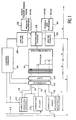
- Figure 1 shows both the steps principal of the process and their sequence chronological.
- a double arrow with the reference 1 designates the constitution of a reaction medium adapted to optimizing the reduction (transformation) of minus a complex chemical structure.
- the double arrow 3 indicates the transformation chemical in supercritical condition with at least one reduction reaction
- the double arrow 4 denotes the recovery, analysis and separation of products of transformation.
- a reactor 10 is supplied respectively by lines 12, 14, 16 and 18 in one or more complex chemical structures 20, a solvent 22 and possibly one or more additives 24.
- the chemical structure (s) to transform can be put into solution or into suspension in the solvent, in reactor 10, which corresponds to lines 12 and 14. It is possible also that the chemical structures are already initially in suspension or in solution in a liquid phase which constitutes the solvent, which corresponds to line 12 (and possibly 16) when the term solvent is extended to the concept of structure complex chemical. For example, when wish to deal with deinking terminals, these contain cellulose and suspended inks in water. Cellulose and inks are like this complex chemical structures to transform and water the solvent, the amount of which can be controlled. The mixture of chemical structures and solvent is in this case carried out prior to its introduction into the reactor (line 14).
- references 28 and 30 denote the recovery and analysis of transformation products. Recovered products are then separated into recoverable products 32 (solid, liquid or gaseous), i.e. recyclable and storable, and in non-recoverable products 34. Finally, the double arrow 5 distinguishes the field of process control.
- composition control which bears the general reference 36 is carried out in function of the analysis 38 of products from the transformation.
- Arrows 40, 42, 43 designate an adjustment initial composition of the reaction fluid, i.e. of the chemical structure-solvent-additive mixture reducer (possibly).
- the adjustment of the composition of the reaction fluid is carried out in view of having an a.c.e.H. sufficient.
- a check consists in checking the pH and / or the a.c.e.H. reaction fluid.
- This control carries the references 46 and 48.
- pH adjustment and / or A.C. in 46 and 48 can basically take place by acting on the additive supply to reactor 10, but it can also concern the supply of chemical structures or in solvent.
- one or more additives controlling respectively the reducing character, the pH or the a.c.e.H. can be dosed.
- the acece can be defined as the chemical contribution in hydrogen equivalents to transform all the carbon into CH 4 under the conditions of the experiment and taking into account the hydrogen equivalents already present in the initial complex structure.
- This chemical contribution in hydrogen equivalents can for example be defined in milligrams of reducing additive per gram of initial material.
- the a.ceH can also be defined in relation to the volume: either per liter of solvent.
- the required aceH is (4x-y) grams or (4x-y) .10 3 mg or (4x-y) 10 2 mg / liter.
- the amount of reducing additive to be supplied will depend on its ability, for example, to release hydrogens (or hydrogen equivalents) per gram. It is then introduced through the control system.
- the reducing agent does not contain hydrogen, one must take into account its ability to capture oxygen in such a way as to keep the ratio VS x H y .
- one of the complex structures, or one of the products resulting from the degradation of one of them can serve as a catalyst for obtaining targeted end products.
- Table I refers to a first example of experimental implementation of the invention in which approximately 30 to 125 ml of reaction fluid with a pH equal to 7 containing in suspension 3 to 5% by mass of sludge of a deinking cell having treated magazines (colored inks) are treated under various pressure (30 ⁇ P ⁇ 90 MPa) and temperature (500 ⁇ T ⁇ 600 ° C) conditions within a 150 cm sealed reaction vessel 3 .
- the quantity of reaction fluid introduced into the enclosure then makes it possible to govern, for a given temperature, the final pressure according to its own thermal expansion value.
- Table I gives the evolution of the solubilization conditions of the sludge as a function of the treatment parameters (pressure P and temperature T).
- the treatment time (duration of the stage where P and T have constant values) is equal to 5 minutes.
- solubility increases when the pressure decreases.
- the quantity of gas produced is, for against, too weak to be collected and analyzed whatever the pH value (acid, neutral or basic).
- reaction fluid containing suspended very black sludge from deinking cells old newspaper papers i.e. with a traditional ink heavily loaded with materials carbonaceous
- the pressure and temperature are adjusted according to the ratio between the volume of liquid phase introduced and that of the reaction chamber. Especially when the temperature is around 600 ° C, the pressure is around 60 MPa.
- the duration of treatment is changed from 3 to 30 then 60 minutes.
- Table III summarizes on this subject the results of a trial where like in the third example 55 ml of a reaction fluid containing suspension of very black sludge from cells of deinking old newsprint are placed in a reaction vessel with a volume close to 150ml. The corresponding amount of dry matter per ratio to the liquid phase is about 3 to 5%. The temperature is kept constant (600 ° C) as well as the duration of treatment which is 3 minutes. Many experiments are carried out at variable pressure (from 60 to 100 MPa) and for various pH values (4, 7, 13) without addition of a reducing additive.
- pH of the reaction medium may be adjusted to a substantially neutral value (pH ⁇ 7) before treatment, for example by adding either a basic additive such as sodium hydroxide, an acid such as hydrochloric for example.
- a basic additive such as sodium hydroxide
- an acid such as hydrochloric for example.
- a fifth example of implementation of the invention relates to the treatment of an effluent such than a hydrocarbon.
- reaction chamber 30 to 125ml of a phase liquid containing about 3% by mass of automobile draining suspended in water are introduced into a reaction chamber of approximately 150ml of useful volume.
- the temperature being maintained at about 600 ° C, the pressure can be adjusted according to the amount of reaction fluid introduced into the enclosure.
- Table V below specifies the conditions used as well as the main observed results.
- Reading Table V below shows that the increase in pressure tends to promote the degradation of the oil as well as the formation of gas. This results in particular from the comparison of experiments B 2 and B 6 .
- the addition of an additive (lithium borohydride) giving the reaction fluid a reducing nature also makes it possible to reduce the pressure at which the treatment is carried out, as experiment B 7 shows .
- a reducing additive such as LiBH 4 was added in proportions of approximately 0.5 g per 50 ml of reaction fluid. The addition of the additive also leads to almost complete degradation of the oil and to greater gas production.
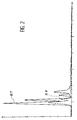
- Figure 2 attached is a diagram obtained by chromatographic analysis and illustrates the influence reducing additive on gas evolution.
- the curves referenced B 6 and B 7 correspond respectively to the evolution of gas during experiments B 6 and B 7 .
- This example concerns hydroxide terminals metallic and shows that it is possible in this case also to assess the role of the various parameters (pressure, temperature, duration) on their transformation.
- the experimental results of this example are reported in Table VI below. This table shows that the range of 600 ° C, 600 bar (60MPa) leads to a significant degradation of the bounds. The mass of solid residual is small. Processing time does not matter not a decisive role. It can also be noted that the aqueous phase resulting from the treatment is colorless. An analysis of the main constituents contained in this aqueous phase shows that it completely satisfies to the standards of rejection in nature.
- This example concerns pressing residues of harvest after fermentation and shows that it is possible to apply the process to this type of structure associated complex chemicals.
- Example 7 0.1 g of sodium borohydride per 19 g of initial material and 50 cm 3 of water is added to the mixture of complex chemical structures identical to that treated in Example 7. The whole is treated for 5 minutes at a temperature of 600 ° C. and a pressure of 900 bar. After returning to normal conditions of the assembly, an increase in the volume of the gas phase consisting of light hydrocarbons is observed, showing the role of the chemical contribution in hydrogen equivalents. A liquid phase containing carbon in suspension is also extracted from the reactor. The mass of carbon is around 1g.
- 125 cm 3 of ethanol are introduced into the same reactor as that used in Example 9.
- the reactor is brought to a temperature of 275 ° C., the pressure then being close to 550 bar. This treatment is maintained for approximately 2 minutes.
- This example relates to an association of complex chemical structures of the casein type.
- casein in the form of 50 cm 3 of water.
- the mixture is then brought to a temperature of 600 ° C., the pressure reached being of the order of 850 bar. After a 10-minute plateau, the assembly is returned to normal conditions.
- This example concerns an association of complex chemical structures derived from milk and known as whey. 50 cm 3 of whey and 0.1 g of NaHB 4 (sodium borohydride) are taken. The whole is brought to a temperature of 600 ° C., the pressure reached being of the order of 750 bar. After such a treatment lasting 15 minutes, the assembly is returned to normal conditions.
- NaHB 4 sodium borohydride
- Examples 13 to 15 provided below have, on the base of initial products identical to those mentioned by document EP-A-0 157 339 (sludge biological), for the purpose of testing with and without a.c.e.H. contribution) their degradation in the fields A, B, C above.
- reaction fluid therefore consists of water at a pH of 7 with 1% by mass of organic mud in suspension.
- the liquid phase mainly contains hydrocarbons between C5 and C8.
- 13b - For the same volume of 32 ml, a treatment identical to that described in Example 13a is used, but 0.6 g of sodium borohydride is added to the reaction fluid in order to increase the acece of the middle.
- the treatment time is 10 minutes.
- Methane is the majority (of the order of 56%), the other constituents being ethane (approximately 17%), propane (approximately 12.5%) and unsaturated hydrocarbons of ethylene or acetylene type in the state of traces (about 0.8%).
- 14b The addition of 0.6 g of NaBH 4 to the reaction fluid leads after treatment under the same conditions as in 14a to an even more complete degradation of the sludge, which corresponds to the maximum degradation obtained for the series of tests 13a, 13b, 14a, 14b (clarification of the liquid phase and disappearance of solid particles).
- Methane is the majority and its presence increased substantially (71%) compared to 14a (56%). The percentage of ethane is also increasing (around 20%).
Landscapes
- Chemical & Material Sciences (AREA)
- Organic Chemistry (AREA)
- Chemical Kinetics & Catalysis (AREA)
- Life Sciences & Earth Sciences (AREA)
- Engineering & Computer Science (AREA)
- General Chemical & Material Sciences (AREA)
- Business, Economics & Management (AREA)
- Emergency Management (AREA)
- Health & Medical Sciences (AREA)
- Hydrology & Water Resources (AREA)
- Toxicology (AREA)
- Environmental & Geological Engineering (AREA)
- Water Supply & Treatment (AREA)
- General Health & Medical Sciences (AREA)
- Organic Low-Molecular-Weight Compounds And Preparation Thereof (AREA)
- Treatment Of Water By Oxidation Or Reduction (AREA)
- Physical Or Chemical Processes And Apparatus (AREA)
- Fire-Extinguishing Compositions (AREA)
Applications Claiming Priority (3)
| Application Number | Priority Date | Filing Date | Title |
|---|---|---|---|
| FR9414664A FR2727634A1 (fr) | 1994-12-06 | 1994-12-06 | Procede en milieu reducteur de transformation chimique de structures chimiques complexes dans un fluide supercritique |
| FR9414664 | 1994-12-06 | ||
| PCT/FR1995/001600 WO1996017680A1 (fr) | 1994-12-06 | 1995-12-05 | Procede en milieu reducteur de transformation chimique de structures chimiques complexes dans un fluide supercritique |
Publications (2)
| Publication Number | Publication Date |
|---|---|
| EP0796143A1 EP0796143A1 (fr) | 1997-09-24 |
| EP0796143B1 true EP0796143B1 (fr) | 1998-10-07 |
Family
ID=9469528
Family Applications (1)
| Application Number | Title | Priority Date | Filing Date |
|---|---|---|---|
| EP95941765A Expired - Lifetime EP0796143B1 (fr) | 1994-12-06 | 1995-12-05 | Procede en milieu reducteur de transformation chimique de structures chimiques complexes dans un fluide supercritique |
Country Status (7)
| Country | Link |
|---|---|
| US (1) | US5914031A (enExample) |
| EP (1) | EP0796143B1 (enExample) |
| AT (1) | ATE171884T1 (enExample) |
| DE (1) | DE69505271T2 (enExample) |
| DK (1) | DK0796143T3 (enExample) |
| FR (1) | FR2727634A1 (enExample) |
| WO (1) | WO1996017680A1 (enExample) |
Families Citing this family (15)
| Publication number | Priority date | Publication date | Assignee | Title |
|---|---|---|---|---|
| US6124519A (en) * | 1996-12-13 | 2000-09-26 | Director-General Of Agency Of Industrial Science And Technology | Method of decomposing polychlorobiphenyls |
| FR2780986B1 (fr) * | 1998-07-10 | 2000-09-29 | Electrolyse L | Procede de transformation de structures chimiques dans un fluide sous pression et en temperature et dispositif pour sa mise en oeuvre |
| US6486355B1 (en) | 2000-02-23 | 2002-11-26 | Brookhaven Science Associates Llc | Application of chiral critical clusters to assymetric synthesis |
| US7144498B2 (en) * | 2004-01-30 | 2006-12-05 | Kellogg Brown & Root Llc | Supercritical hydrocarbon conversion process |
| US7833408B2 (en) * | 2004-01-30 | 2010-11-16 | Kellogg Brown & Root Llc | Staged hydrocarbon conversion process |
| US20080099374A1 (en) * | 2006-10-31 | 2008-05-01 | Chevron U.S.A. Inc. | Reactor and process for upgrading heavy hydrocarbon oils |
| US20080099377A1 (en) * | 2006-10-31 | 2008-05-01 | Chevron U.S.A. Inc. | Process for upgrading heavy hydrocarbon oils |
| US20080099376A1 (en) * | 2006-10-31 | 2008-05-01 | Chevron U.S.A. Inc. | Upgrading heavy hydrocarbon oils |
| US20080099378A1 (en) * | 2006-10-31 | 2008-05-01 | Chevron U.S.A. Inc. | Process and reactor for upgrading heavy hydrocarbon oils |
| JP5111072B2 (ja) * | 2007-11-22 | 2012-12-26 | 三菱電機株式会社 | 液晶表示装置 |
| WO2009073442A2 (en) | 2007-11-28 | 2009-06-11 | Saudi Arabian Oil Company | Process to reduce acidity of crude oil |
| US20090166261A1 (en) * | 2007-12-28 | 2009-07-02 | Chevron U.S.A. Inc. | Upgrading heavy hydrocarbon oils |
| US20110133406A1 (en) * | 2009-12-09 | 2011-06-09 | I-Cheng Chiu | Game Apparatus Which Combines with Gears and Blocks |
| US8394260B2 (en) | 2009-12-21 | 2013-03-12 | Saudi Arabian Oil Company | Petroleum upgrading process |
| US9382485B2 (en) | 2010-09-14 | 2016-07-05 | Saudi Arabian Oil Company | Petroleum upgrading process |
Family Cites Families (5)
| Publication number | Priority date | Publication date | Assignee | Title |
|---|---|---|---|---|
| US4483761A (en) * | 1983-07-05 | 1984-11-20 | The Standard Oil Company | Upgrading heavy hydrocarbons with supercritical water and light olefins |
| DE3412536A1 (de) * | 1984-04-04 | 1985-10-31 | Fried. Krupp Gmbh, 4300 Essen | Verfahren zur herstellung von kohlenwasserstoffen aus klaerschlamm |
| US4840725A (en) * | 1987-06-19 | 1989-06-20 | The Standard Oil Company | Conversion of high boiling liquid organic materials to lower boiling materials |
| US5118447A (en) * | 1991-04-12 | 1992-06-02 | Battelle Memorial Institute | Thermochemical nitrate destruction |
| US5221486A (en) * | 1991-04-12 | 1993-06-22 | Battelle Memorial Institute | Aqueous phase removal of nitrogen from nitrogen compounds |
-
1994
- 1994-12-06 FR FR9414664A patent/FR2727634A1/fr active Granted
-
1995
- 1995-12-05 DK DK95941765T patent/DK0796143T3/da active
- 1995-12-05 WO PCT/FR1995/001600 patent/WO1996017680A1/fr not_active Ceased
- 1995-12-05 US US08/849,265 patent/US5914031A/en not_active Expired - Fee Related
- 1995-12-05 EP EP95941765A patent/EP0796143B1/fr not_active Expired - Lifetime
- 1995-12-05 DE DE69505271T patent/DE69505271T2/de not_active Expired - Fee Related
- 1995-12-05 AT AT95941765T patent/ATE171884T1/de not_active IP Right Cessation
Also Published As
| Publication number | Publication date |
|---|---|
| FR2727634A1 (fr) | 1996-06-07 |
| DE69505271T2 (de) | 1999-04-08 |
| FR2727634B1 (enExample) | 1997-02-21 |
| WO1996017680A1 (fr) | 1996-06-13 |
| DE69505271D1 (de) | 1998-11-12 |
| ATE171884T1 (de) | 1998-10-15 |
| US5914031A (en) | 1999-06-22 |
| EP0796143A1 (fr) | 1997-09-24 |
| DK0796143T3 (da) | 1999-06-21 |
Similar Documents
| Publication | Publication Date | Title |
|---|---|---|
| EP0796143B1 (fr) | Procede en milieu reducteur de transformation chimique de structures chimiques complexes dans un fluide supercritique | |
| CA2337272A1 (fr) | Procede de transformation de structures chimiques dans un fluide sous pression et en temperature et dispositif pour sa mise en oeuvre | |
| CA2342257C (fr) | Hydrogenation continue de composes nitres aromatiques utilisant un catalyseur a faible teneur en aluminium | |
| FR2754464A1 (fr) | Procede et installation d'extraction de composes organiques et/ou inorganiques du bois par un fluide supercritique | |
| CA2756415A1 (fr) | Polymeres (meth) acryliques de bas poids moleculaire, exempts de composes soufres, metalliques et halogenes et de taux de monomeres residuels faible, leur procede de preparation et leurs utilisations | |
| EP1105353B1 (fr) | Dispositif de transformation de structures chimiques dans un fluide comprenant un solvant et des sels sous l'action des ultrasons | |
| EP1165728A1 (fr) | Procede de traitement d'une huile utilisant un fluide a l'etat supercritique | |
| CA2941696A1 (fr) | Procede de traitement de dechets organiques par oxydation hydrothermale | |
| WO2004018367A2 (fr) | Elimination des ions metalliques des effluents aqueux | |
| EP4623048A1 (fr) | Production de carburants de synthèse à partir de co2 avec oxycombustion partielle de sous-produits et séparation de co2 | |
| EP3188815B1 (fr) | Procédé d'extraction sélectif de platinoides, à partir d'un support les contenant, avec un milieu d'extraction constitué par un fluide supercritique et un ligand organique | |
| EP1414742B1 (fr) | Procede de decomposition du peroxyde d'hydrogene sous pression et dispositif pour rechauffer un equipement | |
| FR3142478A1 (fr) | Production de carburants de synthèse à partir de dioxyde de carbone avec séparation de dioxyde de carbone | |
| EP0528012A1 (fr) | Support vegetal pour l'adsorption de contaminants en milieu aqueux | |
| WO1997026314A1 (fr) | Procede de traitement des huiles de lubrification usagees en phase aqueuse dispersee pour leur recyclage | |
| BE1008468A4 (fr) | Procede d'extraction de metaux lourds des huiles usees. | |
| FR2900145A1 (fr) | Procede d'extraction sans solvant des polluants organiques et metalliques | |
| EP1115662A1 (fr) | Procede de traitement de substances organiques en milieu aqueux, notamment d'effluents et dispositif electrochimique pour mettre en oeuvre le procede | |
| FR2593079A1 (fr) | Procede de separation, par microfiltration, d'au moins une phase solide d'une phase gazeuse, et utilisation dans un procede de gazeification d'une charge hydrocarbonee. | |
| EP0896049A1 (fr) | Procédé de conversion d'hydrocarbures légers gazeux en hydrocarbures supérieurs | |
| EP2158017A2 (fr) | Dispositif et procede d'elimination d'un compose du biodiesel, procede de purification du biodiesel issu d'une etape de transesterification, ainsi qu'une installation de production de biodiesel les incluant | |
| FR2475036A1 (fr) | Procede d'amelioration de la qualite des acides monocarboxyliques aliphatiques satures de 7 a 9 atomes de carbone | |
| BE501653A (enExample) | ||
| BE584635A (enExample) | ||
| BE424910A (enExample) |
Legal Events
| Date | Code | Title | Description |
|---|---|---|---|
| PUAI | Public reference made under article 153(3) epc to a published international application that has entered the european phase |
Free format text: ORIGINAL CODE: 0009012 |
|
| 17P | Request for examination filed |
Effective date: 19970517 |
|
| AK | Designated contracting states |
Kind code of ref document: A1 Designated state(s): AT BE CH DE DK FR GB IT LI NL SE |
|
| GRAG | Despatch of communication of intention to grant |
Free format text: ORIGINAL CODE: EPIDOS AGRA |
|
| 17Q | First examination report despatched |
Effective date: 19971006 |
|
| GRAG | Despatch of communication of intention to grant |
Free format text: ORIGINAL CODE: EPIDOS AGRA |
|
| GRAH | Despatch of communication of intention to grant a patent |
Free format text: ORIGINAL CODE: EPIDOS IGRA |
|
| GRAH | Despatch of communication of intention to grant a patent |
Free format text: ORIGINAL CODE: EPIDOS IGRA |
|
| GRAA | (expected) grant |
Free format text: ORIGINAL CODE: 0009210 |
|
| AK | Designated contracting states |
Kind code of ref document: B1 Designated state(s): AT BE CH DE DK FR GB IT LI NL SE |
|
| REF | Corresponds to: |
Ref document number: 171884 Country of ref document: AT Date of ref document: 19981015 Kind code of ref document: T |
|
| REG | Reference to a national code |
Ref country code: CH Ref legal event code: EP |
|
| REF | Corresponds to: |
Ref document number: 69505271 Country of ref document: DE Date of ref document: 19981112 |
|
| GBT | Gb: translation of ep patent filed (gb section 77(6)(a)/1977) |
Effective date: 19981209 |
|
| REG | Reference to a national code |
Ref country code: DK Ref legal event code: T3 |
|
| PLBE | No opposition filed within time limit |
Free format text: ORIGINAL CODE: 0009261 |
|
| STAA | Information on the status of an ep patent application or granted ep patent |
Free format text: STATUS: NO OPPOSITION FILED WITHIN TIME LIMIT |
|
| 26N | No opposition filed | ||
| PGFP | Annual fee paid to national office [announced via postgrant information from national office to epo] |
Ref country code: GB Payment date: 20011205 Year of fee payment: 7 |
|
| PGFP | Annual fee paid to national office [announced via postgrant information from national office to epo] |
Ref country code: SE Payment date: 20011206 Year of fee payment: 7 |
|
| PGFP | Annual fee paid to national office [announced via postgrant information from national office to epo] |
Ref country code: DK Payment date: 20011212 Year of fee payment: 7 Ref country code: AT Payment date: 20011212 Year of fee payment: 7 |
|
| PGFP | Annual fee paid to national office [announced via postgrant information from national office to epo] |
Ref country code: FR Payment date: 20011218 Year of fee payment: 7 |
|
| PGFP | Annual fee paid to national office [announced via postgrant information from national office to epo] |
Ref country code: CH Payment date: 20011224 Year of fee payment: 7 |
|
| PGFP | Annual fee paid to national office [announced via postgrant information from national office to epo] |
Ref country code: NL Payment date: 20011228 Year of fee payment: 7 |
|
| REG | Reference to a national code |
Ref country code: GB Ref legal event code: IF02 |
|
| PGFP | Annual fee paid to national office [announced via postgrant information from national office to epo] |
Ref country code: BE Payment date: 20020218 Year of fee payment: 7 |
|
| PGFP | Annual fee paid to national office [announced via postgrant information from national office to epo] |
Ref country code: DE Payment date: 20020306 Year of fee payment: 7 |
|
| PG25 | Lapsed in a contracting state [announced via postgrant information from national office to epo] |
Ref country code: GB Free format text: LAPSE BECAUSE OF NON-PAYMENT OF DUE FEES Effective date: 20021205 Ref country code: AT Free format text: LAPSE BECAUSE OF NON-PAYMENT OF DUE FEES Effective date: 20021205 |
|
| PG25 | Lapsed in a contracting state [announced via postgrant information from national office to epo] |
Ref country code: SE Free format text: LAPSE BECAUSE OF NON-PAYMENT OF DUE FEES Effective date: 20021206 |
|
| PG25 | Lapsed in a contracting state [announced via postgrant information from national office to epo] |
Ref country code: LI Free format text: LAPSE BECAUSE OF NON-PAYMENT OF DUE FEES Effective date: 20021231 Ref country code: CH Free format text: LAPSE BECAUSE OF NON-PAYMENT OF DUE FEES Effective date: 20021231 Ref country code: BE Free format text: LAPSE BECAUSE OF NON-PAYMENT OF DUE FEES Effective date: 20021231 |
|
| PG25 | Lapsed in a contracting state [announced via postgrant information from national office to epo] |
Ref country code: DK Free format text: LAPSE BECAUSE OF NON-PAYMENT OF DUE FEES Effective date: 20030131 |
|
| BERE | Be: lapsed |
Owner name: *SENTAGNES DOMINIQUE Effective date: 20021231 Owner name: L'*ELECTROLYSE Effective date: 20021231 |
|
| PG25 | Lapsed in a contracting state [announced via postgrant information from national office to epo] |
Ref country code: NL Free format text: LAPSE BECAUSE OF NON-PAYMENT OF DUE FEES Effective date: 20030701 Ref country code: DE Free format text: LAPSE BECAUSE OF NON-PAYMENT OF DUE FEES Effective date: 20030701 |
|
| GBPC | Gb: european patent ceased through non-payment of renewal fee | ||
| EUG | Se: european patent has lapsed | ||
| REG | Reference to a national code |
Ref country code: DK Ref legal event code: EBP |
|
| REG | Reference to a national code |
Ref country code: CH Ref legal event code: PL |
|
| NLV4 | Nl: lapsed or anulled due to non-payment of the annual fee |
Effective date: 20030701 |
|
| PG25 | Lapsed in a contracting state [announced via postgrant information from national office to epo] |
Ref country code: FR Free format text: LAPSE BECAUSE OF NON-PAYMENT OF DUE FEES Effective date: 20030901 |
|
| REG | Reference to a national code |
Ref country code: FR Ref legal event code: ST |
|
| PG25 | Lapsed in a contracting state [announced via postgrant information from national office to epo] |
Ref country code: IT Free format text: LAPSE BECAUSE OF NON-PAYMENT OF DUE FEES Effective date: 20051205 |