EP0789719B1 - Composition de polyurethanne et joint d'etancheite pour vitrage - Google Patents
Composition de polyurethanne et joint d'etancheite pour vitrage Download PDFInfo
- Publication number
- EP0789719B1 EP0789719B1 EP96930200A EP96930200A EP0789719B1 EP 0789719 B1 EP0789719 B1 EP 0789719B1 EP 96930200 A EP96930200 A EP 96930200A EP 96930200 A EP96930200 A EP 96930200A EP 0789719 B1 EP0789719 B1 EP 0789719B1
- Authority
- EP
- European Patent Office
- Prior art keywords
- hardener
- composition
- use according
- polyurethane
- anyone
- Prior art date
- Legal status (The legal status is an assumption and is not a legal conclusion. Google has not performed a legal analysis and makes no representation as to the accuracy of the status listed.)
- Expired - Lifetime
Links
- 239000000203 mixture Substances 0.000 title claims abstract description 26
- 229920002635 polyurethane Polymers 0.000 title claims abstract description 23
- 239000004814 polyurethane Substances 0.000 title claims abstract description 23
- 239000012948 isocyanate Substances 0.000 claims abstract description 13
- 150000002513 isocyanates Chemical class 0.000 claims abstract description 12
- VTYYLEPIZMXCLO-UHFFFAOYSA-L Calcium carbonate Chemical compound [Ca+2].[O-]C([O-])=O VTYYLEPIZMXCLO-UHFFFAOYSA-L 0.000 claims abstract description 10
- 229920005862 polyol Polymers 0.000 claims abstract description 9
- 150000003077 polyols Chemical class 0.000 claims abstract description 9
- VYPSYNLAJGMNEJ-UHFFFAOYSA-N Silicium dioxide Chemical compound O=[Si]=O VYPSYNLAJGMNEJ-UHFFFAOYSA-N 0.000 claims abstract description 8
- 235000011837 pasties Nutrition 0.000 claims abstract description 8
- 230000008719 thickening Effects 0.000 claims abstract description 8
- 239000006229 carbon black Substances 0.000 claims abstract description 7
- 150000004760 silicates Chemical class 0.000 claims abstract description 6
- 229910000019 calcium carbonate Inorganic materials 0.000 claims abstract description 5
- 239000002562 thickening agent Substances 0.000 claims abstract description 5
- 239000013008 thixotropic agent Substances 0.000 claims abstract description 5
- 235000012216 bentonite Nutrition 0.000 claims abstract description 4
- 239000004800 polyvinyl chloride Substances 0.000 claims abstract 2
- 239000002510 pyrogen Substances 0.000 claims abstract 2
- 239000000377 silicon dioxide Substances 0.000 claims abstract 2
- 239000004848 polyfunctional curative Substances 0.000 claims description 22
- 229920001021 polysulfide Polymers 0.000 claims description 15
- 239000005077 polysulfide Substances 0.000 claims description 12
- 150000008117 polysulfides Polymers 0.000 claims description 12
- 239000000945 filler Substances 0.000 claims description 10
- 239000004014 plasticizer Substances 0.000 claims description 8
- 229920002121 Hydroxyl-terminated polybutadiene Polymers 0.000 claims description 4
- 238000007789 sealing Methods 0.000 claims description 4
- 239000003054 catalyst Substances 0.000 claims description 3
- XSQUKJJJFZCRTK-UHFFFAOYSA-N Urea Chemical compound NC(N)=O XSQUKJJJFZCRTK-UHFFFAOYSA-N 0.000 claims description 2
- 239000004202 carbamide Substances 0.000 claims description 2
- 239000000565 sealant Substances 0.000 claims description 2
- 239000004587 polysulfide sealant Substances 0.000 claims 1
- NIXOWILDQLNWCW-UHFFFAOYSA-N acrylic acid group Chemical group C(C=C)(=O)O NIXOWILDQLNWCW-UHFFFAOYSA-N 0.000 abstract description 2
- 239000003795 chemical substances by application Substances 0.000 abstract description 2
- 238000009413 insulation Methods 0.000 abstract description 2
- 150000003672 ureas Chemical class 0.000 abstract 1
- 239000011521 glass Substances 0.000 description 13
- UPMLOUAZCHDJJD-UHFFFAOYSA-N 4,4'-Diphenylmethane Diisocyanate Chemical compound C1=CC(N=C=O)=CC=C1CC1=CC=C(N=C=O)C=C1 UPMLOUAZCHDJJD-UHFFFAOYSA-N 0.000 description 6
- 239000007788 liquid Substances 0.000 description 6
- 230000008901 benefit Effects 0.000 description 5
- 230000015572 biosynthetic process Effects 0.000 description 5
- 229910021485 fumed silica Inorganic materials 0.000 description 5
- 230000004048 modification Effects 0.000 description 3
- 238000012986 modification Methods 0.000 description 3
- 230000009974 thixotropic effect Effects 0.000 description 3
- XKRFYHLGVUSROY-UHFFFAOYSA-N Argon Chemical compound [Ar] XKRFYHLGVUSROY-UHFFFAOYSA-N 0.000 description 2
- 239000002318 adhesion promoter Substances 0.000 description 2
- 239000012212 insulator Substances 0.000 description 2
- 238000000034 method Methods 0.000 description 2
- 239000002245 particle Substances 0.000 description 2
- 125000006850 spacer group Chemical group 0.000 description 2
- 239000005995 Aluminium silicate Substances 0.000 description 1
- MQIUGAXCHLFZKX-UHFFFAOYSA-N Di-n-octyl phthalate Chemical compound CCCCCCCCOC(=O)C1=CC=CC=C1C(=O)OCCCCCCCC MQIUGAXCHLFZKX-UHFFFAOYSA-N 0.000 description 1
- 229920001730 Moisture cure polyurethane Polymers 0.000 description 1
- 239000005062 Polybutadiene Substances 0.000 description 1
- 229910004298 SiO 2 Inorganic materials 0.000 description 1
- 239000000654 additive Substances 0.000 description 1
- 150000001278 adipic acid derivatives Chemical class 0.000 description 1
- 235000012211 aluminium silicate Nutrition 0.000 description 1
- 229910052786 argon Inorganic materials 0.000 description 1
- 230000008859 change Effects 0.000 description 1
- 150000001875 compounds Chemical class 0.000 description 1
- 230000000694 effects Effects 0.000 description 1
- 229920001971 elastomer Polymers 0.000 description 1
- 239000000806 elastomer Substances 0.000 description 1
- 125000002887 hydroxy group Chemical group [H]O* 0.000 description 1
- 238000011065 in-situ storage Methods 0.000 description 1
- 239000011261 inert gas Substances 0.000 description 1
- 238000002347 injection Methods 0.000 description 1
- 239000007924 injection Substances 0.000 description 1
- NLYAJNPCOHFWQQ-UHFFFAOYSA-N kaolin Chemical compound O.O.O=[Al]O[Si](=O)O[Si](=O)O[Al]=O NLYAJNPCOHFWQQ-UHFFFAOYSA-N 0.000 description 1
- 238000004519 manufacturing process Methods 0.000 description 1
- 229910052753 mercury Inorganic materials 0.000 description 1
- -1 mercury esters Chemical class 0.000 description 1
- 239000002480 mineral oil Substances 0.000 description 1
- 150000003021 phthalic acid derivatives Chemical class 0.000 description 1
- 239000000049 pigment Substances 0.000 description 1
- 229920002857 polybutadiene Polymers 0.000 description 1
- 229920000642 polymer Polymers 0.000 description 1
- 239000002244 precipitate Substances 0.000 description 1
- 239000000047 product Substances 0.000 description 1
- 230000001698 pyrogenic effect Effects 0.000 description 1
- 230000009467 reduction Effects 0.000 description 1
- 238000007665 sagging Methods 0.000 description 1
- 150000004756 silanes Chemical class 0.000 description 1
- 239000000243 solution Substances 0.000 description 1
- 239000000454 talc Substances 0.000 description 1
- 229910052623 talc Inorganic materials 0.000 description 1
Images
Classifications
-
- C—CHEMISTRY; METALLURGY
- C08—ORGANIC MACROMOLECULAR COMPOUNDS; THEIR PREPARATION OR CHEMICAL WORKING-UP; COMPOSITIONS BASED THEREON
- C08G—MACROMOLECULAR COMPOUNDS OBTAINED OTHERWISE THAN BY REACTIONS ONLY INVOLVING UNSATURATED CARBON-TO-CARBON BONDS
- C08G18/00—Polymeric products of isocyanates or isothiocyanates
- C08G18/06—Polymeric products of isocyanates or isothiocyanates with compounds having active hydrogen
- C08G18/28—Polymeric products of isocyanates or isothiocyanates with compounds having active hydrogen characterised by the compounds used containing active hydrogen
- C08G18/67—Unsaturated compounds having active hydrogen
- C08G18/69—Polymers of conjugated dienes
-
- C—CHEMISTRY; METALLURGY
- C08—ORGANIC MACROMOLECULAR COMPOUNDS; THEIR PREPARATION OR CHEMICAL WORKING-UP; COMPOSITIONS BASED THEREON
- C08K—Use of inorganic or non-macromolecular organic substances as compounding ingredients
- C08K5/00—Use of organic ingredients
- C08K5/0008—Organic ingredients according to more than one of the "one dot" groups of C08K5/01 - C08K5/59
- C08K5/0016—Plasticisers
-
- C—CHEMISTRY; METALLURGY
- C08—ORGANIC MACROMOLECULAR COMPOUNDS; THEIR PREPARATION OR CHEMICAL WORKING-UP; COMPOSITIONS BASED THEREON
- C08G—MACROMOLECULAR COMPOUNDS OBTAINED OTHERWISE THAN BY REACTIONS ONLY INVOLVING UNSATURATED CARBON-TO-CARBON BONDS
- C08G2190/00—Compositions for sealing or packing joints
Definitions
- the invention relates to the use of a two-component polyurethane composition for especially to form seals for glazing insulator or double glazing, in a machine intended for production of polysulfide seals as well as seals sealing formed from this composition and at using such a machine.
- Insulating glass generally includes two or more glass plates separated by spacer profiles and seals which are injected or formed in situ to cover the profiles and fill the space between the glass plates.
- the invention aims to provide a solution simple, effective and inexpensive to this problem.
- a two-component polyurethane composition intended to be mixed immediately before use, in particular to form seals for glazing, in a machine intended for producing polysulphide seals, said composition comprising a polyol-based component, in particular hydroxyl-terminated polybutadiene and an isocyanate-based hardener, made pasty or viscous by adding a thickening or thixotropic agent so that its viscosity is between approximately 10 and 30 Pa.s for a shear rate of 100 s -1 and that said composition can be used in such a machine.
- composition defined above including the polyol-based component is of the pasty type and the isocyanate-based hardener is also of the type pasty or viscous, can be used in machines designed for making polysulfide seals, with minor modification or simple adjustment of these machines, and allows the owners of these machines for making polyurethane seals more efficient and less expensive.
- the thickening or thixotropic agent comprises an inert filler such as chalk, silicates, bentonites, calcium carbonate, PVC,
- the hardener may also include a pre-polymer isocyanate-terminated having a viscosity relatively high, or a mixture of this prepolymer and a thickening or thixotropic inert filler of the type cited above.
- polyurethane seals according to the invention had a better deflection factor (sagging factor) than known polyurethane seals so far which is an unexpected benefit and surprising resulting from the modification of the hardener the composition according to the invention.
- Another advantage of the invention is that the use of a pasty or viscous hardener allows greater choice among components based on polyols which can be combined with this hardener to form polyurethane.
- the invention also provides a seal sealant for glazing characterized in that it is made of polyurethane having a composition such as defined above, using a conventional machine designed for installing polysulphide seals.
- the invention further relates to the use of a composition as defined above to make a seal for glazing by means of a machine designed to carry out polysulfide seals.
- the invention results in a reduction in the cost price of insulating glass and an increase in their service life.
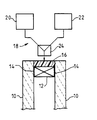
- references 10 denote two parallel glass plates intended to form a insulating glass, or "double glazing", these two plates of glass being joined together in the vicinity of their edges by profiles 12 forming a spacer, these profiles being for example metallic and tubular and may contain a moisture absorbing product. Sealing can be ensured on the one hand by means of a thin layer of elastomer interposed between the faces of profiles 12 and the glass plates 10 and on the other hand by a seal 16 which covers the profiles 12 and possibly the edges of the glass plates lining the space between the edges of these plates.
- the volume between the glass plates 10 can be filled with an inert gas such as argon, to improve insulation.
- the seal 16 is, in accordance with the invention, made of polyurethane and formed in situated by means of a machine 18 comprising means 20, 22 for bringing the two components of the polyurethane to a mixing and injection head 24, these two components being pasty or relatively high viscosity and comprising a polyol component and a hardener based on isocyanate, machine 18 being well known in the technique and used until then for the formation of polysulfide seals.
- the composition according to the invention comprises liquid polymers such as hydroxyl-terminated polybutadienes, isocyanates, plasticizers, inert fillers, a catalyst, glass adhesion promoters, and various additives already known in the technique.
- the isocyanates used are preferably di-isocyanates and polyfunctional isocyanates
- the plasticizers are phthalic acid esters, adipic acid esters, mineral oils, etc.
- the fillers can be ground calcium carbonate or precipitate, silicates such as talc, kaolin, carbon black, pyrogenic silicates, in particular pyrogenic silica with an extremely fine structure, consisting of practically pure SiO 2 in particles whose average dimensions are, for example, order of 0.01 (m, these particles being united entered into aggregates in the form of branched chains giving the fumed silica remarkable thickening and thixotropic properties.
- the adhesion promoters can be functionalized organic silanes.
- the viscosity of the isocyanate hardener (normally liquid) is increased by using a high viscosity isocyanate terminated prepolymer and / or by adding a thickening filler or thixotropic such as chalk, silicates, bentonites, calcium carbonate, PVC, derivatives urea or acrylic derivatives, fumed silica or carbon black, the amount of filler being typically of the order of 15 to 25% by weight in the hardener and can more generally be understood as 10 and 70% by weight depending on its type and effect research.
- a thickening filler or thixotropic such as chalk, silicates, bentonites, calcium carbonate, PVC, derivatives urea or acrylic derivatives, fumed silica or carbon black
- compositions according to the invention are compositions according to the invention:
- the hardeners of known compositions have a viscosity of less than 1.5 Pa.s for a shear rate of 100 s -1 , this viscosity being for example 0.4 Pa.s for the hardener of the known composition indicated above .
- the hardeners of the compositions useful according to the invention have a viscosity of approximately 10 to 30 Pa.s for a shear rate of 100 s -1 , which allows them to be used without difficulty on machines designed for the formation of joints in polysulfide.
Landscapes
- Chemical & Material Sciences (AREA)
- Health & Medical Sciences (AREA)
- Chemical Kinetics & Catalysis (AREA)
- Medicinal Chemistry (AREA)
- Polymers & Plastics (AREA)
- Organic Chemistry (AREA)
- Sealing Material Composition (AREA)
- Compositions Of Macromolecular Compounds (AREA)
- Polyurethanes Or Polyureas (AREA)
- Joining Of Glass To Other Materials (AREA)
Description
- polybutadiène à terminaison
hydroxyle : 22% - plastifiant (DOP)
(di-octyl-phtalate) : 20% - charge inerte (craie) : 58%
- catalyseur (esters de mercure) : 0,04%
- MDI liquide
(diphénylméthanediisocyanate) : 50% - noir de carbone
(servant de pigment) : 1% - silice pyrogénée : 3%
- plastifiant (DOP) : 46%
- MDI liquide : 50%
- noir de carbone : 25%
- plastifiant (DOP) : 25%
- MDI liquide : 50%
- noir de carbone : 10%
- silice pyrogénée : 6%
- plastifiant (DOP) : 34%
Claims (7)
- Utilisation d'une composition de polyuréthanne à deux composants destinés à être mélangés immédiatement avant emploi en particulier pour former des joints d'étanchéité pour vitrage, dans une machine destinée à la réalisation de joints en polysulfure, ladite composition comprenant un composant à base de polyol, notamment de polybutadiène à terminaison hydroxyle et un durcisseur à base d'isocyanate, rendu pâteux ou visqueux par addition d'un agent épaississant ou thixotrope pour que sa viscosité soit comprise entre environ 10 et 30 Pa.s pour un taux de cisaillement de 100 s-1 et que ladite composition soit utilisable dans une telle machine.
- Utilisation selon la revendication 1, caractérisée en ce que l'agent épaississant ou thixotrope comprend une charge inerte telle que de la craie, des silicates, des bentonites, du carbonate de calcium, du PVC, des dérivés d'urée, des dérivés acryliques, du noir de carbone ou de la silice pyrogénée, la quantité de charge inerte dans le durcisseur étant de l'ordre de 10 à 70% en poids.
- Utilisation selon la revendication 2, caractérisée en ce que la quantité de charge inerte dans le durcisseur est de l'ordre de 15 à 25% en poids.
- Utilisation selon l'une des revendications précédentes, caractérisée en ce que le durcisseur comprend un pré-polymère à terminaison isocyanate et à viscosité relativement élevée.
- Composition selon l'une des revendications précédentes, caractérisée en ce que le durcisseur comprend un plastifiant, tel par exemple que du DOP.
- Composition selon l'une des revendications précédentes, caractérisée en ce que le composant à base de polyol comprend également un plastifiant tel par exemple que du DOP, une charge inerte et un catalyseur.
- Joint d'étanchéité pour vitrage, caractérisé en ce qu'il est réalisé en un polyuréthanne ayant une composition telle que définie dans l'une des revendications précédentes et en ce qu'il est posé au moyen d'une machine conçue pour la pose de joints en polysulfure.
Applications Claiming Priority (3)
| Application Number | Priority Date | Filing Date | Title |
|---|---|---|---|
| FR9510380A FR2738251B1 (fr) | 1995-09-05 | 1995-09-05 | Composition de polyurethanne et joint d'etancheite pour vitrage isolant |
| FR9510380 | 1995-09-05 | ||
| PCT/FR1996/001345 WO1997009365A1 (fr) | 1995-09-05 | 1996-09-04 | Composition de polyurethanne et joint d'etancheite pour vitrage |
Publications (2)
| Publication Number | Publication Date |
|---|---|
| EP0789719A1 EP0789719A1 (fr) | 1997-08-20 |
| EP0789719B1 true EP0789719B1 (fr) | 2001-12-12 |
Family
ID=9482272
Family Applications (1)
| Application Number | Title | Priority Date | Filing Date |
|---|---|---|---|
| EP96930200A Expired - Lifetime EP0789719B1 (fr) | 1995-09-05 | 1996-09-04 | Composition de polyurethanne et joint d'etancheite pour vitrage |
Country Status (12)
| Country | Link |
|---|---|
| EP (1) | EP0789719B1 (fr) |
| AT (1) | ATE210692T1 (fr) |
| CZ (1) | CZ291208B6 (fr) |
| DE (1) | DE69617898T2 (fr) |
| DK (1) | DK0789719T3 (fr) |
| ES (1) | ES2169261T3 (fr) |
| FR (1) | FR2738251B1 (fr) |
| HU (1) | HU218089B (fr) |
| PL (1) | PL186694B1 (fr) |
| SK (1) | SK55297A3 (fr) |
| TR (1) | TR199700345T1 (fr) |
| WO (1) | WO1997009365A1 (fr) |
Family Cites Families (5)
| Publication number | Priority date | Publication date | Assignee | Title |
|---|---|---|---|---|
| US3267063A (en) * | 1962-04-30 | 1966-08-16 | Mobay Chemical Corp | Polyurethane caulk containing ketone aldehyde resins and plasticizer |
| NL134942C (fr) * | 1965-06-14 | |||
| GB8928157D0 (en) * | 1989-12-13 | 1990-02-14 | Bostik Ltd | Chemically-curing two-part polyurethane composition |
| DE4038815A1 (de) * | 1990-12-05 | 1992-06-11 | Bostik Gmbh | Zweikomponenten-polyurethan-dichtungsmassen und mischverfahren hierfuer |
| GB2242907A (en) * | 1990-04-03 | 1991-10-16 | Bostik Ltd | Two-component polyurethane composition and method of mixing thereof |
-
1995
- 1995-09-05 FR FR9510380A patent/FR2738251B1/fr not_active Expired - Fee Related
-
1996
- 1996-09-04 DK DK96930200T patent/DK0789719T3/da active
- 1996-09-04 SK SK552-97A patent/SK55297A3/sk unknown
- 1996-09-04 PL PL96320339A patent/PL186694B1/pl unknown
- 1996-09-04 CZ CZ19971361A patent/CZ291208B6/cs not_active IP Right Cessation
- 1996-09-04 TR TR97/00345T patent/TR199700345T1/xx unknown
- 1996-09-04 HU HU9800342A patent/HU218089B/hu not_active IP Right Cessation
- 1996-09-04 WO PCT/FR1996/001345 patent/WO1997009365A1/fr not_active Ceased
- 1996-09-04 ES ES96930200T patent/ES2169261T3/es not_active Expired - Lifetime
- 1996-09-04 AT AT96930200T patent/ATE210692T1/de active
- 1996-09-04 EP EP96930200A patent/EP0789719B1/fr not_active Expired - Lifetime
- 1996-09-04 DE DE69617898T patent/DE69617898T2/de not_active Expired - Lifetime
Also Published As
| Publication number | Publication date |
|---|---|
| EP0789719A1 (fr) | 1997-08-20 |
| HUP9800342A3 (en) | 1998-11-30 |
| HU218089B (hu) | 2000-05-28 |
| CZ136197A3 (en) | 1997-10-15 |
| HUP9800342A2 (hu) | 1998-05-28 |
| DK0789719T3 (da) | 2002-04-15 |
| PL186694B1 (pl) | 2004-02-27 |
| PL320339A1 (en) | 1997-09-29 |
| TR199700345T1 (xx) | 1997-11-21 |
| CZ291208B6 (cs) | 2003-01-15 |
| DE69617898T2 (de) | 2002-08-08 |
| ATE210692T1 (de) | 2001-12-15 |
| ES2169261T3 (es) | 2002-07-01 |
| WO1997009365A1 (fr) | 1997-03-13 |
| SK55297A3 (en) | 1997-10-08 |
| FR2738251A1 (fr) | 1997-03-07 |
| FR2738251B1 (fr) | 1997-10-31 |
| DE69617898D1 (de) | 2002-01-24 |
Similar Documents
| Publication | Publication Date | Title |
|---|---|---|
| EP1216212B1 (fr) | Unite de verre isolant comprenant un systeme de scellement structurel | |
| LU82723A1 (fr) | Joint de dilatation d'ouvrages d'art et son procede de fixation | |
| CN106147694A (zh) | 一种即时密封硅酮密封胶及其制备方法 | |
| EP1648975A2 (fr) | Materiau a propriete d amortissement acoustique et de collage | |
| CN101580699B (zh) | 聚氨酯密封胶及其制备方法 | |
| CA2000569C (fr) | Adhesif et produit d'etancheite a base de caoutchouc et procede d'application | |
| WO2023217795A1 (fr) | Composition comprenant un polymère silylé | |
| EP3947497A1 (fr) | Composition a base de monomere methacrylate | |
| EP3947502A1 (fr) | Composition a base de monomere methacrylate | |
| EP0789719A1 (fr) | Composition de polyurethanne et joint d'etancheite pour vitrage | |
| CN105238320B (zh) | 一种高弹性硅烷封端聚环氧丙烷密封胶及其制备方法 | |
| CN105153984A (zh) | 一种导热型硅烷封端聚醚密封胶及其制备方法 | |
| EP4061866B1 (fr) | Composition réticulable à l'humidité à base de polymère silylé | |
| EP0192363A1 (fr) | Vitrage multiple | |
| DE19502128A1 (de) | Dichtstoff-Zusammensetzung zur Herstellung von druckelastischen Dichtungen | |
| DE3221655A1 (de) | Elastische dichtungsmassen und klebwerkstoffe, sowie deren verwendung | |
| CN113088246A (zh) | 一种高粘性硅酮密封胶及其制备方法 | |
| JP3874652B2 (ja) | シート建材の施工方法 | |
| CN116694283B (zh) | 一种建筑用密封胶及其制备方法 | |
| WO2026093676A1 (fr) | Composition comprenant un polymère silylé | |
| BE1003875A3 (fr) | Agent de colmatage pour unites de verre isolant constituees de deux vitres ou plus. | |
| CN109943280A (zh) | 双组份硅酮结构密封胶 | |
| HUT36155A (en) | Gap sealing, glueing and anti-corrosive coating composition of melt | |
| KR19980022803A (ko) | 자동차용 저온경화성 매스틱실러의 조성물 |
Legal Events
| Date | Code | Title | Description |
|---|---|---|---|
| PUAI | Public reference made under article 153(3) epc to a published international application that has entered the european phase |
Free format text: ORIGINAL CODE: 0009012 |
|
| 17P | Request for examination filed |
Effective date: 19970422 |
|
| AK | Designated contracting states |
Kind code of ref document: A1 Designated state(s): AT BE CH DE DK ES GB GR IE IT LI NL SE |
|
| AX | Request for extension of the european patent |
Free format text: SI PAYMENT 970404 |
|
| 17Q | First examination report despatched |
Effective date: 19981214 |
|
| GRAG | Despatch of communication of intention to grant |
Free format text: ORIGINAL CODE: EPIDOS AGRA |
|
| GRAG | Despatch of communication of intention to grant |
Free format text: ORIGINAL CODE: EPIDOS AGRA |
|
| GRAH | Despatch of communication of intention to grant a patent |
Free format text: ORIGINAL CODE: EPIDOS IGRA |
|
| GRAH | Despatch of communication of intention to grant a patent |
Free format text: ORIGINAL CODE: EPIDOS IGRA |
|
| GRAA | (expected) grant |
Free format text: ORIGINAL CODE: 0009210 |
|
| AK | Designated contracting states |
Kind code of ref document: B1 Designated state(s): AT BE CH DE DK ES GB GR IE IT LI NL SE |
|
| AX | Request for extension of the european patent |
Free format text: SI PAYMENT 19970404 |
|
| PG25 | Lapsed in a contracting state [announced via postgrant information from national office to epo] |
Ref country code: GR Free format text: LAPSE BECAUSE OF FAILURE TO SUBMIT A TRANSLATION OF THE DESCRIPTION OR TO PAY THE FEE WITHIN THE PRESCRIBED TIME-LIMIT Effective date: 20011212 |
|
| REF | Corresponds to: |
Ref document number: 210692 Country of ref document: AT Date of ref document: 20011215 Kind code of ref document: T |
|
| REG | Reference to a national code |
Ref country code: CH Ref legal event code: EP |
|
| REG | Reference to a national code |
Ref country code: GB Ref legal event code: IF02 |
|
| REG | Reference to a national code |
Ref country code: IE Ref legal event code: FG4D Free format text: FRENCH |
|
| REF | Corresponds to: |
Ref document number: 69617898 Country of ref document: DE Date of ref document: 20020124 |
|
| PG25 | Lapsed in a contracting state [announced via postgrant information from national office to epo] |
Ref country code: SE Free format text: LAPSE BECAUSE OF FAILURE TO SUBMIT A TRANSLATION OF THE DESCRIPTION OR TO PAY THE FEE WITHIN THE PRESCRIBED TIME-LIMIT Effective date: 20020312 |
|
| REG | Reference to a national code |
Ref country code: CH Ref legal event code: NV Representative=s name: ISLER & PEDRAZZINI AG |
|
| GBT | Gb: translation of ep patent filed (gb section 77(6)(a)/1977) |
Effective date: 20020314 |
|
| REG | Reference to a national code |
Ref country code: DK Ref legal event code: T3 |
|
| REG | Reference to a national code |
Ref country code: ES Ref legal event code: FG2A Ref document number: 2169261 Country of ref document: ES Kind code of ref document: T3 |
|
| PLBQ | Unpublished change to opponent data |
Free format text: ORIGINAL CODE: EPIDOS OPPO |
|
| PLBI | Opposition filed |
Free format text: ORIGINAL CODE: 0009260 |
|
| PLBF | Reply of patent proprietor to notice(s) of opposition |
Free format text: ORIGINAL CODE: EPIDOS OBSO |
|
| 26 | Opposition filed |
Opponent name: KOEMMERLING CHEMISCHE FABRIK GMBH Effective date: 20020912 |
|
| NLR1 | Nl: opposition has been filed with the epo |
Opponent name: KOEMMERLING CHEMISCHE FABRIK GMBH |
|
| PLBF | Reply of patent proprietor to notice(s) of opposition |
Free format text: ORIGINAL CODE: EPIDOS OBSO |
|
| PLBP | Opposition withdrawn |
Free format text: ORIGINAL CODE: 0009264 |
|
| PLBD | Termination of opposition procedure: decision despatched |
Free format text: ORIGINAL CODE: EPIDOSNOPC1 |
|
| PLBM | Termination of opposition procedure: date of legal effect published |
Free format text: ORIGINAL CODE: 0009276 |
|
| STAA | Information on the status of an ep patent application or granted ep patent |
Free format text: STATUS: OPPOSITION PROCEDURE CLOSED |
|
| 27C | Opposition proceedings terminated |
Effective date: 20040102 |
|
| NLR2 | Nl: decision of opposition |
Effective date: 20040102 |
|
| REG | Reference to a national code |
Ref country code: CH Ref legal event code: PCAR Free format text: ISLER & PEDRAZZINI AG;POSTFACH 1772;8027 ZUERICH (CH) |
|
| PGFP | Annual fee paid to national office [announced via postgrant information from national office to epo] |
Ref country code: IE Payment date: 20100922 Year of fee payment: 15 Ref country code: CH Payment date: 20100923 Year of fee payment: 15 |
|
| PGFP | Annual fee paid to national office [announced via postgrant information from national office to epo] |
Ref country code: AT Payment date: 20100930 Year of fee payment: 15 |
|
| PGFP | Annual fee paid to national office [announced via postgrant information from national office to epo] |
Ref country code: DK Payment date: 20100927 Year of fee payment: 15 |
|
| PGFP | Annual fee paid to national office [announced via postgrant information from national office to epo] |
Ref country code: BE Payment date: 20100913 Year of fee payment: 15 |
|
| BERE | Be: lapsed |
Owner name: *LE JOINT FRANCAIS Effective date: 20110930 |
|
| REG | Reference to a national code |
Ref country code: CH Ref legal event code: PL Ref country code: DK Ref legal event code: EBP |
|
| REG | Reference to a national code |
Ref country code: IE Ref legal event code: MM4A |
|
| PG25 | Lapsed in a contracting state [announced via postgrant information from national office to epo] |
Ref country code: BE Free format text: LAPSE BECAUSE OF NON-PAYMENT OF DUE FEES Effective date: 20110930 |
|
| PG25 | Lapsed in a contracting state [announced via postgrant information from national office to epo] |
Ref country code: IE Free format text: LAPSE BECAUSE OF NON-PAYMENT OF DUE FEES Effective date: 20110904 Ref country code: CH Free format text: LAPSE BECAUSE OF NON-PAYMENT OF DUE FEES Effective date: 20110930 Ref country code: LI Free format text: LAPSE BECAUSE OF NON-PAYMENT OF DUE FEES Effective date: 20110930 |
|
| PG25 | Lapsed in a contracting state [announced via postgrant information from national office to epo] |
Ref country code: DK Free format text: LAPSE BECAUSE OF NON-PAYMENT OF DUE FEES Effective date: 20110930 |
|
| REG | Reference to a national code |
Ref country code: AT Ref legal event code: MM01 Ref document number: 210692 Country of ref document: AT Kind code of ref document: T Effective date: 20110904 |
|
| PG25 | Lapsed in a contracting state [announced via postgrant information from national office to epo] |
Ref country code: AT Free format text: LAPSE BECAUSE OF NON-PAYMENT OF DUE FEES Effective date: 20110904 |
|
| PGFP | Annual fee paid to national office [announced via postgrant information from national office to epo] |
Ref country code: NL Payment date: 20130918 Year of fee payment: 18 Ref country code: ES Payment date: 20130927 Year of fee payment: 18 Ref country code: DE Payment date: 20130919 Year of fee payment: 18 |
|
| PGFP | Annual fee paid to national office [announced via postgrant information from national office to epo] |
Ref country code: GB Payment date: 20130919 Year of fee payment: 18 |
|
| PGFP | Annual fee paid to national office [announced via postgrant information from national office to epo] |
Ref country code: IT Payment date: 20130925 Year of fee payment: 18 |
|
| REG | Reference to a national code |
Ref country code: DE Ref legal event code: R119 Ref document number: 69617898 Country of ref document: DE |
|
| GBPC | Gb: european patent ceased through non-payment of renewal fee |
Effective date: 20140904 |
|
| REG | Reference to a national code |
Ref country code: DE Ref legal event code: R119 Ref document number: 69617898 Country of ref document: DE Effective date: 20150401 |
|
| PG25 | Lapsed in a contracting state [announced via postgrant information from national office to epo] |
Ref country code: NL Free format text: LAPSE BECAUSE OF NON-PAYMENT OF DUE FEES Effective date: 20150401 |
|
| PG25 | Lapsed in a contracting state [announced via postgrant information from national office to epo] |
Ref country code: GB Free format text: LAPSE BECAUSE OF NON-PAYMENT OF DUE FEES Effective date: 20140904 Ref country code: DE Free format text: LAPSE BECAUSE OF NON-PAYMENT OF DUE FEES Effective date: 20150401 |
|
| PG25 | Lapsed in a contracting state [announced via postgrant information from national office to epo] |
Ref country code: IT Free format text: LAPSE BECAUSE OF NON-PAYMENT OF DUE FEES Effective date: 20140904 |
|
| REG | Reference to a national code |
Ref country code: ES Ref legal event code: FD2A Effective date: 20151026 |
|
| PG25 | Lapsed in a contracting state [announced via postgrant information from national office to epo] |
Ref country code: ES Free format text: LAPSE BECAUSE OF NON-PAYMENT OF DUE FEES Effective date: 20140905 |