EP0787604B1 - Fahrzeugreifen - Google Patents
Fahrzeugreifen Download PDFInfo
- Publication number
- EP0787604B1 EP0787604B1 EP97101181A EP97101181A EP0787604B1 EP 0787604 B1 EP0787604 B1 EP 0787604B1 EP 97101181 A EP97101181 A EP 97101181A EP 97101181 A EP97101181 A EP 97101181A EP 0787604 B1 EP0787604 B1 EP 0787604B1
- Authority
- EP
- European Patent Office
- Prior art keywords
- rubber
- polymer
- ohm
- exp
- tread layer
- Prior art date
- Legal status (The legal status is an assumption and is not a legal conclusion. Google has not performed a legal analysis and makes no representation as to the accuracy of the status listed.)
- Expired - Lifetime
Links
- 229920000642 polymer Polymers 0.000 claims description 73
- 229920001971 elastomer Polymers 0.000 claims description 67
- 239000005060 rubber Substances 0.000 claims description 67
- 239000004033 plastic Substances 0.000 claims description 26
- 229920003023 plastic Polymers 0.000 claims description 26
- 239000000203 mixture Substances 0.000 claims description 23
- 239000000463 material Substances 0.000 claims description 22
- 238000000034 method Methods 0.000 claims description 13
- VYPSYNLAJGMNEJ-UHFFFAOYSA-N Silicium dioxide Chemical compound O=[Si]=O VYPSYNLAJGMNEJ-UHFFFAOYSA-N 0.000 claims description 12
- 239000007787 solid Substances 0.000 claims description 7
- 239000000377 silicon dioxide Substances 0.000 claims description 6
- 238000005553 drilling Methods 0.000 claims description 3
- 239000007788 liquid Substances 0.000 claims description 3
- 238000001125 extrusion Methods 0.000 claims description 2
- 229920000767 polyaniline Polymers 0.000 claims description 2
- 229920000128 polypyrrole Polymers 0.000 claims description 2
- 238000004073 vulcanization Methods 0.000 claims description 2
- 230000003247 decreasing effect Effects 0.000 claims 1
- 229920001940 conductive polymer Polymers 0.000 description 13
- 238000002347 injection Methods 0.000 description 9
- 239000007924 injection Substances 0.000 description 9
- 239000005062 Polybutadiene Substances 0.000 description 5
- 229920002857 polybutadiene Polymers 0.000 description 5
- 244000043261 Hevea brasiliensis Species 0.000 description 4
- 150000001875 compounds Chemical class 0.000 description 4
- 229920003052 natural elastomer Polymers 0.000 description 4
- 229920001194 natural rubber Polymers 0.000 description 4
- 238000000926 separation method Methods 0.000 description 4
- 239000004071 soot Substances 0.000 description 4
- 238000009795 derivation Methods 0.000 description 3
- 238000005096 rolling process Methods 0.000 description 3
- 235000021355 Stearic acid Nutrition 0.000 description 2
- NINIDFKCEFEMDL-UHFFFAOYSA-N Sulfur Chemical compound [S] NINIDFKCEFEMDL-UHFFFAOYSA-N 0.000 description 2
- XLOMVQKBTHCTTD-UHFFFAOYSA-N Zinc monoxide Chemical compound [Zn]=O XLOMVQKBTHCTTD-UHFFFAOYSA-N 0.000 description 2
- 230000003712 anti-aging effect Effects 0.000 description 2
- 239000011324 bead Substances 0.000 description 2
- 239000003795 chemical substances by application Substances 0.000 description 2
- 230000007547 defect Effects 0.000 description 2
- 239000003974 emollient agent Substances 0.000 description 2
- 238000004519 manufacturing process Methods 0.000 description 2
- 239000002184 metal Substances 0.000 description 2
- 229910052751 metal Inorganic materials 0.000 description 2
- QIQXTHQIDYTFRH-UHFFFAOYSA-N octadecanoic acid Chemical compound CCCCCCCCCCCCCCCCCC(O)=O QIQXTHQIDYTFRH-UHFFFAOYSA-N 0.000 description 2
- OQCDKBAXFALNLD-UHFFFAOYSA-N octadecanoic acid Natural products CCCCCCCC(C)CCCCCCCCC(O)=O OQCDKBAXFALNLD-UHFFFAOYSA-N 0.000 description 2
- 239000000243 solution Substances 0.000 description 2
- 239000002904 solvent Substances 0.000 description 2
- 239000008117 stearic acid Substances 0.000 description 2
- 229920003048 styrene butadiene rubber Polymers 0.000 description 2
- 239000000126 substance Substances 0.000 description 2
- 229910052717 sulfur Inorganic materials 0.000 description 2
- 239000011593 sulfur Substances 0.000 description 2
- 239000004636 vulcanized rubber Substances 0.000 description 2
- 235000014692 zinc oxide Nutrition 0.000 description 2
- 239000011787 zinc oxide Substances 0.000 description 2
- 125000000349 (Z)-3-carboxyprop-2-enoyl group Chemical group O=C([*])/C([H])=C([H])\C(O[H])=O 0.000 description 1
- 239000000654 additive Substances 0.000 description 1
- 238000010073 coating (rubber) Methods 0.000 description 1
- 238000001816 cooling Methods 0.000 description 1
- 238000004132 cross linking Methods 0.000 description 1
- 239000003431 cross linking reagent Substances 0.000 description 1
- 238000004880 explosion Methods 0.000 description 1
- 230000002349 favourable effect Effects 0.000 description 1
- 239000000945 filler Substances 0.000 description 1
- 239000011521 glass Substances 0.000 description 1
- 238000003780 insertion Methods 0.000 description 1
- 230000037431 insertion Effects 0.000 description 1
- 238000002156 mixing Methods 0.000 description 1
- 238000005457 optimization Methods 0.000 description 1
- 239000000049 pigment Substances 0.000 description 1
- 229920001195 polyisoprene Polymers 0.000 description 1
- 230000002028 premature Effects 0.000 description 1
- 230000002787 reinforcement Effects 0.000 description 1
- 238000003860 storage Methods 0.000 description 1
- VTHOKNTVYKTUPI-UHFFFAOYSA-N triethoxy-[3-(3-triethoxysilylpropyltetrasulfanyl)propyl]silane Chemical compound CCO[Si](OCC)(OCC)CCCSSSSCCC[Si](OCC)(OCC)OCC VTHOKNTVYKTUPI-UHFFFAOYSA-N 0.000 description 1
- 239000002699 waste material Substances 0.000 description 1
- 238000004804 winding Methods 0.000 description 1
Images


Classifications
-
- B—PERFORMING OPERATIONS; TRANSPORTING
- B60—VEHICLES IN GENERAL
- B60C—VEHICLE TYRES; TYRE INFLATION; TYRE CHANGING; CONNECTING VALVES TO INFLATABLE ELASTIC BODIES IN GENERAL; DEVICES OR ARRANGEMENTS RELATED TO TYRES
- B60C19/00—Tyre parts or constructions not otherwise provided for
- B60C19/08—Electric-charge-dissipating arrangements
-
- B—PERFORMING OPERATIONS; TRANSPORTING
- B29—WORKING OF PLASTICS; WORKING OF SUBSTANCES IN A PLASTIC STATE IN GENERAL
- B29D—PRODUCING PARTICULAR ARTICLES FROM PLASTICS OR FROM SUBSTANCES IN A PLASTIC STATE
- B29D30/00—Producing pneumatic or solid tyres or parts thereof
- B29D30/06—Pneumatic tyres or parts thereof (e.g. produced by casting, moulding, compression moulding, injection moulding, centrifugal casting)
- B29D30/52—Unvulcanised treads, e.g. on used tyres; Retreading
- B29D2030/526—Unvulcanised treads, e.g. on used tyres; Retreading the tread comprising means for discharging the electrostatic charge, e.g. conductive elements or portions having conductivity higher than the tread rubber
-
- B—PERFORMING OPERATIONS; TRANSPORTING
- B29—WORKING OF PLASTICS; WORKING OF SUBSTANCES IN A PLASTIC STATE IN GENERAL
- B29K—INDEXING SCHEME ASSOCIATED WITH SUBCLASSES B29B, B29C OR B29D, RELATING TO MOULDING MATERIALS OR TO MATERIALS FOR MOULDS, REINFORCEMENTS, FILLERS OR PREFORMED PARTS, e.g. INSERTS
- B29K2105/00—Condition, form or state of moulded material or of the material to be shaped
- B29K2105/0005—Condition, form or state of moulded material or of the material to be shaped containing compounding ingredients
- B29K2105/002—Agents changing electric characteristics
-
- B—PERFORMING OPERATIONS; TRANSPORTING
- B29—WORKING OF PLASTICS; WORKING OF SUBSTANCES IN A PLASTIC STATE IN GENERAL
- B29K—INDEXING SCHEME ASSOCIATED WITH SUBCLASSES B29B, B29C OR B29D, RELATING TO MOULDING MATERIALS OR TO MATERIALS FOR MOULDS, REINFORCEMENTS, FILLERS OR PREFORMED PARTS, e.g. INSERTS
- B29K2995/00—Properties of moulding materials, reinforcements, fillers, preformed parts or moulds
- B29K2995/0003—Properties of moulding materials, reinforcements, fillers, preformed parts or moulds having particular electrical or magnetic properties, e.g. piezoelectric
- B29K2995/0005—Conductive
Definitions
- the invention relates to a vehicle tire for mounting an electrically conductive rim that has a radially outer one Running rubber layer that has a specific electrical Resistance greater than 10 exp 10 Ohm x cm.
- metal wires are known (DE-GM 19 92 389), which are introduced into the tire to discharge electrostatic charge and extend to the tread surface.
- wire structures such. B. unsuitable for a belt tire, since the belt would be destroyed by rigid metal wires in the course of driving.
- the invention is based on the object in one Adequate tires of the type mentioned Provide electrical conductivity without sacrificing in the driving characteristics or premature defects of the tire to accept.
- the rubber layer in the Area of the ground contact area of the tire at least one has essentially radially extending channel with a polymer plug made of rubber and / or plastic with a specific electrical resistance less than 10 exp 8 ohm x cm is filled, and that this polymer plug at least the Electrically poorly conductive running rubber layer completely penetrates.
- the polymer plug made of rubber and / or plastic is said to be in this application also mixtures of different rubber and / or Include plastics. Furthermore, the "Polymer plug made of rubber and / or plastic" for the Experts usual additives such. B. accelerator, Containing crosslinking agents, fillers and pigments.
- the electrically conductive polymer plugs according to the invention are sufficient to the while driving the tire picked up electrostatic charge on the road surface to derive.
- the derivation takes place over rim, side wall, belt rubber, if necessary Bandage rubber coating and the polymer plug according to the invention to the street surface instead. Because only one at a time Polymer plug, the diameter of which is between 1 and 10 mm should lie in the ground contact area is required the area of the polymer plug in relation to the tire circumference, that has contact with the road surface, very little.
- Plastics are used that have no positive impact the properties (e.g. rolling resistance, wet slip behavior) of the tire, provided their electrical resistance is less than 10 exp 8 ohms x cm.
- Another advantage of relatively small diameter of the polymer plug which by the non-conductive tread surface except for a good one conductive layer is enough that a Separation of the entire tread due to extensive mixture separation layers is not possible. Due to the geometric structure (small diameter) the polymer plug will crumble the polymer plug prevented from the tread, since liability problems do not matter play. The selection of mixtures that can be used for This does not limit polymer grafts and treads.
- the polymer plugs according to the invention can be used both in Solid rubber tires as well as pneumatic tires. If it is a profiled tire, it is advantageous if the polymer plug in areas of raised profile sections such as blocks or ribs, because these profile elements with the road surface in are in direct contact and thus occurring charges derive immediately. In principle, it is also possible Polymer plug on non-raised profile sections (grooves) bring in.
- the polymer plug is said to have a specific electrical Resistance less than 10 exp 8 ohm x cm. Suitable for that rubber and / or plastic that contains soot. In particular becomes soot-containing rubber in tire manufacturing commonly used (e.g. as a belt rubber), so that a additional material provision for the polymer plugs can be omitted. But it is also advantageous if the Polymer plugs made of rubber or plastic that conductive polymers such as B. polypyridines and / or polypyrroles and / or contain polyanilines. It is also possible these substances mentioned only as polymer plug material to use. These substances are particularly low specific electrical resistance so that the diameter of the polymer plug can be kept even lower so there is sufficient discharge of the electrical charge can. This has the advantage that the contact area, which the polymer plug has on the road surface, also very much is small, so that the driving characteristics of the tire through the Polymer grafts can be influenced even less.
- the rubber and / or Plastic of the polymer plug is particularly low has specific electrical resistance.
- Specific electrical ones have been advantageous here Resistances less than 100 Ohm x cm proven.
- the tire with polymer plug according to the invention can be made by in the already vulcanized tires Polymer plug made of vulcanized rubber and / or plastic with a specific electrical resistance smaller 10 exp 8 ohm x cm using an injection device be introduced, which are at least by the part of Extend rubber tread that has a specific electrical resistance greater than 10 exp 10 Ohm x cm.
- Polymer plug into a poorly conductive rubber layer Introducing vulcanized tires are channels in the essentially required in the radially inner direction, the z. B. by a drilling tool that is part of the Injection device forms, are generated and at least through the entire poorly conductive tread rubber layer. The channels preferably extend to the layer in Tire interior that has the least electrical resistance has to a maximum charge dissipation achieve.
- the variant of introducing conductive Polymer plugs in vulcanized tires have the advantage that specifically in the raised profile sections (blocks, Ribs) conductive polymer plugs can be introduced, so that an optimization of the number of polymer plugs is achieved
- Another way of making the Tire according to the invention with conductive polymer plugs consists in the poorly conductive tread rubber layer unvulcanized tire made of conductive mixtures Introduce unvulcanized rubber and / or plastic.
- The can by means of an injection device that the conductivity Polymer plug material in the form of unvulcanized Rubber compounds and / or plastic compounds or solutions contains from this. It is also possible to have frozen Inject polymer plug material.
- the advantage of Introducing polymer plugs into an unvulcanized one Tire is that possibly arising Material waste is not cross-linked and can therefore be reused. Of further vulcanization / crosslinking of Tread and polymer plugs for optimal adhesion achieved between these two components. You can also in contrast to the prior art (EP 0 658 452 A1), in which generally additional extruders for extruding the conductive circulating tape are required when Introduction of the polymer plugs according to the invention cheaper Devices are used.
- the polymer plugs can be made from unvulcanized Rubber and / or plastic also in pre-wound Tire blanks are introduced.
- the insertion of polymer plugs in a tire or Tire blank is suitable for solid rubber tires as well for pneumatic tires.
- FIG. 1 shows a pneumatic vehicle tire 1 with tread 2, Belt 3, carcass 4, side wall 5 and a bead with Bead cores 6 shown, which is mounted on a rim 8 is.
- tread 2 In the tread 2 are starting from the outer poorly conductive rubber layer radially inwards running channels, with a diameter of z. B. 3 mm introduced, which filled with conductive polymer plug 7 are.
- the polymer plugs 7 are at a maximum distance 10 cm apart so that at least one Polymer plug is always in contact with the road.
- the polymer plugs 7 are preferably in the profile blocks introduced the profile of the tread 2, not shown.
- the outer rubber layer has a specific electrical resistance of 10 exp 11 Ohm x cm (poorly conductive) and has the following composition: Component: Concentration [pphr]: Natural rubber (NR) 10 Solvent styrene-butadiene rubber (SSBR) 60 Butadiene rubber (BR) 30th precipitated silica 70 Soot 10 Emollient oil 20th Anti-aging agent 3rd Bis- (3-triethoxysilylpropyl) tetrasulfide (TESPT) 10 Zinc white 3rd Stearic acid 3rd sulfur 1.5 accelerator 3.5
- the polymer plug 7 have a specific electrical resistance of 60 ohms x cm (good conductivity) and can, for. B. have the following composition: Component: Concentration [pphr]: Natural rubber (NR) 10 Solvent styrene-butadiene rubber (SSBR) 60 Butadiene rubber (BR) 30th precipitated silica 10 Soot 70 Emollient oil 20th Anti-aging agent 3rd Zinc white 3rd Stearic acid 3rd sulfur 1.5 accelerator 3.5
- NR Natural rubber
- SSBR Solvent styrene-butadiene rubber
- BR Butadiene rubber
- Emollient oil 20th Anti-aging agent 3rd Zinc white 3rd Stearic acid 3rd sulfur 1.5 accelerator 3.5
- the polymer plugs 7 in FIG. 1 extend from the surface the tread 2 to the belt rubber, not shown of the belt 3 of the pneumatic vehicle tire 1 since the Belt gum in most cases already higher has electrical conductivity than the tread. It is of course also conceivable to the polymer plug 7 to directly the belt 3 (metallic reinforcement) are sufficient leave because the potential difference in this case especially is high and therefore a maximum number of charges is dissipated. In principle, it is possible that the polymer plug only penetrate the outermost rubber layer (e.g. cap) and up to the next rubber layer (e.g. base), which is a higher one Having conductivity is enough. Of course it is also possible the polymer plugs on an existing one To end bandage rubberization. Deriving the Electrical charges are absorbed by the rim the existing electrically conductive rubber layers or Strength members up to the surface of the road.
- the following method (not shown) is suitable for producing the solid rubber tire 9 according to the invention according to FIG. 2 (polymer plug extends to the rim): With a drilling tool, a channel reaching to the rim is created. The vulcanized rubber and / or plastic for the polymer plug with an oversize to the hole is pulled by a winding drum. Its diameter is reduced by the tensile force. The polymer plug is pulled through the bore by means of an injection device, which has a wire-loop-like structure for holding the vulcanized polymer plug. The polymer plug diameter increases due to the reduced tensile stress, so that the polymer plug sits firmly in the channel.
- FIG. like a vehicle tire (e.g. Figure 1) with an improved one Conductivity can be established. So it can be done by a Extrusion process 15 treads available 16 (Mix composition table 1) or at least the part of the tread, which in the vulcanized state has a high has specific resistance, with in vulcanized Condition of conductive polymer plug (mixture composition Table 2) are enforced.
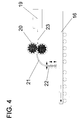
- a Injector 17 can be the conductive polymer plug be introduced. Then the tread goes through 16 a cooling device 18 and is used for the further Tire manufacturing provided. In principle it is too possible to cool the tread 16 before Inject the polymer plug.
- pens are made from unvulcanized Rubber and / or plastic (mixture composition table 2) e.g. B. with a diameter of 2 to 5 mm and a length, the at least the thickness of the tread part, the one resistivity greater than 10 exp 10 ohm x cm, corresponds to, frozen below - 80 ° C. Under frozen principally temperatures around the glass temperature of the Polymer plug mixture and are understood.
- the Injector 17 includes a cooler and a Piling tool, so that the polymer plug material in frozen state using the piling tool in the unvulcanized tread 16 can be introduced.
Landscapes
- Engineering & Computer Science (AREA)
- Mechanical Engineering (AREA)
- Tires In General (AREA)
Description
Des weiteren sind Metalldrähte bekannt (DE-GM 19 92 389), die zur Ableitung von elektrostatischer Ladung in den Reifen eingebracht werden und bis an die Laufflächenoberfläche reichen. Aber aufgrund der geringen mechanischen Beständigkeit dieser Drähte und auftretender Haftprobleme zum Gummimaterial ist keine gesicherte Ableitung über die gesamte Lebensdauer einer Reifens gewährleistet. Außerdem sind derartige Drahtkonstruktionen z. B. für einen Gürtelreifen ungeeignet, da der Gürtel im Laufe des Fahrbetriebes durch starre Metalldrähte zerstört werden würde.
- Fig. 1:
- im Querschnitt einen Fahrzeugluftreifen mit leitfähigen Polymerpfropfen, der auf einer Felge montiert ist,
- Fig. 2:
- im Querschnitt einen Vollgummireifen mit leitenden Polymerpfropfen, der auf einer Felge montiert ist,
- Fig. 3:
- Verfahrensablauf zur Herstellung eines unvulkanisierten Laufstreifens mit leitendem Polymerpfropfen,
- Fig. 4:
- Verfahrensablauf zur Einbringung von Polymerpfropfen in einen unvulkanisierten Laufstreifen.
| Bestandteil: | Konzentration [pphr]: |
| Naturkautschuk (NR) | 10 |
| Lös. Styren-Butadien-Kautschuk (SSBR) | 60 |
| Butadienkautschuk (BR) | 30 |
| gefällte Kieselsäure | 70 |
| Aktivruß | 10 |
| Weichmacheröl | 20 |
| Alterungsschutzmittel | 3 |
| Bis-(3-triethoxysilylpropyl)tetrasulfid (TESPT) | 10 |
| Zinkweiß | 3 |
| Stearinsäure | 3 |
| Schwefel | 1,5 |
| Beschleuniger | 3,5 |
| Bestandteil: | Konzentration [pphr]: |
| Naturkautschuk (NR) | 10 |
| Lös. Styren-Butadien-Kautschuk (SSBR) | 60 |
| Butadienkautschuk (BR) | 30 |
| gefällte Kieselsäure | 10 |
| Aktivruß | 70 |
| Weichmacheröl | 20 |
| Alterungsschutzmittel | 3 |
| Zinkweiß | 3 |
| Stearinsäure | 3 |
| Schwefel | 1,5 |
| Beschleuniger | 3,5 |
Mit einem Bohrwerkzeug wird ein bis zur Felge reichender Kanal erzeugt. Der vulkanisierte Gummi und/oder Kunststoff für den Polymerpfropfen mit einem Übermaß zur Bohrung wird von einer Wickeltrommel gezogen. Durch die Zugkraft verringert sich sein Durchmesser. Mittels einer Injiziervorrichtung, die ein drahtschlingenähnliches Gebilde zur Fassung des vulkanisierten Polymerpfropfens aufweist, wird der Polymerpfropfen durch die Bohrung gezogen. Der Polymerpfropfendurchmesser nimmt aufgrund der nachgelassenen Zugbeanspruchung zu, so daß der Polymerpfropfen fest im Kanal sitzt.
Claims (8)
- Verfahren zur Herstellung eines Fahrzeugreifens, der eine radial äußere Laufgummischicht aufweist, die einen spezifischen elektrischen Widerstand größer 10 exp 10 Ohm x cm besitzt und die Laufgummischicht im Bereich der Bodenaufstandsfläche des Reifens zumindest einen im wesentlichen radial verlaufenden Kanal aufweist, der mit einem Polymerpfropfen (7) aus Gummi und/oder Kunststoff mit einem spezifischen elektrischen Widerstand kleiner 10 exp 8 Ohm x cm ausgefüllt ist, so daß dieser Polymerpfropfen (7) zumindest die elektrisch schlecht leitende Laufgummischicht vollständig durchdringt,
dadurch gekennzeichnet,
daß in den fertig vulkanisierten Fahrzeugreifen Polymerpfropfen (7) aus vulkanisiertem Gummi und/oder Kunststoff mit einem spezifischen elektrischen Widerstand kleiner 10 exp 8 Ohm x cm mittels einer Injiziervorrichtung mit Bohrwerkzeug eingebracht werden, die sich zumindest durch den Teil der Laufgummischicht erstrecken, der einen spezifischen elektrischen Widerstand größer 10 exp 10 Ohm x cm aufweist. - Verfahren zur Herstellung eines Vollgummireifens nach Anspruch 1, dadurch gekennzeichnet, daß der Polymerpfropfen (7) aus vulkanisiertem Gummi und/oder Kunststoff mit einem Übermaß zum Bohrungsdurchmesser unter Ausnutzung von Zugkräften mittels einer Injiziervorrichtung durch die in der Laufgummischicht bis zur Felge reichenden Bohrung gezogen wird, so daß aufgrund nachlassender Zugbeanspruchung der Polymerpfropfen (7) fest in der Bohrung der Laufgummischicht sitzt.
- Verfahren zur Herstellung einer Laufgummischicht für einen Fahrzeugreifen, insbesondere für einen Luftreifen (1) mit einem Laufstreifen (2)/Gürtelpaket (3) radial oberhalb bezüglich der Karkasse (4), der eine radial äußere Laufgummischicht aufweist, die einen spezifischen elektrischen Widerstand größer 10 exp 10 Ohm x cm besitzt und daß die Laufgummischicht im Bereich der Bodenaufstandsfläche des Reifens zumindest einen im wesentlichen radial verlaufenden Kanal aufweist, der mit einem Polymerpfropfen (7) aus Gummi und/oder Kunststoff mit einem spezifischen elektrischen Widerstand kleiner 10 exp 8 Ohm x cm ausgefüllt ist und daß dieser Polymerpfropfen (7) zumindest die elektrisch schlecht leitende Laufgummischicht vollständig durchdringt, dadurch gekennzeichnet, daß zumindest in dem Teil des durch Extrusion erzeugten Laufstreifens (16), dessen Mischung nach der Reifenvulkanisation einen spezifischen elektrischen Widerstand größer 10 exp 10 Ohm x cm aufweist, mittels einer Injiziervorrichtung (17) Polymerpfropfen (7) aus unvulkanisiertem Gummi und/oder Kunststoff mit einem spezifischen elektrischen Widerstand kleiner 10 exp 8 Ohm x cm eingebracht werden.
- Verfahren nach Anspruch 3, dadurch gekennzeichnet, daß zur Herstellung der Polymerpfropfen (7) Mischungen aus unvulkanisiertem Gummi und/oder Kunststoff in flüssiger oder gelöster Form eingebracht werden.
- Verfahren nach Anspruch 3, dadurch gekennzeichnet, daß zur Herstellung der Polymerpfropfen (7) Mischungen aus unvulkanisiertem Gummi und/oder Kunststoff in Form von tiefgekühlten Stiften eingebracht werden.
- Verfahren nach zumindest einem der vorhergehenden Ansprüche, dadurch gekennzeichnet, daß für die Polymerpfropfen (7) Gummi und/oder Kunststoff verwendet wird, der zumindest Polypyridine und/oder Polypyrrole und/oder Polyaniline enthält.
- Verfahren nach zumindest einem der vorhergehenden Ansprüche, dadurch gekennzeichnet, daß für die Polymerpfropfen (7) Gummi und/oder Kunststoff verwendet wird, der einen spezifischen Widerstand kleiner 100 Ohm x cm aufweist.
- Verfahren nach zumindest einem der vorhergehenden Ansprüche, dadurch gekennzeichnet, daß als äußere Laufgummischicht eine Silica enthaltende Gummimischung verwendet wird.
Applications Claiming Priority (2)
| Application Number | Priority Date | Filing Date | Title |
|---|---|---|---|
| DE19603441A DE19603441C2 (de) | 1996-02-01 | 1996-02-01 | Verfahren zur Herstellung eines Fahrzeugreifens |
| DE19603441 | 1996-02-01 |
Publications (3)
| Publication Number | Publication Date |
|---|---|
| EP0787604A2 EP0787604A2 (de) | 1997-08-06 |
| EP0787604A3 EP0787604A3 (de) | 1998-01-28 |
| EP0787604B1 true EP0787604B1 (de) | 2001-04-11 |
Family
ID=7784143
Family Applications (1)
| Application Number | Title | Priority Date | Filing Date |
|---|---|---|---|
| EP97101181A Expired - Lifetime EP0787604B1 (de) | 1996-02-01 | 1997-01-25 | Fahrzeugreifen |
Country Status (2)
| Country | Link |
|---|---|
| EP (1) | EP0787604B1 (de) |
| DE (2) | DE19603441C2 (de) |
Families Citing this family (19)
| Publication number | Priority date | Publication date | Assignee | Title |
|---|---|---|---|---|
| IT1291210B1 (it) * | 1997-03-18 | 1998-12-29 | Bridgestone Firestone Tech | Pneumatico anti-statico. |
| EP0881060A3 (de) * | 1997-05-26 | 1999-12-22 | Bridgestone Corporation | Verfahren und Vorrichtung zur Herstellung von Luftreifen mit Mitteln zur Ableitung der elektrostatischen Ladung |
| JPH11240312A (ja) * | 1997-08-04 | 1999-09-07 | Bridgestone Corp | 空気入りタイヤ |
| US6289958B1 (en) * | 1998-10-19 | 2001-09-18 | The Goodyear Tire & Rubber Company | Tire with tread containing electrically conductive stitched thread |
| US6220319B1 (en) | 1998-10-19 | 2001-04-24 | The Goodyear Tire & Rubber Company | Tire with tread containing electrically conductive staples |
| DE19850766B4 (de) * | 1998-11-04 | 2004-01-22 | Continental Aktiengesellschaft | Fahrzeugluftreifen |
| WO2002022382A1 (en) * | 2000-09-15 | 2002-03-21 | Bridgestone/Firestone North American Tire, Llc | Conductive pathways in tire treads for reduced static charge buildup |
| US7029544B2 (en) | 2000-09-15 | 2006-04-18 | Bridgestone Firestone North American Tire, Llc | Conductive pathways in tire treads for reduced static charge buildup |
| DE10154454C1 (de) * | 2001-11-06 | 2003-06-18 | Continental Ag | Vollgummireifen |
| DE102005056248B4 (de) * | 2005-11-25 | 2012-01-12 | Siemens Ag | Selektiver Hauptleitungsschutzschalter |
| JP2007153092A (ja) * | 2005-12-02 | 2007-06-21 | Sumitomo Rubber Ind Ltd | 空気入りタイヤおよび該空気入りタイヤの製造方法 |
| JP5014840B2 (ja) * | 2007-03-06 | 2012-08-29 | 東洋ゴム工業株式会社 | 空気入りタイヤの製造方法及び空気入りタイヤ |
| EP2036704B1 (de) * | 2007-09-11 | 2013-09-18 | Artic Investments S.A. | Verfahren zur Herstellung eines nicht-markierenden antistatischen Reifen und damit hergestellter Reifen. |
| US20130126060A1 (en) * | 2011-11-22 | 2013-05-23 | Kenneth Lee Oblizajek | Stiffness enhanced tread |
| DE102016203039A1 (de) * | 2016-02-26 | 2017-08-31 | Continental Reifen Deutschland Gmbh | Vollgummireifen |
| PL3478485T3 (pl) * | 2016-06-30 | 2020-11-30 | Artic Investments S.A. | Sposób wytwarzania opony |
| DE102016212509A1 (de) * | 2016-07-08 | 2018-01-11 | Continental Reifen Deutschland Gmbh | Fahrzeugreifen |
| WO2019123363A1 (fr) * | 2017-12-22 | 2019-06-27 | Compagnie Générale Des Établissements Michelin | Pneumatique comprenant un cordon conducteur |
| DE102020215898A1 (de) * | 2020-12-15 | 2022-06-15 | Continental Reifen Deutschland Gmbh | Verfahren zur Herstellung eines Vollreifens |
Family Cites Families (7)
| Publication number | Priority date | Publication date | Assignee | Title |
|---|---|---|---|---|
| GB544757A (en) * | 1940-02-15 | 1942-04-27 | Us Rubber Co | Improvements in a pneumatic tyre and method of making same |
| GB551657A (en) * | 1940-12-19 | 1943-03-04 | Firestone Tire & Rubber Co | Improvements in or relating to rubber tires |
| FR1279913A (fr) * | 1959-06-29 | 1961-12-29 | Dispositif de liaison électrique entre un véhicule et le sol | |
| JP2782073B2 (ja) * | 1989-02-01 | 1998-07-30 | 横浜ゴム株式会社 | 乗用車用ラジアルプライタイヤ |
| IT1264990B1 (it) * | 1993-12-14 | 1996-10-17 | Pirelli | Pneumatico antistatico con mescole a basso tenore di nero di carbonio |
| DE4417914A1 (de) * | 1994-05-21 | 1995-11-23 | Ralf Schoeppe | Einrichtung zur Verhinderung der elektrischen Aufladung von metallischen Fahrzeugkarosserien |
| DE4447823B4 (de) * | 1994-12-21 | 2007-07-26 | Dunlop Gmbh | Fahrzeugreifen und Verfahren zu seiner Herstellung |
-
1996
- 1996-02-01 DE DE19603441A patent/DE19603441C2/de not_active Expired - Fee Related
-
1997
- 1997-01-25 DE DE59703326T patent/DE59703326D1/de not_active Expired - Lifetime
- 1997-01-25 EP EP97101181A patent/EP0787604B1/de not_active Expired - Lifetime
Also Published As
| Publication number | Publication date |
|---|---|
| DE59703326D1 (de) | 2001-05-17 |
| DE19603441A1 (de) | 1997-08-07 |
| EP0787604A2 (de) | 1997-08-06 |
| DE19603441C2 (de) | 1999-12-23 |
| EP0787604A3 (de) | 1998-01-28 |
Similar Documents
| Publication | Publication Date | Title |
|---|---|---|
| DE19603441C2 (de) | Verfahren zur Herstellung eines Fahrzeugreifens | |
| DE19718699C1 (de) | Verfahren zur Herstellung eines Fahrzeugluftreifens | |
| DE102008012841B4 (de) | Luftreifen und Verfahren zur Herstellung von derartigen Luftreifen | |
| DE102008053464B4 (de) | Luftreifen | |
| DE102004052351A1 (de) | Düsensatz eines Extruders zum Formen eines Reifens | |
| DE102007039101A1 (de) | Verfahren zur Herstellung eines Fahrzeugluftreifens und Fahrzeugluftreifen | |
| EP3288780B1 (de) | Fahrzeugluftreifen mit einem laufstreifen | |
| DE69611859T2 (de) | Fahrzeugreifen mit Ladungsableitung | |
| EP3103661B1 (de) | Verfahren zur herstellung einer elektrisch leitfähigen passage in einem fahrzeugluftreifen | |
| EP0798142A1 (de) | Fahrzeugluftreifen | |
| EP2477824B1 (de) | Fahrzeugluftreifen | |
| DE2937137A1 (de) | Radial-guertelreifen | |
| DE102015207937A1 (de) | Fahrzeugluftreifen mit einem Laufstreifen | |
| EP0838353B1 (de) | Fahrzeugluftreifen | |
| EP3653360B1 (de) | Vorform-vorrichtung und verfahren zur herstellung eines fahrzeugluftreifens mit einem laufstreifenabschnitt mit mindestens zwei gummikomponenten | |
| EP3983213B1 (de) | Verfahren zur herstellung eines fahrzeugluftreifens, vorrichtung zum ausformen eines zwei wingkomponenten und eine ableitkomponente umfassenden kautschukprofils und verwendung der vorrichtung | |
| DE19802088A1 (de) | Fahrzeugreifen | |
| DE102016222061A1 (de) | Fahrzeugluftreifen | |
| EP1918132A1 (de) | Verfahren zur Herstellung eines Fahrzeugluftreifens und Fahrzeugluftreifen | |
| DE102022213081A1 (de) | Verfahren zur Einbringung dünner Elemente mit verbesserter elektrischer Leitfähigkeit in ein Extrudat | |
| EP0211301B1 (de) | Ventil für einen Fahrradschlauch und Verfahren zu seiner Herstellung | |
| EP4169738B1 (de) | Laufstreifenkonstruktion | |
| DE102023210701A1 (de) | Extrusionsschablone | |
| DE102019208322A1 (de) | Fahrzeugluftreifen | |
| DE102015207221A1 (de) | Verfahren zur Herstellung von elektrisch leitfähigen Passagen in einer Seitenwand eines Fahrzeugluftreifens |
Legal Events
| Date | Code | Title | Description |
|---|---|---|---|
| PUAI | Public reference made under article 153(3) epc to a published international application that has entered the european phase |
Free format text: ORIGINAL CODE: 0009012 |
|
| AK | Designated contracting states |
Kind code of ref document: A2 Designated state(s): DE FR GB IT |
|
| PUAL | Search report despatched |
Free format text: ORIGINAL CODE: 0009013 |
|
| AK | Designated contracting states |
Kind code of ref document: A3 Designated state(s): DE FR GB IT |
|
| 17P | Request for examination filed |
Effective date: 19980728 |
|
| 17Q | First examination report despatched |
Effective date: 19991209 |
|
| GRAG | Despatch of communication of intention to grant |
Free format text: ORIGINAL CODE: EPIDOS AGRA |
|
| GRAG | Despatch of communication of intention to grant |
Free format text: ORIGINAL CODE: EPIDOS AGRA |
|
| GRAH | Despatch of communication of intention to grant a patent |
Free format text: ORIGINAL CODE: EPIDOS IGRA |
|
| GRAH | Despatch of communication of intention to grant a patent |
Free format text: ORIGINAL CODE: EPIDOS IGRA |
|
| GRAA | (expected) grant |
Free format text: ORIGINAL CODE: 0009210 |
|
| AK | Designated contracting states |
Kind code of ref document: B1 Designated state(s): DE FR GB IT |
|
| REF | Corresponds to: |
Ref document number: 59703326 Country of ref document: DE Date of ref document: 20010517 |
|
| ITF | It: translation for a ep patent filed | ||
| GBT | Gb: translation of ep patent filed (gb section 77(6)(a)/1977) |
Effective date: 20010705 |
|
| ET | Fr: translation filed | ||
| REG | Reference to a national code |
Ref country code: GB Ref legal event code: IF02 |
|
| PLBE | No opposition filed within time limit |
Free format text: ORIGINAL CODE: 0009261 |
|
| STAA | Information on the status of an ep patent application or granted ep patent |
Free format text: STATUS: NO OPPOSITION FILED WITHIN TIME LIMIT |
|
| 26N | No opposition filed | ||
| PGFP | Annual fee paid to national office [announced via postgrant information from national office to epo] |
Ref country code: GB Payment date: 20070119 Year of fee payment: 11 |
|
| PGFP | Annual fee paid to national office [announced via postgrant information from national office to epo] |
Ref country code: IT Payment date: 20070625 Year of fee payment: 11 |
|
| PGFP | Annual fee paid to national office [announced via postgrant information from national office to epo] |
Ref country code: FR Payment date: 20070111 Year of fee payment: 11 |
|
| GBPC | Gb: european patent ceased through non-payment of renewal fee |
Effective date: 20080125 |
|
| REG | Reference to a national code |
Ref country code: FR Ref legal event code: ST Effective date: 20081029 |
|
| PG25 | Lapsed in a contracting state [announced via postgrant information from national office to epo] |
Ref country code: GB Free format text: LAPSE BECAUSE OF NON-PAYMENT OF DUE FEES Effective date: 20080125 |
|
| PG25 | Lapsed in a contracting state [announced via postgrant information from national office to epo] |
Ref country code: FR Free format text: LAPSE BECAUSE OF NON-PAYMENT OF DUE FEES Effective date: 20080131 |
|
| PG25 | Lapsed in a contracting state [announced via postgrant information from national office to epo] |
Ref country code: IT Free format text: LAPSE BECAUSE OF NON-PAYMENT OF DUE FEES Effective date: 20080125 |
|
| PGFP | Annual fee paid to national office [announced via postgrant information from national office to epo] |
Ref country code: DE Payment date: 20110121 Year of fee payment: 15 |
|
| PG25 | Lapsed in a contracting state [announced via postgrant information from national office to epo] |
Ref country code: DE Free format text: LAPSE BECAUSE OF NON-PAYMENT OF DUE FEES Effective date: 20120801 |
|
| REG | Reference to a national code |
Ref country code: DE Ref legal event code: R119 Ref document number: 59703326 Country of ref document: DE Effective date: 20120801 |