EP0787137B1 - Procede pour la preparation de n-carboxyanhydrides d'acides amines a partir d'acides amines n-(n'-nitrosocarbamoyles) - Google Patents
Procede pour la preparation de n-carboxyanhydrides d'acides amines a partir d'acides amines n-(n'-nitrosocarbamoyles) Download PDFInfo
- Publication number
- EP0787137B1 EP0787137B1 EP95934205A EP95934205A EP0787137B1 EP 0787137 B1 EP0787137 B1 EP 0787137B1 EP 95934205 A EP95934205 A EP 95934205A EP 95934205 A EP95934205 A EP 95934205A EP 0787137 B1 EP0787137 B1 EP 0787137B1
- Authority
- EP
- European Patent Office
- Prior art keywords
- amino acid
- compound
- decomposition
- formula
- carbamoyl
- Prior art date
- Legal status (The legal status is an assumption and is not a legal conclusion. Google has not performed a legal analysis and makes no representation as to the accuracy of the status listed.)
- Expired - Lifetime
Links
- 238000000034 method Methods 0.000 title claims abstract description 23
- 150000001413 amino acids Chemical class 0.000 title claims abstract description 22
- 238000000354 decomposition reaction Methods 0.000 claims abstract description 17
- 125000002496 methyl group Chemical group [H]C([H])([H])* 0.000 claims abstract description 16
- 125000003917 carbamoyl group Chemical group [H]N([H])C(*)=O 0.000 claims abstract description 13
- 239000002253 acid Substances 0.000 claims abstract description 9
- 125000003118 aryl group Chemical group 0.000 claims abstract description 4
- 125000000753 cycloalkyl group Chemical group 0.000 claims abstract description 4
- UCKMPCXJQFINFW-UHFFFAOYSA-N Sulphide Chemical compound [S-2] UCKMPCXJQFINFW-UHFFFAOYSA-N 0.000 claims abstract description 3
- 125000000217 alkyl group Chemical group 0.000 claims abstract description 3
- 150000001875 compounds Chemical class 0.000 claims description 17
- IJGRMHOSHXDMSA-UHFFFAOYSA-N Atomic nitrogen Chemical compound N#N IJGRMHOSHXDMSA-UHFFFAOYSA-N 0.000 claims description 11
- 239000003795 chemical substances by application Substances 0.000 claims description 11
- XLYOFNOQVPJJNP-UHFFFAOYSA-N water Substances O XLYOFNOQVPJJNP-UHFFFAOYSA-N 0.000 claims description 10
- 239000002904 solvent Substances 0.000 claims description 9
- 229910052739 hydrogen Inorganic materials 0.000 claims description 7
- -1 amino acid compound Chemical class 0.000 claims description 6
- 239000001257 hydrogen Substances 0.000 claims description 6
- 229910052757 nitrogen Inorganic materials 0.000 claims description 6
- 239000003960 organic solvent Substances 0.000 claims description 6
- 239000012429 reaction media Substances 0.000 claims description 6
- 150000001412 amines Chemical class 0.000 claims description 4
- UFHFLCQGNIYNRP-UHFFFAOYSA-N Hydrogen Chemical compound [H][H] UFHFLCQGNIYNRP-UHFFFAOYSA-N 0.000 claims description 3
- 150000001408 amides Chemical group 0.000 claims description 3
- 150000003573 thiols Chemical class 0.000 claims description 3
- BCMYXYHEMGPZJN-UHFFFAOYSA-N 1-chloro-2-isocyanatoethane Chemical compound ClCCN=C=O BCMYXYHEMGPZJN-UHFFFAOYSA-N 0.000 claims description 2
- LFQSCWFLJHTTHZ-UHFFFAOYSA-N Ethanol Chemical compound CCO LFQSCWFLJHTTHZ-UHFFFAOYSA-N 0.000 claims description 2
- OWIKHYCFFJSOEH-UHFFFAOYSA-N Isocyanic acid Chemical compound N=C=O OWIKHYCFFJSOEH-UHFFFAOYSA-N 0.000 claims description 2
- 239000006227 byproduct Substances 0.000 claims description 2
- 125000001495 ethyl group Chemical group [H]C([H])([H])C([H])([H])* 0.000 claims description 2
- 125000001436 propyl group Chemical group [H]C([*])([H])C([H])([H])C([H])([H])[H] 0.000 claims description 2
- 150000003839 salts Chemical class 0.000 claims description 2
- 125000004435 hydrogen atom Chemical group [H]* 0.000 claims 2
- 230000002194 synthesizing effect Effects 0.000 claims 2
- BVKZGUZCCUSVTD-UHFFFAOYSA-M Bicarbonate Chemical compound OC([O-])=O BVKZGUZCCUSVTD-UHFFFAOYSA-M 0.000 claims 1
- 125000000539 amino acid group Chemical group 0.000 claims 1
- XLJMAIOERFSOGZ-UHFFFAOYSA-N anhydrous cyanic acid Natural products OC#N XLJMAIOERFSOGZ-UHFFFAOYSA-N 0.000 claims 1
- 235000001014 amino acid Nutrition 0.000 abstract description 15
- 238000006243 chemical reaction Methods 0.000 abstract description 9
- 108090000765 processed proteins & peptides Proteins 0.000 abstract description 7
- 125000003710 aryl alkyl group Chemical group 0.000 abstract description 2
- 102000004196 processed proteins & peptides Human genes 0.000 abstract description 2
- 125000001340 2-chloroethyl group Chemical group [H]C([H])(Cl)C([H])([H])* 0.000 abstract 1
- 108010016626 Dipeptides Proteins 0.000 abstract 1
- 125000003368 amide group Chemical group 0.000 abstract 1
- WEVYAHXRMPXWCK-UHFFFAOYSA-N Acetonitrile Chemical compound CC#N WEVYAHXRMPXWCK-UHFFFAOYSA-N 0.000 description 15
- 230000015572 biosynthetic process Effects 0.000 description 15
- IAZDPXIOMUYVGZ-WFGJKAKNSA-N Dimethyl sulfoxide Chemical compound [2H]C([2H])([2H])S(=O)C([2H])([2H])[2H] IAZDPXIOMUYVGZ-WFGJKAKNSA-N 0.000 description 12
- 238000003786 synthesis reaction Methods 0.000 description 12
- KZSNJWFQEVHDMF-BYPYZUCNSA-N L-valine Chemical compound CC(C)[C@H](N)C(O)=O KZSNJWFQEVHDMF-BYPYZUCNSA-N 0.000 description 10
- KZSNJWFQEVHDMF-UHFFFAOYSA-N Valine Natural products CC(C)C(N)C(O)=O KZSNJWFQEVHDMF-UHFFFAOYSA-N 0.000 description 10
- 238000004128 high performance liquid chromatography Methods 0.000 description 10
- 239000004474 valine Substances 0.000 description 10
- 238000004458 analytical method Methods 0.000 description 9
- JDXMIYHOSFNZKO-UHFFFAOYSA-N N-carbamoylvaline Chemical compound CC(C)C(C(O)=O)NC(N)=O JDXMIYHOSFNZKO-UHFFFAOYSA-N 0.000 description 7
- 238000005481 NMR spectroscopy Methods 0.000 description 7
- DEWDMTSMCKXBNP-BYPYZUCNSA-N N-carbamoyl-L-methionine Chemical compound CSCC[C@@H](C(O)=O)NC(N)=O DEWDMTSMCKXBNP-BYPYZUCNSA-N 0.000 description 5
- 239000000203 mixture Substances 0.000 description 4
- 239000000047 product Substances 0.000 description 4
- SKBKTVDWVCPHTF-BYPYZUCNSA-N (2s)-2-[carbamoyl(nitroso)amino]-3-methylbutanoic acid Chemical compound CC(C)[C@@H](C(O)=O)N(N=O)C(N)=O SKBKTVDWVCPHTF-BYPYZUCNSA-N 0.000 description 3
- RYHBNJHYFVUHQT-UHFFFAOYSA-N 1,4-Dioxane Chemical compound C1COCCO1 RYHBNJHYFVUHQT-UHFFFAOYSA-N 0.000 description 3
- FFEARJCKVFRZRR-BYPYZUCNSA-N L-methionine Chemical compound CSCC[C@H](N)C(O)=O FFEARJCKVFRZRR-BYPYZUCNSA-N 0.000 description 3
- 229930182817 methionine Natural products 0.000 description 3
- YBMQGNWGOIQEOC-BYPYZUCNSA-N (2s)-2-[carbamoyl(nitroso)amino]-4-methylsulfanylbutanoic acid Chemical compound CSCC[C@@H](C(O)=O)N(N=O)C(N)=O YBMQGNWGOIQEOC-BYPYZUCNSA-N 0.000 description 2
- CURLTUGMZLYLDI-UHFFFAOYSA-N Carbon dioxide Chemical compound O=C=O CURLTUGMZLYLDI-UHFFFAOYSA-N 0.000 description 2
- QNAYBMKLOCPYGJ-REOHCLBHSA-N L-alanine Chemical compound C[C@H](N)C(O)=O QNAYBMKLOCPYGJ-REOHCLBHSA-N 0.000 description 2
- 235000004279 alanine Nutrition 0.000 description 2
- 239000012298 atmosphere Substances 0.000 description 2
- 239000003480 eluent Substances 0.000 description 2
- 230000007062 hydrolysis Effects 0.000 description 2
- 238000006460 hydrolysis reaction Methods 0.000 description 2
- 239000012299 nitrogen atmosphere Substances 0.000 description 2
- 238000000655 nuclear magnetic resonance spectrum Methods 0.000 description 2
- 239000007800 oxidant agent Substances 0.000 description 2
- IZSQNUOXWWDMGI-BYPYZUCNSA-N (2s)-4-methylsulfanyl-2-(nitrosocarbamoylamino)butanoic acid Chemical compound CSCC[C@@H](C(O)=O)NC(=O)NN=O IZSQNUOXWWDMGI-BYPYZUCNSA-N 0.000 description 1
- 238000001321 HNCO Methods 0.000 description 1
- QEFRNWWLZKMPFJ-ZXPFJRLXSA-N L-methionine (R)-S-oxide Chemical compound C[S@@](=O)CC[C@H]([NH3+])C([O-])=O QEFRNWWLZKMPFJ-ZXPFJRLXSA-N 0.000 description 1
- QEFRNWWLZKMPFJ-UHFFFAOYSA-N L-methionine sulphoxide Natural products CS(=O)CCC(N)C(O)=O QEFRNWWLZKMPFJ-UHFFFAOYSA-N 0.000 description 1
- DTQVDTLACAAQTR-UHFFFAOYSA-N Trifluoroacetic acid Chemical compound OC(=O)C(F)(F)F DTQVDTLACAAQTR-UHFFFAOYSA-N 0.000 description 1
- 230000002152 alkylating effect Effects 0.000 description 1
- 229940061720 alpha hydroxy acid Drugs 0.000 description 1
- 150000001280 alpha hydroxy acids Chemical class 0.000 description 1
- 230000000259 anti-tumor effect Effects 0.000 description 1
- 229940045719 antineoplastic alkylating agent nitrosoureas Drugs 0.000 description 1
- QVGXLLKOCUKJST-UHFFFAOYSA-N atomic oxygen Chemical compound [O] QVGXLLKOCUKJST-UHFFFAOYSA-N 0.000 description 1
- 229910002092 carbon dioxide Inorganic materials 0.000 description 1
- 239000001569 carbon dioxide Substances 0.000 description 1
- 239000007806 chemical reaction intermediate Substances 0.000 description 1
- 238000010276 construction Methods 0.000 description 1
- 239000012043 crude product Substances 0.000 description 1
- 230000008034 disappearance Effects 0.000 description 1
- 238000006056 electrooxidation reaction Methods 0.000 description 1
- NLFBCYMMUAKCPC-KQQUZDAGSA-N ethyl (e)-3-[3-amino-2-cyano-1-[(e)-3-ethoxy-3-oxoprop-1-enyl]sulfanyl-3-oxoprop-1-enyl]sulfanylprop-2-enoate Chemical compound CCOC(=O)\C=C\SC(=C(C#N)C(N)=O)S\C=C\C(=O)OCC NLFBCYMMUAKCPC-KQQUZDAGSA-N 0.000 description 1
- 239000007789 gas Substances 0.000 description 1
- 239000008246 gaseous mixture Substances 0.000 description 1
- 239000001307 helium Substances 0.000 description 1
- 229910052734 helium Inorganic materials 0.000 description 1
- SWQJXJOGLNCZEY-UHFFFAOYSA-N helium atom Chemical compound [He] SWQJXJOGLNCZEY-UHFFFAOYSA-N 0.000 description 1
- 150000002431 hydrogen Chemical class 0.000 description 1
- 238000011065 in-situ storage Methods 0.000 description 1
- 239000013067 intermediate product Substances 0.000 description 1
- 239000012948 isocyanate Substances 0.000 description 1
- 150000002513 isocyanates Chemical class 0.000 description 1
- 230000014759 maintenance of location Effects 0.000 description 1
- 238000004949 mass spectrometry Methods 0.000 description 1
- 238000002844 melting Methods 0.000 description 1
- 230000008018 melting Effects 0.000 description 1
- 229910052751 metal Inorganic materials 0.000 description 1
- 239000002184 metal Substances 0.000 description 1
- VPKDCDLSJZCGKE-UHFFFAOYSA-N methanediimine Chemical compound N=C=N VPKDCDLSJZCGKE-UHFFFAOYSA-N 0.000 description 1
- JCXJVPUVTGWSNB-UHFFFAOYSA-N nitrogen dioxide Inorganic materials O=[N]=O JCXJVPUVTGWSNB-UHFFFAOYSA-N 0.000 description 1
- 238000006902 nitrogenation reaction Methods 0.000 description 1
- 239000001301 oxygen Substances 0.000 description 1
- 229910052760 oxygen Inorganic materials 0.000 description 1
- GKKCIDNWFBPDBW-UHFFFAOYSA-M potassium cyanate Chemical compound [K]OC#N GKKCIDNWFBPDBW-UHFFFAOYSA-M 0.000 description 1
- 238000000425 proton nuclear magnetic resonance spectrum Methods 0.000 description 1
- 238000001953 recrystallisation Methods 0.000 description 1
- 238000000926 separation method Methods 0.000 description 1
- 239000007787 solid Substances 0.000 description 1
- 239000007858 starting material Substances 0.000 description 1
- 238000003756 stirring Methods 0.000 description 1
- 238000001308 synthesis method Methods 0.000 description 1
Classifications
-
- C—CHEMISTRY; METALLURGY
- C07—ORGANIC CHEMISTRY
- C07D—HETEROCYCLIC COMPOUNDS
- C07D263/00—Heterocyclic compounds containing 1,3-oxazole or hydrogenated 1,3-oxazole rings
- C07D263/02—Heterocyclic compounds containing 1,3-oxazole or hydrogenated 1,3-oxazole rings not condensed with other rings
- C07D263/30—Heterocyclic compounds containing 1,3-oxazole or hydrogenated 1,3-oxazole rings not condensed with other rings having two or three double bonds between ring members or between ring members and non-ring members
- C07D263/34—Heterocyclic compounds containing 1,3-oxazole or hydrogenated 1,3-oxazole rings not condensed with other rings having two or three double bonds between ring members or between ring members and non-ring members with hetero atoms or with carbon atoms having three bonds to hetero atoms with at the most one bond to halogen, e.g. ester or nitrile radicals, directly attached to ring carbon atoms
- C07D263/44—Two oxygen atoms
-
- C—CHEMISTRY; METALLURGY
- C07—ORGANIC CHEMISTRY
- C07K—PEPTIDES
- C07K1/00—General methods for the preparation of peptides, i.e. processes for the organic chemical preparation of peptides or proteins of any length
- C07K1/06—General methods for the preparation of peptides, i.e. processes for the organic chemical preparation of peptides or proteins of any length using protecting groups or activating agents
- C07K1/08—General methods for the preparation of peptides, i.e. processes for the organic chemical preparation of peptides or proteins of any length using protecting groups or activating agents using activating agents
- C07K1/084—General methods for the preparation of peptides, i.e. processes for the organic chemical preparation of peptides or proteins of any length using protecting groups or activating agents using activating agents containing nitrogen
-
- C—CHEMISTRY; METALLURGY
- C07—ORGANIC CHEMISTRY
- C07K—PEPTIDES
- C07K1/00—General methods for the preparation of peptides, i.e. processes for the organic chemical preparation of peptides or proteins of any length
- C07K1/10—General methods for the preparation of peptides, i.e. processes for the organic chemical preparation of peptides or proteins of any length using coupling agents
Definitions
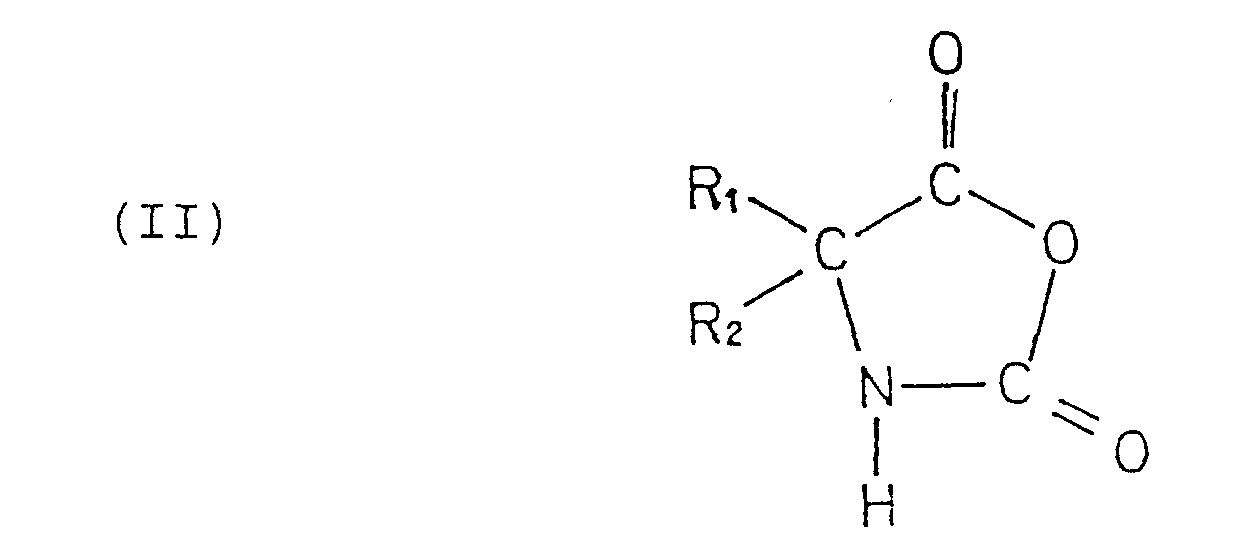
- the invention relates to a new synthesis method of N-carboxyanhydrideaminoacids which can constitute intermediate products as part of the synthesis peptide.
- Peptides are biologically molecules assets of considerable interest and their synthesis was studied for a very long time, this synthesis can be carried out by various methodologies, both in phase homogeneous only in solid or supported phase. In a case like in the other, these methodologies use amino acids protected on a function, create or lengthen the peptide on the remaining free function by means of an amino acid blocked, unlock this last function and continue thus step by step the construction of the chain. To have a free peptide the terminal functions obviously have to be unlocked.
- the solvent used is essentially a organic solvent. Such methodologies while being effective are nevertheless very heavy.
- the invention aims to develop of a new process for the synthesis of N-carboxyanhydrideaminoacids.
- a compound (I) in which R 'is hydrogen in order to obtain, at the end of the decomposition (b), water as a decomposition by-product.
- residue R1 a residue natural amino acid and as radical R2 hydrogen; we can also choose as radical R1 an acid residue modified amine and as a radical R2 a methyl group, ethyl or propyl.
- the decomposition reaction (b) can be carried out in an anhydrous organic solvent.
- Another operating mode consists in operating the decomposition (b) in an organic-organic medium at a substantially pH between 6 and 10.
- decomposition (b) do not seem critical in practice, we can operate at room temperature however, in some cases, a higher temperature can be chosen for decomposition in order to favor it (50 ° C for example).
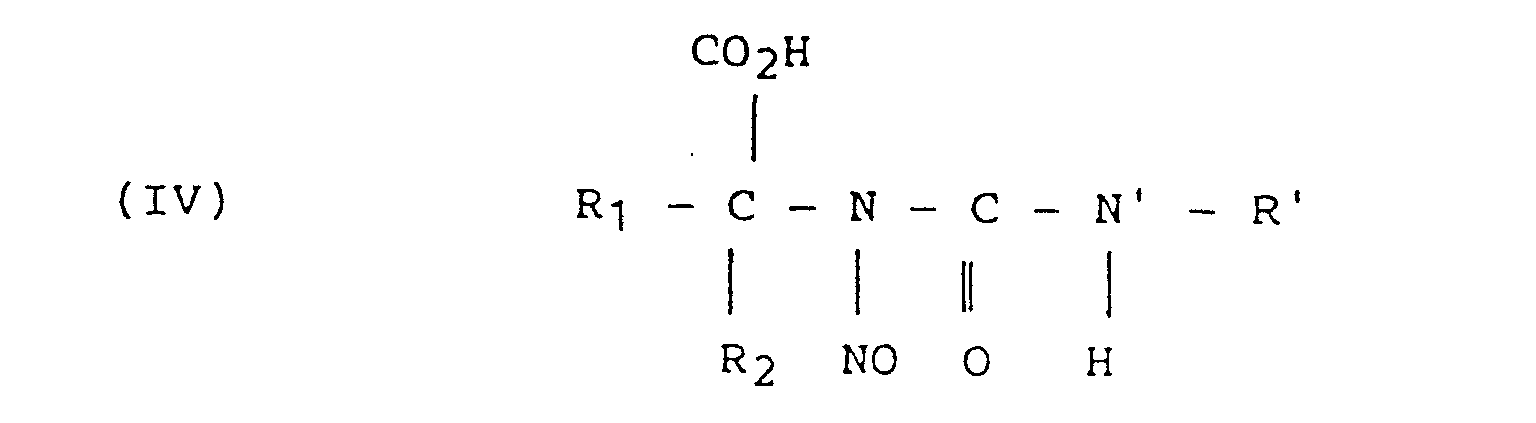
- the compounds (I) can be synthesized directly in the anhydrous reaction medium (dioxane, acetonitrile, etc.), aqueous at pH below 4 or aquo-organic at pH below 4 by action of a nitrosating agent such as ° NO, N0 2 H, N 2 0 3 , N 2 0 4 , ... used pure or in mixture with an oxidizing agent (oxygen, or any other agent such as Fe3 + , Cu2 + , metal couples, or electrochemical oxidation) on an N- [N '- (R') carbamoyl] amino acid of formula:
- a reaction intermediate in this reaction has been determined to be the N-nitroso-N-carbamoylamino acid compound of formula (IV) which, under operating conditions different from those used in this process, can decompose in part to give an ⁇ -hydroxy acid:
- amino acids used can be of chirality D or L, or racemic. When the compounds used are enantiomerically pure, they do not do not racemize during the reaction.
- N- (N'-nitrosocarbamoyl) amino acid (I) When the decomposition of the N- (N'-nitrosocarbamoyl) amino acid (I) is carried out in a solvent anhydrous organic, an N-carboxyanhydrideamino acid is collected more stable after release of nitrogen and separation of organic solvent containing the water formed (these operating conditions avoid hydrolysis of the compound N-carboxyanhydrideaminoacid).
- the solution is analyzed by HPLC (high pressure liquid chromatography), on a C18 column with a 9/1 water / acetonitrile solution containing 0.05% CF3COOH as eluent and detected in UV at 220 nm.
- HPLC high pressure liquid chromatography
- the isocratic analysis at 1 ml / min gives two signals at 22 and 28 min of relative intensity 30/70.
- a new analysis of the same reaction medium 60 minutes after the previous one shows that the relative intensity of these two signals reverses 70/30.
- a third analysis 60 minutes after the previous one shows the disappearance of the signal at 28 mn in favor of the signal at 22 minutes thus corresponding to the quasi-formation quantitative of N- (N'-nitrosocarbamoyl) valine (I), even if in this last chromatogram begins to appear with a very weak intensity a signal at 17 mn that one analysis in Example 2 below.
- N- (N'nitrosocarbamoyl) valine (I) from the previous example placed in 20 ml of anhydrous dioxane under a helium atmosphere is maintained at 30 ° C for 30 minutes during which a gas evolution within the solution.
- This release is analyzed by mass spectroscopy as being nitrogen molecular (Mass 28).
- Analysis of the solution in HPLC then shows the presence of a single signal at 17 min and the signal disappears at 22 min.
- the reaction medium is then evaporated under reduced pressure so as to eliminate the solvent and the water formed during the reaction.
- the product crude (145 mg) crystallized is identified, by comparing it to an authentic sample, as being N-carboxyanhydridevaline.
- N-carbamoylvaline 1 mmol is placed in 20 ml acetonitrile (containing less than 0.1% water) at room temperature and under a nitrogen atmosphere. The mixture nitrosant (66 ml NO + 26 ml air) is added. After 30 minutes reaction, excess nitrosating agent and solvent are driven off under reduced pressure. Analysis of the solution in HPLC of the crystallized raw product, (mp 74 ° C) shows the presence of a single signal at 17 min characteristic of N-carboxyanhydridevaline. Its NMR spectrum conforms to the one given in example 2.
- N-carbamoylvaline - (III) 1 mmol of valine and 3 mmol of potassium cyanate are added to 20 ml of water at room temperature (pH equal to 4).
- the formation of N-carbamoylvaline - (III) is followed in HPLC.
- the medium is placed under a nitrogen atmosphere and the nitrosating mixture (264 ml NO + 104 ml air) is added. After 30 minutes of reaction, excess nitrosating agent and solvent are driven off under reduced pressure.
- HPLC analysis shows as in example 4 the presence of a signal characteristic of the N-carboxyanhydridevaline as well as an intensity signal lower valine in the 80/20 ratio.
- N-carbamoylmethionine (III) (192 mg) is placed in 20 ml of acetonitrile and treated according to the procedure of Example 1. After 5 minutes of reaction, excess nitrosating agent and solvent are removed under reduced pressure.
Landscapes
- Chemical & Material Sciences (AREA)
- Organic Chemistry (AREA)
- Genetics & Genomics (AREA)
- Proteomics, Peptides & Aminoacids (AREA)
- Life Sciences & Earth Sciences (AREA)
- Biochemistry (AREA)
- Biophysics (AREA)
- General Health & Medical Sciences (AREA)
- Analytical Chemistry (AREA)
- Medicinal Chemistry (AREA)
- Molecular Biology (AREA)
- Health & Medical Sciences (AREA)
- Peptides Or Proteins (AREA)
- Organic Low-Molecular-Weight Compounds And Preparation Thereof (AREA)
- Preparation Of Compounds By Using Micro-Organisms (AREA)
- Pharmaceuticals Containing Other Organic And Inorganic Compounds (AREA)
- Medicines That Contain Protein Lipid Enzymes And Other Medicines (AREA)
- Heterocyclic Carbon Compounds Containing A Hetero Ring Having Nitrogen And Oxygen As The Only Ring Hetero Atoms (AREA)
- Low-Molecular Organic Synthesis Reactions Using Catalysts (AREA)
Description


- en faisant d'abord réagir à un pH inférieur à
8 de l'acide isocyanique (HNCO), un sel de cet acide ou un
isocyanate de méthyle ou de chloroéthyle sur un aminoacide
pour obtenir un N-[N'-(R')carbamoyl]aminoacide de formule :
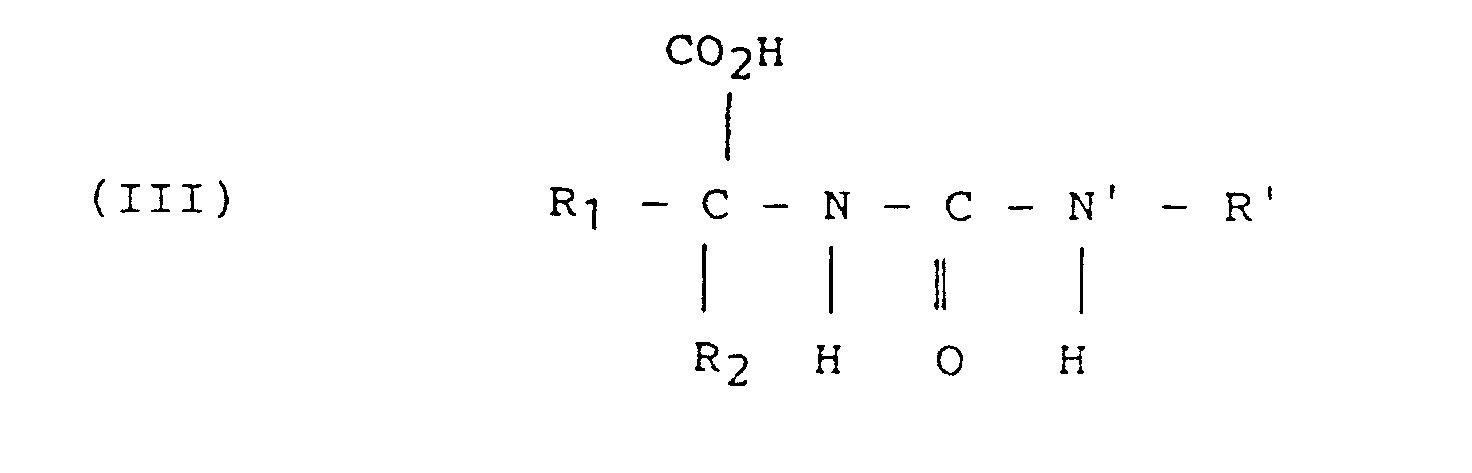
- et en faisant ensuite réagir un agent nitrosant sur le N-[N'-(R)carbamoyl]aminoacide formé.
- un pic de très faible intensité à 28 mn caractérisant la présence résiduelle de la N-nitroso-N-carbamoylméthionine (IV),
- un pic très intense à 22 mn caractérisant la N- (N'-nitrosocarbamoyl) méthionine (I) RMN 1H (DMSO- 6 + TMS) ; δ (ppm) : 2,02 (m, 2H, CH2) 2,06 (s, 3H, CH3) ; 2,55 (t, 2H, CH2) ; 4,58 (t, 1H, CH) ; 7,9 (s, 1H, NH) ; 8,2 (s, 1H, NH),
- un pic également très intense à 17 mn caractérisant le N-carboxyanhydrideméthionine (II) (RMN 1H (DMSO-d6 + TMS) ; δ (ppm) : 2,02 (m, 2H, CH2) ; 2,06 (s, 3H, CH3) ; 2, 55 (t, 2H, CH2) ; 4, 6 (t, 1 H, CH) ; 9, 1 (s, 1H, NH).
Claims (10)
- Procédé de synthèse de N-carboxyanhydrideaminoacides
caractérisé en ce que(a) on prépare un N-[N'-nitroso-N'-(R')carbamoyl]aminoacide de formule :où R1 et R2 sont un hydrogène ou un radical alkyl, cycloalkyl, aryl ou aryl alkyl, substitué ou non par une ou des fonctions alcool, thiol, amine, sulfure, -acide ou amide,
et R' est un radical du groupe : H, CH3, CH2CH2Cl, et(b) on décompose le composé (I) en N2, R'OH et N-carboxyanhydrideaminoacide de formule :
- Procédé selon la revendication 1,
caractérisé en ce que(a) on prépare un composé (I) dans lequel R' est un hydrogène, en vue d'obtenir, au terme de la décomposition(b) (b), de l'eau comme sous-produit de décomposition. - Procédé selon la revendication 2,
caractérisé en ce que(a) on prépare un composé (I) dans lequel R1 est un résidu d'acide aminé et R2 un hydrogène ou un groupement méthyl, éthyl ou propyl. - Procédé selon l'une des revendications 1, 2 ou 3,
caractérisé en ce que(b) la décomposition du composé (I) est réalisée dans un solvant organique anhydre. - Procédé selon l'une des revendications 1, 2 ou 3,
caractérisé en ce que(c) la décomposition du composé (I) est réalisée en milieu aquo-organique de pH sensiblement compris entre 6 et 10. - Procédé selon la revendication 5,
caractérisé en ce qu'
on utilise pour opérer la décomposition (b) un milieu aquo-organique tamponné au moyen de bicarbonate alcalin à pH compris entre 6,5 et 7,5. - Procédé selon l'une des revendications 1 à 6,
dans lequel(a) le N-[N'-nitroso-N'-(R')carbamoyl]aminoacide est synthétisé directement dans le milieu réactionnel par action d'un agent nitrosant sur un N-[N'-(R')carbamoyl]aminoacide de formule :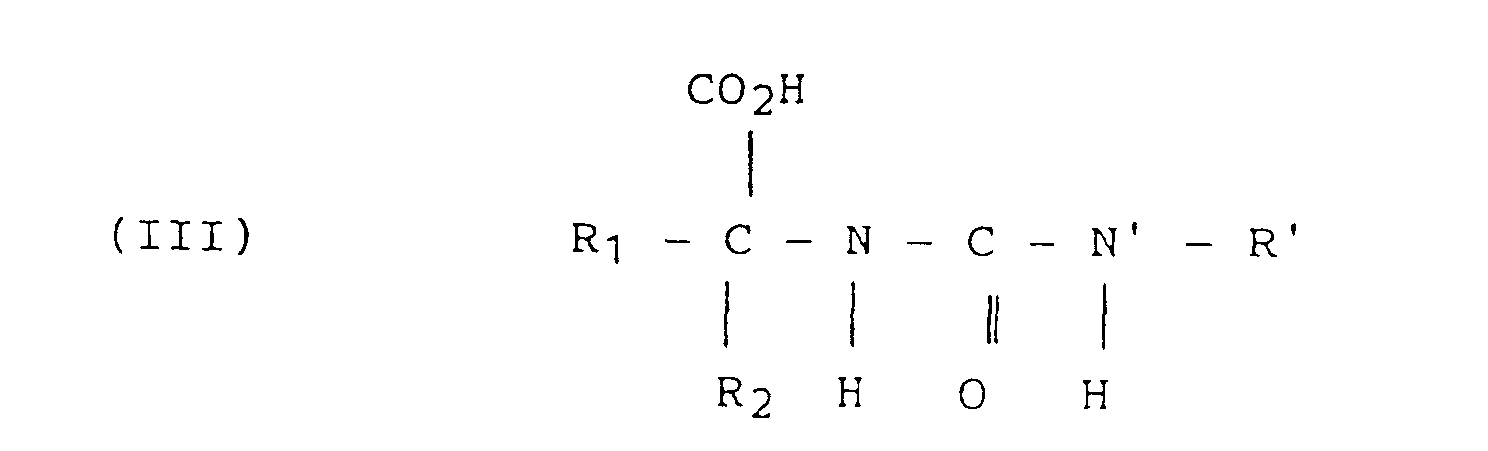
- Procédé selon l'une des revendications 1 à 6,
dans lequel(a) le N-[N'-nitroso-N'(R')carbamoyllaminoacide est synthétisé directement dans le milieu réactionnel en deux étapes :en faisant d'abord réagir de l'acide isocyanique, un sel de cet acide ou un isocyanate de méthyle ou de chloroéthyle sur un aminoacide pour obtenir un N-[N'-(R')carbamoyllaminoacide de formule : et en faisant ensuite réagir un agent nitrosant sur le N-[N'-(R')carbamoyllaminoacide formé.
 - Procédé de synthèse du composé N-carboxyanhydrideaminoacide de formule :caractérisé en ce qu'

on décompose un N-(N-nitrosocarbamoyl)aminoacide de formule :dans lequels R1, R2 et R' sont tels/que définis dans la revendication 1, et on recueille le N-carboxyanhydride après dégagement d'azote.
- Procédé selon la revendication 9,
caractérisé en ce que
la décomposition du composé (I) est réalisée dans un solvant organique anhydre, ce solvant contenant l'eau formée étant séparé en fin d'opération.
Priority Applications (1)
| Application Number | Priority Date | Filing Date | Title |
|---|---|---|---|
| EP00109844A EP1041082B1 (fr) | 1994-10-24 | 1995-10-19 | Procédé de synthése peptidique à partir de N-carboxyanhydrideaminoacides |
Applications Claiming Priority (3)
| Application Number | Priority Date | Filing Date | Title |
|---|---|---|---|
| FR9412779 | 1994-10-24 | ||
| FR9412779A FR2725991B1 (fr) | 1994-10-24 | 1994-10-24 | Procede de synthese peptidique a partir des n-(n'-(r')-n' -nitrosocarbamoyls) aminoacides |
| PCT/FR1995/001380 WO1996012729A2 (fr) | 1994-10-24 | 1995-10-19 | Procede de synthese peptidique a partir des n-(n'-nitrosocarbamoyl)aminoacides |
Related Child Applications (1)
| Application Number | Title | Priority Date | Filing Date |
|---|---|---|---|
| EP00109844A Division EP1041082B1 (fr) | 1994-10-24 | 1995-10-19 | Procédé de synthése peptidique à partir de N-carboxyanhydrideaminoacides |
Publications (2)
| Publication Number | Publication Date |
|---|---|
| EP0787137A2 EP0787137A2 (fr) | 1997-08-06 |
| EP0787137B1 true EP0787137B1 (fr) | 2002-01-23 |
Family
ID=9468211
Family Applications (2)
| Application Number | Title | Priority Date | Filing Date |
|---|---|---|---|
| EP95934205A Expired - Lifetime EP0787137B1 (fr) | 1994-10-24 | 1995-10-19 | Procede pour la preparation de n-carboxyanhydrides d'acides amines a partir d'acides amines n-(n'-nitrosocarbamoyles) |
| EP00109844A Expired - Lifetime EP1041082B1 (fr) | 1994-10-24 | 1995-10-19 | Procédé de synthése peptidique à partir de N-carboxyanhydrideaminoacides |
Family Applications After (1)
| Application Number | Title | Priority Date | Filing Date |
|---|---|---|---|
| EP00109844A Expired - Lifetime EP1041082B1 (fr) | 1994-10-24 | 1995-10-19 | Procédé de synthése peptidique à partir de N-carboxyanhydrideaminoacides |
Country Status (11)
| Country | Link |
|---|---|
| US (1) | US5777076A (fr) |
| EP (2) | EP0787137B1 (fr) |
| JP (1) | JPH10509430A (fr) |
| AT (2) | ATE212340T1 (fr) |
| CA (1) | CA2201511A1 (fr) |
| DE (2) | DE69526462T2 (fr) |
| DK (2) | DK0787137T3 (fr) |
| ES (2) | ES2173061T3 (fr) |
| FR (1) | FR2725991B1 (fr) |
| PT (2) | PT1041082E (fr) |
| WO (1) | WO1996012729A2 (fr) |
Families Citing this family (4)
| Publication number | Priority date | Publication date | Assignee | Title |
|---|---|---|---|---|
| SE0000382D0 (sv) | 2000-02-07 | 2000-02-07 | Astrazeneca Ab | New process |
| FR2899583A1 (fr) * | 2006-04-05 | 2007-10-12 | Centre Nat Rech Scient | Procede de preparation de carboxyanhidrides d'acides amines par nitrosation en phase heterogene |
| EP2035442B1 (fr) * | 2006-06-14 | 2011-10-12 | Centre National De La Recherche Scientifique -Cnrs- | Nouveaux réactifs d'oxydation supportés, leurs procédés de synthèse et leurs applications |
| JP7356707B2 (ja) * | 2018-11-15 | 2023-10-05 | 国立大学法人神戸大学 | アミノ酸-n-カルボン酸無水物の製造方法 |
Family Cites Families (3)
| Publication number | Priority date | Publication date | Assignee | Title |
|---|---|---|---|---|
| IT1037176B (it) * | 1975-04-09 | 1979-11-10 | Snam Progetti | Procedimento per la preparazione di ammindacidi |
| JPS584707B2 (ja) * | 1977-02-21 | 1983-01-27 | 鐘淵化学工業株式会社 | 光学活性フエニルグリシン類の製造法 |
| IT1204979B (it) * | 1987-04-28 | 1989-03-10 | Eniricerche Spa | Sintesi di alfa amminoacidi otticamente attivi |
-
1994
- 1994-10-24 FR FR9412779A patent/FR2725991B1/fr not_active Expired - Fee Related
-
1995
- 1995-10-19 PT PT00109844T patent/PT1041082E/pt unknown
- 1995-10-19 AT AT95934205T patent/ATE212340T1/de not_active IP Right Cessation
- 1995-10-19 DK DK95934205T patent/DK0787137T3/da active
- 1995-10-19 AT AT00109844T patent/ATE216398T1/de not_active IP Right Cessation
- 1995-10-19 DE DE69526462T patent/DE69526462T2/de not_active Expired - Fee Related
- 1995-10-19 DE DE69525169T patent/DE69525169T2/de not_active Expired - Fee Related
- 1995-10-19 DK DK00109844T patent/DK1041082T3/da active
- 1995-10-19 CA CA002201511A patent/CA2201511A1/fr not_active Abandoned
- 1995-10-19 ES ES00109844T patent/ES2173061T3/es not_active Expired - Lifetime
- 1995-10-19 WO PCT/FR1995/001380 patent/WO1996012729A2/fr not_active Ceased
- 1995-10-19 EP EP95934205A patent/EP0787137B1/fr not_active Expired - Lifetime
- 1995-10-19 US US08/809,445 patent/US5777076A/en not_active Expired - Fee Related
- 1995-10-19 ES ES95934205T patent/ES2167464T3/es not_active Expired - Lifetime
- 1995-10-19 EP EP00109844A patent/EP1041082B1/fr not_active Expired - Lifetime
- 1995-10-19 JP JP8513683A patent/JPH10509430A/ja active Pending
- 1995-10-19 PT PT95934205T patent/PT787137E/pt unknown
Also Published As
| Publication number | Publication date |
|---|---|
| PT787137E (pt) | 2002-07-31 |
| FR2725991B1 (fr) | 1997-01-17 |
| ATE212340T1 (de) | 2002-02-15 |
| CA2201511A1 (fr) | 1996-05-02 |
| US5777076A (en) | 1998-07-07 |
| DE69525169D1 (de) | 2002-03-14 |
| WO1996012729A3 (fr) | 1996-09-06 |
| FR2725991A1 (fr) | 1996-04-26 |
| WO1996012729A2 (fr) | 1996-05-02 |
| DE69526462T2 (de) | 2002-11-07 |
| EP1041082A1 (fr) | 2000-10-04 |
| DE69525169T2 (de) | 2002-09-05 |
| ES2167464T3 (es) | 2002-05-16 |
| EP1041082B1 (fr) | 2002-04-17 |
| DK0787137T3 (da) | 2002-05-06 |
| JPH10509430A (ja) | 1998-09-14 |
| PT1041082E (pt) | 2002-09-30 |
| ATE216398T1 (de) | 2002-05-15 |
| ES2173061T3 (es) | 2002-10-16 |
| EP0787137A2 (fr) | 1997-08-06 |
| DE69526462D1 (de) | 2002-05-23 |
| DK1041082T3 (da) | 2002-06-17 |
Similar Documents
| Publication | Publication Date | Title |
|---|---|---|
| US8618310B2 (en) | Process for preparing n-protected 4-ketoproline derivatives | |
| CH636344A5 (fr) | Composes analogues de dipeptides. | |
| EP0787137B1 (fr) | Procede pour la preparation de n-carboxyanhydrides d'acides amines a partir d'acides amines n-(n'-nitrosocarbamoyles) | |
| CA1250399A (fr) | Procede pour la synthese de peptides | |
| EP0462016B1 (fr) | Procéde de préparation industrielle du 4-chloro 3-sulfamoyl N-(2,3-dihydro 2-méthyl 1H-indol-1-yl) benzamide | |
| Lowik et al. | Synthesis of α‐and β‐substituted aminoethane sulfonamide arginine‐glycine mimics | |
| EP2139910B1 (fr) | Procede de synthese de peptides sans solvant | |
| CA2305944A1 (fr) | Procede pour la separation d'enantiomeres et reactif enantiopur | |
| EP0154581B1 (fr) | Nouveaux carbonates alpha-chlorés, leur procédé de fabrication et leur application à la protection des fonctions amines des amino-acides | |
| EP0279716B1 (fr) | Procédé de n-omega-trifluoroacetylation des alpha,omega diaminoacides monocarboxyliques aliphatiques saturés | |
| EP0155862B1 (fr) | Procédé de préparation de dérivés de l'acide carbamique | |
| EP0562659A1 (fr) | Procédé de synthèse peptidique et nouveaux intermédiaires de synthèse | |
| FR2584399A1 (fr) | Procede de synthese stereospecifique d'acides amino-4 hydroxy-3 carboxyliques | |
| EP0629612B1 (fr) | Procédé de préparation d'uréines dérivées d'alpha,omega-diaminoacides | |
| EP0943621A2 (fr) | Procédé de production des intermédaires des peptides alcoxycarbonyl pour la synthèse de la lisinoprile | |
| EP0716062A1 (fr) | Un procédé pour la préparation de N-(S)-alpha-alkylbenzylamide D-aminoacide | |
| EP0056343B1 (fr) | Procédé de préparation de l'amino-4 butyramide | |
| FR2589860A1 (fr) | Nouveau procede de preparation des n-nitrosourees | |
| FR2598422A1 (fr) | Pseudo-peptide comportant au moins la sequence de l'acide g-glutamyl-aspartique ou l'un de ses derives, son utilisation dans la preparation d'une composition pharmaceutique et composition pharmaceutique en resultant | |
| FR2510994A1 (fr) | Procede de preparation de l'herbicide phenmedipham | |
| KR100358935B1 (ko) | 고체상 반응을 이용한 신규 α-메틸펩티도미메틱 유도체의 제조방법 | |
| Akutagawa et al. | A facile conversion of sulfoximines and sulfonediimines to sulfoxides and sulfilimines with tert-butyl nitrite | |
| EP0149582A2 (fr) | Procédé de préparation d'aspartyl peptides et nouveaux dérivés de l'acide aspartique utilisables dans leur synthèse | |
| WO1997009303A1 (fr) | Derives d'alfa-hydrazinoacides et procede pour les fabriquer | |
| FR2585354A1 (fr) | Procede stereoselectif de preparation de derives de la proline |
Legal Events
| Date | Code | Title | Description |
|---|---|---|---|
| PUAI | Public reference made under article 153(3) epc to a published international application that has entered the european phase |
Free format text: ORIGINAL CODE: 0009012 |
|
| 17P | Request for examination filed |
Effective date: 19970410 |
|
| AK | Designated contracting states |
Kind code of ref document: A2 Designated state(s): AT BE CH DE DK ES FR GB GR IE IT LI LU MC NL PT SE |
|
| RAP1 | Party data changed (applicant data changed or rights of an application transferred) |
Owner name: DEGUSSA AKTIENGESELLSCHAFT |
|
| 17Q | First examination report despatched |
Effective date: 19990318 |
|
| RAP1 | Party data changed (applicant data changed or rights of an application transferred) |
Owner name: DEGUSSA-HUELS AKTIENGESELLSCHAFT |
|
| RAP3 | Party data changed (applicant data changed or rights of an application transferred) |
Owner name: DEGUSSA-HUELS AKTIENGESELLSCHAFT |
|
| GRAG | Despatch of communication of intention to grant |
Free format text: ORIGINAL CODE: EPIDOS AGRA |
|
| RIC1 | Information provided on ipc code assigned before grant |
Free format text: 7C 07D 263/44 A |
|
| RTI1 | Title (correction) |
Free format text: PROCESS FOR THE PREPARATION OF N-CARBOXYANHYDRIDE AMINO ACIDS FROM N-(N'-NITROSOCARBAMOYL)AMINO ACIDS |
|
| GRAG | Despatch of communication of intention to grant |
Free format text: ORIGINAL CODE: EPIDOS AGRA |
|
| GRAH | Despatch of communication of intention to grant a patent |
Free format text: ORIGINAL CODE: EPIDOS IGRA |
|
| RAP1 | Party data changed (applicant data changed or rights of an application transferred) |
Owner name: DEGUSSA AG |
|
| GRAG | Despatch of communication of intention to grant |
Free format text: ORIGINAL CODE: EPIDOS AGRA |
|
| GRAH | Despatch of communication of intention to grant a patent |
Free format text: ORIGINAL CODE: EPIDOS IGRA |
|
| GRAG | Despatch of communication of intention to grant |
Free format text: ORIGINAL CODE: EPIDOS AGRA |
|
| GRAH | Despatch of communication of intention to grant a patent |
Free format text: ORIGINAL CODE: EPIDOS IGRA |
|
| GRAH | Despatch of communication of intention to grant a patent |
Free format text: ORIGINAL CODE: EPIDOS IGRA |
|
| GRAA | (expected) grant |
Free format text: ORIGINAL CODE: 0009210 |
|
| REG | Reference to a national code |
Ref country code: GB Ref legal event code: IF02 |
|
| AK | Designated contracting states |
Kind code of ref document: B1 Designated state(s): AT BE CH DE DK ES FR GB GR IE IT LI LU MC NL PT SE |
|
| REF | Corresponds to: |
Ref document number: 212340 Country of ref document: AT Date of ref document: 20020215 Kind code of ref document: T |
|
| REG | Reference to a national code |
Ref country code: CH Ref legal event code: EP |
|
| REG | Reference to a national code |
Ref country code: CH Ref legal event code: NV Representative=s name: BOVARD AG PATENTANWAELTE |
|
| REG | Reference to a national code |
Ref country code: IE Ref legal event code: FG4D Free format text: FRENCH |
|
| REF | Corresponds to: |
Ref document number: 69525169 Country of ref document: DE Date of ref document: 20020314 |
|
| REG | Reference to a national code |
Ref country code: DK Ref legal event code: T3 |
|
| GBT | Gb: translation of ep patent filed (gb section 77(6)(a)/1977) |
Effective date: 20020424 |
|
| REG | Reference to a national code |
Ref country code: ES Ref legal event code: FG2A Ref document number: 2167464 Country of ref document: ES Kind code of ref document: T3 |
|
| REG | Reference to a national code |
Ref country code: PT Ref legal event code: SC4A Free format text: AVAILABILITY OF NATIONAL TRANSLATION Effective date: 20020418 |
|
| REG | Reference to a national code |
Ref country code: GR Ref legal event code: EP Ref document number: 20020401389 Country of ref document: GR |
|
| PLBE | No opposition filed within time limit |
Free format text: ORIGINAL CODE: 0009261 |
|
| STAA | Information on the status of an ep patent application or granted ep patent |
Free format text: STATUS: NO OPPOSITION FILED WITHIN TIME LIMIT |
|
| 26N | No opposition filed | ||
| PGFP | Annual fee paid to national office [announced via postgrant information from national office to epo] |
Ref country code: MC Payment date: 20030917 Year of fee payment: 9 |
|
| PGFP | Annual fee paid to national office [announced via postgrant information from national office to epo] |
Ref country code: PT Payment date: 20030919 Year of fee payment: 9 |
|
| PGFP | Annual fee paid to national office [announced via postgrant information from national office to epo] |
Ref country code: GB Payment date: 20030929 Year of fee payment: 9 |
|
| PGFP | Annual fee paid to national office [announced via postgrant information from national office to epo] |
Ref country code: NL Payment date: 20030930 Year of fee payment: 9 Ref country code: IE Payment date: 20030930 Year of fee payment: 9 Ref country code: GR Payment date: 20030930 Year of fee payment: 9 |
|
| PGFP | Annual fee paid to national office [announced via postgrant information from national office to epo] |
Ref country code: SE Payment date: 20031001 Year of fee payment: 9 Ref country code: LU Payment date: 20031001 Year of fee payment: 9 Ref country code: CH Payment date: 20031001 Year of fee payment: 9 Ref country code: AT Payment date: 20031001 Year of fee payment: 9 |
|
| PGFP | Annual fee paid to national office [announced via postgrant information from national office to epo] |
Ref country code: DK Payment date: 20031003 Year of fee payment: 9 |
|
| PGFP | Annual fee paid to national office [announced via postgrant information from national office to epo] |
Ref country code: FR Payment date: 20031009 Year of fee payment: 9 Ref country code: BE Payment date: 20031009 Year of fee payment: 9 |
|
| PGFP | Annual fee paid to national office [announced via postgrant information from national office to epo] |
Ref country code: DE Payment date: 20031010 Year of fee payment: 9 |
|
| PGFP | Annual fee paid to national office [announced via postgrant information from national office to epo] |
Ref country code: ES Payment date: 20031020 Year of fee payment: 9 |
|
| PG25 | Lapsed in a contracting state [announced via postgrant information from national office to epo] |
Ref country code: LU Free format text: LAPSE BECAUSE OF NON-PAYMENT OF DUE FEES Effective date: 20041019 Ref country code: IE Free format text: LAPSE BECAUSE OF NON-PAYMENT OF DUE FEES Effective date: 20041019 Ref country code: GB Free format text: LAPSE BECAUSE OF NON-PAYMENT OF DUE FEES Effective date: 20041019 Ref country code: AT Free format text: LAPSE BECAUSE OF NON-PAYMENT OF DUE FEES Effective date: 20041019 |
|
| PG25 | Lapsed in a contracting state [announced via postgrant information from national office to epo] |
Ref country code: SE Free format text: LAPSE BECAUSE OF NON-PAYMENT OF DUE FEES Effective date: 20041020 Ref country code: ES Free format text: LAPSE BECAUSE OF NON-PAYMENT OF DUE FEES Effective date: 20041020 |
|
| PG25 | Lapsed in a contracting state [announced via postgrant information from national office to epo] |
Ref country code: MC Free format text: LAPSE BECAUSE OF NON-PAYMENT OF DUE FEES Effective date: 20041031 Ref country code: LI Free format text: LAPSE BECAUSE OF NON-PAYMENT OF DUE FEES Effective date: 20041031 Ref country code: CH Free format text: LAPSE BECAUSE OF NON-PAYMENT OF DUE FEES Effective date: 20041031 Ref country code: BE Free format text: LAPSE BECAUSE OF NON-PAYMENT OF DUE FEES Effective date: 20041031 |
|
| PG25 | Lapsed in a contracting state [announced via postgrant information from national office to epo] |
Ref country code: DK Free format text: LAPSE BECAUSE OF NON-PAYMENT OF DUE FEES Effective date: 20041101 |
|
| PG25 | Lapsed in a contracting state [announced via postgrant information from national office to epo] |
Ref country code: PT Free format text: LAPSE BECAUSE OF NON-PAYMENT OF DUE FEES Effective date: 20050419 |
|
| BERE | Be: lapsed |
Owner name: *DEGUSSA A.G. Effective date: 20041031 |
|
| PG25 | Lapsed in a contracting state [announced via postgrant information from national office to epo] |
Ref country code: NL Free format text: LAPSE BECAUSE OF NON-PAYMENT OF DUE FEES Effective date: 20050501 |
|
| PG25 | Lapsed in a contracting state [announced via postgrant information from national office to epo] |
Ref country code: DE Free format text: LAPSE BECAUSE OF NON-PAYMENT OF DUE FEES Effective date: 20050503 |
|
| PG25 | Lapsed in a contracting state [announced via postgrant information from national office to epo] |
Ref country code: GR Free format text: LAPSE BECAUSE OF NON-PAYMENT OF DUE FEES Effective date: 20050504 |
|
| EUG | Se: european patent has lapsed | ||
| REG | Reference to a national code |
Ref country code: DK Ref legal event code: EBP |
|
| GBPC | Gb: european patent ceased through non-payment of renewal fee |
Effective date: 20041019 |
|
| REG | Reference to a national code |
Ref country code: CH Ref legal event code: PL |
|
| PG25 | Lapsed in a contracting state [announced via postgrant information from national office to epo] |
Ref country code: FR Free format text: LAPSE BECAUSE OF NON-PAYMENT OF DUE FEES Effective date: 20050630 |
|
| REG | Reference to a national code |
Ref country code: PT Ref legal event code: MM4A Free format text: LAPSE DUE TO NON-PAYMENT OF FEES Effective date: 20050419 |
|
| NLV4 | Nl: lapsed or anulled due to non-payment of the annual fee |
Effective date: 20050501 |
|
| REG | Reference to a national code |
Ref country code: IE Ref legal event code: MM4A |
|
| REG | Reference to a national code |
Ref country code: FR Ref legal event code: ST |
|
| PG25 | Lapsed in a contracting state [announced via postgrant information from national office to epo] |
Ref country code: IT Free format text: LAPSE BECAUSE OF NON-PAYMENT OF DUE FEES Effective date: 20051019 |
|
| REG | Reference to a national code |
Ref country code: ES Ref legal event code: FD2A Effective date: 20041020 |
|
| BERE | Be: lapsed |
Owner name: *DEGUSSA A.G. Effective date: 20041031 |