EP0782206A1 - Positive electrode active material for lithium secondary battery, method of producing thereof, and lithium secondary battery - Google Patents
Positive electrode active material for lithium secondary battery, method of producing thereof, and lithium secondary battery Download PDFInfo
- Publication number
- EP0782206A1 EP0782206A1 EP96120921A EP96120921A EP0782206A1 EP 0782206 A1 EP0782206 A1 EP 0782206A1 EP 96120921 A EP96120921 A EP 96120921A EP 96120921 A EP96120921 A EP 96120921A EP 0782206 A1 EP0782206 A1 EP 0782206A1
- Authority
- EP
- European Patent Office
- Prior art keywords
- positive electrode
- active material
- electrode active
- lithium secondary
- secondary battery
- Prior art date
- Legal status (The legal status is an assumption and is not a legal conclusion. Google has not performed a legal analysis and makes no representation as to the accuracy of the status listed.)
- Granted
Links
Images

Classifications
-
- H—ELECTRICITY
- H01—ELECTRIC ELEMENTS
- H01M—PROCESSES OR MEANS, e.g. BATTERIES, FOR THE DIRECT CONVERSION OF CHEMICAL ENERGY INTO ELECTRICAL ENERGY
- H01M4/00—Electrodes
- H01M4/02—Electrodes composed of, or comprising, active material
- H01M4/36—Selection of substances as active materials, active masses, active liquids
- H01M4/48—Selection of substances as active materials, active masses, active liquids of inorganic oxides or hydroxides
- H01M4/52—Selection of substances as active materials, active masses, active liquids of inorganic oxides or hydroxides of nickel, cobalt or iron
- H01M4/525—Selection of substances as active materials, active masses, active liquids of inorganic oxides or hydroxides of nickel, cobalt or iron of mixed oxides or hydroxides containing iron, cobalt or nickel for inserting or intercalating light metals, e.g. LiNiO2, LiCoO2 or LiCoOxFy
-
- H—ELECTRICITY
- H01—ELECTRIC ELEMENTS
- H01M—PROCESSES OR MEANS, e.g. BATTERIES, FOR THE DIRECT CONVERSION OF CHEMICAL ENERGY INTO ELECTRICAL ENERGY
- H01M10/00—Secondary cells; Manufacture thereof
- H01M10/05—Accumulators with non-aqueous electrolyte
- H01M10/052—Li-accumulators
- H01M10/0525—Rocking-chair batteries, i.e. batteries with lithium insertion or intercalation in both electrodes; Lithium-ion batteries
-
- H—ELECTRICITY
- H01—ELECTRIC ELEMENTS
- H01M—PROCESSES OR MEANS, e.g. BATTERIES, FOR THE DIRECT CONVERSION OF CHEMICAL ENERGY INTO ELECTRICAL ENERGY
- H01M4/00—Electrodes
- H01M4/02—Electrodes composed of, or comprising, active material
- H01M4/13—Electrodes for accumulators with non-aqueous electrolyte, e.g. for lithium-accumulators; Processes of manufacture thereof
- H01M4/133—Electrodes based on carbonaceous material, e.g. graphite-intercalation compounds or CFx
-
- H—ELECTRICITY
- H01—ELECTRIC ELEMENTS
- H01M—PROCESSES OR MEANS, e.g. BATTERIES, FOR THE DIRECT CONVERSION OF CHEMICAL ENERGY INTO ELECTRICAL ENERGY
- H01M4/00—Electrodes
- H01M4/02—Electrodes composed of, or comprising, active material
- H01M4/36—Selection of substances as active materials, active masses, active liquids
- H01M4/48—Selection of substances as active materials, active masses, active liquids of inorganic oxides or hydroxides
- H01M4/485—Selection of substances as active materials, active masses, active liquids of inorganic oxides or hydroxides of mixed oxides or hydroxides for inserting or intercalating light metals, e.g. LiTi2O4 or LiTi2OxFy
-
- H—ELECTRICITY
- H01—ELECTRIC ELEMENTS
- H01M—PROCESSES OR MEANS, e.g. BATTERIES, FOR THE DIRECT CONVERSION OF CHEMICAL ENERGY INTO ELECTRICAL ENERGY
- H01M4/00—Electrodes
- H01M4/02—Electrodes composed of, or comprising, active material
- H01M4/36—Selection of substances as active materials, active masses, active liquids
- H01M4/48—Selection of substances as active materials, active masses, active liquids of inorganic oxides or hydroxides
- H01M4/50—Selection of substances as active materials, active masses, active liquids of inorganic oxides or hydroxides of manganese
- H01M4/505—Selection of substances as active materials, active masses, active liquids of inorganic oxides or hydroxides of manganese of mixed oxides or hydroxides containing manganese for inserting or intercalating light metals, e.g. LiMn2O4 or LiMn2OxFy
-
- Y—GENERAL TAGGING OF NEW TECHNOLOGICAL DEVELOPMENTS; GENERAL TAGGING OF CROSS-SECTIONAL TECHNOLOGIES SPANNING OVER SEVERAL SECTIONS OF THE IPC; TECHNICAL SUBJECTS COVERED BY FORMER USPC CROSS-REFERENCE ART COLLECTIONS [XRACs] AND DIGESTS
- Y02—TECHNOLOGIES OR APPLICATIONS FOR MITIGATION OR ADAPTATION AGAINST CLIMATE CHANGE
- Y02E—REDUCTION OF GREENHOUSE GAS [GHG] EMISSIONS, RELATED TO ENERGY GENERATION, TRANSMISSION OR DISTRIBUTION
- Y02E60/00—Enabling technologies; Technologies with a potential or indirect contribution to GHG emissions mitigation
- Y02E60/10—Energy storage using batteries
Definitions
- the present invention relates to an active material for a lithium secondary battery, a method of producing thereof, and a lithium secondary battery per se using the active material.
- an aqueous solution type battery such as a lead batteries and a nickel-cadmium battery has been used mainly as a general-purpose battery.
- the aqueous solution type battery is excellent in cycle characteristic but it is not said to be satisfactory in terms of battery weight and energy density.
- non-aqueous electrolyte battery high in battery voltage and having high energy density has begun to be used recently.
- a typical example of the non-aqueous electrolyte battery is a lithium secondary battery in which material capable of reversible intercalation of lithium ions is used as an electrode material.
- the energy density of a lithium secondary battery is 60-125 Wh/kg and 190-310 Wh/l whereas the energy density of a lead battery is 20-40 Wh/kg and 50-100 Wh/l
- the energy density of a nickel-cadmium battery is 30-60 Wh/kg and 100-160 Wh/l
- the energy density of a nickel-hydrogen battery is 45-65 Wh/kg and 160-200 Wh/l.
- lithium secondary batteries are expected to be used as supply electric sources for portable appliances relatively large in consumed electric power because they are excellent in energy density as described above, improvement in safety and further improvement in cycle characteristic are required as one important problem. Improvement in thermal stability of active materials is important for improvement in safety whereas reversibility (doping and de-doping) of intercalation of positive and negative active materials is of course also important for improvement in cycle characteristic.
- positive electrode active materials for use in lithium secondary batteries there are composite oxide of lithium and transition metals and composite oxide of lithium, transition metals and non-transition metals.
- Li x MO 2 transition metal; 0.5 ⁇ x ⁇ 1.10) as disclosed in Japanese Patent Unexamined Publication No. Hei-4-249074 and Li x M y N z O 2 (M: at least one kind selected from the group of transition metals; N: at least one kind selected from the group of non-transition metal:; 0.05 ⁇ x ⁇ 1.10; 0.85 ⁇ y ⁇ 1.00; 0 ⁇ z ⁇ 0.10) as disclosed in Japanese Patent Unexamined Publication No. Hei-4-22066 are known.
- Li secondary batteries using these positive electrode active materials it is a fact that no battery exhibiting sufficient safety and sufficient cycle characteristic while keeping high energy density has been obtained under present circumstances.
- a positive electrode active material for a lithium secondary battery according to the present invention comprises LiNi 1-x-y-z Co x Mn y Al z O 2 wherein x, y and z satisfy relations of 0 ⁇ y ⁇ 0.3, 0 ⁇ x ⁇ 0.25, 0 ⁇ z ⁇ 0.15.
- a method of producing a positive electrode active material for a lithium secondary battery according to the present invention comprises the steps of: mixing at least one of ⁇ -Ni 1-x Co x (OH) 2 and ⁇ -Ni 1-x Co x OOH in which x and y satisfy relations of 0 ⁇ y ⁇ 0.3 and 0 ⁇ x ⁇ 0.25, a Li supply source material which is a Li chemical compound used at a time of forming Li-Ni-Co-Al composite oxide, and an Al supply source material which is an Al chemical compound used at a time of forming Li-Ni-Co-Al composite oxide; and burning the resulting mixture.
- a lithium secondary battery according to the present invention comprises a positive electrode, a negative electrode, a separator, a positive electrode terminal, a case serving as a negative electrode terminal and an electrolytic solution; wherein the positive electrode active material comprises LiNi 1-x-y-z Co x Mn y Al z O 2 wherein x, y and z satisfy relations of 0 ⁇ y ⁇ 0.3, 0 ⁇ x ⁇ 0.25, 0 ⁇ z ⁇ 0.15.
- the value of the present invention is in that the optimum proportion of Ni, Co, Mn and Al not only for improving cycle characteristic remarkably but, also for improving battery safety without lowering of energy density is found out. As a result, it can be made possible to provide a lithium secondary battery excellent both in cycle characteristic and in thermal stability and easy to handle.
- LiNi 1-x-y-z Co x Mn y Al z O 2 satisfies relations of 0.15 ⁇ x ⁇ 0.25 and 0 ⁇ z ⁇ 0.15, or when 0 ⁇ y ⁇ 0.3, satisfies relations of 0 ⁇ x ⁇ 0.25, 0 ⁇ z ⁇ 0.15 and x + y ⁇ 0.4.
- x satisfy a relation of 0 ⁇ x ⁇ 0.2, more preferably, 0 ⁇ x ⁇ 0.1.
- y satisfy a relation of 0.1 ⁇ x ⁇ 0.2.
- a Li supply source material which is a Li chemical compound such as LiOH, Li 2 CO 3 or/and LiNO 3 used at the time of forming Li-Ni-Co-Mn-Al composite oxide
- an Al supply source material which is
- a lithium secondary battery according to the present invention uses the aforementioned positive electrode active material for lithium secondary batteries.
- x satisfy a relation of 0 ⁇ x ⁇ 0.2, more preferably, 0 ⁇ x ⁇ 0.1.
- y satisfy a relation of 0.1 ⁇ x ⁇ 0.2.
- the amounts of Co, Mn and Al are preferably selected to be not larger than those values respectively.
- Li-Ni-Co-Mn-Al composite oxides were prepared while x was set to 0, 0.10, 0.15, 0.20 and 0.25, y was set to 0, 0.1, 0.2, 0.3 and 0.4 and z was set to 0, 0.5, 1.5 and 2.0 in LiNi 1-x-y-z Co x Mn y Al z O 2 .
- the burning temperature and the oxygen partial pressure may be selected suitably to be in a range of from 300 to 950°C and in a range of from 0.1 to 100 atm., respectively.
- acetylene black granule was prepared by kneading, granulating and drying 98 parts by weight of acetylene black and 2 parts by weight of CMC as a binding agent. Then, the granule was ground by a ball mill using a 3.0 mm-diameter zirconia ball to thereby prepare a carbon type electrically conductive agent.
- the specific surface area of acetylene black used herein was not smaller than 30 m 2 /g.
- ketchen black, furnace black and the like are used singly or in combination.
- binder examples include: polytetrafluoroethylene; rubber type high molecules; mixtures of polytetrafluoroethylene, rubber type high molecules and cellulose type high molecules; copolymers mainly containing polyvinylidene fluoride; etc.
- the electrode substrate examples include an aluminum lath board, a stainless steel plate, etc.
- An 80 20 weight proportion mixture of mesocarbon microbeads which is formed from mesophase globules as raw material generated in a pitch-carbonating process and flake artificial graphite was used as a lithium ion intercalation member.
- N-methyl pyrolidone was added suitably to the intercalation member with use of styrene-butadiene rubber as a binder to form paste.
- the paste was applied onto a substrate of copper foil and dried to prepare a negative electrode.
- the particle size of mesocarbon black microbeads and flake artificial graphite was in a range of from 5 to 50 ⁇ m and the surface area thereof was in a range of from 4 to 20 m 2 /g.
- Non-aqueous electrolyte was prepared by dissolving 1 mol/l of LiPF 6 in a 1:1 volume proportion mixture solvent of ethylene carbonate and diethyl carbonate.
- the non-aqueous electrolyte is not limited to the above description, but various solutions, for example, a solution obtained by dissolving a solute such as LiBF 6 , LiClO 4 , or the like, in a solvent such as sulfolane, propylene carbonate, gamma-butyrolactone, 1,2-butylene carbonate, dimethyl carbonate, or the like, or a mixture solvent of any of those mentioned above and a low boiling point solvent such as 1,2-dimethoxyethane, or the like, can be used.
- a solute such as LiBF 6 , LiClO 4 , or the like
- a solvent such as sulfolane, propylene carbonate, gamma-butyrolactone, 1,2-butylene carbonate, dimethyl carbonate,
- a polyethylene porous film having a thickness of 25 ⁇ m, a porosity of 40 %, a mean through-hole size of 0.01 ⁇ m and a shear strength of 0.7 kg in a width of 10 mm was used as a separator.
- the separator is not limited specifically, but various separators used heretofore may be used.
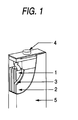
- Fig. 1 is a schematic view of this battery.
- Main constituent elements of this battery are a positive electrode 1, a negative electrode 2, a separator 3, a positive electrode terminal 4, a case 5 serving as a negative electrode terminal, an electrolytic solution (not shown), etc.
- Tables 1 to 5 show the mean values of electric discharge capacities at the 50th cycle of each of the respective batteries.
- Table 1 y 0 x 0 0.1 0.15 0.2 0.25 z 0 748 (728) 752 (738) 891 (883) 952 (940) 832 (819) 0.05 749 (730) 753 (736) 891 (882) 952 (941) 831 (821) 0.1 748 (731) 750 (738) 892 (882) 950 (941) 830 (821) 0.15 749 (731) 751 (739) 890 (880) 950 (940) 831 (820) 0.2 641 (629) 642 (630) 713 (709) 771 (755) 650 (639) (mAh)
- Table 2 y 0.1 x 0 0.1 0.15 0.2 0.25 z 0 830 (820) 850 (835) 890 (885) 880 (870) 832 (825) 0.05 825 (820) 840 (836) 875 (868) 890 (880)
- each section the value shown in the upper portion of each section is of the battery using the positive electrode active material synthesized with ⁇ -Ni 1-x Co x Mn y (OH) 2 as starting material, and the parenthesezed values in the lower portion of each section is of the battery using the positive electrode active material synthesized with individual hydroxides of nickel, cobalt and manganese as stating material.
- lithium secondary batteries using the positive electrode active material satisfying the relations of 0 ⁇ x ⁇ 0.25, 0 ⁇ y ⁇ 0.3, 0 ⁇ z ⁇ 0.15 and x + y ⁇ 0.4 when 0 ⁇ y ⁇ 0.3 in LiNi 1-x-y-z Co x Mn y Al z O 2 are also excellent in cycle characteristic.
- z 0 is not preferable because addition of Al has an operational effect of improving battery safety by reducing the heating reaction rate as well as reducing the total heat release value.
- the fact that the heat release peak in the DSC data is broad is an evidence of the above description. Suppression of heat releasing is very important for battery safety in abnormal use.
- batteries in the upper portions in the respective sections in Tables 1 to 5 using ⁇ -Ni 1-x Co x Mn y (OH) 2 synthesized by co-precipitation, Al(OH) 3 and LiOH as raw materials for preparing a positive electrode active material are superior to batteries parenthesezed in the lower portions in the respective sections in Tables 1 to 5 using respective hydroxides of Li, Ni, Co and Mn.
- the value of the present invention is in that the optimum proportion of Ni, Co, Mn and Al not only for improving cycle characteristic remarkably but also for improving battery safety without lowering of energy density is found out. As a result, it can be made possible to provide a lithium secondary battery excellent both in cycle characteristic and in thermal stability and easy to handle.
Landscapes
- Chemical & Material Sciences (AREA)
- Chemical Kinetics & Catalysis (AREA)
- Electrochemistry (AREA)
- General Chemical & Material Sciences (AREA)
- Engineering & Computer Science (AREA)
- Inorganic Chemistry (AREA)
- Materials Engineering (AREA)
- Manufacturing & Machinery (AREA)
- Battery Electrode And Active Subsutance (AREA)
- Secondary Cells (AREA)
Abstract
Description
- The present invention relates to an active material for a lithium secondary battery, a method of producing thereof, and a lithium secondary battery per se using the active material.
- The remarkable progress of electronic techniques in recent years has actualized reduction in else and weight of electronic appliances in rapid succession. With such actualization, more and more reduction in size and weight and increase in energy density have been required of batteries which are electric sources of those electric appliances.
- Conventionally, an aqueous solution type battery such as a lead batteries and a nickel-cadmium battery has been used mainly as a general-purpose battery. The aqueous solution type battery is excellent in cycle characteristic but it is not said to be satisfactory in terms of battery weight and energy density.
- Therefore, a non-aqueous electrolyte battery high in battery voltage and having high energy density has begun to be used recently. A typical example of the non-aqueous electrolyte battery is a lithium secondary battery in which material capable of reversible intercalation of lithium ions is used as an electrode material.
- In rough comparison in energy density among various types of small-size secondary batteries used as portable appliance electric sources, it is said that the energy density of a lithium secondary battery is 60-125 Wh/kg and 190-310 Wh/l whereas the energy density of a lead battery is 20-40 Wh/kg and 50-100 Wh/l, the energy density of a nickel-cadmium battery is 30-60 Wh/kg and 100-160 Wh/l and the energy density of a nickel-hydrogen battery is 45-65 Wh/kg and 160-200 Wh/l.
- Although lithium secondary batteries are expected to be used as supply electric sources for portable appliances relatively large in consumed electric power because they are excellent in energy density as described above, improvement in safety and further improvement in cycle characteristic are required as one important problem. Improvement in thermal stability of active materials is important for improvement in safety whereas reversibility (doping and de-doping) of intercalation of positive and negative active materials is of course also important for improvement in cycle characteristic.
- As positive electrode active materials for use in lithium secondary batteries, there are composite oxide of lithium and transition metals and composite oxide of lithium, transition metals and non-transition metals. Among such materials, for example, LixMO2 (M: transition metal; 0.5 ≤ x ≤ 1.10) as disclosed in Japanese Patent Unexamined Publication No. Hei-4-249074 and LixMyNzO2 (M: at least one kind selected from the group of transition metals; N: at least one kind selected from the group of non-transition metal:; 0.05 ≤ x ≤ 1.10; 0.85 ≤ y ≤ 1.00; 0 ≤ z ≤ 0.10) as disclosed in Japanese Patent Unexamined Publication No. Hei-4-22066 are known. Among lithium secondary batteries using these positive electrode active materials, however, it is a fact that no battery exhibiting sufficient safety and sufficient cycle characteristic while keeping high energy density has been obtained under present circumstances.
- In order to solve the above problems, it is an object of the present invention to provide a lithium secondary battery which is high in energy density as well as excellent in safety and cycle characteristic.
- A positive electrode active material for a lithium secondary battery according to the present invention comprises LiNi1-x-y-zCoxMnyAlzO2 wherein x, y and z satisfy relations of 0 ≤ y ≤ 0.3, 0 ≤ x ≤ 0.25, 0 < z ≤ 0.15.
- A method of producing a positive electrode active material for a lithium secondary battery according to the present invention comprises the steps of: mixing at least one of β-Ni1-xCox(OH)2 and β-Ni1-xCoxOOH in which x and y satisfy relations of 0 ≤ y ≤ 0.3 and 0 ≤ x ≤ 0.25, a Li supply source material which is a Li chemical compound used at a time of forming Li-Ni-Co-Al composite oxide, and an Al supply source material which is an Al chemical compound used at a time of forming Li-Ni-Co-Al composite oxide; and burning the resulting mixture.
- A lithium secondary battery according to the present invention comprises a positive electrode, a negative electrode, a separator, a positive electrode terminal, a case serving as a negative electrode terminal and an electrolytic solution; wherein the positive electrode active material comprises LiNi1-x-y-z CoxMnyAlzO2 wherein x, y and z satisfy relations of 0 ≤ y ≤ 0.3, 0 ≤ x ≤ 0.25, 0 < z ≤ 0.15.
- According to the present invention, it should be noted that the value of the present invention is in that the optimum proportion of Ni, Co, Mn and Al not only for improving cycle characteristic remarkably but, also for improving battery safety without lowering of energy density is found out. As a result, it can be made possible to provide a lithium secondary battery excellent both in cycle characteristic and in thermal stability and easy to handle.
- In the accompanying drawings:
- Fig. 1 is a view showing a battery as an embodiment of the present invention;
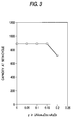
- Fig. 2 is a graph showing electric discharge capacity after a cycle test;
- Fig. 3 is a graph showing electric discharge capacity after a cycle test; and
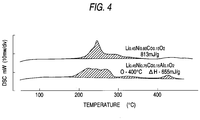
- Fig. 4 is a graph showing heat generating characteristic.
- Detailed description of the present invention will be described as follows.
- As a result of diligent study made by the inventors of the present invention, it was found that a lithium secondary battery excellent in cycle characteristic can be obtained by limiting the amounts of Ni, Co, Mn and Al in Li-Ni-Co-Mn-Al composite oxide to certain numerical value ranges respectively.
- In a positive electrode of the lithium secondary battery according to the present invention, when y = 0, LiNi1-x-y-z CoxMnyAlzO2 satisfies relations of 0.15 ≤ x ≤ 0.25 and 0 < z ≤ 0.15, or when 0 < y ≤ 0.3, satisfies relations of 0 ≤ x ≤ 0.25, 0 < z ≤ 0.15 and x + y ≤ 0.4. Preferably, x satisfy a relation of 0 ≤ x ≤ 0.2, more preferably, 0 ≤ x ≤ 0.1. Further, preferably, y satisfy a relation of 0.1 ≤ x ≤ 0.2.
- Further, in a method of producing a positive electrode active material for use in lithium secondary batteries, β-Ni1-x-y-z CoxMny(OH)2 or β-Ni1-x-yCoxMnyOOH (0 ≤ x ≤ 0.25, 0 ≤ y ≤ 0.3) synthesized by co-precipitation, a Li supply source material which is a Li chemical compound such as LiOH, Li2CO3 or/and LiNO3 used at the time of forming Li-Ni-Co-Mn-Al composite oxide, and an Al supply source material which is an Al chemical compound such as Al(OH)3, Al2O3, or the like, used at the time of forming Li-Ni-Co-Mn-Al composite oxide are mixed; and the resulting mixture to synthesize the positive electrode active material is burned. Further, a lithium secondary battery according to the present invention uses the aforementioned positive electrode active material for lithium secondary batteries. Also in this case, preferably, x satisfy a relation of 0 ≤ x ≤ 0.2, more preferably, 0 ≤ x ≤ 0.1. Further, preferably, y satisfy a relation of 0.1 ≤ x ≤ 0.2.
- In the present invention, it should be noted that a remarkable effect for improvement in safety and cycle characteristic could be achieved by limiting the amounts of Ni, Co, Mn and Al to certain numerical value ranges of 0 ≤ x ≤ 0.25, 0 < y ≤ 0.3, 0 < z ≤ 0.15 and x + y ≤ 0.4 in a positive electrode active material for lithium secondary batteries, in which LiNi1-x-y-zCoxMnyAlzO2 satisfies relations of 0.15 ≤ x ≤ 0.25 and 0 < z ≤ 0.15 when y = 0, or relations of 0 ≤ x ≤ 0.25, 0 < z ≤ 0.15 and x + y ≤ 0.4 are satisfied when 0 < y ≤ 0.3.
- Use of composite oxide of Li, transition metals such as Ni and Co and non-transition metals such as Al as a positive electrode active material for lithium secondary batteries is disclosed, in fact, in the aforementioned Japanese Patent Unexamined Publication No. Hei-4-22066. However, only the total amount of transition metals is defined therein, and relations between transition metals is not defined at all therein. The inventors of the Japanese Patent Unexamined Publication No. Hei-4-22066 did not recognize the problem that the quantitative relations between transition metals have influence on safety and cycle characteristic.
- That is, the technical concept that improvement in safety and cycle characteristic can be achieved by limiting the amounts of Ni, Co, Mn and Al to certain numerical value ranges in composite oxide of Li, Ni, Co, Mn and Al is a finding which had been never obtained before the inventors of the present application have found.
- Although the reason why safety and cycle characteristic are improved remarkably by employing the configuration of the present invention is not always elucidated by the inventors of the present application perfectly, the reason is guessed as follows. That is, it is considered that addition of Co and Mn suppresses displacement between positive electrode active material crystal layers at the time of de-doping of Li and that addition of Al improves thermal stability by introducing a moderate amount of inactive points into a crystal lattice as will be shown in the following data. Further, the effect of use of a co-precipitate is considered to be based on the fact that the crystalline structure of the burned material is more homogeneous because a solid solution which is a mixture more homogeneous than a simple mixture is used as a starting raw material.
- Incidentally, if the amount of addition of Co exceeds 25 %, not only the cost of the active material is increased but also the lowering of initial electric discharge capacity is brought about. Similarly, if the amount of addition of Mn exceeds 30 % and the amount of addition of Al exceeds 15 %, the lowering of electric discharge capacity is brought about. Accordingly, the amounts of Co, Mn and Al are preferably selected to be not larger than those values respectively.
- Although the present invention will be described in detail below on the basis of an embodiment, it is to be understood that the present invention is not limited to the following embodiment but it may be changed suitably without departing from the gist thereof.
- Li-Ni-Co-Mn-Al composite oxides were prepared while x was set to 0, 0.10, 0.15, 0.20 and 0.25, y was set to 0, 0.1, 0.2, 0.3 and 0.4 and z was set to 0, 0.5, 1.5 and 2.0 in LiNi1-x-y-z CoxMnyAlzO2.
- As a preparation method, after β-Ni1-x-y-zCoxMny(OH)2 synthesized by co-precipitation, Al(OH)3 and LiOH were mixed in a predetermined proportion, the mixture was burned at 720°C for 40 hours under an atmosphere of oxygen partial pressure of 0.5 atm. After burning, these were ground to an average of 3.5 µm by a ball mill to thereby obtain a lithium secondary battery-use positive electrode active material.
- On the other hand, for comparison, after respective hydroxides of Li, Ni, Co, Mn and Al were mixed in a predetermined proportion, a positive electrode active material for lithium secondary batteries was prepared under the same condition.
- Incidentally, the burning temperature and the oxygen partial pressure may be selected suitably to be in a range of from 300 to 950°C and in a range of from 0.1 to 100 atm., respectively.
- An acetylene black granule was prepared by kneading, granulating and drying 98 parts by weight of acetylene black and 2 parts by weight of CMC as a binding agent. Then, the granule was ground by a ball mill using a 3.0 mm-diameter zirconia ball to thereby prepare a carbon type electrically conductive agent. Incidentally, the specific surface area of acetylene black used herein was not smaller than 30 m2/g. Further, as an example of the conductive material, ketchen black, furnace black and the like are used singly or in combination.
- 1.5 parts by weight of the carbon type electrically conductive agent was mixed into 100 parts by weight of the aforementioned LiNi1-x-y-zCoxMnyAlzO2 to thereby obtain a mixture. Polyvinylidene fluoride is a binder was added to the above mixture by 4 parts by weight with respect to the whole and N-methylpyrolidone was added suitably thereto. The resulting mixture was kneaded to obtain active material paste. Then, the active material paste was applied onto an electrode substrate of aluminum foil and dried to prepare a positive electrode for a lithium secondary battery.
- Incidentally, other examples of the binder include: polytetrafluoroethylene; rubber type high molecules; mixtures of polytetrafluoroethylene, rubber type high molecules and cellulose type high molecules; copolymers mainly containing polyvinylidene fluoride; etc.
- Further, other examples of the electrode substrate include an aluminum lath board, a stainless steel plate, etc.
- An 80 : 20 weight proportion mixture of mesocarbon microbeads which is formed from mesophase globules as raw material generated in a pitch-carbonating process and flake artificial graphite was used as a lithium ion intercalation member. N-methyl pyrolidone was added suitably to the intercalation member with use of styrene-butadiene rubber as a binder to form paste. The paste was applied onto a substrate of copper foil and dried to prepare a negative electrode.
- Incidentally, the particle size of mesocarbon black microbeads and flake artificial graphite was in a range of from 5 to 50 µm and the surface area thereof was in a range of from 4 to 20 m2/g.
- Non-aqueous electrolyte was prepared by dissolving 1 mol/l of LiPF6 in a 1:1 volume proportion mixture solvent of ethylene carbonate and diethyl carbonate. The non-aqueous electrolyte is not limited to the above description, but various solutions, for example, a solution obtained by dissolving a solute such as LiBF6, LiClO4, or the like, in a solvent such as sulfolane, propylene carbonate, gamma-butyrolactone, 1,2-butylene carbonate, dimethyl carbonate, or the like, or a mixture solvent of any of those mentioned above and a low boiling point solvent such as 1,2-dimethoxyethane, or the like, can be used.
- A polyethylene porous film having a thickness of 25 µm, a porosity of 40 %, a mean through-hole size of 0.01 µm and a shear strength of 0.7 kg in a width of 10 mm was used as a separator. The separator is not limited specifically, but various separators used heretofore may be used.
- The aforementioned positive and negative electrodes, separator and electrolyte were put in rectangular battery cases to thereby produce 250 kinds ((5 kinds of x) × (5 kinds of y) × (5 kinds of z) × (2 kinds of starting materials)) of non-aqueous electrolyte battery samples, which are different from each other only in prescription of the positive electrode active material. Fig. 1 is a schematic view of this battery. Main constituent elements of this battery are a
positive electrode 1, a negative electrode 2, aseparator 3, apositive electrode terminal 4, acase 5 serving as a negative electrode terminal, an electrolytic solution (not shown), etc. - 10 samples per kind of the aforementioned batteries were subjected to a cycle test under the following condition.
- Charge:
- {200 mA constant current}/{4.1 V constant voltage × 5 h (25°C)}
- Discharge:
- 400 mA constant current, termination constant voltage (25°C)
- Tables 1 to 5 show the mean values of electric discharge capacities at the 50th cycle of each of the respective batteries.
Table 1 y=0 x 0 0.1 0.15 0.2 0.25 z 0 748 (728) 752 (738) 891 (883) 952 (940) 832 (819) 0.05 749 (730) 753 (736) 891 (882) 952 (941) 831 (821) 0.1 748 (731) 750 (738) 892 (882) 950 (941) 830 (821) 0.15 749 (731) 751 (739) 890 (880) 950 (940) 831 (820) 0.2 641 (629) 642 (630) 713 (709) 771 (755) 650 (639) (mAh) Table 2 y=0.1 x 0 0.1 0.15 0.2 0.25 z 0 830 (820) 850 (835) 890 (885) 880 (870) 832 (825) 0.05 825 (820) 840 (836) 875 (868) 890 (880) 831 (821) 0.1 820 (815) 835 (825) 860 (855) 870 (865) 820 (810) 0.15 815 (810) 825 (816) 855 (825) 865 (840) 810 (805) 0.2 740 (720) 740 (720) 742 (715) 742 (717) 741 (717) (mAh) Table 3 y=0.2 x 0 0.1 0.15 0.2 0.25 z 0 880 (875) 860 (855) 830 (825) 825 (810) 750 (745) 0.05 860 (855) 850 (845) 825 (818) 815 (805) 745 (738) 0.1 845 (830) 845 (830) 820 (815) 815 (805) 741 (730) 0.15 830 (825) 840 (815) 815 (810) 810 (805) 725 (700) 0.2 725 (715) 725 (715) 720 (713) 720 (713) 715 (712) (mAh) Table 4 y=0.3 x 0 0.1 0.15 0.2 0.25 z 0 870 (860) 830 (815) 765 (745) 755 (745) 750 (720) 0.05 850 (835) 815 (805) 760 (755) 745 (730) 730 (725) 0.1 840 (835) 815 (810) 755 (730) 720 (705) 700 (690) 0.15 830 (820) 825 (820) 750 (740) 735 (720) 725 (705) 0.2 725 (700) 715 (700) 713 (695) 700 (680) 650 (635) (mAh) Table 5 y=0.4 x 0 0.1 0.15 0.2 0.25 z 0 765 (750) 760 (745) 730 (720) 725 (700) 715 (700) 0.05 735 (715) 745 (700) 730 (705) 710 (705) 703 (690) 0.1 695 (670) 690 (665) 690 (675) 675 (650) 655 (650) 0.15 640 (630) 630 (625) 630 (605) 630 (625) 625 (620) 0.2 620 (605) 620 (605) 615 (603) 615 (605) 610 (600) (mAh) - In these tables, the value shown in the upper portion of each section is of the battery using the positive electrode active material synthesized with β-Ni1-xCoxMny(OH)2 as starting material, and the parenthesezed values in the lower portion of each section is of the battery using the positive electrode active material synthesized with individual hydroxides of nickel, cobalt and manganese as stating material.
- Fig. 2 is a graph showing the relation between the value of x when y = 0 and z = 0.1, and the electric discharge capacity, and Fig. 3 is a graph showing the relation between the value of z when x = 0.15 and y = 0, and the electric discharge capacity.
- It is apparent from these results that lithium secondary batteries using the positive electrode active material satisfying the relations of 0.15 ≤ x ≤ 0.25 and z ≤ 0.15 when y = 0 in LiNi1-x-y-zCoxMnyAlzO2 are excellent in cycle characteristic.
- It is further apparent that lithium secondary batteries using the positive electrode active material satisfying the relations of 0 ≤ x ≤ 0.25, 0 < y ≤ 0.3, 0 < z ≤ 0.15 and x + y ≤ 0.4 when 0 < y ≤ 0.3 in LiNi1-x-y-zCoxMnyAlzO2 are also excellent in cycle characteristic.
- Incidentally, z = 0 is not preferable because addition of Al has an operational effect of improving battery safety by reducing the heating reaction rate as well as reducing the total heat release value.
- For reference, Fig. 4 shows DSC data under the conditions of z = 0.1 and x = 0.15 when y = 0. The fact that the heat release peak in the DSC data is broad is an evidence of the above description. Suppression of heat releasing is very important for battery safety in abnormal use.
- It is further apparent that batteries in the upper portions in the respective sections in Tables 1 to 5 using β-Ni1-xCoxMny(OH)2 synthesized by co-precipitation, Al(OH)3 and LiOH as raw materials for preparing a positive electrode active material are superior to batteries parenthesezed in the lower portions in the respective sections in Tables 1 to 5 using respective hydroxides of Li, Ni, Co and Mn.
- Although this embodiment has shown the case where β-Ni1-x CoxMny(OH)2 synthesized by co-precipitation, Al(OH)3 and LiOH are used as raw materials for preparing a positive electrode active material, the same result is obtained also in the case of use of β-Ni1-xCoxMnyOOH (0 ≤ x ≤ 0.25, 0 ≤ y ≤ 0.3) synthesized by co-precipitation. Further, the same result is obtained also in the case where, other than LiOH, a Li chemical compound such as Li2CO3 or/and LiNO3 serving as a Li supply source at the time of forming Li-Ni-Co-Al composite oxide is used and, other than Al(OH)3, an Al chemical compound such as Al2O3 serving as an Al supply source at the time of forming Li-Ni-Co-Mn-Al composite oxide is used.
- It is to be kept in mind that the value of the present invention is in that the optimum proportion of Ni, Co, Mn and Al not only for improving cycle characteristic remarkably but also for improving battery safety without lowering of energy density is found out. As a result, it can be made possible to provide a lithium secondary battery excellent both in cycle characteristic and in thermal stability and easy to handle.
Claims (17)
- A positive electrode active material for a lithium secondary battery, comprising LiNi1-x-y-zCoxMnyAlzO2 wherein x, y and z satisfy relations of 0 ≤ y ≤ 0.3, 0 ≤ x ≤ 0.25, 0 < z ≤ 0.15.
- A positive electrode active material for a lithium secondary battery according to claim 1, wherein x, y and z satisfy relation: of 0.15 ≤ x ≤ 0.25, y = 0 and 0 < z ≤ 0.15.
- A positive electrode active material for a lithium secondary battery according to claim 1, wherein x, y and z satisfy relations of 0 < y ≤ 0.3, 0 ≤ x ≤ 0.25, 0 < z ≤ 0.15 and x + y ≤ 0.4.
- A positive electrode active material according to claim 3, wherein x satisfy a relation of 0 ≤ x ≤ 0.2.
- A positive electrode active material according to claim 4, wherein x satisfy a relation of 0 ≤ x ≤ 0.1.
- A positive electrode active material according to claim 4, wherein y satisfy a relation of 0.1 ≤ y ≤ 0.2.
- A method of producing a positive electrode active material for a lithium secondary battery comprising the steps of:mixing at least one of β-Ni1-xCox(OH)2 and β-Ni1-xCoxOOH in which x and y satisfy relations of 0 ≤ y ≤ 0.3 and 0 ≤ x ≤ 0.25, a Li supply source material which is a Li chemical compound used at a time of forming Li-Ni-Co-Al composite oxide, and an Al supply source material which is an Al chemical compound used at a time of forming Li-Ni-Co-Al composite oxide; andburning the resulting mixture.
- A method of producing a positive electrode active material according to claim 7, wherein x and y satisfy relations of 0.15 ≤ x ≤ 0.25 and y = 0.
- A method of producing a positive electrode active material according to claim 7, wherein x and y satisfy relations of 0 ≤ x ≤ 0.25 and 0 < y ≤ 0.3.
- A method of producing a positive electrode active material according to claim 9, wherein x satisfy a relation of 0 ≤ x ≤ 0.2.
- A method of producing a positive electrode active material according to claim 10, wherein x satisfy a relation of 0 ≤ x ≤ 0.1.
- A method of producing a positive electrode active material according to claim 9, wherein y satisfy a relation of 0.1 ≤ y ≤ 0.2.
- A method of producing a positive electrode active material according to claim 9, wherein said Li chemical compound comprises at least one of LiOH, Li2CO3 and LiNO3.
- A method of producing a positive electrode active material according to claim 9, wherein said Al chemical compound comprises at least one of Al(OH)3 and Al2O3.
- A lithium secondary battery comprising a positive electrode, a negative electrode, a separator, a positive electrode terminal, a case serving as a negative electrode terminal and an electrolytic solution; wherein said positive electrode active material comprises LiNi1-x-y-zCoxMnyAlzO2 wherein x, y and z satisfy relations of 0 ≤ y ≤ 0.3, 0 ≤ x ≤ 0.25, 0 < z ≤ 0.15.
- A lithium secondary battery according to claim 15, wherein x, y and z satisfy relations of 0.15 ≤ x ≤ 0.25, y = 0 and 0 < z ≤ 0.15.
- A lithium secondary battery according to claim 15, wherein x, y and z satisfy relation: of 0 < y ≤ 0.3, 0 ≤ x ≤ 0.25, 0 < z ≤ 0.15 and x + y ≤ 0.4.
Applications Claiming Priority (6)
| Application Number | Priority Date | Filing Date | Title |
|---|---|---|---|
| JP353033/95 | 1995-12-29 | ||
| JP35303395 | 1995-12-29 | ||
| JP35303395 | 1995-12-29 | ||
| JP34251696 | 1996-12-05 | ||
| JP342516/96 | 1996-12-05 | ||
| JP34251696A JP3897387B2 (en) | 1995-12-29 | 1996-12-05 | Method for producing positive electrode active material for lithium secondary battery |
Publications (2)
| Publication Number | Publication Date |
|---|---|
| EP0782206A1 true EP0782206A1 (en) | 1997-07-02 |
| EP0782206B1 EP0782206B1 (en) | 2003-04-16 |
Family
ID=26577284
Family Applications (1)
| Application Number | Title | Priority Date | Filing Date |
|---|---|---|---|
| EP96120921A Expired - Lifetime EP0782206B1 (en) | 1995-12-29 | 1996-12-27 | Positive electrode active material for lithium secondary battery, method of producing thereof, and lithium secondary battery |
Country Status (4)
| Country | Link |
|---|---|
| EP (1) | EP0782206B1 (en) |
| JP (1) | JP3897387B2 (en) |
| CN (1) | CN1139138C (en) |
| DE (1) | DE69627462T2 (en) |
Cited By (14)
| Publication number | Priority date | Publication date | Assignee | Title |
|---|---|---|---|---|
| EP0845824A1 (en) * | 1996-11-28 | 1998-06-03 | Sumitomo Chemical Company Limited | Lithium secondary battery and cathode active material for use in lithium secondary battery |
| EP0872450A1 (en) * | 1997-04-15 | 1998-10-21 | SANYO ELECTRIC Co., Ltd. | Positive electrode material for use in non-aqueous electrolyte battery, process for preparing the same, and non-aqueous electrolyte battery |
| WO2000023380A1 (en) * | 1998-10-16 | 2000-04-27 | Pacific Lithium Limited | Lithium manganese oxide and methods of manufacture |
| EP0973217A3 (en) * | 1998-07-13 | 2000-06-28 | Ngk Insulators, Ltd. | Lithium transition metal compound for lithium secondary battery |
| EP1357616A1 (en) * | 2002-03-25 | 2003-10-29 | Sumitomo Chemical Company, Limited | Method for preparing positive electrode active material for non-aqueous secondary battery |
| US6660432B2 (en) | 2000-09-14 | 2003-12-09 | Ilion Technology Corporation | Lithiated oxide materials and methods of manufacture |
| WO2003017398A3 (en) * | 2001-08-20 | 2004-05-06 | Fmc Corp | Positive electrode active materials for secondary batteries and methods of preparing same |
| EP1619741A1 (en) | 2004-07-23 | 2006-01-25 | Saft, Sa | Lithium secondary battery for use at high temperature |
| EP1096585A3 (en) * | 1999-10-26 | 2006-05-10 | Sumitomo Chemical Company, Limited | Active material for non-aqueous secondary battery, and non-aqueous secondary battery using the same |
| US7211237B2 (en) | 2003-11-26 | 2007-05-01 | 3M Innovative Properties Company | Solid state synthesis of lithium ion battery cathode material |
| EP1295851A4 (en) * | 2000-11-16 | 2008-08-20 | Hitachi Maxell | LITHIUM CONTENT COMPOSITE OXIDE AND NONAQUEOUS SECONDARY CELL USING THE SAME, AND METHOD FOR MANUFACTURING THE SAME |
| WO2016095177A1 (en) | 2014-12-18 | 2016-06-23 | Dow Global Technologies Llc | Lithium ion battery having improved thermal stability |
| US9911970B2 (en) | 2013-07-09 | 2018-03-06 | Dow Global Technologies Llc | Lithium ion batteries |
| US20200161652A1 (en) * | 2017-07-14 | 2020-05-21 | Basf Se | Process for making an electrode active material |
Families Citing this family (37)
| Publication number | Priority date | Publication date | Assignee | Title |
|---|---|---|---|---|
| JP2002289261A (en) * | 2001-01-16 | 2002-10-04 | Matsushita Electric Ind Co Ltd | Non-aqueous electrolyte secondary battery |
| JP2008195610A (en) * | 1997-05-19 | 2008-08-28 | Showa Denko Kk | Lithium-containing compound metal oxide and its production and use |
| US6998069B1 (en) * | 1999-12-03 | 2006-02-14 | Ferro Gmbh | Electrode material for positive electrodes of rechargeable lithium batteries |
| US6350543B2 (en) * | 1999-12-29 | 2002-02-26 | Kimberly-Clark Worldwide, Inc. | Manganese-rich quaternary metal oxide materials as cathodes for lithium-ion and lithium-ion polymer batteries |
| JP5026629B2 (en) * | 2000-03-15 | 2012-09-12 | ソニー株式会社 | Positive electrode for non-aqueous electrolyte battery and non-aqueous electrolyte battery |
| JP4813453B2 (en) * | 2000-11-16 | 2011-11-09 | 日立マクセルエナジー株式会社 | Lithium-containing composite oxide and non-aqueous secondary battery |
| US6964828B2 (en) | 2001-04-27 | 2005-11-15 | 3M Innovative Properties Company | Cathode compositions for lithium-ion batteries |
| JP4635386B2 (en) * | 2001-07-13 | 2011-02-23 | 株式会社Gsユアサ | Positive electrode active material and non-aqueous electrolyte secondary battery using the same |
| KR101036743B1 (en) | 2001-08-07 | 2011-05-24 | 쓰리엠 이노베이티브 프로퍼티즈 컴파니 | Cathode composition for lithium ion battery |
| JP4981508B2 (en) * | 2001-10-25 | 2012-07-25 | パナソニック株式会社 | Positive electrode active material and non-aqueous electrolyte secondary battery including the same |
| JP4813450B2 (en) * | 2001-11-22 | 2011-11-09 | 日立マクセルエナジー株式会社 | Lithium-containing composite oxide and non-aqueous secondary battery using the same |
| US7410511B2 (en) | 2002-08-08 | 2008-08-12 | Matsushita Electric Industrial Co., Ltd. | Production method of positive electrode active material for non-aqueous electrolyte secondary battery and positive electrode active material |
| JP4217710B2 (en) * | 2003-04-17 | 2009-02-04 | Agcセイミケミカル株式会社 | Method for producing lithium-nickel-cobalt-manganese-containing composite oxide |
| JP4578790B2 (en) * | 2003-09-16 | 2010-11-10 | Agcセイミケミカル株式会社 | Method for producing lithium-nickel-cobalt-manganese-aluminum-containing composite oxide |
| WO2006070977A1 (en) | 2004-12-31 | 2006-07-06 | Iucf-Hyu (Industry-University Cooperation Foundation Hanyang University) | Double-layer cathode active materials for lithium secondary batteries, method for preparing the active materials, and lithium secondary batteries using the active materials |
| KR100759377B1 (en) * | 2005-04-21 | 2007-09-19 | 삼성에스디아이 주식회사 | Lithium secondary battery |
| WO2007142275A1 (en) | 2006-06-09 | 2007-12-13 | Agc Seimi Chemical Co., Ltd. | Positive electrode active material for rechargeable battery with nonaqueous electrolyte, and method for manufacturing the same |
| JP5339766B2 (en) | 2007-04-12 | 2013-11-13 | パナソニック株式会社 | Nonaqueous electrolyte secondary battery |
| WO2009002438A1 (en) | 2007-06-22 | 2008-12-31 | Boston-Power, Inc. | Cid retention device for li-ion cell |
| KR101271852B1 (en) | 2007-08-10 | 2013-06-07 | 유미코르 | Doped lithium transition metal oxides containing sulfur |
| KR101640937B1 (en) | 2009-11-13 | 2016-07-20 | 삼성에스디아이 주식회사 | Rechargeable lithium battery |
| JP5471591B2 (en) * | 2010-02-26 | 2014-04-16 | 東洋インキScホールディングス株式会社 | Conductive composition for electrode |
| JP2015043258A (en) * | 2011-12-22 | 2015-03-05 | パナソニック株式会社 | Sealed battery |
| US9520593B2 (en) | 2012-03-31 | 2016-12-13 | Iucf-Hyu (Industry-University Cooperation Foundation Hanyang University) | Method of preparing cathode active material precursor for lithium rechargeable battery, cathode active material precursor for lithium rechargeable battery prepared thereby, and cathode active material formed using the cathode active material precursor |
| CN103985856A (en) * | 2014-05-16 | 2014-08-13 | 海宁美达瑞新材料科技有限公司 | Nickel cobalt lithium aluminate positive material and preparation method thereof |
| KR20170072032A (en) | 2015-12-16 | 2017-06-26 | 삼성에스디아이 주식회사 | Electrolyte for rechargeable lithium battery and rechargeable lithium battery including the same |
| CN105489886A (en) * | 2016-01-11 | 2016-04-13 | 山东玉皇新能源科技有限公司 | Nickel-cobalt-aluminum ternary cathode material with high tap-density and preparation method of nickel-cobalt-aluminum ternary cathode material |
| CN105845928B (en) * | 2016-06-17 | 2019-05-31 | 天津中聚新能源科技有限公司 | A kind of lithium-ion-power cell and preparation method thereof |
| GB2566473B (en) | 2017-09-14 | 2020-03-04 | Dyson Technology Ltd | Magnesium salts |
| GB2566472B (en) | 2017-09-14 | 2020-03-04 | Dyson Technology Ltd | Magnesium salts |
| GB2569389B (en) * | 2017-12-18 | 2022-02-09 | Dyson Technology Ltd | Compound |
| GB2569388B (en) | 2017-12-18 | 2022-02-02 | Dyson Technology Ltd | Compound |
| GB2569390A (en) | 2017-12-18 | 2019-06-19 | Dyson Technology Ltd | Compound |
| GB2569392B (en) | 2017-12-18 | 2022-01-26 | Dyson Technology Ltd | Use of aluminium in a cathode material |
| GB2569387B (en) | 2017-12-18 | 2022-02-02 | Dyson Technology Ltd | Electrode |
| US20230286825A1 (en) * | 2020-08-20 | 2023-09-14 | Semiconductor Energy Laboratory Co., Ltd. | Manufacturing method of positive electrode active material |
| JP2022107520A (en) * | 2021-01-08 | 2022-07-21 | 株式会社半導体エネルギー研究所 | Manufacturing method of positive electrode active material and secondary battery |
Citations (5)
| Publication number | Priority date | Publication date | Assignee | Title |
|---|---|---|---|---|
| EP0205856A2 (en) * | 1985-05-10 | 1986-12-30 | Asahi Kasei Kogyo Kabushiki Kaisha | Secondary battery |
| JPH0422066A (en) | 1990-05-17 | 1992-01-27 | Asahi Chem Ind Co Ltd | Nonaqueous secondary battery |
| JPH04249074A (en) | 1991-02-05 | 1992-09-04 | Sony Corp | Manufacture of non-aqueous electrolyte secondary battery |
| EP0714144A1 (en) * | 1994-11-22 | 1996-05-29 | Sumitomo Chemical Company, Limited | Cathode for lithium secondary battery and production method for the same |
| EP0744780A1 (en) * | 1995-05-26 | 1996-11-27 | Matsushita Electric Industrial Co., Ltd. | Non-aqueous electrolyte lithium secondary battery |
Family Cites Families (3)
| Publication number | Priority date | Publication date | Assignee | Title |
|---|---|---|---|---|
| US6045771A (en) * | 1995-11-24 | 2000-04-04 | Fuji Chemical Industry Co., Ltd. | Lithium-nickel complex oxide, a process for preparing the same and a positive electrode active material for a secondary battery |
| TW363940B (en) * | 1996-08-12 | 1999-07-11 | Toda Kogyo Corp | A lithium-nickle-cobalt compound oxide, process thereof and anode active substance for storage battery |
| US20010036577A1 (en) * | 1996-11-28 | 2001-11-01 | Kenji Nakane | Lithium secondary battery and cathode active material for ues in lithium secondary battery |
-
1996
- 1996-12-05 JP JP34251696A patent/JP3897387B2/en not_active Expired - Lifetime
- 1996-12-27 EP EP96120921A patent/EP0782206B1/en not_active Expired - Lifetime
- 1996-12-27 CN CNB961140887A patent/CN1139138C/en not_active Expired - Lifetime
- 1996-12-27 DE DE69627462T patent/DE69627462T2/en not_active Expired - Fee Related
Patent Citations (6)
| Publication number | Priority date | Publication date | Assignee | Title |
|---|---|---|---|---|
| EP0205856A2 (en) * | 1985-05-10 | 1986-12-30 | Asahi Kasei Kogyo Kabushiki Kaisha | Secondary battery |
| USRE34991E (en) * | 1985-05-10 | 1995-07-04 | Asahi Kasei Kogyo Kabushiki Kaisha | Secondary battery |
| JPH0422066A (en) | 1990-05-17 | 1992-01-27 | Asahi Chem Ind Co Ltd | Nonaqueous secondary battery |
| JPH04249074A (en) | 1991-02-05 | 1992-09-04 | Sony Corp | Manufacture of non-aqueous electrolyte secondary battery |
| EP0714144A1 (en) * | 1994-11-22 | 1996-05-29 | Sumitomo Chemical Company, Limited | Cathode for lithium secondary battery and production method for the same |
| EP0744780A1 (en) * | 1995-05-26 | 1996-11-27 | Matsushita Electric Industrial Co., Ltd. | Non-aqueous electrolyte lithium secondary battery |
Non-Patent Citations (1)
| Title |
|---|
| PATENT ABSTRACTS OF JAPAN vol. 016, no. 178 (E - 1196) 28 April 1992 (1992-04-28) * |
Cited By (26)
| Publication number | Priority date | Publication date | Assignee | Title |
|---|---|---|---|---|
| EP0845824A1 (en) * | 1996-11-28 | 1998-06-03 | Sumitomo Chemical Company Limited | Lithium secondary battery and cathode active material for use in lithium secondary battery |
| EP0872450A1 (en) * | 1997-04-15 | 1998-10-21 | SANYO ELECTRIC Co., Ltd. | Positive electrode material for use in non-aqueous electrolyte battery, process for preparing the same, and non-aqueous electrolyte battery |
| US6040090A (en) * | 1997-04-15 | 2000-03-21 | Sanyo Electric Co., Ltd. | Positive electrode material for use in non-aqueous electrolyte battery, process for preparing the same, and non-aqueous electrolyte battery |
| EP0973217A3 (en) * | 1998-07-13 | 2000-06-28 | Ngk Insulators, Ltd. | Lithium transition metal compound for lithium secondary battery |
| US6368750B1 (en) | 1998-07-13 | 2002-04-09 | Ngk Insulators, Ltd. | Lithium secondary battery |
| WO2000023380A1 (en) * | 1998-10-16 | 2000-04-27 | Pacific Lithium Limited | Lithium manganese oxide and methods of manufacture |
| EP1096585A3 (en) * | 1999-10-26 | 2006-05-10 | Sumitomo Chemical Company, Limited | Active material for non-aqueous secondary battery, and non-aqueous secondary battery using the same |
| EP1189296A3 (en) * | 2000-09-14 | 2005-05-11 | Pacific Lithium New Zealand Limited | Lithiated oxide materials and methods of manufacture |
| US6660432B2 (en) | 2000-09-14 | 2003-12-09 | Ilion Technology Corporation | Lithiated oxide materials and methods of manufacture |
| US8801960B2 (en) | 2000-11-16 | 2014-08-12 | Hitachi Maxell, Ltd. | Lithium-containing complex oxide, non-aqueous secondary battery using the lithium-containing complex oxide, and method for producing the lithium-containing complex oxide |
| EP1295851A4 (en) * | 2000-11-16 | 2008-08-20 | Hitachi Maxell | LITHIUM CONTENT COMPOSITE OXIDE AND NONAQUEOUS SECONDARY CELL USING THE SAME, AND METHOD FOR MANUFACTURING THE SAME |
| US6878490B2 (en) | 2001-08-20 | 2005-04-12 | Fmc Corporation | Positive electrode active materials for secondary batteries and methods of preparing same |
| WO2003017398A3 (en) * | 2001-08-20 | 2004-05-06 | Fmc Corp | Positive electrode active materials for secondary batteries and methods of preparing same |
| US7709150B2 (en) | 2002-03-25 | 2010-05-04 | Sumitomo Chemical Company, Limited | Method for preparing positive electrode active material for non-aqueous secondary battery |
| US7429435B2 (en) | 2002-03-25 | 2008-09-30 | Sumitomo Chemical Company, Limited | Method for preparing positive electrode active material for non-aqueous secondary battery |
| EP2367224A1 (en) * | 2002-03-25 | 2011-09-21 | Sumitomo Chemical Company, Limited | Method for preparing positive electrode active material for non-aqueous secondary battery |
| USRE43913E1 (en) | 2002-03-25 | 2013-01-08 | Sumitomo Chemical Company, Limited | Method for preparing positive electrode active material for non-aqueous secondary battery |
| EP1357616A1 (en) * | 2002-03-25 | 2003-10-29 | Sumitomo Chemical Company, Limited | Method for preparing positive electrode active material for non-aqueous secondary battery |
| US7211237B2 (en) | 2003-11-26 | 2007-05-01 | 3M Innovative Properties Company | Solid state synthesis of lithium ion battery cathode material |
| US7488465B2 (en) | 2003-11-26 | 2009-02-10 | 3M Innovative Properties Company | Solid state synthesis of lithium ion battery cathode material |
| FR2873497A1 (en) * | 2004-07-23 | 2006-01-27 | Accumulateurs Fixes | LITHIUM ELECTROCHEMICAL ACCUMULATOR OPERATING AT HIGH TEMPERATURE |
| EP1619741A1 (en) | 2004-07-23 | 2006-01-25 | Saft, Sa | Lithium secondary battery for use at high temperature |
| US9911970B2 (en) | 2013-07-09 | 2018-03-06 | Dow Global Technologies Llc | Lithium ion batteries |
| WO2016095177A1 (en) | 2014-12-18 | 2016-06-23 | Dow Global Technologies Llc | Lithium ion battery having improved thermal stability |
| US11251419B2 (en) | 2014-12-18 | 2022-02-15 | Dow Global Technologies Llc | Lithium ion battery having improved thermal stability |
| US20200161652A1 (en) * | 2017-07-14 | 2020-05-21 | Basf Se | Process for making an electrode active material |
Also Published As
| Publication number | Publication date |
|---|---|
| CN1139138C (en) | 2004-02-18 |
| EP0782206B1 (en) | 2003-04-16 |
| JPH09237631A (en) | 1997-09-09 |
| DE69627462D1 (en) | 2003-05-22 |
| DE69627462T2 (en) | 2003-10-30 |
| CN1156910A (en) | 1997-08-13 |
| JP3897387B2 (en) | 2007-03-22 |
Similar Documents
| Publication | Publication Date | Title |
|---|---|---|
| US5795558A (en) | Positive electrode active material for lithium secondary battery method of producing | |
| EP0782206B1 (en) | Positive electrode active material for lithium secondary battery, method of producing thereof, and lithium secondary battery | |
| EP1022792B1 (en) | Positive electrode for non-aqueous electrolyte cell and manufacturing method of the same | |
| US6582854B1 (en) | Lithium ion secondary battery, cathode active material therefor and production thereof | |
| EP1139466B1 (en) | Non-aqueous electrolyte secondary cell | |
| EP1391959B1 (en) | Non-aqueous electrolyte secondary battery | |
| EP2677572B1 (en) | Positive pole, non-aqueous electrolyte battery and battery pack | |
| EP0838098B1 (en) | Nonaqueous electrolyte secondary battery | |
| EP1237213A2 (en) | Lithium secondary battery | |
| JP4177574B2 (en) | Lithium secondary battery | |
| EP1439591B1 (en) | Lithium ion secondary battery | |
| JP4855399B2 (en) | Electrode active material for lithium secondary battery | |
| KR101115416B1 (en) | Cathode active material for lithium secondary battery, method for manufacturing same and lithium secondary battery comprising same | |
| JP4821023B2 (en) | Positive electrode for lithium secondary battery and lithium ion battery using the same | |
| JP3564756B2 (en) | Non-aqueous electrolyte secondary battery | |
| KR101502898B1 (en) | Composite anode active material for lithium rechargeable battery, its preparation and lithium battery using same | |
| KR100660949B1 (en) | Self-recoverable gallium alloy electrode, method for manufacturing lithium secondary battery and gallium alloy electrode using same | |
| JPH1145715A (en) | Non-aqueous electrolyte secondary battery and manufacturing method of its negative electrode | |
| US6482546B1 (en) | Rechargeable lithium battery | |
| JPH0684542A (en) | Nonaqueous electrolytic solution secondary battery | |
| JP3996554B2 (en) | Lithium secondary battery | |
| JPH11111291A (en) | Positive electrode material for non-aqueous secondary battery and battery using the same | |
| JP4795509B2 (en) | Non-aqueous electrolyte battery | |
| EP0987780B1 (en) | Non-aqueous electrolyte battery | |
| KR20070010103A (en) | Cathode active material, manufacturing method thereof, cathode and lithium battery employing the same |
Legal Events
| Date | Code | Title | Description |
|---|---|---|---|
| PUAI | Public reference made under article 153(3) epc to a published international application that has entered the european phase |
Free format text: ORIGINAL CODE: 0009012 |
|
| AK | Designated contracting states |
Kind code of ref document: A1 Designated state(s): DE FR GB |
|
| 17P | Request for examination filed |
Effective date: 19971009 |
|
| 17Q | First examination report despatched |
Effective date: 19990713 |
|
| GRAG | Despatch of communication of intention to grant |
Free format text: ORIGINAL CODE: EPIDOS AGRA |
|
| GRAG | Despatch of communication of intention to grant |
Free format text: ORIGINAL CODE: EPIDOS AGRA |
|
| GRAH | Despatch of communication of intention to grant a patent |
Free format text: ORIGINAL CODE: EPIDOS IGRA |
|
| GRAH | Despatch of communication of intention to grant a patent |
Free format text: ORIGINAL CODE: EPIDOS IGRA |
|
| GRAA | (expected) grant |
Free format text: ORIGINAL CODE: 0009210 |
|
| AK | Designated contracting states |
Designated state(s): DE FR GB |
|
| REG | Reference to a national code |
Ref country code: GB Ref legal event code: FG4D |
|
| REF | Corresponds to: |
Ref document number: 69627462 Country of ref document: DE Date of ref document: 20030522 Kind code of ref document: P |
|
| PG25 | Lapsed in a contracting state [announced via postgrant information from national office to epo] |
Ref country code: GB Free format text: LAPSE BECAUSE OF NON-PAYMENT OF DUE FEES Effective date: 20031227 |
|
| ET | Fr: translation filed | ||
| PLBE | No opposition filed within time limit |
Free format text: ORIGINAL CODE: 0009261 |
|
| STAA | Information on the status of an ep patent application or granted ep patent |
Free format text: STATUS: NO OPPOSITION FILED WITHIN TIME LIMIT |
|
| 26N | No opposition filed |
Effective date: 20040119 |
|
| PG25 | Lapsed in a contracting state [announced via postgrant information from national office to epo] |
Ref country code: DE Free format text: LAPSE BECAUSE OF NON-PAYMENT OF DUE FEES Effective date: 20040701 |
|
| GBPC | Gb: european patent ceased through non-payment of renewal fee |
Effective date: 20031227 |
|
| PG25 | Lapsed in a contracting state [announced via postgrant information from national office to epo] |
Ref country code: FR Free format text: LAPSE BECAUSE OF NON-PAYMENT OF DUE FEES Effective date: 20040831 |
|
| REG | Reference to a national code |
Ref country code: FR Ref legal event code: ST |