EP0780904A2 - Bauelement mit einer Anordnung von lichtaktiven Elementen - Google Patents
Bauelement mit einer Anordnung von lichtaktiven Elementen Download PDFInfo
- Publication number
- EP0780904A2 EP0780904A2 EP96309251A EP96309251A EP0780904A2 EP 0780904 A2 EP0780904 A2 EP 0780904A2 EP 96309251 A EP96309251 A EP 96309251A EP 96309251 A EP96309251 A EP 96309251A EP 0780904 A2 EP0780904 A2 EP 0780904A2
- Authority
- EP
- European Patent Office
- Prior art keywords
- light control
- control unit
- lines
- light
- size
- Prior art date
- Legal status (The legal status is an assumption and is not a legal conclusion. Google has not performed a legal analysis and makes no representation as to the accuracy of the status listed.)
- Granted
Links
Images



Classifications
-
- H—ELECTRICITY
- H10—SEMICONDUCTOR DEVICES; ELECTRIC SOLID-STATE DEVICES NOT OTHERWISE PROVIDED FOR
- H10F—INORGANIC SEMICONDUCTOR DEVICES SENSITIVE TO INFRARED RADIATION, LIGHT, ELECTROMAGNETIC RADIATION OF SHORTER WAVELENGTH OR CORPUSCULAR RADIATION
- H10F39/00—Integrated devices, or assemblies of multiple devices, comprising at least one element covered by group H10F30/00, e.g. radiation detectors comprising photodiode arrays
- H10F39/10—Integrated devices
- H10F39/12—Image sensors
- H10F39/18—Complementary metal-oxide-semiconductor [CMOS] image sensors; Photodiode array image sensors
-
- G—PHYSICS
- G02—OPTICS
- G02F—OPTICAL DEVICES OR ARRANGEMENTS FOR THE CONTROL OF LIGHT BY MODIFICATION OF THE OPTICAL PROPERTIES OF THE MEDIA OF THE ELEMENTS INVOLVED THEREIN; NON-LINEAR OPTICS; FREQUENCY-CHANGING OF LIGHT; OPTICAL LOGIC ELEMENTS; OPTICAL ANALOGUE/DIGITAL CONVERTERS
- G02F1/00—Devices or arrangements for the control of the intensity, colour, phase, polarisation or direction of light arriving from an independent light source, e.g. switching, gating or modulating; Non-linear optics
- G02F1/01—Devices or arrangements for the control of the intensity, colour, phase, polarisation or direction of light arriving from an independent light source, e.g. switching, gating or modulating; Non-linear optics for the control of the intensity, phase, polarisation or colour
- G02F1/13—Devices or arrangements for the control of the intensity, colour, phase, polarisation or direction of light arriving from an independent light source, e.g. switching, gating or modulating; Non-linear optics for the control of the intensity, phase, polarisation or colour based on liquid crystals, e.g. single liquid crystal display cells
- G02F1/133—Constructional arrangements; Operation of liquid crystal cells; Circuit arrangements
- G02F1/1333—Constructional arrangements; Manufacturing methods
- G02F1/1343—Electrodes
- G02F1/134309—Electrodes characterised by their geometrical arrangement
- G02F1/134336—Matrix
-
- G—PHYSICS
- G02—OPTICS
- G02F—OPTICAL DEVICES OR ARRANGEMENTS FOR THE CONTROL OF LIGHT BY MODIFICATION OF THE OPTICAL PROPERTIES OF THE MEDIA OF THE ELEMENTS INVOLVED THEREIN; NON-LINEAR OPTICS; FREQUENCY-CHANGING OF LIGHT; OPTICAL LOGIC ELEMENTS; OPTICAL ANALOGUE/DIGITAL CONVERTERS
- G02F1/00—Devices or arrangements for the control of the intensity, colour, phase, polarisation or direction of light arriving from an independent light source, e.g. switching, gating or modulating; Non-linear optics
- G02F1/01—Devices or arrangements for the control of the intensity, colour, phase, polarisation or direction of light arriving from an independent light source, e.g. switching, gating or modulating; Non-linear optics for the control of the intensity, phase, polarisation or colour
- G02F1/13—Devices or arrangements for the control of the intensity, colour, phase, polarisation or direction of light arriving from an independent light source, e.g. switching, gating or modulating; Non-linear optics for the control of the intensity, phase, polarisation or colour based on liquid crystals, e.g. single liquid crystal display cells
- G02F1/1306—Details
- G02F1/1309—Repairing; Testing
-
- G—PHYSICS
- G02—OPTICS
- G02F—OPTICAL DEVICES OR ARRANGEMENTS FOR THE CONTROL OF LIGHT BY MODIFICATION OF THE OPTICAL PROPERTIES OF THE MEDIA OF THE ELEMENTS INVOLVED THEREIN; NON-LINEAR OPTICS; FREQUENCY-CHANGING OF LIGHT; OPTICAL LOGIC ELEMENTS; OPTICAL ANALOGUE/DIGITAL CONVERTERS
- G02F1/00—Devices or arrangements for the control of the intensity, colour, phase, polarisation or direction of light arriving from an independent light source, e.g. switching, gating or modulating; Non-linear optics
- G02F1/01—Devices or arrangements for the control of the intensity, colour, phase, polarisation or direction of light arriving from an independent light source, e.g. switching, gating or modulating; Non-linear optics for the control of the intensity, phase, polarisation or colour
- G02F1/13—Devices or arrangements for the control of the intensity, colour, phase, polarisation or direction of light arriving from an independent light source, e.g. switching, gating or modulating; Non-linear optics for the control of the intensity, phase, polarisation or colour based on liquid crystals, e.g. single liquid crystal display cells
- G02F1/133—Constructional arrangements; Operation of liquid crystal cells; Circuit arrangements
- G02F1/136—Liquid crystal cells structurally associated with a semi-conducting layer or substrate, e.g. cells forming part of an integrated circuit
- G02F1/1362—Active matrix addressed cells
- G02F1/136259—Repairing; Defects
-
- G—PHYSICS
- G02—OPTICS
- G02F—OPTICAL DEVICES OR ARRANGEMENTS FOR THE CONTROL OF LIGHT BY MODIFICATION OF THE OPTICAL PROPERTIES OF THE MEDIA OF THE ELEMENTS INVOLVED THEREIN; NON-LINEAR OPTICS; FREQUENCY-CHANGING OF LIGHT; OPTICAL LOGIC ELEMENTS; OPTICAL ANALOGUE/DIGITAL CONVERTERS
- G02F1/00—Devices or arrangements for the control of the intensity, colour, phase, polarisation or direction of light arriving from an independent light source, e.g. switching, gating or modulating; Non-linear optics
- G02F1/01—Devices or arrangements for the control of the intensity, colour, phase, polarisation or direction of light arriving from an independent light source, e.g. switching, gating or modulating; Non-linear optics for the control of the intensity, phase, polarisation or colour
- G02F1/13—Devices or arrangements for the control of the intensity, colour, phase, polarisation or direction of light arriving from an independent light source, e.g. switching, gating or modulating; Non-linear optics for the control of the intensity, phase, polarisation or colour based on liquid crystals, e.g. single liquid crystal display cells
- G02F1/133—Constructional arrangements; Operation of liquid crystal cells; Circuit arrangements
- G02F1/136—Liquid crystal cells structurally associated with a semi-conducting layer or substrate, e.g. cells forming part of an integrated circuit
- G02F1/1362—Active matrix addressed cells
- G02F1/136259—Repairing; Defects
- G02F1/136272—Auxiliary lines
-
- G—PHYSICS
- G02—OPTICS
- G02F—OPTICAL DEVICES OR ARRANGEMENTS FOR THE CONTROL OF LIGHT BY MODIFICATION OF THE OPTICAL PROPERTIES OF THE MEDIA OF THE ELEMENTS INVOLVED THEREIN; NON-LINEAR OPTICS; FREQUENCY-CHANGING OF LIGHT; OPTICAL LOGIC ELEMENTS; OPTICAL ANALOGUE/DIGITAL CONVERTERS
- G02F2201/00—Constructional arrangements not provided for in groups G02F1/00 - G02F7/00
- G02F2201/12—Constructional arrangements not provided for in groups G02F1/00 - G02F7/00 electrode
- G02F2201/123—Constructional arrangements not provided for in groups G02F1/00 - G02F7/00 electrode pixel
Definitions
- the present invention relates to arrays of circuitry fabricated on substrates.
- US-A 5 464 984 describes an x-ray imaging system with a sensor array
- US-A 5 464 984 discloses that it is desirable to fabricate a large area array with contiguous edge-to-edge sensing of a radiation field. To accomplish this, non-imaging I/O circuitry of a sensor tile must reside interstitially in the imaging area of a pixel array. If the associated I/O pads and circuitry take up space on the imaging plane a loss of resolution and/or dead spots may occur in the image.
- US-A 5 464 984 also discloses an octagonal pixel architecture that can maintain high fill factor while allowing for adequate non-imaging area between the pixels to construct peripheral I/O circuitry. A transfer gate added between first and second rows is utilized to allow the first row to be read out and then used as an output shift register.
- the invention addresses a problem that arises in arrays of light active cells fabricated on substrates.
- conventional arrays are typically structured so that every light active cell has the same size, situations arise in which cells must have different sizes.
- artifacts may arise that reduce image quality.
- a displayed image for example, may have perceptible artifacts due to different cell sizes.
- Such artifacts can occur when a display array is constructed from distinct parts. Along a boundary between parts, a perceptible line may occur because a small additional space at the boundary enlarges the adjacent rows of cells slightly.
- the invention is based on the discovery of a general technique that can alleviate the problem of different cell sizes.
- the technique spreads a difference in cell size across a series of cells to eliminate an artifact.
- the technique can be implemented in an article that includes a substrate and array circuitry at a surface of the substrate.
- the array circuitry includes an array of light active units, each with an effective size.
- the array circuitry also includes signal circuitry for receiving signals from or providing signals to the light active units.
- the array of light active units together interacts with images of an image size, for which there is a characteristic minimum size difference between adjacent light active units that is sufficient to produce an artifact in the application in which the array is used. That size difference is referred to herein as the "minimum artifact difference.”
- a first light active unit has a first effective size, while a second has a second effective size smaller than the first by an overall size difference.
- the overall size difference is sufficient to produce an artifact in images having the image size were the first and second light active units adjacent each other.
- the first and second light active units are separated by a spacing in which a subarray of intermediate light active units form a series of light active units extending from the first light active unit to the second light active unit.
- each intermediate light active unit has an effective size less than the effective size of the preceding light active unit by a first size difference and greater than the effective size of the following light active unit by a second size difference.
- the first and second size differences of each intermediate light active unit are insufficient to produce an artifact in images having the image size.
- the signal circuitry can include two sets of lines that cross, with each light active unit connected to one of each set of lines.
- the light active unit can be adjacent the region in which the lines to which it is connected cross.
- the article can be a display such as an active matrix liquid crystal display (AMLCD), and each light active unit can control presentation of a segment of images.
- AMLCD active matrix liquid crystal display
- Each unit's effective size can be its aperture area, determined by a spacing between lines that bound it or by an aperture boundary defined by a dark matrix. The overall size difference can result from a pair of scan lines or from a repair line parallel to and alongside one of the scan lines.
- an article comprising: a substrate with a surface at which circuitry can be formed; array circuitry formed at the surface of the substrate, the array circuitry comprising: an array of light active units; each light active unit having an effective size; the array of light active units together interacting with images having an image size; and signal circuitry for receiving signals from or providing signals to the light active units; the array of light active units including: a first light active unit that has a first effective size: a second light active unit that has second effective size smaller than the first effective size by an overall size difference; the overall size difference being sufficient to produce an artifact in images having the image size if the first and second light active units were adjacent to each other; the first and second light active units being separated in the array by a spacing; and a subarray of intermediate light active units in the spacing that form a series of light active units extending from the first light active unit to the second light active unit; each intermediate light active unit having an effective size less than the effective size of the light active unit preceding it in the series
- One embodiment of the invention is based on the recognition that the technique described above can produce special types of perceptible artifacts in displayed images.
- the human perceptual system is especially sensitive to line artifacts. A slight misalignment between light control units in a display can produce a perceptible artifact that appears as a break or bending defect in a line.
- This embodiment is further based on the discovery that these line artifacts can be reduced even though apertures of light control units have different sizes. If the effective centers of the light control unit apertures are evenly spaced, line artifacts are significantly lessened if not eliminated.
- the techniques described above are advantageous because they make it possible to provide an AMLCD with repair lines or with paired scan lines along a split without introducing artifacts due to differences in effective sizes of light control units.
- the techniques could reduce visibility of an artifact that would occur when a split array is formed by butting or joining two partial arrays.
- a cell is a "light active unit" if the cell includes circuitry that can interact with light, such as by sensing light, by emitting light, or by modifying reflected or transmitted light.
- An “image” is a pattern of physical light.
- An image may be divided into "segments,” each of which is itself an image.
- a segment of an image may be of any size up to and including the whole image.
- the "effective size” of a light active unit is a measure of the segment of an image with which the light active unit interacts.
- the "effective area” of a two-dimensional light active unit is its effective size measured in two dimensions.
- the "boundary" of a light active unit's effective area is a line that surrounds its effective area.
- two light active units are "separated in the array by a spacing" if the spacing indicates the shortest distance between the boundaries of their effective areas.
- a “series of light active units” is a number of light active units that extend from a first light active unit to a last light active unit, within which each intermediate light active unit has a preceding light active unit and a following light active unit, and within which adjacent light active units are not separated by a spacing large enough for an additional light active unit.
- Intermediate light active units in a spacing between first and second light active units "form a series of light active units extending from the first light active unit to the second light active unit” if there is a series of light active units that extends from the first light active unit to the second and that includes, in addition, only the intermediate light active units.
- An "artifact” is an item of information about an image or another effect produced by an image that does not result from the image itself but that results due to a boundary or other difference between segments interacting with adjacent light active units. Artifacts typically result from sampling that is inherent in interacting with an image as an array of image segments. An artifact can be thought of as a type of spatially constant noise that is added to the image.
- a size difference between the effective sizes of two light active units is "sufficient to produce an artifact" in images having the image size if the light active units were adjacent if the ordinary use of the array would produce an artifact resulting from the size difference if the light active units were adjacent.
- the "minimum artifact difference" for interactions of an array of light active units with images of an image size is a characteristic minimum size difference between adjacent light active units that is sufficient to produce an artifact in the application in which the array is used.
- a "light control unit” is a light active unit that is structured to receive a signal and to respond to its signal by causing presentation of an image segment with one of a set of colors; in a monochrome display, the colors are different levels of brightness of a single hue.
- the "effective aperture area" of a light control unit is the effective area of image segments that the light control unit causes to be presented.
- a light control unit's effective aperture area is "bounded by lines" extending in a direction if the effective aperture area is within a spacing separating the lines.
- a "dark matrix” is a component of a display that defines image areas in which nearly all light is absorbed rather than being transmitted or reflected.
- a dark matrix defines a light control unit's "aperture boundary” if the dark matrix defines a boundary between the light control unit's effective aperture area and a surrounding dark area.
- a light control unit's "aperture center” is the center of area of the unit's effective aperture area.
- Aperture centers of a series of light control units are "evenly spaced" if the spacings between adjacent units in the series are all approximately equal.
- an artifact When an image is presented by a display, an artifact is “perceptible” if the artifact would be perceived by most humans with normal vision viewing the image at the display's usual viewing distance.
- An "ordinary acuity artifact” is a perceptible artifact that is visible only up to spatial frequencies of approximately 60 cycles per degree of visual angle. Examples include boundaries between scan lines, jagged edges, and other features that indicate a boundary or other difference between segments presented by different light control units. Artifacts that are visible to significantly greater spatial frequencies than 60 cycles per degree of visual angle are referred to herein as "hyperacuity artifacts"; an example of a hyperacuity artifact is an offset in a line one light control unit wide.
- FIGs. 1-3 show general features of the invention.
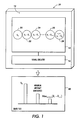
- Fig. 1 shows article 10 with substrate 12 on the surface of which circuitry is formed.
- the circuitry includes array 14 of light active units, a series of which is shown in greater detail.
- the circuitry also includes signal circuitry for receiving signals from or providing signals to light active units in array 14.
- Array 14 includes a series of ( n +1) light active units 20, 22, 24, 26, and 28.
- the effective size of each illustrated light active unit is shown in relation to s 1 , the effective size of light active unit 20, the largest in the series.
- Light active unit 22 is smaller than light active unit 20 by a first difference ⁇ 1
- light active unit 24 is smaller by a second difference ⁇ 2
- so forth for other intermediate light active units in the series Therefore, light active unit 26 is smaller by an ( n -1)th difference ⁇ n-1 and the smallest, light active unit 28, is smaller by an n th difference ⁇ n .
- each intermediate unit in the series between light active units 20 and 28 has an effective size less than that of the preceding unit in the series and greater than that of the following unit in the series.
- Fig. 1 also shows image size 30, the image size with which array 14 interacts.
- image size 30 is a bar graph with three bars representing key differences between effective sizes of adjacent light active units.
- the left bar represents the size difference ⁇ n , the difference that would occur if light active units 20 and 28 were adjacent.
- the middle bar represents the minimum artifact difference ("MAD"), meaning the minimum size difference between adjacent light active units at which an artifact is produced for image size 30 when article 10 is in use.
- Fig. 2 shows display array 50, with substrate 52 on a surface of which array circuitry 54 provides an array of light control units.
- the signal circuitry for array circuitry 54 has a first set of lines extending left and right and a second set of lines extending up and down.
- the first set of lines could, for example, be scan lines, and the second set could be data lines.
- the signal circuitry includes paired lines 56 and 58 which extend alongside each other and are therefore not separated by a row of light control units. Paired lines 56 and 58 could both be in the first set of lines, but not separated by a row of light control units because they occur at a split in the array. Or one of paired lines 56 and 58 could be in the first set of lines and the other could be an additional line, such as a repair line.
- Region 60 of array circuitry 54 is shown in more detail at the right side of Fig. 2.
- Region 60 includes, in addition to paired left and right lines 56 and 58, single left and right lines 62, 64, 66, 68, 70, and 72 and up and down lines 80 and 82.
- Lines 56 and 62 are separated by a row of light control units, as are lines 58 and 64, lines 64 and 66, lines 66 and 68, and lines 70 and 72.
- Lines 80 and 82 are separated by a column of light control units.
- the spacings immediately above and below, each designated h are smaller than the spacings between adjacent left and right lines elsewhere in array circuitry 54. If there were no paired lines, the spacings between left and right lines could all take a maximum value of H, the spacing between lines 80 and 82, and the left and right lines could have constant pitch.
- the effective size of light control units in each row is proportional to the spacing between the lines immediately above and below that row, assuming that the up and down lines are all evenly spaced at the same spacing as lines 80 and 82. Therefore, even if the overall difference (H- h ) is greater than the minimum artifact difference for the size of images presented by display array 50, it may be possible to make all the differences in spacing between adjacent rows less than the minimum artifact difference by slightly modifying the pitch of rows near paired lines 56 and 58. In effect, the pitch of the rows adjacent paired lines 56 and 58 can be increased slightly to compensate for the extra line, while the pitch of the next rows can be decreased slightly because they do not include extra lines and therefore must be more closely spaced to provide an appropriate effective size.
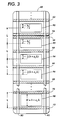
- Fig. 3 shows the same lines as in Fig. 2, and aperture areas 90, 92, 94, 96, and 98 which remain after a dark matrix is applied over the lines.
- the pitch between the centers of lines 70 and 72 is L, which is the same as the pitch between the centers of aperture areas 90 and 92, aperture areas 92 and 94, and aperture areas 94 and 96.
- Aperture areas 90 and 92 are reduced to size h due to the presence of paired lines 56 and 58 between them, with h /2 both above and below the center of each aperture area.
- aperture area 90 is spaced more from line 62 than from line 56
- aperture area 92 is similarly spaced more from line 64 than from line 58.
- Aperture area 94 has a height of h+ a 1 ⁇ , again divided equally above and below its center.
- Aperture area 96 has a height of h +a 2 ⁇ , again divided equally above and below its center.
- Figs. 4-6 show features of a layout of a split array.
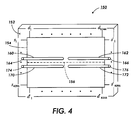
- Display array 150 in Fig. 4 includes substrate 152, which can be a transparent glass sheet as described in relation to Fig. 7 of US-A-5 491 347.
- Array region 154 on the surface of substrate 152 is split into upper and lower array regions along split line 156.
- the circuitry in array region 154 also includes two repair structures.
- the upper repair stucture is along the upper side of split line 156, and includes repair lines 160 and 162 in array region 154 and connecting leads 164 and 166 outside array region 154.
- the lower repair structure is along the lower side of split line 156, and includes repair lines 170 and 172 in array region 154 and connecting leads 174 and 176 outside array region 154.
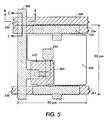
- Fig. 5 which is a modified version of Fig. 3 of US-A-5 491 347, shows a layout for a light control unit.
- Fig. 5 shows several layers, with upper layers that are farthest from the substrate's surface obscuring lower layers.
- the uppermost layer shown in Fig. 5 is a top metal layer, which forms data line 200 connected to a channel lead of an amorphous silicon (a-Si) transistor that switches the light control unit; the top metal layer also forms several other features described below.
- the next layer shown is a layer of indium-tin-oxide (ITO), which forms transparent electrode 202.
- ITO indium-tin-oxide
- the next layer is a top nitride layer, which forms insulating island 204, part of the transistor; the top nitride is an insulating layer that can form other features as mentioned below.
- the lowest layer shown is a bottom metal layer, which forms gate line 201, repair line 208, and, connected to gate line 201, gate lead 210, which serves as the gate lead of the transistor.
- Data line 200 provides a data signal to a column of light control units, one of which is shown in Fig. 5.
- the part of data line 200 that extends over gate lead 210 connects to one channel lead of the transistor.
- Gate line 201 similarly provides a scan signal to a row of light control units.
- Data line 200 and gate line 201 are illustratively each 10 ⁇ m wide, and repair line 208 can be of approximately the same width, as shown.
- Data line 200 crosses over gate line 201 in crossover region 220 and over repair line 208 in repair crossing region 222.
- Crossover region 220 and repair crossing region 222 can each include an insulator formed by the top nitride layer and other features as necessary to ensure that the lines conduct signals adequately and that signals in the lines do not interfere.
- Transparent electrode 202 connects to the other channel lead of the transistor through line 230, formed by the top metal layer. Therefore, when the transistor is conductive due to a scan signal provided to gate lead 210 by gate line 201, transparent electrode 202 receives and stores a drive signal from data line 200 through line 230.
- Transparent electrode 202 also connects to charging lead 232, which implements one electrode of a storage capacitor and is formed by the top metal layer.
- the light control unit shown in Fig. 5 is square, and an array of identical light control units would have effective widths in the row and column directions of 90 ⁇ m ⁇ 90 ⁇ m.
- the patterned layers shown in Fig. 5 can be produced using the technique described in relation to Fig. 4 of US-A-5 491 347.
- the bottom metal pattern can include repair line 208 and can also include peripheral lines that cross data lines outside the array region.
- Fig. 6 shows part of the layout of the bottom metal pattern along split line 156 in greater detail.
- repair lines 250 and 252 laid out in the manner illustrated in Fig. 5.
- scan lines 254 and 256 Parallel to and alongside repair lines 250 and 252 are scan lines 254 and 256, respectively.
- Each of the light control units could be laid out as illustrated in Fig. 5, with the rows above split line 156 rotated 180°.
- scan lines 260 and 262 control the first rows of light control units along split line 156
- scan lines 254 and 256 are dummy scan lines, not themselves providing scan signals but necessary to provide capacitor electrodes for the first rows of light control units.
- Scan lines 214 and 216 control second rows of light control units bounded on the opposite side by scan lines 260 and 262, respectively.
- Scan lines 270 and 272 similarly control third rows of light control units bounded on the opposite side by scan lines 264 and 266, respectively; scan lines 280 and 282 control n th rows of light control units; and scan lines 284 and 286 control ( n +1)th rows of light control units bounded on the opposite side by scan lines 280 and 282.
- the light control units in the first rows along split line 156 could be laid out with repair lines along the scan lines that drive the first rows, in which case scan lines 254 and 256 control the first rows of light control units; scan lines 260 and 262 control the second rows; scan lines 264 and 266 control the third rows; and so forth.
- Fig. 6 shows sizes in the y -direction of rows of light control units between adjacent lines in the bottom metal pattern.
- the sizes shown can either indicate the actual spacing in the y -direction between adjacent lines or the aperture size in the y -direction that, when taken with the actual aperture size in the x-direction, would produce the actual aperture area of each light control unit between the lines.
- the sizes are such that a human viewer with normal vision viewing display array 150 at usual viewing distances cannot perceive a difference between single lines such as lines 260, 262, 264, 266, 270, 272, 280, 282, 284, and 286 on the one hand and, on the other hand, grouped lines such as lines 250, 252, 254, and 256.
- the size of the row of light control units between adjacent lines 280 and 284 and between adjacent lines 282 and 286 is h MAX , the largest size that occurs in the array.
- 2 n rows of light control units are between lines 280 and 282, n above split line 156 and n below.
- the rows next to split line 156, referred to above as the first rows, have a size of ( h MAX - ⁇ n ), the smallest size shown.
- the second rows have a size of ( h MAX - ⁇ n-1 ), the third rows ( h MAX - ⁇ n-2 ), and so forth until the n th rows have a size of ( h MAX - ⁇ 1 ).
- the difference between light control units of 80 ⁇ m and light control units of 70.1 ⁇ m might be perceptible if they were juxtaposed, when the transition between them is in increments of 0.09 ⁇ m, perceptibility is decreased.
- the increments can be no smaller than 0.5 ⁇ m.
- it may be preferable to step the ⁇ i by equal increments ⁇ ⁇ 1 after groups of rows, such as after each 10th row.
- each single line or group of lines can be centered on the appropriate position and the apertures of the light control units can be adjusted.
- Fig. 6 with four lines grouped along split line 156, may work best with light control units that have large aperture areas and are separated by relatively narrow lines, because the proportional difference between adjacent rows of light control units will be relatively small.
- Figs. 7 and 8 show features of a structure laid out as described above.
- Fig. 7 shows a cross section along line B-B in Fig. 5.
- Fig. 8 shows a cross section along line C-C in Fig. 5.
- the cross sections in Figs. 7 and 8 can be understood more fully from US-A-5 486 939.
- the structure shown in Figs. 7 and 8, which are similar respectively to Figs. 8 and 9 of US-A-5 486 939, can be produced using the process in Fig. 7 of US-A-5 486 939, which is substantially the same as Fig. 4 of US-A-5 491 347. Layers of the same material are similarly shaded and bear the same reference number in the two drawings.
- Substrate 300 has surface 302 at which a thin-film structure is formed, beginning with bottom metal layer 304.
- Fig. 7 shows part of bottom metal layer 304 in repair line 208 in Fig. 5, while Fig. 8 shows repair line 208 at right and scan line 234 at left.
- Over bottom metal layer 304 is bottom nitride layer 310, followed by undoped amorphous silicon layer 312.
- Over amorphous silicon layer 312 is top nitride layer 314.
- Over top nitride layer 314 where it exists and over amorphous silicon layer 312 elsewhere is n+ amorphous silicon layer 320.
- Over n+ layer 320 is top metal layer 322.
- Over top metal layer 322 and other exposed layers can be a passivation layer (not shown).
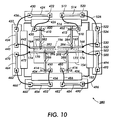
- Figs. 9 and 10 show features of repair techniques.
- the act in box 350 in Fig. 9 begins by producing a split array that includes repair lines that are parallel to scan lines and that cross data lines.
- the act in box 350 can be implemented as described above in relation to Figs. 4-6.
- the act in box 352 then tests the split array for data line defects. Since each data line has only one accessible lead, this cannot be done with conventional continuity testing. Instead, test equipment such as the In-Process Tester (IPT) from Photon Dynamics, Inc., Milpitas, California can be used to find defects in the array. As explained by Bond, J., and Levenson, M.D., "The US gears up to challenge Japan in flat panel displays," Solid State Technology, December 1993, pp. 37, 38, and 40-43, the IPT can use a noncontact method of performing voltage imaging on AMLCDs before cell assembly. The IPT can scan the substrate with light to collect data on the location and type of line defects, testing all the data lines.
- IPT In-Process Tester
- the act in box 354 repairs data line shorts by laser cutting to eliminate each short.
- This act may include cutting a data line to create an open on each side of a short to a scan line, for example.
- This act can be performed with the Photon Dynamics LCD Panel Repair System using the integrated laser trim (ILT) capability.
- ILT integrated laser trim
- the act in box 360 repairs data line opens, including any created in box 354, by laser welding each open data line to a repair line that it crosses and to a peripheral line that it crosses.
- This act can also be performed with the Photon Dynamics LCD Panel Repair System, but using the integrated laser weld (ILW) capability to produce conductive paths between lines that cross.
- ILW integrated laser weld
- the act in box 364 completes repair of data line opens by soldering wires for each open data line so that one or more highly conductive lines on the PCBs are electrically connected between the connecting lead of the data line's repair line and the lead of the data line's peripheral line.
- Fig. 10 shows features of a repaired array 380 produced by the technique of Fig. 9 using array 150 in Fig. 4. with array region 154 on a surface of substrate 152. and with repair lines 160. 162, 170, and 172 having connecting leads 164, 166, 174, and 176, respectively.
- PCBs are connected around the edge of substrate 152 by TABs as in Figs. 1 and 8.
- Open lines 382, 384, 386, and 388 are electrically connected to repair lines 160, 162, 170, and 172 by laser welds 390, 392, 394, and 396, respectively. Open lines 382, 384, 386, and 388 are also electrically connected to peripheral lines 400, 402, 404, and 406 by laser welds 410, 412, 414, and 416, respectively.
- Lead 420 on peripheral line 400 is electrically connected to lead 422 on conductive line 424 by wire 426.
- Lead 430 on conductive line 424 is in turn connected to lead 432 on conductive line 434 by wire 436.
- Lead 440 on conductive line 434 is in turn connected to connecting lead 164 by wire 442, completing the repair of open line 382.
- Lead 450 on peripheral line 404 is electrically connected to lead 452 on conductive line 454 by wire 456.
- Lead 460 on conductive line 454 is in turn connected to lead 462 on conductive line 464 by wire 466.
- Lead 470 on conductive line 464 is in turn connected to connecting lead 174 by wire 472, completing the repair of open line 386.
- Lead 480 on peripheral line 406 is electrically connected to lead 482 on conductive line 484 by wire 486.
- Lead 490 on conductive line 484 is in turn connected to lead 492 on conductive line 494 by wire 496.
- Lead 500 on conductive line 494 is in turn connected to connecting lead 676 by wire 502, completing the repair of open line 388.
- Lead 510 on peripheral line 402 is electrically connected to lead 512 on conductive line 514 by wire 516.
- Lead 520 on conductive line 514 is in turn connected to lead 522 on conductive line 524 by wire 526.
- Lead 530 on conductive line 524 is in turn connected to connecting lead 666 by wire 532, completing the repair of open line 384.
- the above implementation provides an array appropriate for an AMLCD, but the invention could be implemented in another type of display array, in another type of light valve array, or in another array in which light active units interact with images.
- the above implementation provides an array of cells with particular dimensions and densities.
- the invention could be implemented with a wide variety of array sizes and shapes, cell sizes and shapes, and cell densities.
- the above implementation adjusts sizes of cells due to a group of four lines.
- the invention could provide appropriately sized light active units in various other situations, including situations in which lines are paired or in which a light active unit's effective size is reduced by a line that crosses the center of the unit.
- the above implementation provides a split array with four repair lines along the split.
- the invention could be implemented, however, with an array that is not split or with an array with more or less repair lines or with repair lines positioned elsewhere within an array.
- an array could be implemented with polysilicon TFTs rather than amorphous silicon TFTs, and some of the drive circuitry could be integrated on the same substrate as the array.
- the data lines and scan lines could include other conductive materials such as doped semiconductive material.
- the insulating layers could include other insulating materials.
- the implementation described above provides thin film circuitry on an insulating substrate.
- the invention could be implemented with other types of circuitry on other types of substrates.
- the implementation described above includes layers in a specific sequence, but the sequence of layers could be modified, such as by producing a top gate TFT structure or a structure in which scan lines cross over data lines.
- the invention could be applied in many ways, including elimination of artifacts in display arrays, light valve arrays, and other arrays that interact with images.
Landscapes
- Physics & Mathematics (AREA)
- Nonlinear Science (AREA)
- General Physics & Mathematics (AREA)
- Chemical & Material Sciences (AREA)
- Crystallography & Structural Chemistry (AREA)
- Mathematical Physics (AREA)
- Geometry (AREA)
- Optics & Photonics (AREA)
- Devices For Indicating Variable Information By Combining Individual Elements (AREA)
- Liquid Crystal (AREA)
- Photometry And Measurement Of Optical Pulse Characteristics (AREA)
- Transforming Electric Information Into Light Information (AREA)
- Thin Film Transistor (AREA)
Applications Claiming Priority (2)
| Application Number | Priority Date | Filing Date | Title |
|---|---|---|---|
| US08/579,048 US5731803A (en) | 1995-12-21 | 1995-12-21 | Array with light active units sized to eliminate artifact from size difference |
| US579048 | 2000-05-26 |
Publications (3)
| Publication Number | Publication Date |
|---|---|
| EP0780904A2 true EP0780904A2 (de) | 1997-06-25 |
| EP0780904A3 EP0780904A3 (de) | 1999-08-11 |
| EP0780904B1 EP0780904B1 (de) | 2009-02-18 |
Family
ID=24315372
Family Applications (1)
| Application Number | Title | Priority Date | Filing Date |
|---|---|---|---|
| EP96309251A Expired - Lifetime EP0780904B1 (de) | 1995-12-21 | 1996-12-18 | Pixelmatrixanzeige, deren Pixelgeometrie die Unterdrückung von Bildartefakten erlaubt, welche durch Unterbrechungen in der Pixelanordnung einer Anzeige entstehen |
Country Status (4)
| Country | Link |
|---|---|
| US (1) | US5731803A (de) |
| EP (1) | EP0780904B1 (de) |
| JP (1) | JPH09230386A (de) |
| DE (1) | DE69637835D1 (de) |
Families Citing this family (3)
| Publication number | Priority date | Publication date | Assignee | Title |
|---|---|---|---|---|
| TWI223713B (en) * | 2003-03-31 | 2004-11-11 | Toppoly Optoelectronics Corp | Method and system for testing driver circuits of AMOLED |
| US8228350B2 (en) * | 2008-06-06 | 2012-07-24 | Omnivision Technologies, Inc. | Data dependent drive scheme and display |
| US10926357B2 (en) * | 2017-04-12 | 2021-02-23 | Dpix, Llc | Method and functional architecture for inline repair of defective imaging arrays |
Citations (3)
| Publication number | Priority date | Publication date | Assignee | Title |
|---|---|---|---|---|
| US5464984A (en) | 1985-12-11 | 1995-11-07 | General Imaging Corporation | X-ray imaging system and solid state detector therefor |
| US5486939A (en) | 1994-04-28 | 1996-01-23 | Xerox Corporation | Thin-film structure with insulating and smoothing layers between crossing conductive lines |
| US5491347A (en) | 1994-04-28 | 1996-02-13 | Xerox Corporation | Thin-film structure with dense array of binary control units for presenting images |
Family Cites Families (19)
| Publication number | Priority date | Publication date | Assignee | Title |
|---|---|---|---|---|
| JPS60218626A (ja) * | 1984-04-13 | 1985-11-01 | Sharp Corp | カラ−液晶表示装置 |
| US5602679A (en) * | 1987-12-31 | 1997-02-11 | Projectavision, Inc. | High efficiency light valve projection system |
| JPH0823643B2 (ja) * | 1989-03-28 | 1996-03-06 | シャープ株式会社 | アクティブマトリクス表示装置 |
| DE3910418A1 (de) * | 1989-03-31 | 1990-10-04 | Licentia Gmbh | Anzeigevorrichtung |
| EP0404528B1 (de) * | 1989-06-20 | 1994-10-12 | Sharp Kabushiki Kaisha | Matrixanzeigevorrichtung |
| JPH03107189A (ja) * | 1989-09-20 | 1991-05-07 | Matsushita Electric Ind Co Ltd | 表示装置 |
| CA2075441A1 (en) * | 1991-12-10 | 1993-06-11 | David D. Lee | Am tft lcd universal controller |
| JP3206976B2 (ja) * | 1992-07-28 | 2001-09-10 | 京セラ株式会社 | 液晶表示素子 |
| CN1065051C (zh) * | 1992-08-13 | 2001-04-25 | 卡西欧计算机公司 | 薄膜晶体管阵列及使用该阵列的液晶显示器 |
| JPH06282245A (ja) * | 1993-03-25 | 1994-10-07 | Toshiba Corp | 画像表示装置および画像処理システム |
| DE69409453T2 (de) * | 1993-08-31 | 1998-11-12 | Advanced Micro Devices Inc | Gerät zur Veränderung eines elektrischen Signals |
| US5485293A (en) * | 1993-09-29 | 1996-01-16 | Honeywell Inc. | Liquid crystal display including color triads with split pixels |
| US5475246A (en) * | 1993-12-20 | 1995-12-12 | General Electric Company | Repair line structure for thin film electronic devices |
| JP3671056B2 (ja) * | 1993-12-20 | 2005-07-13 | ゼネラル・エレクトリック・カンパニイ | アドレス線修理構造及び薄膜作像装置に対する方法 |
| US5381014B1 (en) * | 1993-12-29 | 1997-06-10 | Du Pont | Large area x-ray imager and method of fabrication |
| WO1995027369A1 (en) * | 1994-03-31 | 1995-10-12 | Minnesota Mining And Manufacturing Company | Imaging system employing variable electrode geometry and processing |
| US5473452A (en) * | 1994-12-21 | 1995-12-05 | Goldstar Co., Ltd. | Liquid crystal display device with repair structure |
| US5648674A (en) * | 1995-06-07 | 1997-07-15 | Xerox Corporation | Array circuitry with conductive lines, contact leads, and storage capacitor electrode all formed in layer that includes highly conductive metal |
| US5608245A (en) * | 1995-12-21 | 1997-03-04 | Xerox Corporation | Array on substrate with repair line crossing lines in the array |
-
1995
- 1995-12-21 US US08/579,048 patent/US5731803A/en not_active Expired - Lifetime
-
1996
- 1996-11-28 JP JP8318145A patent/JPH09230386A/ja active Pending
- 1996-12-18 DE DE69637835T patent/DE69637835D1/de not_active Expired - Lifetime
- 1996-12-18 EP EP96309251A patent/EP0780904B1/de not_active Expired - Lifetime
Patent Citations (3)
| Publication number | Priority date | Publication date | Assignee | Title |
|---|---|---|---|---|
| US5464984A (en) | 1985-12-11 | 1995-11-07 | General Imaging Corporation | X-ray imaging system and solid state detector therefor |
| US5486939A (en) | 1994-04-28 | 1996-01-23 | Xerox Corporation | Thin-film structure with insulating and smoothing layers between crossing conductive lines |
| US5491347A (en) | 1994-04-28 | 1996-02-13 | Xerox Corporation | Thin-film structure with dense array of binary control units for presenting images |
Non-Patent Citations (1)
| Title |
|---|
| BOND J., LEVENSON M.D.: "The US gears up to challenge Japan in flat panel displays.", SOLID STATE TECHNOLOGY., December 1993 (1993-12-01), pages 37/38 - 40-43 |
Also Published As
| Publication number | Publication date |
|---|---|
| EP0780904B1 (de) | 2009-02-18 |
| US5731803A (en) | 1998-03-24 |
| EP0780904A3 (de) | 1999-08-11 |
| JPH09230386A (ja) | 1997-09-05 |
| DE69637835D1 (de) | 2009-04-02 |
Similar Documents
| Publication | Publication Date | Title |
|---|---|---|
| US7362393B2 (en) | Four color liquid crystal display | |
| US6111621A (en) | Flat panel display devices having improved signal line repair capability | |
| KR100997965B1 (ko) | 액정 표시 장치 | |
| CN100430783C (zh) | 液晶显示器 | |
| KR100806897B1 (ko) | 액정 표시 장치 | |
| US6982569B2 (en) | Multiple testing bars for testing liquid crystal display and method thereof | |
| KR100298995B1 (ko) | 액정 표시 장치 및 그 검사 방법 | |
| US5517341A (en) | Liquid crystal display with TFT and capacitor electrodes with redundant connection | |
| US6172729B1 (en) | Liquid crystal display device of delta arrangement having pixel openings with sides oblique to scan lines | |
| US10223958B2 (en) | Display device and driving method thereof | |
| US6052167A (en) | Liquid crystal display having only one common line in peripheral region of substrate | |
| EP0780766B1 (de) | Matrize auf Substrat und Herstellungsverfahren | |
| US6226057B1 (en) | Liquid crystal display having overlapped pixel electrodes and method for fabricating the same | |
| US8730420B2 (en) | Liquid crystal display | |
| US20080180372A1 (en) | Display device | |
| KR20030054280A (ko) | 액정 표시 장치 | |
| GB2275809A (en) | Liquid crystal display | |
| JP2007114778A (ja) | 薄膜トランジスタ表示板 | |
| US20100032677A1 (en) | Display device | |
| EP1672414B1 (de) | Dünnschichttransistormatrix und Flüssigkristallanzeige mit dieser Matrix | |
| WO2004017129A1 (en) | Pixel array for display device and liquid crystal display | |
| KR20030086399A (ko) | 액정 표시 장치 | |
| JP3093739B2 (ja) | 液晶表示装置及びその製造方法並びに不良検査方法 | |
| EP0780904B1 (de) | Pixelmatrixanzeige, deren Pixelgeometrie die Unterdrückung von Bildartefakten erlaubt, welche durch Unterbrechungen in der Pixelanordnung einer Anzeige entstehen | |
| US8310262B2 (en) | Multiple testing bars for testing liquid crystal display and method thereof |
Legal Events
| Date | Code | Title | Description |
|---|---|---|---|
| PUAI | Public reference made under article 153(3) epc to a published international application that has entered the european phase |
Free format text: ORIGINAL CODE: 0009012 |
|
| AK | Designated contracting states |
Kind code of ref document: A2 Designated state(s): DE FR GB |
|
| PUAL | Search report despatched |
Free format text: ORIGINAL CODE: 0009013 |
|
| AK | Designated contracting states |
Kind code of ref document: A3 Designated state(s): DE FR GB |
|
| RIC1 | Information provided on ipc code assigned before grant |
Free format text: 6G 02F 1/1343 A, 6G 02F 1/136 B, 6H 01L 27/146 B |
|
| 17P | Request for examination filed |
Effective date: 20000211 |
|
| 17Q | First examination report despatched |
Effective date: 20040211 |
|
| 17Q | First examination report despatched |
Effective date: 20040211 |
|
| GRAP | Despatch of communication of intention to grant a patent |
Free format text: ORIGINAL CODE: EPIDOSNIGR1 |
|
| RTI1 | Title (correction) |
Free format text: PIXEL GEOMETRY FOR THE SUPPRESSION OF IMAGE ARTIFACTS DUE TO DISCONTINUITIES IN THE PIXEL ARRAY OF A DISPLAY |
|
| RTI1 | Title (correction) |
Free format text: PIXEL MATRIX DISPLAY WHOSE GEOMETRY ALLOWS FOR THE SUPPRESSION OF IMAGE ARTIFACTS DUE TO DISCONTINUITIES IN THE PIXEL ARRAY |
|
| GRAS | Grant fee paid |
Free format text: ORIGINAL CODE: EPIDOSNIGR3 |
|
| RAP1 | Party data changed (applicant data changed or rights of an application transferred) |
Owner name: THOMSON LICENSING LLC |
|
| GRAA | (expected) grant |
Free format text: ORIGINAL CODE: 0009210 |
|
| AK | Designated contracting states |
Kind code of ref document: B1 Designated state(s): DE FR GB |
|
| REG | Reference to a national code |
Ref country code: GB Ref legal event code: FG4D |
|
| REF | Corresponds to: |
Ref document number: 69637835 Country of ref document: DE Date of ref document: 20090402 Kind code of ref document: P |
|
| PLBE | No opposition filed within time limit |
Free format text: ORIGINAL CODE: 0009261 |
|
| STAA | Information on the status of an ep patent application or granted ep patent |
Free format text: STATUS: NO OPPOSITION FILED WITHIN TIME LIMIT |
|
| 26N | No opposition filed |
Effective date: 20091119 |
|
| PGFP | Annual fee paid to national office [announced via postgrant information from national office to epo] |
Ref country code: GB Payment date: 20121219 Year of fee payment: 17 |
|
| PGFP | Annual fee paid to national office [announced via postgrant information from national office to epo] |
Ref country code: DE Payment date: 20121217 Year of fee payment: 17 Ref country code: FR Payment date: 20130128 Year of fee payment: 17 |
|
| REG | Reference to a national code |
Ref country code: DE Ref legal event code: R119 Ref document number: 69637835 Country of ref document: DE |
|
| GBPC | Gb: european patent ceased through non-payment of renewal fee |
Effective date: 20131218 |
|
| REG | Reference to a national code |
Ref country code: FR Ref legal event code: ST Effective date: 20140829 |
|
| REG | Reference to a national code |
Ref country code: DE Ref legal event code: R119 Ref document number: 69637835 Country of ref document: DE Effective date: 20140701 |
|
| PG25 | Lapsed in a contracting state [announced via postgrant information from national office to epo] |
Ref country code: DE Free format text: LAPSE BECAUSE OF NON-PAYMENT OF DUE FEES Effective date: 20140701 |
|
| PG25 | Lapsed in a contracting state [announced via postgrant information from national office to epo] |
Ref country code: FR Free format text: LAPSE BECAUSE OF NON-PAYMENT OF DUE FEES Effective date: 20131231 Ref country code: GB Free format text: LAPSE BECAUSE OF NON-PAYMENT OF DUE FEES Effective date: 20131218 |