EP0776589B1 - Attribution des canaux dans un systeme radiotelephonique mobile - Google Patents
Attribution des canaux dans un systeme radiotelephonique mobile Download PDFInfo
- Publication number
- EP0776589B1 EP0776589B1 EP96919844A EP96919844A EP0776589B1 EP 0776589 B1 EP0776589 B1 EP 0776589B1 EP 96919844 A EP96919844 A EP 96919844A EP 96919844 A EP96919844 A EP 96919844A EP 0776589 B1 EP0776589 B1 EP 0776589B1
- Authority
- EP
- European Patent Office
- Prior art keywords
- base station
- mobile radio
- interfering
- selected channel
- base stations
- Prior art date
- Legal status (The legal status is an assumption and is not a legal conclusion. Google has not performed a legal analysis and makes no representation as to the accuracy of the status listed.)
- Expired - Lifetime
Links
- 230000002452 interceptive effect Effects 0.000 claims abstract description 52
- 238000000034 method Methods 0.000 claims description 17
- 238000010295 mobile communication Methods 0.000 claims description 10
- 239000002585 base Substances 0.000 description 91
- 238000010586 diagram Methods 0.000 description 2
- 239000003637 basic solution Substances 0.000 description 1
- 238000004891 communication Methods 0.000 description 1
- 238000007726 management method Methods 0.000 description 1
- 230000011664 signaling Effects 0.000 description 1
- 239000000243 solution Substances 0.000 description 1
Images

Classifications
-
- H—ELECTRICITY
- H04—ELECTRIC COMMUNICATION TECHNIQUE
- H04W—WIRELESS COMMUNICATION NETWORKS
- H04W16/00—Network planning, e.g. coverage or traffic planning tools; Network deployment, e.g. resource partitioning or cells structures
- H04W16/02—Resource partitioning among network components, e.g. reuse partitioning
- H04W16/10—Dynamic resource partitioning
-
- H—ELECTRICITY
- H04—ELECTRIC COMMUNICATION TECHNIQUE
- H04W—WIRELESS COMMUNICATION NETWORKS
- H04W72/00—Local resource management
- H04W72/50—Allocation or scheduling criteria for wireless resources
- H04W72/54—Allocation or scheduling criteria for wireless resources based on quality criteria
- H04W72/541—Allocation or scheduling criteria for wireless resources based on quality criteria using the level of interference
-
- H—ELECTRICITY
- H04—ELECTRIC COMMUNICATION TECHNIQUE
- H04W—WIRELESS COMMUNICATION NETWORKS
- H04W72/00—Local resource management
- H04W72/02—Selection of wireless resources by user or terminal
Definitions
- the invention relates to a method for allocating channels in a mobile communications system comprising a data base, a first base station and second base stations interfering with the first base station, isolated mobile radios, each of which is normally capable of communicating solely within a coverage area of a specified base station, and freely mobile radios, each of which is capable of communicating via any of the base stations.
- the invention relates to the field of radio phone systems.
- a subscriber in a radio phone system i.e. a radio unit or a subscriber station, for instance a radio phone or some other means of communication, may be registered in a radio network or system, whereby it is registered in the radio network via system and traffic channels maintained by the base stations of the radio network.
- trunked networks which are typically company networks cr government networks in which all channels are shared by one or several companies or governmental agencies.
- This invention is especially suitable for radio systems where part of the radio users, or a group of users, may always be located in such isolated areas that the channels used by them could be reused already at the neighbouring base stations.
- Such user groups can be found, for instance, in underground (railway) systems.
- the invention is suitable for use in mobile radio systems with digital as well as analog radio paths.
- Analog mobile radio systems have been described for example in MPT 1327 , January 1988, revised and reprinted November 1991, A Signalling Standard for Trunked Private Land Mobile Radio Systems, and MPT 1343, January 1988, revised and reprinted September 1991, Performance Specification, United Kingdom Department of Trade and Industry, Radiocommunications Agency.
- the problem to be solved by this invention is how to reduce the number of radio channels used in a mobile radio system, especially in a PMR system.
- channels In a conventional channel management system, channels must be divided between base station sites in a way which ensures that the base stations do not interfere with each other. The same channel cannot be given to sites which are close enough to cause interference. This makes it possible to use any channel at any time without checking if the channel is already being used.
- dynamic channel allocation A newer prior art method for allocating channels is called dynamic channel allocation.
- the basic idea in dynamic channel allocation is that the same channels can be shared by base station sites even if they are situated geographically close enough to cause interference. Nearby sites sharing the same channels are listed in the exchange, and whenever a shared channel is allocated for a call, it is blocked from use on sites where it might cause interference. When the channel has been released, it is again available to any of these sites.
- the coverage of the system can be extended without it being necessary to add more channels.
- the channels of the system can be used on any base station site according to traffic load. The maximum call switching capacity of the system will not be increased, however.
- This invention relates to a method for allocating channels in a mobile communications system comprising a data base, a first base station and second base stations interfering with the first base station, isolated mobile radios, each of which is normally capable of communicating solely within a coverage area of a specified base station, and freely mobile radios, each of which is capable of communicating via any of the base stations, the method comprising the following steps: maintaining in the data base a file on the interfering base stations for the first base station, selecting a free channel to be allocated to a requesting mobile radio at the first base station, checking whether the mobile radio is an isolated mobile radio or a freely mobile radio, checking whether the selected channel is free at the interfering base stations, allocating said selected channel if the selected channel is free at the interfering base stations, allocating said selected channel if the selected channel is allocated only to one or to several isolated mobile radios at one or several interfering base stations and if the requesting mobile radio is an isolated mobile radio, preventing allocation of said selected channel if the selected channel is allocated to a
- the present invention further relates to a mobile communications system comprising: a first base station and second base stations interfering with the first base station, isolated mobile radios, each of which is normally capable of communicating solely within a coverage area of a specified base station, and freely mobile radios, each of which is capable of communicating via any of the base stations, a data base for maintaining a file on the interfering base stations for the first base station, a selector for selecting a free channel to be allocated to a requesting mobile radio at the first base station, a first checker for checking whether the mobile radio is an isolated mobile radio or a freely mobile radio, a second checker for checking whether the selected channel is free at the interfering base stations, a first allocator for allocating said selected channel if the selected channel is free at the interfering base stations, a second allocator for allocating said selected channel if the selected channel is allocated only to one or to several isolated mobile radios at one or several interfering base stations and if the requesting mobile radio is an isolated mobile radio, first
- the invention is based on the idea that the channel reservation situation of the mobile communications system is always checked also on the interfering base stations when allocating a new channel of a base station.
- each time the system allocates a new channel to a mobile radio on a (first) base station site it checks that there is a free channel for the mobile radio on that site. If there is a free channel to be found, it is then checked whether there are still any base station sites that interfere with the first base station site. If there are no more interfering sites around the first site, then the channel is allocated to an isolated radio on the first base station site.
- IR isolated radio
- the channel to be allocated is used only by one or several isolated radios, then it is clear that, concerning that second base station site, that specific channel can be used on the first base station site. In the other case, if the channel is used by a freely mobile radio (FR), which is capable of communicating via any base station of the network, then that channel can not be allocated for the intended use.
- FR freely mobile radio
- the mobile station that is going to use the channel is an isolated radio, which is normally capable of communicating solely within a coverage area of a specified base station, or whether the mobile station is a freely mobile radio, which is capable of communicating via any base station of the network.
- a further advantage of the invention is that when the mobile communications system has only isolated radios (IR), which are normally capable of communicating solely within a coverage area of a specified base station, and a limited number of channels, then the number of channels available on a base station site can be multiplied by the number of interfering sites because of the invention.
- IR isolated radios
- Still another advantage of the invention is that when the system has both IR and FR mobile radios, the number of channels available on a base station site can be multiplied by the number of interfering sites in the ratio of N IR /(N IR +N FR ) because of the invention.
- FIG. 1 is a simplified schematic view of an underground (railway) system in which the invention is implemented.
- underground radio systems for example in the city of London, there is a base station BS1, BS2, BS3 in each railway station S1, S2, S3 feeding leaky cables LF1 on track 101 sides and as well as at stations S1 to S3.
- Neighbouring base stations BS1, BS2; BS2, BS3 interfere only in a small area I1; I2 between stations S1, S2; S2, S3 where their leaky feeders LF1 meet.
- a handportable mobile station MS2 that is a freely mobile radio (FR), which is capable of communicating via any base station of the network according to the interfering site concept.
- FR freely mobile radio
- the system should be able to make a difference between station handportables, i.e. isolated radios (IR), which are normally capable of communicating solely within a coverage area of a specified base station, and train-carried radios, i.e. freely mobile radios (FR), which are capable of communicating via any base station of the network according to the interfering site concept.
- station handportables i.e. isolated radios (IR)
- FR freely mobile radios
- Figure 2 is a flow chart of the operation of the invention.
- the operation of the method starts in phase 200.
- each time the system allocates a new channel to a mobile radio on a (first) base station site it checks 201 that there is a free channel C for the mobile radio on that site S. If there is a free channel to be found, it is then checked 202 whether there are still any base station sites that interfere with the first base station site. If there are 205 no more interfering sites for the first site, then the channel C is allocated 206 to an isolated radio on the first base station site.
- the operation returns to phase 202.
- the channel to be allocated is used by an isolated radio (IR), i.e. a radio that is normally capable of communicating solely within a coverage area of a specified base station. If the channel to be allocated is used 210 by an isolated radio, then it is clear that, concerning that second base station site, that specific channel can be used on the first base station site. Then the system returns 210 to phase 202.
- IR isolated radio
- FR means a freely mobile radio, i.e. freely mobile radios capable of communicating via any base station of the network.
- IR means an isolated radio, which is normally capable of communicating solely within a coverage area of a specified base station. The following conditions must be fulfilled before starting to use the same channels on interfering base station sites.
- the subscriber is a FR or IR subscriber on a user or user group basis in the subscriber data base of the mobile communications system.
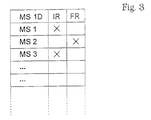
- Figure 3 is a block diagram illustrating the database realizing the invention.
- the database contains the identifiers MS ID of the mobile stations MS1, MS2, MS3.
- In the database there are two flags for every identifier MS1, MS2, MS3 of the mobile station.
- the IR flag indicates whether the mobile station in question is an isolated radio, and FR flag indicates whether the mobile in question is a freely mobile radio.
- the data base is also maintained a file on the interfering base stations for all of the base stations, particularly for the first base station.
Landscapes
- Engineering & Computer Science (AREA)
- Computer Networks & Wireless Communication (AREA)
- Signal Processing (AREA)
- Quality & Reliability (AREA)
- Mobile Radio Communication Systems (AREA)
Claims (2)
- Procédé pour attribuer des canaux dans un système radiotéléphonique mobile, comprenant une base de données, une première station de base et des deuxième stations de base brouillant la première station de base, des radiotéléphones mobiles isolés (MS1, MS3) dont chacun est normalement apte à communiquer uniquement dans une zone de desserte d'une station de base donnée (BS1, BS3), et des radiotéléphones (MS2) à liberté de mouvements dont chacun est apte à communiquer par l'intermédiaire de n'importe laquelle des stations de base (BS1, BS2, BS3), caractérisé en ce que le procédé comprend les étapes consistant à:actualiser dans la base de données un fichier sur les stations de base exerçant un brouillage pour la première station de base,sélectionner dans la première station de base un canal à attribuer à un radiotéléphone mobile demandeur,vérifier si le radiotéléphone mobile est un radiotéléphone mobile isolé ou un radiotéléphone à liberté de mouvements,vérifier si le canal choisi est libre dans lesdites deuxième stations de base brouillant la première station de base,attribuer ledit canal choisi si le canal choisi est libre dans les deuxième stations de base brouillant la première station de base,attribuer ledit canal choisi si le canal choisi est attribué à un seul ou à plusieurs radiotéléphones mobiles isolés dans une ou plusieurs secondes stations de base brouillant la première station de base et si le radiotéléphone mobile demandeur est un radiotéléphone mobile isolé,empêcher, dans n'importe laquelle desdites deuxième stations de base exerçant un brouillage de la première station de base, l'attribution dudit canal choisi si le canal choisi est attribué à un radiotéléphone à liberté de mouvements,empêcher l'attribution dudit canal sélectionné si le canal sélectionné est attribué à l'une des deuxièmes stations de base brouillant la première station de base et si le radiotéléphone mobile demandeur est un radiotéléphone à liberté de mouvements.
- Système radiotéléphonique mobile, comprenant:une première station de base et des deuxièmes stations de base brouillant la première station de base,des radiotéléphones mobiles isolés (MS1, MS3) dont chacun est normalement apte à communiquer uniquement dans une zone de desserte d'une station de base donnée (BS1, BS3), etdes radiotéléphones (MS2) à liberté de mouvements dont chacun est apte à communiquer par l'intermédiaire de l'une quelconque des stations de base (BS1, BS2, BS3), caractérisé en ce que le système comprend en outre:une base de données servant à actualiser un fichier concernant une première station de base dans les deuxièmes stations de base brouillant la première station de base,un sélecteur servant à sélectionner dans la première station de base un canal libre à attribuer à un radiotéléphone mobile demandeur,un premier moyen de contrôle servant à vérifier si le radiotéléphone mobile est un radiotéléphone mobile isolé ou un radiotéléphone à liberté de mouvements,un deuxième moyen de contrôle servant à vérifier si le canal sélectionné est libre dans les deuxièmes stations de base brouillant la première station de base,un premier moyen d'attribution servant à attribuer ledit canal sélectionné si le canal sélectionné libre dans lesdites deuxièmes stations de base brouillant la première station de base,un deuxième moyen d'attribution servant à attribuer ledit canal sélectionné si le canal sélectionné est attribué à un seul ou à plusieurs radiotéléphones mobiles isolés dans une ou plusieurs stations de base exerçant un brouillage et si le radiotéléphone mobile demandeur est un radiotéléphone mobile isolé,un premier moyen de prévention servant, dans l'une quelconque desdites deuxième stations de base brouillant la première station de base, à empêcher l'attribution dudit canal sélectionné si le canal sélectionné est attribué à un radiotéléphone à liberté de mouvements,un deuxième moyen de prévention servant à empêcher l'attribution dudit canal sélectionné si le canal sélectionné est attribué, dans l'une quelconque desdites deuxièmes stations brouillant la première station de base, et si le radiotéléphone mobile demandeur est un radiotéléphone à liberté de mouvements.
Applications Claiming Priority (3)
| Application Number | Priority Date | Filing Date | Title |
|---|---|---|---|
| GB9512295 | 1995-06-16 | ||
| GB9512295A GB2302481A (en) | 1995-06-16 | 1995-06-16 | Allocating channels in a mobile communications system |
| PCT/FI1996/000324 WO1997000590A1 (fr) | 1995-06-16 | 1996-05-31 | Attribution des canaux dans un systeme radiotelephonique mobile |
Publications (2)
| Publication Number | Publication Date |
|---|---|
| EP0776589A1 EP0776589A1 (fr) | 1997-06-04 |
| EP0776589B1 true EP0776589B1 (fr) | 1998-11-04 |
Family
ID=10776203
Family Applications (1)
| Application Number | Title | Priority Date | Filing Date |
|---|---|---|---|
| EP96919844A Expired - Lifetime EP0776589B1 (fr) | 1995-06-16 | 1996-05-31 | Attribution des canaux dans un systeme radiotelephonique mobile |
Country Status (8)
| Country | Link |
|---|---|
| EP (1) | EP0776589B1 (fr) |
| CN (1) | CN1087131C (fr) |
| AT (1) | ATE173128T1 (fr) |
| AU (1) | AU5823396A (fr) |
| DE (1) | DE69600914T2 (fr) |
| DK (1) | DK0776589T3 (fr) |
| GB (1) | GB2302481A (fr) |
| WO (1) | WO1997000590A1 (fr) |
Families Citing this family (12)
| Publication number | Priority date | Publication date | Assignee | Title |
|---|---|---|---|---|
| GB2320648A (en) | 1996-12-20 | 1998-06-24 | Dsc Telecom Lp | Controlling interference in a cell of a wireless telecommunications system |
| GB9702790D0 (en) * | 1997-02-11 | 1997-04-02 | Nokia Telecommunications Oy | Radio telephone systems and methods of operation |
| GB2337180B (en) * | 1997-02-11 | 2001-05-23 | Nokia Telecommunications Oy | Radio telephone systems and methods of operation |
| EP1841273A3 (fr) * | 1997-04-24 | 2013-12-18 | Ntt Mobile Communications Network Inc. | Procédé et système de communication mobile |
| GB9711356D0 (en) | 1997-05-30 | 1997-07-30 | Unilever Plc | Particulate detergent composition |
| KR100452276B1 (ko) * | 1997-12-26 | 2005-06-21 | 고려화학 주식회사 | 로진을이용한비닐바닥재 |
| GB2336972A (en) * | 1998-04-28 | 1999-11-03 | Nokia Telecommunications Oy | Channel allocation particularly in underground railway radio telephone system |
| JP3405322B2 (ja) * | 2000-06-15 | 2003-05-12 | 日本電気株式会社 | 非同期干渉回避方法及び非同期干渉回避システム |
| CN100391183C (zh) * | 2003-07-14 | 2008-05-28 | 日本电信电话株式会社 | 无线分组通信方法及无线分组通信装置 |
| US8477711B2 (en) * | 2009-12-04 | 2013-07-02 | General Electric Company | Media access control scheme for a multi-frequency TDMA network |
| US10624119B2 (en) | 2015-04-08 | 2020-04-14 | Qualcomm Incorporated | Transmission scheduling for contention based carrier |
| CN110769427B (zh) * | 2018-07-27 | 2023-06-13 | 哈尔滨海能达科技有限公司 | 同播系统的信道资源动态分配方法、装置及存储介质 |
Family Cites Families (4)
| Publication number | Priority date | Publication date | Assignee | Title |
|---|---|---|---|---|
| JP2653000B2 (ja) * | 1991-04-24 | 1997-09-10 | 日本電気株式会社 | 移動無線通信方式 |
| US5448750A (en) * | 1992-04-22 | 1995-09-05 | Telefonaktiebolaget Lm Ericsson | Segregation method of dynamic channel allocation in a mobile radio system |
| DE4307966C2 (de) * | 1993-03-12 | 2001-04-05 | Siemens Ag | Mobilfunksystem |
| US5530945A (en) * | 1993-08-31 | 1996-06-25 | At&T Corp. | Infrastructure equipment in a wireless communication system serves different service providers |
-
1995
- 1995-06-16 GB GB9512295A patent/GB2302481A/en not_active Withdrawn
-
1996
- 1996-05-31 DE DE69600914T patent/DE69600914T2/de not_active Expired - Fee Related
- 1996-05-31 DK DK96919844T patent/DK0776589T3/da active
- 1996-05-31 CN CN96190648.0A patent/CN1087131C/zh not_active Expired - Fee Related
- 1996-05-31 AU AU58233/96A patent/AU5823396A/en not_active Abandoned
- 1996-05-31 AT AT96919844T patent/ATE173128T1/de not_active IP Right Cessation
- 1996-05-31 EP EP96919844A patent/EP0776589B1/fr not_active Expired - Lifetime
- 1996-05-31 WO PCT/FI1996/000324 patent/WO1997000590A1/fr not_active Ceased
Also Published As
| Publication number | Publication date |
|---|---|
| DK0776589T3 (da) | 1999-07-19 |
| CN1157088A (zh) | 1997-08-13 |
| GB9512295D0 (en) | 1995-08-16 |
| CN1087131C (zh) | 2002-07-03 |
| ATE173128T1 (de) | 1998-11-15 |
| DE69600914D1 (de) | 1998-12-10 |
| WO1997000590A1 (fr) | 1997-01-03 |
| GB2302481A (en) | 1997-01-15 |
| DE69600914T2 (de) | 1999-04-29 |
| EP0776589A1 (fr) | 1997-06-04 |
| AU5823396A (en) | 1997-01-15 |
Similar Documents
| Publication | Publication Date | Title |
|---|---|---|
| Young | Advanced mobile phone service: Introduction, background, and objectives | |
| JP3244182B2 (ja) | 室内及び室外加入者用に意図した移動電話システム | |
| FI102703B (fi) | Kanavan allokointimenetelmä | |
| EP0739574B1 (fr) | Etablissement d'un appel groupe dans un systeme radio-mobile | |
| DE69220305T2 (de) | Funkverbindungsgestaltung für schnurlose Kommunikationssysteme | |
| EP0776589B1 (fr) | Attribution des canaux dans un systeme radiotelephonique mobile | |
| Amitay | Distributed switching and control with fast resource assignment/handoff for personal communications systems | |
| WO1995007012A1 (fr) | Procede de reglage de la puissance d'emission dans un systeme radio et un central | |
| Chang et al. | An efficient borrowing channel assignment scheme for cellular mobile systems | |
| US8054790B2 (en) | Frequency mapping for a wireless communication system | |
| CN102098685B (zh) | 基于gsm网络的频谱重用通信系统及方法 | |
| Kunavut | An overview of digital trunked radio: Technologies and standards | |
| CN114980129A (zh) | 跨运营商的频谱共享方法 | |
| JP2596184B2 (ja) | 無線チャンネル割当方式 | |
| CN111194091B (zh) | 混合集群系统、资源调度方法及装置、存储介质 | |
| JP2002262344A (ja) | 移動通信ネットワークにおける輻輳対策方法および回線制御装置 | |
| Khan et al. | Multilevel channel assignment (MCA) for wireless personal communications | |
| JPH08265839A (ja) | 移動無線通信システム | |
| JP2002262340A (ja) | ゾーン/セル共存移動通信ネットワークにおける無線チャネル割当て方法および回線制御装置 | |
| Dimitriadou et al. | Priority to low moving terminals in TETRA Networks | |
| FI112907B (fi) | Solukerroksen käsittely | |
| JPH03222596A (ja) | 移動通信システムにおける無線基地局 | |
| Okumura | The Mobile Radio Propagation Model “OKUMURA-Curve” and the World's First Full-Scale Cellular Telephone System | |
| Macario | Spectral Efficiency Considerations | |
| JPH01309525A (ja) | 移動通信システム |
Legal Events
| Date | Code | Title | Description |
|---|---|---|---|
| PUAI | Public reference made under article 153(3) epc to a published international application that has entered the european phase |
Free format text: ORIGINAL CODE: 0009012 |
|
| 17P | Request for examination filed |
Effective date: 19970125 |
|
| AK | Designated contracting states |
Kind code of ref document: A1 Designated state(s): AT BE CH DE DK ES FI FR GB GR IE IT LI LU MC NL PT SE |
|
| 17Q | First examination report despatched |
Effective date: 19970530 |
|
| GRAG | Despatch of communication of intention to grant |
Free format text: ORIGINAL CODE: EPIDOS AGRA |
|
| GRAG | Despatch of communication of intention to grant |
Free format text: ORIGINAL CODE: EPIDOS AGRA |
|
| GRAG | Despatch of communication of intention to grant |
Free format text: ORIGINAL CODE: EPIDOS AGRA |
|
| GRAH | Despatch of communication of intention to grant a patent |
Free format text: ORIGINAL CODE: EPIDOS IGRA |
|
| GRAH | Despatch of communication of intention to grant a patent |
Free format text: ORIGINAL CODE: EPIDOS IGRA |
|
| GRAA | (expected) grant |
Free format text: ORIGINAL CODE: 0009210 |
|
| AK | Designated contracting states |
Kind code of ref document: B1 Designated state(s): AT BE CH DE DK ES FI FR GB GR IE IT LI LU MC NL PT SE |
|
| PG25 | Lapsed in a contracting state [announced via postgrant information from national office to epo] |
Ref country code: GR Free format text: LAPSE BECAUSE OF NON-PAYMENT OF DUE FEES Effective date: 19981104 Ref country code: ES Free format text: THE PATENT HAS BEEN ANNULLED BY A DECISION OF A NATIONAL AUTHORITY Effective date: 19981104 |
|
| REF | Corresponds to: |
Ref document number: 173128 Country of ref document: AT Date of ref document: 19981115 Kind code of ref document: T |
|
| REG | Reference to a national code |
Ref country code: CH Ref legal event code: NV Representative=s name: ICB INGENIEURS CONSEILS EN BREVETS SA Ref country code: CH Ref legal event code: EP |
|
| REF | Corresponds to: |
Ref document number: 69600914 Country of ref document: DE Date of ref document: 19981210 |
|
| ET | Fr: translation filed | ||
| PG25 | Lapsed in a contracting state [announced via postgrant information from national office to epo] |
Ref country code: PT Free format text: LAPSE BECAUSE OF FAILURE TO SUBMIT A TRANSLATION OF THE DESCRIPTION OR TO PAY THE FEE WITHIN THE PRESCRIBED TIME-LIMIT Effective date: 19990204 |
|
| NLT2 | Nl: modifications (of names), taken from the european patent patent bulletin |
Owner name: NOKIA TELECOMMUNICATIONS OY |
|
| PG25 | Lapsed in a contracting state [announced via postgrant information from national office to epo] |
Ref country code: LU Free format text: LAPSE BECAUSE OF NON-PAYMENT OF DUE FEES Effective date: 19990531 Ref country code: IE Free format text: LAPSE BECAUSE OF NON-PAYMENT OF DUE FEES Effective date: 19990531 |
|
| REG | Reference to a national code |
Ref country code: DK Ref legal event code: T3 |
|
| PLBE | No opposition filed within time limit |
Free format text: ORIGINAL CODE: 0009261 |
|
| STAA | Information on the status of an ep patent application or granted ep patent |
Free format text: STATUS: NO OPPOSITION FILED WITHIN TIME LIMIT |
|
| 26N | No opposition filed | ||
| PG25 | Lapsed in a contracting state [announced via postgrant information from national office to epo] |
Ref country code: MC Free format text: LAPSE BECAUSE OF NON-PAYMENT OF DUE FEES Effective date: 19991130 |
|
| REG | Reference to a national code |
Ref country code: GB Ref legal event code: IF02 |
|
| REG | Reference to a national code |
Ref country code: GB Ref legal event code: 732E |
|
| PGFP | Annual fee paid to national office [announced via postgrant information from national office to epo] |
Ref country code: SE Payment date: 20020508 Year of fee payment: 7 |
|
| PGFP | Annual fee paid to national office [announced via postgrant information from national office to epo] |
Ref country code: AT Payment date: 20020513 Year of fee payment: 7 |
|
| PGFP | Annual fee paid to national office [announced via postgrant information from national office to epo] |
Ref country code: FI Payment date: 20020514 Year of fee payment: 7 Ref country code: DK Payment date: 20020514 Year of fee payment: 7 |
|
| PGFP | Annual fee paid to national office [announced via postgrant information from national office to epo] |
Ref country code: NL Payment date: 20020529 Year of fee payment: 7 |
|
| PGFP | Annual fee paid to national office [announced via postgrant information from national office to epo] |
Ref country code: CH Payment date: 20020531 Year of fee payment: 7 |
|
| PGFP | Annual fee paid to national office [announced via postgrant information from national office to epo] |
Ref country code: BE Payment date: 20020717 Year of fee payment: 7 |
|
| PG25 | Lapsed in a contracting state [announced via postgrant information from national office to epo] |
Ref country code: LI Free format text: LAPSE BECAUSE OF NON-PAYMENT OF DUE FEES Effective date: 20030531 Ref country code: FI Free format text: LAPSE BECAUSE OF NON-PAYMENT OF DUE FEES Effective date: 20030531 Ref country code: CH Free format text: LAPSE BECAUSE OF NON-PAYMENT OF DUE FEES Effective date: 20030531 Ref country code: BE Free format text: LAPSE BECAUSE OF NON-PAYMENT OF DUE FEES Effective date: 20030531 Ref country code: AT Free format text: LAPSE BECAUSE OF NON-PAYMENT OF DUE FEES Effective date: 20030531 |
|
| PG25 | Lapsed in a contracting state [announced via postgrant information from national office to epo] |
Ref country code: SE Free format text: LAPSE BECAUSE OF NON-PAYMENT OF DUE FEES Effective date: 20030601 |
|
| BERE | Be: lapsed |
Owner name: *NOKIA TELECOMMUNICATIONS OY Effective date: 20030531 |
|
| PG25 | Lapsed in a contracting state [announced via postgrant information from national office to epo] |
Ref country code: NL Free format text: LAPSE BECAUSE OF NON-PAYMENT OF DUE FEES Effective date: 20031201 Ref country code: DK Free format text: LAPSE BECAUSE OF NON-PAYMENT OF DUE FEES Effective date: 20031201 |
|
| REG | Reference to a national code |
Ref country code: DK Ref legal event code: EBP |
|
| REG | Reference to a national code |
Ref country code: CH Ref legal event code: PL |
|
| NLV4 | Nl: lapsed or anulled due to non-payment of the annual fee |
Effective date: 20031201 |
|
| EUG | Se: european patent has lapsed | ||
| PG25 | Lapsed in a contracting state [announced via postgrant information from national office to epo] |
Ref country code: IT Free format text: LAPSE BECAUSE OF NON-PAYMENT OF DUE FEES;WARNING: LAPSES OF ITALIAN PATENTS WITH EFFECTIVE DATE BEFORE 2007 MAY HAVE OCCURRED AT ANY TIME BEFORE 2007. THE CORRECT EFFECTIVE DATE MAY BE DIFFERENT FROM THE ONE RECORDED. Effective date: 20050531 |
|
| REG | Reference to a national code |
Ref country code: GB Ref legal event code: 732E |
|
| REG | Reference to a national code |
Ref country code: FR Ref legal event code: TP Ref country code: FR Ref legal event code: CD |
|
| PGFP | Annual fee paid to national office [announced via postgrant information from national office to epo] |
Ref country code: DE Payment date: 20070524 Year of fee payment: 12 |
|
| PGFP | Annual fee paid to national office [announced via postgrant information from national office to epo] |
Ref country code: GB Payment date: 20070521 Year of fee payment: 12 |
|
| PGFP | Annual fee paid to national office [announced via postgrant information from national office to epo] |
Ref country code: FR Payment date: 20070430 Year of fee payment: 12 |
|
| GBPC | Gb: european patent ceased through non-payment of renewal fee |
Effective date: 20080531 |
|
| REG | Reference to a national code |
Ref country code: FR Ref legal event code: ST Effective date: 20090119 |
|
| PG25 | Lapsed in a contracting state [announced via postgrant information from national office to epo] |
Ref country code: FR Free format text: LAPSE BECAUSE OF NON-PAYMENT OF DUE FEES Effective date: 20080602 Ref country code: DE Free format text: LAPSE BECAUSE OF NON-PAYMENT OF DUE FEES Effective date: 20081202 |
|
| PG25 | Lapsed in a contracting state [announced via postgrant information from national office to epo] |
Ref country code: GB Free format text: LAPSE BECAUSE OF NON-PAYMENT OF DUE FEES Effective date: 20080531 |