EP0775889A1 - Verfahren und Vorrichtung zum Vergleichen von Geschosshülsen - Google Patents
Verfahren und Vorrichtung zum Vergleichen von Geschosshülsen Download PDFInfo
- Publication number
- EP0775889A1 EP0775889A1 EP97400029A EP97400029A EP0775889A1 EP 0775889 A1 EP0775889 A1 EP 0775889A1 EP 97400029 A EP97400029 A EP 97400029A EP 97400029 A EP97400029 A EP 97400029A EP 0775889 A1 EP0775889 A1 EP 0775889A1
- Authority
- EP
- European Patent Office
- Prior art keywords
- projectile
- criteria
- comparing
- imprint
- data
- Prior art date
- Legal status (The legal status is an assumption and is not a legal conclusion. Google has not performed a legal analysis and makes no representation as to the accuracy of the status listed.)
- Granted
Links
Images


Classifications
-
- F—MECHANICAL ENGINEERING; LIGHTING; HEATING; WEAPONS; BLASTING
- F42—AMMUNITION; BLASTING
- F42B—EXPLOSIVE CHARGES, e.g. FOR BLASTING, FIREWORKS, AMMUNITION
- F42B35/00—Testing or checking of ammunition
-
- Y—GENERAL TAGGING OF NEW TECHNOLOGICAL DEVELOPMENTS; GENERAL TAGGING OF CROSS-SECTIONAL TECHNOLOGIES SPANNING OVER SEVERAL SECTIONS OF THE IPC; TECHNICAL SUBJECTS COVERED BY FORMER USPC CROSS-REFERENCE ART COLLECTIONS [XRACs] AND DIGESTS
- Y10—TECHNICAL SUBJECTS COVERED BY FORMER USPC
- Y10S—TECHNICAL SUBJECTS COVERED BY FORMER USPC CROSS-REFERENCE ART COLLECTIONS [XRACs] AND DIGESTS
- Y10S707/00—Data processing: database and file management or data structures
- Y10S707/99941—Database schema or data structure
- Y10S707/99944—Object-oriented database structure
- Y10S707/99945—Object-oriented database structure processing
-
- Y—GENERAL TAGGING OF NEW TECHNOLOGICAL DEVELOPMENTS; GENERAL TAGGING OF CROSS-SECTIONAL TECHNOLOGIES SPANNING OVER SEVERAL SECTIONS OF THE IPC; TECHNICAL SUBJECTS COVERED BY FORMER USPC CROSS-REFERENCE ART COLLECTIONS [XRACs] AND DIGESTS
- Y10—TECHNICAL SUBJECTS COVERED BY FORMER USPC
- Y10S—TECHNICAL SUBJECTS COVERED BY FORMER USPC CROSS-REFERENCE ART COLLECTIONS [XRACs] AND DIGESTS
- Y10S707/00—Data processing: database and file management or data structures
- Y10S707/99941—Database schema or data structure
- Y10S707/99948—Application of database or data structure, e.g. distributed, multimedia, or image
Definitions
- the present invention relates to a method for comparing projectile casings and the device.
- PCT applications WO 93/22617 and WO 92/20988 disclose a method and apparatus for analyzing projectiles.
- the method taught by these patents requires the lighting of the projectile by a planar beam along a plane intersecting with respect to the axis of symmetry of the projectile so as to generate an illumination strip transversely to the projectiles.
- This process requires recording the images of the projectile sections and then attaching these images of the different projectile sectors to completely reconstruct the projectile. For this it is necessary in a first step to detect in the image of each sector the portions of sectors overlapping with the previous image so as to eliminate these parts.
- this device subsequently requires means making it possible to modify the position of the projectiles in order to be able to bring them into a position where the corresponding images of each projectile are comparable to each other.
- This therefore requires significant storage means for storing all the images and, on the other hand, non-negligible calculation means for arriving at a comparison.
- This method and device does not apply to projectile casings. Even if it could be transposed to projectile casings, this research method is limited to a single comparative criterion concerning scratches and does not allow other criteria to be taken into account.
- the first object of the invention is to propose a method of comparing sockets making it possible to take account for different criteria and requiring less storage for a higher number of criteria.
- the extraction and processing technique varies according to the nature of the imprint and the associated criterion.
- each nature of imprint has a defined number of criteria selected from the criteria of shape, texture position, striation.
- the system calculates the center and the shape of the zone then calculates an index which is the ratio of the selected zone on the surface of the imprint.
- the user has means making it possible to determine the criteria taken into account for the comparison, said means consisting of a list of criteria that can be displayed on display means and by actions such as clicks that can be selected and validated by the user through mouse input means.
- the method makes a comparison according to the criterion of the caliber of the projectile case.
- the method makes a comparison on the data of the criteria corresponding to the imprint of the retainer.
- the method compares the data of the criteria corresponding to the imprint of the primer defect.
- the method makes a comparison on the data of the criteria corresponding to the footprint of the ejector.
- the method makes a comparison on the data of the criteria corresponding to the imprint of the extractor.
- the method performs a comparison on the data of the criteria corresponding to the imprint of the loading indicator.
- the method makes a comparison on the data of the criteria corresponding to the imprint of the food brand.
- the method compares the data of the criteria corresponding to the extractor passage fingerprint.
- the method performs a comparison on the data of the criteria corresponding to the ejector passage fingerprint.
- the method makes a comparison on the data of the criteria corresponding to the percussion imprint.
- the method makes a comparison on the data of the criteria corresponding to the imprint of the striations of primer and plateau left by the breech during the firing.
- the comparison of the incriminated data with the reference data according to the striation criterion is carried out by counting the number of scratches of the incriminated projectile situated in the same place as the scratches of the reference projectile then by application of a coefficient of filters the result if the ratio between the number of scratches from the reference folder that has been counted and the total number of scratches from the reference folder is greater than 0.6.
- Another object of the invention is to propose a device for constituting a reference database.
- the interactive means comprise application software making it possible to display on a monitor a window comprising a plurality of text zones each corresponding to a criterion and intended to receive and accept only digital information with for each text zone the designation, next to the text box, of the criterion concerned.
- Another object of the invention is to propose a use of the device.
- the device is used to extract information relating to an offending projectile and to use this information on a computer system provided with application software making it possible to select from the database the criteria of the incriminated case and in the data base of the computer system the same criteria for the reference files then to carry out on each criterion a count of identical information so as to determine an index of likelihood.
- the reference database and the numerical values of the criteria of the offending file are stored on a transportable physical medium.
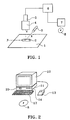
- FIG. 1 represents a schematic view of the device for constituting the database.
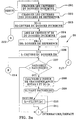
- FIG. 2 represents a schematic view of the operating computer system.
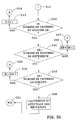
- FIGS. 3A and 3B the operating flow diagram of the operating system.
- Figure 4 shows the mathematical principle of image processing.
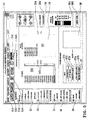
- FIG. 5 represents the general window of the application software.
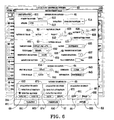
- FIG. 6 represents the window for displaying the selection criteria for the search.
- FIG. 7 represents the image of the socket on the installation screen and the means for selecting an area.
- FIG. 8 represents the principle of the comparison algorithm according to the correlation criterion.
- the device of Figure 1 shows a support plate (1) on which the projectile sleeve (2) is arranged to be illuminated by a light beam from a light source (3).
- the light beam from this source (3) is grazing so as to illuminate the upper edge of the surface of the sleeve (2) in a direction perpendicular to the y axis of the projectile and perpendicular to the plane formed by the y axis of the projectile and to the z axis of the optical observation means.
- the optical observation means consist of a binocular (4) or a microscope, for example of the type marketed by the firm “LEITZ” under the reference M420 coupled with an electronic camera (5), of high definition digital type and wide field for example marketed by the company "VIDEK” under the name “Megaplus 1.4".
- This assembly delivers a digitized signal processed by a computer system (6) to then send the result of the processing to a storage means (7).
- This storage means (7) providing a transportable or transferable support (8) on which a database constituting all of the reference records is saved.
- This support (8) can be of the floppy, CD-ROM, digital magnetic cassette type.
- the device is also then used to supply the data corresponding to an offending object for the transfer of this data to an operating system for comparison with the information in the database.
- FIG. 2 represents the operating system consisting of a computer system (6) comprising a monitor (10) a central unit (11) provided with a reader (14) for optical disc or CD-ROM or any other mass storage means capable of receiving the transportable medium (8) containing the data from the database.
- This system includes command input means (13) making it possible to interact with the application software (20) for analyzing and searching for likelihood indices between the information corresponding to an incriminated projectile and that of a base. of reference data.
- the database is built around a table comprising for each reference of a projectile shell a plurality of classification criteria made up of alphanumeric values stored in this base and organized according to the following criteria represented according to the table appended.
- the shape criterion we will calculate its score on the extraction of the contour followed by the analysis of the geometric criteria and leading to recognition.
- the score for each position criterion is calculated as a function of the spatial distance of the fingerprints of the offending file from that of the reference file.
- the texture criterion its score is expressed from the co-occurrence and fractal dimension criteria taken from the texture analysis.
- the striation criterion its score is based on the analysis of the distribution of the characteristic streaks. between them, this analysis of streaks based on the search for corresponding lines and the coordinates defining these lines in the case where these streaks are linear and in the case where the streaks are concentric on the value of the radius expressing the concentricity of the streaks.
- the user installed in front of his operating station digital information obtained from the image of the camera will view on the screen (16) from his monitor the view allowing him to see the desired footprint and by interactive means such as the mouse (13) associated with an interface software interpreting the movements of the mouse and the cursor on the screen, he may, by selection in a menu, trigger the display of a window (17) of variable size materialized by a dotted square, the size of which it will vary to frame the image area corresponding to the nature of the imprint it wishes computer processing.
- a window (17) of variable size materialized by a dotted square the size of which it will vary to frame the image area corresponding to the nature of the imprint it wishes computer processing.
- the system performs a processing which makes it possible to extract on the one hand the contour corresponding to the plate of the socket (20), the contour (22) corresponding to the edges of the primer, as well as the contour corresponding to the imprint (21) of the striker.
- contours are subjected to computer processing making it possible to determine the position of the centers then, for example, to calculate an index consisting of the ratio between the square or rectangular surface (17) and the contour of the socket (20).
- the alphanumeric values for the striations are extracted by a computer processing to obtain, from the images of the striations taken by the camera, the equations of the lines representing these stripes.
- This extraction phase is carried out in the acquisition and constitution phase of the database at using the hardware of Figure 1 described above and the image processing program described below.
- the digital video image acquisition system provides very high resolution images (1280/1024 pixels) with a sufficient number of gray levels for example (16, 32, 64).
- the recording of the image is materialized in memory by three pieces of information, a pair of coordinates in x and in y for each pixel, and a gray level associated with each pixel.
- the method consists in extracting the characteristic streaks and coding them so that they can be compared with the streaks of other ball images. With low-angle lighting, streaks appear either light (high gray level) or dark (low gray level).
- the projectiles having been positioned so that the striations are practically parallel to the y axis of FIG. 1, the angle ⁇ of the different striations will vary between - 20 and + 20 °, as shown in Figure 4.
- the search program will therefore perform for each pixel xi, yi a calculation of a plurality of pairs ⁇ ij , ⁇ j with ⁇ j between -20 and + 20 ° and varying in increments of for example 2 °.
- the system associates to each pair xi, yi a plurality of three values ⁇ kj , ⁇ j ng (gray level) then makes the sum for identical ⁇ kj , ⁇ j gray levels and thus we determine a set of accumulation vectors which is actually a three-dimensional array where the x-axis corresponds to the parameters ⁇ , the y-axis to the parameters ⁇ , the z-axis to the sum of the gray levels of points of the sinusoids which go through the couple ⁇ , ⁇ given.
- the program detects the local extremes of gray levels which, for the detection of white lines will consist in determining the local maxima, and, for the detection of dark lines, in searching for local minima.
- Each maximum or minimum therefore corresponds to a line identified by the value ⁇ , ⁇ associated with this maximum.
- Each point ⁇ , ⁇ of the sinusoidal equation corresponds to the parametric equation of a line.
- the choice of the size of the accumulation vector depends essentially on the type of images analyzed and on the computing time available. If the lines that we are looking for are oriented in any direction, it will be necessary to take for the parameter ⁇ a sampling interval between 0 and 180 ° with an increment step of 10 ° for example.
- the stripes appear on the camera image in contrast to the surface of the projectile.
- the operator then manually completes the information in the database by entering other information such as the caliber, the family of the weapon, the type of weapon, etc ...
- This method of extracting digital information from the images taken allows on the one hand to greatly reduce the storage space required and on the other hand to obtain a database on a portable object such as a magnetic or electronic medium. and easily transportable to be used in any place where the need arises.
- the operation of the database is carried out using a computer system and application software loaded on the computer system intended to exploit on the one hand the information in the database, on the other hand that provided by the analysis and extraction of criteria from a file concerning the offending projectile.
- the operating system first shows the user a window (201) making it possible to select from a menu the criteria of the offending folder on which he wants to work, then to load these criteria from the support of the floppy, CD-ROM, optical disc type.
- a second window (202) allows the user, by a menu or by buttons validated by the actions of the mouse, to select the criteria of the reference folder on which the search will be carried out, these criteria having to be normally the same as those in the offending file.
- step (203) the system positions a counter (DI) of criteria for the incriminated case at 1, then performs in step (204) the reading of the criterion of the incriminated case having the number (DI).
- step (205) sets a counter (DR) of reference file to 1 then step (206) sets a counter (I) of criteria for the reference folder having the number (DR).
- step (207) the software examines whether the nature of the criterion in the offending file is identical to the nature of the criterion in the reference file. This nature is defined by coded information associated with the digital information of each criterion. In the affirmative case, the system proceeds to the next step (208) of calculating indices. If not, the system jumps to step (211) which makes it possible to pass to the next reference folder criterion. The likelihood index calculation will be carried out in step (208) by a comparison of the numerical values for each criterion. Thus for the stripes criterion, we will examine for each stripe of the offending projectile whether the position of these stripes corresponds to the position of the stripes in the reference file.
- step (209) it is examined in step (209) whether a filter should be applied by determining in step ( 209) the nature of the criterion and if they are scratch or interayures.
- the system applies a filter if the ratio of the number of scratches in the reference folder identical to the scratches in the offending folder to the total number of scratches in the reference folder is greater than 0.6.
- a reduction coefficient is applied to the likelihood analysis result which corresponds to 90 or 100%, for example, to bring it back to a value closer to reality, taking into account the fact that we look at the equality between the file incriminated and the reference file and not between the reference file and the incriminated file.
- step (212) the program continues with a test (212) to determine if the counter (I) of criteria of the reference file is equal to the total number of criteria of the reference files, in the case where this test is negative, at step (213) this counter (I) is incremented and the program reconnects to level (214) before the test between the nature of the criterion of the reference file and the nature of the criterion of the file in question.
- step (215) which consists of a test to determine whether the counter (DR) of the number of reference files is equal to the number total of reference files.
- step (215) If in step (215) the answer is no, the reference folder counter (DR) is incremented in step (216) and the program reconnects between the steps (205) for initializing the folder folder counter. reference, and the step (206) of initializing the criteria counter for the reference files.
- step (218) consisting of a test on the number (DI) of criteria incriminated to examine whether this number is equal to the total number of criteria. If not, the program increments the counter (DI) by the number of incriminated criteria (219) and reconnects between step (203) initialization of the criteria counter of the incriminated file and, the step (204) of reading the criterion of the incriminated file.
- step (220) by classifying and displaying the results obtained.
- This classification makes it possible to determine in the database a certain number of projectiles whose characteristics come closest to the selected criteria.
- This software therefore allows the user to act on the comparison criteria and, according to the files, to select more judiciously the criteria which will allow reaching a conclusion.
- Such software therefore allows an investigator from three portable elements, one comprising the application software, the other the database and, the third the data from the file of the offending projectile to progress in an investigation.
- the application software includes an interface program making it possible to display the windows in FIGS. 5 and 6 and to manage keyboard or mouse events according to the mouse button or the keyboard key pressed and the position of the cursor. shown on the screen to trigger the operations corresponding to the buttons or functions displayed.
- the general window (50) includes a menu bar (51) in which the operator can select the file menu (511), the display menu (512), the acquisition menu (513), the processing menu (514), the graphic menu (515), archiving menu (516), and weapon type menu (517). Each of these menus is associated with a sub-window for selecting the operations or functions to be performed.
- the window (50) also comprises a first group or button box (52) comprising a bullet button, a 12-gauge socket button, a socket button, any button, a weapon type button.
- the operator can also select from a group of display buttons (53) the type display among the following: classic, side by side, comparison, overlay.
- a group of buttons (54, 55) the search mode by a selection between a global search and a selective search and, in this type of search select the search methods, for example on the basic criteria, on all criteria or certain criteria only.
- a group of buttons (56) allows to choose the mode of expression of score by an image, by a file or by an arrangement.
- a window (59) makes it possible to display in a drop-down list (592) the references of the available files and to control the progress of this list by the advance buttons (593) of the list so as to bring the highlighting to the file wish.
- a second drop-down list (591) makes it possible to display the images associated with a highlighted folder, and in these associated images, to select the desired image (s) by choosing, for example the stripe (3) and the interlay (1 ). Arrows (594) for commanding the unfolding of the menu list (591) allow the highlighting to be brought to an associated image which one wishes to select.
- the main window (50) also includes a menu (57) for an incriminated folder allowing to choose the actions to be carried out among the following: (571) initialization, (572) adding images, (573) eliminating images, (574) folder backup, (575) folder search and, next to this menu (57) there is a window (58) in which an image stored in memory can be displayed.
- a menu (57) for an incriminated folder allowing to choose the actions to be carried out among the following: (571) initialization, (572) adding images, (573) eliminating images, (574) folder backup, (575) folder search and, next to this menu (57) there is a window (58) in which an image stored in memory can be displayed.
- This main window (50) also has a button (502) for information and a graphic window (501) for displaying, according to a color code, the calculated probability index corresponding to the comparison between an accused file and a file selected. Finally a button (503) provides access to a camera control menu.
- a first zone (61) corresponds to the references of the case and comprises a button (611) making it possible to indicate if it is a weapon found and to document in an alphanumeric text zone (612), the number of the file, in another area (613), the name of the case and in one area (614) the type of offense.
- a second zone (62) relates to the nature of the image and makes it possible, by a button (621), to select the nature of the image from among the different types: stripes, defects, etc., a text zone makes it possible to indicate the number ball and increase and decrease buttons (623) (624) to increase or decrease the ball number.
- a zone (626) comprising the same increase (627) and decrease (628) buttons makes it possible to indicate the number of stripes and, a button (625) makes it possible to indicate whether the order of stripes is known.
- a third zone corresponds to the basic criteria and makes it possible to select by a drop-down list (631) the weapon family from among the families mentioned above, a drop-down list (632) makes it possible to select the type of weapon from a recorded list, a drop-down list (633) allows to select the orientation of the stripes on the right or on the left, a drop-down list (635) allows to select the size, a button (634) allows to choose the width of the stripes, a button (636) allows to determine if there is presence of a socket, a button (637) makes it possible to indicate the number of scratches and a button (638) makes it possible to enter the orientation pitch in millimeters.
- a fourth zone (64) makes it possible to choose the descriptive criteria in four drop-down lists, a first (641) describing the state of the ball (for example intact), a second (642) describing the type of bullet (for example armored), a third (643) describing the lining (for example copper), a fourth (645) describing the deformation (indefinite).
- a fifth zone makes it possible to select the geometric criteria by three sub-zones (66, 67, 68), a first sub-zone for determining the location of the edges allows a button (663) to trigger the automatic detection or by a button (664) to switch to manual detection, these two buttons operating on the principle of a rocker, a third button (661) makes it possible to determine whether it is the upper edge and a fourth button to determine whether it is the bottom edge.
- the second sub-area (67) makes it possible to choose the criteria for locating the streaks by a button (673) in automatic detection and by a button (674) in manual detection.
- This zone also includes an input button (671) and an erase button (672).
- the third sub-area (68) allows the location of faults and includes a button (681) entered, a button (682) for erasing.
- the last zone (69) of the window has three buttons (691) validation, (692) comment, (693) cancellation allowing either to validate, or to write comments, or to cancel the selection made by the operator on the ball information criteria.
- This correlation coefficient r is used to compare either two images of sockets with each other, or shapes extracted from images.
- the statistical variable X corresponds to the pixel of image No. 1 and the statistical variable Y corresponds to the pixel of image No. 2.
- the variable X corresponds to the contour points of the form N ° 1 extracted from an image and the variable Y to the contour points of the form N ° 2 extracted from the second image.
- the comparison algorithm using the correlation criterion is based on the principle that image No. 1 is certainly different in size from image No. 2 as shown in FIG. 8. In the case represented by the reference (81) we are going to compare the part of image N ° 2 with the part of image N ° 1 which is superimposed with image N ° 2.
- the correlation criterion r between the pixels x i of the part of image No. 1 superimposed on No. 2 and the criteria y i of image No. 2 is calculated. Then we make a horizontal shift of one pixel in the selection of the pixels of image No. 1 which are correlated to the pixels of image No. 2 and the program calculates the new correlation criterion. Then the program continues the horizontal shifts until the pixels of image No. 1 correlated to image No. 2 are superimposed as in the example referenced (82) with image No. 2 in the figure 8 and the program calculates the correlation criterion at each shift.
- the algorithm then continues by applying a vertical offset of one pixel and starting from the position where the image area N ° 1 selected is located on the left as represented by the reference (81) with a vertical offset of a pixel.
- the program will deal with a succession of horizontal and vertical offsets sets of pixels of image areas No. 1 corresponding to the areas of image No. 2 and calculate the correlation coefficients between the different possible arrangements. After a certain number of vertical shifts we find our in the situation represented by the reference (83). Then a further succession of horizontal shifts is carried out in order to find themselves in the situation represented by the reference (84). For each situation resulting from an offset, the system also calculates the correlation coefficient. Then the program compares the series of correlation coefficient obtained following the different successive shifts to determine the maximum correlation coefficient which corresponds to the best score between the two images.
Landscapes
- Engineering & Computer Science (AREA)
- General Engineering & Computer Science (AREA)
- Processing Or Creating Images (AREA)
- Image Analysis (AREA)
Applications Claiming Priority (2)
| Application Number | Priority Date | Filing Date | Title |
|---|---|---|---|
| FR9600173 | 1996-01-09 | ||
| FR9600173A FR2743416B1 (fr) | 1996-01-09 | 1996-01-09 | Procede de comparaison de douilles projectiles et dispositif |
Publications (2)
| Publication Number | Publication Date |
|---|---|
| EP0775889A1 true EP0775889A1 (de) | 1997-05-28 |
| EP0775889B1 EP0775889B1 (de) | 2001-11-21 |
Family
ID=9487979
Family Applications (1)
| Application Number | Title | Priority Date | Filing Date |
|---|---|---|---|
| EP97400029A Expired - Lifetime EP0775889B1 (de) | 1996-01-09 | 1997-01-08 | Verfahren und Vorrichtung zum Vergleichen von Geschosshülsen |
Country Status (4)
| Country | Link |
|---|---|
| US (1) | US5857202A (de) |
| EP (1) | EP0775889B1 (de) |
| DE (1) | DE69708341T2 (de) |
| FR (1) | FR2743416B1 (de) |
Cited By (2)
| Publication number | Priority date | Publication date | Assignee | Title |
|---|---|---|---|---|
| WO1999014553A1 (en) * | 1997-09-16 | 1999-03-25 | Forensic Technology Wai Inc. | A method and apparatus for imaging a cartridge case ejector markings |
| US6327032B1 (en) | 1997-09-16 | 2001-12-04 | Forensic Technology (Wai) Inc. | Method and apparatus for imaging a cartridge case ejector markings |
Families Citing this family (9)
| Publication number | Priority date | Publication date | Assignee | Title |
|---|---|---|---|---|
| US6018394A (en) * | 1998-04-17 | 2000-01-25 | Forensic Technologies Wai Inc. | Apparatus and method for imaging fired ammunition |
| US7068808B1 (en) * | 1998-06-10 | 2006-06-27 | Prokoski Francine J | Method and apparatus for alignment, comparison and identification of characteristic tool marks, including ballistic signatures |
| US6785634B2 (en) * | 2000-01-18 | 2004-08-31 | Intelligent Automation, Inc. | Computerized system and methods of ballistic analysis for gun identifiability and bullet-to-gun classifications |
| ATE384241T1 (de) * | 2000-09-29 | 2008-02-15 | Forensic Technology Wai Inc | Verfahren und vorrichtung zur identifikation einer feuerwaffe |
| US20030082502A1 (en) * | 2001-10-29 | 2003-05-01 | Stender H. Robert | Digital target spotting system |
| CA2577969A1 (en) * | 2004-08-31 | 2006-03-09 | Intelligent Automation, Inc. | Automated system and method for tool mark analysis |
| US7822263B1 (en) * | 2005-12-28 | 2010-10-26 | Prokoski Francine J | Method and apparatus for alignment, comparison and identification of characteristic tool marks, including ballistic signatures |
| DE102010016963A1 (de) | 2010-05-17 | 2011-11-17 | Krauss-Maffei Wegmann Gmbh & Co. Kg | Waffensystem, Verfahren zum Verschießen und Erkennen von Munitionskörpern |
| CN107339945A (zh) * | 2016-12-24 | 2017-11-10 | 重庆都英科技有限公司 | 一种弹头检测装置 |
Citations (6)
| Publication number | Priority date | Publication date | Assignee | Title |
|---|---|---|---|---|
| US3680966A (en) * | 1971-03-12 | 1972-08-01 | Iris Corp | Apparatus and method for shell inspection |
| US4596037A (en) * | 1984-03-09 | 1986-06-17 | International Business Machines Corporation | Video measuring system for defining location orthogonally |
| US4644583A (en) * | 1984-01-13 | 1987-02-17 | Kabushiki Kaisha Komatsu Seisakusho | Method of identifying contour lines |
| US5134661A (en) * | 1991-03-04 | 1992-07-28 | Reinsch Roger A | Method of capture and analysis of digitized image data |
| WO1992020988A1 (en) | 1991-05-24 | 1992-11-26 | Walsh Automation Inc. | Computer automated bullet analysis apparatus |
| WO1993022617A1 (en) | 1992-04-24 | 1993-11-11 | Walsh Automation Inc. | Method and apparatus for monitoring and adjusting the position of an article under optical observation |
Family Cites Families (2)
| Publication number | Priority date | Publication date | Assignee | Title |
|---|---|---|---|---|
| US5179642A (en) * | 1987-12-14 | 1993-01-12 | Hitachi, Ltd. | Image synthesizing apparatus for superposing a second image on a first image |
| JP3327948B2 (ja) * | 1992-06-09 | 2002-09-24 | オリンパス光学工業株式会社 | 光学像再構成装置 |
-
1996
- 1996-01-09 FR FR9600173A patent/FR2743416B1/fr not_active Expired - Fee Related
-
1997
- 1997-01-08 DE DE69708341T patent/DE69708341T2/de not_active Expired - Lifetime
- 1997-01-08 EP EP97400029A patent/EP0775889B1/de not_active Expired - Lifetime
- 1997-01-09 US US08/781,147 patent/US5857202A/en not_active Expired - Lifetime
Patent Citations (6)
| Publication number | Priority date | Publication date | Assignee | Title |
|---|---|---|---|---|
| US3680966A (en) * | 1971-03-12 | 1972-08-01 | Iris Corp | Apparatus and method for shell inspection |
| US4644583A (en) * | 1984-01-13 | 1987-02-17 | Kabushiki Kaisha Komatsu Seisakusho | Method of identifying contour lines |
| US4596037A (en) * | 1984-03-09 | 1986-06-17 | International Business Machines Corporation | Video measuring system for defining location orthogonally |
| US5134661A (en) * | 1991-03-04 | 1992-07-28 | Reinsch Roger A | Method of capture and analysis of digitized image data |
| WO1992020988A1 (en) | 1991-05-24 | 1992-11-26 | Walsh Automation Inc. | Computer automated bullet analysis apparatus |
| WO1993022617A1 (en) | 1992-04-24 | 1993-11-11 | Walsh Automation Inc. | Method and apparatus for monitoring and adjusting the position of an article under optical observation |
Non-Patent Citations (3)
| Title |
|---|
| ARNDT G D ET AL: "BULLET SIGNATURE IDENTIFICATION USING TIME DOMAIN COMPUTER TECHNQIUES", 1 January 1983, PROCEEDINGS INTERNATIONAL CARNAHAN CONFERENCE ON SECURITY TECHNOL OGY, PAGE(S) 145 - 151, XP000568267 * |
| ARNDT G D: "BALLISTIC SIGNATURE IDENTIFICATION STUDIES", 1 January 1977, PROCEEDINGS OF THE CARNAHAN CONFERENCE ON CRIME COUNTERMEASURES, KENTUCKY, APRIL 6 - 8, 1977, NR. -, PAGE(S) 235, JACKSON J S, XP000565288 * |
| GARDNER G Y: "COMPUTER IDENTIFICATION OF BULLETS", 1 January 1977, PROCEEDINGS OF THE CARNAHAN CONFERENCE ON CRIME COUNTERMEASURES, KENTUCKY, APRIL 6 - 8, 1977, NR. -, PAGE(S) 149 - 166, JACKSON J S, XP000565287 * |
Cited By (3)
| Publication number | Priority date | Publication date | Assignee | Title |
|---|---|---|---|---|
| WO1999014553A1 (en) * | 1997-09-16 | 1999-03-25 | Forensic Technology Wai Inc. | A method and apparatus for imaging a cartridge case ejector markings |
| US6327032B1 (en) | 1997-09-16 | 2001-12-04 | Forensic Technology (Wai) Inc. | Method and apparatus for imaging a cartridge case ejector markings |
| RU2217693C2 (ru) * | 1997-09-16 | 2003-11-27 | Форенсик Текнолоджи Вей Инк. | Способ и устройство для получения изображений следов выбрасывателя на патронных гильзах |
Also Published As
| Publication number | Publication date |
|---|---|
| DE69708341D1 (de) | 2002-01-03 |
| US5857202A (en) | 1999-01-05 |
| DE69708341T2 (de) | 2002-10-24 |
| EP0775889B1 (de) | 2001-11-21 |
| FR2743416A1 (fr) | 1997-07-11 |
| FR2743416B1 (fr) | 1998-02-13 |
Similar Documents
| Publication | Publication Date | Title |
|---|---|---|
| Vitoria et al. | Automatic flare spot artifact detection and removal in photographs | |
| US11004129B2 (en) | Image processing | |
| Bandeira et al. | Detection of sub-kilometer craters in high resolution planetary images using shape and texture features | |
| Ren et al. | Best frame selection in a short video | |
| US9535930B2 (en) | System and method for using an image to provide search results | |
| Pisantanaroj et al. | Automated firearm classification from bullet markings using deep learning | |
| EP0775889B1 (de) | Verfahren und Vorrichtung zum Vergleichen von Geschosshülsen | |
| FR2955681A1 (fr) | Systeme pour navigation et exploration d'images de creation | |
| WO2011048302A1 (fr) | Procede, programme d'ordinateur et dispositif de suivi hybride de representations d'objets, en temps reel, dans une sequence d'images | |
| FR2656684A1 (fr) | Systeme d'inspection des munitions des armes portatives. | |
| CN110866931A (zh) | 图像分割模型训练方法及基于分类的强化图像分割方法 | |
| Li | Ballistics projectile image analysis for firearm identification | |
| US20240355088A1 (en) | Method for matching a candidate image with a reference image | |
| Kuzovkin et al. | Image selection in photo albums | |
| FR2807852A1 (fr) | Procedes et dispositifs d'indexation et de recherche d'images numeriques prenant en compte la distribution spatiale du contenu des images | |
| Bianco et al. | User preferences modeling and learning for pleasing photo collage generation | |
| Wang et al. | SIHRNet: a fully convolutional network for single image highlight removal with a real-world dataset | |
| Wang et al. | Deep-learning-based block similarity evaluation for image forensics | |
| Geradts et al. | Pattern recognition in a database of cartridge cases | |
| FR2743415A1 (fr) | Procede de comparaison de projectiles et dispositif | |
| CN113657378B (zh) | 车辆跟踪方法、车辆跟踪系统和计算设备 | |
| Kollo et al. | Enhancing satellite trail detection in night sky imagery with automatic salience thresholding | |
| Li | Ballistics image processing and analysis for firearm identification | |
| FR3109457A1 (fr) | Procédé de détection d’attaque par présentation pour des empreintes digitales | |
| Geradts | Use of Correlation algorithms in a database of spent cartridge cases of firearms |
Legal Events
| Date | Code | Title | Description |
|---|---|---|---|
| PUAI | Public reference made under article 153(3) epc to a published international application that has entered the european phase |
Free format text: ORIGINAL CODE: 0009012 |
|
| AK | Designated contracting states |
Kind code of ref document: A1 Designated state(s): BE DE FR GB NL |
|
| 17P | Request for examination filed |
Effective date: 19980121 |
|
| 17Q | First examination report despatched |
Effective date: 19991014 |
|
| GRAG | Despatch of communication of intention to grant |
Free format text: ORIGINAL CODE: EPIDOS AGRA |
|
| GRAG | Despatch of communication of intention to grant |
Free format text: ORIGINAL CODE: EPIDOS AGRA |
|
| GRAH | Despatch of communication of intention to grant a patent |
Free format text: ORIGINAL CODE: EPIDOS IGRA |
|
| GRAH | Despatch of communication of intention to grant a patent |
Free format text: ORIGINAL CODE: EPIDOS IGRA |
|
| GRAA | (expected) grant |
Free format text: ORIGINAL CODE: 0009210 |
|
| AK | Designated contracting states |
Kind code of ref document: B1 Designated state(s): BE DE FR GB NL |
|
| REG | Reference to a national code |
Ref country code: GB Ref legal event code: IF02 |
|
| REF | Corresponds to: |
Ref document number: 69708341 Country of ref document: DE Date of ref document: 20020103 |
|
| GBT | Gb: translation of ep patent filed (gb section 77(6)(a)/1977) |
Effective date: 20020206 |
|
| PLBE | No opposition filed within time limit |
Free format text: ORIGINAL CODE: 0009261 |
|
| STAA | Information on the status of an ep patent application or granted ep patent |
Free format text: STATUS: NO OPPOSITION FILED WITHIN TIME LIMIT |
|
| 26N | No opposition filed | ||
| REG | Reference to a national code |
Ref country code: FR Ref legal event code: PLFP Year of fee payment: 19 |
|
| PGFP | Annual fee paid to national office [announced via postgrant information from national office to epo] |
Ref country code: NL Payment date: 20150123 Year of fee payment: 19 |
|
| PGFP | Annual fee paid to national office [announced via postgrant information from national office to epo] |
Ref country code: DE Payment date: 20150123 Year of fee payment: 19 |
|
| PGFP | Annual fee paid to national office [announced via postgrant information from national office to epo] |
Ref country code: GB Payment date: 20150116 Year of fee payment: 19 Ref country code: FR Payment date: 20150129 Year of fee payment: 19 |
|
| PG25 | Lapsed in a contracting state [announced via postgrant information from national office to epo] |
Ref country code: BE Free format text: LAPSE BECAUSE OF NON-PAYMENT OF DUE FEES Effective date: 20150131 |
|
| PGFP | Annual fee paid to national office [announced via postgrant information from national office to epo] |
Ref country code: BE Payment date: 20150129 Year of fee payment: 19 |
|
| PGRI | Patent reinstated in contracting state [announced from national office to epo] |
Ref country code: BE Effective date: 20150507 |
|
| PG25 | Lapsed in a contracting state [announced via postgrant information from national office to epo] |
Ref country code: BE Free format text: LAPSE BECAUSE OF NON-PAYMENT OF DUE FEES Effective date: 20160131 |
|
| REG | Reference to a national code |
Ref country code: DE Ref legal event code: R119 Ref document number: 69708341 Country of ref document: DE |
|
| GBPC | Gb: european patent ceased through non-payment of renewal fee |
Effective date: 20160108 |
|
| REG | Reference to a national code |
Ref country code: NL Ref legal event code: MM Effective date: 20160201 |
|
| REG | Reference to a national code |
Ref country code: FR Ref legal event code: ST Effective date: 20160930 |
|
| PG25 | Lapsed in a contracting state [announced via postgrant information from national office to epo] |
Ref country code: GB Free format text: LAPSE BECAUSE OF NON-PAYMENT OF DUE FEES Effective date: 20160108 Ref country code: DE Free format text: LAPSE BECAUSE OF FAILURE TO SUBMIT A TRANSLATION OF THE DESCRIPTION OR TO PAY THE FEE WITHIN THE PRESCRIBED TIME-LIMIT Effective date: 20160802 |
|
| PG25 | Lapsed in a contracting state [announced via postgrant information from national office to epo] |
Ref country code: NL Free format text: LAPSE BECAUSE OF NON-PAYMENT OF DUE FEES Effective date: 20160201 Ref country code: FR Free format text: LAPSE BECAUSE OF NON-PAYMENT OF DUE FEES Effective date: 20160201 |