EP0775757B1 - Verfahren und Anlage zur Schmelztauchbeschichtung von alterungsbeständigem Stahlband - Google Patents
Verfahren und Anlage zur Schmelztauchbeschichtung von alterungsbeständigem Stahlband Download PDFInfo
- Publication number
- EP0775757B1 EP0775757B1 EP96116218A EP96116218A EP0775757B1 EP 0775757 B1 EP0775757 B1 EP 0775757B1 EP 96116218 A EP96116218 A EP 96116218A EP 96116218 A EP96116218 A EP 96116218A EP 0775757 B1 EP0775757 B1 EP 0775757B1
- Authority
- EP
- European Patent Office
- Prior art keywords
- titanium
- steel strip
- hot
- temperature
- strip
- Prior art date
- Legal status (The legal status is an assumption and is not a legal conclusion. Google has not performed a legal analysis and makes no representation as to the accuracy of the status listed.)
- Expired - Lifetime
Links
Images
Classifications
-
- C—CHEMISTRY; METALLURGY
- C21—METALLURGY OF IRON
- C21D—MODIFYING THE PHYSICAL STRUCTURE OF FERROUS METALS; GENERAL DEVICES FOR HEAT TREATMENT OF FERROUS OR NON-FERROUS METALS OR ALLOYS; MAKING METAL MALLEABLE, e.g. BY DECARBURISATION OR TEMPERING
- C21D9/00—Heat treatment, e.g. annealing, hardening, quenching or tempering, adapted for particular articles; Furnaces therefor
- C21D9/46—Heat treatment, e.g. annealing, hardening, quenching or tempering, adapted for particular articles; Furnaces therefor for sheet metals
- C21D9/48—Heat treatment, e.g. annealing, hardening, quenching or tempering, adapted for particular articles; Furnaces therefor for sheet metals deep-drawing sheets
-
- C—CHEMISTRY; METALLURGY
- C23—COATING METALLIC MATERIAL; COATING MATERIAL WITH METALLIC MATERIAL; CHEMICAL SURFACE TREATMENT; DIFFUSION TREATMENT OF METALLIC MATERIAL; COATING BY VACUUM EVAPORATION, BY SPUTTERING, BY ION IMPLANTATION OR BY CHEMICAL VAPOUR DEPOSITION, IN GENERAL; INHIBITING CORROSION OF METALLIC MATERIAL OR INCRUSTATION IN GENERAL
- C23C—COATING METALLIC MATERIAL; COATING MATERIAL WITH METALLIC MATERIAL; SURFACE TREATMENT OF METALLIC MATERIAL BY DIFFUSION INTO THE SURFACE, BY CHEMICAL CONVERSION OR SUBSTITUTION; COATING BY VACUUM EVAPORATION, BY SPUTTERING, BY ION IMPLANTATION OR BY CHEMICAL VAPOUR DEPOSITION, IN GENERAL
- C23C2/00—Hot-dipping or immersion processes for applying the coating material in the molten state without affecting the shape; Apparatus therefor
- C23C2/003—Apparatus
- C23C2/0038—Apparatus characterised by the pre-treatment chambers located immediately upstream of the bath or occurring locally before the dipping process
-
- C—CHEMISTRY; METALLURGY
- C23—COATING METALLIC MATERIAL; COATING MATERIAL WITH METALLIC MATERIAL; CHEMICAL SURFACE TREATMENT; DIFFUSION TREATMENT OF METALLIC MATERIAL; COATING BY VACUUM EVAPORATION, BY SPUTTERING, BY ION IMPLANTATION OR BY CHEMICAL VAPOUR DEPOSITION, IN GENERAL; INHIBITING CORROSION OF METALLIC MATERIAL OR INCRUSTATION IN GENERAL
- C23C—COATING METALLIC MATERIAL; COATING MATERIAL WITH METALLIC MATERIAL; SURFACE TREATMENT OF METALLIC MATERIAL BY DIFFUSION INTO THE SURFACE, BY CHEMICAL CONVERSION OR SUBSTITUTION; COATING BY VACUUM EVAPORATION, BY SPUTTERING, BY ION IMPLANTATION OR BY CHEMICAL VAPOUR DEPOSITION, IN GENERAL
- C23C2/00—Hot-dipping or immersion processes for applying the coating material in the molten state without affecting the shape; Apparatus therefor
- C23C2/02—Pretreatment of the material to be coated, e.g. for coating on selected surface areas
-
- C—CHEMISTRY; METALLURGY
- C23—COATING METALLIC MATERIAL; COATING MATERIAL WITH METALLIC MATERIAL; CHEMICAL SURFACE TREATMENT; DIFFUSION TREATMENT OF METALLIC MATERIAL; COATING BY VACUUM EVAPORATION, BY SPUTTERING, BY ION IMPLANTATION OR BY CHEMICAL VAPOUR DEPOSITION, IN GENERAL; INHIBITING CORROSION OF METALLIC MATERIAL OR INCRUSTATION IN GENERAL
- C23C—COATING METALLIC MATERIAL; COATING MATERIAL WITH METALLIC MATERIAL; SURFACE TREATMENT OF METALLIC MATERIAL BY DIFFUSION INTO THE SURFACE, BY CHEMICAL CONVERSION OR SUBSTITUTION; COATING BY VACUUM EVAPORATION, BY SPUTTERING, BY ION IMPLANTATION OR BY CHEMICAL VAPOUR DEPOSITION, IN GENERAL
- C23C2/00—Hot-dipping or immersion processes for applying the coating material in the molten state without affecting the shape; Apparatus therefor
- C23C2/02—Pretreatment of the material to be coated, e.g. for coating on selected surface areas
- C23C2/022—Pretreatment of the material to be coated, e.g. for coating on selected surface areas by heating
- C23C2/0224—Two or more thermal pretreatments
-
- C—CHEMISTRY; METALLURGY
- C23—COATING METALLIC MATERIAL; COATING MATERIAL WITH METALLIC MATERIAL; CHEMICAL SURFACE TREATMENT; DIFFUSION TREATMENT OF METALLIC MATERIAL; COATING BY VACUUM EVAPORATION, BY SPUTTERING, BY ION IMPLANTATION OR BY CHEMICAL VAPOUR DEPOSITION, IN GENERAL; INHIBITING CORROSION OF METALLIC MATERIAL OR INCRUSTATION IN GENERAL
- C23C—COATING METALLIC MATERIAL; COATING MATERIAL WITH METALLIC MATERIAL; SURFACE TREATMENT OF METALLIC MATERIAL BY DIFFUSION INTO THE SURFACE, BY CHEMICAL CONVERSION OR SUBSTITUTION; COATING BY VACUUM EVAPORATION, BY SPUTTERING, BY ION IMPLANTATION OR BY CHEMICAL VAPOUR DEPOSITION, IN GENERAL
- C23C2/00—Hot-dipping or immersion processes for applying the coating material in the molten state without affecting the shape; Apparatus therefor
- C23C2/02—Pretreatment of the material to be coated, e.g. for coating on selected surface areas
- C23C2/024—Pretreatment of the material to be coated, e.g. for coating on selected surface areas by cleaning or etching
-
- C—CHEMISTRY; METALLURGY
- C21—METALLURGY OF IRON
- C21D—MODIFYING THE PHYSICAL STRUCTURE OF FERROUS METALS; GENERAL DEVICES FOR HEAT TREATMENT OF FERROUS OR NON-FERROUS METALS OR ALLOYS; MAKING METAL MALLEABLE, e.g. BY DECARBURISATION OR TEMPERING
- C21D8/00—Modifying the physical properties of ferrous metals or ferrous alloys by deformation combined with, or followed by, heat treatment
- C21D8/02—Modifying the physical properties of ferrous metals or ferrous alloys by deformation combined with, or followed by, heat treatment during manufacturing of plates or strips
- C21D8/04—Modifying the physical properties of ferrous metals or ferrous alloys by deformation combined with, or followed by, heat treatment during manufacturing of plates or strips to produce plates or strips for drawing, e.g. for deep-drawing
- C21D8/0421—Modifying the physical properties of ferrous metals or ferrous alloys by deformation combined with, or followed by, heat treatment during manufacturing of plates or strips to produce plates or strips for drawing, e.g. for deep-drawing characterised by the working steps
- C21D8/0426—Hot rolling
Definitions
- the invention relates to a method for producing hot-dip galvanized steel strip.
- the invention further relates to a hot-dip galvanized, cold-rolled, good cold formable sheet or steel strip.
- Such steel belts are regularly required to: are resistant to aging and have good cold formability or deep-drawing properties have to be particularly suitable for the production of body panels to be.
- the annealing treatment at temperatures of more than 500 degrees Celsius before The introduction of the tape into the zinc bath is also known in the prior art Technology provided as a basic measure.
- the tape is at temperatures between Annealed 650 and 750 degrees.
- the tape is under non-oxidizing conditions heated to 750 to 800 degrees Celsius before it is introduced into the zinc bath.
- the strip is heated to 650 to 950 degrees Celsius, before immersing it in the zinc bath after cooling.
- tapes can only be produced in a continuous process. It must after an annealing process, the usual aging treatment, in which the tape was kept below 450 degrees Celsius for at least 60 seconds must be achieved by cooling in three cooling phases, each with a defined one Cooling rate take place. This is to ensure that the The yield strength of the steels treated according to the invention is reduced and the Elongation at break is increased. How to look at samples after outsourcing of four weeks were checked to determine the usual storage times between production and to take into account the processing resulted in an improvement aging resistance has been achieved. This beneficial effect will by a decrease in the cooling achieved according to the invention harmful, dissolved carbon content. In this case, too recommended cooling at defined cooling rates an annealing treatment of 750 to 800 degrees Celsius ahead. It appears also that it is not an age-resistant sheet with high Yield point.
- a method for producing a hot strip is known from WO 90/13672, that after reeling into a coil when reeling no through a pronounced yield point caused flow figures on the surface forms, which can lead to kinks (coil breaks) in the hot strip surface. Based on the composition of a common mild steel a titanium addition of 0.03 to 0.08% is provided. The hot strip produced can then be cold rolled.
- Hot-dip galvanized cold-rolled After a recrystallizing annealing in a band Continuous annealing at a temperature between 880 and 920 degrees Celsius, that The band emerging from the continuous annealing line has another in a proboscis zone Temperature between 500 and 540 degrees Celsius and goes into a galvanizing bath, at a temperature between 450 and 460 degrees Celsius is held.
- skin pass rolling is included a degree of deformation between 0.5 and 2%. The aim is a defiance the addition of titanium as soft as possible, the hot strip of which is resistant to aging remains coilbreak-free.
- WO 89/07158 discloses a manufacturing process for a cold rolled sheet or tape that is characterized by a quasi isotropic formability and is particularly easy to form. A part formed with this steel is droplet-free or at least drool-free. This result is through a combination an addition of 0.01 to 0.04% titanium to a conventional composition of soft steel and compliance with certain process parameters achieved.
- the invention has for its object a hot-dip galvanized steel strip ready to provide, which is resistant to aging and has good cold formability.
- the steel strip is recrystallized after cold rolling Hood furnace annealed and then cools down in the usual way.
- the cold strip will then before immersion in the molten bath, for example at a heating rate from 150 to 300 ° C / s essentially only on the Melt bath temperature warmed.
- the temperature of the Strip surface during galvanizing increased to no more than 500 degrees Celsius.
- the tape is immersed in the weld pool immediately after heating.
- the advantage here is that the hot-dip galvanized sheet is the same chemical Composition and the same technological properties as without Has hot-dip galvanizing. This is a considerable advantage over the known ones Processes where strip galvanizing with a continuous anneal has been combined.
- a higher quality material e.g. IF steel
- a hot-dip coated, cold-rolled, readily cold-formable and aging-resistant sheet or strip of steel having an extremely low anisotropy of ⁇ r ⁇ 0.2 and having the following composition in% by weight, producible by a process according to the invention, 0.02 to 0.06% carbon 0.01 to 0.40% silicon, 0.10 to 0.80% manganese, 0.005 to 0.08% phosphorus, 0.0005 to 0.02% sulfur, 0.002 to 0.009% nitrogen, 0.015 to 0.08% aluminum, 0.01 to 0.04% titanium Max. 0.15% of one or more of the elements copper, vanadium, nickel, Balance iron and unavoidable impurities.
- the hot-dip galvanized sheet or strip according to the invention thus has a high Yield strength or high strength in combination with a good one Cold formability or deep drawing ability and a quasi isotropic drawing behavior on.
- the hot-dip galvanized steel strip or sheet according to the invention is initially with regard to the cold strip production using the following exemplary embodiments for the production of a cold strip with extremely low anisotropy ( ⁇ r ⁇ 0.2) explained in more detail.
- cold rolling degrees of up to 15% or 20% and up to 85% are preferably set. At values between 0.01% and 0.02%, lower values are preferred Cold rolling degrees set.
- the preferred cold rolling grade could be one high tensile strength and yield strength levels can be assigned.
- Table 2 shows the grain size achieved according to the invention in ASTM units; the achievable grain refinement compared to steels without titanium addition the state of the art is considerable and extends up to ASTM 11. In contrast the comparative melts showed a larger grain and increased anisotropy on.
- variable coiling temperature Th For a steel C (variants C3 to C5) tests were carried out with variable coiling temperature Th and annealing throughput Pg (Table 3). While fluctuations in the throughput of the bell annealer from 1.1 to 1.9 t / h did not adversely affect the grain size or the level anisotropy Delta r, an increase in the reel temperatures to 710 degrees Celsius with roughly the same roll temperatures resulted in a coarsening and an increase the plane anisotropy.
- the reel temperatures should therefore be between 520 and 710, preferably between 450 and 680 degrees Celsius.
- the cold strip produced in this way is after a chemical cleaning in an oven under protective gas, preferably an induction oven, to essentially only heated the molten bath temperature.
- protective gas preferably an induction oven
- the label "Melting bath” is used here only in the sense of an example. It can other coating processes, such as. B. flame spraying used become. According to the invention, it is important to heat the strip only to the extent as is necessary for the coating. While warming up “Melting bath temperature” is therefore a warming up to that for the coating understand the necessary temperature.
- the surface temperature of the strip is this Warming no more than 420 to 500 degrees Celsius. That warmed up like this Belt is immediately, essentially without cooling, in the bathroom introduced for hot dip coating.
- the hot dip coated tape is cooled to about Dressed at room temperature, stretch-oriented and chemically passivated respectively chemically pretreated for a subsequent coating and dried.
- the coating can in particular consist of a multilayer structure, for example from sealing, pre-priming and a multi-layer Pre-painting.
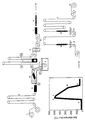
- the coating system has one immediately the hot-dip bath 4 arranged heating furnace 14. By doing The belt is heated to substantially melt bath temperature in the furnace. In the case of a galvanizing plant, the surface temperature of the strip is 500 degrees Celsius in the oven. A temperature of 420 is preferred set to 500 degrees Celsius. This eliminates the usual cooling as well as the aging so far common.
- An embodiment of the coating system is shown schematically in the attached figure illustrated embodiment explained.
- the tape arrives from the reel 1 via a tape storage device 2 (looper) degreasing with drying 3 in the heating furnace 14.
- the heating furnace 14 is preferably an induction furnace, which is immediately in front of the Introduction of the tape is arranged in the melt pool 4.
- the oven becomes from about room temperature (a) the tape for example at a heating rate from 150 to 300 degrees Celsius / second under protective gas the desired temperature (b) is heated and then leaves the molten bath 4 with approximately the molten bath temperature (c).
- a cooling unit cools the strip to specified temperatures (d, e), then passes into a skin pass mill 5, a stretching judge 6 and a chemical Treatment 7 with dryer 8 Coating steps 9, 11 with respective drying 10, 12 take place.
- the finished coated tape is wound on a reel 13.
Landscapes
- Chemical & Material Sciences (AREA)
- Engineering & Computer Science (AREA)
- Mechanical Engineering (AREA)
- Materials Engineering (AREA)
- Metallurgy (AREA)
- Organic Chemistry (AREA)
- Chemical Kinetics & Catalysis (AREA)
- Physics & Mathematics (AREA)
- Thermal Sciences (AREA)
- Crystallography & Structural Chemistry (AREA)
- Coating With Molten Metal (AREA)
- Heat Treatment Of Sheet Steel (AREA)
Description
0,02 bis 0,06 % Kohlenstoff,
0,01 bis 0,40 % Silizium,
0,10 bis 0,80 % Mangan,
0,005 bis 0,08 % Phosphor,
0,0005 bis 0,02 % Schwefel,
0,002 bis 0,009 % Stickstoff,
0,015 bis 0,08 % Aluminium,
0,01 bis 0,04 % Titan
max. 0,15 % von einem oder mehreren der Elemente Kupfer, Vanadium, Nickel,
Rest Eisen und unvermeidbare Verunreinigungen
mit folgenden Verfahrensschritten:
- Herstellung eines eine gute Kaltumformbarkeit aufweisenden Stahlbandes der angegebenen Zusammensetzung durch Warmwalzen, Haspeln, anschließendes Kaltwalzen und rekristallisierendes Glühen im Haubenglühofen bei etwa 700° C und
- Erwärmen des so hergestellten, auf etwa Raumtemperatur abgekühlten Stahlbandes im abgehaspelten Zustand auf eine Temperatur zwischen 420° C und 500° C und unmittelbar darauf Einleiten des erwärmten Stahlbandes im Wesentlichen ohne Abkühlung in ein etwa die gleiche Temperatur aufweisendes Bad für die Feuerverzinkung.
0,02 bis 0,06 % Kohlenstoff
0,01 bis 0,40 % Silizium,
0,10 bis 0,80 % Mangan,
0,005 bis 0,08 % Phosphor,
0,0005 bis 0,02 % Schwefel,
0,002 bis 0,009 % Stickstoff,
0,015 bis 0,08 % Aluminium,
0,01 bis 0,04 % Titan
max. 0,15 % von einem oder mehreren der Elemente Kupfer, Vanadium, Nickel,
Rest Eisen und unvermeidbare Verunreinigungen.
bevorzugt 50 - 80 % Kaltwalzgrad;
bevorzugt 60 - 80 % Kaltwalzgrad;
bevorzugt 20 % oder 60 - 70 % Kaltwalzgrad.
Streckgrenzenniveau Rp 0,2 = 400 bis 350 N/mm2
Zugfestigkeitsniveau Rm = 450 bis 400 N/mm2
Rp 0,2 = 180 N/mm2 und Rm = 320 N/mm2
Rp 0,2 = 250 bis 280 N/mm2 und Rm = 360 bis 370 N/mm2
| Schmelzanalyse (Werte in Gewichtsprozenten) | |||||||||
| Stahl | C | Si | Mn | P | S | Al | N | Ti | Bemerkung |
| A | 0,046 | 0,02 | 0,17 | 0,009 | 0,011 | 0,022 | 0,0025 | 0,01 | |
| B | 0,044 | 0,025 | 0,25 | 0,013 | 0,005 | 0,054 | 0,0032 | 0,02 | |
| C | 0,048 | 0,03 | 0,24 | 0,014 | 0,006 | 0,051 | 0,0034 | 0,03 | |
| D | 0,03 | 0,03 | 0,20 | 0,012 | 0,005 | 0,078 | 0,0050 | 0,04 | |
| E | 0,04 | 0,02 | 0,25 | 0,020 | 0,015 | 0,061 | 0,0033 | ----- | Vergleich |
| F | 0,04 | 0,03 | 0,25 | 0,008 | 0,007 | 0,065 | 0,0047 | ----- | Vergleich |
| Stahl | Tw°C | Th°C | KASTM min/max |
| A | 860 | 490 | 10/7 |
| B | 870 | 500 | 11/9 |
| C1 | 870 | 500 | 11/9 |
| C2 | 880 | 450 | 11/9 |
| D | 890 | 430 | 11/9 |
| E | 900 | 710 | 9/4 |
| F | 890 | 500 | 9/6 |
| Stahl | Tw°C | Th°C | Pg t/h | KASTM | Δ rmin/max |
| C3 | 880 | 520 | 1,1 | 9-10 | -0,07/+0,06 |
| C4 | 915 | 540 | 1,9 | 9-10 | -0,04/+0,08 |
| C5 | 870 | 710 | 1,9 | 8- 9 | +0,09/+0,17 |
| Tw | Walzendtemperatur |
| Th | Haspeltemperatur |
| K | Korngröße nach ASTM |
| Pg | Glühdurchsatz |
| Δr | ebene Anisotropie |
Claims (5)
- Verfahren zur Herstellung von feuerverzinktem Stahlband mit der Zusammensetzung in Gew%
0,02 bis 0,06 % Kohlenstoff,
0,01 bis 0,40 % Silizium,
0,10 bis 0,80 % Mangan,
0,005 bis 0,08 % Phosphor,
0,0005 bis 0,02 % Schwefel,
0,002 bis 0,009 % Stickstoff,
0,015 bis 0,08 % Aluminium,
0,01 bis 0,04 % Titan
max. 0,15 % von einem oder mehreren der Elemente Kupfer, Vanadium, Nickel,
Rest Eisen und unvermeidbare Verunreinigungen
mit folgenden Verfahrensschritten:Herstellung eines eine gute Kaltumformbarkeit aufweisenden Stahlbandes der angegebenen Zusammensetzung durch Warmwalzen, Haspeln, anschließendes Kaltwalzen und rekristallisierendes Glühen im Haubenglühofen bei etwa 700° C undErwärmen des so hergestellten, auf etwa Raumtemperatur abgekühlten Stahlbandes im abgehaspelten Zustand auf eine Temperatur zwischen 420° C und 500° C und unmittelbar darauf Einleiten des erwärmten Stahlbandes im Wesentlichen ohne Abkühlung in ein etwa die gleiche Temperatur aufweisendes Bad für die Feuerverzinkung. - Verfahren nach Anspruch 1, bei dem das Aufheizen des auf etwa Raumtemperatur abgekühlten Stahlbandes im abgehaspelten Zustand mit einer Aufheizgeschwindigkeit von 150 - 300 °C/s vorgenommen wird.
- Verfahren nach Anspruch 1 oder 2, bei dem das Stahlband mit einem quasi isotropen Verformungsverhalten (Δr < 0,2) hergestellt wird.
- Verfahren nach Anspruch 3, bei dem in Abhängigkeit vom Titangehalt folgende Kaltwalzgrade verwendet werden:
0,01 % Titan 20 bis 60 %,
bevorzugt 30 bis 50 %0,02 % Titan 10 bis 15 oder 40 bis 85 %,
bevorzugt 50 bis 80 %0,03 % Titan 10 bis 20 oder 50 bis 85 %,
bevorzugt 60 bis 80 %0,04 % Titan 15 bis 25 oder 55 bis 80 %,
bevorzugt 20 % oder 60 bis 70 %. - Feuerverzinktes, kaltgewalztes, gut kalt umformbares und alterungsbeständiges, eine äußerst geringe Anisotropie von Δr < 0,2 aufweisendes Blech oder Band aus Stahl mit folgender Zusammensetzung in Gew%, herstellbar mit einem Verfahren nach einem der Ansprüche 1 bis 4,
0,02 bis 0,06 % Kohlenstoff
0,01 bis 0,40 % Silizium,
0,10 bis 0,80 % Mangan,
0,005 bis 0,08 % Phosphor,
0,0005 bis 0,02 % Schwefel,
0,002 bis 0,009 % Stickstoff,
0,015 bis 0,08 % Aluminium,
0,01 bis 0,04 % Titan
max. 0,15 % von einem oder mehreren der Elemente Kupfer, Vanadium, Nickel,
Rest Eisen und unvermeidbare Verunreinigungen.
Applications Claiming Priority (2)
| Application Number | Priority Date | Filing Date | Title |
|---|---|---|---|
| DE19543804A DE19543804B4 (de) | 1995-11-24 | 1995-11-24 | Verfahren zur Herstellung von feuerverzinktem Stahlband und damit hergestelltes feuerverzinktes Blech oder Band aus Stahl |
| DE19543804 | 1995-11-24 |
Publications (2)
| Publication Number | Publication Date |
|---|---|
| EP0775757A1 EP0775757A1 (de) | 1997-05-28 |
| EP0775757B1 true EP0775757B1 (de) | 2003-03-05 |
Family
ID=7778303
Family Applications (1)
| Application Number | Title | Priority Date | Filing Date |
|---|---|---|---|
| EP96116218A Expired - Lifetime EP0775757B1 (de) | 1995-11-24 | 1996-10-10 | Verfahren und Anlage zur Schmelztauchbeschichtung von alterungsbeständigem Stahlband |
Country Status (3)
| Country | Link |
|---|---|
| EP (1) | EP0775757B1 (de) |
| AT (1) | ATE233830T1 (de) |
| DE (2) | DE19543804B4 (de) |
Families Citing this family (1)
| Publication number | Priority date | Publication date | Assignee | Title |
|---|---|---|---|---|
| CN114959491B (zh) * | 2022-06-20 | 2023-05-02 | 武汉钢铁有限公司 | 一种采用短流程生产的350MPa级高耐蚀涂镀薄钢板及方法 |
Family Cites Families (10)
| Publication number | Priority date | Publication date | Assignee | Title |
|---|---|---|---|---|
| SE330469B (de) * | 1966-06-07 | 1970-11-16 | An Metallurg D Esperance Longd | |
| BE756530A (fr) * | 1969-10-28 | 1971-03-01 | Allied Tube & Conduit Corp | Appareil pour galvaniser du feuillard d'acier en continu |
| US4140821A (en) * | 1976-03-05 | 1979-02-20 | International Lead Zinc Research Organization, Inc. | Process for preheating and preparing ferrous metal for galvanizing |
| US4171394A (en) * | 1977-11-30 | 1979-10-16 | Inland Steel Company | Process of hot-dip galvanizing and alloying |
| JPS57169022A (en) * | 1981-04-11 | 1982-10-18 | Sumitomo Metal Ind Ltd | Production of cold rolled mild steel plate by continuous annealing |
| DE3603691A1 (de) * | 1986-02-06 | 1987-08-20 | Hoesch Stahl Ag | Alterungsfreier bandstahl |
| DE3803064C2 (de) * | 1988-01-29 | 1995-04-20 | Preussag Stahl Ag | Kaltgewalztes Blech oder Band und Verfahren zu seiner Herstellung |
| DK0435968T3 (da) * | 1989-05-09 | 1995-12-27 | Preussag Stahl Ag | Fremgangsmåde til fremstilling af coilbreak-frit varmbånd og ældningsbestandigt varmforzinket koldbånd |
| DE4038186C1 (en) * | 1990-11-30 | 1992-05-27 | Hoesch Stahl Ag, 4600 Dortmund, De | Steel strip prodn. without over ageing - comprises hot and cold rolling, and continuously annealing slab, then passing through three cooling phases |
| DE4340838A1 (de) * | 1993-11-26 | 1995-06-01 | Mannesmann Ag | Verfahren und Anlage zum metallischen Durchlaufbeschichten von stabförmigen Stählen |
-
1995
- 1995-11-24 DE DE19543804A patent/DE19543804B4/de not_active Expired - Fee Related
-
1996
- 1996-10-10 DE DE59610189T patent/DE59610189D1/de not_active Expired - Lifetime
- 1996-10-10 AT AT96116218T patent/ATE233830T1/de not_active IP Right Cessation
- 1996-10-10 EP EP96116218A patent/EP0775757B1/de not_active Expired - Lifetime
Also Published As
| Publication number | Publication date |
|---|---|
| ATE233830T1 (de) | 2003-03-15 |
| EP0775757A1 (de) | 1997-05-28 |
| DE19543804A1 (de) | 1997-05-28 |
| DE59610189D1 (de) | 2003-04-10 |
| DE19543804B4 (de) | 2004-02-05 |
Similar Documents
| Publication | Publication Date | Title |
|---|---|---|
| EP2031081B1 (de) | Dualphasenstahl, Flachprodukt aus einem solchen Dualphasenstahl und Verfahren zur Herstellung eines Flachprodukts | |
| EP2028282B1 (de) | Dualphasenstahl, Flachprodukt aus einem solchen Dualphasenstahl und Verfahren zur Herstellung eines Flachprodukts | |
| DE2607646C2 (de) | Kaltgewalztes und geglühtes Stahlband und Stahlblech, dessen Verwendung und Verfahren zu seiner Herstellung | |
| DE69930291T2 (de) | Hochfestes feuerverzinktes Stahlblech mit ausgezeichneter Plattierungshaftung und Preßformbarkeit sowie Verfahren zu seiner Herstellung | |
| DE602004010699T2 (de) | Kaltgewalztes Stahlblech mit einer Zugfestigkeit von 780 MPa oder mehr, einer hervorragenden lokalen Formbarkeit und einer unterdrückten Schweißhärteerhöhung | |
| EP1200635B1 (de) | Höherfestes stahlband oder -blech und verfahren zu seiner herstellung | |
| EP2924141B1 (de) | Kaltgewalztes Stahlflachprodukt und Verfahren zu seiner Herstellung | |
| DE102006039307B3 (de) | Verfahren zum Beschichten eines 6-30 Gew.% Mn enthaltenden warm- oder kaltgewalzten Stahlbands mit einer metallischen Schutzschicht | |
| EP2836614B1 (de) | Hochfester mehrphasenstahl und verfahren zur herstellung eines bandes aus diesem stahl | |
| DE69329236T2 (de) | Kaltgewalztes stahlblech mit guter einbrennhärtbarkeit, ohne kaltalterungserscheinungen und exzellenter giessbarkeit, tauchzink-beschichtetes kaltgewalztes stahlblech und deren herstellungsverfahren | |
| EP2513346B1 (de) | Verfahren zum herstellen eines gut umformbaren stahlflachprodukts | |
| EP2668302B1 (de) | Verfahren zur herstellung eines stahlbandes aus einem höherfesten mehrphasenstahl mit ausgezeichneten umformeigenschaften | |
| EP2848709A1 (de) | Verfahren zum Herstellen eines mit einem metallischen, vor Korrosion schützenden Überzug versehenen Stahlbauteils und Stahlbauteil | |
| DE69014532T2 (de) | Verfahren zur Herstellung eines Stahlbleches. | |
| DE3221840C2 (de) | ||
| DE68908991T2 (de) | Eine mit Zink beschichtete Stahlplatte mit einer Alterungsbeständigkeit beim Feuerverzinken und Verfahren für ihre Herstellung. | |
| EP1918402B1 (de) | Verfahren zum Herstellen von Stahl-Flachprodukten aus einem ein Komplexphasen-Gefüge bildenden Stahl | |
| EP1225235B1 (de) | Verfahren zur Herstellung eines kalt gewalzten Bandes oder Bleches aus Stahl und nach dem Verfahren herstellbares Band oder Blech | |
| EP1399598B2 (de) | Verfahren zum herstellen von hochfesten, aus einem warmband kaltverformten stahlprodukten mit guter dehnbarkeit | |
| DE60317520T2 (de) | Ultrahochfester stahl und verfahren zur herstellung eines mit zink oder zinklegierung platierten stahlbleches | |
| DE3881002T2 (de) | Durch wärmrbehandlung härtbares warmgewalztes stahlfeinblech mit ausgezeichneter kaltverformbarkeit und verfahren zu seiner herstellung. | |
| EP3332048B1 (de) | Verfahren zum erzeugen eines zink-magnesium-galvannealed-schmelztauchüberzugs und mit einem solchen überzug versehenes stahlflachprodukt | |
| EP1918405B1 (de) | Verfahren zum Herstellen von Stahl-Flachprodukten aus einem mit Silizium legierten Mehrphasenstahl | |
| DE19543804B4 (de) | Verfahren zur Herstellung von feuerverzinktem Stahlband und damit hergestelltes feuerverzinktes Blech oder Band aus Stahl | |
| EP0435968B1 (de) | Verfahren zur herstellung von coilbreak-freiem warmband und alterungsbeständigem feuerverzinktem kaltband |
Legal Events
| Date | Code | Title | Description |
|---|---|---|---|
| PUAI | Public reference made under article 153(3) epc to a published international application that has entered the european phase |
Free format text: ORIGINAL CODE: 0009012 |
|
| 17P | Request for examination filed |
Effective date: 19961019 |
|
| AK | Designated contracting states |
Kind code of ref document: A1 Designated state(s): AT BE CH DE FR GB IT LI LU NL SE |
|
| 17Q | First examination report despatched |
Effective date: 19971010 |
|
| RAP1 | Party data changed (applicant data changed or rights of an application transferred) |
Owner name: SALZGITTER AG |
|
| GRAH | Despatch of communication of intention to grant a patent |
Free format text: ORIGINAL CODE: EPIDOS IGRA |
|
| GRAH | Despatch of communication of intention to grant a patent |
Free format text: ORIGINAL CODE: EPIDOS IGRA |
|
| GRAA | (expected) grant |
Free format text: ORIGINAL CODE: 0009210 |
|
| AK | Designated contracting states |
Designated state(s): AT BE CH DE FR GB IT LI LU NL SE |
|
| REG | Reference to a national code |
Ref country code: GB Ref legal event code: FG4D Free format text: NOT ENGLISH |
|
| REG | Reference to a national code |
Ref country code: CH Ref legal event code: EP |
|
| REF | Corresponds to: |
Ref document number: 59610189 Country of ref document: DE Date of ref document: 20030410 Kind code of ref document: P |
|
| REG | Reference to a national code |
Ref country code: SE Ref legal event code: TRGR |
|
| GBT | Gb: translation of ep patent filed (gb section 77(6)(a)/1977) |
Effective date: 20030519 |
|
| ET | Fr: translation filed | ||
| PG25 | Lapsed in a contracting state [announced via postgrant information from national office to epo] |
Ref country code: LI Free format text: LAPSE BECAUSE OF NON-PAYMENT OF DUE FEES Effective date: 20031031 Ref country code: CH Free format text: LAPSE BECAUSE OF NON-PAYMENT OF DUE FEES Effective date: 20031031 |
|
| PLBE | No opposition filed within time limit |
Free format text: ORIGINAL CODE: 0009261 |
|
| STAA | Information on the status of an ep patent application or granted ep patent |
Free format text: STATUS: NO OPPOSITION FILED WITHIN TIME LIMIT |
|
| 26N | No opposition filed |
Effective date: 20031208 |
|
| REG | Reference to a national code |
Ref country code: CH Ref legal event code: PL |
|
| PGFP | Annual fee paid to national office [announced via postgrant information from national office to epo] |
Ref country code: GB Payment date: 20051003 Year of fee payment: 10 |
|
| PGFP | Annual fee paid to national office [announced via postgrant information from national office to epo] |
Ref country code: SE Payment date: 20051013 Year of fee payment: 10 |
|
| PGFP | Annual fee paid to national office [announced via postgrant information from national office to epo] |
Ref country code: LU Payment date: 20051027 Year of fee payment: 10 |
|
| PG25 | Lapsed in a contracting state [announced via postgrant information from national office to epo] |
Ref country code: SE Free format text: LAPSE BECAUSE OF NON-PAYMENT OF DUE FEES Effective date: 20061011 |
|
| PGFP | Annual fee paid to national office [announced via postgrant information from national office to epo] |
Ref country code: IT Payment date: 20061031 Year of fee payment: 11 |
|
| EUG | Se: european patent has lapsed | ||
| GBPC | Gb: european patent ceased through non-payment of renewal fee |
Effective date: 20061010 |
|
| PG25 | Lapsed in a contracting state [announced via postgrant information from national office to epo] |
Ref country code: GB Free format text: LAPSE BECAUSE OF NON-PAYMENT OF DUE FEES Effective date: 20061010 |
|
| PGFP | Annual fee paid to national office [announced via postgrant information from national office to epo] |
Ref country code: NL Payment date: 20071016 Year of fee payment: 12 |
|
| PGFP | Annual fee paid to national office [announced via postgrant information from national office to epo] |
Ref country code: AT Payment date: 20071015 Year of fee payment: 12 |
|
| PGFP | Annual fee paid to national office [announced via postgrant information from national office to epo] |
Ref country code: BE Payment date: 20071123 Year of fee payment: 12 |
|
| PG25 | Lapsed in a contracting state [announced via postgrant information from national office to epo] |
Ref country code: LU Free format text: LAPSE BECAUSE OF NON-PAYMENT OF DUE FEES Effective date: 20061010 |
|
| BERE | Be: lapsed |
Owner name: *SALZGITTER A.G. Effective date: 20081031 |
|
| NLV4 | Nl: lapsed or anulled due to non-payment of the annual fee |
Effective date: 20090501 |
|
| PG25 | Lapsed in a contracting state [announced via postgrant information from national office to epo] |
Ref country code: NL Free format text: LAPSE BECAUSE OF NON-PAYMENT OF DUE FEES Effective date: 20090501 |
|
| PG25 | Lapsed in a contracting state [announced via postgrant information from national office to epo] |
Ref country code: IT Free format text: LAPSE BECAUSE OF NON-PAYMENT OF DUE FEES Effective date: 20071010 Ref country code: AT Free format text: LAPSE BECAUSE OF NON-PAYMENT OF DUE FEES Effective date: 20081010 |
|
| PG25 | Lapsed in a contracting state [announced via postgrant information from national office to epo] |
Ref country code: BE Free format text: LAPSE BECAUSE OF NON-PAYMENT OF DUE FEES Effective date: 20081031 |
|
| PGFP | Annual fee paid to national office [announced via postgrant information from national office to epo] |
Ref country code: DE Payment date: 20091026 Year of fee payment: 14 |
|
| PGFP | Annual fee paid to national office [announced via postgrant information from national office to epo] |
Ref country code: FR Payment date: 20091110 Year of fee payment: 14 |
|
| PG25 | Lapsed in a contracting state [announced via postgrant information from national office to epo] |
Ref country code: FR Free format text: LAPSE BECAUSE OF NON-PAYMENT OF DUE FEES Effective date: 20101102 |
|
| REG | Reference to a national code |
Ref country code: FR Ref legal event code: ST Effective date: 20110630 |
|
| REG | Reference to a national code |
Ref country code: DE Ref legal event code: R119 Ref document number: 59610189 Country of ref document: DE Effective date: 20110502 |
|
| PG25 | Lapsed in a contracting state [announced via postgrant information from national office to epo] |
Ref country code: DE Free format text: LAPSE BECAUSE OF NON-PAYMENT OF DUE FEES Effective date: 20110502 |