EP0769662B1 - Method for controlling the water level and the presence of foam in immersed-electrode humidifiers - Google Patents
Method for controlling the water level and the presence of foam in immersed-electrode humidifiers Download PDFInfo
- Publication number
- EP0769662B1 EP0769662B1 EP96116580A EP96116580A EP0769662B1 EP 0769662 B1 EP0769662 B1 EP 0769662B1 EP 96116580 A EP96116580 A EP 96116580A EP 96116580 A EP96116580 A EP 96116580A EP 0769662 B1 EP0769662 B1 EP 0769662B1
- Authority
- EP
- European Patent Office
- Prior art keywords
- water
- current
- reference value
- foam
- value
- Prior art date
- Legal status (The legal status is an assumption and is not a legal conclusion. Google has not performed a legal analysis and makes no representation as to the accuracy of the status listed.)
- Expired - Lifetime
Links
- XLYOFNOQVPJJNP-UHFFFAOYSA-N water Substances O XLYOFNOQVPJJNP-UHFFFAOYSA-N 0.000 title claims description 78
- 239000006260 foam Substances 0.000 title claims description 34
- 238000000034 method Methods 0.000 title claims description 29
- 230000009467 reduction Effects 0.000 claims description 3
- 238000004519 manufacturing process Methods 0.000 description 12
- 238000010586 diagram Methods 0.000 description 4
- 230000008030 elimination Effects 0.000 description 3
- 238000003379 elimination reaction Methods 0.000 description 3
- 238000001704 evaporation Methods 0.000 description 3
- 150000003839 salts Chemical class 0.000 description 3
- 238000007599 discharging Methods 0.000 description 2
- 230000008020 evaporation Effects 0.000 description 2
- 238000005187 foaming Methods 0.000 description 2
- 229910052500 inorganic mineral Inorganic materials 0.000 description 2
- 239000011707 mineral Substances 0.000 description 2
- 230000008569 process Effects 0.000 description 2
- 239000008400 supply water Substances 0.000 description 2
- 238000010521 absorption reaction Methods 0.000 description 1
- 230000003213 activating effect Effects 0.000 description 1
- 230000032683 aging Effects 0.000 description 1
- 230000009849 deactivation Effects 0.000 description 1
- 230000003247 decreasing effect Effects 0.000 description 1
- 238000001514 detection method Methods 0.000 description 1
- 230000000670 limiting effect Effects 0.000 description 1
- 239000000463 material Substances 0.000 description 1
- 238000005259 measurement Methods 0.000 description 1
- 238000012986 modification Methods 0.000 description 1
- 230000004048 modification Effects 0.000 description 1
- 230000001376 precipitating effect Effects 0.000 description 1
- 239000000126 substance Substances 0.000 description 1
Images


Classifications
-
- G—PHYSICS
- G05—CONTROLLING; REGULATING
- G05D—SYSTEMS FOR CONTROLLING OR REGULATING NON-ELECTRIC VARIABLES
- G05D9/00—Level control, e.g. controlling quantity of material stored in vessel
- G05D9/12—Level control, e.g. controlling quantity of material stored in vessel characterised by the use of electric means
-
- F—MECHANICAL ENGINEERING; LIGHTING; HEATING; WEAPONS; BLASTING
- F24—HEATING; RANGES; VENTILATING
- F24F—AIR-CONDITIONING; AIR-HUMIDIFICATION; VENTILATION; USE OF AIR CURRENTS FOR SCREENING
- F24F11/00—Control or safety arrangements
- F24F11/30—Control or safety arrangements for purposes related to the operation of the system, e.g. for safety or monitoring
-
- F—MECHANICAL ENGINEERING; LIGHTING; HEATING; WEAPONS; BLASTING
- F24—HEATING; RANGES; VENTILATING
- F24F—AIR-CONDITIONING; AIR-HUMIDIFICATION; VENTILATION; USE OF AIR CURRENTS FOR SCREENING
- F24F6/00—Air-humidification, e.g. cooling by humidification
- F24F6/02—Air-humidification, e.g. cooling by humidification by evaporation of water in the air
- F24F6/025—Air-humidification, e.g. cooling by humidification by evaporation of water in the air using electrical heating means
-
- F—MECHANICAL ENGINEERING; LIGHTING; HEATING; WEAPONS; BLASTING
- F24—HEATING; RANGES; VENTILATING
- F24F—AIR-CONDITIONING; AIR-HUMIDIFICATION; VENTILATION; USE OF AIR CURRENTS FOR SCREENING
- F24F2110/00—Control inputs relating to air properties
Definitions
- the present invention relates to a method for controlling the water level and the presence of foam, particularly in immersed-electrode humidifiers.
- Conventional immersed-electrode humidifiers usually also include a water level sensor to indicate when the container is full, a device for measuring the absorbed electric current, switch or regulator means for supplying the electric power applied to the electrodes, a water filling valve, a discharge valve or pump, and a control system for managing the production of steam by means of the above-listed devices.
- Immersed-electrode humidifiers utilize the conductivity of water produced by the presence of dissolved salts to allow the flow of a current, which produces heat and generates water vapor.
- immersed-electrode humidifiers there are substantially three main parameters that are linked to each other: the production of steam is closely linked to the absorbed current, to the conductivity of the water, and to the level of the water that is present in the container.
- the current is kept within a range which is centered on a nominal value determined by the geometric and constructive characteristics of the humidifier and by the chemical and physical characteristics of the water.
- the evaporating water carries away only a small part of the mineral salts; therefore, if successive filling operations are performed without ever discharging, the concentration of salts inside the humidifier increases, thus causing an increase in electrical conductivity, and this can also lead to regulation problems, with possible damage to the humidifier.
- the conductivity is directly linked to the rate at which the absorbed current varies.
- the amount of water to be discharged in order to keep the internal concentration at a desired value can be determined from the behavior of the absorbed current intensity.
- Control of the steam production process must normally be capable of handling three main stages of the life of an evaporator: the startup stage, the steady-state stage, and the saturation stage.
- the startup stage relates to new or fully discharged evaporators, especially if the supplied water has low conductivity.
- the cylinder starts to operate in the steady state.
- the humidifier must be managed in the presence of foam.
- the quantity and thickness of the foam can be such as to activate the filling sensor, which halts water filling.
- the water level can be insufficient to produce the required steam.
- the problem substantially resides in the fact that the sensor mistakes the foam for water, activating an automatic command or the request for a manual command and incorrectly detecting a situation that relates to the saturated-cylinder or startup stage as described in the previous cases.
- a principal aim of the present invention is to provide a method that allows to correctly detect the water level and the presence of foam, helping to manage in an optimum manner every stage of the life of an immersed-electrode humidifier.
- an object of the present invention is to provide a method that is adapted to automatically manage foam elimination.
- Another object of the present invention is to provide a method that is adapted to distinguish between a humidifier in the startup stage and a humidifier in the steady-state stage.
- a further object of the present invention is to provide a method that is adapted to restore as quickly as possible the optimum steady-state operating conditions of the humidifier.
- a method for controlling the water level and the presence of foam in immersed-electrode humidifiers of the type comprising a container which is connected to water filling and discharge ducts controlled by valves and is also provided with an opening for the discharge of the produced steam; at least two electrodes; a sensor for detecting the presence of water at the maximum allowed level; a device for measuring the intensity of the absorbed current; power supply means; said method being a part of an algorithm for managing the operation of said humidifier, which consists in:
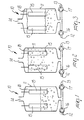
- an immersed-electrode humidifier is generally designated by the reference numeral 10.
- the humidifier 10 comprises a container 11 that is supplied by a duct 12 and is provided with a discharge 13 and with an opening 14 that is located in its uppermost part for the discharge of the generated steam.
- two electrically powered electrodes 15 are contained in the container 11 and there is provided a current measurement device, not shown.
- the humidifier 10 comprises, in this case, a filling valve 16, a discharge valve 17, and a sensor 18 for detecting the presence of water at the maximum level allowed inside the container 11.
- the humidifier 10 is managed by an algorithm for controlling the production of steam; its part related to water level control and to the detection and elimination of any foam that may have formed inside the container 11 is described hereinafter.
- a block diagram that schematically illustrates the water level control method according to the invention is generally designated by the reference sign AL.
- the description of the water level control method starts in filling conditions (block 19) and therefore with the filling valve 16 initially open (block 20).
- the intensity of the current absorbed by the electrodes 15 is measured (block 22) and the measured value is compared with a first reference value.
- the first reference value relates to the control of production in steady-state operating conditions.
- the first reference value can be the sum of the set point current, i.e., the current for correct operation, and of a percentage (on the order of approximately 10%) of the nominal current, which is between 30 and 100% of the set point value.
- the filling valve 16 is closed (block 23), leaving a counter, the function whereof will be specified hereinafter, set to zero (block 24) and performing normal steady-state management, substantially returning to the beginning of the procedure described so far.
- the humidifier 10 is in fact in normal operating conditions, in which the absorbed current is allowed to vary within a range that is centered on the nominal value.
- the algorithm continues by starting to check the level of the water inside the humidifier 10.
- a supply water lack check has also been included in this example.
- Water continues to be loaded in order to reach the first current reference value, unless the water presence sensor reports that the maximum level has been reached. In this case, the current value is compared with a second reference value.
- said second reference value can be estimated as 70% of the nominal current value.
- the logic steps of reporting or not reporting that the container 11 is full and of checking and comparing the absorbed current are represented by the blocks 25 and 26 respectively.
- the algorithm shifts to normal management of the startup or saturation stages (block 27), deactivating the filling (block 23) and keeping the counter set to zero (block 24).
- a first possibility is that the humidifier 10 is in the startup stage and therefore requires a plurality of filling and evaporation cycles, which are obtained with a limited discharge command, in order to reach and exceed the first reference value, and the management of these cycles is assigned to the part of the algorithm that manages the startup stage.
- a second possibility is that the humidifier 10 is in the saturation stage and therefore an absorbed current that is higher than the second reference value can be in itself acceptable.
- foam management is performed in order to eliminate it by performing discharges of water for preset time intervals.
- the sensor 18 does not report that the maximum level has been reached within the water loading time, it is possible to deduce that the water level is very low and that the foam layer is significant and must therefore be reduced.
- the counter is increased by one unit (block 36) while performing a first water discharge (block 37) for a preset discharge time.
- the method according to the invention can work only if the sensor 18 continues to operate even if the supply of current to the electrodes 15 is interrupted.
- the water level control method according to the invention ensures the best balance of the functional parameters, which do not necessarily imply complete elimination of the foam that is present.
- the water level control method according to the invention provides for automatic recognition of the condition in which the humidifier is in the startup/saturation stage or in the steady-state stage and furthermore also automatically recognizes the presence or lack of foam.
- control method according to the invention ensures, in any condition, the optimum relation between the various functional parameters in order to ensure adequate steam production.
Landscapes
- Engineering & Computer Science (AREA)
- Chemical & Material Sciences (AREA)
- Combustion & Propulsion (AREA)
- Mechanical Engineering (AREA)
- General Engineering & Computer Science (AREA)
- Physics & Mathematics (AREA)
- General Physics & Mathematics (AREA)
- Automation & Control Theory (AREA)
- Air Humidification (AREA)
- Air Conditioning Control Device (AREA)
Applications Claiming Priority (2)
| Application Number | Priority Date | Filing Date | Title |
|---|---|---|---|
| ITPD950193 | 1995-10-17 | ||
| IT95PD000193A IT1293557B1 (it) | 1995-10-17 | 1995-10-17 | Procedimento per il controllo del livello dell'acqua e della presenza di schiuma in umidificatori ad elettrodi immersi. |
Publications (2)
| Publication Number | Publication Date |
|---|---|
| EP0769662A1 EP0769662A1 (en) | 1997-04-23 |
| EP0769662B1 true EP0769662B1 (en) | 2001-07-11 |
Family
ID=11391150
Family Applications (1)
| Application Number | Title | Priority Date | Filing Date |
|---|---|---|---|
| EP96116580A Expired - Lifetime EP0769662B1 (en) | 1995-10-17 | 1996-10-16 | Method for controlling the water level and the presence of foam in immersed-electrode humidifiers |
Country Status (3)
| Country | Link |
|---|---|
| EP (1) | EP0769662B1 (enExample) |
| DE (1) | DE69613789T2 (enExample) |
| IT (1) | IT1293557B1 (enExample) |
Families Citing this family (7)
| Publication number | Priority date | Publication date | Assignee | Title |
|---|---|---|---|---|
| US6390027B1 (en) | 2000-05-31 | 2002-05-21 | C. Cowles & Company | Cycle control system for boiler and associated burner |
| US6688329B2 (en) | 2001-07-06 | 2004-02-10 | C. Cowles & Company | Water feeder controller for boiler |
| CA3014561A1 (en) | 2017-08-22 | 2019-02-22 | Technologies Steamovap Inc. | Steam generator |
| US11428407B2 (en) | 2018-09-26 | 2022-08-30 | Cowles Operating Company | Combustion air proving apparatus with burner cut-off capability and method of performing the same |
| CN109631211B (zh) * | 2018-11-14 | 2021-01-05 | 青岛海尔空调电子有限公司 | 一种加湿器及其泡沫检测方法、空调、存储介质 |
| CN109654640B (zh) * | 2018-11-14 | 2021-01-05 | 青岛海尔空调电子有限公司 | 一种加湿器及其泡沫清除方法、空调、存储介质 |
| CN115597148B (zh) * | 2022-10-19 | 2026-06-02 | 南京天加环境科技有限公司 | 一种电极加湿器泡沫检测控制方法、加湿器、空调及介质 |
Family Cites Families (4)
| Publication number | Priority date | Publication date | Assignee | Title |
|---|---|---|---|---|
| DE2228901C3 (de) * | 1972-06-14 | 1975-12-11 | Fa. Anton Kaeser, 2000 Hamburg | Verfahren und Vorrichtung zum Steuern eines Dampferzeugers zur Luftbefeuchtung in Klimaanlagen |
| CH563000A5 (enExample) * | 1973-03-09 | 1975-06-13 | Plascon Ag | |
| CH663458A5 (de) * | 1983-12-23 | 1987-12-15 | Condair Ag | Verfahren und einrichtung zur regelung eines dampferzeugers. |
| US4705936A (en) * | 1985-01-17 | 1987-11-10 | Masco Corporation | Electronically controlled electric steam humidifier |
-
1995
- 1995-10-17 IT IT95PD000193A patent/IT1293557B1/it active IP Right Grant
-
1996
- 1996-10-16 DE DE69613789T patent/DE69613789T2/de not_active Expired - Lifetime
- 1996-10-16 EP EP96116580A patent/EP0769662B1/en not_active Expired - Lifetime
Also Published As
| Publication number | Publication date |
|---|---|
| ITPD950193A0 (enExample) | 1995-10-17 |
| IT1293557B1 (it) | 1999-03-01 |
| DE69613789D1 (de) | 2001-08-16 |
| DE69613789T2 (de) | 2002-04-25 |
| ITPD950193A1 (it) | 1997-04-17 |
| EP0769662A1 (en) | 1997-04-23 |
Similar Documents
| Publication | Publication Date | Title |
|---|---|---|
| KR900001895B1 (ko) | 냉동시스템의 작동 제어시스템과 그 제어방법 | |
| EP0769662A1 (en) | Method for controlling the water level and the presence of foam in immersed-electrode humidifiers | |
| US6819977B2 (en) | Dispenser having multiple modes of operation | |
| EP1314699B1 (en) | Method for cleaning an electrolyzed water production apparatus | |
| US7886373B2 (en) | Method of controlling temperature of warm water of bidet | |
| CN118806102A (zh) | 水处理设备的控制方法、控制装置、介质和水处理设备 | |
| KR20030092465A (ko) | 도금탱크의 도금액 제어장치 및 방법 | |
| CN113982061B (zh) | 一种挖掘机液压系统及其控制方法 | |
| KR20120095228A (ko) | 일정온도의 온수 공급이 가능한 온수 공급시스템 | |
| CN116646566A (zh) | 一种自动给排水的燃料电池系统、控制方法及车辆 | |
| KR950004476B1 (ko) | 식기세척기의 세척수온 제어방법 | |
| KR20000000303U (ko) | 반도체 제조용 냉각수 공급 아셈블리 | |
| JP7189813B2 (ja) | 燃料電池システム、車両および燃料電池システムの制御方法 | |
| KR200331414Y1 (ko) | 비상발전용 연료공급 배관 | |
| KR100590478B1 (ko) | 보일러 분배기 조절을 이용한 시운전 방법 | |
| JP3653135B2 (ja) | 電解水生成装置 | |
| CN120402346B (zh) | 高压水泵启停耐久试验的控制方法及其系统 | |
| JPS61262201A (ja) | 圧油タンクの油面制御方法 | |
| JP2004278902A (ja) | 暖房装置の熱媒漏れ検知方法 | |
| JP4583525B2 (ja) | 送水ユニット | |
| RU2042744C1 (ru) | Способ а.н.алексеева для защиты трубчатых электронагревателей от перегрева в гальванической ванне | |
| JPH0326281B2 (enExample) | ||
| JP2006250503A (ja) | 貯湯式給湯装置 | |
| CN119828609A (zh) | 循环液供给装置及其液位调控方法、温控系统、集成电路工艺制程系统 | |
| CN121140301A (zh) | 一种用于控制液氮后备系统的方法、装置、液氮后备系统及计算机可读存储介质 |
Legal Events
| Date | Code | Title | Description |
|---|---|---|---|
| PUAI | Public reference made under article 153(3) epc to a published international application that has entered the european phase |
Free format text: ORIGINAL CODE: 0009012 |
|
| AK | Designated contracting states |
Kind code of ref document: A1 Designated state(s): DE FR GB |
|
| 17P | Request for examination filed |
Effective date: 19971006 |
|
| 17Q | First examination report despatched |
Effective date: 19991208 |
|
| GRAG | Despatch of communication of intention to grant |
Free format text: ORIGINAL CODE: EPIDOS AGRA |
|
| GRAG | Despatch of communication of intention to grant |
Free format text: ORIGINAL CODE: EPIDOS AGRA |
|
| GRAH | Despatch of communication of intention to grant a patent |
Free format text: ORIGINAL CODE: EPIDOS IGRA |
|
| GRAH | Despatch of communication of intention to grant a patent |
Free format text: ORIGINAL CODE: EPIDOS IGRA |
|
| GRAA | (expected) grant |
Free format text: ORIGINAL CODE: 0009210 |
|
| AK | Designated contracting states |
Kind code of ref document: B1 Designated state(s): DE FR GB |
|
| REF | Corresponds to: |
Ref document number: 69613789 Country of ref document: DE Date of ref document: 20010816 |
|
| ET | Fr: translation filed | ||
| REG | Reference to a national code |
Ref country code: GB Ref legal event code: IF02 |
|
| PLBE | No opposition filed within time limit |
Free format text: ORIGINAL CODE: 0009261 |
|
| STAA | Information on the status of an ep patent application or granted ep patent |
Free format text: STATUS: NO OPPOSITION FILED WITHIN TIME LIMIT |
|
| 26N | No opposition filed | ||
| REG | Reference to a national code |
Ref country code: FR Ref legal event code: PLFP Year of fee payment: 20 |
|
| PGFP | Annual fee paid to national office [announced via postgrant information from national office to epo] |
Ref country code: GB Payment date: 20151020 Year of fee payment: 20 Ref country code: DE Payment date: 20151022 Year of fee payment: 20 |
|
| PGFP | Annual fee paid to national office [announced via postgrant information from national office to epo] |
Ref country code: FR Payment date: 20151016 Year of fee payment: 20 |
|
| REG | Reference to a national code |
Ref country code: DE Ref legal event code: R071 Ref document number: 69613789 Country of ref document: DE |
|
| REG | Reference to a national code |
Ref country code: GB Ref legal event code: PE20 Expiry date: 20161015 |
|
| PG25 | Lapsed in a contracting state [announced via postgrant information from national office to epo] |
Ref country code: GB Free format text: LAPSE BECAUSE OF EXPIRATION OF PROTECTION Effective date: 20161015 |