EP0762694A1 - Lokales, nach dem asynchronen Transfermodus (ATM) arbeitendes Netzwerk mit wenigstens zwei Ringsystemen - Google Patents
Lokales, nach dem asynchronen Transfermodus (ATM) arbeitendes Netzwerk mit wenigstens zwei Ringsystemen Download PDFInfo
- Publication number
- EP0762694A1 EP0762694A1 EP96202367A EP96202367A EP0762694A1 EP 0762694 A1 EP0762694 A1 EP 0762694A1 EP 96202367 A EP96202367 A EP 96202367A EP 96202367 A EP96202367 A EP 96202367A EP 0762694 A1 EP0762694 A1 EP 0762694A1
- Authority
- EP
- European Patent Office
- Prior art keywords
- network
- ring
- ring system
- connection
- network interface
- Prior art date
- Legal status (The legal status is an assumption and is not a legal conclusion. Google has not performed a legal analysis and makes no representation as to the accuracy of the status listed.)
- Withdrawn
Links
- 238000012546 transfer Methods 0.000 title claims abstract description 14
- 230000005540 biological transmission Effects 0.000 claims abstract description 8
- 230000008878 coupling Effects 0.000 claims description 31
- 238000010168 coupling process Methods 0.000 claims description 31
- 238000005859 coupling reaction Methods 0.000 claims description 31
- 238000000034 method Methods 0.000 claims description 4
- 230000015654 memory Effects 0.000 description 30
- 239000011159 matrix material Substances 0.000 description 13
- 238000012545 processing Methods 0.000 description 3
- 230000002950 deficient Effects 0.000 description 2
- 230000006870 function Effects 0.000 description 2
- 238000009795 derivation Methods 0.000 description 1
- 238000001514 detection method Methods 0.000 description 1
- 238000011161 development Methods 0.000 description 1
- 230000005236 sound signal Effects 0.000 description 1
- 238000013519 translation Methods 0.000 description 1
Images

Classifications
-
- H—ELECTRICITY
- H04—ELECTRIC COMMUNICATION TECHNIQUE
- H04Q—SELECTING
- H04Q11/00—Selecting arrangements for multiplex systems
- H04Q11/04—Selecting arrangements for multiplex systems for time-division multiplexing
- H04Q11/0428—Integrated services digital network, i.e. systems for transmission of different types of digitised signals, e.g. speech, data, telecentral, television signals
- H04Q11/0478—Provisions for broadband connections
-
- H—ELECTRICITY
- H04—ELECTRIC COMMUNICATION TECHNIQUE
- H04L—TRANSMISSION OF DIGITAL INFORMATION, e.g. TELEGRAPHIC COMMUNICATION
- H04L12/00—Data switching networks
- H04L12/28—Data switching networks characterised by path configuration, e.g. LAN [Local Area Networks] or WAN [Wide Area Networks]
- H04L12/46—Interconnection of networks
- H04L12/4604—LAN interconnection over a backbone network, e.g. Internet, Frame Relay
- H04L12/4608—LAN interconnection over ATM networks
-
- H—ELECTRICITY
- H04—ELECTRIC COMMUNICATION TECHNIQUE
- H04L—TRANSMISSION OF DIGITAL INFORMATION, e.g. TELEGRAPHIC COMMUNICATION
- H04L12/00—Data switching networks
- H04L12/28—Data switching networks characterised by path configuration, e.g. LAN [Local Area Networks] or WAN [Wide Area Networks]
- H04L12/46—Interconnection of networks
- H04L12/4637—Interconnected ring systems
-
- H—ELECTRICITY
- H04—ELECTRIC COMMUNICATION TECHNIQUE
- H04J—MULTIPLEX COMMUNICATION
- H04J2203/00—Aspects of optical multiplex systems other than those covered by H04J14/05 and H04J14/07
- H04J2203/0001—Provisions for broadband connections in integrated services digital network using frames of the Optical Transport Network [OTN] or using synchronous transfer mode [STM], e.g. SONET, SDH
- H04J2203/0057—Operations, administration and maintenance [OAM]
- H04J2203/006—Fault tolerance and recovery
-
- H—ELECTRICITY
- H04—ELECTRIC COMMUNICATION TECHNIQUE
- H04L—TRANSMISSION OF DIGITAL INFORMATION, e.g. TELEGRAPHIC COMMUNICATION
- H04L12/00—Data switching networks
- H04L12/54—Store-and-forward switching systems
- H04L12/56—Packet switching systems
- H04L12/5601—Transfer mode dependent, e.g. ATM
- H04L2012/5603—Access techniques
- H04L2012/5609—Topology
- H04L2012/5612—Ring
Definitions
- the invention relates to a local network operating according to the asynchronous transfer mode (ATM) for the transmission of cells with several network interfaces.
- ATM asynchronous transfer mode
- a local area network which operates according to the asynchronous transfer mode is known from EP 0 641 105 A2.
- This network contains several stations and assigned network interfaces, each of which has a send and receive ring connection. Cells that contain address information about the destination, for example of a particular station, are transmitted via the ring formed in this way.
- a network interface contains a coupling device and a control arrangement.
- the coupling device contains a path storage arrangement which is assigned to the receiving ring connection and a path storage arrangement which is assigned to a receiving station connection.
- the corresponding switching or coupling operations are carried out in the coupling device when a cell is received. For example, an incoming cell is forwarded to the control arrangement, the station and / or the ring on the basis of the address information.
- a fixed length block is a cell that has a predetermined number of bytes (eg 53 bytes).
- Each cell consists of a header field with a length of, for example, 5 bytes and an information field in which the useful information is housed, with a length of 48 bytes, for example.
- Address information, data for error detection and data for control information are present in such a header field.
- Address information includes bundle identifiers and connection identifiers.
- the connection identifier which is also referred to as VCI (Virtual Channel Identifier), contains the information about the destination of the cell in the system.
- a virtual channel is made available based on the connection identifier.
- a VCI is changed after reaching an exchange.
- a bundle of several virtual channels is called a virtual path.
- a virtual path is identified by the bundle identifier.
- Such a virtual path is called VPI (Virtual Path Identifier).
- Cells are sequentially assigned to certain time periods. The duration of such a time period depends on the underlying clock frequency of the transmission component. If no useful information is available, empty cells are transmitted in such a time period, ie cells without useful information. Cells that contain useful information are referred to as useful cells.
- the local network known from EP 0 641 105 A2 consists of only one ring system and does not specify any possibilities for exchanging cells over several ring systems.
- a ring system can have one ring or two rings for countercurrent cell currents.
- a ring represents a closed signal path across several network interfaces.
- DE 40 02 022 A1 discloses a method and an arrangement for the highly available transmission of data between two bus systems operating according to the token passing principle.
- the two bus systems are connected to one another via two coupling links provided for the exchange of data.
- One coupling link is active and the other coupling link is in stand-by mode.
- the coupling link in stand-by mode checks the correct token transfer of the active coupling link. With the failure of the active coupling link, the coupling link previously operating in stand-by mode is activated. Thus, only one coupling link is active in this arrangement.
- the object of the invention is therefore to create a local network which operates according to the asynchronous transfer mode and in which an exchange of cells between ring systems is also possible.
- the invention is achieved by a local network operating according to the asynchronous transfer mode of the type mentioned in the introduction in that at least two ring systems are provided, each with two network interfaces, each having at least one bridge connection, and in that a first network interface of a first ring system and a first network interface of a second ring system via at least a first bridge connection for transmitting the cell current between the two ring systems and a second network interface of the first ring system and a second network interface of the second ring system are coupled via at least a second bridge connection for conducting the cell current between the two ring systems.
- the local network according to the invention contains at least two ring systems with one or two rings. Cells can be transferred from one ring system to the other ring system via first network interfaces. The first two network interfaces are coupled to one another via at least one bridge connection. The first and second ring systems each also contain second network interfaces which are coupled to one another via at least one second bridge connection. The cell stream can thus flow either through the first or second network interfaces. If a bridge connection fails, the measures according to the invention allow the cell current to flow through the respective other bridge connections.
- the first network interfaces are not intended for forwarding cells whose destination is the respective other ring system into the other ring system.
- the second network interfaces are not provided for forwarding cells whose destination is the respective other ring system into the other ring system.
- the network interface which is assigned to an interrupted bridge connection, therefore no longer flows a cell to the bridge connection, but forwards a cell on the ring.
- a first or second network interface contains a coupling device for coupling at least one receive and one transmit ring connection and two bridge connections, that one receive ring connection and one bridge connection each have a path storage arrangement for controlling the paths in the Coupling device are assigned to a cell after taking address information from the header field and that the path storage arrangements of the first and second network interfaces of a ring system have the same content. Since the path storage arrangements in the network interfaces of a ring system have the same contents, if one bridge connection fails, the cell current can be passed over the other bridge connections without delay.
- the invention also relates to a method for the transmission of cells in a local network which operates according to the asynchronous transfer mode (ATM) and contains several network interfaces.
- ATM asynchronous transfer mode
- cells are transmitted between a first network interface of a first ring system and a first network interface of a second ring system via at least a first bridge connection and between a second network interface of the first ring system and a second network interface of the second ring system via at least a second bridge connection.
- a ring system 1 to 6 can consist of either one or two rings. Ring systems 1 and 2 contain one and ring systems 3 to 6 contain two rings. A ring represents a closed signal path over several network nodes. The ring systems 3 to 6 each form two opposite rings, i.e. the signals run in opposite directions on the rings.
- a network node which is represented as a rectangle in the ring systems 1 to 6, comprises a network interface with two or four ring connections and two bridge connections.
- Either a station or a network interface of another ring system is connected to the bridge connections. For example, a total of three network interfaces with stations and four network interfaces with network interfaces of the ring systems 3 and 5 are connected to the ring system 4 in FIG. 1.
- a station can be, for example, a video telephone, a personal computer or a workstation or a telephone.
- the messages or information originating from the stations or the network interfaces are transmitted using cells after the asynchronous transfer mode.
- a cell contains a header field with, for example, 5 bytes and an information field with, for example, 48 bytes. The information contained in the header field of the cell is used in particular for addressing and for performing switching functions.
- Each network node is still coupled to a network management system (not shown) for controlling the local network.
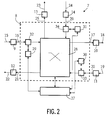
- a network interface 7 with four ring connections is shown in more detail in FIG. 2.
- the network interface 7 contains a coupling device 8, which is coupled to ring and bridge connections via buffer memories 9 to 14 and forwards the cell current.
- the buffer memory 9 is coupled on the one hand to a receiving ring connection 15 of a first ring and on the other hand to a connection 16 which leads to the coupling device 8.
- the buffer memory 9 also receives a first receive clock signal, which is derived from the cell current of the receive ring connection 15, and an internal clock signal from a clock generator of the network interface 7.
- the buffer memory 10 is coupled to the coupling device 8 via a connection 17 and supplies a cell current a transmit ring connector 18 of the first ring.
- the buffer clock 10 is supplied with the internal clock signal and a first transmit clock signal which is derived, for example, from the internal clock signal.
- the buffer memory 11 receives a cell current from a reception ring connection 19 of a second ring and supplies a cell current via a connection 20 to the coupling device 8. From a connection 21 of the coupling device 8, the buffer memory 12 receives cells which are connected to a transmission ring connection 22 of the second ring be forwarded.
- the buffer memory 11 receives a second receive clock signal, which is derived from the cell current of the receive ring connector 19 is derived, and the internal clock signal.
- the buffer clock 12 is supplied with the internal clock signal and a second transmit clock signal which is derived, for example, from the internal clock signal.
- a bridge connection 23 is coupled via the buffer memory 13 and a bridge connection 24 is coupled to the network interface 7 via the buffer memory 14.
- the buffer memory 13, which receives a cell current from the coupling device 8, is coupled to the coupling device 8 via a connection 25.
- the buffer clock 13 is also supplied with the internal clock signal and, if appropriate, a first station signal from a station connected to the bridge connections 23 and 24.
- the buffer memory 14, which is supplied with a cell stream from a network interface of another ring system or a station, is coupled to a station or a network interface of another ring system via the bridge connection 24 and to the coupling device 8 via a connection 26.
- This buffer memory 14 may receive a second station signal and the internal clock signal.
- the cell current is adapted to a clock signal.
- the derivation of the various clock signals from the cell current and the generation of the internal clock signal in the clock generator are not shown in more detail here.
- the station clock signals can, for example, be the same as the internal clock signal. In this case, no buffer memories 13 and 14 are required.
- the network interface 7 also contains a control arrangement 27 which controls the coupling device 8 and is used, for example, for establishing and clearing the connection.
- the control arrangement 27, which can be implemented as a microprocessor, can also receive and generate cells.
- the coupling device 8 also contains a switching matrix 28, three path storage arrangements 29, 30 and 31 and three receiving circuits 32, 33 and 34.
- the receiving circuits 32, 33 and 34 each evaluate the head fields of cells arriving via connections 16, 20 and 26.
- Address information contained in the header field is used to control various tables for the path memory arrangements 29, 30 and 31 connected to the receiving circuits 32, 33 and 34.
- the data stored in the tables are used by the receiving circuits 32, 33 and 34, respectively, to organize the further processing and forwarding of the cell.
- the receiving circuit 32 can copy the cell and provide it with new address information.
- the original cell is e.g. given via the switching matrix 28 to the bridge connection 23 and the copied cell via the switching matrix 28 to the buffer memory 10. There is still the possibility that the switching matrix 28 performs this copying function.
- the receiving circuit 32 is coupled to the buffer memory 9 via the connection 16 and forwards received cells to the switching matrix 28.
- the path memory arrangement 29 is connected to the receiving circuit 32.
- the receiving circuit 33 is connected to the path memory arrangement 30, receives cells from the buffer memory 11 and passes cells on to the switching matrix 28.
- the receiving circuit 34 which is connected to the path memory arrangement 31, is arranged between the switching matrix 28 and the connection 26.
- Two types of useful cells are transmitted via the ring connections 15 and 18 of the first ring and via the ring connections 19 and 22.
- user cells which in their information field, for. B. messages or data of the user of a previously established connection and on the other hand control cells that contain control information in their information field.
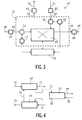
- the network interface 47 operates in a similar manner to the network interface 7 2.
- cells are transmitted between the ring connections 48 and 49, bridge connections 50 and 51 and a control arrangement 52 by a coupling device 53.
- the coupling device 53 contains a switching matrix 54, two receiving circuits 55 and 56 and two path storage arrangements 57 and 58.
- the ring connection 48 is coupled via a buffer memory 59 to the receiving circuit 55 via a connection 60.
- the receiving circuit 55 which is coupled to the path storage arrangement 57, forwards received cells to the switching matrix 54.
- the path memory arrangement 57 may provide the receiving circuit 55 with new control information for the header field of the received cell.
- the switching matrix 54 is further coupled to the ring connection 49 via a connection 65 and a buffer memory 66.
- the bridge connections 50 and 51 are also connected to buffer memories 61 and 62, respectively.
- the buffer memory 61 is supplied with cells from the switching matrix 54 via a connection 63.
- the reception circuit 56 is arranged between the buffer memory 62 and the switching matrix 54 and is coupled to the path memory arrangement 58.
- the receiving circuit 56 and the buffer memory 62 are coupled to one another via a connection 64.
- the control arrangement 52 is used to control the path storage arrangements 57 and 58 and receives at least cells from the switching matrix 54.
- a network interface with four ring connections can also be formed from three network connections, each with two ring connections, as shown in FIG. 3.
- 4 shows three network interfaces 67, 68 and 69.
- the ring connections 70 and 71 of the network interface 68 and the ring connections 73 and 74 of the network interface 69 also form ring connections in this interconnection.
- the bridge connection 75 of the network interface 68 is the ring connection of the network interface 67, the bridge connections 77 and 78 of which are also the bridge connections in this interconnection.
- the further ring connection of the network interface 67 is with the bridge connection 76 Network interface 69 connected.
- the bridge connection 72 still connects the two network interfaces 68 and 69.
- a network interface therefore routes cells from one ring connection to the other ring connection of the same ring, to a bridge or station connection or, in the case of four ring connections, to the ring connection of the other ring.
- a cell on a bridge or station connection is passed on to a ring connection. Cells can also be received and sent by the control arrangement of the network interface.
- VCI virtual channel identifier
- VPI virtual path identifier
- the VCI and the VPI are provided for different information than in the standardization proposals.
- the VPI contains information about the address (address information) or the destination (network node) of a cell in a ring system.
- the VCI is used to specify the user-specific identifier for a connection, the type of connection and the cell type.
- the VCI is also used as an address for a ring system.
- a control arrangement 27 of the network interface 7 or a control arrangement 52 of the network interface 47 controls the connection establishment of an assigned station with other stations.
- the corresponding control processes for the Establishing and clearing down connections can be found, for example, in European patent application EP-0 641 105 A2.
- the path storage arrangements 29 to 31 of the network interface 7 or the path storage arrangements 57 and 58 of the network interface 47 contain information which is evaluated by the associated receiving circuits 32 to 34 or 55 and 56 in order to organize the further processing and forwarding of the received cell. For example, a cell can be assigned a different address, copied or deleted.
- the path storage arrangements 29 to 31 or 57 and 58 can be changed by the respective control arrangement 27 or 52, for example in the event of an error or on the basis of certain information from the network management system.
- a cell generated by the network node f of the ring system B receives the address (C, f) and is transmitted via the network nodes e and d to the network node c of the ring system B and via the associated bridge connections to the network node f of the ring system C.
- the address (C, f) is replaced by a new address (D, a).
- the cell then reaches network node a of ring system D via network nodes e and d of ring system C.
- a new address (E, a) has been inserted, the cell runs via network node d of ring system D to network node a of ring system E.
- F, a a new address in the header of the cell used and given the cell via node d (ring system E) to node a of ring system F.
- the cell reaches network node d via network nodes b and c of ring system F.
- a ring connection or a bridge or station connection can be interrupted or a network node can fail.
- a network interface that detects such an error reports this error to the network management system.
- Such a fault is e.g. after sending out control cells that are not received again or detected by a loss of synchronization.
- the network management system makes this error information available, so that path storage arrangements in the network interfaces can be changed accordingly by the associated control arrangement.
- the network interface If an error occurs on a ring connection between two network interfaces, the network interface receiving no further cells due to the error informs the network management system. The network interface sending out the cells switches a loop after receiving the error information from the network management system. This means that all cells to be routed via the defective ring connection are looped onto the ring connection of the other ring. However, this is only possible if there is a network interface with four ring connections. Otherwise, in the case of a network interface with two ring connections, the cells are deleted.
- a network node detecting the error informs the network management system. Be further In the network interfaces connected via the bridge connection, the entries in the routing memory arrangements are changed. A cell that is to be passed through the bridge connections is then only forwarded by the corresponding coupling devices via the ring and not to a bridge connection.
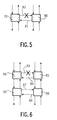
- 5 shows an example with two network interfaces 79 and 80.
- a bridge connection 81 supplies cells from the network interface 80 to a first ring system of the network interface 79 to a second ring system. Cells are normally passed from the network interface 79 to the network interface 80 via the bridge connection 82.
- This bridge connection 82 is interrupted, for example. The cells are then no longer passed through the bridge connections 81 and 82, but remain in the respective ring system, where they may be destroyed if there is no further connection between the two ring systems.
- FIG. 6 shows an example in which there is a further bridge connection between two ring systems.
- a bridge connection 83 or 84 between a network interface 85 of a first ring system and a network interface 86 of a second ring system is interrupted. Cells which are to get from one ring system to the other via the bridge connections 83 and 84 are therefore transmitted via further bridge connections 87 or 88 between the network interface 89 of the first ring system and the network interface 90 of the second ring system.
- the path storage arrangements in the network interfaces 85, 86, 89 and 90 are thus set up so that both cells can be transferred from one ring system to the other.
- the path storage arrangements of the network interfaces 85 and 89 and the network interfaces 86 and 90 have the same content. This ensures that if a bridge connection fails, cells can be transferred between ring systems via further bridge connections. 6, the network interfaces 85, 86, 89 and 90 each have four ring connections. It is also possible to use network interfaces with two ring connections each.
Landscapes
- Engineering & Computer Science (AREA)
- Computer Networks & Wireless Communication (AREA)
- Signal Processing (AREA)
- Data Exchanges In Wide-Area Networks (AREA)
- Small-Scale Networks (AREA)
Applications Claiming Priority (2)
| Application Number | Priority Date | Filing Date | Title |
|---|---|---|---|
| DE19532422 | 1995-09-01 | ||
| DE19532422A DE19532422C1 (de) | 1995-09-01 | 1995-09-01 | Lokales, nach dem asynchronen Transfermodus (ATM) arbeitendes Netzwerk mit wenigstens zwei Ringsystemen |
Publications (1)
| Publication Number | Publication Date |
|---|---|
| EP0762694A1 true EP0762694A1 (de) | 1997-03-12 |
Family
ID=7771105
Family Applications (1)
| Application Number | Title | Priority Date | Filing Date |
|---|---|---|---|
| EP96202367A Withdrawn EP0762694A1 (de) | 1995-09-01 | 1996-08-26 | Lokales, nach dem asynchronen Transfermodus (ATM) arbeitendes Netzwerk mit wenigstens zwei Ringsystemen |
Country Status (4)
| Country | Link |
|---|---|
| US (1) | US6647429B1 (enExample) |
| EP (1) | EP0762694A1 (enExample) |
| JP (1) | JPH09116567A (enExample) |
| DE (1) | DE19532422C1 (enExample) |
Families Citing this family (31)
| Publication number | Priority date | Publication date | Assignee | Title |
|---|---|---|---|---|
| DE19918896A1 (de) * | 1999-04-26 | 2000-11-02 | Mueschenborn Hans Joachim | Logisches Netzwerksystem |
| DE19961399C2 (de) * | 1999-12-20 | 2002-08-22 | Mueschenborn Hans Joachim | Schutz sicherheitskritischer Daten in Netzwerken |
| DE10004426A1 (de) * | 2000-02-02 | 2001-08-09 | Siemens Ag | Netzwerkteilnehmer, insbesondere Feldgerät, sowie Netzwerk mit einem derartigen Netzwerkteilnehmer |
| DE10004432A1 (de) * | 2000-02-02 | 2001-08-09 | Siemens Ag | Netzwerk sowie Netzwerkteilnehmer, insbesondere Feldgerät, für ein derartiges Netzwerk |
| US7962716B2 (en) | 2001-03-22 | 2011-06-14 | Qst Holdings, Inc. | Adaptive integrated circuitry with heterogeneous and reconfigurable matrices of diverse and adaptive computational units having fixed, application specific computational elements |
| US7400668B2 (en) | 2001-03-22 | 2008-07-15 | Qst Holdings, Llc | Method and system for implementing a system acquisition function for use with a communication device |
| US6836839B2 (en) | 2001-03-22 | 2004-12-28 | Quicksilver Technology, Inc. | Adaptive integrated circuitry with heterogeneous and reconfigurable matrices of diverse and adaptive computational units having fixed, application specific computational elements |
| US7653710B2 (en) | 2002-06-25 | 2010-01-26 | Qst Holdings, Llc. | Hardware task manager |
| US7752419B1 (en) | 2001-03-22 | 2010-07-06 | Qst Holdings, Llc | Method and system for managing hardware resources to implement system functions using an adaptive computing architecture |
| US7388872B2 (en) * | 2001-04-06 | 2008-06-17 | Montgomery Jr Charles D | Dynamic communication channel allocation method and system |
| US6577678B2 (en) | 2001-05-08 | 2003-06-10 | Quicksilver Technology | Method and system for reconfigurable channel coding |
| US8412915B2 (en) | 2001-11-30 | 2013-04-02 | Altera Corporation | Apparatus, system and method for configuration of adaptive integrated circuitry having heterogeneous computational elements |
| US6986021B2 (en) * | 2001-11-30 | 2006-01-10 | Quick Silver Technology, Inc. | Apparatus, method, system and executable module for configuration and operation of adaptive integrated circuitry having fixed, application specific computational elements |
| US7602740B2 (en) | 2001-12-10 | 2009-10-13 | Qst Holdings, Inc. | System for adapting device standards after manufacture |
| US20030108012A1 (en) * | 2001-12-12 | 2003-06-12 | Quicksilver Technology, Inc. | Method and system for detecting and identifying scrambling codes |
| US7215701B2 (en) | 2001-12-12 | 2007-05-08 | Sharad Sambhwani | Low I/O bandwidth method and system for implementing detection and identification of scrambling codes |
| US7403981B2 (en) * | 2002-01-04 | 2008-07-22 | Quicksilver Technology, Inc. | Apparatus and method for adaptive multimedia reception and transmission in communication environments |
| FR2836731B1 (fr) * | 2002-03-01 | 2004-12-03 | Abdulai Danso | Procede pour la realisation et la mise en oeuvre d'un systeme de communication multifonctionnel et systeme obtenu conformement audit procede |
| US7493375B2 (en) | 2002-04-29 | 2009-02-17 | Qst Holding, Llc | Storage and delivery of device features |
| US7660984B1 (en) | 2003-05-13 | 2010-02-09 | Quicksilver Technology | Method and system for achieving individualized protected space in an operating system |
| US7328414B1 (en) | 2003-05-13 | 2008-02-05 | Qst Holdings, Llc | Method and system for creating and programming an adaptive computing engine |
| US8108656B2 (en) | 2002-08-29 | 2012-01-31 | Qst Holdings, Llc | Task definition for specifying resource requirements |
| US7937591B1 (en) | 2002-10-25 | 2011-05-03 | Qst Holdings, Llc | Method and system for providing a device which can be adapted on an ongoing basis |
| US8276135B2 (en) * | 2002-11-07 | 2012-09-25 | Qst Holdings Llc | Profiling of software and circuit designs utilizing data operation analyses |
| US7225301B2 (en) | 2002-11-22 | 2007-05-29 | Quicksilver Technologies | External memory controller node |
| US7609297B2 (en) | 2003-06-25 | 2009-10-27 | Qst Holdings, Inc. | Configurable hardware based digital imaging apparatus |
| US7194598B2 (en) * | 2004-01-26 | 2007-03-20 | Nvidia Corporation | System and method using embedded microprocessor as a node in an adaptable computing machine |
| US20080182021A1 (en) * | 2007-01-31 | 2008-07-31 | Simka Harsono S | Continuous ultra-thin copper film formed using a low thermal budget |
| DE102007017835A1 (de) * | 2007-04-16 | 2008-10-23 | Beckhoff Automation Gmbh | Paketvermittlungsvorrichtung und lokales Kommunikationsnetz mit einer solchen Paketvermittlungsvorrichtung |
| JP5990466B2 (ja) | 2010-01-21 | 2016-09-14 | スビラル・インコーポレーテッド | ストリームに基づく演算を実装するための汎用複数コアシステムのための方法および装置 |
| FR3000338B1 (fr) * | 2012-12-21 | 2016-05-13 | Thales Sa | Reseau de transmission d'informations a au moins deux boucles |
Citations (3)
| Publication number | Priority date | Publication date | Assignee | Title |
|---|---|---|---|---|
| US4949340A (en) * | 1988-07-21 | 1990-08-14 | Xyplex, Inc. | Redundant repeater |
| JPH04181838A (ja) * | 1990-11-16 | 1992-06-29 | Hitachi Ltd | ネットワーク構成制御方式 |
| EP0641105A2 (de) * | 1993-08-28 | 1995-03-01 | Philips Patentverwaltung GmbH | Lokales, nach dem asynchronen Transfermodus (ATM) arbeitendes Netzwerk |
Family Cites Families (8)
| Publication number | Priority date | Publication date | Assignee | Title |
|---|---|---|---|---|
| DE4002022A1 (de) * | 1990-01-24 | 1991-07-25 | Siemens Ag | Verfahren und anordnung zur hochverfuegbaren uebertragung von daten |
| JPH07101886B2 (ja) * | 1990-05-15 | 1995-11-01 | 三菱電機株式会社 | ブリツジ装置 |
| US5434863A (en) * | 1991-08-30 | 1995-07-18 | Hitachi, Ltd. | Internetworking apparatus for connecting plural network systems and communication network system composed of plural network systems mutually connected |
| JP3483900B2 (ja) * | 1992-07-08 | 2004-01-06 | 株式会社日立製作所 | 同報通信方法 |
| EP0603443A1 (en) * | 1992-12-22 | 1994-06-29 | International Business Machines Corporation | Token star bridge |
| KR0136519B1 (ko) * | 1994-07-14 | 1998-06-01 | 양승택 | 연결설정방식의 비연결형 데이타 처리장치 및 그 방법 |
| US5550816A (en) * | 1994-12-29 | 1996-08-27 | Storage Technology Corporation | Method and apparatus for virtual switching |
| US5631908A (en) * | 1995-03-28 | 1997-05-20 | Digital Equipment Corporation | Method and apparatus for generating and implementing smooth schedules for forwarding data flows across cell-based switches |
-
1995
- 1995-09-01 DE DE19532422A patent/DE19532422C1/de not_active Expired - Fee Related
-
1996
- 1996-08-26 EP EP96202367A patent/EP0762694A1/de not_active Withdrawn
- 1996-08-30 US US08/706,114 patent/US6647429B1/en not_active Expired - Fee Related
- 1996-08-30 JP JP8229914A patent/JPH09116567A/ja not_active Abandoned
Patent Citations (3)
| Publication number | Priority date | Publication date | Assignee | Title |
|---|---|---|---|---|
| US4949340A (en) * | 1988-07-21 | 1990-08-14 | Xyplex, Inc. | Redundant repeater |
| JPH04181838A (ja) * | 1990-11-16 | 1992-06-29 | Hitachi Ltd | ネットワーク構成制御方式 |
| EP0641105A2 (de) * | 1993-08-28 | 1995-03-01 | Philips Patentverwaltung GmbH | Lokales, nach dem asynchronen Transfermodus (ATM) arbeitendes Netzwerk |
Non-Patent Citations (2)
| Title |
|---|
| MASATO TSUKAKOSHI ET AL: "LARGE-SCALE AND HIGH-SPEED INTERCONNECTION OF MULTIPLE FDDIS USING ATM-BASED BACKBONE LAN", ONE WORLD THROUGH COMMUNICATIONS, FLORENCE, MAY 4 - 8, 1992, vol. 3 OF 3, 1 January 1992 (1992-01-01), INSTITUTE OF ELECTRICAL AND ELECTRONICS ENGINEERS, pages 2290 - 2298, XP000300354 * |
| PATENT ABSTRACTS OF JAPAN vol. 016, no. 497 (E - 1279) 14 October 1992 (1992-10-14) * |
Also Published As
| Publication number | Publication date |
|---|---|
| JPH09116567A (ja) | 1997-05-02 |
| DE19532422C1 (de) | 1997-01-23 |
| US6647429B1 (en) | 2003-11-11 |
Similar Documents
| Publication | Publication Date | Title |
|---|---|---|
| DE19532422C1 (de) | Lokales, nach dem asynchronen Transfermodus (ATM) arbeitendes Netzwerk mit wenigstens zwei Ringsystemen | |
| DE69017193T2 (de) | Automatische fehlererholung in einem paketnetz. | |
| DE69232247T2 (de) | Vermittlungsknoten in einem Netz mit Etikett-Multiplexinformation | |
| DE69327576T2 (de) | Paralleles Rechnersystem | |
| DE3788303T2 (de) | Verfahren und System zur Adressierung und Steuerung eines Modemnetzes. | |
| EP0384936B1 (de) | Verfahren und Schaltungsanordnung zum Weiterleiten von auf Zubringerleitungen übertragenen Nachrichtenpaketen über eine Paketvermittlungseinrichtung | |
| DE4329048A1 (de) | Lokales, nach dem asynchronen Transfermodus (ATM) arbeitendes Netzwerk | |
| DE69133547T2 (de) | Paketvermittlungssystem mit selbstleitweglenkenden Koppelfeldern | |
| DE69117106T2 (de) | Verfahren zum Kontrollieren der Einfügung von Stationen in einem Netzwerk mit optischen Fasern (FDDI-Netzwerk) | |
| DE69031438T2 (de) | Kommunikationsprotokoll für statistische Datenmultiplexer in einer Weitbereichsnetzanordnung | |
| EP0631412A2 (de) | Verfahren und Schaltungsanordnung zur Übertragung von ATM-Paketen | |
| WO2002043336A9 (de) | System und verfahren zur parallelen übertragung von echtzeitkritischen und nicht echtzeitkritischen daten über schaltbare datennetze, insbesondere ethernet | |
| EP0871344A2 (de) | Lokales Netzwerk zur Rekonfigurierung bei Leitungsbrüchen oder Knotenausfall | |
| DE19609265B4 (de) | Kommunikationseinrichtung mit asynchronem Übertragungmodus und daraus aufgebautes Kommunikationsnetzwerk | |
| DE69826640T2 (de) | Vermittlungsarchitektur mit zwei Koppelfelden | |
| DE4343839A1 (de) | Lokales Netzwerk mit einem Datenaustausch über Funkübertragungswege | |
| EP1010303A1 (de) | Kommunikationseinrichtung für die übertragung von nachrichtensignalen | |
| EP0937370A1 (de) | Verfahren zum ersatzschalten von übertragungseinrichtungen zur bidirektionalen übertragung von atm-zellen | |
| EP0751693A2 (de) | ATM-Kommunikationsnetz | |
| DE60128854T2 (de) | Kopfteil Übersetzung in einer ATM Vermittlungsstelle | |
| EP0634879A2 (de) | Anordnung und Verfahren zum Bearbeiten von Datenstrukturen bei deren Durchlauf durch einen Netzwerkknoten | |
| EP0685950A2 (de) | Lokales, nach dem asynchronen Transfermodus (ATM) arbeitendes Netzwerk | |
| EP0614296B1 (de) | Lokales, nach dem asynchronen Transfermodus (ATM) arbeitendes Netzwerk | |
| DE19532421C1 (de) | Lokales, nach dem asynchronen Transfermodus (ATM) arbeitendes Netzwerk zur Erzeugung von priorisierten Zellen | |
| EP0973301A2 (de) | Lokales Netzwerk mit Master-Netzknoten zur Löschung von kreisenden Nachtrichten |
Legal Events
| Date | Code | Title | Description |
|---|---|---|---|
| PUAI | Public reference made under article 153(3) epc to a published international application that has entered the european phase |
Free format text: ORIGINAL CODE: 0009012 |
|
| AK | Designated contracting states |
Kind code of ref document: A1 Designated state(s): DE FR GB |
|
| 17P | Request for examination filed |
Effective date: 19970912 |
|
| RAP3 | Party data changed (applicant data changed or rights of an application transferred) |
Owner name: KONINKLIJKE PHILIPS ELECTRONICS N.V. Owner name: PHILIPS CORPORATE INTELLECTUAL PROPERTY GMBH |
|
| RAP1 | Party data changed (applicant data changed or rights of an application transferred) |
Owner name: KONINKLIJKE PHILIPS ELECTRONICS N.V. Owner name: PHILIPS CORPORATE INTELLECTUAL PROPERTY GMBH |
|
| RAP1 | Party data changed (applicant data changed or rights of an application transferred) |
Owner name: KONINKLIJKE PHILIPS ELECTRONICS N.V. Owner name: PHILIPS INTELLECTUAL PROPERTY & STANDARDS GMBH |
|
| STAA | Information on the status of an ep patent application or granted ep patent |
Free format text: STATUS: THE APPLICATION HAS BEEN WITHDRAWN |
|
| 18W | Application withdrawn |
Effective date: 20031013 |