EP0761826A2 - Eisen modifizierte Phosphorbronze - Google Patents
Eisen modifizierte Phosphorbronze Download PDFInfo
- Publication number
- EP0761826A2 EP0761826A2 EP96202345A EP96202345A EP0761826A2 EP 0761826 A2 EP0761826 A2 EP 0761826A2 EP 96202345 A EP96202345 A EP 96202345A EP 96202345 A EP96202345 A EP 96202345A EP 0761826 A2 EP0761826 A2 EP 0761826A2
- Authority
- EP
- European Patent Office
- Prior art keywords
- weight
- production
- seamless tubes
- tubes according
- deformation
- Prior art date
- Legal status (The legal status is an assumption and is not a legal conclusion. Google has not performed a legal analysis and makes no representation as to the accuracy of the status listed.)
- Granted
Links
Images
Classifications
-
- C—CHEMISTRY; METALLURGY
- C21—METALLURGY OF IRON
- C21D—MODIFYING THE PHYSICAL STRUCTURE OF FERROUS METALS; GENERAL DEVICES FOR HEAT TREATMENT OF FERROUS OR NON-FERROUS METALS OR ALLOYS; MAKING METAL MALLEABLE, e.g. BY DECARBURISATION OR TEMPERING
- C21D8/00—Modifying the physical properties by deformation combined with, or followed by, heat treatment
- C21D8/10—Modifying the physical properties by deformation combined with, or followed by, heat treatment during manufacturing of tubular bodies
-
- C—CHEMISTRY; METALLURGY
- C22—METALLURGY; FERROUS OR NON-FERROUS ALLOYS; TREATMENT OF ALLOYS OR NON-FERROUS METALS
- C22C—ALLOYS
- C22C32/00—Non-ferrous alloys containing at least 5% by weight but less than 50% by weight of oxides, carbides, borides, nitrides, silicides or other metal compounds, e.g. oxynitrides, sulfides, whether added as such or formed in situ
- C22C32/001—Non-ferrous alloys containing at least 5% by weight but less than 50% by weight of oxides, carbides, borides, nitrides, silicides or other metal compounds, e.g. oxynitrides, sulfides, whether added as such or formed in situ with only oxides
- C22C32/0015—Non-ferrous alloys containing at least 5% by weight but less than 50% by weight of oxides, carbides, borides, nitrides, silicides or other metal compounds, e.g. oxynitrides, sulfides, whether added as such or formed in situ with only oxides with only single oxides as main non-metallic constituents
- C22C32/0026—Matrix based on Ni, Co, Cr or alloys thereof
-
- C—CHEMISTRY; METALLURGY
- C22—METALLURGY; FERROUS OR NON-FERROUS ALLOYS; TREATMENT OF ALLOYS OR NON-FERROUS METALS
- C22C—ALLOYS
- C22C1/00—Making non-ferrous alloys
- C22C1/04—Making non-ferrous alloys by powder metallurgy
- C22C1/05—Mixtures of metal powder with non-metallic powder
- C22C1/059—Making alloys comprising less than 5% by weight of dispersed reinforcing phases
-
- C—CHEMISTRY; METALLURGY
- C22—METALLURGY; FERROUS OR NON-FERROUS ALLOYS; TREATMENT OF ALLOYS OR NON-FERROUS METALS
- C22C—ALLOYS
- C22C19/00—Alloys based on nickel or cobalt
- C22C19/03—Alloys based on nickel or cobalt based on nickel
- C22C19/05—Alloys based on nickel or cobalt based on nickel with chromium
-
- C—CHEMISTRY; METALLURGY
- C22—METALLURGY; FERROUS OR NON-FERROUS ALLOYS; TREATMENT OF ALLOYS OR NON-FERROUS METALS
- C22C—ALLOYS
- C22C33/00—Making ferrous alloys
- C22C33/02—Making ferrous alloys by powder metallurgy
- C22C33/0207—Using a mixture of prealloyed powders or a master alloy
-
- C—CHEMISTRY; METALLURGY
- C22—METALLURGY; FERROUS OR NON-FERROUS ALLOYS; TREATMENT OF ALLOYS OR NON-FERROUS METALS
- C22F—CHANGING THE PHYSICAL STRUCTURE OF NON-FERROUS METALS AND NON-FERROUS ALLOYS
- C22F1/00—Changing the physical structure of non-ferrous metals or alloys by heat treatment or by hot or cold working
- C22F1/10—Changing the physical structure of non-ferrous metals or alloys by heat treatment or by hot or cold working of nickel or cobalt or alloys based thereon
-
- B—PERFORMING OPERATIONS; TRANSPORTING
- B22—CASTING; POWDER METALLURGY
- B22F—WORKING METALLIC POWDER; MANUFACTURE OF ARTICLES FROM METALLIC POWDER; MAKING METALLIC POWDER; APPARATUS OR DEVICES SPECIALLY ADAPTED FOR METALLIC POWDER
- B22F3/00—Manufacture of workpieces or articles from metallic powder characterised by the manner of compacting or sintering; Apparatus specially adapted therefor ; Presses and furnaces
- B22F3/24—After-treatment of workpieces or articles
- B22F2003/248—Thermal after-treatment
-
- B—PERFORMING OPERATIONS; TRANSPORTING
- B22—CASTING; POWDER METALLURGY
- B22F—WORKING METALLIC POWDER; MANUFACTURE OF ARTICLES FROM METALLIC POWDER; MAKING METALLIC POWDER; APPARATUS OR DEVICES SPECIALLY ADAPTED FOR METALLIC POWDER
- B22F2998/00—Supplementary information concerning processes or compositions relating to powder metallurgy
-
- B—PERFORMING OPERATIONS; TRANSPORTING
- B22—CASTING; POWDER METALLURGY
- B22F—WORKING METALLIC POWDER; MANUFACTURE OF ARTICLES FROM METALLIC POWDER; MAKING METALLIC POWDER; APPARATUS OR DEVICES SPECIALLY ADAPTED FOR METALLIC POWDER
- B22F2998/00—Supplementary information concerning processes or compositions relating to powder metallurgy
- B22F2998/10—Processes characterised by the sequence of their steps
Definitions
- the invention relates to a method for producing seamless tubes from materials that form a strongly elongated coarse grain structure by mechanical forming in combination with a recrystallizing heat treatment.
- Such materials are dispersion-strengthened metals, metal alloys or intermetallic phases, which are used due to their excellent mechanical properties at high temperatures, in particular for thermally and mechanically highly stressed components.
- An important group of these materials are the so-called ODS superalloys based on iron, nickel or cobalt, in which oxide particles are used as dispersoids.
- the ODS superalloys extend the temperature range from heat-resistant materials to approximately 1350 ° C.
- the materials have in common that they achieve their good high-temperature properties, in particular their good creep resistance, through the formation of an elongated coarse grain structure.
- the materials have to be mechanically formed with a high degree of forming and have to be subjected to a subsequent annealing treatment for recrystallization. Due to this directional recrystallization, depending on the alloy and type of production, the materials show a rather pronounced directional dependence of the mechanical properties, for example the high-temperature creep resistance.
- the best strength properties are always observed in the direction of the main forming direction, i.e. parallel to the structural extension. In the directions orthogonal to this main forming direction, these materials have so far only shown comparatively unfavorable strength values at high temperatures.
- the greatest mechanical stress in the circumferential direction is present for pipes subjected to internal pressure.
- the material tensions in the circumferential direction are twice as high as those in the longitudinal pipe direction.
- the materials mentioned with an elongated coarse grain structure are appropriate if it is ensured that the high microstructure in the pipe circumferential direction is set in order to fully utilize the heat resistance potential of these materials.
- seamless tubes made of the materials mentioned have been produced, for example, by deep hole drilling from bar stock or by hot extrusion with or without subsequent cold reduction, such as tube drawing or tube vocational step rolling.
- the disadvantage of this method is, however, that the main forming direction lies in the axial direction of the tube and thus also the strong structural extension or structural orientation lies in this direction, which is associated with a relatively low strength in the most stressed circumferential direction of the tube.
- the method severely restricts the tube formats that can be produced by means of the maximum available pressing forces of industrial extrusion presses, both upwards and downwards.
- the main disadvantage of this method is, however, that only relatively thick-walled tubes can be produced, which, for reasons of heat conduction for tubes in tube bundle heat exchangers or simply because of the increased cost of materials, often does not allow technically or economically satisfactory tube production despite the optimized structure.
- hot extrusion with or without a downstream cold processing process can be used to produce pipes with outside diameters between 25 and 40 mm and wall thicknesses between 2.5 and 5 mm.
- the object of the present invention is to provide a method for the production of seamless tubes, in which a strongly elongated structure is oriented in the tube circumferential direction, which ensures good reproducibility of these microstructures in a simple manner and with which thin-walled tubes with wall thicknesses below 2.5 mm can be manufactured over a large diameter range.
- the object is achieved according to the invention in that a cup-shaped or sleeve-shaped starting part is brought into the desired tube shape in the unrecrystallized state by pressure rolling in accordance with DIN 8583, T2 with a degree of deformation of at least 30% and the material is subjected to intermediate annealing between individual deformation steps or final annealing is coarse-grained recrystallized after completion of the forming.
- the cup-shaped or tubular starting part is applied to a mandrel on a conventional spinning machine and the outer diameter is reduced by means of one or preferably several spinning rollers in one or more overflows.
- the kinematics of the cylinder pressure rolling process is such that the material flow during the forming process takes place almost exclusively in the axial direction.
- the tangential material flow material flow in the pipe circumferential direction
- the tangential material flow must be reduced to a minimum by coordinating the dimensions of the starting part with the pressure rollers used and the number of overflows.
- the tubes which are produced by the process according to the invention have an elongated coarse grain structure after the recrystallization annealing which runs in the tube circumferential direction. This is achieved by simple application of the cylinder pressure rolling within the known process limits without the use of additional or without complex optimization of individual process parameters, so that good reproducibility of the pipes is ensured by the process according to the invention.
- the process according to the invention also offers the advantage that high cross-sectional reductions per pass rolling pass and also high overall cross-sectional reductions can be achieved without heating and without intermediate annealing steps. This was not to be expected especially when using the method with ferritic ODS materials, since these materials exhibit a brittle-ductile transition behavior, so that such materials normally have to be preheated to at least 60-100 ° for the forming, in order to be sure after the forming to result in crack-free parts.
- the fact that the method according to the invention can be used for practically all materials at room temperature without the need to preheat the workpiece and mandrel requires economical production and excellent reproducibility of the tubes. The good reproducibility concerns both the good dimensional stability and the metallurgical quality with regard to the coarse grain structure stretched in the pipe circumferential direction after the recrystallization annealing.
- intermediate annealing in the form of relaxation or relaxation annealing can also be inserted between individual deformation steps.
- the method according to the invention is particularly advantageously applicable to materials in the form of metals, metal alloys or intermetallic phases which are solidified with oxide and / or nitride and / or carbide particles.
- oxides of one or more metals from the group of yttrium, aluminum, lanthanum, cerium and zircon have proven themselves in particular as solidifying particles.
- a variant of a material which can be used according to the invention is to form the solidifying particles in the material in such a way that reactive metallic additives are added to the material, which are converted into the corresponding oxide, nitride or carbide particles during processing of the material and / or during heat treatment .
- iron-based alloys 6-30% by weight Cr, 0-10% by weight Al, 0-2% by weight Ti, 0-10% by weight Mo, 0-10% by weight W, 0-10% by weight Ta, 0.1-2% by weight of one or more oxides from the group Y, Al, La, Ce and Zr, and Fe as the balance and as nickel-based alloys those with the composition 6-38% by weight Cr, 0.1-7% by weight Al, 0-2% by weight Ti, 0-5% by weight Mo, 0-5% by weight W, 0-5% by weight Ta, 0.1-2% by weight of one or more oxides from group Y, Al, La, Ce and Zr, and Ni as the rest, in particular proven.
- a hollow format was produced from an ODS alloy of the same composition as in Example 1 by mechanical alloying of the powder starting materials, hot isostatic pressing and subsequent conventional hole pressing.
- This blank was then turned into a sleeve-shaped blank with an inner diameter of 60 mm and a wall thickness of 5 mm.
- the blank obtained in this way has a fine-grained structure. It was formed by spinning in only three overflows from the initial wall thickness of 5 mm to an end wall thickness of 0.7 mm. This corresponds to an overall degree of deformation of 84% relative cross-sectional decrease, which was achieved without heating and without intermediate annealing.
- the tube was then examined for cracks using both the dye penetration method and the eddy current test. The tube was subsequently recrystallized in air at 1380 ° C. for one hour.
- the microstructure shown in FIG. 2 was formed.
Landscapes
- Chemical & Material Sciences (AREA)
- Engineering & Computer Science (AREA)
- Materials Engineering (AREA)
- Mechanical Engineering (AREA)
- Metallurgy (AREA)
- Organic Chemistry (AREA)
- Physics & Mathematics (AREA)
- Thermal Sciences (AREA)
- Crystallography & Structural Chemistry (AREA)
- Dispersion Chemistry (AREA)
- Manufacturing & Machinery (AREA)
- Heat Treatment Of Steel (AREA)
- Pressure Welding/Diffusion-Bonding (AREA)
- Arc Welding In General (AREA)
- Butt Welding And Welding Of Specific Article (AREA)
Abstract
Description
- Die Erfindung betrifft ein Verfahren zur Herstellung nahtloser Rohre aus Werkstoffen, die durch mechanische Umformung in Kombination mit einer rekristallisierenden Wärmebehandlung ein stark gestrecktes Grobkorngefüge ausbilden.
- Derartige Werkstoffe sind dispersionsverfestigte Metalle, Metallegierungen oder intermetallische Phasen, die aufgrund ihrer hervorragenden mechanischen Eigenschaften bei hohen Temperaturen, insbesondere für thermisch und mechanisch hoch beanspruchte Bauteile verwendet werden. Eine wichtige Gruppe dieser Werkstoffe sind die sogenannten ODS-Superlegierungen auf Eisen-, Nickel- oder Kobaltbasis, bei denen als Dispersoide Oxidteilchen verwendet werden. Die ODS-Superlegierungen erweitern das Temperatureinsatzgebiet von hitzebeständigen Werkstoffen bis auf etwa 1350°C.
- Allen diesen Werkstoffen ist gemeinsam, daß sie ihre guten Hochtemperatureigenschaften, insbesondere ihre gute Kriechfestigkeit, durch die Ausbildung eines langgestreckten Grobkorngefüges erreichen. Zur Ausbildung dieses Grobkorngefüges müssen die Werkstoffe mit einem hohen Umformgrad mechanisch umgeformt werden und einer anschließenden Glühbehandlung zur Rekristallisation unterzogen werden. Durch diese direktionale Rekristallisation zeigen die Werkstoffe je nach Legierung und Herstellungsart eine ziemlich ausgeprägte Richtungsabhängigkeit der mechanischen Eigenschaften, beispielsweise der Hochtemperatur-Kriechfestigkeit. Die besten Festigkeitseigenschaften werden immer in Richtung der Hauptumformrichtung, also parallel zur Gefügestreckung, beobachtet. In den Richtungen orthogonal zu dieser Hauptumformrichtung zeigen bisher auch diese Werkstoffe nur vergleichsweise ungünstige Festigkeitswerte bei hohen Temperaturen.
- Bei innendruckbeaufschlagten Rohren liegt die größte mechanische Beanspruchung in Umfangsrichtung vor. Die Materialspannungen in Umfangrichtung sind doppelt so hoch wie jene in Rohrlängsrichtung. Für innendruckführende Rohre, die hohen Temperaturen ausgesetzt sind, bieten sich daher die genannten Werkstoffe mit einem gestreckten Grobkorngefüge dann an, wenn dabei sichergestellt ist, daß die hohe Gefügestreckung in Rohrumfangsrichtung eingestellt wird, um das Warmfestigkeitspotential dieser Werkstoffe voll auszunützen.
- Bisher wurden nahtlose Rohre aus den genannten Werkstoffen beispielsweise durch Tieflochbohren aus Stangenmaterial oder durch Warmstrangpressen mit oder ohne anschließendes Kaltreduzieren, wie etwa das Rohrziehen oder Rohrpilgerschrittwalzen hergestellt. Der Nachteil dieser Verfahren liegt jedoch darin, daß die Hauptumformrichtung in axialer Richtung des Rohres liegt und damit auch die starke Gefügestreckung bzw. Gefügeorientierung in dieser Richtung liegt, was mit einer relativ geringen Festigkeit in der am höchsten beanspruchten Rohrumfangsrichtung verbunden ist.
- In "Development of Ferritic ODS Tubes for Heat Exchangers Operating Above 1100°C", B. Kazimierzak, J. M. Prignon et al., "Structural Applications of Mechanical Alloying", ASM, Ohio (1990), Seiten 137 - 145 wird ein Heißstrangpreßverfahren zur Herstellung von nahtlosen Rohren aus ODS-Werkstoffen beschrieben, die die gewünschte hochgestreckte Gefügestruktur in Rohrumfangsrichtung zeigen.
Nachteilig bei diesem Verfahren ist, daß dessen erfolgreiche Anwendung von einer Vielzahl von Parametern abhängt. Der Prozeß, vor allem die Temperaturführung, muß in sehr engen Grenzen kontrolliert werden, um die Kornstreckung in Umfangsrichtung in reproduzierbarer Weise zu erhalten. Dadurch wird das Verfahren aufwendig und teuer. - Darüberhinaus schränkt das Verfahren die erzeugbaren Rohrformate über die maximal zur Verfügung stehenden Preßkräfte industrieller Strangpressen sowohl nach oben als auch nach unten stark ein. Der wesentliche Nachteil dieses Verfahrens liegt aber darin, daß nur relativ dickwandige Rohre hergestellt werden können, was aus Wärmeleitungsgründen für Rohre in Rohrbündel-Wärmetauschern oder einfach aus Gründen des erhöhten Materialaufwandes trotz optimierter Gefügestruktur häufig keine technisch oder wirtschaftlich befriedigende Rohrfertigung erlaubt.
Heute lassen sich über das Heißstrangpreßverfahren mit oder ohne nachgeschaltete Kaltverarbeitungsverfahren Rohre mit Außendurchmessern zwischen 25 und 40 mm bei Wandstärken zwischen 2,5 und 5 mm herstellen. - Die Aufgabe der vorliegenden Erfindung ist die Bereitstellung eines Verfahrens zur Herstellung nahtloser Rohre, bei denen ein stark gestrecktes Gefüge in Rohrumfangsrichtung orientiert ist, das auf einfache Weise eine gute Reproduzierbarkeit dieser Gefügestrukturen gewährleistet und mit dem auch dünnwandige Rohre mit Wandstärken unterhalb von 2,5 mm über einen großen Durchmesserbereich hergestellt werden können.
- Die Aufgabe wird erfindungsgemäß dadurch gelöst, daß ein napf- oder büchsenförmiges Ausgangsteil in unrekristallisiertem Zustand durch Drückwalzen nach DIN 8583, T2 mit einem Umformgrad von mindestens 30 % in die gewünschte Rohrform gebracht wird und der Werkstoff durch eine Zwischenglühung zwischen einzelnen Verformungsschritten oder durch eine Endglühung nach Abschluß der Umformung grobkörnig rekristallisiert wird.
- Erfindungsgemäß wird das napf- oder rohrförmige Ausgangsteil auf einer konventionellen Drückmaschine auf einen Dorn aufgebracht und mittels einer oder vorzugsweise mehrerer Drückrollen in einem oder mehreren Überläufen im Außendurchmesser reduziert. Dadurch wird die Wandstärke verringert und gleichzeitig die Länge des Ausgangsnapfes bzw. der Ausgangsbüchse erhöht, wodurch ein rohrförmiger Körper entsteht. Auf diese Art und Weise sind Rohre mit Wandstärken zwischen 0,3 und 2,5 mm und Durchmessern im Bereich von 20 bis 450 mm herstellbar.
- Die Kinematik des Zylinder-Drückwalzprozesses ist derart, daß der Materialfluß während der Umformung fast ausschließlich in axialer Richtung erfolgt. Um Teile mit möglichst maßgenauem Innendurchmesser zu erhalten muß der tangentiale Materialfluß (Materialfluß in Rohrumfangsrichtung) durch Abstimmung der Abmessungen des Ausgangsteiles auf die verwendeten Drückwalzen und die Anzahl der Überläufe auf ein Minimum reduziert werden.
- Für den Fachmann völlig überraschend war es, daß es trotz der Tatsache, daß der Materialfluß beim Zylinder-Drückwalzen hauptsächlich in axialer Richtung erfolgt, die Rohre die nach dem erfindungsgemäßen Verfahren hergestellt werden, nach der Rekristallisationsglühung ein hochgestrecktes Grobkorngefüge aufweisen, das in Rohrumfangsrichtung verläuft. Dies wird durch einfache Anwendung des Zylinder-Drückwalzens innerhalb der bekannten Verfahrensgrenzen ohne Anwendung zusätzlicher oder ohne aufwendige Optimierung einzelner Verfahrensparameter erreicht, sodaß eine gute Reproduzierbarkeit der Rohre durch das erfindungsgemäße Verfahren gewährleistet ist.
- Das erfindungsgemäße Verfahren bietet darüberhinaus den Vorteil, daß hohe Querschnittsreduktionen pro Drückwalzdurchgang sowie auch hohe Gesamtquerschnittsabnahmen ohne Anwärmung und ohne Zwischenglühungsschritte erreicht werden können. Dies war insbesondere bei Anwendung des Verfahrens bei ferritischen ODS-Werkstoffen nicht zu erwarten, da diese Werkstoffe ein spröd-duktil Übergangsverhalten zeigen, sodaß derartige Werkstoffe für die Umformung normalerweise stets auf mindestens 60 - 100° vorgewärmt werden müssen, um nach der Umformung mit Sicherheit rißfreie Teile zu ergeben. Dadurch, daß das erfindungsgemäße Verfahren praktisch bei allen Werkstoffen bei Raumtemperatur angewandt werden kann, ohne daß Werkstück und Drückdorn aufwendig vorgewärmt werden müssen, ergibt sich eine wirtschaftliche Herstellung und ausgezeichnete Reproduzierbarkeit der Rohre. Die gute Reproduzierbarkeit betrifft dabei sowohl die gute Maßhaltigkeit als auch die metallurgische Qualität im Hinblick auf das in Rohrumfangsrichtung gestreckte Grobkorngefüge nach der Rekristallisationsglühung.
- Neben der Rekristallisationsglühung können zwischen einzelnen Verformungsschritten auch Zwischenglühungen in Form von Entspannungs- bzw. Erholungsglühungen eingelegt werden.
- Besonders vorteilhaft ist das erfindungsgemäße Verfahren auf Werkstoffe in Form von Metallen, Metallegierungen oder intermetallischen Phasen anwendbar, die mit Oxid- und/oder Nitrid- und/oder Karbidteilchen verfestigt sind.
- Als verfestigende Teilchen haben sich insbesondere die Oxide eines oder mehrerer Metalle aus der Gruppe Yttrium, Aluminium, Lanthan, Cer und Zirkon bewährt.
- Eine Variante eines erfindungsgemäß einsetzbaren Werkstoffes ist es, die verfestigenden Teilchen im Werkstoff derart auszubilden, daß zum Werkstoff reaktive metallische Zusätze zugegeben werden, die während der Verarbeitung des Werkstoffes und/oder während einer Wärmebehandlung in die entsprechenden Oxid-, Nitrid- oder Karbidteilchen umgewandelt werden.
- Als Metallegierungen haben sich insbesondere solche auf der Basis von Eisen, Nickel oder Kobalt bewährt.
Als Eisenbasislegierungen haben sich jene mit der Zusammensetzung
6 - 30 Gew.% Cr, 0 - 10 Gew.% Al, 0 - 2 Gew.% Ti,
0 - 10 Gew.% Mo, 0 - 10 Gew.% W, 0 - 10 Gew.% Ta, 0,1 - 2 Gew.% von einem oder mehreren Oxiden aus der Gruppe Y, Al, La, Ce und Zr, sowie Fe als Rest und als Nickelbasislegierungen jene mit der Zusammensetzung 6 - 38 Gew.% Cr, 0,1 - 7 Gew.% Al,
0 - 2 Gew.% Ti, 0 - 5 Gew.% Mo, 0 - 5 Gew.% W, 0 - 5 Gew.% Ta, 0,1 - 2 Gew.% von einem oder mehreren Oxiden aus der Gruppe Y, Al, La, Ce und Zr, sowie Ni als Rest, insbesondere bewährt. - Im folgenden wird die Erfindung anhand von Beispielen und Figuren näher erläutert:
- Es zeigen:
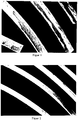
- Figur 1
- Querschliff von einzelnen Abschnitten des nach Beispiel 1 hergestellten Rohres in 16-facher Vergrößerung
- Figur 2
- Querschliff von einzelnen Abschnitten des nach Beispiel 2 hergestellten Rohres in 16-facher Vergrößerung
- Aus einer ODS-Legierung mit der chemischen Zusammensetzung 19 Gew.% Cr, 5,5 Gew.% Al, 0,5 Gew.% Ti, 0,5 Gew.% Y2O3 und Rest Fe wurde in der Schrittfolge Mechanisches Legieren der Pulverausgangsstoffe, heißisostatisches Verdichten der Pulver, anschließende Warmumformung durch Rundschmieden, Aufbohren des geschmiedeten Zylinders und abschließendes Überdrehen der inneren und äußeren Mantelflächen, ein büchsenförmiger Rohling mit Innendurchmesser 60 mm und Wandstärke 5 mm angefertigt. Dieser Rohling wurde auf einer konventionellen 3-Rollen-CNC-Drückmaschine in nur zwei Überläufen bei gleichbleibendem Innendurchmesser von der Ausgangswandstärke auf eine Endwandstärke von 1,25 mm umgeformt. Das so hergestellte Rohr zeigte eine hervorragende Oberflächenqualität sowie Maßhaltigkeit. Es wurde anschließend ohne Befund mit dem Farbeindringverfahren auf Risse untersucht. Schließlich wurde das Rohr bei einer Temperatur von 1380 °C während einer Stunde rekristallisierend an Luft geglüht. Während dieser Glühung bildete sich eine sehr dünne und fest anhaftende Al2O3-Schicht aus. Eine metallographische Untersuchung des geglühten Rohres ergab ein grobkörniges Rekristallisationsgefüge mit hoher Gefügestreckung in Rohrumfangsrichtung entsprechend Figur 1.
- Aus einer ODS-Legierung derselben Zusammensetzung wie im Beispiel 1 wurde durch Mechanisches Legieren der Pulverausgangsstoffe, heißisostatisches Pressen und anschließendes konventionelles Lochpressen ein Hohlformat hergestellt. Aus diesem Rohling wurde in der Folge durch Überdrehen ein büchsenförmiger Rohling mit 60 mm Innendurchmesser und 5 mm Wandstärke hergestellt. Der so erhaltene Rohling zeigt eine feinkörnige Gefügestruktur. Er wurde durch Drückwalzen in nur drei Überläufen von der Ausgangswandstärke 5 mm auf eine Endwandstärke von 0,7 mm umgeformt. Dies entspricht einem Gesamtumformgrad von 84 % relativer Querschnittsabnahme, der ohne Anwärmung und ohne Zwischenglühen erreicht wurde.
Das Rohr wurde anschließend ohne Befund sowohl mit dem Farbeindringverfahren als auch mit Wirbelstromprüfung auf Risse untersucht. In der Folge wurde das Rohr bei 1380 °C während einer Stunde rekristallisierend an Luft geglüht. Dabei bildete sich die in Figur 2 dargestellte Gefügestruktur aus.
Claims (7)
- Verfahren zur Herstellung nahtloser Rohre aus Werkstoffen, die durch mechanische Umformung in Kombination mit einer rekristallisierenden Wärmebehandlung ein stark gestrecktes Grobkorngefüge ausbilden,
dadurch gekennzeichnet,
daß ein napf- oder büchsenförmiges Ausgansteil in unrekristallisiertem Zustand durch Drückwalzen nach DIN 8583, T2 mit einem Umformgrad von mindestens 30 % in die gewünschte Rohrform gebracht wird und der Werkstoff durch eine Zwischenglühung zwischen einzelnen Verformungsschritten oder durch eine Endglühung nach Abschluß der Verformung grobkörnig rekristallisiert wird. - Verfahren zur Herstellung nahtloser Rohre nach Anspruch 1, dadurch gekennzeichnet, daß als Werkstoff ein mit Oxid- und/oder Nitrid- und/oder Karbidteilchen verfestigtes Metall, Metallegierung oder intermetallische Phase verwendet wird.
- Verfahren zur Herstellung nahtloser Rohre nach Anspruch 2, dadurch gekennzeichnet, daß die verfestigenden Teilchen Oxide eines oder mehrerer Metalle aus der Gruppe Yttrium, Aluminium, Lanthan, Cer und Zirkon sind.
- Verfahren zur Herstellung nahtloser Rohre nach Anspruch 2, dadurch gekennzeichnet, daß die verfestigenden Teilchen aus reaktiven metallischen Zusätzen gebildet werden, die während der Verarbeitung des Werkstoffes und/oder während einer Wärmebehandlung in die entsprechenden Oxid-, Nitrid- oder Karbidteilchen umgewandelt werden.
- Verfahren zur Herstellung nahtloser Rohre nach Anspruch 2, dadurch gekennzeichnet, daß als Metallegierung eine dispersionsverfestigte Legierung auf Basis Eisen, Nickel oder Kobalt verwendet wird.
- Verfahren zur Herstellung nahtloser Rohre nach Anspruch 5, dadurch gekennzeichnet, daß die Legierung aus 6 - 30 Gew.% Cr, 0 - 10 Gew.% Al, 0 - 2 Gew.% Ti, 0 - 10 Gew.% Mo, 0 - 10 Gew.% W, 0 - 10 Gew.% Ta, 0,1 - 2 Gew.% von einem oder mehreren Oxiden der Metalle aus der Gruppe Y, Al, La, Ce und Zr, sowie Fe als Rest besteht.
- Verfahren zur Herstellung nahtloser Rohre nach Anspruch 5, dadurch gekennzeichnet, daß die Legierung aus 6 - 38 Gew.% Cr, 0,1 - 7 Gew.% Al, 0 - 2 Gew.% Ti, 0 - 5 Gew.% Mo, 0 - 5 Gew.% W, 0 - 5 Gew.% Ta, 0,1 - 2 Gew.% von einem oder mehreren Oxiden der Metalle aus der Gruppe Y, Al, La, Ce und Zr, sowie Ni als Rest besteht.
Applications Claiming Priority (3)
| Application Number | Priority Date | Filing Date | Title |
|---|---|---|---|
| AT457/95 | 1995-08-28 | ||
| AT0045795U AT902U1 (de) | 1995-08-28 | 1995-08-28 | Verfahren zur herstellung nahtloser rohre |
| AT45795 | 1995-08-28 |
Publications (3)
| Publication Number | Publication Date |
|---|---|
| EP0761826A2 true EP0761826A2 (de) | 1997-03-12 |
| EP0761826A3 EP0761826A3 (de) | 1998-10-28 |
| EP0761826B1 EP0761826B1 (de) | 2001-05-23 |
Family
ID=3491143
Family Applications (1)
| Application Number | Title | Priority Date | Filing Date |
|---|---|---|---|
| EP96202345A Expired - Lifetime EP0761826B1 (de) | 1995-08-28 | 1996-08-23 | Verfahren zur Herstellung nahtloser Rohre aus ODS Werkstoffen |
Country Status (4)
| Country | Link |
|---|---|
| EP (1) | EP0761826B1 (de) |
| AT (2) | AT902U1 (de) |
| DE (1) | DE59606939D1 (de) |
| ES (1) | ES2158234T3 (de) |
Cited By (1)
| Publication number | Priority date | Publication date | Assignee | Title |
|---|---|---|---|---|
| CN115055532A (zh) * | 2022-05-30 | 2022-09-16 | 西北工业大学 | 一种兼具高强度和高塑性的钴铬基合金无缝管制备方法 |
Family Cites Families (10)
| Publication number | Priority date | Publication date | Assignee | Title |
|---|---|---|---|---|
| GB629131A (en) * | 1947-05-05 | 1949-09-13 | Samuel James Everett | Improvements relating to the production of elongated metal tubular parts |
| US4034588A (en) * | 1970-05-11 | 1977-07-12 | Columbiana Foundry Company | Methods of piercing and enlarging elongate metal members such as seamless tubes |
| FR2443884A1 (fr) * | 1978-12-15 | 1980-07-11 | Vallourec | Fabrication de tubes sans soudure de forts diametres |
| CH671583A5 (de) * | 1986-12-19 | 1989-09-15 | Bbc Brown Boveri & Cie | |
| DE3832014C2 (de) * | 1988-09-16 | 1994-11-24 | Mannesmann Ag | Verfahren zur Herstellung hochfester nahtloser Stahlrohre |
| JPH02217443A (ja) * | 1989-02-16 | 1990-08-30 | Sumitomo Metal Ind Ltd | ごみ焼却廃熱ボイラ管用高クロム鋼 |
| DE59007734D1 (de) * | 1989-05-16 | 1995-01-05 | Asea Brown Boveri | Verfahren zur Erzeugung grober längsgerichteter Stengelkristalle in einer oxyddispersionsgehärteten Nickelbasis-Superlegierung. |
| EP0447858B1 (de) * | 1990-03-20 | 1995-05-24 | Asea Brown Boveri Ag | Verfahren zur Erzeugung von längsgerichteten grobkörnigen Stengelkristallen in einem aus einer oxyddispersionsgehärteten Nickelbasis-Superlegierung bestehenden Werkstück |
| DE4014614A1 (de) * | 1990-05-07 | 1991-11-14 | Pm Hochtemperatur Metall Gmbh | Superlegierung auf nickelbasis |
| DE4332132A1 (de) * | 1993-09-17 | 1995-03-23 | Mannesmann Ag | Herstellverfahren für nahtlose Rohre aus Nichteisenmetallen, insbesondere Kupfer und Kupferlegierungen |
-
1995
- 1995-08-28 AT AT0045795U patent/AT902U1/de not_active IP Right Cessation
-
1996
- 1996-08-23 EP EP96202345A patent/EP0761826B1/de not_active Expired - Lifetime
- 1996-08-23 AT AT96202345T patent/ATE201456T1/de not_active IP Right Cessation
- 1996-08-23 DE DE59606939T patent/DE59606939D1/de not_active Expired - Fee Related
- 1996-08-23 ES ES96202345T patent/ES2158234T3/es not_active Expired - Lifetime
Cited By (1)
| Publication number | Priority date | Publication date | Assignee | Title |
|---|---|---|---|---|
| CN115055532A (zh) * | 2022-05-30 | 2022-09-16 | 西北工业大学 | 一种兼具高强度和高塑性的钴铬基合金无缝管制备方法 |
Also Published As
| Publication number | Publication date |
|---|---|
| EP0761826B1 (de) | 2001-05-23 |
| AT902U1 (de) | 1996-07-25 |
| EP0761826A3 (de) | 1998-10-28 |
| DE59606939D1 (de) | 2001-06-28 |
| ATE201456T1 (de) | 2001-06-15 |
| ES2158234T3 (es) | 2001-09-01 |
Similar Documents
| Publication | Publication Date | Title |
|---|---|---|
| EP3314031B1 (de) | Hochfestes und gut umformbares almg-band sowie verfahren zu seiner herstellung | |
| DE60313065T2 (de) | Dünne Produkte aus Beta- oder quasi Beta-Titan-Legierungen, Herstellung durch Schmieden | |
| DE68916383T2 (de) | Verfahren zur Herstellung eines plattierten Metallrohres. | |
| DE69108295T2 (de) | Verfahren zur Herstellung von korrosionsbeständigen nahtlosen Röhren aus Titanlegierung. | |
| DE60224290T2 (de) | Herstellung von metallrohren | |
| DE102005027259B4 (de) | Verfahren zur Herstellung von metallischen Bauteilen durch Halbwarm-Umformung | |
| DE19536978A1 (de) | Verfahren zur Herstellung schweißplattierter Stahlrohre | |
| DE69806596T2 (de) | Verfahren zur herstellung von aluminiumbändern durch rollen-bandgiessen | |
| DE102019106209A1 (de) | Verfahren zur Herstellung eines Hohlventils für Verbrennungsmotoren | |
| DE102022112397A1 (de) | Wertstromprozess zum profilieren und doppelschulterwerkzeug-rührreibschweissen von aluminiumblech zum bilden von fahrzeugstrukturschienen | |
| EP3335820B1 (de) | Verbundkörper und verfahren zu seiner herstellung | |
| DE60202994T2 (de) | Walz- oder extrusionsprodukte aus al-mn-legierung mit erhöhter korrosionsbeständigkeit | |
| US5344508A (en) | Flow forming of aluminum alloy products | |
| DE3609074A1 (de) | Verfahren zum herstellen von komposit-huellrohren fuer kernbrennstoffe sowie danach erhaltene produkte | |
| EP0801139B1 (de) | Bauteil | |
| DE2138195A1 (de) | Hochfester korrosionsbeständiger Stahl und Verfahren zu dessen Herstellung | |
| EP0926251B1 (de) | Verfahren zur Herstellung und Verwendung von einer Kupfer-Zinn-Titan-Legierung | |
| DE69206696T2 (de) | Verfahren zum Warmschmieden bei sehr hoher Temperatur | |
| EP0761826B1 (de) | Verfahren zur Herstellung nahtloser Rohre aus ODS Werkstoffen | |
| WO1999022886A1 (de) | Verfahren zum herstellen von nickel-titan-hohlprofilen | |
| EP0013331A1 (de) | Verfahren zum Herstellen von Profilen und die Verwendung eines Feinkornstahles für Profile | |
| DE3507124A1 (de) | Durch elektro-widerstandsschweissen geschweisstes oelbohrungsrohr und verfahren zu dessen herstellung | |
| EP0227001B1 (de) | Verfahren zum Herstellen von Werkzeugen | |
| EP0735148A1 (de) | Verfahren zur Herstellung eines Bauteiles mit aufgelöteten Folien aus ODS-Sintereisen-Legierungen und nach diesem Verfahren hergestelltes Bauteil | |
| EP4140612B1 (de) | Verfahren zur herstellung eines rohrproduktes aus stahl, insbesondere eines airbagrohrproduktes |
Legal Events
| Date | Code | Title | Description |
|---|---|---|---|
| PUAI | Public reference made under article 153(3) epc to a published international application that has entered the european phase |
Free format text: ORIGINAL CODE: 0009012 |
|
| AK | Designated contracting states |
Kind code of ref document: A2 Designated state(s): AT DE ES FR GB IT SE |
|
| PUAL | Search report despatched |
Free format text: ORIGINAL CODE: 0009013 |
|
| AK | Designated contracting states |
Kind code of ref document: A3 Designated state(s): AT DE ES FR GB IT SE |
|
| 17P | Request for examination filed |
Effective date: 19980923 |
|
| 17Q | First examination report despatched |
Effective date: 19991105 |
|
| RTI1 | Title (correction) |
Free format text: METHOD FOR MANUFACTURING ODS SEAMLESS PIPES |
|
| GRAG | Despatch of communication of intention to grant |
Free format text: ORIGINAL CODE: EPIDOS AGRA |
|
| GRAG | Despatch of communication of intention to grant |
Free format text: ORIGINAL CODE: EPIDOS AGRA |
|
| GRAH | Despatch of communication of intention to grant a patent |
Free format text: ORIGINAL CODE: EPIDOS IGRA |
|
| GRAH | Despatch of communication of intention to grant a patent |
Free format text: ORIGINAL CODE: EPIDOS IGRA |
|
| GRAA | (expected) grant |
Free format text: ORIGINAL CODE: 0009210 |
|
| AK | Designated contracting states |
Kind code of ref document: B1 Designated state(s): AT DE ES FR GB IT SE |
|
| REF | Corresponds to: |
Ref document number: 201456 Country of ref document: AT Date of ref document: 20010615 Kind code of ref document: T |
|
| ITF | It: translation for a ep patent filed | ||
| GBT | Gb: translation of ep patent filed (gb section 77(6)(a)/1977) |
Effective date: 20010523 |
|
| REF | Corresponds to: |
Ref document number: 59606939 Country of ref document: DE Date of ref document: 20010628 |
|
| PGFP | Annual fee paid to national office [announced via postgrant information from national office to epo] |
Ref country code: GB Payment date: 20010713 Year of fee payment: 6 |
|
| PGFP | Annual fee paid to national office [announced via postgrant information from national office to epo] |
Ref country code: AT Payment date: 20010725 Year of fee payment: 6 |
|
| PGFP | Annual fee paid to national office [announced via postgrant information from national office to epo] |
Ref country code: FR Payment date: 20010801 Year of fee payment: 6 Ref country code: DE Payment date: 20010801 Year of fee payment: 6 |
|
| PGFP | Annual fee paid to national office [announced via postgrant information from national office to epo] |
Ref country code: SE Payment date: 20010802 Year of fee payment: 6 |
|
| PGFP | Annual fee paid to national office [announced via postgrant information from national office to epo] |
Ref country code: ES Payment date: 20010803 Year of fee payment: 6 |
|
| REG | Reference to a national code |
Ref country code: ES Ref legal event code: FG2A Ref document number: 2158234 Country of ref document: ES Kind code of ref document: T3 |
|
| ET | Fr: translation filed | ||
| REG | Reference to a national code |
Ref country code: GB Ref legal event code: IF02 |
|
| PLBE | No opposition filed within time limit |
Free format text: ORIGINAL CODE: 0009261 |
|
| STAA | Information on the status of an ep patent application or granted ep patent |
Free format text: STATUS: NO OPPOSITION FILED WITHIN TIME LIMIT |
|
| 26N | No opposition filed | ||
| PG25 | Lapsed in a contracting state [announced via postgrant information from national office to epo] |
Ref country code: GB Free format text: LAPSE BECAUSE OF NON-PAYMENT OF DUE FEES Effective date: 20020823 Ref country code: AT Free format text: LAPSE BECAUSE OF NON-PAYMENT OF DUE FEES Effective date: 20020823 |
|
| PG25 | Lapsed in a contracting state [announced via postgrant information from national office to epo] |
Ref country code: SE Free format text: LAPSE BECAUSE OF NON-PAYMENT OF DUE FEES Effective date: 20020824 Ref country code: ES Free format text: LAPSE BECAUSE OF NON-PAYMENT OF DUE FEES Effective date: 20020824 |
|
| PG25 | Lapsed in a contracting state [announced via postgrant information from national office to epo] |
Ref country code: DE Free format text: LAPSE BECAUSE OF NON-PAYMENT OF DUE FEES Effective date: 20030301 |
|
| EUG | Se: european patent has lapsed | ||
| GBPC | Gb: european patent ceased through non-payment of renewal fee |
Effective date: 20020823 |
|
| PG25 | Lapsed in a contracting state [announced via postgrant information from national office to epo] |
Ref country code: FR Free format text: LAPSE BECAUSE OF NON-PAYMENT OF DUE FEES Effective date: 20030430 |
|
| REG | Reference to a national code |
Ref country code: FR Ref legal event code: ST |
|
| REG | Reference to a national code |
Ref country code: ES Ref legal event code: FD2A Effective date: 20030912 |
|
| PG25 | Lapsed in a contracting state [announced via postgrant information from national office to epo] |
Ref country code: IT Free format text: LAPSE BECAUSE OF NON-PAYMENT OF DUE FEES;WARNING: LAPSES OF ITALIAN PATENTS WITH EFFECTIVE DATE BEFORE 2007 MAY HAVE OCCURRED AT ANY TIME BEFORE 2007. THE CORRECT EFFECTIVE DATE MAY BE DIFFERENT FROM THE ONE RECORDED. Effective date: 20050823 |