EP0750412B1 - Verfahren und Vorrichtung für kontextempfindliches Pfadsende - Google Patents
Verfahren und Vorrichtung für kontextempfindliches Pfadsende Download PDFInfo
- Publication number
- EP0750412B1 EP0750412B1 EP96108876A EP96108876A EP0750412B1 EP 0750412 B1 EP0750412 B1 EP 0750412B1 EP 96108876 A EP96108876 A EP 96108876A EP 96108876 A EP96108876 A EP 96108876A EP 0750412 B1 EP0750412 B1 EP 0750412B1
- Authority
- EP
- European Patent Office
- Prior art keywords
- client
- server
- dialog
- sending
- request
- Prior art date
- Legal status (The legal status is an assumption and is not a legal conclusion. Google has not performed a legal analysis and makes no representation as to the accuracy of the status listed.)
- Expired - Lifetime
Links
- 238000000034 method Methods 0.000 title claims description 81
- 230000004044 response Effects 0.000 claims description 23
- 238000004891 communication Methods 0.000 claims description 15
- 238000012545 processing Methods 0.000 claims description 8
- 230000026676 system process Effects 0.000 claims description 6
- 230000008569 process Effects 0.000 description 54
- 230000037361 pathway Effects 0.000 description 6
- 230000005540 biological transmission Effects 0.000 description 5
- 230000027455 binding Effects 0.000 description 4
- 238000009739 binding Methods 0.000 description 4
- 230000007246 mechanism Effects 0.000 description 4
- 230000002159 abnormal effect Effects 0.000 description 3
- 230000008901 benefit Effects 0.000 description 3
- 230000006870 function Effects 0.000 description 2
- 230000000977 initiatory effect Effects 0.000 description 2
- 238000012423 maintenance Methods 0.000 description 2
- 241000677635 Tuxedo Species 0.000 description 1
- 238000010420 art technique Methods 0.000 description 1
- 230000003190 augmentative effect Effects 0.000 description 1
- 230000008859 change Effects 0.000 description 1
- 230000001419 dependent effect Effects 0.000 description 1
- 238000001514 detection method Methods 0.000 description 1
- 238000010586 diagram Methods 0.000 description 1
- 230000000694 effects Effects 0.000 description 1
- 238000012986 modification Methods 0.000 description 1
- 230000004048 modification Effects 0.000 description 1
- 238000012544 monitoring process Methods 0.000 description 1
- 230000000717 retained effect Effects 0.000 description 1
- 230000008685 targeting Effects 0.000 description 1
- 239000002699 waste material Substances 0.000 description 1
Images

Classifications
-
- H—ELECTRICITY
- H04—ELECTRIC COMMUNICATION TECHNIQUE
- H04L—TRANSMISSION OF DIGITAL INFORMATION, e.g. TELEGRAPHIC COMMUNICATION
- H04L9/00—Cryptographic mechanisms or cryptographic arrangements for secret or secure communications; Network security protocols
- H04L9/40—Network security protocols
Definitions
- the client applications may send a voluminous number of very brief messages or requests (often tens of thousands of data packets each less than 32k in size) that have to be processed by a particular server in the server pool.
- the clients and servers work independently (asynchronously) of one another, and the transmission of data by the network connecting client and server is asynchronous as well, as the data packets are sent in a message forwarding scheme.
- pathsends such as Tuxedo, Encino, and CPIC (the protocol for some of these programs can be found in publications by the XOpen standard committee), but the present invention provides for a novel and improved dialog that has numerous advantages over any prior efforts.
- EP 0 600 285 A1 discloses an object interface that supports three modes of inter-object communication, i.e. message processing, conversational communication, and remote procedure call.
- a service broker manages service requests from, and responsive services provided by, a plurality of clients and servers, respectively.
- the server maintains the data and execution status context to perform sequences of clients requests that are dependent on each other.
- Conversational server sessions must be terminated explicitly by the client program.
- dialog servers which are special servers capable of remembering context information regarding a dialog. However, such dialog servers are not capable of establishing a dialog, maintaining or completing a dialog.
- One object of the present invention allows for a receiving process to optimize performance relating to processing of individual, yet logically related requests, by preventing the need for the receiving process to reinstate prior context so that the receiving process may process the current request.
- Another object of the present invention is to provide greater functionality and ease of use to applications which need to perform multiple I/O which are logically related.
- Another object of the invention is to enable the ability to solve problems where the solution requires one to logically send messages of sizes greater than 32k bytes without having to reestablish context with every message sent.
- a further object is to provide for transactional context to be carried on each logically related I/O.
- Yet another object is to provide a mechanism which allows for a decrease in processing time for individual requests within a dialogue (session) by inventing the ability of the runtime to bind the originating process to the receiving process for the duration of the dialogue. This insures that all messages within the dialogue flow between the same originating and receiving process, and allows for the receiving process to maintain the context relating to the dialogue.
- the present invention provides a method for sending information in a server-client network according to claim 1 and a corresponding system according to claim 19.
- an ATM machine may be connected to a "client" application (software program) and/or node.
- a node, or workstation is hardware that operates off of software and consists of at least a processor, primary and secondary memory and I/O means, and typically includes several applications within it. In the most general case a single node may include and run both client and server applications within it.
- a typical on-line application may require that the client application and/or network communicate with the host server application and/or node for a brief period of time (as short as a few seconds). There may be thousands of such client nodes for every server node, as well as a plurality of interconnected server nodes. Typically tens of thousands of messages are being passed between client and server at any given time.
- a typical transaction between client and server is a debit/credit transaction, and such a transaction has its own unique problems.
- a bank customer may be debiting his checking account with a cash withdrawal.
- the transaction between the client and server needs to be monitored so that in the event of an unexpected failure during communications between client and server, the transaction can be "rolled back" to the initial state prior to the failure, otherwise, either the customer or the bank would be unfairly credited or debited for a transaction that was never completed.
- client applications run asynchronously from server applications, and during a typical session the client node application may be performing such tasks as outputting to a screen, printing a receipt or the like, while a server node application may be performing a database operation with the bank's databases.
- a further aspect of the present invention is to provide for as little overhead as possible with establishing or breaking a connection (session) between client and server.
- the method of practicing the present invention utilizes this property to its fullest. Thus the cost of establishing or breaking down the connection (operating system resources, including memory, operating system time) is small.
- LM Linkmon
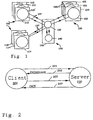
- client nodes 110 having at least one client or client program or application 115'
- server node 120 having at least one server program or application 125
- the communication between client and server applications is done through an operating system process application 130, called "Linkmon" (LM) in the present application, which may and typically does reside in a separate node 132 from the client and server nodes 110, 120.
- Linkmon LM
- client nodes 110-115 communicating with every single server
- server nodes 120-122 in the general environment there are a plurality of server nodes 120-122, all communicating with one another, as indicated by communication lines 126. Messages are passed between nodes as indicated by the communication lines 137.
- Linkmon application 130 itself communicates and calls upon the operating system application 140, which must be also be the operating system common to both the server application and client applications, and which is shown residing in node 132 in Fig. 1.
- node 132 is in a Tandem computer and operating system 140 is running under the Guardian Tandem operating system (Non-Stop Kernel OS, B30.02 version).
- the operating system application 140 residing in hardware 132 is also called a "process monitor", shown as node 145, and it optimizes the client-server-service relationship to perform the best way to connect servers to clients.
- this process monitor is called “Pathway", or TS/MP ("transaction services/ massively parallel"), since it allows for parallel servers to work on a problem in tandem.
- TS/MP compatible servers lend themselves well to and are employed in on-line transaction processing (OLTP).
- OTP on-line transaction processing
- increasing computing resources by a factor of N is roughly a serial function of N computers, in that adding N more computer nodes to the TS/MP network will increase the computer resources by N, since the computers for the most part work independently and in parallel.
- the present invention typically is run with "cascaded servers" 120-122, where one server may delegate the server functions to another server at another location.
- a single server node services a plurality of client nodes.
- a particular server node may be assigned to a particular set of client nodes, so that not any server can service any client node.
- the server application would have to reestablish all states associated with the client. This problem is eliminated in the context sensitive pathsend of the present invention.
- Complicating the client-server relationship in the Tandem environment is that there is a plurality of servers 120-122, or "pool" of servers 190 generally, that must service an even greater number of clients nodes (clients 105 generally) and their associated applications (with several applications per node possible).
- the idea behind the TS/MP node 145 is to multiplex the plurality of servers 190 for the plurality of clients 105 so that the transaction access time to make a connection is reasonably short. In some transactions, the client may only need access to a server for a few seconds. Thus, typically a queue of clients wishing to access servers is formed.
- a context-free request session In the Tandem environment prior to the present invention there was only one general type of service session (dialogue or 'dialog') that could be asked for by a client: a context-free request session.
- a context-free request a service request is executed within the server but the server retains no context about that request.
- the server would then have to reestablish all states associated with the clients to establish the correct relationships, in a time consuming manner.
- the present invention obviates this need.
- the present invention further supports a layering of different applications over the Tandem Pathway or TS/MP subsystem.
- the client In a context sensitive session, for a plurality of sessions the client would after a first message in a dialog obtain the same server as the first message for all such subsequent messages in the dialog.
- a dialogue can be broken by either a server or a client.
- a server acknowledges the message from the client after the transmission of a message from client node to server that establishes a connection, with an acknowledgement message passed back from the server to the client.
- Error messages other than the special error code ERROR 70 include error codes that request for normal termination, return codes such as FeOK (which stops a session) and error codes associated with abnormal events.
- the client may also, in response to a request from the server, terminate the session by sending back a "DIALOG ABORT" message.
- This immediately stops the session and guarantees an aborted dialogue.
- Aborted dialogue guarantees are important in certain ATM transactions, as noted above, in order to roll back transactions to leave parties in the same state they were prior to the initiation of the transactions (termed an "atomic transaction", in that the transaction is either completed or not).
- Aborted transactions can be distinguished from canceled transactions in that aborted transactions may occur due to unplanned events, but the distinction is not critical to this invention.
- a client node can cancel a request, which alerts the client that the session is over. If any request is outstanding (queued) the request is canceled, and a message to this effect is sent back to the server. This is done by the DIALOG ABORT message.
- Tandem's TM/MP subsystem for transaction monitoring facility, a proprietary transaction log manager of Tandem
- any abnormal termination of the dialogue will terminate the transaction.
- Abnormal termination may be arbitrarily defined to occur at any particular transaction demarcation boundary.
- a transaction demarcation boundary can be thought of as a point of no return in a transaction, before which a transaction may be rolled back but after which it cannot.
- a customer is transferring money from one account to the other, so one account is being debited (say a savings account) while another account (say a checking account) is being simultaneously credited in the same transaction.
- a particular client node has to access a particular server node (which may be in a particular location, such as a bank's regional headquarters) for such a debit/credit transaction.
- server node which may be in a particular location, such as a bank's regional headquarters
- the client and server nodes 200, 210 would be the TS/MP application (not shown) coordinating the process.
- the first message 201 between client and server nodes 200 not only establishes or sets up a connection by identifying the particular client node involved in the transaction, but the message itself also can have information related to the transaction, such as, which account to debit, e.g., the savings account.
- the process of combining information related to establishing a connection with information related to the transaction that is the purpose behind the connection is known as "piggy-backing the setup onto the first send", and minimizes the setup time, especially when there are numerous such transaction messages.
- An acknowledgement message (ref. no. 203) is returned by the server to the client (and includes an error code, here FeContinue to continue the dialogue). Thereafter another message (205) is sent by the client and received by the server, regarding the identification and crediting of a second account, e.g., the checking account. After this message is received, an acknowledgement message 207 simultaneously acknowledges that the message 205 has been received and, in the same message, instructs the client 200 to "tear down" (abort or cancel) the session (with its concomitant error code, FeOK).
- piggy-backing of messages there is economy in the number of messages sent, which is a tremendous advantage when dealing with many thousands of such dialogues.
- piggy-backing of messages can nearly halve the total system operating cost of transmission.
- Another aspect of the present invention is that in the event of a failure, either application at the client or server node will know where in the session the failure occurred and can "roll back" the session (if the failure occurred before a predetermined transaction demarcation boundary). Further, a series of segments of primary memory, called Dialog Control Blocks, also track the messages associated with particular clients.
- a client node 305 (workstation) having client applications (307, 309, 311), an operating system process application "Linkmon” 315, which is a proprietary Tandem process that is part of the "Pathway" TS/MP environment.
- Linkmon is in charge of all outbound resources of client node 305, including the client node cpu resources.
- Client node 305 and client applications 307, 309, 311 are connected with the Linkmon process through the IPC (Inter processor Communication) protocol.
- the Linkmon process itself is connected to the plurality of interconnected server nodes 320-323, and any applications therein (and their run-time libraries) through the IPC protocol as well.
- the Linkmon is what actually contains the "bindings" (linkages) between the client applications and the server. Linkmon in addition communicates with server applications which process the acknowledgement messages and other messages as disclosed herein. Linkmon considers all such messages from client applications and/or client cpu's, and cascades them to one or more server applications and/or server nodes or cpu's.
- Linkmon In the context-free case, Linkmon would forward a single request from a client to a server, await the reply, forward the reply back and always break context (terminate the session) at the end of every message. In the context-sensitive case of the present invention, Linkmon has to be responsible for maintaining the temporary binding between the client and server as well.
- the method of the present invention uses the same routing mechanism (paths) for context-free requests as for context-sensitive requests, so that the method of the present invention is backwardly compatible with older Tandem applications not designed to be context-sensitive.
- the preferred embodiment of the present invention uses the same API's for both context-free and context-sensitive dialogues, and only certain flags are present to indicate any differences in dialogues.
- a context-sensitive pathsend of the present invention would be an advantage is in the results of a SQL query where it was not clear whether the answer to a query would one row or a thousand rows. If the answer was a thousand rows, typically not all thousand rows could be sent at once due to memory constraints, and in a context-free query the connection to the sublanguage application that is processing the SQL would have to be established again and again. By establishing a context-sensitive pathsend, however, the cost of transferring the answers (rows) to such a query would be minimized, whether for one row or a thousand.
- APIs Application Programmatic Interfaces
- Dialog ID has been invented to allow for unique identification of the dialogue by the originating process, the run-time environment, and the receiving process (e.g., the state of the client-server relationship).
- the receiving process keys on this, preventing the need for authentication of the originating process on all but the first I/O with the dialogue.
- Dialog IDs provide not only for authentication service, but are also used by the run-time environment for high performance access to pertinent data structures.
- API'S involved are "DIALOG BEGIN”, “DIALOG SEND”, “DIALOG ABORT”, Cancel, Abort Transmission.
- the first three API's and Abort Transmission are for the TS/MP (Pathway) component of the present application, while cancel is for the file system, which is run by the Guardian OS.
- the code for these API's would reside in Tandem's system library.
- an associated segment in primary memory (RAM) of the node running the subsystem is set up that is accessed by the system library.
- Fig. 4 shows such a segment of memory, called the Dialog Segment, as ref. no.
- Dialog Control Blocks Every time the client application calls one of the API's of the TS/MP (Pathway) it will put the Dialog Control Blocks in a different state in every Dialog Segment and affect a change reflecting this state. There is one Dialog Segment per session. Thus for example if a call is made to DIALOG SEND, it will cause the initiation of a message from either the server application or the client application, which is done through a Tandem OS primitives formatting a buffer, such as Tandem's WriteRead OS primitive.
- a DIALOG BEGIN does a DIALOG SEND as well as the acknowledgment of a message that a session has been started, which prevents two conflicting sessions to be established for a single client application.
- An algorithm keeps track of the changes in the Dialog Segment (state information for each session) for each call to the APIs by the client application.
- the server application uses file system API's, such as READUPDATE, FILE_GETRECEIVEINFO and REPLY.
- Dialog control blocks to check for states and used in conjunction with the APIs in networks are known per se and form only one possible low-level implementation of the present invention.
- a client application via Linkmon calls the API "DIALOG BEGIN” first, which calls a "Begin Transaction” (Dialog Begin) routine (step 502), creates a Dialog Control Block (DCB) (step 504), creates a Dialog ID (step 506), initiates a Send to the Linkmon process using Tandem's WriteRead (step 508), and sets the state and state tables of the DCB to reflect that a DIALOG BEGIN has been initiated.
- a low level data structure (“T file”) in the process file segment is then incremented than contains information related to opened transactions (step 510). Once the session is over, the low level data structure in step 510 is returned to its original state and memory resources are freed and restored.
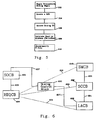
- Objects relating to the steps outlined in Fig. 5 are created and managed in the "Linkmon" portion of the client application. These include: a "Send Open Control Block” (SOCB) object 602; and a "Request” data object control block, REQCB object 604, both constructed the first time a client attempts to communicate with a server via Linkmon.
- SOCB Send Open Control Block
- REQCB object 604 data object control block
- an object 606 called SCCB (Server Class Control Block) is created related to the server class (SC) (one such object per server class).
- a Link Access Control Block (LACB) 608 representsation of a server process open), uniquely identifies the access path to a server process.
- a server monitor control block (SMCB) 610 supervises the other server objects.
- SMCB server monitor control block
- the control blocks 606, 608 and 610 create links (bindings) to one another (shown symbolically as links 601) when the server application is started.
- links 601 When client applications initiate contact to the server (via Linkmon) and DIALOG BEGIN is called (a DIALOG SEND is also piggybacked to the DIALOG BEGIN, as mentioned above), the control blocks 602, 604 are created, and the control blocks 602, 604 are linked together (as shown symbolically by link 603).
- the REQCB block 604 is linked to server class control blocks 606, 608 and 610, as shown symbolically by links 605.
- Linkmon After establishing the links 601, 603 and 605, the request itself is forwarded from the client to the server process by Linkmon.
- the importance of establishing links is that it sets up a communication path to a server process instance so that path is readily identifiable for work.
- the presence of links between the objects means the objects will all be readily identified by traversing the links.
- DCB 650 is also responsible for storing the unique file number and/or dialogue ID representing a session to the server.
- the Linkmon When a message is received in the present invention, the Linkmon will query a flag in FILE_GETRECEIVEINFO, that is handled by the WriteRead OS, to determine if the message is context sensitive. If the message is not context sensitive, the existing invention can handle the message in the usual, context-free manner (that is, the present invention allows backwards compatibility with existing software).
- the flag in FILE_GETRECEIVEINFO further contains information as to whether the message is a DIALOG BEGIN, DIALOG SEND, DIALOG ABORT type message.
- Linkmon also creates the Dialog Control Block (DCB) object 650, which contains information as to the exact nature of the dialogue relationship that exists between the client and the server, and links DCB 650 to the SOCB block 602 and LACB block 608, as shown by symbolic links 607 in Fig. 6.
- DCB Dialog Control Block
- SOCB 602 and LACB 608 are linked together by links 607 and the Dialog Control Block 650, it means to the server application that a context-sensitive pathsend session is present.
- ABORT or CANCEL there will be no multiplexing of dialogues in a context-sensitive case, and a sort of temporary dedicated communication between client and server is established.
- the server knows not to open more than one session, by checking for the presence of a link between the SOCB (Send Open Control Block) and the LACB (Link Access Control Block). All of the above is in reply to Dialog Begin or Dialog Send and in response to the WriteRead OS primitive.
- SOCB Send Open Control Block
- LACB Link Access Control Block
- the first part of the protocol is the response by a server to a Dialog Begin or Send. Most of the time the server response is "FeContinue" (which causes a session to be maintained).
- FeContinue causes a session to be maintained.
- links 605 are broken (deallocated) between the current request control block REQCB 604 and the control blocks in the server application, and any associated memory is freed.
- the links 607 are not broken, nor is the Dialog Control Block 650 destroyed (deallocated), which contain the information important for maintaining the temporary dedicated communication between server and client.
- a return code of FeContinue will cause the run-time environment to maintain the connection between the originating process and the receiving process, so that subsequent SERVERCLASS_DIALOG_SEND_ requests are routed to the same receiving process instance which is maintaining context relating to the dialogue, in a fast and economic manner.
- Linkmon in response to a FeContinue message after a Dialog Begin, the client would pass a Dialog Send and the associated message to Linkmon.
- Linkmon would look up the dialogue ID received to associate it with the particular dialogue and server (the identification of all dialogues active are present in memory in RAM). Then a request control block REQCB, such as block 604, would be built (allocated) and the links 605 would be established for this particular message.
- a DIALOG END will force Linkmon and the operating system to clean up system resources.
- a DIALOG END can follow a FeOK message.
- the server itself has to know and track the different sessions that are open with different clients, and assign unique Dialog Control Blocks to each. This is particularly true when the server is multi-threaded. In practice, this is done automatically by Tandem's Guardian OS using segments in RAM of the DCB's every time a file is opened, and information in the form of flags relating to the above is passed through to the server along with messages by Linkmon. ID's would also be passed between client and server in the first Dialog Begin and acknowledgement. The uniqueness of ID's is determined by Linkmon working with the operating system (which determines file number id's related to the messages as well). In the preferred embodiment the operating system is the Guardian Tandem operating system (Non-Stop Kernel OS, B30.02 version).
- the server application will know whether the next message after a context sensitive Send is from a particular known content sensitive pathsend client application (and most likely that the message will either be a DIALOG SEND or DIALOG ABORT messages, particularly if the transaction is as described in Fig. 2 above).
- the server will also know that the message is not from some other client application or from a non-context sensitive path send application. This, along with piggybacking of data, saves one or more extra units of computation time and systems resources.
- acknowledgement of message with FeContinue by the server will "locked on" a particular client, in a form of temporary dedicated or pseudo-synchronous communication.
- piggyback communications may be used to tear down (kill) the dialogue.
Landscapes
- Engineering & Computer Science (AREA)
- Computer Security & Cryptography (AREA)
- Computer Networks & Wireless Communication (AREA)
- Signal Processing (AREA)
- Computer And Data Communications (AREA)
- Data Exchanges In Wide-Area Networks (AREA)
Claims (23)
- Verfahren zum Senden von Information in einem Server-Client-Netz zwischen einem Client und einem Server, wobei das Verfahren die folgenden Schritte umfaßt, welche von einem Datenverarbeitungssystem ausgeführt werden:Senden einer anfänglichen Anfrage durch den Client, die Daten, welche sich auf die anfängliche Anfrage beziehen, sowie Daten umfaßt, die sich auf den Zustand einer Client-Server-Beziehung beziehen;Aufbauen eines Dialogs zwischen dem Client und dem Server mittels eines Betriebssystems des Datenverarbeitungssystems, in Reaktion auf die anfängliche Anfrage;Senden einer Antwort auf die anfängliche Anfrage durch den Server, wobei die Antwort Daten, die sich auf die anfängliche Anfrage beziehen, sowie einen Dialogzustand umfaßt, der sich auf den Zustand der Client-Server-Beziehung bezieht;Senden, durch den Client, einer zweiten Anfrage gemäß eines Werts des Dialogzustands; undSenden einer zweiten Antwort auf die zweite Anfrage, wobei die zweite Anfrage den Dialogzustand sowie Information umfaßt, die kontextabhängig von der Information in der Antwort ist.
- Verfahren nach Anspruch 1, wobei der Schritt des Aufbauens eines Dialogs die Schritte des Einrichtens einer Dialog-Identifikation umfaßt.
- Verfahren nach Anspruch 2, wobei die zweite Anfrage die Dialog-Identifikation umfaßt.
- Verfahren nach Anspruch 2, wobei der Schritt des Einrichtens einer Dialog-Identifikation die Schritte des Zuordnens der Dialog-Identifikation zu der anfänglichen Anfrage und des Sendens der anfänglichen Anfrage an den Server umfaßt.
- Verfahren nach einem der vorangegangenen Ansprüche, wobei der Dialogzustand einen der folgenden Werte hat:FeOK, der angibt, daß der Dialog beendet werden sollte, undFeContinue, der angibt, daß der Client eine weitere Anfrage senden sollte.
- Verfahren nach Anspruch 5, wobei der Schritt des Sendens einer zweiten Anfrage den Schritt des Sendens der zweiten Anfrage durch den Client umfaßt, wenn der Wert des Dialogzustands FeContinue ist, wodurch angezeigt wird, daß der Server weitere zu sendende Information hat.
- Verfahren nach einem der vorangegangenen Ansprüche, das ferner den Schritt des Sendens einer zweiten Antwort durch den Server umfaßt, die Information enthält, welche sich logisch auf Information in der ersten Antwort bezieht.
- Verfahren nach einem der vorangegangenen Ansprüche, das ferner den Schritt umfaßt:Senden einer Abbruchnachricht, die den Dialog beendet, durch entweder den Client, den Server oder das Betriebssystem.
- Verfahren nach einem der vorangegangenen Ansprüche, wobei der Schritt des Aufbauens eines Dialogs den Schritt des Einrichtens eines Dialogssteuerungsblocks umfaßt, welcher eine Dialog-Identifikation enthält.
- Verfahren nach einem der vorangegangenen Ansprüche, wobei die anfängliche Anfrage ein Feld umfaßt, das angibt, daß ein kontextabhängiger Dialog aufgebaut werden sollte.
- Verfahren nach einem der vorangegangenen Ansprüche, das ferner den Schritt umfaßt:Senden einer Dialogbeendigungsnachricht durch den Client, wenn der Dialogzustand FeOK ist.
- Verfahren nach Anspruch 1, wobei der Client und der Server aus einer jeweiligen Vielzahl von Client-Knoten und Server-Knoten stammen, die ein Server-Client-Knotennetz umfassen, wobei ein kontextabhängiger Pfad erzeugt wird, um den Aufwand des Aufrechterhaltens eines Dialogs zwischen dem Server und dem Client zu minimieren, wobei das Verfahren umfaßt:wobei die huckepack-zugefügten Daten den Aufwand des Aufrechterhaltens eines Dialogs zwischen den Clients und den Server-Knoten verringern können.Senden von Client-Nachrichten ausgehend von einer Vielzahl von Client-Knoten, wobei jede Client-Nachricht spezielle Client-Anfragen an einen bestimmten Server-Knoten aufweist;Huckepack-Hinzufügen von Daten auf die von der Vielzahl von Client-Knoten stammenden Client-Nachrichten, wobei die huckepack-hinzugefügten Daten sowohl die Daten, welche sich auf die bestimmten Client-Anfragen beziehen, als auch Daten umfaßt, die sich auf den Zustand der Client-Server-Beziehung beziehen;Antworten auf die huckepack-hinzugefiigten Daten, indem eine Vielzahl von Servernachrichten an die Vielzahl von Clients gesendet wird; undHuckepack-Hinzufügen von Daten auf die Servernachrichten, wobei die huckepack-hinzugefügten Daten sowohl Daten, welche sich auf die bestimmten Client-Anfragen beziehen, als auch Daten umfaßt, die sich auf den Zustand der Client-Server-Beziehung beziehen,
- Verfahren nach Anspruch 12, wobei eine vorübergehend zugewiesene Kommunikation zwischen zumindest einem der Vielzahl von Client-Knoten und dem Server-Knoten erzeugt wird, wobei die zugewiesene Kommunikation von einer Vielzahl von Zuständen zwischen dem Client-Knoten und dem Server-Knoten definiert wird und diese erzeugt, wobei die Zustände von einer Betriebssystem-Prozeßanwendung überwacht werden, die für den Client-Knoten und den Server-Knoten gemeinsam ist, wobei die Betriebssystem-Prozeßanwendung in einem Betriebssystem-Prozeßknoten mit einem primären Speicher vorgesehen ist, und das Verfahren ferner die Schritte umfaßt:wobei der Zustand der zugewiesenen Kommunikation nachgeprüft werden kann und somit die einzelnen Client- und Server-Knoten nachgeprüft werden können, indem die Verknüpfungen der Vielzahl von Datenstrukturen durchlaufen werden.Erzeugen einer Vielzahl von objektorientierten Datenstrukturen in dem primären Speicher des Betriebssystem-Prozeßknotens; undVerknüpfen der Vielzahl von Strukturen in einer vorbestimmten Weise, die davon abhängt, welche Zustände zwischen dem Client-Knoten und dem Server-Knoten vorliegen,
- Verfahren nach Anspruch 12 oder 13, wobei der Schritt des Huckepack-Hinzufiigens von Daten den Schritt des Erstellens einer Dialog-Identifikation umfaßt.
- Verfahren nach einem der Ansprüche 12 oder 13, wobei der Schritt des Huckepack-Hinzufügens von Daten den Schritt des Erstellens eines Dialogzustands umfaßt.
- Verfahren nach Anspruch 15, wobei der Dialogzustand einen der folgenden Werte aufweist:FeOK, der angibt, daß der Dialog beendet werden sollte, undFeContinue, der angibt, daß der Client eine weitere Anfrage senden sollte.
- Verfahren nach einem der Ansprüche 12 bis 16, das ferner den Schritt des Sendens einer den Dialog beendende Beendigungsnachricht, durch entweder den Client, durch den Server oder durch das Betriebssystem umfaßt.
- Verfahren nach Anspruch 12 oder 13, wobei der Schritt des Huckepack-Hinzufiigens von Daten den Schritt des Einrichtens eines Dialogsteuerungsblocks umfaßt, der eine Dialog-Identifikation umfaßt.
- System in einem Server-Client-Netz, umfassend:einen Client und zumindest einen Server, wobei der Client umfaßt:Mittel zum Senden einer anfänglichen Anfrage, die Daten, welche sich auf die anfängliche Anfrage beziehen, und Daten umfaßt, die sich auf den Zustand einer Client-Server-Beziehung beziehen;Mittel zum Senden einer zweiten Anfrage gemäß eines ersten Werts eines Dialogzustands der Client-Server-Beziehung; undMittel zum Senden einer Dialog-Beendigungsnachricht gemäß eines zweiten Werts des Dialogzustands, wobei der Server umfaßt:Mittel zum Senden einer ersten Antwort auf die anfängliche Anfrage, wobei die erste Antwort Daten, welche sich auf die anfängliche Anfrage beziehen, und einen Dialogzustand umfaßt, der den ersten Wert aufweist; undMittel zum Senden einer zweiten Antwort auf die zweite Anfrage, wobei die zweite Anfrage Information, die kontextabhängig von Information in der ersten Nachricht ist, sowie den Dialogzustand umfaßt, der den zweiten Wert aufweist;Mittel zum Aufbauen eines Dialogs zwischen dem Client und dem Server in Reaktion auf die anfängliche Anfrage.
- System nach Anspruch 19, wobei die jeweiligen ersten und zweiten Dialogzustandswerte sind:FeContinue und FeOK, die angeben, daß der Client eine weitere Anfrage senden sollte beziehungsweise daß der Dialog beendet werden sollte.
- System nach Anspruch 19 oder 20, das umfaßt:einen ersten Sendeschaltkreis, der vorgesehen ist, die anfängliche Anfrage an den Server zu senden;einen Empfängerschaltkreis, der vorgesehen ist, den Dialogzustand von dem Client zu empfangen; undeinen zweiten Sendeschaltkreis, der vorgesehen ist, gemäß dem Dialogzustand an den Client entweder 1) eine zweite Anfrage an den Server zu senden, wobei die zweite Anfrage logisch mit der ersten Anfrage verbunden ist, oder 2) eine Dialogbeendigungsnachricht zu senden.
- System nach Anspruch 19, 20 oder 21, wobei der Server umfaßt:einen ersten Empfangsschaltkreis, der vorgesehen ist, die anfängliche Anfrage von dem Client zu empfangen;einen ersten Sendeschaltkreis, der vorgesehen ist, in Reaktion auf die anfängliche Anfrage erste Daten an den Client zu senden, wobei die ersten Daten den Dialogzustandswert umfassen, der angibt, daß der Server in Reaktion auf die anfängliche Anfrage weitere Daten zu senden hat;einen zweiten Empfangsschaltkreis, der vorgesehen ist, die zweite Anfrage von dem Client zu empfangen; undeinen zweiten Sendeschaltkreis, der vorgesehen ist, in Reaktion auf die zweite Anfrage zweite Daten an den Empfänger zu senden, wobei die zweiten Daten einen Dialogzustandswert umfassen, der angibt, daß der Server das Senden seiner Daten abgeschlossen hat.
- System nach Anspruch 22, wobei der zweite Sendeschaltkreis einen Sendeschaltkreis umfaßt, der vorgesehen ist, in Reaktion auf die zweite Anfrage die zweiten Daten an den Client zu senden, wobei die ersten und zweiten Daten logisch in Beziehung sind.
Applications Claiming Priority (2)
| Application Number | Priority Date | Filing Date | Title |
|---|---|---|---|
| US08/472,227 US5889957A (en) | 1995-06-07 | 1995-06-07 | Method and apparatus for context sensitive pathsend |
| US472227 | 1995-06-07 |
Publications (3)
| Publication Number | Publication Date |
|---|---|
| EP0750412A2 EP0750412A2 (de) | 1996-12-27 |
| EP0750412A3 EP0750412A3 (de) | 2001-05-16 |
| EP0750412B1 true EP0750412B1 (de) | 2005-08-24 |
Family
ID=23874658
Family Applications (1)
| Application Number | Title | Priority Date | Filing Date |
|---|---|---|---|
| EP96108876A Expired - Lifetime EP0750412B1 (de) | 1995-06-07 | 1996-06-03 | Verfahren und Vorrichtung für kontextempfindliches Pfadsende |
Country Status (5)
| Country | Link |
|---|---|
| US (2) | US5889957A (de) |
| EP (1) | EP0750412B1 (de) |
| JP (1) | JPH09146870A (de) |
| CA (1) | CA2178403A1 (de) |
| DE (1) | DE69635099T2 (de) |
Families Citing this family (40)
| Publication number | Priority date | Publication date | Assignee | Title |
|---|---|---|---|---|
| US5889957A (en) * | 1995-06-07 | 1999-03-30 | Tandem Computers Incorporated | Method and apparatus for context sensitive pathsend |
| US8271339B2 (en) * | 1995-11-13 | 2012-09-18 | Lakshmi Arunachalam | Method and apparatus for enabling real-time bi-directional transactions on a network |
| US8037158B2 (en) * | 1995-11-13 | 2011-10-11 | Lakshmi Arunachalam | Multimedia transactional services |
| US7930340B2 (en) * | 1995-11-13 | 2011-04-19 | Lakshmi Arunachalam | Network transaction portal to control multi-service provider transactions |
| US6920637B2 (en) * | 1995-11-17 | 2005-07-19 | Symbol Technologies, Inc. | Method and apparatus for implementing alerts on a browser running on a portable handheld device |
| GB2313524A (en) * | 1996-05-24 | 1997-11-26 | Ibm | Providing communications links in a computer network |
| US6321274B1 (en) * | 1996-06-28 | 2001-11-20 | Microsoft Corporation | Multiple procedure calls in a single request |
| US6377691B1 (en) | 1996-12-09 | 2002-04-23 | Microsoft Corporation | Challenge-response authentication and key exchange for a connectionless security protocol |
| US6901425B1 (en) * | 1996-12-23 | 2005-05-31 | International Business Machines Corporation | Computer apparatus and method including a disconnect mechanism for communicating between software applications and computers on the world-wide web |
| US5958004A (en) | 1997-10-28 | 1999-09-28 | Microsoft Corporation | Disabling and enabling transaction committal in transactional application components |
| US5890161A (en) | 1997-10-28 | 1999-03-30 | Microsoft Corporation | Automatic transaction processing of component-based server applications |
| US6813769B1 (en) * | 1997-10-28 | 2004-11-02 | Microsoft Corporation | Server application components with control over state duration |
| US7076784B1 (en) | 1997-10-28 | 2006-07-11 | Microsoft Corporation | Software component execution management using context objects for tracking externally-defined intrinsic properties of executing software components within an execution environment |
| US6631425B1 (en) * | 1997-10-28 | 2003-10-07 | Microsoft Corporation | Just-in-time activation and as-soon-as-possible deactivation or server application components |
| US6134594A (en) | 1997-10-28 | 2000-10-17 | Microsoft Corporation | Multi-user, multiple tier distributed application architecture with single-user access control of middle tier objects |
| US6016496A (en) * | 1997-11-20 | 2000-01-18 | International Business Machines Corporation | Method and apparatus for an object-oriented object for retrieving information from local and remote databases |
| US6314422B1 (en) * | 1997-12-09 | 2001-11-06 | Chrysler Corporation | Method for softlinking between documents in a vehicle diagnostic system |
| FR2773241B1 (fr) * | 1997-12-30 | 2001-09-07 | Bull Sa | Procede d'assistance a l'administration d'une application distribuee basee sur un fichier binaire de configuration dans un systeme informatique |
| US6289344B1 (en) | 1998-05-11 | 2001-09-11 | International Business Machines Corporation | Context-sensitive authorization in an RDBMS |
| US6526416B1 (en) | 1998-06-30 | 2003-02-25 | Microsoft Corporation | Compensating resource managers |
| US6425017B1 (en) | 1998-08-17 | 2002-07-23 | Microsoft Corporation | Queued method invocations on distributed component applications |
| US6442620B1 (en) | 1998-08-17 | 2002-08-27 | Microsoft Corporation | Environment extensibility and automatic services for component applications using contexts, policies and activators |
| US7707600B1 (en) * | 1998-08-21 | 2010-04-27 | Intel Corporation | Confirming video transmissions |
| JP2000148503A (ja) * | 1998-11-10 | 2000-05-30 | Mitsubishi Electric Corp | 動的モジュール構成方式及び動的モジュール構成方法及びデバイス |
| US6330528B1 (en) * | 1998-12-16 | 2001-12-11 | Compaq Computer Corp. | Method of terminating temporarily unstoppable code executing in a multi-threaded simulated operating system |
| US6829770B1 (en) | 1999-02-23 | 2004-12-07 | Microsoft Corporation | Object connectivity through loosely coupled publish and subscribe events |
| US6748455B1 (en) | 1999-02-23 | 2004-06-08 | Microsoft Corporation | Object connectivity through loosely coupled publish and subscribe events with filtering |
| JP3713161B2 (ja) * | 1999-03-31 | 2005-11-02 | 富士通株式会社 | サーバおよび記録媒体 |
| US6978464B1 (en) * | 1999-10-07 | 2005-12-20 | Sprint Communications Company L.P. | Communicating between a process and a destination |
| US6920636B1 (en) | 1999-12-15 | 2005-07-19 | Microsoft Corporation | Queued component interface passing for results outflow from queued method invocations |
| CA2299150A1 (en) * | 2000-02-23 | 2001-08-23 | Hummingbird Communications Ltd | A system and method for providing real-time information to a web browser |
| US8112529B2 (en) * | 2001-08-20 | 2012-02-07 | Masterobjects, Inc. | System and method for asynchronous client server session communication |
| US7752326B2 (en) * | 2001-08-20 | 2010-07-06 | Masterobjects, Inc. | System and method for utilizing asynchronous client server communication objects |
| US20030149741A1 (en) * | 2002-02-05 | 2003-08-07 | Krooss Kevin William | Methods for implementing remote operating system procedure calls |
| US8621031B2 (en) * | 2003-04-29 | 2013-12-31 | Oracle International Corporation | Method and apparatus using connection pools in communication networks |
| EP1510951A1 (de) * | 2003-08-27 | 2005-03-02 | Sap Ag | Datenverarbeitungsverfahren, System und Computerprogramm |
| US20130007106A1 (en) * | 2011-07-01 | 2013-01-03 | Salesforce. Com Inc. | Asynchronous interaction in the report generator |
| US10819756B2 (en) * | 2017-04-10 | 2020-10-27 | OpenLegacy Technologies Ltd. | Atomic transaction over non-persistent protocol(s) |
| CN109614379A (zh) * | 2018-10-22 | 2019-04-12 | 中国平安人寿保险股份有限公司 | 日志输出方法、装置、计算机存储介质和计算机设备 |
| US12001888B2 (en) | 2022-01-28 | 2024-06-04 | Hewlett Packard Enterprise Development Lp | Server instance allocation for execution of application instances |
Family Cites Families (17)
| Publication number | Priority date | Publication date | Assignee | Title |
|---|---|---|---|---|
| US4646300A (en) * | 1983-11-14 | 1987-02-24 | Tandem Computers Incorporated | Communications method |
| AU601328B2 (en) * | 1988-05-26 | 1990-09-06 | Digital Equipment Corporation | Temporary state preservation for a distributed file service |
| US5249293A (en) * | 1989-06-27 | 1993-09-28 | Digital Equipment Corporation | Computer network providing transparent operation on a compute server and associated method |
| US5329619A (en) * | 1992-10-30 | 1994-07-12 | Software Ag | Cooperative processing interface and communication broker for heterogeneous computing environments |
| JP3490473B2 (ja) * | 1993-02-17 | 2004-01-26 | 松下電器産業株式会社 | プロセッサ間通信システム |
| US5386412A (en) * | 1993-05-11 | 1995-01-31 | Park; Jung S. | Telecommunication system protocol for asynchronous data communication between multiport switch control processor and information support personal computer terminal |
| US5367523A (en) * | 1993-08-26 | 1994-11-22 | International Business Machines Corporation | Adaptive rate-based congestion and flow control in packet communications networks |
| US5617570A (en) * | 1993-11-03 | 1997-04-01 | Wang Laboratories, Inc. | Server for executing client operation calls, having a dispatcher, worker tasks, dispatcher shared memory area and worker control block with a task memory for each worker task and dispatcher/worker task semaphore communication |
| US5546583A (en) * | 1994-04-05 | 1996-08-13 | International Business Machines Corporation | Method and system for providing a client/server interface in a programming language |
| US5577172A (en) * | 1994-07-01 | 1996-11-19 | Lasermaster Corporation | High-capacity protocol for packet-based networks |
| US5590266A (en) * | 1994-10-11 | 1996-12-31 | International Business Machines Corporation | Integrity mechanism for data transfer in a windowing system |
| US5634127A (en) * | 1994-11-30 | 1997-05-27 | International Business Machines Corporation | Methods and apparatus for implementing a message driven processor in a client-server environment |
| US5638374A (en) * | 1995-03-15 | 1997-06-10 | Hughes Electronics | Enhanced transaction reservation |
| US5889957A (en) * | 1995-06-07 | 1999-03-30 | Tandem Computers Incorporated | Method and apparatus for context sensitive pathsend |
| US5649103A (en) * | 1995-07-13 | 1997-07-15 | Cabletron Systems, Inc. | Method and apparatus for managing multiple server requests and collating reponses |
| US5617540A (en) * | 1995-07-31 | 1997-04-01 | At&T | System for binding host name of servers and address of available server in cache within client and for clearing cache prior to client establishes connection |
| US5751708A (en) * | 1995-10-25 | 1998-05-12 | Lucent Technologies Inc. | Access method for broadband and narrowband networks |
-
1995
- 1995-06-07 US US08/472,227 patent/US5889957A/en not_active Expired - Lifetime
-
1996
- 1996-06-03 EP EP96108876A patent/EP0750412B1/de not_active Expired - Lifetime
- 1996-06-03 DE DE69635099T patent/DE69635099T2/de not_active Expired - Fee Related
- 1996-06-06 CA CA002178403A patent/CA2178403A1/en not_active Abandoned
- 1996-06-07 JP JP8168446A patent/JPH09146870A/ja active Pending
-
1998
- 1998-09-25 US US09/161,442 patent/US6003085A/en not_active Expired - Lifetime
Also Published As
| Publication number | Publication date |
|---|---|
| EP0750412A2 (de) | 1996-12-27 |
| CA2178403A1 (en) | 1996-12-08 |
| JPH09146870A (ja) | 1997-06-06 |
| DE69635099D1 (de) | 2005-09-29 |
| US6003085A (en) | 1999-12-14 |
| EP0750412A3 (de) | 2001-05-16 |
| US5889957A (en) | 1999-03-30 |
| DE69635099T2 (de) | 2006-06-29 |
Similar Documents
| Publication | Publication Date | Title |
|---|---|---|
| US6003085A (en) | Method and apparatus for context sensitive pathsend | |
| EP1099164B1 (de) | Verfahren und programm zum verarbeiten der verwaltungsanfragen einer verteilten netzwerkanwendung in einer gruppierten rechnerumgebung | |
| EP0600235B1 (de) | Zusammenarbeitende Rechnerschnittstelle und Kommunikationsmakler für heterogene Umgebung | |
| US20020156930A1 (en) | System, method, and article of manufacture for facilitating communication between an IMS process and CORBA process | |
| EP0849921B1 (de) | Verfahren und Vorrichtung zur Absendung von Klientverfahrenanrufen in einem Server Rechnersystem | |
| US5771343A (en) | System and method for failure detection and recovery | |
| US6314512B1 (en) | Automatic notification of connection or system failure in asynchronous multi-tiered system by monitoring connection status using connection objects | |
| US6336147B1 (en) | Method and apparatus for managing connections for communication among objects in a distributed object system | |
| EP0817445B1 (de) | Vorrichtung und Verfahren zur Bestimmung von Server-Cluster-Topologien | |
| EP0956687B1 (de) | Webagent zur anforderung von mehreren prozessen | |
| WO1997019411A1 (en) | Registry communications middleware | |
| US7478277B2 (en) | Recovery guarantees for general multi-tier applications | |
| US6704764B1 (en) | Method and apparatus for a servlet server class | |
| US20080172473A1 (en) | System for ensuring client access to messages from a server | |
| EP0807884B1 (de) | Verfahren und Gerät zur Löschung von Objekten in einer Multifaden-Umgebung | |
| US6934948B2 (en) | System and method for grouping diverse operations | |
| EP0834807A1 (de) | Verfahren und Gerät zur Durchführung von effizienten CORBA-Transaktionen | |
| KR20010024837A (ko) | 트랜잭션을 수행하는 클라이언트/서버 컴퓨팅시스템에서의 사용을 위한 클라이언트 처리 장치, 서버처리 장치, 클라이언트 처리 방법, 서버 처리 방법 및컴퓨터 프로그램 제품 | |
| US6112315A (en) | Process and apparatus for reducing software failures using sparing in distributed systems | |
| US6381606B1 (en) | Application programming interface for creating authorized connections to a database management system | |
| CN114331445A (zh) | 用于海量用户接入的api接口、方法、存储介质及电子设备 | |
| WO1993018464A1 (en) | Distributed processing system | |
| KR100318974B1 (ko) | 트리거링 이벤트에 기초한 코디네이터 트랜잭션 상태 객체 생성의 타이밍을 가진 클라이언트/서버 컴퓨팅을 위한 장치, 방법 및 컴퓨터 프로그램 제품 | |
| Zhang et al. | End-to-end transactions in three-tier systems | |
| GB2330431A (en) | Client/server computing with failure detection |
Legal Events
| Date | Code | Title | Description |
|---|---|---|---|
| PUAI | Public reference made under article 153(3) epc to a published international application that has entered the european phase |
Free format text: ORIGINAL CODE: 0009012 |
|
| AK | Designated contracting states |
Kind code of ref document: A2 Designated state(s): DE FR GB IT SE |
|
| PUAL | Search report despatched |
Free format text: ORIGINAL CODE: 0009013 |
|
| AK | Designated contracting states |
Kind code of ref document: A3 Designated state(s): DE FR GB IT SE |
|
| 17P | Request for examination filed |
Effective date: 20011016 |
|
| RAP1 | Party data changed (applicant data changed or rights of an application transferred) |
Owner name: COMPAQ COMPUTER CORPORATION |
|
| 17Q | First examination report despatched |
Effective date: 20030313 |
|
| GRAP | Despatch of communication of intention to grant a patent |
Free format text: ORIGINAL CODE: EPIDOSNIGR1 |
|
| GRAS | Grant fee paid |
Free format text: ORIGINAL CODE: EPIDOSNIGR3 |
|
| RAP1 | Party data changed (applicant data changed or rights of an application transferred) |
Owner name: HEWLETT-PACKARD DEVELOPMENT COMPANY, L.P. |
|
| GRAA | (expected) grant |
Free format text: ORIGINAL CODE: 0009210 |
|
| AK | Designated contracting states |
Kind code of ref document: B1 Designated state(s): DE FR GB IT SE |
|
| PG25 | Lapsed in a contracting state [announced via postgrant information from national office to epo] |
Ref country code: IT Free format text: LAPSE BECAUSE OF FAILURE TO SUBMIT A TRANSLATION OF THE DESCRIPTION OR TO PAY THE FEE WITHIN THE PRESCRIBED TIME-LIMIT;WARNING: LAPSES OF ITALIAN PATENTS WITH EFFECTIVE DATE BEFORE 2007 MAY HAVE OCCURRED AT ANY TIME BEFORE 2007. THE CORRECT EFFECTIVE DATE MAY BE DIFFERENT FROM THE ONE RECORDED. Effective date: 20050824 |
|
| REG | Reference to a national code |
Ref country code: GB Ref legal event code: FG4D |
|
| REF | Corresponds to: |
Ref document number: 69635099 Country of ref document: DE Date of ref document: 20050929 Kind code of ref document: P |
|
| PG25 | Lapsed in a contracting state [announced via postgrant information from national office to epo] |
Ref country code: SE Free format text: LAPSE BECAUSE OF FAILURE TO SUBMIT A TRANSLATION OF THE DESCRIPTION OR TO PAY THE FEE WITHIN THE PRESCRIBED TIME-LIMIT Effective date: 20051124 |
|
| ET | Fr: translation filed | ||
| PLBE | No opposition filed within time limit |
Free format text: ORIGINAL CODE: 0009261 |
|
| STAA | Information on the status of an ep patent application or granted ep patent |
Free format text: STATUS: NO OPPOSITION FILED WITHIN TIME LIMIT |
|
| 26N | No opposition filed |
Effective date: 20060526 |
|
| PGFP | Annual fee paid to national office [announced via postgrant information from national office to epo] |
Ref country code: DE Payment date: 20080731 Year of fee payment: 13 |
|
| PGFP | Annual fee paid to national office [announced via postgrant information from national office to epo] |
Ref country code: FR Payment date: 20080617 Year of fee payment: 13 |
|
| PGFP | Annual fee paid to national office [announced via postgrant information from national office to epo] |
Ref country code: GB Payment date: 20080627 Year of fee payment: 13 |
|
| GBPC | Gb: european patent ceased through non-payment of renewal fee |
Effective date: 20090603 |
|
| REG | Reference to a national code |
Ref country code: FR Ref legal event code: ST Effective date: 20100226 |
|
| PG25 | Lapsed in a contracting state [announced via postgrant information from national office to epo] |
Ref country code: FR Free format text: LAPSE BECAUSE OF NON-PAYMENT OF DUE FEES Effective date: 20090630 |
|
| PG25 | Lapsed in a contracting state [announced via postgrant information from national office to epo] |
Ref country code: GB Free format text: LAPSE BECAUSE OF NON-PAYMENT OF DUE FEES Effective date: 20090603 |
|
| PG25 | Lapsed in a contracting state [announced via postgrant information from national office to epo] |
Ref country code: DE Free format text: LAPSE BECAUSE OF NON-PAYMENT OF DUE FEES Effective date: 20100101 |