EP0744781B1 - Nickel positivelektrode für alkalische Speicherbatterie und gasdichte Nickel-Metallhydrid Speicherbatterie - Google Patents
Nickel positivelektrode für alkalische Speicherbatterie und gasdichte Nickel-Metallhydrid Speicherbatterie Download PDFInfo
- Publication number
- EP0744781B1 EP0744781B1 EP96303646A EP96303646A EP0744781B1 EP 0744781 B1 EP0744781 B1 EP 0744781B1 EP 96303646 A EP96303646 A EP 96303646A EP 96303646 A EP96303646 A EP 96303646A EP 0744781 B1 EP0744781 B1 EP 0744781B1
- Authority
- EP
- European Patent Office
- Prior art keywords
- nickel
- positive electrode
- storage battery
- powder
- cobalt hydroxide
- Prior art date
- Legal status (The legal status is an assumption and is not a legal conclusion. Google has not performed a legal analysis and makes no representation as to the accuracy of the status listed.)
- Expired - Lifetime
Links
Images
Classifications
-
- H—ELECTRICITY
- H01—ELECTRIC ELEMENTS
- H01M—PROCESSES OR MEANS, e.g. BATTERIES, FOR THE DIRECT CONVERSION OF CHEMICAL ENERGY INTO ELECTRICAL ENERGY
- H01M4/00—Electrodes
- H01M4/02—Electrodes composed of, or comprising, active material
- H01M4/36—Selection of substances as active materials, active masses, active liquids
- H01M4/48—Selection of substances as active materials, active masses, active liquids of inorganic oxides or hydroxides
- H01M4/52—Selection of substances as active materials, active masses, active liquids of inorganic oxides or hydroxides of nickel, cobalt or iron
-
- H—ELECTRICITY
- H01—ELECTRIC ELEMENTS
- H01M—PROCESSES OR MEANS, e.g. BATTERIES, FOR THE DIRECT CONVERSION OF CHEMICAL ENERGY INTO ELECTRICAL ENERGY
- H01M10/00—Secondary cells; Manufacture thereof
- H01M10/42—Methods or arrangements for servicing or maintenance of secondary cells or secondary half-cells
- H01M10/44—Methods for charging or discharging
-
- H—ELECTRICITY
- H01—ELECTRIC ELEMENTS
- H01M—PROCESSES OR MEANS, e.g. BATTERIES, FOR THE DIRECT CONVERSION OF CHEMICAL ENERGY INTO ELECTRICAL ENERGY
- H01M10/00—Secondary cells; Manufacture thereof
- H01M10/34—Gastight accumulators
- H01M10/345—Gastight metal hydride accumulators
-
- Y—GENERAL TAGGING OF NEW TECHNOLOGICAL DEVELOPMENTS; GENERAL TAGGING OF CROSS-SECTIONAL TECHNOLOGIES SPANNING OVER SEVERAL SECTIONS OF THE IPC; TECHNICAL SUBJECTS COVERED BY FORMER USPC CROSS-REFERENCE ART COLLECTIONS [XRACs] AND DIGESTS
- Y02—TECHNOLOGIES OR APPLICATIONS FOR MITIGATION OR ADAPTATION AGAINST CLIMATE CHANGE
- Y02E—REDUCTION OF GREENHOUSE GAS [GHG] EMISSIONS, RELATED TO ENERGY GENERATION, TRANSMISSION OR DISTRIBUTION
- Y02E60/00—Enabling technologies; Technologies with a potential or indirect contribution to GHG emissions mitigation
- Y02E60/10—Energy storage using batteries
Definitions
- the present invention relates to a nickel positive electrode for an alkaline storage battery, a sealed-type nickel-metal hydride storage battery, and a method for charging the battery.
- the alkaline storage battery is a secondary battery comprising a positive electrode configured with a nickel oxide or a nickel hydroxide, a negative electrode configured with a hydrogen storage alloy capable of electrochemically absorbing and desorbing hydrogen in a reversible manner, an oxide or a hydroxide of cadmium, iron or zinc or the like, and an electrolyte prepared with an alkaline aqueous solution.
- a wider application of such alkaline storage battery has been expected, ranging from the batteries of large or medium capacity for electric vehicles to those of small capacity for small electric or electronic appliances such as portable telephone. In either case, an improvement in the utilization of its positive electrode (a ratio of actual capacity of the produced positive electrode to the theoretical positive electrode capacity) is imperative for realizing the expected broadening of the applications.
- An aim of the present invention is to provide a nickel positive electrode having an excellent utilization which has overcome the disadvantages and obviated the deficiencies inherent to the above-mentioned conventional methods of adding the cobalt component.
- Another aim of the present invention is to provide a sealed-type nickel-metal hydride storage battery having a longer cycle life and a higher capacity, provided with the above-mentioned nickel positive electrode.
- EP-A-0,571,630 discloses a manufacturing method for a nickel plate of an alkaline battery, in which nickel hydroxide powder is mixed with cobalt compound powder having a grain size of 20 microns or smaller and a surface area of 10 m 2 /g or larger.
- a nickel positive electrode for an alkaline storage battery comprising a nickel hydroxide powder and a cobalt hydroxide powder, wherein said cobalt hydroxide powder has a specific surface area of 10 m 2 /g or larger and an average particle diameter of one-half or less of that of said nickel hydroxide powder, and wherein the surfaces of the particles of said nickel hydroxide powder are covered with the particles of said cobalt hydroxide powder.
- both the nickel hydroxide particles and the cobalt hydroxide particles are aggregates of primary particles, namely, secondary or tertiary particles.
- the primary particles (of minimum size level) of the cobalt hydroxide have a particle diameter of about 0.1 - 0.2 ⁇ m and their aggregates have a particle diameter of about 1 - 5 ⁇ m.
- the average particle diameter of the nickel hydroxide is about 10 ⁇ m.
- the above-mentioned cobalt hydroxide powder has preferably been subjected to an anti-oxidation treatment or oxidation prevention treatment.
- the above-mentioned nickel positive electrode for an alkaline storage battery further comprises at least one of a metal nickel powder, a carbon powder and a metal cobalt powder.
- the above-mentioned nickel hydroxide is in spheric shape having an average particle diameter of 1- 30 ⁇ m.
- a sealed nickel-metal hydride storage battery comprising:
- a method for charging a sealed nickel-metal hydride storage battery comprising standing still the storage battery in accordance with the second aspect of the present invention for 20 hours or longer after its assembly, and thereafter performing an initial charging.
- battery includes single cell as well as multiple cell arrangements.
- the nickel positive electrode for an alkaline storage battery of the present invention is configured by incorporating a cobalt hydroxide powder which has a specific surface area of 10 m 2 /g or larger and a particle diameter of one-half (1/2) or less of that of the nickel hydroxide powder into the nickel positive electrode.
- a cobalt hydroxide powder which has a specific surface area of 10 m 2 /g or larger and a particle diameter of one-half (1/2) or less of that of the nickel hydroxide powder into the nickel positive electrode.
- the portion of the cobalt hydroxide in contact with the nickel hydroxide increases.
- the CoOOH produced on the surfaces of the particles of the nickel hydroxide serves as the electrically conductive network between the nickel hydroxide and the collector, the utilization of the nickel positive electrode is improved.
- the improvement in the utilization of the nickel positive electrode is remarkable in particular when the surfaces of the particles of the nickel hydroxide powder are covered with the particles of the cobalt hydroxide powder which has a specific surface area of 10 m 2 /g or larger and a particle diameter of one-half (1/2) or less of that of the above-mentioned nickel hydroxide powder.
- cobalt hydroxide is stable in the air, it may sometimes become unstable depending on the manufacturing process employed therefor. Therefore, the cobalt hydroxide can safely be used as a stable material if only anti-oxidation treatment is applied thereto.
- the incorporated cobalt hydroxide first dissolves in the electrolyte and then precipitates again on the surfaces of the particles of the nickel hydroxide as the active material, thereby to increase the amount of the cobalt hydroxide which covers the surfaces of the particles of the nickel hydroxide. In this manner, the previously-mentioned electrically conductive network of the CoOOH is produced more effectively.
- a nickel hydroxide powder having an average particle diameter of 10 ⁇ m was employed in combination with each cobalt hydroxide powder having an average particle diameter of 1/10, 1/5, 1/3, 1/2 or 1 of the average particle diameter of the nickel hydroxide powder and a specific surface area of 5, 10, 30 or 100 m 2 /g determined according to BET method as listed in Table 1 below.
- the paste was filled into a foamed nickel substrate having a width of 60 mm, a length of 81 mm and a weight of 3.1 g, and the filled substrate was dried at 80°C and pressure-molded to a thickness of 1.74 mm to produce a positive electrode plate.
- a nickel plate as a lead conductor was spot-welded to a corner of this positive electrode plate. Five (5) sheets of the positive electrode were employed in each of the test cells.
- an AB 5 -type alloy represented by the formula MmNi 3.55 Mn 0.4 Al 0.3 Co 0.75 containing misch metal (Mm) which includes 10 wt% lanthanum was employed as a hydrogen storage alloy for the negative electrode.
- Mm misch metal
- a paste was obtained.
- the paste was filled into a foamed nickel substrate having a width of 60 mm, a length of 81 mm and a weight of 3.1 g, and the filled substrate was pressure-molded to a thickness of 1.20 mm after dried to produce a negative electrode plate.
- a nickel plate as a lead conductor was spot-welded to a corner of this negative electrode plate.
- Six (6) sheets of the negative electrode were employed in each of the test cells.
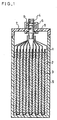
- each of the above-mentioned negative electrodes 2 and each of the positive electrodes 3 were alternately laminated by interposing separators made of sulfonated polypropylene nonwoven fiber between two electrodes of opposite polarity, in a manner that two of the negative electrodes were placed at the outermost positions of the laminated assemblage.
- the lead conductors of the negative electrodes were spot-welded to a negative terminal 4 made of nickel and the lead conductors of the positive electrodes were spot-welded to a positive terminal (not shown) made of nickel, respectively.
- the electrode group thus configured was housed in a battery case 5 made of acrylonitrile-styrene copolymer resin having a wall thickness of 3 mm, and an inner height of 108 mm, an inner length of 69 mm and an inner width of 18 mm, and 54 ml of an electrolyte of an aqueous solution of potassium hydroxide having a specific gravity of 1.3 was injected into the battery case housing the electrode group.
- An open end of the battery case 5 is closed with a sealing member 7 made of acrylonitrile-styrene copolymer resin provided with a safety valve which actuates at 2 atom, by adhering it to the case with an epoxy resin.
- the positive terminal and the negative terminal 4 were fixed on the sealing member 7.
- the part of these terminals was gas-tightly sealed by placing an O-ring 8 and squeezing it with a nut 9. In this manner, sealed-type batteries for evaluation were configured.
- the positive electrodes configured with the cobalt hydroxide powder that has a specific surface area of 10 m 2 /g or larger and a particle diameter of 1/2 or smaller of that of the nickel hydroxide powder are most excellent.
- aqueous solution containing sodium hydroxide in 5 mol/L was combined with another aqueous solution containing cobalt sulfate in 2 mol/L and the combined mixture was stirred well, to form cobalt hydroxide.
- the cobalt hydroxide was treated with an aqueous solution of D-glucose as an oxidation inhibition treatment or a treatment for preventing oxidation and then dried.
- the cobalt hydroxide thus obtained had an average particle diameter of 1 ⁇ m and a specific surface area of 150 m 2 /g according to the BET method.
- the cobalt hydroxide which had not been treated with the D-glucose was immediately oxidized and discolored.
- Example 2 A procedure similar to that in Example 1 was followed in preparing a positive electrode with the thus treated cobalt hydroxide and another positive electrode with the cobalt hydroxide without treatment. Then, the utilization of the positive electrodes was calculated based on the discharge capacities derived from the repeated charge/discharge tests conducted under the same conditions as those in Example 1. The calculated utilization is summarized in Table 2 below. Table 2 Utilization of positive electrode (%) Treated 99 Nontreated 87
- the treated cobalt hydroxide can be used as a stable material.
- a nickel hydroxide powder having an average particle diameter of 10 ⁇ m was shaken vigorously with an aqueous solution containing cobalt ions in a reaction vessel, and by titrating an alkaline aqueous solution therein, the surfaces of the particles of the nickel hydroxide were covered with a layer of the cobalt hydroxide particles.
- each of the nickel hydroxide powders covered with the respective cobalt hydroxide powder having an average particle diameter of 1/10, 1/5, 1/3, 1/2 or 1 of the average particle diameter of the nickel hydroxide powder and a specific surface area of 5, 10, 50 or 150 m 2 /g according to the BET method as listed in Table 3 below was prepared.
- the weight ratio of the nickel hydroxide Ni(OH) 2 to the cobalt hydroxide Co(OH) 2 was adjusted to 100:10.
- each of the above-mentioned nickel hydroxide powders was added with water to prepare a paste.
- the paste was filled into a foamed nickel substrate having a width of 60 mm, a length of 81 mm and a weight of 3.1 g, the filled substrate was dried at 80°C and pressure-molded to have a thickness of 1.74 mm, thereby to produce a positive electrode plate.
- a nickel plate as a lead conductor was spot-welded to a corner of this positive electrode plate. Five (5) sheets of this positive electrode were employed in each of the test cells.
- Example 2 For a negative electrode, a hydrogen storage alloy electrode similar to that in Example 1 was employed. Six (6) sheets of this negative electrode were employed in each of the test cells.
- the positive electrodes configured with the nickel hydroxide powder covered with the cobalt hydroxide powder that has a specific surface area of 10 m 2 /g or larger and a particle diameter of 1/2 or smaller of that of the nickel hydroxide powder are most excellent. Since the cobalt hydroxide powders having a large specific surface area are liable to be oxidized, there is a difference in the utilization of the positive electrode by the oxidation inhibition treatment as seen from Table 3 above.
- a stability of the cobalt hydroxide which covers the surfaces of the nickel hydroxide particles was therefore confirmed in the following manner.
- valence of the cobalt in the cobalt hydroxide was measured.
- a method of adding an excessive amount of potassium iodide and then titrating the added mixture with sodium thiosulfate was employed.
- Table 4 summarizes the results of the measurements on the stability of the covering cobalt hydroxide. As clearly shown in Table 4, a simple anti-oxidation treatment makes the cobalt hydroxide stable and usable as a material. Table 4 Specific surface area of cobalt hydroxide (m 2 /g) Utilization of positive electrode(%) Valence of cobalt Treated Nontreated Treated Nontreated 10 96 95 2.00 2.00 50 97 97 2.01 2.00 150 100 89 2.01 2.12
- the nickel hydroxide thus prepared was subjected to an oxidation inhibition treatment by washing it with an aqueous solution of D-glucose.
- batteries for evaluation were configured in a manner similar to that in Example 3.
- the positive electrode capacity of each battery was 25.3 Ah and the quantity of electricity required for oxidizing Co(II) of the cobalt hydroxide to Co(III) was 2.63 Ah.
- the batteries for evaluation were set to 0, 10, 20 and 30 hours, respectively. Each battery was then subjected to an initial charge under varying charging conditions specified below, and then discharged at 1/5 CA until the terminal voltage decreased to 1 V. Thereafter, the respective batteries were subjected to the repeated charge/discharge cycles, whereby they were charged at 1/5 CA up to a charged state which equivalents to 120% of the theoretical capacities of the batteries and discharged at 1/5 CA until the terminal voltages decreased to 1 V.
- the conditions for initial charging were such that each battery was charged at a current of 0.88, 1.32, 2.63 or 5.26 A, which corresponds to 1/3, 1/2, 1 or 2 CA of the quantity of electricity required for oxidizing Co(II) of the cobalt hydroxide to Co(III). After a lapse of the oxidizing region of the cobalt, the charging for each battery was continued at a current of 5.26 A which corresponds to about 1/5 CA, calculated on a basis of the theoretical capacity of the battery, i.e., 25.3 Ah until the charge became equivalent to 120% of the theoretical capacity of the battery. A changeover of the charging current was performed at a time point when the terminal voltage of the battery reached 1.4 V.
- the nickel positive electrode in accordance with the present invention has been described mainly in conjunction with its application to the nickel-metal hydride storage battery, it is needless to say that the disclosed nickel positive electrode can also be applied to the nickelcadmium storage battery and the like.
- the nickel positive electrode having an improved utilization and thus to provide the alkaline storage battery having a high performance as well as a high capacity.
Landscapes
- Chemical & Material Sciences (AREA)
- Chemical Kinetics & Catalysis (AREA)
- Electrochemistry (AREA)
- General Chemical & Material Sciences (AREA)
- Inorganic Chemistry (AREA)
- Engineering & Computer Science (AREA)
- Manufacturing & Machinery (AREA)
- Battery Electrode And Active Subsutance (AREA)
Claims (6)
- Positive Nickelelektrode für eine alkalische Speicherbatterie, welche ein Nickelhydroxid-Pulver und ein Kobalthydroxid-Pulver umfasst, wobei das Kobalthydroxid-Pulver eine spezifische Oberfläche von 10 m2/g oder größer und einen mittleren Teilchendurchmesser von ½ oder weniger von dem des Nickelhydroxid-Pulvers aufweist, und wobei die Oberflächen der Teilchen des Nickelhydroxid-Pulvers mit den Teilchen des Kobalthydroxid-Pulvers bedeckt sind.
- Die positive Nickelelektrode nach Anspruch 1, wobei das Kobalthydroxid-Pulver einer Antioxidationsbehandlung unterzogen wurde.
- Die positive Nickelelektrode nach Anspruch 1, welche ferner mindestens ein Pulver von metallischem Nickel, Kohlenstoff und metallischem Kobalt umfasst.
- Versiegelte Nickel-Metallhydrid-Speicherbatterie, welche umfasst:eine positive Nickelelektrode nach einem der Ansprüche 1 bis 3;eine negative Elektrode, welche eine Wasserstoffspeicherlegierung umfasst, die dazu fähig ist, Wasserstoff in einer reversiblen Art und Weise elektrochemisch zu absorbieren und zu desorbieren;einen Separator;ein Elektrolyt einer alkalischen wässrigen Lösung; undein versiegeltes Batteriegehäuse, welches mit einem Anschlußleiter-Element zum Verbinden der Elektroden zu Anschlüssen und einem zurücksetzbaren Sicherheitsventil versehen ist.
- Verfahren zum Aufladen einer versiegelten Nickel-Metallhydrid-Speicherbatterie, welches das Stillstehen der Speicherbatterie nach Anspruch 4 für 20 Stunden oder länger nach seinem Zusammenbau und danach das Durchführen eines anfänglichen Aufladens umfasst.
- Das Verfahren nach Anspruch 5, wobei das anfängliche Aufladen der Speicherbatterie bei einem Strom von ½ CA oder weniger durchgeführt, berechnet auf einer Grundlage der Quantität der Elektrizität zum Oxidieren von Co(II) des Kobalthydroxids zu Co(III) in der Oxidationsregion des Kobalthydroxids, und die Batterie dann gleich oder bei einer höheren Rate als der anfängliche Wert aufgeladen wird.
Applications Claiming Priority (4)
| Application Number | Priority Date | Filing Date | Title |
|---|---|---|---|
| JP12657495 | 1995-05-25 | ||
| JP126574/95 | 1995-05-25 | ||
| JP150522/95 | 1995-06-16 | ||
| JP15052295 | 1995-06-16 |
Publications (2)
| Publication Number | Publication Date |
|---|---|
| EP0744781A1 EP0744781A1 (de) | 1996-11-27 |
| EP0744781B1 true EP0744781B1 (de) | 2006-01-04 |
Family
ID=26462742
Family Applications (1)
| Application Number | Title | Priority Date | Filing Date |
|---|---|---|---|
| EP96303646A Expired - Lifetime EP0744781B1 (de) | 1995-05-25 | 1996-05-22 | Nickel positivelektrode für alkalische Speicherbatterie und gasdichte Nickel-Metallhydrid Speicherbatterie |
Country Status (3)
| Country | Link |
|---|---|
| US (1) | US5744259A (de) |
| EP (1) | EP0744781B1 (de) |
| DE (1) | DE69635695T2 (de) |
Families Citing this family (17)
| Publication number | Priority date | Publication date | Assignee | Title |
|---|---|---|---|---|
| US6040007A (en) * | 1996-06-19 | 2000-03-21 | Tanaka Chemical Corporation | Nickel hydroxide particles having an α- or β-cobalt hydroxide coating layer for use in alkali batteries and a process for producing the nickel hydroxide |
| JP3246345B2 (ja) * | 1996-08-21 | 2002-01-15 | 松下電器産業株式会社 | アルカリ蓄電池用ニッケル正極とこれを用いたニッケル・水素蓄電池 |
| US7393612B2 (en) * | 1996-12-17 | 2008-07-01 | Toshiba Battery Co., Ltd. | Electrodes, alkaline secondary battery, and method for manufacturing alkaline secondary battery |
| US6309775B1 (en) * | 1998-02-12 | 2001-10-30 | Duracell Inc. | Prismatic electrochemical cell |
| TW416166B (en) * | 1998-03-13 | 2000-12-21 | Toshiba Battery | Manufacturing method of anode active material of alkaline battery, the anode using the active material, and manufacturing method of alkaline battery using the anode |
| ES2201357T3 (es) * | 1998-03-30 | 2004-03-16 | Renata Ag | Respiradero de seguridad para acumulador o pila. |
| JP2000003707A (ja) * | 1998-06-16 | 2000-01-07 | Matsushita Electric Ind Co Ltd | アルカリ蓄電池 |
| US6270535B1 (en) | 1998-09-04 | 2001-08-07 | Moltech Power Systems, Inc. | Method of forming CoOOH and NiOOH in a NiMH electrochemical cell and an electrochemical cell formed thereby |
| DE19910461A1 (de) * | 1999-03-10 | 2000-09-14 | Starck H C Gmbh Co Kg | Mit Kobalthydroxid beschichtetes Nickelhydroxid |
| JP2001035488A (ja) * | 1999-07-26 | 2001-02-09 | Honda Motor Co Ltd | ニッケル水素電池の製造方法 |
| US6492062B1 (en) | 2000-08-04 | 2002-12-10 | The Gillette Company | Primary alkaline battery including nickel oxyhydroxide |
| US6737035B1 (en) * | 2000-08-31 | 2004-05-18 | Osram Sylvania Inc. | Heterogenite material for making submicron cobalt powders |
| US6489056B1 (en) | 2000-09-18 | 2002-12-03 | The Gillette Company | Battery including a hydrogen-absorbing cathode material |
| JP4206269B2 (ja) * | 2000-11-17 | 2009-01-07 | 東芝電池株式会社 | 密閉形ニッケル亜鉛一次電池、その正極及びそれらの製造方法 |
| US6740451B2 (en) | 2001-12-20 | 2004-05-25 | The Gillette Company | Gold additive for a cathode including nickel oxyhydroxide for an alkaline battery |
| US7081319B2 (en) * | 2002-03-04 | 2006-07-25 | The Gillette Company | Preparation of nickel oxyhydroxide |
| JP5240897B2 (ja) * | 2007-12-19 | 2013-07-17 | 日立マクセル株式会社 | アルカリ電池 |
Family Cites Families (12)
| Publication number | Priority date | Publication date | Assignee | Title |
|---|---|---|---|---|
| DE3486180T2 (de) * | 1983-07-05 | 1993-12-16 | Japan Storage Battery Co Ltd | Alkalische Sammlerbatterie. |
| JPH06101332B2 (ja) * | 1985-09-19 | 1994-12-12 | 三洋電機株式会社 | アルカリ蓄電池用陽極 |
| JPS63152866A (ja) * | 1986-12-16 | 1988-06-25 | Yuasa Battery Co Ltd | 蓄電池用ニツケル活物質及びその製造法 |
| JPS63216268A (ja) * | 1987-03-03 | 1988-09-08 | Sanyo Electric Co Ltd | アルカリ蓄電池用水酸化ニツケル電極の製造方法 |
| JP2609911B2 (ja) * | 1988-10-19 | 1997-05-14 | 三洋電機株式会社 | アルカリ蓄電池 |
| US4975035A (en) * | 1989-01-13 | 1990-12-04 | Jerry Kuklinski | Method of making a nickel hydroxide-containing cathode for alkaline batteries |
| US5200282A (en) * | 1989-06-15 | 1993-04-06 | Yuasa Battery Co. Ltd. | Nickel electrode and alkaline battery using the same |
| WO1992008251A1 (en) * | 1990-10-29 | 1992-05-14 | Yuasa Corporation | Hydrogen-storing electrode, nickel electrode, and nickel-hydrogen battery |
| WO1993008611A1 (fr) * | 1991-10-21 | 1993-04-29 | Yuasa Corporation | Procede de fabrication d'une plaque de nickel et d'un accumulateur alcalin |
| US5348822A (en) * | 1992-11-12 | 1994-09-20 | Ovonic Battery Company, Inc. | Chemically and compositionally modified solid solution disordered multiphase nickel hydroxide positive electrode for alkaline rechargeable electrochemical cells |
| US5523182A (en) * | 1992-11-12 | 1996-06-04 | Ovonic Battery Company, Inc. | Enhanced nickel hydroxide positive electrode materials for alkaline rechargeable electrochemical cells |
| JP2962957B2 (ja) * | 1992-12-24 | 1999-10-12 | 古河電池株式会社 | 蓄電池用ペースト式ニッケル極板、蓄電池並びに導電材の製造法 |
-
1996
- 1996-05-21 US US08/646,824 patent/US5744259A/en not_active Expired - Lifetime
- 1996-05-22 DE DE69635695T patent/DE69635695T2/de not_active Expired - Lifetime
- 1996-05-22 EP EP96303646A patent/EP0744781B1/de not_active Expired - Lifetime
Also Published As
| Publication number | Publication date |
|---|---|
| EP0744781A1 (de) | 1996-11-27 |
| DE69635695T2 (de) | 2006-07-20 |
| US5744259A (en) | 1998-04-28 |
| DE69635695D1 (de) | 2006-03-30 |
Similar Documents
| Publication | Publication Date | Title |
|---|---|---|
| EP0354966B1 (de) | Alkalische batterien und verfahren zur herstellung | |
| EP0744781A1 (de) | Nickel positivelektrode für alkalische Speicherbatterie und gasdichte Nickel-Metallhydrid Speicherbatterie | |
| EP1195824B1 (de) | Positives Elektrodenaktivmaterial für alkalische Speicherbatterien | |
| EP0869565B1 (de) | Alkalische Speicherbatterie | |
| EP1172869B1 (de) | Verfahren zur Herstellung von einem positiven aktiven Elektrodenmaterial für eine alkalische Speicherbatterie | |
| EP0817291B1 (de) | Nicht gesinterte Nickelelektrode für alkalische Speicherbatterie, diese enthaltende alkalische Speicherbatterie und Herstellungsverfahren für solch eine Elektrode. | |
| EP0634804A1 (de) | Positive Nickelelektrode für alkalische Akkumulatoren und diese enthaltenden abgedichteten Nickel/Wasserstoff-Akkumulator | |
| EP0800222B1 (de) | Verfahren zur Herstellung von Lithiumnickelat positiver Elektrode sowie diese verwendende Lithiumbatterie | |
| EP1137082B1 (de) | Pastöse positive Elektrode für alkalische Speicherbatterie und Nickel-Metallhydrid Speicherbatterie | |
| US6620549B2 (en) | Alkaline storage battery | |
| EP0771041B1 (de) | Nickel-Positivelektrode und alkalische Speicherbatterie diese verwendend | |
| EP0889535B1 (de) | Nickelhydroxid aktives Material für alkalische Speicherzelle und Herstellungsverfahren | |
| US6440607B1 (en) | Nickel-hydrogen secondary cell | |
| EP1624508B1 (de) | Nickel-Wasserstoff Speicherbatterie | |
| EP0901179B1 (de) | Alkalische aufladbare Batterie | |
| US4897324A (en) | Hermetically-sealed alkaline battery | |
| US6221529B1 (en) | Positive electrode for lithium battery and lithium battery | |
| JP4979178B2 (ja) | 密閉型アルカリ蓄電池用水素吸蔵合金粉末及びそれを用いた密閉型アルカリ蓄電池 | |
| JP3414200B2 (ja) | アルカリ蓄電池 | |
| EP0848439B1 (de) | Aktives Kathodenmaterial für Nickelzelle, Herstellungsverfahren und Verfahren zur Herstellung von einer Kathode für Nickelzelle | |
| JP2989877B2 (ja) | ニッケル水素二次電池 | |
| US6926998B2 (en) | Nickel-metal hydride storage battery | |
| EP1137083A2 (de) | Ungesinterte Elektrode für alkalische Speicherbatterie und alkalische Speicherbatterie | |
| JPH0714578A (ja) | アルカリ蓄電池用ニッケル正極および密閉型ニッケル−水素蓄電池 | |
| US6171728B1 (en) | Nickel electrode for akaline storage cell and manufacturing method of the same |
Legal Events
| Date | Code | Title | Description |
|---|---|---|---|
| PUAI | Public reference made under article 153(3) epc to a published international application that has entered the european phase |
Free format text: ORIGINAL CODE: 0009012 |
|
| 17P | Request for examination filed |
Effective date: 19960604 |
|
| AK | Designated contracting states |
Kind code of ref document: A1 Designated state(s): DE FR GB |
|
| 17Q | First examination report despatched |
Effective date: 19990520 |
|
| GRAP | Despatch of communication of intention to grant a patent |
Free format text: ORIGINAL CODE: EPIDOSNIGR1 |
|
| GRAS | Grant fee paid |
Free format text: ORIGINAL CODE: EPIDOSNIGR3 |
|
| GRAA | (expected) grant |
Free format text: ORIGINAL CODE: 0009210 |
|
| AK | Designated contracting states |
Kind code of ref document: B1 Designated state(s): DE FR GB |
|
| REG | Reference to a national code |
Ref country code: GB Ref legal event code: FG4D |
|
| REF | Corresponds to: |
Ref document number: 69635695 Country of ref document: DE Date of ref document: 20060330 Kind code of ref document: P |
|
| ET | Fr: translation filed | ||
| PLBE | No opposition filed within time limit |
Free format text: ORIGINAL CODE: 0009261 |
|
| STAA | Information on the status of an ep patent application or granted ep patent |
Free format text: STATUS: NO OPPOSITION FILED WITHIN TIME LIMIT |
|
| 26N | No opposition filed |
Effective date: 20061005 |
|
| REG | Reference to a national code |
Ref country code: FR Ref legal event code: PLFP Year of fee payment: 20 |
|
| PGFP | Annual fee paid to national office [announced via postgrant information from national office to epo] |
Ref country code: GB Payment date: 20150520 Year of fee payment: 20 Ref country code: DE Payment date: 20150519 Year of fee payment: 20 |
|
| PGFP | Annual fee paid to national office [announced via postgrant information from national office to epo] |
Ref country code: FR Payment date: 20150508 Year of fee payment: 20 |
|
| REG | Reference to a national code |
Ref country code: DE Ref legal event code: R071 Ref document number: 69635695 Country of ref document: DE |
|
| REG | Reference to a national code |
Ref country code: GB Ref legal event code: PE20 Expiry date: 20160521 |
|
| PG25 | Lapsed in a contracting state [announced via postgrant information from national office to epo] |
Ref country code: GB Free format text: LAPSE BECAUSE OF EXPIRATION OF PROTECTION Effective date: 20160521 |