EP0739652B1 - Method for the continuous production of room-temperature-curable organopolysiloxane compositions - Google Patents
Method for the continuous production of room-temperature-curable organopolysiloxane compositions Download PDFInfo
- Publication number
- EP0739652B1 EP0739652B1 EP96302201A EP96302201A EP0739652B1 EP 0739652 B1 EP0739652 B1 EP 0739652B1 EP 96302201 A EP96302201 A EP 96302201A EP 96302201 A EP96302201 A EP 96302201A EP 0739652 B1 EP0739652 B1 EP 0739652B1
- Authority
- EP
- European Patent Office
- Prior art keywords
- parts
- weight
- room
- temperature
- curable organopolysiloxane
- Prior art date
- Legal status (The legal status is an assumption and is not a legal conclusion. Google has not performed a legal analysis and makes no representation as to the accuracy of the status listed.)
- Expired - Lifetime
Links
Images

Classifications
-
- C—CHEMISTRY; METALLURGY
- C08—ORGANIC MACROMOLECULAR COMPOUNDS; THEIR PREPARATION OR CHEMICAL WORKING-UP; COMPOSITIONS BASED THEREON
- C08K—Use of inorganic or non-macromolecular organic substances as compounding ingredients
- C08K13/00—Use of mixtures of ingredients not covered by one single of the preceding main groups, each of these compounds being essential
- C08K13/02—Organic and inorganic ingredients
-
- B—PERFORMING OPERATIONS; TRANSPORTING
- B29—WORKING OF PLASTICS; WORKING OF SUBSTANCES IN A PLASTIC STATE IN GENERAL
- B29B—PREPARATION OR PRETREATMENT OF THE MATERIAL TO BE SHAPED; MAKING GRANULES OR PREFORMS; RECOVERY OF PLASTICS OR OTHER CONSTITUENTS OF WASTE MATERIAL CONTAINING PLASTICS
- B29B7/00—Mixing; Kneading
- B29B7/30—Mixing; Kneading continuous, with mechanical mixing or kneading devices
- B29B7/34—Mixing; Kneading continuous, with mechanical mixing or kneading devices with movable mixing or kneading devices
- B29B7/38—Mixing; Kneading continuous, with mechanical mixing or kneading devices with movable mixing or kneading devices rotary
- B29B7/40—Mixing; Kneading continuous, with mechanical mixing or kneading devices with movable mixing or kneading devices rotary with single shaft
- B29B7/402—Mixing; Kneading continuous, with mechanical mixing or kneading devices with movable mixing or kneading devices rotary with single shaft using a rotor-stator system with intermeshing elements, e.g. teeth
-
- B—PERFORMING OPERATIONS; TRANSPORTING
- B29—WORKING OF PLASTICS; WORKING OF SUBSTANCES IN A PLASTIC STATE IN GENERAL
- B29B—PREPARATION OR PRETREATMENT OF THE MATERIAL TO BE SHAPED; MAKING GRANULES OR PREFORMS; RECOVERY OF PLASTICS OR OTHER CONSTITUENTS OF WASTE MATERIAL CONTAINING PLASTICS
- B29B7/00—Mixing; Kneading
- B29B7/80—Component parts, details or accessories; Auxiliary operations
- B29B7/84—Venting or degassing ; Removing liquids, e.g. by evaporating components
- B29B7/845—Venting, degassing or removing evaporated components in devices with rotary stirrers
- B29B7/847—Removing of gaseous components before or after mixing
-
- B—PERFORMING OPERATIONS; TRANSPORTING
- B29—WORKING OF PLASTICS; WORKING OF SUBSTANCES IN A PLASTIC STATE IN GENERAL
- B29C—SHAPING OR JOINING OF PLASTICS; SHAPING OF MATERIAL IN A PLASTIC STATE, NOT OTHERWISE PROVIDED FOR; AFTER-TREATMENT OF THE SHAPED PRODUCTS, e.g. REPAIRING
- B29C48/00—Extrusion moulding, i.e. expressing the moulding material through a die or nozzle which imparts the desired form; Apparatus therefor
- B29C48/25—Component parts, details or accessories; Auxiliary operations
- B29C48/36—Means for plasticising or homogenising the moulding material or forcing it through the nozzle or die
- B29C48/365—Means for plasticising or homogenising the moulding material or forcing it through the nozzle or die using pumps, e.g. piston pumps
- B29C48/37—Gear pumps
-
- B—PERFORMING OPERATIONS; TRANSPORTING
- B29—WORKING OF PLASTICS; WORKING OF SUBSTANCES IN A PLASTIC STATE IN GENERAL
- B29C—SHAPING OR JOINING OF PLASTICS; SHAPING OF MATERIAL IN A PLASTIC STATE, NOT OTHERWISE PROVIDED FOR; AFTER-TREATMENT OF THE SHAPED PRODUCTS, e.g. REPAIRING
- B29C48/00—Extrusion moulding, i.e. expressing the moulding material through a die or nozzle which imparts the desired form; Apparatus therefor
- B29C48/25—Component parts, details or accessories; Auxiliary operations
- B29C48/36—Means for plasticising or homogenising the moulding material or forcing it through the nozzle or die
- B29C48/395—Means for plasticising or homogenising the moulding material or forcing it through the nozzle or die using screws surrounded by a cooperating barrel, e.g. single screw extruders
- B29C48/40—Means for plasticising or homogenising the moulding material or forcing it through the nozzle or die using screws surrounded by a cooperating barrel, e.g. single screw extruders using two or more parallel screws or at least two parallel non-intermeshing screws, e.g. twin screw extruders
-
- B—PERFORMING OPERATIONS; TRANSPORTING
- B29—WORKING OF PLASTICS; WORKING OF SUBSTANCES IN A PLASTIC STATE IN GENERAL
- B29C—SHAPING OR JOINING OF PLASTICS; SHAPING OF MATERIAL IN A PLASTIC STATE, NOT OTHERWISE PROVIDED FOR; AFTER-TREATMENT OF THE SHAPED PRODUCTS, e.g. REPAIRING
- B29C48/00—Extrusion moulding, i.e. expressing the moulding material through a die or nozzle which imparts the desired form; Apparatus therefor
- B29C48/25—Component parts, details or accessories; Auxiliary operations
- B29C48/36—Means for plasticising or homogenising the moulding material or forcing it through the nozzle or die
- B29C48/50—Details of extruders
- B29C48/505—Screws
- B29C48/625—Screws characterised by the ratio of the threaded length of the screw to its outside diameter [L/D ratio]
-
- C—CHEMISTRY; METALLURGY
- C08—ORGANIC MACROMOLECULAR COMPOUNDS; THEIR PREPARATION OR CHEMICAL WORKING-UP; COMPOSITIONS BASED THEREON
- C08L—COMPOSITIONS OF MACROMOLECULAR COMPOUNDS
- C08L83/00—Compositions of macromolecular compounds obtained by reactions forming in the main chain of the macromolecule a linkage containing silicon with or without sulfur, nitrogen, oxygen or carbon only; Compositions of derivatives of such polymers
- C08L83/04—Polysiloxanes
-
- C—CHEMISTRY; METALLURGY
- C08—ORGANIC MACROMOLECULAR COMPOUNDS; THEIR PREPARATION OR CHEMICAL WORKING-UP; COMPOSITIONS BASED THEREON
- C08G—MACROMOLECULAR COMPOUNDS OBTAINED OTHERWISE THAN BY REACTIONS ONLY INVOLVING UNSATURATED CARBON-TO-CARBON BONDS
- C08G77/00—Macromolecular compounds obtained by reactions forming a linkage containing silicon with or without sulfur, nitrogen, oxygen or carbon in the main chain of the macromolecule
- C08G77/04—Polysiloxanes
- C08G77/06—Preparatory processes
-
- C—CHEMISTRY; METALLURGY
- C08—ORGANIC MACROMOLECULAR COMPOUNDS; THEIR PREPARATION OR CHEMICAL WORKING-UP; COMPOSITIONS BASED THEREON
- C08G—MACROMOLECULAR COMPOUNDS OBTAINED OTHERWISE THAN BY REACTIONS ONLY INVOLVING UNSATURATED CARBON-TO-CARBON BONDS
- C08G77/00—Macromolecular compounds obtained by reactions forming a linkage containing silicon with or without sulfur, nitrogen, oxygen or carbon in the main chain of the macromolecule
- C08G77/04—Polysiloxanes
- C08G77/14—Polysiloxanes containing silicon bound to oxygen-containing groups
- C08G77/16—Polysiloxanes containing silicon bound to oxygen-containing groups to hydroxy groups
Definitions
- This invention relates to a method for the continuous production of room-temperature-curable organopolysiloxane compositions that are cured at ambient temperatures by moisture present in air.
- Room-temperature-curable organopolysiloxane compositions that are cured by atmospheric moisture at ambient temperature into rubbery elastomers are already well known. They have found wide application as sealants, commercial adhesives, potting agents, and mold-making materials, in a number of fields, such as construction, machinery, and electrical applications.
- Room-temperature-curable organopoly- siloxane compositions are typically produced by mixing diorgano- polysiloxane having at least 2 silicon-bonded hydroxyl groups in each molecule, organosilane having at least 2 silicon-bonded hydrolyzable groups in each molecule, and inorganic filler powder using a mixing means having a stirring or agitating action, such as a Henschel mixer or kneader mixer.
- these production methods suffer from a poor productivity. It is desirable to have a highly productive method for producing room-temperature-curable organopolysiloxane compositions.
- EP-A-0 512 730 describes a process and apparatus for the continuous manufacture of moisture curable silicone compositions in which the ingredients of a moisture curable organosiloxane composition are homogeneously mixed in the first mixing zone of a screw-extruder device and the mixture is then passed through a residence zone in which the mixture is not subjected to the mixing action and in which the mixture is permitted to react after which the composition is transported through a second mixing zone from which volatile materials are exhausted and the mixture is then extruded into storage containers.
- US-A-4528324 discloses the contineous preparation of room temperature curable silicone compositions, wherein some of the components are pre-mixed in a static mixer, followed by passing the composition through a devolatilising extruder.
- the present invention is a highly productive, continuous method for the preparation of room-temperature-curable organopolysiloxane compositions.
- the present invention relates to a method for the continuous production of room-temperature-curable organopoly- siloxane compositions comprising continuously feeding
- Figure 1 contains an example of a continuous mixing apparatus that can be used by the present invention.
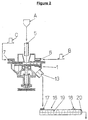
- Figure 2 contains a schematic drawing of one example of the continuous production method according to the present invention.
- the diorganopolysiloxane (A) used by the present invention is the base ingredient of the room-temperature-curable organopolysiloxane compositions, and it must contain at least 2 silicon-bonded hydroxyl groups or hydrolyzable groups in each molecule.
- This diorganopolysiloxane is well known as a starting material for room-temperature-curable organopolysiloxane compositions, and those diorganopolysiloxanes already known from the art can be used in the present invention.
- hydroxyl-terminated diorganopolysiloxane with the following formula is preferred in which n is a positive integer that yields a viscosity at 25°C of 0.1 to 500 Pa.s and R represents substituted and unsubstituted monovalent hydrocarbon groups.
- R group in the above formula is exemplified by monovalent hydrocarbon groups such as methyl, ethyl, propyl, butyl, vinyl, phenyl, and the like, and by substituted monovalent hydrocarbon groups such as chloromethyl, cyanoethyl, and 3,3,3-trifluoropropyl.
- Component (A) must have a viscosity at 25°C in the range from 0.1 to 500 Pa.s. Good physical properties become difficult to obtain at below 0.1 Pa.s. At above 500 Pa.s, the room-temperature-curable organopolysiloxane compositions obtained suffer from problems such as poor extrudability and poor curability.
- Component (B) used in the present invention is a crosslinker that crosslinks component (A) to produce a network structure.
- Component (B) is specifically exemplified by organosilanes such as methyltrimethoxysilane, vinyltriethoxysilane, methylvinylethoxysilane, methyltri(methyl ethyl ketoximo)silane, vinyltri(methyl ethyl ketoximo)silane, phenyltri(methyl ethyl ketoximo)silane, methyltriacetoxysilane, vinyltriacetoxysilane, phenyltriacetoxysilane, dimethyldiacetoxysilane, methylethoxydiacetoxysilane, methyltri(N,N-diethylaminoxy)silane, vinyltri(N,N-diethylaminoxy)silane, vinyltri(N-cyclohexylamino)silane, vinyl
- Component (B) should be added at 1 to 30 parts by weight per 100 parts by weight component (A).
- the use of less than 1 part by weight component (B) prevents the production of a cured product having an excellent rubbery elasticity and excellent mechanical properties.
- the use of more than 30 parts by weight causes a reduced mechanical strength in the cured products.
- Inorganic filler powder (C) used in the present invention can be a reinforcing filler used for the purpose of imparting mechanical strength to the cured products obtained by curing the room-temperature-curable organopolysiloxane compositions.
- the reinforcing inorganic filler powder is exemplified by fumed silica, calcined silica, and precipitated silica, and by these silicas after surface hydrophobicization with organochlorosilane, organopolysiloxane, or hexamethyldisil-azane.
- reinforcing silica fillers can be present in amounts of from 5 to 50 parts by weight per 100 parts by weight of (A) and preferably from 5 to 25 parts by weight per 100 parts by weight of (A).
- Other examples of inorganic fillers include extending fillers which are advantagefied by calcium carbonate, magnesium carbonate, quartz, diatomaceous earth, barium sulfate, and calcium sulfate.
- Component (C) is added at from 1 to 200 parts by weight per 100 parts by weight component (A) and is preferably added at from 5 to 150 parts by weight per 100 parts by weight component (A).
- An acceptable mechanical strength is not obtained in the cured product at additions of less than 5 parts by weight of reinforcing silica filler is used.
- the addition of more than 200 parts by weight per 100 parts by weight of (A) causes the resulting room- temperature-curable organopolysiloxane composition itself to have a too high viscosity.
- Cure-accelerating catalyst (D) used in the present invention is used on an optional basis, and its purpose is to accelerate the cure of the room-temperature-curable organopoly- siloxane composition by accelerating the condensation reaction between components (A) and (B).
- the cure-accelerating catalyst is specifically exemplified by metal carboxylates such as iron octoate, cobalt octoate, manganese octoate, tin naphthenate, and tin octoate; organotin compounds such as dibutyltin acetate, dibutyltin octoate, dibutyltin dilaurate, and diphenyltin acetate; organotitanium compounds such as tetrabutyl titanate, triethanolamine titanate, tetra-2-ethylhexyl titanate, titanium acetoacetate, and organosiloxy-titanium; and alkoxyaluminum compounds. This component is
- the above-described components (A) to (C) or components (A) to (D) are continuously fed in their specified quantities into a continuous mixing apparatus having starting material feed openings installed at its top, a discharge opening installed at its bottom, and a rotating disk installed within a casing and are therein mixed in their specified quantities by the rotation of the said rotating disk.
- the continuous mixing apparatus used for this purpose is known from JP-A-62-106 828 (Japanese Patent Publication [Kokai] Hei 2-2610 (1990)) and US-A-3,998,433, which is equivalent to Japanese Patent Publication [Kokai] Sho JP-B 53-38828 (1978) in the form of apparatuses for mixing a liquid and a powder.
- FIG. 1 gives one example of a continuous mixing apparatus for use in the present invention.
- a cylindrical casing 2 forms the shell of the mixing apparatus body 1.
- a powder feed inlet 5 for powder intake is installed at the center of the upper plate 1a of this casing, while the central region of the casing contains a rotating disk 4 for liquid-powder mixing and its lower region forms an inclined surface 1b in the shape of an inverted cone.
- a discharge opening 13 for the mixture is installed in this inclined surface 1b.
- a liquid feed opening 7 for the feed of the various liquid additives, such as the crosslinker, curing agent, plasticizer, and so forth, while in its interior there is formed a liquid reservoir 8.
- An overflow tube 9 in the form of an inverted cone is connected to the mixing apparatus body 1 so as to ascend into the liquid reservoir 8, and the bottom end 3 of the powder feed inlet 5 faces on the inlet to the overflow tube 9.
- a rotating disk 4 is installed in the central region of the cylindrical casing 2 so as to face the bottom end 3 of the powder feed inlet 5.
- the starting diorganopolysiloxane is supplied through liquid feed inlet 6 and the starting inorganic filler powder is supplied through the powder feed inlet 5.
- the various liquid additives such as the crosslinker, curing agent, and plasticizer, are supplied through the liquid feed opening 7.
- the diorganopolysiloxane fed through liquid feed inlet 6 is first stored in liquid reservoir 8 and then flows down along the inside wall from the top edge of the overflow tube 9 and is mixed with the inorganic filler powder supplied from the powder feed inlet 5. This mixture is then mixed with the various liquid additives.
- the mixture is discharged through the action of rake-out blade 10 from discharge opening 13 to the outside of the continuous mixing apparatus.
- the rotating disk 4 is disposed to rotate freely within the mixing compartment and is equipped with a plural number of top-surface scrapers 11a and a plural number of mixing pins 12 that are embedded in the rotating disk 4.
- the center of rotation of the rotating disk 4 is fixed at the top end of a rotating axle 14, and the bottom end of the rotating axle 14 is connected to a pulley 15.
- This pulley 15 is set up to be driven by rotational power from a motor (not shown). Its rotation rate is preferably from 400 to 1500 rpm.
- the rotation rate of the rotating disk in the above- described continuous mixing apparatus is preferably from 500 to 1,500 rpm in the present invention.
- This apparatus can be equipped with a jacket for cooling.
- the method of the present invention then continues with the introduction of the mixture discharged from the above-described continuous mixing apparatus into a degassing apparatus that is equipped with a vacuum mechanism.
- the air, volatiles, and water present in the mixture are removed in this apparatus under reduced pressure.
- No specific restrictions apply to the vacuum mechanism-equipped degassing apparatus employed here, and the invention method can use those apparatuses already known for the vacuum removal of the gases (e.g., air, etc.) and volatiles present in liquids and pastes.
- the subject apparatus is exemplified by vented single- screw and twin-screw extruders.
- Transport means such as a gear pump, piston pump, and tubular pump, can be used to feed the mixture produced in the continuous mixing apparatus into the degassing apparatus.
- the room-temperature-curable organopolysiloxane compositions were prepared in the examples using the method depicted in Figure 2.
- the properties of the room-temperature-curable organopolysiloxane compositions were measured and evaluated in the examples using the following procedures. "Parts” represents “parts by weight” and the viscosities were those measured at 25°C.
- the particular room-temperature-curable organopolysiloxane composition was dissolved in xylene and the amount of water present in this solution was measured using a Karl Fischer water titration instrument from Kyoto Denki Kogyo Kabushiki Kaisha of Japan.
- the particular room-temperature-curable organopolysiloxane composition was introduced into a mold designed for the production of specimens for physical property measurements and was cured into a 2-mm thick sheet by standing for 7 days at 25°C and 55% humidity.
- the mechanical properties of this sheet were measured according to the procedures of Japanese Industrial Standard K 6301.
- the particular room-temperature-curable organopoly- siloxane composition was sealed in an aluminum cartridge, and this cartridge was held for 3 months at room temperature. After this holding period, a sample of the composition was removed from the cartridge, heated in a 70°C oven for 2 hours, and scored for the presence/absence of foaming.
- a tubular pump was used to transport the mixture from the discharge opening of the continuous mixing apparatus 1 to the twin-screw extruder 16.
- the water, volatiles, and air present in the mixture were continuously removed by the imposition of a vacuum within the twin-screw extruder 16 through the vacuum vent opening 18.
- Three vacuum conditions 48 kPa, 21.3 kPa, and 2.7 kPa were executed.
- the mixture at this point taking the form of the target room-temperature-curable organopolysiloxane composition, was continuously discharged from discharge opening 20 and sealed into aluminum cartridges. The properties of this room- temperature-curable organopolysiloxane composition were measured and these results were as reported in Table 1.
- Example 1-1 1-2 1-3 Vacuum, kPa 48 21.3 2.7 Durometer 26 26 26 Tensile strength, kPa 1775 1795 1814 Elongation, % 482 505 512 Foamed no no no Water content, % 0.16 0.13 0.12
- a tubular pump was used to transport the mixture from the discharge opening of the continuous mixing apparatus to the twin-screw extruder.
- the water, volatiles, and air present in the mixture were continuously removed by the imposition of a vacuum within the vented twin-screw extruder through the vacuum vent opening 18. Three vacuum conditions (21.3 kPa and 2.7 kPa) were executed.
- the method of the present invention is characterized by an excellent productivity and by its ability to produce high-quality room-temperature-curable organopolysiloxane compositions at high levels of productivity. These characteristics accrue because production method of continuously feeding
Landscapes
- Engineering & Computer Science (AREA)
- Mechanical Engineering (AREA)
- Chemical & Material Sciences (AREA)
- Health & Medical Sciences (AREA)
- Chemical Kinetics & Catalysis (AREA)
- Medicinal Chemistry (AREA)
- Polymers & Plastics (AREA)
- Organic Chemistry (AREA)
- Compositions Of Macromolecular Compounds (AREA)
- Silicon Polymers (AREA)
- Mixers Of The Rotary Stirring Type (AREA)
Applications Claiming Priority (3)
| Application Number | Priority Date | Filing Date | Title |
|---|---|---|---|
| JP99502/95 | 1995-03-31 | ||
| JP9950295 | 1995-03-31 | ||
| JP09950295A JP3540429B2 (ja) | 1995-03-31 | 1995-03-31 | 室温硬化性オルガノポリシロキサン組成物の連続的製造方法 |
Publications (2)
| Publication Number | Publication Date |
|---|---|
| EP0739652A1 EP0739652A1 (en) | 1996-10-30 |
| EP0739652B1 true EP0739652B1 (en) | 2001-05-30 |
Family
ID=14249055
Family Applications (1)
| Application Number | Title | Priority Date | Filing Date |
|---|---|---|---|
| EP96302201A Expired - Lifetime EP0739652B1 (en) | 1995-03-31 | 1996-03-29 | Method for the continuous production of room-temperature-curable organopolysiloxane compositions |
Country Status (5)
| Country | Link |
|---|---|
| US (1) | US5861460A (enExample) |
| EP (1) | EP0739652B1 (enExample) |
| JP (1) | JP3540429B2 (enExample) |
| CA (1) | CA2172914C (enExample) |
| DE (1) | DE69613042T2 (enExample) |
Cited By (2)
| Publication number | Priority date | Publication date | Assignee | Title |
|---|---|---|---|---|
| EP1956039A2 (de) | 2007-01-16 | 2008-08-13 | Wacker Chemie AG | Verfahren zur Herstellung von vernetzbaren Massen auf der Basis von Organopolysiloxanen |
| US7888421B2 (en) | 2006-08-03 | 2011-02-15 | Wacker Chemie Ag | Continuous process for producing crosslinkable organopolysiloxane compositions |
Families Citing this family (16)
| Publication number | Priority date | Publication date | Assignee | Title |
|---|---|---|---|---|
| JP3739533B2 (ja) * | 1996-09-30 | 2006-01-25 | 東レ・ダウコーニング株式会社 | 液状シリコーンゴムベースの連続的製造方法 |
| EP1008613A3 (en) * | 1998-12-10 | 2001-03-28 | Dow Corning Corporation | Process for preparing room temperature vulcanizing silicone compositions |
| JP2001114896A (ja) * | 1999-10-13 | 2001-04-24 | Shin Etsu Chem Co Ltd | 末端加水分解性基封鎖オルガノポリシロキサンの製造方法 |
| GB0028254D0 (en) * | 2000-11-21 | 2001-01-03 | Dow Corning Sa | Organopolysiloxane compositions and their preparation |
| JP4395270B2 (ja) * | 2001-05-11 | 2010-01-06 | 信越化学工業株式会社 | 室温速硬化性オルガポリシロキサン組成物 |
| US6737494B2 (en) * | 2001-11-09 | 2004-05-18 | General Electric Company | Synthesis and use of alkylalkoxyacyloxysilanes and blends thereof for use as a crosslinking agent in moisture curing RTV'S |
| DE102007041857A1 (de) | 2007-09-03 | 2009-03-05 | Wacker Chemie Ag | Verfahren zur kontinuierlichen Herstellung von vernetzbaren Massen auf der Basis von Organosiliciumverbindungen |
| US8007912B2 (en) | 2007-11-16 | 2011-08-30 | Xerox Corporation | Fuser member with intermediate adhesive layer |
| US9840640B2 (en) * | 2008-05-29 | 2017-12-12 | Bluestar Silicones France | Article having antifouling properties for aquatic and particularly sea use |
| DE102008055041A1 (de) * | 2008-12-19 | 2010-07-29 | Wacker Chemie Ag | Kontinuierliches Verfahren zur Herstellung von Organopolysiloxanzusammensetzungen |
| US9012558B2 (en) * | 2011-07-06 | 2015-04-21 | Momentive Performance Materials Inc. | Moisture-curable, elastomeric, translucent silicone waterproofing coating and method of making the same |
| WO2013165906A2 (en) * | 2012-05-02 | 2013-11-07 | Dow Global Technologies Llc | Radial-flow rotor-stator mixer and process to produce polymeric froths |
| FI20155022A7 (fi) | 2015-01-13 | 2016-07-14 | Oy Pro Hydro Ab | Menetelmä ja laitejärjestely silikonimassan sekoittamiseksi |
| KR20180005570A (ko) * | 2016-07-06 | 2018-01-16 | 주식회사 영도 | 열경화성수지 조성물을 이용한 차선 표시장치 |
| CN109966941A (zh) * | 2019-05-13 | 2019-07-05 | 江苏炬焰智能科技有限公司 | 碳酸泉混合器 |
| JP2025500008A (ja) * | 2021-11-10 | 2025-01-07 | ダウ シリコーンズ コーポレーション | シリコーン組成物及びその用途 |
Citations (2)
| Publication number | Priority date | Publication date | Assignee | Title |
|---|---|---|---|---|
| US4528324A (en) * | 1982-11-01 | 1985-07-09 | General Electric Company | Process for producing RTV silicone rubber compositions using a devolatilizing extruder |
| JPS62106828A (ja) * | 1985-10-29 | 1987-05-18 | Funken:Kk | 予備混合機を備えた連続噴射混練装置 |
Family Cites Families (7)
| Publication number | Priority date | Publication date | Assignee | Title |
|---|---|---|---|---|
| CH604861A5 (enExample) * | 1974-05-10 | 1978-09-15 | Hiroyuki Iwako | |
| CA1276410C (en) * | 1986-02-14 | 1990-11-20 | Theodor A. Liss | Textiles having stain resistance |
| EP0512730B1 (en) * | 1991-05-06 | 1996-02-21 | Dow Corning S.A. | Manufacture of moisture curable organosiloxane compositions |
| US5227111A (en) * | 1991-05-06 | 1993-07-13 | Dow Corning, S.A. | Manufacture of moisture curable organosiloxane compositions |
| GB9202375D0 (en) * | 1992-02-05 | 1992-03-18 | Ici Plc | Process |
| JP3318338B2 (ja) * | 1992-02-28 | 2002-08-26 | 東レ・ダウコーニング・シリコーン株式会社 | 導電性ポリオルガノシロキサン組成物の製造方法 |
| JP3591874B2 (ja) * | 1994-06-21 | 2004-11-24 | 東レ・ダウコーニング・シリコーン株式会社 | 液体と粉体の連続混練装置 |
-
1995
- 1995-03-31 JP JP09950295A patent/JP3540429B2/ja not_active Expired - Fee Related
-
1996
- 1996-03-28 CA CA002172914A patent/CA2172914C/en not_active Expired - Fee Related
- 1996-03-28 US US08/625,568 patent/US5861460A/en not_active Expired - Lifetime
- 1996-03-29 DE DE69613042T patent/DE69613042T2/de not_active Expired - Lifetime
- 1996-03-29 EP EP96302201A patent/EP0739652B1/en not_active Expired - Lifetime
Patent Citations (2)
| Publication number | Priority date | Publication date | Assignee | Title |
|---|---|---|---|---|
| US4528324A (en) * | 1982-11-01 | 1985-07-09 | General Electric Company | Process for producing RTV silicone rubber compositions using a devolatilizing extruder |
| JPS62106828A (ja) * | 1985-10-29 | 1987-05-18 | Funken:Kk | 予備混合機を備えた連続噴射混練装置 |
Cited By (3)
| Publication number | Priority date | Publication date | Assignee | Title |
|---|---|---|---|---|
| US7888421B2 (en) | 2006-08-03 | 2011-02-15 | Wacker Chemie Ag | Continuous process for producing crosslinkable organopolysiloxane compositions |
| EP1956039A2 (de) | 2007-01-16 | 2008-08-13 | Wacker Chemie AG | Verfahren zur Herstellung von vernetzbaren Massen auf der Basis von Organopolysiloxanen |
| US7798374B2 (en) | 2007-01-16 | 2010-09-21 | Wacker Chemie Ag | Process for producing crosslinkable compositions based on organopolysiloxanes |
Also Published As
| Publication number | Publication date |
|---|---|
| CA2172914C (en) | 2005-11-29 |
| US5861460A (en) | 1999-01-19 |
| DE69613042T2 (de) | 2002-03-21 |
| JPH08269330A (ja) | 1996-10-15 |
| EP0739652A1 (en) | 1996-10-30 |
| CA2172914A1 (en) | 1996-10-01 |
| JP3540429B2 (ja) | 2004-07-07 |
| DE69613042D1 (de) | 2001-07-05 |
Similar Documents
| Publication | Publication Date | Title |
|---|---|---|
| CA2172914C (en) | Method for the continuous production of room-temperature-curable organopolysiloxane compositions | |
| US6913380B2 (en) | Continuous preparation of heat-vulcanizable silicone compositions | |
| US4737561A (en) | Process for the continuous production of room temperature-vulcanizable silicone compositions | |
| EP1792944B1 (en) | Continuous preparation of a liquid silicone rubber composition | |
| EP1715943B1 (en) | Process for making filled silicone rubber compositions | |
| US6780926B2 (en) | Process for the manufacturing of organopolysiloxane compositions | |
| US6572253B2 (en) | System to compound silicone compositions | |
| EP0841363A1 (en) | Preparation of silicone rubber compositions | |
| US5227111A (en) | Manufacture of moisture curable organosiloxane compositions | |
| JP3256271B2 (ja) | 湿分硬化性組成物の連続的な調製のための方法 | |
| EP0205964A2 (en) | Method for producing a silicone polymer-filler mixture | |
| EP1352014B1 (en) | Mixing | |
| US6031026A (en) | Process for the continuous production of RTV silicone rubber compositions | |
| US8497339B2 (en) | Process for the continuous preparation of crosslinkable materials based on organosilicon compounds | |
| MXPA01000064A (en) | Continuous preparation of heat-vulcanizable silicone compositions |
Legal Events
| Date | Code | Title | Description |
|---|---|---|---|
| PUAI | Public reference made under article 153(3) epc to a published international application that has entered the european phase |
Free format text: ORIGINAL CODE: 0009012 |
|
| AK | Designated contracting states |
Kind code of ref document: A1 Designated state(s): BE DE FR GB IT NL |
|
| 17P | Request for examination filed |
Effective date: 19961205 |
|
| 17Q | First examination report despatched |
Effective date: 19991108 |
|
| GRAG | Despatch of communication of intention to grant |
Free format text: ORIGINAL CODE: EPIDOS AGRA |
|
| GRAG | Despatch of communication of intention to grant |
Free format text: ORIGINAL CODE: EPIDOS AGRA |
|
| GRAG | Despatch of communication of intention to grant |
Free format text: ORIGINAL CODE: EPIDOS AGRA |
|
| GRAH | Despatch of communication of intention to grant a patent |
Free format text: ORIGINAL CODE: EPIDOS IGRA |
|
| GRAH | Despatch of communication of intention to grant a patent |
Free format text: ORIGINAL CODE: EPIDOS IGRA |
|
| GRAA | (expected) grant |
Free format text: ORIGINAL CODE: 0009210 |
|
| AK | Designated contracting states |
Kind code of ref document: B1 Designated state(s): BE DE FR GB IT NL |
|
| ITF | It: translation for a ep patent filed | ||
| REF | Corresponds to: |
Ref document number: 69613042 Country of ref document: DE Date of ref document: 20010705 |
|
| ET | Fr: translation filed | ||
| REG | Reference to a national code |
Ref country code: GB Ref legal event code: IF02 |
|
| PLBE | No opposition filed within time limit |
Free format text: ORIGINAL CODE: 0009261 |
|
| STAA | Information on the status of an ep patent application or granted ep patent |
Free format text: STATUS: NO OPPOSITION FILED WITHIN TIME LIMIT |
|
| 26N | No opposition filed | ||
| PGFP | Annual fee paid to national office [announced via postgrant information from national office to epo] |
Ref country code: BE Payment date: 20070514 Year of fee payment: 12 |
|
| BERE | Be: lapsed |
Owner name: *DOW CORNING TORAY SILICONE CY LTD Effective date: 20080331 |
|
| PG25 | Lapsed in a contracting state [announced via postgrant information from national office to epo] |
Ref country code: BE Free format text: LAPSE BECAUSE OF NON-PAYMENT OF DUE FEES Effective date: 20080331 |
|
| PGFP | Annual fee paid to national office [announced via postgrant information from national office to epo] |
Ref country code: IT Payment date: 20120321 Year of fee payment: 17 |
|
| PGFP | Annual fee paid to national office [announced via postgrant information from national office to epo] |
Ref country code: FR Payment date: 20130325 Year of fee payment: 18 Ref country code: DE Payment date: 20130327 Year of fee payment: 18 Ref country code: GB Payment date: 20130327 Year of fee payment: 18 |
|
| PGFP | Annual fee paid to national office [announced via postgrant information from national office to epo] |
Ref country code: NL Payment date: 20130309 Year of fee payment: 18 |
|
| REG | Reference to a national code |
Ref country code: DE Ref legal event code: R082 Ref document number: 69613042 Country of ref document: DE Representative=s name: FLEISCHER, ENGELS & PARTNER MBB, PATENTANWAELT, DE |
|
| REG | Reference to a national code |
Ref country code: DE Ref legal event code: R119 Ref document number: 69613042 Country of ref document: DE |
|
| REG | Reference to a national code |
Ref country code: NL Ref legal event code: V1 Effective date: 20141001 |
|
| GBPC | Gb: european patent ceased through non-payment of renewal fee |
Effective date: 20140329 |
|
| REG | Reference to a national code |
Ref country code: FR Ref legal event code: ST Effective date: 20141128 |
|
| REG | Reference to a national code |
Ref country code: DE Ref legal event code: R119 Ref document number: 69613042 Country of ref document: DE Effective date: 20141001 |
|
| PG25 | Lapsed in a contracting state [announced via postgrant information from national office to epo] |
Ref country code: FR Free format text: LAPSE BECAUSE OF NON-PAYMENT OF DUE FEES Effective date: 20140331 Ref country code: GB Free format text: LAPSE BECAUSE OF NON-PAYMENT OF DUE FEES Effective date: 20140329 Ref country code: DE Free format text: LAPSE BECAUSE OF NON-PAYMENT OF DUE FEES Effective date: 20141001 |
|
| PG25 | Lapsed in a contracting state [announced via postgrant information from national office to epo] |
Ref country code: NL Free format text: LAPSE BECAUSE OF NON-PAYMENT OF DUE FEES Effective date: 20141001 |
|
| PG25 | Lapsed in a contracting state [announced via postgrant information from national office to epo] |
Ref country code: IT Free format text: LAPSE BECAUSE OF NON-PAYMENT OF DUE FEES Effective date: 20140329 |