EP0734790B1 - Machine de tri d'objets en plastique - Google Patents
Machine de tri d'objets en plastique Download PDFInfo
- Publication number
- EP0734790B1 EP0734790B1 EP19960400652 EP96400652A EP0734790B1 EP 0734790 B1 EP0734790 B1 EP 0734790B1 EP 19960400652 EP19960400652 EP 19960400652 EP 96400652 A EP96400652 A EP 96400652A EP 0734790 B1 EP0734790 B1 EP 0734790B1
- Authority
- EP
- European Patent Office
- Prior art keywords
- sorting
- objects
- path
- vessel
- bottles
- Prior art date
- Legal status (The legal status is an assumption and is not a legal conclusion. Google has not performed a legal analysis and makes no representation as to the accuracy of the status listed.)
- Expired - Lifetime
Links
- 239000004033 plastic Substances 0.000 title claims description 14
- 229920003023 plastic Polymers 0.000 title claims description 14
- 239000000463 material Substances 0.000 claims description 8
- 238000000926 separation method Methods 0.000 claims description 7
- 238000004806 packaging method and process Methods 0.000 claims description 5
- 239000003086 colorant Substances 0.000 claims description 4
- 239000000203 mixture Substances 0.000 claims description 4
- 230000002093 peripheral effect Effects 0.000 claims description 4
- 238000004140 cleaning Methods 0.000 claims description 2
- 235000013305 food Nutrition 0.000 claims description 2
- 239000012634 fragment Substances 0.000 claims description 2
- 230000001360 synchronised effect Effects 0.000 claims description 2
- 239000003599 detergent Substances 0.000 claims 1
- 238000011144 upstream manufacturing Methods 0.000 claims 1
- 239000011521 glass Substances 0.000 description 4
- -1 polyethylene terephthalate Polymers 0.000 description 3
- 239000004698 Polyethylene Substances 0.000 description 1
- 239000004743 Polypropylene Substances 0.000 description 1
- 241000863032 Trieres Species 0.000 description 1
- 240000008042 Zea mays Species 0.000 description 1
- 238000000429 assembly Methods 0.000 description 1
- 238000000605 extraction Methods 0.000 description 1
- 239000003337 fertilizer Substances 0.000 description 1
- 238000010304 firing Methods 0.000 description 1
- 238000010413 gardening Methods 0.000 description 1
- 229910052736 halogen Inorganic materials 0.000 description 1
- 150000002367 halogens Chemical class 0.000 description 1
- 238000009434 installation Methods 0.000 description 1
- 238000000034 method Methods 0.000 description 1
- 238000010422 painting Methods 0.000 description 1
- 230000000704 physical effect Effects 0.000 description 1
- 229920000573 polyethylene Polymers 0.000 description 1
- 229920000139 polyethylene terephthalate Polymers 0.000 description 1
- 239000005020 polyethylene terephthalate Substances 0.000 description 1
- 229920001155 polypropylene Polymers 0.000 description 1
- 229920000915 polyvinyl chloride Polymers 0.000 description 1
- 239000004800 polyvinyl chloride Substances 0.000 description 1
- 238000011084 recovery Methods 0.000 description 1
- 238000004064 recycling Methods 0.000 description 1
- 239000000126 substance Substances 0.000 description 1
Images

Classifications
-
- B—PERFORMING OPERATIONS; TRANSPORTING
- B07—SEPARATING SOLIDS FROM SOLIDS; SORTING
- B07C—POSTAL SORTING; SORTING INDIVIDUAL ARTICLES, OR BULK MATERIAL FIT TO BE SORTED PIECE-MEAL, e.g. BY PICKING
- B07C5/00—Sorting according to a characteristic or feature of the articles or material being sorted, e.g. by control effected by devices which detect or measure such characteristic or feature; Sorting by manually actuated devices, e.g. switches
- B07C5/36—Sorting apparatus characterised by the means used for distribution
-
- B—PERFORMING OPERATIONS; TRANSPORTING
- B07—SEPARATING SOLIDS FROM SOLIDS; SORTING
- B07C—POSTAL SORTING; SORTING INDIVIDUAL ARTICLES, OR BULK MATERIAL FIT TO BE SORTED PIECE-MEAL, e.g. BY PICKING
- B07C5/00—Sorting according to a characteristic or feature of the articles or material being sorted, e.g. by control effected by devices which detect or measure such characteristic or feature; Sorting by manually actuated devices, e.g. switches
- B07C5/34—Sorting according to other particular properties
Definitions
- the invention relates to a machine for sorting objects, for example glass, plastic or other similar material.
- this type of machine comprises at least one sensor capable of recognizing said objects to be sorted, said sensor delivering, during the identification phase of said object, object start and end signals, when this object passes in front of the sensor.
- the present invention therefore relates to an object sorting machine and more specifically relates to ways to properly scroll through objects to sort in a restricted area in front of said sensor.
- the purpose of the system is to carry out the sorting of objects and for example here the sorting of plastic bottles appearing in the normal appearance of bottles but also in the form of clusters, or shredded bottles of conformation imprecise, heterogeneous in color and nature.
- the sorting criterion depends on the sensor used chosen according to the properties of the objects to be identified (nature, color, conformation, chemical composition, physical properties).
- Patent WO 92 / 07.232 describes a rectilinear mat for separating objects.
- US Patent 3,900,107 describes a simple tank containing at its bottom a substantially horizontal disc requiring the use of various means to elevate the objects to be sorted from the disc to a separation mat objects.
- WO 92 / 03.551 also describes a bottom tank in the shape of a disc relatively little tilted.
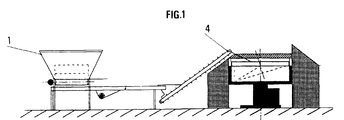
- an object separation device consists of 5 sub-assemblies functional (reference numbers refer to figure 1 non-limiting of the invention.) which is described here for better understanding of the invention, the invention itself being only the means (centrifugal bowl) which allows the discharge of objects and send them one by one to the sensor.
- This device includes:
- the hopper is filled by means of handling (example a bucket loader).
- an extraction conveyor regulates the flow of material sorting.
- the screen is intended to evacuate the fragments as well as reduced-size objects not acceptable to the sorter.
- At least one elevator (for example belt) (4)
- At least one centrifugal bowl aligner separator (see Figure 2)
- the cone is inscribed in the tank; his diameter is substantially equal to that of the tank at the operating clearance near.
- the cone In its rotational movement the cone drives objects around it. Arrived at the "high" point of cone, the generator of it is at the level of the horizontal peripheral track. Objects are plated against the shore by the action of centrifugal force and reach a first track (3). The width of the track is such that only one object can be there. Each object is thus isolated on its track.
- track sorting or firing track
- At least one sorting track (8) substantially horizontal and tangent to said first track, therefore concentric with the tank (2) from which it is separated by said crown. (figure 2).
- the sorting track is independently driven. Its rotation speed, greater than or equal to that of the tank increases the interval between Items.
- the device according to the invention can be supplemented, for example, as follows:
- the trajectory described by the sorting track is preferably divided into angular sectors.
- a sector generally, the first sector, located immediately after the break in the shore, is reserved for the identification of the object.
- the mesh structure of the mat allows positioning of the sensor (7) on either side of the object to be identified. Most of the other sectors are used to collect identified and separate objects. The number of the following sectors depends on the selectivity that one wishes to bring to the objects.
- Each sector corresponds to a type of object to be sorted.
- a sector for example the last, is a scrap zone for badly identified or unidentified objects or can be used for any other particular recovery of objects not selected in the other sectors.
- the position of the sensor (7) on Figure 2 is not limiting.
- An ejection system (10) (for example by forced air) is located under the carpet sorting at the level of each sector. Objects once ejected are guided to a specific silo.
- the purity level of the batches constituted is generally greater than 98%.
- the rates of sorted bottles can reach 18,000 bottles per hour.
- the lots sorted by material are sent to different centers specialized recycling.
- the sorting machine incorporates the sensor which allows to recognize the different materials.
- the sensor used is for example, a near spectrometer infrared (NIR) with factorial filters from BUHLER.
- NIR near spectrometer infrared
- Bottles or other objects to be identified are illuminated with a source of light (for example with halogen lamps) and measured without contact physical with the sensor.
- a source of light for example with halogen lamps
- the ejection of bottles or other objects is done by air push compressed.
- the blow guns used deliver a precise directional jet and measurable.
- the entire installation is generally controlled by a PLC which mainly ensures the regulation of the bottle flow, the dialogue with the sensor as well as the control of the ejectors.
- the sorter assigns the identified object to the specific silo.
- the sorting track is equipped an angular position sensor.
- the relative angular position of each receiving silo in relation to the reference position of the sensor identification is measured beforehand and then configured at the automaton.
- the sensor delivers the signals to the PLC. start and end of object. These signals are synchronized by the PLC to information delivered by the angular position sensor in order to measure the length of the object. The precision of this synchronization allows also to delimit areas of the object to be ignored or treated particularly (bottle cap, label, ink, barcode, painting etc ). Knowing this length makes it possible to determine the optimum point of impact of the shot.
- This device also comprises at least a second track called sorting track (8) concentric with the tank (2) and located at the periphery of said first previous track, substantially horizontal and tangent to said first track, of which it is separated by said crown, this sorting track being driven independently.
- the device according to the invention applies to the separation of objects of size, shapes, colors, and variable masses.
- the objects to be sorted are by example of glass or plastic bottles.
- the device is particularly suitable for sorting bottles broken, shredded or crushed plastics (provided they are not not welded or glued, entangled together by procedures overwriting).
- the device is also suitable for sorting packaging plastics of all kinds, e.g. laundry packaging, products cleaning products, food products (oil containers), products for cars, gardening products, fertilizers or all types of packaging similar. We can sort mixtures of all the objects mentioned above.
Landscapes
- Centrifugal Separators (AREA)
- Sorting Of Articles (AREA)
- Combined Means For Separation Of Solids (AREA)
- Sampling And Sample Adjustment (AREA)
- Separation, Recovery Or Treatment Of Waste Materials Containing Plastics (AREA)
Description
- Une cuve (2) qui contrairement à la cuve décrite dans WO 92/03.551 n'est pas un disque mais est sensiblement troncosphérique ou sphérique ou en forme de tronc de cône, (cette cuve n'a donc pas la forme cylindrique habituelle) possédant dans sa partie supérieure une première piste (3) périphérique horizontale limitée par une couronne (5) extérieure fixe (ou rive), interrompue partiellement sur sa longueur. La couronne a l'aspect d'une paroi circulaire en forme de bande verticale cette bande agit comme un petit muret dont la hauteur est de 1 à 4 fois environ (par exemple) la hauteur des objets à séparer et elle sépare la première piste de la deuxième piste définie ci-dessous (8).
- Un élément (9) constitué par un cône dont le sommet est orienté vers le haut, et qui est entraíné en rotation selon un axe incliné généralement de 5 à 30°, de préférence 10 à 25° (de 15° par exemple) par rapport à la verticale et tournant à l'intérieur de la cuve.
La trajectoire décrite par la piste de tri est de préférence divisée en secteurs angulaires. Un secteur, généralement, le premier secteur, situé immédiatement après l'interruption pratiquée dans la rive, est réservé à l'identification de l'objet. La structure maillée du tapis autorise un positionnement du capteur (7) de part et d'autre de l'objet à identifier. La majeure partie des autres secteurs sert à la collecte des objets identifiés et séparés. Le nombre des secteurs suivants est fonction de la sélectivité que l'on souhaite apporter aux objets. Chaque secteur correspond à un type d'objets à trier. Éventuellement, un secteur, par exemple le dernier, est une zone de rebut pour les objets mal ou non identifiés ou peut être utilisé pour toute autre récupération particulière d'objets non sélectionnés dans les autres secteurs.. La position du capteur (7) sur la figure 2 n'est pas limitative.
- Une cuve sensiblement troncosphérique ou en forme de tronc de cône sphérique possédant dans sa partie supérieure une première piste périphérique horizontale limitée par une couronne extérieure fixe ou rive, interrompue partiellement sur sa longueur, la cuve étant entraínée en rotation selon un axe vertical et recevant les objets à trier.
- Un cône dont le sommet orienté vers le haut, est entraíné en rotation selon un axe incliné par rapport à la verticale et tournant à l'intérieur de la cuve, le cône s'inscrivant dans la cuve; son diamètre étant égal environ à celui de la cuve au jeu de fonctionnement près.
Claims (10)
- Dispositif pour le tri de bouteilles plastiques ou d'emballages plastiques comportant :Au moins un séparateur aligneur à bol centrifuge, ce séparateur se décomposant en deux parties :Une cuve (2) sensiblement troncosphérique ou sphérique ou en forme de tronc de cône possédant dans sa partie supérieure une première piste (3) périphérique horizontale limitée par une couronne extérieure fixe (5) ou rive, interrompue partiellement sur sa longueur, la cuve étant entraínée en rotation selon un axe sensiblement vertical et recevant les objets à trier.Un élément (9) constitué par un cône, dont le sommet est orienté vers le haut et est entraíné en rotation selon un axe incliné par rapport à la verticale et tournant à l'intérieur de la cuve, le cône s'inscrivant dans la cuve, son diamètre étant égal environ à celui de la cuve au jeu de fonctionnement près.- Au moins une deuxième piste appelée piste de tri (8) concentrique à la cuve (2) et située à la périphérie de ladite première piste précédente, sensiblement horizontale et tangente à ladite première piste dont elle est séparée par ladite couronne, cette piste de tri étant entraíné indépendamment.
- Dispositif selon la revendication 1 dans lequel en outre la trajectoire décrite par le tapis de tri est divisée en secteurs angulaires, un secteur généralement situé immédiatement après l'interruption pratiquée dans la rive, étant réservé à l'identification de l'objet, la piste de tri ayant une structure maillée, la structure maillée du tapis autorisant un positionnement d'un capteur (7) de part et d'autre de l'objet à identifier, la majeure partie des autres secteurs servant à la collecte des objets identifiés et séparés.
- Dispositif selon l'une des revendications 1 et 2 appliqué à la séparation d'objets de tailles, de formes, de couleurs et de masses variables.
- Dispositif selon l'une des revendications 1 à 3, comportant, en outre en amont du séparateur aligneur :Au moins une trémie de réception,Au moins un crible destiné à évacuer les fragments ainsi que les objets de dimension réduite non acceptables par le trieur.
- Dispositif selon l'une des revendications 2 à 4 dans lequel, lors de la phase d'identification desdits objets, le capteur délivre à un automate des signaux de début et de fin d'objet, ces signaux étant synchronisés par l'automate aux informations délivrées par le capteur angulaire de position afin de mesurer la longueur de l'objet.
- Dispositif selon l'une des revendications 1 à 5 appliqué au tri des bouteilles.
- Dispositif selon l'une des revendications 1 à 6 appliqué au tri des bouteilles en plastique.
- Dispositif selon l'une des revendications 1 à 6 appliqué au tri des bouteilles en plastique, cassées, déchiquetée ou écrasées.
- Dispositif selon l'une des revendications 1 à 6 appliqué au tri des emballages plastiques pour lessives, produits alimentaires, produits d'entretien ou similaire.
- Dispositif selon l'une des revendications 7 à 9 appliqué au tri de mélange d'objets.
Applications Claiming Priority (2)
| Application Number | Priority Date | Filing Date | Title |
|---|---|---|---|
| FR9503924A FR2732247B1 (fr) | 1995-03-30 | 1995-03-30 | Machine de tri d'objets en plastique |
| FR9503924 | 1995-03-30 |
Publications (2)
| Publication Number | Publication Date |
|---|---|
| EP0734790A1 EP0734790A1 (fr) | 1996-10-02 |
| EP0734790B1 true EP0734790B1 (fr) | 2000-12-20 |
Family
ID=9477702
Family Applications (1)
| Application Number | Title | Priority Date | Filing Date |
|---|---|---|---|
| EP19960400652 Expired - Lifetime EP0734790B1 (fr) | 1995-03-30 | 1996-03-27 | Machine de tri d'objets en plastique |
Country Status (5)
| Country | Link |
|---|---|
| EP (1) | EP0734790B1 (fr) |
| JP (1) | JPH0994535A (fr) |
| DE (1) | DE69611259T2 (fr) |
| ES (1) | ES2154390T3 (fr) |
| FR (1) | FR2732247B1 (fr) |
Families Citing this family (2)
| Publication number | Priority date | Publication date | Assignee | Title |
|---|---|---|---|---|
| DE10245167B4 (de) * | 2002-09-26 | 2004-10-21 | Wincor Nixdorf International Gmbh | Vorrichtung zum Sortieren von Abfall |
| CN119926821B (zh) * | 2025-03-27 | 2026-03-10 | 霍里思特科技(浙江)有限公司 | 双层识别机构、分选设备及物料识别分选方法 |
Family Cites Families (2)
| Publication number | Priority date | Publication date | Assignee | Title |
|---|---|---|---|---|
| US4938082A (en) * | 1988-09-22 | 1990-07-03 | Buckley B Shawn | Inspection system and method |
| US5150307A (en) * | 1990-10-15 | 1992-09-22 | Automation Industrial Control, Inc. | Computer-controlled system and method for sorting plastic items |
-
1995
- 1995-03-30 FR FR9503924A patent/FR2732247B1/fr not_active Expired - Fee Related
-
1996
- 1996-03-27 DE DE1996611259 patent/DE69611259T2/de not_active Expired - Fee Related
- 1996-03-27 ES ES96400652T patent/ES2154390T3/es not_active Expired - Lifetime
- 1996-03-27 EP EP19960400652 patent/EP0734790B1/fr not_active Expired - Lifetime
- 1996-03-28 JP JP7378996A patent/JPH0994535A/ja not_active Withdrawn
Also Published As
| Publication number | Publication date |
|---|---|
| DE69611259T2 (de) | 2001-04-26 |
| FR2732247A1 (fr) | 1996-10-04 |
| FR2732247B1 (fr) | 1997-05-23 |
| JPH0994535A (ja) | 1997-04-08 |
| ES2154390T3 (es) | 2001-04-01 |
| EP0734790A1 (fr) | 1996-10-02 |
| DE69611259D1 (de) | 2001-01-25 |
Similar Documents
| Publication | Publication Date | Title |
|---|---|---|
| EP2004525B1 (fr) | Dispositif d'alimentation de preformes a grande cadence | |
| US5590791A (en) | Method and apparatus for sorting waste | |
| US8618432B2 (en) | Separation system for recyclable material | |
| US5484247A (en) | Bag breaker | |
| EP0578727B1 (fr) | Methode et appareil pour trier les articles en matiere plastique | |
| EP2331044B1 (fr) | Machine de tri automatique de gelules | |
| US5485964A (en) | Method and apparatus for sorting plastic items | |
| EP2064004B1 (fr) | Procede de tri selectif sequentiel de flux de dechets et installation pour sa mise en oeuvre | |
| CN114407235B (zh) | 一种塑料瓶高效分解回收机器人及其回收方法 | |
| JP2009279553A (ja) | プラスチック選別装置 | |
| EP3541539B1 (fr) | Prétraitement de capsules pour boissons chaudes et emballages de produits cosmétiques avant recyclage et valorisation | |
| EP3372539B1 (fr) | Dispositif et methode de fourniture fiable d'elements de bouchage conformes | |
| EP0734790A1 (fr) | Machine de tri d'objets en plastique | |
| JP4020215B2 (ja) | 分類装置 | |
| FR2593478A1 (fr) | Dispositif de distribution pour la delivrance un a un, et dresses verticalement, de quelconques objets a un quelconque convoyeur | |
| JP2002514560A (ja) | 部品の自動分配及び配向機構 | |
| JP2009279551A (ja) | プラスチック選別装置 | |
| KR100271434B1 (ko) | 페트병 재생칩 생산 자동화 기계 | |
| JP2002159920A (ja) | 廃棄物選別装置において混合廃棄物からプラスチック混合体を選別する方法および廃棄物選別装置 | |
| JP2018517635A (ja) | 発光装置のビニング用のビンインサート、発光装置のビニング用のビニング装置、および発光装置のビニング用のビニング装置の使用 | |
| NL2024148B1 (nl) | Werkwijze voor het verwerken van afvalobjecten, alsmede een inrichting daarvoor | |
| FR2738759A1 (fr) | Dispositif de tri selectif de dechets et ligne de tri mettant en oeuvre ce dispositif | |
| JP2005161429A (ja) | ペットボトル切断装置 | |
| CA2209641A1 (fr) | Dispositif de traitement de melanges de matieres recyclables | |
| CA2707999C (fr) | Separateur de matieres electrostatique |
Legal Events
| Date | Code | Title | Description |
|---|---|---|---|
| PUAI | Public reference made under article 153(3) epc to a published international application that has entered the european phase |
Free format text: ORIGINAL CODE: 0009012 |
|
| AK | Designated contracting states |
Kind code of ref document: A1 Designated state(s): BE CH DE ES FR GB IT LI |
|
| 17P | Request for examination filed |
Effective date: 19970402 |
|
| 17Q | First examination report despatched |
Effective date: 19990816 |
|
| GRAG | Despatch of communication of intention to grant |
Free format text: ORIGINAL CODE: EPIDOS AGRA |
|
| GRAG | Despatch of communication of intention to grant |
Free format text: ORIGINAL CODE: EPIDOS AGRA |
|
| GRAH | Despatch of communication of intention to grant a patent |
Free format text: ORIGINAL CODE: EPIDOS IGRA |
|
| ITF | It: translation for a ep patent filed | ||
| GRAH | Despatch of communication of intention to grant a patent |
Free format text: ORIGINAL CODE: EPIDOS IGRA |
|
| GRAA | (expected) grant |
Free format text: ORIGINAL CODE: 0009210 |
|
| AK | Designated contracting states |
Kind code of ref document: B1 Designated state(s): BE CH DE ES FR GB IT LI |
|
| REG | Reference to a national code |
Ref country code: CH Ref legal event code: EP |
|
| REF | Corresponds to: |
Ref document number: 69611259 Country of ref document: DE Date of ref document: 20010125 |
|
| GBT | Gb: translation of ep patent filed (gb section 77(6)(a)/1977) |
Effective date: 20010112 |
|
| REG | Reference to a national code |
Ref country code: ES Ref legal event code: FG2A Ref document number: 2154390 Country of ref document: ES Kind code of ref document: T3 |
|
| PLBE | No opposition filed within time limit |
Free format text: ORIGINAL CODE: 0009261 |
|
| STAA | Information on the status of an ep patent application or granted ep patent |
Free format text: STATUS: NO OPPOSITION FILED WITHIN TIME LIMIT |
|
| 26N | No opposition filed | ||
| REG | Reference to a national code |
Ref country code: GB Ref legal event code: IF02 |
|
| PGFP | Annual fee paid to national office [announced via postgrant information from national office to epo] |
Ref country code: GB Payment date: 20020227 Year of fee payment: 7 Ref country code: CH Payment date: 20020227 Year of fee payment: 7 |
|
| PGFP | Annual fee paid to national office [announced via postgrant information from national office to epo] |
Ref country code: ES Payment date: 20020327 Year of fee payment: 7 |
|
| PGFP | Annual fee paid to national office [announced via postgrant information from national office to epo] |
Ref country code: DE Payment date: 20020402 Year of fee payment: 7 |
|
| PGFP | Annual fee paid to national office [announced via postgrant information from national office to epo] |
Ref country code: BE Payment date: 20020404 Year of fee payment: 7 |
|
| PG25 | Lapsed in a contracting state [announced via postgrant information from national office to epo] |
Ref country code: FR Free format text: LAPSE BECAUSE OF NON-PAYMENT OF DUE FEES Effective date: 20021129 |
|
| REG | Reference to a national code |
Ref country code: FR Ref legal event code: ST |
|
| PG25 | Lapsed in a contracting state [announced via postgrant information from national office to epo] |
Ref country code: GB Free format text: LAPSE BECAUSE OF NON-PAYMENT OF DUE FEES Effective date: 20030327 |
|
| PG25 | Lapsed in a contracting state [announced via postgrant information from national office to epo] |
Ref country code: ES Free format text: LAPSE BECAUSE OF NON-PAYMENT OF DUE FEES Effective date: 20030328 |
|
| PG25 | Lapsed in a contracting state [announced via postgrant information from national office to epo] |
Ref country code: LI Free format text: LAPSE BECAUSE OF NON-PAYMENT OF DUE FEES Effective date: 20030331 Ref country code: CH Free format text: LAPSE BECAUSE OF NON-PAYMENT OF DUE FEES Effective date: 20030331 Ref country code: BE Free format text: LAPSE BECAUSE OF NON-PAYMENT OF DUE FEES Effective date: 20030331 |
|
| REG | Reference to a national code |
Ref country code: FR Ref legal event code: FC |
|
| BERE | Be: lapsed |
Owner name: SOC. *SYDEL Effective date: 20030331 Owner name: INSTITUT REGIONAL DES MATERAUX AVANCES *IRMA Effective date: 20030331 Owner name: *INSTITUT FRANCAIS DU PETROLE Effective date: 20030331 |
|
| PG25 | Lapsed in a contracting state [announced via postgrant information from national office to epo] |
Ref country code: DE Free format text: LAPSE BECAUSE OF NON-PAYMENT OF DUE FEES Effective date: 20031001 |
|
| REG | Reference to a national code |
Ref country code: CH Ref legal event code: PL |
|
| GBPC | Gb: european patent ceased through non-payment of renewal fee |
Effective date: 20030327 |
|
| REG | Reference to a national code |
Ref country code: ES Ref legal event code: FD2A Effective date: 20030328 |
|
| PG25 | Lapsed in a contracting state [announced via postgrant information from national office to epo] |
Ref country code: IT Free format text: LAPSE BECAUSE OF NON-PAYMENT OF DUE FEES;WARNING: LAPSES OF ITALIAN PATENTS WITH EFFECTIVE DATE BEFORE 2007 MAY HAVE OCCURRED AT ANY TIME BEFORE 2007. THE CORRECT EFFECTIVE DATE MAY BE DIFFERENT FROM THE ONE RECORDED. Effective date: 20050327 |
|
| REG | Reference to a national code |
Ref country code: FR Ref legal event code: CD |
|
| PGFP | Annual fee paid to national office [announced via postgrant information from national office to epo] |
Ref country code: FR Payment date: 20130222 Year of fee payment: 18 |
|
| REG | Reference to a national code |
Ref country code: FR Ref legal event code: ST Effective date: 20141128 |
|
| PG25 | Lapsed in a contracting state [announced via postgrant information from national office to epo] |
Ref country code: FR Free format text: LAPSE BECAUSE OF NON-PAYMENT OF DUE FEES Effective date: 20140331 |