EP0732891B1 - Astigmatic correcting intrastromal corneal ring - Google Patents
Astigmatic correcting intrastromal corneal ring Download PDFInfo
- Publication number
- EP0732891B1 EP0732891B1 EP95905866A EP95905866A EP0732891B1 EP 0732891 B1 EP0732891 B1 EP 0732891B1 EP 95905866 A EP95905866 A EP 95905866A EP 95905866 A EP95905866 A EP 95905866A EP 0732891 B1 EP0732891 B1 EP 0732891B1
- Authority
- EP
- European Patent Office
- Prior art keywords
- implant
- ring
- areas
- sector
- cornea
- Prior art date
- Legal status (The legal status is an assumption and is not a legal conclusion. Google has not performed a legal analysis and makes no representation as to the accuracy of the status listed.)
- Expired - Lifetime
Links
- 201000009310 astigmatism Diseases 0.000 claims abstract description 17
- 210000004087 cornea Anatomy 0.000 claims description 41
- 239000007943 implant Substances 0.000 claims description 26
- 229920000642 polymer Polymers 0.000 claims description 15
- 229920003229 poly(methyl methacrylate) Polymers 0.000 claims description 7
- 239000004926 polymethyl methacrylate Substances 0.000 claims description 7
- 230000007704 transition Effects 0.000 claims description 4
- 229920000036 polyvinylpyrrolidone Polymers 0.000 claims description 3
- 235000013855 polyvinylpyrrolidone Nutrition 0.000 claims description 3
- 239000001267 polyvinylpyrrolidone Substances 0.000 claims description 3
- 238000012937 correction Methods 0.000 abstract description 9
- 210000001508 eye Anatomy 0.000 description 30
- 210000001525 retina Anatomy 0.000 description 10
- 239000010410 layer Substances 0.000 description 7
- 238000000034 method Methods 0.000 description 7
- 230000004075 alteration Effects 0.000 description 5
- XLYOFNOQVPJJNP-UHFFFAOYSA-N water Substances O XLYOFNOQVPJJNP-UHFFFAOYSA-N 0.000 description 5
- 210000004240 ciliary body Anatomy 0.000 description 4
- 239000002131 composite material Substances 0.000 description 4
- 210000000981 epithelium Anatomy 0.000 description 3
- 230000004305 hyperopia Effects 0.000 description 3
- 201000006318 hyperopia Diseases 0.000 description 3
- 208000001491 myopia Diseases 0.000 description 3
- 230000004379 myopia Effects 0.000 description 3
- -1 polyethylene Polymers 0.000 description 3
- 206010020675 Hypermetropia Diseases 0.000 description 2
- 230000004308 accommodation Effects 0.000 description 2
- 210000004556 brain Anatomy 0.000 description 2
- 210000005252 bulbus oculi Anatomy 0.000 description 2
- 210000004027 cell Anatomy 0.000 description 2
- 210000003161 choroid Anatomy 0.000 description 2
- 230000001886 ciliary effect Effects 0.000 description 2
- 210000003683 corneal stroma Anatomy 0.000 description 2
- 238000004132 cross linking Methods 0.000 description 2
- 208000037265 diseases, disorders, signs and symptoms Diseases 0.000 description 2
- 210000002919 epithelial cell Anatomy 0.000 description 2
- 239000011521 glass Substances 0.000 description 2
- 238000002513 implantation Methods 0.000 description 2
- 238000009434 installation Methods 0.000 description 2
- 239000000463 material Substances 0.000 description 2
- 210000005036 nerve Anatomy 0.000 description 2
- 210000004129 prosencephalon Anatomy 0.000 description 2
- 210000001747 pupil Anatomy 0.000 description 2
- 210000003786 sclera Anatomy 0.000 description 2
- 230000000007 visual effect Effects 0.000 description 2
- 210000004127 vitreous body Anatomy 0.000 description 2
- 102000004190 Enzymes Human genes 0.000 description 1
- 108090000790 Enzymes Proteins 0.000 description 1
- 229920002527 Glycogen Polymers 0.000 description 1
- 201000002287 Keratoconus Diseases 0.000 description 1
- 241000446313 Lamella Species 0.000 description 1
- 208000037273 Pathologic Processes Diseases 0.000 description 1
- 239000004698 Polyethylene Substances 0.000 description 1
- 239000004743 Polypropylene Substances 0.000 description 1
- 239000004809 Teflon Substances 0.000 description 1
- 229920006362 Teflon® Polymers 0.000 description 1
- 208000013521 Visual disease Diseases 0.000 description 1
- 238000002679 ablation Methods 0.000 description 1
- 230000004480 accommodation of the lens Effects 0.000 description 1
- OIPILFWXSMYKGL-UHFFFAOYSA-N acetylcholine Chemical compound CC(=O)OCC[N+](C)(C)C OIPILFWXSMYKGL-UHFFFAOYSA-N 0.000 description 1
- 229960004373 acetylcholine Drugs 0.000 description 1
- 210000002159 anterior chamber Anatomy 0.000 description 1
- 210000004045 bowman membrane Anatomy 0.000 description 1
- 230000008859 change Effects 0.000 description 1
- 239000011248 coating agent Substances 0.000 description 1
- 238000000576 coating method Methods 0.000 description 1
- 230000000052 comparative effect Effects 0.000 description 1
- 210000000795 conjunctiva Anatomy 0.000 description 1
- 210000002555 descemet membrane Anatomy 0.000 description 1
- 230000003467 diminishing effect Effects 0.000 description 1
- 230000000694 effects Effects 0.000 description 1
- 239000003792 electrolyte Substances 0.000 description 1
- 210000003038 endothelium Anatomy 0.000 description 1
- 229940088598 enzyme Drugs 0.000 description 1
- 239000000835 fiber Substances 0.000 description 1
- 239000000499 gel Substances 0.000 description 1
- 230000014509 gene expression Effects 0.000 description 1
- 229940096919 glycogen Drugs 0.000 description 1
- 230000036571 hydration Effects 0.000 description 1
- 238000006703 hydration reaction Methods 0.000 description 1
- 239000000017 hydrogel Substances 0.000 description 1
- 208000014674 injury Diseases 0.000 description 1
- 238000003780 insertion Methods 0.000 description 1
- 230000037431 insertion Effects 0.000 description 1
- 210000004379 membrane Anatomy 0.000 description 1
- 239000012528 membrane Substances 0.000 description 1
- 239000000203 mixture Substances 0.000 description 1
- 210000003205 muscle Anatomy 0.000 description 1
- 230000000050 nutritive effect Effects 0.000 description 1
- 210000001328 optic nerve Anatomy 0.000 description 1
- 230000003287 optical effect Effects 0.000 description 1
- 230000009054 pathological process Effects 0.000 description 1
- 230000002093 peripheral effect Effects 0.000 description 1
- 108091008695 photoreceptors Proteins 0.000 description 1
- 230000035479 physiological effects, processes and functions Effects 0.000 description 1
- 229920001748 polybutylene Polymers 0.000 description 1
- 229920000515 polycarbonate Polymers 0.000 description 1
- 239000004417 polycarbonate Substances 0.000 description 1
- 229920000573 polyethylene Polymers 0.000 description 1
- 229920000098 polyolefin Polymers 0.000 description 1
- 229920001155 polypropylene Polymers 0.000 description 1
- 230000001681 protective effect Effects 0.000 description 1
- 229920005573 silicon-containing polymer Polymers 0.000 description 1
- 239000002356 single layer Substances 0.000 description 1
- BFKJFAAPBSQJPD-UHFFFAOYSA-N tetrafluoroethene Chemical compound FC(F)=C(F)F BFKJFAAPBSQJPD-UHFFFAOYSA-N 0.000 description 1
- 210000001519 tissue Anatomy 0.000 description 1
- 239000013306 transparent fiber Substances 0.000 description 1
- 230000008733 trauma Effects 0.000 description 1
- 230000002792 vascular Effects 0.000 description 1
- 208000029257 vision disease Diseases 0.000 description 1
Images


Classifications
-
- A—HUMAN NECESSITIES
- A61—MEDICAL OR VETERINARY SCIENCE; HYGIENE
- A61F—FILTERS IMPLANTABLE INTO BLOOD VESSELS; PROSTHESES; DEVICES PROVIDING PATENCY TO, OR PREVENTING COLLAPSING OF, TUBULAR STRUCTURES OF THE BODY, e.g. STENTS; ORTHOPAEDIC, NURSING OR CONTRACEPTIVE DEVICES; FOMENTATION; TREATMENT OR PROTECTION OF EYES OR EARS; BANDAGES, DRESSINGS OR ABSORBENT PADS; FIRST-AID KITS
- A61F2/00—Filters implantable into blood vessels; Prostheses, i.e. artificial substitutes or replacements for parts of the body; Appliances for connecting them with the body; Devices providing patency to, or preventing collapsing of, tubular structures of the body, e.g. stents
- A61F2/02—Prostheses implantable into the body
- A61F2/14—Eye parts, e.g. lenses or corneal implants; Artificial eyes
- A61F2/147—Implants to be inserted in the stroma for refractive correction, e.g. ring-like implants
Definitions
- This invention is a sector of an intrastromal corneal ring ("ICR") which is not dimensionally uniform about the ring. It has two or more raised areas (or areas of additional bulk) spaced apart from each other on the ring.
- This ring design when introduced into the stroma and properly adjusted for position there, permits at least partial correction of astigmatism in the eye.
- Anomalies in the overall shape of the eye can cause visual disorders.
- Hyperopia occurs when the front-to-back distance in the eyeball is too small. In such a case, parallel rays originating greater than 20 feet from the eye focus behind the retina.
- myopia occurs and the focus of parallel rays entering the eye occurs in front of the retina.
- Astigmatism is a condition which occurs when the parallel rays of light do not focus to a single point within the eye, but rather focus to a region due to the fact that the cornea is aspherical and refracts light in a different meridian at different distances. Some degree of astigmatism in an eye is normal, but where the astigmatism is too pronounced, it must often be corrected.
- Hyperopia, myopia, and astigmatism are usually corrected by glasses or contact lenses.
- Surgical methods for the correction of such disorders are known. These methods include radial keratotomy (see, e.g., U.S. Patents Nos. 4,815,463 and 4,688,570) and laser corneal ablation (see, e.g., U.S. Patent No. 4,941,093).
- Another method for correcting those disorders is through the implantation of polymeric rings in the eye's corneal.stroma to change the curvature of the cornea.
- Previous work involving the implantation of polymethylmethacrylate (PMMA) rings, allograft corneal tissue and hydrogels is well documented.
- One of the ring devices involves a split ring design which is inserted into a channel previously dissected in the stromal layer of the cornea. The device uses a minimally invasive incision through which the channel for the implant is created and, finally, through which the implant is inserted.
- U.S. Patent No. 4,452,235, to Reynolds describes a method and apparatus for corneal curvature adjustment.
- the method involves inserting one end of a split end adjusting ring into the cornea of the eye and moving the ring in a circular path until its ends meet.
- the ends are thereafter adjusted relative to each other until the shape of the eye has assumed a desired curvature whereupon the ends are fixedly attached to maintain the desired curvature of the cornea.
- U.S. Patent No. 5,188,125, to Reynolds discloses a combination dissecting/adjustment ring in the shape of a generally circular member having split end portions.
- the end portions are adjustable relative to one another to enlarge or decrease the normal diameter of the ring at rest.
- the forward end portion of the ring is enlarged to form a leading dissecting sharpened edge which, as it is driven through the stroma of the cornea, forms a tunnel for the trailing ring.
- a polymeric implant for treating astigmatism said implant being in the form of a sector of a ring having a cross-section which is suitable for introduction into the stroma, said sector being adapted to partially encircle the cornea, said cross-section having two areas of comparatively larger dimension.
- Figure 1 is a schematic representation of a horizontal section of the eye.
- Figure 2 is a schematic representation of the anterior portion of the eye showing the various layers of the cornea.
- Figure 3 depicts an ACICR, resident within a cornea, the depicted ACICR not being in accordance with the present invention.
- Figure 4 is a side cross-section of the ACICR of Fig. 3, depicted within the cornea.
- Figure 5 is a frontal view showing the placement of the ACICR of Figure 3 within the eye.
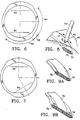
- Figure 6 is a frontal view of the ACICR of Fig. 3, showing symmetrical areas of added bulk or cross-section.
- Figure 7 is a frontal view of an alternative ACICR, also not in accordance with the present invention, having non-symmetric areas of added bulk or cross-section.
- Figure 8 depicts a feature which allows an ACICR to be manipulated into proper position for astigmatism correction.
- Figures 9A and 9B show variations of ACICR using composite implant in which a portion of the implant uses a swellable polymer.
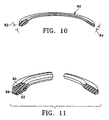
- Figure 10 shows an ACICR in which the thickness of the implant varies.
- Figure 11 shows an ACICR in which the implant is a composite of a stiff polymer and a swellable polymer.
- Figure 1 shows a horizontal section of the eye with the globe (10) of the eye resembling a sphere with an anterior bulged spherical portion representing the cornea (11).
- the globe (10) of the eye consists of three concentric coverings enclosing the various transparent media through which the light must pass before reaching the light-sensitive retina (12).
- the outermost covering is a fibrous protective portion the posterior five-sixths of which is white and opaque and called the sclera (13), and sometimes referred to as the white of the eye where visible to the front.
- the anterior one-sixth of this outer layer is the transparent cornea (11).
- a middle covering is mainly vascular and nutritive in function and is comprised of the choroid, ciliary body (15) and iris (20).
- the choroid (14) generally functions to maintain the retina (12).
- the ciliary body (15) is involved in suspending the lens (17) and accommodation of the lens.
- the iris (16) is the most anterior portion of the middle covering of the eye and is arranged in a frontal plane. It is a thin circular disc similar in function to the diaphragm of a camera, and is perforated near its center by a circular aperture called the pupil (20).
- the size of the pupil varies to regulate the amount of light which reaches the retina (12). It contracts also to accommodation, which serves to sharpen the focus by diminishing spherical aberration.
- the iris divides the space between the cornea (11) and the lens (17) into an anterior chamber (21) and posterior chamber.
- the innermost portion of covering is the retina (12), which is made up of nerve elements which form the true receptive portion for visual impressions.
- the retina (12) is a part of the brain arising as an outgrowth from the fore-brain, with the optic nerve (23) serving as a fiber tract connecting the retina part of the brain with the fore-brain.
- a layer of rods and cones, lying just beneath a pigmented epithelium on the anterior wall of the retina serve as visual cells or photoreceptors which transform physical energy (light) into nerve impulses.
- the vitreous body (24) is a transparent gelatinous mass which fills the posterior four-fifths of the globe (10). At its sides it supports the ciliary body (15) and the retina (12). A frontal saucer-shaped depression houses the lens.
- the lens (17) of the eye is a transparent biconvex body of crystalline appearance placed between the iris (16) and vitreous body (24). Its axial diameter varies markedly with accommodation.
- this outermost fibrous transparent coating resembles a watch glass. Its curvature is somewhat greater than the rest of the globe and is ideally spherical in nature. However, often it is more curved in one meridian than another giving rise to astigmatism. A central third of the cornea is called the optical zone with a slight flattening taking place outwardly thereof as the cornea thickens towards its periphery. Most of the refraction of the eye takes place at the cornea.
- a more detailed drawing of the anterior portion of the globe shows the various layers of the cornea (11) made up of an epithelium (31). Epithelial cells on the surface thereof function to maintain transparency of the cornea (11). These epithelial cells are rich in glycogen, enzymes, and acetylcholine and their activity regulates the corneal corpuscles and controls the transport of water and electrolytes through the lamellae of the stroma (32) of the cornea (11).
- An anterior limiting lamina (33), referred to as Bowman's membrane or layer, is positioned between the epithelium (31) and the stroma (32) of the cornea.
- the stroma (32) is comprised of lamella having bands of fibrils parallel to each other and crossing the whole of the cornea. While most of the fibrous bands are parallel to the surface, some are oblique, especially anteriorly.
- a posterior limiting lamina (34) is referred to as Descemet's membrane. It is a strong membrane sharply defined from the stroma (32) and resistant to pathological processes of the cornea.
- the endothelium (35) is the most posterior layer of the cornea and consists of a single layer of cells.
- the limbus (37) is the transition zone between the conjunctiva and sclera on the one hand and the cornea (11) on the other.
- Figure 3 shows the placement of the non-regular ACICR within the cornea as discussed above.
- the ring (50) has two regions (52) of added bulk or dimension.
- the larger regions in this instance have a larger relational width (54) than the local width of the narrower region (56). See also the side view of the comparative widths in Figure 3.
- the relationship between the local widths (54) and (56), the thickness (58) at various positions of the ACICR, and their respective corrections, are known.
- Figure 5 is a frontal view of the eye having an ACICR installed.
- the ring (50) has two regions of added dimension (52). Those regions of added dimension would be placed in the regions of the cornea having the steepest slope in an effort to correct the cornea to an approximate spherical, or at least regular, shape about its anterior surface.
- the regions of added dimension are critically tailored to correct the astigmatism found in a particular eye.
- the regions (52) subtend an arc of at least about 2° measured from the center of the ring. More typically, the regions of larger dimension will subtend 10° to about 180° of an arc on the ring.
- the larger values are to remedy such conditions as keratoconus in which (typically) a significant angular portion the cornea is thinned or, at least, significantly lower (flatter) in profile than other portions of the cornea.
- Such regions typically subtend 15° to 45° of the ring arc in correction of typical astigmatic conditions.
- the arc should be at least about 2°, preferably about 10° to 90°, more preferably about 20° to 45°, all however tailored to correction of the noted astigmatism in a particular eye. Special corrections up to 340°, although typically of up to 180°, of subtended arc are acceptable when special circumstances of astigmatism are encountered.
- each section may be of the subtended arc sizes listed above for the single arcs.
- the sum of all of the subtended arcs for the must be less than 350° or so.
- Figure 6 shows a frontal view of an ACICR in which the regions of added dimension are generally symmetrical.
- the regions of added dimension (54) are shown each to extend over a region of about 90° of the ACICR.
- Figure 6 also shows a transition zone (62) between the area of added bulk 60 and the comparatively thinner region at (64).
- the transition zone allows the ACICR to be inserted into an intrastromal channel with greater ease. We believe this permits installation of the ACICR with less trauma.
- the arc (64) of lesser dimension is shown in Figure 6.
- the percentage of arcs (60) and (64) and their respective relationship to each other are a function of the level of astigmatism to be corrected.
- the percentage of arcs of the areas of added dimension (60) and (64) are of the same relative sizes as discussed above in relation to Figure 5.
- Figure 7 shows an ACICR with regions of enhanced dimension which are not placed symmetrically about the ring. Again, such a ring would be employed in an eye which did not have symmetrical astigmatism about a single axis. Such an ACICR would be employed with the intent to bring the corneal shape back into general spherical form.
- the implant of the present invention is a sector of a ring and has two areas of comparatively larger dimension, for example varying thickness or varying width.
- each of the variations disclosed herein may be used in a variation covering as small an arc as 10°-15° of the corneal circumference.
- the ring would be installed in the inner lamellar regions of the corneal stroma by any of the methods we have shown in the past to be suitable for such installation.
- the ring is installed in the following manner: a small radial incision is made at the radius in which the ring is ultimately to be installed about the cornea.
- a dissector in the form of a split ring and having a point suitable for producing an interlamellar channel or tunnel in the corneal stroma is introduced through the small incision and rotated in such a fashion that a generally circular channel is often (but not necessarily) formed completely about the cornea.
- the dissector is then rotated in the opposite direction to withdraw it from the tunnel thus formed.
- An ACICR is then introduced into the circular channel and joined at its ends.
- ICRs of constant cross-section typically need no further adjustment other than, perhaps, to move the point of junction away from the region of corneal incision so to help assure that the junction is held together by the interlamellar tension of the cornea.
- the relationship of the ring and the astigmatic aberration must be aligned so to allow the ACICR to perform its desired correction.
- FIG 8 one such method for adjusting the position of the ACICR in the eye is shown.
- the radial incision (66) in cornea (68) which is used to introduce the ICR into the eye is shown.
- the ACICR (70) has a number of depressions (72) spaced about its upper surface.
- the position of the ACICR (70) is changed by engaging a generally pointed tool (74) into the depressions and slipping the ring (70) around in one direction or another until the regions of added dimension are in appropriate position for correcting the astigmatic aberrations of the cornea. Other variations on this will be apparent to those studying the need to adjust the position of these rings.
- the materials used in these rings are typically stiff physiologically acceptable polymers such as polymethylmethacrylate (PMMA), TEFLON, polycarbonate, polyolefins such as polyethylene, polypropylene, polybutylene, and their mixtures and interpolymers, or a silicone polymer or interpolymer such as are known in the art to be appropriately used in hard contact lenses.
- PMMA has a long history in ophthalmological usage and consequently is quite desirable for use in these ACICRs.
- Figures 9A and 9B another desirable variation is shown in Figures 9A and 9B.
- the added dimension comprises a polymer which is swellable or expands upon continued contact with water.
- Figure 9A shows a cross-section of an ACICR having a central portion (76) of a polymer such as PMMA and two regions (78) bonded to the inner and outer periphery of central portion (76).
- Outer portions (78) may be made of a crosslinked polymeric gel such as polyhydroxyethylmethylacrylate (Poly-HEMA) or polyvinylpyrrolidone (PVP).
- Poly-HEMA polyhydroxyethylmethylacrylate
- PVP polyvinylpyrrolidone
- Figure 9A shows the bonded outer portions (78) in their dehydrated condition (if the polymer is not highly crosslinked) and Figure 9B shows those same outlying portions after insertion into the cornea and after they have been allowed to hydrate and swell.
- This variation of the inventive ACICRs allows the device to be inserted at a much smaller size but allows the ring to swell to correct much larger aberrations.
- the ACICR (80) shown in Figure 10 is one in which the thickness of at least one portion of the regions is thicker (82) than another thinner portion (84) of the ring.
- the number of thicker portions of the ring may be one or more depending upon the spherical aberration to be corrected.
- the typical ACICR likely will have two thicker regions about 180° apart on the ring.
- the ring may be between about 45° and more than about 140°.
- the portions of the arc which are thicker are also to be determined depending upon the astigmatism of the eye to be repaired.
- Figure 11 shows another variation of the ACICRs in which the ring is a composite assembly.
- the central portion (88) is of the one or more of the stiff polymers discussed above.
- the peripheral portions (90) comprise a swellable polymer which swells upon contact with moisture. As with the composite ACICRs above, they may be introduced into the eye prior to hydration, adjusted into proper position, and allowed to hydrate and swell into final shape.
Landscapes
- Health & Medical Sciences (AREA)
- Public Health (AREA)
- Vascular Medicine (AREA)
- Oral & Maxillofacial Surgery (AREA)
- Transplantation (AREA)
- Engineering & Computer Science (AREA)
- Biomedical Technology (AREA)
- Heart & Thoracic Surgery (AREA)
- Veterinary Medicine (AREA)
- Life Sciences & Earth Sciences (AREA)
- Animal Behavior & Ethology (AREA)
- General Health & Medical Sciences (AREA)
- Ophthalmology & Optometry (AREA)
- Cardiology (AREA)
- Prostheses (AREA)
- Agricultural Chemicals And Associated Chemicals (AREA)
- Treatments For Attaching Organic Compounds To Fibrous Goods (AREA)
- Saccharide Compounds (AREA)
- Pharmaceuticals Containing Other Organic And Inorganic Compounds (AREA)
- Acyclic And Carbocyclic Compounds In Medicinal Compositions (AREA)
- Polyesters Or Polycarbonates (AREA)
- Materials For Medical Uses (AREA)
- Medicines That Contain Protein Lipid Enzymes And Other Medicines (AREA)
- Display Devices Of Pinball Game Machines (AREA)
- Molds, Cores, And Manufacturing Methods Thereof (AREA)
- Curing Cements, Concrete, And Artificial Stone (AREA)
Applications Claiming Priority (3)
| Application Number | Priority Date | Filing Date | Title |
|---|---|---|---|
| US08/163,650 US5405384A (en) | 1992-09-03 | 1993-12-06 | Astigmatic correcting intrastromal corneal ring |
| US163650 | 1993-12-06 | ||
| PCT/US1994/014077 WO1995015719A1 (en) | 1993-12-06 | 1994-12-06 | Astigmatic correcting intrastromal corneal ring |
Publications (3)
| Publication Number | Publication Date |
|---|---|
| EP0732891A1 EP0732891A1 (en) | 1996-09-25 |
| EP0732891A4 EP0732891A4 (en) | 1997-06-11 |
| EP0732891B1 true EP0732891B1 (en) | 2002-03-27 |
Family
ID=22590960
Family Applications (1)
| Application Number | Title | Priority Date | Filing Date |
|---|---|---|---|
| EP95905866A Expired - Lifetime EP0732891B1 (en) | 1993-12-06 | 1994-12-06 | Astigmatic correcting intrastromal corneal ring |
Country Status (12)
| Country | Link |
|---|---|
| US (1) | US5405384A (cg-RX-API-DMAC7.html) |
| EP (1) | EP0732891B1 (cg-RX-API-DMAC7.html) |
| JP (1) | JPH09508818A (cg-RX-API-DMAC7.html) |
| AT (1) | ATE214900T1 (cg-RX-API-DMAC7.html) |
| AU (1) | AU700806B2 (cg-RX-API-DMAC7.html) |
| BR (1) | BR9408262A (cg-RX-API-DMAC7.html) |
| CA (1) | CA2178478A1 (cg-RX-API-DMAC7.html) |
| DE (1) | DE69430257T2 (cg-RX-API-DMAC7.html) |
| IL (1) | IL111891A (cg-RX-API-DMAC7.html) |
| SG (1) | SG52642A1 (cg-RX-API-DMAC7.html) |
| TW (1) | TW288974B (cg-RX-API-DMAC7.html) |
| WO (1) | WO1995015719A1 (cg-RX-API-DMAC7.html) |
Families Citing this family (90)
| Publication number | Priority date | Publication date | Assignee | Title |
|---|---|---|---|---|
| US6565584B1 (en) * | 1992-04-10 | 2003-05-20 | Addition Technology, Inc. | Device and method for inserting a biocompatible material into the corneal stroma |
| US6966927B1 (en) | 1992-08-07 | 2005-11-22 | Addition Technology, Inc. | Hybrid intrastromal corneal ring |
| DE69324811T2 (de) * | 1992-08-07 | 1999-09-16 | Keravision, Inc. | Intrastromaler kornealring |
| US5944752A (en) * | 1992-09-03 | 1999-08-31 | Kera Vision, Inc. | Astigmatic correcting intrastromal corneal insert |
| US5771088A (en) * | 1993-03-27 | 1998-06-23 | Pilkington Barnes Hind, Inc. | Contact lens designed to accommodate and correct for the effects of presbyopia |
| SG87083A1 (en) | 1993-08-02 | 2002-03-19 | Keravision Inc | Segmented preformed intrastromal corneal insert |
| BR9506468A (pt) * | 1994-01-07 | 1997-10-28 | Keravision Inc | Sistema para a inserção de material em estroma corneano |
| US5964748A (en) * | 1995-10-20 | 1999-10-12 | Peyman; Gholam A. | Intrastromal corneal modification |
| US20050143717A1 (en) * | 2001-04-27 | 2005-06-30 | Peyman Gholam A. | Method of treatment of refractive errors using subepithelial or intrastromal corneal inlay with bonding coating |
| US5722971A (en) * | 1995-10-20 | 1998-03-03 | Peyman; Gholam A. | Intrastromal corneal modification |
| US6551307B2 (en) | 2001-03-23 | 2003-04-22 | Gholam A. Peyman | Vision correction using intrastromal pocket and flap |
| US20090069817A1 (en) * | 1995-10-20 | 2009-03-12 | Acufocus, Inc. | Intrastromal corneal modification |
| US6221067B1 (en) | 1995-10-20 | 2001-04-24 | Gholam A. Peyman | Corneal modification via implantation |
| US6280470B1 (en) * | 1995-10-20 | 2001-08-28 | Gholam A. Peyman | Intrastromal corneal modification |
| US6989008B2 (en) | 2001-03-23 | 2006-01-24 | Minu Llc | Adjustable ablatable inlay |
| US6203538B1 (en) | 1995-11-03 | 2001-03-20 | Gholam A. Peyman | Intrastromal corneal modification |
| CA2216205A1 (en) * | 1996-02-09 | 1997-08-14 | Thomas A. Silvestrini | Segmented intrastromal corneal insert for altering corneal refractive properties and methods thereof |
| US5733334A (en) * | 1996-12-09 | 1998-03-31 | Microoptix | Method and apparatus for adjusting corneal curvature |
| US5855604A (en) * | 1996-12-09 | 1999-01-05 | Microoptix, Llc | Method and apparatus for adjusting corneal curvature using a solid filled corneal ring |
| AU730045B2 (en) * | 1996-12-09 | 2001-02-22 | Microoptix, Llc | Method and apparatus for adjusting corneal curvature using corneal ring with removable biocompatible material |
| US5876439A (en) * | 1996-12-09 | 1999-03-02 | Micooptix, Llc | Method and appartus for adjusting corneal curvature using a fluid-filled corneal ring |
| FR2758079B1 (fr) * | 1997-01-08 | 1999-06-25 | Corneal Laboratoires | Implant intra-corneen |
| US6228114B1 (en) | 1997-04-01 | 2001-05-08 | Joseph Y. Lee | Adjustable corneal ring |
| AU7116998A (en) * | 1997-04-14 | 1998-11-11 | Keravision, Inc. | Radial pocket forming and insert positioning instruments, corneal marker, and method for using same |
| US6063073A (en) * | 1997-04-25 | 2000-05-16 | Peyman; Gholam A. | Universal implant blank for modifying corneal curvature and methods of modifying corneal curvature therewith |
| US6231583B1 (en) | 1997-07-09 | 2001-05-15 | Joseph Y. Lee | Corneal circular channel dissecting device |
| US20010018612A1 (en) | 1997-08-07 | 2001-08-30 | Carson Daniel R. | Intracorneal lens |
| BR9811081A (pt) | 1997-08-07 | 2000-08-15 | Alcon Lab Inc | Lente de difração intracorneal |
| US5951565A (en) * | 1997-10-14 | 1999-09-14 | Eagle Vision, Inc. | Corneal endothelium protective device |
| US20020055753A1 (en) * | 1997-12-18 | 2002-05-09 | Thomas A. Silvestrini | Corneal implant methods and pliable implant therefor |
| US6206919B1 (en) | 1998-01-14 | 2001-03-27 | Joseph Y. Lee | Method and apparatus to correct refractive errors using adjustable corneal arcuate segments |
| FR2784287B1 (fr) * | 1998-10-13 | 2000-12-08 | Georges Baikoff | Segment d'expansion sclerale |
| US20020010510A1 (en) * | 1998-11-04 | 2002-01-24 | Thomas A. Silvestrini | Variable modulus corneal implant and fabrication methods |
| EP1173790A2 (en) | 1999-03-01 | 2002-01-23 | Boston Innovative Optics, Inc. | System and method for increasing the depth of focus of the human eye |
| US6138307A (en) * | 1999-05-06 | 2000-10-31 | Surgical Concepts, Inc. | Corneal intra-stromel prostheses |
| US6543453B1 (en) * | 1999-05-06 | 2003-04-08 | Sciencevision L.L.C. | Methods of refractive correction of the eye |
| US6358262B1 (en) | 1999-11-05 | 2002-03-19 | Alcon Universal Ltd. | Lamellar dissecting instrument |
| US6358261B1 (en) | 1999-11-05 | 2002-03-19 | Alcon Universal Ltd. | Lamellar dissecting instrument |
| US6290705B1 (en) | 1999-12-20 | 2001-09-18 | Alcon Universal Ltd. | Irrigating forceps |
| US6228113B1 (en) | 2000-01-10 | 2001-05-08 | Board Of Supervisors Of Louisiana State University And Agricultural And Mechanical College | Intracorneal astigmatic onlay |
| US6543610B1 (en) * | 2000-09-12 | 2003-04-08 | Alok Nigam | System for packaging and handling an implant and method of use |
| US8668735B2 (en) | 2000-09-12 | 2014-03-11 | Revision Optics, Inc. | Corneal implant storage and delivery devices |
| WO2002021965A1 (en) | 2000-09-12 | 2002-03-21 | Anamed, Inc. | System for packaging and handling an implant and method of use |
| JP3628250B2 (ja) * | 2000-11-17 | 2005-03-09 | 株式会社東芝 | 無線通信システムで用いられる登録・認証方法 |
| US20050222679A1 (en) * | 2001-04-27 | 2005-10-06 | Peyman Gholam A | Bifocal implant and method for altering the refractive properties of the eye |
| US20050182488A1 (en) * | 2001-04-27 | 2005-08-18 | Peyman Gholam A. | Implant and method for altering the refractive properties of the eye |
| US20050182489A1 (en) * | 2001-04-27 | 2005-08-18 | Peyman Gholam A. | Intraocular lens adapted for adjustment via laser after implantation |
| US6702807B2 (en) | 2001-09-10 | 2004-03-09 | Minu, L.L.C. | Ablatable intracorneal inlay with predetermined refractive properties |
| US20030208189A1 (en) * | 2001-10-19 | 2003-11-06 | Payman Gholam A. | Integrated system for correction of vision of the human eye |
| US6623522B2 (en) * | 2001-11-07 | 2003-09-23 | Alok Nigam | Myopic corneal ring with central accommodating portion |
| US6786926B2 (en) | 2001-11-09 | 2004-09-07 | Minu, L.L.C. | Method and apparatus for alignment of intracorneal inlay |
| US20030199978A1 (en) * | 2002-04-17 | 2003-10-23 | Lindsey Raymie H. | Stable anterior chamber phakic lens |
| US6855163B2 (en) | 2002-07-19 | 2005-02-15 | Minu, Llc | Gradual correction of corneal refractive error using multiple inlays |
| US7341599B1 (en) | 2003-04-09 | 2008-03-11 | Minu, Llc | Intraocular lens for correcting presbyopia |
| US7628810B2 (en) * | 2003-05-28 | 2009-12-08 | Acufocus, Inc. | Mask configured to maintain nutrient transport without producing visible diffraction patterns |
| US20050046794A1 (en) | 2003-06-17 | 2005-03-03 | Silvestrini Thomas A. | Method and apparatus for aligning a mask with the visual axis of an eye |
| US20080262610A1 (en) * | 2007-04-20 | 2008-10-23 | Alan Lang | Biomechanical design of intracorneal inlays |
| US10835371B2 (en) | 2004-04-30 | 2020-11-17 | Rvo 2.0, Inc. | Small diameter corneal inlay methods |
| US8057541B2 (en) * | 2006-02-24 | 2011-11-15 | Revision Optics, Inc. | Method of using small diameter intracorneal inlays to treat visual impairment |
| US7776086B2 (en) * | 2004-04-30 | 2010-08-17 | Revision Optics, Inc. | Aspherical corneal implant |
| US20110218623A1 (en) * | 2004-04-30 | 2011-09-08 | Jon Dishler | Small Diameter Inlays |
| US20050246016A1 (en) * | 2004-04-30 | 2005-11-03 | Intralens Vision, Inc. | Implantable lenses with modified edge regions |
| KR20070053217A (ko) * | 2004-08-13 | 2007-05-23 | 오타와 헬쓰 리서치 인스티튜트 | 시력 향상 안과용 장치 및 이와 관련된 방법 및 조성물 |
| AR050764A1 (es) * | 2005-03-18 | 2006-11-22 | Maldonado Bas Arturo | Anillo intracorneal y el procedimiento para colocarlo |
| US7976577B2 (en) | 2005-04-14 | 2011-07-12 | Acufocus, Inc. | Corneal optic formed of degradation resistant polymer |
| US20070129797A1 (en) * | 2005-12-01 | 2007-06-07 | Revision Optics, Inc. | Intracorneal inlays |
| US10555805B2 (en) | 2006-02-24 | 2020-02-11 | Rvo 2.0, Inc. | Anterior corneal shapes and methods of providing the shapes |
| US8394140B2 (en) * | 2006-03-17 | 2013-03-12 | Addition Technology, Inc. | Pre-formed intrastromal corneal insert for corneal abnormalities or dystrophies |
| EP2004093A1 (de) * | 2006-03-30 | 2008-12-24 | Acritec AG | Stützelement zum ausgleich von verformungen der hornhaut eines auges |
| US20070255401A1 (en) * | 2006-05-01 | 2007-11-01 | Revision Optics, Inc. | Design of Inlays With Intrinsic Diopter Power |
| US8162953B2 (en) | 2007-03-28 | 2012-04-24 | Revision Optics, Inc. | Insertion system for corneal implants |
| US9271828B2 (en) | 2007-03-28 | 2016-03-01 | Revision Optics, Inc. | Corneal implant retaining devices and methods of use |
| US9549848B2 (en) | 2007-03-28 | 2017-01-24 | Revision Optics, Inc. | Corneal implant inserters and methods of use |
| TW200910648A (en) | 2007-08-31 | 2009-03-01 | Isotech Products Inc | Forming process of resin lens of an LED component |
| US9539143B2 (en) | 2008-04-04 | 2017-01-10 | Revision Optics, Inc. | Methods of correcting vision |
| CA2720573C (en) * | 2008-04-04 | 2019-08-13 | Revision Optics, Inc. | Corneal inlay design and methods of correcting vision |
| US20090306773A1 (en) * | 2008-06-04 | 2009-12-10 | Acufocus, Inc. | Opaque corneal insert for refractive correction |
| US9492272B2 (en) | 2009-08-13 | 2016-11-15 | Acufocus, Inc. | Masked intraocular implants and lenses |
| USD656526S1 (en) | 2009-11-10 | 2012-03-27 | Acufocus, Inc. | Ocular mask |
| US8469948B2 (en) | 2010-08-23 | 2013-06-25 | Revision Optics, Inc. | Methods and devices for forming corneal channels |
| ES2397473B1 (es) | 2011-05-26 | 2014-01-10 | Imexclinic, S.L. | Un segmento intraestromal. |
| KR101762932B1 (ko) | 2011-10-21 | 2017-08-04 | 리비젼 옵틱스, 인크. | 각막 이식물 저장 및 전달 디바이스 |
| WO2013082545A1 (en) | 2011-12-02 | 2013-06-06 | Acufocus, Inc. | Ocular mask having selective spectral transmission |
| US10265161B2 (en) | 2012-08-07 | 2019-04-23 | Regeneye L. L. C. | Ocular collar stent for treating narrowing of the irideocorneal angle |
| US9308082B2 (en) | 2012-08-07 | 2016-04-12 | RegenEye, L.L.C. | Ocular collar stent for treating narrowing of the irideocorneal angle |
| US9974645B2 (en) | 2012-08-07 | 2018-05-22 | RegenEye, L.L.C. | Method of reducing the occurrence of macular and neuroretinal degenerations by alleviating age related retinal stresses as a contributing factor in a mammalian eye |
| US9204962B2 (en) | 2013-03-13 | 2015-12-08 | Acufocus, Inc. | In situ adjustable optical mask |
| US9427922B2 (en) | 2013-03-14 | 2016-08-30 | Acufocus, Inc. | Process for manufacturing an intraocular lens with an embedded mask |
| EP3226808A4 (en) * | 2014-12-01 | 2018-07-25 | Marwan Ghabra | Intra corneal implants and methods of using same |
| WO2016144404A1 (en) | 2015-03-12 | 2016-09-15 | Revision Optics, Inc. | Methods of correcting vision |
Family Cites Families (13)
| Publication number | Priority date | Publication date | Assignee | Title |
|---|---|---|---|---|
| US4688570A (en) * | 1981-03-09 | 1987-08-25 | The Regents Of The University Of California | Ophthalmologic surgical instrument |
| NL8104900A (nl) * | 1981-03-24 | 1982-10-18 | Tennant Jerald Lee | Cirkelvormige keratotomie met inzetstuk voor myopiacorrectie. |
| US4452235A (en) * | 1982-01-04 | 1984-06-05 | Reynolds Alvin E | Method for corneal curvature adjustment |
| US5188125A (en) * | 1982-01-04 | 1993-02-23 | Keravision, Inc. | Method for corneal curvature adjustment |
| FR2556953B1 (fr) * | 1983-12-21 | 1986-05-16 | Hanna Khalil | Appareil chirurgical pour keratotomie radiaire |
| AU606315B2 (en) * | 1985-09-12 | 1991-02-07 | Summit Technology, Inc. | Surface erosion using lasers |
| US4994081A (en) * | 1986-10-16 | 1991-02-19 | Cbs Lens | Method for locating on a cornea an artificial lens fabricated from a collagen-hydrogel for promoting epithelial cell growth |
| US5067961A (en) * | 1988-02-18 | 1991-11-26 | Autogenesis Technologies, Inc. | Non-biodegradable two phase corneal implant and method for preparing same |
| US4976719A (en) * | 1988-11-21 | 1990-12-11 | Siepser Steven B | Device used to change corneal curvature |
| US4951744A (en) * | 1989-08-16 | 1990-08-28 | Schlumberger Technology Corporation | Angularly shaped unitary structured base strip comprised of a specific material adapted for phasing charges in a perforating gun |
| US5089443A (en) * | 1990-05-30 | 1992-02-18 | Prime Computer, Inc. | Method of making a semiconductor heat sink |
| US5090955A (en) * | 1990-07-12 | 1992-02-25 | University Of Miami | Gel injection adjustable keratoplasty |
| ATE183067T1 (de) * | 1992-09-03 | 1999-08-15 | Keravision Inc | Intrastromaler, kornealer ring zur astigmatismuskorrektur |
-
1993
- 1993-12-06 US US08/163,650 patent/US5405384A/en not_active Expired - Lifetime
-
1994
- 1994-12-06 EP EP95905866A patent/EP0732891B1/en not_active Expired - Lifetime
- 1994-12-06 CA CA002178478A patent/CA2178478A1/en not_active Abandoned
- 1994-12-06 DE DE69430257T patent/DE69430257T2/de not_active Expired - Lifetime
- 1994-12-06 AT AT95905866T patent/ATE214900T1/de not_active IP Right Cessation
- 1994-12-06 AU AU14317/95A patent/AU700806B2/en not_active Ceased
- 1994-12-06 JP JP7516319A patent/JPH09508818A/ja active Pending
- 1994-12-06 SG SG1996007271A patent/SG52642A1/en unknown
- 1994-12-06 WO PCT/US1994/014077 patent/WO1995015719A1/en not_active Ceased
- 1994-12-06 IL IL11189194A patent/IL111891A/en not_active IP Right Cessation
- 1994-12-06 BR BR9408262A patent/BR9408262A/pt not_active Application Discontinuation
- 1994-12-24 TW TW083112160A patent/TW288974B/zh active
Also Published As
| Publication number | Publication date |
|---|---|
| AU700806B2 (en) | 1999-01-14 |
| EP0732891A4 (en) | 1997-06-11 |
| JPH09508818A (ja) | 1997-09-09 |
| AU1431795A (en) | 1995-06-27 |
| CA2178478A1 (en) | 1995-06-15 |
| BR9408262A (pt) | 1996-12-10 |
| DE69430257D1 (de) | 2002-05-02 |
| IL111891A (en) | 1998-12-06 |
| SG52642A1 (en) | 1998-09-28 |
| IL111891A0 (en) | 1995-03-15 |
| ATE214900T1 (de) | 2002-04-15 |
| TW288974B (cg-RX-API-DMAC7.html) | 1996-10-21 |
| US5405384A (en) | 1995-04-11 |
| DE69430257T2 (de) | 2002-09-05 |
| EP0732891A1 (en) | 1996-09-25 |
| WO1995015719A1 (en) | 1995-06-15 |
Similar Documents
| Publication | Publication Date | Title |
|---|---|---|
| EP0732891B1 (en) | Astigmatic correcting intrastromal corneal ring | |
| US5944752A (en) | Astigmatic correcting intrastromal corneal insert | |
| EP0686018B1 (en) | Astigmatic correcting intrastromal corneal ring | |
| US5323788A (en) | Overlapping split ring device for corneal curvature adjustment | |
| US6508837B1 (en) | Segmented pre-formed intrastromal corneal insert | |
| US5843105A (en) | System for inserting material into corneal stroma | |
| JP3415838B2 (ja) | 角膜の真空センタリングガイドおよび解剖装置 | |
| US6626941B2 (en) | Corneal implant and method of manufacture | |
| AU721590B2 (en) | Segmented intrastromal corneal insert for altering corneal refractive properties and methods thereof | |
| JP2002533159A (ja) | 角膜インプラントおよびその製造方法 | |
| US20020058996A1 (en) | Corneal refractive properties altering device and method | |
| MXPA97007772A (en) | Segmented intrastromal corneal insert to alter the properties of refraction of the cornea and methods for the mi | |
| US6565584B1 (en) | Device and method for inserting a biocompatible material into the corneal stroma | |
| EP0746272B1 (en) | Method of choosing a device for altering corneal refractive properties | |
| CA2595034C (en) | Corneal implant | |
| AU741125B2 (en) | Corneal vacuum centering guide and dissector | |
| US20040106939A1 (en) | Device and method for inserting a biocompatible material into the corneal stroma | |
| AU2522600A (en) | Corneal implant for changing refractive properties | |
| AU6251400A (en) | Segmented intrastromal corneal insert for altering corneal refractive properties and methods thereof |
Legal Events
| Date | Code | Title | Description |
|---|---|---|---|
| PUAI | Public reference made under article 153(3) epc to a published international application that has entered the european phase |
Free format text: ORIGINAL CODE: 0009012 |
|
| 17P | Request for examination filed |
Effective date: 19960619 |
|
| AK | Designated contracting states |
Kind code of ref document: A1 Designated state(s): AT BE CH DE DK ES FR GB GR IE IT LI LU MC NL PT SE |
|
| RHK1 | Main classification (correction) |
Ipc: A61F 2/14 |
|
| A4 | Supplementary search report drawn up and despatched |
Effective date: 19970422 |
|
| AK | Designated contracting states |
Kind code of ref document: A4 Designated state(s): AT BE CH DE DK ES FR GB GR IE IT LI LU MC NL PT SE |
|
| 17Q | First examination report despatched |
Effective date: 20000114 |
|
| GRAG | Despatch of communication of intention to grant |
Free format text: ORIGINAL CODE: EPIDOS AGRA |
|
| GRAG | Despatch of communication of intention to grant |
Free format text: ORIGINAL CODE: EPIDOS AGRA |
|
| GRAH | Despatch of communication of intention to grant a patent |
Free format text: ORIGINAL CODE: EPIDOS IGRA |
|
| GRAH | Despatch of communication of intention to grant a patent |
Free format text: ORIGINAL CODE: EPIDOS IGRA |
|
| REG | Reference to a national code |
Ref country code: GB Ref legal event code: IF02 |
|
| GRAA | (expected) grant |
Free format text: ORIGINAL CODE: 0009210 |
|
| AK | Designated contracting states |
Kind code of ref document: B1 Designated state(s): AT BE CH DE DK ES FR GB GR IE IT LI LU MC NL PT SE |
|
| PG25 | Lapsed in a contracting state [announced via postgrant information from national office to epo] |
Ref country code: NL Free format text: LAPSE BECAUSE OF FAILURE TO SUBMIT A TRANSLATION OF THE DESCRIPTION OR TO PAY THE FEE WITHIN THE PRESCRIBED TIME-LIMIT Effective date: 20020327 Ref country code: LI Free format text: LAPSE BECAUSE OF FAILURE TO SUBMIT A TRANSLATION OF THE DESCRIPTION OR TO PAY THE FEE WITHIN THE PRESCRIBED TIME-LIMIT Effective date: 20020327 Ref country code: GR Free format text: LAPSE BECAUSE OF FAILURE TO SUBMIT A TRANSLATION OF THE DESCRIPTION OR TO PAY THE FEE WITHIN THE PRESCRIBED TIME-LIMIT Effective date: 20020327 Ref country code: CH Free format text: LAPSE BECAUSE OF FAILURE TO SUBMIT A TRANSLATION OF THE DESCRIPTION OR TO PAY THE FEE WITHIN THE PRESCRIBED TIME-LIMIT Effective date: 20020327 Ref country code: BE Free format text: LAPSE BECAUSE OF FAILURE TO SUBMIT A TRANSLATION OF THE DESCRIPTION OR TO PAY THE FEE WITHIN THE PRESCRIBED TIME-LIMIT Effective date: 20020327 Ref country code: AT Free format text: LAPSE BECAUSE OF FAILURE TO SUBMIT A TRANSLATION OF THE DESCRIPTION OR TO PAY THE FEE WITHIN THE PRESCRIBED TIME-LIMIT Effective date: 20020327 |
|
| REF | Corresponds to: |
Ref document number: 214900 Country of ref document: AT Date of ref document: 20020415 Kind code of ref document: T |
|
| REG | Reference to a national code |
Ref country code: CH Ref legal event code: EP |
|
| REF | Corresponds to: |
Ref document number: 69430257 Country of ref document: DE Date of ref document: 20020502 |
|
| REG | Reference to a national code |
Ref country code: IE Ref legal event code: FG4D |
|
| PG25 | Lapsed in a contracting state [announced via postgrant information from national office to epo] |
Ref country code: SE Free format text: LAPSE BECAUSE OF FAILURE TO SUBMIT A TRANSLATION OF THE DESCRIPTION OR TO PAY THE FEE WITHIN THE PRESCRIBED TIME-LIMIT Effective date: 20020627 Ref country code: PT Free format text: LAPSE BECAUSE OF FAILURE TO SUBMIT A TRANSLATION OF THE DESCRIPTION OR TO PAY THE FEE WITHIN THE PRESCRIBED TIME-LIMIT Effective date: 20020627 Ref country code: DK Free format text: LAPSE BECAUSE OF FAILURE TO SUBMIT A TRANSLATION OF THE DESCRIPTION OR TO PAY THE FEE WITHIN THE PRESCRIBED TIME-LIMIT Effective date: 20020627 |
|
| ET | Fr: translation filed | ||
| NLV1 | Nl: lapsed or annulled due to failure to fulfill the requirements of art. 29p and 29m of the patents act | ||
| PG25 | Lapsed in a contracting state [announced via postgrant information from national office to epo] |
Ref country code: ES Free format text: LAPSE BECAUSE OF FAILURE TO SUBMIT A TRANSLATION OF THE DESCRIPTION OR TO PAY THE FEE WITHIN THE PRESCRIBED TIME-LIMIT Effective date: 20020925 |
|
| REG | Reference to a national code |
Ref country code: CH Ref legal event code: PL |
|
| PG25 | Lapsed in a contracting state [announced via postgrant information from national office to epo] |
Ref country code: LU Free format text: LAPSE BECAUSE OF NON-PAYMENT OF DUE FEES Effective date: 20021206 Ref country code: IE Free format text: LAPSE BECAUSE OF NON-PAYMENT OF DUE FEES Effective date: 20021206 |
|
| PLBE | No opposition filed within time limit |
Free format text: ORIGINAL CODE: 0009261 |
|
| STAA | Information on the status of an ep patent application or granted ep patent |
Free format text: STATUS: NO OPPOSITION FILED WITHIN TIME LIMIT |
|
| 26N | No opposition filed |
Effective date: 20021230 |
|
| PG25 | Lapsed in a contracting state [announced via postgrant information from national office to epo] |
Ref country code: MC Free format text: LAPSE BECAUSE OF NON-PAYMENT OF DUE FEES Effective date: 20030701 |
|
| REG | Reference to a national code |
Ref country code: IE Ref legal event code: MM4A |
|
| PGFP | Annual fee paid to national office [announced via postgrant information from national office to epo] |
Ref country code: DE Payment date: 20131204 Year of fee payment: 20 Ref country code: GB Payment date: 20131204 Year of fee payment: 20 |
|
| PGFP | Annual fee paid to national office [announced via postgrant information from national office to epo] |
Ref country code: IT Payment date: 20131220 Year of fee payment: 20 Ref country code: FR Payment date: 20131209 Year of fee payment: 20 |
|
| REG | Reference to a national code |
Ref country code: DE Ref legal event code: R071 Ref document number: 69430257 Country of ref document: DE |
|
| REG | Reference to a national code |
Ref country code: GB Ref legal event code: PE20 Expiry date: 20141205 |
|
| PG25 | Lapsed in a contracting state [announced via postgrant information from national office to epo] |
Ref country code: GB Free format text: LAPSE BECAUSE OF EXPIRATION OF PROTECTION Effective date: 20141205 |