EP0728022B1 - Chirurgisch implantierbare prothesenteile - Google Patents
Chirurgisch implantierbare prothesenteile Download PDFInfo
- Publication number
- EP0728022B1 EP0728022B1 EP95901109A EP95901109A EP0728022B1 EP 0728022 B1 EP0728022 B1 EP 0728022B1 EP 95901109 A EP95901109 A EP 95901109A EP 95901109 A EP95901109 A EP 95901109A EP 0728022 B1 EP0728022 B1 EP 0728022B1
- Authority
- EP
- European Patent Office
- Prior art keywords
- grit
- particles
- bone
- impacting
- steps
- Prior art date
- Legal status (The legal status is an assumption and is not a legal conclusion. Google has not performed a legal analysis and makes no representation as to the accuracy of the status listed.)
- Expired - Lifetime
Links
- 239000002245 particle Substances 0.000 claims abstract description 53
- 239000000463 material Substances 0.000 claims abstract description 42
- 238000000034 method Methods 0.000 claims description 48
- RTAQQCXQSZGOHL-UHFFFAOYSA-N Titanium Chemical compound [Ti] RTAQQCXQSZGOHL-UHFFFAOYSA-N 0.000 claims description 31
- 239000010936 titanium Substances 0.000 claims description 29
- 229910052719 titanium Inorganic materials 0.000 claims description 29
- 210000000988 bone and bone Anatomy 0.000 claims description 25
- 230000003116 impacting effect Effects 0.000 claims description 22
- 229910045601 alloy Inorganic materials 0.000 claims description 16
- 239000000956 alloy Substances 0.000 claims description 16
- 239000012530 fluid Substances 0.000 claims description 8
- 229910052588 hydroxylapatite Inorganic materials 0.000 claims description 8
- XYJRXVWERLGGKC-UHFFFAOYSA-D pentacalcium;hydroxide;triphosphate Chemical compound [OH-].[Ca+2].[Ca+2].[Ca+2].[Ca+2].[Ca+2].[O-]P([O-])([O-])=O.[O-]P([O-])([O-])=O.[O-]P([O-])([O-])=O XYJRXVWERLGGKC-UHFFFAOYSA-D 0.000 claims description 7
- 102000004169 proteins and genes Human genes 0.000 claims description 7
- 108090000623 proteins and genes Proteins 0.000 claims description 7
- 239000000560 biocompatible material Substances 0.000 claims description 6
- 229910052586 apatite Inorganic materials 0.000 claims description 5
- QVGXLLKOCUKJST-UHFFFAOYSA-N atomic oxygen Chemical compound [O] QVGXLLKOCUKJST-UHFFFAOYSA-N 0.000 claims description 5
- 239000003814 drug Substances 0.000 claims description 5
- 239000001301 oxygen Substances 0.000 claims description 5
- 229910052760 oxygen Inorganic materials 0.000 claims description 5
- VSIIXMUUUJUKCM-UHFFFAOYSA-D pentacalcium;fluoride;triphosphate Chemical compound [F-].[Ca+2].[Ca+2].[Ca+2].[Ca+2].[Ca+2].[O-]P([O-])([O-])=O.[O-]P([O-])([O-])=O.[O-]P([O-])([O-])=O VSIIXMUUUJUKCM-UHFFFAOYSA-D 0.000 claims description 5
- 229910052591 whitlockite Inorganic materials 0.000 claims description 5
- 238000002513 implantation Methods 0.000 claims description 4
- CVPJXKJISAFJDU-UHFFFAOYSA-A nonacalcium;magnesium;hydrogen phosphate;iron(2+);hexaphosphate Chemical compound [Mg+2].[Ca+2].[Ca+2].[Ca+2].[Ca+2].[Ca+2].[Ca+2].[Ca+2].[Ca+2].[Ca+2].[Fe+2].OP([O-])([O-])=O.OP([O-])([O-])=O.[O-]P([O-])([O-])=O.[O-]P([O-])([O-])=O.[O-]P([O-])([O-])=O.[O-]P([O-])([O-])=O.[O-]P([O-])([O-])=O.[O-]P([O-])([O-])=O CVPJXKJISAFJDU-UHFFFAOYSA-A 0.000 claims description 4
- 230000000921 morphogenic effect Effects 0.000 claims description 3
- 230000002708 enhancing effect Effects 0.000 claims description 2
- 238000002407 reforming Methods 0.000 claims description 2
- 230000002093 peripheral effect Effects 0.000 claims 2
- 239000007943 implant Substances 0.000 description 28
- 239000004053 dental implant Substances 0.000 description 11
- 239000003795 chemical substances by application Substances 0.000 description 7
- 230000008468 bone growth Effects 0.000 description 4
- 238000000576 coating method Methods 0.000 description 3
- 238000009826 distribution Methods 0.000 description 3
- 239000007789 gas Substances 0.000 description 3
- 238000007373 indentation Methods 0.000 description 3
- 239000011148 porous material Substances 0.000 description 3
- 230000001737 promoting effect Effects 0.000 description 3
- 238000012876 topography Methods 0.000 description 3
- XKRFYHLGVUSROY-UHFFFAOYSA-N Argon Chemical compound [Ar] XKRFYHLGVUSROY-UHFFFAOYSA-N 0.000 description 2
- 241000282472 Canis lupus familiaris Species 0.000 description 2
- 239000002253 acid Substances 0.000 description 2
- 230000001413 cellular effect Effects 0.000 description 2
- 238000004140 cleaning Methods 0.000 description 2
- 239000011248 coating agent Substances 0.000 description 2
- 230000000694 effects Effects 0.000 description 2
- 238000005530 etching Methods 0.000 description 2
- 239000000835 fiber Substances 0.000 description 2
- 239000000203 mixture Substances 0.000 description 2
- 238000011160 research Methods 0.000 description 2
- 238000000926 separation method Methods 0.000 description 2
- 238000003892 spreading Methods 0.000 description 2
- 239000000126 substance Substances 0.000 description 2
- 229910001069 Ti alloy Inorganic materials 0.000 description 1
- GWEVSGVZZGPLCZ-UHFFFAOYSA-N Titan oxide Chemical compound O=[Ti]=O GWEVSGVZZGPLCZ-UHFFFAOYSA-N 0.000 description 1
- 229910052786 argon Inorganic materials 0.000 description 1
- 230000004323 axial length Effects 0.000 description 1
- 230000008512 biological response Effects 0.000 description 1
- 238000005253 cladding Methods 0.000 description 1
- 230000000052 comparative effect Effects 0.000 description 1
- 230000002596 correlated effect Effects 0.000 description 1
- 210000004513 dentition Anatomy 0.000 description 1
- 230000001419 dependent effect Effects 0.000 description 1
- 238000013461 design Methods 0.000 description 1
- 238000009760 electrical discharge machining Methods 0.000 description 1
- 238000010285 flame spraying Methods 0.000 description 1
- 238000000227 grinding Methods 0.000 description 1
- 238000009499 grossing Methods 0.000 description 1
- 230000012010 growth Effects 0.000 description 1
- 238000005470 impregnation Methods 0.000 description 1
- 239000012535 impurity Substances 0.000 description 1
- 239000011261 inert gas Substances 0.000 description 1
- 238000009434 installation Methods 0.000 description 1
- 230000010354 integration Effects 0.000 description 1
- 238000011835 investigation Methods 0.000 description 1
- 230000001788 irregular Effects 0.000 description 1
- 229910052743 krypton Inorganic materials 0.000 description 1
- DNNSSWSSYDEUBZ-UHFFFAOYSA-N krypton atom Chemical compound [Kr] DNNSSWSSYDEUBZ-UHFFFAOYSA-N 0.000 description 1
- 238000010329 laser etching Methods 0.000 description 1
- 239000010410 layer Substances 0.000 description 1
- 239000007788 liquid Substances 0.000 description 1
- 238000012423 maintenance Methods 0.000 description 1
- 229910052751 metal Inorganic materials 0.000 description 1
- 239000002184 metal Substances 0.000 description 1
- 238000003801 milling Methods 0.000 description 1
- 244000309715 mini pig Species 0.000 description 1
- 238000012986 modification Methods 0.000 description 1
- 230000004048 modification Effects 0.000 description 1
- 238000010883 osseointegration Methods 0.000 description 1
- 230000000704 physical effect Effects 0.000 description 1
- 238000007747 plating Methods 0.000 description 1
- 238000005498 polishing Methods 0.000 description 1
- 230000002035 prolonged effect Effects 0.000 description 1
- 230000004044 response Effects 0.000 description 1
- 238000005488 sandblasting Methods 0.000 description 1
- 238000000992 sputter etching Methods 0.000 description 1
- 239000010935 stainless steel Substances 0.000 description 1
- 229910001220 stainless steel Inorganic materials 0.000 description 1
- 239000002344 surface layer Substances 0.000 description 1
- 238000004381 surface treatment Methods 0.000 description 1
- 238000001356 surgical procedure Methods 0.000 description 1
- 210000001519 tissue Anatomy 0.000 description 1
- OGIDPMRJRNCKJF-UHFFFAOYSA-N titanium oxide Inorganic materials [Ti]=O OGIDPMRJRNCKJF-UHFFFAOYSA-N 0.000 description 1
- 230000036346 tooth eruption Effects 0.000 description 1
- 210000000689 upper leg Anatomy 0.000 description 1
Images


Classifications
-
- B—PERFORMING OPERATIONS; TRANSPORTING
- B24—GRINDING; POLISHING
- B24C—ABRASIVE OR RELATED BLASTING WITH PARTICULATE MATERIAL
- B24C1/00—Methods for use of abrasive blasting for producing particular effects; Use of auxiliary equipment in connection with such methods
- B24C1/06—Methods for use of abrasive blasting for producing particular effects; Use of auxiliary equipment in connection with such methods for producing matt surfaces, e.g. on plastic materials, on glass
-
- A—HUMAN NECESSITIES
- A61—MEDICAL OR VETERINARY SCIENCE; HYGIENE
- A61C—DENTISTRY; APPARATUS OR METHODS FOR ORAL OR DENTAL HYGIENE
- A61C8/00—Means to be fixed to the jaw-bone for consolidating natural teeth or for fixing dental prostheses thereon; Dental implants; Implanting tools
-
- A—HUMAN NECESSITIES
- A61—MEDICAL OR VETERINARY SCIENCE; HYGIENE
- A61C—DENTISTRY; APPARATUS OR METHODS FOR ORAL OR DENTAL HYGIENE
- A61C8/00—Means to be fixed to the jaw-bone for consolidating natural teeth or for fixing dental prostheses thereon; Dental implants; Implanting tools
- A61C8/0012—Means to be fixed to the jaw-bone for consolidating natural teeth or for fixing dental prostheses thereon; Dental implants; Implanting tools characterised by the material or composition, e.g. ceramics, surface layer, metal alloy
-
- A—HUMAN NECESSITIES
- A61—MEDICAL OR VETERINARY SCIENCE; HYGIENE
- A61F—FILTERS IMPLANTABLE INTO BLOOD VESSELS; PROSTHESES; DEVICES PROVIDING PATENCY TO, OR PREVENTING COLLAPSING OF, TUBULAR STRUCTURES OF THE BODY, e.g. STENTS; ORTHOPAEDIC, NURSING OR CONTRACEPTIVE DEVICES; FOMENTATION; TREATMENT OR PROTECTION OF EYES OR EARS; BANDAGES, DRESSINGS OR ABSORBENT PADS; FIRST-AID KITS
- A61F2/00—Filters implantable into blood vessels; Prostheses, i.e. artificial substitutes or replacements for parts of the body; Appliances for connecting them with the body; Devices providing patency to, or preventing collapsing of, tubular structures of the body, e.g. stents
- A61F2/02—Prostheses implantable into the body
- A61F2/28—Bones
-
- A—HUMAN NECESSITIES
- A61—MEDICAL OR VETERINARY SCIENCE; HYGIENE
- A61F—FILTERS IMPLANTABLE INTO BLOOD VESSELS; PROSTHESES; DEVICES PROVIDING PATENCY TO, OR PREVENTING COLLAPSING OF, TUBULAR STRUCTURES OF THE BODY, e.g. STENTS; ORTHOPAEDIC, NURSING OR CONTRACEPTIVE DEVICES; FOMENTATION; TREATMENT OR PROTECTION OF EYES OR EARS; BANDAGES, DRESSINGS OR ABSORBENT PADS; FIRST-AID KITS
- A61F2/00—Filters implantable into blood vessels; Prostheses, i.e. artificial substitutes or replacements for parts of the body; Appliances for connecting them with the body; Devices providing patency to, or preventing collapsing of, tubular structures of the body, e.g. stents
- A61F2/02—Prostheses implantable into the body
- A61F2/30—Joints
- A61F2/30767—Special external or bone-contacting surface, e.g. coating for improving bone ingrowth
-
- A—HUMAN NECESSITIES
- A61—MEDICAL OR VETERINARY SCIENCE; HYGIENE
- A61L—METHODS OR APPARATUS FOR STERILISING MATERIALS OR OBJECTS IN GENERAL; DISINFECTION, STERILISATION OR DEODORISATION OF AIR; CHEMICAL ASPECTS OF BANDAGES, DRESSINGS, ABSORBENT PADS OR SURGICAL ARTICLES; MATERIALS FOR BANDAGES, DRESSINGS, ABSORBENT PADS OR SURGICAL ARTICLES
- A61L27/00—Materials for grafts or prostheses or for coating grafts or prostheses
- A61L27/02—Inorganic materials
- A61L27/04—Metals or alloys
- A61L27/06—Titanium or titanium alloys
-
- A—HUMAN NECESSITIES
- A61—MEDICAL OR VETERINARY SCIENCE; HYGIENE
- A61L—METHODS OR APPARATUS FOR STERILISING MATERIALS OR OBJECTS IN GENERAL; DISINFECTION, STERILISATION OR DEODORISATION OF AIR; CHEMICAL ASPECTS OF BANDAGES, DRESSINGS, ABSORBENT PADS OR SURGICAL ARTICLES; MATERIALS FOR BANDAGES, DRESSINGS, ABSORBENT PADS OR SURGICAL ARTICLES
- A61L27/00—Materials for grafts or prostheses or for coating grafts or prostheses
- A61L27/14—Macromolecular materials
- A61L27/22—Polypeptides or derivatives thereof, e.g. degradation products
- A61L27/227—Other specific proteins or polypeptides not covered by A61L27/222, A61L27/225 or A61L27/24
-
- A—HUMAN NECESSITIES
- A61—MEDICAL OR VETERINARY SCIENCE; HYGIENE
- A61L—METHODS OR APPARATUS FOR STERILISING MATERIALS OR OBJECTS IN GENERAL; DISINFECTION, STERILISATION OR DEODORISATION OF AIR; CHEMICAL ASPECTS OF BANDAGES, DRESSINGS, ABSORBENT PADS OR SURGICAL ARTICLES; MATERIALS FOR BANDAGES, DRESSINGS, ABSORBENT PADS OR SURGICAL ARTICLES
- A61L27/00—Materials for grafts or prostheses or for coating grafts or prostheses
- A61L27/28—Materials for coating prostheses
- A61L27/30—Inorganic materials
- A61L27/32—Phosphorus-containing materials, e.g. apatite
-
- A—HUMAN NECESSITIES
- A61—MEDICAL OR VETERINARY SCIENCE; HYGIENE
- A61L—METHODS OR APPARATUS FOR STERILISING MATERIALS OR OBJECTS IN GENERAL; DISINFECTION, STERILISATION OR DEODORISATION OF AIR; CHEMICAL ASPECTS OF BANDAGES, DRESSINGS, ABSORBENT PADS OR SURGICAL ARTICLES; MATERIALS FOR BANDAGES, DRESSINGS, ABSORBENT PADS OR SURGICAL ARTICLES
- A61L27/00—Materials for grafts or prostheses or for coating grafts or prostheses
- A61L27/50—Materials characterised by their function or physical properties, e.g. injectable or lubricating compositions, shape-memory materials, surface modified materials
- A61L27/56—Porous materials, e.g. foams or sponges
-
- B—PERFORMING OPERATIONS; TRANSPORTING
- B24—GRINDING; POLISHING
- B24C—ABRASIVE OR RELATED BLASTING WITH PARTICULATE MATERIAL
- B24C11/00—Selection of abrasive materials or additives for abrasive blasts
-
- C—CHEMISTRY; METALLURGY
- C21—METALLURGY OF IRON
- C21D—MODIFYING THE PHYSICAL STRUCTURE OF FERROUS METALS; GENERAL DEVICES FOR HEAT TREATMENT OF FERROUS OR NON-FERROUS METALS OR ALLOYS; MAKING METAL MALLEABLE, e.g. BY DECARBURISATION OR TEMPERING
- C21D7/00—Modifying the physical properties of iron or steel by deformation
- C21D7/02—Modifying the physical properties of iron or steel by deformation by cold working
- C21D7/04—Modifying the physical properties of iron or steel by deformation by cold working of the surface
- C21D7/06—Modifying the physical properties of iron or steel by deformation by cold working of the surface by shot-peening or the like
-
- C—CHEMISTRY; METALLURGY
- C23—COATING METALLIC MATERIAL; COATING MATERIAL WITH METALLIC MATERIAL; CHEMICAL SURFACE TREATMENT; DIFFUSION TREATMENT OF METALLIC MATERIAL; COATING BY VACUUM EVAPORATION, BY SPUTTERING, BY ION IMPLANTATION OR BY CHEMICAL VAPOUR DEPOSITION, IN GENERAL; INHIBITING CORROSION OF METALLIC MATERIAL OR INCRUSTATION IN GENERAL
- C23C—COATING METALLIC MATERIAL; COATING MATERIAL WITH METALLIC MATERIAL; SURFACE TREATMENT OF METALLIC MATERIAL BY DIFFUSION INTO THE SURFACE, BY CHEMICAL CONVERSION OR SUBSTITUTION; COATING BY VACUUM EVAPORATION, BY SPUTTERING, BY ION IMPLANTATION OR BY CHEMICAL VAPOUR DEPOSITION, IN GENERAL
- C23C24/00—Coating starting from inorganic powder
- C23C24/02—Coating starting from inorganic powder by application of pressure only
- C23C24/04—Impact or kinetic deposition of particles
-
- A—HUMAN NECESSITIES
- A61—MEDICAL OR VETERINARY SCIENCE; HYGIENE
- A61F—FILTERS IMPLANTABLE INTO BLOOD VESSELS; PROSTHESES; DEVICES PROVIDING PATENCY TO, OR PREVENTING COLLAPSING OF, TUBULAR STRUCTURES OF THE BODY, e.g. STENTS; ORTHOPAEDIC, NURSING OR CONTRACEPTIVE DEVICES; FOMENTATION; TREATMENT OR PROTECTION OF EYES OR EARS; BANDAGES, DRESSINGS OR ABSORBENT PADS; FIRST-AID KITS
- A61F2/00—Filters implantable into blood vessels; Prostheses, i.e. artificial substitutes or replacements for parts of the body; Appliances for connecting them with the body; Devices providing patency to, or preventing collapsing of, tubular structures of the body, e.g. stents
- A61F2/02—Prostheses implantable into the body
- A61F2/30—Joints
- A61F2/3094—Designing or manufacturing processes
-
- A—HUMAN NECESSITIES
- A61—MEDICAL OR VETERINARY SCIENCE; HYGIENE
- A61F—FILTERS IMPLANTABLE INTO BLOOD VESSELS; PROSTHESES; DEVICES PROVIDING PATENCY TO, OR PREVENTING COLLAPSING OF, TUBULAR STRUCTURES OF THE BODY, e.g. STENTS; ORTHOPAEDIC, NURSING OR CONTRACEPTIVE DEVICES; FOMENTATION; TREATMENT OR PROTECTION OF EYES OR EARS; BANDAGES, DRESSINGS OR ABSORBENT PADS; FIRST-AID KITS
- A61F2/00—Filters implantable into blood vessels; Prostheses, i.e. artificial substitutes or replacements for parts of the body; Appliances for connecting them with the body; Devices providing patency to, or preventing collapsing of, tubular structures of the body, e.g. stents
- A61F2/02—Prostheses implantable into the body
- A61F2/30—Joints
- A61F2002/30001—Additional features of subject-matter classified in A61F2/28, A61F2/30 and subgroups thereof
- A61F2002/30667—Features concerning an interaction with the environment or a particular use of the prosthesis
- A61F2002/30677—Means for introducing or releasing pharmaceutical products, e.g. antibiotics, into the body
-
- A—HUMAN NECESSITIES
- A61—MEDICAL OR VETERINARY SCIENCE; HYGIENE
- A61F—FILTERS IMPLANTABLE INTO BLOOD VESSELS; PROSTHESES; DEVICES PROVIDING PATENCY TO, OR PREVENTING COLLAPSING OF, TUBULAR STRUCTURES OF THE BODY, e.g. STENTS; ORTHOPAEDIC, NURSING OR CONTRACEPTIVE DEVICES; FOMENTATION; TREATMENT OR PROTECTION OF EYES OR EARS; BANDAGES, DRESSINGS OR ABSORBENT PADS; FIRST-AID KITS
- A61F2/00—Filters implantable into blood vessels; Prostheses, i.e. artificial substitutes or replacements for parts of the body; Appliances for connecting them with the body; Devices providing patency to, or preventing collapsing of, tubular structures of the body, e.g. stents
- A61F2/02—Prostheses implantable into the body
- A61F2/30—Joints
- A61F2/30767—Special external or bone-contacting surface, e.g. coating for improving bone ingrowth
- A61F2/30771—Special external or bone-contacting surface, e.g. coating for improving bone ingrowth applied in original prostheses, e.g. holes or grooves
- A61F2002/30838—Microstructures
-
- A—HUMAN NECESSITIES
- A61—MEDICAL OR VETERINARY SCIENCE; HYGIENE
- A61F—FILTERS IMPLANTABLE INTO BLOOD VESSELS; PROSTHESES; DEVICES PROVIDING PATENCY TO, OR PREVENTING COLLAPSING OF, TUBULAR STRUCTURES OF THE BODY, e.g. STENTS; ORTHOPAEDIC, NURSING OR CONTRACEPTIVE DEVICES; FOMENTATION; TREATMENT OR PROTECTION OF EYES OR EARS; BANDAGES, DRESSINGS OR ABSORBENT PADS; FIRST-AID KITS
- A61F2/00—Filters implantable into blood vessels; Prostheses, i.e. artificial substitutes or replacements for parts of the body; Appliances for connecting them with the body; Devices providing patency to, or preventing collapsing of, tubular structures of the body, e.g. stents
- A61F2/02—Prostheses implantable into the body
- A61F2/30—Joints
- A61F2/30767—Special external or bone-contacting surface, e.g. coating for improving bone ingrowth
- A61F2002/30922—Hardened surfaces
-
- A—HUMAN NECESSITIES
- A61—MEDICAL OR VETERINARY SCIENCE; HYGIENE
- A61F—FILTERS IMPLANTABLE INTO BLOOD VESSELS; PROSTHESES; DEVICES PROVIDING PATENCY TO, OR PREVENTING COLLAPSING OF, TUBULAR STRUCTURES OF THE BODY, e.g. STENTS; ORTHOPAEDIC, NURSING OR CONTRACEPTIVE DEVICES; FOMENTATION; TREATMENT OR PROTECTION OF EYES OR EARS; BANDAGES, DRESSINGS OR ABSORBENT PADS; FIRST-AID KITS
- A61F2310/00—Prostheses classified in A61F2/28 or A61F2/30 - A61F2/44 being constructed from or coated with a particular material
- A61F2310/00005—The prosthesis being constructed from a particular material
- A61F2310/00011—Metals or alloys
- A61F2310/00023—Titanium or titanium-based alloys, e.g. Ti-Ni alloys
-
- A—HUMAN NECESSITIES
- A61—MEDICAL OR VETERINARY SCIENCE; HYGIENE
- A61F—FILTERS IMPLANTABLE INTO BLOOD VESSELS; PROSTHESES; DEVICES PROVIDING PATENCY TO, OR PREVENTING COLLAPSING OF, TUBULAR STRUCTURES OF THE BODY, e.g. STENTS; ORTHOPAEDIC, NURSING OR CONTRACEPTIVE DEVICES; FOMENTATION; TREATMENT OR PROTECTION OF EYES OR EARS; BANDAGES, DRESSINGS OR ABSORBENT PADS; FIRST-AID KITS
- A61F2310/00—Prostheses classified in A61F2/28 or A61F2/30 - A61F2/44 being constructed from or coated with a particular material
- A61F2310/00389—The prosthesis being coated or covered with a particular material
- A61F2310/00592—Coating or prosthesis-covering structure made of ceramics or of ceramic-like compounds
- A61F2310/00796—Coating or prosthesis-covering structure made of a phosphorus-containing compound, e.g. hydroxy(l)apatite
-
- A—HUMAN NECESSITIES
- A61—MEDICAL OR VETERINARY SCIENCE; HYGIENE
- A61L—METHODS OR APPARATUS FOR STERILISING MATERIALS OR OBJECTS IN GENERAL; DISINFECTION, STERILISATION OR DEODORISATION OF AIR; CHEMICAL ASPECTS OF BANDAGES, DRESSINGS, ABSORBENT PADS OR SURGICAL ARTICLES; MATERIALS FOR BANDAGES, DRESSINGS, ABSORBENT PADS OR SURGICAL ARTICLES
- A61L2430/00—Materials or treatment for tissue regeneration
- A61L2430/02—Materials or treatment for tissue regeneration for reconstruction of bones; weight-bearing implants
-
- Y—GENERAL TAGGING OF NEW TECHNOLOGICAL DEVELOPMENTS; GENERAL TAGGING OF CROSS-SECTIONAL TECHNOLOGIES SPANNING OVER SEVERAL SECTIONS OF THE IPC; TECHNICAL SUBJECTS COVERED BY FORMER USPC CROSS-REFERENCE ART COLLECTIONS [XRACs] AND DIGESTS
- Y10—TECHNICAL SUBJECTS COVERED BY FORMER USPC
- Y10S—TECHNICAL SUBJECTS COVERED BY FORMER USPC CROSS-REFERENCE ART COLLECTIONS [XRACs] AND DIGESTS
- Y10S623/00—Prosthesis, i.e. artificial body members, parts thereof, or aids and accessories therefor
- Y10S623/901—Method of manufacturing prosthetic device
Definitions
- prosthetic devices surgically implanted in living bone depends entirely on achieving an enduring bond between the confronting surfaces of the device and the host bone.
- a surgical procedure for preparing living bone to receive a surgically implanted prosthetic device has been known for twenty years or more, but considerable controversy remains concerning the ideal properties of the surface of the implanted device which confronts the host bone.
- This invention relates to processes for improving those surfaces of the prosthetic devices and to devices having the improved surfaces, so as to enhance the quality and durability of bonding between the prosthetic devices and the host bone.
- the endosseous dental implant fixture made of titanium is the artificial root most frequently chosen for restoring dentition to edentulous patients.
- that success depends in part on the micromorphologic nature of the surface of the implant fixture which comes in contact with the host bone.
- the response of cells and tissues at implant interfaces can be affected by surface topography or geometry on a macroscopic basis as well as by surface morphology or roughness on a microscopic basis.
- 3,855,638 issued to Robert M. Pilliar December 24, 1974 discloses a surgical prosthetic device made of a body of a selected material and having on its surface a layer of particles of the same material forming a porous coat of the particles. It has been suggested, e.g: PCT application No. SE91/00672, International Publication No. W092/05745 and date April 16, 1992, to blast the surface of implants of titanium or an alloy of titanium with particles of a titanium oxide.
- the present invention is not based essentially on addition to or taking away from the surface of the prosthetic device. While it may fit incidentally into the second class, and in some embodiments it may appropriate properties of the first class, it is primarily concerned with reforming the surface without necessarily removing any material from it or adding any material to it.
- the invention accordingly addresses new and greatly improved processes for achieving a biocompatible surface on surgically-implantable devices wherein the existing surface is selectively and controllably manipulated to form a new prescribed surface topography or texture.
- Said object is archieved by a prosthetic device suitable for surgical implantation in living bone, said device having a surface of a biocompatible titanium material for confronting said bone, said surface being obtainable by impaction substantially in the absence of oxygen with a grit made of particles comprising said biocompatible material or an alloy of said biocompatible material, said alloy being harder than said material, to obliterate features of individual depressions, dents and scratches and to produce a prescribed pattern of irregularities selected from among depressions, scratches and dents of prescribed sizes and configurations.
- the invention further relates to a method for enhancing bone attachment to a device that is suitable for surgical implantation in living bone comprising the steps of;
- the surface of a surgically implantable prosthetic device is impacted with particles of a material which is related to the material of the device and preferably harder, e.g: an alloy of that material, in order to form the desired micromorphology without risk of contaminating that surface.
- a titanium body is impacted with a titanium grit which is not required to remain on the surface.
- the relative hardness, the quantities, sizes and shapes, of the grit particles, and the impact-velocity of the particles and the direction of their impact, are each selected and controlled with a view to the size, shape, character and distribution of the surface depressions or indentations intended to be formed.
- the invention envisions controllably forming surface depressions that are round or elongated (e.g: oval) in shape, that have smooth or sharp-edges contours, that are simple dents or scratches in the surface, or that are crater-like with a berm surrounding or partly surrounding the depression.
- the particles in the grit preferably have greater hardness than the body of the device. For example, if the device is made of pure titanium the grit particles may be of a dilute alloy that is harder.
- the grit may be carried in a fluid in which the concentration of the particles may be controlled and the particles may be directed in a stream to achieve a desired distribution and array-pattern of indentations or depressions on the surface of the device.
- the grit may include particles of a bone-compatible apatite material, such as hydroxyapatite or whitlockite, some of which are deliberately embedded in the surface of the titanium body by the process of the invention.
- the grit may be predominantly or even entirely composed of the apatite material.
- Such embodiments unlike prior devices coated with the known coatings, resist separation of the apatite material from the titanium body when the prosthetic device is put into use.
- Processes for making the invention include steps for forming, selectively, each form of depression in the surface of the device, under controllable conditions. Such steps include, as one example, preparing a fluidized bed of grit particles in which the hardness, shapes, sizes, compositions and concentrations of the particles can be precisely controlled and directing a stream of the fluid bearing the particles under controlled velocity and direction toward the surface of the device.
- the process includes the steps of providing the grit particles in a whirling cyclonic fluid and locating the device in the whirling fluid while slowly turning it to expose its surface to impact by the particles.
- the carrier fluid may be a gas or a liquid.
- the particles may be propelled without a carrier. Heat is not necessary to the process.
- the invention has the ability to provide surface treatments for surgically implantable prosthetic devices which can be tailored to the advances in clinical knowledge which are occurring and will continue to occur in the future. It has the further ability to provide a prescribed surface micromorphology for clinical research and investigation designed to elucidate paths leading to such advances; thus, the invention has as a further and very important object the advancement of progress in the design of surgically implantable prosthetic devices.
- That titanium particles may have surface layers of naturally-forming oxides of titanium, to a thickness of perhaps 80 Angstrom units, is not material to the invention.
- the invention does not require the presence of any oxide(s), and is fully functional without them.
- Implant devices with surfaces selectively prepared according to the present invention may be subjected to an additional process according to U.S. Patent No. 5,188,800, owned by the Assignee if the present application, so as to increase wettability of the surface.
- That additional process involves placing the implant in a plasma cleaning device, therein subjecting the implant to a flow of substantially pure gas (e.g: an inert gas selected from Krypton, Argon, and mixtures thereof; or oxygen), continually removing gas from the plasma cleaning device so as to maintain a vacuum therein in the range about 20 to about 5,000 microns, and continuing the flow and the vacuum for a period of time to clean and sterilize the implant and until the surface develops a surface contact angle of about 20 degrees or less, preferably about 10 degrees or less, and more preferably about 5 degrees or less.
- substantially pure gas e.g: an inert gas selected from Krypton, Argon, and mixtures thereof; or oxygen
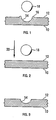
- FIGS. 1 and 2 a segment of an article 10, which article may be a dental implant fixture, has an outer surface 12 which has been modified (FIG. 1) to have a depression 14 surrounded by a berm 16.
- the depression has substantially round perimeter and the berm is substantially symmetrical around that perimeter.
- This depression may be formed by impacting the surface 12 with a projectile 18 aimed to hit the surface normally, as is represented by the arrow 20 in FIG. 2.
- the depression may have the berm 12, or it may be without a berm as is illustrated in FIG. 3.
- the mass of the projectile, its hardness, its velocity on impact, its surface characteristics and its shape will all combine to determine the characteristics of the depression, such as it shape and depth.
- FIGS. 4 and 5 shows a non-symmetrical depression 24 (FIG. 4) in the surface 12, formed by impacting the surface with the projectile 18 aimed to impact the surface at an oblique angle as is represented by the arrow 26 in FIG. 5.
- the depression may have a non-symmetrical berm 28, or not, depending on the above-mentioned properties of the projectile.
- a stream 29 of projectiles 18 may be aimed to impact the surface 32 of a cylindrical body 30 substantially normally using the scheme shown in FIG. 6.
- a mask 34 fitted with a slot 36 is placed adjacent the surface 32 in the path of the stream of projectiles, so that those projectiles which pass through the slot will impact the surface 32 substantially normally.
- the slot 36 has a length at least as great as the axial length of the body 30, as is represented in FIG. 6A, so that projectiles 18 may impact the surface 32 along its entire length.
- the body 30 may be rotated on its axis A, counterclockwise as represented by the curved arrow B, or vice versa, to expose the entire surface 32 to projectiles 18.
- the number of depressions formed on the surface 32 will depend primarily on the density of projectiles in the stream and the speed of rotation of the body.
- the stream of projectiles may be aimed obliquely, or tangentially, at the surface 32 using the scheme shown in FIG. 7.
- the character of the pits formed in this manner will depend, additionally, on the direction of rotation of the body 30.
- a fluidized bed 40 provides a cloud of particles 18 in the confined space 42 above the bed.
- Several articles e.g: dental implants) 30 are in that space, each mounted to a support 44 for rotation around its longitudinal axis A-A.
- the density of this cloud and the velocity of individual particles in it are established as desired to effect the required modification of the surfaces of the articles 30.
- a uniform pattern of depressions may be produced on the surface of each article.
- the implant is located in a whirling cyclonic stream of particles 18 (not shown), where it may be rotated to expose its entire surface to oncoming particles.
- a whirling cyclonic stream of particles 18 not shown
- prolonged exposure of the implant surface will result in an overlapping mass of irregularities to the point of destroying features of individual impressions, dents, scratches and the like.
- a bone-growth promoting agent to a surface that has been modified according to the invention one may substitute particles of that agent for some or all of the surface-modifying projectiles 18 in any of the above-described processes and apparatus.
- particles of hydroxy-apatite, whitlockite or another agent such as a carrier for a medicament (e.g: a bone morphogenic protein),to the particles 18 of titanium or its alloy, or substitute same after the implant surface has been modified, and continue the process to place particles of the bone-growth promoting agent in the depressions formed on that surface.
- a carrier for a medicament e.g: a bone morphogenic protein
- the bone-growth promoting agent can be projected into those depressions while the implant 30 is being rotated clockwise, for example, as seen in FIG. 7. If, further, the implant is designed to be screwed into the patient's bone socket with a clockwise rotation, small chips of bone will be gathered into the depressions, and be packed therein on top of the growth-promoting agent.
- the invention envisions such an embodiment of the invention, which will inherently resist separation of the growth-promoting agent from the implant surface 12, thereby overcoming a problem which is indigenous to the prior art.
- the shape of the particles 18 etc may be controlled with the aid of fluidized bed apparatus of the kind illustrated in FIG. 8. If initially particles in the cloud are rough-shaped with sharp edges, corners and the like, one may maintain the cloud for an extended time interval during which the particles in the cloud will impact each other smoothing away the sharp corners and edges. Particles which are substantially round may be produced in this way, in order to form substantially round depressions on the surfaces of the articles 30. If the article 30 is made of c.p.titanium and it is desired to use projectiles which are harder than the article 30, the projectiles may be made of the alloy TiAl6V4.
- FIG. 9A is a 50x photographic enlargement of a portion of a screw-type dental implant only part of the surface of which has been modified.
- the unmodified part 102 is the threaded surface produced by machine turning of a billet of titanium.
- FIG. 9A measures 0.60mm in the axial direction of the implant.
- FIG. 9B is a further enlarged view looking along the modified surface 104.
- the implant procedure was continued long enough to substantially obliterate features of individual depressions, dents, scratches and the like, so as to produce an intense, substantially uniform roughness of the bone-contacting surface of the implant. It has been observed that individual depressions and dents, will have transverse dimensions (e.g: diameters) about half the size of the impacting grit particles. Thus, a grit of -325 mesh, having particles in the size range from about 10-15 microns, will generally produce depressions about 5-10 microns across at the surface of the implant.
Landscapes
- Health & Medical Sciences (AREA)
- Chemical & Material Sciences (AREA)
- Animal Behavior & Ethology (AREA)
- Veterinary Medicine (AREA)
- General Health & Medical Sciences (AREA)
- Public Health (AREA)
- Engineering & Computer Science (AREA)
- Oral & Maxillofacial Surgery (AREA)
- Life Sciences & Earth Sciences (AREA)
- Transplantation (AREA)
- Epidemiology (AREA)
- Mechanical Engineering (AREA)
- Dermatology (AREA)
- Medicinal Chemistry (AREA)
- Orthopedic Medicine & Surgery (AREA)
- Heart & Thoracic Surgery (AREA)
- Vascular Medicine (AREA)
- Dentistry (AREA)
- Materials Engineering (AREA)
- Cardiology (AREA)
- Biomedical Technology (AREA)
- Metallurgy (AREA)
- Organic Chemistry (AREA)
- Inorganic Chemistry (AREA)
- Crystallography & Structural Chemistry (AREA)
- Chemical Kinetics & Catalysis (AREA)
- Dispersion Chemistry (AREA)
- Ceramic Engineering (AREA)
- Prostheses (AREA)
- Materials For Medical Uses (AREA)
Claims (36)
- Prothesevorrichtung, geeignet zur chirurgischen Implantation in lebende Knochen, wobei die Vorrichtung eine dem Knochen auszusetzende Oberfläche aus einem biokompatiblen Titanmaterial aufweist, die Oberfläche erhältlich ist im Wesentlichen ohne Sauerstoff durch Einwirkung eines Strahlguts, zusammengesetzt aus Teilchen, umfassend das biokompatible Material oder eine Legierung des biokompatiblen Materials, wobei die Legierung härter als das Material ist, um Merkmale individueller Vertiefungen, Beulen und Kratzer auszulöschen und um ein vorgeschriebenes Muster aus Unregelmäßigkeiten, gewählt aus Vertiefungen, Kratzern und Beulen, einer vorbestimmten Größe und Konfiguration herzustellen.
- Prothesevorrichtung nach Anspruch 1, in welcher sich die Unregelmäßigkeiten im Wesentlichen überlappen.
- Prothesevorrichtung nach Anspruch 1, welche Teilchen aus einem zweiten biokompatiblen Material, das im Wesentlichen in den Unregelmäßigkeiten fixiert ist, einschließt.
- Prothesevorrichtung nach Anspruch 1, in welcher das Strahlgut aus Teilchen, umfassend Titan oder verdünnte Titanlegierungen, zusammengesetzt ist.
- Prothesevorrichtung nach Anspruch 3, wobei das Strahlgut aus Teilchen, umfassend Titan oder verdünnte Titanlegierungen, zusammengesetzt ist und das zweite Material Teilchen, gewählt aus knochenkompatiblem Apatit und einem Träger für ein Medikament, welcher ein knochenmorphogenes Protein einschließt, einschließt.
- Prothesevorrichtung nach Anspruch 1, in welcher zumindest einige der Vertiefungen periphere Wälle aufweisen.
- Prothesevorrichtung nach Anspruch 1, in welcher im Wesentlichen alle Unregelmäßigkeiten Beulen sind.
- Prothesevorrichtung nach Anspruch 7, in welcher zumindest einige der Beulen periphere Wälle aufweisen.
- Prothesevorrichtung nach Anspruch 1, in welcher die Unregelmäßigkeiten durch kugelartige Teilchen aus im Wesentlichen demselben Material geformt werden, die auf die Oberfläche unter einem vorgeschriebenen Winkel aufprallen, wobei der Winkel im Wesentlichen senkrecht zur Oberfläche bis im Wesentlichen tangential zur Oberfläche ist.
- Prothesevorrichtung nach Anspruch 9, in welcher die kugelartigen Teilchen härter sind als das biokompatible Material.
- Verfahren zur Verstärkung der Knochenanbindung an eine Vorrichtung, die zur chirurgischen Implantation in lebende Knochen geeignet ist, umfassend die Schritte:Zurverfügungstellen eines implantierbaren Körpers aus einem biokompatiblen Titanmaterial mit einer Oberfläche, die mit dem Knochen in Wechselwirkung tritt, undAufprallenlassen im Wesentlichen ohne Sauerstoff eines Strahlguts, zusammengesetzt aus Teilchen aus im Wesentlichen dem gleichen biokompatiblem Titanmaterial oder einer Legierung daraus wie der implantierbare Körper, auf die Oberfläche, so dass Merkmale von individuellen Vertiefungen, Beulen und Kratzern ausgelöscht werden und die Oberfläche mit einer vorgeschriebenen Mikromorphologie neu gebildet wird.
- Verfahren nach Anspruch 11, in welchem das Strahlgut so gewählt wird, dass es einen oder mehrere Bestandteile ausenthält.a - im Wesentlichen demselben Material wie der Körperb - einem das Knochenwachstum verstärkenden Materialc - einem Träger für ein Medikamentd - Hydroxyapatite - Whitlockitf - einem knochenmorphogenen Protein
- Verfahren nach Anspruch 12, welches die Schritte des Aufprallens eines und dann eines weiteren Materials auf die Oberfläche einschließt.
- Verfahren nach Anspruch 13, welches die Schritte des Aufprallens eines Strahlguts aus im Wesentlichen dem gleichen Material wie der Körper auf die Oberfläche, gefolgt vom Aufprallen eines Strahlguts aus einem knochenwachstumsverstärkenden Material auf die Oberfläche einschließt.
- Verfahren nach Anspruch 13, welches die Schritte des Aufprallens eines Strahlguts aus im Wesentlichen demselben Material wie der Körper auf die Oberfläche, gefolgt vom Aufprallen eines Strahlguts aus einem Material, gewählt aus Hydroxyapatit und Whitlockit, auf die Oberfläche, einschließt.
- Verfahren nach Anspruch 13, welches die Schritte des Aufprallens eines Strahlguts aus im Wesentlichen demselben Material wie der Körper auf die Oberfläche, gefolgt von einer Behandlung der Oberfläche mit einem Träger für ein Medikament einschließt.
- Verfahren nach Anspruch 13, welches die Schritte des Aufprallens eines Strahlguts aus im Wesentlichen demselben Material wie der Körper auf die Oberfläche, gefolgt von einer Behandlung der Oberfläche mit einem knochenmorphogenen Protein einschließt.
- Verfahren nach Anspruch 13, welches die Schritte des Aufprallens eines Strahlgut aus im Wesentlichen demselben Material wie der Körper auf die Oberfläche, gefolgt vom Aufprallen eines Strahlguts aus einem Träger für ein Medikament auf die Oberfläche einschließt.
- Verfahren nach Anspruch 13, welches die Schritte des Aufprallens eines Strahlguts aus im Wesentlichen demselben Material wie der Körper auf die Oberfläche, gefolgt vom Aufprallen eines Strahlguts aus einem Träger für ein knochenmorphogenes Protein auf die Oberfläche einschließt.
- Verfahren nach Anspruch 13, welches den Schritt des Aufprallens eines Strahlguts aus Hydroxyapatit auf die Oberfläche umfasst.
- Verfahren nach Anspruch 20, welches den weiteren Schritt einer Behandlung der Oberfläche mit einem knochenmorphogenen Protein einschließt.
- Verfahren nach Anspruch 20, welches den weiteren Schritt des Aufprallens eines Strahlguts aus einem Träger für ein knochenmorphogenes Protein auf die Oberfläche einschließt.
- Verfahren nach Anspruch 11, welches durchgeführt wird, ohne dass im Wesentlichen dem Körper Material zugeführt oder entfernt wird.
- Verfahren nach Anspruch 11, welches die weitere Behandlung der Oberfläche nach dem Neubildungsschritt zur Herstellung einer Oberfläche mit einem Kontaktwinkel von 20 Grad oder weniger umfasst.
- Verfahren nach Anspruch 11, worin das Strahlgut so ausgewählt wird, dass es hauptsächlich aus Teilchen besteht, welche im Wesentlichen keine scharfen Spitzen oder Kanten aufweisen.
- Verfahren nach Anspruch 11, worin das Strahlgut so ausgewählt wird, dass es hauptsächlich aus Teilchen besteht, welche im Wesentlichen scharfe topografische Merkmale, gewählt aus Kanten und Spitzen, aufweisen.
- Verfahren nach Anspruch 11, welches den Schritt des Zurverfügungstellens einer Aperturmaske über der Oberfläche, um den Einschlagwinkel der Teilchen auf der Oberfläche auf einen vorgeschriebenen Bereich zu begrenzen, der innerhalb der Grenzen von überwiegend senkrecht bis überwiegend tangential liegt, einschließt.
- Verfahren nach Anspruch 12, welches die Schritte der Auswahl eines Bereichs der Teilchengeschwindigkeit und eines Bereichs der Teilchendichte, wodurch in der Oberfläche eine Vielzahl von Unregelmäßigkeiten gebildet wird, die sich im Wesentlichen gegenseitig überlappen, einschließt.
- Verfahren nach Anspruch 12, welches die Schritte des Ausrichtens der Teilchen auf eine cyclonische Flugbahn und des Anordnens des implantierbaren Körpers in diese Bahn einschließt.
- Verfahren nach Anspruch 29, welches den Schritt, des Rotierens des Körpers in der Bahn, so dass die Oberfläche im Wesentlichen vollkommen dem Aufprall der Teilchen ausgesetzt ist, einschließt.
- Verfahren nach Anspruch 12, welches die Schritte des Zurverfügungstellens einer fluidisierten Wolke aus den Teilchen und des Anordnens der Vorrichtung in der Wolke einschließt.
- Verfahren nach Anspruch 31, welches den Schritt des Rotierens der Vorrichtung in der Wolke einschließt.
- Verfahren nach Anspruch 12, worin der Körper aus einem Material, gewählt aus Titan und verdünnten Titanlegierungen, zusammengesetzt ist, und das Strahlgut aus einem Material, gewählt aus Titan und verdünnten Titanlegierungen, zusammengesetzt ist.
- Verfahren nach Anspruch 33, worin der Körper aus chemisch reinem Titan zusammengesetzt ist und das Strahlgut aus TiA16V4 zusammengesetzt ist.
- Verfahren nach Anspruch 11, welches die Schritte des Dispergierens der Teilchen des Strahlguts in einem Fluid und des Bewegens des Fluids, um das Strahlgut zur Oberfläche zu transportieren, einschließt.
- Verfahren nach Anspruch 35, welches den Schritt des Bewegens des Fluids mit einem Druck im Bereich von 414 bis 552 kPa (60 bis 80 psi) einschließt.
Applications Claiming Priority (3)
| Application Number | Priority Date | Filing Date | Title |
|---|---|---|---|
| US149905 | 1980-05-15 | ||
| US08/149,905 US5607480A (en) | 1993-11-10 | 1993-11-10 | Surgically implantable prosthetic devices |
| PCT/US1994/012581 WO1995013102A1 (en) | 1993-11-10 | 1994-11-03 | Surgically implantable prosthetic devices |
Publications (2)
| Publication Number | Publication Date |
|---|---|
| EP0728022A1 EP0728022A1 (de) | 1996-08-28 |
| EP0728022B1 true EP0728022B1 (de) | 2003-02-26 |
Family
ID=22532303
Family Applications (1)
| Application Number | Title | Priority Date | Filing Date |
|---|---|---|---|
| EP95901109A Expired - Lifetime EP0728022B1 (de) | 1993-11-10 | 1994-11-03 | Chirurgisch implantierbare prothesenteile |
Country Status (11)
| Country | Link |
|---|---|
| US (2) | US5607480A (de) |
| EP (1) | EP0728022B1 (de) |
| JP (1) | JPH09506273A (de) |
| KR (1) | KR100361872B1 (de) |
| AT (1) | ATE233108T1 (de) |
| AU (1) | AU1047395A (de) |
| BR (1) | BR9407992A (de) |
| DE (1) | DE69432184T2 (de) |
| ES (1) | ES2193184T3 (de) |
| NO (1) | NO961882L (de) |
| WO (1) | WO1995013102A1 (de) |
Families Citing this family (87)
| Publication number | Priority date | Publication date | Assignee | Title |
|---|---|---|---|---|
| WO1996016611A1 (en) * | 1994-11-30 | 1996-06-06 | Implant Innovations, Inc. | Implant surface preparation |
| US5863201A (en) | 1994-11-30 | 1999-01-26 | Implant Innovations, Inc. | Infection-blocking dental implant |
| WO1996029030A1 (en) * | 1995-03-17 | 1996-09-26 | Smith & Nephew Richards Inc. | Medical implants |
| US6209621B1 (en) * | 1995-07-07 | 2001-04-03 | Depuy Orthopaedics, Inc. | Implantable prostheses with metallic porous bead preforms applied during casting and method of forming the same |
| EP0806212B1 (de) * | 1996-05-10 | 2003-04-02 | IsoTis N.V. | Vorrichtung zur Aufnahme und Freigabe von biologisch aktiven Substanzen |
| EP0806211B1 (de) * | 1996-05-10 | 2002-10-23 | IsoTis N.V. | Implantatwerkstoff und Verfahren zu seiner Herstellung |
| ES2185861T3 (es) * | 1996-05-10 | 2003-05-01 | Isotis Nv | Material para implantes y procedimiento de fabricacion del mismo. |
| USH1984H1 (en) * | 1996-05-10 | 2001-08-07 | Implant Innovations, Inc. | Orthodontic abutment |
| US6143948A (en) * | 1996-05-10 | 2000-11-07 | Isotis B.V. | Device for incorporation and release of biologically active agents |
| EP1516602B1 (de) * | 1996-09-30 | 2008-01-23 | Brainbase Corporation | Implantat mit bioaktiven Partikeln und Verfahren zu dessen Herstellung |
| US5746691A (en) * | 1997-06-06 | 1998-05-05 | Global Therapeutics, Inc. | Method for polishing surgical stents |
| US6217331B1 (en) | 1997-10-03 | 2001-04-17 | Implant Innovations, Inc. | Single-stage implant system |
| US5829978A (en) * | 1997-11-10 | 1998-11-03 | Sulzer Calcitek Inc. | Surface roughening of self-tapping dental implants |
| US5980973A (en) * | 1998-03-13 | 1999-11-09 | Medtronic, Inc. | Implantable medical device with biocompatible surface and method for its manufacture |
| US6039568A (en) * | 1998-06-02 | 2000-03-21 | Hinds; Kenneth F. | Tooth shaped dental implants |
| CA2282035A1 (en) * | 1998-09-10 | 2000-03-10 | Buechel-Pappas Trust | Method for improving strength of prosthetic component |
| US6174167B1 (en) † | 1998-12-01 | 2001-01-16 | Woehrle Peter S. | Bioroot endosseous implant |
| US6254631B1 (en) | 1999-09-23 | 2001-07-03 | Intratherapeutics, Inc. | Stent with enhanced friction |
| EP1093766A1 (de) * | 1999-10-20 | 2001-04-25 | Abou Tara, Nicolas, Prof.Dr. Dr.med.dent. | Einschraubbares, selbstschneidendes Knochenimplantat zur Pfostenverankerung von zahnärztlichen Suprakonstruktionen |
| SE515300C2 (sv) * | 1999-11-17 | 2001-07-09 | Ann Wennerberg | Element avsett att implanteras i kroppsvävnad samt förfarande och anordning för tillverkning av sådant element |
| US7163541B2 (en) * | 2002-12-03 | 2007-01-16 | Arthrosurface Incorporated | Tibial resurfacing system |
| EP2314257B9 (de) | 2000-05-01 | 2013-02-27 | ArthroSurface, Inc. | System zur Gelenkoberflächenerneuerung |
| US7678151B2 (en) * | 2000-05-01 | 2010-03-16 | Ek Steven W | System and method for joint resurface repair |
| US6610067B2 (en) | 2000-05-01 | 2003-08-26 | Arthrosurface, Incorporated | System and method for joint resurface repair |
| US8177841B2 (en) | 2000-05-01 | 2012-05-15 | Arthrosurface Inc. | System and method for joint resurface repair |
| US20060078847A1 (en) * | 2000-09-29 | 2006-04-13 | Kwan Norman H | Dental implant system and additional methods of attachment |
| US6620332B2 (en) * | 2001-01-25 | 2003-09-16 | Tecomet, Inc. | Method for making a mesh-and-plate surgical implant |
| US6599322B1 (en) * | 2001-01-25 | 2003-07-29 | Tecomet, Inc. | Method for producing undercut micro recesses in a surface, a surgical implant made thereby, and method for fixing an implant to bone |
| US7018418B2 (en) * | 2001-01-25 | 2006-03-28 | Tecomet, Inc. | Textured surface having undercut micro recesses in a surface |
| KR100441765B1 (ko) * | 2001-11-14 | 2004-07-27 | 한국과학기술연구원 | 초미세 생체활성 다공성 표면을 갖는 생체 재료용티타늄계 합금 및 그 제조방법 |
| GB0206838D0 (en) * | 2002-03-22 | 2002-05-01 | Ic Innovations | Use |
| US20040049285A1 (en) * | 2002-09-09 | 2004-03-11 | Brian Haas | Duo-fixation prosthetic joints |
| US7914545B2 (en) | 2002-12-03 | 2011-03-29 | Arthrosurface, Inc | System and method for retrograde procedure |
| US7901408B2 (en) | 2002-12-03 | 2011-03-08 | Arthrosurface, Inc. | System and method for retrograde procedure |
| GB0302026D0 (en) * | 2003-01-29 | 2003-02-26 | Biocomposites Ltd | Bioabsorbable implant |
| US20040167632A1 (en) * | 2003-02-24 | 2004-08-26 | Depuy Products, Inc. | Metallic implants having roughened surfaces and methods for producing the same |
| US8388624B2 (en) | 2003-02-24 | 2013-03-05 | Arthrosurface Incorporated | Trochlear resurfacing system and method |
| US8251700B2 (en) | 2003-05-16 | 2012-08-28 | Biomet 3I, Llc | Surface treatment process for implants made of titanium alloy |
| US7067169B2 (en) | 2003-06-04 | 2006-06-27 | Chemat Technology Inc. | Coated implants and methods of coating |
| EP1671662A4 (de) * | 2003-08-27 | 2010-12-15 | Makoto Ogiso | Strukturkörper aus biokompatiblem material, das mit feinknochenstaub imprägniert ist, und herstellungsverfahren dafür |
| WO2005051231A2 (en) | 2003-11-20 | 2005-06-09 | Arthrosurface, Inc. | Retrograde delivery of resurfacing devices |
| JP2008504107A (ja) | 2004-06-28 | 2008-02-14 | アースロサーフィス・インコーポレーテッド | 関節面交換用システム |
| US7828853B2 (en) | 2004-11-22 | 2010-11-09 | Arthrosurface, Inc. | Articular surface implant and delivery system |
| US7850452B2 (en) | 2005-04-27 | 2010-12-14 | Biomet 3I, Llc | Pre-stressed implant component and assembly |
| US7901462B2 (en) * | 2005-06-23 | 2011-03-08 | Depuy Products, Inc. | Implants with textured surface and methods for producing the same |
| US8562346B2 (en) | 2005-08-30 | 2013-10-22 | Zimmer Dental, Inc. | Dental implant for a jaw with reduced bone volume and improved osseointegration features |
| EP3517137A1 (de) | 2005-11-14 | 2019-07-31 | Biomet 3I, LLC | Ablagerung diskreter nanopartikel auf einer implantatoberfläche |
| US8684281B2 (en) * | 2006-03-24 | 2014-04-01 | Finishing Brands Holdings Inc. | Spray device having removable hard coated tip |
| US20080017734A1 (en) * | 2006-07-10 | 2008-01-24 | Micheli Paul R | System and method of uniform spray coating |
| AU2007296573B2 (en) * | 2006-09-11 | 2013-01-17 | Enbio Limited | Method of doping surfaces |
| AU2007332787A1 (en) | 2006-12-11 | 2008-06-19 | Arthrosurface Incorporated | Retrograde resection apparatus and method |
| US20080179408A1 (en) * | 2007-01-30 | 2008-07-31 | Johnson Controls Technology Company | Sensor-free optimal control of air-side economizer |
| US20080221688A1 (en) * | 2007-03-09 | 2008-09-11 | Warsaw Orthopedic, Inc. | Method of Maintaining Fatigue Performance In A Bone-Engaging Implant |
| FI20070953L (fi) * | 2007-12-10 | 2009-06-11 | Beneq Oy | Menetelmä ja laite pinnan strukturoimiseksi |
| KR100931668B1 (ko) * | 2007-12-26 | 2009-12-14 | 주식회사 포스코 | 수산화 아파타이트가 코팅된 저탄성 티타늄 합금 임플란트 |
| ES2545781T3 (es) | 2008-01-28 | 2015-09-15 | Biomet 3I, Llc | Implante superficial con mayor hidrofilia |
| WO2009111481A1 (en) | 2008-03-03 | 2009-09-11 | Arthrosurface Incorporated | Bone resurfacing system and method |
| GB2479514A (en) * | 2009-02-23 | 2011-10-12 | Arthrosurface Inc | Nanorough alloy substrate |
| US8696759B2 (en) * | 2009-04-15 | 2014-04-15 | DePuy Synthes Products, LLC | Methods and devices for implants with calcium phosphate |
| US8580134B2 (en) * | 2009-04-15 | 2013-11-12 | DePuy Synthes Products, LLC. | Nanotextured cobalt-chromium alloy articles having high wettability and method of producing same |
| US10945743B2 (en) | 2009-04-17 | 2021-03-16 | Arthrosurface Incorporated | Glenoid repair system and methods of use thereof |
| WO2010121250A1 (en) | 2009-04-17 | 2010-10-21 | Arthrosurface Incorporated | Glenoid resurfacing system and method |
| CA3064646C (en) | 2009-04-17 | 2023-01-03 | Arthrosurface Incorporated | Glenoid resurfacing system and method |
| US8475536B2 (en) * | 2010-01-29 | 2013-07-02 | DePuy Synthes Products, LLC | Methods and devices for implants with improved cement adhesion |
| BR112012022482A2 (pt) | 2010-03-05 | 2016-07-19 | Arthrosurface Inc | sistema e método de recomposição da superfície tibial. |
| JP5560074B2 (ja) * | 2010-03-23 | 2014-07-23 | 京セラメディカル株式会社 | 生体インプラント用金属材料 |
| US8641418B2 (en) | 2010-03-29 | 2014-02-04 | Biomet 3I, Llc | Titanium nano-scale etching on an implant surface |
| DE102010017859B4 (de) * | 2010-04-22 | 2012-05-31 | Mtu Aero Engines Gmbh | Verfahren zum Bearbeiten einer Oberfläche eines Bauteils |
| WO2011156506A2 (en) * | 2010-06-08 | 2011-12-15 | Smith & Nephew, Inc. | Implant components and methods |
| US9066716B2 (en) | 2011-03-30 | 2015-06-30 | Arthrosurface Incorporated | Suture coil and suture sheath for tissue repair |
| US9315798B2 (en) * | 2011-08-22 | 2016-04-19 | Exogenesis Corporation | Methods for improving the bioactivity characteristics of a surface and objects with surfaces improved thereby |
| EP2804565B1 (de) | 2011-12-22 | 2018-03-07 | Arthrosurface Incorporated | System zur knochenfixierung |
| DE102012003064A1 (de) | 2012-02-13 | 2013-08-14 | Fraunhofer-Gesellschaft zur Förderung der angewandten Forschung e.V. | Implantatformkörper |
| WO2013142118A1 (en) | 2012-03-20 | 2013-09-26 | Biomet 3I, Llc | Surface treatment for an implant surface |
| DE112013003358T5 (de) | 2012-07-03 | 2015-03-19 | Arthrosurface, Inc. | System und Verfahren für Gelenkoberflächenersatz und -reparatur |
| US9949837B2 (en) | 2013-03-07 | 2018-04-24 | Howmedica Osteonics Corp. | Partially porous bone implant keel |
| US9492200B2 (en) | 2013-04-16 | 2016-11-15 | Arthrosurface Incorporated | Suture system and method |
| US9931219B2 (en) | 2014-03-07 | 2018-04-03 | Arthrosurface Incorporated | Implant and anchor assembly |
| US11607319B2 (en) | 2014-03-07 | 2023-03-21 | Arthrosurface Incorporated | System and method for repairing articular surfaces |
| US10624748B2 (en) | 2014-03-07 | 2020-04-21 | Arthrosurface Incorporated | System and method for repairing articular surfaces |
| US20150366668A1 (en) * | 2014-06-23 | 2015-12-24 | Community Blood Center | Cellular-scale surface modification for increased osteogenic protein expression |
| FR3035607B1 (fr) * | 2015-04-30 | 2017-04-28 | Saint-Gobain Centre De Rech Et D'Etudes Europeen | Procede de modification de l'aspect d'une surface |
| JP6350384B2 (ja) * | 2015-05-11 | 2018-07-04 | 信越半導体株式会社 | 研削用砥石 |
| CA3108761A1 (en) | 2017-08-04 | 2019-02-07 | Arthrosurface Incorporated | Multicomponent articular surface implant |
| GB2609338B (en) | 2019-03-12 | 2023-06-14 | Arthrosurface Inc | Humeral and glenoid articular surface implant systems and methods |
| CN110640638B (zh) * | 2019-09-03 | 2021-04-02 | 广州大学 | 一种用于滚动体工件表面的超声强化加工设备 |
| JP7162263B2 (ja) * | 2019-09-05 | 2022-10-28 | 株式会社サーフテクノロジー | 機能性部材及びその生産方法 |
Family Cites Families (18)
| Publication number | Priority date | Publication date | Assignee | Title |
|---|---|---|---|---|
| US3790507A (en) * | 1969-03-10 | 1974-02-05 | Research Corp | Plastic bone composition |
| CA962806A (en) * | 1970-06-04 | 1975-02-18 | Ontario Research Foundation | Surgical prosthetic device |
| CH618870A5 (de) * | 1977-10-31 | 1980-08-29 | Straumann Inst Ag | |
| CH656525A5 (de) * | 1982-10-15 | 1986-07-15 | Sulzer Ag | Verankerungsschaft fuer die verankerung einer gelenkendoprothese. |
| JPS6131163A (ja) * | 1984-07-23 | 1986-02-13 | 京セラ株式会社 | セラミツク製生体補綴材とその製造方法 |
| US4818559A (en) * | 1985-08-08 | 1989-04-04 | Sumitomo Chemical Company, Limited | Method for producing endosseous implants |
| JPS6236676A (ja) * | 1985-08-10 | 1987-02-17 | Canon Inc | 光導電部材用の支持体及び該支持体を有する光導電部材 |
| JPH01148254A (ja) * | 1987-12-07 | 1989-06-09 | Tokyo Baiteku Kenkyusho:Kk | 人工骨 |
| SE464850B (sv) * | 1989-07-19 | 1991-06-24 | Ellem Bioteknik Ab | Saett foer preparering av en implantatkropp genom behandling med en vaeteperoxidloesning |
| US4865603A (en) * | 1988-02-04 | 1989-09-12 | Joint Medical Products Corporation | Metallic prosthetic devices having micro-textured outer surfaces |
| US5188800A (en) * | 1988-06-03 | 1993-02-23 | Implant Innovations, Inc. | Dental implant system |
| ES2064845T3 (es) * | 1990-09-13 | 1995-02-01 | Thera Ges Fuer Patente | Protesis implantable. |
| SE468153B (sv) * | 1990-10-08 | 1992-11-16 | Astra Meditec Ab | Saett foer ytbehandling av implantat av titan eller titanlegering |
| JPH06114099A (ja) * | 1991-06-12 | 1994-04-26 | Nara Kikai Seisakusho:Kk | 医用材料とその製造方法 |
| US5258030A (en) * | 1991-07-08 | 1993-11-02 | The Trustees Of The University Of Pennsylvania | Porous coated implants |
| US5358533A (en) * | 1992-02-19 | 1994-10-25 | Joint Medical Products Corporation | Sintered coatings for implantable prostheses |
| US5316476B1 (en) * | 1992-06-19 | 1996-06-18 | Jack T Krauser | Dental implant with a longitudinally grooved cylindrical surface |
| US5366374A (en) * | 1993-05-18 | 1994-11-22 | Vlassis James M | Dental implant |
-
1993
- 1993-11-10 US US08/149,905 patent/US5607480A/en not_active Expired - Lifetime
-
1994
- 1994-11-03 AT AT95901109T patent/ATE233108T1/de not_active IP Right Cessation
- 1994-11-03 EP EP95901109A patent/EP0728022B1/de not_active Expired - Lifetime
- 1994-11-03 JP JP7513873A patent/JPH09506273A/ja active Pending
- 1994-11-03 ES ES95901109T patent/ES2193184T3/es not_active Expired - Lifetime
- 1994-11-03 BR BR9407992A patent/BR9407992A/pt not_active Application Discontinuation
- 1994-11-03 WO PCT/US1994/012581 patent/WO1995013102A1/en not_active Ceased
- 1994-11-03 AU AU10473/95A patent/AU1047395A/en not_active Abandoned
- 1994-11-03 DE DE69432184T patent/DE69432184T2/de not_active Expired - Fee Related
- 1994-11-03 KR KR1019960702432A patent/KR100361872B1/ko not_active Expired - Fee Related
-
1996
- 1996-05-09 NO NO961882A patent/NO961882L/no not_active Application Discontinuation
- 1996-09-06 US US08/711,398 patent/US5816811A/en not_active Expired - Lifetime
Also Published As
| Publication number | Publication date |
|---|---|
| JPH09506273A (ja) | 1997-06-24 |
| WO1995013102A1 (en) | 1995-05-18 |
| EP0728022A1 (de) | 1996-08-28 |
| KR100361872B1 (ko) | 2003-02-05 |
| DE69432184T2 (de) | 2003-07-17 |
| US5816811A (en) | 1998-10-06 |
| ATE233108T1 (de) | 2003-03-15 |
| NO961882D0 (no) | 1996-05-09 |
| US5607480A (en) | 1997-03-04 |
| BR9407992A (pt) | 1996-12-03 |
| DE69432184D1 (de) | 2003-04-03 |
| NO961882L (no) | 1996-05-09 |
| ES2193184T3 (es) | 2003-11-01 |
| AU1047395A (en) | 1995-05-29 |
Similar Documents
| Publication | Publication Date | Title |
|---|---|---|
| US5607480A (en) | Surgically implantable prosthetic devices | |
| Swain et al. | Effect of surface roughness on titanium medical implants | |
| US5603338A (en) | Implant surface preparation utilizing acid treatment | |
| JP3053214B2 (ja) | チタン又はその合金でつくったインプラントの製造方法 | |
| US5826586A (en) | Methods for producing medical implants with roughened, particulate-free surfaces | |
| JP5478658B2 (ja) | インプラントおよびインプラント部材 | |
| US6969474B2 (en) | Implant surface preparation | |
| EP1255502B1 (de) | Maxillofaciale chirurgische elemente mit geordneten microgeometrischen oberflächenmustern | |
| AU725983B2 (en) | Surface modification of medical implants | |
| US20080015616A1 (en) | Orthopedic implants having ordered microgeometric surface patterns | |
| US20100268346A1 (en) | Nanotextured cobalt-chromium alloy articles having high wettability and method of producing same | |
| WO2005074530A2 (en) | Metallic bone implant having improved implantability and method of making the same | |
| Richard | Innovative surface treatments of titanium alloys for biomedical applications | |
| JP3026074B2 (ja) | インプラント及びその製造方法 | |
| WO2003080140A1 (en) | Use of bioactive glass for air abrasive blasting of implant surfaces | |
| Alkhodary | Laser Micromachining of Titanium Aluminum Vanadium Alloy Rods | |
| Corrêa et al. | Treatment of implant surfaces: Insights, outcomes and limitations | |
| HK1215368B (en) | Maxillofacial surgical elements having ordered microgeometric surface patterns |
Legal Events
| Date | Code | Title | Description |
|---|---|---|---|
| PUAI | Public reference made under article 153(3) epc to a published international application that has entered the european phase |
Free format text: ORIGINAL CODE: 0009012 |
|
| 17P | Request for examination filed |
Effective date: 19960430 |
|
| AK | Designated contracting states |
Kind code of ref document: A1 Designated state(s): AT BE CH DE ES FR GB IT LI NL SE |
|
| 17Q | First examination report despatched |
Effective date: 19990901 |
|
| GRAG | Despatch of communication of intention to grant |
Free format text: ORIGINAL CODE: EPIDOS AGRA |
|
| GRAG | Despatch of communication of intention to grant |
Free format text: ORIGINAL CODE: EPIDOS AGRA |
|
| GRAH | Despatch of communication of intention to grant a patent |
Free format text: ORIGINAL CODE: EPIDOS IGRA |
|
| GRAH | Despatch of communication of intention to grant a patent |
Free format text: ORIGINAL CODE: EPIDOS IGRA |
|
| GRAA | (expected) grant |
Free format text: ORIGINAL CODE: 0009210 |
|
| AK | Designated contracting states |
Designated state(s): AT BE CH DE ES FR GB IT LI NL SE |
|
| PG25 | Lapsed in a contracting state [announced via postgrant information from national office to epo] |
Ref country code: NL Free format text: LAPSE BECAUSE OF FAILURE TO SUBMIT A TRANSLATION OF THE DESCRIPTION OR TO PAY THE FEE WITHIN THE PRESCRIBED TIME-LIMIT Effective date: 20030226 Ref country code: BE Free format text: LAPSE BECAUSE OF FAILURE TO SUBMIT A TRANSLATION OF THE DESCRIPTION OR TO PAY THE FEE WITHIN THE PRESCRIBED TIME-LIMIT Effective date: 20030226 Ref country code: AT Free format text: LAPSE BECAUSE OF FAILURE TO SUBMIT A TRANSLATION OF THE DESCRIPTION OR TO PAY THE FEE WITHIN THE PRESCRIBED TIME-LIMIT Effective date: 20030226 |
|
| REG | Reference to a national code |
Ref country code: GB Ref legal event code: FG4D |
|
| REG | Reference to a national code |
Ref country code: CH Ref legal event code: EP |
|
| REG | Reference to a national code |
Ref country code: CH Ref legal event code: NV Representative=s name: PATENTANWALTSBUERO JEAN HUNZIKER |
|
| REF | Corresponds to: |
Ref document number: 69432184 Country of ref document: DE Date of ref document: 20030403 Kind code of ref document: P |
|
| PG25 | Lapsed in a contracting state [announced via postgrant information from national office to epo] |
Ref country code: SE Free format text: LAPSE BECAUSE OF FAILURE TO SUBMIT A TRANSLATION OF THE DESCRIPTION OR TO PAY THE FEE WITHIN THE PRESCRIBED TIME-LIMIT Effective date: 20030526 |
|
| NLV1 | Nl: lapsed or annulled due to failure to fulfill the requirements of art. 29p and 29m of the patents act | ||
| ET | Fr: translation filed | ||
| REG | Reference to a national code |
Ref country code: ES Ref legal event code: FG2A Ref document number: 2193184 Country of ref document: ES Kind code of ref document: T3 |
|
| PLBE | No opposition filed within time limit |
Free format text: ORIGINAL CODE: 0009261 |
|
| STAA | Information on the status of an ep patent application or granted ep patent |
Free format text: STATUS: NO OPPOSITION FILED WITHIN TIME LIMIT |
|
| 26N | No opposition filed |
Effective date: 20031127 |
|
| PGFP | Annual fee paid to national office [announced via postgrant information from national office to epo] |
Ref country code: DE Payment date: 20071108 Year of fee payment: 14 |
|
| PGFP | Annual fee paid to national office [announced via postgrant information from national office to epo] |
Ref country code: CH Payment date: 20071114 Year of fee payment: 14 |
|
| PGFP | Annual fee paid to national office [announced via postgrant information from national office to epo] |
Ref country code: GB Payment date: 20071107 Year of fee payment: 14 Ref country code: FR Payment date: 20071108 Year of fee payment: 14 |
|
| REG | Reference to a national code |
Ref country code: CH Ref legal event code: PL |
|
| GBPC | Gb: european patent ceased through non-payment of renewal fee |
Effective date: 20081103 |
|
| REG | Reference to a national code |
Ref country code: FR Ref legal event code: ST Effective date: 20090731 |
|
| PG25 | Lapsed in a contracting state [announced via postgrant information from national office to epo] |
Ref country code: LI Free format text: LAPSE BECAUSE OF NON-PAYMENT OF DUE FEES Effective date: 20081130 Ref country code: DE Free format text: LAPSE BECAUSE OF NON-PAYMENT OF DUE FEES Effective date: 20090603 Ref country code: CH Free format text: LAPSE BECAUSE OF NON-PAYMENT OF DUE FEES Effective date: 20081130 |
|
| PG25 | Lapsed in a contracting state [announced via postgrant information from national office to epo] |
Ref country code: GB Free format text: LAPSE BECAUSE OF NON-PAYMENT OF DUE FEES Effective date: 20081103 |
|
| PGFP | Annual fee paid to national office [announced via postgrant information from national office to epo] |
Ref country code: IT Payment date: 20101111 Year of fee payment: 17 |
|
| PGFP | Annual fee paid to national office [announced via postgrant information from national office to epo] |
Ref country code: ES Payment date: 20101217 Year of fee payment: 17 |
|
| PG25 | Lapsed in a contracting state [announced via postgrant information from national office to epo] |
Ref country code: FR Free format text: LAPSE BECAUSE OF NON-PAYMENT OF DUE FEES Effective date: 20081130 |
|
| PG25 | Lapsed in a contracting state [announced via postgrant information from national office to epo] |
Ref country code: IT Free format text: LAPSE BECAUSE OF NON-PAYMENT OF DUE FEES Effective date: 20111103 |
|
| REG | Reference to a national code |
Ref country code: ES Ref legal event code: FD2A Effective date: 20130604 |
|
| PG25 | Lapsed in a contracting state [announced via postgrant information from national office to epo] |
Ref country code: ES Free format text: LAPSE BECAUSE OF NON-PAYMENT OF DUE FEES Effective date: 20111104 |