EP0727962B1 - Verfahren und vorrichtung zur automatischen erfassung auffälliger atemgeräusche - Google Patents
Verfahren und vorrichtung zur automatischen erfassung auffälliger atemgeräusche Download PDFInfo
- Publication number
- EP0727962B1 EP0727962B1 EP94931501A EP94931501A EP0727962B1 EP 0727962 B1 EP0727962 B1 EP 0727962B1 EP 94931501 A EP94931501 A EP 94931501A EP 94931501 A EP94931501 A EP 94931501A EP 0727962 B1 EP0727962 B1 EP 0727962B1
- Authority
- EP
- European Patent Office
- Prior art keywords
- frequency
- person
- comparison
- frequencies
- stored
- Prior art date
- Legal status (The legal status is an assumption and is not a legal conclusion. Google has not performed a legal analysis and makes no representation as to the accuracy of the status listed.)
- Expired - Lifetime
Links
Images
Classifications
-
- A—HUMAN NECESSITIES
- A61—MEDICAL OR VETERINARY SCIENCE; HYGIENE
- A61B—DIAGNOSIS; SURGERY; IDENTIFICATION
- A61B5/00—Measuring for diagnostic purposes; Identification of persons
- A61B5/08—Measuring devices for evaluating the respiratory organs
- A61B5/0816—Measuring devices for examining respiratory frequency
-
- A—HUMAN NECESSITIES
- A61—MEDICAL OR VETERINARY SCIENCE; HYGIENE
- A61B—DIAGNOSIS; SURGERY; IDENTIFICATION
- A61B5/00—Measuring for diagnostic purposes; Identification of persons
- A61B5/08—Measuring devices for evaluating the respiratory organs
- A61B5/0803—Recording apparatus specially adapted therefor
-
- A—HUMAN NECESSITIES
- A61—MEDICAL OR VETERINARY SCIENCE; HYGIENE
- A61B—DIAGNOSIS; SURGERY; IDENTIFICATION
- A61B7/00—Instruments for auscultation
- A61B7/003—Detecting lung or respiration noise
Definitions
- the invention relates to a method and an apparatus for automatic Detection and monitoring of conspicuous breathing noises, in particular of people with bronchitis or asthma and those at risk, via one longer period.
- a diagnostic method for respiratory diseases in which first of all the exhalation of the person to be examined is preferably recorded via a microphone. In a next step, the recorded breathing noise is subjected to a spectral analysis and the result is shown in a frequency-time diagram. B. correspond to different colors in the diagram. This type of presentation is intended to assist the doctor in making the diagnosis, since he receives an additional visual display of the respiratory frequencies, from whose time and amplitude distribution a pathological breathing noise can be recognized.
- continuous recording under normal living conditions is not possible with this, since the abundance of data makes it very complex to evaluate and store them. The evaluation must be carried out optically by the treating doctor.
- WO 91/03981 describes a method for the automatic detection of pathological breathing noises, in which the breathing noise of a person to be monitored is automatically detected, processed and evaluated in real time in a coherent frequency range, the amplitude and duration of the sound waves also being used for pathological breathing noises typical preset values are compared and the occurrence of an abnormal breathing noise is recognized.
- This method is also designed as a diagnostic method for the laboratory and is therefore not easily suitable for recording and recording abnormal breathing noises under normal living conditions.
- the characteristic signs for the occurrence of pathological breathing noises, which differ from person to person, are not taken into account, so that a reliable statement about the disease situation is not possible in every case.
- the present invention has for its object a method and a To specify a device for the automatic detection of abnormal breathing noises, the the amount of data in the evaluation with simultaneous increase Reduce reliability significantly, so that with appropriate miniaturization the device a continuous and stress-free registration more noticeable Breathing sounds along a time coordinate over a period of hours or days under normal living conditions.
- the breathing sounds of the person to be monitored e.g. B. recorded, processed and evaluated in real time via a microphone.
- the preparation includes z. B. Gain, noise reduction and filtering.
- the characteristic frequency (s) individually determined for the person to be monitored before the start of the measurement are taken into account, at whose position in the frequency spectrum of the breathing noises of the person to be monitored a noticeable breathing noise can be recognized by a significant characteristic.
- This significant feature can e.g. B. be a particularly high amplitude at this frequency position, which occurs in this person only in the event of a pathological outbreak. Since the characteristic frequencies could be different for each individual, it is important to determine them individually for each person to be monitored beforehand. This can e.g. B. as specified in claim 12 or 13.
- the data recorded at these characteristic frequency positions are compared with data determined individually for the person to be monitored for compliance with one or more criteria for the occurrence of a conspicuous breathing noise.
- This individually determined data can e.g. B. be amplitude values, the exceeding or falling short of this person are a sign (criterion) for a conspicuous breathing sound.
- the measurement information is provided either with each comparison by a signal representing the result of the comparison or only when the criteria for the occurrence of a conspicuous breathing noise are met by a corresponding signal.
- the signal can e.g. B. be provided in analog form by a certain voltage value or in digital form.
- a measuring device for performing the method just described consists of at least one microphone for recording the breathing noise, at least one signal processing unit that contains one or more adjustable frequency filters for selecting the characteristic frequency (s), an evaluation unit in which selected measurement data with presettable ones Comparison values are compared, a clock with which the occurrence of conspicuous breathing noises can be determined, a power supply (e.g. battery), a memory unit for storing the comparison values and the comparison results, and a control unit.
- Several microphones with a downstream signal processing unit can also be attached to the body surface of the person to be monitored (preferably in the area of the lungs), the data of which, however, are fed to a common evaluation unit.
- the signal processing unit is used for amplification, possibly digitization, noise suppression and filtering of the incoming signals, the characteristic frequency (s) being filtered out using adjustable frequency filters (analog or digital).
- the comparison values and the comparison results ie the signals representing the result of the comparisons or the signals provided only when certain comparison criteria are met, are each stored in a storage unit, with each signal value being able to store time information predetermined by the clock. After the end of the measuring time (several hours or days), the information stored in the memory can be read externally and, in conjunction with the stored time information, a conclusion can be drawn as to the occurrence of abnormal breathing noises of the person being monitored.
- characteristic noises in the airway of the monitored persons recognized as typical characteristics in the time and frequency domain, isolated from external and irrelevant sound events and as objective parameters are recorded. These are individual, objective for those affected Parameters can be time-related with their value and their tendency to change to save.
- the device is preferably worn as a mini-sensor (see claim 16) on the body of the person for a long time and then read externally. This enables correlations to be established with externally measured parameters (e.g. air hygiene data) and, if necessary, appropriate medical treatments to be initiated. Overall, this invention results in a method for recording, registering and evaluating effects of air pollutants on the respiratory tract which is not very stressful for the test subjects.
- Such an intelligent monolithic bronchitis sensor is special suitable for automatic monitoring of the respiratory tract of bronchitis or asthma sufferers and people at risk; as an early warning device about an upcoming one Attack for risk groups, which is constant or in certain weather or Layers of pollutants can be carried or worn on the body; for experimental epidemiological Studies on the incidence of chronic Bronchitis and bronchial asthma in smog situations and depending on the concentration of air pollutants in the habitat of children; to Reduction in the consumption of medication and thus also a reduction of risks and side effects from this.
- a value representing the result of the comparison is stored for each comparison. This value allows a statement to be made as to whether the respective measured value was greater than, equal to or less than the comparison value.
- Claim 4 gives a special embodiment of the invention Procedure in which when the criteria for a conspicuous breathing sound are met an acoustic and / or optical and / or electrical and / or mechanical warning signal is triggered. It can be z. B. one Sound signal corresponding to the blinking of a light emitting diode or also voltage impulses triggering a body stimulus or mechanical (Tactile) stimuli on the skin act through an appropriate Signal unit (claim 17) are given. Also a combination of the different possibilities can be used. The corresponding Signal should be sent by the person to be examined in any case without delay can be clearly perceived so that this person in front of you upcoming seizure can be warned.
- the respiratory rate of the person to be monitored is preferred Person initially hired.
- a change in breathing frequency during the measurement e.g. caused by increased exertion of the person
- the characteristic sounds of the inhalation or exhalation process automatically recognized and the preset value of the respiratory rate accordingly customized.
- This can e.g. B. take place in such a way that first the detection the breathing sounds only while by the preset breathing rate predetermined fixed time window takes place (only the inhalation and exhalation process).
- Ends z. B. the sounds characteristic of exhalation already at an earlier point in time within the open time window, so the value of the set respiratory rate increases accordingly.
- the respiratory rate will decrease if the inhalation process is within of the time window only starts at a later point in time. That way you can the breaks between two breathing cycles are optimally used to save energy become.
- the evaluation characteristic frequency to be taken into account (or also several characteristic Frequencies) by suitable adjustable filters from the detected Frequency range filtered out, so that only the data of the frequencies of interest be evaluated.
- the criterion for the occurrence of conspicuous breathing sounds the exceeding of an amplitude threshold at a characteristic Frequency selected.
- the amplitude threshold (as a comparison value) corresponds to an individual for the person to be examined before the measurement determined value, the exceeding of this person a sign of the There is a noticeable breathing sound.
- Claims 9 and 10 give special embodiments of the invention Procedure in which the represent the result of the comparisons Values are stored in a form in which they provide information about the amplitude of the respective measured value at the respective frequency or also about the sum of the amplitude values of certain characteristic frequencies contain. In both embodiments can thus be saved from the Values drawn information about the intensity of each attack become.
- the noise occurs during the break between two Breathing cycles, the acquisition and evaluation will be carried out during the subsequent input and output Exhalation process is not carried out, the noise occurs during the Acquisition and evaluation on, the evaluation for this one and Exhalation process canceled and not taken into account.
- the characteristic frequency (s) and individual for the person to be examined determined data are in the embodiment according to claim 12 by separate recording and evaluation the breathing noises of this person before the start of the measurement. This can e.g. B. done by auscultation by a doctor.
- the data collected at various points are merged so that the evaluation and storage together can be done.
- this is carried out in a miniaturized design integrated into one or more chips. So, as already described above, possible to use the device as a sensor over a longer period of time to wear on the body without being restricted in freedom of movement. A Monitoring the breathing sounds of the person under examination this enables normal living conditions.
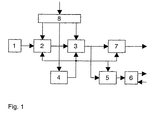
- the breathing sounds are picked up by the microphone (1). While in 2 synchronization to the wearer's breathing frequency takes place at the same time the signals emitted by the microphone (1) by frequency and Amplitude filter examined for whether they are noise. In this case further signal processing is prevented. Only signals in the one of interest The frequency and amplitude range are fed to a feature extraction (3). Here the frequency and amplitude signals are individually adjustable Characteristics compared and these comparison results quantized to provided for further processing. In FIG. 7 there is a conversion e.g. B. in a acoustic signal by which the wearer of the bronchitis sensor in front of one warning of impending seizure in good time.
- the doctor first records during an auscultation before the sensor is applied the pathological bronchial noise of the person to be checked.
- the typical sound frequencies pathofrequencies
- the typical sound frequencies are recorded externally. Only these characteristic frequencies and the ones determined from them typical features are then entered into the sensor as an internal standard and made available for signal detection. Along a timeline the sensor only scans these characteristic frequencies. As soon as Interference with the specified characteristics occurs, this condition is called Signal registered or saved. The time and possibly the duration this interference event are sufficient parameters for the automatic Monitoring the airways for the pathological in question Conditions.
- the respective path frequency can be found in a calibration curve that was previously created statistically and taking into account the size and age dependency.
- the frequency spectrum of the normal breathing noises is obtained individually.
- these frequencies e.g. for exhalation noise
- a calibration curve of the age- and size-dependent standard noise frequencies can be created most reliably and most accurately.
- the characteristic distance between these standard frequencies and the expected patho frequencies can also be determined statistically. On this basis, you can go to a corresponding nomogram with the individually measured standard frequency, read off the pathofrequency expected for the individual and specify this as an internal standard for the sensor, i.e. set the filters according to the characteristic frequencies.
- the entire sensor is designed as a microsystem.
- the recording of the sound is carried out by a capacitively readable chip microphone (1).
- the recording area is z. B. 20 to 2000 Hz, which already when recording the interested Signals a first filter effect is achieved in the system.
- a further individual setting is made by downstream programmable Filter (2).
- the condition of the monitored person's airways is determined by the sounds characterized during inhalation and exhalation.
- the breaths are striking.
- the Breathing frequency can be set when the device is started up. It corresponds the distance between two successive, relatively similar signal groups (Breathing impulses obtained from the frequency / amplitude spectrum).
- a Tracking the change in respiratory rate (change in time interval between two breaths) is based on appropriate measurements carried out automatically (see also claim 6).
- a first masking or suppression of noise is done via the Limitation of the observed frequency band to z. B. 20 to 2000 Hz Signal processing is also blocked when between two breathing pulses or during breathing signals occur that have a set threshold exceed and therefore a flawless detection and evaluation of the would make breathing difficult or impossible.
- the data obtained from the frequency / amplitude spectrum are, under Circumstances after using suitable transformation algorithms (e.g. Laplace or Fourier transformations), with the individually determined preset Data compared. If individually determined set values are exceeded Values the time of their occurrence is saved. This will make the registration or monitoring is limited to a few values, which means that the Memory consumption and the power consumption of the sensor are significantly reduced can be.
- suitable transformation algorithms e.g. Laplace or Fourier transformations
- Reading into the memory takes place in the usual way: a counter counts the used storage locations or indicates the next storage location. Reading out is controlled from the outside using the counter that is reset when reading or is set to zero.
Landscapes
- Health & Medical Sciences (AREA)
- Life Sciences & Earth Sciences (AREA)
- Pulmonology (AREA)
- Surgery (AREA)
- General Health & Medical Sciences (AREA)
- Heart & Thoracic Surgery (AREA)
- Medical Informatics (AREA)
- Molecular Biology (AREA)
- Engineering & Computer Science (AREA)
- Animal Behavior & Ethology (AREA)
- Biomedical Technology (AREA)
- Public Health (AREA)
- Veterinary Medicine (AREA)
- Physiology (AREA)
- Physics & Mathematics (AREA)
- Biophysics (AREA)
- Pathology (AREA)
- Measurement Of The Respiration, Hearing Ability, Form, And Blood Characteristics Of Living Organisms (AREA)
Description
In einem nächsten Schritt wird das aufgezeichnete Atemgeräusch einer Spektralanalyse unterzogen und das Ergebnis in einem Frequenz-Zeit-Diagramm dargestellt, wobei unterschiedlichen Intensitäten z. B. unterschiedliche Farben im Diagramm entsprechen. Diese Darstellungsweise soll den Arzt bei der Stellung der Diagnose unterstützen, da er hier eine zusätzliche optische Anzeige der Atemfrequenzen erhalt, aus deren Zeit- und Amplitudenverteilung ein krankhaftes Atemgeräusch zu erkennen ist.
Eine kontinuierliche Aufzeichnung unter normalen Lebensbedingungen ist jedoch hiermit nicht möglich, da die Fülle der Daten deren Auswertung und Speicherung sehr aufwendig macht. Die Auswertung muß hier optisch durch den behandelnden Arzt erfolgen.
Auch dieses Verfahren ist als Diagnoseverfahren für das Labor konzipiert und somit nicht auf einfache Weise zur Erfassung und Aufzeichnung auffälliger Atemgeräusche unter normalen Lebensbedingungen geeignet. Die von Person zu Person unterschiedlichen charakteristischen Anzeichen für das Auftreten krankhafter Atemgeräusche finden keine Berücksichtigung, so daß nicht in jedem Fall eine zuverlässige Aussage über die Krankheitssituation möglich ist.
Die an diesen charakteristischen Frequenzpositionen erfaßten Daten werden mit für die zu überwachende Person individuell ermittelten Daten auf Erfüllung eines oder mehrerer Kriterien für das Auftreten eines auffälligen Atemgeräusches verglichen. Diese individuell ermittelten Daten können z. B. Amplitudenwerte sein, deren Über- oder Unterschreitung bei dieser Person ein Anzeichen (Kriterium) für ein auffälliges Atemgeräusch sind. Die Bereitstellung der Meßinformation erfolgt entweder bei jedem Vergleich durch ein das Ergebnis des Vergleichs repräsentierendes Signal oder nur bei Erfüllung des/der Kriterien für das Auftreten eines auffälligen Atemgeräusches durch ein entsprechendes Signal. Das Signal kann z. B. in analoger Form durch einen bestimmten Spannungswert oder auch in digitaler Form bereitgestellt werden.
Die Reduktion der Auswertung auf diese charakteristische(n) Frequenz(en) führt zu einer erheblichen Datenreduktion und Verringerung des Rechenaufwandes und somit zu einer verbesserten Auswertemöglichkeit in Echtzeit.
Der Vergleich der Meßdaten mit für jede Person individuell ermittelten Vergleichswerten, wie auch die individuell ermittelten charakteristischen Frequenzen, erhöhen die Zuverlässigkeit des Verfahrens.
Durch die erhebliche Datenreduktion - im Minimalfall werden z. B. die Daten an nur einer charakteristischen Frequenzposition mit nur einem individuell bestimmten Amplitudenwert verglichen - wird auch der apparative Aufwand stark verringert, so daß es möglich ist, eine entsprechende Meßvorrichtung in miniaturisierter Bauweise (Mikrosystem) auszuführen (vgl. Anspruch 16), die dann über längere Zeit am Körper getragen werden kann, ohne die Bewegungsfreiheit des Trägers einzuschränken. Es wird somit eine kontinuierliche und belastungsfreie Registrierung auffälliger Atemgeräusche über einen Zeitraum von Stunden oder Tagen unter normalen Lebensbedingungen möglich.
Es können auch mehrere Mikrofone mit nachgeschalteter Signalverarbeitungseinheit an der Körperoberfläche der zu überwachenden Person (vorzugsweise im Bereich der Lunge) angebracht werden, deren Daten jedoch einer gemeinsamen Auswerteeinheit zugeführt werden. Die Signalverarbeitungseinheit dient der Verstärkung, eventuell der Digitalisierung, der Rauschunterdrückung und der Filterung der eingehenden Signale, wobei durch einstellbare Frequenzfilter (analoger oder digitalerArt) die charakteristische(n) Frequenz(en) herausgefiltert werden. Die Vergleichswerte und die Vergleichsergebnisse, d. h. die das Ergebnis der Vergleiche repräsentierenden Signale oder die nur bei Erfüllung gewisser Vergleichskriterien bereitgestellten Signale, werden jeweils in einer Speichereinheit abgelegt, wobei mit jedem Signalwert eine durch die Uhr vorgegebene Zeitinformation abgespeichert werden kann. Nach dem Ende der Meßzeit (mehrere Stunden oder Tage ) kann die im Speicher abgelegte Information extern gelesen und somit in Verbindung mit der abgespeicherten Zeitinformation ein Rückschluß auf das zeitliche Auftreten auffälliger Atemgeräusche der überwachten Person gezogen werden.
Insgesamt ergibt sich durch diese Erfindung eine den Probanden wenig belastende Methode zur Erfassung, Registrierung und Auswertung von Luftschadstoffwirkungen auf den Atemtrakt.
In einer vorteilhaften Ausgestaltung wird gemäß Anspruch 2 bei jedem Vergleich ein das Ergebnis des Vergleichs repräsentierender Wert gespeichert. Dieser Wert läßt eine Aussage darüber zu, ob der jeweilige Meßwert größer, gleich oder kleiner als der Vergleichswert war. Durch die Speicherung der Vergleichsergebnisse ist es möglich, nach Ablauf einer Meßzeit von mehreren Stunden oder Tagen aus den gespeicherten Werten eine Information über die Häufigkeit, den Zeitpunkt und den Zeitverlauf des Auftretens auffälliger Atemgeräusche der untersuchten Person zu gewinnen. Natürlich ist es auch möglich, zusätzlich bei jedem Vergleich eine exakte Zeitinformation abzuspeichern.
- Figur 1
- ein Blockschaltbild eines Ausführungsbeispieles des erfindungsgemäßen Verfahrens.
Für diesen Personenkreis wird zunächst das Frequenzspektrum der Normatemgeräusche individuell gewonnen. Für diese Frequenzen (z. B. für das Ausatmungsgeräusch) kann auch am zuverlässigsten und genauesten eine Eichkurve der alters- und größenabhängigen Normgeräuschsfrequenzen erstellt werden. Auch der charakteristische Abstand zwischen diesen Normfrequenzen und den erwarteten Pathofrequenzen kann statistisch ermittelt werden. Auf dieser Grundlage kann man mit der individuell gemessenen Normfrequenz in ein entsprechendes Nomogramm gehen, dort die für das Individuum erwartete Pathofrequenz ablesen und diese dem Sensor als inneren Standard vorgeben, das heißt, die Filter den charakteristischen Frequenzen entsprechend einstellen.
Claims (18)
- Verfahren zur automatischen Erfassung auffälliger Atemgeräusche, insbesondere von bronchitis- oder asthmakranken und -gefährdeten Personen, bei dem die Atemgeräusche einer zu überwachenden Person in einem zusammenhängenden Frequenzbereich in Echtzeit automatisch erfaßt, aufbereitet und ausgewertet werden,
wobei
aus dem erfaßten Frequenzbereich bei der Auswertung eine oder mehrere vorher für die zu untersuchende Person individuell bestimmte charakteristische Frequenz (en) berücksichtigt werden, an deren Position im Frequenzspektrum des Atemgeräusches der zu überwachenden Person ein auffälliges Atemgeräusch durch ein signifikantes Merkmal zu erkennen ist,
bei der Auswertung nur die an diesen Frequenzpositionen erfaßten Daten mit für die zu überwachende Person individuell ermittelten Daten auf Erfüllung eines oder mehrerer Kriterien für das Auftreten eines auffälligen Atemgeräusches verglichen werden,
und entweder bei jedem Vergleich ein das Ergebnis des Vergleichs repräsentierendes Signal oder nur bei Erfüllung des/der Kriterien ein dieses Ereignis repräsentierendes Signal bereitgestellt und ein das Vergleichsergebnis repräsentierender Wert gespeichert werden. - Verfahren nach Anspruch 1,
dadurch gekennzeichnet,
daß bei jedem Vergleich ein das Ergebnis des Vergleichs repräsentierender Wert gespeichert wird,
so daß nach Ablauf einer Meßzeit von mehreren Stunden oder Tagen aus den gespeicherten Werten eine Information über die Häufigkeit und den Zeitverlauf des Auftretens auffälliger Atemgeräusche gewonnen werden kann. - Verfahren nach Anspruch 1,
dadurch gekennzeichnet,
daß nur bei Erfüllung des/der Kriterien ein dieses Ereignis repräsentierender Wert einschließlich einer Information, die einen Rückschluß auf das zeitliche Auftreten des Ereignisses zuläßt, gespeichert wird/werden, so daß nach Ablauf einer Meßzeit von mehreren Stunden oder Tagen aus den gespeicherten Werten eine Information über die Häufigkeit und den Zeitverlauf des Auftretens auffälliger Atemgeräusche gewonnen werden kann. - Verfahren nach einem der Ansprüche 1 bis 3,
dadurch gekennzeichnet,
daß bei Erfüllung des/der Kriterien für ein auffälliges Atemgeräusch ein akustisches und/oder optisches und/oder elektrisches und/oder mechanisches Warnsignal ausgelöst wird. - Verfahren nach einem der Ansprüche 1 bis 4,
dadurch gekennzeichnet,
daß die Erfassung, Aufbereitung und Auswertung nur während des Einund/oder Ausatmens erfolgt. - Verfahren nach Anspruch 5,
dadurch gekennzeichnet,
daß der Ein- und/oder Ausatemvorgang aufgrund der typischen Atemgeräusche erkannt und ein voreingestellter Wert des zeitlichen Abstandes der Atemzyklen, während dessen keine Erfassung, Aufbereitung und Auswertung erfolgt, bei Veränderung der Atemfrequenz selbständig angepaßt wird. - Verfahren nach einem der Ansprüche 1 bis 6,
dadurch gekennzeichnet,
daß die bei der Auswertung zu berücksichtigende(n) Frequenz(en) durch geeignete Filter aus dem erfaßten Frequenzbereich herausgefiltert werden. - Verfahren nach einem der Ansprüche 1 bis 7,
dadurch gekennzeichnet,
daß als ein Kriterium für das Auftreten auffälliger Atemgeräusche die Überschreitung eines Amplituden-Schwellwertes gewählt wird. - Verfahren nach einem der Ansprüche 2 bis 8,
dadurch gekennzeichnet,
daß die Werte in einer Form gespeichert werden, in der sie eine Information über den jeweils erfaßten Amplitudenwert bei der jeweiligen Frequenz enthalten. - Verfahren nach einem der Ansprüche 2 bis 8,
dadurch gekennzeichnet,
daß die Werte in einer Form gespeichert werden, in der sie eine Information über die Summe der Amplitudenwerte bestimmter charakteristischer Frequenzen enthalten. - Verfahren nach einem der Ansprüche 1 bis 10,
dadurch gekennzeichnet,
daß das Auftreten starker Störgeräusche während der Meßzeit durch Überschreitung eines voreingestellten Amplitudenschwellwertes erkannt und die Signalverarbeitung in diesem Fall unterbrochen wird. - Verfahren nach einem der Ansprüche 1 bis 11,
dadurch gekennzeichnet,
daß die für die zu untersuchende Person charakteristische(n) Frequenz(en) und individuell ermittelten Daten durch eine getrennte Aufzeichnung- und Auswertung der Atemgeräusche dieser Person vor Beginn der Messung gewonnen werden. - Verfahren nach einem der Ansprüche 1 bis 11,
dadurch gekennzeichnet,
daß die für die zu untersuchende Person charakteristische(n) Frequenz(en) vor Beginn der Messung aus einem Nomogramm gewonnen werden, nachdem aus dem Atemgeräusch der zu untersuchenden Person die Normfrequenzen bestimmt wurden. - Verfahren nach einem der Ansprüche 1 bis 13,
dadurch gekennzeichnet,
daß die Atemgeräusche an einer oder mehreren Stellen der Körperoberfläche der zu überwachenden Person erfaßt werden, und die erfaßten Daten gemeinsam ausgewertet und gespeichert werden. - Vorrichtung zur Durchführung des Verfahrens nach einem der Ansprüche 1 bis 14, bestehend ausmindestens einem Mikrofon (1) zum Erfassen des Atemgeräusches,mindestens einer Signalverarbeitungseinheit (2), die einen oder mehrere einstellbare Frequenzfilter zur Selektion voreinstellbarer charakteristischer Frequenzen enthält,einer Auswerteeinheit (3), die für den Vergleich selektierter, mit dem Mikrofon erfaßter Meßdaten mit voreinstellbaren Vergleichswerten ausgelegt ist, und entweder bei jedem Vergleich oder nur bei Erfüllung des/der Kriterien für das Auftreten eines auffälligen Atemgeräusches einen das Vergleichsergebnis repräsentierenden Wert abspeichert,einer Uhr (4), die so in die Vorrichtung integriert ist, daß deren jeweilige Zeitinformation in Abhängigkeit des Ergebnisses des Vergleichs gespeichert werden kann,einer Spannungsversorgung,einer Speichereinheit (5), zum Abspeichern der Vergleichswerte und Vergleichsergebnisse undeiner Steuereinheit (8) zur Umsetzung kompakter, externer Initialisierungs- und Steuerinformationen auf die Subsysteme (2, 3, 4) der Vorrichtung,wobei die Vorrichtung so ausgestaltet ist, daß sie vom Probanden während der Messung über längere Zeit unter normalen Lebensbedingungen am Körper getragen werden kann, ohne dessen Bewegungsfreiheit einzuschränken.
- Vorrichtung nach Anspruch 15,
dadurch gekennzeichnet,
daß sie in miniaturisierter Bauweise ausgeführt und auf einem oder mehreren Chips integriert ist. - Vorrichtung nach Anspruch 15 oder 16,
dadurch gekennzeichnet,
daß sie eine Signaleinheit aufweist, die bei Bedarf ein akustisches und/oder optisches und/oder elektrisches und/oder mechanisches Signal abgibt. - Vorrichtung nach einem der Ansprüche 15 bis 17,
dadurch gekennzeichnet,
daß sie eine Stand-By-Schaltung aufweist, mit der der Energieverbrauch der Vorrichtung in der Zeit zwischen zwei Atemzyklen reduzierbar ist.
Applications Claiming Priority (3)
| Application Number | Priority Date | Filing Date | Title |
|---|---|---|---|
| DE4338466 | 1993-11-11 | ||
| DE4338466A DE4338466A1 (de) | 1993-11-11 | 1993-11-11 | Verfahren und Vorrichtung zur automatischen Erfassung auffälliger Atemgeräusche |
| PCT/DE1994/001282 WO1995013019A1 (de) | 1993-11-11 | 1994-10-28 | Verfahren und vorrichtung zur automatischen erfassung auffälliger atemgeräusche |
Publications (2)
| Publication Number | Publication Date |
|---|---|
| EP0727962A1 EP0727962A1 (de) | 1996-08-28 |
| EP0727962B1 true EP0727962B1 (de) | 2000-01-26 |
Family
ID=6502311
Family Applications (1)
| Application Number | Title | Priority Date | Filing Date |
|---|---|---|---|
| EP94931501A Expired - Lifetime EP0727962B1 (de) | 1993-11-11 | 1994-10-28 | Verfahren und vorrichtung zur automatischen erfassung auffälliger atemgeräusche |
Country Status (4)
| Country | Link |
|---|---|
| US (1) | US5928156A (de) |
| EP (1) | EP0727962B1 (de) |
| DE (2) | DE4338466A1 (de) |
| WO (1) | WO1995013019A1 (de) |
Families Citing this family (37)
| Publication number | Priority date | Publication date | Assignee | Title |
|---|---|---|---|---|
| AUPN394895A0 (en) * | 1995-07-03 | 1995-07-27 | Rescare Limited | Auto-calibration of pressure transducer offset |
| DE19605028C1 (de) * | 1996-02-05 | 1997-06-26 | Ufz Leipzighalle Gmbh | Fixiervorrichtung für Sensoren auf der Hautoberfläche und Verfahren zum Nachweis des Entfernens von Sensoren von der Hautoberfläche |
| US6050950A (en) | 1996-12-18 | 2000-04-18 | Aurora Holdings, Llc | Passive/non-invasive systemic and pulmonary blood pressure measurement |
| US6169915B1 (en) | 1997-01-13 | 2001-01-02 | Ufz-Umweltforschungszentrum Leipzighalle Gmbh | Device for fastening of sensors to the surface of the skin and a method for detecting the removal of sensors from the surface of the skin |
| US6228040B1 (en) | 1998-08-04 | 2001-05-08 | Western Research Company, Inc. | Method and apparatus for diagnosis of irritable bowel syndrome |
| FR2791248B1 (fr) * | 1999-03-24 | 2001-08-24 | Georges Kehyayan | Dispositif d'analyse de bruits auscultatoires, en particulier de bruits respiratoires |
| DE29910326U1 (de) | 1999-06-14 | 1999-08-26 | Maier, Folker, Dipl.-Ing., 74538 Rosengarten | Am Körper zu tragende Vorrichtung zum Erfassen von Energie |
| AU2001248369A1 (en) * | 2000-04-20 | 2001-11-07 | Thomas Hilfen Hilbeg Gmbh And Co. Kg | Method and device for measuring vital parameters |
| US8394031B2 (en) * | 2000-10-06 | 2013-03-12 | Biomedical Acoustic Research, Corp. | Acoustic detection of endotracheal tube location |
| US20030048836A1 (en) * | 2001-09-07 | 2003-03-13 | Hsieh Gary Kuan-Hong | Astute system for detect to adapt to environment |
| DE20211929U1 (de) * | 2002-08-02 | 2003-12-11 | Petra-Electric Peter Hohlfeldt Gmbh & Co | Atemgeräuschkontrollvorrichtung |
| GB2395437C (en) * | 2002-11-20 | 2010-10-20 | Profile Respiratory Systems Ltd | Improved inhalation method and apparatus |
| US6949075B2 (en) * | 2002-12-27 | 2005-09-27 | Cardiac Pacemakers, Inc. | Apparatus and method for detecting lung sounds using an implanted device |
| US20050080348A1 (en) * | 2003-09-18 | 2005-04-14 | Stahmann Jeffrey E. | Medical event logbook system and method |
| CA2464029A1 (en) | 2004-04-08 | 2005-10-08 | Valery Telfort | Non-invasive ventilation monitor |
| US7882834B2 (en) * | 2004-08-06 | 2011-02-08 | Fisher & Paykel Healthcare Limited | Autotitrating method and apparatus |
| US7630755B2 (en) | 2005-05-04 | 2009-12-08 | Cardiac Pacemakers Inc. | Syncope logbook and method of using same |
| GB0511307D0 (en) * | 2005-06-03 | 2005-07-13 | South Manchester University Ho | A method for generating output data |
| EP1898786B1 (de) * | 2005-06-03 | 2011-03-30 | South Manchester University Hospitals NHS Trust | Verfahren zur erzeugung von ausgabedaten |
| US7777632B2 (en) * | 2006-02-06 | 2010-08-17 | Cooper Technologies Company | Acoustic occupancy sensor |
| US20070183329A1 (en) * | 2006-02-06 | 2007-08-09 | Cooper Technologies Company | Networking of switchpacks |
| US8920343B2 (en) | 2006-03-23 | 2014-12-30 | Michael Edward Sabatino | Apparatus for acquiring and processing of physiological auditory signals |
| DE102007001921B3 (de) | 2007-01-12 | 2008-08-28 | Enverdis Gmbh | Medizinischer Schallsensor sowie Diagnoseverfahren zur Diagnose von Herz- und/ oder Lungenerkrankungen |
| US8218871B2 (en) * | 2008-03-05 | 2012-07-10 | International Business Machines Corporation | Detecting behavioral deviations by measuring respiratory patterns in cohort groups |
| US8345935B2 (en) * | 2008-03-17 | 2013-01-01 | International Business Machines Corporation | Detecting behavioral deviations by measuring eye movements |
| US8430817B1 (en) | 2009-10-15 | 2013-04-30 | Masimo Corporation | System for determining confidence in respiratory rate measurements |
| US9848800B1 (en) | 2009-10-16 | 2017-12-26 | Masimo Corporation | Respiratory pause detector |
| GB2487882B (en) | 2009-12-04 | 2017-03-29 | Masimo Corp | Calibration for multi-stage physiological monitors |
| US9307928B1 (en) | 2010-03-30 | 2016-04-12 | Masimo Corporation | Plethysmographic respiration processor |
| US8991392B1 (en) | 2010-12-21 | 2015-03-31 | Fisher & Paykel Healthcare Limited | Pressure adjustment method for CPAP machine |
| JP5942566B2 (ja) * | 2012-04-19 | 2016-06-29 | 富士通株式会社 | 無呼吸判定プログラム、無呼吸判定装置及び無呼吸判定方法 |
| US10736515B2 (en) | 2012-06-07 | 2020-08-11 | Clarkson University | Portable monitoring device for breath detection |
| US8663126B1 (en) | 2013-02-19 | 2014-03-04 | Fatemah S. Al Thalab | Wearable acoustic device for monitoring breathing sounds |
| US10441181B1 (en) | 2013-03-13 | 2019-10-15 | Masimo Corporation | Acoustic pulse and respiration monitoring system |
| TWI646942B (zh) | 2018-02-06 | 2019-01-11 | 財團法人工業技術研究院 | 肺音監測裝置及肺音監測方法 |
| CN112466328B (zh) * | 2020-10-29 | 2023-10-24 | 北京百度网讯科技有限公司 | 呼吸音检测方法、装置和电子设备 |
| DE102021100061A1 (de) | 2021-01-05 | 2022-07-07 | Dräger Safety AG & Co. KGaA | Kommunikationsgerät und Kommunikationssystem zum Überwachen einer Atmung |
Family Cites Families (13)
| Publication number | Priority date | Publication date | Assignee | Title |
|---|---|---|---|---|
| US3990435A (en) * | 1974-09-30 | 1976-11-09 | Murphy Raymond L H | Breath sound diagnostic apparatus |
| DE2948863A1 (de) * | 1979-12-05 | 1981-06-11 | Ulrich H. Priv.-Doz. Dr.med. 7542 Schömberg Cegla | Diagnosegeraet zum messen der in der lunge und in den bronchien eines probanden auftretenden schallphaenomene und zum gleichzeitigen registrieren der atemstaerke |
| US4428381A (en) * | 1981-03-13 | 1984-01-31 | Medtronic, Inc. | Monitoring device |
| US4686999A (en) * | 1985-04-10 | 1987-08-18 | Tri Fund Research Corporation | Multi-channel ventilation monitor and method |
| US4889130A (en) * | 1985-10-11 | 1989-12-26 | Lee Arnold St J | Method for monitoring a subject's heart and lung sounds |
| GB8825611D0 (en) * | 1988-11-02 | 1988-12-07 | Stoneman S A T | Respiratory condition diagnosis & apparatus therefor |
| US4982738A (en) * | 1988-11-30 | 1991-01-08 | Dr. Madaus Gmbh | Diagnostic apnea monitor system |
| US5165417A (en) * | 1989-09-12 | 1992-11-24 | Murphy Jr Raymond L H | Lung sound detection system and method |
| US5058600A (en) * | 1990-01-08 | 1991-10-22 | Center For Innovative Technology | Graphical readout of laryngotracheal spectra and airway monitor |
| GB2240392A (en) * | 1990-01-17 | 1991-07-31 | Rory Joseph Donnelly | Acoustic monitor for vital functions |
| US5133346A (en) * | 1990-12-03 | 1992-07-28 | Arvee Medical, Incorporated | Apnea monitor data system |
| DE4138702A1 (de) * | 1991-03-22 | 1992-09-24 | Madaus Medizin Elektronik | Verfahren und vorrichtung zur diagnose und quantitativen analyse von apnoe und zur gleichzeitigen feststellung anderer erkrankungen |
| US5301679A (en) * | 1991-05-31 | 1994-04-12 | Taylor Microtechnology, Inc. | Method and system for analysis of body sounds |
-
1993
- 1993-11-11 DE DE4338466A patent/DE4338466A1/de not_active Withdrawn
-
1994
- 1994-10-28 EP EP94931501A patent/EP0727962B1/de not_active Expired - Lifetime
- 1994-10-28 DE DE59409110T patent/DE59409110D1/de not_active Expired - Fee Related
- 1994-10-28 WO PCT/DE1994/001282 patent/WO1995013019A1/de not_active Ceased
- 1994-10-28 US US08/640,857 patent/US5928156A/en not_active Expired - Fee Related
Also Published As
| Publication number | Publication date |
|---|---|
| DE59409110D1 (de) | 2000-03-02 |
| US5928156A (en) | 1999-07-27 |
| WO1995013019A1 (de) | 1995-05-18 |
| EP0727962A1 (de) | 1996-08-28 |
| DE4338466A1 (de) | 1995-05-18 |
Similar Documents
| Publication | Publication Date | Title |
|---|---|---|
| DE4338466A1 (de) | Verfahren und Vorrichtung zur automatischen Erfassung auffälliger Atemgeräusche | |
| EP0858287B1 (de) | Vorrichtung zur quantitativen analyse von schlafstörungen | |
| DE69126315T2 (de) | Narkoseüberwachung | |
| EP0504945B1 (de) | Vorrichtung zur Diagnose und quantitativen Analyse von Apnoe und zur gleichzeitigen Feststellung anderer Erkrankungen | |
| DE69331951T2 (de) | Vorrichtung zur anzeige von apnoe während des schlafens | |
| DE4091020C2 (de) | Verfahren und Vorrichtung zum Überwachen, Anzeigen und/oder Aufzeichnen von bioelektrischen Spannungssignalen eines menschlichen oder tierischen Körpers | |
| DE69208791T2 (de) | Anordnung und Verfahren zur Erkennung von Tremor, insbesondere bei Parkinsonismus | |
| EP0371424B1 (de) | Überwachungsvorrichtung zur Diagnose von Apnoe | |
| DE3023648A1 (de) | Einrichtung zur untersuchung der atemwege auf reizstoff-ueberempfindlichkeit | |
| DE102007031017B3 (de) | Verfahren zum Betreiben einer Anästhesie- oder Beatmungsvorrichtung mit Triggerfunktion und Vorrichtung hierzu | |
| DE102008002933A1 (de) | Datenaufzeichnung zur Patientenstatusanalyse | |
| DE102006057709A1 (de) | Vorrichtung und Verfahrren zum Bestimmen einer Atemfrequenz | |
| DE69112703T2 (de) | Tragbares Überwachungsgerät. | |
| EP0892619B1 (de) | Gerät zur registrierung von befindlichkeitswerten | |
| DE102019129288A1 (de) | Vorrichtung und Verfahren zur Bestimmung des Schweregrads einer Schlafapnoe | |
| DE3004515C2 (de) | Apparatur zur Bestimmung einer Hypersensitivität der Atemluftwege | |
| EP2162061B1 (de) | Nachweis einer apnoe mit blutdruckabhängig erfassten signalen | |
| WO2007118560A2 (de) | Automatische detektion von hypopnoen | |
| DE102012100441A1 (de) | Verfahren und Vorrichtung zur kontinuierlichen Messung von Intraokulardrücken | |
| DE2232875A1 (de) | Einrichtung zur ermittlung von messdaten durch automatische fernregistrierung | |
| EP0445809B1 (de) | Blutdruckmessvorrichtung | |
| EP1192897B1 (de) | Risikomonitoring | |
| WO2009079977A2 (de) | Verfahren und vorrichtung zur schlafmedizinischen vorabdiagnose und therapie-begleitung | |
| DE4114357A1 (de) | Verfahren zur automatischen diagnose von apnoe | |
| DE2413941A1 (de) | Verfahren und einrichtung zur kontrolle des narkosegrades bei operationen |
Legal Events
| Date | Code | Title | Description |
|---|---|---|---|
| PUAI | Public reference made under article 153(3) epc to a published international application that has entered the european phase |
Free format text: ORIGINAL CODE: 0009012 |
|
| 17P | Request for examination filed |
Effective date: 19960619 |
|
| AK | Designated contracting states |
Kind code of ref document: A1 Designated state(s): BE DE FR GB IT NL |
|
| 17Q | First examination report despatched |
Effective date: 19970805 |
|
| GRAG | Despatch of communication of intention to grant |
Free format text: ORIGINAL CODE: EPIDOS AGRA |
|
| GRAG | Despatch of communication of intention to grant |
Free format text: ORIGINAL CODE: EPIDOS AGRA |
|
| GRAH | Despatch of communication of intention to grant a patent |
Free format text: ORIGINAL CODE: EPIDOS IGRA |
|
| GRAH | Despatch of communication of intention to grant a patent |
Free format text: ORIGINAL CODE: EPIDOS IGRA |
|
| GRAA | (expected) grant |
Free format text: ORIGINAL CODE: 0009210 |
|
| AK | Designated contracting states |
Kind code of ref document: B1 Designated state(s): BE DE FR GB IT NL |
|
| REF | Corresponds to: |
Ref document number: 59409110 Country of ref document: DE Date of ref document: 20000302 |
|
| ITF | It: translation for a ep patent filed | ||
| ET | Fr: translation filed | ||
| GBT | Gb: translation of ep patent filed (gb section 77(6)(a)/1977) |
Effective date: 20000502 |
|
| PLBE | No opposition filed within time limit |
Free format text: ORIGINAL CODE: 0009261 |
|
| STAA | Information on the status of an ep patent application or granted ep patent |
Free format text: STATUS: NO OPPOSITION FILED WITHIN TIME LIMIT |
|
| 26N | No opposition filed | ||
| REG | Reference to a national code |
Ref country code: GB Ref legal event code: IF02 |
|
| PGFP | Annual fee paid to national office [announced via postgrant information from national office to epo] |
Ref country code: BE Payment date: 20020923 Year of fee payment: 9 |
|
| PGFP | Annual fee paid to national office [announced via postgrant information from national office to epo] |
Ref country code: GB Payment date: 20021004 Year of fee payment: 9 |
|
| PGFP | Annual fee paid to national office [announced via postgrant information from national office to epo] |
Ref country code: FR Payment date: 20021018 Year of fee payment: 9 |
|
| PGFP | Annual fee paid to national office [announced via postgrant information from national office to epo] |
Ref country code: NL Payment date: 20021022 Year of fee payment: 9 |
|
| PGFP | Annual fee paid to national office [announced via postgrant information from national office to epo] |
Ref country code: DE Payment date: 20021213 Year of fee payment: 9 |
|
| PG25 | Lapsed in a contracting state [announced via postgrant information from national office to epo] |
Ref country code: GB Free format text: LAPSE BECAUSE OF NON-PAYMENT OF DUE FEES Effective date: 20031028 |
|
| PG25 | Lapsed in a contracting state [announced via postgrant information from national office to epo] |
Ref country code: BE Free format text: LAPSE BECAUSE OF NON-PAYMENT OF DUE FEES Effective date: 20031031 |
|
| BERE | Be: lapsed |
Owner name: UMWELTFORSCHUNGSZENTRUM LEIPZIG-HALLE G.M.B.H.*UFZ Effective date: 20031031 Owner name: *FRAUNHOFER-GESELLSCHAFT ZUR FORDERUNG DER ANGEWAN Effective date: 20031031 |
|
| PG25 | Lapsed in a contracting state [announced via postgrant information from national office to epo] |
Ref country code: NL Free format text: LAPSE BECAUSE OF NON-PAYMENT OF DUE FEES Effective date: 20040501 Ref country code: DE Free format text: LAPSE BECAUSE OF NON-PAYMENT OF DUE FEES Effective date: 20040501 |
|
| GBPC | Gb: european patent ceased through non-payment of renewal fee |
Effective date: 20031028 |
|
| PG25 | Lapsed in a contracting state [announced via postgrant information from national office to epo] |
Ref country code: FR Free format text: LAPSE BECAUSE OF NON-PAYMENT OF DUE FEES Effective date: 20040630 |
|
| NLV4 | Nl: lapsed or anulled due to non-payment of the annual fee |
Effective date: 20040501 |
|
| REG | Reference to a national code |
Ref country code: FR Ref legal event code: ST |
|
| PG25 | Lapsed in a contracting state [announced via postgrant information from national office to epo] |
Ref country code: IT Free format text: LAPSE BECAUSE OF NON-PAYMENT OF DUE FEES;WARNING: LAPSES OF ITALIAN PATENTS WITH EFFECTIVE DATE BEFORE 2007 MAY HAVE OCCURRED AT ANY TIME BEFORE 2007. THE CORRECT EFFECTIVE DATE MAY BE DIFFERENT FROM THE ONE RECORDED. Effective date: 20051028 |