EP0726609B1 - Solid electrolyte for a fuel cell and its manufacturing method - Google Patents
Solid electrolyte for a fuel cell and its manufacturing method Download PDFInfo
- Publication number
- EP0726609B1 EP0726609B1 EP95105914A EP95105914A EP0726609B1 EP 0726609 B1 EP0726609 B1 EP 0726609B1 EP 95105914 A EP95105914 A EP 95105914A EP 95105914 A EP95105914 A EP 95105914A EP 0726609 B1 EP0726609 B1 EP 0726609B1
- Authority
- EP
- European Patent Office
- Prior art keywords
- solid electrolyte
- oxide
- cerium
- cerium oxide
- fuel cell
- Prior art date
- Legal status (The legal status is an assumption and is not a legal conclusion. Google has not performed a legal analysis and makes no representation as to the accuracy of the status listed.)
- Expired - Lifetime
Links
Images



Classifications
-
- H—ELECTRICITY
- H01—ELECTRIC ELEMENTS
- H01M—PROCESSES OR MEANS, e.g. BATTERIES, FOR THE DIRECT CONVERSION OF CHEMICAL ENERGY INTO ELECTRICAL ENERGY
- H01M4/00—Electrodes
- H01M4/86—Inert electrodes with catalytic activity, e.g. for fuel cells
- H01M4/90—Selection of catalytic material
- H01M4/9016—Oxides, hydroxides or oxygenated metallic salts
- H01M4/9025—Oxides specially used in fuel cell operating at high temperature, e.g. SOFC
- H01M4/9033—Complex oxides, optionally doped, of the type M1MeO3, M1 being an alkaline earth metal or a rare earth, Me being a metal, e.g. perovskites
-
- H—ELECTRICITY
- H01—ELECTRIC ELEMENTS
- H01M—PROCESSES OR MEANS, e.g. BATTERIES, FOR THE DIRECT CONVERSION OF CHEMICAL ENERGY INTO ELECTRICAL ENERGY
- H01M8/00—Fuel cells; Manufacture thereof
- H01M8/10—Fuel cells with solid electrolytes
- H01M8/12—Fuel cells with solid electrolytes operating at high temperature, e.g. with stabilised ZrO2 electrolyte
- H01M8/124—Fuel cells with solid electrolytes operating at high temperature, e.g. with stabilised ZrO2 electrolyte characterised by the process of manufacturing or by the material of the electrolyte
- H01M8/1246—Fuel cells with solid electrolytes operating at high temperature, e.g. with stabilised ZrO2 electrolyte characterised by the process of manufacturing or by the material of the electrolyte the electrolyte consisting of oxides
-
- H—ELECTRICITY
- H01—ELECTRIC ELEMENTS
- H01M—PROCESSES OR MEANS, e.g. BATTERIES, FOR THE DIRECT CONVERSION OF CHEMICAL ENERGY INTO ELECTRICAL ENERGY
- H01M2300/00—Electrolytes
- H01M2300/0088—Composites
- H01M2300/0094—Composites in the form of layered products, e.g. coatings
-
- Y—GENERAL TAGGING OF NEW TECHNOLOGICAL DEVELOPMENTS; GENERAL TAGGING OF CROSS-SECTIONAL TECHNOLOGIES SPANNING OVER SEVERAL SECTIONS OF THE IPC; TECHNICAL SUBJECTS COVERED BY FORMER USPC CROSS-REFERENCE ART COLLECTIONS [XRACs] AND DIGESTS
- Y02—TECHNOLOGIES OR APPLICATIONS FOR MITIGATION OR ADAPTATION AGAINST CLIMATE CHANGE
- Y02E—REDUCTION OF GREENHOUSE GAS [GHG] EMISSIONS, RELATED TO ENERGY GENERATION, TRANSMISSION OR DISTRIBUTION
- Y02E60/00—Enabling technologies; Technologies with a potential or indirect contribution to GHG emissions mitigation
- Y02E60/30—Hydrogen technology
- Y02E60/50—Fuel cells
-
- Y—GENERAL TAGGING OF NEW TECHNOLOGICAL DEVELOPMENTS; GENERAL TAGGING OF CROSS-SECTIONAL TECHNOLOGIES SPANNING OVER SEVERAL SECTIONS OF THE IPC; TECHNICAL SUBJECTS COVERED BY FORMER USPC CROSS-REFERENCE ART COLLECTIONS [XRACs] AND DIGESTS
- Y02—TECHNOLOGIES OR APPLICATIONS FOR MITIGATION OR ADAPTATION AGAINST CLIMATE CHANGE
- Y02P—CLIMATE CHANGE MITIGATION TECHNOLOGIES IN THE PRODUCTION OR PROCESSING OF GOODS
- Y02P70/00—Climate change mitigation technologies in the production process for final industrial or consumer products
- Y02P70/50—Manufacturing or production processes characterised by the final manufactured product
Definitions
- the present invention relates to a solid electrolyte for a fuel cell and its manufacturing method.
- This solid electrolyte comprises a solid electrolyte of oxide-ionic conduction which consists essentially of cerium oxide and a membrane of a solid electrolyte of proton/oxide-ionic mixed conduction bonded on the solid electrolyte of oxide-ionic conduction.
- a most frequently used material of a solid electrolyte for a high-temperature-type fuel cell is zirconia stabilized with yttrium oxide.
- a solid electrolyte of higher ionic conductivity has been demanded.
- a solid electrolyte consisting essentially of cerium oxide can be used in place of stabilized-zirconia electrolyte.
- the fuel gas supplied to its anode's side is H 2 , CH 4 or the like, the cerium oxide contained in the electrolyte may be partially reduced under the effect of the fuel gas at its operating temperature because of its low partial pressure of oxygen, which can present a problem of decrease in terminal voltage.
- the object of the present invention is to provide a solid electrolyte of proton/oxide-ionic mixed conduction on the anode's side surface of a solid electrolyte consisting essentially of cerium oxide in such a manner that a high degree of adhesiveness can be achieved between these electrolytes and this bonding can be performed inexpensively and easily.
- a further object of the present invention is to provide a fuel cell which utilizes the above mentioned solid electrolyte.
- a solid electrolyte for a fuel cell which comprises a solid electrolyte of proton/oxide-ionic mixed conduction bonded on one surface of a solid electrolyte of oxide-ionic conduction can be obtained easily by coating at least one material selected from the inorganic acid salts, organic acid salts and organic metal compounds of the alkaline earth metals which are the elements composing the solid electrolyte of proton/oxide-ionic mixed conduction on one surface of a solid electrolyte consisting essentially of cerium oxide, and causing a reaction between the alkaline earth metal compounds and the solid electrolyte of oxide-ionic conduction in an oxidizing atmosphere at a temperature higher than 800 °C.
- the present invention described hereinafter is based on this finding.
- a solid electrolyte for a fuel cell comprising:
- a solid electrolyte fuel cell comprising:
- Fig. 1 is an X-ray diffraction pattern of the surface of a solid electrolyte which was obtained by coating saturated aqueous barium nitrate on the surface of disk-like close sintered-body based on cerium oxide which is a solid solution containing 20 mol% of YO 1.5 , drying the solid electrolyte thus coated, and firing it at 1300 °C for 10 hours in air.
- Fig. 2 shows a sectional view of the surface structure of a solid electrolyte which was obtained by coating saturated aqueous barium nitrate on the surface of disk-like close sintered-body based on cerium oxide which is a solid solution containing 20 mol% of YO 1.5 , drying the solid electrolyte thus coated, and firing it at 1300 °C for 10 hours in air.
- the horizontal axis represents the distance and the vertical axis represents the concentration of the elements.
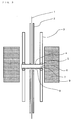
- Fig. 3 is a schematic view of a fuel cell according to the present invention.
- Fig. 4 is a graph showing voltage-current characteristics of a fuel cell according to the present invention.
- a specifically-shaped solid electrolyte consisting essentially of cerium oxide is used as a solid electrolyte of oxide-ionic conduction which has suitable operating properties in a high temperature environment.
- the shape of this solid electrolyte may be either plate-like or cylindrical according to a required shape for a fuel cell.
- cerium-oxide solid solution which contains 1 to 30 mol% of at least one element selected from the group of alkaline earth metals (Mg, Sr, Ca, Ba) and rare earth elements (Sc, Y, La, Nd, Sm, Eu, Gd, Dy, Ho, Yb), instead of the above mentioned solid electrolyte consisting of cerium oxide.
- Alkaline earth metals Mg, Sr, Ca, Ba
- rare earth elements Sc, Y, La, Nd, Sm, Eu, Gd, Dy, Ho, Yb
- Examples of the solid electrolyte of oxide-ionic conduction includes (CeO 2 ) 0.8 (YO 1.5 ) 0.2 , (CeO 2 ) 0.9 (SmO 1.5 ) 0.1 , (CeO 2 ) 0.8 (CaO) 0.2 , (CeO 2 ) 0.8 (SrO) 0.2 and the like.
- Examples of the methods for coating at least one material selected from the inorganic acid salts, organic acid salts and organic metal compounds of alkaline earth metals include
- This electrolyte of proton/oxide-ionic mixed conduction is a perovskite-type oxide having an ABO3-type composition.
- a of the "ABO 3 " represents at least one element selected from the group consisting of alkaline earth metals (Mg, Sr, Ca, Ba), and B of the “ABO 3 " represents at least one element selected from rare earth elements and the like, more specifically, cerium by itself or cerium and at least one element selected from a group consisting of alkaline earth metals (Mg, Sr, Ca, Ba) and rare earth elements (Sc, Y, La, Nd, Sm, Eu, Gd, Dy, Ho, Yb), the element(s) selected from alkaline earth metals and rare earth elements substituting the cerium by 1 to 30 mol%.
- this solid electrolyte of proton/oxide-ionic mixed conduction is preferably 10 ⁇ m or more.
- the thickness less than 10 ⁇ m cannot prevent the solid electrolyte of oxide-ionic conduction from being reduced under the influence of the fuel gas which enters into it.
- An electrode material as an anode such as Ni paste, Pt paste or the like is applied on the surface of the solid electrolyte of proton/oxide-ionic mixed conduction so that this electrode material can act as an anode of a fuel cell.
- an electrode material as an anode such as Ni paste, Pt paste or the like is applied on the surface of the solid electrolyte of proton/oxide-ionic mixed conduction so that this electrode material can act as an anode of a fuel cell.
- a solid electrolyte which has a high degree of adhesiveness to the solid electrolyte of oxide-ionic conduction and which forms a cathode is provided.
- this solid electrolyte examples include well-known perovskite-type rare earth metal oxide and the like, and more specifically, La 0.7 Sr 0.3 MnO 3 , Ca 0.9 Ce 0.1 MnO 3 , La 0.7 Sr 0.3 CoO 3 and the like.
- An interconnector or a separator which is made of platinum, La 0.7 Ca 0.3 CrO 3 or a heat resistant alloy (e.g. Inconel) can be connected to the anode and the cathode mentioned above. It is possible to constitute a high-power fuel cell by connecting elementary cells in series or parallel with the use of this interconnector.
- the oxide-ionic conductor consisting essentially of cerium oxide has the characteristics that the polarization of its electrode reaction is small on the interface of the electrode, and at the same time, in the anode's side, the proton/oxide-ionic mixed conductor has the characteristics that the polarization of its electrode reaction is small, which makes it possible to obtain electric high power density in the generation of electric current.
- the oxide-ionic conductor consisting essentially of cerium oxide has the characteristics that the polarization of its electrode reaction is small on the interface of the electrode
- the proton/oxide-ionic mixed conductor has the characteristics that the polarization of its electrode reaction is small, which makes it possible to obtain electric high power density in the generation of electric current.
- Saturated aqueous barium nitrate was coated on the surface of disk-shaped close sintered-body based on cerium oxide which is a substitutional solid solution containing 20 mol% of YO 1.5 . Then the sintered-body thus coated was dried, and fired at 1300 °C for 10 hours in air.
- Fig. 1 shows a X-ray diffraction pattern of the membrane thus obtained.
- This membrane had a diffraction pattern which could be identified as BaCeO 3 according to the X-ray diffraction data listed in JCPDS, and found to be BaCeO 3 .
- Fig. 2 shows a sectional view of the membrane thus obtained.
- the thickness of this membrane was 30 to 40 ⁇ m.
- the adhesiveness of the BaCeO 3 membrane to the solid solution based on cerium oxide was appropriate and the delamination between them was not observed even after the heat cycle from room temperature to 1000 °C had been repeated 30 times and more.
- a fuel cell was composed with the use of the solid electrolyte of oxide-ionic conduction consisting essentially of cerium oxide mentioned above.
- Paste of La 0.7 Sr 0.3 MnO 3 was coated on the central area (about 2 cm 2 ) of the surface of this solid electrolyte which was plate-shaped and about 0.4 mm in thickness.
- Paste of Ni as anode was coated on the surface of the solid electrolyte of proton/oxide-ionic conduction mentioned above.
- the paste of La 0.7 Sr 0.3 MnO 3 as cathode and the paste of Ni on these solid electrolytes were fired. Thus a porous electrode was obtained.
- Fig.3 shows a fuel cell thus obtained.
- an alumina pipe 3 was connected to the surface of an electrode 6 with the use of Pyrex glass 5 as a gas seal material.
- Two alumina tubes 2 each of which contained a platinum wire were inserted into the alumina pipe 3 in order to form a fuel cell.
- This fuel cell was placed in an electric furnace 9 and maintained at 1000 °C.
- Air was introduced into the space 4 located in the side of the cathode (La 0.7 Sr 0.3 MnO 3 ), and hydrogen gas was introduced into the space 7 located in the side of the solid electrolyte of proton/oxide-ionic conduction.
- a Ni electrode 8 was used as an electrode provided for the anode.
- Fig. 4 shows the voltage-current characteristics of the fuel cell thus obtained.
- the measured voltage of this cell generally agreed with the theoretical electromotive force calculated from a theoretical formula and showed that the fuel cell according to the present invention displayed higher no-load voltage than that of a conventional fuel cell.
- a fuel cell in which the solid electrolyte layer of proton/oxide-ionic mixed conduction is used for anode side and its cathode is formed on the solid electrolyte of oxide-ionic conduction can show greatly advantageous characteristics for a fuel cell.
Landscapes
- Engineering & Computer Science (AREA)
- Chemical & Material Sciences (AREA)
- Manufacturing & Machinery (AREA)
- Chemical Kinetics & Catalysis (AREA)
- Electrochemistry (AREA)
- General Chemical & Material Sciences (AREA)
- Materials Engineering (AREA)
- Life Sciences & Earth Sciences (AREA)
- Sustainable Development (AREA)
- Sustainable Energy (AREA)
- Fuel Cell (AREA)
- Conductive Materials (AREA)
Description
Claims (7)
- A solid electrolyte for a fuel cell comprising:a) a specifically-shaped solid electrolyte consisting essentially of cerium oxide having a fluorite-type structure and oxide-ionic conduction, andb) a membrane of a perovskite-type oxide having an ABO3-type composition, which is a solid electrolyte of proton/oxide-ionic mixed conduction, being bonded on a portion of a surface of the solid electrolyte consisting essentially of cerium oxide, in which(i) A of the "ABO3" represents at least one element selected from a group consisting of alkaline earth metals (Mg, Sr, Ca, Ba), and(ii) B of the "ABO3" represents cerium by itself or cerium and at least one element selected from a group consisting of alkaline earth metals (Mg, Sr, Ca, Ba) and rare earth elements (Sc, Y, La, Nd, Sm, Eu, Gd, Dy, Ho, Yb), the elements selected from alkaline earth metals and rare earth elements substituting the cerium by 1 to 30 mol%.
- A solid electrolyte according to Claim 1, wherein instead of cerium oxide, the solid electrolyte consists essentially of cerium oxide solid solution in which a part of said cerium oxide is substituted by at least one oxide of an element selected from a group consisting of alkaline earth metals (Mg, Sr, Ca, Ba) and rare earth elements (Sc, Y, La, Nd, Sm, Eu, Gd, Dy, Ho, Yb) in an amount of 1 to 30 mol%.
- A method for producing a solid electrolyte for a fuel cell comprising the steps of:(a) preparing a specifically-shaped solid electrolyte consisting essentially of cerium oxide which has a fluorite-type structure and oxide-ionic conduction,(b) coating at least one material selected from the inorganic acid salts, organic acid salts and organic metal compounds of alkaline earth metals (Mg, Sr, Ca, Ba) on a part of a surface of the solid electrolyte consisting essentially of cerium oxide, and(c) heating the solid electrolyte thus coated to a temperature higher than 800°C in an oxidizing atmosphere to form a solid electrolyte membrane of proton/oxide-ionic mixed conduction on the part of the surface of the solid electrolyte consisting essentially of cerium oxide.
- A method according to Claim 3, wherein the specifically-shaped solid electrolyte consists essentially of cerium oxide or its substitutional solid solution in which a part of the cerium is substituted by at least one element selected from a group consisting of alkaline earth metals (Mg, Sr, Ca, Ba) and rare earth elements (Sc, Y, La, Nd, Sm, Eu, Gd, Dy, Ho, Yb) in an amount of 1 to 30 mol%.
- A solid electrolyte fuel cell comprising:(a) a specifically-shaped body formed from a solid electrolyte according to Claim 1,(b) an anode formed from sintered Ni paste or Pt paste formed on the fuel side of the perovskite-type oxide membrane bonded on a part of the surface of the specifically-shaped body, and(c) a cathode formed from a perovskite-type rare-earth metal oxide bonded on another part of the surface of the specifically shaped body.
- A solid electrolyte fuel cell according to Claim 5, wherein, stead of cerium oxide, the solid electrolyte consists essentially of cerium oxide solid solution in which a part of the cerium oxide is substituted by at least one oxide of an element selected from a group consisting of alkaline earth metals Mg, Sr, Ca and Ba and rare earth elements Sc, Y, La, Nd, Sm, Eu, Gd, Dy, Ho and Yb in an amount of 1 to 30 mol%.
- A solid electrolyte fuel cell according to Claim 5 or Claim 6, wherein the membrane of the perovskite-type oxide of proton/oxide-ionic mixed conduction has a thickness of 10 µm or more.
Applications Claiming Priority (4)
| Application Number | Priority Date | Filing Date | Title |
|---|---|---|---|
| JP7043666A JPH08222242A (en) | 1995-02-09 | 1995-02-09 | Solid electrolyte for fuel cell and method for producing the same |
| JP43666/95 | 1995-02-09 | ||
| JP7047918A JPH08222243A (en) | 1995-02-14 | 1995-02-14 | Fuel cell |
| JP47918/95 | 1995-02-14 |
Publications (2)
| Publication Number | Publication Date |
|---|---|
| EP0726609A1 EP0726609A1 (en) | 1996-08-14 |
| EP0726609B1 true EP0726609B1 (en) | 1998-11-04 |
Family
ID=26383469
Family Applications (1)
| Application Number | Title | Priority Date | Filing Date |
|---|---|---|---|
| EP95105914A Expired - Lifetime EP0726609B1 (en) | 1995-02-09 | 1995-04-20 | Solid electrolyte for a fuel cell and its manufacturing method |
Country Status (4)
| Country | Link |
|---|---|
| US (1) | US5672437A (en) |
| EP (1) | EP0726609B1 (en) |
| CA (1) | CA2153736C (en) |
| DE (1) | DE69505784T2 (en) |
Cited By (1)
| Publication number | Priority date | Publication date | Assignee | Title |
|---|---|---|---|---|
| DE19836132A1 (en) * | 1998-08-10 | 2000-02-24 | Siemens Ag | High temperature solid oxide fuel cell has a gadolinium- and-or scandium-doped cerium oxide interlayer between an electrolyte layer and a cathode layer to reduce interface resistance |
Families Citing this family (13)
| Publication number | Priority date | Publication date | Assignee | Title |
|---|---|---|---|---|
| EP0763864A1 (en) * | 1995-09-13 | 1997-03-19 | Kabushiki Kaisha Meidensha | High temperature solid electrolyte fuel cell |
| US6296687B2 (en) | 1999-04-30 | 2001-10-02 | Her Majesty The Queen In Right Of Canada, As Represented By The Minister Of Natural Resources | Hydrogen permeation through mixed protonic-electronic conducting materials |
| DE10105426A1 (en) * | 2001-02-07 | 2002-08-08 | Forschungszentrum Juelich Gmbh | Proton conductor for high temperature fuel cells |
| US20020127455A1 (en) * | 2001-03-08 | 2002-09-12 | The Regents Of The University Of California | Ceria-based solid oxide fuel cells |
| WO2003017407A1 (en) * | 2001-08-10 | 2003-02-27 | Eda, Inc. | Improved load leveling battery and methods therefor |
| DE102005003612B3 (en) * | 2005-01-26 | 2006-06-14 | Forschungszentrum Jülich GmbH | Method for producing a thin, gas-tight and proton-conducting ceramic layer and use thereof |
| JP5040123B2 (en) | 2006-02-28 | 2012-10-03 | トヨタ自動車株式会社 | Proton conducting electrolyte and electrochemical cell using the same |
| JP4946819B2 (en) * | 2007-11-20 | 2012-06-06 | 株式会社豊田自動織機 | Electrochemical device and exhaust gas purification device |
| US20110003084A1 (en) * | 2008-02-25 | 2011-01-06 | National Research Council Of Canada | Process of Making Ceria-Based Electrolyte Coating |
| FR2969395B1 (en) * | 2010-12-17 | 2013-01-11 | Ass Pour La Rech Et Le Dev De Methodes Et Processus Ind Armines | FUEL CELL WITH MONOLITHIC MEMBRANE ELECTROLYTES ASSEMBLY |
| CN108091885B (en) * | 2016-11-21 | 2020-08-04 | 中国科学院大连化学物理研究所 | High-temperature fuel cell cathode and application thereof |
| CN110092664B (en) * | 2018-01-31 | 2022-05-31 | 中国科学院青岛生物能源与过程研究所 | Self-phase-splitting mixed conductor three-phase membrane material and preparation method and application thereof |
| WO2021209380A1 (en) * | 2020-04-14 | 2021-10-21 | Solvay Sa | New lithium rare-earth halides |
Family Cites Families (11)
| Publication number | Priority date | Publication date | Assignee | Title |
|---|---|---|---|---|
| DE3583150D1 (en) * | 1984-10-23 | 1991-07-11 | Mitsubishi Heavy Ind Ltd | SOLID ELECTROLYTE FUEL CELL AND METHOD FOR THE PRODUCTION THEREOF. |
| US4562124A (en) * | 1985-01-22 | 1985-12-31 | Westinghouse Electric Corp. | Air electrode material for high temperature electrochemical cells |
| US5378345A (en) * | 1986-07-25 | 1995-01-03 | Ceramatec, Inc. | Ceramic solid electrolyte-based electrochemical oxygen concentrator cell |
| GB2206571A (en) * | 1987-07-09 | 1989-01-11 | British Petroleum Co Plc | Barium cerate doped with gadolinium |
| JP2572883B2 (en) * | 1990-09-04 | 1997-01-16 | 日本碍子株式会社 | Solid electrolyte membrane, solid electrolyte fuel cell having the same, and methods of manufacturing these |
| DK167163B1 (en) * | 1991-02-13 | 1993-09-06 | Risoe Forskningscenter | FAST OXIDE FUEL CELLS FOR OXIDATION OF CH4 |
| JP2882104B2 (en) * | 1991-07-17 | 1999-04-12 | 松下電器産業株式会社 | Proton conductor and method for producing the same |
| JP3314426B2 (en) * | 1992-12-25 | 2002-08-12 | 株式会社デンソー | Oxygen sensor |
| US5403461A (en) * | 1993-03-10 | 1995-04-04 | Massachusetts Institute Of Technology | Solid electrolyte-electrode system for an electrochemical cell |
| JPH06349503A (en) * | 1993-06-07 | 1994-12-22 | Mitsubishi Heavy Ind Ltd | Solid electrolyte type electrolytic cell |
| JP3340526B2 (en) * | 1993-08-23 | 2002-11-05 | 松下電器産業株式会社 | Reduction electrode for barium-cerium-based oxide solid electrolyte and method for producing the same |
-
1995
- 1995-04-20 EP EP95105914A patent/EP0726609B1/en not_active Expired - Lifetime
- 1995-04-20 DE DE69505784T patent/DE69505784T2/en not_active Expired - Fee Related
- 1995-06-05 US US08/461,497 patent/US5672437A/en not_active Expired - Lifetime
- 1995-07-12 CA CA002153736A patent/CA2153736C/en not_active Expired - Fee Related
Cited By (2)
| Publication number | Priority date | Publication date | Assignee | Title |
|---|---|---|---|---|
| DE19836132A1 (en) * | 1998-08-10 | 2000-02-24 | Siemens Ag | High temperature solid oxide fuel cell has a gadolinium- and-or scandium-doped cerium oxide interlayer between an electrolyte layer and a cathode layer to reduce interface resistance |
| DE19836132B4 (en) * | 1998-08-10 | 2006-11-23 | Siemens Ag | High temperature solid electrolyte fuel cell (SOFC) for a wide operating temperature range |
Also Published As
| Publication number | Publication date |
|---|---|
| EP0726609A1 (en) | 1996-08-14 |
| DE69505784T2 (en) | 1999-05-06 |
| CA2153736C (en) | 2000-09-05 |
| CA2153736A1 (en) | 1996-08-10 |
| US5672437A (en) | 1997-09-30 |
| DE69505784D1 (en) | 1998-12-10 |
Similar Documents
| Publication | Publication Date | Title |
|---|---|---|
| EP0188868B1 (en) | Ceramic compound and air electrode materials for high-temperature electrochemical cells | |
| EP0476808B1 (en) | Process for producing a composite body and use in a solid oxide fuel cell | |
| EP2748884B1 (en) | Solid oxide fuel cell with composite anode with improved mechanical integrity and increased efficiency | |
| JP2719049B2 (en) | Method for producing lanthanum chromite membrane and method for producing interconnector for solid oxide fuel cell | |
| EP0552055B1 (en) | A process for producing solid oxide fuel cells | |
| EP0584551B1 (en) | Solid oxide fuel cell and fuel electrode therefor | |
| JPH05135787A (en) | Manufacture of solid electrolyte film and manufacture of solid electrolyte fuel cell | |
| US5672437A (en) | Solid electrolyte for a fuel cell | |
| WO1992007393A1 (en) | Solid oxide fuel cells, and air electrode and electrical interconnection materials therefor | |
| US10059584B2 (en) | Cathode material for low temperature solid oxide fuel cells | |
| EP0194380B1 (en) | Support tubes for electrochemical cells | |
| US8337939B2 (en) | Method of processing a ceramic layer and related articles | |
| EP3960907A1 (en) | Membrane electrode assembly, electrochemical device, and electrochemical system | |
| JP2513920B2 (en) | Fuel electrode for solid electrolyte fuel cell and method for manufacturing the same | |
| JP2002015754A (en) | Solid electrolyte fuel cell and its manufacturing method | |
| CN116137334A (en) | A solid oxide battery separation layer, single battery and preparation method | |
| JP3339998B2 (en) | Cylindrical fuel cell | |
| JP3725997B2 (en) | Method for manufacturing solid oxide fuel cell | |
| WO2006098272A1 (en) | Ion conductor | |
| JPH08222243A (en) | Fuel cell | |
| JPH06103988A (en) | Solid electrolyte type fuel cell | |
| JPH0541237A (en) | Solid fuel cell | |
| JP2005243473A (en) | Ceria-based solid electrolyte and method for producing the same | |
| JP3652932B2 (en) | Solid oxide fuel cell | |
| JP3398213B2 (en) | Solid oxide fuel cell |
Legal Events
| Date | Code | Title | Description |
|---|---|---|---|
| PUAI | Public reference made under article 153(3) epc to a published international application that has entered the european phase |
Free format text: ORIGINAL CODE: 0009012 |
|
| AK | Designated contracting states |
Kind code of ref document: A1 Designated state(s): DE FR GB IT |
|
| 17P | Request for examination filed |
Effective date: 19961211 |
|
| 17Q | First examination report despatched |
Effective date: 19970819 |
|
| GRAG | Despatch of communication of intention to grant |
Free format text: ORIGINAL CODE: EPIDOS AGRA |
|
| GRAG | Despatch of communication of intention to grant |
Free format text: ORIGINAL CODE: EPIDOS AGRA |
|
| GRAH | Despatch of communication of intention to grant a patent |
Free format text: ORIGINAL CODE: EPIDOS IGRA |
|
| GRAH | Despatch of communication of intention to grant a patent |
Free format text: ORIGINAL CODE: EPIDOS IGRA |
|
| GRAA | (expected) grant |
Free format text: ORIGINAL CODE: 0009210 |
|
| AK | Designated contracting states |
Kind code of ref document: B1 Designated state(s): DE FR GB IT |
|
| PG25 | Lapsed in a contracting state [announced via postgrant information from national office to epo] |
Ref country code: IT Free format text: LAPSE BECAUSE OF FAILURE TO SUBMIT A TRANSLATION OF THE DESCRIPTION OR TO PAY THE FEE WITHIN THE PRE;WARNING: LAPSES OF ITALIAN PATENTS WITH EFFECTIVE DATE BEFORE 2007 MAY HAVE OCCURRED AT ANY TIME BEFORE 2007. THE CORRECT EFFECTIVE DATE MAY BE DIFFERENT FROM THE ONE RECORDED.SCRIBED TIME-LIMIT Effective date: 19981104 |
|
| REF | Corresponds to: |
Ref document number: 69505784 Country of ref document: DE Date of ref document: 19981210 |
|
| ET | Fr: translation filed | ||
| PLBE | No opposition filed within time limit |
Free format text: ORIGINAL CODE: 0009261 |
|
| STAA | Information on the status of an ep patent application or granted ep patent |
Free format text: STATUS: NO OPPOSITION FILED WITHIN TIME LIMIT |
|
| 26N | No opposition filed | ||
| REG | Reference to a national code |
Ref country code: GB Ref legal event code: IF02 |
|
| PGFP | Annual fee paid to national office [announced via postgrant information from national office to epo] |
Ref country code: FR Payment date: 20060410 Year of fee payment: 12 |
|
| PGFP | Annual fee paid to national office [announced via postgrant information from national office to epo] |
Ref country code: DE Payment date: 20060413 Year of fee payment: 12 |
|
| PGFP | Annual fee paid to national office [announced via postgrant information from national office to epo] |
Ref country code: GB Payment date: 20060419 Year of fee payment: 12 |
|
| GBPC | Gb: european patent ceased through non-payment of renewal fee |
Effective date: 20070420 |
|
| PG25 | Lapsed in a contracting state [announced via postgrant information from national office to epo] |
Ref country code: DE Free format text: LAPSE BECAUSE OF NON-PAYMENT OF DUE FEES Effective date: 20071101 |
|
| PG25 | Lapsed in a contracting state [announced via postgrant information from national office to epo] |
Ref country code: GB Free format text: LAPSE BECAUSE OF NON-PAYMENT OF DUE FEES Effective date: 20070420 |
|
| PG25 | Lapsed in a contracting state [announced via postgrant information from national office to epo] |
Ref country code: FR Free format text: LAPSE BECAUSE OF NON-PAYMENT OF DUE FEES Effective date: 20070430 |