EP0724839B1 - Method of improving quality of eggs - Google Patents
Method of improving quality of eggs Download PDFInfo
- Publication number
- EP0724839B1 EP0724839B1 EP96100871A EP96100871A EP0724839B1 EP 0724839 B1 EP0724839 B1 EP 0724839B1 EP 96100871 A EP96100871 A EP 96100871A EP 96100871 A EP96100871 A EP 96100871A EP 0724839 B1 EP0724839 B1 EP 0724839B1
- Authority
- EP
- European Patent Office
- Prior art keywords
- tea
- egg
- group
- feed
- eggs
- Prior art date
- Legal status (The legal status is an assumption and is not a legal conclusion. Google has not performed a legal analysis and makes no representation as to the accuracy of the status listed.)
- Expired - Lifetime
Links
Images
Classifications
-
- A—HUMAN NECESSITIES
- A23—FOODS OR FOODSTUFFS; TREATMENT THEREOF, NOT COVERED BY OTHER CLASSES
- A23K—FODDER
- A23K50/00—Feeding-stuffs specially adapted for particular animals
- A23K50/70—Feeding-stuffs specially adapted for particular animals for birds
- A23K50/75—Feeding-stuffs specially adapted for particular animals for birds for poultry
-
- A—HUMAN NECESSITIES
- A23—FOODS OR FOODSTUFFS; TREATMENT THEREOF, NOT COVERED BY OTHER CLASSES
- A23K—FODDER
- A23K10/00—Animal feeding-stuffs
- A23K10/30—Animal feeding-stuffs from material of plant origin, e.g. roots, seeds or hay; from material of fungal origin, e.g. mushrooms
-
- A—HUMAN NECESSITIES
- A23—FOODS OR FOODSTUFFS; TREATMENT THEREOF, NOT COVERED BY OTHER CLASSES
- A23K—FODDER
- A23K20/00—Accessory food factors for animal feeding-stuffs
- A23K20/10—Organic substances
- A23K20/116—Heterocyclic compounds
- A23K20/121—Heterocyclic compounds containing oxygen or sulfur as hetero atom
-
- Y—GENERAL TAGGING OF NEW TECHNOLOGICAL DEVELOPMENTS; GENERAL TAGGING OF CROSS-SECTIONAL TECHNOLOGIES SPANNING OVER SEVERAL SECTIONS OF THE IPC; TECHNICAL SUBJECTS COVERED BY FORMER USPC CROSS-REFERENCE ART COLLECTIONS [XRACs] AND DIGESTS
- Y02—TECHNOLOGIES OR APPLICATIONS FOR MITIGATION OR ADAPTATION AGAINST CLIMATE CHANGE
- Y02P—CLIMATE CHANGE MITIGATION TECHNOLOGIES IN THE PRODUCTION OR PROCESSING OF GOODS
- Y02P60/00—Technologies relating to agriculture, livestock or agroalimentary industries
- Y02P60/80—Food processing, e.g. use of renewable energies or variable speed drives in handling, conveying or stacking
- Y02P60/87—Re-use of by-products of food processing for fodder production
Definitions
- the present invention relates to a method of improving quality of domestic fowl eggs and the use of a feed which improves the quality of domestic fowl eggs.
- Polyphenols are contained in green tea, black tea and oolong tea. Human and animal experiments have proven that tea catechins, the main components in the polyphenolic fraction, possess blood pressure lowering action, inhibition of fat absorption, anti-oxidative action in vivo; among other actions.
- WPI abstract 77-86199 Y [48], 22.4.1977 of SU 552066 discloses the addition of plant material of tea plants to poultry feed in concentrations of e.g. 4% leading to an enhanced laying rate.
- Eggs are well-known for their high nutritional value. However, it is unfortunate that people concerned about the possibility of various ailments which often occur as the body ages, are avoiding eating eggs. With these points in mind, the present inventors undertook extensive research to produce an egg with reduced fat content and a low level of peroxides.
- eggs which beat up well and have pure white color of egg white are desirable.
- egg white of an egg has a yellowy tinge and the beaten egg too, retains this coloring.
- this coloring is undesirable and so a whitening agent is sometimes used.
- the present invention provides a method of improving the quality of an egg from a female adult fowl comprising adding an effective egg improving amount of at least one tea polyphenol to a feed composition for the fowl and feeding said feed composition to the fowl and also an improved feed composition for improving the quality of an egg from a female adult fowl, wherein the improvement comprises said feed composition containing an effective egg improving amount of at least one tea polyphenol.
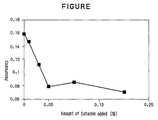
- Figure 1 shows the effect of catechin content in the feed on the color of the egg white.
- the eggs from white and brown strain hens of the present invention are fresh produce, there are variations in the HU value, the content of crude fats, and the concentration of peroxides in the yolk, but for example HU in all seasons apart from summer, a 2 day-old egg showed improvement of about 6%, from HU 80 to HU 85, and the content of crude fats in the yolk decreased by 13%, from 35% to 30% and the amount of peroxides decreased by about 18%, from 65 nano-mol/g to 53 nano-mol/g. Also the whites of the eggs of the present invention have a high degree of transparency and are pure white when cooked.
- the eggs have the following characteristics: the egg having an egg yolk with a crude fat content of 25 to 35%; a peroxide content of the egg yolk of 48 to 58 nano-mol/g; a height of the egg yolk in Haugh Units of 79 to 93, based on an egg laid during a season other than summer, for a two-day old egg from hens 300 days old; the height of the egg laid during the summer being 70 to 85 Haugh Units; the egg having an absorbancy measured by visible rays of 0. 15 to 0.03 ; the egg white having a color of N9.5 to N9.0 on the Munsell color system after cooking at a temperature of from 90 to 100°C for 30 minutes.
- the crude fat content of the egg yolk is obtained by a method described in Standard Methods of Analysis for Hygienic Chemists (1990 Japan), item 2.1.4.1 Extraction with a mixture solution of chloroform and methanol, and the peroxide content of the egg yolk is obtained by a method described in Standard Methods of Analysis for Hygienic Chemists(1990 Japan), item 2.1.4.4(4) thiobarbituric value.
- Tea polyphenol component as referred to in the present invention could be green tea, black tea, oolong tea; an extraction thereof, or the dregs from the extraction; or polyphenol extracted from green tea, black tea or oolong tea; or instant tea products, an extraction or dregs thereof, that is to say, crude catechins; but it is not limited to these substances, it could be any plant material containing polyphenols.
- Green tea and black tea refer to all green, oolong and black tea of the botanical name Camellia sinensis; a large leaf (Assam), a small leaf (Chinese), and varieties with a middle-sized leaf (hybrids).
- Tea polyphenol compounds include the tea catechin compounds represented by the general formula(I) given below and the theaflavin compounds represented by the general formula(II) given below, and also thearubigin: in which R 1 is a hydrogen atom or a hydroxy group and R 2 is a hydrogen atom or a 3,4,5-trihydroxybenzoyl group; and in which R 3 and R 4 are, each independently from the other, a hydrogen atom or a 3,4,5-trihydroxybenzoyl group.
- tea polyphenol compounds can be prepared from tea leaves as the starting material and a method for the preparation thereof and a typical example of the product composition are described, for example, in Japanese Patent Kokai 59-219384, 60-13780 and 61-130285, etc.
- Polyphenon 100 (trade name, product of Mitsui Norin Co., Ltd.): (+)-gallocatechin 1.44%, (-)-epicatechin 5.81%, (-)-epigallocatechin 17.57%, (-)-epicatechin gallate 12.51%, (-)-epigallocatechin gallate 53.9%;
- Polyphenon E (trade name, product of Mitsui Norin Co., Ltd.): (-)-epicatechin 10.8%, (-)-epigallocatechin 9.2%, (-)-epicatechin gallate 6. 5%, (-)-epigallocatechin gallate 54.8%, (-)-gallocatechin gallate 4.0%.
- the period of feeding of the feed to the domestic fowls varies with the amount of tea polyphenol in the feed, but feeding should be continued for more than 7 days, preferably 7 to 14 days in case of the content of catechin is 0.2% and more than 10 days, preferably 10 to 21 days in case of the content of catechin is 0.01%.
- the Haugh Unit may fluctuate according to the strains and variety of hens, the age of the hens, the feed, the season and the age of the egg, but according to the method of the present invention, in all seasons apart from summer, a two day old egg from hens around 300 days old which generally had a value around 74-88 (average 81) improved to a value of 79-93 (average 86), and in summer the improvement was from a value of 66-80 (average 73) to a value of 70-85 (average 77).
- Calculation of HU is as follows:
- the crude fat content in the yolks of chicken eggs is about 25-38%, but according to the method of present invention when the crude fat content was 35%, it was decreased to about 30% (a decrease of about 13%). This resulted in an egg with a lighter taste. Moreover, for those who are sick or those concerned about an excess fat intake, these eggs are a healthier alternative to regular eggs.
- the reason for the reduced crude fat content is that tea catechins inhibit the absorption of fats into the body.
- Peroxides are produced when fat in the cells is oxidised. Active oxygen is continuously produced in the cells and this causes the production of peroxides. As people age production of the enzyme which inhibits oxidation is impeded so peroxides accumulate in the cells and this is one of the main causes of Alzeheimers disease.
- the intake of catechins according to the method of the present invention results in a statistically significant decrease in peroxides in the yolks.
- the peroxide content in the yolk of chicken eggs is about 65 nano-mol/g but with feeding of 0.2% catechin the content of peroxides in the yolk decreased to 53 nano-mol/g (about an 18% reduction).
- the reduction of peroxides in the yolk of eggs with catechin feeding is due to the antioxidative action of tea catechins in vivo.
- the content of peroxides in the egg yolk is low, the eggs keep for longer and moreover they are healthier.
- the egg white has a high level of transparency and turns pure white when cooked, thus increasing its value as an ingredient in commercial products.
- the above crude fat content of the egg yolk is obtained by a method described in Standard Methods of Analysis for Hygienic Chemists (1990 Japan), item 2.1.4.1 Extraction with a mixture solution of chloroform and methanol, and the above peroxide content of the egg yolk is obtained by a method described in Standard Methods of Analysis for Hygienic Chemists(1990 Japan), item 2.1.4.4(4) thiobarbituric value.
- a transparency of the egg white could be improved by adding caffeine in amount of 0.02 wt/% or more to the feed composition of the present invention and feeding said feed composition to the fowl.
- An extraction or dregs of caffeine containing substance such as coffee bean, tea leaves, etc. is preferably used as crude caffeine.
- purified material therefrom or commercially available synthetic caffeine can be used as caffeine source.
- a dried green tea extract (catechin content: 30%) was added to the regular feed for layers in a concentration of 0.17-0.7 wt/% (0.05-0. 2% as catechin) and fed to layers (groups of 50; a total number of 250) for 7 weeks from September 5th, 1994.
- the results showed that as the percentage of catechin added was increased there was a tendency for the food intake, the number of eggs laid and the strength of the shell to decrease but the HU value showed an improvement. There was no effect on the color of the egg yolk or the thickness of the shell of the egg.
- a green tea extract (catechin content: 30%) was added to regular chicken feed in a concentration of 0.01-0.05% and fed to laying chicks (each group consisting of 50 chicks, and a total of 200) for a period of 7 weeks starting from 16th November 1994.
- Results (Tables 3 and 4) showed there were no noticeable differences in food intake, rate of laying, strength of the shell among the groups while the HU value increased as the catechin concentration was increased.
- Control Group 1 (Catechin 0.01%) Group 2 (Catechin 0.03%) Group 3 (Catechin 0.05%) Rate of survival (%) 100.0 100.0 100.0 100.0 Rate of Laying (%) 81.0 81.3 79.0 82.0 Weight of Egg (g) 66.8 67.5 67.1 66.5 Average weight of Egg/Day(g) 54.1 54.8 53.0 54.5 Food Intake (g) 125 126 123 124 Feed Efficiency 2.31 2.30 2.32 2.27 Control Group 1 Group 2 Group 3 Weight of Egg (g) 68.5 67.6 67.8 68.2 HU 80.8 82.9 83.5 84.8 Strength of Shell(kg/cm 2 ) 2.76 2.76 2.71 2.72 Thickness of Shell (mm) 0.378 0.372 0.376 0.375
- the HU value improved as the tea catechin concentration increased. There was some decrease in the strength of the shell in the 1. 0% green tea leaf group.
- the dried dregs from green tea infusion (5%) and black tea infusion (3%) were added to the feed and fed to laying hens (50 hens in each group, a total of 150) for a period of 7 weeks from 3rd December 1994.
- the green tea and black tea infusion dregs were obtained from a liquid tea bottling factory and the catechin content was 4.1% and 7.0%. respectively.
- a dried green tea extract (catechin content 30%) was added to regular layer feed in a concentration of 0-0.2% and fed for a period of two weeks (Layers: Boris brown 26 weeks old, 1 group 50 chickens, total 300). Eggs laid were broken open and the degree of transparency was measured. Results are as shown in Table 9 and Figure 1.
- the degree of transparency of the egg white increased with the amount of tea catechin added. With a concentration of over 0.1% the beaten egg white was pure white in color. The wave-length 440nm which shows a yellow colour was used.
- Example 5 10 eggs from each group (control group and catechin 0.2% group) of Example 5 were boiled and the cooked egg white was obtained.
- the egg white of the 0.2% catechin group was pure white in color compared with the control group which had a yellowy tinge.
- the color of the control group was measured as 5Y8/2 while the catechin 0.2% group was measured as N9.5.
- the color of the cooked white of the 0.05% and 0.01% catechin groups was the same as the 0.2% group.
- Caffeine containing substance was added to regular layer feed in a concentration of 0-0.045 wt/% and fed the feed to the fowl as described in Example 5. The eggs obtained were broken open and the degree of transparency was measured as described in Example 5. Results are as shown in Table 10. Amount of caffeine in feed Absorbance Control 0.198 0.01% 0.115 0.02% 0.082 0.045% 0.036 polyphenon G 0.6% 0.087
- the absorbance was 0.09 or less, and the degree of transparency of the egg white was improved.
Landscapes
- Life Sciences & Earth Sciences (AREA)
- Chemical & Material Sciences (AREA)
- Polymers & Plastics (AREA)
- Engineering & Computer Science (AREA)
- Food Science & Technology (AREA)
- Animal Husbandry (AREA)
- Zoology (AREA)
- Birds (AREA)
- Molecular Biology (AREA)
- Mycology (AREA)
- Physiology (AREA)
- Botany (AREA)
- Biotechnology (AREA)
- Health & Medical Sciences (AREA)
- Fodder In General (AREA)
- Feed For Specific Animals (AREA)
- Meat, Egg Or Seafood Products (AREA)
Description


Calculation of HU is as follows:
| Effects of Tea Catechin Feeding on Egg Production | |||||
| Control | Group 1 (Catechin 0.05%) | Group 2 (Catechin 0.1%) | Group 3 Catechin 0.15%) | Group 4 (Catechin 0.2%) | |
| Rate of survival (%) | 100.0 | 100.0 | 100.0 | 97.5 | 92.5 |
| Rate of Laying (%) | 79.9 c | 77.5 c | 66.5 bc | 52.2 ab | 40.2 a |
| Weight of Egg (g) | 67.5 c | 66.1 ab | 66.8 bc | 65.4 a | 66.2 abc |
| Average Weight of Egg/Day(g) | 53.9 c | 51.3 c | 44,5 bc | 34.1 ab | 26.6 a |
| Rate of Food Intake(g) | 122 c | 118 c | 109 b | 94 a | 90 a |
| Feed Efficiency | 2.27 a | 2.31 a | 2.51 a | 2.92 ab | 4.27 b |
| *Average of 20 eggs in each group. Statistically significant difference shown by differences between letters (P<0.05) |
| Effects of Tea Catechin Feeding on Egg Quality | |||||
| Control | Group 1 | Group 2 | Group 3 | Group 4 | |
| Weight of Egg (g) | 69.1 b | 66.4 ab | 66.2 ab | 65.1 a | 63.9 a |
| HU | 81.9 a | 85.8 bc | 83.0 ab | 84.2 ab | 88.7 c |
| Strength of Shell(kg/cm2) | 2.74 a | 2.76 a | 2.55 a | 2.83 a | 2.59 a |
| Thickness of Shell (mm) | 0.376 a | 0.372 a | 0.368 a | 0.374 a | 0.367 a |
| Yolk Color Fan Score (Roche, 1993) | 10.4 b | 10.4 b | 10.5 b | 9.85 a | 10.2 ab |
| Control Group | 37.3% a ± 2.22 |
| 0.05% Group | 33.6% b ± 1.77 |
| 0.1% Group | 34.3% b ± 0. 82 |
| 0.2% Group | 32.8% b ± 1.74 |
| Control Group | 64.93 a ± 2.59 |
| 0.05% Group | 54.66b ± 4.14 |
| 0.1% Group | 52.40b ± 3.08 |
| 0.2% Group | 53.04b ± 3.33 |
| Difference in taste of raw egg between the control group and the test group | |
| No difference | 20.0% (4/20) |
| Difference Noted | 80.0% (16/20) |
| Preference | |
| Preferred the control group | 0.0% |
| Preferred the test group | 75.0% (15/20) |
| No preference | 25.0% (5/20) |
| Control | Group 1 (Catechin 0.01%) | Group 2 (Catechin 0.03%) | Group 3 (Catechin 0.05%) | |
| Rate of survival (%) | 100.0 | 100.0 | 100.0 | 100.0 |
| Rate of Laying (%) | 81.0 | 81.3 | 79.0 | 82.0 |
| Weight of Egg (g) | 66.8 | 67.5 | 67.1 | 66.5 |
| Average weight of Egg/Day(g) | 54.1 | 54.8 | 53.0 | 54.5 |
| Food Intake (g) | 125 | 126 | 123 | 124 |
| Feed Efficiency | 2.31 | 2.30 | 2.32 | 2.27 |
| Control | Group 1 | Group 2 | Group 3 | |
| Weight of Egg (g) | 68.5 | 67.6 | 67.8 | 68.2 |
| HU | 80.8 | 82.9 | 83.5 | 84.8 |
| Strength of Shell(kg/cm2) | 2.76 | 2.76 | 2.71 | 2.72 |
| Thickness of Shell (mm) | 0.378 | 0.372 | 0.376 | 0.375 |
| Control | 35.8a ± 2.16 |
| 0.01% Group | 33.5ab ± 2.05 |
| 0.03% Group | 32.1ab ± 1.26 |
| 0.05% Group | 31.5b ± 1.61 |
| Control | 65.3a ± 2.18 |
| 0.01% Group | 57.5ab ± 2.51 |
| 0.03% Group | 55.1b ± 3.09 |
| 0.05% Group | 52.8b ± 3.41 |
| Control | Group 1 (Green tea 0.5%) | Group 2 (Green tea 1.0%) | Group 3 (Green tea 3.0%) | Group 4 (Black tea 1.0%) | |
| Rate of Survival (%) | 100.0 | 100.0 | 100.0 | 100.0 | 100.0 |
| Rate of Laying (%) | 76.7 | 77.5 | 69.8 | 45.0 | 71.5 |
| Weight of Egg (g) | 65.8 | 66.1 | 66.3 | 64.1 | 65.7 |
| Average weight of Egg/Day (g) | 50.4 | 51.2 | 46.2 | 28.9 | 47.0 |
| Food Intake (g) | 128 | 130 | 115 | 88 | 118 |
| Feed Efficiency | 2.54 | 2.54 | 2.49 | 3.04 | 2.51 |
| Effects of Feeding of Green Tea Leaf on Egg Quality | |||||
| Control | Group 1 (Green tea 0.5%) | Group 2 (Green tea 1.0%) | Group 3 (Green tea 3.0%) | Group 4 (Black tea 1.0%) | |
| Weight of Egg (g) | 67.5 | 67.9 | 68.3 | 63.3 | 67.5 |
| HU | 80.5 | 83.9 | 85.2 | 86.1 | 86.1 |
| Strength of Shell (kg/cm2) | 2.69 | 2.72 | 2.61 | 2.45 | 2.65 |
| Thickness of Shell(mm) | 0.368 | 0.368 | 0.361 | 0.355 | 0.364 |
| Control | 33.9 a % ±1.89 |
| Green tea 0.5% Group | 30.8 ab % ±2.21 |
| Green tea 1.0% Group | 29.7 b % ±2.82 |
| Green tea 3.0% Group | 26.5 b % ±0.89 |
| Black tea 1.0% Group | 30.1 % ±1.58 |
| Control | 65.5 a ±2.44 |
| Green tea 0.5% Group | 58.0 b ±2.91 |
| Green tea 1.0% Group | 53.1 b ±3.55 |
| Green tea 3.0% Group | 51.0 b ±3.41 |
| Black tea 1.0% Group | 52.7 ±2.18 |
| Effects of Feeding of Green Tea and Black Tea Dregs on Laying | |||
| Control | Group 1 (Green tea dregs 5%) | Group 2 (Black tea dregs 3%) | |
| Rate of Survival (%) | 100.0 | 98.0 | 100.0 |
| Rate of Laying (%) | 82.0 | 80.1 | 81.5 |
| Weight of Egg (g) | 65.5 | 64.7 | 65.0 |
| Average weight of Egg/Day (g) | 53.7 | 51.8 | 53.0 |
| Food Intake (g) | 119 | 117 | 115 |
| Feed Efficiency | 2.22 | 2.26 | 2.17 |
| Effects of Feeding of Green Tea and Black Tea Dregs on Egg Quality | |||
| Control | Group 1 (Green tea dregs 5%) | Group 2 (Black tea dregs 3%) | |
| Weight of Egg (g) | 64.8 | 65.1 | 64.5 |
| HU | 82.0 | 87.9 | 89.2 |
| Strength of Shell (kg/cm2) | 2.70 | 2.69 | 2.71 |
| Thickness of Shell(mm) | 0.368 | 0.370 | 0.365 |
| Control | 36.8 a % ± 2.14 |
| Green tea dregs (5%) | 32.9 b % ± 2.55 |
| Black tea dregs (3%) | 32.1 b % ± 1.81 |
| Control | 63.33 a ± 2.65 |
| Green tea dregs (5%) | 52.99 b ± 3.01 |
| Black tea dregs (3%) | 54.25 b ± 4.53 |
| Amount of catechin in feed | Absorbance |
| Control | 0.158 |
| 0.01% | 0.148 |
| 0.03% | 0.112 |
| 0.05% | 0.079 |
| 0.1% | 0.086 |
| 0.2% | 0.071 |
| Amount of caffeine in feed | Absorbance |
| Control | 0.198 |
| 0.01% | 0.115 |
| 0.02% | 0.082 |
| 0.045% | 0.036 |
| polyphenon G 0.6% | 0.087 |
Claims (7)
- A method of improving the quality of an egg from a female adult fowl, the improved eggs having the characteristics of the egg-white displaying an absorbancy measured by visible rays of 0.03 to 0.15 and having a white colour of N9.5 to N9.0 on the Munsell colour system after cooking at a temperature of from 90 to 100°C for 30 minutes, the method comprising adding an effective amount of at least one tea polyphenol to a feed composition for the fowl and feeding said feed composition to the fowl.
- The method according to claim 1, wherein the tea polyphenol is a tea polyphenol selected from the group consisting of green tea, black tea, oolong tea, an extraxction or the dregs thereof; or polyphenol extracted from green tea, black tea or oolong tea; or instant tea products, an extraction or dregs thereof.
- The method of claim 1 or 2, wherein the amount of tea polyphenol in the feed is 0.001 to 0.5 wt% calculated as catechin.
- The method according to claim 1 or 2, wherein the amount of tea polyphenol in the feed is 0.01 to 10 wt% as green tea, black tea or oolong tea; or 0.2 to 30 wt% as the dregs.
- The method of claim 1 modified that the at least one tea polyphenol is replaced by caffeine.
- The method of claim 5 wherein the amount of caffeine in the feed is 0.02 wt% or more.
- An egg having the following characteristics:the egg yolk having a crude fat content of 25 to 35 %, a peroxide content of 48 to 58 nmol/g and a height of from 79 to 93 Haugh Units for two-day old eggs laid outside the summer season by a chicken 300 days old and of from 70 to 85 Haugh Units forthe same eggs laid during the summer;the egg white having an absorbancy measured by visible rays of 0.03 to 0.15 and a white colour of N9.5 to N9.0 on the Munsell colour system after cooking at a temperature of 90 to 100 °C for 30 minutes.
Applications Claiming Priority (6)
| Application Number | Priority Date | Filing Date | Title |
|---|---|---|---|
| JP1423995 | 1995-01-31 | ||
| JP1423995 | 1995-01-31 | ||
| JP14239/95 | 1995-01-31 | ||
| JP23146295 | 1995-09-08 | ||
| JP231462/95 | 1995-09-08 | ||
| JP7231462A JP2718653B2 (en) | 1995-01-31 | 1995-09-08 | New egg and egg quality improvement method |
Publications (2)
| Publication Number | Publication Date |
|---|---|
| EP0724839A1 EP0724839A1 (en) | 1996-08-07 |
| EP0724839B1 true EP0724839B1 (en) | 2002-04-17 |
Family
ID=26350148
Family Applications (1)
| Application Number | Title | Priority Date | Filing Date |
|---|---|---|---|
| EP96100871A Expired - Lifetime EP0724839B1 (en) | 1995-01-31 | 1996-01-23 | Method of improving quality of eggs |
Country Status (9)
| Country | Link |
|---|---|
| US (1) | US5766595A (en) |
| EP (1) | EP0724839B1 (en) |
| JP (1) | JP2718653B2 (en) |
| KR (1) | KR100402308B1 (en) |
| AU (1) | AU687287B2 (en) |
| CA (1) | CA2168400C (en) |
| DE (1) | DE69620666T2 (en) |
| IL (1) | IL116874A (en) |
| TW (1) | TW396022B (en) |
Cited By (1)
| Publication number | Priority date | Publication date | Assignee | Title |
|---|---|---|---|---|
| DE10244359A1 (en) * | 2002-09-24 | 2004-04-08 | Nutrinova Nutrition Specialties & Food Ingredients Gmbh | Composition useful as an animal feed or feed additive comprises resistant starch, a polyphenol and an acid and/or salt |
Families Citing this family (19)
| Publication number | Priority date | Publication date | Assignee | Title |
|---|---|---|---|---|
| JP4302895B2 (en) * | 1998-11-09 | 2009-07-29 | 太陽化学株式会社 | Poultry productivity improver and productivity improvement method |
| ES2156718B1 (en) * | 1999-03-23 | 2003-03-01 | Agq S L | PREPARED TO IMPROVE THE QUALITY OF MEAT AND FAT IN FARM ANIMALS. |
| AU1648901A (en) * | 1999-11-29 | 2001-06-12 | Japan Science And Technology Corporation | Neutralizing agent for toxin of microorganism belonging to the genus clostridium |
| ES2236331T3 (en) * | 2000-11-17 | 2005-07-16 | Kao Corporation | PACKED BEVERAGES. |
| KR100413052B1 (en) * | 2001-07-25 | 2003-12-31 | 유희민 | feed for laying functional egg and method for producing the same |
| BRPI0214256B8 (en) | 2001-11-19 | 2021-05-25 | Medigene Ag | medicine |
| JP2003219806A (en) * | 2002-02-01 | 2003-08-05 | Brd Kenkyusho:Kk | Egg quality improving feed |
| US20050079235A1 (en) * | 2003-10-09 | 2005-04-14 | Eggert Stockfleth | Use of a polyphenol for the treatment of actinic keratosis |
| AU2004281525B2 (en) * | 2003-10-09 | 2010-01-28 | Aresus Pharma GmbH | The use of a polyphenol for the treatment of a cancerous or pre-cancerous lesion of the skin |
| US20060263453A1 (en) * | 2004-11-01 | 2006-11-23 | Thomas Smith | Methods and compositions for modulating glutamate dehydrogenase |
| US7829132B2 (en) * | 2004-11-03 | 2010-11-09 | Unilever Bestfoods, North America Division Of Conopco, Inc. | Consumable tea composition with antioxidants |
| US20060196428A1 (en) * | 2005-03-03 | 2006-09-07 | Correa Rafael S | Method for improving chick hatchability |
| US9017754B2 (en) | 2011-08-26 | 2015-04-28 | Meisho, Co., Ltd. | Method for producing hen egg |
| CN102919576A (en) * | 2012-10-25 | 2013-02-13 | 淮安正昌饲料有限公司 | Tea-fragrant hen compound feed and its preparation method and feeding method |
| CN103039400B (en) * | 2012-12-06 | 2014-07-23 | 武云 | Chicken raising method capable of improving egg quality |
| CN104938788B (en) * | 2015-05-14 | 2018-03-09 | 四川农业大学 | Application and its method of the Tea Polyphenols in the gel characteristic of regulation and control egg white albumen |
| CN108967812A (en) * | 2018-07-25 | 2018-12-11 | 江苏奥迈生物科技有限公司 | A kind of tea polyphenol composite antioxidant for feedstuff and preparation method thereof |
| CN112401081A (en) * | 2020-10-15 | 2021-02-26 | 天津农学院 | A kind of production method of egg rich in epigallocatechin gallate |
| KR102367647B1 (en) * | 2021-05-18 | 2022-02-25 | 김효섭 | Production method of egg having anti-oxidant ability and blood circulation ability using the feed composition for chicken including rhus verniciflua extract, and egg produced by the same method |
Family Cites Families (9)
| Publication number | Priority date | Publication date | Assignee | Title |
|---|---|---|---|---|
| SU552066A1 (en) * | 1975-06-05 | 1977-03-30 | Грузинский Филиал Всесоюзного Научно-Исследовательского Института Комбикормовой Промышленности | Feed additive for animals |
| JPH0297353A (en) * | 1988-09-30 | 1990-04-09 | Kotaro Shiozaki | Extraction of essence in tea leaf and essence of tea |
| JP2591673B2 (en) * | 1988-12-23 | 1997-03-19 | 周七 高橋 | Poultry eggs and their production method |
| JP2727471B2 (en) * | 1989-09-14 | 1998-03-11 | 三井農林株式会社 | Influenza virus infection prevention agent |
| JPH0551A (en) * | 1991-06-21 | 1993-01-08 | Taiyo Kagaku Co Ltd | Feed additive |
| JPH07112980B2 (en) * | 1992-11-04 | 1995-12-06 | 株式会社スカイ・フード | Active oxygen free radical scavenger |
| JPH06209720A (en) * | 1993-01-13 | 1994-08-02 | Nippon Haigou Shiryo Kk | Method for improving meat quality |
| AU6983994A (en) * | 1993-06-30 | 1995-01-24 | Taiyo Kogyo Co., Ltd. | Feed additive of tea origin and animal feed containing the same |
| JPH08332031A (en) * | 1995-06-07 | 1996-12-17 | Nagata Nogyo Kenkyusho:Kk | Green tea egg and its production |
-
1995
- 1995-09-08 JP JP7231462A patent/JP2718653B2/en not_active Expired - Fee Related
-
1996
- 1996-01-19 AU AU42071/96A patent/AU687287B2/en not_active Ceased
- 1996-01-22 TW TW085100711A patent/TW396022B/en not_active IP Right Cessation
- 1996-01-23 EP EP96100871A patent/EP0724839B1/en not_active Expired - Lifetime
- 1996-01-23 DE DE69620666T patent/DE69620666T2/en not_active Expired - Fee Related
- 1996-01-23 IL IL11687496A patent/IL116874A/en not_active IP Right Cessation
- 1996-01-30 CA CA002168400A patent/CA2168400C/en not_active Expired - Fee Related
- 1996-01-30 US US08/593,853 patent/US5766595A/en not_active Expired - Fee Related
- 1996-01-31 KR KR1019960002205A patent/KR100402308B1/en not_active Expired - Fee Related
Cited By (1)
| Publication number | Priority date | Publication date | Assignee | Title |
|---|---|---|---|---|
| DE10244359A1 (en) * | 2002-09-24 | 2004-04-08 | Nutrinova Nutrition Specialties & Food Ingredients Gmbh | Composition useful as an animal feed or feed additive comprises resistant starch, a polyphenol and an acid and/or salt |
Also Published As
| Publication number | Publication date |
|---|---|
| IL116874A (en) | 1999-11-30 |
| CA2168400C (en) | 2003-07-29 |
| KR100402308B1 (en) | 2004-01-07 |
| IL116874A0 (en) | 1996-05-14 |
| CA2168400A1 (en) | 1996-08-01 |
| TW396022B (en) | 2000-07-01 |
| DE69620666T2 (en) | 2002-09-26 |
| JP2718653B2 (en) | 1998-02-25 |
| DE69620666D1 (en) | 2002-05-23 |
| EP0724839A1 (en) | 1996-08-07 |
| AU687287B2 (en) | 1998-02-19 |
| US5766595A (en) | 1998-06-16 |
| JPH08266230A (en) | 1996-10-15 |
| KR960028822A (en) | 1996-08-17 |
| AU4207196A (en) | 1996-08-08 |
Similar Documents
| Publication | Publication Date | Title |
|---|---|---|
| CA2168400C (en) | Method of improving quality of eggs | |
| CN107028003A (en) | A kind of pork pig feed for lifting meat quality and preparation method thereof | |
| JPH06209720A (en) | Method for improving meat quality | |
| KR20030002893A (en) | Hot pepper paste using an extract from a japanese apricot and method for producing the same | |
| CN107307229B (en) | Feed additive for improving meat quality of rejected laying hens and preparation method and application thereof | |
| JP2005278478A (en) | Rebound preventive beverage containing post-fermented tea and fat absorption inhibitor | |
| Ravindran et al. | Influence of selenium source on the performance, feathering and meat quality of broilers | |
| CN119949461A (en) | Artificial feeding feed for Chilo suppressalis and preparation method thereof | |
| KR100647067B1 (en) | Poultry feed composition containing bokbunja and eggs produced by administering the same | |
| Majun et al. | Autoclaved rice bran in layers’ diets | |
| KR102428386B1 (en) | The manufacturing method of the feed for obtaining the egg or the meat | |
| JP6124400B2 (en) | Meat quality improvement method of rib chicken | |
| KR100857358B1 (en) | Calcium fortified poultry farming | |
| KR20020008286A (en) | Manufacturing method of a domestic fowl feed | |
| JPS5921354A (en) | Method for improving quality of eggshell for old-age hen and feed composition | |
| KR101535635B1 (en) | Manufacturing method of Japanese apricot pickles | |
| JP2784350B2 (en) | How to Prevent Heated Egg Yolk from Blackening | |
| JP7266305B2 (en) | Chicken feed, method for producing chicken feed, and method for raising chickens | |
| KR19980016882A (en) | Chicken feed composition for egg production with lower cholesterol content and eggs produced by administering the feed | |
| Mahfudz et al. | Interactive effect of cage density and dietary black cumin level on productive efficiency in broiler chickens | |
| Sharma et al. | Effect of Dietary Supplementation of Arjuna (Terminalia arjuna) Bark and Sahjan (Moringa oleifera) Leaf Powder on the Egg Quality and Egg Composition of Uttara Chicken | |
| RU2221856C2 (en) | Vodka | |
| Buckner et al. | The influence of distillery slop on the production of chicken fat | |
| Miller et al. | A study of the utilization of the iron of meats as compared with other protein foods | |
| CN106912448A (en) | A kind of cultural method of prevention DISEASE IN FLOCKS |
Legal Events
| Date | Code | Title | Description |
|---|---|---|---|
| PUAI | Public reference made under article 153(3) epc to a published international application that has entered the european phase |
Free format text: ORIGINAL CODE: 0009012 |
|
| AK | Designated contracting states |
Kind code of ref document: A1 Designated state(s): BE DE DK FR GB IT NL |
|
| 17P | Request for examination filed |
Effective date: 19970122 |
|
| 17Q | First examination report despatched |
Effective date: 20000615 |
|
| GRAG | Despatch of communication of intention to grant |
Free format text: ORIGINAL CODE: EPIDOS AGRA |
|
| GRAG | Despatch of communication of intention to grant |
Free format text: ORIGINAL CODE: EPIDOS AGRA |
|
| GRAG | Despatch of communication of intention to grant |
Free format text: ORIGINAL CODE: EPIDOS AGRA |
|
| GRAH | Despatch of communication of intention to grant a patent |
Free format text: ORIGINAL CODE: EPIDOS IGRA |
|
| GRAH | Despatch of communication of intention to grant a patent |
Free format text: ORIGINAL CODE: EPIDOS IGRA |
|
| REG | Reference to a national code |
Ref country code: GB Ref legal event code: IF02 |
|
| GRAA | (expected) grant |
Free format text: ORIGINAL CODE: 0009210 |
|
| AK | Designated contracting states |
Kind code of ref document: B1 Designated state(s): BE DE DK FR GB IT NL |
|
| PG25 | Lapsed in a contracting state [announced via postgrant information from national office to epo] |
Ref country code: NL Free format text: LAPSE BECAUSE OF FAILURE TO SUBMIT A TRANSLATION OF THE DESCRIPTION OR TO PAY THE FEE WITHIN THE PRESCRIBED TIME-LIMIT Effective date: 20020417 Ref country code: IT Free format text: LAPSE BECAUSE OF FAILURE TO SUBMIT A TRANSLATION OF THE DESCRIPTION OR TO PAY THE FEE WITHIN THE PRE;WARNING: LAPSES OF ITALIAN PATENTS WITH EFFECTIVE DATE BEFORE 2007 MAY HAVE OCCURRED AT ANY TIME BEFORE 2007. THE CORRECT EFFECTIVE DATE MAY BE DIFFERENT FROM THE ONE RECORDED.SCRIBED TIME-LIMIT Effective date: 20020417 Ref country code: BE Free format text: LAPSE BECAUSE OF FAILURE TO SUBMIT A TRANSLATION OF THE DESCRIPTION OR TO PAY THE FEE WITHIN THE PRESCRIBED TIME-LIMIT Effective date: 20020417 |
|
| REF | Corresponds to: |
Ref document number: 69620666 Country of ref document: DE Date of ref document: 20020523 |
|
| PG25 | Lapsed in a contracting state [announced via postgrant information from national office to epo] |
Ref country code: DK Free format text: LAPSE BECAUSE OF FAILURE TO SUBMIT A TRANSLATION OF THE DESCRIPTION OR TO PAY THE FEE WITHIN THE PRESCRIBED TIME-LIMIT Effective date: 20020717 |
|
| ET | Fr: translation filed | ||
| NLV1 | Nl: lapsed or annulled due to failure to fulfill the requirements of art. 29p and 29m of the patents act | ||
| PLBE | No opposition filed within time limit |
Free format text: ORIGINAL CODE: 0009261 |
|
| STAA | Information on the status of an ep patent application or granted ep patent |
Free format text: STATUS: NO OPPOSITION FILED WITHIN TIME LIMIT |
|
| 26N | No opposition filed |
Effective date: 20030120 |
|
| PGFP | Annual fee paid to national office [announced via postgrant information from national office to epo] |
Ref country code: FR Payment date: 20051214 Year of fee payment: 11 |
|
| PGFP | Annual fee paid to national office [announced via postgrant information from national office to epo] |
Ref country code: GB Payment date: 20060123 Year of fee payment: 11 |
|
| PGFP | Annual fee paid to national office [announced via postgrant information from national office to epo] |
Ref country code: DE Payment date: 20060316 Year of fee payment: 11 |
|
| PG25 | Lapsed in a contracting state [announced via postgrant information from national office to epo] |
Ref country code: DE Free format text: LAPSE BECAUSE OF NON-PAYMENT OF DUE FEES Effective date: 20070801 |
|
| GBPC | Gb: european patent ceased through non-payment of renewal fee |
Effective date: 20070123 |
|
| REG | Reference to a national code |
Ref country code: FR Ref legal event code: ST Effective date: 20070930 |
|
| PG25 | Lapsed in a contracting state [announced via postgrant information from national office to epo] |
Ref country code: GB Free format text: LAPSE BECAUSE OF NON-PAYMENT OF DUE FEES Effective date: 20070123 |
|
| PG25 | Lapsed in a contracting state [announced via postgrant information from national office to epo] |
Ref country code: FR Free format text: LAPSE BECAUSE OF NON-PAYMENT OF DUE FEES Effective date: 20070131 |